




GRE 2024 Quantitative Reasoning Practice Test Set 21 Question Paper with Solutions PDF is available for download. The overall test time is about 1 hour and 58 minutes. GRE has total 5 sections:
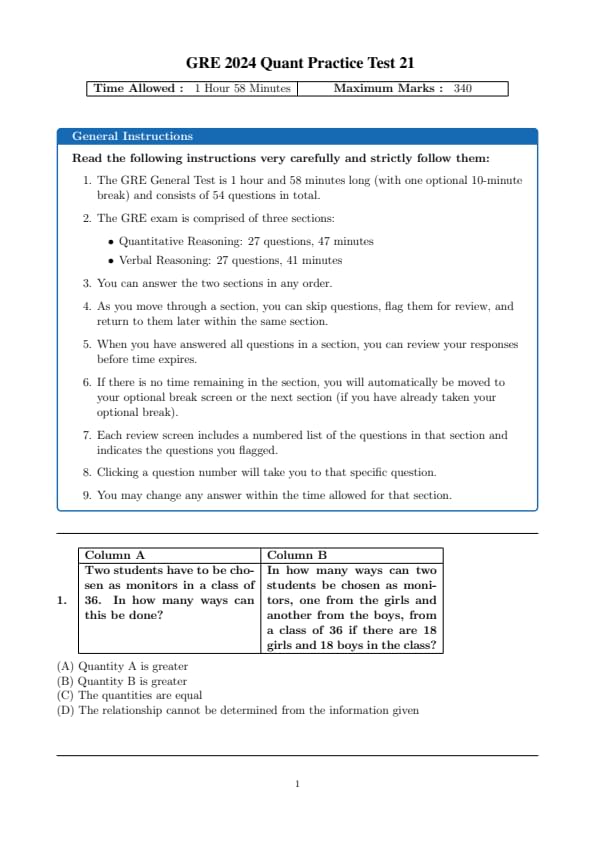
- Analytical Writing (One "Analyze an Issue" task, Alloted time 30 minutes)
- Verbal Reasoning (Two Sections, with 12 questions and 15 questions respectively)
- Quantitative Reasoning (Two Sections, with 12 questions and 15 questions respectively)
GRE 2024 Qantitative Reasoning Practice Test Set 21 Question Paper with Solutions PDF
| GRE 2024 Quantitative Reasoning Set 21 Question Paper with Solutions PDF |  Download Download |
Check Solutions |

View Solution
Step 1: Understanding the Concept:
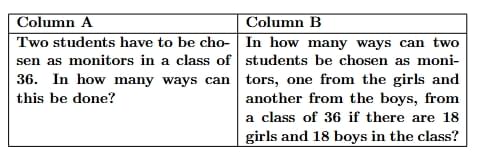
This question involves comparing two different scenarios of selecting students. Both scenarios use the principles of combinations and the fundamental counting principle. We need to calculate the number of ways for each column and then compare them.
Step 2: Key Formula or Approach:
The number of ways to choose \(r\) items from a set of \(n\) distinct items is given by the combination formula: \[ C(n, r) = \binom{n}{r} = \frac{n!}{r!(n-r)!} \]
The fundamental counting principle states that if one event can occur in \(m\) ways and a second event can occur in \(n\) ways, then the two events can occur in \(m \times n\) ways.
Step 3: Detailed Explanation:
For Column A:
We need to choose 2 students from a class of 36. The order of selection does not matter, so we use combinations.
Number of ways = \( C(36, 2) \)
\[ C(36, 2) = \frac{36!}{2!(36-2)!} = \frac{36!}{2!34!} = \frac{36 \times 35}{2 \times 1} = 18 \times 35 = 630 \]
So, there are 630 ways to choose two monitors from the class.
For Column B:
We need to choose one monitor from 18 girls and one monitor from 18 boys.
Number of ways to choose 1 girl from 18 girls = \( C(18, 1) = 18 \).
Number of ways to choose 1 boy from 18 boys = \( C(18, 1) = 18 \).
Using the fundamental counting principle, the total number of ways to choose one girl AND one boy is:
\[ Total ways = 18 \times 18 = 324 \]
So, there are 324 ways to choose one girl and one boy as monitors.
Step 4: Final Answer:
Comparing the two quantities:
Quantity A = 630
Quantity B = 324
Clearly, Quantity A is greater than Quantity B.
Quick Tip: In "choose" or "select" problems, always determine if the order matters. If it doesn't, use combinations (C(n, r)). If it does, use permutations (P(n, r)). When selections are made from different groups (like boys and girls), calculate the ways for each group separately and then multiply them together.
View Solution
Step 1: Understanding the Concept:
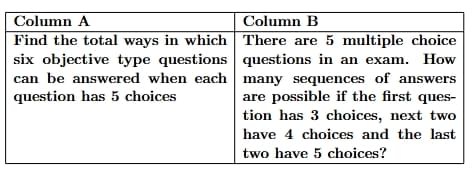
This problem uses the fundamental principle of counting (also known as the multiplication principle). For a sequence of independent events, the total number of possible outcomes is the product of the number of outcomes for each event.
Step 2: Key Formula or Approach:
If there are \(n_1\) ways for the first event, \(n_2\) for the second, ..., and \(n_k\) for the \(k\)-th event, then the total number of ways for the sequence of events to occur is \(n_1 \times n_2 \times \dots \times n_k\).
Step 3: Detailed Explanation:
For Column A:
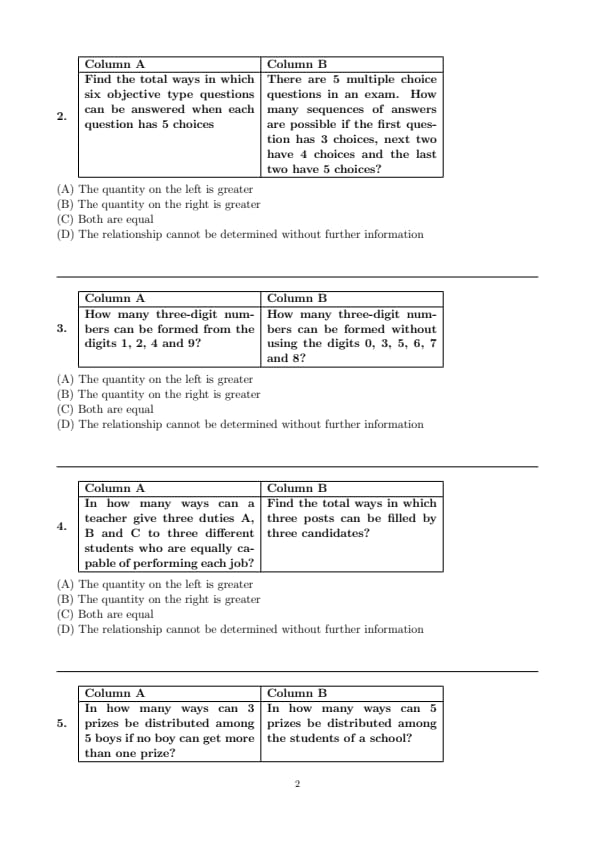
There are 6 questions.
Each question has 5 choices.
The choice for each question is an independent event.
Total ways = (Ways for Q1) \( \times \) (Ways for Q2) \( \times \) ... \( \times \) (Ways for Q6)
\[ Total ways = 5 \times 5 \times 5 \times 5 \times 5 \times 5 = 5^6 \] \[ 5^6 = 15625 \]
For Column B:
There are 5 questions with a varying number of choices.
Question 1 has 3 choices.
Question 2 has 4 choices.
Question 3 has 4 choices.
Question 4 has 5 choices.
Question 5 has 5 choices.
Using the multiplication principle:
\[ Total ways = 3 \times 4 \times 4 \times 5 \times 5 \] \[ Total ways = 3 \times 16 \times 25 = 48 \times 25 = 1200 \]
Step 4: Final Answer:
Comparing the two quantities:
Quantity A = 15625
Quantity B = 1200
Therefore, Quantity A is greater than Quantity B.
Quick Tip: For questions involving sequences of choices (like answering multiple-choice questions, forming numbers from digits, etc.), the multiplication principle is your go-to tool. Just multiply the number of options available for each position or step.
View Solution
Step 1: Understanding the Concept:
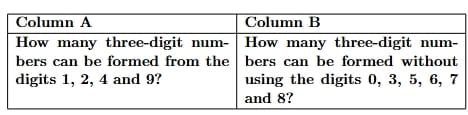
Both columns ask for the number of three-digit numbers that can be formed from a given set of digits. Since it's not specified that repetition is not allowed, we assume repetition of digits is allowed. The key is to correctly identify the set of usable digits for each column.
Step 2: Key Formula or Approach:
We will use the fundamental principle of counting. For a three-digit number, we have three places to fill: hundreds, tens, and units. The total number of possibilities is the product of the number of choices for each place.
Step 3: Detailed Explanation:
For Column A:
The available digits are \{1, 2, 4, 9\. There are 4 available digits.
We need to form a three-digit number. Repetition is allowed.
Number of choices for the hundreds place = 4.
Number of choices for the tens place = 4.
Number of choices for the units place = 4.
Total number of three-digit numbers = \( 4 \times 4 \times 4 = 4^3 = 64 \).
For Column B:
The digits we cannot use are \{0, 3, 5, 6, 7, 8\.
The set of all digits is \{0, 1, 2, 3, 4, 5, 6, 7, 8, 9\.
The digits we can use are those remaining: \{1, 2, 4, 9\.
This is the exact same set of digits as in Column A.
We need to form a three-digit number using \{1, 2, 4, 9\. Repetition is allowed.
Number of choices for the hundreds place = 4.
Number of choices for the tens place = 4.
Number of choices for the units place = 4.
Total number of three-digit numbers = \( 4 \times 4 \times 4 = 4^3 = 64 \).
Step 4: Final Answer:
Comparing the two quantities:
Quantity A = 64
Quantity B = 64
The two quantities are equal.
Quick Tip: In quantitative comparison questions, always carefully analyze the wording. Here, "without using the digits..." is an indirect way of specifying the allowed digits. The two columns were designed to look different but result in the same calculation.
View Solution
Step 1: Understanding the Concept:
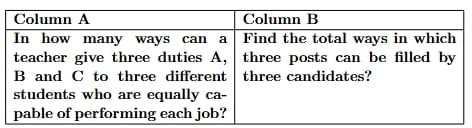
Both questions are about arranging a set of items (duties or posts) among an equal number of recipients (students or candidates). This is a classic permutation problem, as the order of assignment matters. For example, Student 1 getting Duty A is different from Student 1 getting Duty B.
Step 2: Key Formula or Approach:
The number of ways to arrange \(n\) distinct items among \(n\) distinct positions is given by the permutation formula \(P(n, n)\), which is equal to \(n!\) (n factorial).
\[ n! = n \times (n-1) \times (n-2) \times \dots \times 1 \]
Step 3: Detailed Explanation:
For Column A:
We have 3 distinct duties (A, B, C) to be assigned to 3 distinct students.
The first duty can be given to any of the 3 students.
The second duty can then be given to any of the remaining 2 students.
The third duty must be given to the last remaining student.
Total number of ways = \( 3 \times 2 \times 1 = 3! = 6 \).
Alternatively, this is a permutation of 3 items taken 3 at a time, \(P(3, 3) = 3! = 6\).
For Column B:
We have 3 distinct posts to be filled by 3 distinct candidates.
This is functionally identical to the problem in Column A.
The first post can be filled by any of the 3 candidates.
The second post can be filled by any of the remaining 2 candidates.
The third post must be filled by the last remaining candidate.
Total number of ways = \( 3 \times 2 \times 1 = 3! = 6 \).
This is also a permutation of 3 items taken 3 at a time, \(P(3, 3) = 3! = 6\).
Step 4: Final Answer:
Comparing the two quantities:
Quantity A = 6
Quantity B = 6
The two quantities are equal.
Quick Tip: Recognize that problems involving assigning distinct jobs/posts/duties to an equal number of distinct people/candidates/students are permutation problems. The number of ways is simply \(n!\), where \(n\) is the number of jobs and people.
View Solution
Step 1: Understanding the Concept:
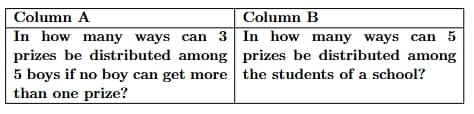
Column A presents a clear permutation problem. We are distributing distinct prizes, so the order matters, and each boy can get at most one. Column B is ambiguous. It lacks crucial information needed for a calculation, such as the number of students, whether prizes are distinct, and if a student can receive more than one prize.
Step 2: Key Formula or Approach:
For Column A, the number of ways to arrange \(r\) items from a set of \(n\) is given by the permutation formula: \[ P(n, r) = \frac{n!}{(n-r)!} \]
Step 3: Detailed Explanation:
For Column A:
We are distributing 3 prizes among 5 boys, with the condition that no boy gets more than one prize. We assume the prizes are distinct (e.g., 1st, 2nd, 3rd).
The first prize can be given to any of the 5 boys.
The second prize can be given to any of the remaining 4 boys.
The third prize can be given to any of the remaining 3 boys.
Total number of ways = \( 5 \times 4 \times 3 = 60 \).
This is equivalent to the permutation \(P(5, 3)\): \[ P(5, 3) = \frac{5!}{(5-3)!} = \frac{5!}{2!} = 5 \times 4 \times 3 = 60 \]
For Column B:
We are asked for the number of ways to distribute 5 prizes among "the students of a school".
This statement is not specific enough to perform a calculation because:
1. Number of students is unknown: Let the number of students be \(n\). We don't know the value of \(n\). Is \(n < 5\), \(n = 5\), or \(n > 5\)?
2. Nature of prizes is unknown: Are the 5 prizes distinct or identical?
3. Distribution rules are unknown: Can one student receive more than one prize?
Because we cannot calculate a specific value for Quantity B, we cannot compare it to Quantity A. For example, if there are only 2 students, the number of ways is \(2^5=32\). If there are 10 students and no student can get more than one prize, the ways are \(P(10,5) = 30240\). The result changes based on the assumptions.
Step 4: Final Answer:
Quantity A = 60.
Quantity B cannot be determined from the given information.
Therefore, the relationship between Quantity A and Quantity B cannot be determined.
Quick Tip: In quantitative comparison, if one of the quantities cannot be calculated due to missing information, the answer is almost always (D). Be alert for vague terms like "students of a school" without specifying a number.
View Solution
Step 1: Understanding the Concept:
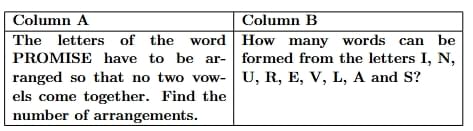
Column A requires finding the number of permutations with a constraint (vowels not together), a common type of arrangement problem. Column B is a straightforward permutation of distinct letters.
Step 2: Key Formula or Approach:
For Column A, we use the "gap method". First, arrange the items that can be together (consonants), creating gaps. Then, place the restricted items (vowels) into these gaps.
For Column B, the number of arrangements of \(n\) distinct items is \(n!\).
Step 3: Detailed Explanation:
For Column A:
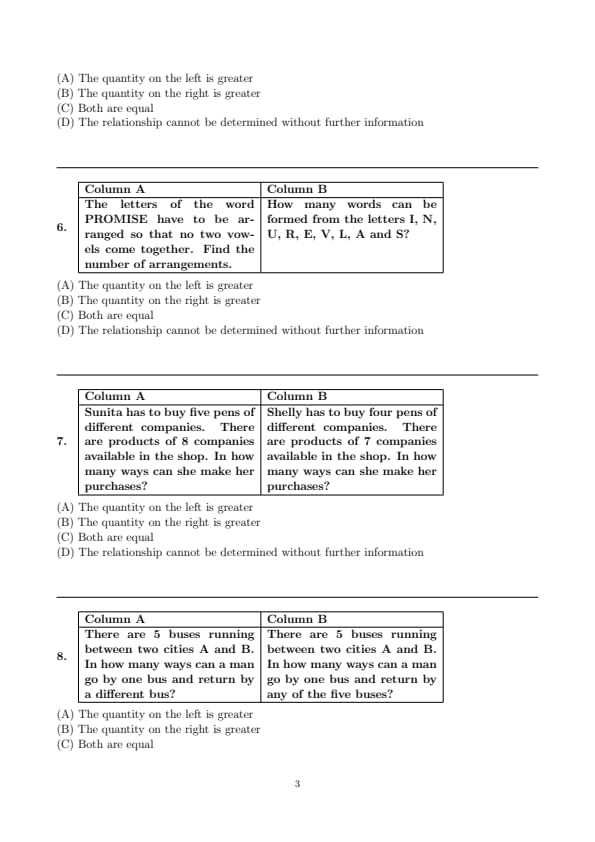
The word is PROMISE.
Total letters = 7.
Vowels = O, I, E (3 vowels).
Consonants = P, R, M, S (4 consonants).
The condition is that no two vowels come together.
Step i: Arrange the consonants. The 4 distinct consonants (P, R, M, S) can be arranged in \(4!\) ways. \[ 4! = 4 \times 3 \times 2 \times 1 = 24 \]
Step ii: Place the vowels in the gaps created by the consonants. The arrangement of consonants creates 5 possible gaps for the vowels (one before the first consonant, three between them, and one after the last). \[ \_ C \_ C \_ C \_ C \_ \]
We need to place the 3 distinct vowels (O, I, E) in these 5 gaps. The number of ways to do this is a permutation of 5 items taken 3 at a time, \(P(5, 3)\). \[ P(5, 3) = \frac{5!}{(5-3)!} = \frac{5!}{2!} = 5 \times 4 \times 3 = 60 \]
Step iii: The total number of arrangements is the product of the ways from Step i and Step ii. \[ Total arrangements = (Ways to arrange consonants) \times (Ways to place vowels) \] \[ Total arrangements = 24 \times 60 = 1440 \]
For Column B:
The given letters are I, N, U, R, E, V, L, A, S.
There are 9 letters in total.
All the letters are distinct.
The number of words that can be formed is the number of permutations of these 9 letters. \[ Total words = 9! \] \[ 9! = 9 \times 8 \times 7 \times 6 \times 5 \times 4 \times 3 \times 2 \times 1 = 362,880 \]
Step 4: Final Answer:
Comparing the two quantities:
Quantity A = 1440
Quantity B = 362,880
Quantity B is significantly greater than Quantity A.
Quick Tip: To handle "never together" problems for a subset of items, use the gap method: arrange the other items first to create slots (gaps), and then place the restricted items into those slots using permutations. The number of gaps is always one more than the number of items you arrange first.
View Solution
Step 1: Understanding the Concept:
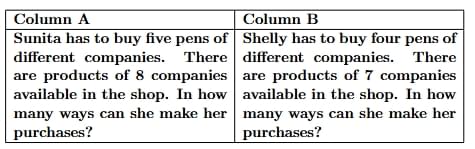
This problem involves selection without regard to order. When Sunita or Shelly buys a set of pens, the order in which they pick them doesn't matter. This is a combination problem. We need to calculate the number of combinations for each case and compare them.
Step 2: Key Formula or Approach:
The number of ways to choose \(r\) items from a set of \(n\) distinct items is given by the combination formula: \[ C(n, r) = \binom{n}{r} = \frac{n!}{r!(n-r)!} \]
An important property of combinations is \(C(n, r) = C(n, n-r)\).
Step 3: Detailed Explanation:
For Column A:
Sunita has to buy 5 pens from 8 available companies. This is a problem of selecting 5 companies out of 8.
Here, \(n = 8\) and \(r = 5\).
Number of ways = \( C(8, 5) \).
Using the property \(C(n, r) = C(n, n-r)\), we have \(C(8, 5) = C(8, 8-5) = C(8, 3)\). \[ C(8, 3) = \frac{8!}{3!(8-3)!} = \frac{8!}{3!5!} = \frac{8 \times 7 \times 6}{3 \times 2 \times 1} = 8 \times 7 = 56 \]
So, Sunita can make her purchase in 56 ways.
For Column B:
Shelly has to buy 4 pens from 7 available companies. This is a problem of selecting 4 companies out of 7.
Here, \(n = 7\) and \(r = 4\).
Number of ways = \( C(7, 4) \).
Using the property \(C(n, r) = C(n, n-r)\), we have \(C(7, 4) = C(7, 7-4) = C(7, 3)\). \[ C(7, 3) = \frac{7!}{3!(7-3)!} = \frac{7!}{3!4!} = \frac{7 \times 6 \times 5}{3 \times 2 \times 1} = 7 \times 5 = 35 \]
So, Shelly can make her purchase in 35 ways.
Step 4: Final Answer:
Comparing the two quantities:
Quantity A = 56
Quantity B = 35
Therefore, Quantity A is greater than Quantity B.
Quick Tip: Remember the property \(C(n, r) = C(n, n-r)\). It can simplify calculations. For instance, calculating \(C(8, 5)\) is easier as \(C(8, 3)\) because it involves fewer terms in the numerator.
View Solution
Step 1: Understanding the Concept:
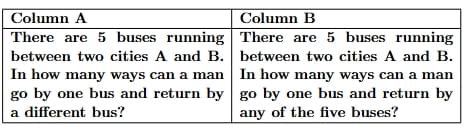
This problem involves the fundamental principle of counting for a sequence of two events: the journey from city A to B, and the return journey from B to A. The key difference between the two columns is the restriction placed on the return journey.
Step 2: Key Formula or Approach:
We will use the multiplication principle. The total number of ways is the product of the number of choices for the first part of the journey and the number of choices for the second part.
Step 3: Detailed Explanation:
For Column A:
A man goes from city A to B and returns by a different bus.
Number of choices to go from A to B = 5 (he can take any of the 5 buses).
Since he must return by a different bus, the bus he took to go is not an option for the return trip.
Number of choices to return from B to A = \(5 - 1 = 4\).
Total number of ways = (Choices for going) \( \times \) (Choices for returning)
\[ Total ways = 5 \times 4 = 20 \]
For Column B:
A man goes from city A to B and returns by any of the five buses.
Number of choices to go from A to B = 5.
There is no restriction on the return bus; he can even take the same bus back.
Number of choices to return from B to A = 5.
Total number of ways = (Choices for going) \( \times \) (Choices for returning)
\[ Total ways = 5 \times 5 = 25 \]
Step 4: Final Answer:
Comparing the two quantities:
Quantity A = 20
Quantity B = 25
Therefore, Quantity B is greater than Quantity A.
Quick Tip: Pay close attention to keywords like "different" or "any". "Different" implies non-repetition and reduces the number of choices for subsequent events. "Any" implies repetition is allowed.
Column A & Column B
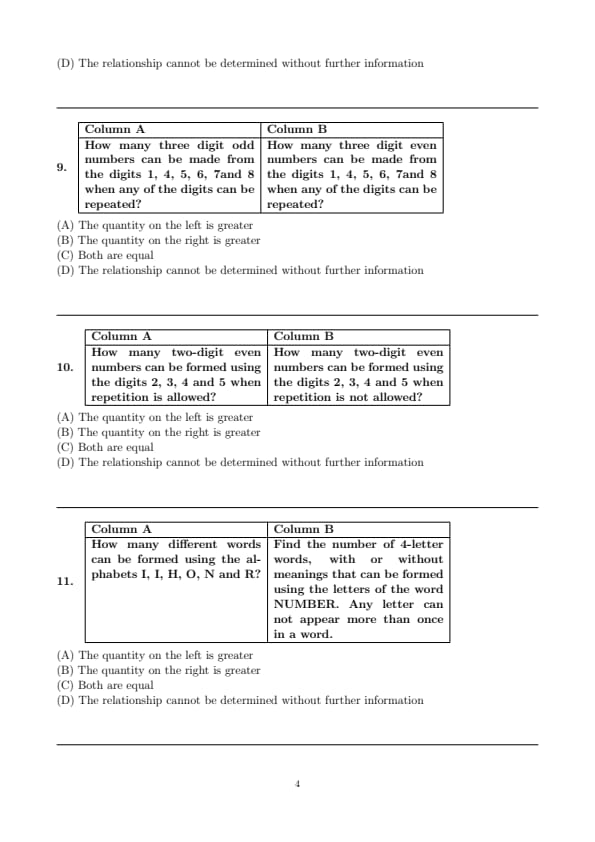
How many three digit odd numbers can be made from the digits 1, 4, 5, 6, 7and 8 when any of the digits can be repeated? & How many three digit even numbers can be made from the digits 1, 4, 5, 6, 7and 8 when any of the digits can be repeated?
View Solution
Step 1: Understanding the Concept:
This question involves forming three-digit numbers with specific constraints (odd or even) from a given set of digits, with repetition allowed. The key is to analyze the choices available for each digit's place (hundreds, tens, units), especially the units place which determines if a number is odd or even.
Step 2: Key Formula or Approach:
We will use the fundamental principle of counting. The total number of possibilities is the product of the number of choices for each of the three places.
Step 3: Detailed Explanation:
The set of available digits is \{1, 4, 5, 6, 7, 8\. Total number of available digits is 6.
Repetition is allowed in both cases.
For Column A: Three-digit ODD numbers
A number is odd if its units digit is an odd number.
From the given set, the odd digits are \{1, 5, 7\. There are 3 choices for the units place.
- Units place: 3 choices (1, 5, or 7).
- Tens place: 6 choices (any of the 6 digits, as repetition is allowed).
- Hundreds place: 6 choices (any of the 6 digits).
Total number of odd numbers = (Choices for hundreds) \( \times \) (Choices for tens) \( \times \) (Choices for units)
\[ Total odd numbers = 6 \times 6 \times 3 = 108 \]
For Column B: Three-digit EVEN numbers
A number is even if its units digit is an even number.
From the given set, the even digits are \{4, 6, 8\. There are 3 choices for the units place.
- Units place: 3 choices (4, 6, or 8).
- Tens place: 6 choices (any of the 6 digits).
- Hundreds place: 6 choices (any of the 6 digits).
Total number of even numbers = (Choices for hundreds) \( \times \) (Choices for tens) \( \times \) (Choices for units)
\[ Total even numbers = 6 \times 6 \times 3 = 108 \]
Step 4: Final Answer:
Comparing the two quantities:
Quantity A = 108
Quantity B = 108
The two quantities are equal.
Quick Tip: When forming numbers with constraints like "odd" or "even", always start by filling the place that has the constraint first (in this case, the units place). Then fill the remaining places. The problem is simplified by noticing that the number of available odd digits is the same as the number of available even digits.
Column A & Column B
How many two-digit even numbers can be formed using the digits 2, 3, 4 and 5 when repetition is allowed? & How many two-digit even numbers can be formed using the digits 2, 3, 4 and 5 when repetition is not allowed?
View Solution
Step 1: Understanding the Concept:
We are forming two-digit even numbers from a given set of digits. The key difference between the two columns is whether repetition of digits is allowed or not. This will affect the number of choices available for the tens place.
Step 2: Key Formula or Approach:
We use the fundamental principle of counting. We determine the number of choices for the units place first (due to the "even" constraint), and then for the tens place.
Step 3: Detailed Explanation:
The set of available digits is \{2, 3, 4, 5\.
The even digits in this set are \{2, 4\.
For Column A: Repetition is allowed
We need to form a two-digit even number.
- Units place: Must be an even digit. We have 2 choices (2 or 4).
- Tens place: Can be any of the 4 digits, since repetition is allowed. We have 4 choices (2, 3, 4, or 5).
Total number of even numbers = (Choices for tens) \( \times \) (Choices for units)
\[ Total ways = 4 \times 2 = 8 \]
The numbers are: 22, 32, 42, 52, 24, 34, 44, 54.
For Column B: Repetition is not allowed
We need to form a two-digit even number without repeating digits. It's best to consider cases based on the units digit.
Case 1: Units digit is 2.
- Units place has 1 choice (the digit 2).
- Tens place cannot be 2. So, we have 3 choices left for the tens place (3, 4, or 5).
- Number of ways for this case = \( 3 \times 1 = 3 \). (Numbers: 32, 42, 52)
Case 2: Units digit is 4.
- Units place has 1 choice (the digit 4).
- Tens place cannot be 4. So, we have 3 choices left for the tens place (2, 3, or 5).
- Number of ways for this case = \( 3 \times 1 = 3 \). (Numbers: 24, 34, 54)
Total number of even numbers = (Ways from Case 1) + (Ways from Case 2)
\[ Total ways = 3 + 3 = 6 \]
Step 4: Final Answer:
Comparing the two quantities:
Quantity A = 8
Quantity B = 6
Therefore, Quantity A is greater than Quantity B.
Quick Tip: When dealing with permutations with restrictions (like "even number" and "no repetition"), it's often easiest to break the problem into cases based on the restricted position. Calculate the possibilities for each case and then add them up.
Column A & Column B
How many different words can be formed using the alphabets I, I, H, O, N and R? & Find the number of 4-letter words, with or without meanings that can be formed using the letters of the word NUMBER. Any letter can not appear more than once in a word.
View Solution
Step 1: Understanding the Concept:
Column A asks for the number of permutations of a set of letters where one letter is repeated. Column B asks for the number of permutations of a specific length (4 letters) from a set of distinct letters.
Step 2: Key Formula or Approach:
For Column A, the number of permutations of \(n\) objects, where \(p_1\) objects are identical of one kind, \(p_2\) are identical of a second kind, ..., \(p_k\) are identical of a \(k\)-th kind is: \[ \frac{n!}{p_1! p_2! \dots p_k!} \]
For Column B, the number of permutations of \(r\) objects taken from a set of \(n\) distinct objects is: \[ P(n, r) = \frac{n!}{(n-r)!} \]
Step 3: Detailed Explanation:
For Column A:
The given letters are I, I, H, O, N, R.
Total number of letters, \(n = 6\).
The letter 'I' is repeated 2 times.
The number of different words that can be formed is: \[ \frac{6!}{2!} = \frac{6 \times 5 \times 4 \times 3 \times 2 \times 1}{2 \times 1} = \frac{720}{2} = 360 \]
So, Quantity A is 360.
For Column B:
The word is NUMBER. The letters are N, U, M, B, E, R.
All 6 letters are distinct.
We need to form 4-letter words, without repetition.
This is an arrangement of 4 letters chosen from 6 distinct letters.
Here, \(n=6\) and \(r=4\).
The number of 4-letter words is \(P(6, 4)\). \[ P(6, 4) = \frac{6!}{(6-4)!} = \frac{6!}{2!} = \frac{720}{2} = 360 \]
So, Quantity B is 360.
Step 4: Final Answer:
Comparing the two quantities:
Quantity A = 360
Quantity B = 360
The two quantities are equal.
Quick Tip: Recognize different types of permutation problems. If there are repeated items, you must divide by the factorial of the counts of each repeated item. If you are selecting and arranging a subset of distinct items, use the \(P(n, r)\) formula.
Column A & Column B
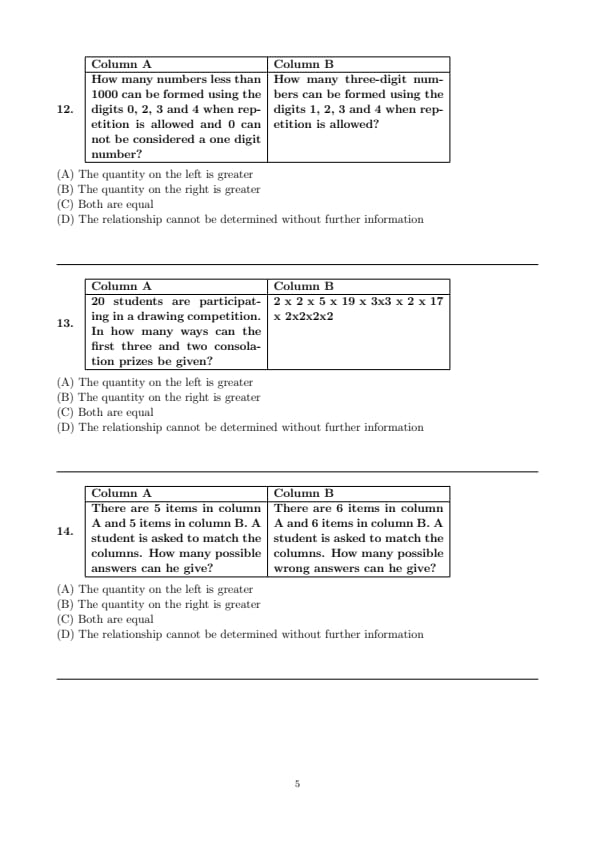
How many numbers less than 1000 can be formed using the digits 0, 2, 3 and 4 when repetition is allowed and 0 can not be considered a one digit number? & How many three-digit numbers can be formed using the digits 1, 2, 3 and 4 when repetition is allowed?
View Solution
Step 1: Understanding the Concept:
This problem requires us to form numbers of different lengths (1-digit, 2-digit, 3-digit) using a given set of digits and certain rules, such as allowing repetition and handling the digit 0 correctly.
Step 2: Key Formula or Approach:
We use the fundamental principle of counting. We'll calculate the number of possibilities for each type of number (1-digit, 2-digit, 3-digit) and then sum them up for Column A.
Step 3: Detailed Explanation:
For Column A:
We need to form numbers less than 1000 using digits \{0, 2, 3, 4\ with repetition. This includes 1-digit, 2-digit, and 3-digit numbers.
1-digit numbers: The digits are \{2, 3, 4\. The question states "0 can not be considered a one digit number". So there are 3 possible 1-digit numbers.
2-digit numbers: The tens place cannot be 0. So, it can be filled by \{2, 3, 4\ (3 ways). The units place can be any of the 4 digits \{0, 2, 3, 4\ (4 ways). Total 2-digit numbers = \(3 \times 4 = 12\).
3-digit numbers: The hundreds place cannot be 0. So, it can be filled by \{2, 3, 4\ (3 ways). The tens and units places can be any of the 4 digits. Total 3-digit numbers = \(3 \times 4 \times 4 = 48\).
Total numbers less than 1000 = (1-digit) + (2-digit) + (3-digit) = \(3 + 12 + 48 = 63\).
So, Quantity A is 63.
For Column B:
We need to form three-digit numbers using the digits \{1, 2, 3, 4\ with repetition allowed.
Hundreds place: Can be filled in 4 ways (1, 2, 3, or 4).
Tens place: Can be filled in 4 ways.
Units place: Can be filled in 4 ways.
Total three-digit numbers = \(4 \times 4 \times 4 = 4^3 = 64\).
So, Quantity B is 64.
Step 4: Final Answer:
Comparing the two quantities:
Quantity A = 63
Quantity B = 64
Therefore, the quantity on the right is greater.
Quick Tip: When forming numbers, always be careful with the digit '0'. It cannot be placed in the leading position (e.g., the hundreds place of a 3-digit number). For questions asking for numbers "less than" a certain value (e.g., 1000), remember to sum the counts for all possible number lengths (1-digit, 2-digit, etc.).
Column A & Column B
20 students are participating in a drawing competition. In how many ways can the first three and two consolation prizes be given? & 2 x 2 x 5 x 19 x 3x3 x 2 x 17 x 2x2x2x2
View Solution
Step 1: Understanding the Concept:
Column A is a two-step counting problem. The phrase "first three" implies that the prizes are distinct (1st, 2nd, 3rd), so order matters (a permutation). The "two consolation prizes" are typically identical, so order does not matter (a combination). We need to calculate this value and compare it to the product in Column B.
Step 2: Key Formula or Approach:
Number of ways to arrange \(r\) items from \(n\) is \(P(n, r) = \frac{n!}{(n-r)!}\).
Number of ways to choose \(r\) items from \(n\) is \(C(n, r) = \frac{n!}{r!(n-r)!}\).
We use the multiplication principle to combine the two steps.
Step 3: Detailed Explanation:
For Column A:
Step i: Give the first three prizes to 3 students from 20. Since the prizes are for 1st, 2nd, and 3rd place, they are distinct, and the order matters. \[ Ways to give first three prizes = P(20, 3) = 20 \times 19 \times 18 \]
Step ii: After giving the first three prizes, \(20 - 3 = 17\) students remain. We need to give two identical consolation prizes to 2 of these 17 students. Since the prizes are identical, the order of selection does not matter. \[ Ways to give consolation prizes = C(17, 2) = \frac{17 \times 16}{2 \times 1} = 17 \times 8 \]
Step iii: The total number of ways is the product of the ways in the two steps. \[ Total Ways = P(20, 3) \times C(17, 2) = (20 \times 19 \times 18) \times (17 \times 8) \]
Quantity A = \( 20 \times 19 \times 18 \times 17 \times 8 \).
For Column B:
We are given a product of numbers: \( 2 \times 2 \times 5 \times 19 \times 3 \times 3 \times 2 \times 17 \times 2 \times 2 \times 2 \times 2 \)
Let's group these factors to make them comparable to Column A. \[ (2 \times 2 \times 5) = 20 \] \[ 19 \] \[ (3 \times 3 \times 2) = 18 \] \[ 17 \] \[ (2 \times 2 \times 2 \times 2) = 16 \]
So, Quantity B = \( 20 \times 19 \times 18 \times 17 \times 16 \).
Step 4: Final Answer:
Comparing the two quantities:
Quantity A = \( 20 \times 19 \times 18 \times 17 \times 8 \)
Quantity B = \( 20 \times 19 \times 18 \times 17 \times 16 \)
Since all other factors are the same, we just compare 8 and 16. As \(16 > 8\), Quantity B is greater than Quantity A.
Quick Tip: In prize distribution problems, pay close attention to whether the prizes are distinct or identical. "1st, 2nd, 3rd" implies distinct prizes (use permutations). "Consolation prizes" or "prizes of the same value" imply identical prizes (use combinations).
Column A & Column B
There are 5 items in column A and 5 items in column B. A student is asked to match the columns. How many possible answers can he give? & There are 6 items in column A and 6 items in column B. A student is asked to match the columns. How many possible wrong answers can he give?
View Solution
Step 1: Understanding the Concept:
Both columns deal with a "match the following" scenario, which is a permutation problem. For \(n\) items in each column, there are \(n!\) total ways to match them. Column B adds a twist by asking for the number of *wrong* answers.
Step 2: Key Formula or Approach:
The number of ways to create a one-to-one matching between two sets of \(n\) items is \(n!\) (n factorial).
Number of wrong answers = Total possible answers - Number of correct answers.
Step 3: Detailed Explanation:
For Column A:
There are 5 items in column A and 5 items in column B.
The first item in column A can be matched with any of the 5 items in column B.
The second item in column A can be matched with any of the remaining 4 items.
This continues until the last item.
The total number of possible ways to match (possible answers) is: \[ 5! = 5 \times 4 \times 3 \times 2 \times 1 = 120 \]
So, Quantity A is 120.
For Column B:
There are 6 items in column A and 6 items in column B.
First, we find the total number of possible answers, which is the total number of ways to match the columns. \[ Total possible answers = 6! = 6 \times 5 \times 4 \times 3 \times 2 \times 1 = 720 \]
Assuming there is only one unique correct matching, the number of correct answers is 1.
The number of possible wrong answers is the total number of answers minus the number of correct answers. \[ Number of wrong answers = 720 - 1 = 719 \]
So, Quantity B is 719.
Step 4: Final Answer:
Comparing the two quantities:
Quantity A = 120
Quantity B = 719
Quantity B is greater than Quantity A.
Quick Tip: Matching \(n\) items to \(n\) items is a direct application of permutations, resulting in \(n!\) possibilities. When a question asks for "wrong" outcomes, calculate the total outcomes and subtract the number of "correct" outcomes (which is usually 1).
Column A & Column B
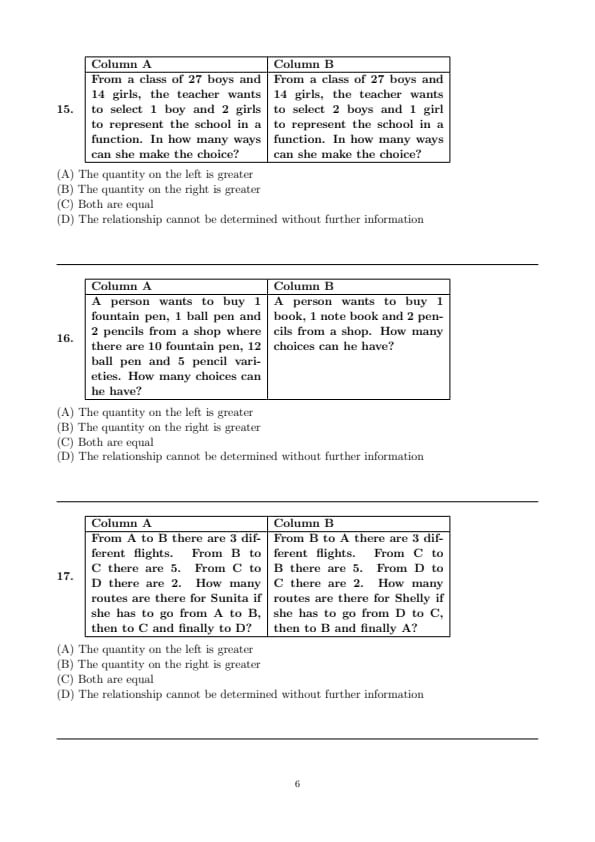
From a class of 27 boys and 14 girls, the teacher wants to select 1 boy and 2 girls to represent the school in a function. In how many ways can she make the choice? & From a class of 27 boys and 14 girls, the teacher wants to select 2 boys and 1 girl to represent the school in a function. In how many ways can she make the choice?
View Solution
Step 1: Understanding the Concept:
This is a combination problem involving two independent selections: choosing boys from a group of boys and choosing girls from a group of girls. The total number of ways is the product of the number of ways for each independent selection.
Step 2: Key Formula or Approach:
The number of ways to choose \(r\) items from a set of \(n\) is given by the combination formula: \(C(n, r) = \frac{n!}{r!(n-r)!}\).
We use the multiplication principle to find the total number of ways.
Step 3: Detailed Explanation:
For Column A:
Select 1 boy from 27 boys AND 2 girls from 14 girls.
Ways to select 1 boy from 27: \[ C(27, 1) = \frac{27!}{1!(27-1)!} = 27 \]
Ways to select 2 girls from 14: \[ C(14, 2) = \frac{14!}{2!(14-2)!} = \frac{14 \times 13}{2 \times 1} = 7 \times 13 = 91 \]
Total ways = (Ways to select boys) \( \times \) (Ways to select girls) \[ Total ways = 27 \times 91 = 2457 \]
So, Quantity A is 2457.
For Column B:
Select 2 boys from 27 boys AND 1 girl from 14 girls.
Ways to select 2 boys from 27: \[ C(27, 2) = \frac{27!}{2!(27-2)!} = \frac{27 \times 26}{2 \times 1} = 27 \times 13 = 351 \]
Ways to select 1 girl from 14: \[ C(14, 1) = \frac{14!}{1!(14-1)!} = 14 \]
Total ways = (Ways to select boys) \( \times \) (Ways to select girls) \[ Total ways = 351 \times 14 = 4914 \]
So, Quantity B is 4914.
Step 4: Final Answer:
Comparing the two quantities:
Quantity A = 2457
Quantity B = 4914
Quantity B is greater than Quantity A.
Quick Tip: Instead of full calculation, you can compare the terms. A = \(27 \times C(14, 2) = 27 \times \frac{14 \times 13}{2} = 27 \times 7 \times 13\). B = \(C(27, 2) \times 14 = \frac{27 \times 26}{2} \times 14 = 27 \times 13 \times 14\). Comparing A and B, we are comparing \(7\) and \(14\). Since \(14 > 7\), B is greater.
Column A & Column B
A person wants to buy 1 fountain pen, 1 ball pen and 2 pencils from a shop where there are 10 fountain pen, 12 ball pen and 5 pencil varieties. How many choices can he have? & A person wants to buy 1 book, 1 note book and 2 pencils from a shop. How many choices can he have?
View Solution
Step 1: Understanding the Concept:
This problem requires using the combination formula and the fundamental principle of counting to determine the total number of ways to make a purchase. We need to evaluate whether we have sufficient information to calculate the values for both columns.
Step 2: Key Formula or Approach:
The number of ways to choose \(r\) items from a set of \(n\) is \(C(n, r)\). The total number of choices for a sequence of independent events is the product of the choices for each event.
Step 3: Detailed Explanation:
For Column A:
The person needs to make three separate choices:
1. Choose 1 fountain pen from 10 available varieties: \( C(10, 1) = 10 \) ways.
2. Choose 1 ball pen from 12 available varieties: \( C(12, 1) = 12 \) ways.
3. Choose 2 pencils from 5 available varieties: \( C(5, 2) = \frac{5 \times 4}{2} = 10 \) ways.
The total number of choices is the product of these individual choices: \[ Total Choices = 10 \times 12 \times 10 = 1200 \]
So, Quantity A is 1200.
For Column B:
The person wants to buy 1 book, 1 notebook, and 2 pencils. However, the problem does not provide the following crucial information:
The number of available book varieties to choose from.
The number of available notebook varieties to choose from.
The number of available pencil varieties to choose from.
Without knowing the size of the selection pools for books, notebooks, and pencils, we cannot calculate the total number of choices.
Step 4: Final Answer:
Quantity A = 1200.
Quantity B cannot be calculated due to missing information.
Therefore, the relationship between the two quantities cannot be determined.
Quick Tip: In quantitative comparison questions, be vigilant about missing information. If any variable or number needed for a calculation is not provided for one of the columns, the answer is almost always (D).
Column A & Column B
From A to B there are 3 different flights. From B to C there are 5. From C to D there are 2. How many routes are there for Sunita if she has to go from A to B, then to C and finally to D? & From B to A there are 3 different flights. From C to B there are 5. From D to C there are 2. How many routes are there for Shelly if she has to go from D to C, then to B and finally A?
View Solution
Step 1: Understanding the Concept:
This problem is a direct application of the fundamental principle of counting (or the multiplication principle). When a journey consists of several sequential, independent stages, the total number of routes is the product of the number of options available for each stage.
Step 2: Key Formula or Approach:
If there are \(n_1\) ways to perform the first task, \(n_2\) ways for the second, and \(n_k\) for the \(k\)-th task, then the total number of ways to perform the sequence of tasks is \(n_1 \times n_2 \times \dots \times n_k\).
Step 3: Detailed Explanation:
For Column A:
Sunita's journey is a sequence of three stages: A \(\rightarrow\) B \(\rightarrow\) C \(\rightarrow\) D.
- Number of routes from A to B = 3.
- Number of routes from B to C = 5.
- Number of routes from C to D = 2.
Total number of routes for Sunita = (Routes A\(\rightarrow\)B) \( \times \) (Routes B\(\rightarrow\)C) \( \times \) (Routes C\(\rightarrow\)D) \[ Total Routes = 3 \times 5 \times 2 = 30 \]
So, Quantity A is 30.
For Column B:
Shelly's journey is also a sequence of three stages: D \(\rightarrow\) C \(\rightarrow\) B \(\rightarrow\) A. The number of flights between two cities is the same regardless of the direction of travel.
- Number of routes from D to C = 2.
- Number of routes from C to B = 5.
- Number of routes from B to A = 3.
Total number of routes for Shelly = (Routes D\(\rightarrow\)C) \( \times \) (Routes C\(\rightarrow\)B) \( \times \) (Routes B\(\rightarrow\)A) \[ Total Routes = 2 \times 5 \times 3 = 30 \]
So, Quantity B is 30.
Step 4: Final Answer:
Comparing the two quantities:
Quantity A = 30
Quantity B = 30
The two quantities are equal.
Quick Tip: Problems involving routes, paths, or sequences of choices are often solved with the multiplication principle. Note that the order of multiplication does not affect the final product (commutative property), so even though the journeys are in reverse order, the result is the same.
Column A & Column B
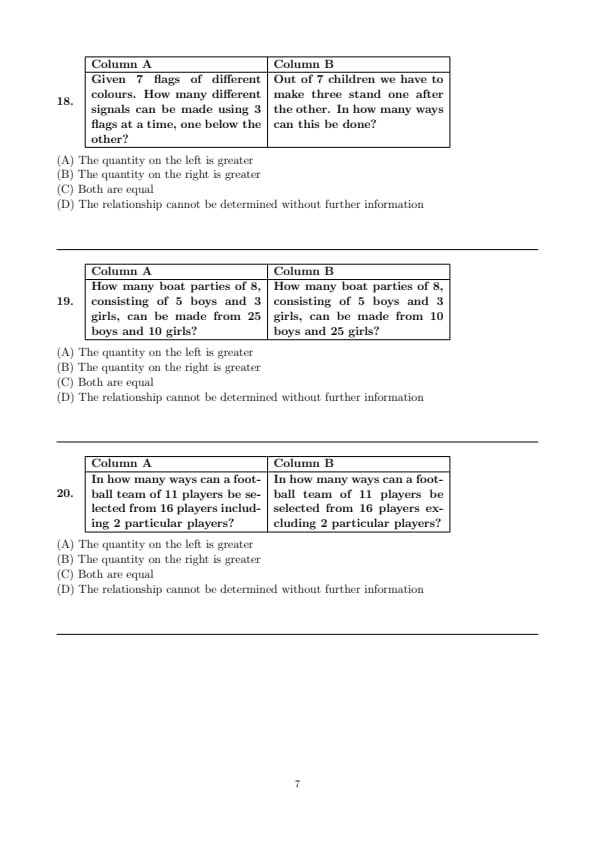
Given 7 flags of different colours. How many different signals can be made using 3 flags at a time, one below the other? & Out of 7 children we have to make three stand one after the other. In how many ways can this be done?
View Solution
Step 1: Understanding the Concept:
Both problems describe situations where we need to select a subset of items from a larger set and arrange them in a specific order. The phrases "one below the other" and "one after the other" indicate that the order of selection is important. Therefore, both are permutation problems.
Step 2: Key Formula or Approach:
The number of arrangements (permutations) of \(r\) objects taken from a set of \(n\) distinct objects is given by the formula: \[ P(n, r) = \frac{n!}{(n-r)!} = n \times (n-1) \times \dots \times (n-r+1) \]
Step 3: Detailed Explanation:
For Column A:
We are selecting 3 flags from 7 distinct flags and arranging them in a vertical order.
This is a permutation of 3 items from a set of 7.
Here, \(n=7\) and \(r=3\).
Number of different signals = \(P(7, 3)\). \[ P(7, 3) = 7 \times 6 \times 5 = 210 \]
Alternatively:
- The top position can be filled by any of the 7 flags.
- The middle position can be filled by any of the remaining 6 flags.
- The bottom position can be filled by any of the remaining 5 flags.
Total ways = \(7 \times 6 \times 5 = 210\).
For Column B:
We are selecting 3 children from 7 distinct children and arranging them in a line.
This is also a permutation of 3 items from a set of 7.
Here, \(n=7\) and \(r=3\).
Number of ways to arrange the children = \(P(7, 3)\). \[ P(7, 3) = 7 \times 6 \times 5 = 210 \]
Alternatively:
- The first position can be filled by any of the 7 children.
- The second position can be filled by any of the remaining 6 children.
- The third position can be filled by any of the remaining 5 children.
Total ways = \(7 \times 6 \times 5 = 210\).
Step 4: Final Answer:
Comparing the two quantities:
Quantity A = 210
Quantity B = 210
The two quantities are equal.
Quick Tip: Look for keywords that indicate order matters, such as "arrange", "one after the other", "rank", "signal", or assigning distinct roles. If order matters, it's a permutation. If the wording was just "select a group of 3", it would be a combination.
Column A & Column B
How many boat parties of 8, consisting of 5 boys and 3 girls, can be made from 25 boys and 10 girls? & How many boat parties of 8, consisting of 5 boys and 3 girls, can be made from 10 boys and 25 girls?
View Solution
Step 1: Understanding the Concept:
This is a combination problem where a group is formed by selecting members from two distinct pools (boys and girls). The total number of ways to form the party is the product of the number of ways to select the boys and the number of ways to select the girls.
Step 2: Key Formula or Approach:
The number of ways to choose \(r\) items from a set of \(n\) is \(C(n, r) = \frac{n!}{r!(n-r)!}\).
Total ways = (Ways to choose boys) \( \times \) (Ways to choose girls).
Step 3: Detailed Explanation:
For Column A:
We need to select 5 boys from 25 and 3 girls from 10.
- Ways to choose 5 boys from 25 = \(C(25, 5)\).
- Ways to choose 3 girls from 10 = \(C(10, 3)\).
Total ways for party A = \(C(25, 5) \times C(10, 3)\).
For Column B:
We need to select 5 boys from 10 and 3 girls from 25.
- Ways to choose 5 boys from 10 = \(C(10, 5)\).
- Ways to choose 3 girls from 25 = \(C(25, 3)\).
Total ways for party B = \(C(10, 5) \times C(25, 3)\).
Comparison:
We are comparing A = \(C(25, 5) \times C(10, 3)\) with B = \(C(10, 5) \times C(25, 3)\).
Let's analyze the ratio A/B: \[ \frac{A}{B} = \frac{C(25, 5) \times C(10, 3)}{C(10, 5) \times C(25, 3)} \]
Let's expand the terms: \[ C(25, 5) = \frac{25 \times 24 \times 23 \times 22 \times 21}{5 \times 4 \times 3 \times 2 \times 1} \quad C(10, 3) = \frac{10 \times 9 \times 8}{3 \times 2 \times 1} \] \[ C(10, 5) = \frac{10 \times 9 \times 8 \times 7 \times 6}{5 \times 4 \times 3 \times 2 \times 1} \quad C(25, 3) = \frac{25 \times 24 \times 23}{3 \times 2 \times 1} \]
Let's use the factorial form for easier cancellation. \[ \frac{A}{B} = \frac{\frac{25!}{5!20!} \times \frac{10!}{3!7!}}{\frac{10!}{5!5!} \times \frac{25!}{3!22!}} = \frac{25! \cdot 10! \cdot 5! \cdot 5! \cdot 3! \cdot 22!}{5! \cdot 20! \cdot 3! \cdot 7! \cdot 10! \cdot 25!} = \frac{5! \cdot 22!}{20! \cdot 7!} \] \[ \frac{A}{B} = \frac{5! \times (22 \times 21 \times 20!)}{20! \times (7 \times 6 \times 5!)} = \frac{22 \times 21}{7 \times 6} = \frac{462}{42} = 11 \]
Since \(\frac{A}{B} = 11\), which is greater than 1, it means A is 11 times larger than B.
Step 4: Final Answer:
Quantity A is greater than Quantity B.
Quick Tip: The value of \(C(n, r)\) grows faster when \(n\) is larger. In this problem, Quantity A involves selecting from larger pools for the larger required group (\(C(25,5)\)) compared to Quantity B (\(C(10,5)\)). This suggests that Quantity A will be larger.
Column A & Column B
In how many ways can a football team of 11 players be selected from 16 players including 2 particular players? & In how many ways can a football team of 11 players be selected from 16 players excluding 2 particular players?
View Solution
Step 1: Understanding the Concept:
This problem involves combinations with specific conditions: one case requires certain players to be *included*, while the other requires them to be *excluded*. These conditions change the number of players we need to select and the pool of players available for selection.
Step 2: Key Formula or Approach:
The number of ways to choose \(r\) items from a set of \(n\) is \(C(n, r) = \frac{n!}{r!(n-r)!}\).
A useful identity is \(C(n, r) = C(n, n-r)\).
Step 3: Detailed Explanation:
For Column A: Including 2 particular players
- We need to select a team of 11 players.
- Since 2 specific players must be on the team, they are already chosen.
- We now need to select the remaining \(11 - 2 = 9\) players.
- The pool of available players is also reduced, as those 2 are no longer available for selection. We have \(16 - 2 = 14\) players left to choose from.
- The number of ways is to choose 9 players from the remaining 14: \[ C(14, 9) = C(14, 14-9) = C(14, 5) = \frac{14 \times 13 \times 12 \times 11 \times 10}{5 \times 4 \times 3 \times 2 \times 1} = 14 \times 13 \times 11 = 2002 \]
So, Quantity A is 2002.
For Column B: Excluding 2 particular players
- We need to select a team of 11 players.
- Since 2 specific players must not be on the team, we remove them from the pool of available players.
- The pool of available players is now \(16 - 2 = 14\).
- We need to select all 11 players for the team from this reduced pool.
- The number of ways is to choose 11 players from the 14 available: \[ C(14, 11) = C(14, 14-11) = C(14, 3) = \frac{14 \times 13 \times 12}{3 \times 2 \times 1} = 14 \times 13 \times 2 = 364 \]
So, Quantity B is 364.
Step 4: Final Answer:
Comparing the two quantities:
Quantity A = 2002
Quantity B = 364
Quantity A is greater than Quantity B.
Quick Tip: For combination problems with conditions: - \textbf{Including} particular items: Reduce both the total number of items to choose from AND the number of items you need to choose. - \textbf{Excluding} particular items: Reduce only the total number of items to choose from.
Column A & Column B
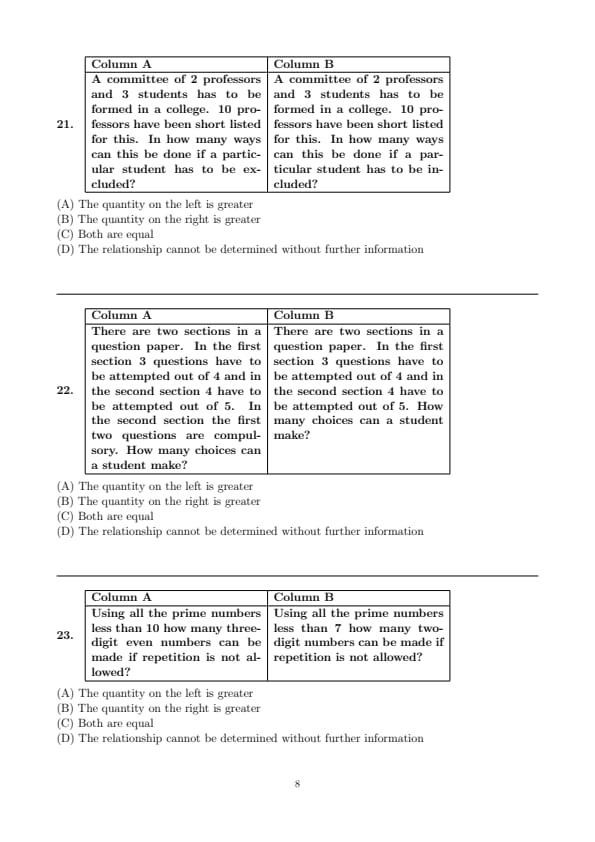
A committee of 2 professors and 3 students has to be formed in a college. 10 professors have been short listed for this. In how many ways can this be done if a particular student has to be excluded? & A committee of 2 professors and 3 students has to be formed in a college. 10 professors have been short listed for this. In how many ways can this be done if a particular student has to be included?
View Solution
Step 1: Understanding the Concept:
This problem asks for the number of ways to form a committee by selecting from two groups (professors and students). However, a critical piece of information, the total number of students to choose from, is missing. We need to analyze if a comparison is possible without this information.
Step 2: Key Formula or Approach:
The total ways to form the committee is (Ways to choose professors) \( \times \) (Ways to choose students). We will use the combination formula \(C(n, r)\). Let 'S' be the total number of students.
Step 3: Detailed Explanation:
In both columns, the number of ways to choose 2 professors from 10 is the same: \[ C(10, 2) = \frac{10 \times 9}{2} = 45 \]
The comparison depends entirely on the number of ways to choose the students. Let 'S' be the total number of shortlisted students. For the combinations to be possible, \(S\) must be at least 4 (since in Column A, one is excluded and we still need to choose 3).
For Column A: A particular student is excluded
- We need to choose 3 students.
- The pool of students is reduced by one, so we choose from \(S-1\) students.
- Ways to choose students = \(C(S-1, 3)\).
- Total ways for A = \(45 \times C(S-1, 3)\).
For Column B: A particular student is included
- We need to choose 3 students, and one is already chosen.
- We need to choose \(3-1 = 2\) more students.
- The pool of students is reduced by one (the one already included), so we choose from \(S-1\) students.
- Ways to choose students = \(C(S-1, 2)\).
- Total ways for B = \(45 \times C(S-1, 2)\).
Comparison:
We are comparing \(C(S-1, 3)\) with \(C(S-1, 2)\). \[ C(S-1, 3) = \frac{(S-1)!}{3!(S-4)!} \quad and \quad C(S-1, 2) = \frac{(S-1)!}{2!(S-3)!} \]
The relationship between them is \(C(n, k) = \frac{n-k+1}{k} C(n, k-1)\).
So, \(C(S-1, 3) = \frac{(S-1)-3+1}{3} C(S-1, 2) = \frac{S-3}{3} C(S-1, 2)\).
- If \(S-3 > 3\) (i.e., \(S > 6\)), then \(C(S-1, 3) > C(S-1, 2)\) and Quantity A is greater.
- If \(S-3 < 3\) (i.e., \(S < 6\)), then \(C(S-1, 3) < C(S-1, 2)\) and Quantity B is greater. (e.g., if S=5, A=45*C(4,3)=180, B=45*C(4,2)=270).
- If \(S-3 = 3\) (i.e., \(S = 6\)), then \(C(S-1, 3) = C(S-1, 2)\) and the quantities are equal. (A=45*C(5,3)=450, B=45*C(5,2)=450).
Since the value of S is not given, we cannot determine which quantity is greater.
Step 4: Final Answer:
The relationship cannot be determined from the information given.
Quick Tip: When a variable is missing from a quantitative comparison question, check if the relationship between the two columns changes depending on the possible values of that variable. If it does, the answer is (D).
Column A & Column B
There are two sections in a question paper. In the first section 3 questions have to be attempted out of 4 and in the second section 4 have to be attempted out of 5. In the second section the first two questions are compulsory. How many choices can a student make? & There are two sections in a question paper. In the first section 3 questions have to be attempted out of 4 and in the second section 4 have to be attempted out of 5. How many choices can a student make?
View Solution
Step 1: Understanding the Concept:
This problem involves calculating the number of ways a student can choose questions from two independent sections of a paper. The total number of choices is the product of the choices available in each section. The key difference is the constraint of compulsory questions in Column A.
Step 2: Key Formula or Approach:
The number of ways to choose \(r\) questions from a set of \(n\) is the combination \(C(n, r)\). We use the multiplication principle to combine the choices from the two sections.
Step 3: Detailed Explanation:
For Column A:
The student has to make choices in two sections.
- Section 1: Attempt 3 questions out of 4.
\[ Choices for Section 1 = C(4, 3) = \frac{4!}{3!1!} = 4 \]
- Section 2: Attempt 4 questions out of 5, but the first two are compulsory.
This means 2 questions are already selected. The student only needs to choose \(4 - 2 = 2\) more questions. The pool of available questions to choose from is also reduced to \(5 - 2 = 3\) questions.
\[ Choices for Section 2 = C(3, 2) = \frac{3!}{2!1!} = 3 \]
- Total Choices: The total number of ways is the product of choices for each section.
\[ Total Choices for A = 4 \times 3 = 12 \]
For Column B:
The student has to make choices in two sections without any compulsory questions.
- Section 1: Attempt 3 questions out of 4.
\[ Choices for Section 1 = C(4, 3) = 4 \]
- Section 2: Attempt 4 questions out of 5.
\[ Choices for Section 2 = C(5, 4) = \frac{5!}{4!1!} = 5 \]
- Total Choices: The total number of ways is the product of choices for each section.
\[ Total Choices for B = 4 \times 5 = 20 \]
Step 4: Final Answer:
Comparing the two quantities:
Quantity A = 12
Quantity B = 20
Quantity B is greater than Quantity A.
Quick Tip: Compulsory items reduce the number of choices you need to make and also reduce the pool of items you can choose from. This always results in fewer combinations compared to a situation without such constraints.
Column A & Column B
Using all the prime numbers less than 10 how many three-digit even numbers can be made if repetition is not allowed? & Using all the prime numbers less than 7 how many two-digit numbers can be made if repetition is not allowed?
View Solution
Step 1: Understanding the Concept:
This problem involves forming numbers with specific properties (even, two-digit, three-digit) from a given set of digits (prime numbers) without repetition. This is a permutation problem with constraints.
Step 2: Key Formula or Approach:
We will use the fundamental principle of counting. We identify the choices for each digit's place, starting with the most restricted position.
Step 3: Detailed Explanation:
For Column A:
First, identify the prime numbers less than 10. They are \{2, 3, 5, 7\.
We need to form a three-digit even number without repetition using these digits.
For a number to be even, its units digit must be even. From our set \{2, 3, 5, 7\, the only even digit is 2.
- Units place: Must be 2. So, there is only 1 choice.
- After placing 2 in the units place, the remaining digits are \{3, 5, 7\.
- Hundreds place: We can choose any of the 3 remaining digits. So, there are 3 choices.
- Tens place: After filling the hundreds place, we have 2 digits left. So, there are 2 choices.
Total number of three-digit even numbers = (Choices for hundreds) \( \times \) (Choices for tens) \( \times \) (Choices for units)
\[ Total numbers = 3 \times 2 \times 1 = 6 \]
So, Quantity A is 6.
For Column B:
First, identify the prime numbers less than 7. They are \{2, 3, 5\.
We need to form a two-digit number without repetition using these digits.
This is an arrangement of 2 digits chosen from the 3 available digits.
- Tens place: We can choose any of the 3 digits. So, there are 3 choices.
- Units place: After filling the tens place, we have 2 digits left. So, there are 2 choices.
Total number of two-digit numbers = (Choices for tens) \( \times \) (Choices for units)
\[ Total numbers = 3 \times 2 = 6 \]
This is also a permutation \(P(3, 2) = \frac{3!}{(3-2)!} = 6\).
So, Quantity B is 6.
Step 4: Final Answer:
Comparing the two quantities:
Quantity A = 6
Quantity B = 6
The two quantities are equal.
Quick Tip: When forming numbers with constraints (like being even or odd), always fill the constrained position first (the units place in this case). This helps determine the remaining choices for the other positions correctly.
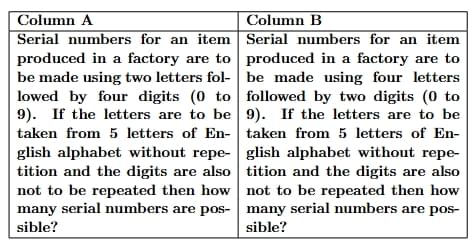
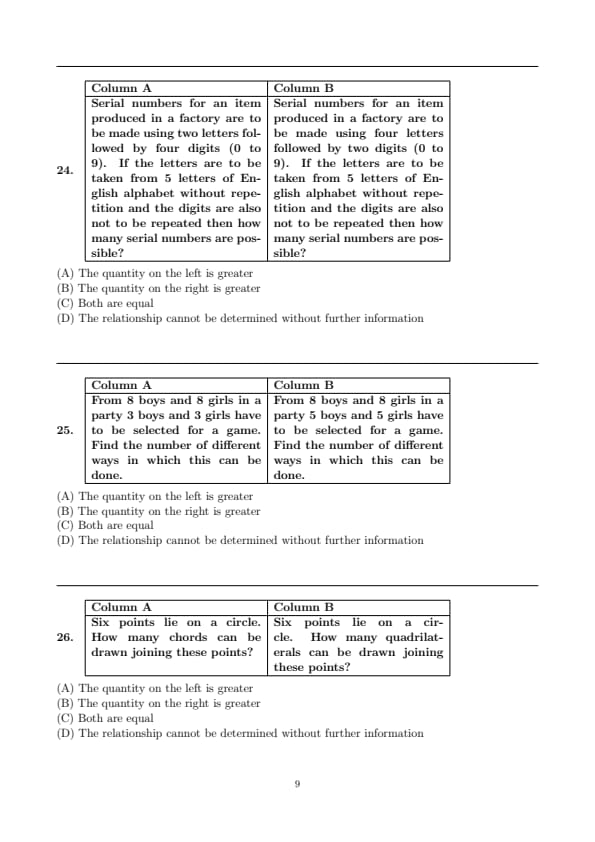
View Solution
Step 1: Understanding the Concept:
This problem involves creating serial numbers with a specific format (letters and digits). Since the order matters and repetition is not allowed, this is a permutation problem. The total number of possibilities is the product of the number of ways to form the letter part and the number of ways to form the digit part.
Step 2: Key Formula or Approach:
The number of permutations of \(r\) objects taken from a set of \(n\) distinct objects is \(P(n, r) = \frac{n!}{(n-r)!}\).
Total possibilities = (Ways to arrange letters) \( \times \) (Ways to arrange digits).
Step 3: Detailed Explanation:
For Column A:
The format is 2 letters followed by 4 digits.
- Letter Part: Choose and arrange 2 letters from 5 without repetition.
\[ Ways for letters = P(5, 2) = 5 \times 4 = 20 \]
- Digit Part: Choose and arrange 4 digits from 10 (0 to 9) without repetition.
\[ Ways for digits = P(10, 4) = 10 \times 9 \times 8 \times 7 = 5040 \]
- Total Serial Numbers:
\[ Total = 20 \times 5040 = 100,800 \]
So, Quantity A is 100,800.
For Column B:
The format is 4 letters followed by 2 digits.
- Letter Part: Choose and arrange 4 letters from 5 without repetition.
\[ Ways for letters = P(5, 4) = 5 \times 4 \times 3 \times 2 = 120 \]
- Digit Part: Choose and arrange 2 digits from 10 (0 to 9) without repetition.
\[ Ways for digits = P(10, 2) = 10 \times 9 = 90 \]
- Total Serial Numbers:
\[ Total = 120 \times 90 = 10,800 \]
So, Quantity B is 10,800.
Step 4: Final Answer:
Comparing the two quantities:
Quantity A = 100,800
Quantity B = 10,800
Quantity A is greater than Quantity B.
Quick Tip: The value of \(P(n, r)\) increases as \(r\) increases up to a point, but the overall product depends on all factors. Notice that \(P(10, 4)\) is much larger than \(P(10, 2)\), which drives the result in this case.
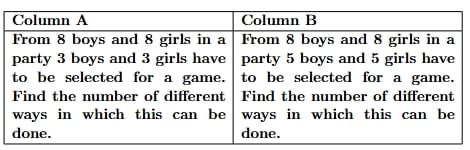
View Solution
Step 1: Understanding the Concept:
The problem involves selecting a group of people from two different pools (boys and girls). Since the order of selection for the game does not matter, this is a combination problem. The total number of ways is the product of the ways to select boys and the ways to select girls.
Step 2: Key Formula or Approach:
The number of ways to choose \(r\) items from a set of \(n\) is given by \(C(n, r) = \frac{n!}{r!(n-r)!}\).
An important identity is \(C(n, r) = C(n, n-r)\).
Total Ways = (Ways to choose boys) \( \times \) (Ways to choose girls).
Step 3: Detailed Explanation:
For Column A:
- Select 3 boys from 8.
\[ Ways for boys = C(8, 3) = \frac{8 \times 7 \times 6}{3 \times 2 \times 1} = 56 \]
- Select 3 girls from 8.
\[ Ways for girls = C(8, 3) = 56 \]
- Total number of ways:
\[ Total = 56 \times 56 = 3136 \]
So, Quantity A is 3136.
For Column B:
- Select 5 boys from 8.
\[ Ways for boys = C(8, 5) \]
Using the identity \(C(n, r) = C(n, n-r)\):
\[ C(8, 5) = C(8, 8-5) = C(8, 3) = 56 \]
- Select 5 girls from 8.
\[ Ways for girls = C(8, 5) = C(8, 3) = 56 \]
- Total number of ways:
\[ Total = 56 \times 56 = 3136 \]
So, Quantity B is 3136.
Step 4: Final Answer:
Comparing the two quantities:
Quantity A = 3136
Quantity B = 3136
The two quantities are equal.
Quick Tip: Always remember the combination identity \(C(n, r) = C(n, n-r)\). It can save you from calculation and help you quickly see that two seemingly different problems are actually the same, as in this question.
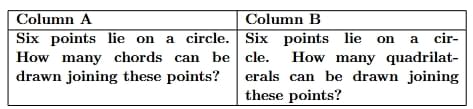
View Solution
Step 1: Understanding the Concept:
This problem involves geometric figures formed by selecting points on a circle. Since the order in which we choose the points does not matter for forming a chord or a quadrilateral, these are combination problems.
Step 2: Key Formula or Approach:
The number of ways to choose \(r\) items from a set of \(n\) distinct items is given by the combination formula: \(C(n, r) = \frac{n!}{r!(n-r)!}\).
We also use the identity \(C(n, r) = C(n, n-r)\).
Step 3: Detailed Explanation:
For Column A:
There are 6 points on a circle.
A chord is a line segment that connects two distinct points on the circle.
To find the number of chords, we need to find the number of ways to choose 2 points from the 6 available points. \[ Number of chords = C(6, 2) = \frac{6!}{2!(6-2)!} = \frac{6 \times 5}{2 \times 1} = 15 \]
So, Quantity A is 15.
For Column B:
There are 6 points on a circle.
A quadrilateral is a polygon with four vertices. To form a quadrilateral, we need to choose 4 points from the 6 available points. \[ Number of quadrilaterals = C(6, 4) \]
Using the identity \(C(n, r) = C(n, n-r)\): \[ C(6, 4) = C(6, 6-4) = C(6, 2) = \frac{6 \times 5}{2 \times 1} = 15 \]
So, Quantity B is 15.
Step 4: Final Answer:
Comparing the two quantities:
Quantity A = 15
Quantity B = 15
The two quantities are equal.
Quick Tip: Problems involving selecting points to form geometric shapes (lines, triangles, polygons) from a set of non-collinear points are applications of combinations. A line/chord needs 2 points, a triangle needs 3, a quadrilateral needs 4, and so on.
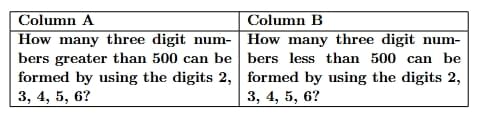
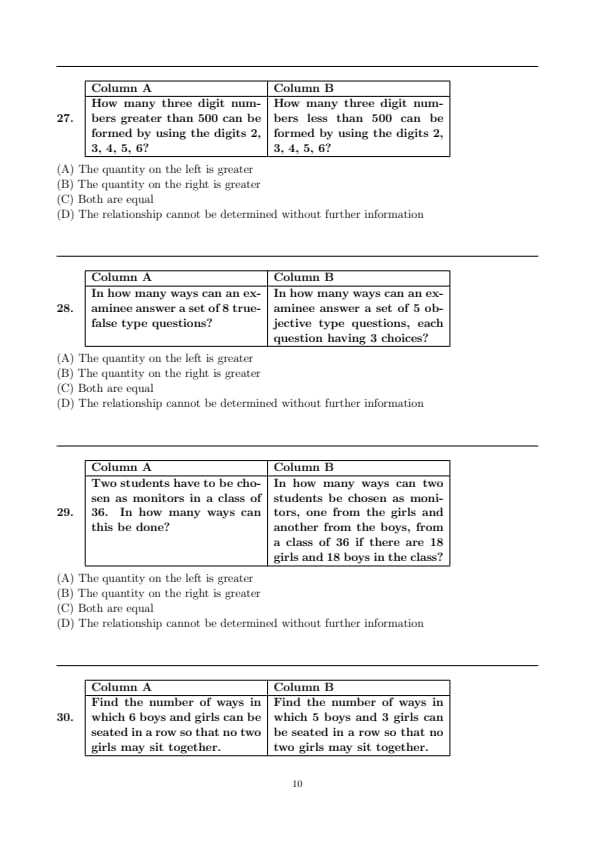
View Solution
Step 1: Understanding the Concept:
This problem involves forming three-digit numbers from a given set of digits with a condition on their value (greater or less than 500). Since the problem does not state that repetition is not allowed, we assume repetition is allowed. The key is to analyze the choices for the hundreds digit.
Step 2: Key Formula or Approach:
We will use the fundamental principle of counting. The total number of possibilities is the product of the number of choices for each of the three places (hundreds, tens, units).
Step 3: Detailed Explanation:
The set of available digits is \{2, 3, 4, 5, 6\. There are 5 available digits.
For Column A: Numbers greater than 500
- For a three-digit number to be greater than 500, its hundreds digit must be 5 or 6.
- Hundreds place: 2 choices (5 or 6).
- Tens place: 5 choices (any of the 5 digits, as repetition is allowed).
- Units place: 5 choices (any of the 5 digits).
Total numbers > 500 = (Choices for hundreds) \( \times \) (Choices for tens) \( \times \) (Choices for units)
\[ Total numbers = 2 \times 5 \times 5 = 50 \]
So, Quantity A is 50.
For Column B: Numbers less than 500
- For a three-digit number to be less than 500, its hundreds digit must be 2, 3, or 4.
- Hundreds place: 3 choices (2, 3, or 4).
- Tens place: 5 choices (any of the 5 digits).
- Units place: 5 choices (any of the 5 digits).
Total numbers < 500 = (Choices for hundreds) \( \times \) (Choices for tens) \( \times \) (Choices for units)
\[ Total numbers = 3 \times 5 \times 5 = 75 \]
So, Quantity B is 75.
Step 4: Final Answer:
Comparing the two quantities:
Quantity A = 50
Quantity B = 75
Quantity B is greater than Quantity A.
Quick Tip: In problems about forming numbers, unless specified otherwise, assume repetition is allowed. The most important constraint often applies to the first digit, so always start your analysis there.
View Solution
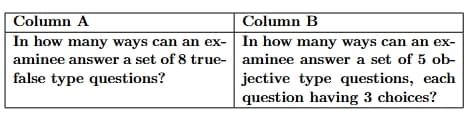
Step 1: Understanding the Concept:
This problem deals with the total number of ways to answer a series of multiple-choice questions. Since the choice for each question is independent of the others, we can use the fundamental principle of counting (multiplication principle).
Step 2: Key Formula or Approach:
If there are \(k\) independent events, and the \(i\)-th event can occur in \(n_i\) ways, then the total number of ways for the sequence of events is \(n_1 \times n_2 \times \dots \times n_k\). For \(k\) questions each with \(n\) choices, the total ways are \(n^k\).
Step 3: Detailed Explanation:
For Column A:
- There are 8 questions.
- Each question is of the true-false type, meaning each has 2 choices (True or False).
- Total number of ways = (Choices for Q1) \( \times \) (Choices for Q2) \( \times \dots \times \) (Choices for Q8) \[ Total ways = 2 \times 2 \times 2 \times 2 \times 2 \times 2 \times 2 \times 2 = 2^8 \] \[ 2^8 = 256 \]
So, Quantity A is 256.
For Column B:
- There are 5 questions.
- Each question has 3 choices.
- Total number of ways = (Choices for Q1) \( \times \dots \times \) (Choices for Q5) \[ Total ways = 3 \times 3 \times 3 \times 3 \times 3 = 3^5 \] \[ 3^5 = 243 \]
So, Quantity B is 243.
Step 4: Final Answer:
Comparing the two quantities:
Quantity A = 256
Quantity B = 243
Quantity A is greater than Quantity B.
Quick Tip: For multiple-choice question problems, the formula is simply \((choices per question)^{(number of questions)}\). Be comfortable with calculating powers of small integers to solve these quickly.
View Solution
Step 1: Understanding the Concept:
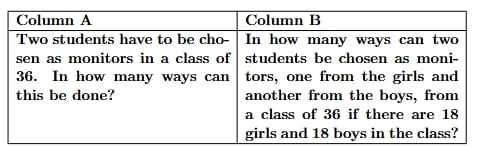
This question compares two different ways of selecting monitors. Column A is a simple combination problem. Column B involves making selections from two distinct subgroups (boys and girls) and uses the multiplication principle.
Step 2: Key Formula or Approach:
The number of ways to choose \(r\) items from a set of \(n\) is \(C(n, r) = \frac{n!}{r!(n-r)!}\).
The multiplication principle states that if one event can occur in \(m\) ways and a second independent event can occur in \(n\) ways, the two can occur in \(m \times n\) ways.
Step 3: Detailed Explanation:
For Column A:
We need to choose 2 students from a class of 36. Since the roles are identical (both are "monitors"), the order does not matter. \[ Number of ways = C(36, 2) = \frac{36 \times 35}{2 \times 1} = 18 \times 35 = 630 \]
So, Quantity A is 630.
For Column B:
We need to choose 1 girl from 18 girls AND 1 boy from 18 boys.
- Ways to choose 1 girl from 18 = \(C(18, 1) = 18\).
- Ways to choose 1 boy from 18 = \(C(18, 1) = 18\).
Using the multiplication principle, the total number of ways is: \[ Total ways = 18 \times 18 = 324 \]
So, Quantity B is 324.
Step 4: Final Answer:
Comparing the two quantities:
Quantity A = 630
Quantity B = 324
Quantity A is greater than Quantity B.
Quick Tip: The number of ways to choose a mixed group (Column B) is just one part of the total ways to choose any group (Column A). The total ways also include choosing two boys or two girls, so it will always be larger.
View Solution
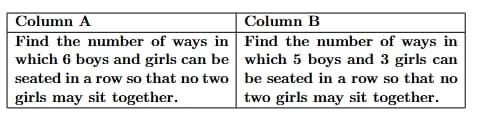
Step 1: Understanding the Concept:
This is a classic permutation problem with a restriction: "no two girls may sit together". We solve this using the "gap method". First, we arrange the items without the restriction (boys) and then place the restricted items (girls) in the gaps created. The phrasing in Column A, "6 boys and girls", is ambiguous. A common interpretation in competitive exams for such phrasing is "6 boys and 6 girls". We will proceed with this assumption.
Step 2: Key Formula or Approach:
1. Arrange the \(n\) boys in \(n!\) ways. This creates \(n+1\) gaps.
2. Choose \(r\) gaps for the \(r\) girls and arrange them in \(P(n+1, r)\) ways.
3. Total ways = (Ways to arrange boys) \( \times \) (Ways to place girls) = \( n! \times P(n+1, r) \).
Step 3: Detailed Explanation:
For Column A (Assuming 6 boys and 6 girls):
- Step 1: Arrange the 6 boys.
The number of ways to arrange 6 boys in a row is \(6!\).
\[ 6! = 720 \]
- Step 2: Place the 6 girls in the gaps.
Arranging the 6 boys creates 7 gaps (_B_B_B_B_B_B_).
We need to place the 6 girls in these 7 gaps. The number of ways to do this is \(P(7, 6)\).
\[ P(7, 6) = \frac{7!}{(7-6)!} = 7! = 5040 \]
- Step 3: Calculate the total ways.
\[ Total ways = 6! \times P(7, 6) = 720 \times 5040 = 3,628,800 \]
So, Quantity A is 3,628,800.
For Column B (5 boys and 3 girls):
- Step 1: Arrange the 5 boys.
The number of ways to arrange 5 boys in a row is \(5!\).
\[ 5! = 120 \]
- Step 2: Place the 3 girls in the gaps.
Arranging the 5 boys creates 6 gaps (_B_B_B_B_B_).
We need to place the 3 girls in these 6 gaps. The number of ways to do this is \(P(6, 3)\).
\[ P(6, 3) = \frac{6!}{(6-3)!} = 6 \times 5 \times 4 = 120 \]
- Step 3: Calculate the total ways.
\[ Total ways = 5! \times P(6, 3) = 120 \times 120 = 14,400 \]
So, Quantity B is 14,400.
Step 4: Final Answer:
Comparing the two quantities:
Quantity A = 3,628,800
Quantity B = 14,400
Quantity A is greater than Quantity B.
Quick Tip: For "never together" problems, the gap method is the most reliable approach. Arrange the unrestricted group first, then place the restricted group in the gaps. The number of gaps is always one more than the number of items in the unrestricted group.



Comments