




GRE 2024 Quantitative Reasoning Practice Test Set 15 Question Paper with Solutions PDF is available for download. The overall test time is about 1 hour and 58 minutes. GRE has total 5 sections:
- Analytical Writing (One "Analyze an Issue" task, Alloted time 30 minutes)
- Verbal Reasoning (Two Sections, with 12 questions and 15 questions respectively)
- Quantitative Reasoning (Two Sections, with 12 questions and 15 questions respectively)
GRE 2024 Qantitative Reasoning Practice Test Set 15 Question Paper with Solutions PDF
| GRE 2024 Quantitative Reasoning Set 15 Question Paper with Solutions PDF |  Download Download |
Check Solutions |

Simplify: \[ \sqrt{343x^5} - \sqrt{49x^3} \]
Which is greater, when \(-1 < x < 0\)?
Quantity A: \(|x|\)
Quantity B: \(x^2\)
Solve: \(231 \div 3 + 93 \div 3\)
Quantity A: \(49012\)
Quantity B: \(4056\)
Flour, eggs, sugar, and chocolate chips are mixed by weight in the ratio of \(12:5:3:5\). How many pounds of chocolate chips are there in 75 pounds of the mixture?
Quantity A: \(|10| - |16|\)
Quantity B: \(|1-5| - |3-6|\)
Given \(0 < x < y < z < 10\), where \(x,y,z\) are integers:
Quantity A: \(-7\)
Quantity B: \(x + y - z\)
Which of the following is true?
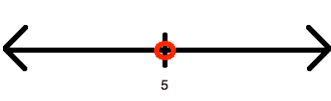
Given inequality: \(2x+6 > 16\)
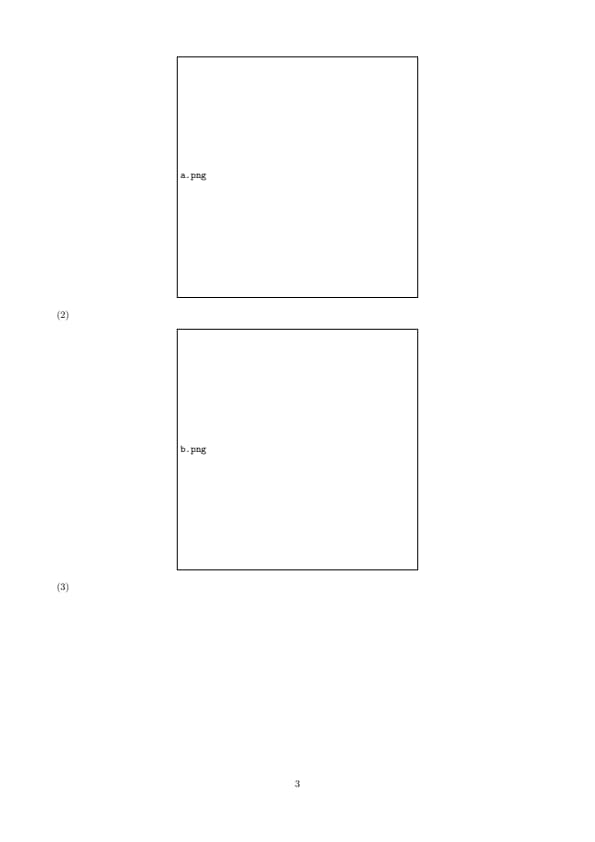
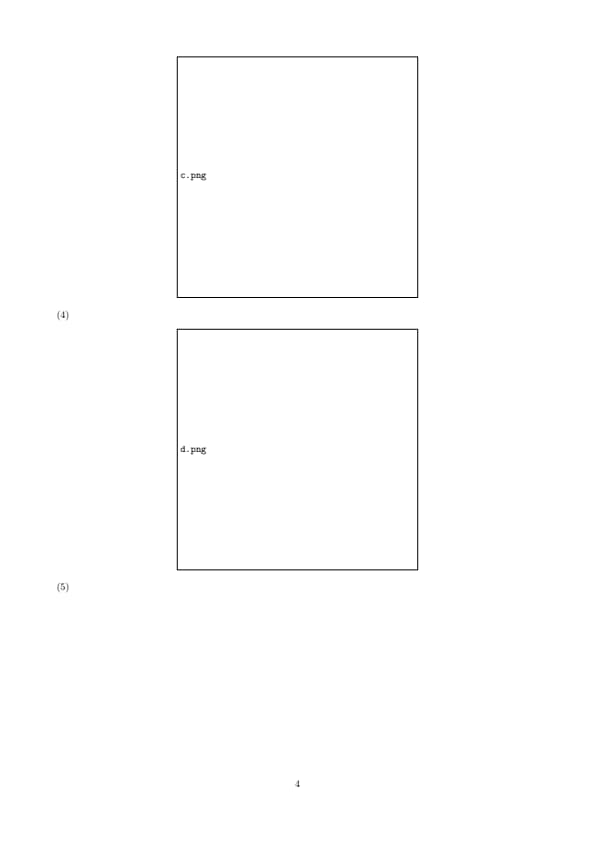
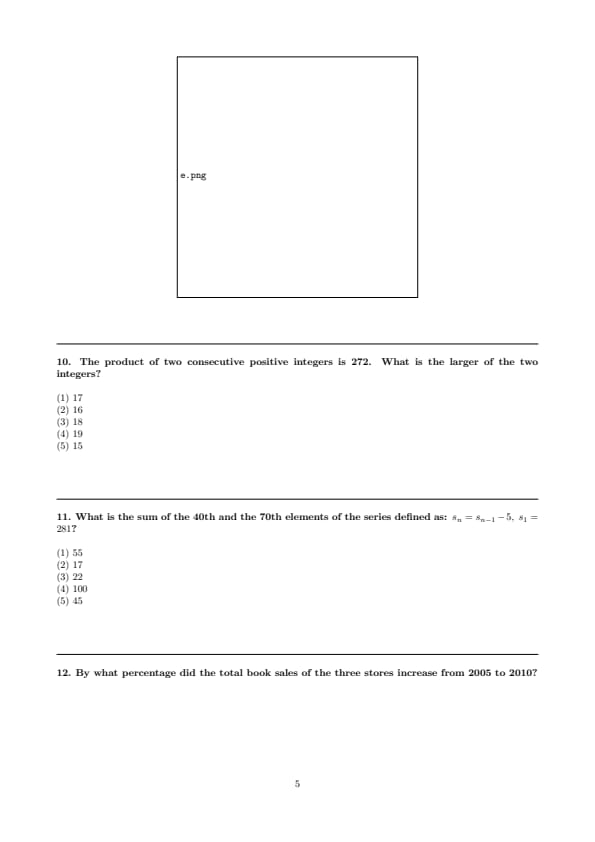
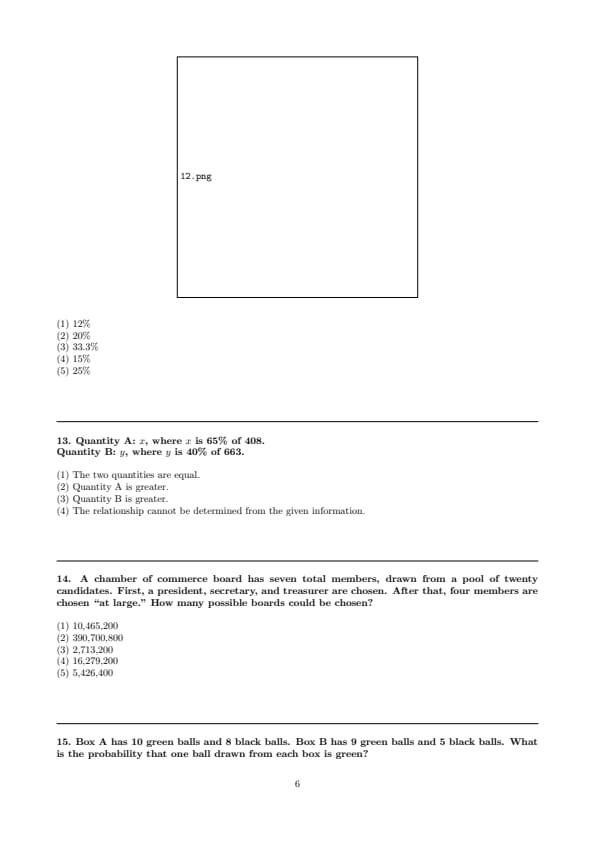
Which of the following is a graph for the values of \(x\) defined by the inequality \(2x+6 > 16\)?
- (1)
![]()
- (2)
![]()
- (3)
![]()
- (4)
![]()
- (5)
![]()
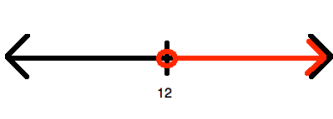
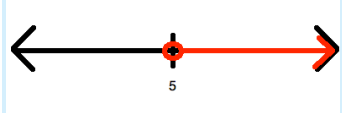
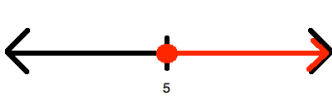
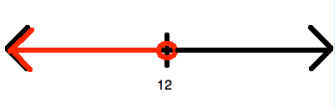
The product of two consecutive positive integers is 272. What is the larger of the two integers?
What is the sum of the 40th and the 70th elements of the series defined as: \( s_n = s_{n-1} - 5, \; s_1 = 281 \)?
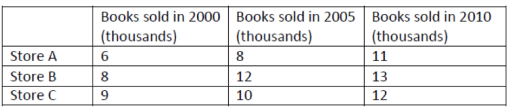
By what percentage did the total book sales of the three stores increase from 2005 to 2010?
Quantity A: \(x\), where \(x\) is 65% of 408.
Quantity B: \(y\), where \(y\) is 40% of 663.
A chamber of commerce board has seven total members, drawn from a pool of twenty candidates. First, a president, secretary, and treasurer are chosen. After that, four members are chosen “at large.” How many possible boards could be chosen?
Box A has 10 green balls and 8 black balls. Box B has 9 green balls and 5 black balls. What is the probability that one ball drawn from each box is green?




Comments