



CAT 2025 Slot 3 VARC Question Paper is available here for free download. CAT 2025 Slot 3 paper is scheduled for November 30 from 4.30 PM to 6.30 PM. CAT 2025 Slot 3 question paper VARC comprises 24 questions to be attempted in 40 minutes. Based on trends from previous years, the difficulty level of the CAT 2025 Slot 3 VARC section is expected to be moderate to tough.
Also Check CAT 2025 Question Paper (All Slots)
CAT 2025 Slot 3 VARC Question Paper with Solutions PDF – Memory Based
| CAT 2025 Slot 3 VARC Question Paper with Solutions PDF | |
|---|---|
| Download PDF | Check Solutions |

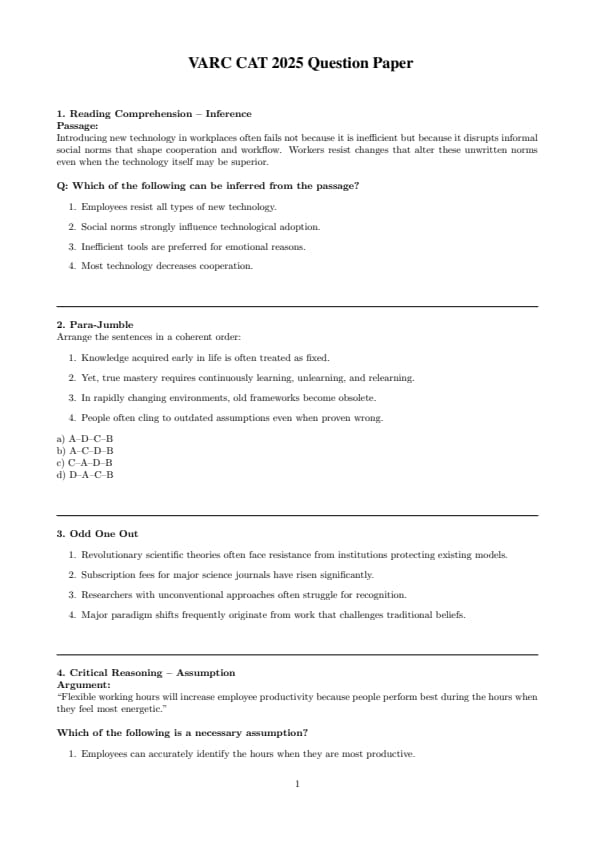
Passage:
Introducing new technology in workplaces often fails not because it is inefficient but because it disrupts informal social norms that shape cooperation and workflow. Workers resist changes that alter these unwritten norms even when the technology itself may be superior.
Q: Which of the following can be inferred from the passage?
(A) Employees resist all types of new technology.
(B) Social norms strongly influence technological adoption.
(C) Inefficient tools are preferred for emotional reasons.
(D) Most technology decreases cooperation.
Arrange the sentences in a coherent order:
(A) Knowledge acquired early in life is often treated as fixed.
(B) Yet, true mastery requires continuously learning, unlearning, and relearning.
(C) In rapidly changing environments, old frameworks become obsolete.
(D) People often cling to outdated assumptions even when proven wrong.
Odd One Out
(A) Revolutionary scientific theories often face resistance from institutions protecting existing models.
(B) Subscription fees for major science journals have risen significantly.
(C) Researchers with unconventional approaches often struggle for recognition.
(D) Major paradigm shifts frequently originate from work that challenges traditional beliefs.
Argument:
“Flexible working hours will increase employee productivity because people perform best during the hours when they feel most energetic.”
Which of the following is a necessary assumption?
(A) Employees can accurately identify the hours when they are most productive.
(B) Productivity depends only on the time of day.
(C) Employees dislike rigid schedules.
(D) Flexible hours reduce overall work time.
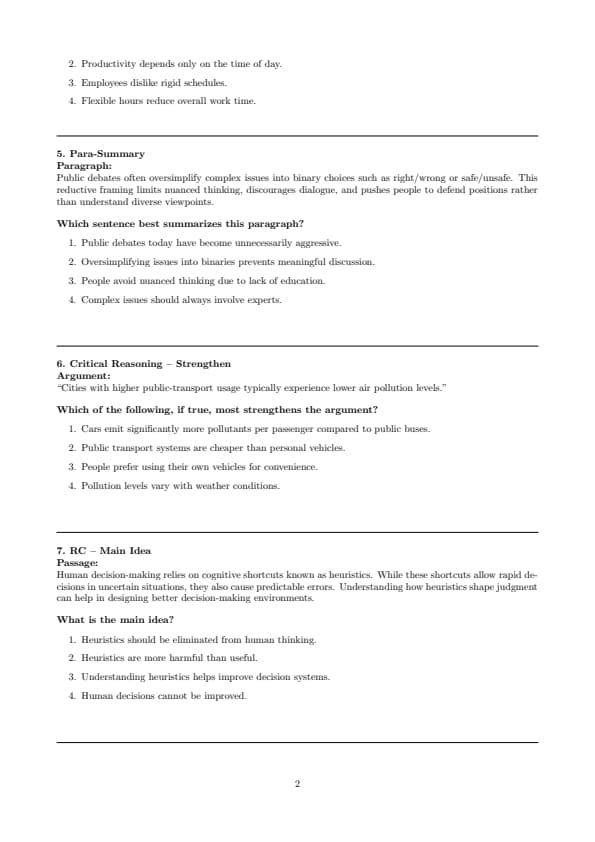
Paragraph:
Public debates often oversimplify complex issues into binary choices such as right/wrong or safe/unsafe. This reductive framing limits nuanced thinking, discourages dialogue, and pushes people to defend positions rather than understand diverse viewpoints.
Which sentence best summarizes this paragraph?
(A) Public debates today have become unnecessarily aggressive.
(B) Oversimplifying issues into binaries prevents meaningful discussion.
(C) People avoid nuanced thinking due to lack of education.
(D) Complex issues should always involve experts.
Argument:
“Cities with higher public-transport usage typically experience lower air pollution levels.”
Which of the following, if true, most strengthens the argument?
(A) Cars emit significantly more pollutants per passenger compared to public buses.
(B) Public transport systems are cheaper than personal vehicles.
(C) People prefer using their own vehicles for convenience.
(D) Pollution levels vary with weather conditions.
Passage:
Human decision-making relies on cognitive shortcuts known as heuristics. While these shortcuts allow rapid decisions in uncertain situations, they also cause predictable errors. Understanding how heuristics shape judgment can help in designing better decision-making environments.
What is the main idea?
(A) Heuristics should be eliminated from human thinking.
(B) Heuristics are more harmful than useful.
(C) Understanding heuristics helps improve decision systems.
(D) Human decisions cannot be improved.
CAT 2025 Difficulty Level Analysis (Expected)
| Section | Difficulty Level | Time Required (Avg.) | Strategy |
|---|---|---|---|
| Verbal Ability and Reading Comprehension (VARC) | Moderate | 60 mins | Focus on speed reading and eliminating incorrect options |
| Data Interpretation and Logical Reasoning (DILR) | High | 40-45 mins | Prioritize easier questions first; manage time carefully |
| Quantitative Ability (QA) | Moderate to High | 60 mins | Solve easy questions first; focus on accuracy |
| Overall | Moderate to High | 180 mins | Time management is key; balance speed and accuracy |



Comments