




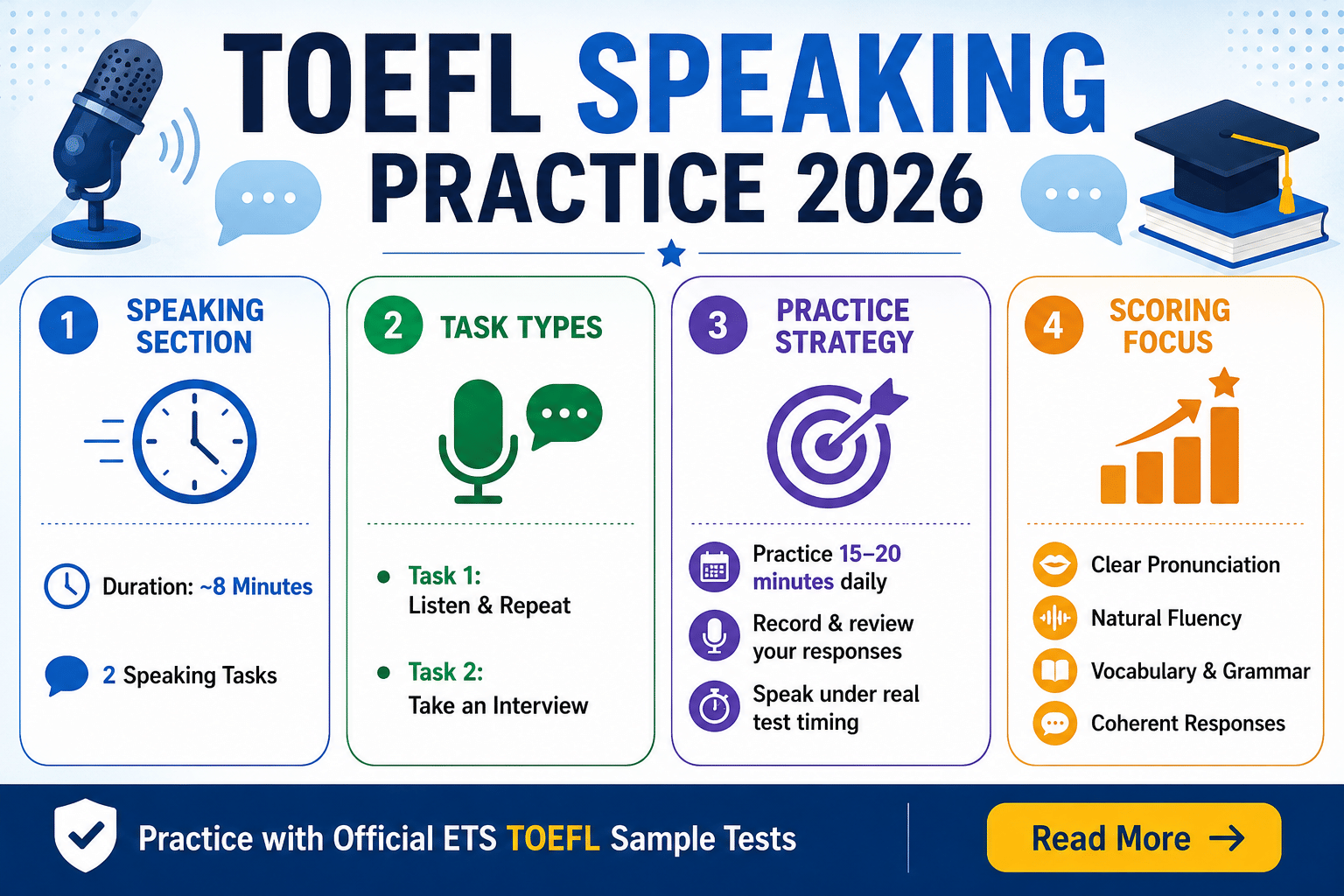
The TOEFL Speaking section tests your ability to communicate clearly and confidently in English through 2 speaking tasks completed in about 8 minutes. Regular practice with timed questions and sample answers can help improve your fluency, pronunciation, and response organization.
The 2 task of TOEFL Speaking are:
- Task 1: Listen and Repeat
- Task 2: Take an Interview
- TOEFL Speaking Format 2026
- TOEFL Speaking Practice Questions with Answers
- TOEFL Speaking Task 1 Practice Questions and Answers
- TOEFL Speaking Task 2 Practice Questions and Answers
- TOEFL Speaking Practice Test Paper PDF 2026
- TOEFL Speaking Practice Tips for Beginners 2026
- How to Practice TOEFL Speaking at Home 2026
- FAQs
TOEFL Speaking Format 2026
The TOEFL Speaking section is approximately 8 minutes long and has 2 tasks. Applicants need to sit for an interview as one of the tasks. 2nd task of this section is “Listen and Repeat.”
The TOEFL Speaking tasks are:
| Task | Description | Skills Tested |
|---|---|---|
| Take an Interview | Sit for an interview discussing your purposes to go abroad and future plans. | Ability to communicate, maintain a natural speaking pace, vocabulary, and grammar |
| Listen and Repeat | You will listen to short sentences and repeat them exactly as you hear them. | Pronunciation accuracy and fluent spoken English. |
TOEFL Speaking Practice Questions with Answers
Task 1: Listen and Repeat
You'll hear a sentence once and repeat it exactly, matching pronunciation, rhythm, and intonation as closely as possible.
- "The university library will be open until midnight during final exam week."
- "She submitted her research proposal a few days before the deadline."
- "Most students in the dorm prefer studying in groups rather than alone."
- "The professor rescheduled the lecture because of a technical problem."
- "He wasn't sure whether the internship would count toward his course credit."
- "The campus shuttle stops running earlier on weekends than on weekdays."
- "They decided to meet at the student center before heading to the seminar."
- "Registration for next semester's classes opens on the fifteenth of this month."
Practice tip: Say each sentence naturally at a normal pace, don't pause mid-sentence, and keep your pitch and stress pattern close to the model.
Task 2: Take an Interview
You'll answer a series of short questions from a simulated interviewer about your experiences, opinions, or campus-life situations. Responses are brief and conversational — not long speeches.
Sample interview set (academic or campus theme):
- "What's one class you're currently taking that you find especially interesting? Why?"
- "Do you prefer studying alone or with a group? What's the reason?"
- "Tell me about a time you had to manage a tight deadline. How did you handle it?"
- "What's something about student life at your school that surprised you?"
- "If you could change one thing about how your university teaches a subject, what would it be?"
Sample interview set (everyday or opinion theme):
- "Do you think it's better to plan your day in detail or stay flexible? Why?"
- "What's a skill you'd like to improve this year, and why?"
- "Describe a place near where you live that you enjoy visiting."
- "Would you rather work on a team project or an individual one? Explain your choice."
- "What's one piece of advice you'd give to someone just starting university?"
Practice tip: Keep answers natural and around 15-30 seconds. State a clear opinion or example first, then add one supporting detail. Avoid memorized scripts, the new format rewards spontaneous, coherent speech over rehearsed structure.
Task 2 Sample Answers
Academic or Campus Theme
1. "What's one class you're currently taking that you find especially interesting? Why?"
Ans) Right now I'm taking a psychology elective on decision-making, and I find it really interesting because it explains a lot of everyday behavior I never thought about critically before. For example, we recently discussed why people often stick with a bad choice just because they've already invested time in it. It's changed how I think about my own decisions, not just academically.
2. "Do you prefer studying alone or with a group? What's the reason?"
I generally prefer studying alone, especially for subjects that require deep focus, like math or writing. When I study with others, I tend to get distracted by conversation, and we end up covering less material. That said, I do think group study works well for reviewing before exams, since explaining concepts to someone else helps me spot gaps in my own understanding.
3. "Tell me about a time you had to manage a tight deadline. How did you handle it?"
Last semester I had two major assignments due on the same day because of a scheduling conflict. I handled it by breaking each task into smaller pieces and setting mini deadlines for myself a few days in advance. It was stressful, but planning like that meant I wasn't trying to finish everything the night before.
4. "What's something about student life at your school that surprised you?"
Honestly, I was surprised by how much independence is expected right from the first week. Coming from a more structured high school environment, I didn't expect professors to leave so much of the responsibility for staying on track up to the students themselves. It took some adjustment, but it also taught me better time-management skills.
5. "If you could change one thing about how your university teaches a subject, what would it be?"
I'd probably change how introductory statistics is taught. Right now it's very lecture-heavy, with limited hands-on practice, so a lot of students struggle to connect the theory to real data. I think adding more lab-style sessions where we actually work with datasets would make the concepts click faster.
Answers Task 2 Practice Questions
Everyday or Opinion Theme
1. "Do you think it's better to plan your day in detail or stay flexible? Why?"
I think a mix of both works best, but if I had to choose, I'd lean toward having a general plan rather than a strict, detailed one. Life is unpredictable, so if every hour is scheduled, one delay throws off the whole day. A loose plan with a few key priorities lets me adjust without feeling like I've failed at sticking to it.
2. "What's a skill you'd like to improve this year, and why?"
I'd like to improve my public speaking skills. I'm comfortable writing out my ideas, but speaking confidently in front of a group still makes me nervous. Since I'll likely need to present research or ideas professionally in the future, I think it's worth working on now rather than avoiding it.
3. "Describe a place near where you live that you enjoy visiting."
There's a small park near my apartment with a walking trail along a river. I like going there in the early evening because it's quiet, and it gives me a break from screens and schoolwork. It's not anything special or well-known, but it's become a spot where I do a lot of my thinking.
4. "Would you rather work on a team project or an individual one? Explain your choice."
I'd rather work on a team project, mainly because I learn a lot from seeing how other people approach the same problem differently than I would. It can be harder to coordinate schedules and divide work fairly, but the result is usually stronger because it combines different strengths.
5. "What's one piece of advice you'd give to someone just starting university?"
I'd tell them not to wait until they're struggling to ask for help. A lot of students, including me at first, think asking questions makes them look unprepared, but professors and tutors are there specifically for that. Reaching out early saves a lot of unnecessary stress later on.
TOEFL Speaking Task 1 Practice Questions and Answers
Task 1: Listen and Repeat
For this task, the "answer" is simply repeating the sentence exactly as spoken — same words, same word order. What raters actually score is how you say it: accuracy of every word, clear pronunciation, natural rhythm, and matching intonation/stress. Below, each sentence is followed by its "answer" (the exact repetition) plus a stress/pronunciation note so you know what to focus on.
| Sentence to Repeat | Stress & Pronunciation Focus |
|---|---|
| "The lecture hall was full by the time class started." | Stress "completely" and "full"; don't drop the "-ly" ending. |
| "I forgot to bring my notebook to the study session." | Keep "forgot" and "notebook" clear; avoid rushing "study session." |
| "The advisor suggested I take a lighter course load next term." | Stress "suggested" and "lighter"; "course load" said as one smooth phrase. |
| "Our group presentation went better than we expected." | Natural rising-falling intonation on "better than we expected." |
| "She's been working part-time at the campus bookstore since August." | Keep "part-time" and "bookstore" crisp; don't merge "since August." |
| "The exam covered material we hadn't reviewed in class." | Stress "covered" and "hadn't"; clear contraction on "hadn't." |
| "He missed the bus, so he walked to campus instead." | Slight pause after "bus," clear "so" as a connector. |
| "The results of the survey were more surprising than we thought." | Stress "surprising"; keep final "thought" from trailing off. |
Answer format: For each, your spoken response should be word-for-word identical to the sentence above, nothing added, nothing omitted, nothing reordered. Scoring focuses on intelligibility (can a listener understand you without extra effort?) and accuracy (did you say every word correctly?), not on adding your own ideas.
TOEFL Speaking Task 2 Practice Questions and Answers
Task 2: Take an Interview
1. "What's a class or subject you found difficult at first but eventually got better at?"
Chemistry was tough for me at first, mostly because of all the formulas and lab procedures. I struggled during the first few weeks, but once I started reviewing my notes right after each class instead of waiting until exam time, it started making a lot more sense. By the end of the semester, it became one of my stronger subjects.
2. "Do you think technology has made studying easier or harder? Why?"
I'd say easier overall, mainly because of how much information is instantly accessible now. I can look up a concept I don't understand in seconds instead of searching through a textbook. That said, it can also be distracting, since it's easy to get pulled toward unrelated apps while trying to study.
3. "Tell me about a decision you made recently that you're glad you made."
I recently decided to switch from commuting to living closer to campus, and I'm really glad I did. It was a big adjustment financially, but it's given me back almost two hours a day that I used to spend traveling. I've been able to use that time for studying and getting more sleep.
4. "What's one thing you wish your school offered that it currently doesn't?"
I wish there were more quiet study spaces available late at night. Right now the library closes earlier than I'd like, especially during exam periods, and it's hard to find a good place to focus after that. Even one 24-hour study room would make a big difference for a lot of students.
5. "How do you usually deal with stress during a busy week?"
Honestly, exercise helps me the most. Even a short walk between classes clears my head and makes it easier to focus afterward. I also try to avoid stacking too many big tasks on the same day, since that's usually when I feel the most overwhelmed.
6. "Would you rather have a strict daily routine or a more spontaneous schedule? Why?"
I lean toward a routine, actually, even though it might sound a little rigid. Having set times for studying, eating, and sleeping keeps me from procrastinating. Without some structure, I tend to lose track of time and end up cramming everything at the last minute.
Tip: Task 1 answers should be identical to the prompt, precision over creativity. Task 2 answers should sound natural and conversational: a clear opinion up front, one relevant detail, and a smooth finish, not a memorized template.
TOEFL Speaking Practice Test Paper PDF 2026
Here are the TOEFL speaking mock tests that will help candidates to practice questions. TOEFL speaking sample can enhance speaking skills during TOEFL preparations. TOEFL speaking sample questions comprises previous year questions. These TOEFL speaking examples can be considered for the practice sessions to ace the speaking section.
TOEFL Speaking Practice Tips for Beginners 2026
Applicants who are planning to appear for the TOEFL exam for the first time should follow these tips to score better in the Speaking test. Follow these tips and strategies to prepare:
- Speak English out loud every day, even just a few minutes about simple topics like your day or plans.
- For Listen and Repeat, record yourself and compare. Play the original sentence, record your repeat, and check which words you missed or said unclearly.
- For “Take an Interview”, keep answers short. One clear opinion, one example, then stop, aim for 20-40 seconds answer.
- Start with easy, personal topics before moving to school or academic ones.
- Don't memorize scripts. Natural, spontaneous speech scores better than rehearsed answers.
- Focus on being understood, not sounding native. The test checks clarity, not accent.
How to Practice TOEFL Speaking at Home 2026
Applicants who are practicing Speaking task 1&2 at home should follow these tips and strategies to prepare well. Follow these tips below to score well in the Speaking test:
- Do short daily sessions (15-20 minutes) instead of one long session a week.
- Record every practice answer and listen back for pace, filler words, and clarity.
- Practice note-taking the real way, a small whiteboard or paper in a plastic sleeve, not regular pen and paper.
- Do full sessions without breaks, just like the actual test.
- Take one full self-test per week using ETS's free Sample Test or TestReady tool.
- Remove distractions during practice, silence notifications, and ask for quiet time to match the real test environment.
Also read: Check TOEFL Speaking Topics for Independent and Integrated Task 2026
Regular TOEFL Speaking practice is the key to improving fluency, pronunciation, and response organization. The Speaking section lasts about 8 minutes and includes 2 tasks, so practicing with timed mock tests and sample questions can help you become comfortable with the actual exam format. Focus on giving clear, natural responses and review your recordings regularly to identify areas for improvement. Consistent practice with official TOEFL materials can help you build confidence and perform better on test day.
FAQs
Ques. Can I take notes during the TOEFL Speaking section?
Ans. Yes. ETS allows you to take notes while reading passages and listening to conversations or lectures in the Speaking section. You may use these notes to prepare and organize your spoken responses.
Ques. How much preparation time do I get before answering a TOEFL Speaking question?
Ans. According to ETS, you receive a short preparation period before speaking. Depending on the question, the preparation time ranges from 15 to 30 seconds, after which your response time begins.
Ques. What does ETS evaluate in the TOEFL Speaking section?
Ans. ETS evaluates whether you can communicate your ideas clearly and coherently. Responses are assessed based on speech delivery, language use, and how well you develop and organize your ideas while accurately conveying information from reading and listening materials when required.
Ques. Can I get feedback on my TOEFL Speaking practice?
Ans. Yes. Through TOEFL TestReady™, ETS provides personalized feedback on Speaking responses, including speech rate, pronunciation, rhythm, grammar, transcripts, and comparison with exemplar responses.
Ques. Does my accent affect my TOEFL Speaking score?
Ans. No. According to ETS, the Speaking section measures whether your speech is clear and understandable. A particular English accent is not required as long as your pronunciation allows listeners to understand you.
Ques. Can I listen to the audio more than once in the Speaking section?
Ans. No. ETS plays each audio recording only once during the Speaking section. Test takers should listen carefully and use their notes to prepare their responses.
Ques. What happens when my speaking time runs out?
Ans. According to ETS, the recording stops automatically when the allotted response time ends. Any speech after the time limit is not recorded.
*tyOAMR



Comments