




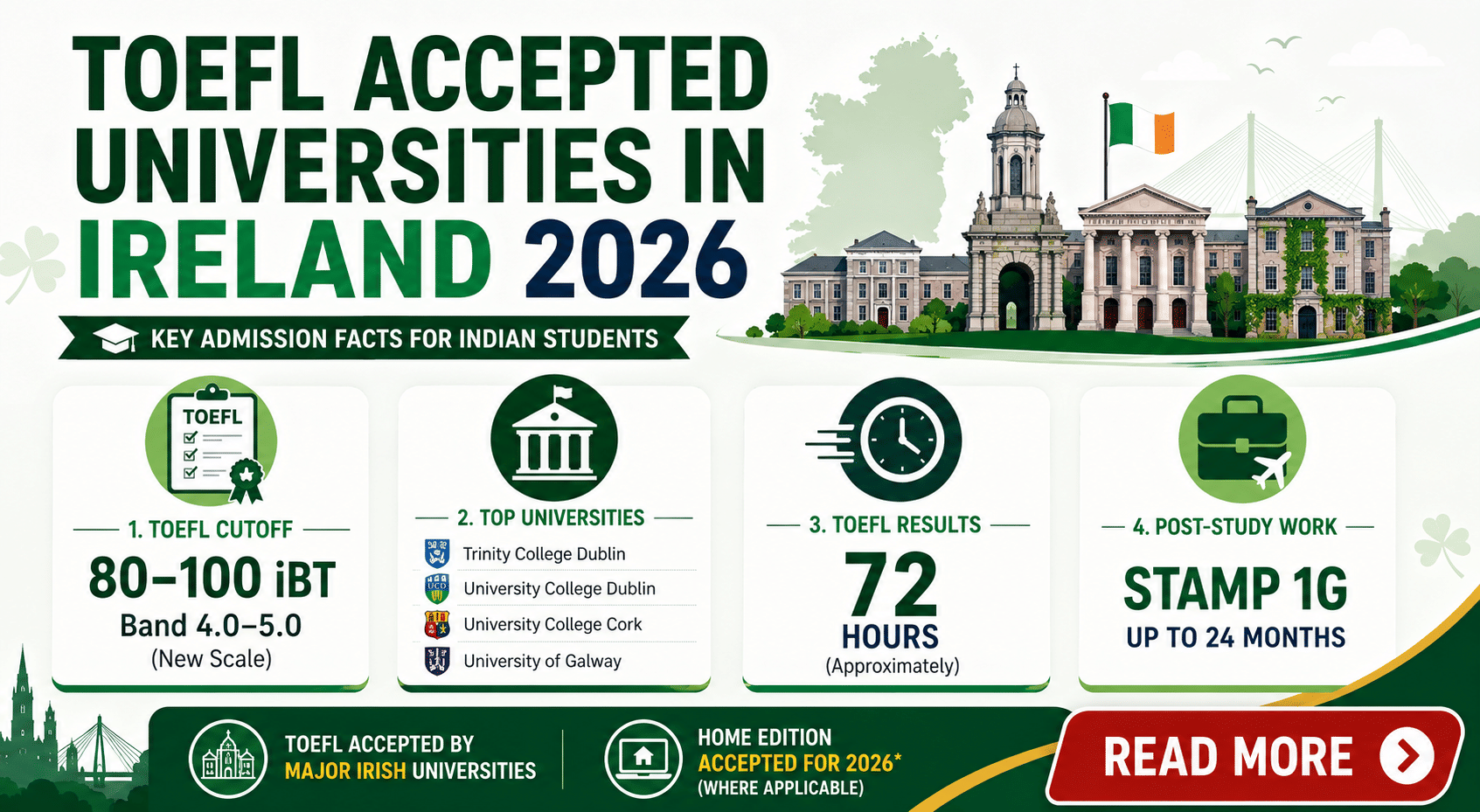
Most major Irish universities accept TOEFL iBT scores between 80 and 100 on the old scale or Band 4.0 to 5.0 on the new 1-6 scale launched by ETS on January 21, 2026. Trinity College Dublin, University College Dublin, University College Cork, University of Galway, Dublin City University, University of Limerick, Maynooth University and Technological University Dublin all recognise TOEFL as valid English proficiency proof.
- Most postgraduate programs in Ireland require a TOEFL iBT score of 90 (Band 4.5) or higher with minimum sectional cutoffs.
- TOEFL score reports now display both the new 1-6 band score and the legacy 0-120 score side by side until January 2028.
- Annual tuition at TOEFL accepted universities in Ireland ranges from EUR 9,800 to EUR 55,000 (Rs 11.04 lakh to Rs 61.96 lakh).
- Stamp 1G gives Level 9 master's graduates a 24-month post-study work stay with no salary threshold.
- TOEFL iBT Home Edition is accepted by Irish Immigration and UCD for student visa applications in 2026.
Many Indian applicants take the test under the old scoring rules and then discover their score reports now show two numbers. Recent student threads show confusion about which figure Irish admissions officers actually use, especially after the ETS scoring change on January 21, 2026.
Picking the right English test and reading the new TOEFL scale correctly affects application turnaround, scholarship eligibility, and visa timeline, so knowing exactly which Irish universities accept TOEFL and how they treat the new band scores saves both money and a wasted exam attempt.
Read More: Top Universities in Ireland for Indian Students
- TOEFL 2026 New Band Scale: What Indian Students Need to Know
1.1 How Irish universities are handling the transition
1.2 Faster results and TOEFL Home Edition status
- Top Universities in Ireland Accepting TOEFL Scores
2.1 Sectional TOEFL score requirements explained
2.2 TOEFL iBT Home Edition status in Ireland
- Minimum TOEFL Score for Irish Universities (UG and PG)
3.1 What the new band scale changes for Indian applicants
- Popular Courses at TOEFL Accepted Universities in Ireland
4.1 Course-specific TOEFL buffer for Indian students
- Scholarships and Intake Calendar for TOEFL Applicants
5.1 September and January intake timeline
- Application Steps for Indian Students Using TOEFL
- Why Ireland Is Gaining Popularity Among Indian Students
7.1 The Stamp 1G stay-back advantage
7.2 ROI math for Indian students
- FAQs on TOEFL Accepted Universities in Ireland
TOEFL 2026 New Band Scale: What Indian Students Need to Know
ETS launched a new TOEFL iBT 1.0 to 6.0 band score scale on January 21, 2026, replacing the legacy 0-120 total score format. During a two-year transition period until January 2028, every TOEFL score report displays both the new band score and the comparable old 0-120 score, so Indian applicants can present either number to Irish universities.
The new TOEFL scale is aligned with the Common European Framework of Reference (CEFR), which most Irish universities already use to benchmark English proficiency. Each of the four sections (Reading, Listening, Speaking and Writing) is now scored from 1.0 to 6.0 in half-point increments. The overall score is the average of all four sections, rounded to the nearest half band. A test-taker whose section average lands at 5.25, for example, receives an overall band score of 5.5.
| New TOEFL Band (1-6) | Old TOEFL Score (0-120) | CEFR Level | What it means for Ireland |
|---|---|---|---|
| Band 6.0 | 114 and above | C2 Proficient | Above any Irish requirement |
| Band 5.5 | 107 and above | C1 to C2 | Exceeds standard Irish PG requirements |
| Band 5.0 | 95 and above | C1 Advanced | UCD Smurfit MBA, Trinity higher entry, UCC select PG |
| Band 4.5 | 86 and above | B2 to C1 | Standard entry for UCD, Trinity, UCC, Galway, UL, DCU, Maynooth |
| Band 4.0 | 72 and above | B2 Upper Intermediate | TU Dublin entry |
| Band 3.5 | 58 and above | B1 to B2 | Below most degree thresholds |
Source: Official ETS score comparison chart. Each band on the new scale maps to a range of total scores on the old scale, since the underlying performance is the same but the scales have different granularity.
How Irish universities are handling the transition
UCD has already published both old and new TOEFL cutoffs on its admissions page. The university accepts TOEFL iBT 90 on the old scale or a minimum overall Band 4.5 with no less than 4.5 in each section on the new scale. Most other Irish universities still publish only the old 0-120 cutoffs but accept the new band scores during the transition period, since every score report continues to show both numbers.
Faster results and TOEFL Home Edition status
Scores are now posted to the test taker's ETS account approximately 3 days (72 hours) after the test, down from the previous 4 to 8 business days. Delivery to designated recipient institutions still follows the standard ETS timeline of 4 to 8 business days via ETS Data Manager. Irish Immigration accepts both the TOEFL iBT test centre and the TOEFL iBT Home Edition for student visa applications. UCD also confirms that it accepts the Home Edition for 2026 entry, subject to a review for future cycles.
Check Out: TOEFL iBT Exam Pattern, Syllabus and Score Validity
Top Universities in Ireland Accepting TOEFL Scores
The top TOEFL accepted universities in Ireland include Trinity College Dublin, University College Dublin, University College Cork, University of Galway, Dublin City University, University of Limerick, Maynooth University and Technological University Dublin. These eight institutions cover almost every QS-ranked option an Indian student would consider.
Every one of these universities recognises TOEFL iBT as a valid English proficiency proof and most also accept the Home Edition version for visa purposes. The minimum score varies by program level, with postgraduate cutoffs typically 10 to 20 points higher than undergraduate ones on the old scale, or roughly 0.5 band higher on the new scale. The table below shows the 2026 QS World University Ranking, the minimum TOEFL score in both formats and the annual tuition range for international students.
| University | QS World Ranking 2026 | Minimum TOEFL (Old 0-120) | Minimum TOEFL (New 1-6 Band) | Annual Tuition (EUR) |
|---|---|---|---|---|
| Trinity College Dublin | 75 | 90 (standard), 100 (higher) | Band 4.5 (standard), Band 5.0 (higher) | 11,002 to 55,000 |
| University College Dublin | 118 | 90 (UG and PG floor), 100 (select PG) | Band 4.5 (floor), Band 5.0 (select PG) | 11,300 to 36,990 |
| University College Cork | 246 | 90 (UG and PG), 100 (select PG) | Band 4.5 (standard), Band 5.0 (select PG) | 11,500 to 49,900 |
| University of Galway | 284 | 88 (UG), 95 (PG) | Band 4.5 (UG), Band 5.0 (PG) | 14,166 to 24,140 |
| Dublin City University | 410 | 92 (UG and PG) | Band 4.5 | 9,800 to 25,000 |
| University of Limerick | 401 | 90 (UG and PG) | Band 4.5 | 12,852 to 37,600 |
| Maynooth University | 771-780 | 92 (UG and PG) | Band 4.5 | 14,000 to 18,000 |
| Technological University Dublin | 781-790 | 80 (UG and PG) | Band 4.0 | 8,806 to 14,500 |
Trinity College Dublin and University College Dublin sit in the global top 130, which make them the strongest brand-value picks for Indian students who plan to return home or move to another English-speaking job market after graduation. The remaining six universities trade a lower ranking for more economical tuition, lower TOEFL cutoffs and stronger placement support in specific sectors like pharma (UCC), data science (Maynooth) and engineering (UL).
Sectional TOEFL score requirements explained
Irish universities do not just look at the overall TOEFL score, they also enforce minimum sectional cutoffs. UCD postgraduate programs, for example, require at least 21 in writing and 19 in each other section on the old scale for an overall 90, or at least 4.5 in each section on the new scale for an overall Band 4.5. Missing a section by even half a band can disqualify an otherwise strong application.
TOEFL iBT Home Edition status in Ireland
Irish Immigration accepts both the TOEFL iBT test centre and the TOEFL iBT Home Edition for student visa applications, a policy that has stayed in place since 2020. Most universities follow the same rule, though a few programs in medicine and nursing still ask for the test-centre version only. Always check the program page before booking the Home Edition slot.
Minimum TOEFL Score for Irish Universities (UG and PG)
The minimum TOEFL iBT score for undergraduate programs in Ireland is 80 to 92 (Band 4.0 to 4.5), while postgraduate programs typically require 90 to 100 (Band 4.5 to 5.0), depending on the university and the specific course.
Cutoffs cluster around three tiers. Tier 1 universities like Trinity and UCD set the bar at 90 (Band 4.5) for standard entry and 100 (Band 5.0) for higher-entry or select PG programs. Tier 2 universities like UCC, Galway, UL, Maynooth and DCU sit between 88 and 95 for standard entry. Tier 3 accepts TOEFL from 80, with TU Dublin published at this floor. The table below breaks down the typical UG and PG cutoffs by university so that applicants can match their TOEFL band to their shortlist.
| University | UG TOEFL (Old / New) | PG TOEFL (Old / New) | Sectional Minimums (Old / New) |
|---|---|---|---|
| Trinity College Dublin | 90 / Band 4.5 | 90 to 100 / Band 4.5 to 5.0 | 21 in each / 4.0 to 4.5 in each |
| University College Dublin | 90 / Band 4.5 | 90 to 100 / Band 4.5 to 5.0 | 21 to 23 in writing / 4.5 in each |
| University College Cork | 90 / Band 4.5 | 90 to 100 / Band 4.5 to 5.0 | 20 in each / 4.5 in each |
| University of Galway | 88 / Band 4.5 | 95 / Band 5.0 | 21 in writing / 4.5 in each |
| Dublin City University | 92 / Band 4.5 | 92 / Band 4.5 | No minimum sectional (overall only) / 4.5 in each |
| University of Limerick | 90 / Band 4.5 | 90 to 100 / Band 4.5 to 5.0 | 20 in writing / 4.0 in each |
| Maynooth University | 92 / Band 4.5 | 92 / Band 4.5 | Overall score only |
| Technological University Dublin | 80 / Band 4.0 | 80 to 90 / Band 4.0 to 4.5 | 17 to 20 by program |
Sources: official university admissions pages (tcd.ie, ucd.ie, ucc.ie, universityofgalway.ie, dcu.ie, ul.ie, maynoothuniversity.ie, tudublin.ie) and the official ETS conversion chart from January 2026, all verified as of May 2026. Cutoffs are the standard published minimums; specific programs (MBA, medicine, law, computer science, business analytics) often set higher bars and applicants must check the exact requirement on the course page before applying.
Important: A TOEFL score of 95 to 100 (Band 5.0) is the safest target for Indian applicants aiming at Trinity, UCD or UCC postgraduate programs. It clears the published cutoff with a buffer and improves the application's competitive standing when seats are limited.
What the new band scale changes for Indian applicants
Indian students who tested under the old TOEFL system before January 21, 2026 continue to use their old 0-120 scores until those scores expire two years from the test date. Students testing on or after that date receive both numbers on their score report. The practical effect is that an applicant with an old TOEFL 100 and a new test-taker with Band 5.0 are evaluated on the same standard at every Irish university. The new scale just makes the score easier to read for admissions officers who are used to CEFR levels.
Read More: Exams Required to Study in Ireland for Indian Students
Popular Courses at TOEFL Accepted Universities in Ireland
The most popular courses for Indian students at TOEFL accepted universities in Ireland are MSc Data Science, MSc Computer Science, MSc Business Analytics, MBA, MSc Pharmaceutical Technology and MSc Finance. Each of these maps to a strong Irish industry sector with active hiring for international graduates.
Ireland's economy concentrates around three pillars: technology (Google, Meta, LinkedIn, Microsoft EMEA HQs in Dublin), pharma and biotech (Pfizer, Johnson and Johnson, AbbVie clusters in Cork and Galway) and financial services (the IFSC zone in Dublin). The course choices below mirror these sectors and feed directly into Stamp 1G hiring pipelines.
| Popular Course | Top Universities | Annual Tuition (EUR / INR) | Typical TOEFL Cutoff |
|---|---|---|---|
| MSc Data Science | UCD, Trinity, Maynooth, Galway | 17,000 to 28,000 / Rs 19.15 lakh to 31.54 lakh | 90 to 100 (Band 4.5 to 5.0) |
| MSc Computer Science | Trinity, UCD, UCC, DCU | 18,000 to 30,000 / Rs 20.28 lakh to 33.80 lakh | 90 to 100 (Band 4.5 to 5.0) |
| MSc Business Analytics | UCD Smurfit, DCU, UL | 16,000 to 27,000 / Rs 18.02 lakh to 30.42 lakh | 90 to 100 (Band 4.5 to 5.0) |
| MBA | Trinity, UCD Smurfit, UCC | 35,000 to 50,000 / Rs 39.43 lakh to 56.33 lakh | 100 (Band 5.0) |
| MSc Pharmaceutical Technology | UCC, Trinity, RCSI | 17,500 to 28,000 / Rs 19.71 lakh to 31.54 lakh | 90 (Band 4.5) |
| MSc Finance | UCD Smurfit, Trinity, DCU | 20,000 to 35,000 / Rs 22.53 lakh to 39.43 lakh | 100 (Band 5.0) |
Conversions based on an EUR-INR rate of Rs 112.65 as of May 21, 2026. Exchange rates fluctuate; check the current rate before financial planning.
The Dublin tech cluster hires hundreds of international graduates each year through Stamp 1G. Starting salaries in technology run EUR 45,000 to EUR 60,000 (Rs 50.69 lakh to Rs 67.59 lakh) per year for new graduates at Dublin-based multinationals. Most programs are 1-year Level 9 master's, which unlocks the full 24-month stay-back. The Critical Skills Employment Permit pathway is well-trodden, leading to Stamp 4 in under 2 years for many Indian graduates.
Course-specific TOEFL buffer for Indian students
Highly competitive programs like UCD MSc Computer Science, Trinity MSc Data Science and UCC MSc Pharmaceutical Technology often see TOEFL admit medians of 100 to 105 (Band 5.0), even though the published cutoff is 90 to 100. Applying with a score that just meets the floor puts the application in a borderline pile, especially for the September intake when seat pressure is highest.
Check Out: MS in Ireland for Indian Students
Scholarships and Intake Calendar for TOEFL Applicants
Indian students applying to TOEFL-accepted universities in Ireland can target two main intakes (September and January) and access scholarships ranging from EUR 2,000 to a full 100% tuition waiver.
The September intake is the larger one with almost every program open, while the January intake is selective and mostly available for taught master's in business, computing and arts. Scholarship applications usually run parallel to the main admission process, so a confirmed TOEFL score helps lock in eligibility early. Some scholarships also weigh the TOEFL band as a tie-breaker between equally qualified Indian applicants.
| Scholarship | Eligibility | Value |
|---|---|---|
| Government of Ireland International Education Scholarship | Open to non-EU/EEA students with strong academic record | EUR 10,000 (Rs 11.27 lakh) plus full fee waiver for 1 year |
| UCD Global Excellence Scholarship | Merit-based, automatic on application to UCD | 10% to 100% tuition reduction |
| Trinity College Dublin Global Excellence Award | Open to Indian PG applicants with first-class degree | EUR 5,000 to EUR 10,000 (Rs 5.63 lakh to Rs 11.27 lakh) |
| UCC India Scholarship | Indian nationals applying to UCC PG programs | EUR 2,000 to EUR 5,000 (Rs 2.25 lakh to Rs 5.63 lakh) tuition waiver |
| University of Galway Hardiman PhD Scholarship | PhD applicants in research-led programs | Full fee waiver plus EUR 19,000 (Rs 21.40 lakh) annual stipend |
| DCU International Merit Scholarship | Merit-based for UG and PG Indian students | EUR 2,000 (Rs 2.25 lakh) tuition reduction |
Most of these scholarships do not have separate TOEFL cutoffs but they assume the applicant has already cleared the program's English requirement. A TOEFL score that comfortably clears the floor (Band 5.0 or 95+ for Trinity, UCD and UCC) signals readiness and helps in close scholarship decisions.
September and January intake timeline
The September intake opens applications in October to November of the previous year and most postgraduate deadlines fall between March and June. The January intake opens around June with deadlines in September to October. Applicants should sit for the TOEFL at least 3 to 4 months before the deadline to allow for score reporting, retakes if needed and document submission.
Important: TOEFL scores are valid for 2 years from the test date. Plan the test window so the score is still valid on the day classes start, not just the day of application. UCD specifically notes that for September 2026 entry, results must have been attained since 1 February 2024.
Application Steps for Indian Students Using TOEFL
The TOEFL-based application to Irish universities follows five stages from shortlisting to visa, with the test score sitting at the centre of the process.
Indian applicants should treat the TOEFL booking and result delivery as a critical-path item, especially since scores are now posted to the test taker's ETS account within 3 days (72 hours) of the test. Faster score visibility for the applicant means less buffer is needed between the test and the application deadline, but planning still matters because institutional delivery via ETS Data Manager takes a further 4 to 8 business days and every university requires the score to be sent directly from ETS using its institution code.
| Stage | Timeline | Action required |
|---|---|---|
| Shortlist universities | 12 to 14 months before intake | Match academic profile to TOEFL cutoffs and tuition budget |
| Book and write TOEFL | 9 to 10 months before intake | Target Band 5.0 (95+) for Tier 1 programs, Band 4.5 (85+) for Tier 2 and 3 |
| Submit application | 6 to 8 months before intake | Send TOEFL scores directly from ETS using the university DI code |
| Accept offer and pay deposit | 3 to 5 months before intake | Confirm seat with non-refundable deposit, typically EUR 500 to EUR 2,000 |
| Apply for Stamp 2 student visa | 2 to 3 months before intake | Submit AIP letter, finances proof and visa fee to Irish Embassy |
The TOEFL score sits at the centre of stages 2 and 3, since most universities will not process the application without an official ETS score report linked to their institution code. Test takers can view their scores within 3 days of testing, though institutional delivery to Irish universities takes a further 4 to 8 business days.
Why Ireland Is Gaining Popularity Among Indian Students
Ireland is gaining popularity among Indian students because of its 2-year Stamp 1G post-study work visa, English-medium instruction, lower tuition than the UK or US, and a fast pathway to long-term residency through the Critical Skills Employment Permit.
The number of Indian students in Ireland has grown sharply. According to Ireland's Higher Education Authority (HEA), Indian students made up 20.6% of the 44,535 international enrolments in 2024/25, around 9,175 Indian students across Irish higher education institutions. Indian nationals are now the largest international cohort in Ireland and consistently top new employment permit issuances. Stamp 1G has been the single biggest driver, since it gives master's graduates 24 months of unrestricted work rights with no salary threshold or sponsor requirement, a structural advantage over the UK and Germany.
| Pros (from student feedback) | Cons (from student feedback) |
|---|---|
| 2-year Stamp 1G is more generous than the UK Graduate Route for master's holders | Dublin rent is high, often EUR 1,200 to EUR 1,800 (Rs 1.35 lakh to Rs 2.03 lakh) per month for shared housing |
| English is the medium of instruction across all major universities | Tuition at top universities is higher than Germany for similar STEM programs |
| Direct path to Stamp 4 and citizenship in 5 reckonable years | Fewer scholarship slots than the US for tech master's programs |
| Strong tech, pharma and finance hiring with Critical Skills Permit | Winters can be tough for first-time international students |
For Indian students whose primary goal is to live and work abroad after the master's, Ireland offers one of the cleanest 1-year-degree-plus-2-year-work pathways among English-speaking destinations. The catch is high Dublin rent, which makes universities in Cork, Limerick and Galway financially smarter for budget-conscious applicants.
The Stamp 1G stay-back advantage
Stamp 1G is issued under Ireland's Third Level Graduate Programme and lets graduates work 40 hours a week for any employer without a separate work permit. The duration depends entirely on the qualification level on the National Framework of Qualifications. NFQ Level 8 (honours bachelor's) gets 12 months stay-back, NFQ Level 9 (master's, PG diploma) gets 24 months and NFQ Level 10 (PhD) gets 24 months.
For Indian students, this means picking a master's program (Level 9) over a bachelor's effectively doubles the post-study runway. In 2024, over 4,800 new Stamp 1G registrations were issued to Indian nationals and roughly 68% came from Level 9 graduates who used the full 2 years to transition into Critical Skills Employment Permits.
ROI math for Indian students
A 1-year master's at a TOEFL accepted university in Ireland costs roughly EUR 17,000 to EUR 30,000 (Rs 19.15 lakh to Rs 33.80 lakh) in tuition and EUR 12,000 to EUR 15,000 (Rs 13.52 lakh to Rs 16.90 lakh) in living expenses. Total all-in cost lands between Rs 32 lakh and Rs 51 lakh for the full degree. Starting salaries in pharma run EUR 38,000 to EUR 50,000 (Rs 42.81 lakh to Rs 56.33 lakh) while tech roles start at EUR 45,000 to EUR 60,000 (Rs 50.69 lakh to Rs 67.59 lakh), which means most graduates can recover the program cost within 2 to 3 years of post-Stamp 1G employment.
Important: Apply for the Stamp 1G within 6 months of receiving the final transcript. Missing this window forfeits the stay-back and forces a return to India before reapplying for a work permit.
Check Out: Scholarships in Ireland for Indian Students
FAQs on TOEFL Accepted Universities in Ireland
Ques. Is TOEFL accepted in Ireland for masters in 2026?
Ans. Yes, TOEFL is accepted at every major Irish university for master's admission. Trinity College Dublin, UCD, UCC, University of Galway, DCU, University of Limerick, Maynooth and TU Dublin all recognise TOEFL iBT with a typical postgraduate cutoff of 90 to 100 on the old scale or Band 4.5 to 5.0 on the new 1-6 band scale launched on January 21, 2026.
Ques. What is the new TOEFL band score system and how does it work for Irish universities?
Ans. From January 21, 2026, ETS scores TOEFL iBT on a new 1.0 to 6.0 band scale in half-point increments, aligned with the CEFR framework. Until January 2028, every score report shows both the new band and the old 0-120 score side by side, so Irish universities can read either number. UCD has already published both old and new TOEFL cutoffs, and other Irish universities accept both formats during the transition period.
Ques. What is the minimum TOEFL score for top universities in Ireland?
Ans. The minimum TOEFL iBT score for top Irish universities is 90 (Band 4.5) for undergraduate and 100 (Band 5.0) for select postgraduate programs at Trinity, UCD and UCC. Technological University Dublin accepts TOEFL scores from 80 (Band 4.0), which is the lowest published cutoff among QS-ranked Irish universities. Sectional cutoffs apply at most universities and vary by program.
Ques. Is TOEFL Home Edition accepted in Ireland for student visa in 2026?
Ans. Yes, the Irish Department of Justice accepts TOEFL iBT Home Edition equally with the test-centre version for the Stamp 2 student visa. UCD has confirmed it accepts the Home Edition for 2026 entry, subject to a review for future cycles. A small number of medical and nursing programs still require the test-centre version only, so always check the program page before booking.
Ques. How long is a TOEFL score valid for Irish university applications?
Ans. TOEFL scores are valid for 2 years from the test date. Irish universities require the score to still be valid on the day of program enrollment, not just the application date. UCD specifies that for September 2026 entry, results must have been attained since 1 February 2024. Applicants should plan to sit the TOEFL within 12 to 18 months of their intended start date.
Ques. Can Indian students get a TOEFL waiver for Irish universities?
Ans. Yes, many Irish universities offer a Medium of Instruction (MOI) waiver if the applicant completed their previous degree fully in English. Maynooth University, University of Limerick and DCU are flexible on this. Trinity, UCD and RCSI are stricter and usually still require a TOEFL score even with an MOI letter. Indian students should email the admissions office before assuming a waiver applies.
Ques. How is the new TOEFL Band 5.0 different from the old TOEFL 100?
Ans. They map to overlapping but not identical ranges. According to the official ETS conversion chart, Band 5.0 corresponds to an old score of 95 and above (up to about 106), while the old 100 sits comfortably within the Band 5.0 range. For Irish universities that previously required TOEFL 100, a new Band 5.0 score will meet that requirement. The two-year transition period (2026 to 2028) ensures both numbers stay visible on score reports.
Ques. Which Irish universities accept the lowest TOEFL scores?
Ans. Technological University Dublin accepts TOEFL iBT scores from 80 (Band 4.0) onwards for many undergraduate and select postgraduate programs. This is the lowest published cutoff among QS-ranked Irish universities. Specific competitive courses within TU Dublin may ask for 85 to 90 (Band 4.5), and applicants should check the official course page for the exact requirement.
Ques. What is the cost of studying at TOEFL accepted universities in Ireland for Indian students?
Ans. Annual tuition at TOEFL accepted universities in Ireland ranges from EUR 9,800 to EUR 55,000 (Rs 11.04 lakh to Rs 61.96 lakh). A 1-year master's typically costs Rs 32 lakh to Rs 51 lakh all-in, including tuition and living expenses. Conversions are based on an EUR-INR rate of Rs 112.65 as of May 21, 2026.
Ques. Are scholarships available at TOEFL accepted universities in Ireland?
Ans. Yes, multiple scholarships exist including the Government of Ireland International Education Scholarship (EUR 10,000), UCD Global Excellence Scholarship (up to 100% tuition), Trinity Global Excellence Award and UCC India Scholarship. Most are merit-based and assume the applicant has cleared the program's TOEFL requirement before being considered.
Ques. How long can Indian students stay in Ireland after a master's with a TOEFL-based admission?
Ans. Master's graduates (NFQ Level 9) get a 24-month Stamp 1G post-study work visa, regardless of the English test used at admission. This gives full-time work rights without a sponsor or salary threshold. Most Indian graduates transition to a Critical Skills Employment Permit during this period, which leads to Stamp 4 long-term residency in under 2 years.
Ques. How fast do TOEFL scores arrive in 2026 under the new system?
Ans. ETS now posts TOEFL iBT scores to the test taker's ETS account approximately 3 days (72 hours) after the test date, down from the previous 4 to 8 business days. The official ETS score report PDF is downloadable 1 day after electronic scores are released. Delivery to designated recipient institutions still follows the standard ETS timeline of 4 to 8 business days via ETS Data Manager, or longer for server-to-server feeds and postal mail.
*tyOAMR



Comments