




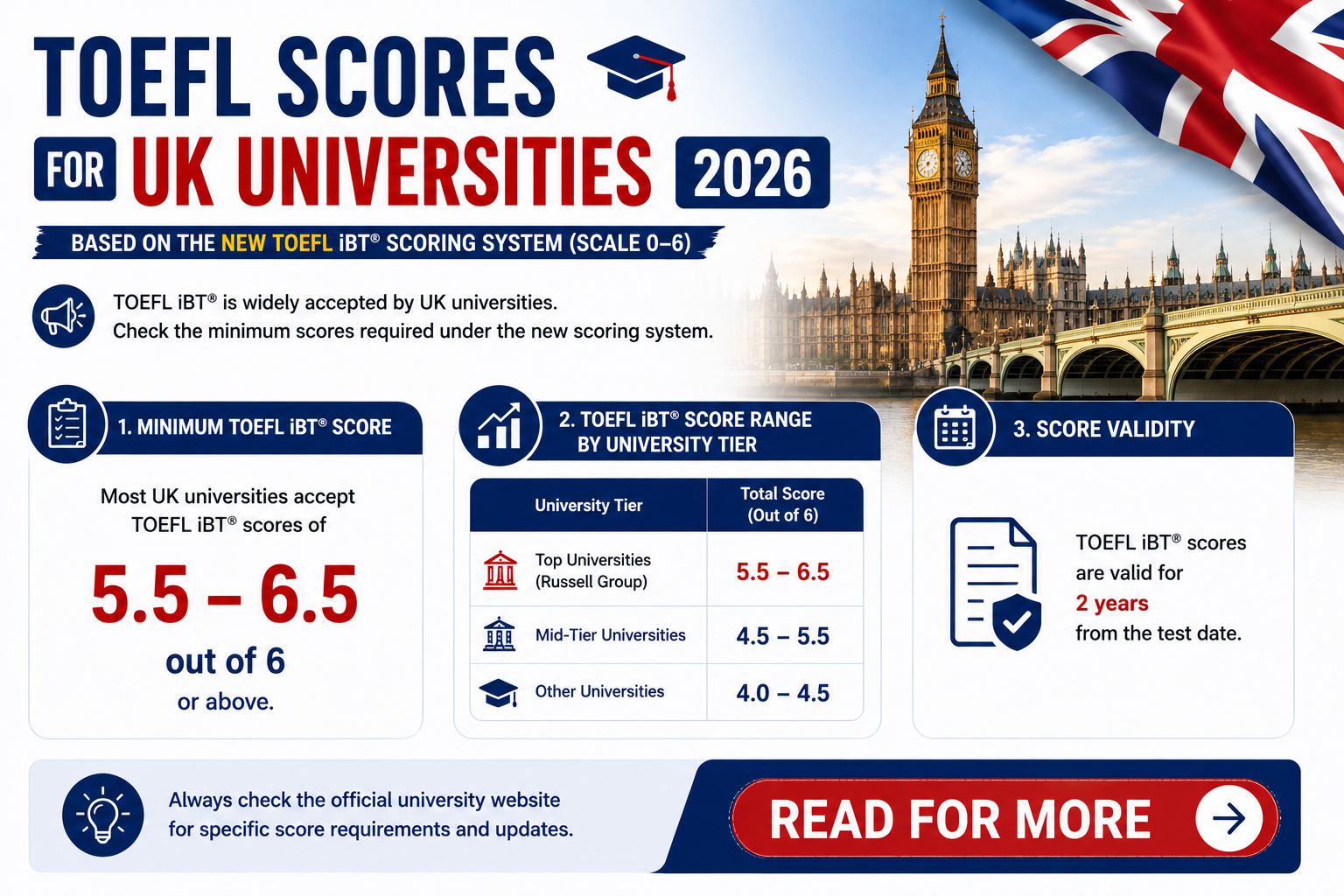
TOEFL requirements for UK universities in 2026 require a band score of 4.0 to 5.5 on the new ETS scale (90-120 according to old scores). Band 4.0 in every component maps to CEFR B2, the level the UK Student visa requires for degree-level study. Band 5.0 is required for Russell Group postgraduate entry.
- TOEFL iBT is accepted for admission by the large majority of UK universities, including most Russell Group members.
- The UK government lets a university assess English itself at degree level, which is why a TOEFL score can support a visa.
- The overall band is an average, so it can hide a weak section that fails both the course condition and the visa level.
- Some universities used the rescale to raise the bar, so converting an old requirement with the ETS chart can under-target.
- Two institutions changed TOEFL policy for the redesigned test, so confirm before booking a date.
Read More: Updated TOEFL Exam Pattern and Scoring System
- Quick Facts on TOEFL Requirements for the UK 2026
- TOEFL Requirements for UK Universities in 2026
- TOEFL Score Requirements by UK University Tier
- Does the UK Student Visa Accept TOEFL?
- Universities That Paused TOEFL From January 2026
- How TOEFL Bands Map to CEFR and IELTS
- TOEFL Section Score Rules UK Universities Apply
7.1 Rules that catch applicants out
- TOEFL Cost and Booking Timeline in India
- When TOEFL Is Not Enough for UK Entry
- TOEFL or IELTS for UK Applications
- FAQs
Quick Facts on TOEFL Requirements for UK 2026
| Parameter | Detail |
|---|---|
| Current score scale | 1.0 to 6.0 in 0.5 steps, live from 21 January 2026 |
| How the overall score is built | Average of four sections, rounded to the nearest half band |
| Typical UK admission range | Band 4.0 to 5.5 |
| UK Student visa English level | CEFR B2 for degree level, B1 below degree level |
| Band that maps to CEFR B2 | 4.0 and 4.5 in each component |
| Score validity | 2 years from the test date |
| Result turnaround | Within 72 hours |
| Dual score reporting ends | January 2028 |

TOEFL Requirements for UK Universities in 2026
Every UK university that publishes a TOEFL condition now runs two sets of numbers, split by the 21 January 2026 test date.
ETS replaced the 0 to 120 total with a 1.0 to 6.0 band scale in half-point steps. The mechanics changed as well. Under the old system, the overall score was the sum of four section scores. Under the new one, it is the average of the four sections, rounded to the nearest half band. An average of 5.125 reports as 5.0. An average of 5.25 reports as 5.5.
The redesign also shortened the test and moved Reading and Listening to a multistage adaptive format, with results released within 72 hours. Applicants comparing formats can read what changed in the January 2026 TOEFL redesign before picking a date.
- Band 6.0 maps to CEFR C2 and a legacy total of 114 and above.
- Band 5.5 maps to C1 and a legacy total of 107 and above.
- Band 5.0 maps to C1 and a legacy total of 95 and above.
- Band 4.5 maps to B2 and a legacy total of 86 and above.
- Band 4.0 maps to B2 and a legacy total of 72 and above.
ETS advises institutions to convert their old thresholds directly. A 100 requirement becomes band 5, a 90 becomes 4.5, and an 80 becomes 4. Many UK universities adopted exactly that mapping, and some did not. Score reports issued until January 2028 carry three figures at once, so both the band and the legacy total appear on one report.
Key Insight: If an offer letter quotes a 0 to 120 figure and the test was sat after 21 January 2026, the university is reading the comparable total printed on the report. That comparable total is the midpoint of the band range, so a 4.5 prints as 90.
TOEFL Score Requirements by UK University Tier
UK TOEFL cutoffs cluster into three tiers, and the gap between the top and the bottom is roughly one and a half bands.
Highly selective programmes ask for band 5.0 to 5.5. Most Russell Group research universities set band 4.5 to 5.0 for postgraduate entry and slightly lower for undergraduate. Modern and post-92 institutions commonly accept band 4.0. The conditions below are the published figures for the specific programme or entry level named, not university-wide floors.
| Institution and entry level | Requirement from 21 Jan 2026 (New scoring system) | Requirement before 21 Jan 2026 (Old scoring system) |
|---|---|---|
| Imperial College Business School | 5.0 overall, 5.0 in all elements | 100 overall |
| Edinburgh, MSc English Language | 5.0 overall, 4.5 in each component | 100 with 23 in each |
| Strathclyde, IELTS 6.5 condition tier | 5.0 overall, 4.0 in each component | 80 overall |
| Strathclyde, IELTS 6.0 condition tier | 4.5 overall, 4.0 in each component | 73 overall |
| Manchester, institutional guidance | Reviewed case by case using ETS tables | Published 0 to 120 conditions |
The third column is each institution's previous requirement, not an ETS equivalent. That difference matters. Strathclyde moved its lower entry tier from 73 to band 4.5, and ETS places 4.5 at 86 and above. An applicant who converts the old 73 with the concordance chart lands on band 4.0 and misses the condition by half a band. Source: University of Strathclyde recognised English language qualifications.
Course-level conditions override the institutional floor almost every time. Law, medicine, journalism and teacher training routinely sit a full band above the general requirement at the same university.
Key Insight: Read the current condition on the course listing rather than converting an old requirement yourself. Universities were free to reset their thresholds during the rescale, and several used it to move the bar up rather than across.
Does the UK Student Visa Accept TOEFL?
TOEFL is not on the UKVI Secure English Language Test list, and for most Indian applicants going to a UK university, that does not matter.
The rule sits in plain text on GOV.UK. Students at degree level or above must show they can read, write, speak and understand English at CEFR B2. GOV.UK then states that a Higher Education Provider can assess a student's English itself, which means the institution may ask for a different test. That is the mechanism a TOEFL score travels through.
Band 4.0 in each of the four sections maps to B2, so a university that accepts TOEFL can confirm the English condition on the Confirmation of Acceptance for Studies. The overall band on its own is not sufficient evidence, because the total is an average and can sit at 4.0 while one section reports 3.0, which is B1. Applicants preparing documents should read the UK Student visa process and document checklist alongside the English condition.
What a TOEFL score gives you for the UK:
- Admission to the large majority of UK universities at undergraduate and postgraduate level.
- Evidence a licensed sponsor can use to confirm CEFR B2 on your CAS.
- Coverage for degree-level courses and above at a compliant Higher Education Provider.
What a TOEFL score does not cover:
- A standalone pre-sessional English visa, where a UKVI-approved SELT is normally required.
- Study below degree level, where the CEFR B1 requirement runs through the SELT route.
- Work, family or settlement visa routes that specify a SELT by name.
If a course sits at degree level and the sponsor accepts TOEFL, then no second English test is needed for the visa. That means the widely repeated claim that a TOEFL score cannot support a UK Student visa is wrong for the majority of Indian applicants. Funding evidence is a separate condition, and the 28-day proof of funds rule trips up more applications than English does.
Universities That Paused TOEFL From January 2026
Two UK institutions changed how they handle TOEFL when the redesigned test launched, and both changes are dated rather than permanent.
Oxford states that it will not accept TOEFL tests taken from 21 January 2026 to meet the English language condition until a review of the revised test is complete. This applies across the university rather than to one level of study. Tests sat before that date remain valid inside the standard two-year window, and no completion date for the review has been published. Source: University of Oxford admissions guidance.
Cambridge split its response by level. Postgraduate admissions still accepts TOEFL, but an applicant who meets the score condition on a test taken after 21 January 2026 is asked to sit an additional assessment at the University Language Centre, and the narrow-miss allowance for TOEFL has been withdrawn. Undergraduate admissions do not list TOEFL among the qualifications it accepts as evidence of competence in English. Indian applicants can check Cambridge admission requirements for Indian applicants for the wider entry picture.
Outside those two, the picture is stable. Imperial College London and UCL have both confirmed in writing that they continue to accept the redesigned TOEFL against updated conditions. Edinburgh publishes both scales inside its degree finder. Manchester continues to accept it with case-by-case review against the ETS equivalency tables.
Important: Check the English condition on your specific course listing before paying the test fee, not the central admissions section. Departments publish higher and later-updated conditions than the university-wide guidance in a large share of cases.
If Oxford is on your shortlist at any level, or Cambridge at undergraduate level, then IELTS Academic is the lower-risk booking today. That means a mixed shortlist can change the test decision even when every other university on it accepts TOEFL.
How TOEFL Bands Map to CEFR and IELTS
The new TOEFL scale was built to sit directly on CEFR, which makes UK requirements easier to read than they were under the 0 to 120 total.
Under the old scale, a section score of 22 meant different proficiency levels depending on the section. Under the 1 to 6 scale, a 5 means C1 in any section. UK universities write their conditions in CEFR terms internally, so the alignment removes a translation step.
| TOEFL band | CEFR level | Comparable IELTS overall |
|---|---|---|
| 6.0 | C2 | 8.0 to 9.0 |
| 5.5 | C1 | 7.5 |
| 5.0 | C1 | 7.0 |
| 4.5 | B2 | 6.5 |
| 4.0 | B2 | 6.0 |
| 3.5 | B1 | 5.5 |
ETS published this IELTS comparison from a concordance study between the previous TOEFL iBT and IELTS, combined with vertical linking research. It is a planning tool rather than a guarantee, and ETS states plainly that comparison tables cannot predict the exact score one candidate would get on two different tests. Source: ETS Score Scale Update.
The practical read for UK applicants is simple. A programme asking IELTS 6.5 with 6.0 in each component is asking for roughly TOEFL 4.5 with 4.0 in each. A programme asking IELTS 7.0 with 6.5 is asking for roughly 5.0 with 4.5.
TOEFL Section Score Rules UK Universities Apply
Sub-score conditions reject more UK applications than overall scores do, because applicants track the total and ignore the floor under each section.
A band 5.0 overall with Speaking at 4.0 fails a condition that reads 5.0 overall with 5.0 in all elements. Imperial College Business School publishes exactly that condition. Edinburgh runs a looser version at 5.0 overall with 4.5 in each component, and Strathclyde sets 5.0 overall with 4.0 in each at one of its tiers. The three look similar and behave very differently.
Rules that catch applicants out
- MyBest Scores are widely rejected. UCL and Edinburgh both state they do not accept them, and a single test date is required.
- Single sitting is the norm. Components must usually be achieved in one test, not combined across attempts.
- Home Edition acceptance varies. UCL accepts it. Manchester does not accept the Special Home Edition, and Strathclyde has excluded it from main degree entry.
- Validity is checked against the start date. Scores must normally still be valid on day one of the course, not on the application date.
Score validity runs two years from the test date under ETS policy, and most UK universities apply that window strictly. Applicants sitting the test early in a long application cycle should confirm how long a TOEFL score stays valid against their intended start month.
Key Insight: Identify the weakest section before booking a retake rather than resitting blind. Speaking and Writing carry the highest sub-score floors at UK business and law programmes, and a targeted retake on one section is cheaper than repeating a full cycle.
TOEFL Cost and Booking Timeline in India
The TOEFL iBT costs approximately INR 18,000 in India in 2026, built from a base fee of around INR 15,254 plus 18% GST.
ETS sets the fee in US dollars, so the rupee amount charged to a card moves with the exchange rate and should be confirmed at checkout. The amount is the same for the test centre and the Home Edition, and it includes four official score reports, though those recipients must be selected before test day. Full booking mechanics are in the TOEFL registration steps and payment options.
| Charge | Amount in India | Condition |
|---|---|---|
| Registration (iBT or Home Edition) | Around INR 18,000 | Includes 18% GST and four score reports |
| Rescheduling | Around INR 5,900 | At least 4 full days before the test date |
| Additional score report | Around INR 1,950 | Per recipient, per request |
| UK Student visa fee for comparison | GBP 558 (around INR 71,800) | Home Office fee schedule effective 8 April 2026 |
Rupee test fees are indicative and inclusive of tax; confirm the payable amount on the ETS booking screen before paying. Conversions based on a GBP-INR rate of INR 128.62 as of July 28, 2026. Rates fluctuate; check the current rate before financial planning.
Results arrive within 72 hours under the new format, which compresses the old four- to eight-day wait. Even so, three months of runway before the earliest application deadline is the sensible booking gap. That leaves room for one retake without touching the deadline.
When TOEFL Is Not Enough for UK Entry
TOEFL stops being sufficient in three situations, and all three are predictable in advance.
The first is a standalone pre-sessional English course. Because that sits below the degree-level rule, a UKVI-approved SELT is normally needed for the visa. Both Glasgow and Strathclyde publish the same workaround: where the university issues a single CAS covering the pre-sessional and the main degree together, a TOEFL score at CEFR B2 can be used instead of an SELT. Strathclyde sets that threshold at band 4.0 overall with 4.0 in each component.
The second is study below degree level, where the visa requirement drops to CEFR B1 but runs through the SELT route rather than institutional assessment. The third is professional registration. Nursing and medical regulators set their own English evidence rules, separate from both the university and the visa.
What a combined CAS gives you:
- One visa application covering the pre-sessional course and the degree that follows it.
- The option to use TOEFL at CEFR B2 rather than booking a separate SELT.
What a combined CAS does not cover:
- Applicants below CEFR B2, who fall back to the SELT route and a single pre-sessional CAS.
- Pre-sessional courses booked independently of a degree offer at the same institution.
Applicants who cannot clear the band in time have alternatives worth checking. Some institutions accept a medium of instruction letter, and the universities that accept a medium of instruction letter publish specific conditions on graduation year and institutional approval.
Key Note: Ask the admissions team in writing whether your offer runs on a single combined CAS or two separate ones before booking any test. The answer changes which exam you need and it is not always stated on the offer letter.
TOEFL or IELTS for UK Applications
TOEFL is the stronger choice for a mixed US and UK shortlist, and IELTS Academic is the safer single-test choice for a shortlist built around Oxford or Cambridge undergraduate entry.
Cost is close to neutral. Both tests sit in a similar range in India based on current provider listings, so the decision turns on acceptance and format rather than price. TOEFL now finishes in around two hours, reports within 72 hours, and delivers four free score reports, which matters when an applicant is sending scores to eight or ten institutions across two countries.
- Applying across the US and UK together: one TOEFL sitting covers both markets.
- Applying to Oxford at any level or Cambridge undergraduate: IELTS Academic removes the policy risk.
- Applying to Russell Group postgraduate programmes generally: either test works, so pick based on format comfort.
- Applying through a standalone pre-sessional route: a UKVI SELT is required regardless.
Format preference is a real input. TOEFL Speaking is recorded rather than conducted face-to-face, and the adaptive Reading and Listening sections reward candidates who hold accuracy under rising difficulty. A candidate who freezes in an interview setting scores better on TOEFL. A candidate who thinks aloud with a person in the room scores better on IELTS. The complete TOEFL exam overview covers the section formats in detail.
Also Check:
| UK Universities List and Fees | UK Student Visa Costs in Rupees | Cost of Living in the UK |
|---|---|---|
| Fully Funded Scholarships in the UK | BSc in the UK for Indian Students | Indian Degree Equivalency in the UK |
TOEFL requirements for UK universities became easier to read in 2026, not harder. The band scale sits directly on CEFR. The visa threshold for degree-level study is B2, and band 4.0 in each component already clears it. The work now is checking three things rather than one: the overall band your course asks for, the floor under each section, and whether that university reset its threshold during the rescale rather than converting it. Oxford and Cambridge undergraduate entry are the exceptions that need confirming before a booking. Build the shortlist first, read the English condition on each course listing, and then book the date.
FAQs
Ques. What TOEFL score is required for UK universities in 2026?
Ans. Band 4.0 to 5.5 on the new scale. Most Russell Group postgraduate programmes ask for band 4.5 to 5.0. Modern and post-92 institutions commonly accept band 4.0. Course-level conditions override the university-wide figure in most cases, and almost all of them also set a floor under each section.
Ques. Can Indian students get a UK Student visa with a TOEFL score?
Ans. Yes, for degree-level study at a licensed Higher Education Provider. GOV.UK allows the institution to assess English itself and confirm CEFR B2 on the CAS. Band 4.0 in each of the four sections maps to B2. A separate Secure English Language Test is not needed in that situation.
Ques. Does an overall band 4.0 automatically meet the UK visa English level?
Ans. No. The overall band is the average of the four sections, so a 4.0 total can contain a section at 3.0, which is CEFR B1 rather than B2. The visa level applies to reading, writing, speaking and listening individually, which is why universities publish component minimums alongside the overall figure.
Ques. Is TOEFL on the UKVI approved SELT list?
Ans. No. ETS was removed from the approved supplier list in July 2014 and has not returned. GOV.UK stated at the time that higher education institutions choose their own method of assessing English and may continue to accept TOEFL, which is the rule still in use today.
Ques. Does Oxford accept the new TOEFL format?
Ans. No, not currently. Oxford will not accept TOEFL tests taken from 21 January 2026 to meet the English condition until a review of the revised test is finished. Tests sat before that date remain valid within the standard two-year window. No completion date has been published.
Ques. Does Cambridge still accept TOEFL scores?
Ans. Postgraduate admissions does, with a condition attached. An applicant meeting the score requirement on a test taken after 21 January 2026 is asked to sit an additional assessment at the University Language Centre, and the narrow-miss allowance has been withdrawn. Undergraduate admissions does not list TOEFL among its accepted qualifications.
Ques. How does the new TOEFL 1 to 6 band convert to the old 120 scale?
Ans. Band 5.0 equals 95 and above, band 4.5 equals 86 and above and band 4.0 equals 72 and above. ETS advises institutions to convert a 100 requirement to band 5, a 90 to 4.5 and an 80 to 4. Score reports show both figures until January 2028.
Ques. Did any UK university raise its TOEFL requirement during the rescale?
Ans. Yes. Strathclyde moved one entry tier from 73 overall to band 4.5, and ETS places 4.5 at 86 and above. Converting an old published requirement with the ETS chart can therefore under-target the current condition by half a band. Read the live condition on the course listing instead.
Ques. How much does the TOEFL exam cost in India?
Ans. Approximately INR 18,000, built from a base fee of around INR 15,254 plus 18% GST. ETS prices the test in US dollars, so the rupee amount moves with the exchange rate. The fee is the same for the test centre and the Home Edition and includes four score reports selected before test day.
Ques. Is TOEFL accepted for a UK pre-sessional English course visa?
Ans. Usually not on its own. A standalone pre-sessional visa normally needs a UKVI-approved SELT. Where a university issues a single CAS covering the pre-sessional and the main degree, a TOEFL score at CEFR B2 can be used instead. Strathclyde sets that at band 4.0 overall with 4.0 in each component.
Ques. Should Indian students take TOEFL or IELTS for the UK?
Ans. TOEFL for a mixed US and UK shortlist, since one sitting covers both markets. IELTS Academic for a shortlist built around Oxford at any level or Cambridge undergraduate entry, where TOEFL is currently restricted. For general Russell Group postgraduate applications, either test works and format comfort should decide.
Ques. Do UK universities accept the TOEFL Home Edition?
Ans. It varies by institution. UCL accepts the TOEFL iBT Home Edition under the same conditions as the test centre version. Manchester does not accept the Special Home Edition, and Strathclyde has excluded it from main degree entry. Because the fee is identical for both formats, the test centre booking is the safer default.
*tyOAMR



Comments