




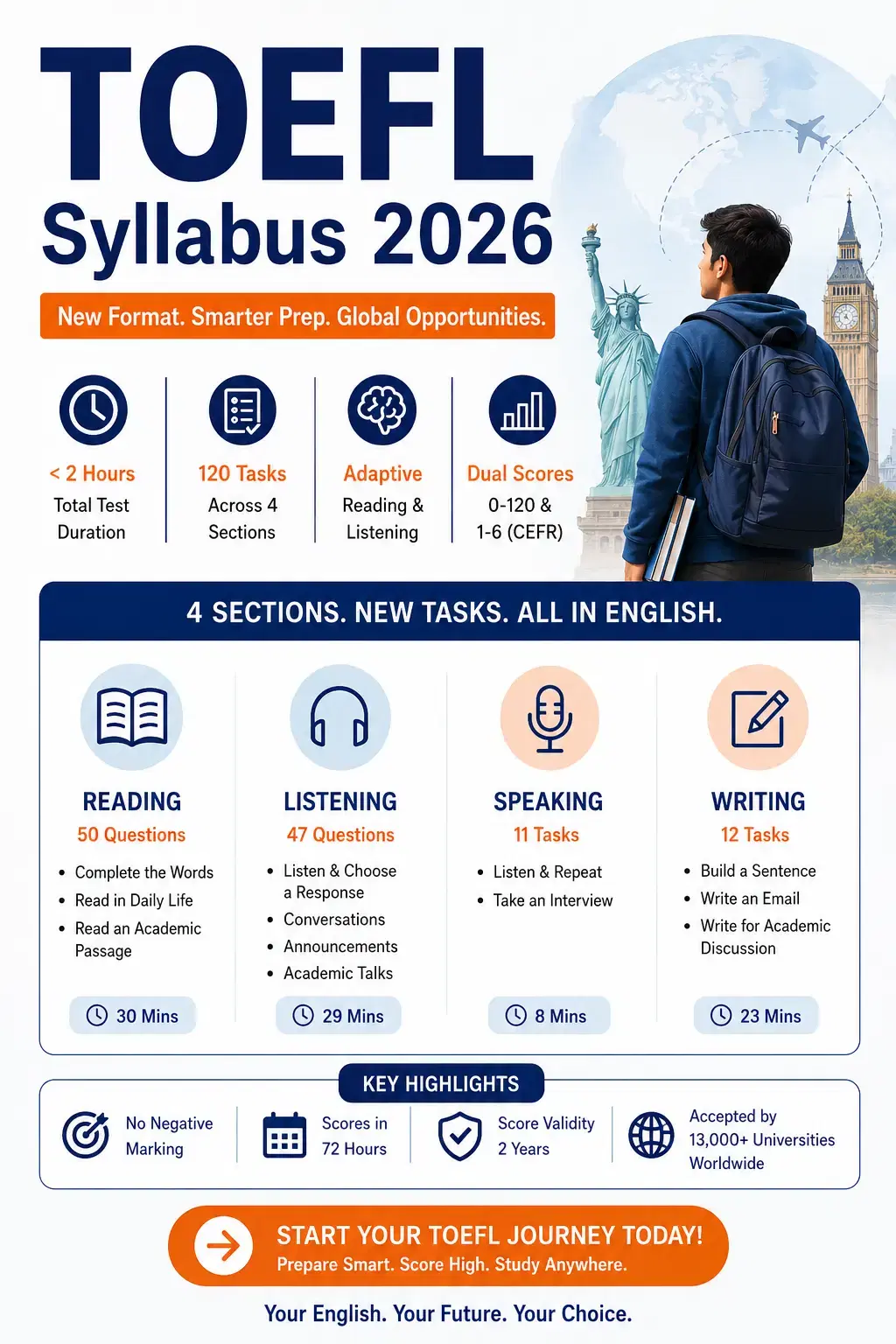
The TOEFL syllabus 2026 was completely revised by ETS on January 21, 2026. The TOEFL iBT now has 4 sections, 120 questions/tasks, and lasts under 2 hours. The Reading and Listening sections follow a multistage adaptive format, and brand-new task types like Complete the Words, Listen and Repeat, Take an Interview, and Build a Sentence have replaced parts of the older syllabus. Scores are now reported on two scales: 0-120 and 1-6 (CEFR-aligned), valid for 2 years.
- TOEFL syllabus 2026 sections: Reading, Listening, Speaking, Writing — all in English, computer-based, with no negative marking.
- TOEFL total questions: Reading 50, Listening 47, Writing 12 tasks, Speaking 11 tasks — total under 2 hours.
- TOEFL scoring 2026: 0-120 traditional scale + new 1-6 band scale; each section scored 0-30; scores released within 72 hours.
| If you are preparing for TOEFL in 2026, also check: | ||
|---|---|---|
| TOEFL Exam Pattern 2026 | TOEFL Exam Fees in India 2026 | TOEFL Registration 2026 |
- TOEFL Exam Syllabus 2026: Overview
1.1 Is the TOEFL syllabus the same for the home edition and the test centre?
- TOEFL Section-Wise Syllabus 2026
2.1 TOEFL Reading Syllabus 2026
2.2 TOEFL Listening Syllabus 2026
2.3 TOEFL Speaking Syllabus 2026
2.4 TOEFL Writing Syllabus 2026
- TOEFL Syllabus 2026: Vocabulary and Grammar Topics
- TOEFL Marking Scheme and Scoring 2026
4.1 How is the new 1-6 band score linked to the TOEFL syllabus?
- TOEFL Computer-Adaptive Format and Syllabus Delivery
- Recent Changes to the TOEFL Syllabus 2026
- TOEFL On-Screen Tools and Test-Day Mechanics
- TOEFL Syllabus Compared to IELTS, PTE and Duolingo
- How to Prepare for the TOEFL Syllabus 2026
- TOEFL Syllabus 2026 FAQs
TOEFL Exam Syllabus 2026: Overview
The TOEFL iBT does not have a fixed list of chapters like school exams. Instead, the TOEFL syllabus covers the 4 language skills you need in a university setting abroad. ETS designs every passage, audio clip, and prompt around real college-life scenarios such as professor-student conversations, campus announcements, lecture summaries, and forum-style academic discussions.
Below is the complete TOEFL syllabus 2026 structure with section-wise task types and time:
| Section | Task Types in Syllabus | No. of Questions / Tasks | Duration |
|---|---|---|---|
| Reading | Complete the Words, Read in Daily Life, Read an Academic Passage | 50 | 30 min |
| Listening | Listen and Choose a Response, Listen to a Conversation, Listen to an Announcement, Listen to an Academic Talk | 47 | 29 min |
| Speaking | Listen and Repeat, Take an Interview | 11 | 8 min |
| Writing | Build a Sentence, Write an Email, Write for an Academic Discussion | 12 | 23 min |
Note: Reading and Listening section times are variable because both are multistage adaptive in 2026 — your second stage shortens or lengthens based on first-stage performance.
Is the TOEFL syllabus the same for the home edition and the test centre?
Yes, the TOEFL iBT syllabus is identical for both formats. The only difference is the delivery — Home Edition runs through an ETS-trained online proctor, while the test centre version uses Koss stereophone audio equipment for clearer Listening playback.
TOEFL Section-Wise Syllabus 2026
The 2026 TOEFL iBT now blends pure academic content with everyday campus English. Each section has its own task list, topic focus, and time block. Indian students should pay extra attention to Listen and Repeat and Take an Interview tasks because both are new in 2026 and have no preparation time.
TOEFL Reading Syllabus 2026
The TOEFL Reading section in 2026 tests how well you understand short academic and real-world English texts. The section is multistage adaptive, with about 50 questions in 30 minutes across three task types.
- Complete the Words: Fill in missing letters inside an academic paragraph. Tests vocabulary, spelling, and contextual understanding. Example topic: a paragraph on photosynthesis with 8-10 incomplete keywords.
- Read in Daily Life: Short real-world texts such as emails, hostel notices, library announcements, course advisor mailers, restaurant menus, syllabi, or campus event flyers. Question types include detail, purpose, and tone identification.
- Read an Academic Passage: Shorter than the old TOEFL — approximately 200 words per passage instead of 700. Topics include biology, environmental science, history, sociology, art history, and psychology. Question types: main idea, vocabulary in context, inference, factual detail, sentence insertion, summary.
TOEFL Reading topics in syllabus: climate change, urbanisation, marine biology, ancient civilisations, modern psychology, US/UK history, business ethics, anthropology, geology, behavioural economics, art movements, public health.
| TOEFL Reading Practice Tests 2026 | |
|---|---|
| TOEFL Reading Practice Test 1 | TOEFL Reading Practice Test 2 |
| TOEFL Reading Practice Test 3 | TOEFL Reading Practice Test 4 |
Also Read:
TOEFL Listening Syllabus 2026
The TOEFL Listening section now has 47 questions in 29 minutes and is also multistage adaptive. The syllabus covers 4 task types and exposes you to North American, British, Australian, and New Zealand accents.
- Listen and Choose a Response: You hear one sentence (often a question or statement) and pick the best reply from 4 options. No note-taking is needed because the audio is under 10 seconds.
- Listen to a Conversation: A 3-minute campus dialogue between a student and a professor, librarian, registrar, advisor, or hostel staff member. Followed by 5 multiple-choice questions.
- Listen to an Announcement: A 30-60 second campus notice — exam schedule changes, event invitations, building closures, scholarship deadlines, or club meetings.
- Listen to an Academic Talk: A 100-250-word mini-lecture on a single topic. Subjects rotate across biology, astronomy, US history, linguistics, economics, anthropology, geology, and literature.
TOEFL Listening topics in syllabus: deep-sea ecosystems, AI ethics, Renaissance art, plate tectonics, behavioural psychology, supply and demand, evolutionary biology, ancient Roman law, climate adaptation, sleep science, urban planning, language acquisition.
| TOEFL Listening Practice Tests 2026 | |
|---|---|
| TOEFL Listening Practice Test 1 | TOEFL Listening Practice Test 2 |
| TOEFL Listening Practice Test 3 | TOEFL Listening Practice Test 4 |
Also Check:
TOEFL Speaking Syllabus 2026
The TOEFL Speaking section was completely rebuilt in 2026. The old 4-task format is gone. The new syllabus has 11 spoken responses across 2 task types in 8 minutes, all delivered through a microphone with no preparation time for most prompts.
- Listen and Repeat: You hear 7 short English sentences played one at a time and must repeat each one exactly after the beep. There is no preparation time. This task tests pronunciation accuracy, stress, and intonation. Sentences cover daily campus situations, polite requests, and academic discussion fragments.
- Take an Interview: A simulated 4-question interview where you reply in 45 seconds per question. Questions cover personal experiences, opinions on academic life, comparisons (e.g. group study vs solo study), and short discussion summaries. You speak only after the beep with no preparation time.
TOEFL Speaking topics in syllabus: a memorable teacher, the best way to learn a new skill, study abroad motivation, the value of internships, online vs in-person classes, hostel vs off-campus living, summer break plans, favourite subject, group work pros and cons, social media in college, time management strategies.
Scoring is done by a combination of AI scoring (SpeechRater) and certified human raters who evaluate fluency, pronunciation, vocabulary, grammar, and coherence on a 0-30 scaled score.
| TOEFL Speaking Practice Tests 2026 | |
|---|---|
| TOEFL Speaking Practice Test 1 | TOEFL Speaking Practice Test 2 |
| TOEFL Speaking Practice Test 3 | TOEFL Speaking Practice Test 4 |
Also check: TOEFL Speaking Topics
TOEFL Writing Syllabus 2026
The TOEFL Writing section now has 12 tasks in 23 minutes. ETS has removed the old 30-minute integrated essay and replaced it with shorter, sharper task types.
- Build a Sentence: You receive a set of scrambled English words and must rearrange them into a grammatically correct sentence. Tests syntax, verb forms, prepositions, and word order. Roughly 6-8 sentences.
- Write an Email (7 minutes): You read a real-life scenario (e.g. requesting an extension from a professor, replying to a hostel notice, declining a club invitation politely) and draft a 90-130-word reply. Tests formal vs informal register, greetings, closings, and tone.
- Write for an Academic Discussion (10 minutes): A professor poses a discussion question in an online forum (e.g. "Should universities make internships compulsory?"). Two students post short opinions. You write a 100+ word reply stating your stance with 2 reasons and an example.
TOEFL Writing topics in syllabus: internships and employability, online learning vs classroom learning, social media's impact on study habits, group projects vs individual work, the role of arts in STEM education, mandatory community service in college, AI tools in coursework, sustainable campus design, mental health support in universities, and language requirements for international students.
| TOEFL Writing Practice Tests 2026 | |
|---|---|
| TOEFL Writing Test 1 | TOEFL Writing Test 2 |
| TOEFL Writing Test 3 | TOEFL Writing Test 4 |
Also check: TOEFL Writing Topics
TOEFL Syllabus 2026: Vocabulary and Grammar Topics
Although the TOEFL syllabus is not explicitly grammar-based like Indian school exams, every section indirectly tests core grammar and academic vocabulary. Here is what to study under each head:
TOEFL Vocabulary Syllabus
- Academic word list: 570 Coxhead AWL words such as analyse, hypothesis, allocate, infer, evident, substantial, contemporary, perspective.
- Synonyms and antonyms in context — heavily tested in Reading Complete the Words and Vocabulary questions.
- Collocations: raise an issue, conduct research, draw a conclusion, address a concern.
- Idiomatic phrasing for Speaking interviews: in my view, on the other hand, what stood out was, the main takeaway.
- Topic-specific vocabulary: science (cell, gene, climate, orbit), arts (perspective, motif, baroque), business (revenue, market share, brand equity), humanities (ideology, hierarchy, ritual).
TOEFL Grammar Syllabus
- Tense usage: past simple, present perfect, future continuous, past perfect for narration.
- Subject-verb agreement — most penalised area for Indian test takers in the Writing section.
- Articles (a/an/the) and prepositions (in/on/at, between/among).
- Conditionals: first, second, third conditionals for academic argumentation.
- Active and passive voice: required for the Build a Sentence task and lecture summaries.
- Relative clauses: who, which, that, whose — essential for academic discussion replies.
- Punctuation: comma usage, semicolon, apostrophe for contractions and possession.
TOEFL Marking Scheme and Scoring 2026
TOEFL iBT 2026 introduces a dual-scale scoring system. ETS continues to issue the familiar 0-120 score during the 2026-2028 transition period and adds a new 1-6 band score aligned with the Common European Framework of Reference (CEFR).
| Section | Score Range (Old Format) | Score Range (New Format) | What is Tested |
|---|---|---|---|
| Reading | 0-30 | 1-6 | Comprehension of academic and real-world texts |
| Listening | 0-30 | 1-6 | Understanding of lectures, conversations, announcements |
| Speaking | 0-30 | 1-6 | Pronunciation, fluency, vocabulary, coherence |
| Writing | 0-30 | 1-6 | Grammar, sentence structure, task fulfilment, organisation |
| Total | 0-120 | 1-6 | Aligned with 1-6 CEFR bands |
Important syllabus-related scoring rules for 2026:
- No negative marking — guess if unsure.
- MyBest Scores combines your best section scores across multiple test attempts, but many universities (especially MIT, Caltech, ETH Zurich) do not accept them.
- Score validity: 2 years from test date. Read More
- Score release: within 72 hours from test date (faster than the previous 4-8 days).
Also Read
How is the new 1-6 band score linked to the TOEFL syllabus?
Each band corresponds to a CEFR level — band 1 ~ A1 (beginner), band 6 ~ C2 (mastery). The bands describe how well you handle the syllabus content rather than just raw correct answers. A band 4 (~B2) reader, for example, can handle the Academic Passage task with minor errors but may struggle with the Complete the Words task on technical topics.
TOEFL Computer-Adaptive Format and Syllabus Delivery
For the first time in TOEFL history, the Reading and Listening sections in 2026 follow a multistage adaptive design. The Speaking and Writing sections remain linear because they are open-response tasks scored individually by AI and humans.
- Stage 1: Every test taker starts with the same medium-difficulty set in Reading and Listening.
- Stage 2: Based on your accuracy in Stage 1, the system serves an easier, medium, or harder Stage 2 set. The harder set carries more weight in the final score.
- Adaptive at the section level, not per question: Unlike the GRE General, which adapts at the section level between Verbal sections, TOEFL adjusts within a single section between stages.
- What this means for syllabus prep: You cannot prepare for "easy questions" — you must master the full topic range because adaptive tests reward consistent strong performance.
If you score in the top band of Stage 1 Reading, expect a Stage 2 that includes dense Academic Passages on topics like quantum mechanics or post-modern art. If you score in the lower band, Stage 2 will favour shorter Read in Daily Life texts.
Recent Changes to the TOEFL Syllabus 2026
The January 21, 2026 redesign is the biggest TOEFL syllabus change since the 2005 launch of the iBT. Indian test takers should note these shifts:
- Section task overhaul: Four old Speaking tasks replaced by Listen and Repeat + Take an Interview. Independent Essay removed from Writing. New Build a Sentence and Write an Email tasks added.
- Shorter test: Total duration dropped from 3 hours (pre-2023) and 116 minutes (post-July 2023) to roughly 90-115 minutes in 2026.
- Adaptive Reading and Listening — first time in TOEFL history.
- Dual scoring: 0-120 traditional scale + new 1-6 CEFR-aligned band scale for a 2-year transition window (2026-2028).
- Content rebalanced: Niche topics like Greek mythology have been reduced; modern globally relevant academic content added (e.g. AI ethics, sustainability, public health).
- Faster results: Score release in 72 hours instead of 4-8 days.
- Better audio: Koss custom stereophones replaced standard headphones at test centres, helping Indian students who struggled with US/UK accents.
- Streamlined registration and an updated ETS account dashboard.
Source: ETS official TOEFL Transformation Announcement and the Manya Group, Magoosh, and BestMyTest editorial reports on the 2026 redesign, cross-verified with the Collegedunia TOEFL Updates 2026 news desk coverage.
TOEFL On-Screen Tools and Test-Day Mechanics
- Scratch paper: Provided at test centres for notes; Home Edition test takers use a small whiteboard.
- No calculator — TOEFL is a language test, not a quantitative one.
- Review and skip: You can move back and forth within Reading and Listening sections within their time limits. Speaking and Writing tasks cannot be revisited once submitted.
- Volume control: Adjustable during the unscored audio check at the start.
- Timer: Always visible on screen. You can hide it during Reading if it feels distracting.
- No spell check or dictionary in Writing — practise manual proofreading.
- No breaks in the 2026 format because the test is shorter than 2 hours.
TOEFL Syllabus Compared to IELTS, PTE and Duolingo
Indian students often weigh the TOEFL syllabus against other English tests before booking. Here is a head-to-head view of what each test covers:
| Feature | TOEFL iBT 2026 | IELTS Academic | PTE Academic | Duolingo English Test |
|---|---|---|---|---|
| Sections | 4 (Reading, Listening, Speaking, Writing) | 4 (same) | 3 combined (Speaking & Writing, Reading, Listening) | Adaptive, single test |
| Duration | Under 2 hours | 2 hr 45 min | 2 hours | 1 hour |
| Speaking format | Mic into computer (AI + human) | Live examiner | Mic into computer (AI) | Mic into computer (AI) |
| Score range | 0-120 + 1-6 band | 0-9 per section | 10-90 | 10-160 |
| Adaptive | Reading + Listening (multistage) | No | Yes (item-level) | Yes (item-level) |
| Reading topics | Academic + everyday | Academic + general | Academic | General |
| Result turnaround | 72 hours | 3-5 days (computer); 13 days (paper) | 48 hours | 48 hours |
For Indian students applying to US universities, TOEFL remains the most widely accepted test. For UK and Australian applications, IELTS still has the strongest brand recall. PTE is rising fast for Australian PR and Canadian immigration cases.
Also Check:
How to Prepare for the TOEFL Syllabus 2026
- Phase 1 (Weeks 1-2): Diagnostic. Take the free ETS TOEFL diagnostic, identify weak sections, and review the official ETS TOEFL iBT Free Practice Test for the 2026 format.
- Phase 2 (Weeks 3-6): Section-by-section coverage. Dedicate one week each to Reading, Listening, Speaking, Writing. Practise the new task types — Listen and Repeat, Take an Interview, Build a Sentence, Write an Email.
- Phase 3 (Weeks 7-8): Full-length mocks. Take 4-6 full mocks under timed conditions. Indian students should focus extra mock time on Listen and Repeat because it has zero preparation time.
- Phase 4 (Final week): Refinement. Review test-day logistics, ID requirements, and equipment setup if taking the Home Edition.
- Daily habit: 20 minutes of US podcast listening (NPR, This American Life, BBC News), 10 minutes of reading from The New York Times or The Atlantic, and 10 minutes of recorded speaking practice.
The TOEFL syllabus 2026 rewards consistent multi-skill practice. It is no longer enough to memorise one essay template or one Speaking introduction line because the new task types are short, sharp, and demand instant English production. Indian students who treat TOEFL as a real-language proficiency check, not just a structured exam, will score consistently above 100 on the 0-120 scale.
TOEFL Syllabus 2026 FAQs
Ques. What is the TOEFL syllabus 2026?
Ans. The TOEFL syllabus 2026 covers four sections — Reading, Listening, Speaking, and Writing — with new task types like Complete the Words, Read in Daily Life, Listen and Repeat, Take an Interview, Build a Sentence, and Write an Email. The total test takes under 2 hours.
Ques. How many sections does the TOEFL exam have in 2026?
Ans. The TOEFL iBT 2026 has 4 sections — Reading, Listening, Speaking, and Writing. Each section is scored on a 0-30 scale, totalling 0-120 plus a 1-6 CEFR band.
Ques. Is the TOEFL syllabus the same as the exam pattern?
Ans. The syllabus refers to the topical content and task types you must master, while the exam pattern refers to the structure, timing, and marking scheme. On Collegedunia, both are addressed together because they overlap heavily in TOEFL preparation.
Ques. Has the TOEFL syllabus changed in 2026?
Ans. Yes. ETS rolled out a complete syllabus overhaul on January 21, 2026. Reading and Listening are now multistage adaptive, the Speaking section was rebuilt with 2 new task types, and the Writing section dropped the Independent Essay in favour of Build a Sentence and Write an Email tasks.
Ques. Is there a fixed TOEFL syllabus PDF I can download?
Ans. ETS does not release a chapter-wise syllabus PDF because TOEFL is a proficiency test, not a content-based exam. The closest official document is the ETS TOEFL iBT Test Prep Planner and the free Quick Prep practice set, both available on the ETS website.
Ques. What grammar topics are tested in the TOEFL syllabus?
Ans. Subject-verb agreement, tenses (especially past perfect and present perfect), articles, prepositions, conditionals, relative clauses, active and passive voice, and punctuation. The Build a Sentence task in Writing tests grammar most directly.
Ques. How many vocabulary words should I learn for the TOEFL syllabus?
Ans. Aim for the 570 Academic Word List by Coxhead plus around 300-400 topic-specific words across sciences, humanities, business, and arts. Anki flashcards and Quizlet TOEFL decks are popular tools.
Ques. Is there negative marking in the TOEFL syllabus?
Ans. No, TOEFL has no negative marking. You should attempt every question even if you are unsure, because incorrect answers do not reduce your score.
Ques. Are calculators allowed in the TOEFL?
Ans. No, calculators are not allowed because TOEFL is purely a language proficiency exam with no numerical or mathematical questions.
Ques. How long does it take to cover the TOEFL syllabus?
Ans. For a student with intermediate English, 6-8 weeks of focused preparation at 1-2 hours per day is enough. Advanced English speakers may need only 3-4 weeks. The new task types like Listen and Repeat may require additional accent and pronunciation training.
Ques. Can I skip questions and revisit them within a TOEFL section?
Ans. Yes, within Reading and Listening you can navigate back and forth until the section timer runs out. Speaking and Writing tasks cannot be revisited because the response is recorded or submitted task by task.
*The article might have information for the previous academic years, which will be updated soon subject to the notification issued by the University/College.



Comments