




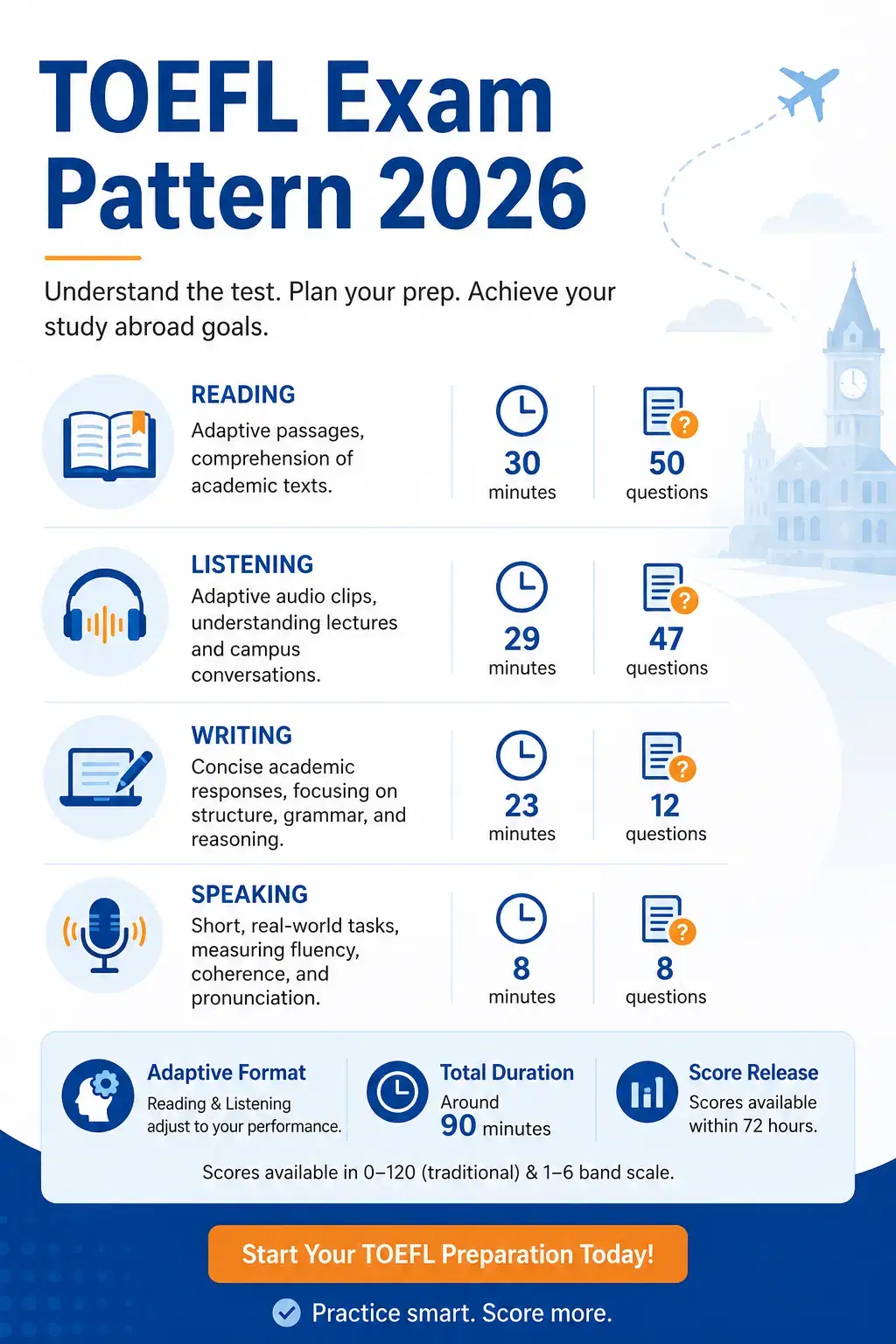
The TOEFL exam pattern 2026 is divided into 4 sections:
- Reading: Adaptive passages, 1-6 band score, comprehension of academic texts.
- Listening: Adaptive audio clips, understanding lectures, and campus conversations.
- Speaking: Short, real-world tasks, measuring fluency, coherence, and pronunciation.
- Writing: Concise academic responses, focusing on structure, grammar, and reasoning.
The TOEFL iBT uses a multistage adaptive format for Reading and Listening, where difficulty adjusts based on performance. The total test duration is around 90 minutes. Scores are released within 72 hours, with both traditional 0-120 and new 1-6 band scales.
| If you are preparing for TOEFL in 2026, also check: | ||
|---|---|---|
| TOEFL Exam Pattern 2026 | TOEFL Exam Fees in India 2026 | TOEFL Registration 2026 |
TOEFL Practice Tests 2026
Check out some free TOEFL iBT practice tests PDF for 2026 in the table below:
TOEFL Exam Pattern 2026
The TOEFL iBT exam pattern is divided into 4 sections: Reading, Listening, Writing, and Speaking. The total test duration is approximately 90 minutes, and the number of questions is around 120. The test is adaptive for the Reading and Listening sections. This means the difficulty of a question depends on your performance in the previous question - correct answers lead to difficult questions and vice versa.
The detailed pattern is given in the table below:
| Section | Duration | Question Type | No. of Questions |
|---|---|---|---|
| Reading | 30 minutes |
| 50 |
| Listening | 29 minutes |
| 47 |
| Writing | 23 minutes |
| 12 |
| Speaking | 8 minutes |
| 8 |
TOEFL Exam Syllabus 2026
The TOEFL iBT 2026 syllabus has been updated. The Reading section now includes "Complete the Words" questions and shorter passages. The Listening section features brief conversations. In Speaking, a new "Listen and Repeat" task has been added. The Writing section now includes a "Build a Sentence" activity. Overall, the syllabus has been reduced, making the TOEFL test shorter and easier for students.
| Section | Format | Tasks / New Question Types | Time |
|---|---|---|---|
| Reading | Adaptive | 1. Complete the Words: Fill in missing letters in an academic paragraph. 2. Read in Daily Life: Analyse short texts like emails, menus, or announcements. 3. Academic Passage: Shorter (approx. 200 words) academic texts with multiple-choice questions. | 30 minutes |
| Listening | Adaptive | 1. Listen & Choose a Response: Quick reaction to a single sentence. 2. Conversation: Short (approx. 3 min) campus life exchanges. 3. Announcement 4. Talk: Campus notices or short academic lectures (100-250 words). (30 sec) | 29 minutes |
| Writing | Fixed | 1. Build a Sentence: Unscramble words to form a correct sentence. 2. Write an Email: Draft a practical response to a specific scenario (7 mins). 3. Academic Discussion: Support an opinion in an online forum (10 mins). (This is the same as earlier) | 23 Minutes |
| Speaking | Fixed | 1. Listen & Repeat: Hear 7 sentences and repeat them exactly (No prep time). (Speak after beep) 2. Take an Interview: Respond to 4 questions in a simulated interview (45 seconds per response; No prep time). (Speak after beep) | 8 Minutes |
TOEFL iBT Scores 2026
ETS has updated the TOEFL iBT scoring system effective January 21, 2026. Alongside the scores on the traditional 0-120 scale, you will also get a band score in the 1-6 scale. This band score directly aligns with the Common European Framework of Reference (CEFR). For a 2-year transition period, scores on both the scales will be provided, and universities will accept both.
In the old TOEFL score format, each TOEFL section is scored from 0-30, and the overall score is the average of the 4 individual scores. Whereas, in the new scoring system, each section is given a band score in the 1-6 scale, and the overall score is the average of the four.
Note:
- Reading and Listening are auto-scored based on the number of correct answers, and then scaled.
- Speaking and Writing are evaluated by both human raters (0-4 or 0-5 per task) and AI, then averaged and scaled.
- You will get unofficial Reading and Listening scores immediately, and the official score report within 72 hours in your ETS account.
Also Read
IELTS vs New TOEFL Band Scale: Which Exam is Easier to Clear in 2026?TOEFL iBT Preparation Tips for Indian Students
Preparing for TOEFL iBT requires consistent practice and familiarity with academic English. Many Indian students find the test manageable with the right strategy and regular exposure to English in academic contexts.
- Resources:
- Focus on daily English practice. Read newspapers, academic blogs, and short articles to build comprehension skills.
- Improve listening by watching English news channels, lectures, and podcasts in different accents like American and British English.
- Practice note-taking while listening. This helps in both the Listening and Speaking sections, where quick recall is important.
- Build typing speed for the Writing section. Many students lose time due to slow typing rather than a lack of ideas.
- Speak English daily, even in simple situations. Fluency matters more than complex vocabulary in the Speaking section.
- Avoid memorising answers. TOEFL tasks are designed to test natural understanding, not rehearsed responses.
- Practice integrated skills, such as listening to a lecture and summarising it in writing.
- Take full-length mock tests regularly to improve time management and reduce exam pressure.
- Pay attention to accents, as the test may include North American, British, Australian, and New Zealand speakers.
- Many Indian test-takers find Listening challenging initially, so extra practice with fast-paced audio is helpful.
Also Check
The TOEFL exam pattern 2026 checks English skills through Reading, Listening, Writing, and Speaking tasks based on academic situations. It uses short, time-bound questions across all sections to assess comprehension, language use, and communication ability in a structured format.
FAQs
Ques. Is TOEFL iBT easier for Indian students compared to IELTS?
Ans. Many Indian students find the TOEFL iBT easier in Listening and Reading due to multiple-choice style questions. However, Speaking can feel challenging as responses are recorded on a microphone without direct interaction.
Ques. How important is note-taking in TOEFL iBT, based on student experiences?
Ans. Reddit and Quora users often highlight note-taking as very important, especially in Listening and Speaking tasks. Since audio is played only once, good notes help in answering accurately.
Ques. Do Indian students face difficulty with different English accents in TOEFL?
Ans. Some students initially struggle with British or Australian accents, as most exposure in India is American English. Regular practice with diverse audio sources helps improve understanding.
Ques. Can you skip questions and come back later in TOEFL sections?
Ans. No, TOEFL iBT does not allow skipping and returning to questions. Each section must be completed in order within the given time limit.
Ques. How soon are TOEFL scores available after the exam?
Ans. TOEFL iBT scores are usually available within 3 days. The score report is released online and can be sent directly to universities from your ETS account.
*The article might have information for the previous academic years, which will be updated soon subject to the notification issued by the University/College.



Comments