




The TOEFL Academic Discussion is one of 3 task types in the TOEFL iBT Writing section (alongside “Build a Sentence” and “Write an Email”). In this task, test takers contribute to an online classroom discussion by stating and supporting an opinion, and the task measures the ability to develop ideas, respond to others' viewpoints, and write in an academic tone.
In the Academic discussion round, a professor posts a question on an online discussion board, 2 classmates respond with their own ideas, and the test taker has 10 minutes to type a post that contributes to the discussion, with no maximum word count, though a good response is typically at least 100-150 words.
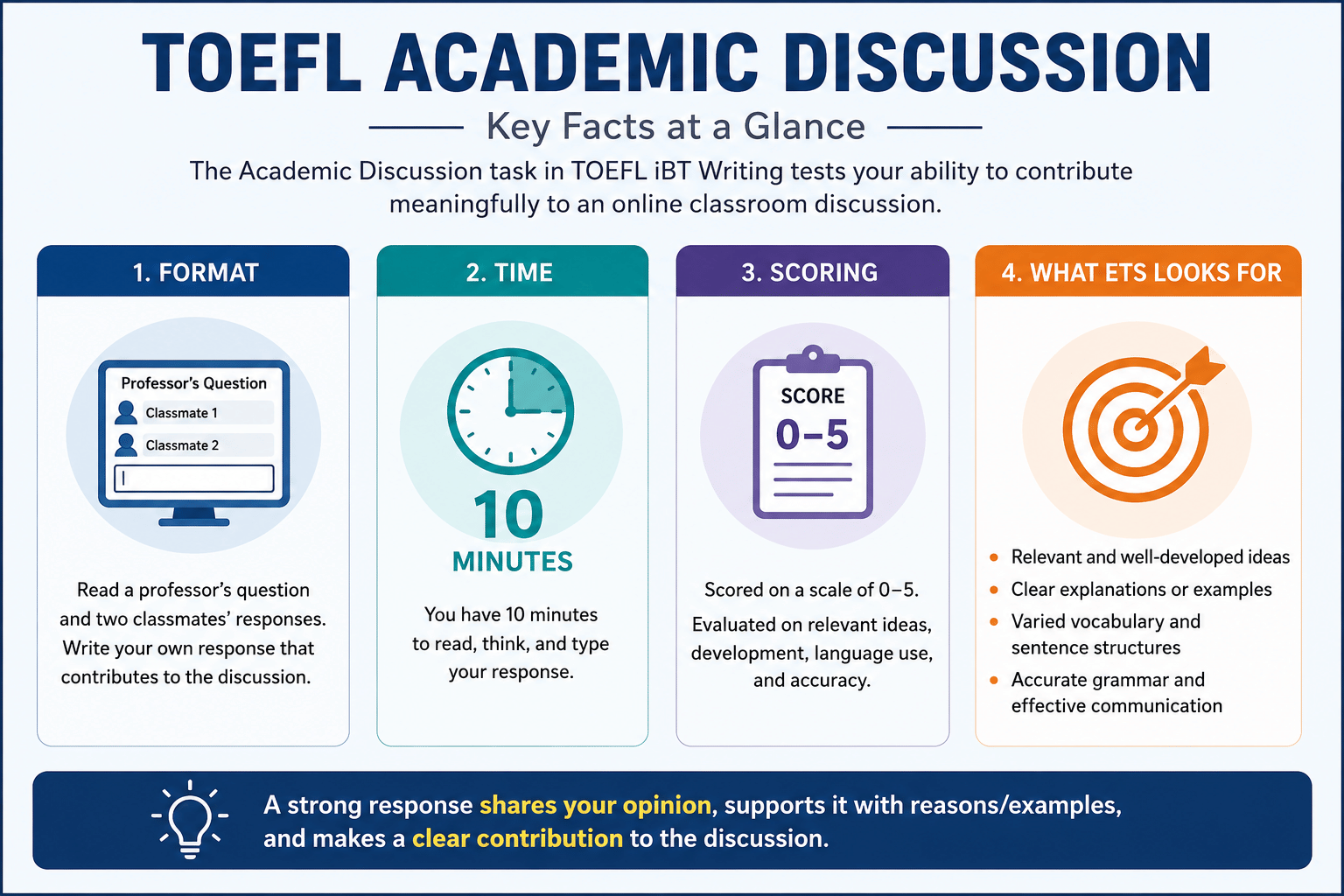
- TOEFL Academic Discussion Format 2026
- TOEFL Academic Discussion Scoring 2026
- TOEFL Academic Discussion Question Types 2026
- TOEFL Academic Discussion Examples 2026
- TOEFL Academic Discussion Sample Answers 2026
- TOEFL Writing Academic Discussion Tip for Indian Students
- TOEFL Academic Discussion Tips and Strategies 2026
- FAQs
TOEFL Academic Discussion Format 2026
The Academic discussion is the 3rd task in the TOEFL Writing section after “Build a Sentence” and “Write an Email”. Applicants need to listen to an audio and structure it in a given time frame.
- Structure: Applicants need to brief the professor's question or lecture with the 2 student responses along with their own post.
- Time limit: 10 minutes
- Word count: No stated maximum, but ETS's own practice materials instruct test takers that an effective response will contain at least 100 words.
- Input method: Typed response via computer keyboard.
Note: ETS generally states that writing tasks are concise and focused to help test takers manage time, topics require no specialized background knowledge, and scoring emphasizes clear, effective communication over a polished first draft.
TOEFL Academic Discussion Scoring 2026
The TOEFL exam is scored on a scale of 0-6 (new scoring system), but the Academic Discussion segment of the Writing test is scored on a scale of 0-5. The table below describes the scoring system for Academic Discussion:
| Score | What ETS Looks For |
|---|---|
| Fully successful: 5 | Relevant, clearly expressed contribution with well-elaborated explanations/examples; effective variety of sentence structures and precise, natural word choice; only the kind of minor slips expected from timed writing |
| Generally successful: 4 | Relevant contribution, easily understood; adequate elaboration; good variety of structures and appropriate vocabulary; few lexical/grammar errors |
| Partially successful: 3 | Mostly relevant and understandable; elaboration may be incomplete or unclear in places; some variety of structures; noticeable errors |
| Mostly unsuccessful: 2 | Ideas may be poorly developed or only partly relevant; limited vocabulary/structure range; accumulation of errors |
| Unsuccessful: 1 | Attempt to address the task but few coherent ideas; severely limited language range; frequent serious errors |
| 0 | Blank, off-topic, non-English, copied entirely from the prompt, or random keystrokes |
TOEFL Academic Discussion Question Types 2026
The Academic questions cover various academic disciplines and question structures. The TOEFL primarily aims to examine applicants for academic purposes. The topics or themes for the test remain the same. Here are some common area form where the questions are framed:
- Policy or preference-style prompt (Political Science): a professor asks students to weigh in on whether government funding should prioritize education or environmental protection, with classmates already staking out opposing positions.
- Open-ended "most important" prompt (Economics): a professor asks students to name and justify a scientific discovery or invention (excluding computers/cell phones) that had a major impact, with classmates offering different picks (e.g., satellites, medical/nutrition discoveries).
The Academic discussion prompts generally fall into 3 functional types:
- Opinion or preference questions: choose between 2 options and justify it.
- Yes or No questions: Take a clear stance on a debatable claim.
- Open-ended "which would you choose" questions: Pick from open possibilities and justify.
TOEFL Academic Discussion Examples 2026
Example 1
Sociology: Social Media and Real-World Relationships
Professor (Dr. Bennett): Social media has changed how people build and maintain relationships. Some argue it strengthens connections by keeping people in touch across distances; others argue it weakens face-to-face social skills. In your view, does social media do more to strengthen or weaken real-world relationships? Why?
Maria: I think social media strengthens relationships. I moved abroad for university, and video calls and messaging apps are the only reason I've stayed close with my family and childhood friends. Without them, those relationships would have faded.
Devon: I disagree with Maria. Social media creates an illusion of closeness. People collect hundreds of "friends" online but often have fewer deep, in-person friendships than previous generations did. Quantity of contact isn't the same as quality of connection.
Example 2
Business: Remote Work vs. Office Work
Professor (Dr. Okafor): As companies decide on long-term workplace policies, they must weigh the benefits of remote work against the benefits of in-person office work. Which model do you think benefits employees more, and why?
Priya: Remote work benefits employees more. It removes commute time, gives people control over their schedules, and lets them work in an environment where they're most productive.
Tomas: I'd push back on that. Office work benefits employees more in the long run because in-person collaboration builds mentorship and career relationships that are hard to replicate over video calls, especially early in a career.
Example 3
Environmental Science: Individual Action vs. Government Policy
Professor (Dr. Larsen): Climate change is often discussed in terms of two levers: individual lifestyle choices and government policy. Which do you think has a greater impact on addressing climate change?
Anya: Government policy matters more. A single national regulation, like a shift to renewable energy standards, reduces more emissions than millions of individual choices ever could.
Ben: I see Anya's point, but I think individual action matters just as much, because public demand and behavior change are often what push governments to act in the first place. Policy rarely leads culture, it usually follows it.
Example 2: Economics (Dr. Achebe): The professor asks students to identify an important scientific/technological breakthrough from the last 200 years, excluding computers and cell phones. One classmate nominates satellites (navigation, telecom, defense); the other nominates advances in nutrition/vitamin science.
Both are official, unmodified ETS discussion-board scenarios - safe to reference/paraphrase as "official TOEFL example topics" in your article for credibility and E-E-A-T.
TOEFL Academic Discussion Sample Answers 2026
Sample Answer
Example 1 (Social Media and Relationships)
I agree with Maria that social media strengthens real-world relationships, though I'd add a point she didn't mention: social media also helps maintain weaker ties that would otherwise disappear completely. Devon argues that online connections lack depth, and that's true for casual acquaintances, but it overlooks how these platforms function differently depending on the relationship. For close friends and family, apps like video calling and messaging don't replace face-to-face contact — they extend it across distance and time zones, which is exactly what Maria experienced with her family abroad. For more distant contacts, like a former classmate or old coworker, social media keeps the relationship alive at a low level instead of letting it fade entirely, which means people now have a much wider support network available to them if they ever need to reconnect. That's a strength, not an illusion.
Sample Answer
Example 2 (Remote Work vs. Office Work)
I lean toward Tomas's view that office work benefits employees more, but I'd support it differently. The biggest advantage isn't just mentorship — it's the speed of learning that happens in person. When employees work alongside colleagues, they absorb small, unspoken lessons simply by watching how experienced coworkers handle problems, communicate, and make decisions, something a video call rarely captures. Priya makes a fair point that remote work increases flexibility and removes commute stress, and I don't think office work is better for everyone. But early-career employees specifically lose more than they gain by working remotely, because they haven't yet built the professional instincts that make independent remote work effective. Office environments compress that learning curve. Later in a career, once those skills are established, remote work's flexibility probably does become the stronger option.
Sample Answer
Example 3 (Individual Action vs. Government Policy)
I agree with Ben that individual action and government policy are closely linked, but I'd take his argument further: government policy is often just individual action organized at scale. Anya is right that a single regulation can cut more emissions than millions of separate personal choices, but regulations don't appear out of nowhere — they're usually a response to public pressure, consumer demand, or shifting social norms that individuals created first. A clear example is the growth of the electric vehicle market: consumer demand and adoption came before most government incentives existed, not after. So while policy is the more powerful tool once it's in place, individual behavior is frequently the force that makes that policy possible in the first place. Treating the two as competing forces misses how dependent one is on the other.
TOEFL Writing Academic Discussion Tip for Indian Students
The TOEFL Writing section overall uses 3 task types - Build a Sentence, Write an Email, and Write for an Academic Discussion. This helps to measure how well test takers organize ideas, use grammar and vocabulary accurately, and write for a specific purpose. This is useful for internal linking to your Build a Sentence / Write an Email content if you have it, since ETS treats them as one integrated section.
TOEFL Academic Discussion Tips and Strategies 2026
Applicants appearing for the TOEFL exam should follow these Tips and strategies to score well. Following are the tips and strategies for TOEFL Academic discussion:
- Say your opinion first. Don't wait. Start your answer with your view.
- Pick a clear side. Don't sit on the fence. Choose one clear opinion.
- Mention one classmate by name. Agree or disagree with them. This shows you read their post.
- Add something new. Don't just repeat what the classmates said. Give a new reason or idea.
- Give one strong reason. Then explain it with an example. One good reason is better than three weak ones.
- Write at least 100 words. Aim for 120-150 words to be safe.
- Use simple, correct grammar. Simple sentences with no errors score better than fancy sentences with mistakes.
- Stay polite if you disagree. Say things like "I see Devon's point, but..." instead of just saying "Devon is wrong."
- Watch the clock. You only have 10 minutes. Spend 1-2 minutes planning, 6-7 minutes writing, and 1-2 minutes checking.
Also read: Check How Much Time is Required to Prepare for TOEFL 2026
The TOEFL Academic Discussion task tests your ability to share and support your opinion in an academic discussion within 10 minutes. A strong response should contribute relevant ideas, provide clear explanations, and demonstrate good grammar and vocabulary to score well on the 0-5 ETS rubric. Understanding the task format, question types, and scoring criteria can help you write an effective response with confidence.
FAQs
Ques. How much time is given for the TOEFL Academic Discussion task?
Ans. ETS gives you 10 minutes to complete the Academic Discussion task. During this time, you should read the discussion prompt, review the classmates' responses, and type your own contribution.
Ques. Is there a minimum or maximum word limit for TOEFL Academic Discussion?
Ans. ETS does not specify a required minimum or maximum word count for the Academic Discussion task. Instead, it recommends writing a clear and well-developed response that effectively answers the discussion prompt.
Ques. How can I prepare for the TOEFL Academic Discussion task using official ETS resources?
Ans. ETS recommends using TOEFL TestReady, The Official Guide to the TOEFL iBT Test, and the Inside the TOEFL video series. These resources include official practice questions, sample responses, scoring guides, and preparation tips.
Ques. What does ETS look for in a high-scoring Academic Discussion response?
Ans. According to ETS, high-scoring responses present relevant and well-developed ideas, include clear explanations or examples, demonstrate a variety of sentence structures and vocabulary, and contain very few grammatical or language errors.
Ques. What writing skills does the TOEFL Academic Discussion task assess?
Ans. According to ETS, the task assesses your ability to develop and organize ideas, respond to others' viewpoints, support your opinion with reasons or examples, and write clearly using appropriate grammar and vocabulary in an academic context.
*The article might have information for the previous academic years, which will be updated soon subject to the notification issued by the University/College.



Comments