



Content Curator
Composite volcanoes or stratovolcanoes are one of the most common categories of volcanoes. Multiple eruptions spanning hundreds of thousands of years create a composite volcano. The eruptions gradually build up the composite volcano, layer by layer, until it reaches tens of thousands of meters in height. Some strata may be made of lava, while others may be made of ash, rock, or pyroclastic flows. Large amounts of thick magma can build up inside a composite volcano, causing it to detonate in a volcanic explosion.
| Table of Content |
Location of Composite Volcanoes
Composite volcanoes are usually found in groups, each one a few kilometers apart. In the Pacific Ocean, stratovolcanoes make up the "Ring of Fire." Mount Fuji, Mount Rainier, and Mount St. Helens in Washington State, and Mayon Volcano in the Philippines are all instances of composite volcanoes. Mount Vesuvius erupted in 79, destroying Pompeii and Herculaneum, while Mount Pinatubo erupted in 1991, ranking as one of the twentieth century's largest eruptions.

Fig. Ring of Fire
Composition of Composite Volcanoes
The composition of composite volcanoes, also known as stratovolcanoes, gives them their name. Layers of pyroclastic material, such as lava, pumice, volcanic ash, and tephra, are used to construct these volcanoes. With each eruption, the layers build up on top of one another. Because the lava is viscous, the volcanoes produce steep cones rather than circular shapes.
The silicate-rich minerals rhyolite, andesite, and dacite are found in composite volcanic magma, making it felsic. Low-viscosity lava pours from fissures and spreads from a shield volcano, such as that found in Hawaii. A stratovolcano's lava, boulders, and ash either flow a short distance from the cone or eject explosively into the air before returning to the source.
Also Read:
A composite volcano can reach heights of up to 8,000 feet above its base. The majority of composite volcanoes have a summit crater with a central vent or a clustered collection of vents. Lava is discharged from the composite volcano through cracks in the crater wall or fractures on the cone's flanks. The ribs formed by the solidified lava within the fissures considerably strengthen the cone.
One of the most important characteristics of composite volcanoes is their conduit system (The volcanic conduit is the pipe that takes magma from the magma chamber up through the crust and into the volcano itself until it reaches the surface.) . Magma from the Earth's chamber's deep reservoir rises to the surface via a composite volcano's conduit system. The buildup of material spewed through the conduit builds composite volcanoes, which grow in size when lava, ash, and other materials are added to the slope.
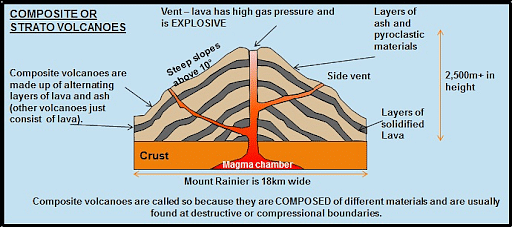
Fig. Structure of Composite Volcano
Formation of Composite Volcanoes
At subduction zones, where one plate at a tectonic boundary is pushed below another, stratovolcanoes occur. This can occur when the oceanic crust slides beneath an oceanic plate (for example, near or beneath Japan and the Aleutian Islands) or when the oceanic crust is dragged beneath the continental crust (underneath the Andes and Cascades mountain ranges).
The porous basalt and minerals trap water. Temperature and pressure rise as the plate goes deeper, resulting in a process known as "dewatering." The melting point of rock in the mantle is lowered as water from hydrates is released.
Because melted rock is less dense than solid rock, it rises and becomes lava. As the magma rises, the pressure decreases, allowing volatile chemicals to escape the solution. Pressure is exerted by water, carbon dioxide, sulphur dioxide, and chlorine gas. Finally, the stony plug that has been covering the vent bursts open, resulting in a tremendous explosion.
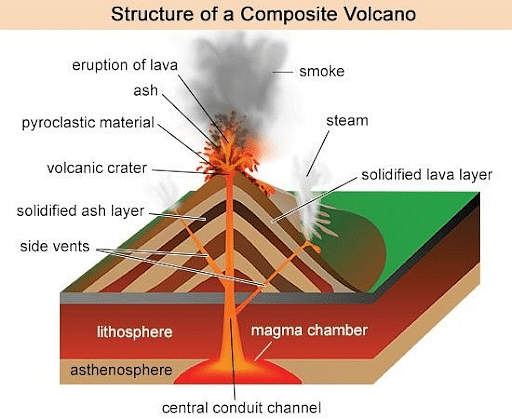
Fig. Composite volcanoes or Stratovolcanoes
The following sections go through the steps involved in the development of composite volcanoes:
- Magma's Ascension
Magma rises from the Earth's chamber below to build a volcanic cone, which explodes at the surface via the conduit system. Lava pours and spreads throughout the area.
- Volcanic Activity is Active
Volcanic activity in a composite volcano can last for hundreds of years, until a large cone forms and lava flows construct a vast plateau around its base.
- Cone Eroding
The cone begins to erode as volcanic activity ceases. The cone is scraped away to reveal the hardened "volcanic plug" in the conduit after thousands of years of volcanic activity. Streams widen their canyons and sever the lava plateau during this time of inactivity.
- Final Activities
All remnants of the cone are being eroded away by soil erosion. Only the protruding plug, the volcano's ruins, and the lava plateau that surrounds it are left.
Also Read:
Consequences of Eruptions
Composite volcanoes cause more than just death and property harm. They affect weather and climate because they discharge particles and gasses into the stratosphere. Composite volcanoes generate particles that cause vibrant sunrises and sunsets. Even though no car accidents have been attributed to volcanic eruptions, explosive debris from composite volcanoes poses a threat to aviation traffic.
Magma from a composite volcano isn't fluid enough to flow around obstructions and emerge as a lava river. A stratovolcano eruption, on the other hand, is sudden and destructive. Toxic fumes, ash, and hot debris are ejected with force, and often without warning. Another hazard is lava bombs.
These molten rock chunks can range in size from small stones to the size of a bus. Although most of these "bombs" do not explode, their mass and velocity produce damage similar to that caused by an explosion. Lahars are also created by composite volcanoes. A lahar is a mudslide that combines water and volcanic debris. Lahars are volcanic landslides that fall down a steep slope at such a fast rate that they are difficult to avoid. Since 1600, volcanoes have killed over a third of a million people. The majority of the deaths have been linked to stratovolcanic eruptions.
Sulfuric acid can be produced when sulphur dioxide is discharged into the environment. Acid rain can be produced by sulfuric acid clouds, which can obscure sunshine and lower temperatures. Stratovolcanic eruptions may have played a role in the world's largest extinction event, at least in part. Beginning 300,000 years before the end-Permian mass extinction and lasting half a million years after the disaster, a complex of volcanoes known as the Siberian Traps emitted vast volumes of greenhouse gasses and ash.
Also Read:
Things to Remember
- Composite volcanoes, also known as stratovolcanoes, are cone-shaped volcanoes composed of many layers of lava, pumice, ash, and tephra.
- Composite volcanoes tend to generate tall peaks rather than rounded cones because they are made up of layers of viscous material instead of fluid lava. A caldera is formed when the peak crater collapses.
- The most catastrophic eruptions in history have occurred due to composite volcanoes.
- When big composite volcanoes erupt, they can leave behind a caldera, which is a collapsed area. The volcano's position was indicated by deep, steep-walled depressions. And it is in this area that a new composite volcano will erupt.
- Apart from Earth, stratovolcanoes have only been discovered on Mars.
Also Read:
Sample Questions
Ques. What is the definition of a composite volcano eruption? (2 Marks)
Ans. Multiple eruptions over hundreds of thousands of years result in the formation of a composite volcano. The eruptions gradually build up the composite volcano, layer by layer, until it reaches a height of thousands of meters. Lava may have formed certain layers, while ash, rock, and pyroclastic flows may have formed others.
Ques. What are some examples of a composite volcano? (3 Marks)
Ans. Composition is the word given to composite volcanoes, commonly known as stratovolcanoes. Pyroclastic materials such as lava, pumice, volcanic ash, and tephra are used to construct these volcanoes. Each eruption causes the layers to pile up on top of one another.
Mount St. Helens, Mount Rainer, Mount Shasta, Mount Hood, and Mount Pinatubo are examples of composite volcanoes. Composite volcanoes and other violent volcanoes can erupt with such force that they collapse in on themselves or blow themselves up, resulting in calderas.
Also Read:
Ques. What causes the formation of composite volcanoes? (3 marks)
Ans. A conduit system is a characteristic of a composite volcano that allows magma from a reservoir deep inside the Earth's crust to ascend to the surface. The volcano grows in size as lava, cinders, ash, and other materials ejected through the conduit accumulate on its slopes.
At destructive plate boundaries, composite volcanoes are common. Mount Fuji in Japan, Mount St Helens in the United States, and Mount Pinatubo in the Philippines are examples of composite volcanoes (Philippines). Shield volcanoes are low volcanoes with gently sloping slopes that are produced by lava layers.
Ques. What makes composite volcanoes so destructive? (2 Marks)
Ans. Fesic to intermediate rock makes up composite volcanoes. Because of the viscosity of the lava, eruptions at these volcanoes are frequently violent. The viscous lava cannot move far down the sides of the volcano before solidifying, resulting in the composite volcano's steep slopes.
Ques. What distinguishes a composite volcano from others? (3 Marks)
Ans. The following are the features of composite volcanoes:
- Acidic lava with high viscosity (sticky).
- Because the lava does not flow very far before solidifying, the slopes are steep.
- Layers of ash and lava alternate. They're also known as stratovolcanoes because of this.
- Eruptions that are violent.
- Between-eruptive periods that are longer
Ques. In a composite volcano, what materials are ejected? (2 Marks)
Ans. Small rock and ash are also ejected from these explosive volcanoes, which settle on the volcano's slopes. As a result, composite volcanoes are made up of alternating layers of hardened lava, volcanic ash, and rock pieces, hence the name.
Ques. Are there any active composite volcanoes? (2 Marks)
Ans. Composite volcanoes like Mount St. Helens, Mount Pinatubo, and Krakatoa have all erupted. Mount Fuji in Japan, Mount Ranier in Washington, and Mount Kilimanjaro in Africa are all composite volcanoes that haven't erupted in a long time.
Ques. In a composite volcano, what are the layers? (5 Marks)
Ans. Different layers of a composite volcano include Magma chamber, bedrock, pipe, ash layers, lava layers, lava flow, vent, lava, ash cloud. A big crater from the last eruption is often visible at the top.
Magma Chamber- A magma chamber is a vast underground pool of liquid rock. Many volcanoes are located over magma chambers because if the magma finds a way to the surface, it will cause a volcanic explosion.
Bedrock- "Volcaniclastics" are sedimentary rocks formed when lava erupts into the air. Volcanic rocks, particularly those found in the oceans, are among the most prevalent rock types on the planet's surface.
Ash layers- Volcanic ash is a mixture of rock, mineral, and glass particles that are ejected from a volcano during an eruption. The particles are extremely tiny, with diameters of less than 2 millimeters. They have a low density because they are pitted and filled with holes.
Lava- Magma is molten rock that rises from beneath the Earth's surface and rises in volcanic vents, but lava is molten rock that erupts from a volcano. Liquid lava can solidify into igneous or magmatic rock after cooling, forming crystals of various minerals.
Lava flow- Lava flows are molten rock streams that ooze or pour out of an erupting vent. Non-explosive activity or explosive lava fountains cause lava to emerge. However, when basalt lava flows are contained within a channel or lava tube on a steep slope, the main body of the flow can reach speeds of more than 30 km/h (19 mph).
Ash cloud- When volcanic ash is ejected into the atmosphere as a result of a severe explosive eruption, ash clouds form. Small rock shards and volcanic glass particles make up ash. An eruption occurs when a gas or water vapour expands drastically within the magma, shattering the rocks.
Because of the alternating layers, or strata, that make up composite volcanoes, they are also known as stratovolcanoes. Stratovolcano magma is viscous, or thick, in nature. As these layers harden, alternating levels of material, known as strata, emerge.



Comments