




BITSAT Preparation 2027 requires a combination of conceptual understanding, quick problem-solving, accuracy, and regular mock-test practice. With the BITSAT 2027 exam expected in April-May 2027, you have approximately five to six months to complete the syllabus, revise important chapters, and develop the speed required to attempt the paper. Unlike JEE Main, BITSAT also tests English and Logical Reasoning, making daily practice across all five subjects important.
- BITSAT 2027 question paper will include a total of 130 MCQs for 390 marks, with +3 marks for each correct answer and -1 mark for each wrong answer.
- BITSAT Mathematics carries 40 questions, Physics and Chemistry carry 30 each, while English and Logical Reasoning together account for 30 questions.
- Chapters with the highest weightage in the BITSAT question paper include Modern Physics, Electrostatics, Chemical Bonding, Organic Chemistry, Algebra, and Calculus
- You should consider NCERT textbooks as the foundation, supplemented by one reference book per subject, previous-year papers, and BITSAT mock tests.
- To score well in the BITSAT exam, prioritise high-weightage topics, practise time-bound MCQs, analyze errors, and avoid random guessing due to negative marking.
- For BITSAT preparation, November-December should focus on concept building, January-February on question practice and revision, and March-April on full-length mock tests.
Related Articles:
An expert on the YouTube channel “Vishtalk” shared a video discussing how to score 350+ marks in BITSAT 2027. The expert shares a subject-wise strategy for meeting the target score. You can watch the video below to know how to score 350+ marks in BITSAT 2027.
BITSAT Preparation 2027: Exam Pattern
Before beginning BITSAT 2027 preparation, you should go through the BITSAT 2027 exam pattern and understand the question paper structure.
- BITSAT question paper will carry 130 questions, and you can score a maximum of 390 marks by solving all MCQs correctly.
- Maths carries a total of 40 questions for 120 marks in the BITSAT question paper.
- Physics and Chemistry each carry a total of 90 marks, with 180 total marks for the two sections.
- English carries 10 questions for 30 marks, and LR carries 20 questions for 60 marks.
| Subject | Questions | Maximum Marks |
|---|---|---|
| Physics | 30 | 90 |
| Chemistry | 30 | 90 |
| English Proficiency | 10 | 30 |
| Logical Reasoning | 20 | 60 |
| Mathematics | 40 | 120 |
| Total | 130 | 390 |
BITSAT Marking Scheme 2027
As per the BITSAT marking scheme, you will get +3 marks for each correct answer, and -1 mark will be deducted for each incorrect answer. There is no negative marking for unattempted questions.
| Response | Marks |
|---|---|
| Correct Answer | +3 |
| Incorrect Answer | -1 |
| Unattempted | 0 |
| Maximum Bonus Questions | 12 |
Ques. Is there any sectional time limit in BITSAT 2027?
Ans. No, BITSAT does not have a sectional time limit. Candidates can decide how much time to allocate to Physics, Chemistry, Mathematics, English, and Logical Reasoning within the overall 180-minute duration.
Ques. How many questions should I attempt to score well in BITSAT 2027?
Ans. Candidates should aim to attempt all 130 questions while maintaining accuracy. The number of correct responses and incorrect attempts ultimately determines the score, so avoid blind guessing.
BITSAT Preparation 2027: High-Weightage Topics
BITSAT does not officially release chapter-wise weightage. However, an analysis of previous-year questions and expert discussions can help students identify frequently tested topics.
Students starting in November should not try to complete every chapter of BITSAT with equal depth from the first day. Instead, they should prioritise chapters that combine recurring questions, conceptual importance, and scoring opportunities.
BITSAT 2027 Physics High-Weightage Topics
BITSAT Physics requires a combination of formula application, conceptual clarity, and numerical practice. Modern Physics, Electrostatics, Current Electricity, and Wave Motion are important areas to prioritise in BITSAT Physics.
- Modern Physics: Focus on Photoelectric Effect, Atomic Physics, Nuclear Physics, and Semiconductor Devices.
- Electrostatics and Current Electricity: Practise Electric Potential, Capacitors, Kirchhoff's Laws, and Resistance Networks.
- Waves and Optics: Revise SHM, Wave Motion, Interference, Diffraction, and Ray Optics.
- Heat and Thermodynamics: Focus on Laws of Thermodynamics, Kinetic Theory, Calorimetry, and Heat Transfer.
| Physics Chapter | Indicative Weightage |
|---|---|
| Modern Physics | 10-13% |
| Electrostatics and Current Electricity | 10-12% |
| Wave Motion and Wave Optics | 10-11% |
| Magnetic Effects of Current | 9-10% |
| Heat and Thermodynamics | 10% |
| Rotational Motion | 5-6% |
| Simple Harmonic Motion | 5-6% |
Also Check:
BITSAT 2027 Chemistry High-Weightage Topics
BITSAT Chemistry can be a scoring section if students combine NCERT-based revision with regular numerical and reaction-based practice. Inorganic Chemistry in BITSAT requires repeated revision, while Physical Chemistry requires calculation speed.
- Chemical Bonding: Revise Molecular Orbital Theory, VSEPR Theory, Hybridisation, and Bond Parameters.
- Organic Chemistry: Prioritise General Organic Chemistry, Hydrocarbons, Alcohols, Phenols, Ethers, and Carbonyl Compounds.
- Inorganic Chemistry: Revise p-Block Elements, Coordination Compounds, and Periodic Properties.
- Physical Chemistry: Practise Thermodynamics, Electrochemistry, Chemical Kinetics, and Mole Concept.
| Chemistry Chapter | Indicative Questions |
|---|---|
| Chemical Bonding | 2-3 |
| p-Block Elements | 2-3 |
| General Organic Chemistry | 2-3 |
| Thermodynamics | 2 |
| Electrochemistry | 2 |
| Coordination Compounds | 2 |
| Hydrocarbons | 2 |
| Alcohols, Phenols and Ethers | 2 |
| Chemical Kinetics | 1-2 |
Also Check:
BITSAT 2027 Mathematics High-Weightage Topics
BITSAT Mathematics carries 120 marks and has the highest individual subject weightage for B.E. aspirants. Students should focus on chapters that offer opportunities for repeated MCQ practice and faster calculations.
- Algebra: Prioritise Complex Numbers, Matrices, Determinants, Probability, and Binomial Theorem.
- Differential Calculus: Practise Limits, Continuity, Differentiability, and Applications of Derivatives.
- Integral Calculus: Focus on Definite Integrals, Indefinite Integrals, and Differential Equations.
- Coordinate Geometry: Practise Straight Lines, Circles, Conic Sections, and Vectors.
| Mathematics Chapter | Indicative Questions |
|---|---|
| Algebra | 8-10 |
| Differential Calculus | 6-8 |
| Integral Calculus | 6-7 |
| Straight Lines | 6-7 |
| Vectors | 6-7 |
| Coordinate Geometry | 5-6 |
| Circles | 4-5 |
| Trigonometry | 3-4 |
| Matrices and Determinants | 3-4 |
| Probability | 2-3 |
Also Check:
BITSAT 2027 English and Logical Reasoning Topics
English and Logical Reasoning in BITSAT together carry 90 marks. Students often overlook these subjects while preparing for PCM, but consistent practice can help improve their overall score without requiring the same amount of preparation time as Mathematics or Physics.
- English Vocabulary: Practise Synonyms, Antonyms, One-Word Substitution, and contextual meanings.
- Grammar and Sentence Completion: Focus on Tenses, Prepositions, Articles, and Sentence Structure.
- Non-Verbal Reasoning: Practise Figure Matrix, Figure Formation, and Pattern Recognition.
- Verbal Reasoning: Focus on Analogies, Series, Logical Deduction, and Syllogisms.
| Subject | Important Topics |
|---|---|
| English | Vocabulary, Sentence Completion, Grammar, Reading Comprehension |
| Logical Reasoning | Figure Matrix, Figure Formation, Series, Analogy, Syllogism |
Also Check:
Ques. Which subject has the highest weightage in BITSAT 2027?
Ans. Mathematics or Biology carries the highest individual subject weightage, with 40 questions for 120 marks. For B.E. aspirants, Mathematics is the relevant section.
Ques. Are Class 11 chapters important for BITSAT 2027?
Ans. Yes. BITSAT covers both Class 11 and Class 12 NCERT topics. Students should not completely skip Mechanics, Waves, Thermodynamics, and other Class 11 chapters while focusing on the Class 12 syllabus.
Also Read:
BITSAT Preparation 2027: Month-Wise Study Plan
Students starting BITSAT preparation in November 2027 must balance three priorities: completing the entrance exam syllabus, preparing for Class 12 board exams, and improving speed.
- A practical strategy is to prepare for JEE Main and BITSAT together due to the syllabi overlap, while allocating separate time for English, LR, and BITSAT-specific mock tests.
- A Reddit preparation guide for 2027 aspirants also highlights the importance of continuing ongoing Class 12 topics rather than creating additional backlogs.
- It recommends prioritising important pending chapters instead of attempting every low-priority chapter first.
BITSAT 2027 Preparation Timeline
- November-December: Strengthen concepts and complete high-priority chapters.
- January-February: Increase MCQ practice and manage preparation alongside board examinations.
- March: Complete remaining topics and begin regular full-length mock tests.
- April-May: Focus on revision, time management, accuracy, and examination practice.
| Month | Preparation Focus | Recommended Target |
|---|---|---|
| November 2026 | Concept building | Complete important Class 11 backlogs and ongoing Class 12 topics |
| December 2026 | Syllabus coverage | Complete high-weightage chapters and start English/LR practice |
| January 2027 | MCQ practice | Solve chapter-wise questions and revise completed topics |
| February 2027 | Board preparation | Focus on boards while maintaining daily BITSAT practice |
| March 2027 | Revision and mocks | Complete pending syllabus and attempt weekly full-length mocks |
| April 2027 | Final preparation | Increase mock frequency and revise weak areas |
| May 2027 | Session 2 preparation | Analyse Session 1 performance and improve remaining weaknesses |
November-December 2026: Build Concepts and Clear Important Backlogs
The first two months should be dedicated to building a strong foundation. Students should not immediately start taking daily full-length BITSAT mock tests because their syllabus coverage may be insufficient. Instead, use this period to complete important topics and establish a regular practice routine.
- Physics: Complete Modern Physics, Electrostatics, Current Electricity, and Thermodynamics.
- Chemistry: Focus on Chemical Bonding, General Organic Chemistry, p-Block, and Electrochemistry.
- Mathematics: Complete Algebra, Differential Calculus, Integral Calculus, and Coordinate Geometry.
- English and LR: Practise vocabulary, grammar, series, and figure-based questions for 20-30 minutes daily.
January-February 2027: Increase Question Practice Alongside Board Preparation
During January and February, students should shift from learning concepts to applying them through timed questions. However, board examinations should not be neglected because BITSAT eligibility also depends on Class 12 performance.
- Solve 40-60 MCQs daily across Physics, Chemistry, and Mathematics, adjusting the target according to school and board workload.
- Practise at least 10-15 English and Logical Reasoning questions daily.
- Solve previous-year questions after completing each chapter instead of postponing all PYQ practice until the end.
- Revise formula sheets, important reactions, and frequently missed concepts every week.
March 2027: Complete the Syllabus and Start Full-Length Mock Tests
March should be treated as the transition from syllabus preparation to examination preparation. Students should ideally have completed most of the syllabus by this stage. Any remaining topics should be selected according to their importance and the student's current strengths.
- Attempt at least one full-length BITSAT mock every week initially.
- Increase the frequency to two mocks weekly as the syllabus becomes complete.
- Analyse incorrect answers and identify whether mistakes occurred due to concepts, calculations, or time pressure.
- Revise high-weightage chapters and solve mixed-topic question sets.
April-May 2027: Final Revision and Session-Wise Strategy
The final preparation phase should focus on improving the score rather than collecting new study materials. Students appearing for Session 1 should use the actual examination experience to identify weak areas before Session 2, if they have registered for it.
- Attempt two to three full-length mocks per week, depending on the examination schedule and preparation level.
- Revise short notes, formulas, NCERT Chemistry facts, and frequently tested concepts.
- Practise completing 130 questions within the available time.
- Avoid starting lengthy, unfamiliar chapters during the final days.
Ques. Can I start BITSAT Preparation 2027 in November?
Ans. Yes. November provides a reasonable preparation window for students targeting the expected April-May 2027 examination. However, students should follow a structured timetable, prioritise important chapters, and begin regular mock practice once they have covered sufficient syllabus.
Ques. Should I prepare for JEE Main and BITSAT together?
Ans. Yes. The PCM syllabus overlaps considerably. Students can use their JEE Main preparation for concept building and numerical practice, while separately preparing English, Logical Reasoning, speed, and BITSAT-specific question patterns.
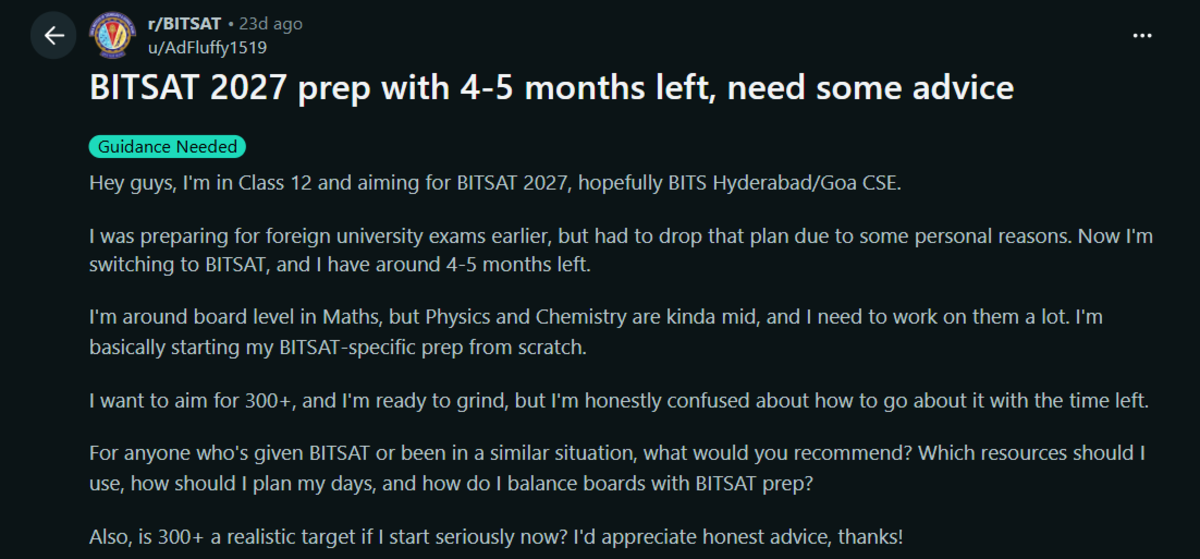
A user on Reddit asked whether scoring 300+ in BITSAT 2027 is realistic with just 4–5 months of preparation, given that they have a decent Mathematics foundation but are weak in Physics and Chemistry.
Experts recommend prioritising Physics and Chemistry, completing NCERT Chemistry, and practising JEE Main-level questions alongside BITSAT-specific MCQs. Dedicate 2 hours each to Physics, Chemistry, and Mathematics, with daily English and Logical Reasoning practice.
Start full-length mocks after building basic concepts and gradually increase their frequency to 3–4 per week in the final month. A 300+ score is possible but challenging; first target 250–270 and then improve through mock analysis, revision, and speed-building.
Source: Reddit
BITSAT 2027 Preparation: Subject-Wise Strategy
A subject-wise preparation strategy is important because each section tests different abilities. Physics and Mathematics require quick calculations, Chemistry requires conceptual understanding and factual revision, while English and Logical Reasoning test vocabulary and analytical thinking. Students should not follow the same practice method for every subject.
BITSAT Physics Preparation Strategy
Physics preparation should focus on understanding formulas and recognising which concept applies to a particular question. Students should avoid spending excessive time solving lengthy derivations when the examination primarily tests objective problem-solving.
- Maintain a chapter-wise formula notebook covering units, dimensions, graphs, and standard equations.
- Solve 25-30 MCQs from a completed chapter and identify calculation-heavy questions.
- Practise mixed questions from Mechanics, Electrodynamics, Optics, and Modern Physics.
- Revisit incorrect questions after two or three days to check whether the underlying concept has improved.
BITSAT Chemistry Preparation Strategy
Chemistry preparation should be divided into Physical, Organic, and Inorganic Chemistry. NCERT is particularly important for factual and inorganic topics, while numerical and reaction-based practice is essential for the remaining sections.
- Revise NCERT line by line for Inorganic Chemistry, particularly periodic trends, p-Block, and Coordination Compounds.
- Prepare reaction maps for Organic Chemistry, including reagents, conversions, and named reactions.
- Solve numerical questions from Mole Concept, Thermodynamics, Electrochemistry, and Chemical Kinetics.
- Maintain a separate list of exceptions, important reactions, and factual points for weekly revision.
BITSAT Mathematics Preparation Strategy
Mathematics requires consistent practice because it carries 120 marks and can consume a significant portion of the examination time. Students should focus on improving their solving speed without compromising accuracy.
- Solve Algebra and Calculus questions regularly instead of completing these topics only once.
- Practise multiple approaches to questions involving Matrices, Determinants, Vectors, and Coordinate Geometry.
- Use timed practice sets to identify questions that take longer than two minutes.
- Revise important identities, differentiation formulas, integration formulas, and standard results every week.
BITSAT English and Logical Reasoning Preparation Strategy
Students should treat English and Logical Reasoning as daily practice subjects rather than leaving them for the final month. Both sections can be prepared through short, focused practice sessions.
- Learn 10-15 new vocabulary words daily and revise previously learned words.
- Practise sentence completion, grammar correction, and reading comprehension.
- Solve figure matrices, series, coding-decoding, and analogy questions.
- Analyse incorrect reasoning questions to understand the pattern rather than memorising answers.
Ques. How much time should I dedicate to English and Logical Reasoning?
Ans. Students can initially dedicate 20-30 minutes daily to both subjects. Increase the time if mock-test analysis shows that these sections are reducing the overall score.
Ques. Is NCERT enough for BITSAT Chemistry?
Ans. NCERT should be the primary resource, particularly for Inorganic Chemistry and factual topics. Students should supplement it with numerical practice, Organic Chemistry questions, and BITSAT-level MCQs.
Related articles:
BITSAT 2027 Best Books and Study Materials
Choosing too many books can make BITSAT preparation difficult, particularly for students managing Class 12 boards and entrance examinations together. Students should use NCERT as their foundation and select one supplementary resource for additional problem-solving. Previous-year questions and full-length mock tests should be included throughout the preparation period.
Recommended Books for BITSAT 2027
- NCERT should be used for fundamental concepts, textbook-based Chemistry, and syllabus coverage.
- Reference books should be selected according to the student's existing preparation level.
- A dedicated BITSAT practice guide can help students become familiar with the MCQ format.
- Mock-test platforms should be used to evaluate speed, accuracy, and subject-wise performance.
| Subject | Recommended Books | Purpose |
|---|---|---|
| Physics | NCERT, H.C. Verma | Concepts and numerical practice |
| Chemistry | NCERT, O.P. Tandon | Theory and numerical practice |
| Mathematics | NCERT, Cengage Mathematics | Concepts and MCQ practice |
| English | Wren and Martin, Word Power Made Easy | Grammar and vocabulary |
| Logical Reasoning | R.S. Aggarwal | Reasoning question practice |
| All Subjects | Arihant BITSAT Prep Guide | BITSAT-oriented practice |
How to Use Study Materials Effectively
- Complete NCERT theory before moving to advanced practice questions.
- Solve JEE Main-level questions for strengthening PCM concepts.
- Use a BITSAT preparation guide for additional MCQs and examination-oriented practice.
- Avoid switching between multiple reference books for the same chapter.
Also Check:
BITSAT 2027 Preparation: Mock Test Strategy to Improve Speed and Accuracy
Mock tests are essential for BITSAT because students must solve 130 questions in 180 minutes. Completing the syllabus alone does not guarantee a good score.
- Students must learn to identify easy questions, avoid lengthy calculations, and distribute time according to their strengths.
- Community preparation discussions also emphasise mock-test analysis and practising speed rather than merely collecting study materials.
BITSAT Mock Test Preparation Strategy
- Start with chapter-wise tests after completing individual topics.
- Take a full-length mock once approximately 60-70% of the syllabus is covered.
- Maintain an error notebook to record conceptual errors, calculation mistakes, and questions skipped due to time.
- Compare subject-wise accuracy across consecutive mocks rather than judging preparation through total marks alone.
Suggested Time Allocation for BITSAT 2027
The following is a suggested starting strategy, not an official sectional time limit. Students should modify it according to their mock-test performance.
| Subject | Suggested Time |
|---|---|
| English and Logical Reasoning | 30 minutes |
| Chemistry | 35 minutes |
| Physics | 45 minutes |
| Mathematics | 55 minutes |
| Review and Buffer | 15 minutes |
| Total | 180 minutes |
Students who are stronger in Mathematics may allocate additional time to it by reducing the time spent on faster sections. Similarly, students who take longer to solve Physics numericals should practise improving their speed rather than blindly copying another candidate's time distribution.
How to Analyse a BITSAT Mock Test
- Identify questions answered incorrectly because of weak concepts.
- Separate calculation errors from incorrect formula application.
- Check the number of questions left unattempted due to time constraints.
- Re-solve difficult questions without looking at the solutions and record the improvement.
Ques. When should I start taking full-length BITSAT mock tests?
Ans. Students can start full-length mocks once they have completed approximately 60-70% of the syllabus. Before that, chapter-wise and subject-wise tests are more useful for identifying conceptual gaps.
Ques. How many mock tests should I take before BITSAT 2027?
Ans. There is no fixed mandatory number. A practical target is to complete around 15-25 well-analysed full-length mocks before the examination, depending on the time available and preparation level. Reviewing mistakes is more important than simply increasing the number of tests.
Check Here:
Common Mistakes to Avoid During BITSAT Preparation 2027
Students preparing for BITSAT often make the mistake of focusing entirely on completing the PCM syllabus. However, the examination also evaluates English, Logical Reasoning, speed, and accuracy. Students beginning in November should avoid the following mistakes to make their preparation more efficient.
- Ignoring English and Logical Reasoning: Leaving these subjects until April can reduce the opportunity to improve scores through regular practice.
- Using Too Many Books: Switching between multiple resources wastes time that could otherwise be spent solving questions and revising.
- Skipping Class 11 Topics: Concentrating only on Class 12 chapters can leave important syllabus areas uncovered.
- Taking Mocks Without Analysis: Attempting several tests without identifying recurring mistakes does not necessarily improve performance.
- Guessing Randomly: Negative marking makes blind guessing risky, particularly when students are unsure of the underlying concept.
Read More:
BITSAT Preparation 2027 FAQs
Ques. Can I crack BITSAT 2027 if I start preparing in November 2026?
Ans. Yes. Students starting in November can prepare effectively if they follow a structured timetable. Prioritise high-weightage chapters, complete the syllabus by March as far as possible, and dedicate April to revision and mock tests.
Ques. How many hours should I study daily for BITSAT 2027?
Ans. Students should aim for approximately 3-4 hours of focused entrance-examination preparation alongside regular Class 12 studies, adjusting the schedule according to school workload and existing JEE preparation. Consistency and effective revision matter more than simply increasing study hours.
Ques. Is BITSAT tougher than JEE Main?
Ans. BITSAT and JEE Main test overlapping PCM concepts but have different examination patterns. BITSAT places greater emphasis on speed, includes English and Logical Reasoning, and has a different marking scheme. Students should practise BITSAT-specific mock tests even if they are already preparing for JEE Main.
Ques. Can I prepare for BITSAT 2027 without coaching?
Ans. Yes. Students can prepare through NCERT textbooks, reference books, previous-year questions, and online mock tests. A structured timetable and regular performance analysis are important for self-study.
Ques. Which subject should I prepare first for BITSAT 2027?
Ans. Start with the subject in which you have the most important conceptual backlogs. However, Mathematics, Physics, and Chemistry should receive regular attention because together they account for 300 of the 390 marks.
Ques. Are BITSAT previous-year question papers enough for preparation?
Ans. Previous-year question papers are useful for understanding question formats and identifying recurring concepts. However, they should be supplemented with chapter-wise practice, NCERT revision, and full-length mock tests.
Ques. Should I prepare for BITSAT Session 1 or Session 2 first?
Ans. Students should prepare for Session 1 as their primary target and use Session 2 as an additional opportunity if they register for both. The Session 1 result and mock-test analysis can help identify areas requiring improvement before Session 2.
Ques. How can I improve my BITSAT score in the last 30 days?
Ans. Focus on full-length mock tests, formula revision, NCERT Chemistry, English, and Logical Reasoning. Analyse incorrect answers after every mock and avoid starting lengthy new topics during the final weeks.



Comments