




The UP Board Class 12 Chemistry 2026 question paper (Set 347 EA) is now available with full solutions for free download. The paper was conducted by the Uttar Pradesh Madhyamik Shiksha Parishad (UPMSP) as a bilingual Hindi and English Intermediate paper of 26 questions for 70 marks in 3 hours 15 minutes.
| UP Board Class 12 Chemistry 2026 Set 347 EA Question Paper with Solutions | Download PDF | Check Solutions |
UP Board Class 12 Chemistry 2026 Set 347 EA Questions with Solutions
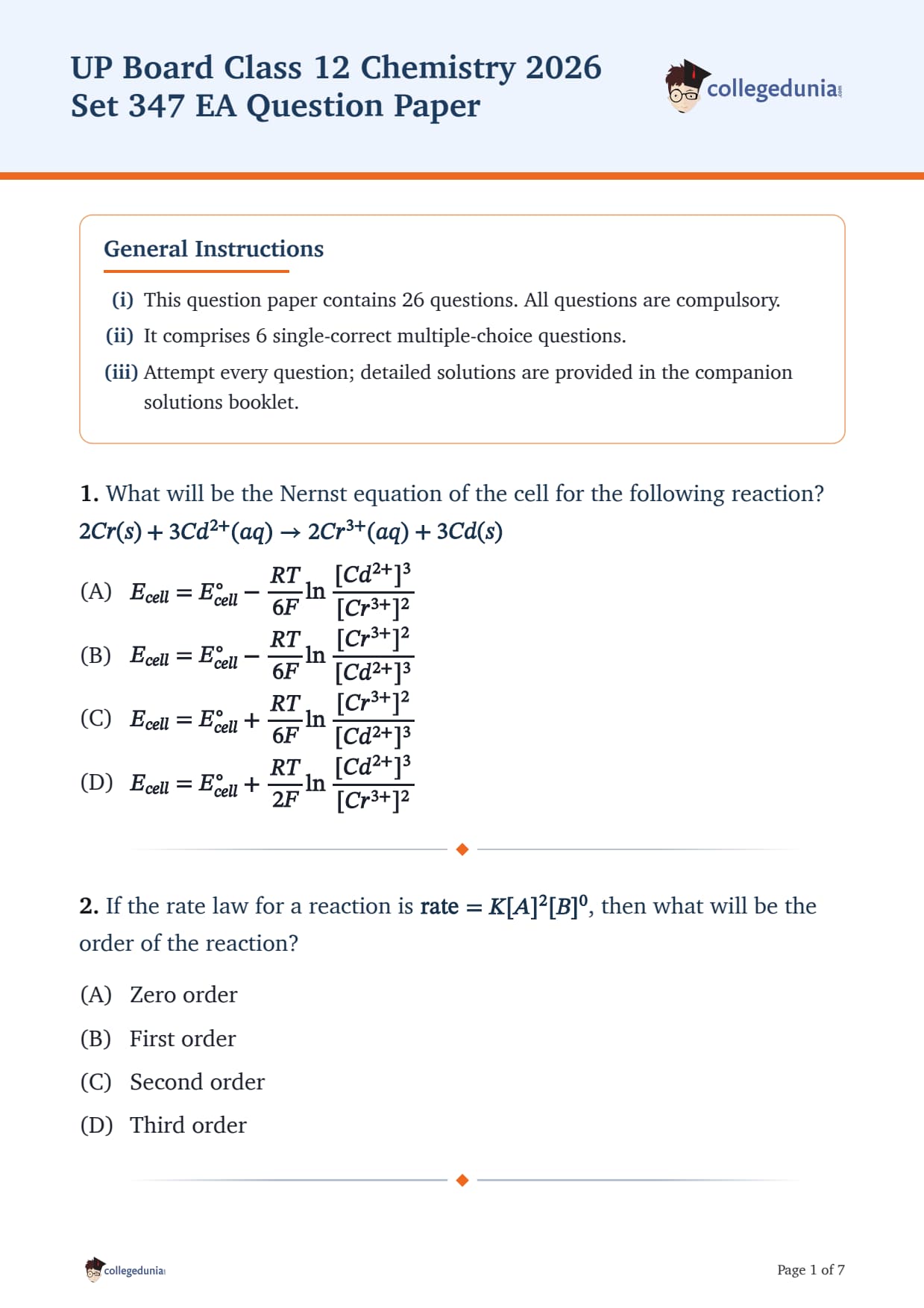
What will be the Nernst equation of the cell for the following reaction?
\( 2Cr(s) + 3Cd^{2+}(aq) \rightarrow 2Cr^{3+}(aq) + 3Cd(s) \)
If the rate law for a reaction is \( \text{rate} = K[A]^2[B]^0 \), then what will be the order of the reaction?
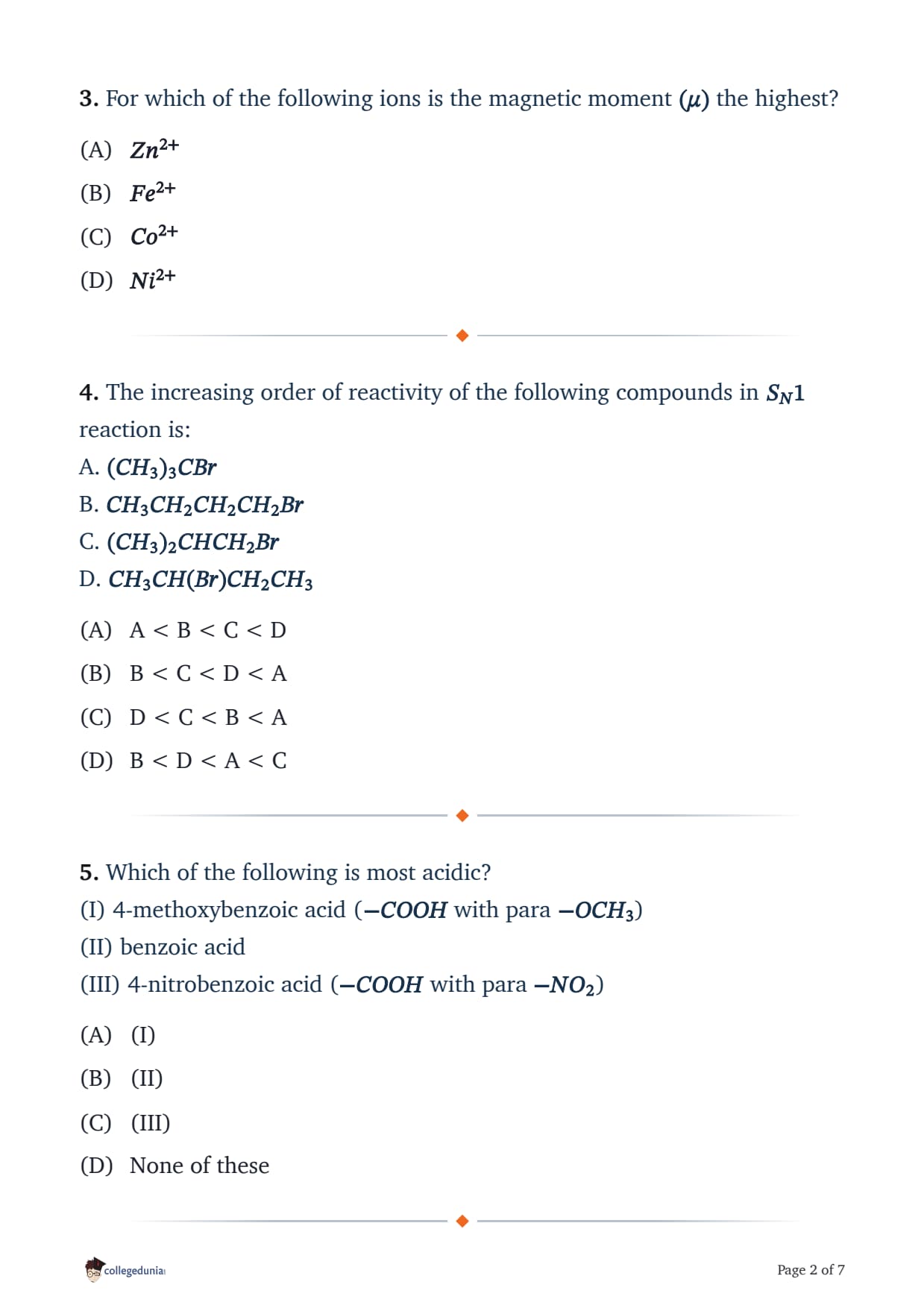
For which of the following ions is the magnetic moment \( (\mu) \) the highest?
The increasing order of reactivity of the following compounds in \( S_N1 \) reaction is:
A. \( (CH_3)_3CBr \)
B. \( CH_3CH_2CH_2CH_2Br \)
C. \( (CH_3)_2CHCH_2Br \)
D. \( CH_3CH(Br)CH_2CH_3 \)
Which of the following is most acidic?
(I) 4-methoxybenzoic acid (\( -COOH \) with para \( -OCH_3 \))
(II) benzoic acid
(III) 4-nitrobenzoic acid (\( -COOH \) with para \( -NO_2 \))
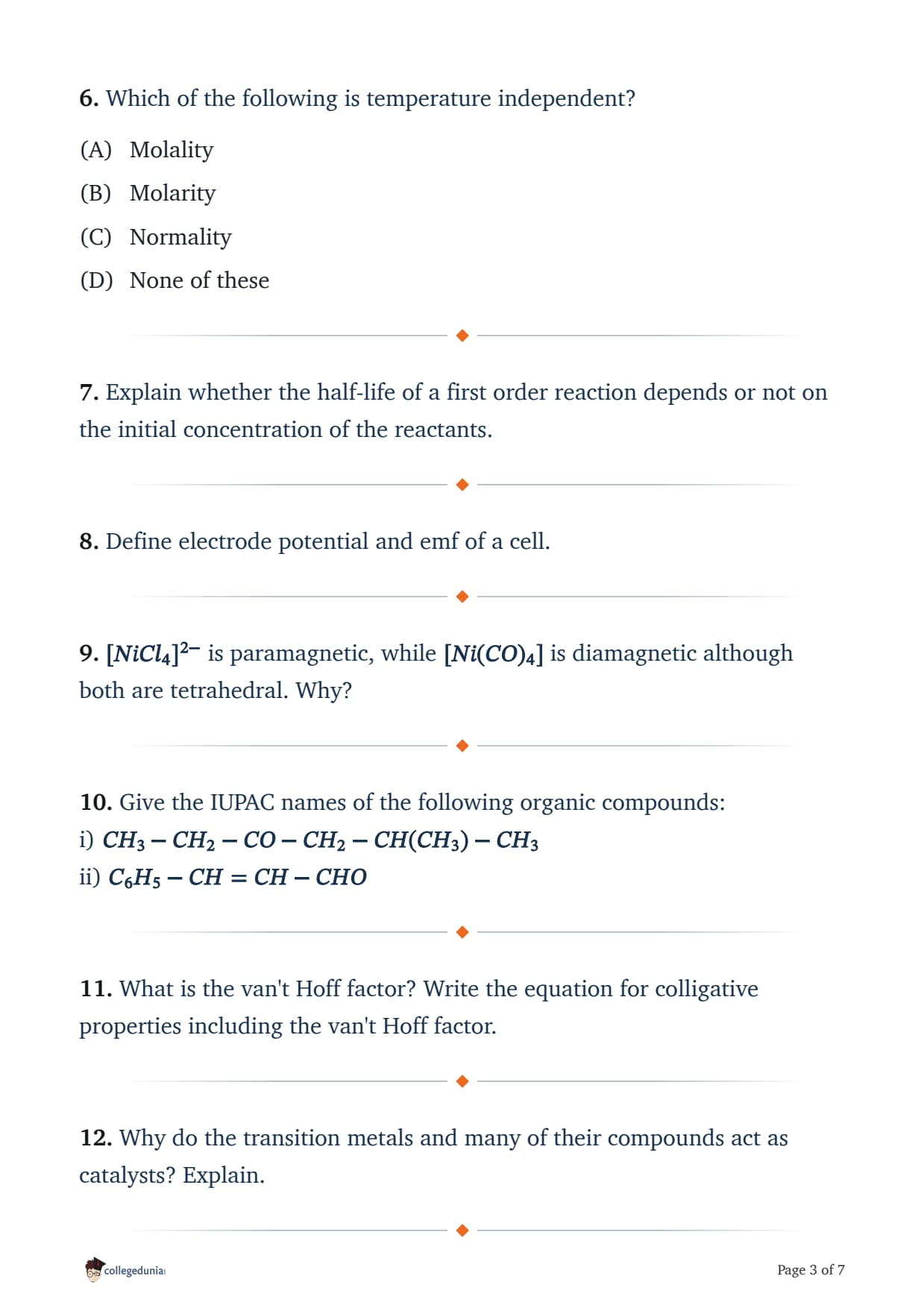
Which of the following is temperature independent?
Explain whether the half-life of a first order reaction depends or not on the initial concentration of the reactants.
Define electrode potential and emf of a cell.
\( [NiCl_4]^{2-} \) is paramagnetic, while \( [Ni(CO)_4] \) is diamagnetic although both are tetrahedral. Why?
Give the IUPAC names of the following organic compounds:
i) \( CH_3-CH_2-CO-CH_2-CH(CH_3)-CH_3 \)
ii) \( C_6H_5-CH=CH-CHO \)
What is the van't Hoff factor? Write the equation for colligative properties including the van't Hoff factor.
Why do the transition metals and many of their compounds act as catalysts? Explain.
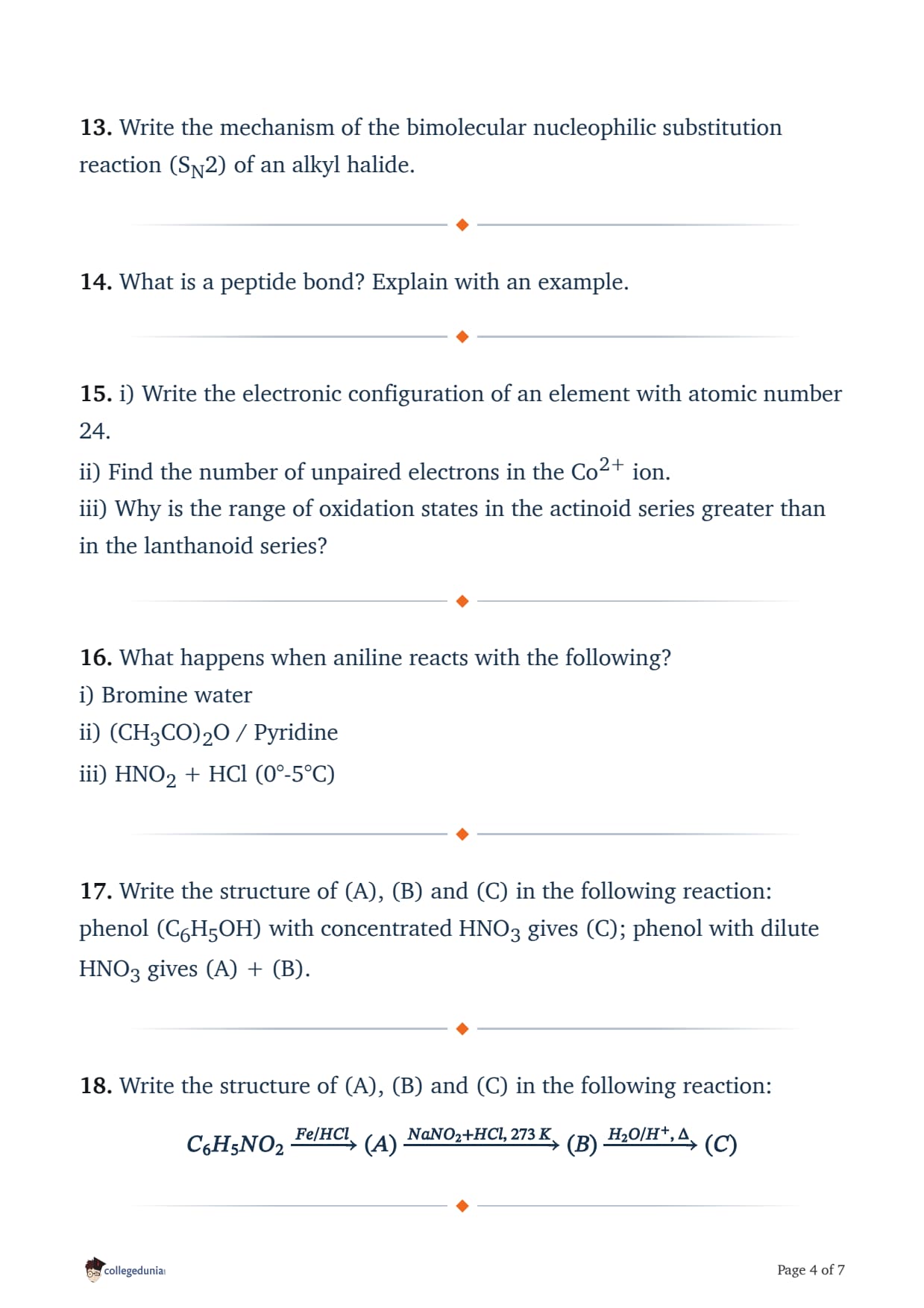
Write the mechanism of the bimolecular nucleophilic substitution reaction (SN2) of an alkyl halide.
What is a peptide bond? Explain with an example.
i) Write the electronic configuration of an element with atomic number 24.
ii) Find the number of unpaired electrons in the Co2+ ion.
iii) Why is the range of oxidation states in the actinoid series greater than in the lanthanoid series?
What happens when aniline reacts with the following?
i) Bromine water
ii) (CH3CO)2O / Pyridine
iii) HNO2 + HCl (0°-5°C)
Write the structure of (A), (B) and (C) in the following reaction: phenol (C6H5OH) with concentrated HNO3 gives (C); phenol with dilute HNO3 gives (A) + (B).
Write the structure of (A), (B) and (C) in the following reaction:
\[ C_6H_5NO_2 \xrightarrow{Fe/HCl} (A) \xrightarrow{NaNO_2 + HCl,\ 273\,K} (B) \xrightarrow{H_2O/H^+,\ \Delta} (C) \]
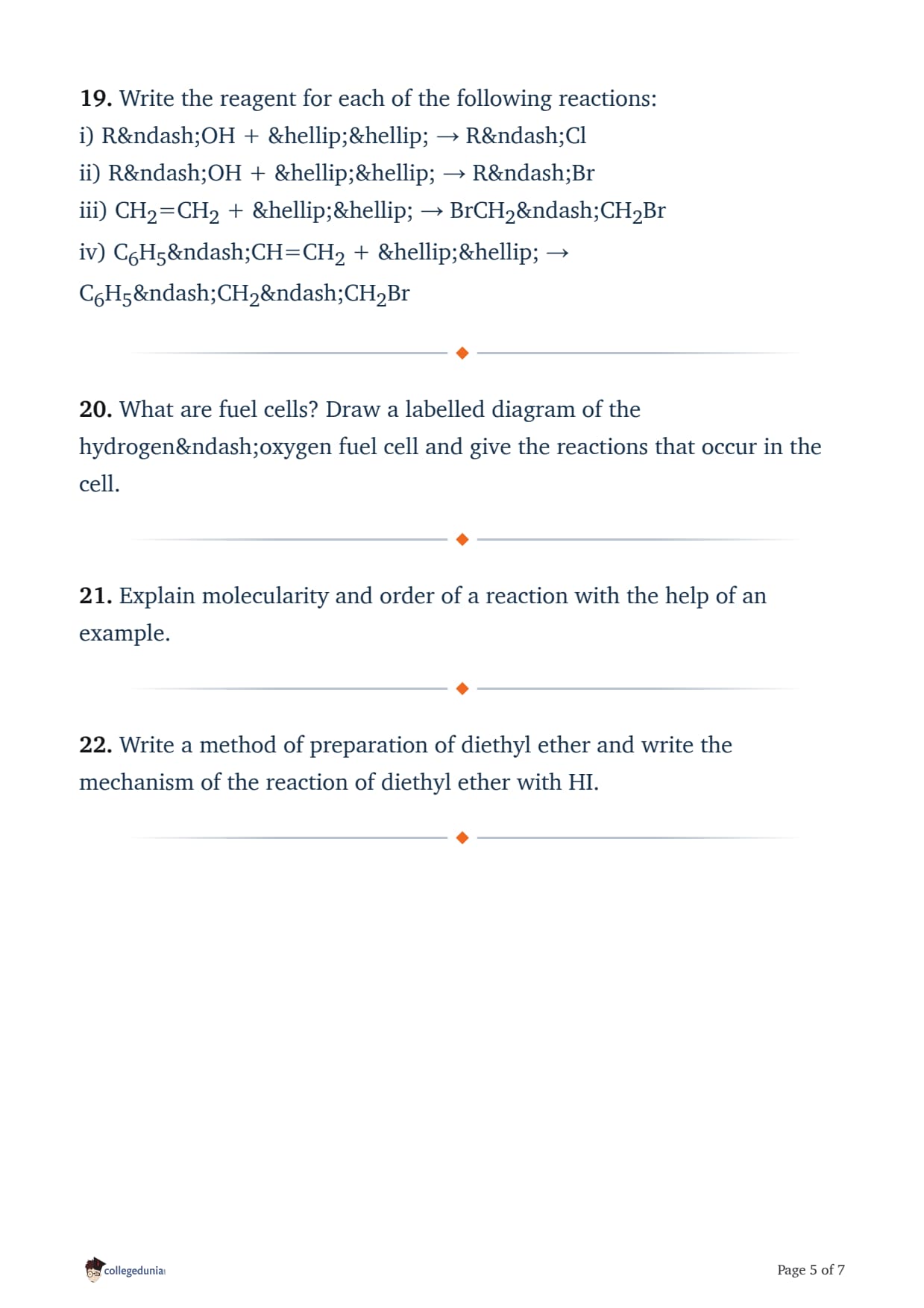
Write the reagent for each of the following reactions:
i) R–OH + …… → R–Cl
ii) R–OH + …… → R–Br
iii) CH2=CH2 + …… → BrCH2–CH2Br
iv) C6H5–CH=CH2 + …… → C6H5–CH2–CH2Br
What are fuel cells? Draw a labelled diagram of the hydrogen–oxygen fuel cell and give the reactions that occur in the cell.
Explain molecularity and order of a reaction with the help of an example.
Write a method of preparation of diethyl ether and write the mechanism of the reaction of diethyl ether with HI.
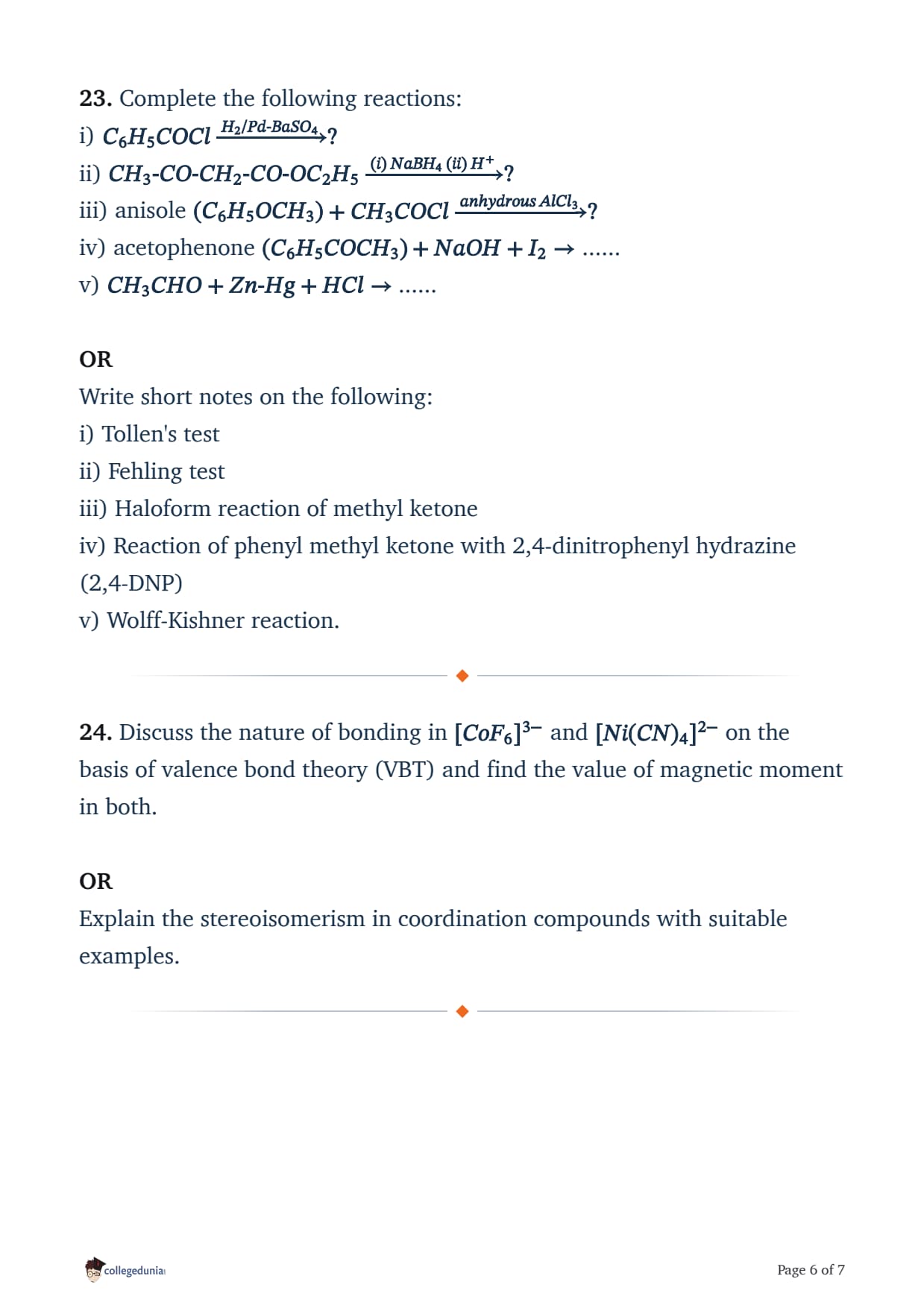
Complete the following reactions:
i) \( C_6H_5COCl \xrightarrow{H_2 / Pd\text{-}BaSO_4} ? \)
ii) \( CH_3\text{-}CO\text{-}CH_2\text{-}CO\text{-}OC_2H_5 \xrightarrow{(i)\ NaBH_4\ (ii)\ H^+} ? \)
iii) anisole \( (C_6H_5OCH_3) + CH_3COCl \xrightarrow{anhydrous\ AlCl_3} ? \)
iv) acetophenone \( (C_6H_5COCH_3) + NaOH + I_2 \rightarrow \) ......
v) \( CH_3CHO + Zn\text{-}Hg + HCl \rightarrow \) ......
OR
Write short notes on the following:
i) Tollen's test
ii) Fehling test
iii) Haloform reaction of methyl ketone
iv) Reaction of phenyl methyl ketone with 2,4-dinitrophenyl hydrazine (2,4-DNP)
v) Wolff-Kishner reaction.
Discuss the nature of bonding in \( [CoF_6]^{3-} \) and \( [Ni(CN)_4]^{2-} \) on the basis of valence bond theory (VBT) and find the value of magnetic moment in both.
OR
Explain the stereoisomerism in coordination compounds with suitable examples.
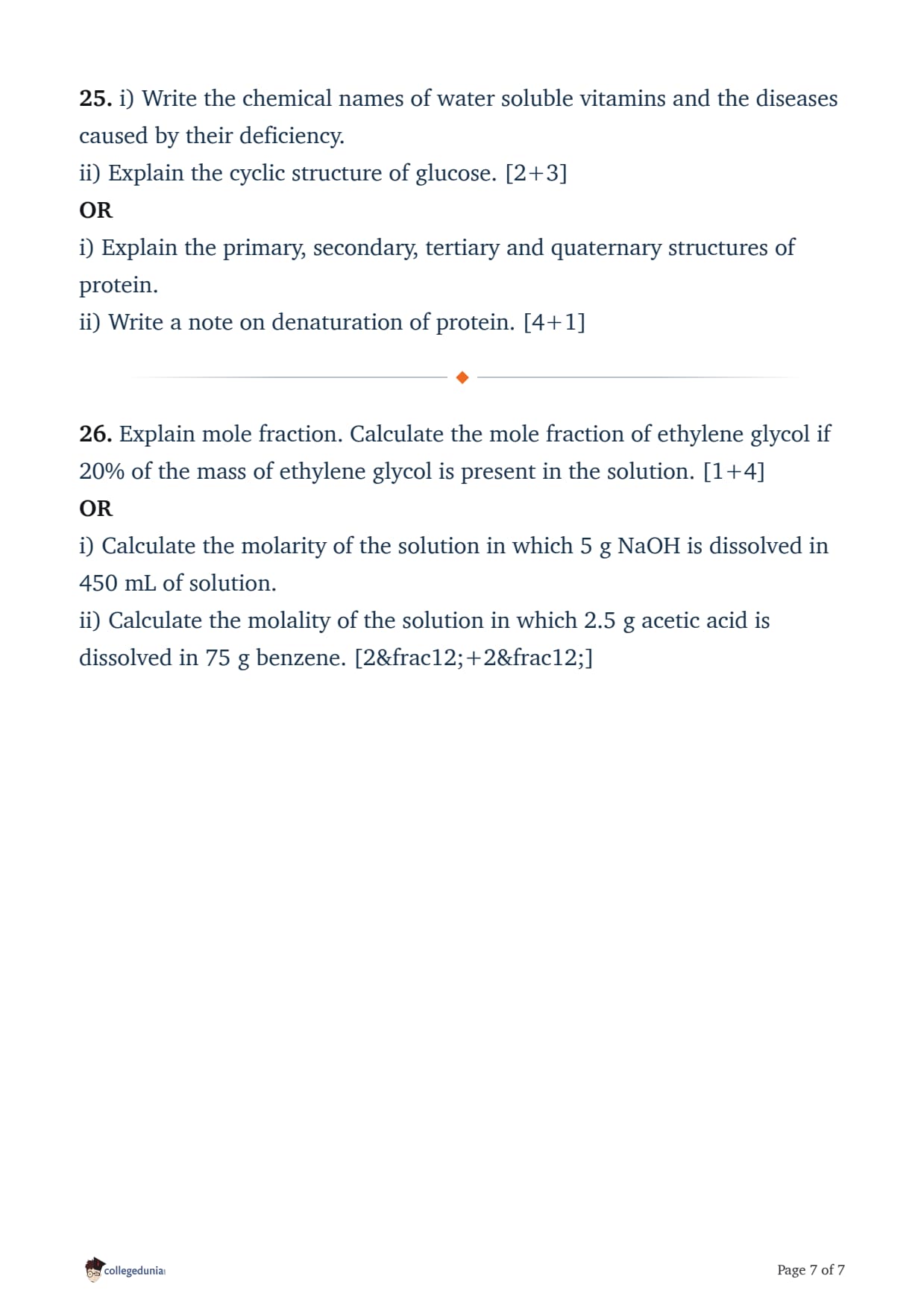
i) Write the chemical names of water soluble vitamins and the diseases caused by their deficiency.
ii) Explain the cyclic structure of glucose. [2+3]
OR
i) Explain the primary, secondary, tertiary and quaternary structures of protein.
ii) Write a note on denaturation of protein. [4+1]
Explain mole fraction. Calculate the mole fraction of ethylene glycol if 20% of the mass of ethylene glycol is present in the solution. [1+4]
OR
i) Calculate the molarity of the solution in which 5 g NaOH is dissolved in 450 mL of solution.
ii) Calculate the molality of the solution in which 2.5 g acetic acid is dissolved in 75 g benzene. [2½+2½]
UP Board Class 12 Chemistry 2026 Set 347 EA Exam Pattern and Marking Scheme
The Set 347 EA paper follows the standard UPMSP Intermediate Chemistry design, moving from 1-mark objective questions up to 5-mark long answers with internal choice. Here is the exact split of the 26 questions across 70 marks.
- Total questions: 26 questions carrying 70 marks in 3 hours 15 minutes
- Objective block (Q1): parts a to f are 6 multiple choice questions of 1 mark each
- Short answer: Section B and Section C questions carry 2 marks each
- Long answer: Section D questions carry 3 marks and 4 marks
- Descriptive (Q6 and Q7): Section E long answers of 5 marks each, with an internal OR choice in both
- Language: every question is printed in both Hindi and English
High-Weightage Topics in UP Board Class 12 Chemistry 2026 Set 347 EA
Organic Chemistry carried the heaviest load in Set 347 EA, so those chapters are where the 5-mark and 4-mark questions concentrated. Focus on these first when you use the paper for revision.
- Aldehydes, Ketones and Carboxylic Acids: around 11% of the theory marks, mostly named reactions and conversions
- Electrochemistry: the single highest-weightage unit at roughly 13% of the paper, with a Nernst equation numerical
- Coordination Compounds: IUPAC naming and hybridisation featured in the 3-mark set
- Chemical Kinetics: a rate-law and half-life numerical worth 3 marks
- p-Block Elements: short-answer distinguishing tests and structures
- Amines: a conversion-based descriptive question appeared in the 5-mark Section E choice
UP Board Class 12 Chemistry 2026 Set 347 EA Question Paper Analysis Video
Source: Alpha Institute
How to Use the UP Board Chemistry 2026 Question Paper for Practice
Treat Set 347 EA as a timed mock before you open the solution PDF. The 70-mark, 3 hour 15 minute window matches the real exam, so practising against the clock is the fastest way to fix your time per section.
- Solve all 26 questions in one 3 hour 15 minute sitting, then score yourself with the solutions PDF above
- Redo every named reaction and conversion you missed in the Organic Chemistry questions, since those repeat most
- Rewrite the Electrochemistry and Chemical Kinetics numericals until you get full steps, not just the final value
- Practise both the OR options in the 5-mark Section E questions so no descriptive topic surprises you
UP Board Class 12 Chemistry 2026 Set 347 EA Question Paper FAQs
Ques. How many questions and marks are there in the UP Board Class 12 Chemistry 2026 Set 347 EA paper?
Ans. The Set 347 EA paper has 26 questions for a total of 70 marks and a duration of 3 hours 15 minutes. It runs from 1-mark objective questions in Q1 up to 5-mark long answers with internal choice in Section E.
Ques. Which topics had the highest weightage in UP Board Class 12 Chemistry 2026?
Ans. Electrochemistry was the heaviest unit at about 13% of the marks, followed by Aldehydes, Ketones and Carboxylic Acids at around 11%. Coordination Compounds, Chemical Kinetics and Amines also carried 3-mark and 5-mark questions.
Ques. Was the UP Board Class 12 Chemistry 2026 paper hard or easy?
Ans. Students found Set 347 EA moderate and close to the NCERT and UPMSP model paper. The numericals in Electrochemistry and Chemical Kinetics were the time-consuming part, while the Organic conversions were scoring if you had practised named reactions.
Ques. Are UP Board Chemistry questions repeated from previous years?
Ans. Yes. UPMSP reuses the same question pattern with small changes in numerical values and named-reaction conversions every year, so solving 5 to 6 previous year papers covers most of what appears. The named reactions in Organic Chemistry repeat the most.
Ques. Is the UP Board Class 12 Chemistry Set 347 EA paper available in Hindi and English?
Ans. Yes. Every question in Set 347 EA is printed in both Hindi and English, so Hindi-medium and English-medium students can use the same paper. The solutions PDF above works for both.
Ques. Where can I download the UP Board Class 12 Chemistry 2026 Set 347 EA question paper with solutions PDF for free?
Ans. Download both the question paper and the full solutions PDF for free from the table above on Collegedunia. The official paper is released by UPMSP on its website, upboardonline.com.



Comments