


UP Board Class 10 Science Question Paper 2023 PDF (Code 824 EO) with Answer Key and Solutions PDF is available for download here. UP Board Class 10 exams were conducted between February 24th to March 12th 2023. The total marks for the theory paper were 70. Students reported the paper to be easy to moderate.
UP Board Class 10 Science Question Paper 2023 (Code 824 EO) with Solutions PDF
| UP Board Class 10 Science (824 EN) Question Paper with Solutions PDF |  Download Download |
Check Solutions |

A mirror producing a virtual image larger than the object is:
View Solution
Step 1: Understand the behavior of mirrors.
- Plane mirrors always produce virtual, erect, and same-size images.
- Convex mirrors always produce virtual, erect, and diminished images.
- Concave mirrors can produce a virtual, erect, and magnified image only when the object is placed between the pole and the focus.
- Spherical mirrors include both concave and convex mirrors, but only concave mirrors can produce magnified virtual images.
Step 2: Conclude based on mirror behavior.
Only a concave mirror has the capability to produce a virtual image larger than the object under certain conditions. Quick Tip: For image formation in mirrors: - Concave mirrors can produce both real and virtual images depending on the object position. - Virtual and magnified images are formed when the object is between the pole and focus of a concave mirror.
The human eye forms the image of an object at its:
View Solution
Step 1: Understand the structure of the human eye.
- The iris controls the size of the pupil and regulates the amount of light entering the eye.
- The pupil is the opening through which light enters.
- The cornea helps focus the incoming light.
- The retina is the light-sensitive layer at the back of the eye where the image is formed.
Step 2: Conclude based on eye function.
The image of an object is always formed on the retina, where photoreceptor cells convert it into electrical signals sent to the brain. Quick Tip: In the human eye: - The retina functions like the film in a camera. - It is the screen where the image is formed and processed.
The colour of white light which is deviated maximum on passing through the glass prism is:
View Solution
Step 1: Understand dispersion of light through a prism.
When white light passes through a glass prism, it splits into its constituent colors due to different degrees of refraction. This phenomenon is called dispersion.
Step 2: Know the order of deviation.
The extent of deviation depends on the wavelength:
- Violet has the shortest wavelength and is deviated the most.
- Red has the longest wavelength and is deviated the least.
Step 3: Conclude based on deviation.
Hence, violet light is deviated the most when white light passes through a prism. Quick Tip: Remember the VIBGYOR order when white light disperses: - Violet deviates the most, - Red deviates the least.
The current passing through an electric kettle has been doubled. The heat produced will become:
View Solution
Step 1: Use the formula for heat produced in an electrical circuit.
The heat produced is given by: \[ H = I^2 R t \]
Where:
- \( H \) is the heat produced,
- \( I \) is the current,
- \( R \) is the resistance,
- \( t \) is the time.
Step 2: Analyze the effect of doubling current.
If the current is doubled: \[ I' = 2I \Rightarrow H' = (2I)^2 R t = 4I^2 R t = 4H \]
Step 3: Conclude.
The heat produced becomes four times the original. Quick Tip: Heat produced in a resistor depends on the square of the current: - Doubling the current increases heat by a factor of \(2^2 = 4\).
The most suitable material for making the core of an electromagnet is:
View Solution
Step 1: Understand the role of the core in an electromagnet.
The core of an electromagnet should:
- Enhance the magnetic field,
- Magnetize and demagnetize quickly with the current.
Step 2: Compare materials.
- Soft iron has high magnetic permeability and low retentivity, making it ideal.
- Steel retains magnetism and is not easily demagnetized.
- Brass and aluminium are non-magnetic materials.
Step 3: Conclude.
Thus, soft iron is the most suitable material for the core of an electromagnet. Quick Tip: For electromagnets: - Use materials with high magnetic permeability and low retentivity. - Soft iron is preferred because it can quickly gain and lose magnetism.
Electric motor is a device which transforms:
View Solution
Step 1: Understand the working principle of an electric motor.
An electric motor works on the principle of converting electrical energy into mechanical energy using the interaction between a magnetic field and current-carrying conductors.
Step 2: Conclude.
The electric motor transforms electrical energy into mechanical energy. Quick Tip: Electric motors are used to power various devices by converting electrical energy into mechanical motion (like in fans, pumps, and electric vehicles).
Pure air is:
View Solution
Step 1: Understand the composition of pure air.
Pure air is a mixture of gases like nitrogen, oxygen, carbon dioxide, and traces of other gases. These gases are uniformly mixed, and their proportions can vary based on the environment, but the air itself is considered a homogeneous mixture.
Step 2: Conclude.
Since air is a mixture of gases that are evenly distributed, it is a homogeneous mixture. Quick Tip: A homogeneous mixture has a uniform composition throughout, while a heterogeneous mixture has distinct components visible or separable.
Alkene is:
View Solution
Step 1: Understand the structure of alkenes.
- Alkenes are hydrocarbons that contain at least one double bond between carbon atoms.
- The general formula for alkenes is \( C_nH_{2n} \).
Step 2: Check the given options.
- \( C3H6 \) corresponds to an alkene with three carbon atoms and a double bond, so it is an alkene.
- \( C2H2 \) is an alkyne (contains a triple bond).
- \( C3H8 \) is an alkane (no double bond).
- \( C4H10 \) is also an alkane.
Step 3: Conclude.
Thus, the correct answer is \( C3H6 \), which represents an alkene. Quick Tip: For hydrocarbons: - Alkenes contain at least one carbon-carbon double bond. - Alkynes have a triple bond, and alkanes have only single bonds.
pH value of pure water is:
View Solution
Step 1: Understand the pH scale.
The pH scale measures the acidity or basicity of a solution, where:
- A pH of 7 indicates a neutral solution.
- A pH below 7 indicates an acidic solution.
- A pH above 7 indicates a basic (alkaline) solution.
Step 2: Analyze the pH of pure water.
Pure water is neutral, with a pH of exactly 7 at 25°C.
Step 3: Conclude.
Thus, the pH value of pure water is \( \textbf{7} \). Quick Tip: Water is neutral at a pH of 7, meaning it is neither acidic nor alkaline.
On moving from left to right in the third period of the periodic table:
View Solution
Step 1: Understand periodic trends.
- As you move from left to right across a period in the periodic table:
- The atomic number increases because protons are being added to the nucleus.
- The atomic size (radius) decreases because the increasing nuclear charge attracts electrons more strongly, pulling them closer to the nucleus.
Step 2: Conclude.
Thus, on moving from left to right in the third period, the atomic number increases and atomic size decreases. Quick Tip: In periods of the periodic table: - Atomic size decreases as the effective nuclear charge increases (due to more protons), pulling electrons closer to the nucleus.
Tally the given substances in Column A with their applications in Column B.
Column A Column B
a. Plaster of Paris i. formation of soap
b. Caustic soda ii. antibacterial
c. Sodium bicarbonate iii. formation of an idol
d. Bleaching powder iv. used for bleaching
The right set of the tally is:
View Solution
Step 1: Analyze the applications of each substance.
- Plaster of Paris is used for making molds and forming idols, so it matches with iii (formation of an idol).
- Caustic soda (NaOH) is used in soap formation, so it matches with i (formation of soap).
- Sodium bicarbonate (baking soda) is used for its bleaching properties, so it matches with iv (used for bleaching).
- Bleaching powder is used as an antibacterial agent, so it matches with ii (antibacterial).
Step 2: Conclude.
The correct set of the tally is:
a - iii, b - i, c - iv, d - ii. Quick Tip: Plaster of Paris is used in construction and making sculptures, while caustic soda is crucial for soap-making. - Sodium bicarbonate has a variety of uses, including as a deodorizer and in cleaning, while bleaching powder is often used for its disinfectant properties.
Which one of the following gives red colour with methyl orange?
View Solution
Step 1: Understand the behaviour of methyl orange.
Methyl orange is a pH indicator that changes color depending on the acidity or basicity of the solution:
- In acidic solutions, methyl orange turns red.
- In basic solutions, it turns yellow.
Step 2: Analyze the options.
- NaCl (Aq) is a neutral salt and does not affect the color of methyl orange.
- Glucose (Aq) is a neutral substance and does not affect the pH.
- KOH (Aq) is a strong base and would turn methyl orange yellow, but since it's not acidic, it won't turn red.
Step 3: Conclude.
None of the above options would turn methyl orange red, as it requires an acidic solution. Therefore, the correct answer is None of the above. Quick Tip: Remember that methyl orange is used to test acidity. It turns red in acidic conditions and yellow in basic conditions.
An eco-friendly renewable source of energy is:
View Solution
Step 1: Understand the types of energy sources.
- Wind energy is a renewable and eco-friendly source of energy. It does not produce harmful emissions and is naturally replenished.
- Petroleum energy, natural gas, and coal are all non-renewable fossil fuels that produce carbon emissions, making them environmentally harmful.
Step 2: Conclude.
Wind energy is the only eco-friendly renewable energy source listed in the options. Quick Tip: Renewable energy sources, like wind, solar, and hydroelectric, are replenished naturally and have a minimal environmental impact compared to fossil fuels.
Mendel is famous:
View Solution
Step 1: Understand Mendel's contribution.
Gregor Mendel is known as the father of genetics. He conducted experiments with pea plants and formulated the laws of inheritance, which form the foundation of modern genetics.
Step 2: Analyze the options.
- Mendel is primarily famous for his work in heredity and the laws of inheritance.
- The discovery of DNA and eugenics are not linked to Mendel, but rather to later scientists like Watson, Crick, and others.
- Conservation of biodiversity was not part of Mendel's work.
Step 3: Conclude.
Thus, Mendel is famous for his work in the field of heredity. Quick Tip: Mendel's work on inheritance laid the foundation for the study of genetics. His experiments demonstrated how traits are passed from one generation to the next.
Sperms are formed in:
View Solution
Step 1: Understand the male reproductive system.
- Sperms are produced in the testes, which are the male gonads.
- The vas deferens is a tube that carries sperm from the testes to the urethra.
- The ovaries are the female gonads where eggs are produced.
- The liver is unrelated to the production of sperm.
Step 2: Conclude.
Sperms are formed in the testes. Quick Tip: Sperm production occurs in the testes through a process called spermatogenesis, which occurs in specialized structures called seminiferous tubules.
Alveoli occur in:
View Solution
Step 1: Understand the structure and function of alveoli.
- Alveoli are tiny air sacs located in the lungs where gas exchange occurs. They allow oxygen to enter the blood and carbon dioxide to be removed.
- The liver, stomach, and heart do not contain alveoli.
Step 2: Conclude.
Thus, alveoli occur in the lungs. Quick Tip: The alveoli are the functional units of the lungs, where the exchange of oxygen and carbon dioxide takes place during breathing.
For the transport of water, plants have:
View Solution
Step 1: Understand the role of plant tissues.
- Phloem is responsible for transporting the products of photosynthesis (mainly sugars) throughout the plant.
- Stomata are pores found on the leaves and stems that allow for gas exchange and transpiration, but they are not responsible for water transport.
- Pith is a tissue found in the center of plant stems and is mainly involved in storage, not water transport.
- Xylem is the tissue responsible for transporting water and minerals from the roots to other parts of the plant.
Step 2: Conclude.
Thus, plants use xylem for the transport of water. Quick Tip: Xylem vessels are specialized for water and mineral transport in plants, and phloem vessels are specialized for transporting food.
Normal blood pressure of a healthy human is:
View Solution
Step 1: Understand normal blood pressure.
The normal blood pressure for a healthy adult human is typically around 120/80 mmHg.
- The first number (120) is the systolic pressure, which is the pressure when the heart beats.
- The second number (80) is the diastolic pressure, which is the pressure when the heart rests between beats.
Step 2: Conclude.
The correct normal blood pressure is 120/80. Quick Tip: A blood pressure reading above 120/80 may indicate hypertension or other cardiovascular issues, depending on the numbers.
Who among the following is famous as the 'Water Man of India'?
View Solution
Step 1: Understand the contributions of the individuals.
- Rajendra Singh is known as the 'Water Man of India' for his work in water conservation and rainwater harvesting, particularly in Rajasthan. His efforts have revived many water bodies.
- Bindeshwar Pathak is known for his work in sanitation and the creation of the Sulabh Shauchalaya.
- J.C. Chaudhry is a well-known educationist, not associated with water conservation.
- Sunderlal Bahuguna was an environmentalist famous for his involvement in the Chipko movement but not specifically for water conservation.
Step 2: Conclude.
Thus, Rajendra Singh is known as the 'Water Man of India'. Quick Tip: Rajendra Singh's work on water conservation, including the revival of traditional water systems, has earned him international recognition.
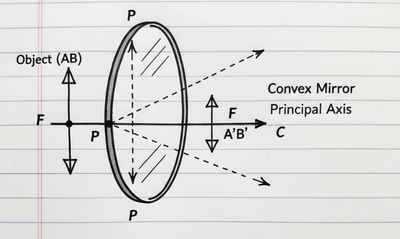
Draw a labelled ray diagram to show the formation of the image of an object placed between the pole and infinity by a convex mirror. State the properties of the image formed. Why do we prefer a convex mirror as a rear-view mirror in vehicles?
View Solution
Step 1: Ray Diagram for a convex mirror.
Step 2: Properties of the image formed.
- The image formed by a convex mirror is virtual, erect, and diminished.
- The image is formed behind the mirror and is smaller than the object, regardless of the position of the object (between the pole and infinity).
Step 3: Why a convex mirror is preferred as a rear-view mirror in vehicles.
- Wide field of view: Convex mirrors diverge light rays, making it easier to see a wide area behind the vehicle, providing a larger field of view compared to flat or concave mirrors.
- Virtual, erect, and diminished image: The image formed is always smaller and upright, which makes it easier to view vehicles or objects behind the driver, preventing the image from being distorted.
- Safety: Since the image is smaller, the driver can see a broader area, reducing blind spots and increasing safety. Quick Tip: Convex mirrors are widely used for safety purposes in vehicles and in places like shopping malls, due to their ability to offer a wide angle of view.
Explain with a drawing how hypermetropia is corrected. The near point of a hypermetropic eye is 75 cm. What is the focal length of the lens required to correct this defect? The near point of a normal eye is 25 cm.
View Solution
Step 1: Understand hypermetropia.
- Hypermetropia, or farsightedness, is a defect in the eye where the near point is farther away than normal. In this case, the near point is 75 cm, whereas for a normal eye, the near point is 25 cm.
- The defect occurs when the eye's focal point falls behind the retina, making it difficult to focus on nearby objects.
Step 2: Correction of hypermetropia.
Hypermetropia can be corrected by using a convex lens, which converges the light before it enters the eye. The lens brings the image of nearby objects to the normal near point (25 cm).
% Drawing the diagram of correction
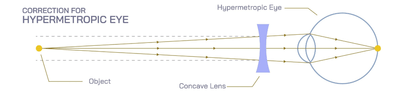
Step 3: Calculation of focal length.
To calculate the focal length of the lens required to correct the defect, we can use the lens formula: \[ \frac{1}{f} = \frac{1}{v} - \frac{1}{u} \]
Where:
- \( f \) is the focal length of the lens,
- \( v \) is the image distance (which, for correction, is the normal near point of 25 cm),
- \( u \) is the object distance (which is the near point of the hypermetropic eye, 75 cm).
\[ \frac{1}{f} = \frac{1}{25} - \frac{1}{75} \]
Calculating the right-hand side:
\[ \frac{1}{f} = \frac{3 - 1}{75} = \frac{2}{75} \]
Thus, the focal length \( f \) is:
\[ f = \frac{75}{2} = 37.5 \, cm \]
Step 4: Conclusion.
The focal length of the lens required to correct the hypermetropic defect is 37.5 cm. Quick Tip: For correcting hypermetropia, a convex lens with a focal length equal to the difference between the near points of the defective and normal eye is used.
On what factors does the resistance of a conductor depend? An electric bulb operated at 80 volts takes 10 amperes of current. How much resistance should be connected in series with the bulb to use it at 240 volts so that it takes the same current?
View Solution
Step 1: Factors affecting the resistance of a conductor.
The resistance of a conductor depends on the following factors:
1. Length of the conductor (L): The resistance is directly proportional to the length of the conductor. As the length increases, resistance increases.
\[ R \propto L \]
2. Cross-sectional area (A): The resistance is inversely proportional to the cross-sectional area of the conductor. As the area increases, the resistance decreases.
\[ R \propto \frac{1}{A} \]
3. Material of the conductor: The resistance depends on the material's resistivity, denoted by \( \rho \). Each material has a characteristic resistivity that determines its resistance.
\[ R = \rho \frac{L}{A} \]
4. Temperature of the conductor: The resistance of most conductors increases with temperature.
Step 2: Calculating the required resistance to use the bulb at 240 volts.
We are given:
- The voltage \( V_1 = 80 \, V \),
- The current \( I_1 = 10 \, A \),
- The voltage \( V_2 = 240 \, V \),
- The current \( I_2 = I_1 = 10 \, A \) (since we want the same current).
First, calculate the resistance of the bulb at 80 V using Ohm's law: \[ R_1 = \frac{V_1}{I_1} = \frac{80}{10} = 8 \, \Omega \]
Now, when the bulb is used at 240 V, we want the same current (10 A) to flow through the bulb. The total resistance in the circuit must be such that: \[ R_{total} = \frac{V_2}{I_2} = \frac{240}{10} = 24 \, \Omega \]
Since the resistance of the bulb \( R_1 \) is already 8 \( \Omega \), the resistance \( R_{series} \) to be connected in series must be: \[ R_{series} = R_{total} - R_1 = 24 - 8 = 16 \, \Omega \]
Step 3: Conclusion.
The resistance that should be connected in series with the bulb to use it at 240 V and maintain the same current of 10 A is 16 \( \Omega \). Quick Tip: When using electrical devices at higher voltages, resistances in series can help regulate the current to the desired value by limiting the total current according to Ohm's law: \( I = \frac{V}{R} \).
Define Kilowatt hour. How many Joules are equal to 1 kilowatt-hour? An electric kettle rated 220 volts, 2.2 kilowatts works for 3 hours. Calculate energy consumed and the current.
View Solution
Step 1: Definition of Kilowatt-hour.
A kilowatt-hour (kWh) is the amount of energy consumed by a device with a power rating of 1 kilowatt operating for 1 hour. It is a unit of energy commonly used by electric utilities to measure electrical energy consumption.
\[ 1 \, kWh = 1 \, kilowatt \times 1 \, hour \]
Step 2: Conversion of Kilowatt-hour to Joules.
We know that: \[ 1 \, kilowatt = 1000 \, watts \quad and \quad 1 \, hour = 3600 \, seconds \]
Thus, the energy in Joules for 1 kWh is: \[ 1 \, kWh = 1000 \, watts \times 3600 \, seconds = 3,600,000 \, Joules \]
So, \( 1 \, kWh = 3,600,000 \, Joules \).
Step 3: Calculation of energy consumed by the electric kettle.
The power rating of the electric kettle is 2.2 kilowatts (kW), and it works for 3 hours.
Energy consumed \( E \) is given by the formula: \[ E = P \times t \]
Where:
- \( P = 2.2 \, kW \) (power of the kettle),
- \( t = 3 \, hours \).
Thus: \[ E = 2.2 \, kW \times 3 \, hours = 6.6 \, kWh \]
Now, convert energy to Joules: \[ E = 6.6 \, kWh \times 3,600,000 \, Joules = 23,760,000 \, Joules \]
Step 4: Calculation of the current.
The electric kettle operates at a voltage of 220 volts, and its power is 2.2 kW.
We can use the formula for electrical power: \[ P = V \times I \]
Where:
- \( P = 2.2 \, kW = 2200 \, W \) (convert to watts),
- \( V = 220 \, V \) (voltage),
- \( I \) is the current.
Rearranging the formula to solve for current: \[ I = \frac{P}{V} = \frac{2200}{220} = 10 \, A \]
Step 5: Conclusion.
- The energy consumed by the electric kettle in 3 hours is 23,760,000 Joules.
- The current drawn by the electric kettle is 10 amperes. Quick Tip: To calculate energy consumed, use the formula \( E = P \times t \). For power in watts and time in hours, the energy in kWh can be converted to Joules by multiplying by \( 3,600,000 \).
Write the electronic configuration of chlorine (atomic number 17). Explain its position in the periodic table and write its valency.
View Solution
Step 1: Electronic configuration of chlorine.
The atomic number of chlorine is 17, which means it has 17 electrons. The electronic configuration is written by filling the orbitals in the order of increasing energy:
\[ Chlorine (Cl): 1s^2 \, 2s^2 \, 2p^6 \, 3s^2 \, 3p^5 \]
This configuration indicates:
- 2 electrons in the first shell (1s),
- 8 electrons in the second shell (2s and 2p),
- 7 electrons in the third shell (3s and 3p).
Step 2: Position of chlorine in the periodic table.
- Chlorine is a member of **Group 17** (also known as **Group VIIA**), which is the **halogen group**.
- It is in the **third period** of the periodic table.
- Chlorine has a total of 7 valence electrons in its outermost shell (3p^5), which makes it highly reactive, especially in forming salts with metals.
Step 3: Valency of chlorine.
- The valency of chlorine is **1**. This is because chlorine needs one more electron to complete its octet and achieve the stable electronic configuration of argon (a noble gas).
- Therefore, chlorine can gain one electron to form a negatively charged ion (Cl⁻), or it can form a covalent bond by sharing one electron with another atom (such as hydrogen in HCl).
Conclusion:
The electronic configuration of chlorine is \( 1s^2 \, 2s^2 \, 2p^6 \, 3s^2 \, 3p^5 \), it belongs to Group 17 (halogens) and the third period, and its valency is 1. Quick Tip: Halogens like chlorine have 7 valence electrons and are highly reactive because they need one more electron to achieve a stable octet. This makes them strong oxidizing agents and reactive in forming ionic or covalent compounds.
Describe Mendel's Laws.
View Solution
Mendel's laws of inheritance are the foundation of classical genetics. They describe how traits are inherited from one generation to the next. These laws are based on Mendel's experiments with pea plants. There are three main laws:
1. Law of Dominance:
This law states that in a heterozygous organism, the dominant allele will express its trait, while the recessive allele will be masked. In simple terms, when two different alleles are present, the dominant one will determine the organism’s appearance.
Example: In pea plants, the allele for round seeds (R) is dominant over the allele for wrinkled seeds (r). Therefore, a plant with the genotype Rr will have round seeds.
\[ R (Round seed) > r (Wrinkled seed) \]
2. Law of Segregation:
This law states that every organism possesses two alleles for each trait, one inherited from each parent. These alleles segregate (separate) during the formation of gametes (egg and sperm), so each gamete carries only one allele for each trait.
Example: In a cross between two heterozygous pea plants (Rr), the offspring can inherit either the R or r allele from each parent.
\[ Gametes: R or r \]
\[ Resulting Genotypes: 1 \, RR : 2 \, Rr : 1 \, rr \]
3. Law of Independent Assortment:
This law states that genes for different traits are inherited independently of one another, provided they are located on different chromosomes. This means the inheritance of one trait does not affect the inheritance of another trait.
Example: In a dihybrid cross between two heterozygous pea plants (RrYy × RrYy), the traits for seed shape (R/r) and seed color (Y/y) assort independently.
\[ Possible Gametes: RY, Ry, rY, ry \]
\[ F2 Generation Phenotypic Ratio: 9:3:3:1 \]
Conclusion:
Mendel's laws of inheritance laid the foundation for our understanding of genetics. These laws explain how traits are passed from parents to offspring and how genetic variation arises in populations. Quick Tip: Mendel’s laws apply to traits controlled by single genes with clear dominant and recessive alleles. More complex inheritance patterns, such as co-dominance and polygenic inheritance, occur in nature.
Give an account of post-fertilization changes in an angiospermic plant.
View Solution
In angiospermic (flowering) plants, post-fertilization refers to the changes that occur after the fertilization of the egg cell. The main processes that occur after fertilization include the development of the seed and fruit, as well as the formation of the embryo. Below are the key steps involved in post-fertilization changes:
1. Formation of the Zygote:
- During fertilization, the male gamete (sperm) fuses with the female gamete (egg cell) to form a zygote. This fertilized egg cell will later develop into the embryo within the seed.
2. Development of the Embryo:
- The zygote undergoes a series of divisions and differentiations to form the embryo. The embryo consists of the following parts:
- Cotyledons: These are the seed leaves and are the first to appear in the developing embryo. They store nutrients and provide energy for the young seedling during germination.
- Radicle: The embryonic root that will later develop into the mature root system of the plant.
- Plumule: The embryonic shoot that will develop into the stem and leaves of the plant.
3. Formation of Endosperm:
- In addition to the zygote, the second male gamete fuses with the two polar nuclei present in the central cell of the ovule to form the triploid endosperm.
- The endosperm acts as a food reserve for the developing embryo and provides nourishment during seed germination.
4. Seed Coat Formation:
- The outer integuments of the ovule develop into the seed coat (testa). The seed coat protects the embryo and provides resistance to desiccation and mechanical damage.
5. Ovary Transforms into Fruit:
- After fertilization, the ovary of the flower matures into a fruit. The walls of the ovary thicken and develop into the fruit's pericarp (fruit wall). The fruit contains the seeds, and its role is to protect the seeds and aid in their dispersal.
- In some plants, the fruit is fleshy (e.g., apples, berries), while in others, it may be dry (e.g., legumes, nuts).
6. Formation of Seed:
- The fertilized ovule develops into a seed, which consists of the embryo, the endosperm, and the seed coat. The seed is the means of reproduction and dispersal in angiospermic plants.
- The seed contains stored food reserves (mainly in the endosperm or cotyledons) that are utilized during germination to nourish the developing plant.
7. Ripening of Fruit:
- After fertilization, the fruit continues to mature, a process known as ripening. This involves changes in the color, texture, and taste of the fruit, making it attractive for seed dispersal.
- In some plants, ripening involves the conversion of starches to sugars, which makes the fruit sweeter and more appealing to animals that will aid in seed dispersal.
8. Dispersal of Seeds:
- Once the fruit has ripened, the seeds are ready to be dispersed. Seed dispersal mechanisms include wind, water, animals, or mechanical forces. Successful seed dispersal ensures that the seeds can grow in new locations, away from the parent plant.
Conclusion:
Post-fertilization changes in angiospermic plants involve a series of steps that lead to the formation of seeds and fruits. The development of the embryo, endosperm, and seed coat, as well as the maturation of the ovary into a fruit, are crucial steps for the successful reproduction and dispersal of the plant. Quick Tip: Post-fertilization changes are essential for the formation of seeds, which are the primary means of reproduction in angiospermic plants. The development of the embryo, endosperm, and fruit ensures that the plant can successfully reproduce and spread.
In order to save the environment, describe the five types of ‘R’.
View Solution
The "five Rs" are a set of principles for sustainable living that can help reduce environmental impact and promote a cleaner, healthier planet. These five principles are:
1. Reduce:
Reducing means cutting down on the amount of waste and consumption. The goal is to consume less and avoid excess. By reducing our use of non-essential goods and opting for products that last longer or have less packaging, we can significantly lower the strain on resources and reduce pollution.
- Example: Using energy-efficient appliances, reducing water usage, and purchasing products with minimal packaging.
2. Reuse:
Reusing involves finding ways to use products and materials multiple times before discarding them. By reusing, we can extend the life of products, reduce waste, and minimize the need for new materials to be produced.
- Example: Using glass jars to store food instead of throwing them away, or repurposing old clothes into rags or other items.
3. Recycle:
Recycling refers to the process of converting waste materials into new products to prevent waste of potentially useful materials. By recycling, we reduce the need for extracting new raw materials, decrease pollution, and conserve energy.
- Example: Recycling paper, plastic, glass, and metal items that can be repurposed into new products.
4. Refuse:
Refusing means saying no to products or practices that harm the environment. By refusing unnecessary single-use plastics, toxic chemicals, or non-recyclable materials, we can prevent pollution and reduce demand for environmentally harmful products.
- Example: Refusing to use plastic bags and opting for reusable bags instead, or saying no to bottled water.
5. Rot (Composting):
Rotting refers to composting organic waste, such as food scraps and yard trimmings, into nutrient-rich soil. Composting reduces the amount of waste sent to landfills, enriches the soil, and promotes sustainable agriculture.
- Example: Composting vegetable peels, coffee grounds, and lawn clippings to create compost for gardening.
Conclusion:
By practicing the five Rs—**Reduce**, **Reuse**, **Recycle**, **Refuse**, and **Rot**—we can all contribute to reducing our environmental footprint and help create a more sustainable world. These practices reduce waste, conserve resources, and minimize pollution, benefiting both the planet and future generations. Quick Tip: By focusing on the five Rs, we can make significant strides in reducing our impact on the environment and promoting sustainability. Every small action contributes to a healthier planet!
Describe the male reproductive system of humans.
View Solution
The male reproductive system is responsible for producing sperm, the male gametes, and transferring them to the female reproductive system for fertilization. It consists of various internal and external structures. Below are the main components:
1. Testes:
The testes are the primary male reproductive organs that produce sperm and the hormone testosterone. They are located in the scrotum, a sac outside the body that helps maintain a temperature slightly lower than the body’s temperature, which is essential for sperm production.
- **Structure:** Each testis contains coiled structures called seminiferous tubules, where sperm are produced through the process of spermatogenesis.
- **Function:** The testes also secrete testosterone, which is responsible for the development of male secondary sexual characteristics.
2. Epididymis:
The epididymis is a long, coiled tube attached to the back of each testis. It serves as the site where sperm mature and are stored.
- **Structure:** It consists of three parts: the head, body, and tail.
- **Function:** Sperm mature in the epididymis, gaining the ability to swim and fertilize an egg. The sperm are stored in the tail of the epididymis until ejaculation.
3. Vas Deferens:
The vas deferens is a muscular tube that transports mature sperm from the epididymis to the urethra during ejaculation.
- **Structure:** It passes through the inguinal canal and into the pelvic cavity.
- **Function:** The vas deferens is responsible for carrying sperm from the epididymis to the urethra, where it mixes with seminal fluid to form semen.
4. Seminal Vesicles:
The seminal vesicles are a pair of glands located behind the bladder. They secrete a thick, alkaline fluid that contains fructose, which provides energy for sperm.
- **Function:** The fluid from the seminal vesicles combines with sperm to form semen, which is ejaculated during intercourse.
5. Prostate Gland:
The prostate gland is located below the bladder and surrounds the urethra. It secretes a milky, alkaline fluid that helps neutralize the acidic environment of the female reproductive tract, providing an optimal pH for sperm survival.
- **Function:** The prostate’s secretions form a part of the semen and enhance sperm motility and survival.
6. Bulbourethral Glands (Cowper’s Glands):
The bulbourethral glands are small glands located beneath the prostate. They secrete a clear, alkaline fluid that lubricates the urethra and neutralizes any acidic urine that may remain in the urethra.
- **Function:** The secretions from the bulbourethral glands help protect sperm from damage during ejaculation and provide lubrication.
7. Urethra:
The urethra is a tube that carries urine from the bladder and semen from the reproductive system to the outside of the body.
- **Structure:** It passes through the penis and opens at the tip.
- **Function:** During ejaculation, the urethra transports semen, which contains sperm, to the outside. It also transports urine from the bladder but not at the same time as semen.
8. Penis:
The penis is the external organ through which semen is delivered to the female reproductive system. It consists of the shaft, glans, and urethra.
- **Structure:** The penis contains erectile tissue that fills with blood during sexual arousal, causing an erection.
- **Function:** The penis delivers sperm into the female reproductive tract during sexual intercourse.
Conclusion:
The male reproductive system is a complex network of organs and glands that work together to produce, mature, and deliver sperm to the female reproductive system for fertilization. Key components include the testes, epididymis, vas deferens, seminal vesicles, prostate gland, bulbourethral glands, urethra, and penis. Quick Tip: The male reproductive system relies on both internal and external structures working together to produce sperm and facilitate fertilization. Hormones like testosterone play a key role in the development of male sexual characteristics.



Comments