


UP Board Class 10 Science Question Paper 2023 PDF (Code 824 EP) with Answer Key and Solutions PDF is available for download here. UP Board Class 10 exams were conducted between February 24th to March 12th 2023. The total marks for the theory paper were 70. Students reported the paper to be easy to moderate.
UP Board Class 10 Science Question Paper 2023 (Code 824 EP) with Solutions PDF
| UP Board Class 10 Science (824 EP) Question Paper with Solutions PDF |  Download Download |
Check Solutions |

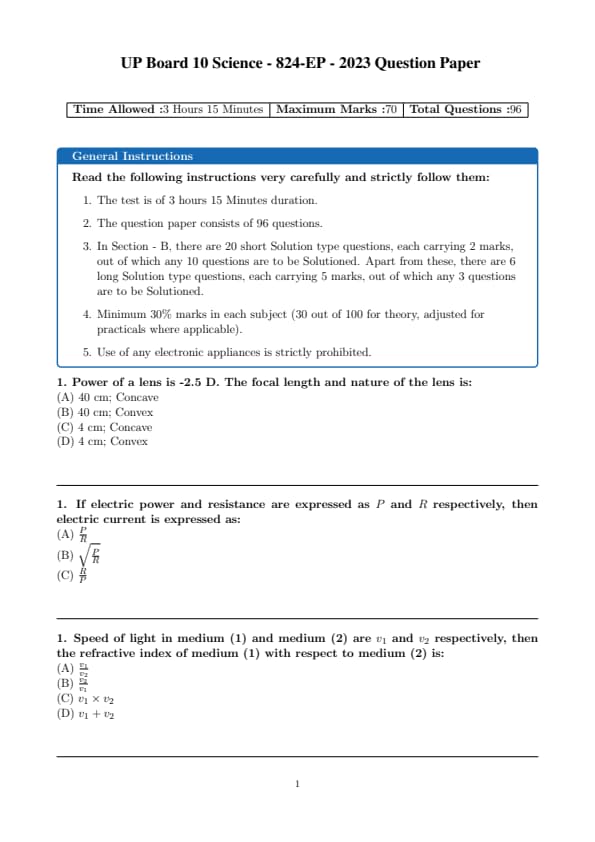
Power of a lens is -2.5 D. The focal length and nature of the lens is:
View Solution
The power \( P \) of a lens is related to its focal length \( f \) by the formula: \[ P = \frac{1}{f} \]
where \( f \) is in meters. Given that the power is \( -2.5 \, D \), we can find the focal length as: \[ f = \frac{1}{P} = \frac{1}{-2.5} = -0.4 \, m = -40 \, cm. \]
Since the focal length is negative, the lens is concave. Quick Tip: For a lens: - Power \( P \) is positive for a convex lens and negative for a concave lens. - Focal length \( f \) is negative for a concave lens and positive for a convex lens.
If electric power and resistance are expressed as \( P \) and \( R \) respectively, then electric current is expressed as:
View Solution
The relationship between electric power \( P \), resistance \( R \), and current \( I \) is given by the formula: \[ P = I^2 R \]
Rearranging this equation to solve for current \( I \), we get: \[ I = \sqrt{\frac{P}{R}}. \] Quick Tip: To remember the formulas: - Power \( P = I^2 R \) - Voltage \( V = IR \) - Power \( P = VI \)
Speed of light in medium (1) and medium (2) are \( v_1 \) and \( v_2 \) respectively, then the refractive index of medium (1) with respect to medium (2) is:
View Solution
The refractive index \( n \) of a medium is defined as the ratio of the speed of light in a vacuum \( c \) to the speed of light in the medium. For two mediums (1) and (2), the refractive index of medium (1) with respect to medium (2) is given by: \[ n_{1,2} = \frac{v_1}{v_2} \]
where \( v_1 \) is the speed of light in medium (1) and \( v_2 \) is the speed of light in medium (2). Quick Tip: The refractive index of medium 1 with respect to medium 2 gives the relative speed of light in the two media. The formula is: \[ n_{1,2} = \frac{v_1}{v_2} \]
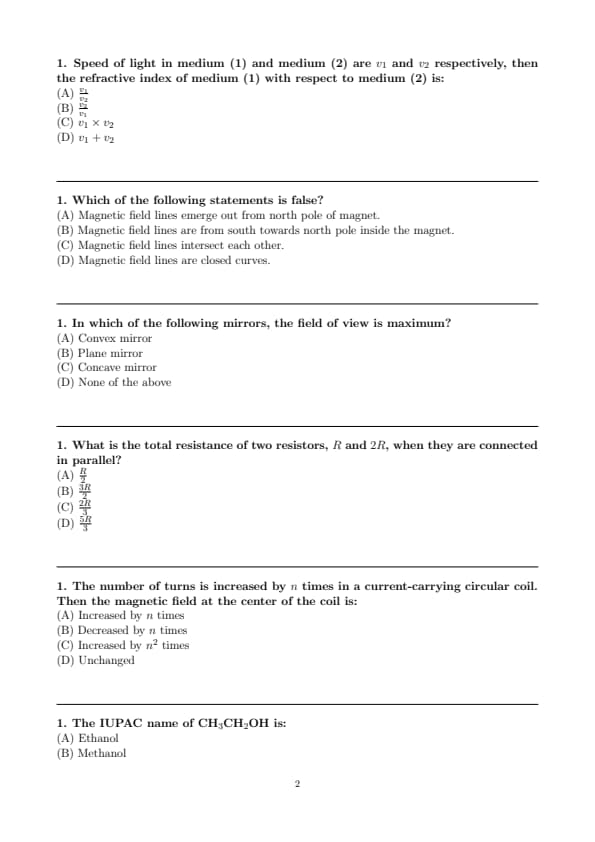
Speed of light in medium (1) and medium (2) are \( v_1 \) and \( v_2 \) respectively, then the refractive index of medium (1) with respect to medium (2) is:
View Solution
The refractive index \( n \) of a medium is defined as the ratio of the speed of light in a vacuum \( c \) to the speed of light in the medium. For two mediums (1) and (2), the refractive index of medium (1) with respect to medium (2) is given by: \[ n_{1,2} = \frac{v_1}{v_2} \]
where \( v_1 \) is the speed of light in medium (1) and \( v_2 \) is the speed of light in medium (2). Quick Tip: The refractive index of medium 1 with respect to medium 2 gives the relative speed of light in the two media. The formula is: \[ n_{1,2} = \frac{v_1}{v_2} \]
Which of the following statements is false?
View Solution
The magnetic field lines have the following properties:
- They emerge from the north pole of a magnet and enter the south pole outside the magnet.
- Inside the magnet, the magnetic field lines travel from the south pole to the north pole.
- Magnetic field lines do not intersect each other. If they did, it would imply that at the point of intersection, the magnetic field has two directions, which is not possible.
- Magnetic field lines are closed curves, meaning they form a continuous loop.
Thus, the false statement is (C), "Magnetic field lines intersect each other." Quick Tip: Magnetic field lines: - Do not intersect. - Form closed loops, always continuing from north to south pole and vice versa inside the magnet.
In which of the following mirrors, the field of view is maximum?
View Solution
The field of view refers to the extent of the observable world that can be seen at any given moment. The field of view is maximum in a convex mirror.
- Convex mirrors have a wide field of view because they diverge light rays, allowing them to reflect a large area.
- Plane mirrors provide a smaller field of view compared to convex mirrors.
- Concave mirrors have a smaller field of view because they converge light rays, focusing the image and reducing the area visible.
Thus, the mirror with the maximum field of view is the convex mirror. Quick Tip: Convex mirrors are used in rearview mirrors and security mirrors because of their wide field of view.
What is the total resistance of two resistors, \( R \) and \( 2R \), when they are connected in parallel?
View Solution
The formula for the total resistance \( R_t \) of two resistors, \( R_1 \) and \( R_2 \), connected in parallel is given by: \[ \frac{1}{R_t} = \frac{1}{R_1} + \frac{1}{R_2} \]
For the resistors \( R \) and \( 2R \), we have: \[ \frac{1}{R_t} = \frac{1}{R} + \frac{1}{2R} \]
Simplifying: \[ \frac{1}{R_t} = \frac{2}{2R} + \frac{1}{2R} = \frac{3}{2R} \]
Thus, \[ R_t = \frac{2R}{3} \] Quick Tip: For resistors in parallel, the total resistance is always less than the smallest individual resistance.
The number of turns is increased by \( n \) times in a current-carrying circular coil. Then the magnetic field at the center of the coil is:
View Solution
The magnetic field at the center of a current-carrying circular coil is given by the formula: \[ B = \frac{\mu_0 n I}{2 R} \]
where:
- \( B \) is the magnetic field at the center of the coil,
- \( \mu_0 \) is the permeability of free space,
- \( n \) is the number of turns per unit length,
- \( I \) is the current through the coil, and
- \( R \) is the radius of the coil.
When the number of turns is increased by a factor of \( n \), the total number of turns becomes \( n \times N \) (where \( N \) is the initial number of turns). As a result, the magnetic field at the center increases by a factor of \( n^2 \), because the magnetic field is proportional to the square of the number of turns in the coil.
Thus, the magnetic field increases by \( n^2 \) times. Quick Tip: The magnetic field at the center of a coil is directly proportional to the number of turns squared, assuming current and radius are constant.
The IUPAC name of \( CH_3CH_2OH \) is:
View Solution
The given chemical formula is \( CH_3CH_2OH \), which is an alcohol. The IUPAC name for this compound is "Ethanol," because it consists of a two-carbon chain (ethane) with a hydroxyl group (\(-OH\)) attached to one of the carbon atoms.
- Methanol (\( CH_3OH \)) is a one-carbon alcohol.
- Acetic acid (\( CH_3COOH \)) and Ethanoic acid (\( CH_3COOH \)) are carboxylic acids, not alcohols.
Thus, the correct IUPAC name for \( CH_3CH_2OH \) is "Ethanol." Quick Tip: In IUPAC naming, alcohols are named by replacing the "e" of the corresponding alkane with "ol." For example: - Ethane → Ethanol - Methane → Methanol
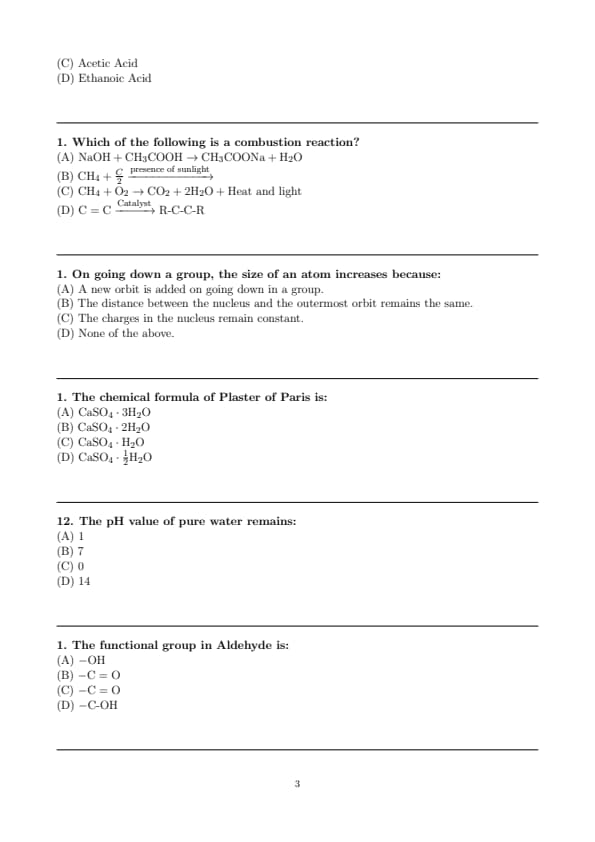
Which of the following is a combustion reaction?
View Solution
A combustion reaction involves the reaction of a substance (typically a hydrocarbon) with oxygen, resulting in the production of carbon dioxide and water, along with the release of heat and light.
Looking at the options:
- Option (A) is an acid-base reaction (neutralization) between sodium hydroxide and acetic acid.
- Option (B) is incomplete and doesn’t represent a combustion reaction.
- Option (C) is a classic combustion reaction where methane (\( CH_4 \)) reacts with oxygen (\( O_2 \)) to form carbon dioxide (\( CO_2 \)) and water (\( H_2O \)), releasing heat and light.
- Option (D) is a polymerization reaction, not combustion.
Thus, the correct answer is (C). Quick Tip: Combustion reactions always involve oxygen and typically produce carbon dioxide, water, and energy (heat and light).
On going down a group, the size of an atom increases because:
View Solution
As we move down a group in the periodic table, the number of electron shells (or orbits) increases. This leads to an increase in the size of the atom because the outermost electrons are farther away from the nucleus.
- Option (A) is correct because when moving down a group, a new electron shell is added, increasing the atomic size.
- Option (B) is incorrect because the distance between the nucleus and the outermost electron actually increases as new shells are added.
- Option (C) is incorrect because although the nuclear charge increases, the effect is counteracted by the addition of more electron shells, leading to increased shielding and a larger atomic size.
- Option (D) is incorrect because option (A) provides the correct explanation.
Thus, the correct answer is (A). Quick Tip: As we move down a group, the number of electron shells increases, leading to a larger atomic radius.
The chemical formula of Plaster of Paris is:
View Solution
Plaster of Paris is chemically known as calcium sulfate hemihydrate. Its formula is: \[ CaSO_4 \cdot \frac{1}{2} H_2O \]
This means that for every molecule of calcium sulfate, half a molecule of water is attached. When Plaster of Paris is mixed with water, it forms a hard solid, making it useful for making casts and molds.
Thus, the correct formula for Plaster of Paris is \( CaSO_4 \cdot H_2O \), which is option (C). Quick Tip: Plaster of Paris is made by heating gypsum (\( CaSO_4 \cdot 2H_2O \)) to remove part of the water content, resulting in \( CaSO_4 \cdot H_2O \).
The pH value of pure water remains:
View Solution
The pH value of pure water at 25°C is 7. This is considered neutral because, in pure water, the concentration of hydrogen ions (\( H^+ \)) is equal to the concentration of hydroxide ions (\( OH^- \)).
- Option (A) is incorrect because the pH of pure water is not 1, which is highly acidic.
- Option (C) is incorrect because the pH of pure water is not 0.
- Option (D) is incorrect because a pH of 14 represents a highly basic solution, not pure water.
Thus, the correct pH value for pure water is 7. Quick Tip: A pH of 7 is neutral, with equal concentrations of \( H^+ \) and \( OH^- \) ions in the solution.
The functional group in Aldehyde is:
View Solution
The functional group of aldehydes is \( -C = O \), which represents a carbonyl group (\( C=O \)) with the carbonyl carbon bonded to a hydrogen atom (\( H \)).
- Option (A) \( -OH \) is the functional group of alcohols.
- Option (C) \( -C=O \) is the carbonyl group, but in aldehydes, it is always attached to a hydrogen atom as in option (B).
- Option (D) \( -C-OH \) is the functional group of carboxylic acids.
Thus, the correct functional group in aldehyde is \( -C=O \). Quick Tip: Aldehydes are characterized by the functional group \( -CHO \), where the carbonyl group (\( C=O \)) is attached to a hydrogen atom.
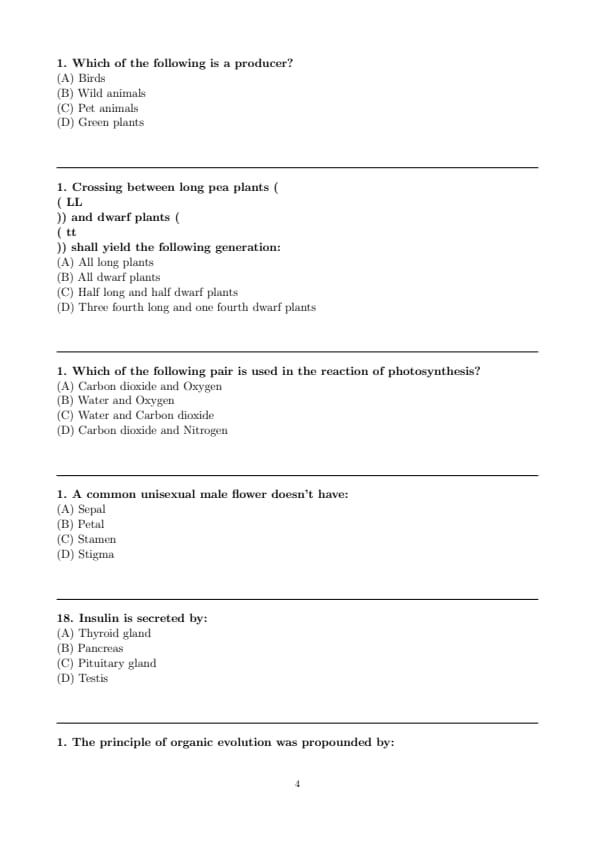
Which of the following is a producer?
View Solution
In an ecosystem, producers are organisms that can make their own food through photosynthesis or chemosynthesis. Green plants are considered producers because they use sunlight to produce food (glucose) through the process of photosynthesis.
- Option (A) Birds are consumers, not producers, as they feed on other organisms.
- Option (B) Wild animals are consumers, not producers.
- Option (C) Pet animals are also consumers as they depend on plants or other animals for food.
- Option (D) Green plants are producers because they produce their own food through photosynthesis.
Thus, the correct answer is (D) Green plants. Quick Tip: Producers, like green plants, form the foundation of food chains as they create their own food and provide energy for consumers.
Crossing between long pea plants ( LL) and dwarf plants ( tt) shall yield the following generation:
View Solution
In this cross, we are crossing a homozygous long pea plant( LL ) with a homozygous dwarf pea plant ( tt ).
- The F1 generation will inherit one allele from each parent.
- The offspring will all have the genotype ( Lt ), where ( L ) represents the dominant allele for long pea plants, and ( t ) represents the recessive allele for dwarf pea plants.
- Since the long trait ( L ) is dominant over the dwarf trait ( t ), all F1 plants will be long.
Thus, the correct answer is (A) All long plants. Quick Tip: In Mendelian genetics, a dominant allele will mask the effect of a recessive allele. In this case, the dominant allele ( L ) for long plants will determine the phenotype.
Which of the following pair is used in the reaction of photosynthesis?
View Solution
Photosynthesis is the process by which green plants, algae, and some bacteria convert light energy, usually from the sun, into chemical energy stored in glucose. The two main reactants used in photosynthesis are water (\( H_2O \)) and carbon dioxide (\( CO_2 \)).
The general equation for photosynthesis is: \[ 6CO_2 + 6H_2O \xrightarrow{light} C_6H_{12}O_6 + 6O_2 \]
In this reaction:
- Water (\( H_2O \)) and carbon dioxide (\( CO_2 \)) are the key reactants.
- Oxygen (\( O_2 \)) is a byproduct of the reaction.
Thus, the correct answer is (C) Water and Carbon dioxide. Quick Tip: In photosynthesis, green plants use light, water, and carbon dioxide to produce glucose and release oxygen as a byproduct.
A common unisexual male flower doesn’t have:
View Solution
In a unisexual male flower, the reproductive organs are typically male (stamens). The stigma, which is part of the female reproductive organ (pistil), is absent in male flowers.
- Option (A) Sepals are present in male flowers, as they protect the flower during bud development.
- Option (B) Petals are often present to attract pollinators, even in male flowers.
- Option (C) Stamens are present in male flowers as they produce pollen.
- Option (D) The stigma is a part of the pistil (female reproductive organ) and is absent in male flowers.
Thus, the correct answer is (D) Stigma. Quick Tip: Male flowers have stamens but lack a stigma, which is part of the female reproductive structure.
Insulin is secreted by:
View Solution
Insulin is a hormone that is secreted by the pancreas, specifically by the beta cells of the islets of Langerhans. It plays a key role in regulating blood sugar (glucose) levels by facilitating the uptake of glucose into cells for energy production or storage.
- Option (A) Thyroid gland secretes thyroid hormones (T3 and T4), not insulin.
- Option (C) Pituitary gland secretes various hormones like growth hormone, but not insulin.
- Option (D) Testis primarily secrete testosterone, not insulin.
Thus, the correct answer is (B) Pancreas. Quick Tip: Insulin is crucial for regulating blood glucose levels and is secreted by the pancreas.
The principle of organic evolution was propounded by:
View Solution
The principle of organic evolution was proposed by Charles Darwin in his theory of natural selection. Darwin's ideas, published in "On the Origin of Species" in 1859, laid the foundation for the modern understanding of evolution.
- Option (A) Charles Darwin is the correct answer. He is known for his theory of evolution by natural selection.
- Option (B) Gregor Johann Mendel is known for his work in genetics and the inheritance of traits, but not for the theory of evolution.
- Option (C) Amrata Devi Vishnoi is a social activist and does not relate to the principle of evolution.
- Option (D) Stanley L. Miller is known for his work on the origin of life, but not the theory of evolution.
Thus, the correct answer is (A) Charles Darwin. Quick Tip: Charles Darwin's theory of natural selection explains how species evolve over time based on the survival and reproduction of individuals with advantageous traits.
On burning, fossil fuel gives:
View Solution
When fossil fuels (such as coal, oil, and natural gas) are burned, they release a variety of gases as byproducts. These gases include:
- **Oxides of Carbon** (mainly \( CO_2 \), carbon dioxide, and in some cases \( CO \), carbon monoxide).
- **Oxides of Nitrogen** (mainly \( NO_x \) compounds, which include nitrogen oxides like \( NO \) and \( NO_2 \)).
- **Oxides of Sulphur** (mainly \( SO_2 \), sulfur dioxide).
These pollutants contribute to environmental issues such as air pollution, acid rain, and global warming.
Thus, the correct answer is (D) All of the above. Quick Tip: Burning fossil fuels releases carbon dioxide, nitrogen oxides, and sulfur oxides, all of which contribute to environmental pollution.
Explain the phenomenon of dispersion of white light through a prism by making a diagram.
View Solution
When white light passes through a prism, it is refracted (bent) due to the difference in refractive indices between air and the glass of the prism. The phenomenon of dispersion occurs because the different colors in white light have different wavelengths, and each color bends by a different amount. This causes the white light to spread out into its component colors, forming a spectrum.
Steps to draw the diagram:
Draw a triangular prism with one of its faces parallel to the horizontal axis.
Draw an incident beam of white light entering the prism at an angle to the surface.
The white light bends as it passes from air (lower refractive index) into the prism (higher refractive index). Each color bends by a different amount.
As the light exits the prism, it bends again, and the spectrum of colors (red, orange, yellow, green, blue, indigo, violet) separates more.
% Diagram Description
Labeling the Diagram:
Incident Light: White light entering the prism.
Refracted Light: The light that bends inside the prism.
Colors of the Spectrum: The separate colors of light (red, orange, yellow, green, blue, indigo, violet) seen after the dispersion.
Explanation of Dispersion:
- Red light bends the least because it has the longest wavelength.
- Violet light bends the most because it has the shortest wavelength.
- This difference in bending causes the white light to spread out into its component colors. Quick Tip: The phenomenon of dispersion is responsible for the formation of rainbows, where sunlight is dispersed by water droplets in the atmosphere.
What is Ohm's Law? Explain the verification of this law with the help of a circuit diagram.
View Solution
Ohm's Law:
Ohm's Law states that the current (\(I\)) flowing through a conductor is directly proportional to the potential difference (\(V\)) across it and inversely proportional to its resistance (\(R\)). Mathematically, it is expressed as:
\[ V = I \cdot R \]
Where:
- \(V\) is the potential difference (voltage) across the conductor.
- \(I\) is the current flowing through the conductor.
- \(R\) is the resistance of the conductor.
Verification of Ohm's Law:
To verify Ohm’s law, we can set up a simple experiment using a circuit. The experiment involves measuring the current flowing through a resistor when a variable voltage is applied across it.
Circuit Diagram:
Steps for Verification:
1. Set up a circuit with a **variable power supply**, a **resistor** (which has a known resistance \(R\)), and an **ammeter** to measure the current.
2. Connect a **voltmeter** in parallel across the resistor to measure the voltage (\(V\)) across the resistor.
3. Start with a low voltage and gradually increase it using the power supply.
4. For each voltage setting, record the corresponding current flowing through the circuit.
5. Plot the graph of voltage (\(V\)) on the y-axis and current (\(I\)) on the x-axis.
Graphical Verification:
From Ohm’s law, we know that \( V = I \cdot R \). Therefore, if we plot a graph of \(V\) versus \(I\), we should obtain a straight line with a slope equal to the resistance \(R\) of the resistor. The linear relationship indicates that the current is directly proportional to the voltage, which verifies Ohm’s law.
Conclusion:
If the graph is a straight line, then the resistance is constant, and Ohm's law is verified for that conductor. Quick Tip: Ohm's law holds true for conductors with constant resistance, but it may not apply to all materials (e.g., semiconductors or non-ohmic conductors) where the relationship between \(V\) and \(I\) is nonlinear.
What is the phenomenon of electromagnetic induction? Explain Faraday’s experiment associated with this phenomenon.
View Solution
The phenomenon of electromagnetic induction refers to the process of generating an electromotive force (EMF) or current in a conductor by changing the magnetic field around it. This was discovered by Michael Faraday in 1831.
Faraday’s Experiment:
Faraday conducted an experiment to demonstrate the phenomenon of electromagnetic induction. He used the following setup:
1. A coil of wire connected to a galvanometer (an instrument used to measure electric current).
2. A magnet was moved in and out of the coil, and the galvanometer showed deflections.
Key Observations:
- When the magnet was moved inside the coil, a current was induced.
- The current stopped once the magnet stopped moving.
- The faster the magnet moved, the greater the current induced.
Conclusion:
Faraday concluded that **a changing magnetic field** (whether by moving a magnet or changing the magnetic field strength) through a coil induces an electric current in the coil. This is the principle of electromagnetic induction. Quick Tip: The greater the rate of change of the magnetic field, the greater the induced EMF. This principle is used in generators and transformers.
Explain the production of a magnetic field due to current in a conductor by making a diagram.
View Solution
When an electric current flows through a conductor, it produces a magnetic field around the conductor. The strength of the magnetic field depends on the amount of current flowing and the distance from the conductor.
Production of Magnetic Field:
1. **Straight Conductor**: When a current-carrying conductor is placed in space, a magnetic field is produced around it in the form of concentric circles.
2. **Right-Hand Rule**: The direction of the magnetic field around the conductor can be determined using the right-hand rule:
- Point your right thumb in the direction of the current.
- The curl of your fingers shows the direction of the magnetic field lines.
Diagram:
Explanation:
In the diagram:
- The straight conductor carries a current.
- The magnetic field lines are shown as concentric circles around the conductor.
- The direction of the magnetic field is determined using the right-hand rule. Quick Tip: The magnetic field around a current-carrying conductor is circular and its strength increases with the current and decreases with distance from the conductor.
Explain the following by giving examples:
Importance of pH in daily life
Exothermic chemical reactions
View Solution
(i) Importance of pH in Daily Life:
pH is a measure of the acidity or basicity of a solution. The pH scale ranges from 0 to 14, where a pH of 7 is neutral, values less than 7 are acidic, and values greater than 7 are basic or alkaline. The importance of pH in daily life is significant, as it affects various biological and chemical processes.
Examples of pH in Daily Life:
- **In the Human Body:** The pH of blood is maintained around 7.4, which is slightly basic. Any significant deviation from this pH can cause health problems. For example, a lower pH (acidic condition) can lead to acidosis, and a higher pH (basic condition) can lead to alkalosis.
- **In Agriculture:** Soil pH affects plant growth. Most plants prefer a soil pH between 6 and 7. Soils that are too acidic or too alkaline may hinder plant nutrient absorption.
- **In Cleaning Products:** Many cleaning agents are either acidic or basic. For example, vinegar (which contains acetic acid) is commonly used to clean surfaces, while baking soda (which is basic) is used to remove stains and odors.
(ii) Exothermic Chemical Reactions:
An exothermic reaction is a chemical reaction that releases energy, usually in the form of heat or light, to the surroundings. These reactions occur when the energy released during the formation of products is greater than the energy required to break the bonds in the reactants.
Examples of Exothermic Reactions:
- **Combustion of Fuels:** When fuels like wood, coal, or natural gas burn, they undergo exothermic combustion reactions, releasing heat and light. For example, burning methane (\( CH_4 \)) with oxygen releases a large amount of energy:
\[ CH_4 + 2O_2 \rightarrow CO_2 + 2H_2O + Energy \]
- **Respiration:** In living organisms, respiration is an exothermic process. Glucose combines with oxygen to form carbon dioxide, water, and energy:
\[ C_6H_{12}O_6 + 6O_2 \rightarrow 6CO_2 + 6H_2O + Energy \]
The energy released is used by cells for various functions.
- **Dissolving Calcium Oxide in Water:** When calcium oxide (\( CaO \)) is added to water, it reacts exothermically to produce calcium hydroxide (\( Ca(OH)_2 \)) and heat:
\[ CaO + H_2O \rightarrow Ca(OH)_2 + Heat \] Quick Tip: In exothermic reactions, energy is released to the surroundings, which often causes the temperature to rise.
Write chemical equations of two chemical properties of Ethanoic Acid.
How will you obtain the following? (Write chemical equations)
Washing Soda from Baking Soda
Plaster of Paris from Gypsum
View Solution
(a) Two Chemical Properties of Ethanoic Acid:
Ethanoic acid (acetic acid, \( CH_3COOH \)) exhibits a variety of chemical properties. Here are two of them:
1. Reaction with Sodium Carbonate:
When ethanoic acid reacts with sodium carbonate (\( Na_2CO_3 \)), it forms sodium acetate (\( CH_3COONa \)), water, and carbon dioxide.
\[ CH_3COOH + Na_2CO_3 \rightarrow CH_3COONa + H_2O + CO_2 \]
2. Reaction with Sodium Hydroxide:
When ethanoic acid reacts with sodium hydroxide (\( NaOH \)), it forms sodium acetate (\( CH_3COONa \)) and water.
\[ CH_3COOH + NaOH \rightarrow CH_3COONa + H_2O \]
(b) Methods to Obtain the Following:
(i) Washing Soda from Baking Soda:
Baking soda (sodium bicarbonate, \( NaHCO_3 \)) can be converted into washing soda (sodium carbonate, \( Na_2CO_3 \)) by heating it. The chemical equation for the thermal decomposition of sodium bicarbonate is:
\[ 2 NaHCO_3 \xrightarrow{heat} Na_2CO_3 + H_2O + CO_2 \]
(ii) Plaster of Paris from Gypsum:
Gypsum (\( CaSO_4 \cdot 2H_2O \)) is heated to produce Plaster of Paris (\( CaSO_4 \cdot \frac{1}{2} H_2O \)):
\[ CaSO_4 \cdot 2H_2O \xrightarrow{heat} CaSO_4 \cdot \frac{1}{2} H_2O + H_2O \] Quick Tip: - Washing soda is used in detergent preparations and softening of water. - Plaster of Paris is used in making molds and casts.
Explain the following:
Cleansing action of soap
Calcination and Roasting
Activity series of metals
View Solution
(i) Cleansing Action of Soap:
Soap is a surfactant that has both hydrophilic (water-attracting) and hydrophobic (water-repelling) ends. The cleansing action of soap is due to the ability of soap molecules to break the oil or grease particles into small droplets, which can be easily washed away with water.
Mechanism of Cleansing:
- The hydrophobic end of the soap molecule dissolves in the oil or grease.
- The hydrophilic end of the soap molecule interacts with water.
- This results in the formation of micelles, which trap the oil and grease particles in the center.
- The micelles are washed away with water, taking the dirt along with them.
(ii) Calcination and Roasting:
Calcination and roasting are two methods used in metallurgy to convert ores into metals, but they differ in the processes involved:
1. Calcination:
- **Calcination** is the process of heating an ore in the absence of air or in a limited supply of air.
- This is done to remove volatile components like water, carbon dioxide, or sulfur.
- Example: Heating limestone (\( CaCO_3 \)) to form quicklime (\( CaO \)):
\[ CaCO_3 \xrightarrow{heat} CaO + CO_2 \]
2. Roasting:
- **Roasting** is the process of heating an ore in the presence of excess air or oxygen.
- It is typically used for ores containing sulfides, which are converted into oxides.
- Example: Heating copper sulfide (\( Cu_2S \)) in air to form copper oxide (\( CuO \)):
\[ 2Cu_2S + 3O_2 \rightarrow 2CuO + 2SO_2 \]
(iii) Activity Series of Metals:
The **activity series** is a list of metals arranged in order of their reactivity, from the most reactive to the least reactive. It helps predict the outcome of displacement reactions and the extraction of metals.
Key Points:
- The metals at the top of the series, such as potassium, sodium, and calcium, are highly reactive and readily lose electrons.
- Metals at the bottom, such as gold and platinum, are less reactive and do not easily participate in reactions.
- **Example of Activity Series**:
- Potassium (\( K \)) is more reactive than sodium (\( Na \)), and sodium is more reactive than iron (\( Fe \)).
- A more reactive metal will displace a less reactive metal from its compound.
Example of Displacement Reaction: \[ Zn + CuSO_4 \rightarrow ZnSO_4 + Cu \]
In this reaction, zinc displaces copper from copper sulfate because zinc is more reactive than copper. Quick Tip: - Soap molecules have a hydrophilic (water-loving) and hydrophobic (water-hating) end, which helps in cleaning oil and grease. - Calcination involves heating in the absence of air, while roasting occurs in the presence of oxygen. - The activity series helps predict which metals will displace others in chemical reactions.
Write one main function of Xylem in plants.
In which organ of the body is Copper replaced?
On which plant did Mendel perform his experiment?
Give examples of homologous organs.
View Solution
(i) Main Function of Xylem in Plants:
Xylem is responsible for the transport of water and minerals from the roots to the leaves and other parts of the plant. It also provides structural support.
\[ Function of Xylem: \quad Water and mineral conduction, and support. \]
(ii) In Which Organ of the Body is Copper Replaced?
Copper is an essential trace element in the human body, and it is primarily stored in the **liver**. Copper plays an important role in several biological processes, such as the formation of red blood cells and the absorption of iron. The liver stores and regulates the copper levels in the body.
(iii) On Which Plant Did Mendel Perform His Experiment?
Mendel performed his famous experiments on the inheritance of traits using the **pea plant** (\( Pisum sativum \)). He chose pea plants because they had easily observable traits, such as flower color and seed shape, and could be crossbred to study inheritance patterns.
(iv) Give Examples of Homologous Organs:
Homologous organs are organs that have a similar structure but perform different functions. These organs share a common evolutionary origin. Examples of homologous organs include:
- **Forelimbs of Humans, Bats, and Whales**: These have similar bone structures but serve different functions like grasping, flying, and swimming, respectively.
- **Wings of Birds and Forelimbs of Humans**: Although they perform different functions, they share a similar bone structure, indicating a common ancestry. Quick Tip: - Xylem is primarily responsible for water transport in plants. - Copper is stored and regulated by the liver in the human body. - Mendel's experiments on pea plants laid the foundation for modern genetics. - Homologous organs suggest a common evolutionary origin but have adapted to perform different functions.
Describe double circulation in human beings.
View Solution
Double circulation refers to the two separate circuits through which blood circulates in the human body. It involves two distinct loops: the **pulmonary circulation** and the **systemic circulation**.
1. Pulmonary Circulation:
Pulmonary circulation is the flow of blood from the heart to the lungs and back to the heart. It helps in the exchange of gases (oxygen and carbon dioxide).
Deoxygenated blood from the body flows into the **right atrium** of the heart.
From the right atrium, the blood moves into the **right ventricle**.
The right ventricle pumps the deoxygenated blood through the **pulmonary artery** to the lungs.
In the lungs, the blood releases carbon dioxide and picks up oxygen.
The oxygenated blood then returns to the **left atrium** of the heart through the **pulmonary veins**.
2. Systemic Circulation:
Systemic circulation is the flow of oxygenated blood from the heart to the rest of the body and back.
Oxygenated blood from the left atrium passes into the **left ventricle**.
The left ventricle pumps the oxygenated blood through the **aorta** to all parts of the body.
The oxygen and nutrients are delivered to the body’s cells, and waste products like carbon dioxide are collected.
The deoxygenated blood then returns to the **right atrium** of the heart through the **superior and inferior vena cava**.
Importance of Double Circulation:
- Double circulation ensures that oxygenated blood is delivered efficiently to body tissues, while deoxygenated blood is sent to the lungs for gas exchange.
- It maintains a high pressure in the systemic circulation, allowing effective nutrient and oxygen distribution, while the pulmonary circulation operates at a lower pressure, preventing damage to the lungs. Quick Tip: - Double circulation ensures that the oxygenated and deoxygenated blood never mix, allowing efficient oxygen delivery and waste removal. - The heart plays a central role in maintaining the separate circulations of the body and lungs.
Write short notes on the following:
Conservation of natural resources
Regeneration
View Solution
(i) Conservation of Natural Resources:
Conservation of natural resources refers to the sustainable management of natural resources like water, air, land, and forests to prevent their depletion and ensure that they are available for future generations. It involves practices such as:
**Sustainable harvesting**: Using natural resources in such a way that they can regenerate and continue to meet human needs without running out.
**Pollution control**: Reducing the contamination of air, water, and soil to preserve natural ecosystems.
**Recycling and reusing**: Converting waste materials into reusable resources to minimize the exploitation of raw materials.
**Protected areas and reserves**: Establishing national parks and wildlife reserves to protect ecosystems and endangered species.
The goal is to balance human needs with the preservation of nature, ensuring that resources are used wisely and conserved for future generations.
(ii) Regeneration:
Regeneration refers to the process of renewal, restoration, and growth that makes a thing or system able to return to its original state or even improve. In biology, it often refers to the process by which organisms replace or restore lost or damaged cells, tissues, or organs.
**In Plants**: Plants regenerate through vegetative reproduction. For example, when a part of a plant like a stem, root, or leaf is cut, it can grow into a new plant.
**In Animals**: Some animals, like starfish and salamanders, can regenerate lost limbs or body parts.
**In Humans**: Humans can regenerate certain tissues, like the liver, which has the ability to grow back after partial removal. However, human regeneration is more limited compared to certain animals.
Regeneration plays a critical role in maintaining the health and function of an organism or ecosystem. Quick Tip: - Conservation focuses on preserving natural resources to ensure their availability for future generations. - Regeneration is a biological process that allows organisms or ecosystems to recover from damage or loss.
Describe the structure of the nephron in the kidney. How does it function?
View Solution
The nephron is the structural and functional unit of the kidney responsible for filtering blood, removing waste products, and regulating water and electrolyte balance. Each kidney contains approximately one million nephrons.
Structure of the Nephron:
The nephron is composed of the following main parts:
1. **Bowman’s Capsule**:
- This is a cup-shaped structure that surrounds the glomerulus (a network of capillaries). It is responsible for collecting the filtrate from the blood.
- The **glomerular filtration** occurs here, where blood is filtered, and water, small molecules (like glucose, salts), and waste products are collected into the Bowman’s capsule.
2. **Proximal Convoluted Tubule (PCT)**:
- The filtrate from the Bowman’s capsule enters the PCT, which is responsible for the reabsorption of most of the essential substances such as glucose, amino acids, and salts back into the bloodstream.
- About 65% of the filtered sodium and water are reabsorbed here.
3. **Loop of Henle**:
- This U-shaped tube consists of a descending and ascending limb. The descending limb is permeable to water but not to salts, while the ascending limb is impermeable to water but actively transports salts out.
- The loop of Henle plays a key role in creating a concentration gradient in the kidney medulla, which is important for water reabsorption and the concentration of urine.
4. **Distal Convoluted Tubule (DCT)**:
- The filtrate moves from the loop of Henle to the DCT. This part is involved in the regulation of sodium, potassium, and calcium levels, as well as the pH balance.
- It is also the site where further reabsorption of water and salts takes place under the influence of hormones like aldosterone.
5. **Collecting Duct**:
- The DCT drains into the collecting duct, which carries the urine to the renal pelvis. The collecting duct is the final site for the regulation of water balance.
- It reabsorbs water, under the influence of antidiuretic hormone (ADH), to produce concentrated urine when necessary.
Function of the Nephron:
The nephron performs several key functions to maintain homeostasis:
1. **Filtration**:
- Blood enters the nephron via the afferent arteriole into the **glomerulus** where filtration of blood occurs. Small molecules like water, glucose, urea, and salts pass into the Bowman’s capsule, while larger molecules like proteins and blood cells remain in the bloodstream.
2. **Reabsorption**:
- As the filtrate moves through the **proximal convoluted tubule (PCT)**, **loop of Henle**, and **distal convoluted tubule (DCT)**, essential substances such as glucose, amino acids, and ions are reabsorbed into the blood.
- Most of the water is reabsorbed, with the exact amount depending on the body’s hydration status.
3. **Secretion**:
- In the DCT and collecting ducts, certain waste products like hydrogen ions, potassium, and drugs are secreted into the filtrate from the blood.
4. **Excretion**:
- The final product, urine, is formed and collected in the **collecting duct**. The urine passes into the renal pelvis, then into the ureter, and finally out of the body.
Diagram:
% Insert your diagram of the nephron structure here (use `\includegraphics` or similar LaTeX commands for image insertion). Quick Tip: - The nephron is essential for regulating blood pressure, electrolyte balance, and waste removal. - The process of urine formation in the nephron is highly efficient, ensuring the body retains vital nutrients and removes toxins.
Write short notes on the following:
Autotrophic nutrition
Transpiration
Chipko movement
View Solution
(i) Autotrophic Nutrition:
Autotrophic nutrition is the process by which organisms make their own food from simple inorganic substances like carbon dioxide and water using the energy from sunlight or chemical reactions. This type of nutrition is found in plants, algae, and some bacteria.
**Plants** perform autotrophic nutrition through **photosynthesis**. They use chlorophyll to capture sunlight, which converts carbon dioxide and water into glucose and oxygen.
The process can be summarized as:
\[ 6CO_2 + 6H_2O + light energy \rightarrow C_6H_{12}O_6 + 6O_2 \]
Autotrophic organisms are primary producers in ecosystems, forming the base of food chains.
(ii) Transpiration:
Transpiration is the process by which water is absorbed by the roots of plants, moves through the plant, and is released as water vapor through small pores called stomata, primarily on the leaves.
Transpiration helps in the cooling of the plant, maintaining turgor pressure, and the uptake of nutrients from the soil.
There are three types of transpiration:
**Stomatal Transpiration**: Water vapor loss through stomata.
**Cuticular Transpiration**: Water loss through the cuticle.
**Lenticular Transpiration**: Water loss through lenticels.
Transpiration also plays a role in the **water cycle** by returning water vapor to the atmosphere.
(iii) Chipko Movement:
The Chipko Movement was an environmental movement that began in the 1970s in India, aimed at protecting forests from deforestation.
The movement was led by people, especially women, in the Himalayan region who physically hugged trees to prevent them from being felled.
The slogan of the movement was “**Ecology is permanent economy**,” highlighting the importance of forests for environmental health and local communities.
The Chipko Movement led to greater awareness of environmental issues in India and contributed to the establishment of forest protection laws. Quick Tip: - **Autotrophic nutrition** is the process by which plants make their own food using sunlight and inorganic substances. - **Transpiration** helps in water movement and cooling of plants. - The **Chipko movement** emphasized the importance of protecting forests and natural resources for sustainable development.



Comments