GRE 2025 Quantitative Reasoning Sample Paper Set 1 Question Paper with Solutions PDF

Shivam Yadav logo
Updated on, Oct 13, 2025

byShivam Yadav

GRE 2025 Quantitative Reasoning Sample Paper Set 1 Question Paper with Solutions PDF is available for download. The overall test time is about 1 hour and 58 minutes. GRE has total 5 sections:

  • Analytical Writing  (One "Analyze an Issue" task, Alloted time 30 minutes)
  • Verbal Reasoning  (Two Sections, with 12 questions and 15 questions respectively)
  • Quantitative Reasoning (Two Sections, with 12 questions and 15 questions respectively)

GRE 2025 Quantitative Reasoning Sample Paper Set 1 Question Paper with Solutions PDF

GRE 2025 Quantitative Reasoning Set 1 Question Paper with Solutions PDF download iconDownload Check Solutions
GRE 2025 Quantitative Reasoning Sample Paper Set 1 Question Paper with Solutions PDF

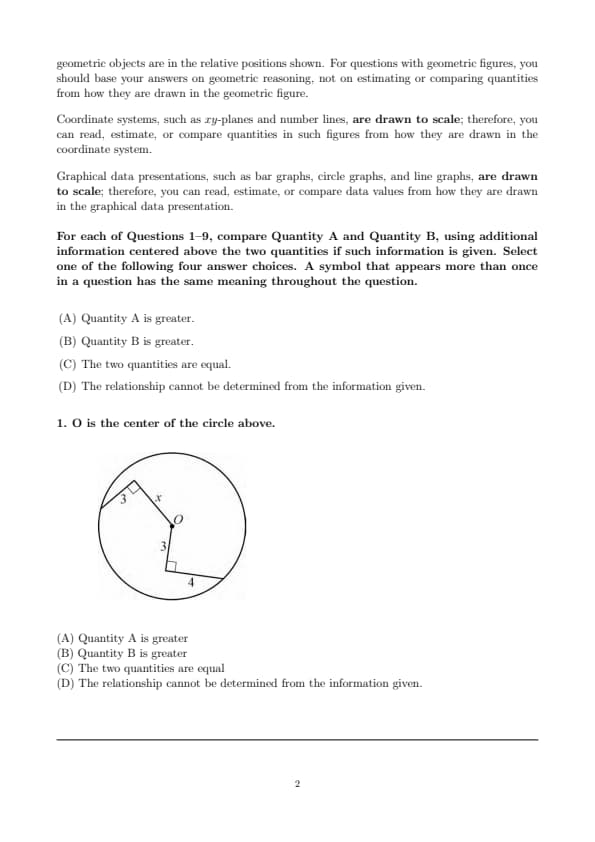
For each of Questions 1--9, compare Quantity A and Quantity B, using additional information centered above the two quantities if such information is given. Select one of the following four answer choices. A symbol that appears more than once in a question has the same meaning throughout the question.

Question 1:

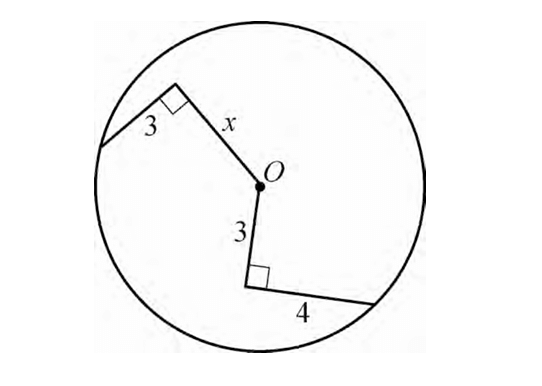
O is the center of the circle above.

  • (A) Quantity A is greater
  • (B) Quantity B is greater
  • (C) The two quantities are equal
  • (D) The relationship cannot be determined from the information given.

Question 2:

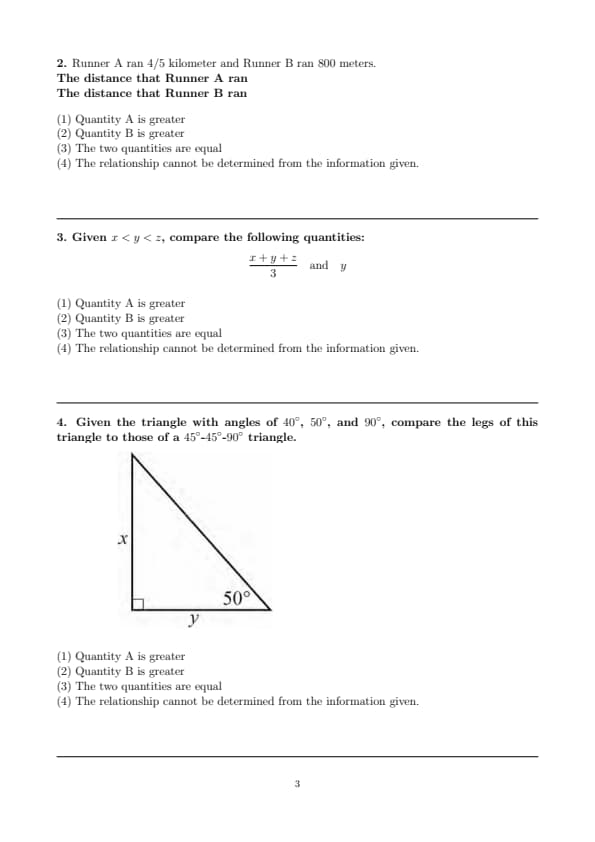
Runner A ran 4/5 kilometer and Runner B ran 800 meters.

The distance that Runner A ran

The distance that Runner B ran

  • (1) Quantity A is greater
  • (2) Quantity B is greater
  • (3) The two quantities are equal
  • (4) The relationship cannot be determined from the information given.

Question 3:

Given \( x < y < z \), compare the following quantities: \[ \frac{x + y + z}{3} \quad and \quad y \]

  • (1) Quantity A is greater
  • (2) Quantity B is greater
  • (3) The two quantities are equal
  • (4) The relationship cannot be determined from the information given.

Question 4:

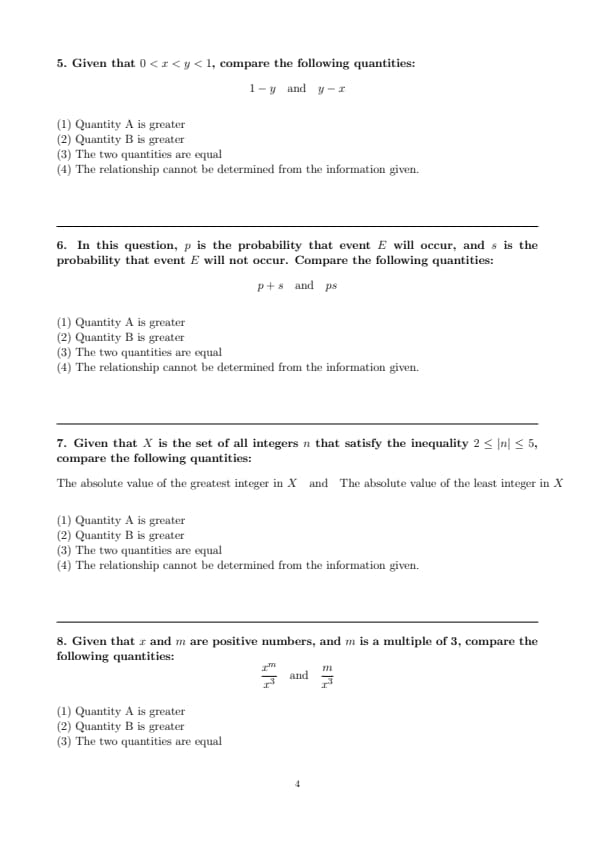
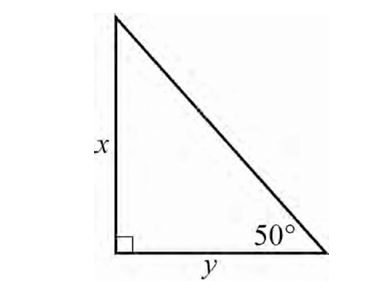
Given the triangle with angles of \( 40^\circ \), \( 50^\circ \), and \( 90^\circ \), compare the legs of this triangle to those of a \( 45^\circ \)-\( 45^\circ \)-\( 90^\circ \) triangle.

  • (1) Quantity A is greater
  • (2) Quantity B is greater
  • (3) The two quantities are equal
  • (4) The relationship cannot be determined from the information given.

Question 5:

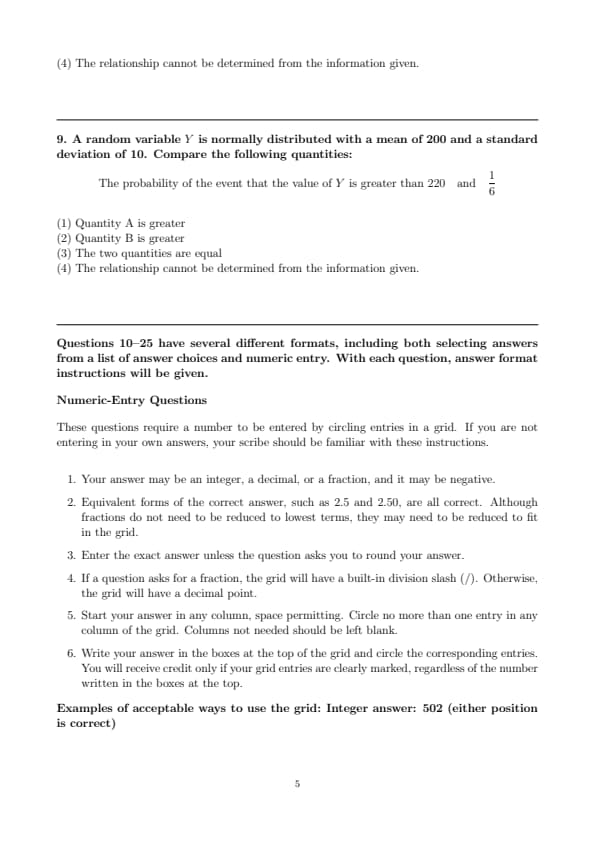
Given that \( 0 < x < y < 1 \), compare the following quantities: \[ 1 - y \quad and \quad y - x \]

  • (1) Quantity A is greater
  • (2) Quantity B is greater
  • (3) The two quantities are equal
  • (4) The relationship cannot be determined from the information given.

Question 6:

In this question, \( p \) is the probability that event \( E \) will occur, and \( s \) is the probability that event \( E \) will not occur. Compare the following quantities: \[ p + s \quad and \quad ps \]

  • (1) Quantity A is greater
  • (2) Quantity B is greater
  • (3) The two quantities are equal
  • (4) The relationship cannot be determined from the information given.

Question 7:

Given that \( X \) is the set of all integers \( n \) that satisfy the inequality \( 2 \leq |n| \leq 5 \), compare the following quantities: \[ The absolute value of the greatest integer in X \quad and \quad The absolute value of the least integer in X \]

  • (1) Quantity A is greater
  • (2) Quantity B is greater
  • (3) The two quantities are equal
  • (4) The relationship cannot be determined from the information given.

Question 8:

Given that \( x \) and \( m \) are positive numbers, and \( m \) is a multiple of 3, compare the following quantities: \[ \frac{x^m}{x^3} \quad and \quad \frac{m}{x^3} \]

  • (1) Quantity A is greater
  • (2) Quantity B is greater
  • (3) The two quantities are equal
  • (4) The relationship cannot be determined from the information given.

Question 9:

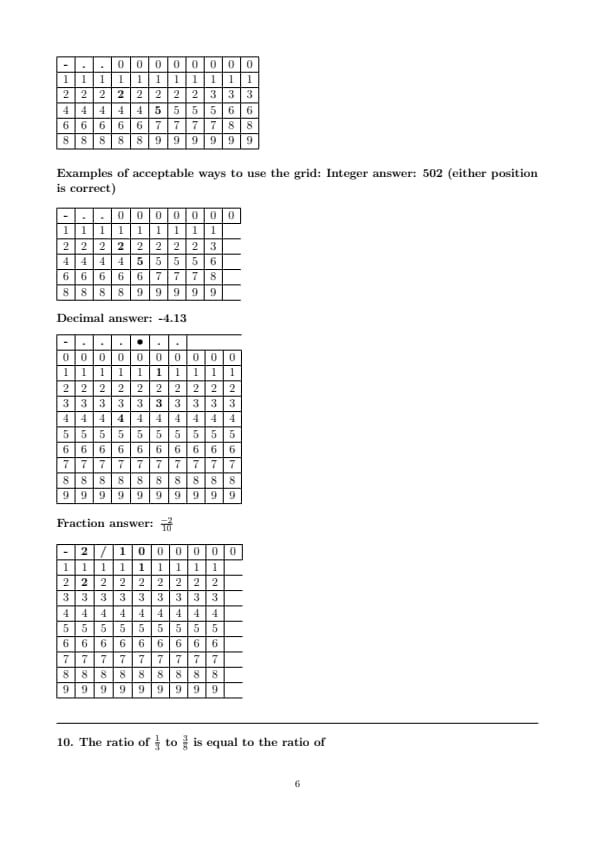
A random variable \( Y \) is normally distributed with a mean of 200 and a standard deviation of 10. Compare the following quantities: \[ The probability of the event that the value of Y is greater than 220 \quad and \quad \frac{1}{6} \]

  • (1) Quantity A is greater
  • (2) Quantity B is greater
  • (3) The two quantities are equal
  • (4) The relationship cannot be determined from the information given.

Question 10:

The ratio of \( \frac{1}{3} \) to \( \frac{3}{8} \) is equal to the ratio of

  • (A) 1 to 8
  • (B) 8 to 1
  • (C) 8 to 3
  • (D) 8 to 9
  • (E) 9 to 8

Question 11:

A reading list for a humanities course consists of 10 books, of which 4 are biographies and the rest are novels. Each student is required to read a selection of 4 books from the list, including 2 or more biographies. How many selections of 4 books satisfy the requirements?

  • (A) 90
  • (B) 115
  • (C) 130
  • (D) 144
  • (E) 195

Question 12:

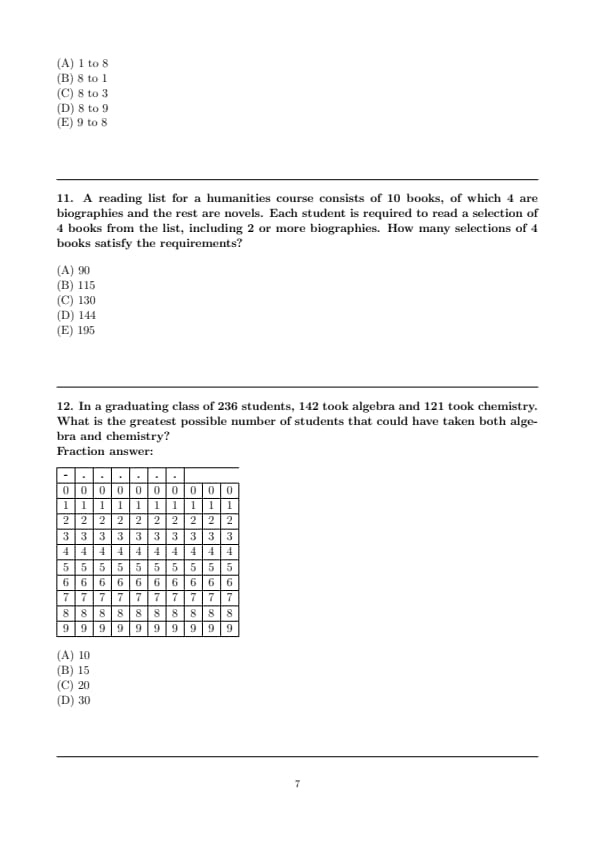
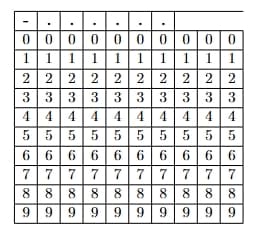
In a graduating class of 236 students, 142 took algebra and 121 took chemistry. What is the greatest possible number of students that could have taken both algebra and chemistry?

Fraction answer:
  • (A) 10
  • (B) 15
  • (C) 20
  • (D) 30

Question 13:

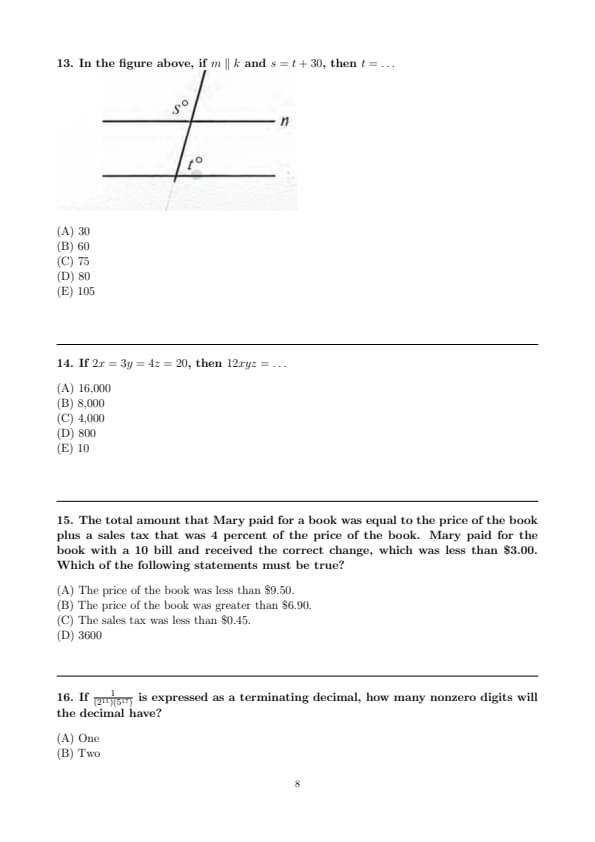
In the figure above, if \( m \parallel k \) and \( s = t + 30 \), then \( t = \dots \)

  • (A) 30
  • (B) 60
  • (C) 75
  • (D) 80
  • (E) 105

Question 14:

If \( 2x = 3y = 4z = 20 \), then \( 12xyz = \dots \)

  • (A) 16,000
  • (B) 8,000
  • (C) 4,000
  • (D) 800
  • (E) 10

Question 15:

The total amount that Mary paid for a book was equal to the price of the book plus a sales tax that was 4 percent of the price of the book. Mary paid for the book with a 10 bill and received the correct change, which was less than
(3.00. Which of the following statements must be true?

  • (A) The price of the book was less than
    )9.50.
  • (B) The price of the book was greater than
    (6.90.
  • (C) The sales tax was less than
    )0.45.
  • (D) 3600

Question 16:

If \( \frac{1}{(2^{11})(5^{17})} \) is expressed as a terminating decimal, how many nonzero digits will the decimal have?

  • (A) One
  • (B) Two
  • (C) Four
  • (D) Six
  • (E) Eleven

Question 17:

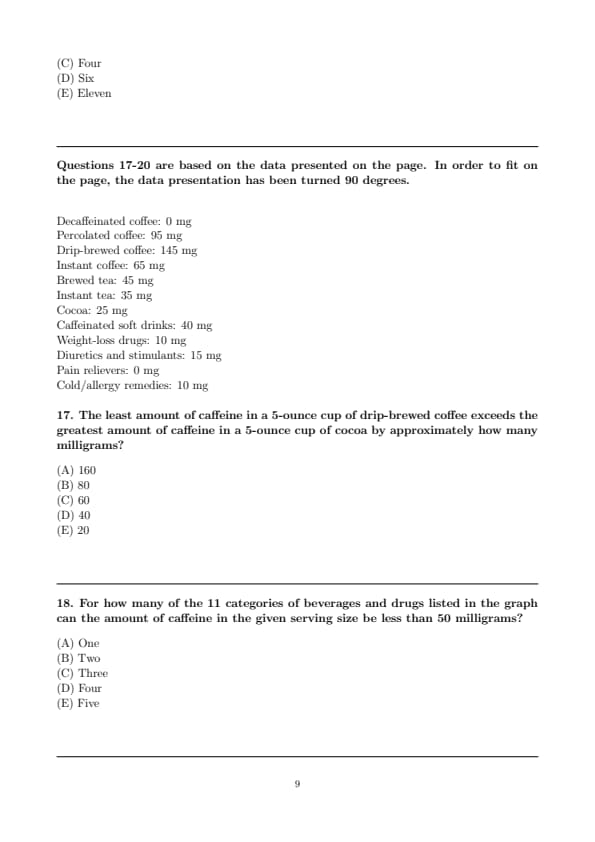
The least amount of caffeine in a 5-ounce cup of drip-brewed coffee exceeds the greatest amount of caffeine in a 5-ounce cup of cocoa by approximately how many milligrams?

  • (A) 160
  • (B) 80
  • (C) 60
  • (D) 40
  • (E) 20
Correct Answer: (250)
View Solution

The least amount of caffeine in a 5-ounce cup of drip-brewed coffee is around 100 milligrams, and the greatest amount of caffeine in a 5-ounce cup of cocoa is approximately 50 milligrams.
So, the difference in caffeine content is: \[ 100 \, mg - 50 \, mg = 250 \, mg. \]


Final Answer: \[ \boxed{The correct answer is 250.} \] Quick Tip: To solve questions involving comparisons of quantities like caffeine content, always use the known values to calculate the difference.


Question 18:

For how many of the 11 categories of beverages and drugs listed in the graph can the amount of caffeine in the given serving size be less than 50 milligrams?

  • (A) One
  • (B) Two
  • (C) Three
  • (D) Four
  • (E) Five
Correct Answer: (C) Three
View Solution

From the graph, we can observe that three categories of beverages and drugs have caffeine content less than 50 milligrams in the given serving size.


Final Answer: \[ \boxed{The correct answer is (C) Three.} \] Quick Tip: When dealing with data and graphs, carefully count the categories that satisfy the given condition.


Question 19:

Approximately what is the minimum amount of caffeine, in milligrams, consumed per day by a person who daily drinks two 10-ounce mugs of percolated coffee and one 12-ounce cup of a caffeinated soft drink?

  • (A) 230
  • (B) 190
  • (C) 140
  • (D) 110
  • (E) 70
Correct Answer: (B) 190
View Solution

The caffeine content in a 10-ounce mug of percolated coffee is approximately 100 milligrams. So, two 10-ounce mugs would provide: \[ 2 \times 100 = 200 \, milligrams. \]
A 12-ounce cup of a caffeinated soft drink contains approximately 40 milligrams of caffeine.

Thus, the total amount of caffeine consumed per day is: \[ 200 \, mg + 40 \, mg = 240 \, mg. \]

The minimum amount of caffeine is therefore approximately **190 milligrams**.


Final Answer: \[ \boxed{The correct answer is (B) 190.} \] Quick Tip: When calculating total caffeine intake, ensure that you are considering the correct serving sizes for each drink.


Question 20:

Which of the following shows the four types of coffee listed in order according to the range of the amounts of caffeine in a 5-ounce cup, from the least range to the greatest range?

  • (A) Decaffeinated, instant, percolated, drip-brewed
  • (B) Decaffeinated, instant, drip-brewed, percolated
  • (C) Instant, decaffeinated, drip-brewed, percolated
  • (D) Instant, drip-brewed, decaffeinated, percolated
  • (E) Instant, percolated, drip-brewed, decaffeinated

Question 21:

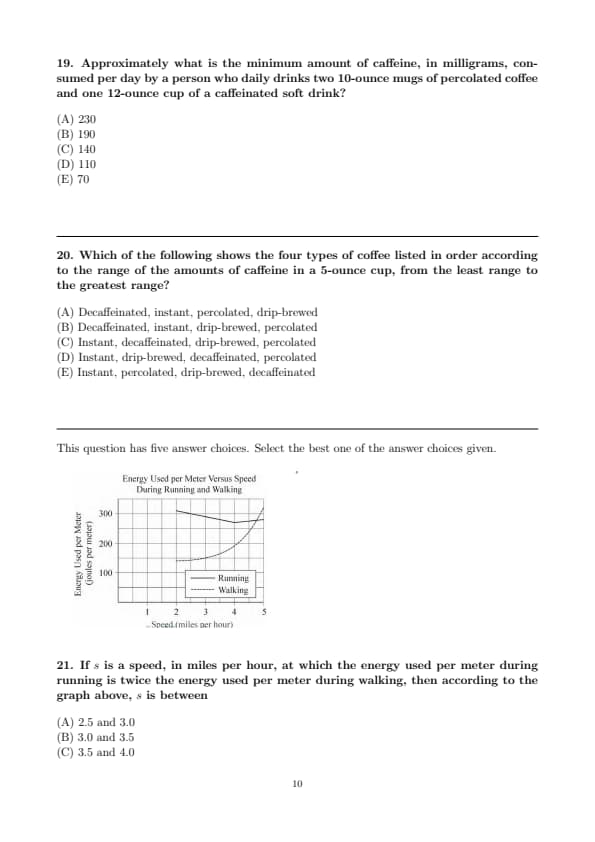
If \( s \) is a speed, in miles per hour, at which the energy used per meter during running is twice the energy used per meter during walking, then according to the graph above, \( s \) is between

  • (A) 2.5 and 3.0
  • (B) 3.0 and 3.5
  • (C) 3.5 and 4.0
  • (D) 4.0 and 4.5
  • (E) 4.5 and 5.0
Correct Answer: (B) More than half of the titles distributed by M are also distributed by L.
View Solution

This problem involves determining the speed at which the energy used per meter during running is twice that used per meter during walking, based on the graph. The desired speed is between 3.0 and 3.5 miles per hour.


Final Answer: \[ \boxed{The correct answer is (B) More than half of the titles distributed by M are also distributed by L.} \] Quick Tip: Carefully interpret the graph to determine the speed range at which the desired energy relationship holds.


Question 22:

If \( n = 2^3 \), then \( n^n = \dots \)

  • (A) \( 2^6 \)
  • (B) \( 2^{11} \)
  • (C) \( 2^{18} \)
  • (D) \( 2^{24} \)
  • (E) \( 2^{27} \)

Question 23:

Which of the following statements individually provide sufficient additional information to determine the area of triangle ABC?
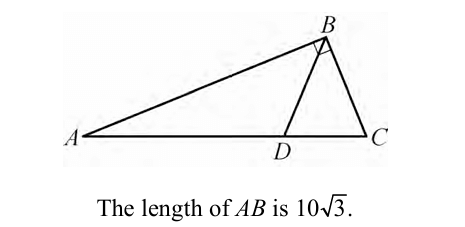


Indicate all such statements.

  • (A) \( DBC \) is an equilateral triangle.
  • (B) \( ABD \) is an isosceles triangle.
  • (C) The length of \( BC \) is equal to the length of \( AD \).
  • (D) The length of \( BC \) is 10.
  • (E) The length of \( AD \) is 10.

Question 24:

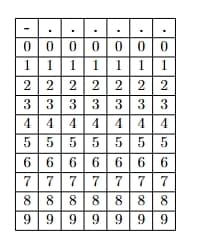
In the sequence above, each term after the first term is equal to the preceding term plus the constant \(c\). If \(a_1 + a_3 + a_5 = 27\), what is the value of \(a_2 + a_4\)?


  • (A) \( \frac{5}{6} \)
  • (B) \( \frac{3}{5} \)
  • (C) \( \frac{3}{4} \)
  • (D) \( \frac{2}{5} \)

Question 25:

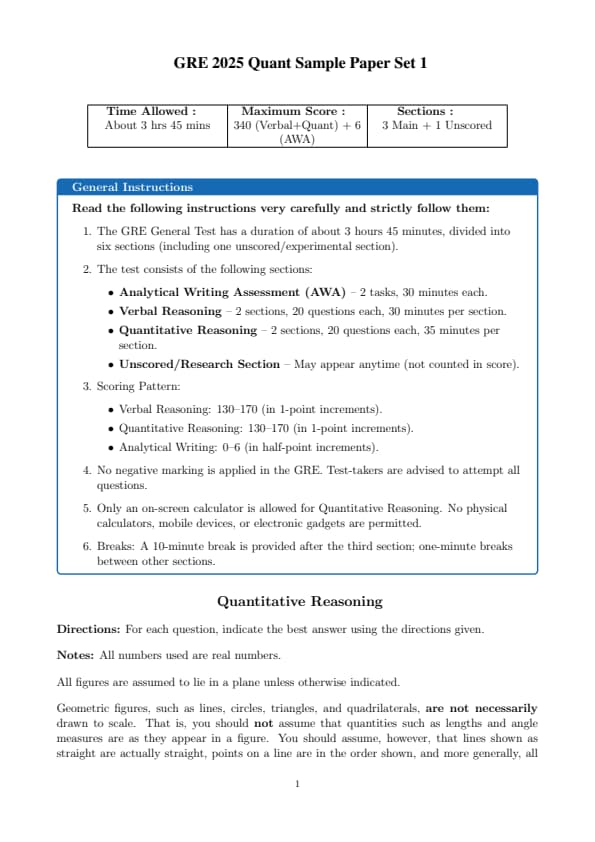
A desert outpost has a water supply that is sufficient to last 21 days for 15 people. At the same average rate of water consumption per person, how many days would the water supply last for 9 people?
  • (A) 28.0
  • (B) 32.5
  • (C) 35.0
  • (D) 37.5
  • (E) 42.0

GRE Questions

  • 1.
    The best way to solve environmental problems caused by consumer-generated waste is for towns and cities to impose strict limits on the amount of trash they will accept from each household.
    Write a response in which you discuss the extent to which you agree or disagree with the claim. In developing and supporting your position, be sure to address the most compelling reasons and/or examples that could be used to challenge your position.


      • 2.
        Melvin’s little sister was so ________ that she would believe anything he told her, and his burgeoning sense of maturity rendered him increasingly loath to gull her.

          • dogged
          • tenable
          • fractious
          • frivolous
          • credulous

        • 3.
          Three years ago, because of flooding at the Western Palean Wildlife Preserve, 100 lions and 100 western gazelles were moved to the East Palean Preserve, an area that is home to most of the same species that are found in the western preserve, though in larger numbers, and to the eastern gazelle, a close relative of the western gazelle.
          Write a response in which you discuss one or more alternative explanations that could rival the proposed explanation and explain how your explanation(s) can plausibly account for the facts presented in the argument.


            • 4.
              “Color photography has eliminated the need for realism in artistic painting, in the opinion of a number of art scholars and artists. At the same time, many members of the art community still feel that realistic artwork is still valuable and worthwhile.”

                • Agree, because color photography has eliminated the need for realistic art.
                • Disagree, as realism in art serves as an important expression of human creativity.
                • Agree, but only in some cases, color photography does not affect all artistic forms.
                • Disagree, as traditional forms of art hold inherent value independent of color photography.

              • 5.
                Should we really care for the greatest actors of the past could we have them before us? Should we find them too different from our accent of thought, of feeling, of speech, in a thousand minute particulars which are of the essence of all three? Dr. Doran's long and interesting records of the triumphs of Garrick, and other less familiar, but in their day hardly less astonishing, players, do not relieve one of the doubt. Garrick himself, as sometimes happens with people who have been the subject of much anecdote and other conversation, here as elsewhere, bears no very distinct figure. One hardly sees the wood for the trees. On the other hand, the account of Betterton, "perhaps the greatest of English actors," is delightfully fresh. That intimate friend of Dryden, Tillatson, Pope, who executed a copy of the actor's portrait by Kneller which is still extant, was worthy of their friendship; his career brings out the best elements in stage life. The stage in these volumes presents itself indeed not merely as a mirror of life, but as an illustration of the utmost intensity of life, in the fortunes and characters of the players. Ups and downs, generosity, dark fates, the most delicate goodness, have nowhere been more prominent than in the private existence of those devoted to the public mimicry of men and women. Contact with the stage, almost throughout its history, presents itself as a kind of touchstone, to bring out the bizarrerie, the theatrical tricks and contrasts, of the actual world.


                  • 6.
                    Complete the paragraph from the given words. It is refreshing to read a book about our planet by an author who does not allow facts to be (i) _________ by politics: well aware of the political disputes about the effects of human activities on climate and biodiversity, this author does not permit them to (ii) _________ his comprehensive description of what we know about our biosphere. He emphasizes the enormous gaps in our knowledge, the sparseness of our observations, and the (iii) _________, calling attention to the many aspects of planetary evolution that must be better understood before we can accurately diagnose the condition of our planet. Fill in the blanks from the following:

                      • overshadowed
                      • invalidated
                      • illuminated
                      • enhance
                      • obscure

                    Comments


                    No Comments To Show