GRE 2024 Verbal Reasoning Test 7 Question Paper with Solutions PDF

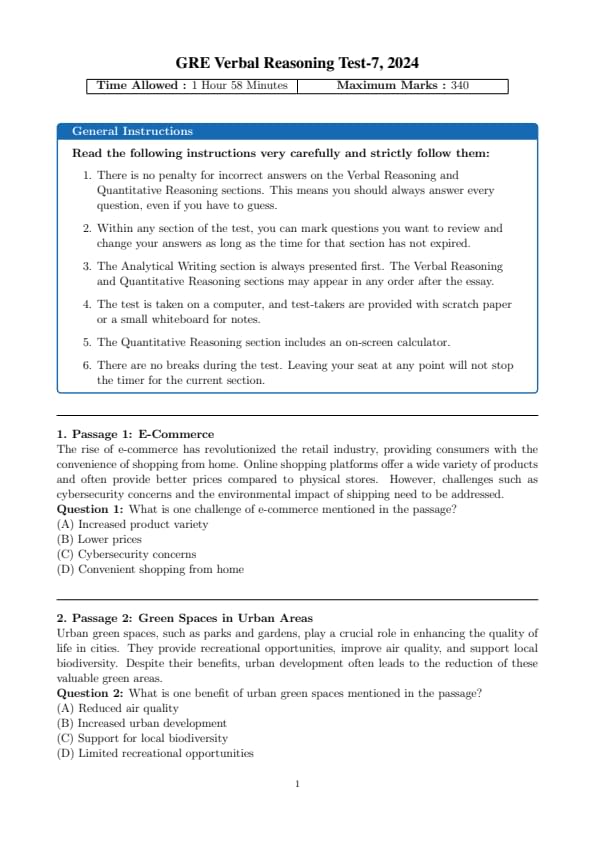
GRE 2024 Verbal Reasoning Test 7 Question Paper with Solutions PDF is available for download. The overall test time is about 1 hour and 58 minutes. GRE has total 5 sections:

  • Analytical Writing  (One "Analyze an Issue" task, Alloted time 30 minutes)
  • Verbal Reasoning  (Two Sections, with 12 questions and 15 questions respectively)
  • Quantitative Reasoning (Two Sections, with 12 questions and 15 questions respectively)

GRE 2024 Verbal Reasoning Test 7 Question Paper with Solutions PDF

GRE 2024 Verbal Reasoning Test 7 Question Paper with Solutions PDF download iconDownload Check Solutions
GRE 2024 Verbal Reasoning Test 7 Question Paper with Solutions PDF

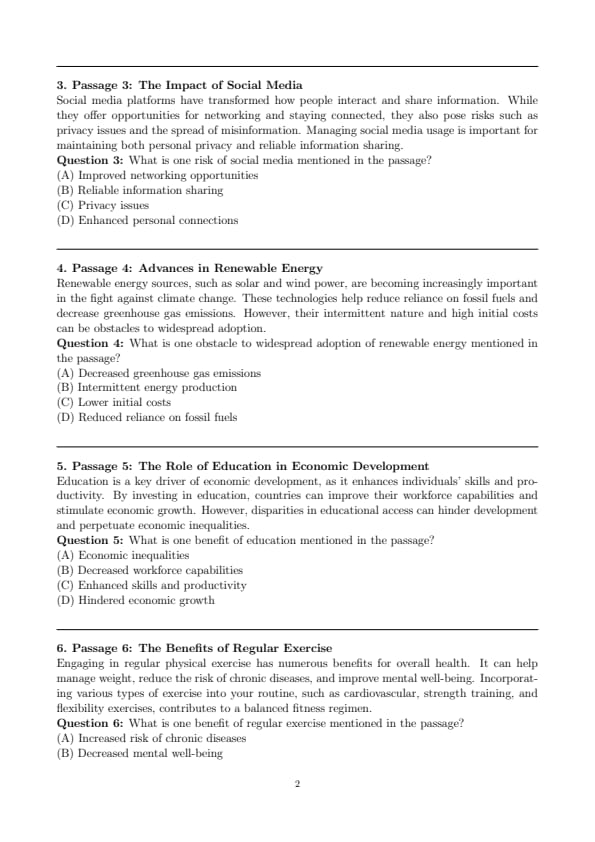
Question 1:

What is one challenge of e-commerce mentioned in the passage?

  • (A) Increased product variety
  • (B) Lower prices
  • (C) Cybersecurity concerns
  • (D) Convenient shopping from home

Question 2:

What is one benefit of urban green spaces mentioned in the passage?

  • (A) Reduced air quality
  • (B) Increased urban development
  • (C) Support for local biodiversity
  • (D) Limited recreational opportunities

Question 3:

What is one risk of social media mentioned in the passage?

  • (A) Improved networking opportunities
  • (B) Reliable information sharing
  • (C) Privacy issues
  • (D) Enhanced personal connections

Question 4:

What is one obstacle to widespread adoption of renewable energy mentioned in the passage?

  • (A) Decreased greenhouse gas emissions
  • (B) Intermittent energy production
  • (C) Lower initial costs
  • (D) Reduced reliance on fossil fuels

Question 5:

What is one benefit of education mentioned in the passage?

  • (A) Economic inequalities
  • (B) Decreased workforce capabilities
  • (C) Enhanced skills and productivity
  • (D) Hindered economic growth

Question 6:

What is one benefit of regular exercise mentioned in the passage?

  • (A) Increased risk of chronic diseases
  • (B) Decreased mental well-being
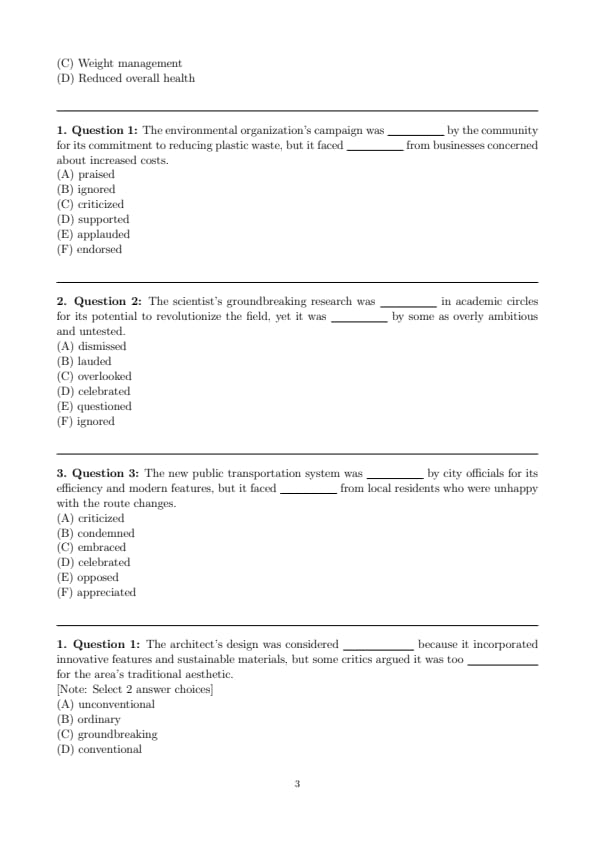
  • (C) Weight management
  • (D) Reduced overall health

Question 7:

The environmental organization’s campaign was by the community for its commitment to reducing plastic waste, but it faced from businesses concerned about increased costs.

  • (B) ignored
  • (C) criticized
  • (D) supported
  • (E) applauded
  • (F) endorsed

Question 8:

The scientist’s groundbreaking research was in academic circles for its potential to revolutionize the field, yet it was  by some as overly ambitious and untested.

  • (B) lauded
  • (C) overlooked
  • (D) celebrated
  • (E) questioned
  • (F) ignored

Question 9:

The new public transportation system was by city officials for its efficiency and modern features, but it faced from local residents who were unhappy with the route changes.

  • (B) condemned
  • (C) embraced
  • (D) celebrated
  • (E) opposed
  • (F) appreciated

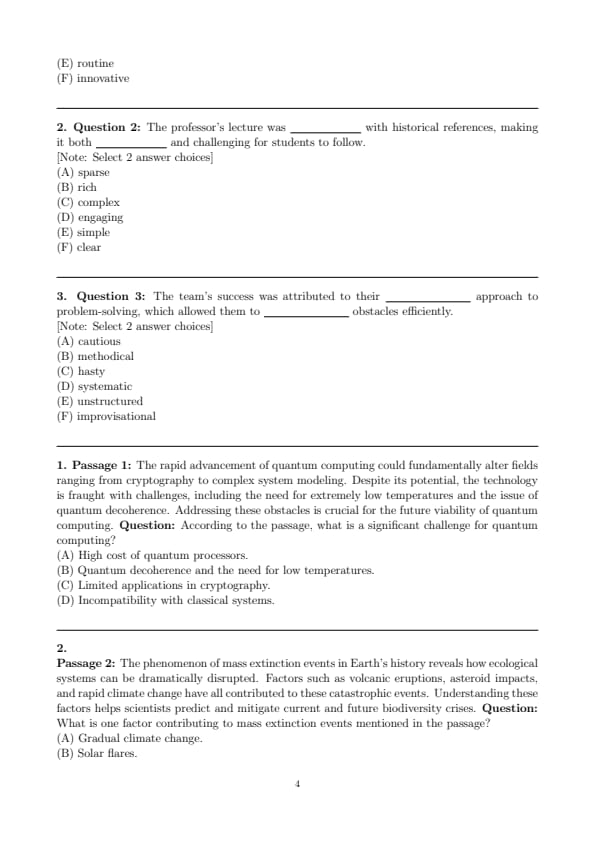
Question 10:

The architect’s design was considered ________ because it incorporated innovative features and sustainable materials, but some critics argued it was too ________ for the area’s traditional aesthetic.
[Note: Select 2 answer choices]

  • (B) ordinary
  • (C) groundbreaking
  • (D) conventional
  • (E) routine
  • (F) innovative

Question 11:

The professor’s lecture was ________ with historical references, making it both ________ and challenging for students to follow.
[Note: Select 2 answer choices]

  • (B) rich
  • (C) complex
  • (D) engaging
  • (E) simple
  • (F) clear

Question 12:

The team’s success was attributed to their ________ approach to problem-solving, which allowed them to ________ obstacles efficiently.
[Note: Select 2 answer choices]

  • (B) methodical
  • (C) hasty
  • (D) systematic
  • (E) unstructured
  • (F) improvisational

Question 13:

According to the passage, what is a significant challenge for quantum computing?

  • (B) Quantum decoherence and the need for low temperatures.
  • (C) Limited applications in cryptography.
  • (D) Incompatibility with classical systems.

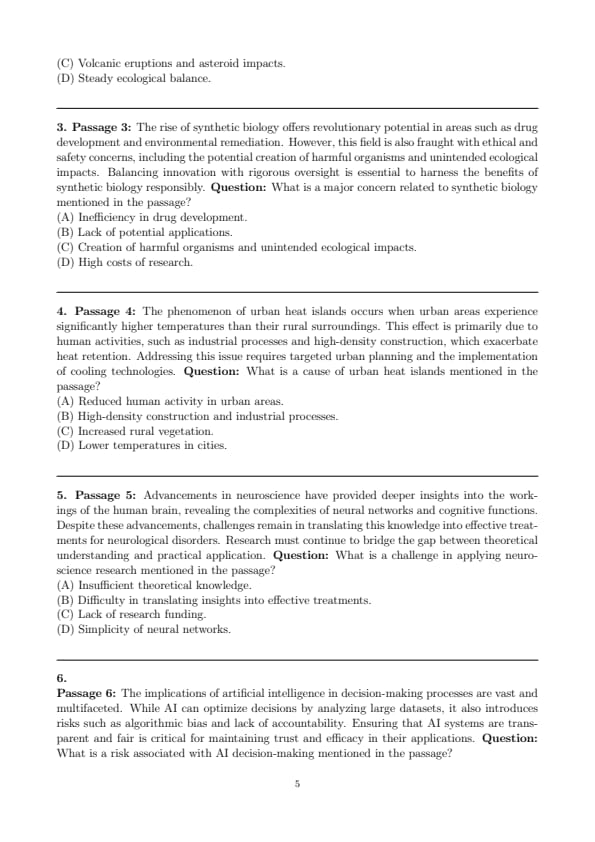
Question 14:

Question: What is one factor contributing to mass extinction events mentioned in the passage?

  • (B) Solar flares.
  • (C) Volcanic eruptions and asteroid impacts.
  • (D) Steady ecological balance.

Question 15:

Question: What is a major concern related to synthetic biology mentioned in the passage?

  • (B) Lack of potential applications.
  • (C) Creation of harmful organisms and unintended ecological impacts.
  • (D) High costs of research.

Question 16:

Question: What is a cause of urban heat islands mentioned in the passage?

  • (B) High-density construction and industrial processes.
  • (C) Increased rural vegetation.
  • (D) Lower temperatures in cities.

Question 17:

Question: What is a challenge in applying neuroscience research mentioned in the passage?

  • (B) Difficulty in translating insights into effective treatments.
  • (C) Lack of research funding.
  • (D) Simplicity of neural networks.

Question 18:

Question: What is a risk associated with AI decision-making mentioned in the passage?

  • (B) Algorithmic bias and lack of accountability.
  • (C) Increased transparency in processes.
  • (D) Reduced need for large datasets.

Question 19:

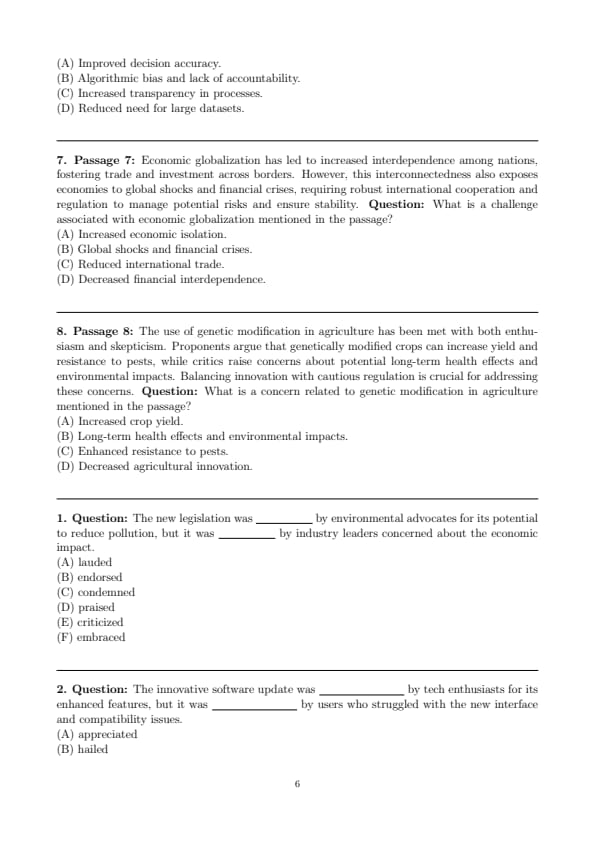
Question: What is a challenge associated with economic globalization mentioned in the passage?

  • (B) Global shocks and financial crises.
  • (C) Reduced international trade.
  • (D) Decreased financial interdependence.

Question 20:

Question: What is a concern related to genetic modification in agriculture mentioned in the passage?

  • (B) Long-term health effects and environmental impacts.
  • (C) Enhanced resistance to pests.
  • (D) Decreased agricultural innovation.

Question 21:

Question: The new legislation was \underline{\hspace{2cm by environmental advocates for its potential to reduce pollution, but it was \underline{\hspace{2cm by industry leaders concerned about the economic impact.

  • (B) endorsed
  • (C) condemned
  • (D) praised
  • (E) criticized
  • (F) embraced

Question 22:

The innovative software update was by tech enthusiasts for its enhanced features, but it was by users who struggled with the new interface and compatibility issues.

  • (B) hailed
  • (C) ignored
  • (D) celebrated
  • (E) lamented
  • (F) dismissed

Question 23:

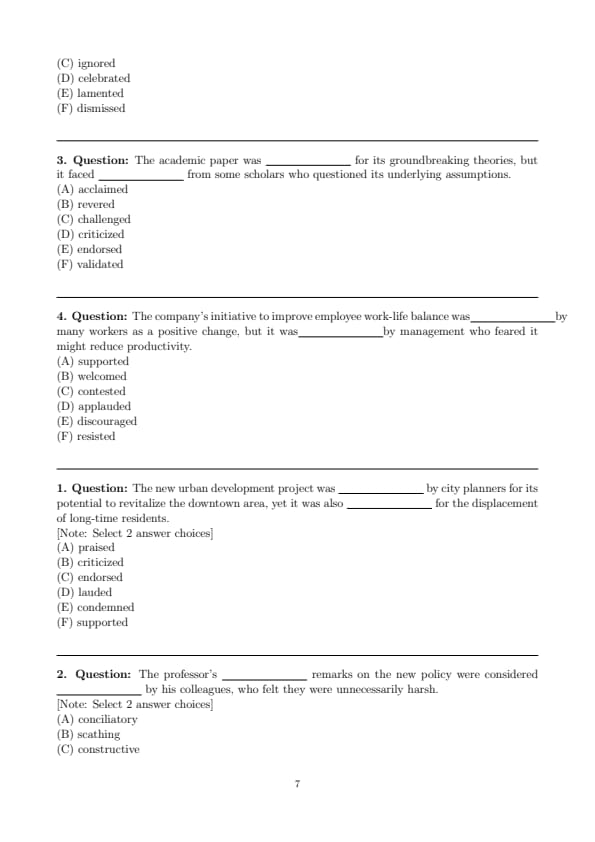
The academic paper was cm for its groundbreaking theories, but it faced from some scholars who questioned its underlying assumptions.

  • (B) revered
  • (C) challenged
  • (D) criticized
  • (E) endorsed
  • (F) validated

Question 24:

The company's initiative to improve employee work-life balance was by many workers as a positive change, but it was by management who feared it might reduce productivity.

  • (B) welcomed
  • (C) contested
  • (D) applauded
  • (E) discouraged
  • (F) resisted

Question 25:

The new urban development project was by city planners for its potential to revitalize the downtown area, yet it was also for the displacement of long-time residents.

[Note: Select 2 answer choices]

  • (B) criticized
  • (C) endorsed
  • (D) lauded
  • (E) condemned
  • (F) supported

Question 26:

The professor’s remarks on the new policy were considered by his colleagues, who felt they were unnecessarily harsh.

[Note: Select 2 answer choices]

  • (B) scathing
  • (C) constructive
  • (D) mild
  • (E) inflammatory
  • (F) neutral

Question 27:

The startup’s \underline{\hspace{3cm decision to pivot its business model was both and risky, given the uncertain market conditions.

[Note: Select 2 answer choices]
  • (B) bold
  • (C) cautious
  • (D) innovative
  • (E) unadventurous
  • (F) daring

GRE Questions

  • 1.
    Claim: Though often considered an objective pursuit, learning about the historical past requires creativity.
    Reason: Because we can never know the past directly, we must reconstruct it by imaginatively interpreting historical accounts, documents, and artifacts.
    Write a response in which you discuss the extent to which you agree or disagree with the claim and the reason on which the claim is based.


      • 2.
        Three years ago, because of flooding at the Western Palean Wildlife Preserve, 100 lions and 100 western gazelles were moved to the East Palean Preserve, an area that is home to most of the same species that are found in the western preserve, though in larger numbers, and to the eastern gazelle, a close relative of the western gazelle.
        Write a response in which you discuss one or more alternative explanations that could rival the proposed explanation and explain how your explanation(s) can plausibly account for the facts presented in the argument.


          • 3.
            Called by some the “island that time forgot,” Madagascar is home to a vast array of unique, exotic creatures. One such animal is the aye-aye. First described by western science in 1782, it was initially categorized as a member of the order Rodentia. Further research then revealed that it was more closely related to the lemur, a member of the primate order. Since the aye-aye is so different from its fellow primates, however, it was given its own family: Daubentoniidae. The aye-aye has been listed as an endangered species and, as a result, the government of Madagascar has designated an island off the northeastern coast of Madagascar as a protected reserve for aye-ayes and other wildlife.
            Long before Western science became enthralled with this nocturnal denizen of Madagascar’s jungles, the aye-aye had its own reputation with the local people. The aye aye is perhaps best known for its large, round eyes and long, extremely thin middle finger. These adaptations are quite sensible, allowing the aye-aye to see well at night and retrieve grubs, which are one of its primary food sources, from deep within hollow branches. However, the aye-aye’s striking appearance may end up causing its extinction. The people of Madagascar believe that the aye-aye is a type of spirit animal, and that its appearance is an omen of death. Whenever one is sighted, it is immediately killed. When combined with the loss of large swaths of jungle habitat, this practice may result in the loss of a superb .


              • 4.
                “Color photography has eliminated the need for realism in artistic painting, in the opinion of a number of art scholars and artists. At the same time, many members of the art community still feel that realistic artwork is still valuable and worthwhile.”

                  • Agree, because color photography has eliminated the need for realistic art.
                  • Disagree, as realism in art serves as an important expression of human creativity.
                  • Agree, but only in some cases, color photography does not affect all artistic forms.
                  • Disagree, as traditional forms of art hold inherent value independent of color photography.

                • 5.
                  The following appeared as a letter to the editor from the owner of a skate shop in Central Plaza.
                  "Two years ago the city council voted to prohibit skateboarding in Central Plaza. They claimed that skateboard users were responsible for litter and vandalism that were keeping other visitors from coming to the plaza. In the past two years, however, there has been only a small increase in the number of visitors to Central Plaza, and litter and vandalism are still problematic. Skateboarding is permitted in Monroe Park, however, and there is no problem with litter or vandalism there. In order to restore Central Plaza to its former glory, then, we recommend that the city lift its prohibition on skateboarding in the plaza."

                    • What is the current level of litter and vandalism in Central Plaza?
                    • How much foot traffic has increased in Monroe Park compared to Central Plaza?
                    • Has the local economy in the plaza improved since the ban on skateboarding?
                    • How successful has the Monroe Park skateboarding program been in other cities?

                  • 6.
                    “Claim: A person in authority should always encourage those under him or her to share their thoughts and ideas. Reason: A leader’s main goal should be to promote innovation and change.”

                      • Agree, as open dialogue fosters creativity and innovation.
                      • Disagree, as not all ideas are practical or beneficial to share.
                      • Agree, but only when it is necessary for progress.
                      • Disagree, as promoting change without evaluating all ideas can be harmful.

                    Comments


                    No Comments To Show