GRE 2024 Verbal Reasoning Test 3 Question Paper with Solutions PDF

GRE 2024 Verbal Reasoning Test 3 Question Paper with Solutions PDF is available for download. The overall test time is about 1 hour and 58 minutes. GRE has total 5 sections:

  • Analytical Writing  (One "Analyze an Issue" task, Alloted time 30 minutes)
  • Verbal Reasoning  (Two Sections, with 12 questions and 15 questions respectively)
  • Quantitative Reasoning (Two Sections, with 12 questions and 15 questions respectively)

GRE 2024 Verbal Reasoning Practice Test 3 Question Paper with Solutions PDF

GRE 2024 Verbal Reasoning Question Paper with Solutions PDF download iconDownload Check Solutions

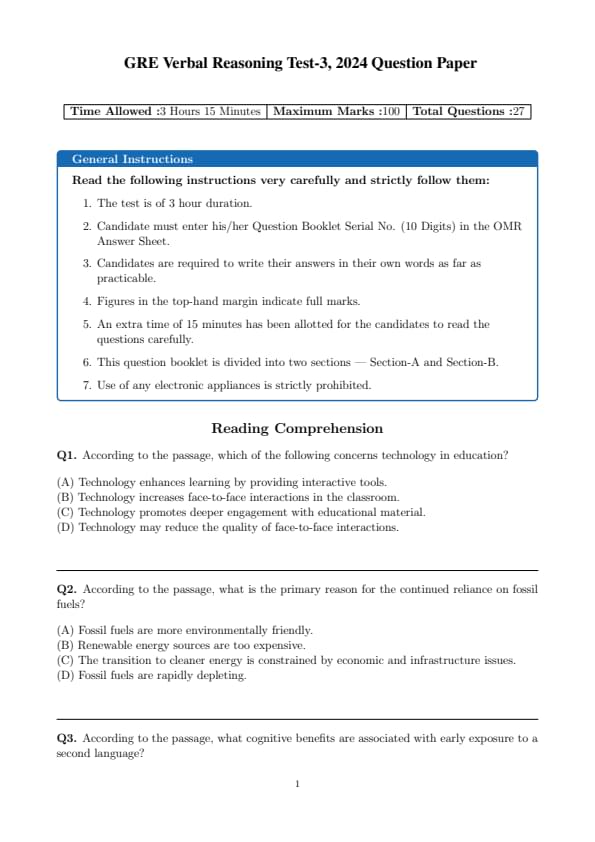
Question 1:

According to the passage, which of the following concerns technology in education?

  • (A) Technology enhances learning by providing interactive tools.
  • (B) Technology increases face-to-face interactions in the classroom.
  • (C) Technology promotes deeper engagement with educational material.
  • (D) Technology may reduce the quality of face-to-face interactions.

Question 2:

According to the passage, what is the primary reason for the continued reliance on fossil fuels?

  • (A) Fossil fuels are more environmentally friendly.
  • (B) Renewable energy sources are too expensive.
  • (C) The transition to cleaner energy is constrained by economic and infrastructure issues.
  • (D) Fossil fuels are rapidly depleting.

Question 3:

According to the passage, what cognitive benefits are associated with early exposure to a second language?

  • (A) Improved memory retention
  • (B) Enhanced problem-solving skills and multitasking abilities
  • (C) Increased creativity
  • (D) Better physical coordination

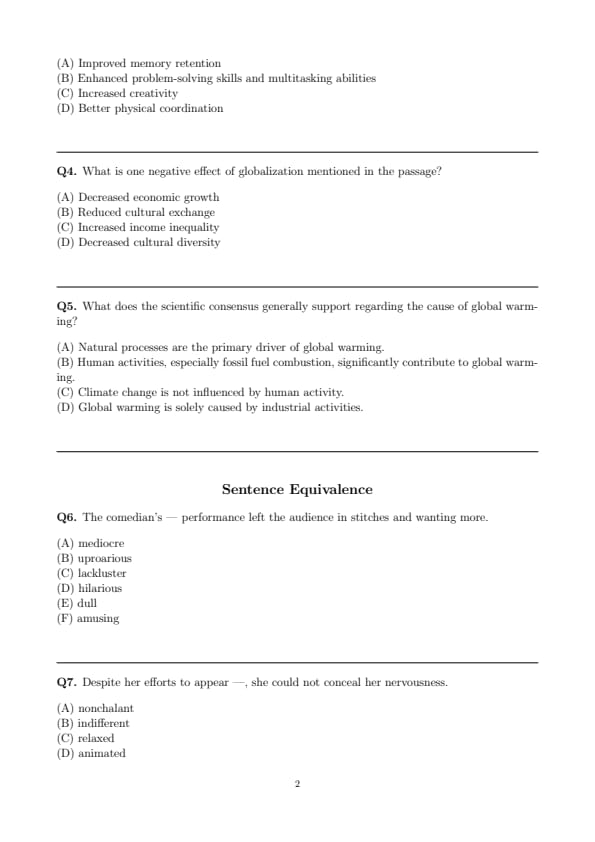
Question 4:

What is one negative effect of globalization mentioned in the passage?

  • (A) Decreased economic growth
  • (B) Reduced cultural exchange
  • (C) Increased income inequality
  • (D) Decreased cultural diversity

Question 5:

What does the scientific consensus generally support regarding the cause of global warming?

  • (A) Natural processes are the primary driver of global warming.
  • (B) Human activities, especially fossil fuel combustion, significantly contribute to global warming.
  • (C) Climate change is not influenced by human activity.
  • (D) Global warming is solely caused by industrial activities.

Question 6:

The comedian’s --- performance left the audience in stitches and wanting more.

  • (A) mediocre
  • (B) uproarious
  • (C) lackluster
  • (D) hilarious
  • (E) dull
  • (F) amusing

Question 7:

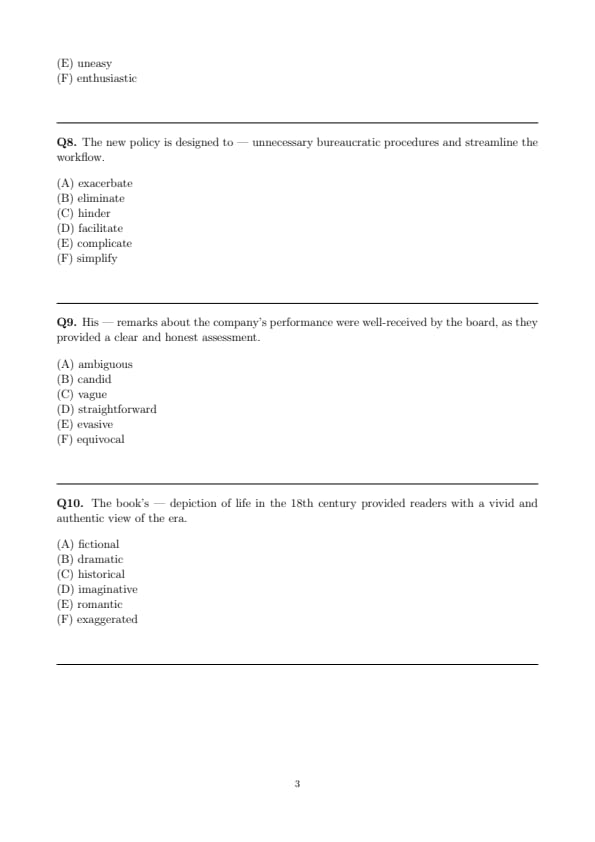
Despite her efforts to appear ---, she could not conceal her nervousness.

  • (A) nonchalant
  • (B) indifferent
  • (C) relaxed
  • (D) animated
  • (E) uneasy
  • (F) enthusiastic

Question 8:

The new policy is designed to --- unnecessary bureaucratic procedures and streamline the workflow.

  • (A) exacerbate
  • (B) eliminate
  • (C) hinder
  • (D) facilitate
  • (E) complicate
  • (F) simplify

Question 9:

His --- remarks about the company’s performance were well-received by the board, as they provided a clear and honest assessment.

  • (A) ambiguous
  • (B) candid
  • (C) vague
  • (D) straightforward
  • (E) evasive
  • (F) equivocal

Question 10:

The book’s --- depiction of life in the 18th century provided readers with a vivid and authentic view of the era.

  • (A) fictional
  • (B) dramatic
  • (C) historical
  • (D) imaginative
  • (E) romantic
  • (F) exaggerated

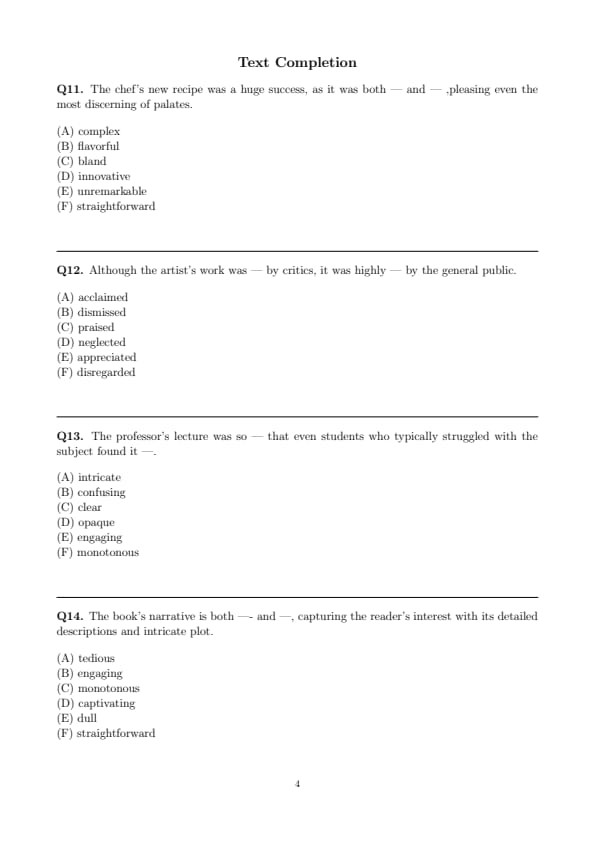
Question 11:

The chef’s new recipe was a huge success, as it was both --- and --- ,pleasing even the most discerning of palates.

  • (A) complex
  • (B) flavorful
  • (C) bland
  • (D) innovative
  • (E) unremarkable
  • (F) straightforward

Question 12:

Although the artist’s work was --- by critics, it was highly --- by the general public.

  • (A) acclaimed
  • (B) dismissed
  • (C) praised
  • (D) neglected
  • (E) appreciated
  • (F) disregarded

Question 13:

The professor’s lecture was so --- that even students who typically struggled with the subject found it ---.

  • (A) intricate
  • (B) confusing
  • (C) clear
  • (D) opaque
  • (E) engaging
  • (F) monotonous

Question 14:

The book’s narrative is both ---- and ---, capturing the reader’s interest with its detailed descriptions and intricate plot.

  • (A) tedious
  • (B) engaging
  • (C) monotonous
  • (D) captivating
  • (E) dull
  • (F) straightforward

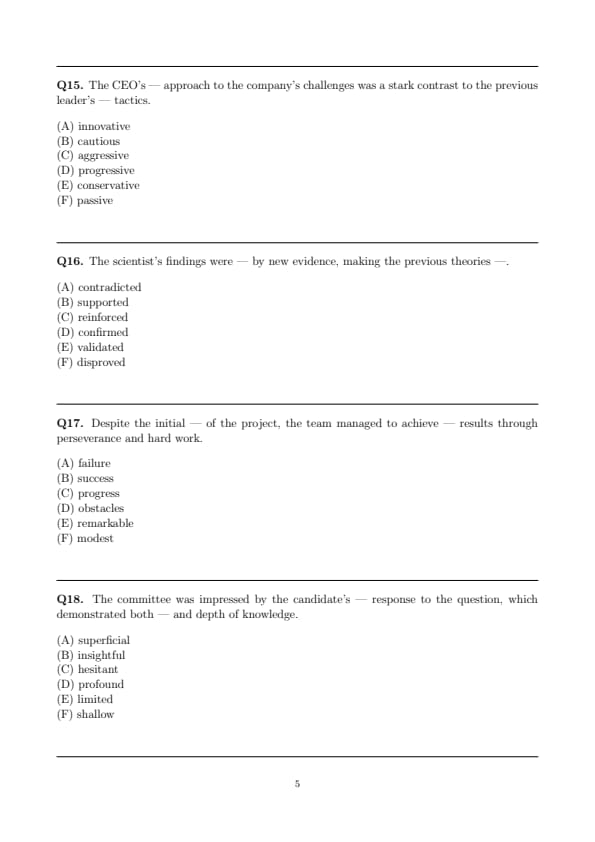
Question 15:

The CEO’s --- approach to the company’s challenges was a stark contrast to the previous leader’s --- tactics.

  • (A) innovative
  • (B) cautious
  • (C) aggressive
  • (D) progressive
  • (E) conservative
  • (F) passive

Question 16:

The scientist’s findings were --- by new evidence, making the previous theories ---.

  • (A) contradicted
  • (B) supported
  • (C) reinforced
  • (D) confirmed
  • (E) validated
  • (F) disproved

Question 17:

Despite the initial --- of the project, the team managed to achieve --- results through perseverance and hard work.

  • (A) failure
  • (B) success
  • (C) progress
  • (D) obstacles
  • (E) remarkable
  • (F) modest

Question 18:

The committee was impressed by the candidate’s --- response to the question, which demonstrated both --- and depth of knowledge.

  • (A) superficial
  • (B) insightful
  • (C) hesitant
  • (D) profound
  • (E) limited
  • (F) shallow

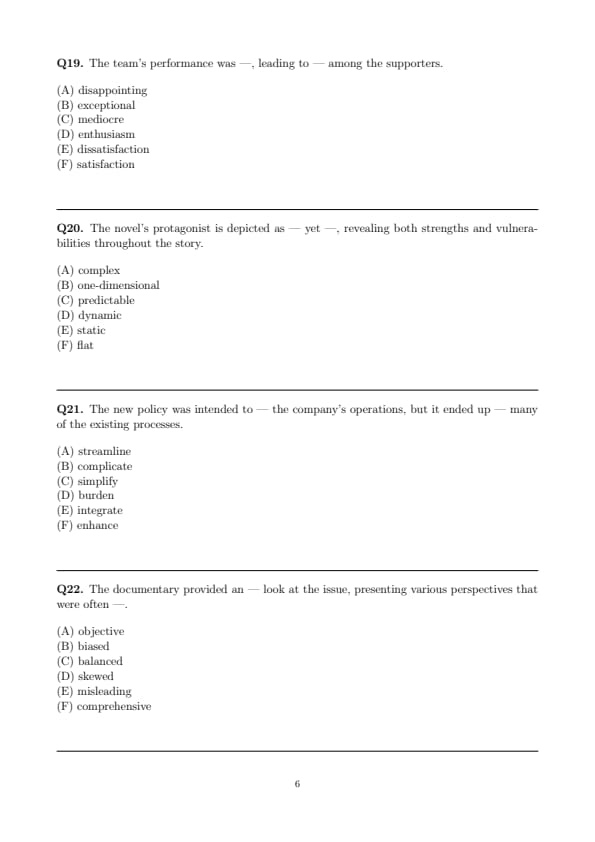
Question 19:

The team’s performance was ---, leading to --- among the supporters.

  • (A) disappointing
  • (B) exceptional
  • (C) mediocre
  • (D) enthusiasm
  • (E) dissatisfaction
  • (F) satisfaction

Question 20:

The novel’s protagonist is depicted as --- yet ---, revealing both strengths and vulnerabilities throughout the story.

  • (A) complex
  • (B) one-dimensional
  • (C) predictable
  • (D) dynamic
  • (E) static
  • (F) flat

Question 21:

The new policy was intended to --- the company’s operations, but it ended up --- many of the existing processes.

  • (A) streamline
  • (B) complicate
  • (C) simplify
  • (D) burden
  • (E) integrate
  • (F) enhance

Question 22:

The documentary provided an --- look at the issue, presenting various perspectives that were often ---.

  • (A) objective
  • (B) biased
  • (C) balanced
  • (D) skewed
  • (E) misleading
  • (F) comprehensive

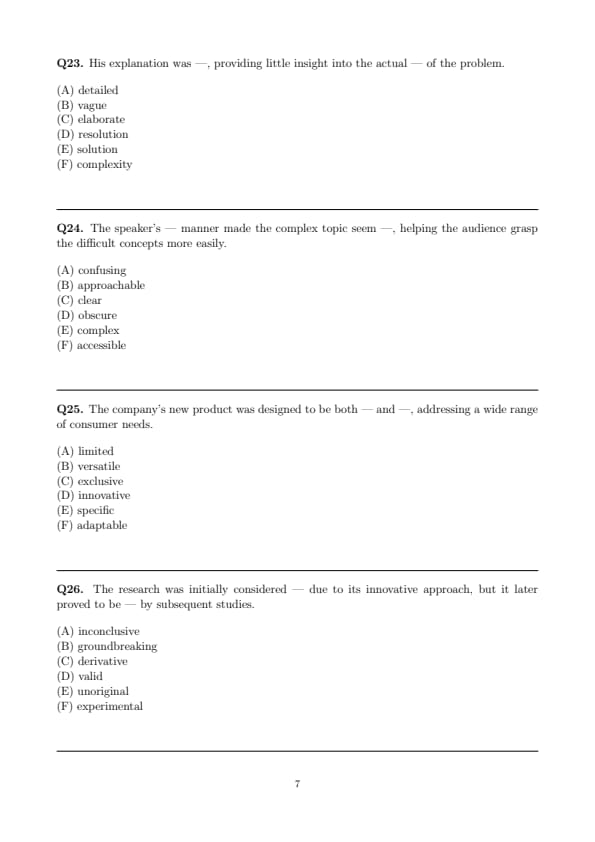
Question 23:

His explanation was ---, providing little insight into the actual --- of the problem.

  • (A) detailed
  • (B) vague
  • (C) elaborate
  • (D) resolution
  • (E) solution
  • (F) complexity

Question 24:

The speaker’s --- manner made the complex topic seem ---, helping the audience grasp the difficult concepts more easily.

  • (A) confusing
  • (B) approachable
  • (C) clear
  • (D) obscure
  • (E) complex
  • (F) accessible

Question 25:

The company’s new product was designed to be both --- and ---, addressing a wide range of consumer needs.

  • (A) limited
  • (B) versatile
  • (C) exclusive
  • (D) innovative
  • (E) specific
  • (F) adaptable

Question 26:

The research was initially considered --- due to its innovative approach, but it later proved to be --- by subsequent studies.

  • (A) inconclusive
  • (B) groundbreaking
  • (C) derivative
  • (D) valid
  • (E) unoriginal
  • (F) experimental

Question 27:

The historian’s account was ---, offering a --- interpretation of the events that shaped the era.
  • (A) controversial
  • (B) biased
  • (C) objective
  • (D) subjective
  • (E) balanced
  • (F) partial

GRE Questions

  • 1.
    The best way to solve environmental problems caused by consumer-generated waste is for towns and cities to impose strict limits on the amount of trash they will accept from each household.
    Write a response in which you discuss the extent to which you agree or disagree with the claim. In developing and supporting your position, be sure to address the most compelling reasons and/or examples that could be used to challenge your position.


      • 2.
        The following appeared in a health newsletter.
        "Nosinia is an herb that many users report to be as effective as prescription medications at fighting allergy symptoms. Researchers recently compared Nosinia to a placebo in 95 men and women with seasonal allergies to ragweed pollen. Participants in the study reported that neither Nosinia nor the placebo offered significant relief. However, for the most severe allergy symptoms, the researchers reported that Nosinia was more effective than the placebo in providing relief. Furthermore, at the end of the study, participants given Nosinia were more likely than participants given a placebo to report feeling healthier. We, therefore, recommend using Nosinia to help with your severe allergy symptoms."

          • How reliable is the study's sample size?
          • How does the severity of symptoms affect the results?
          • Was the placebo truly effective in reducing allergy symptoms?
          • Is there any independent evidence for Nosinia’s effectiveness?

        • 3.
          “Color photography has eliminated the need for realism in artistic painting, in the opinion of a number of art scholars and artists. At the same time, many members of the art community still feel that realistic artwork is still valuable and worthwhile.”

            • Agree, because color photography has eliminated the need for realistic art.
            • Disagree, as realism in art serves as an important expression of human creativity.
            • Agree, but only in some cases, color photography does not affect all artistic forms.
            • Disagree, as traditional forms of art hold inherent value independent of color photography.

          • 4.
            Called by some the “island that time forgot,” Madagascar is home to a vast array of unique, exotic creatures. One such animal is the aye-aye. First described by western science in 1782, it was initially categorized as a member of the order Rodentia. Further research then revealed that it was more closely related to the lemur, a member of the primate order. Since the aye-aye is so different from its fellow primates, however, it was given its own family: Daubentoniidae. The aye-aye has been listed as an endangered species and, as a result, the government of Madagascar has designated an island off the northeastern coast of Madagascar as a protected reserve for aye-ayes and other wildlife.
            Long before Western science became enthralled with this nocturnal denizen of Madagascar’s jungles, the aye-aye had its own reputation with the local people. The aye aye is perhaps best known for its large, round eyes and long, extremely thin middle finger. These adaptations are quite sensible, allowing the aye-aye to see well at night and retrieve grubs, which are one of its primary food sources, from deep within hollow branches. However, the aye-aye’s striking appearance may end up causing its extinction. The people of Madagascar believe that the aye-aye is a type of spirit animal, and that its appearance is an omen of death. Whenever one is sighted, it is immediately killed. When combined with the loss of large swaths of jungle habitat, this practice may result in the loss of a superb .


              • 5.
                “Claim: A person in authority should always encourage those under him or her to share their thoughts and ideas. Reason: A leader’s main goal should be to promote innovation and change.”

                  • Agree, as open dialogue fosters creativity and innovation.
                  • Disagree, as not all ideas are practical or beneficial to share.
                  • Agree, but only when it is necessary for progress.
                  • Disagree, as promoting change without evaluating all ideas can be harmful.

                • 6.
                  Claim: Though often considered an objective pursuit, learning about the historical past requires creativity.
                  Reason: Because we can never know the past directly, we must reconstruct it by imaginatively interpreting historical accounts, documents, and artifacts.
                  Write a response in which you discuss the extent to which you agree or disagree with the claim and the reason on which the claim is based.

                    Comments


                    No Comments To Show