GRE 2024 Quantitative Reasoning Practice Test Set 3 Question Paper with Solutions PDF

Shivam Yadav logo
Updated on, Oct 13, 2025

byShivam Yadav

GRE 2024 Quantitative Reasoning Practice Test Set 3 Question Paper with Solutions PDF is available for download. The overall test time is about 1 hour and 58 minutes. GRE has total 5 sections:

  • Analytical Writing  (One "Analyze an Issue" task, Alloted time 30 minutes)
  • Verbal Reasoning  (Two Sections, with 12 questions and 15 questions respectively)
  • Quantitative Reasoning (Two Sections, with 12 questions and 15 questions respectively)

GRE 2024 Qantitative Reasoning Practice Test Set 3 Question Paper with Solutions PDF

GRE 2024 Quantitative Reasoning Set 3 Question Paper with Solutions PDF download iconDownload Check Solutions
GRE 2024 Qantitative Reasoning Practice Test Set 3 Question Paper with Solutions PDF

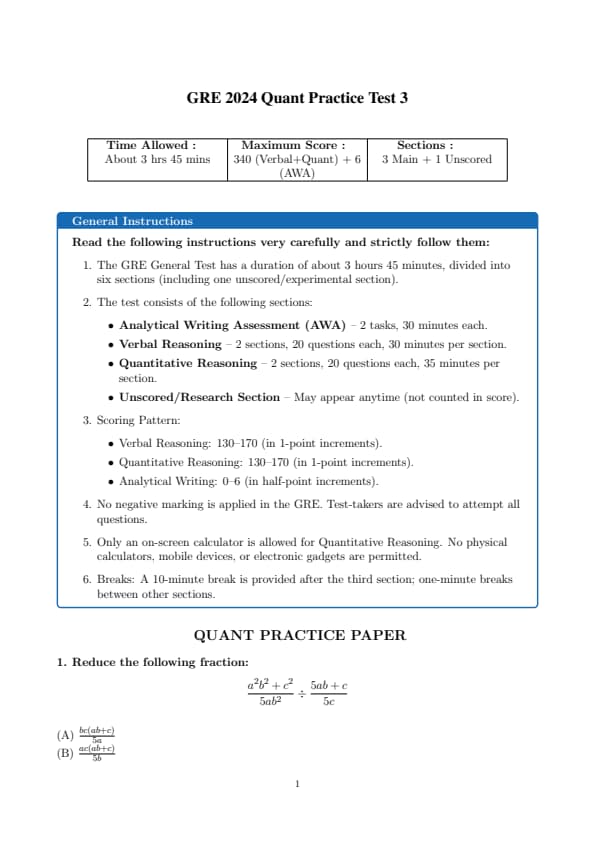
Question 1:

Reduce the following fraction: \[ \frac{a^2b^2 + c^2}{5ab^2} \div \frac{5ab + c}{5c} \]

  • (A) \( \frac{bc(ab + c)}{5a} \)
  • (B) \( \frac{ac(ab + c)}{5b} \)
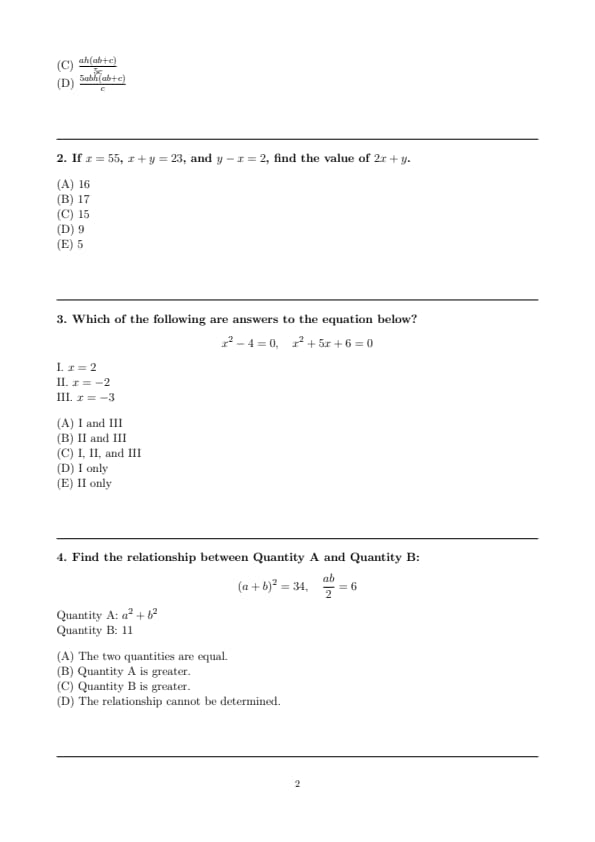
  • (C) \( \frac{ah(ab + c)}{5c} \)
  • (D) \( \frac{5abh(ab + c)}{c} \)

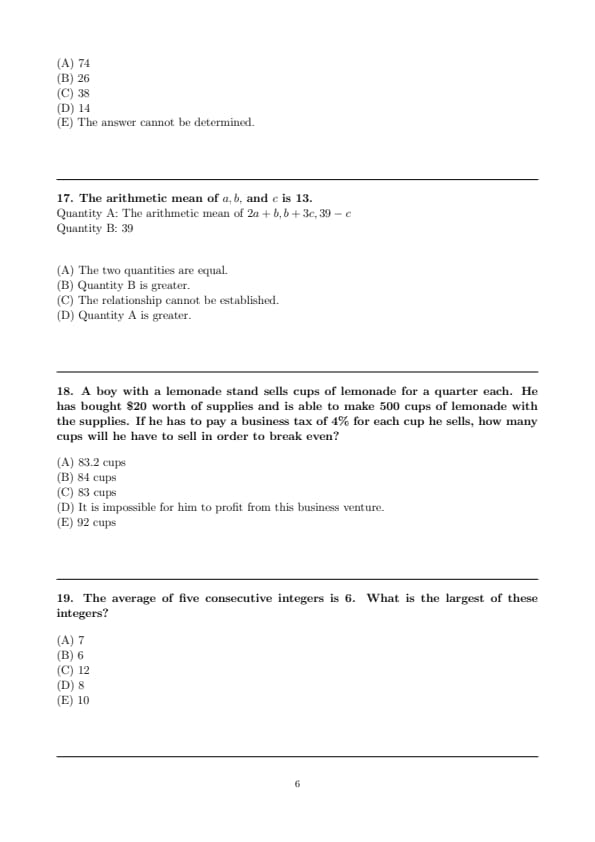
Question 2:

If \( x = 55 \), \( x + y = 23 \), and \( y - x = 2 \), find the value of \( 2x + y \).

  • (A) 16
  • (B) 17
  • (C) 15
  • (D) 9
  • (E) 5

Question 3:

Which of the following are answers to the equation below? \[ x^2 - 4 = 0, \quad x^2 + 5x + 6 = 0 \]
I. \( x = 2 \)

II. \( x = -2 \)

III. \( x = -3 \)

  • (A) I and III
  • (B) II and III
  • (C) I, II, and III
  • (D) I only
  • (E) II only

Question 4:

Find the relationship between Quantity A and Quantity B: \[ (a + b)^2 = 34, \quad \frac{ab}{2} = 6 \]
Quantity A: \( a^2 + b^2 \)

Quantity B: 11

  • (A) The two quantities are equal.
  • (B) Quantity A is greater.
  • (C) Quantity B is greater.
  • (D) The relationship cannot be determined.

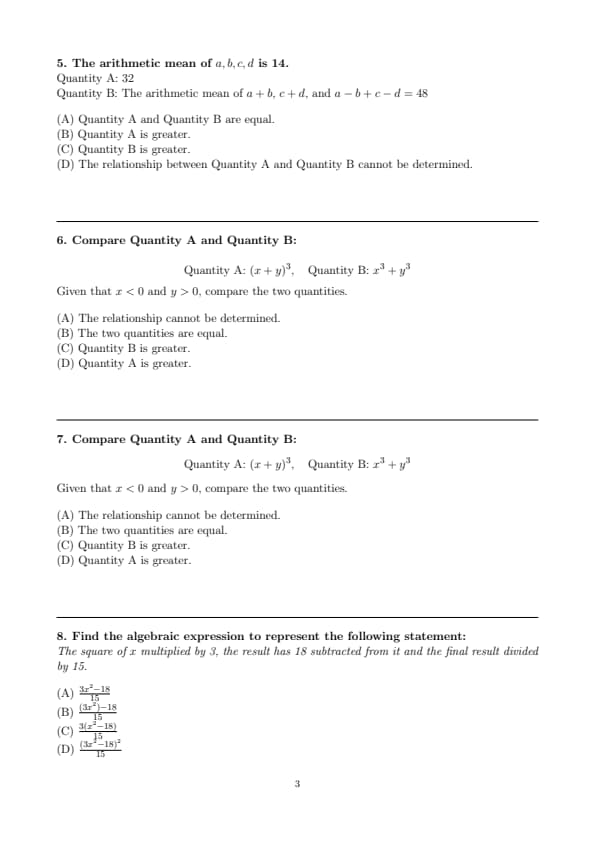
Question 5:

The arithmetic mean of \( a, b, c, d \) is 14.

Quantity A: 32

Quantity B: The arithmetic mean of \( a + b \), \( c + d \), and \( a - b + c - d = 48 \)

  • (A) Quantity A and Quantity B are equal.
  • (B) Quantity A is greater.
  • (C) Quantity B is greater.
  • (D) The relationship between Quantity A and Quantity B cannot be determined.

Question 6:

Compare Quantity A and Quantity B:
\[ Quantity A: (x + y)^3, \quad Quantity B: x^3 + y^3 \]
Given that \( x < 0 \) and \( y > 0 \), compare the two quantities.

  • (A) The relationship cannot be determined.
  • (B) The two quantities are equal.
  • (C) Quantity B is greater.
  • (D) Quantity A is greater.

Question 7:

Compare Quantity A and Quantity B: \[ Quantity A: (x + y)^3, \quad Quantity B: x^3 + y^3 \]
Given that \( x < 0 \) and \( y > 0 \), compare the two quantities.

  • (A) The relationship cannot be determined.
  • (B) The two quantities are equal.
  • (C) Quantity B is greater.
  • (D) Quantity A is greater.

Question 8:

Find the algebraic expression to represent the following statement:

The square of \( x \) multiplied by 3, the result has 18 subtracted from it and the final result divided by 15.

  • (A) \( \frac{3x^2 - 18}{15} \)
  • (B) \( \frac{(3x^2) - 18}{15} \)
  • (C) \( \frac{3(x^2 - 18)}{15} \)
  • (D) \( \frac{(3x^2 - 18)^2}{15} \)
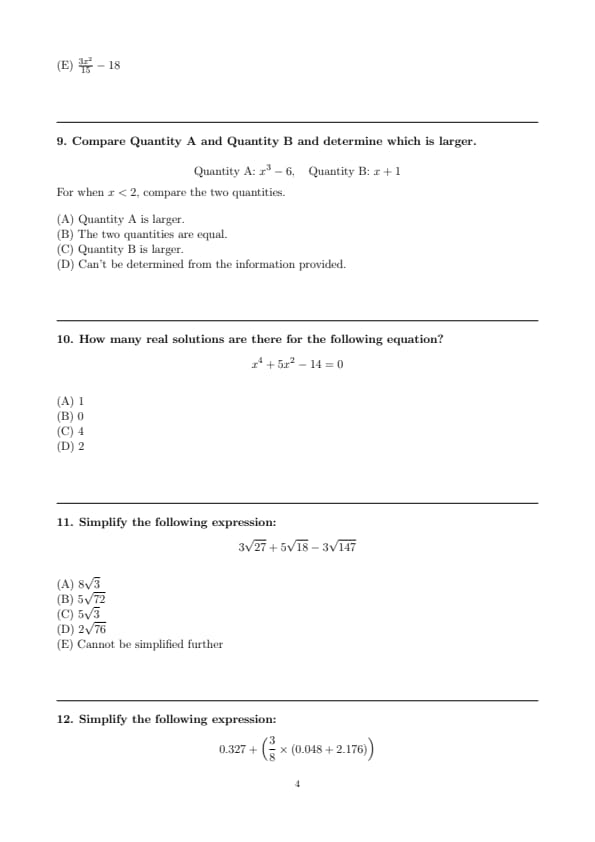
  • (E) \( \frac{3x^2}{15} - 18 \)

Question 9:

Compare Quantity A and Quantity B and determine which is larger.
\[ Quantity A: x^3 - 6, \quad Quantity B: x + 1 \]
For when \( x < 2 \), compare the two quantities.

  • (A) Quantity A is larger.
  • (B) The two quantities are equal.
  • (C) Quantity B is larger.
  • (D) Can't be determined from the information provided.

Question 10:

How many real solutions are there for the following equation? \[ x^4 + 5x^2 - 14 = 0 \]

  • (A) 1
  • (B) 0
  • (C) 4
  • (D) 2

Question 11:

Simplify the following expression: \[ 3\sqrt{27} + 5\sqrt{18} - 3\sqrt{147} \]

  • (A) \( 8\sqrt{3} \)
  • (B) \( 5\sqrt{72} \)
  • (C) \( 5\sqrt{3} \)
  • (D) \( 2\sqrt{76} \)
  • (E) Cannot be simplified further

Question 12:

Simplify the following expression: \[ 0.327 + \left( \frac{3}{8} \times (0.048 + 2.176) \right) \]

  • (A) 0.0532
  • (B) 1.242
  • (C) 0.793
  • (D) 1.522

Question 13:

Which of the following is true? \[ Quantity A: \frac{12}{11} \div \frac{7}{6}, \quad Quantity B: \frac{17}{8} \div \frac{7}{6} \]

  • (A) The relationship between the quantities cannot be determined.
  • (B) Quantity B is larger.
  • (C) The two quantities are equal.
  • (D) Quantity A is larger.

Question 14:

If the product of two distinct integers is 143, which of the following could not represent the sum of those two integers?

  • (A) 144
  • (B) -144
  • (C) 24
  • (D) -24
  • (E) 11

Question 15:

A cake order cost 45.40 before tax. If the tax rate is 6.5%, what is the price of the cake after tax is applied?

  • (A)48.99
  • (B)5.34
  • (C)49.42
  • (D)48.35
  • (E)2.95

Question 16:

At an overpriced department store there are 112 customers. If 43 have purchased shirts, 57 have purchased pants, and 38 have purchased neither, how many purchased both shirts and pants?

  • (A) 74
  • (B) 26
  • (C) 38
  • (D) 14
  • (E) The answer cannot be determined.

Question 17:

The arithmetic mean of \( a, b, \) and \( c \) is 13.

Quantity A: The arithmetic mean of \( 2a + b, b + 3c, 39 - c \)

Quantity B: 39

  • (A) The two quantities are equal.
  • (B) Quantity B is greater.
  • (C) The relationship cannot be established.
  • (D) Quantity A is greater.

Question 18:

A boy with a lemonade stand sells cups of lemonade for a quarter each. He has bought 20 worth of supplies and is able to make 500 cups of lemonade with the supplies. If he has to pay a business tax of 4% for each cup he sells, how many cups will he have to sell in order to break even?

  • (A) 83.2 cups
  • (B) 84 cups
  • (C) 83 cups
  • (D) It is impossible for him to profit from this business venture.
  • (E) 92 cups

Question 19:

The average of five consecutive integers is 6. What is the largest of these integers?

  • (A) 7
  • (B) 6
  • (C) 12
  • (D) 8
  • (E) 10

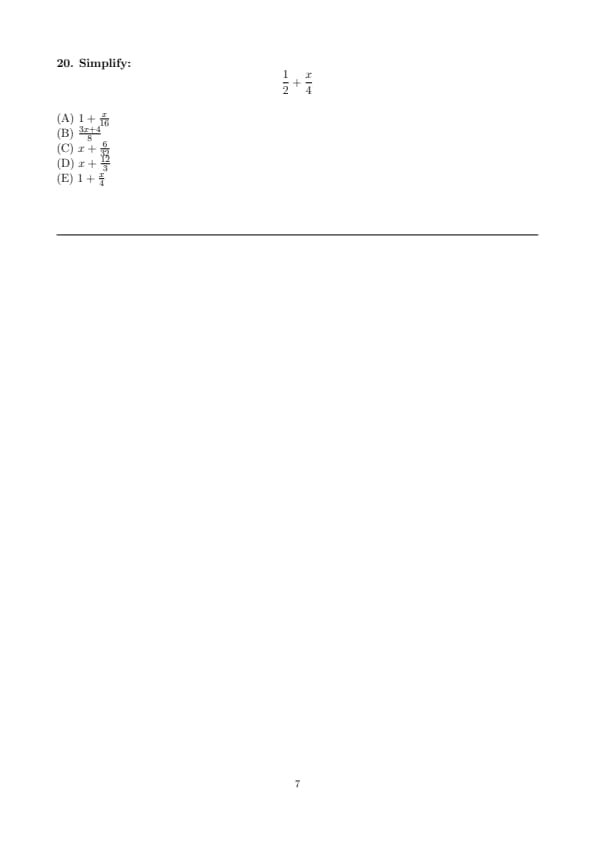
Question 20:

Simplify: \[ \frac{1}{2} + \frac{x}{4} \]
  • (A) \( 1 + \frac{x}{16} \)
  • (B) \( \frac{3x + 4}{8} \)
  • (C) \( x + \frac{6}{32} \)
  • (D) \( x + \frac{12}{3} \)
  • (E) \( 1 + \frac{x}{4} \)

GRE Questions

  • 1.
    “Claim: A person in authority should always encourage those under him or her to share their thoughts and ideas. Reason: A leader’s main goal should be to promote innovation and change.”

      • Agree, as open dialogue fosters creativity and innovation.
      • Disagree, as not all ideas are practical or beneficial to share.
      • Agree, but only when it is necessary for progress.
      • Disagree, as promoting change without evaluating all ideas can be harmful.

    • 2.
      Jean Valjean, the protagonist in Victor Hugo’s novel Les Misérables, spends the bulk of his lengthy _______ plotting a very clever set of revenge schemes, which he executes upon his escape.

        • ruination
        • peregrination
        • immolation
        • rumination

      • 3.
        Complete the paragraph from the given words. It is refreshing to read a book about our planet by an author who does not allow facts to be (i) _________ by politics: well aware of the political disputes about the effects of human activities on climate and biodiversity, this author does not permit them to (ii) _________ his comprehensive description of what we know about our biosphere. He emphasizes the enormous gaps in our knowledge, the sparseness of our observations, and the (iii) _________, calling attention to the many aspects of planetary evolution that must be better understood before we can accurately diagnose the condition of our planet. Fill in the blanks from the following:

          • overshadowed
          • invalidated
          • illuminated
          • enhance
          • obscure

        • 4.
          The following appeared as a letter to the editor from the owner of a skate shop in Central Plaza.
          "Two years ago the city council voted to prohibit skateboarding in Central Plaza. They claimed that skateboard users were responsible for litter and vandalism that were keeping other visitors from coming to the plaza. In the past two years, however, there has been only a small increase in the number of visitors to Central Plaza, and litter and vandalism are still problematic. Skateboarding is permitted in Monroe Park, however, and there is no problem with litter or vandalism there. In order to restore Central Plaza to its former glory, then, we recommend that the city lift its prohibition on skateboarding in the plaza."

            • What is the current level of litter and vandalism in Central Plaza?
            • How much foot traffic has increased in Monroe Park compared to Central Plaza?
            • Has the local economy in the plaza improved since the ban on skateboarding?
            • How successful has the Monroe Park skateboarding program been in other cities?

          • 5.
            “Reviving the practice of using elements of popular music in classical composition, an approach that had been in hibernation in the United States during the 1960s, composer Philip Glass (born 1937) embraced the ethos of popular music in his compositions. Glass based two symphonies on music by rock musicians David Bowie and Brian Eno, but the symphonies' sound is distinctively his. Popular elements do not appear out of place in Glass's classical music, which from its early days has shared certain harmonies and rhythms with rock music. Yet this use of popular elements has not made Glass a composer of popular music. His music is not a version of popular music packaged to attract classical listeners; it is high art for listeners steeped in rock rather than the classics.


              • 6.
                It has been suggested that long-term prisoners, on release from jail, be given a reasonable state pension to reduce the likelihood of their resorting to crime. Most people instinctively reject the suggestion as they feel it would be like rewarding criminal activity. The supporters of the prisoners' pension scheme have criticized those who reject this possibility, by claiming that for the critics...
                Which of the following is the most logical completion of the sentence above?

                  • emotion is more important than justice
                  • punishment for criminals is more important than crime prevention
                  • crime prevention is not an important issue
                  • money has too high a value
                  • the law should not be concerned with what happens after jail

                Comments


                No Comments To Show