GRE 2024 Quantitative Reasoning Practice Test Set 1 Question Paper with Solutions PDF

GRE 2024 Quantitative Reasoning Practice Test Set 1 Question Paper with Solutions PDF is available for download. The overall test time is about 1 hour and 58 minutes. GRE has total 5 sections:

  • Analytical Writing  (One "Analyze an Issue" task, Alloted time 30 minutes)
  • Verbal Reasoning  (Two Sections, with 12 questions and 15 questions respectively)
  • Quantitative Reasoning (Two Sections, with 12 questions and 15 questions respectively)

GRE 2024 Qantitative Reasoning Practice Test Set 1 Question Paper with Solutions PDF

GRE 2024 Quantitative Reasoning Set 1 Question Paper with Solutions PDF download iconDownload Check Solutions
GRE 2024 Qantitative Reasoning Practice Test Set 1 Question Paper with Solutions PDF

Question 1:

Compare Quantity A and Quantity B, using additional information centered above the two quantities if such information is given, and select one of the four answer choices:

A symbol that appears more than once in a question has the same meaning throughout the question.
\[ 10^x = 10,000,000,000 \]

  • (A) Quantity A is greater
  • (B) The relationship cannot be determined from the information given
  • (C) The two quantities are equal
  • (D) Quantity B is greater

Question 2:

Compare Quantity A and Quantity B, using additional information centered above the two quantities if such information is given, and select one of the four answer choices:

A symbol that appears more than once in a question has the same meaning throughout the question.
\[ 10y + 20x = 50 \]

  • (A) Quantity A is greater
  • (B) The relationship cannot be determined from the information given
  • (C) The two quantities are equal
  • (D) Quantity B is greater

Question 3:

Compare Quantity A and Quantity B, using additional information centered above the two quantities if such information is given, and select one of the four answer choices:

A symbol that appears more than once in a question has the same meaning throughout the question.

Figure is not drawn to scale

  • (A) The two quantities are equal
  • (B) Quantity B is greater
  • (C) Quantity A is greater
  • (D) The relationship cannot be determined from the information given

Question 4:

Compare Quantity A and Quantity B, using additional information centered above the two quantities if such information is given, and select one of the four answer choices:

The following table displays the income Jane's business earned and the percentage of that income she paid in taxes for the first half of the year.
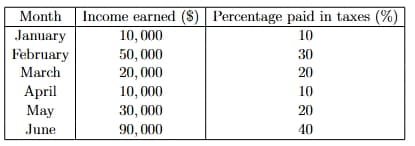
  • (A) The average of the income tax Jane paid
  • (B) 22% of Jane’s average income
  • (C) Quantity B is greater
  • (D) The two quantities are equal

Question 5:

If \( q \) is the smallest composite number greater than 2 and \( p \) is the smallest prime number less than 10, what is \( p \times q \)?

  • (A) 4
  • (B) 2
  • (C) 1
  • (D) 0.5

Question 6:

For which value of \( n \) is \( (1/2^n) > 1 \) true?

  • (A) \( n = 1/2 \)
  • (B) \( n = -1/2 \)
  • (C) \( n = \sqrt{2} \)
  • (D) \( n = 1 \)

Question 7:

Lines \( l \) and \( m \) are parallel. \( O \) is the center of the circle. The measure of angle \( d \) is \( 45^\circ \). The length of line \( RS \) is \( \frac{\sqrt{2}}{2} \). Line \( RS \) forms a right angle with line \( m \).
What is the measure of angle \( a \)?

  • (A) 45°
  • (B) 90°
  • (C) 60°
  • (D) 30°

Question 8:

Lines \( l \) and \( m \) are parallel. \( O \) is the center of the circle. The measure of angle \( d \) is \( 45^\circ \). The length of line \( RS \) is \( \frac{\sqrt{2}}{2} \). Line \( RS \) forms a right angle with line \( m \).
What is the length of line PR?

  • (A) \( \sqrt{2}/2 \)
  • (B) \( 2\sqrt{2} \)
  • (C) \( \sqrt{2} \)
  • (D) 1

Question 9:

Lines \( l \) and \( m \) are parallel. \( O \) is the center of the circle. The measure of angle \( d \) is \( 45^\circ \). The length of line \( RS \) is \( \frac{\sqrt{2}}{2} \). Line \( RS \) forms a right angle with line \( m \).
What is the diameter of circle O?

  • (A) 1
  • (B) \( \sqrt{2} \)
  • (C) \( 1\sqrt{2} \)
  • (D) \( \sqrt{2}/2 \)

Question 10:

Circle A represents students who major in liberal arts at a certain university. Circle B
represents students who major in the life sciences at that university, and circle C represents
engineering majors at the same university.What does \( A \cup B \) represent?

  • (A) Only life science students
  • (B) Only liberal arts students
  • (C) All liberal arts and life science students
  • (D) Only the subset of liberal arts and life science double-majors

Question 11:

Circle A represents students who major in liberal arts at a certain university. Circle B
represents students who major in the life sciences at that university, and circle C represents
engineering majors at the same university.What does \( A \cap B \) represent?

  • (A) Only life science students
  • (B) All liberal arts and life science students
  • (C) Only liberal arts students
  • (D) The subset of liberal arts and life science double-majors

Question 12:

Compare Quantity A and Quantity B, using additional information centered above the two quantities if such information is given, and select one of the four answer choices:
\[ A \times B = (AB)^2 + (A + B)^2 \]

  • (A) Quantity A is greater
  • (B) Quantity B is greater
  • (C) The two quantities are equal
  • (D) The relationship cannot be determined from the information given

Question 13:

The electrical engineering department at a certain graduate school in the United States (US) has a total of 36 students. The department has twice as many male students as female students and three times as many international students as students who are US citizens.

Quantity A: The number of students who are US citizens
Quantity B: The number of female students

  • (A) The relationship cannot be determined from the information given
  • (B) Quantity A is greater
  • (C) The two quantities are equal
  • (D) Quantity B is greater

Question 14:

Compare Quantity A and Quantity B, using additional information centered above the two quantities if such information is given, and select one of the four answer choices:
R is the center of the circle below:


Quantity A: Half the circumference
Quantity B: The area of triangle QRS

  • (A) Quantity A is greater
  • (B) Quantity B is greater
  • (C) The two quantities are equal
  • (D) The relationship cannot be determined from the information given

Question 15:

Compare Quantity A and Quantity B, using additional information centered above the two quantities if such information is given, and select one of the four answer choices:

The graph below shows the gross domestic product (GDP) in trillions of US dollars for four countries between 2000 and 2008.

Quantity A: The combined GDP of Japan, China, and Canada in 2008

Quantity B: The GDP of the US in 2008

  • (A) Quantity A is greater
  • (B) The two quantities are equal
  • (C) The relationship cannot be determined from the information given
  • (D) Quantity B is greater

GRE Questions

  • 1.
    Called by some the “island that time forgot,” Madagascar is home to a vast array of unique, exotic creatures. One such animal is the aye-aye. First described by western science in 1782, it was initially categorized as a member of the order Rodentia. Further research then revealed that it was more closely related to the lemur, a member of the primate order. Since the aye-aye is so different from its fellow primates, however, it was given its own family: Daubentoniidae. The aye-aye has been listed as an endangered species and, as a result, the government of Madagascar has designated an island off the northeastern coast of Madagascar as a protected reserve for aye-ayes and other wildlife.
    Long before Western science became enthralled with this nocturnal denizen of Madagascar’s jungles, the aye-aye had its own reputation with the local people. The aye aye is perhaps best known for its large, round eyes and long, extremely thin middle finger. These adaptations are quite sensible, allowing the aye-aye to see well at night and retrieve grubs, which are one of its primary food sources, from deep within hollow branches. However, the aye-aye’s striking appearance may end up causing its extinction. The people of Madagascar believe that the aye-aye is a type of spirit animal, and that its appearance is an omen of death. Whenever one is sighted, it is immediately killed. When combined with the loss of large swaths of jungle habitat, this practice may result in the loss of a superb .


      • 2.
        It has been suggested that long-term prisoners, on release from jail, be given a reasonable state pension to reduce the likelihood of their resorting to crime. Most people instinctively reject the suggestion as they feel it would be like rewarding criminal activity. The supporters of the prisoners' pension scheme have criticized those who reject this possibility, by claiming that for the critics...
        Which of the following is the most logical completion of the sentence above?

          • emotion is more important than justice
          • punishment for criminals is more important than crime prevention
          • crime prevention is not an important issue
          • money has too high a value
          • the law should not be concerned with what happens after jail

        • 3.
          Jean Valjean, the protagonist in Victor Hugo’s novel Les Misérables, spends the bulk of his lengthy _______ plotting a very clever set of revenge schemes, which he executes upon his escape.

            • ruination
            • peregrination
            • immolation
            • rumination

          • 4.
            The best way to solve environmental problems caused by consumer-generated waste is for towns and cities to impose strict limits on the amount of trash they will accept from each household.
            Write a response in which you discuss the extent to which you agree or disagree with the claim. In developing and supporting your position, be sure to address the most compelling reasons and/or examples that could be used to challenge your position.


              • 5.
                “Reviving the practice of using elements of popular music in classical composition, an approach that had been in hibernation in the United States during the 1960s, composer Philip Glass (born 1937) embraced the ethos of popular music in his compositions. Glass based two symphonies on music by rock musicians David Bowie and Brian Eno, but the symphonies' sound is distinctively his. Popular elements do not appear out of place in Glass's classical music, which from its early days has shared certain harmonies and rhythms with rock music. Yet this use of popular elements has not made Glass a composer of popular music. His music is not a version of popular music packaged to attract classical listeners; it is high art for listeners steeped in rock rather than the classics.


                  • 6.
                    “Claim: A person in authority should always encourage those under him or her to share their thoughts and ideas. Reason: A leader’s main goal should be to promote innovation and change.”

                      • Agree, as open dialogue fosters creativity and innovation.
                      • Disagree, as not all ideas are practical or beneficial to share.
                      • Agree, but only when it is necessary for progress.
                      • Disagree, as promoting change without evaluating all ideas can be harmful.

                    Comments


                    No Comments To Show