




MHT CET 2025 May 5 Shift 2 PCM Question Paper is available for download here. Maharashtra State CET Cell conducted MHT CET 2025 PCM Exam on May 5 in Shift 2 from 2 PM to 5 PM in CBT mode. This was a re-exam sitting of the MHT CET 2025 PCM group.
The MHT CET 2025 PCM question paper includes the following:
- The MHT CET 2025 PCM Question Paper consists of 150 multiple-choice questions (MCQs) totalling 200 marks divided into 3 sections: Physics, Chemistry, and Mathematics, with 50 questions in each subject.
- Physics and Chemistry questions carry 1 mark each while Mathematics questions carry 2 marks each.
- There is no negative marking for incorrect answers.
MHT CET 2025 May 5 Shift 2 PCM Question Paper with Solution PDF
| CD PDF | CD PDF with Solutions |
|---|---|
| Download Collegedunia PDF 0.93 MB | - |
Also Check:
MHT CET 2025 May 5 Shift 2 PCM Questions with Solutions
Physics (Q1 - Q50)
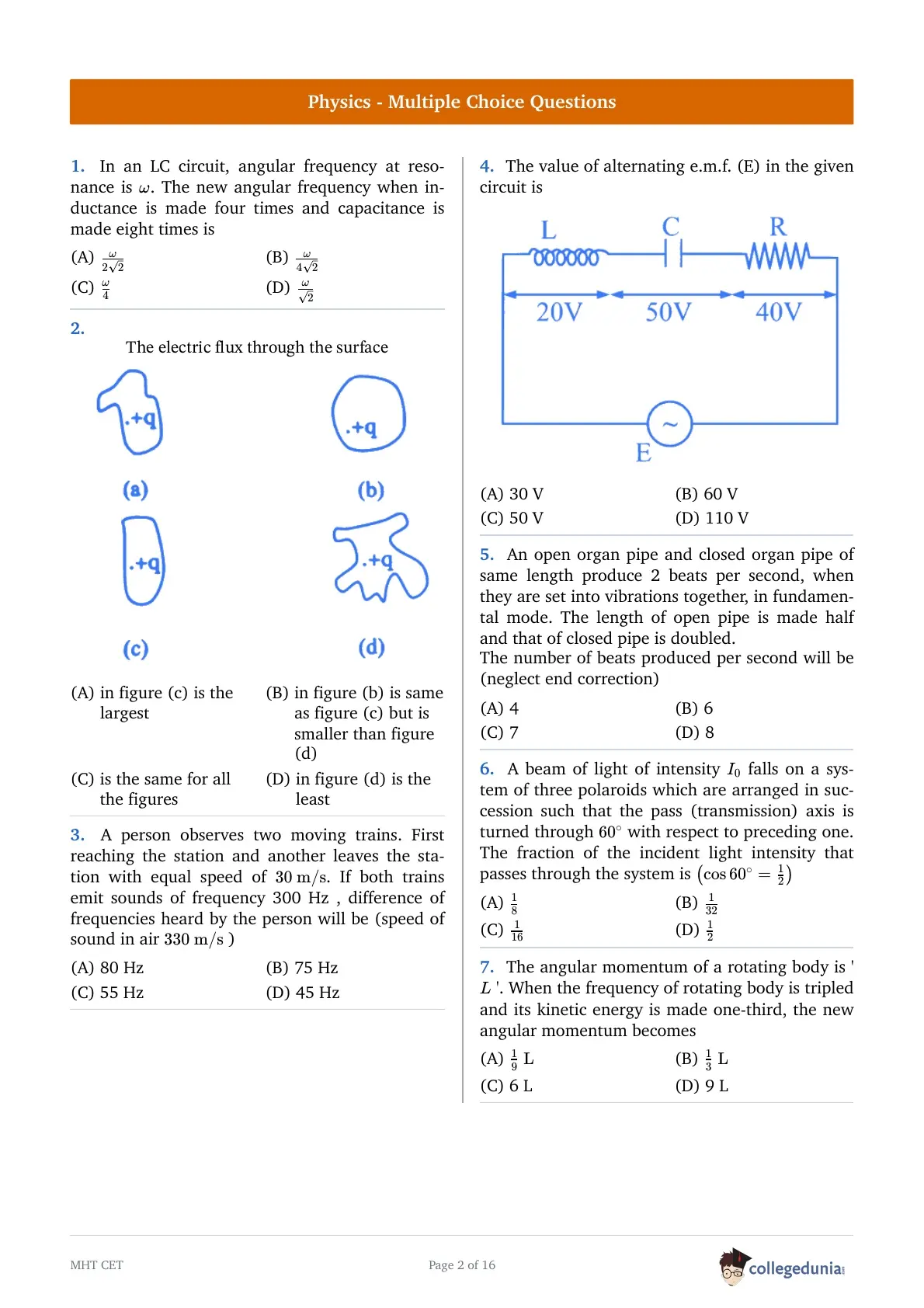
In an \(LC\) circuit, angular frequency at resonance is \(\omega\). The new angular frequency when inductance is made four times and capacitance is made eight times is

A person observes two moving trains. First reaching the station and another leaves the station with equal speed of \(30 \text{ m/s}\). If both trains emit sounds of frequency \(300 \text{ Hz}\), difference of frequencies heard by the person will be (speed of sound in air \(330 \text{ m/s}\))

An open organ pipe and closed organ pipe of same length produce \(2\) beats per second in fundamental mode. The length of open pipe is made half and that of closed pipe is doubled. The number of beats produced per second will be:
A beam of light of intensity \(I_0\) falls on a system of three polaroids such that each pass axis is turned through \(60^{\circ}\) with respect to preceding one. The fraction of intensity that passes through is:
The angular momentum of a rotating body is '\(L\)'. When frequency is tripled and kinetic energy is made one-third, the new angular momentum becomes
An electric dipole of length \(2 \text{ cm}\) is placed at \(60^{\circ}\) to a uniform electric field of \(10^{5} \text{ N/C}\). If it experiences a torque of \(9\sqrt{3} \text{ Nm}\), the magnitude of the charge is:
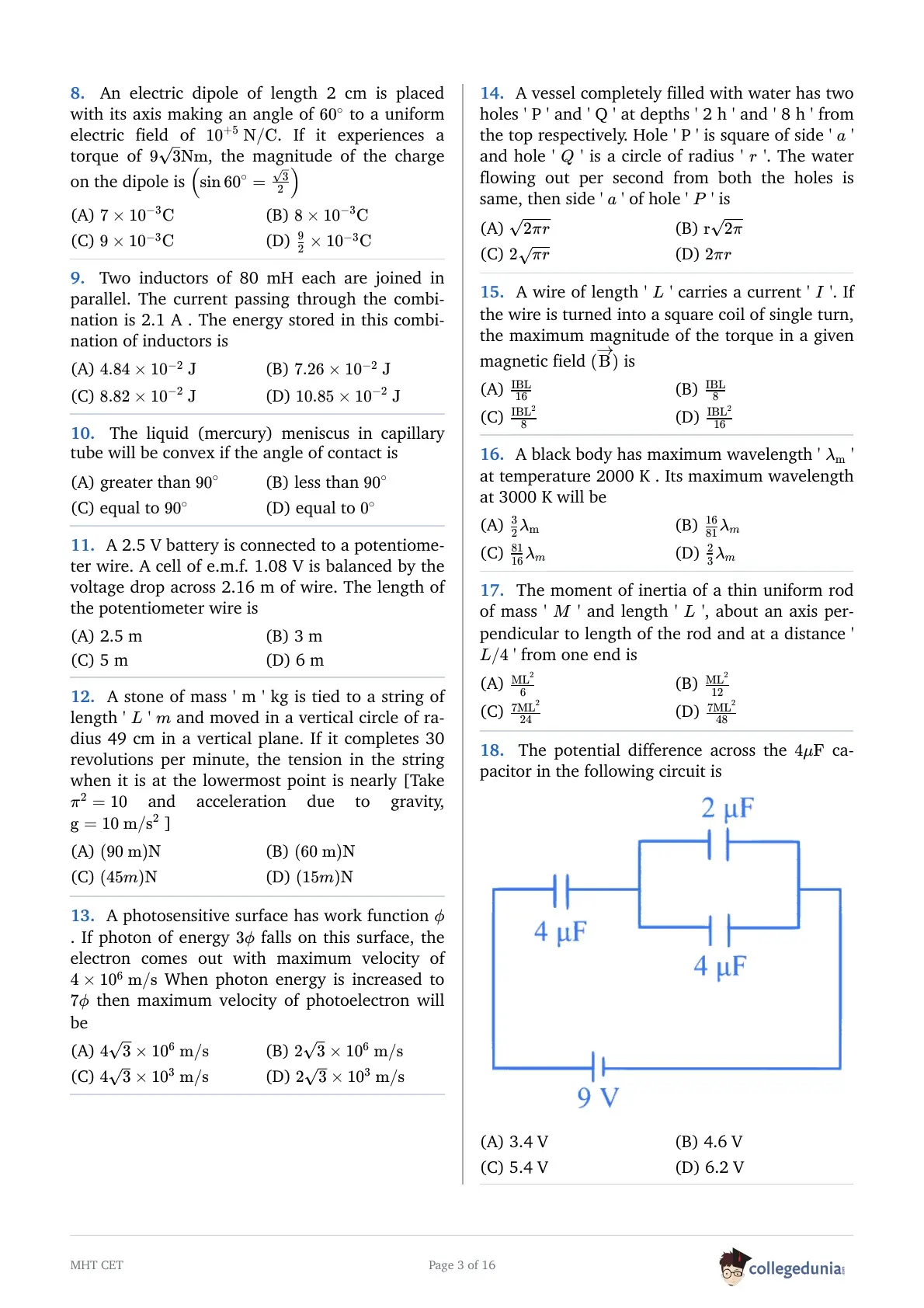
Two inductors of \(80 \text{ mH}\) each are joined in parallel. If the current is \(2.1 \text{ A}\), the energy stored in the combination is
The liquid (mercury) meniscus in capillary tube will be convex if the angle of contact is
A (2.5 V) battery is connected to a potentiometer wire. A cell of e.m.f. (1.08 V) is balanced by the voltage drop across (2.16 m) of wire. The length of the potentiometer wire is
A stone of mass ' m ' kg is tied to a string of length ' \(L\) ' \(m\) and moved in a vertical circle of radius 49 cm in a vertical plane. If it completes 30 revolutions per minute, the tension in the string when it is at the lowermost point is nearly [Take \(\pi^2=10\) and acceleration due to gravity, \(\mathrm{g}=10 \mathrm{~m} / \mathrm{s}^2\) ]
A photosensitive surface has work function \(\phi\). If photon of energy \(3 \phi\) falls on this surface, the electron comes out with maximum velocity of \(4 \times 10^6 \mathrm{~m} / \mathrm{s}\) When photon energy is increased to \(7 \phi\) then maximum velocity of photoelectron will be
A vessel completely filled with water has two holes ' P ' and ' Q ' at depths ' 2 h ' and ' 8 h ' from the top respectively. Hole ' P ' is square of side ' \(a\) ' and hole ' \(Q\) ' is a circle of radius ' \(r\) '. The water flowing out per second from both the holes is same, then side ' \(a\) ' of hole ' \(P\) ' is
A wire of length ' \(L\) ' carries a current ' \(I\) '. If the wire is turned into a square coil of single turn, the maximum magnitude of the torque in a given magnetic field \((\overrightarrow{\mathrm{B}})\) is
A black body has maximum wavelength ' \(\lambda_{\mathrm{m}}\) ' at temperature 2000 K . Its maximum wavelength at 3000 K will be
The moment of inertia of a thin uniform rod of mass ' \(M\) ' and length ' \(L\) ', about an axis perpendicular to length of the rod and at a distance ' \(L / 4\) ' from one end is
The potential difference across the \(4\,\mu\text{F}\) capacitor in the following circuit is

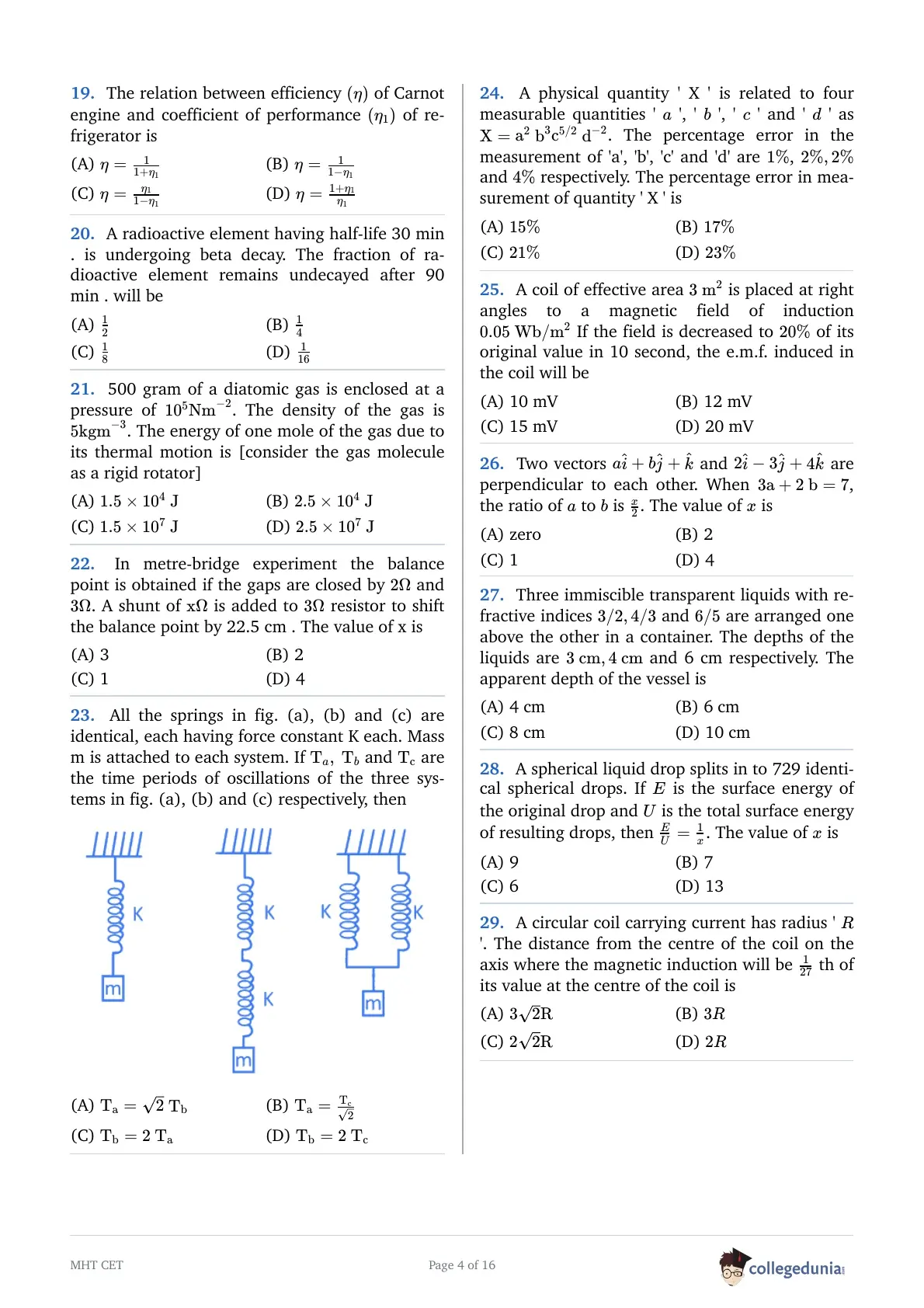
The relation between efficiency \((\eta)\) of Carnot engine and coefficient of performance \(\left(\eta_1\right)\) of refrigerator is
A radioactive element having half-life 30 min . is undergoing beta decay. The fraction of radioactive element remains undecayed after 90 min . will be
\(500 \text{ gram}\) of a diatomic gas is enclosed at a pressure of \(10^{5} \text{ Nm}^{-2}\). The density of the gas is \(5 \text{ kg m}^{-3}\). The energy of one mole of the gas due to its thermal motion is [consider the gas molecule as a rigid rotator].
In metre-bridge experiment the balance point is obtained if the gaps are closed by \(2 \Omega\) and \(3 \Omega\). A shunt of \(x \Omega\) is added to \(3 \Omega\) resistor to shift the balance point by \(22.5 \text{ cm}\). The value of \(x\) is.
A physical quantity ' \(X\) ' is related to four quantities as \(X = a^2 b^3 c^{5/2} d^{-2}\). The percentage error in 'a', 'b', 'c' and 'd' are \(1%\), \(2%\), \(2%\) and \(4%\) respectively. The percentage error in ' \(X\) ' is.
A coil of area \(3 \text{ m}^{2}\) is at right angles to a magnetic field of \(0.05 \text{ Wb/m}^{2}\). If the field is decreased to \(20%\) of its value in \(10 \text{ s}\) , the induced e.m.f. is.
Two vectors \(a\hat{i} + b\hat{j} + \hat{k}\) and \(2\hat{i} - 3\hat{j} + 4\hat{k}\) are perpendicular. When \(3a + 2b = 7\) , the ratio \(a/b\) is \(x/2\). The value of \(x\) is.
Three immiscible transparent liquids with indices \(3/2\), \(4/3\) and \(6/5\) are arranged one above the other. The depths are \(3 \text{ cm}\), \(4 \text{ cm}\) and \(6 \text{ cm}\) respectively. The apparent depth of the vessel is.
A liquid drop splits into \(729\) identical spherical drops. If \(E\) is the original energy and \(U\) is the total resulting energy , then \(E/U = 1/x\). The value of \(x\) is.
A circular coil has radius ' \(R\) '. The distance from centre on axis where induction is \(1/27\) th of its value at centre is.
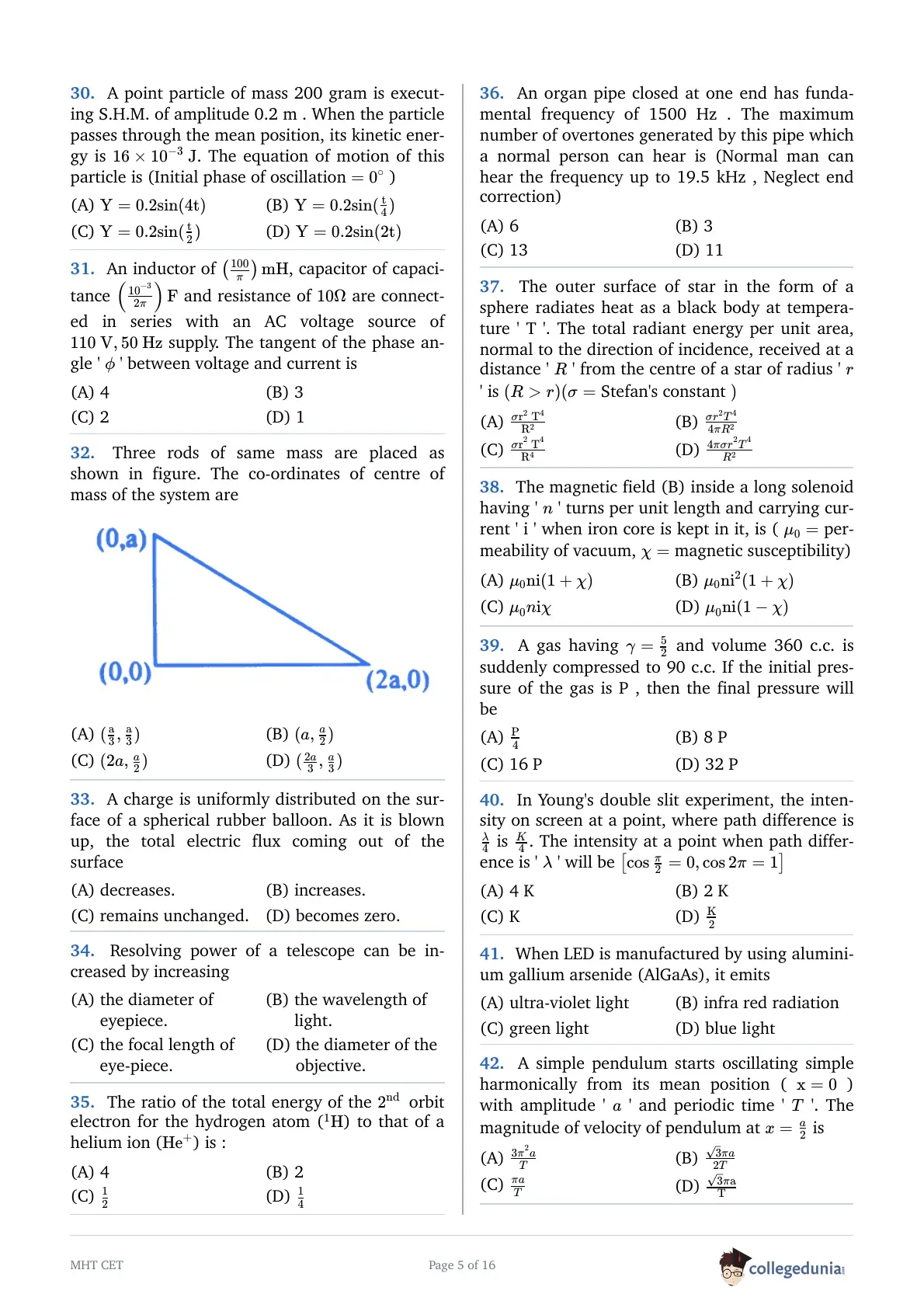
A point particle of mass 200 gram is executing S.H.M. of amplitude 0.2 m . When the particle passes through the mean position, its kinetic energy is \(16 \times 10^{-3} \mathrm{~J}\). The equation of motion of this particle is (Initial phase of oscillation \(=0^{\circ}\) )
An inductor of \( \frac{100}{\pi} \,\text{mH} \), a capacitor of capacitance \( \frac{10^{-3}}{2\pi} \,\text{F} \), and a resistance of \( 10\,\Omega \) are connected in series with an AC voltage source of \( 110\,\text{V} \), \( 50\,\text{Hz} \) supply. The tangent of the phase angle \( \phi \) between voltage and current is ______.
Three rods of same mass are placed as shown in figure. The co-ordinates of centre of mass of the system are

A charge is uniformly distributed on the surface of a spherical rubber balloon. As it is blown up, the total electric flux coming out of the surface
Resolving power of a telescope can be increased by increasing
The ratio of the total energy of the \(2^{\text {nd }}\) orbit electron for the hydrogen atom (\(^1\mathrm{H}\)) to that of a helium ion (\(\mathrm{He}^+\)) is :
An organ pipe closed at one end has fundamental frequency of 1500 Hz . The maximum number of overtones generated by this pipe which a normal person can hear is (Normal man can hear the frequency up to 19.5 kHz , Neglect end correction)
The outer surface of star in the form of a sphere radiates heat as a black body at temperature ' T '. The total radiant energy per unit area, normal to the direction of incidence, received at a distance ' \(R\) ' from the centre of a star of radius ' \(r\) ' is \((R>r)(\sigma=\) Stefan's constant \()\)
The magnetic field \(B\) inside a long solenoid carrying current \(i\) with an iron core is (\(\mu_0\) = vacuum permeability, \(\chi\) = susceptibility)
A gas having \(\gamma=\frac{5}{2}\) and volume 360 c.c. is suddenly compressed to 90 c.c. If the initial pressure of the gas is P , then the final pressure will be
In Young's double slit experiment, the intensity on screen at a point, where path difference is \(\frac{\lambda}{4}\) is \(\frac{K}{4}\). The intensity at a point when path difference is ' \(\lambda\) ' will be \(\left[\cos \frac{\pi}{2}=0, \cos 2 \pi=1\right]\)
When LED is manufactured by using aluminium gallium arsenide (AlGaAs), it emits
A simple pendulum starts oscillating simple harmonically from its mean position (\(x = 0\)) with amplitude ' \(a\) ' and periodic time ' \(T\) '. The magnitude of velocity of pendulum at \(x = \frac{a}{2}\) is
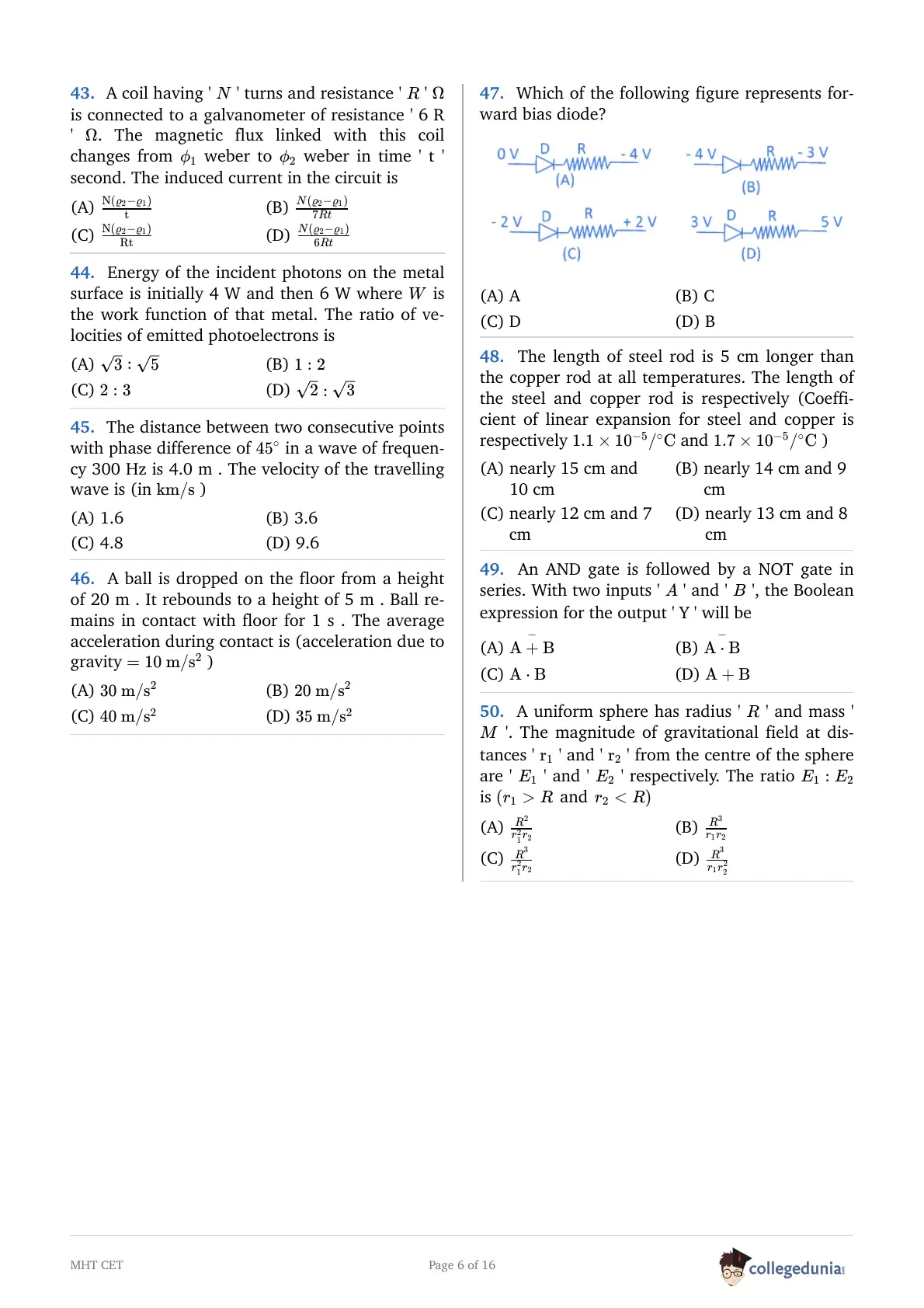
A coil having ' \(N\) ' turns and resistance ' \(R \Omega\) ' is connected to a galvanometer of resistance ' \(6 \text{ R } \Omega\) '. The magnetic flux linked with this coil changes from \(\phi_1\) weber to \(\phi_2\) weber in time ' \(t\) ' second. The induced current in the circuit is
Energy of the incident photons on the metal surface is initially \(4 \text{ W}\) and then \(6 \text{ W}\) where \(W\) is the work function of that metal. The ratio of velocities of emitted photoelectrons is
The distance between two consecutive points with phase difference of \(45^{\circ}\) in a wave of frequency \(300 \text{ Hz}\) is \(4.0 \text{ m}\). The velocity of the travelling wave is (in \( \text{km/s} \))
A ball is dropped on the floor from a height of \(20 \text{ m}\). It rebounds to a height of \(5 \text{ m}\). Ball remains in contact with floor for \(1 \text{ s}\). The average acceleration during contact is (\(g = 10 \text{ m/s}^2\))
The length of steel rod is \(5 \text{ cm}\) longer than the copper rod at all temperatures. The length of the steel and copper rod is respectively (\(\alpha_s = 1.1 \times 10^{-5}/^{\circ} \text{C}, \alpha_c = 1.7 \times 10^{-5}/^{\circ} \text{C}\))
An AND gate is followed by a NOT gate in series. With two inputs ' \(A\) ' and ' \(B\) ', the Boolean expression for the output ' \(Y\) ' will be
A uniform sphere has radius ' \(R\) ' and mass ' \(M\) '. The magnitude of gravitational field at distances ' \(r_1\) ' and ' \(r_2\) ' from the centre are ' \(E_1\) ' and ' \(E_2\) ' respectively. The ratio \(E_1 : E_2\) is (\(r_1 > R\) and \(r_2 < R\))
Chemistry (Q51 - Q100)
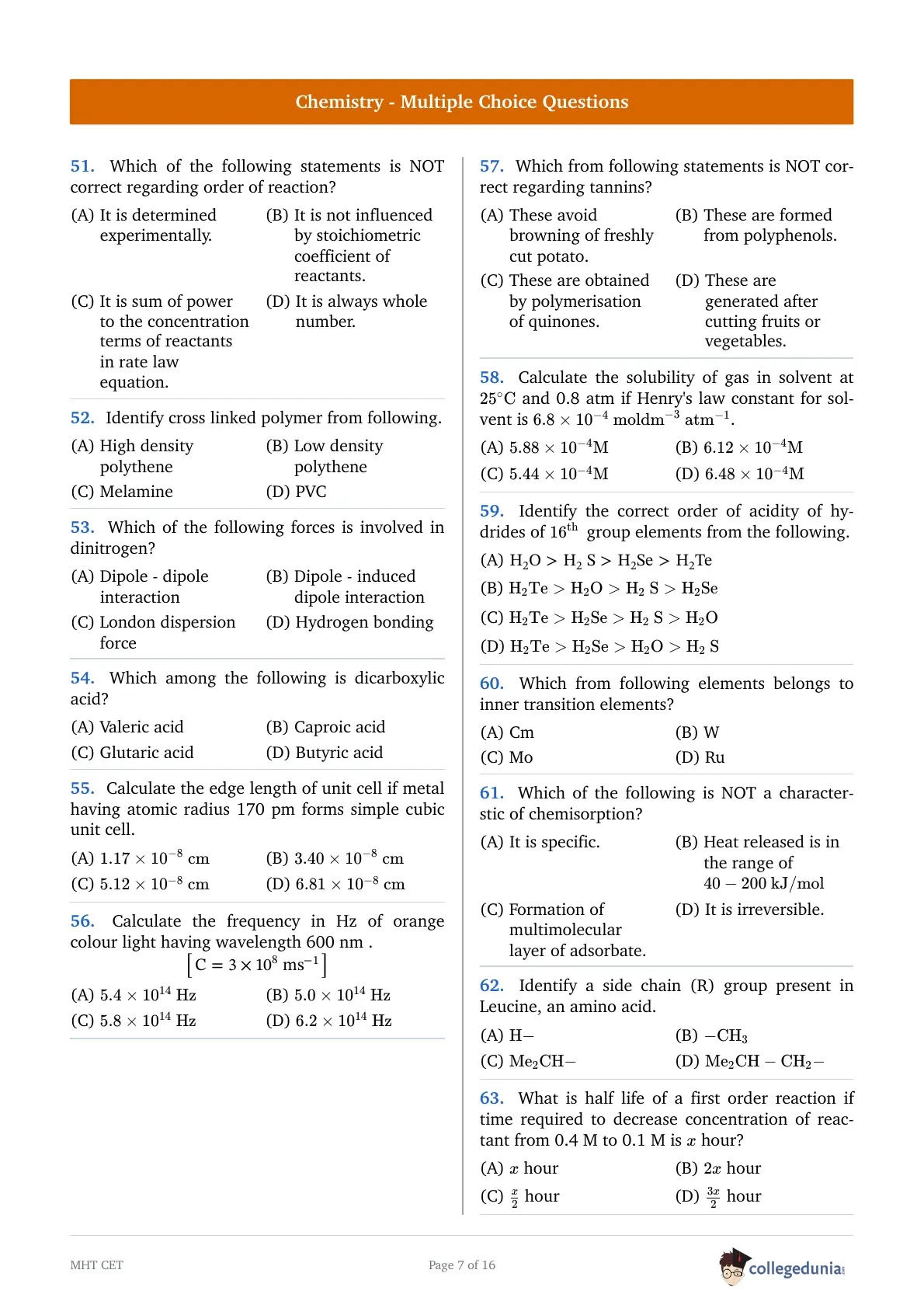
Which of the following statements is NOT correct regarding order of reaction?
Identify cross linked polymer from following.
Which of the following forces is involved in dinitrogen?
Which among the following is dicarboxylic acid?
Calculate the edge length of unit cell if metal having atomic radius 170 pm forms simple cubic unit cell.
Calculate the frequency in Hz of orange colour light having wavelength 600 nm. [C = \(3 \times 10^8\) ms\(^{-1}\)]
Which from following statements is NOT correct regarding tannins?
Calculate the solubility of gas in solvent at 25\(^{\circ}\)C and 0.8 atm if Henry's law constant for solvent is \(6.8 \times 10^{-4}\) moldm\(^{-3}\) atm\(^{-1}\).
Identify the correct order of acidity of hydrides of \(16^{\text {th }}\) group elements from the following.
Which from following elements belongs to inner transition elements?
Which of the following is NOT a characteristic of chemisorption?
Identify a side chain (R) group present in Leucine, an amino acid.
What is half life of a first order reaction if time required to decrease concentration of reactant from 0.4 M to 0.1 M is \(x\) hour?
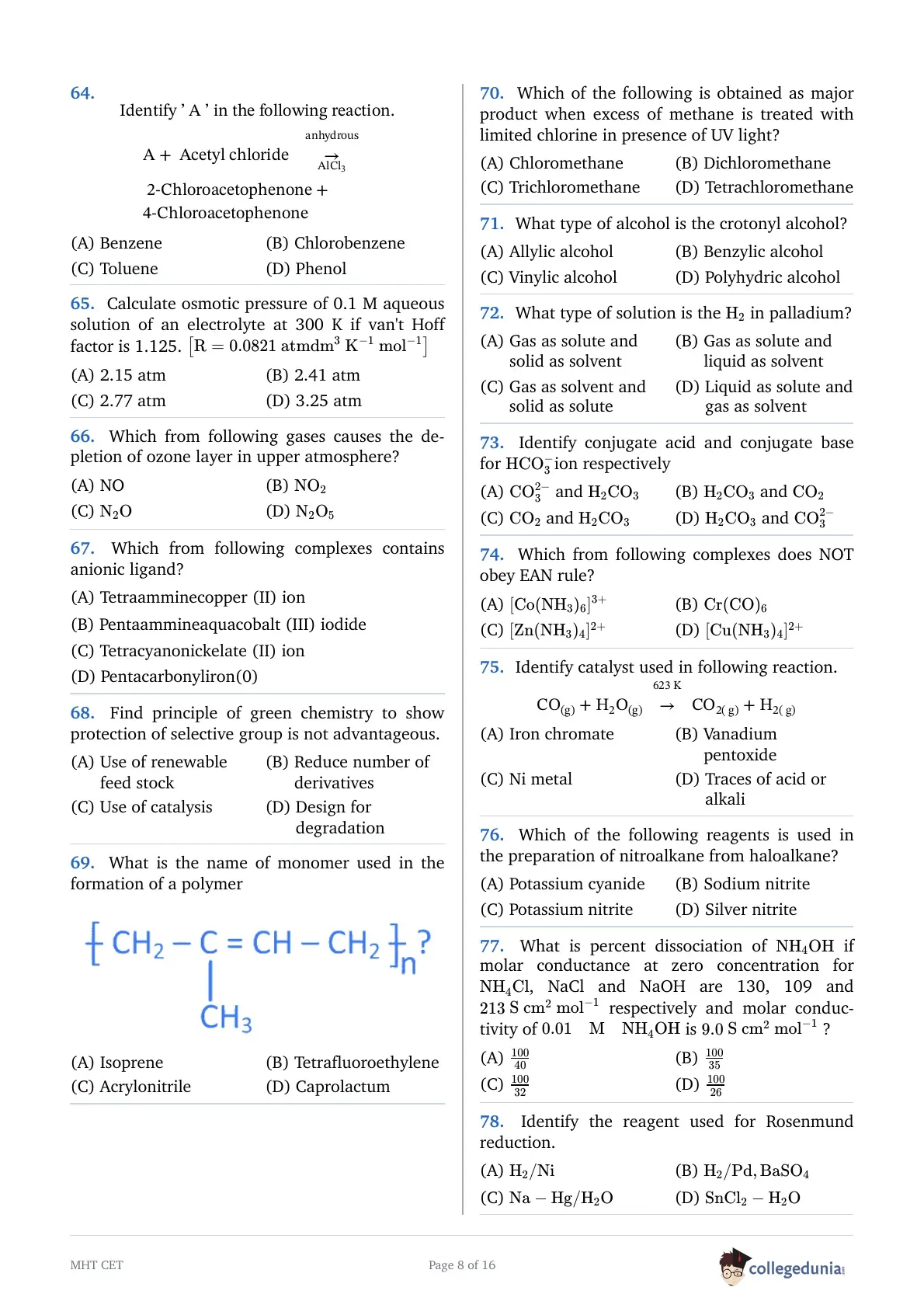
Identify 'A' in the following reaction.
A + Acetyl chloride \(\xrightarrow[AlCl_3]{anhydrous}\) 2-Chloroacetophenone + 4-Chloroacetophenone}
Calculate osmotic pressure of 0.1 M aqueous solution of an electrolyte at 300 K if van't Hoff factor is 1.125. [R = 0.0821 atmdm\(^3\) K\(^{-1}\) mol\(^{-1}\)]
Which from following gases causes the depletion of ozone layer in upper atmosphere?
Which from following complexes contains anionic ligand?
Find principle of green chemistry to show protection of selective group is not advantageous.

Which of the following is obtained as major product when excess of methane is treated with limited chlorine in presence of UV light?
What type of alcohol is the crotonyl alcohol?
What type of solution is the \(H_2\) in palladium?
Identify conjugate acid and conjugate base for \(HCO_3^-\) ion respectively
Which from following complexes does NOT obey EAN rule?
Identify catalyst used in following reaction.
\(CO_{(g)} + H_2O_{(g)} \xrightarrow{623\text{ K}} CO_{2(g)} + H_{2(g)}\)
Which of the following reagents is used in the preparation of nitroalkane from haloalkane?
What is percent dissociation of \(NH_4OH\) if molar conductance at zero concentration for \(NH_4Cl, NaCl\) and \(NaOH\) are 130, 109 and 213 S cm\(^2\) mol\(^{-1}\) respectively and molar conductivity of 0.01 M \(NH_4OH\) is 9.0 S cm\(^2\) mol\(^{-1}\) ?
Identify the reagent used for Rosenmund reduction.
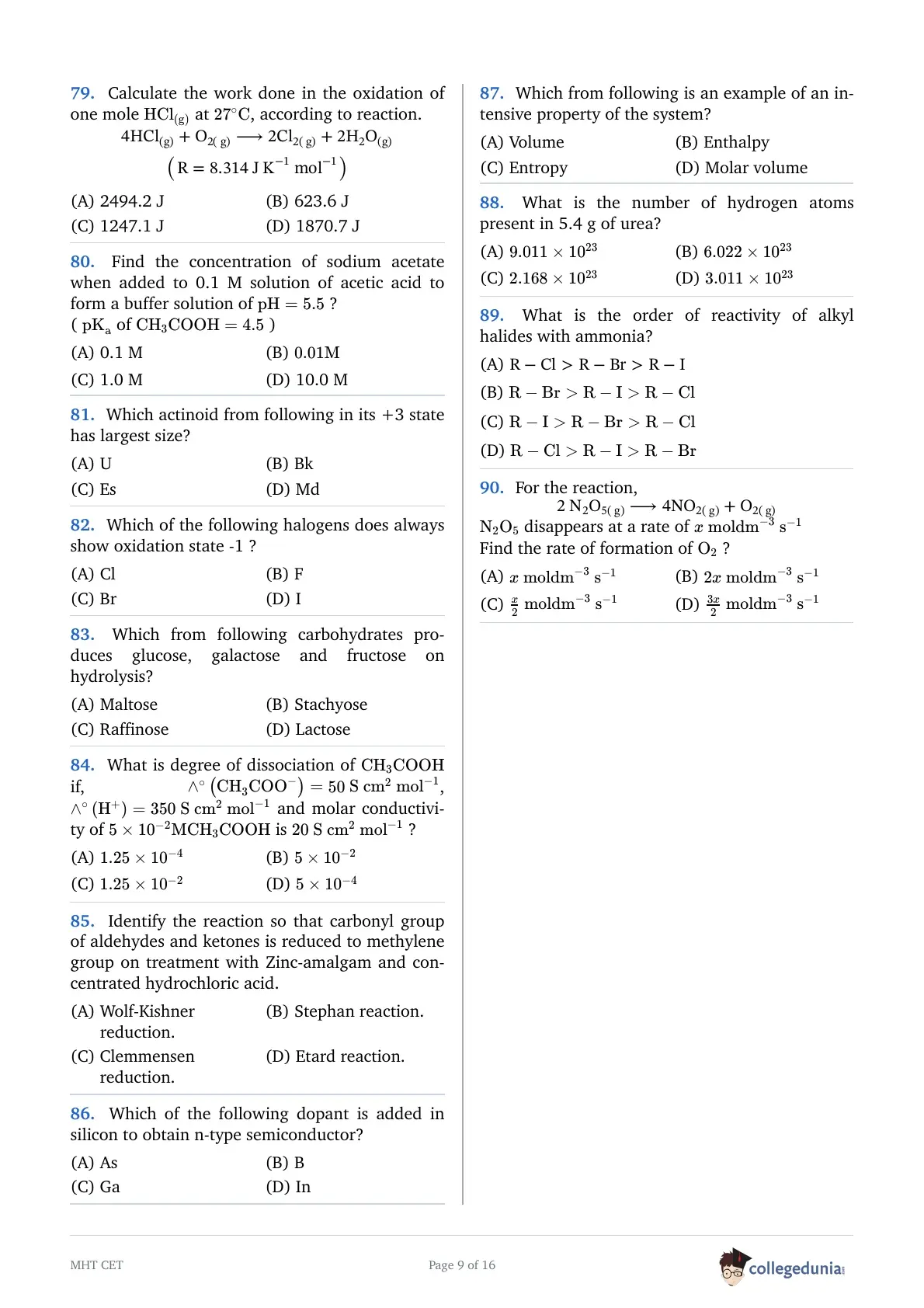
Calculate the work done in the oxidation of one mole \(HCl_{(g)}\) at 27\(^\circ\)C, according to reaction.
\(4HCl_{(g)} + O_{2(g)} \rightarrow 2Cl_{2(g)} + 2H_2O_{(g)}\)
(R = 8.314 J K\(^{-1}\) mol\(^{-1}\))
Find the concentration of sodium acetate when added to 0.1 M solution of acetic acid to form a buffer solution of pH = 5.5 ? (pK\(_a\) of CH\(_3\)COOH = 4.5)
Which actinoid from following in its +3 state has largest size?
Which of the following halogens does always show oxidation state -1 ?
Which from following carbohydrates produces glucose, galactose and fructose on hydrolysis?
What is degree of dissociation of \(CH_3COOH\) if, \(\Lambda^\circ (CH_3COO^-) = 50\text{ S cm}^2\text{ mol}^{-1}\), \(\Lambda^\circ (H^+) = 350\text{ S cm}^2\text{ mol}^{-1}\) and molar conductivity of \(5 \times 10^{-2}\text{ M }CH_3COOH\) is \(20\text{ S cm}^2\text{ mol}^{-1}\) ?
Identify the reaction so that carbonyl group of aldehydes and ketones is reduced to methylene group on treatment with Zinc-amalgam and concentrated hydrochloric acid.
Which of the following dopant is added in silicon to obtain n-type semiconductor?
Which from following is an example of an intensive property of the system?
What is the number of hydrogen atoms present in 5.4 g of urea?
What is the order of reactivity of alkyl halides with ammonia?
For the reaction, \(2N_2O_5(g) \rightarrow 4NO_2(g) + O_2(g)\) \(N_2O_5\) disappears at a rate of \(x\) moldm\(^{-3}\) s\(^{-1}\) Find the rate of formation of \(O_2\) ?
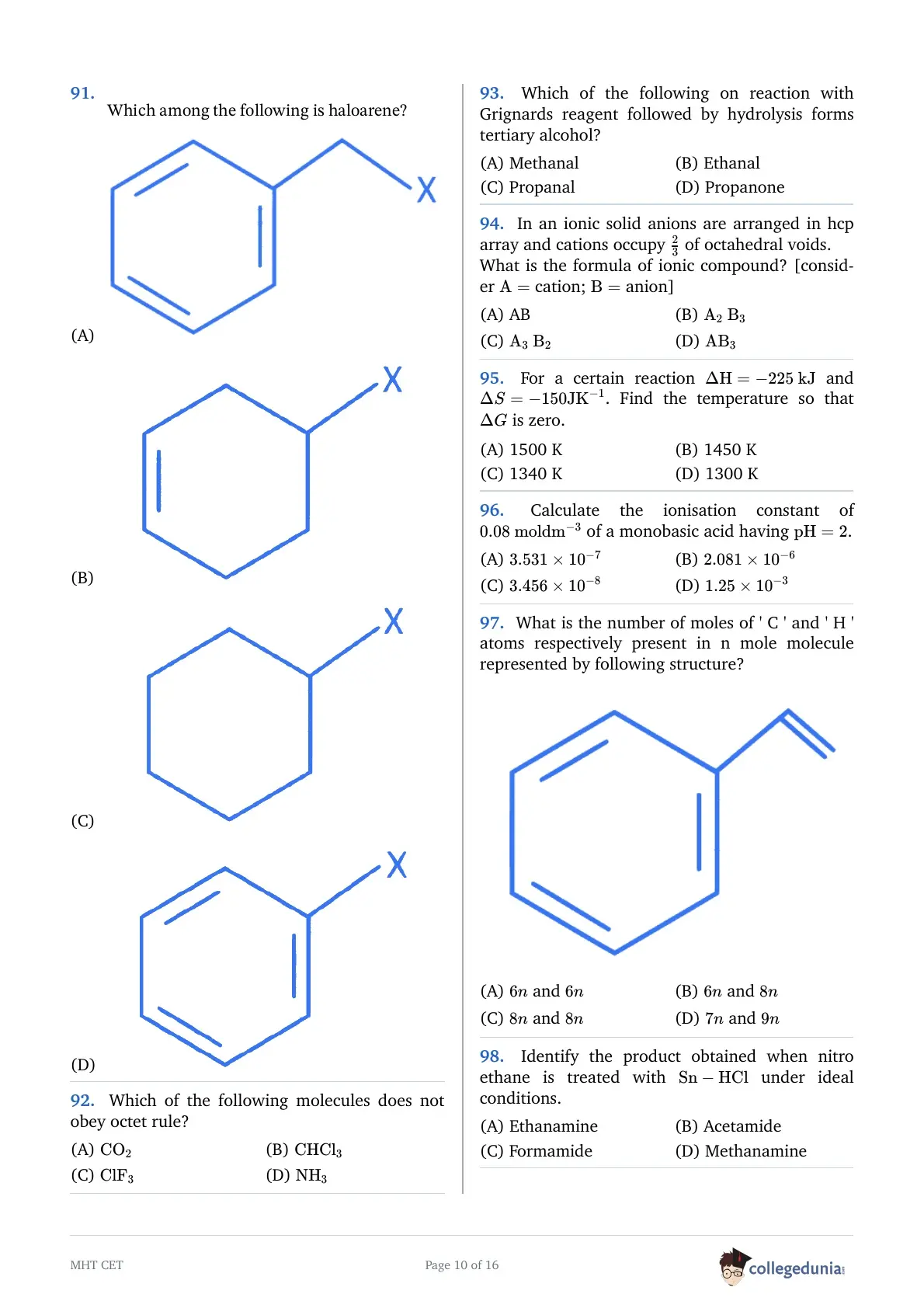
\[ \text { Which among the following is haloarene? } \]
- (A)
![]()
- (B)
![]()
- (C)
![]()
- (D)
![]()


Which of the following molecules does not obey octet rule?
Which of the following on reaction with Grignard's reagent followed by hydrolysis forms tertiary alcohol?
In an ionic solid anions are arranged in hcp array and cations occupy \(\frac{2}{3}\) of octahedral voids. What is the formula of ionic compound? [consider A = cation; B = anion]}
For a certain reaction \(\Delta H = -225\) kJ and \(\Delta S = -150\) J K\(^{-1}\). Find the temperature so that \(\Delta G\) is zero.
Calculate the ionisation constant of 0.08 moldm\(^{-3}\) of a monobasic acid having pH = 2.
Identify the product obtained when nitro ethane is treated with Sn - HCl under ideal conditions.
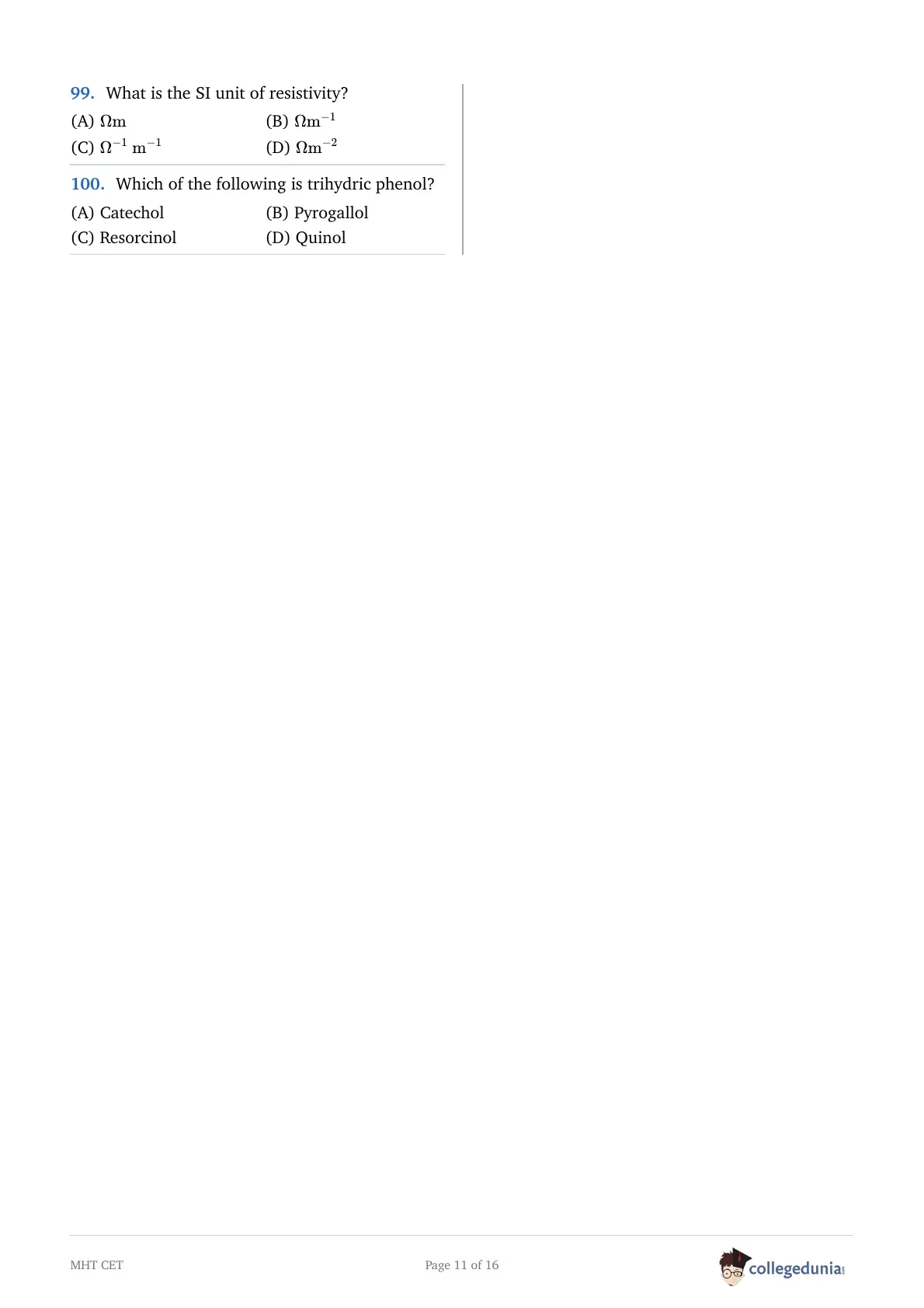
Which of the following is trihydric phenol?
Mathematics (Q101 - Q150)
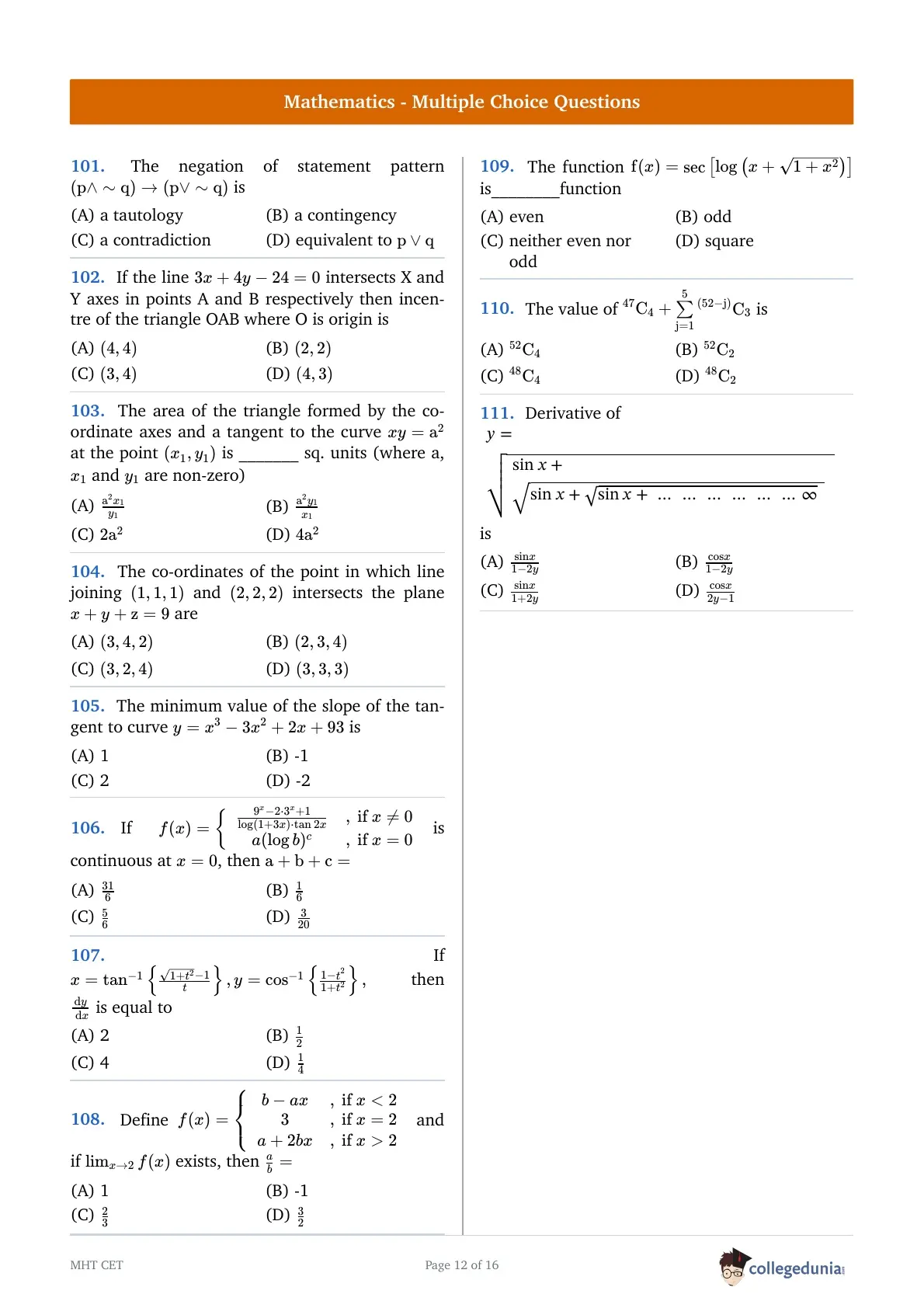
The negation of statement pattern \((p \wedge \sim q) \rightarrow (p \vee \sim q)\) is
If the line \(3x + 4y - 24 = 0\) intersects X and Y axes in points A and B respectively then incentre of the triangle OAB where O is origin is
The area of the triangle formed by the co-ordinate axes and a tangent to the curve \(xy = a^2\) at the point \((x_1, y_1)\) is ______ sq. units (where \(a, x_1\) and \(y_1\) are non-zero)
The co-ordinates of the point in which line joining \((1, 1, 1)\) and \((2, 2, 2)\) intersects the plane \(x + y + z = 9\) are
The minimum value of the slope of the tangent to curve \(y = x^3 - 3x^2 + 2x + 93\) is
If \(f(x) = \begin{cases} \frac{9^x - 2 \cdot 3^x + 1}{\log(1+3x) \cdot \tan 2x} & , \text{if } x \neq 0 \\ a(\log b)^c & , \text{if } x = 0 \end{cases}\) is continuous at \(x = 0\), then \(a+b+c =\)
If \(x = \tan^{-1} \left\{ \frac{\sqrt{1+t^2}-1}{t} \right\}, y = \cos^{-1} \left\{ \frac{1-t^2}{1+t^2} \right\}\), then \(\frac{dy}{dx}\) is equal to
Define \(f(x)=\left\{\begin{array}{cl}b-a x & , \text { if } x<2 \\ 3 & , \text { if } x=2 \\ a+2 b x & , \text { if } x>2\end{array}\right.\) and if \(\lim _{x \rightarrow 2} f(x)\) exists, then \(\frac{a}{b}=\)
The function \( f(x) = \sec \left[ \log \left( x + \sqrt{1 + x^2} \right) \right] \) is ________ function
The value of \[ {}^{47}C_{4} + \sum_{j=1}^{5} {}^{(52-j)}C_{3} \] is:
The derivative of
\[ y = \sqrt{\sin x + \sqrt{\sin x + \sqrt{\sin x + \cdots \infty}}} \]
is ______.
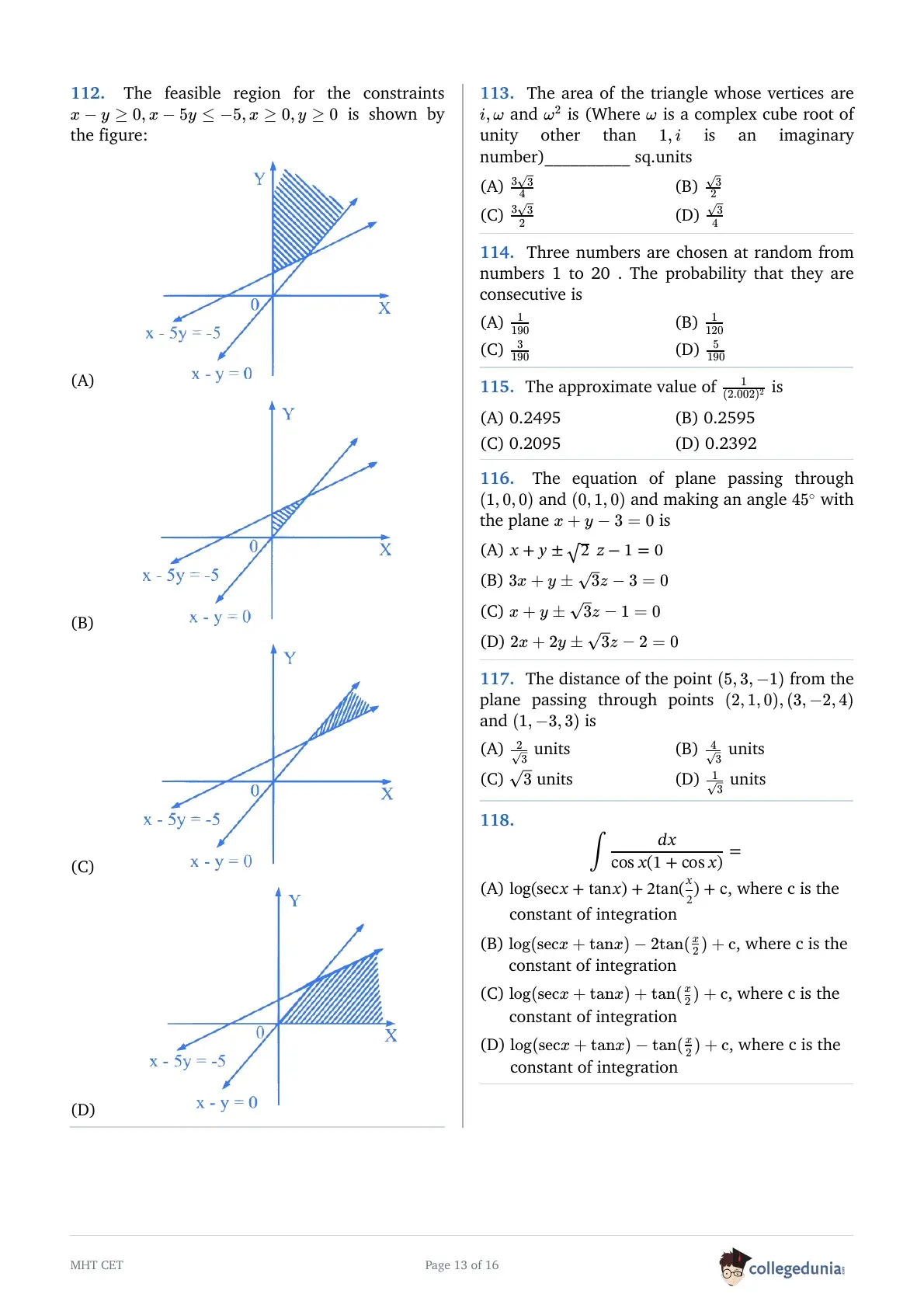
The feasible region for the constraints \(x-y \geq 0, x-5 y \leq-5, x \geq 0, y \geq 0\) is shown by the figure:
- (A)
![]()
- (B)
![]()
- (C)
![]()
- (D)
![]()


The area of the triangle whose vertices are \(( i, \omega, \omega^2 )\) is (Where \(\omega\) is a complex cube root of unity other than 1, \(i\) is an imaginary number)________ sq.units
Three numbers are chosen at random from numbers 1 to 20 . The probability that they are consecutive is
The equation of plane passing through \((1,0,0)\) and \((0,1,0)\) and making an angle \(45^{\circ}\) with the plane \(x+y-3=0\) is
The distance of the point \((5,3,-1)\) from the plane passing through points \((2,1,0),(3,-2,4)\) and \((1,-3,3)\) is
Two cards are drawn successively with replacement from fair playing 52 cards. let X denote number of kings obtained when two cards are drawn, then \(\mathrm{E}\left(\mathrm{X}^2\right)=\)
The eccentric angle of the point \(\mathrm{P}(-6,2)\) of the ellipse \(\frac{x^2}{48}+\frac{y^2}{16}=1\) is
If one of the diameters of the circle, given by the equation \(x^2+y^2-4 x+6 y-12=0\), is a chord of a circle, ' S ', whose centre is at \((-3,2)\), then the length of radius of ' S ' is _______ units.
The area of the region bounded by the parabola \(y^2=27 x\) and the line \(x=1\) is ________ sq.units.
If \(( \sin(\alpha + \beta) = 1, \sin(\alpha - \beta) = \frac{1}{2}, \alpha, \beta \in [0, \pi/2] ), then ( \tan(\alpha + 2\beta) \cdot \tan(2\alpha + \beta) = ) \)
The population \(p\) of the city at time \(t\) is given by \(\frac{\mathrm{dp}}{\mathrm{dt}}=\frac{\mathrm{p}}{2}-100\). If initial population is 100 then \(\mathrm{p}=\)
If \(A=\left[\begin{array}{lll}a & 0 & 0 \\ 0 & b & 0 \\ 0 & 0 & c\end{array}\right]\) where \(a=7^x, b=7^{7^x}, c=7^{7^{7^x}}\) then \(\int|A| d x\), (Where \(|A|\) is the determinant of the matrix \(A\) ) is equal to
\(\int \frac{\sin 7 x}{\cos 9 x \cos 2 x} \mathrm{~d} x\) is equal to
The solution of the equation \(\frac{\mathrm{d} y}{\mathrm{~d} x}=\frac{1}{x+y+1}\) is
A spherical balloon is filled with \(4500 \pi\) cubic meters of helium gas. If a leak in the balloon causes the gas to escape at the rate of \(72 \pi\) cubic meters per minute, then the rate (in meters per minute) at which the radius of the balloon decreases 49 minutes after the leakage has begun, is
If \(x \cdot \log_e(\log_e x) - x^2 + y^2 = 4(y > 0)\), then \(\frac{dy}{dx}\) at \(x = e\) is
The solution of \(\log \left(\frac{\mathrm{d} y}{\mathrm{~d} x}\right)=2 x-5 y, y(0)=0\) is
The integrating factor of \(x \cdot \frac{dy}{dx} + y \log x = x \cdot e^x x^{-1/2} \log x\) is
ABCD is a quadrilateral with \(\overline{AB} = \overline{a}, \overline{AD} = \overline{b}\) and \(\overline{AC} = 2\overline{a} + 3\overline{b}\). If its area is \(\alpha\) times the area of the parallelogram with AB, AD as adjacent sides, then the value of \(\alpha\) is
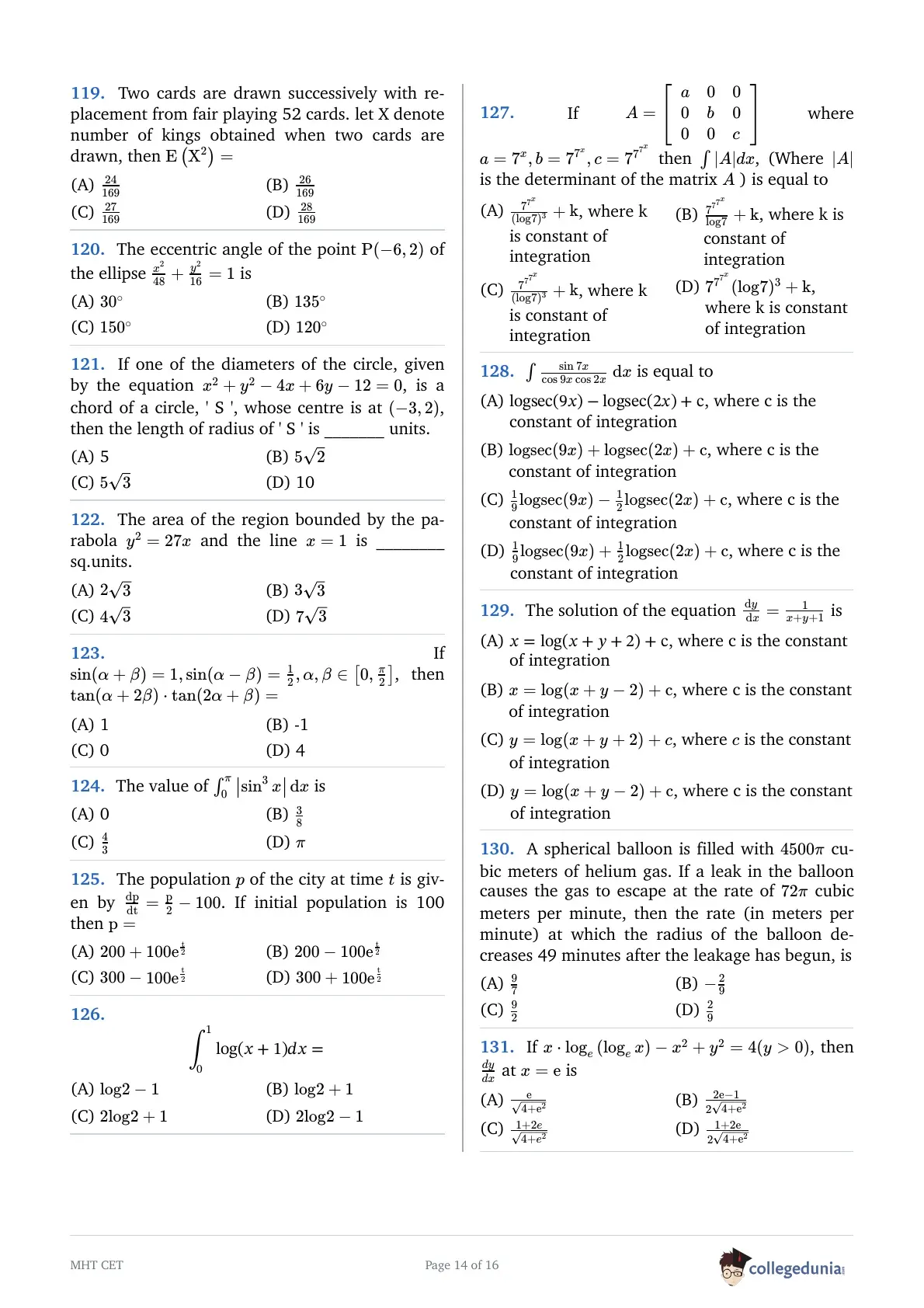
The equation of a line passing through the point \((-1, 2, 3)\) and perpendicular to the lines \(\frac{x}{2} = \frac{y-1}{-3} = \frac{z+2}{-2}\) and \(\frac{x+3}{-1} = \frac{y+3}{2} = \frac{z-1}{3}\) is
If \(A = \begin{bmatrix} 1 & -2 & 2 \\ 0 & 2 & -3 \\ 3 & -2 & 4 \end{bmatrix}\) then \(A(I + \text{adj } A) =\)
A line L is passing through points A(1, 3, 2) and B(2, 2, 1). If mirror image of point P(1, 1, -1) in the line L is (x, y, z) then \(x + y + z =\)
If \(\vec{c} = 5\vec{a} + 6\vec{b}\) and \(3\vec{c} = \vec{a} - 4\vec{b}\) then}
The equation \(x^2 - 3xy + 2y^2 + 3x - 5y + 2 = 0\) represents a pair of straight lines. If \(\theta\) is the angle between them, then the value of \(\cos \theta\) is equal to
\(\cot^{-1}(2 \cdot 1^2) + \cot^{-1}(2 \cdot 2^2) + \cot^{-1}(2 \cdot 3^2) + \dots \dots \infty =\)
With usual notation, in a triangle ABC \(\frac{b+c}{11} = \frac{c+a}{12} = \frac{a+b}{13}\), then the value of \(\cos B\) is equal to
If \(\vec{a} = \frac{1}{\sqrt{10}}(3\hat{i} + \hat{k}), \vec{b} = \frac{1}{7}(2\hat{i} + 3\hat{j} - 6\hat{k})\), then the value of \((\vec{a} - 2\vec{b}) \cdot \{(\vec{a} \times \vec{b}) \times (2\vec{a} + \vec{b})\}\) is
The vectors \(\vec{p} = \hat{i} + a\hat{j} + a^2\hat{k}, \vec{q} = \hat{i} + b\hat{j} + b^2\hat{k}\) and \(\vec{r} = \hat{i} + c\hat{j} + c^2\hat{k}\) are non-coplanar and \(\begin{vmatrix} a & a^2 & 1+a^3 \\ b & b^2 & 1+b^3 \\ c & c^2 & 1+c^3 \end{vmatrix} = 0\) then the value of \((abc)\) is
Two adjacent sides of a parallelogram \(A B C D\) are given by \(\overline{\mathrm{AB}}=2 \hat{\mathrm{i}}+10 \hat{\mathrm{j}}+11 \hat{\mathrm{k}}\) and \(\overline{\mathrm{AD}}=-\hat{\mathrm{i}}+2 \hat{\mathrm{j}}+2 \hat{\mathrm{k}}\). The side AD is rotated by an acute angle \(\alpha\) in the plane of parallelogram so that AD becomes \(\mathrm{AD}^{\prime}\). If \(\mathrm{AD}^{\prime}\) makes a right angle with the side AB , then \(\cos \alpha=\)
The general solutions of the equation \(\tan ^2 \theta+\sec 2 \theta=1\) are
In a triangle \(A B C\), with usual notations, the sides \(\mathrm{a}, \mathrm{b}, \mathrm{c}\) are such that they are roots of the equation \(x^3-11 x^2+38 x-40=0\) then \(\frac{\cos \mathrm{A}}{\mathrm{a}}+\frac{\cos \mathrm{B}}{\mathrm{b}}+\frac{\cos \mathrm{C}}{\mathrm{c}}=\)
The value of \(\tan \left[2 \tan ^{-1} \frac{1}{5}-\frac{\pi}{4}\right]\) is
If \(\mathrm{X} \sim \mathrm{B}(35, \mathrm{p})\) such that \(7 \mathrm{P}(\mathrm{X}=0)=\mathrm{P}(\mathrm{X}=1)\) then the value of \(\frac{\mathrm{P}(\mathrm{X}=15)}{\mathrm{P}(\mathrm{X}=20)}\) is equal to
A student studies for X number of hours during a randomly selected school day. The probability that X can take the values, has the following form, where k is some constant.
\[ \mathrm{P}(\mathrm{X}=x)= \begin{cases}0.2, & \text { if } x=0 \\ \mathrm{k} x, & \text { if } x=1 \text { or } 2 \\ \mathrm{k}(6-x), & \text { if } x=3 \text { or } 4 \\ 0, & \text { otherwise }\end{cases} \]
The probability that the student studies for at most two hours is
MHT CET 2025 PCM Exam Pattern and Marking Scheme
| Parameter | Details |
|---|---|
| Conducting Body | Maharashtra Common Entrance Test Cell (Maharashtra CET Cell) |
| Exam Mode | Online (Computer-Based Test) |
| Duration | 180 minutes (3 hours) |
| Groups / Subjects | PCM (Physics, Chemistry, Mathematics) for Engineering |
| Total Questions |
150 |
| Total Marks | 200 |
| Question Type | Multiple Choice Questions (MCQs) |
| Marks Distribution |
|
| Negative Marking | No |
| Syllabus Weightage |
|



Comments