




MHT CET 2025 April 23 Shift 2 PCM Question Paper is available for download here. Maharashtra State CET Cell conducted MHT CET 2025 PCM Exam on April 23 in Shift 2 from 2 PM to 5 PM in CBT mode.
The MHT CET 2025 PCM question paper includes the following:
- The MHT CET 2025 PCM Question Paper consists of 150 multiple-choice questions (MCQs) totalling 200 marks divided into 3 sections: Physics, Chemistry, and Mathematics, with 50 questions in each subject.
- Physics and Chemistry questions carry 1 mark each while Mathematics questions carry 2 marks each.
- There is no negative marking for incorrect answers.
MHT CET 2025 April 23 Shift 2 PCM Question Paper with Solution PDF
| CD PDF | CD PDF with Solutions |
|---|---|
| Download Collegedunia PDF 0.97 MB | - |
Also Check:
MHT CET 2025 April 23 Shift 2 PCM Questions with Solutions
Physics (Q1 - Q50)
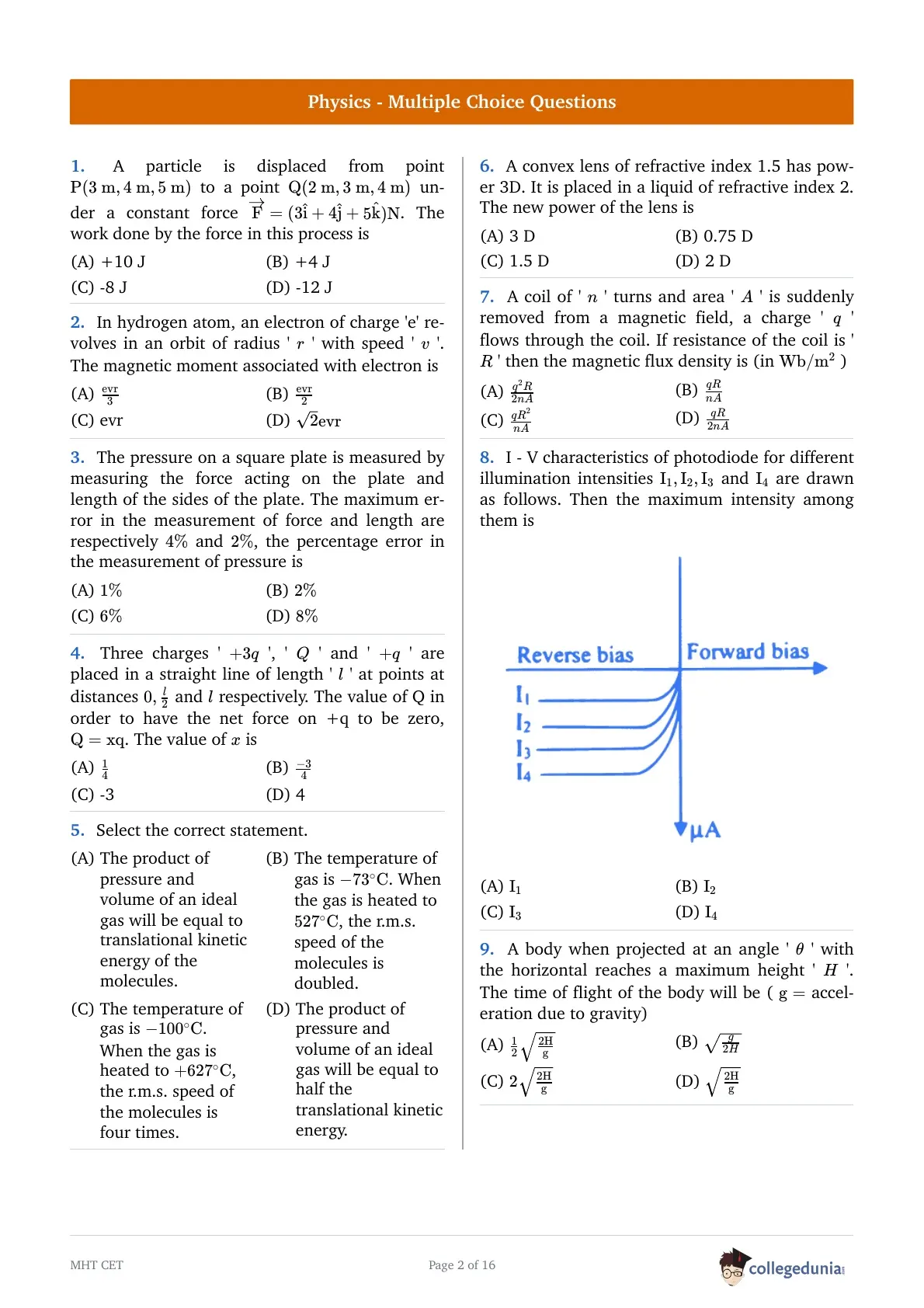
A particle is displaced from point \( P(3 \text{ m}, 4 \text{ m}, 5 \text{ m}) \) to a point \( Q(2 \text{ m}, 3 \text{ m}, 4 \text{ m}) \) under a constant force \( \vec{F} = (3\hat{i} + 4\hat{j} + 5\hat{k})\text{N} \). The work done by the force in this process is
In hydrogen atom, an electron of charge 'e' revolves in an orbit of radius 'r' with speed 'v'. The magnetic moment associated with electron is
The pressure on a square plate is measured by measuring the force acting on the plate and length of the sides of the plate. The maximum error in the measurement of force and length are respectively 4% and 2%, the percentage error in the measurement of pressure is
Three charges \( +3q, Q \) and \( +q \) are placed in a straight line of length \( L \) at points at distances \( 0, \frac{L}{2} \) and \( L \) respectively. The value of \( Q \) in order to have the net force on \( +q \) to be zero, \( Q = xq \). The value of \( x \) is
Select the correct statement.
A convex lens of refractive index 1.5 has power 3D. It is placed in a liquid of refractive index 2. The new power of the lens is
A coil of 'n' turns and area 'A' is suddenly removed from a magnetic field, a charge 'q' flows through the coil. If resistance of the coil is 'R' then the magnetic flux density is (in \( \text{Wb/m}^2 \))
I - V characteristics of photodiode for different illumination intensities \( I_1, I_2, I_3, I_4 \) are drawn as follows. Then the maximum intensity among them is

A body when projected at an angle \( \theta \) with the horizontal reaches a maximum height \( H \). The time of flight of the body will be ( \( g \) = acceleration due to gravity)
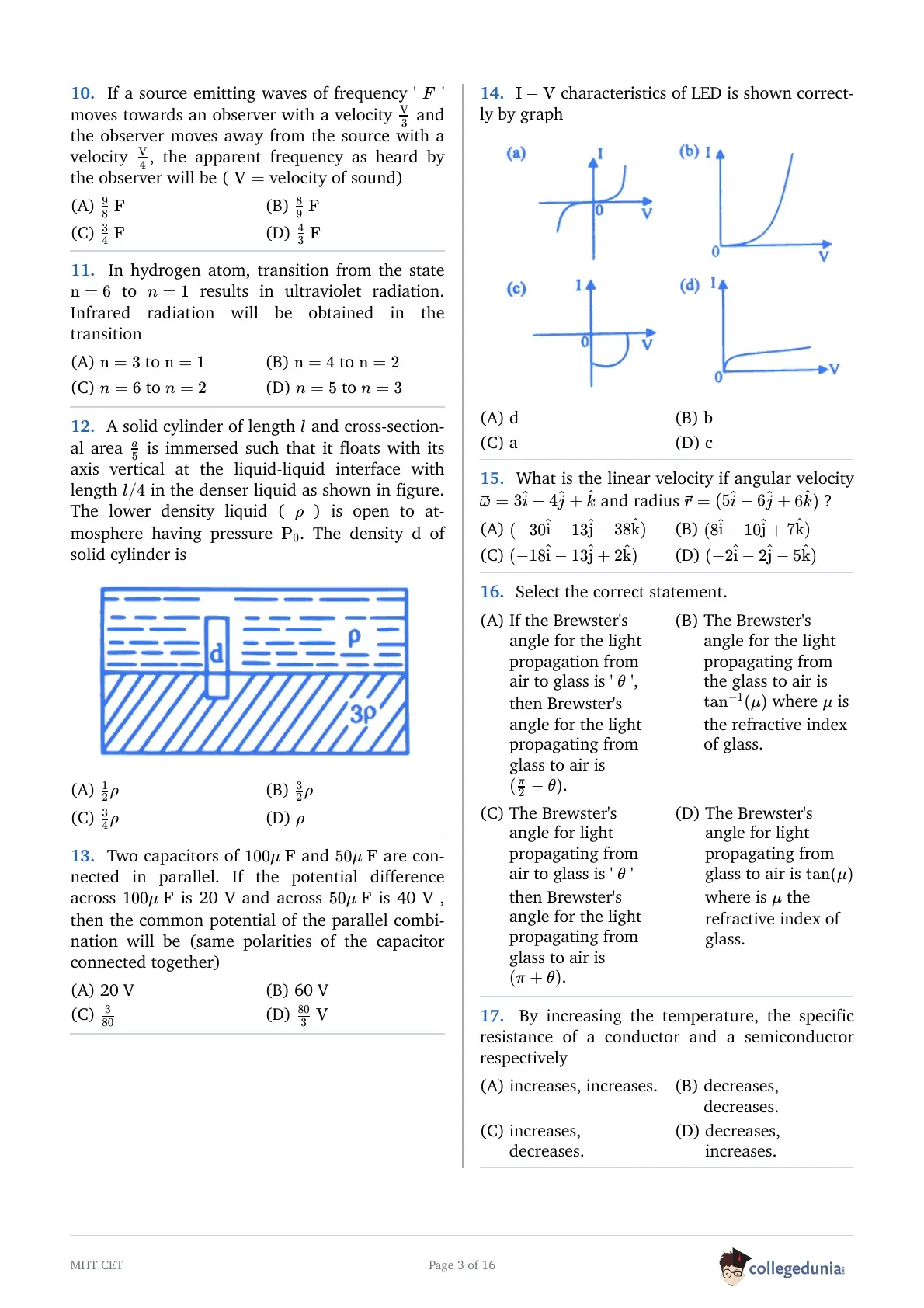
If a source emitting waves of frequency \( F \) moves towards an observer with a velocity \( \frac{V}{3} \) and the observer moves away from the source with a velocity \( \frac{V}{4} \), the apparent frequency as heard by the observer will be ( \( V \) = velocity of sound)
In hydrogen atom, transition from the state \( n = 6 \) to \( n = 1 \) results in ultraviolet radiation. Infrared radiation will be obtained in the transition
A solid cylinder of length \(l\) and cross-sectional area \(\frac{a}{5}\) is immersed such that it floats with its axis vertical at the liquid-liquid interface with length \(l / 4\) in the denser liquid as shown in figure. The lower density liquid ( \(\rho\) ) is open to atmosphere having pressure \(\mathrm{P}_0\). The density d of solid cylinder is

Two capacitors of \( 100 \mu\text{F} \) and \( 50 \mu\text{F} \) are connected in parallel. If the potential difference across \( 100 \mu\text{F} \) is 20 V and across \( 50 \mu\text{F} \) is 40 V, then the common potential of the parallel combination will be (same polarities of the capacitor connected together)
What is the linear velocity if angular velocity \(\vec{\omega} = 3\hat{i} - 4\hat{j} + \hat{k}\) and radius \(\vec{r} = (5\hat{i} - 6\hat{j} + 6\hat{k})\) ?
Select the correct statement.
By increasing the temperature, the specific resistance of a conductor and a semiconductor respectively
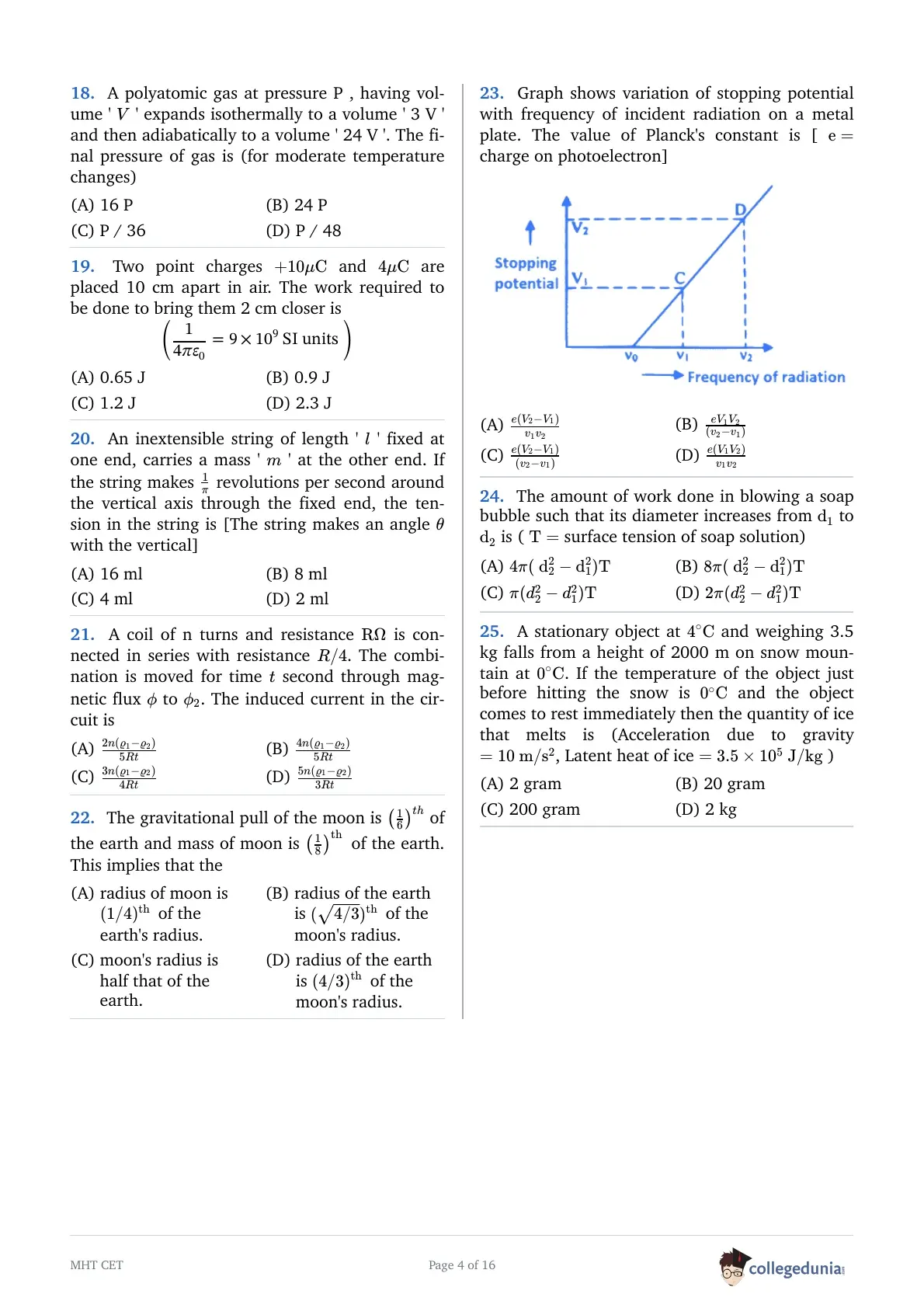
A polyatomic gas at pressure P, having volume 'V' expands isothermally to a volume '3 V' and then adiabatically to a volume '24 V'. The final pressure of gas is (for moderate temperature changes)
Two point charges \(+10\mu C\) and \(4\mu C\) are placed 10 cm apart in air. The work required to be done to bring them 2 cm closer is (\(\frac{1}{4\pi\epsilon_0} = 9 \times 10^9\) SI units)
An inextensible string of length 'l' fixed at one end, carries a mass 'm' at the other end. If the string makes \(\frac{1}{\pi}\) revolutions per second around the vertical axis through the fixed end, the tension in the string is [The string makes an angle \(\theta\) with the vertical]
A coil of n turns and resistance \(R \Omega\) is connected in series with resistance \(R/4\). The combination is moved for time t second through magnetic flux \(\phi_1\) to \(\phi_2\). The induced current in the circuit is
The gravitational pull of the moon is \((\frac{1}{6})^{th}\) of the earth and mass of moon is \((\frac{1}{8})^{th}\) of the earth. This implies that the
Graph shows variation of stopping potential with frequency of incident radiation on a metal plate. The value of Planck's constant is [e = charge on photoelectron]

The amount of work done in blowing a soap bubble such that its diameter increases from \(d_1\) to \(d_2\) is (T = surface tension of soap solution)
A stationary object at \(4^\circ C\) and weighing 3.5 kg falls from a height of 2000 m on snow mountain at \(0^\circ C\). If the temperature of the object just before hitting the snow is \(0^\circ C\) and the object comes to rest immediately then the quantity of ice that melts is (Acceleration due to gravity = \(10 m/s^2\), Latent heat of ice = \(3.5 \times 10^5 J/kg\))
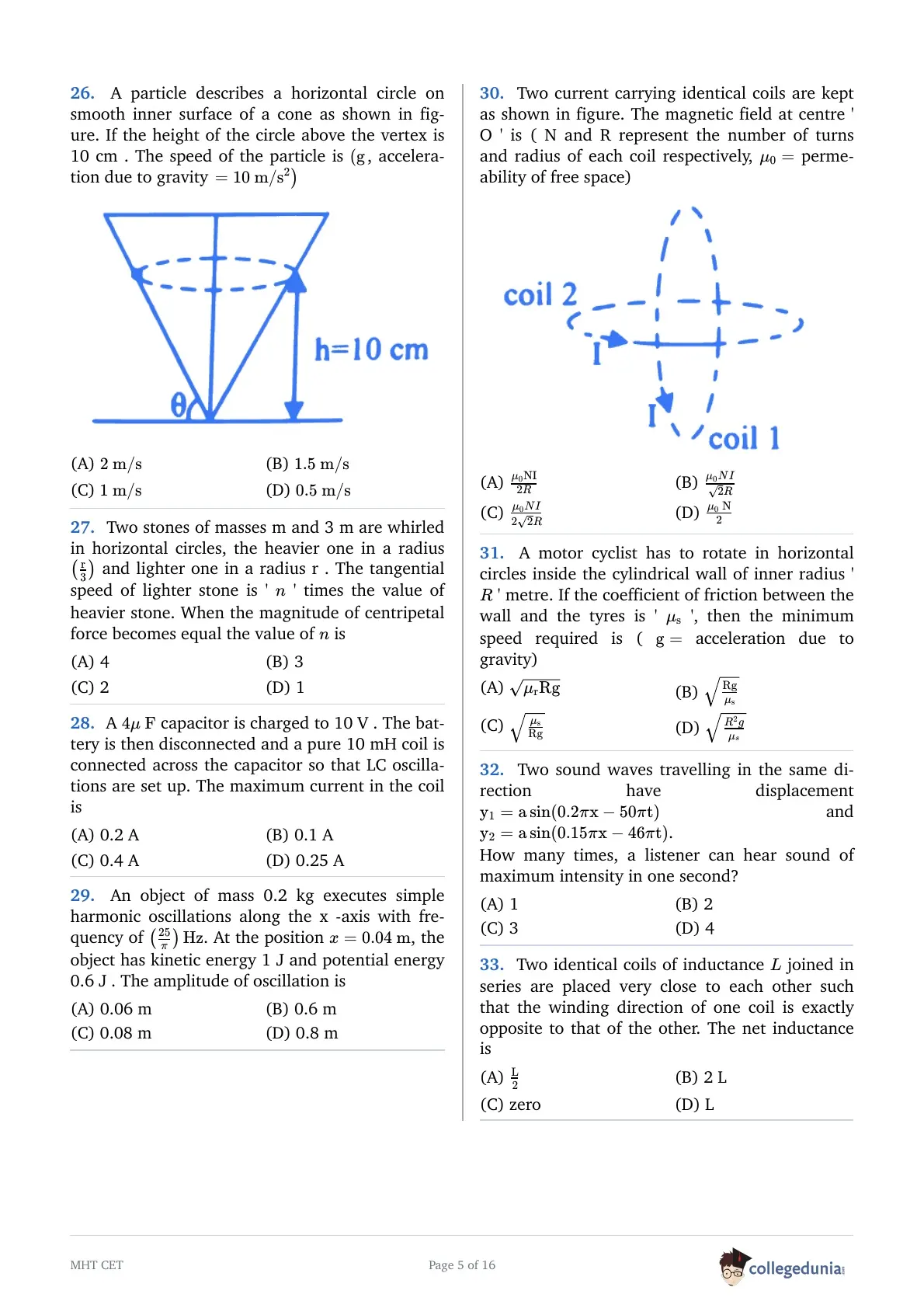
A particle describes a horizontal circle on smooth inner surface of a cone as shown in figure. If the height of the circle above the vertex is 10 cm. The speed of the particle is (g, acceleration due to gravity = \(10 m/s^2\))

Two stones of masses m and 3 m are whirled in horizontal circles, the heavier one in a radius \((\frac{r}{3})\) and lighter one in a radius r. The tangential speed of lighter stone is 'n' times the value of heavier stone. When the magnitude of centripetal force becomes equal the value of n is
A \(4\mu F\) capacitor is charged to 10 V. The battery is then disconnected and a pure 10 mH coil is connected across the capacitor so that LC oscillations are set up. The maximum current in the coil is
An object of mass 0.2 kg executes simple harmonic oscillations along the x-axis with frequency of \((\frac{25}{\pi}) Hz\). At the position \(x = 0.04 m\), the object has kinetic energy 1 J and potential energy 0.6 J. The amplitude of oscillation is
Two current carrying identical coils are kept as shown in figure. The magnetic field at centre 'O' is (N and R represent the number of turns and radius of each coil respectively, \(\mu_0\) = permeability of free space)

A motor cyclist has to rotate in horizontal circles inside the cylindrical wall of inner radius 'R' metre. If the coefficient of friction between the wall and the tyres is '\(\mu_s\)', then the minimum speed required is ( g = acceleration due to gravity)
Two sound waves travelling in the same direction have displacement \(y_1 = a \sin(0.2\pi x - 50\pi t)\) and \(y_2 = a \sin(0.15\pi x - 46\pi t)\). How many times, a listener can hear sound of maximum intensity in one second?
Two identical coils of inductance L joined in series are placed very close to each other such that the winding direction of one coil is exactly opposite to that of the other. The net inductance is
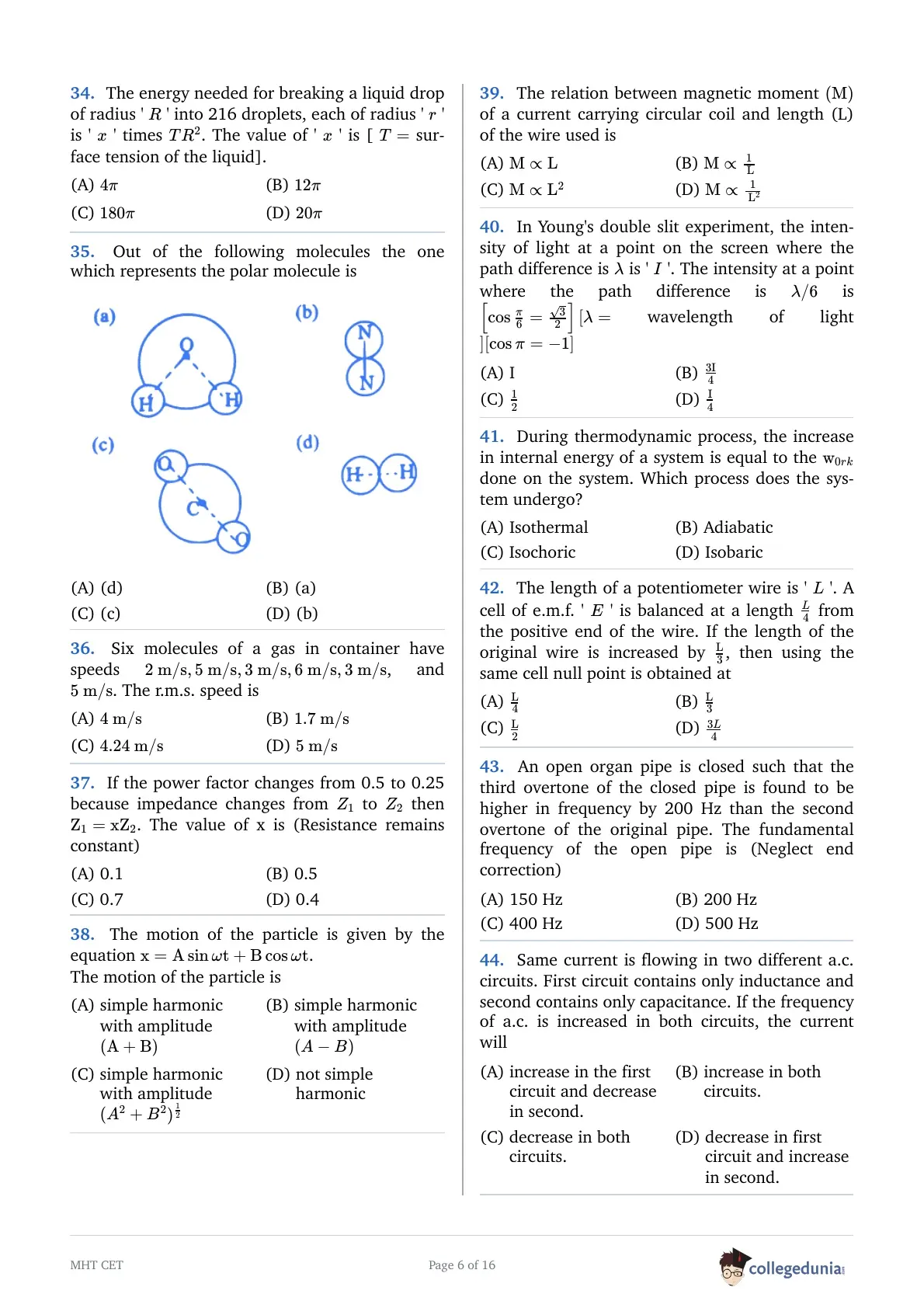
The energy needed for breaking a liquid drop of radius 'R' into 216 droplets, each of radius 'r' is 'x' times \(TR^2\). The value of 'x' is [ T = surface tension of the liquid].
Six molecules of a gas in container have speeds 2 m/s, 5 m/s, 3 m/s, 6 m/s, 3 m/s, and 5 m/s. The r.m.s. speed is
If the power factor changes from 0.5 to 0.25 because impedance changes from \(Z_1\) to \(Z_2\) then \(Z_1 = x Z_2\). The value of x is (Resistance remains constant)
The motion of the particle is given by the equation \(\mathrm{x}=\mathrm{A} \sin \omega \mathrm{t}+\mathrm{B} \cos \omega \mathrm{t}\).
The motion of the particle is
The relation between magnetic moment (M) of a current carrying circular coil and length (L) of the wire used is
In Young's double slit experiment, the intensity of light at a point on the screen where the path difference is \(\lambda\) is 'I'. The intensity at a point where the path difference is \(\lambda/6\) is \([\cos \frac{\pi}{6} = \frac{\sqrt{3}}{2}][\lambda = \text{wavelength of light}][\cos \pi = -1]\)
During thermodynamic process, the increase in internal energy of a system is equal to the work done on the system. Which process does the system undergo?
The length of a potentiometer wire is 'L'. A cell of e.m.f. 'E' is balanced at a length \(\frac{L}{4}\) from the positive end of the wire. If the length of the original wire is increased by \(\frac{L}{3}\), then using the same cell null point is obtained at
An open organ pipe is closed such that the third overtone of the closed pipe is found to be higher in frequency by 200 Hz than the second overtone of the original pipe. The fundamental frequency of the open pipe is (Neglect end correction)
Same current is flowing in two different a.c. circuits. First circuit contains only inductance and second contains only capacitance. If the frequency of a.c. is increased in both circuits, the current will
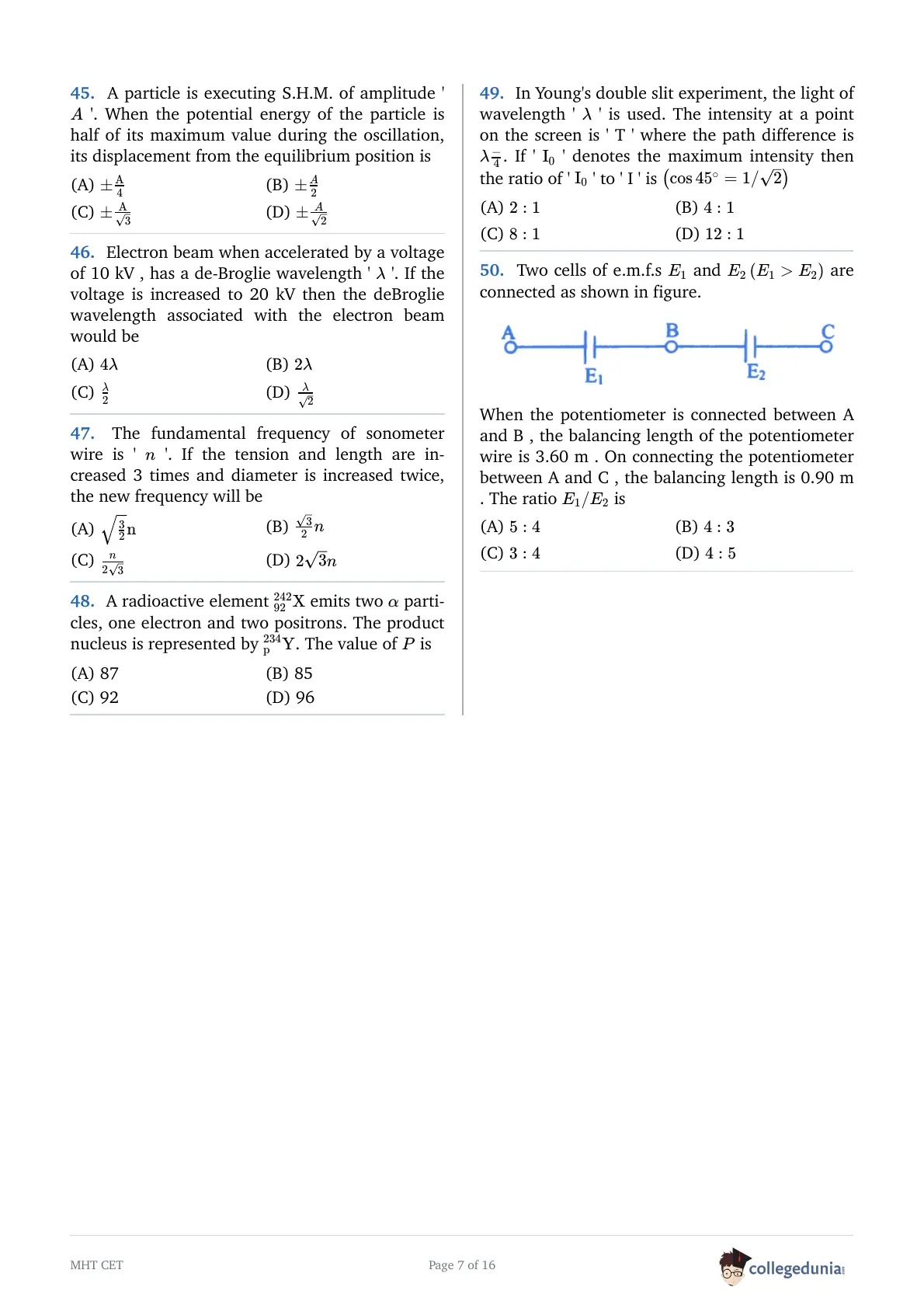
A particle is executing S.H.M. of amplitude 'A'. When the potential energy of the particle is half of its maximum value during the oscillation, its displacement from the equilibrium position is
Electron beam when accelerated by a voltage of 10 kV, has a de-Broglie wavelength '\(\lambda\)'. If the voltage is increased to 20 kV then the de-Broglie wavelength associated with the electron beam would be
The fundamental frequency of sonometer wire is 'n'. If the tension and length are increased 3 times and diameter is increased twice, the new frequency will be
A radioactive element \(^{242}_{92}X\) emits two \(\alpha\) particles, one electron and two positrons. The product nucleus is represented by \(^{234}_P Y\). The value of P is
In Young's double slit experiment, the light of wavelength '\(\lambda\)' is used. The intensity at a point on the screen is 'I' where the path difference is \(\lambda/4\). If '\(I_0\)' denotes the maximum intensity then the ratio of '\(I_0\)' to 'I' is (\(\cos 45^\circ = 1/\sqrt{2}\))
Two cells of e.m.f.s \(E_1\) and \(E_2\) (\(E_1>E_2\)) are connected as shown in figure. When the potentiometer is connected between A and B, the balancing length of the potentiometer wire is 3.60 m. On connecting the potentiometer between A and C, the balancing length is 0.90 m. The ratio \(E_1/E_2\) is

Chemistry (Q51 - Q100)
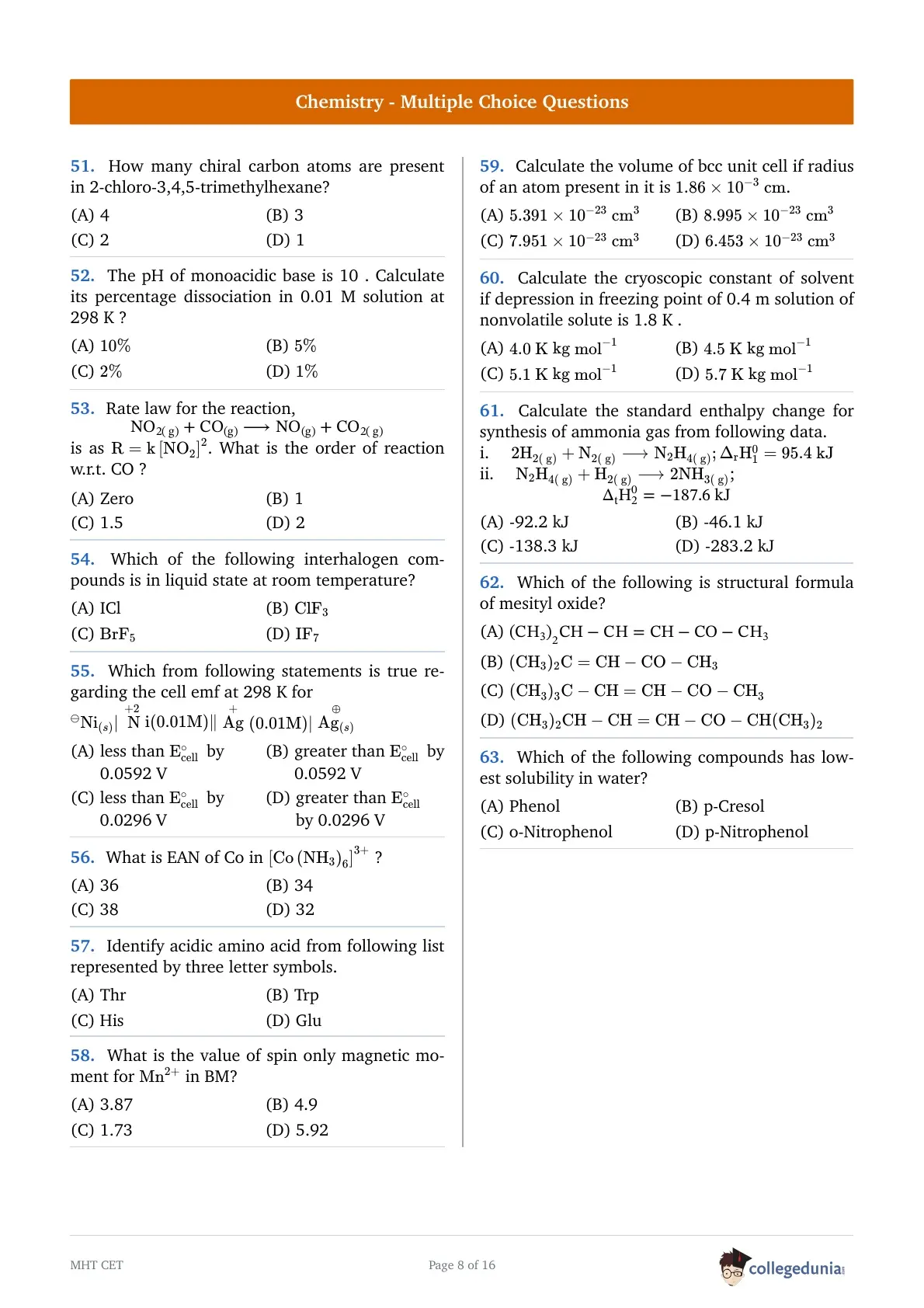
How many chiral carbon atoms are present in 2-chloro-3,4,5-trimethylhexane?
The pH of monoacidic base is 10. Calculate its percentage dissociation in 0.01 M solution at 298 K ?
Rate law for the reaction, \( NO_{2(g)} + CO_{g} \rightarrow NO_{(g)} + CO_{2(g)} \) is as \( R = k[NO_{2}]^2 \). What is the order of reaction w.r.t. CO?
Which of the following interhalogen compounds is in liquid state at room temperature?
Which from following statements is true regarding the cell emf at 298 K for \( \ominus Ni_{(s)} | Ni^{+2}(0.01M) || Ag^{+}(0.01M) | Ag_{(s)} \oplus \)?
What is EAN of Co in \( [Co(NH_{3})_{6}]^{3+} \)?
Identify acidic amino acid from following list represented by three letter symbols.
What is the value of spin only magnetic moment for \( Mn^{2+} \) in BM?
Calculate the volume of bcc unit cell if radius of an atom present in it is \( 1.86 \times 10^{-8} \) cm.
Calculate the cryoscopic constant of solvent if depression in freezing point of 0.4 m solution of nonvolatile solute is 1.8 K .
Calculate the standard enthalpy change for synthesis of ammonia gas from following data. i. \( 2H_{2(g)} + N_{2(g)} \rightarrow N_{2}H_{4(g)} \); \( \Delta_{r}H^{\circ}_{1} = 95.4\text{ kJ} \) ii. \( N_{2}H_{4(g)} + H_{2(g)} \rightarrow 2NH_{3(g)} \); \( \Delta_{r}H^{\circ}_{2} = -187.6\text{ kJ} \)}
Which of the following is structural formula of mesityl oxide?
Which of the following compounds has lowest solubility in water?
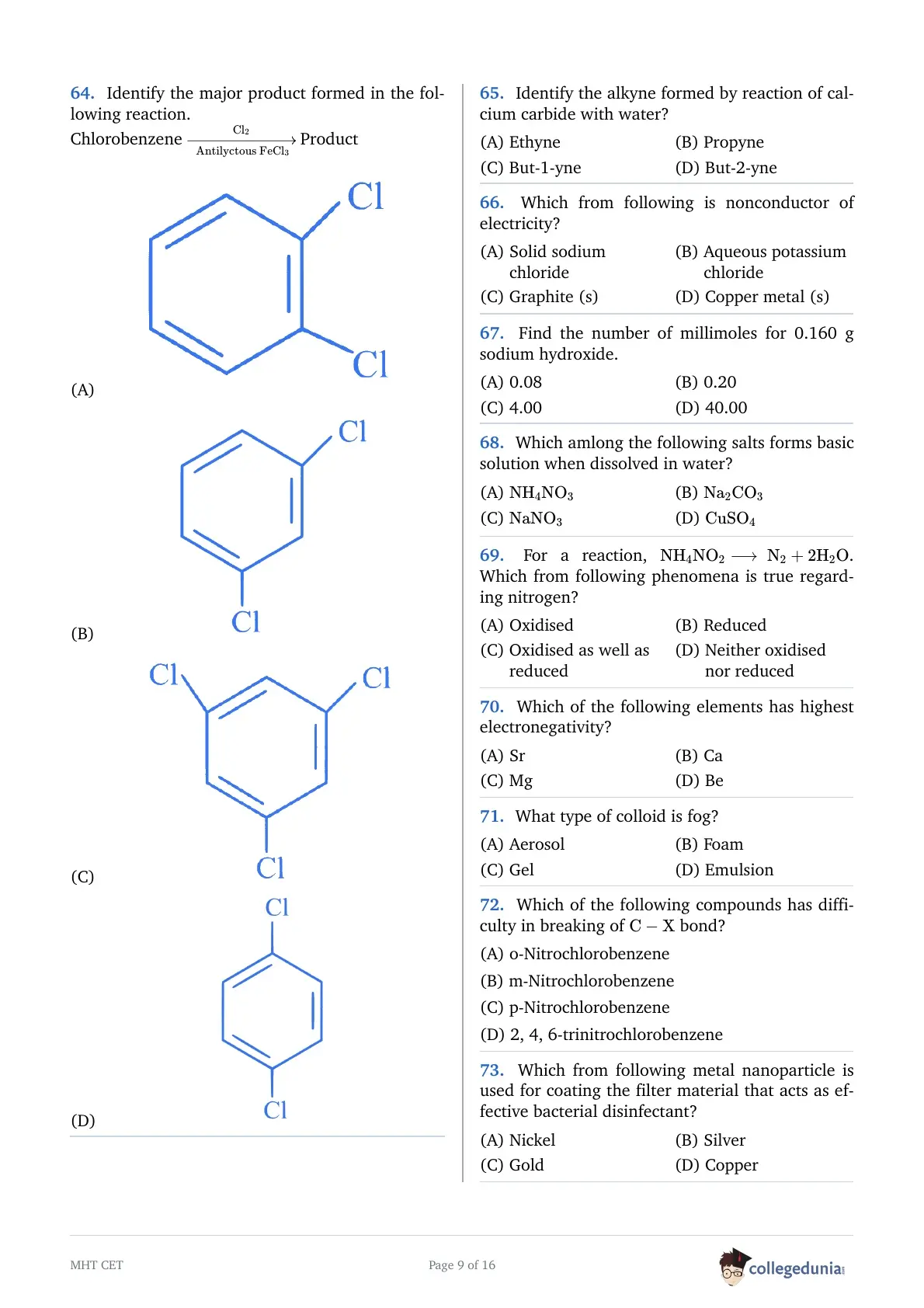
Identify the major product formed in the following reaction.
Chlorobenzene \(\xrightarrow[\text { Antilyctous } \mathrm{FeCl}_3]{\mathrm{Cl}_2}\) Product
- (A)
![]()
- (B)
![]()
- (C)
![]()
- (D)
![]()


Identify the alkyne formed by reaction of calcium carbide with water?
Which from following is nonconductor of electricity?
Find the number of millimoles for 0.160 g sodium hydroxide.
Which among the following salts forms basic solution when dissolved in water?
For a reaction, \( NH_{4}NO_{2} \rightarrow N_{2} + 2H_{2}O \). Which from following phenomena is true regarding nitrogen?
Which of the following elements has highest electronegativity?
What type of colloid is fog?
Which of the following compounds has difficulty in breaking of \(\mathrm{C}-\mathrm{X}\) bond?
Which from following metal nanoparticle is used for coating the filter material that acts as effective bacterial disinfectant?
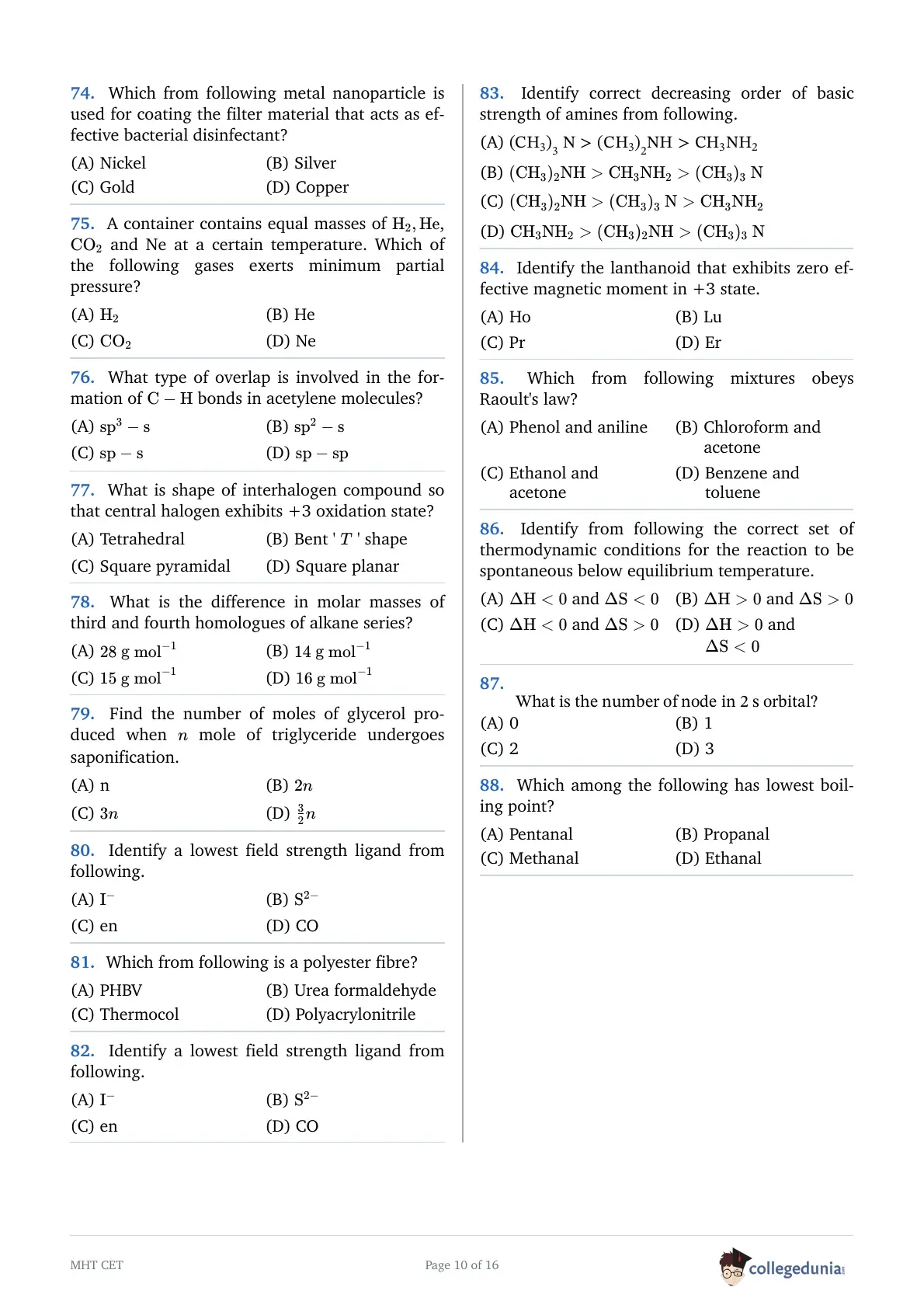
Which from following metal nanoparticle is used for coating the filter material that acts as effective bacterial disinfectant?
A container contains equal masses of H\(_{2}\), He, CO\(_{2}\) and Ne at a certain temperature. Which of the following gases exerts minimum partial pressure?
What type of overlap is involved in the formation of C \(-\) H bonds in acetylene molecules?
What is shape of interhalogen compound so that central halogen exhibits +3 oxidation state?
What is the difference in molar masses of third and fourth homologues of alkane series?
Find the number of moles of glycerol produced when \( n \) mole of triglyceride undergoes saponification.
Identify a lowest field strength ligand from following.
Identify a lowest field strength ligand from following.
Identify correct decreasing order of basic strength of amines from following.
Identify the lanthanoid that exhibits zero effective magnetic moment in +3 state.
Which from following mixtures obeys Raoult's law?
Identify from following the correct set of thermodynamic conditions for the reaction to be spontaneous below equilibrium temperature.
What is the number of node in 2s orbital?
Which among the following has lowest boiling point?
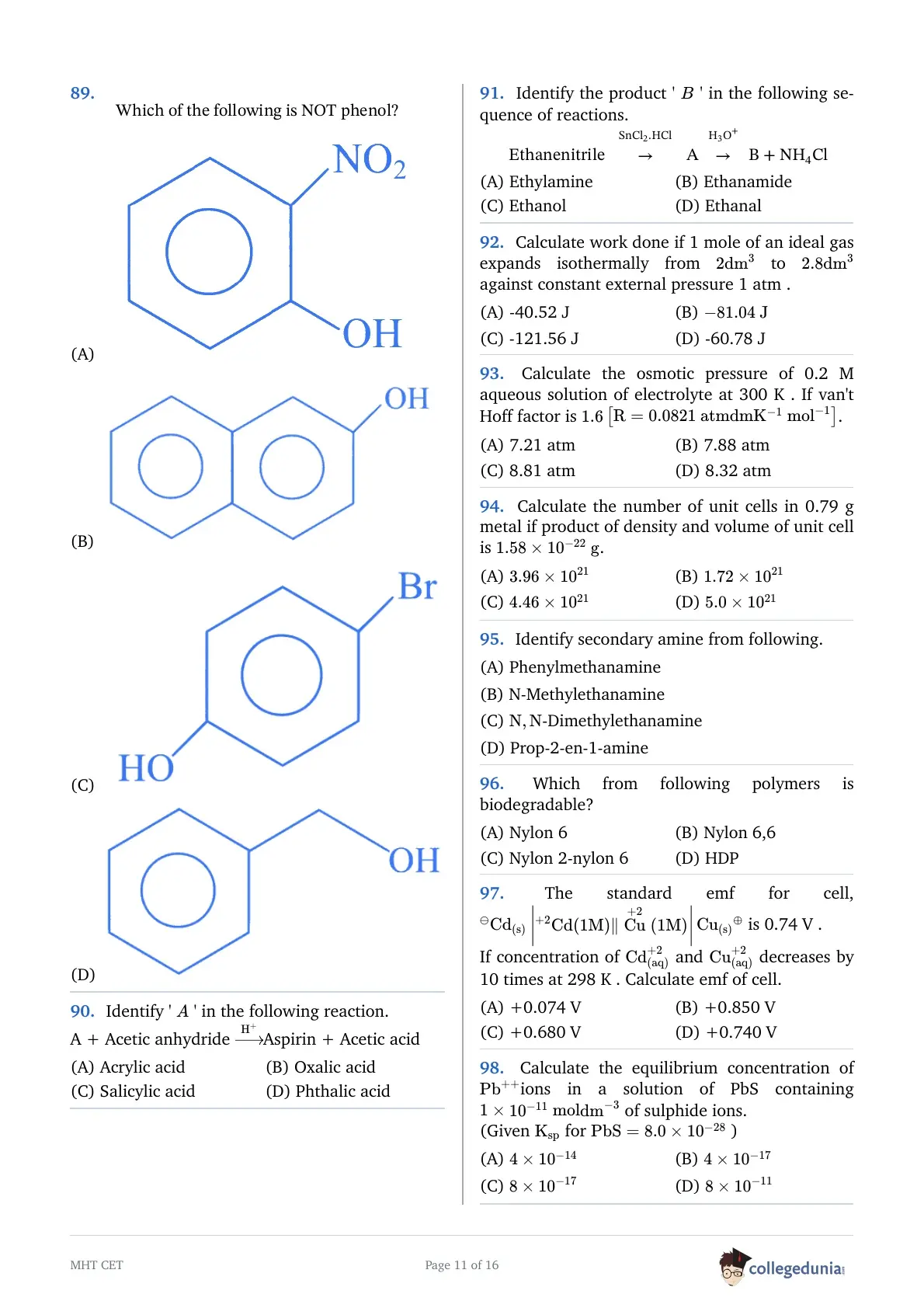
\[ \text { Which of the following is NOT phenol? } \]
- (A)
![]()
- (B)
![]()
- (C)
![]()
- (D)
![]()


Identify 'A' in the following reaction.
A + Acetic anhydride \( \xrightarrow{\text{H}^+} \) Aspirin + Acetic acid}
Identify the product 'B' in the following sequence of reactions.
Ethanenitrile \( \xrightarrow{\text{SnCl}_2, \text{HCl}} \) A \( \xrightarrow{\text{H}_3\text{O}^+} \) B + NH\(_4\)Cl}
Calculate work done if 1 mole of an ideal gas expands isothermally from 2 dm\(^3\) to 2.8 dm\(^3\) against constant external pressure 1 atm.
Calculate the osmotic pressure of 0.2 M aqueous solution of electrolyte at 300 K. If van't Hoff factor is 1.6 [R = 0.0821 atm dm\(^3\) K\(^{-1}\) mol\(^{-1}\)].
Calculate the number of unit cells in 0.79 g metal if product of density and volume of unit cell is 1.58 \(\times\) 10\(^{-22}\) g.
Identify secondary amine from following.
Which from following polymers is biodegradable?
The standard emf for cell, Cd\(_{(s)}\) | Cd\(^{+2}\)(1M) || Cu\(^{+2}\)(1M) | Cu\(_{(s)}\) is 0.74 V.
If concentration of Cd\(^{+2}_{(aq)}\) and Cu\(^{+2}_{(aq)}\) decreases by 10 times at 298 K. Calculate emf of cell.
Calculate the equilibrium concentration of Pb\(^{2+}\) ions in a solution of PbS containing 1 \(\times\) 10\(^{-11}\) moldm\(^{-3}\) of sulphide ions. (Given \(K_{sp}\) for PbS = 8.0 \(\times\) 10\(^{-28}\))}
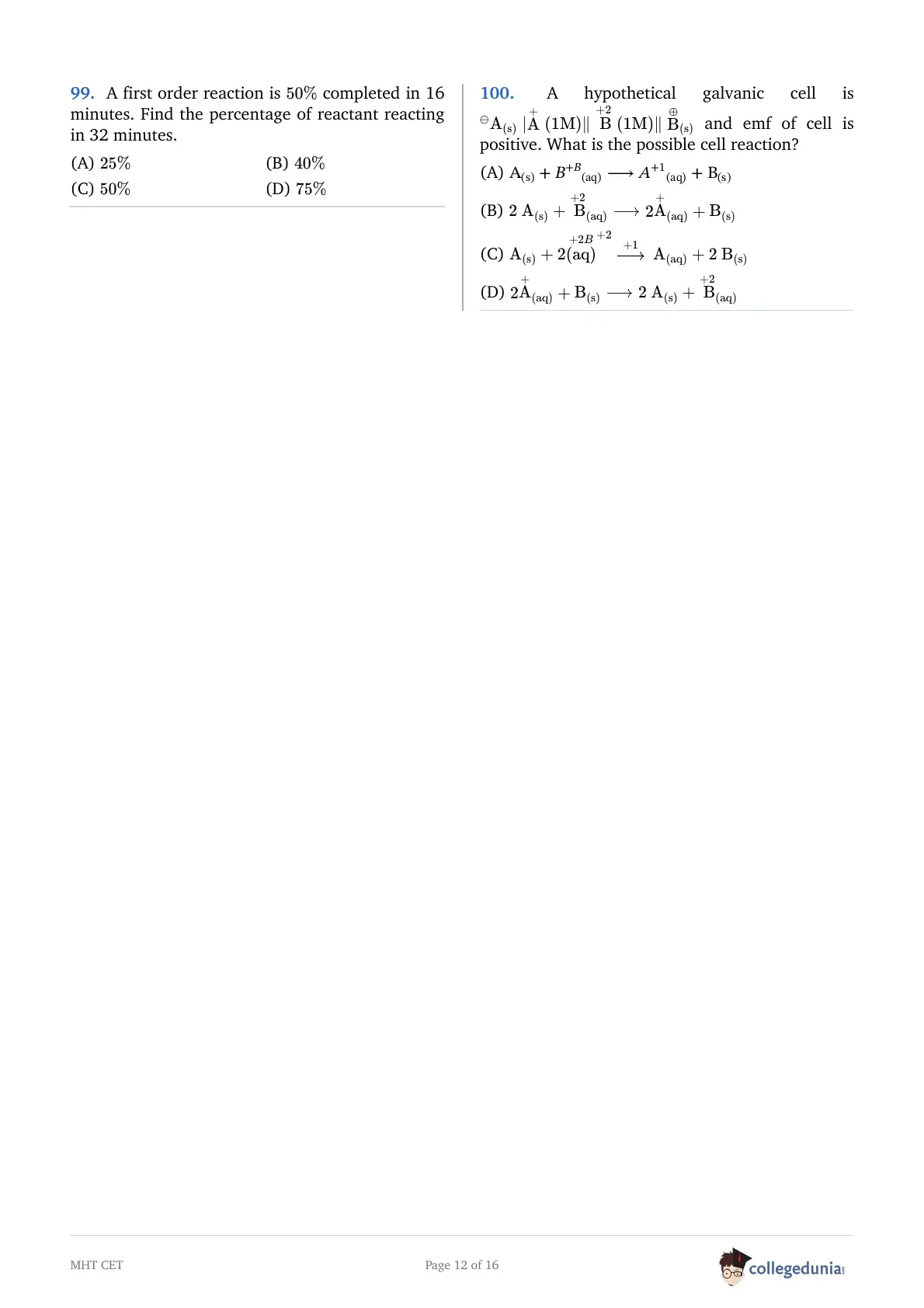
A first order reaction is 50% completed in 16 minutes. Find the percentage of reactant reacting in 32 minutes.
A hypothetical galvanic cell is A\(_{(s)}\) | A\(^+\)(1M) || B\(^{+2}\)(1M) | B\(_{(s)}\) and emf of cell is positive. What is the possible cell reaction?
Mathematics (Q101 - Q150)
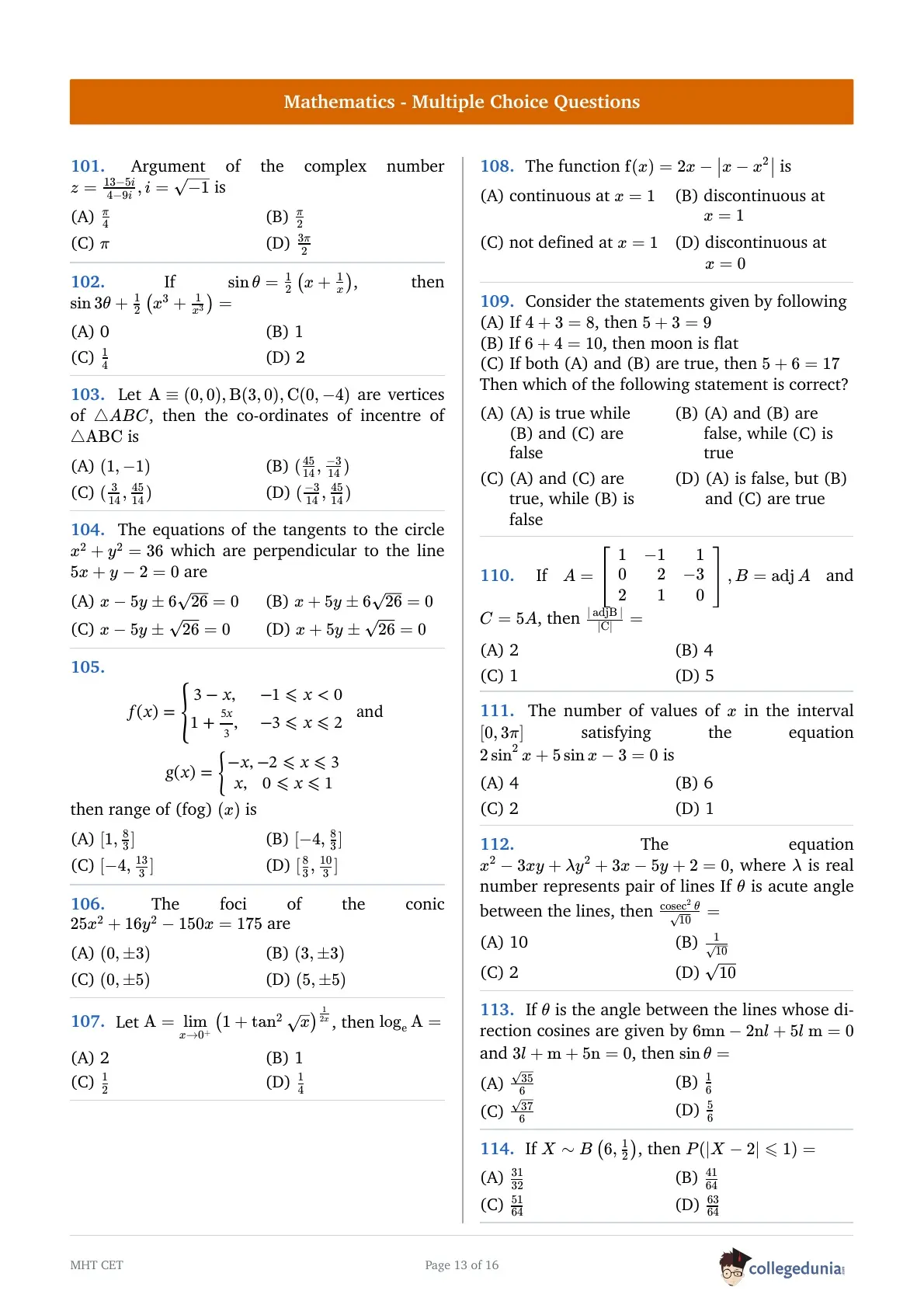
Argument of the complex number z = \( \frac{13-5i}{4-9i} \), i = \( \sqrt{-1} \) is
If sin \( \theta \) = \( \frac{1}{2}\left(x + \frac{1}{x}\right) \), then sin \( 3\theta + \frac{1}{2}\left(x^3 + \frac{1}{x^3}\right) \) =}
Let \(\mathrm{A} \equiv(0,0), \mathrm{B}(3,0), \mathrm{C}(0,-4)\) are vertices of \(\triangle A B C\), then the co-ordinates of incentre of \(\triangle \mathrm{ABC}\) is
The equations of the tangents to the circle \( x^2 + y^2 = 36 \) which are perpendicular to the line \( 5x + y - 2 = 0 \) are
Let A = \( \lim_{x \to 0^+} (1 + \tan^2 \sqrt{x})^{\frac{1}{2x}} \), then log\(_e\) A =}
The function f(x) = 2x - \(|x - x^2|\) is
Consider the statements given by following
(A) If 4+3 = 8, then 5+3=9
(B) If 6 + 4 = 10, then moon is flat
(C) If both (A) and (B) are true, then 5 + 6 = 17
Then which of the following statement is correct?
If \( A = \begin{bmatrix} 1 & -1 & 1 \\ 0 & 2 & -3 \\ 2 & 1 & 0 \end{bmatrix} \), \( B = \text{adj } A \) and \( C = 5A \), then \( \frac{|\text{adj } B|}{|C|} = \)}
The number of values of \( x \) in the interval \( [0, 3\pi] \) satisfying the equation \( 2 \sin^2 x + 5 \sin x - 3 = 0 \) is
The equation \( x^2 - 3xy + \lambda y^2 + 3x - 5y + 2 = 0 \), where \( \lambda \) is a real number represents a pair of lines. If \( \theta \) is the acute angle between the lines, then \( \frac{\text{cosec}^2 \theta}{\sqrt{10}} = \)}
If \( \theta \) is the angle between the lines whose direction cosines are given by \( 6mn - 2nl + 5lm = 0 \) and \( 3l + m + 5n = 0 \), then \( \sin \theta = \)}
If \( X \sim B(6, \frac{1}{2}) \), then \( P(|X - 2| \le 1) = \)}
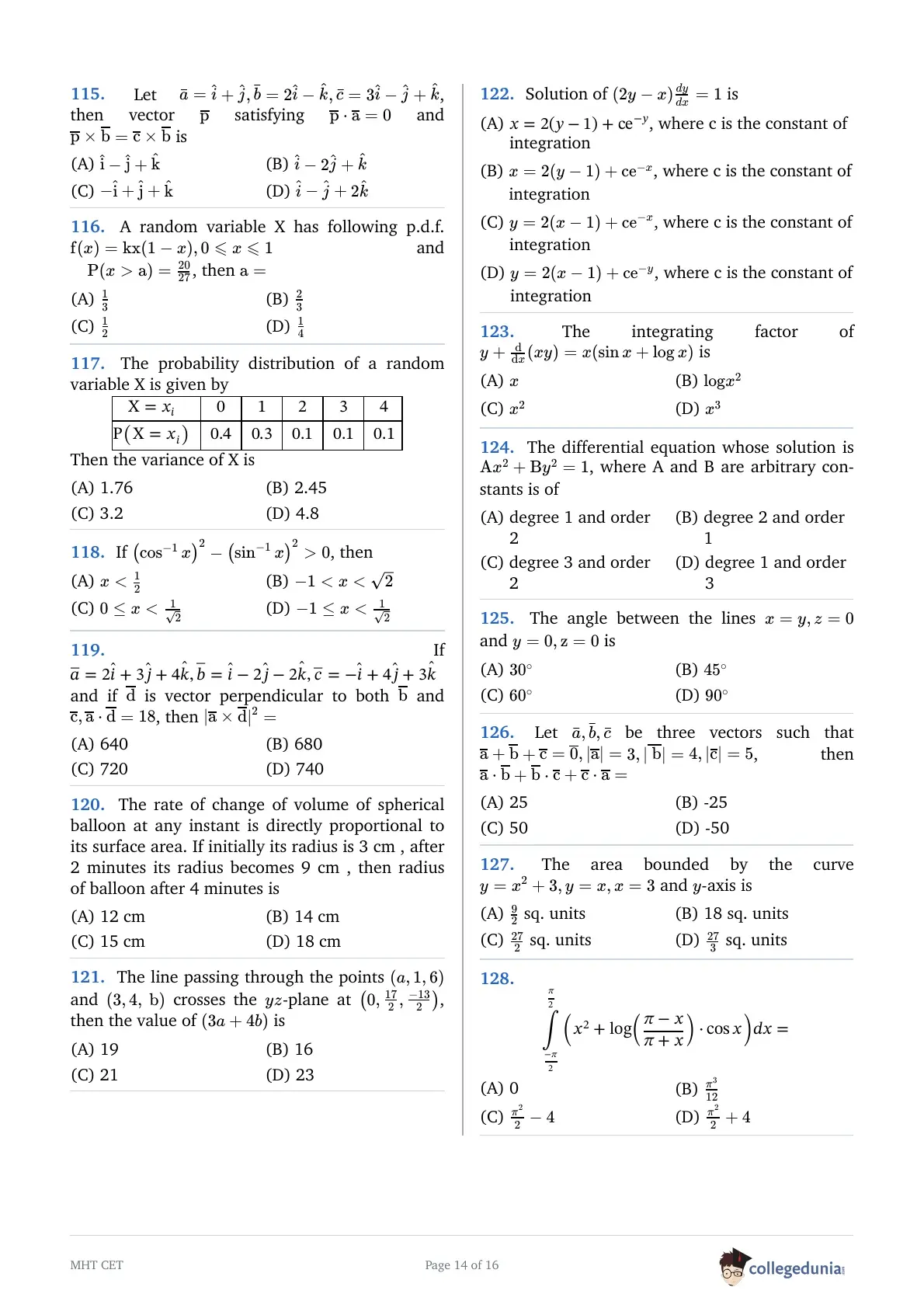
Let \( \bar{a} = \hat{i} + \hat{j}, \bar{b} = 2\hat{i} - \hat{k}, \bar{c} = 3\hat{i} - \hat{j} + \hat{k} \), then vector \( \bar{p} \) satisfying \( \bar{p} \cdot \bar{a} = 0 \) and \( \bar{p} \times \bar{b} = \bar{c} \times \bar{b} \) is
A random variable X has following p.d.f. \( f(x) = kx(1 - x), 0 \le x \le 1 \) and \( P(x>a) = \frac{20}{27} \), then \( a = \)}
The probability distribution of a random variable X is given by\[ \begin{array}{|l|c|c|c|c|c|} \hline \mathrm{X}=x_i & 0 & 1 & 2 & 3 & 4 \\ \hline \mathrm{P}\left(\mathrm{X}=x_i\right) & 0.4 & 0.3 & 0.1 & 0.1 & 0.1 \\ \hline \end{array} \]
Then the variance of X is
If \( (\cos^{-1} x)^2 - (\sin^{-1} x)^2>0 \), then}
If \( \bar{a} = 2\hat{i} + 3\hat{j} + 4\hat{k}, \bar{b} = \hat{i} - 2\hat{j} - 2\hat{k}, \bar{c} = -\hat{i} + 4\hat{j} + 3\hat{k} \) and if \( \bar{d} \) is vector perpendicular to both \( \bar{b} \) and \( \bar{c} \), \( \bar{a} \cdot \bar{d} = 18 \), then \( |\bar{a} \times \bar{d}|^2 = \)}
The rate of change of volume of spherical balloon at any instant is directly proportional to its surface area. If initially its radius is 3 cm, after 2 minutes its radius becomes 9 cm, then radius of balloon after 4 minutes is
The line passing through the points \( (a, 1, 6) \) and \( (3, 4, b) \) crosses the \( yz \)-plane at \( (0, \frac{17}{2}, -\frac{13}{2}) \), then the value of \( (3a + 4b) \) is
Solution of \( (2y - x) \frac{dy}{dx} = 1 \) is
The integrating factor of \( y + \frac{d}{dx}(xy) = x(\sin x + \log x) \) is
The differential equation whose solution is \( Ax^2 + By^2 = 1 \), where A and B are arbitrary constants is of}
The angle between the lines \( x = y, z = 0 \) and \( y = 0, z = 0 \) is
Let \( \bar{a}, \bar{b}, \bar{c} \) be three vectors such that \( \bar{a} + \bar{b} + \bar{c} = \bar{0}, |\bar{a}| = 3, |\bar{b}| = 4, |\bar{c}| = 5 \), then \( \bar{a} \cdot \bar{b} + \bar{b} \cdot \bar{c} + \bar{c} \cdot \bar{a} = \)}
The area bounded by the curve \( y = x^2 + 3, y = x, x = 3 \) and \( y \)-axis is
\( \int_{-\frac{\pi}{2}}^{\frac{\pi}{2}} (x^2 + \log (\frac{\pi - x}{\pi + x}) \cdot \cos x) dx = \)}
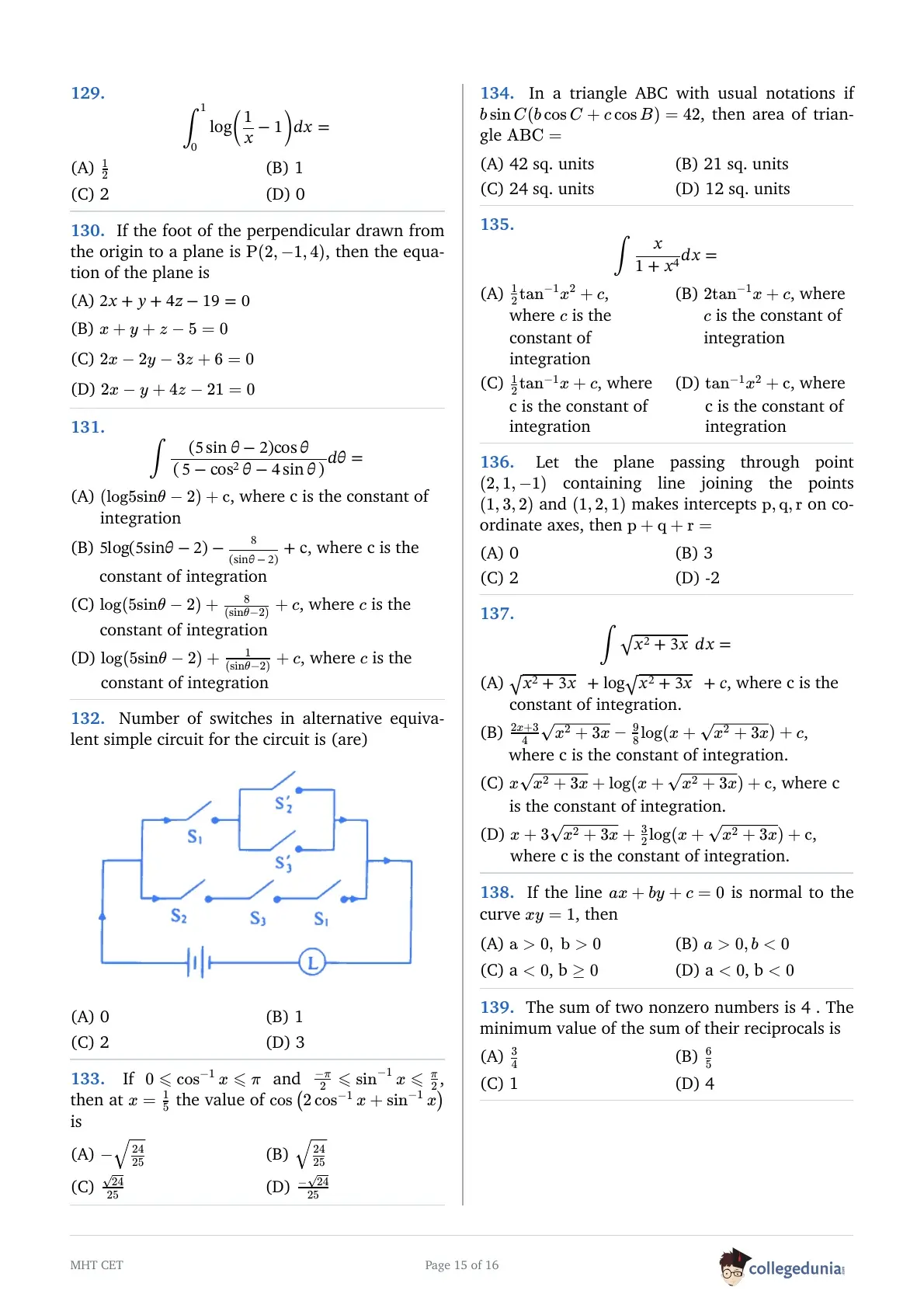
\( \int_{0}^{1} \log (\frac{1}{x} - 1) dx = \)}
If the foot of the perpendicular drawn from the origin to a plane is \( P(2, -1, 4) \), then the equation of the plane is
Number of switches in alternative equivalent simple circuit for the circuit is (are)

If \(0 \leqslant \cos ^{-1} x \leqslant \pi\) and \(\frac{-\pi}{2} \leqslant \sin ^{-1} x \leqslant \frac{\pi}{2}\), then at \(x=\frac{1}{5}\) the value of \(\cos \left(2 \cos ^{-1} x+\sin ^{-1} x\right)\) is
In a triangle ABC with usual notations if \( b \sin C (b \cos C + c \cos B) = 42 \), then area of triangle ABC =}
Let the plane passing through point (2, 1, -1) containing line joining the points (1, 3, 2) and (1, 2, 1) makes intercepts \( p, q, r \) on co-ordinate axes, then \( p + q + r = \)}
The sum of two nonzero numbers is 4. The minimum value of the sum of their reciprocals is
The angle between the line \( x = \frac{y-1}{2} = \frac{z-3}{\lambda} \) and the plane \( x + 2y + 3z = 6 \) is \( \cos^{-1} \sqrt{\frac{5}{14}} \), then the value of \( \lambda \) is
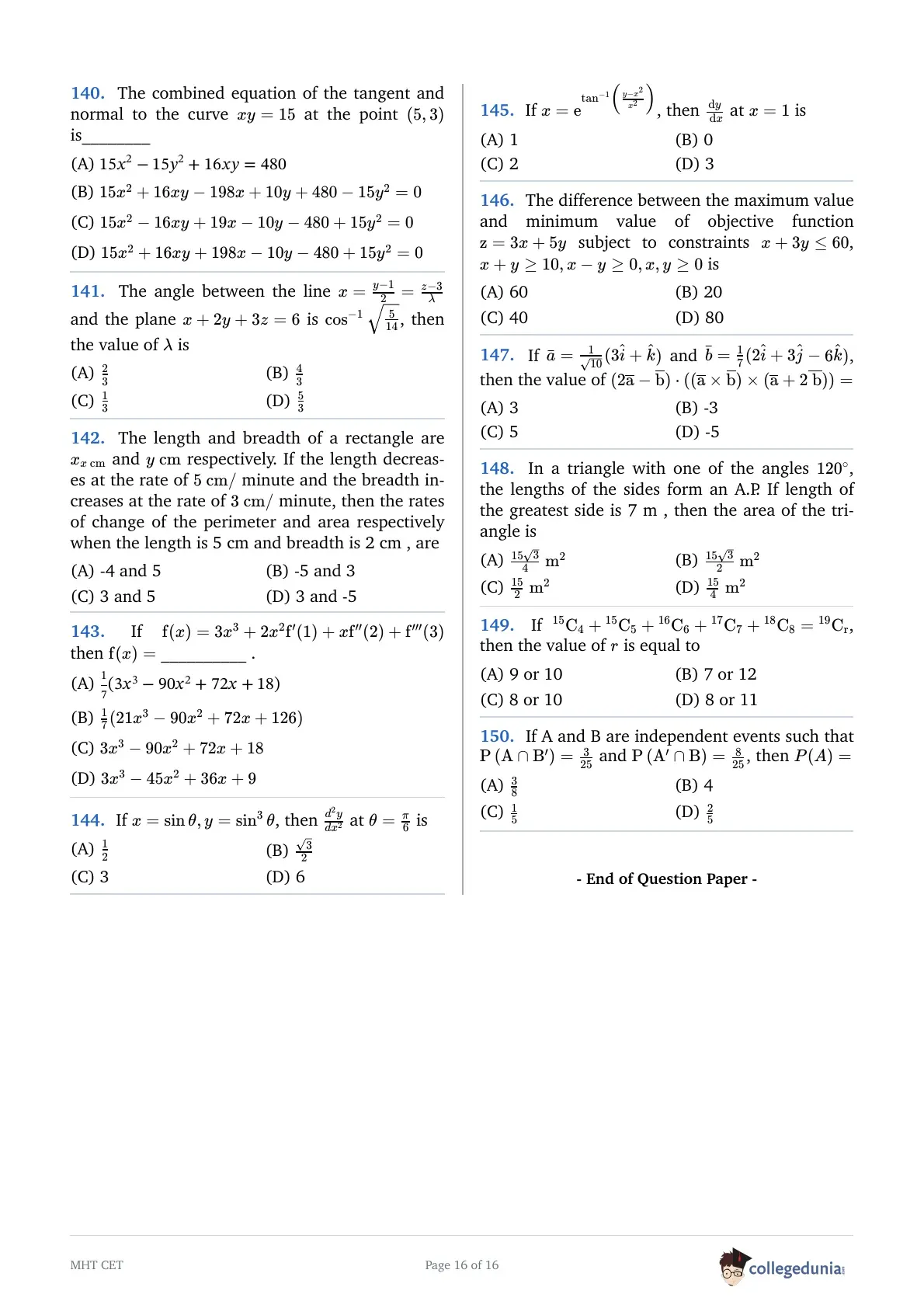
The rates of change of the perimeter and area of a rectangle respectively when length \(x=5\) cm and breadth \(y=2\) cm, if \(dx/dt = -5\) cm/min and \(dy/dt = 3\) cm/min, are
If \( f(x) = 3x^3 + 2x^2 f'(1) + x f''(2) + f'''(3) \) then \( f(x) = ....... \)}
If \( x = \sin \theta, y = \sin^3 \theta \), then \( \frac{d^2y}{dx^2} \) at \( \theta = \frac{\pi}{6} \) is
If \( x = e^{\tan^{-1} \left( \frac{y-x^2}{x^2} \right)} \), then \( \frac{dy}{dx} \) at \( x = 1 \) is
The difference between the maximum value and minimum value of objective function \( z = 3x + 5y \) subject to \( x + 3y \le 60, x + y \ge 10, x - y \ge 0, x, y \ge 0 \) is
If \( \bar{a} = \frac{1}{\sqrt{10}}(3\hat{i} + \hat{k}) \) and \( \bar{b} = \frac{1}{7}(2\hat{i} + 3\hat{j} - 6\hat{k}) \), then the value of \( (2\bar{a} - \bar{b}) \cdot ((\bar{a} \times \bar{b}) \times (\bar{a} + 2\bar{b})) = \)}
In a triangle with one of the angles \( 120^\circ \), the lengths of the sides form an A.P. If the length of the greatest side is 7 m, then the area of the triangle is
If \( ^{15}C_4 + ^{15}C_5 + ^{16}C_6 + ^{17}C_7 + ^{18}C_8 = ^{19}C_r \), then the value of \( r \) is equal to}
If A and B are independent events such that \( P(A \cap B') = \frac{3}{25} \) and \( P(A' \cap B) = \frac{8}{25} \), then \( P(A) = \)}
MHT CET 2025 PCM Exam Pattern and Marking Scheme
| Parameter | Details |
|---|---|
| Conducting Body | Maharashtra Common Entrance Test Cell (Maharashtra CET Cell) |
| Exam Mode | Online (Computer-Based Test) |
| Duration | 180 minutes (3 hours) |
| Groups / Subjects | PCM (Physics, Chemistry, Mathematics) for Engineering |
| Total Questions |
150 |
| Total Marks | 200 |
| Question Type | Multiple Choice Questions (MCQs) |
| Marks Distribution |
|
| Negative Marking | No |
| Syllabus Weightage |
|



Comments