




`The MHT CET 2025 PCM Exam Shift 1 for 26th April 2025 was conducted from 9:00 A.M. to 12:00 P.M. The MHT CET 2025 question paper for April 26 Shift 1 (PCM group) is available here with the solutions PDF.
The MHT CET 2025 Question Paper consists of 150 multiple-choice questions (MCQs) totaling 200 marks divided into 3 sections: Physics, Chemistry, and Mathematics, with 50 questions in each subject.
Also Check:
MHT CET 2025 April 26 Shift 1 PCM Question Paper PDF Download
| MHT CET 2025 PCM Question Paper With Answer Key | Download PDF | Check Solution |

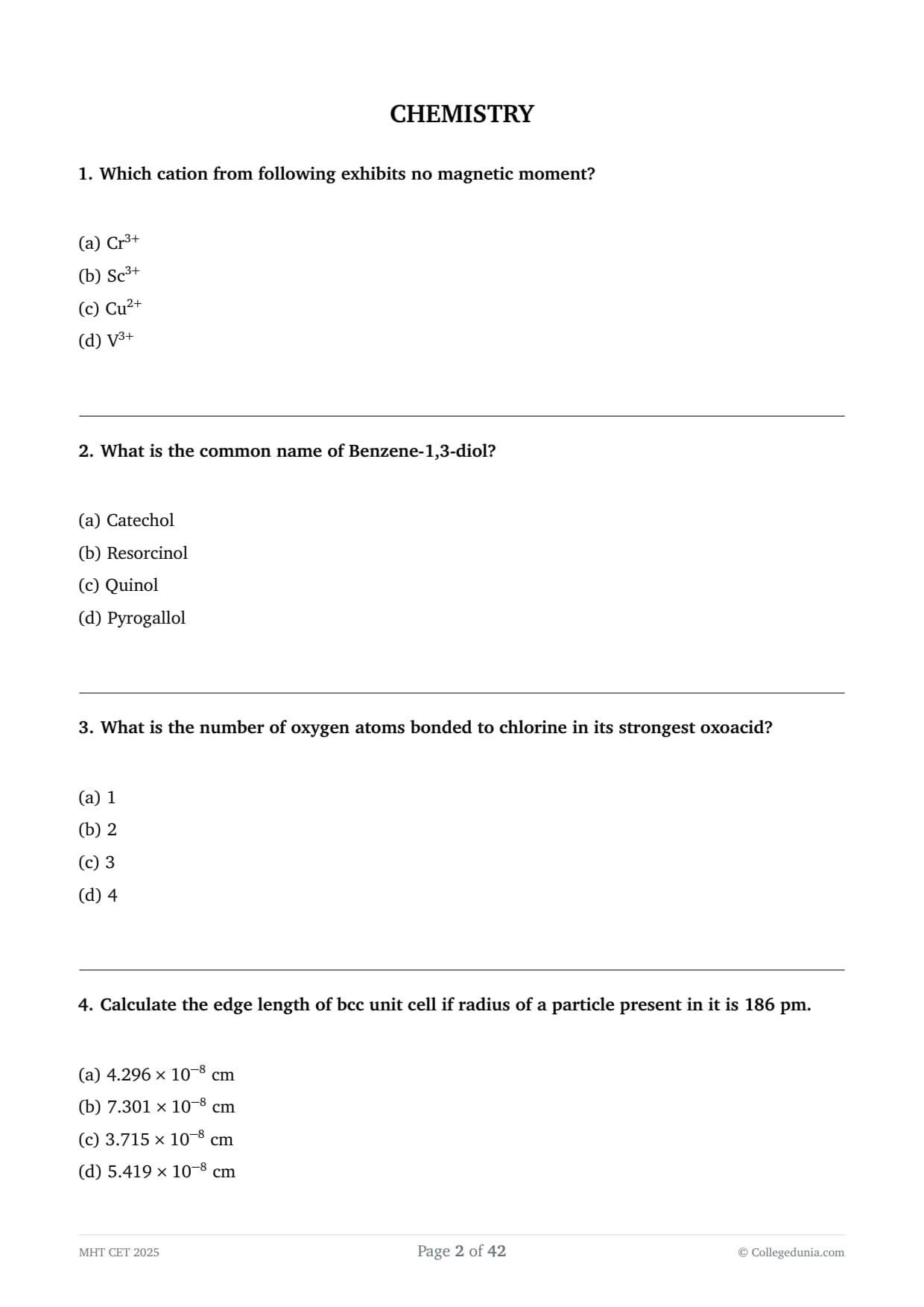





Which cation from following exhibits no magnetic moment?
What is the common name of Benzene-1,3-diol?
What is the number of oxygen atoms bonded to chlorine in its strongest oxoacid?
Calculate the edge length of bcc unit cell if radius of a particle present in it is 186 pm.
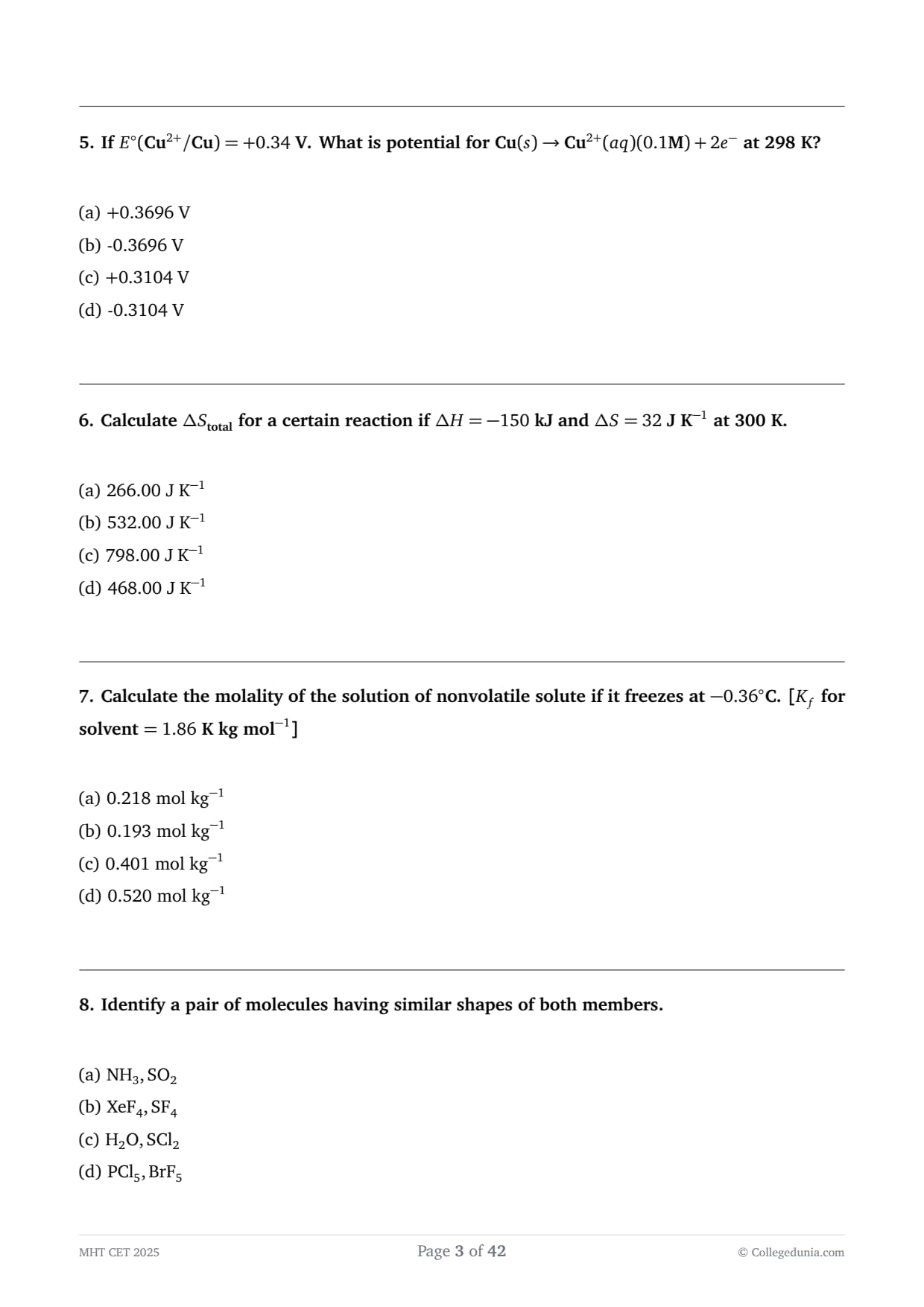
If \(E^{\circ}(Cu^{2+}/Cu)=+0.34 V\). What is potential for \(Cu(s)\rightarrow Cu^{2+}(aq)(0.1M)+2e^{-}\) at 298 K?
Calculate \(\Delta S_{total}\) for a certain reaction if \(\Delta H=-150 kJ\) and \(\Delta S=32 J K^{-1}\) at 300 K.
Calculate the molality of the solution of nonvolatile solute if it freezes at \(-0.36^{\circ}C\). [\(K_{f}\) for solvent \(=1.86 K kg mol^{-1}\)]
Identify a pair of molecules having similar shapes of both members.
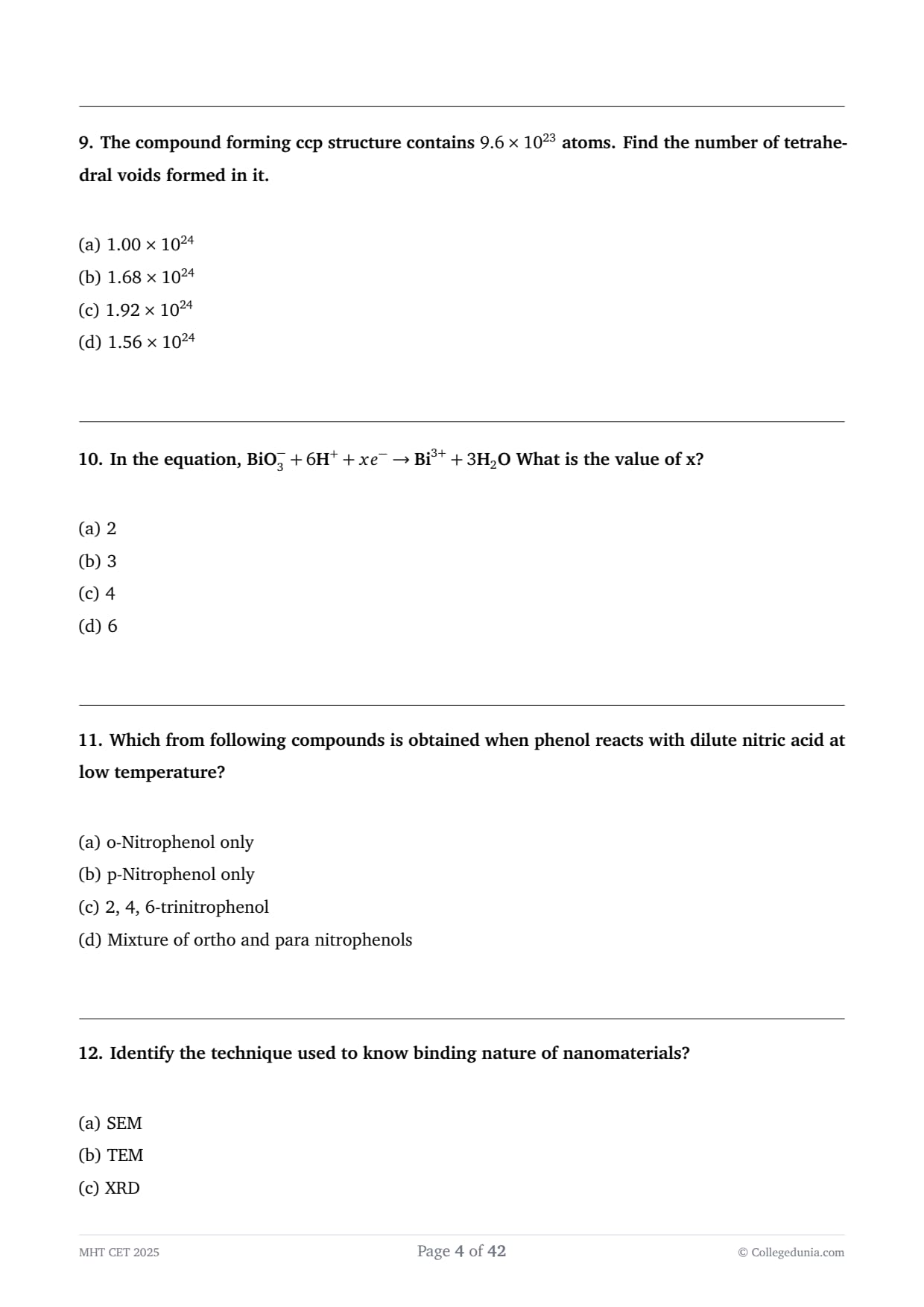
The compound forming ccp structure contains \(9.6\times10^{23}\) atoms. Find the number of tetrahedral voids formed in it.
In the equation, \(BiO_{3}^{-}+6H^{+}+xe^{-}\rightarrow Bi^{3+}+3H_{2}O\) What is the value of x?
Which from following compounds is obtained when phenol reacts with dilute nitric acid at low temperature?
Identify the technique used to know binding nature of nanomaterials?
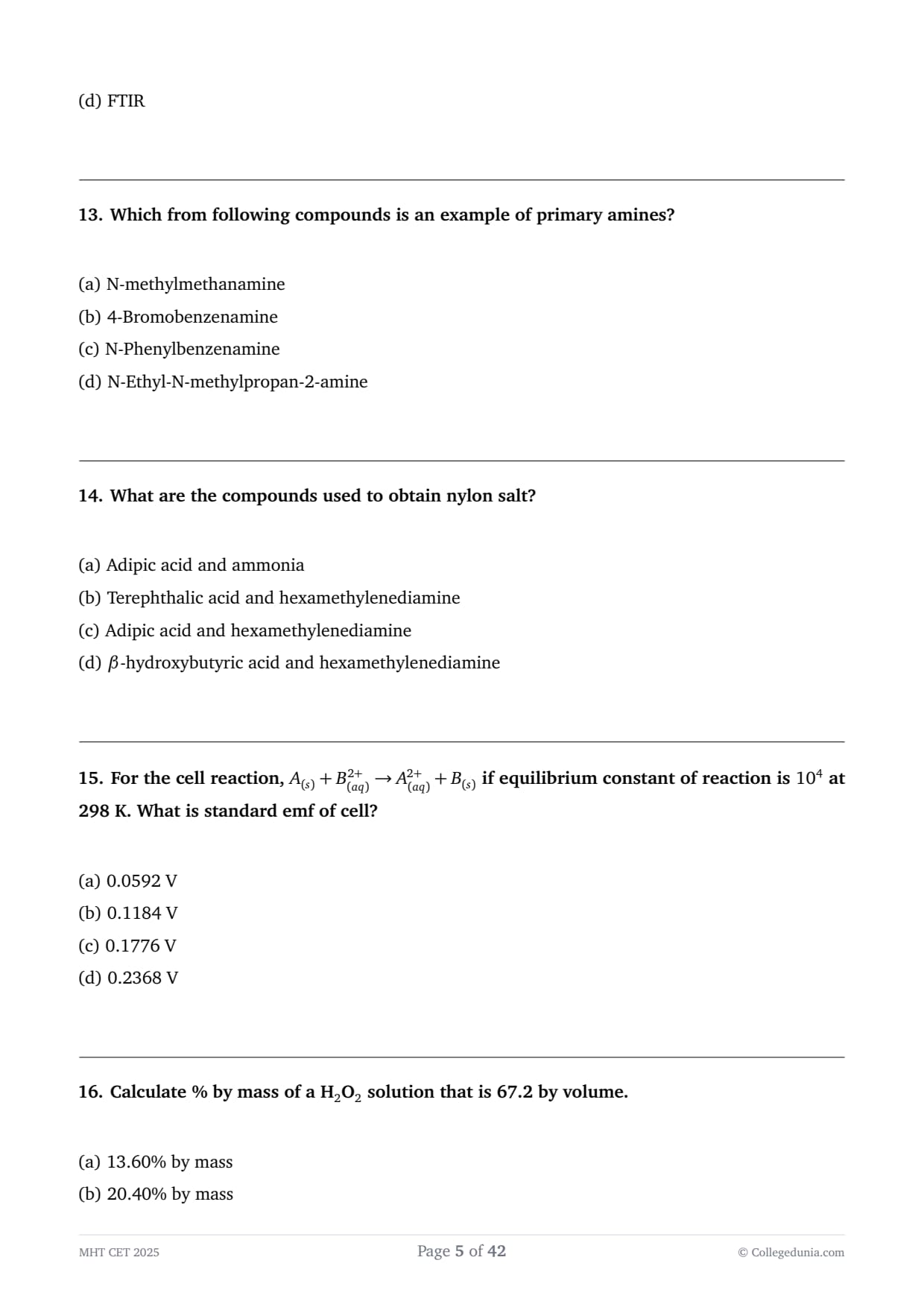
Which from following compounds is an example of primary amines?
What are the compounds used to obtain nylon salt?
For the cell reaction, \(A_{(s)}+B_{(aq)}^{2+}\rightarrow A_{(aq)}^{2+}+B_{(s)}\) if equilibrium constant of reaction is \(10^{4}\) at 298 K. What is standard emf of cell?
Calculate % by mass of a \(H_{2}O_{2}\) solution that is 67.2 by volume.
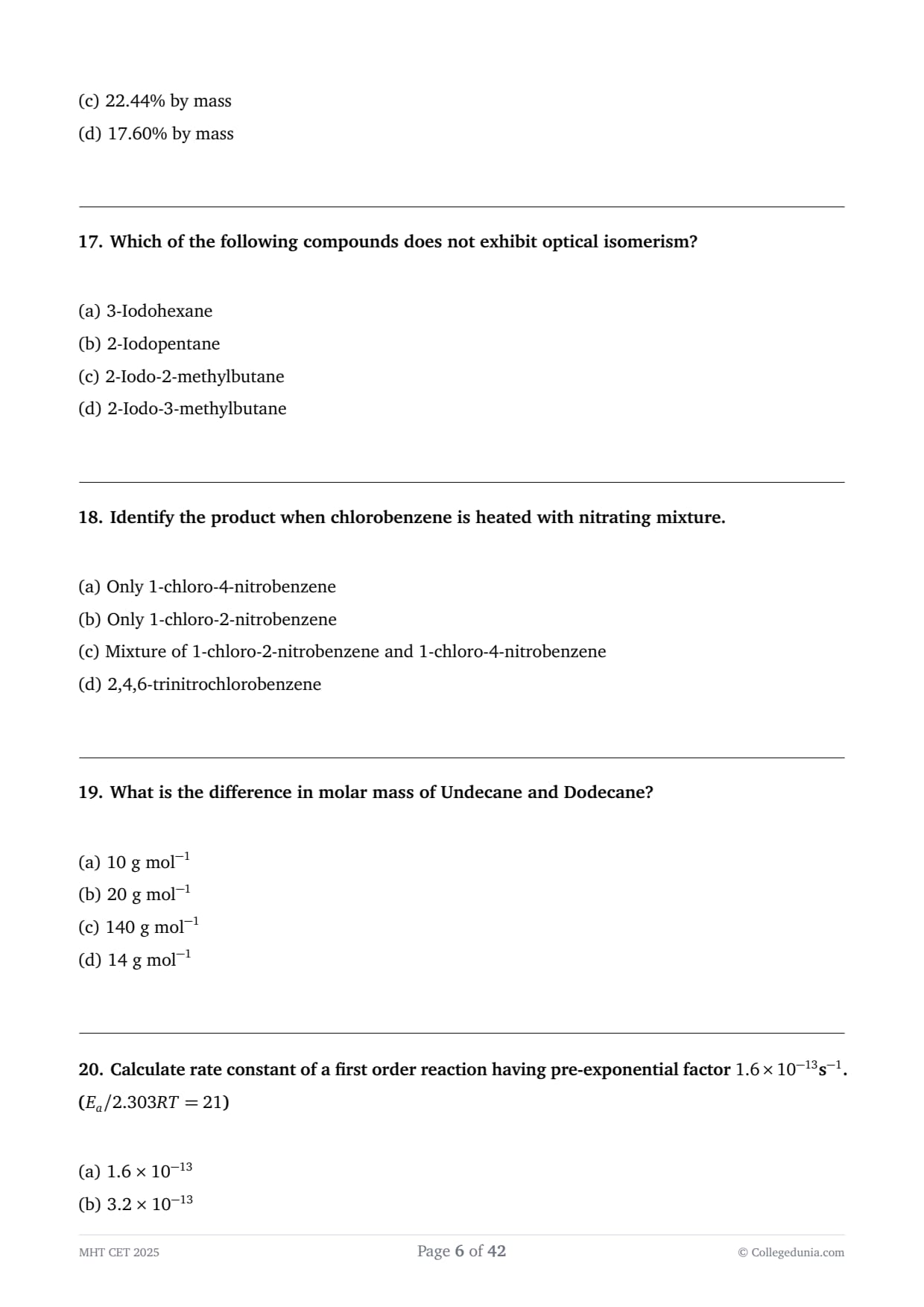
Which of the following compounds does not exhibit optical isomerism?
Identify the product when chlorobenzene is heated with nitrating mixture.
What is the difference in molar mass of Undecane and Dodecane?
Calculate rate constant of a first order reaction having pre-exponential factor \(1.6\times10^{-13}s^{-1}\). (\(E_{a}/2.303RT=21\))
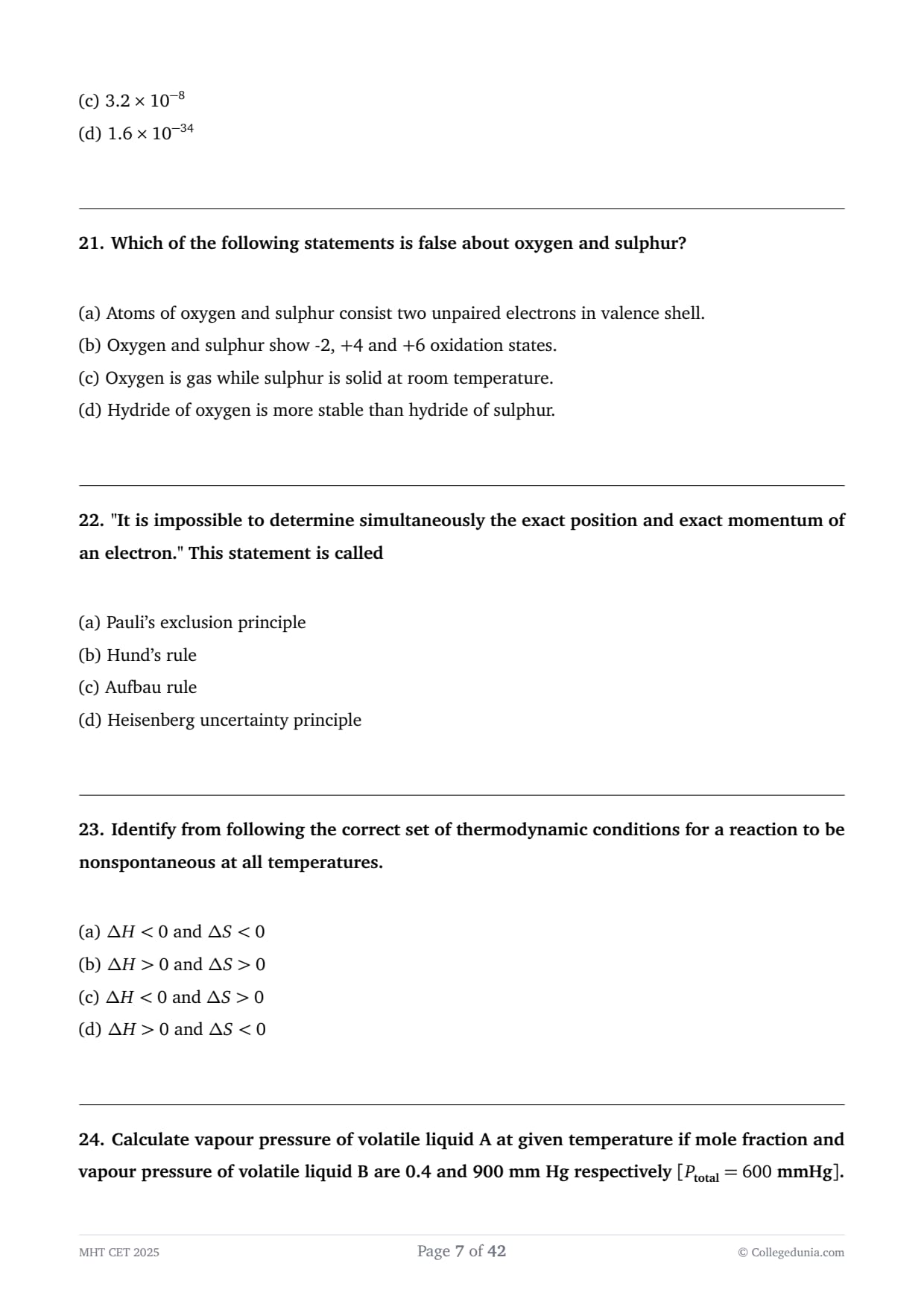
Which of the following statements is false about oxygen and sulphur?
"It is impossible to determine simultaneously the exact position and exact momentum of an electron." This statement is called
Identify from following the correct set of thermodynamic conditions for a reaction to be nonspontaneous at all temperatures.
Calculate vapour pressure of volatile liquid A at given temperature if mole fraction and vapour pressure of volatile liquid B are 0.4 and 900 mm Hg respectively \([P_{total}=600 mmHg]\).
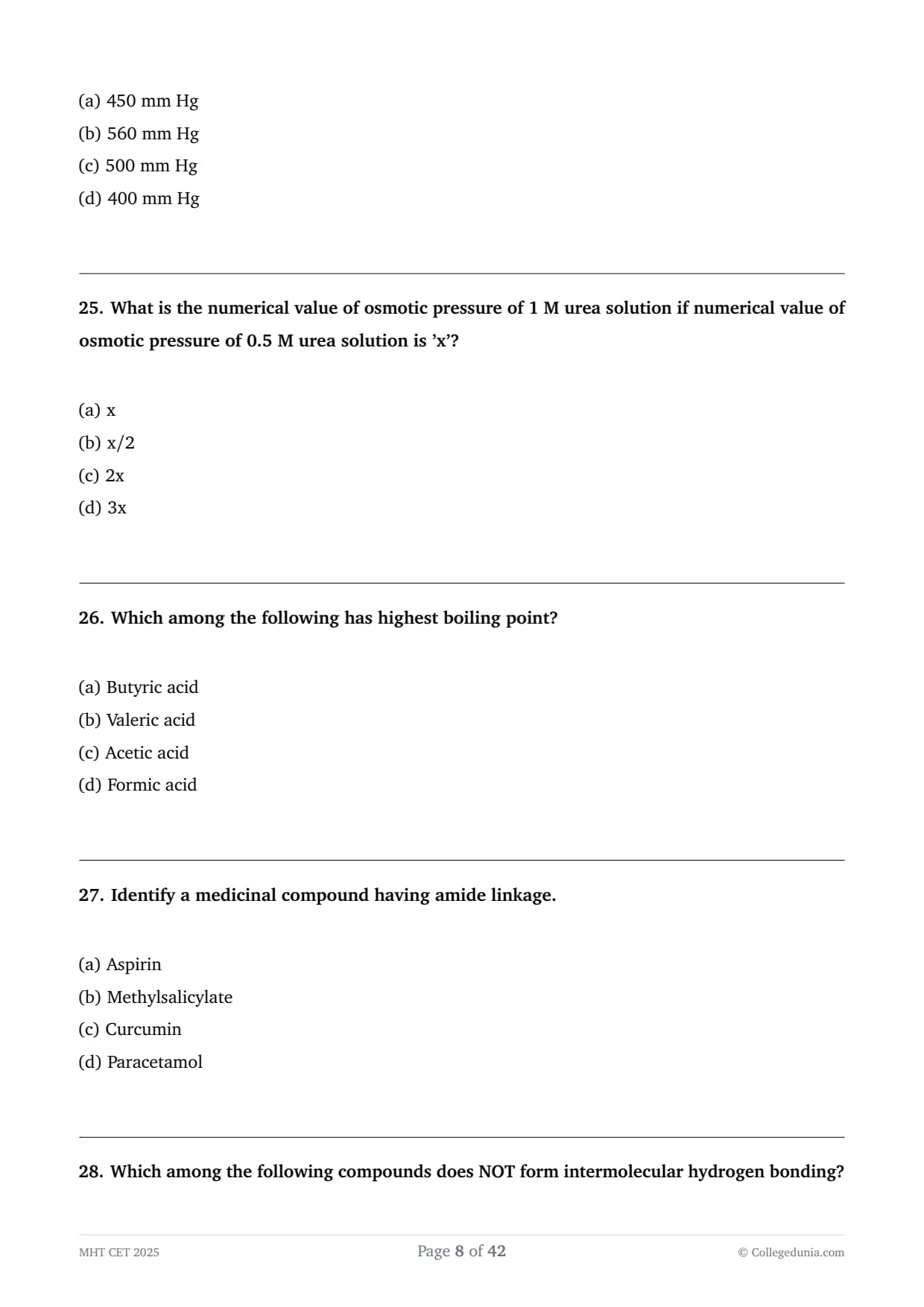
What is the numerical value of osmotic pressure of 1 M urea solution if numerical value of osmotic pressure of 0.5 M urea solution is 'x'?
Which among the following has highest boiling point?
Identify a medicinal compound having amide linkage.
Which among the following compounds does NOT form intermolecular hydrogen bonding?
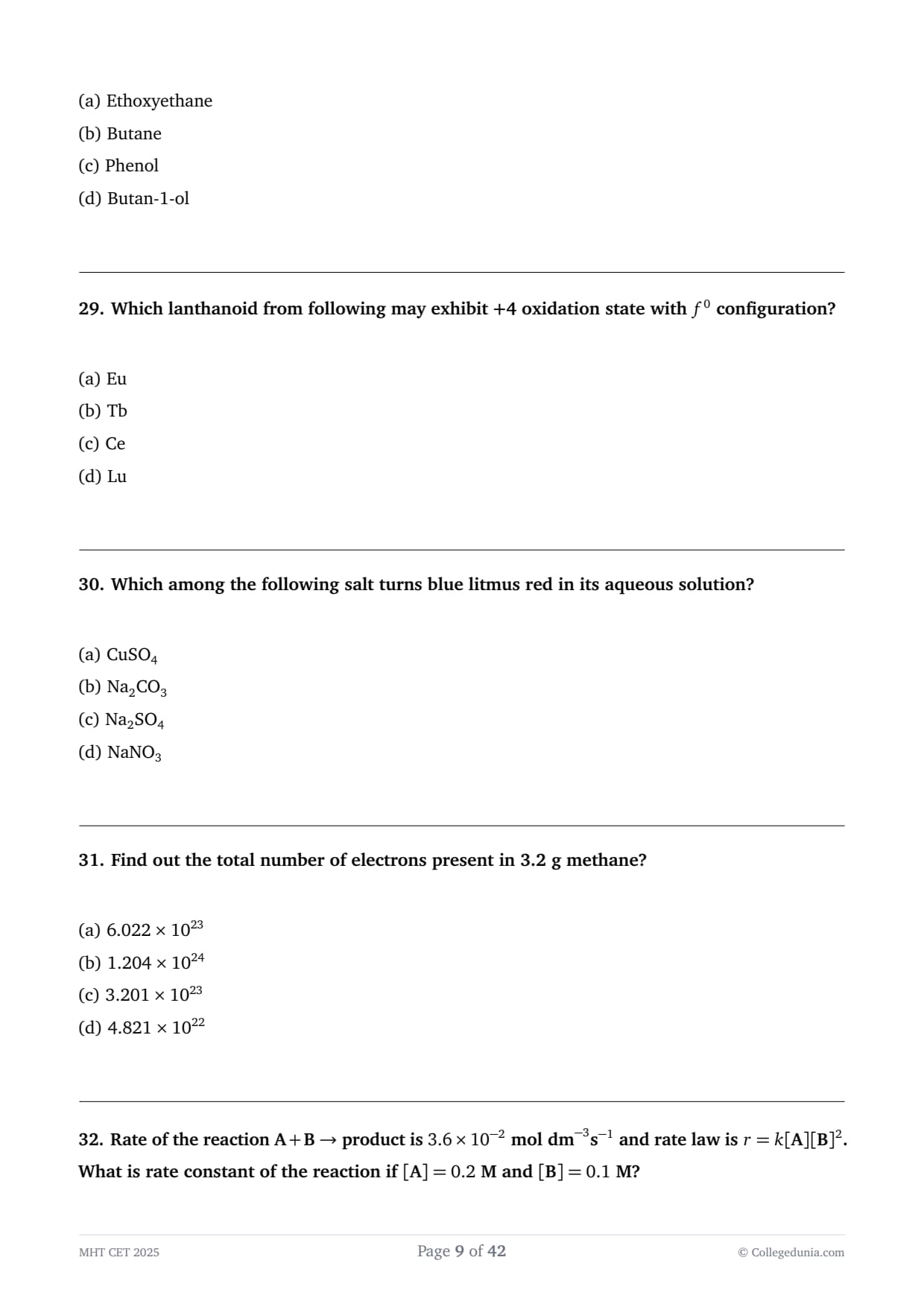
Which lanthanoid from following may exhibit +4 oxidation state with \(f^{0}\) configuration?
Which among the following salt turns blue litmus red in its aqueous solution?
Find out the total number of electrons present in 3.2 g methane?
Rate of the reaction \(A+B\rightarrow\) product is \(3.6\times10^{-2} mol dm^{-3}s^{-1}\) and rate law is \(r=k[A][B]^{2}\). What is rate constant of the reaction if \([A]=0.2\) M and \([B]=0.1\) M?
Identify the product 'A' formed in the following reaction (Addition of \(Br_{2}\) to an alkene).

What are the positions of 'N' atoms present in purine ring of nucleic acids?
Which from following compounds contains complex anions?
Which among the following gases is least adsorbed on solid at similar conditions of temperature and pressure?
Dissociation constant of 0.01 M weak acid is \(10^{-4}\). What is percent dissociation of acid?
Equal masses of helium and oxygen are mixed in an empty container at \(25^{\circ}C\). What is the fraction of the total pressure exerted by helium?
Calculate the change in internal energy of the system if work done by the system is 18 joule and absorbs heat 50 joule in a particular reaction.
What is the expected order of basic strength of different compounds from following (in gaseous phase)?
Which of the following does NOT exhibit haloform reaction?
Which from following polymers does NOT contain either -COO- or -CO-NH- linkage in it?
What is the coordination number of a particle in simple cubic close packed structure?
Identify the products of following reaction: Formaldehyde + Benzaldehyde \(\xrightarrow{i. conc. NaOH ii. H_3O^+}\) Products.
Identify the order of following reaction: \(2NO_{2}(g)\rightarrow2NO(g)+O_{2}(g)\).
Which from following is a weak field ligand?
Identify neutral amino acid from following list represented by three letter symbols.
Which of the following changes takes place at positive electrode during recharging of lead accumulator?
Which of the following reagents is used to convert \(C\equiv C\) triple bond to \(C=C\) double bond to give Cis isomer of alkene?
The solubility product of AgBr is \(4.9\times10^{-13}\) at a certain temperature. Calculate the solubility.
Consider statements \(p\) : \(S_1\) is closed; \(q\) : \(S_2\) is closed; \(r\) : \(S_3\) is closed. The simplified equivalent circuit diagram and its logical statement for the switching circuit is respectively ______.

- (a)
![]()
- (b)
![]()
- (c)
![]()
- (d)
![]()


The volume of tetrahedron with co-terminus edges \(\vec{a}\), \(\vec{b}\), \(\vec{c}\) is \(\frac{64}{3}\) cubic units, then volume of parallelopiped considering co-terminus edges given by the vectors \(\vec{a} + \vec{b}\), \(\vec{b} + \vec{c}\), \(\vec{c} + \vec{a}\) is ______ cubic units.
If \(y = \tan^{-1} \left( \sqrt{\frac{1+\sin x}{1-\sin x}} \right)\), \(0 \le x < \frac{\pi}{2}\), then \(y' \left( \frac{\pi}{6} \right) = \) ______.
If \(f(x) = \frac{\sin^2 x}{1+\cot x} + \frac{\cos^2 x}{1+\tan x}\), then the value of \(f'(\frac{\pi}{6})\) is equal to ______.
\(\int \frac{\sqrt{\tan x}}{\sin x \cdot \cos x} \, dx = \) ______.
If \(\int \frac{dx}{x^4 + 5x^2 + 4} = A \tan^{-1} x + B \tan^{-1} \frac{x}{2} + c\) where \(c\) is a constant of integration, then ______.
The number of positive integral solutions of \(\tan^{-1} x + \cos^{-1} \left( \frac{y}{\sqrt{1+y^2}} \right) = \sin^{-1} \left( \frac{3}{\sqrt{10}} \right)\) are ______.
If the plane \(\frac{x}{2} + \frac{y}{3} + \frac{z}{6} = 1\) cuts the co-ordinate axes at points A, B, C respectively, then area of the triangle ABC is ______.
Matrix A is non-singular matrix and \((A - 3I)(A - 5I) = 0\), then \(\frac{15}{8} A^{-1} = \dots\dots\)
\(\int_{1/2}^{2} \frac{1}{x} \csc^{101} \left( x - \frac{1}{x} \right) dx = \) ______.
The differential equation which represents the family of curves \(y = c_1 e^{c_2 x}\), where \(c_1, c_2\) are arbitrary constants is ______.
\(\lim_{x \to \infty} \frac{(2x+1)^{50} + (2x+2)^{50} + (2x+3)^{50} + \dots + (2x+100)^{50}}{(2x)^{50} + (10)^{50}} = \) ______.
The number of ways in which a team of 11 players can be formed out of 25 players, if 6 out of them are always to be included and 5 of them are always to be excluded, is ______.
A box contains 8 red and \(x\) number of green balls. 3 balls are drawn at random, if the probability that 3 balls being red is \(\frac{7}{15}\), then number of green balls is ______.
The equation of a curve passing through (1,0) and having slope of tangent at any point (x, y) of the curve as \(\frac{y-1}{x^2+x}\) is ______.
If \(y = \alpha \log x + \beta x^2 - x\) has extreme values at \(x = -1\) and \(x = 1\), then \(\alpha\) and \(\beta\) are respectively ______.
The equation of the tangent to the curve \((1 + x^2)y = 2 - x\), where it crosses the X-axis, is ______.
The following is p.d.f. of continuous random variable X: \(f(x) = \frac{x}{8}\) for \(0 < x < 4\). Then \(F(0.5)\), \(F(1.7)\) and \(F(5)\) is respectively ______.
A manufacturer sells \(x\) items at a price of ₹\((6 - \frac{x}{40})\) each. The cost price of \(x\) items is ₹\((\frac{x}{5} + 193)\). The maximum profit in ₹ is ______.
The mirror image of the point \(P(-1, 2, -4)\) in the plane \(x - y - 2z + 1 = 0\) is ______.
The cumulative distribution function of a discrete random variable X is given. Then \(\frac{P(X \le 0)}{P(X > 0)} = \) ______.

If \(\vec{a} = \lambda x \hat{i} + y \hat{j} + 4z \hat{k}\), \(\vec{b} = x \hat{i} + y \hat{j} + 3y \hat{k}\), and \(\vec{c} = -2 \hat{i} - 2z \hat{j} - (\lambda + 1) \hat{k}\) such that \(\vec{a} + \vec{b} - \vec{c} = \vec{0}\), then the value of \(\lambda\) is ______.
A triangle ABC is formed by A(1, -1, 0), B(3, 5, 3), C(-11, -5, 6). The equation of the internal angle bisector of angle A is ______.
The circumcenter of the triangle formed by lines \(xy + 2x + 2y + 4 = 0\) and \(x + y + 2 = 0\) is ______.
The angle between lines whose direction cosines satisfy the equation \(l + m + n = 0\) and \(l^2 - m^2 - n^2 = 0\), is ______.
The solution for minimizing the function \(z = x + y\) under an L.P.P. with constraints \(x + y \ge 2\), \(x + 2y \le 8\), \(y \le 3\), \(x, y \ge 0\) is ______.
The angle between the tangents drawn from the point (1, 4) to the parabola \(y^2 = 4x\), is ______.
If \(\int \frac{(x^4+1)}{x(x^2+1)^2} \, dx = A \log |x| + \frac{B}{1+x^2} + c\), then \(A - B\) is ______.
Let \(\vec{a}\), \(\vec{b}\) and \(\vec{c}\) be vectors of magnitude 2, 3 and 4 respectively. If \(\vec{a} \cdot (\vec{b} + \vec{c}) = 0\), \(\vec{b} \cdot (\vec{c} + \vec{a}) = 0\) and \(\vec{c} \cdot (\vec{a} + \vec{b}) = 0\), then the magnitude of \(\vec{a} + \vec{b} + \vec{c}\) is ______.
If \(\vec{a}\), \(\vec{b}\), \(\vec{c}\) are three coplanar vectors such that \(|\vec{a}| = 1\), \(|\vec{b}| = 2\), \(\vec{b} \cdot \vec{c} = 8\), the angle between \(\vec{b}\) and \(\vec{c}\) is \(45^\circ\), then \(|\vec{a} \times (\vec{b} \times \vec{c})| = \) ______.
In a triangle ABC, with usual notations, \((a + b + c)(a + b - c) = 3ab\), then \(\angle C = \) ______.
In a triangle ABC, with usual notations, \(\cot\left(\frac{A+B}{2}\right) \cdot \tan\left(\frac{A-B}{2}\right) = \) ______.
If the truth value of the expression \([(p \vee q) \wedge (q \to r) \wedge (\sim r)] \to (p \wedge q)\) is False, then truth values of p, q, r are respectively ______.
\(\int_0^1 \tan^{-1} x \, dx = \) ______.
If \(f(x) = \frac{\cos ax - \cos bx}{\cos cx - \cos bx}\) for \(x \ne 0\) and \(f(0) = -1\) is continuous at \(x = 0\), then \(a^2, b^2, c^2\) are in ______.
The area of smaller part between the circle \(x^2 + y^2 = 4\) and the line \(x = 1\) is ______ sq. units.
If \([x]^2 - 5[x] + 6 = 0\), where \([.]\) denotes the greatest integer function, then ______.
The modulus of the square root of the complex number \(6 + 8i\) (where \(i = \sqrt{-1}\)) is ______.
If \(f(x) = \sqrt{1 + \cos^2(x^2)}\), then \(f'(\frac{\sqrt{\pi}}{2})\) is ______.
The equation of the directrix of the parabola \(y^2 + 4y + 4x + 2 = 0\) is ______.
Let \(\vec{a} = \alpha\hat{i} + 3\hat{j} - \hat{k}\), \(\vec{b} = 3\hat{i} - \hat{j} + \beta\hat{k}\) and \(\vec{c} = \hat{i} + 2\hat{j} - 2\hat{k}\) where \(\alpha, \beta \in \mathbb{R}\), be three vectors. If the projection of \(\vec{a}\) on \(\vec{c}\) is \(\frac{10}{3}\) and \(\vec{b} \times \vec{c} = -6\hat{i} + 10\hat{j} + 7\hat{k}\), then the value of \((\alpha + \beta)\) is ______.
If \(\sin^{-1}(4x) + \sin^{-1}(4\sqrt{3}x) = -\frac{\pi}{2}\), then the value of \(x\) is ______.
In a triangle ABC, with usual notations, if \(a = 5\), \(b = 7\), \(\sin A = \frac{3}{4}\), then total number of triangles possible are ______.
If the foot of the perpendicular drawn from the origin to a plane is P(-1, -1, 2), then the equation of the plane is ______.
The least distance of the point A(10, 7) from the circle \(x^2 + y^2 - 4x - 2y - 20 = 0\) is length of seg AM. If MM' is the diameter of the circle, then the lengths of AM and AM' are respectively ______, ______ units.
The money invested in a company is compounded continuously. If Rs. 400 invested today becomes Rs. 800 in 6 years, then at the end of 30 years, it will become (in Rs.) ______.
The line MN whose equation is \(x - y - 2 = 0\) cuts the X-axis at M and coordinates of N are (4, 2). The line MN is rotated about M through \(45^{\circ}\) in anticlockwise direction. The equation of the line MN in the new position is ______.
If \(\tan(\pi \cos \theta) = \cot(\pi \sin \theta)\), then \(\sin\left(\frac{\pi}{4} + \theta\right) = \) ______.
The probability that a person is not a sportsperson is \(1/6\). Then the probability that out of 6 members of the family, 5 are sportspersons is ______.
The general solution of the differential equation \(\frac{dy}{dx} = \cot x \cdot \cot y\) is ______.
In series LCR circuit C = 2\(\mu\)F, L = 5mH and R = 5\(\Omega\). The ratio of energy stored in the inductor to that in capacitor, when maximum current flows through the circuit is ______.
A boy throws a ball vertically upwards from a bridge with velocity 5 m/s. It strikes water surface after 2 s. The height of the bridge is (Take g = 10 m/s\(^2\)) ______.
In Sonometer experiment, the frequency of a tuning fork used is 288 Hz. Harmonics will 'NOT' be produced at the frequency ______.
The ratio of energies of photons produced due to transition of electron of hydrogen atom from its (i) third to 2nd energy level and (ii) highest energy level to 3rd level is ______.
A magnetic field \(4 \times 10^{-2}\) T acts at right angles to a coil of area \(100\) cm\(^2\) with 50 turns. The average e.m.f. induced in the coil is 0.1 V, when it is removed from the field in time 't'. The value of 't' is ______.
A sphere of mass 'm', moving with velocity '3u' collides head-on with another identical sphere at rest. If 'e' is coefficient of restitution then what will be the ratio of velocity of the second sphere to that of first sphere after collision?
In Paschen series, wavelength of first line is '\(\lambda_1\)' and for Brackett series, wavelength of first line is '\(\lambda_2\)' then ratio \(\frac{\lambda_1}{\lambda_2}\) is ______.
An air column is of length 17 cm. The ratio of frequencies of 5th overtone if the air column is closed at one end to that open at both ends is (velocity of sound in air = 340 ms\(^{-1}\)) ______.
A body weighs 45 N on the surface of the earth. The gravitational force on a body due to earth at a height equal to half the radius of earth will be ______.
Moment of inertia of the rod about an axis passing through the centre and perpendicular to its length is '\(I_1\)'. The same rod is bent into a ring and its moment of inertia about the diameter is '\(I_2\)'. Then \(I_1/I_2\) is ______.
The potentiometer wire is 5 m long and potential difference of 4 V is maintained between the ends. The e.m.f. of the cell which balances against a length of 200 cm of the potentiometer wire is ______.
The error in the measurement of length and mass is 3% and 4% respectively. The error in the measurement of density will be ______.
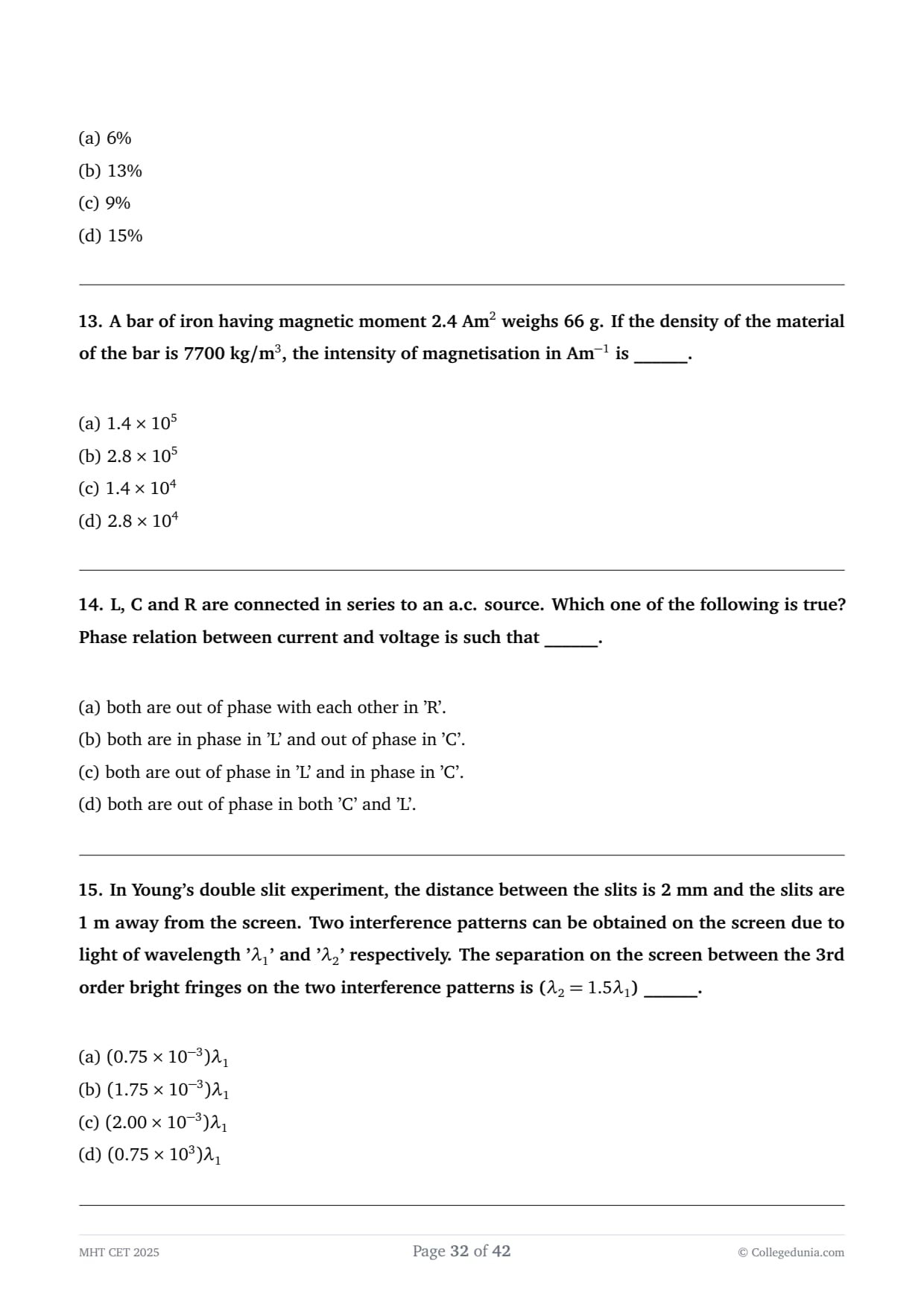
A bar of iron having magnetic moment 2.4 Am\(^2\) weighs 66 g. If the density of the material of the bar is 7700 kg/m\(^3\), the intensity of magnetisation in Am\(^{-1}\) is ______.
L, C and R are connected in series to an a.c. source. Which one of the following is true? Phase relation between current and voltage is such that ______.
In Young's double slit experiment, the distance between the slits is 2 mm and the slits are 1 m away from the screen. Two interference patterns can be obtained on the screen due to light of wavelength '\(\lambda_1\)' and '\(\lambda_2\)' respectively. The separation on the screen between the 3rd order bright fringes on the two interference patterns is (\(\lambda_2 = 1.5\lambda_1\)) ______.
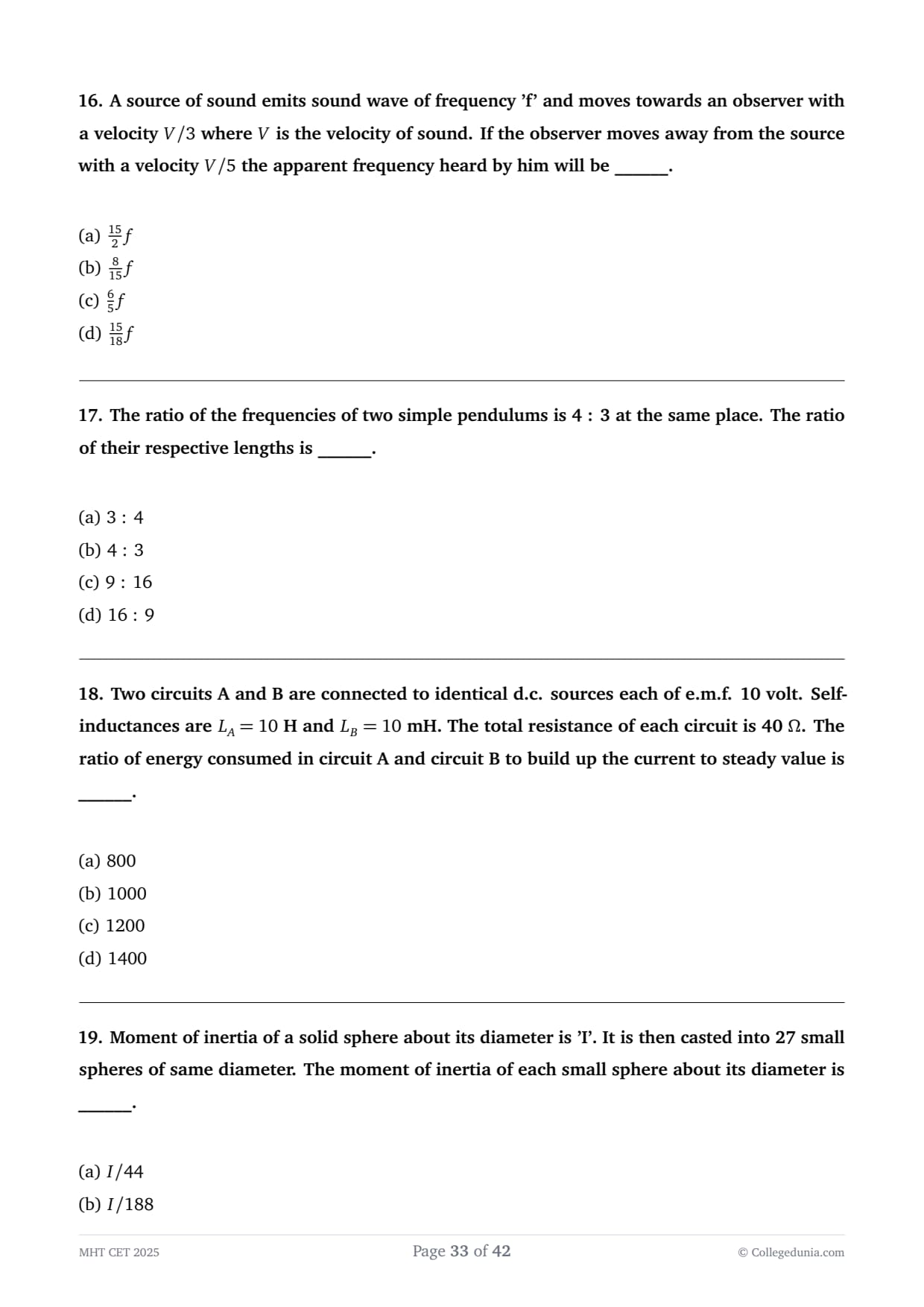
A source of sound emits sound wave of frequency 'f' and moves towards an observer with a velocity \(V/3\) where \(V\) is the velocity of sound. If the observer moves away from the source with a velocity \(V/5\) the apparent frequency heard by him will be ______.
The ratio of the frequencies of two simple pendulums is 4 : 3 at the same place. The ratio of their respective lengths is ______.
Two circuits A and B are connected to identical d.c. sources each of e.m.f. 10 volt. Self-inductances are \(L_A = 10\) H and \(L_B = 10\) mH. The total resistance of each circuit is 40 \(\Omega\). The ratio of energy consumed in circuit A and circuit B to build up the current to steady value is ______.
Moment of inertia of a solid sphere about its diameter is 'I'. It is then casted into 27 small spheres of same diameter. The moment of inertia of each small sphere about its diameter is ______.
Fundamental frequency of sonometer wire is 'n'. If the tension and length are increased 3 times and diameter is increased twice, the new frequency will be ______.
Let \(R_1, R_2\) and \(R_3\) be the radii of three mercury drops. A big mercury drop is formed from them under isothermal conditions. The radius of the resultant drop is ______.
An infinitely long straight conductor carrying current 'I' is bent into a shape as shown in figure. The radius of the circular loop is 'r'. The magnetic induction at the centre of the loop at point 'O' is ______.

The difference in length between two rods A and B is 60 cm at all temperatures. If \(\alpha_A = 18 \times 10^{-6}/^\circ C\) and \(\alpha_B = 27 \times 10^{-6}/^\circ C\), then the length of rod A and rod B at \(0^\circ C\) is respectively ______.
Charges of \(2\mu C\) and \(-3\mu C\) are placed at two points A and B separated by distance of 1 m. The distance of the point from A where net potential is zero is ______.
The heat energy that must be supplied to 14 gram of nitrogen at room temperature to raise its temperature by \(48^\circ C\) at constant pressure is (Molecular weight of nitrogen = 28, R = gas constant, \(C_p = 7/2 R\) for diatomic gas) ______.
The wavelength '\(\lambda\)' of a photon and the deBroglie wavelength of an electron have same value. The ratio of kinetic energy of the electron to the energy of a photon is ______.
A monochromatic ray of light is incident normally on a thin prism of refracting angle A. The ray is deviated through an angle \((1.15)^\circ\) in passing through the prism. The ray reflected internally from the second face emerges from the first face making an angle of \((6.3)^\circ\) with the incident ray. The refractive index of the prism is ______.
Two black spheres P & Q have radii in the ratio 4 : 3. The wavelength of maximum intensity of radiation are in the ratio 4 : 5 respectively. The ratio of radiated power by P to Q is ______.
The capacity of air filled parallel plate capacitor is \(C_0\). One-half of the space between the plates is filled with a dielectric constant 'K' as shown in figure. The new capacity becomes \(C_n\). The ratio \(C_n\) to \(C_0\) is ______.

A rigid body rotates about a fixed axis with variable angular velocity \((\alpha - \beta t)\) at time \(t\), where \(\alpha\) and \(\beta\) are constants. The angle through which it rotates before it comes to rest is ______.
A resistor of 5 \(\Omega\), inductor of self inductance \(\left(\frac{2}{\pi}\right)\) H and a capacitor of unknown capacity are connected in series to an a.c. source of 100 V, 50 Hz supply. When the voltage and current are in phase, the value of capacitance is ______.
A single slit diffraction pattern is formed with white light. For what wavelength of light the 4th secondary maximum in diffraction pattern coincides with the 3rd secondary maximum in the pattern of light of wavelength '\(\lambda\)'?
The temperature at which oxygen molecules will have same r.m.s. speed as helium molecules at 57\(^\circ\)C is (molecular masses of oxygen and helium are 32 and 4 respectively.) ______.
Out of the following statements which is NOT the characteristics of electric lines of force? ______.
An ideal gas expands adiabatically, (\(\gamma = 1.5\)). To reduce the r.m.s. velocity of the molecules 4 times, the gas has to be expanded ______.
The ratio of the distance of \(n^{th}\) bright band and \(m^{th}\) dark band from the central bright band in an interference pattern is ______.
The material used for solar cell should have band gap ______.
A spring executes S.H.M. with mass 1 kg attached to it. The force constant of the spring is 4 N/m. If at any instant its velocity is 20 cm/s, the displacement at that instant is (Amplitude of S.H.M. is 0.4 m) ______.
Three capacitors are connected to a battery as shown in figure. The ratio of charge on capacitors \(C_3\) and \(C_1\) is ______.

(Assuming standard bridge configuration where \(C_1\) is in series with parallel \(C_2, C_3\) based on OCR artifacts, or the visual Delta where battery connects to the base)
If \(|\vec{a}| = \sqrt{26}\), \(|\vec{b}| = 7\), \(|\vec{a} \times \vec{b}| = 35\), find \(\vec{a} \cdot \vec{b}\)
125 small water drops of same size fall through air with constant velocity 4 cm/s. They coalesce to form a big drop. The terminal velocity of the big drop is ______.
At a place, the length of the oscillating simple pendulum is made \(1/4\) times keeping amplitude same then the total energy will be ______.
When magnetic flux changes from \(6.5 \times 10^{-2}\) Wb to \(11 \times 10^{-2}\) Wb and the change in current is 0.03 A, the coefficient of mutual inductance will be ______.
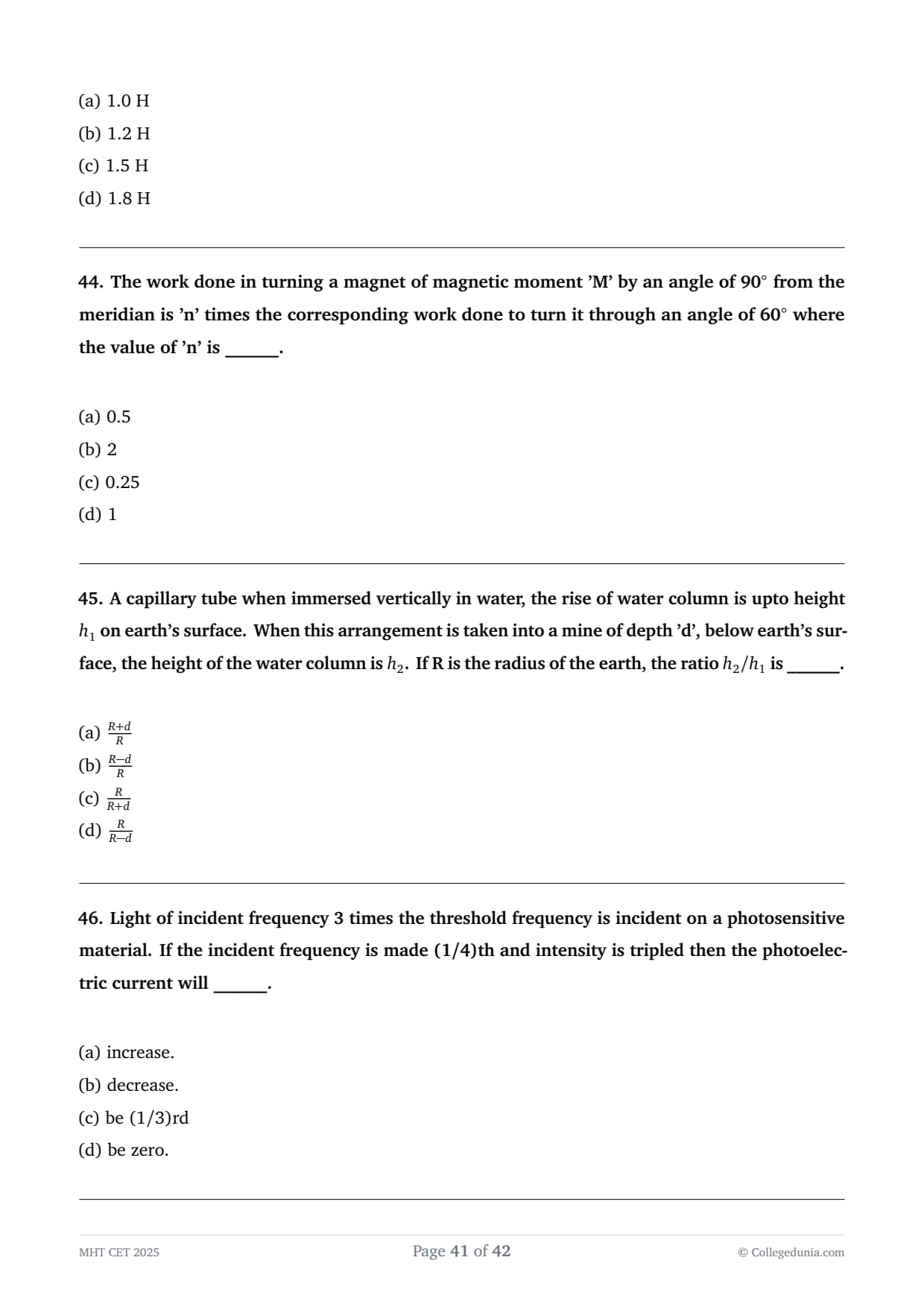
The work done in turning a magnet of magnetic moment 'M' by an angle of 90\(^\circ\) from the meridian is 'n' times the corresponding work done to turn it through an angle of 60\(^\circ\) where the value of 'n' is ______.
A capillary tube when immersed vertically in water, the rise of water column is upto height \(h_1\) on earth's surface. When this arrangement is taken into a mine of depth 'd', below earth's surface, the height of the water column is \(h_2\). If R is the radius of the earth, the ratio \(h_2/h_1\) is ______.
Light of incident frequency 3 times the threshold frequency is incident on a photosensitive material. If the incident frequency is made (1/4)th and intensity is tripled then the photoelectric current will ______.
Applying forward bias to p-n junction, the potential barrier ______.
In case of free expansion, which one of the following statements is WRONG ______.
In a common emitter transistor amplifier circuit, the input resistance is 1.8 k\(\Omega\) and output is obtained across a load resistance of 9 k\(\Omega\). The alternating current gain is 70. Corresponding to an a.c. input voltage of 6 mV, the output voltage will be ______.
When a resistance of 100 \(\Omega\) is connected in series with a galvanometer of resistance 'G', its range is 'V'. To double its range, a resistance of 1000 \(\Omega\) is connected in series. The value of 'G' is ______.
MHT CET 2025 PCM Subject-wise Weightage
MHT CET 2025 for PCM (Physics, Chemistry, Mathematics) exam is held for admission to B.Tech/B.E. and Pharmacy courses in Maharashtra.
The PCM paper has 150 questions (50 questions each of Physics, Chemistry, and Mathematics), with Mathematics having 2 marks per question and Physics and Chemistry having 1 mark each.
Also Check:
MHT-CET 2025 Topper’s Strategy: Scoring 90 Percentile
MHT CET 2025 PCM Chapter-wise Weightage (Expected)
| Subject | Important Chapters (Class 11 & 12) | Expected Weightage |
|---|---|---|
| Physics |
|
8–10 Questions |
|
6–8 Questions | |
|
5–6 Questions | |
| Chemistry |
|
10–12 Questions |
|
6–8 Questions | |
|
5–7 Questions | |
| Mathematics |
|
10–12 Questions |
|
7–9 Questions | |
|
5–7 Questions |
MHT CET 2025 Difficulty Level
MHT CET 2025, organized by the State CET Cell, Maharashtra, is likely to be patterned much the same as in previous years.The Exam is expected to be moderate in terms of difficulty, with Physics and Maths being more challenging than Chemistry.
As the exam is held online with no negative marking, the exam tends to test speed and accuracy rather than in-depth conceptual Knowledge.
MHT CET 2025 Subject-wise Expected Difficulty Level
| Subject | Expected Difficulty Level | Nature of Questions |
| Physics | Moderate to Difficult | Conceptual and Numerical based questions (e.g., Current Electricity, Modern Physics) |
| Chemistry | Easy to Moderate | Fact-based and Some Organic Mechanism questions (e.g., Thermodynamics, Coordination Compounds) |
| Mathematics | Moderate to Difficult | Lengthy and heavy Calculation based (e.g., Calculus, Vectors, Probability) |



Comments