MHT CET 2022 Aug 11 Shift 2 PCM Question Paper is available for download here. Maharashtra State CET Cell conducted MHT CET 2022 PCM Exam on Aug 11 in Shift 2 from 2 PM to 5 PM in CBT mode.

The MHT CET 2022 PCM question paper includes the following:

  • The MHT CET 2022 PCM Question Paper consists of 150 multiple-choice questions (MCQs) totalling 200 marks divided into 3 sections: Physics, Chemistry, and Mathematics, with 50 questions in each subject.
  • Physics and Chemistry questions carry 1 mark each while Mathematics questions carry 2 marks each.
  • There is no negative marking for incorrect answers.

MHT CET 2022 Aug 11 Shift 2 PCM Question Paper with Solution PDF

CD PDF CD PDF with Solutions
Download Collegedunia PDF 1.11 MB -

Also Check:

MHT CET 2022 Aug 11 Shift 2 PCM Questions with Solutions


Physics (Q1 - Q50)

Question 1:

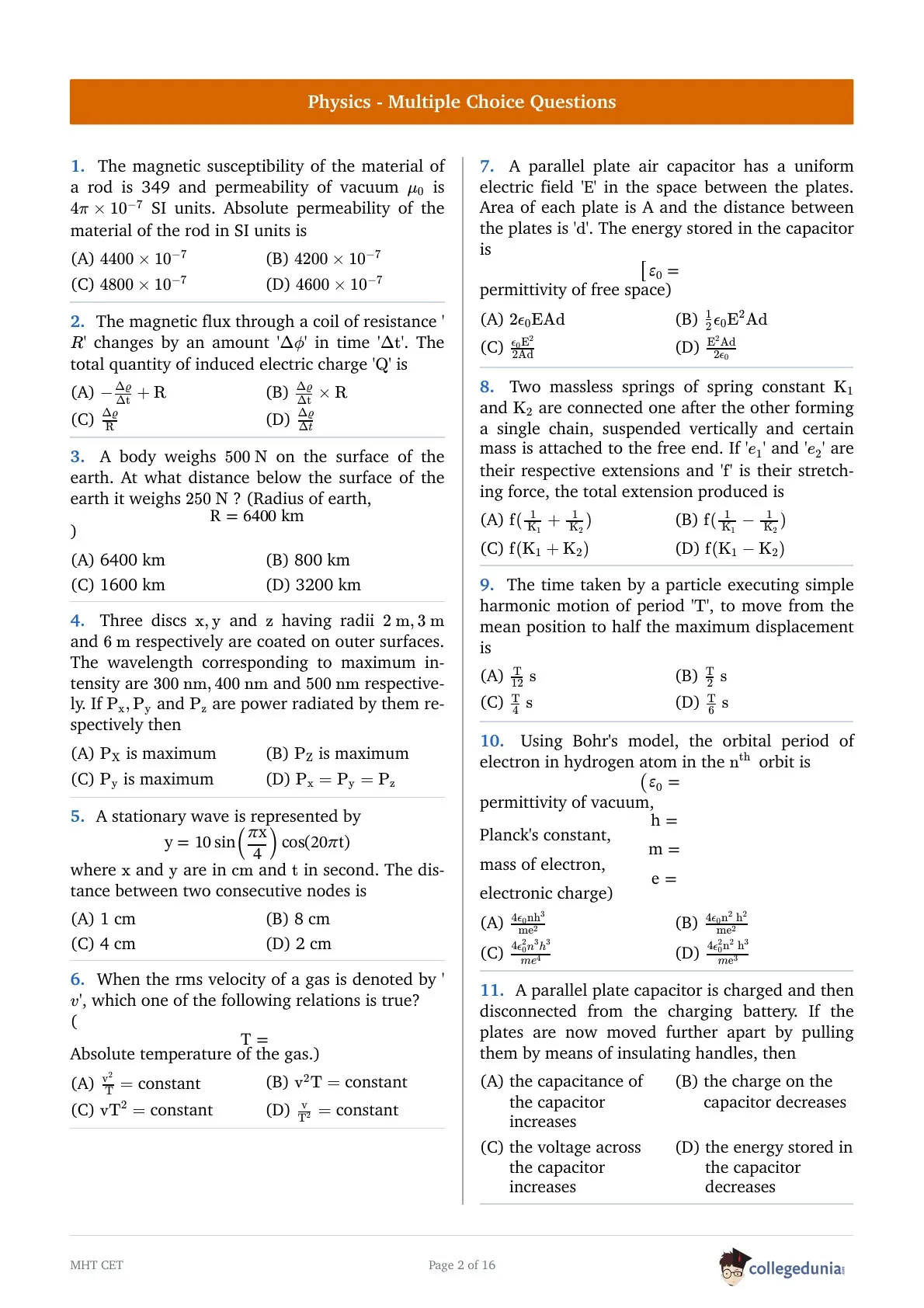
The magnetic susceptibility of the material of a rod is 349 and permeability of vacuum \[\mu_0\] is \[4 \pi \times 10^{-7}\] SI units. Absolute permeability of the material of the rod in SI units is

  • (A) \(4400\times 10^{-7}\)
  • (B) \(4200\times 10^{-7}\)
  • (C) \(4800\times 10^{-7}\)
  • (D) \(4600\times 10^{-7}\)

Question 2:

The magnetic flux through a coil of resistance '\[R\]' changes by an amount '\[\Delta \phi\]' in time '\[\Delta \mathrm{t}\]'. The total quantity of induced electric charge '\[\mathrm{Q}\]' is

  • (A) \(-\frac{\Delta \varrho}{\Delta \mathrm{t}}+\mathrm{R}\)
  • (B) \(\frac{\Delta \varrho}{\Delta \mathrm{t}}\times \mathrm{R}\)
  • (C) \(\frac{\Delta \varrho}{\mathrm{R}}\)
  • (D) \(\frac{\Delta \varrho}{\Delta t}\)

Question 3:

A body weighs \[500 \mathrm{~N}\] on the surface of the earth. At what distance below the surface of the earth it weighs \[250 \mathrm{~N}\] ? (Radius of earth, \[\mathrm{R}=6400 \mathrm{~km}\] )

  • (A) 6400 km
  • (B) 800 km
  • (C) 1600 km
  • (D) 3200 km

Question 4:

Three discs \[\mathrm{x}, \mathrm{y}\] and \[\mathrm{z}\] having radii \[2 \mathrm{~m}, 3 \mathrm{~m}\] and \[6 \mathrm{~m}\] respectively are coated on outer surfaces. The wavelength corresponding to maximum intensity are \[300 \mathrm{~nm}, 400 \mathrm{~nm}\] and \[500 \mathrm{~nm}\] respectively. If \[\mathrm{P}_{\mathrm{x}}, \mathrm{P}_{\mathrm{y}}\] and \[\mathrm{P}_{\mathrm{z}}\] are power radiated by them respectively then

  • (A) \(\mathrm{P}_{\mathrm{X}}\) is maximum
  • (B) \(\mathrm{P}_{\mathrm{Z}}\) is maximum
  • (C) \(\mathrm{P}_{\mathrm{y}}\) is maximum
  • (D) \(\mathrm{P}_{\mathrm{x}}=\mathrm{P}_{\mathrm{y}}=\mathrm{P}_{\mathrm{z}}\)

Question 5:

A stationary wave is represented by \[\mathrm{y}=10 \sin \left(\frac{\pi \mathrm{x}}{4}\right) \cos (20 \pi \mathrm{t})\] where \[\mathrm{x}\] and \[\mathrm{y}\] are in \[\mathrm{cm}\] and \[\mathrm{t}\] in second. The distance between two consecutive nodes is

  • (A) 1 cm
  • (B) 8 cm
  • (C) 4 cm
  • (D) 2 cm

Question 6:

When the rms velocity of a gas is denoted by '\[v\]', which one of the following relations is true?

(\[\mathrm{T}=\] Absolute temperature of the gas.)

  • (A) \(\frac{\mathrm{v}^{2}}{\text{ }\mathrm{T}}=\) constant
  • (B) \(\mathrm{v}^{2}\mathrm{T}=\) constant
  • (C) \(\mathrm{vT}^{2}=\) constant
  • (D) \(\frac{\mathrm{v}}{\mathrm{T}^{2}}=\) constant

Question 7:

A parallel plate air capacitor has a uniform electric field 'E' in the space between the plates. Area of each plate is A and the distance between the plates is '\[\mathrm{d}\]'. The energy stored in the capacitor is \[\left[\varepsilon_0=\right.\] permittivity of free space)

  • (A) \(2\epsilon _{0}\mathrm{EAd}\)
  • (B) \(\frac{1}{2}\epsilon _{0}\mathrm{E}^{2}\mathrm{Ad}\)
  • (C) \(\frac{\epsilon _{0}\mathrm{E}^{2}}{2\mathrm{Ad}}\)
  • (D) \(\frac{\mathrm{E}^{2}\mathrm{Ad}}{2\epsilon _{0}}\)

Question 8:

Two massless springs of spring constant \[\mathrm{K}_1\] and \[\mathrm{K}_2\] are connected one after the other forming a single chain, suspended vertically and certain mass is attached to the free end. If '\[e_1\]' and '\[e_2\]' are their respective extensions and '\[\mathrm{f}\]' is their stretching force, the total extension produced is

  • (A) \(\mathrm{f}(\frac{1}{\text{ }\mathrm{K}_{1}}+\frac{1}{\text{ }\mathrm{K}_{2}})\)
  • (B) \(\mathrm{f}(\frac{1}{\text{ }\mathrm{K}_{1}}-\frac{1}{\text{ }\mathrm{K}_{2}})\)
  • (C) \(\mathrm{f}(\mathrm{K}_{1}+\mathrm{K}_{2})\)
  • (D) \(\mathrm{f}(\mathrm{K}_{1}-\mathrm{K}_{2})\)

Question 9:

The time taken by a particle executing simple harmonic motion of period '\[\mathrm{T}\]', to move from the mean position to half the maximum displacement is

  • (A) \(\frac{\mathrm{T}}{12}\text{ }\mathrm{s}\)
  • (B) \(\frac{\mathrm{T}}{2}\text{ }\mathrm{s}\)
  • (C) \(\frac{\mathrm{T}}{4}\text{ }\mathrm{s}\)
  • (D) \(\frac{\mathrm{T}}{6}\text{ }\mathrm{s}\)

Question 10:

Using Bohr's model, the orbital period of electron in hydrogen atom in the \[\mathrm{n}^{\text {th }}\] orbit is \[\left(\varepsilon_0=\right.\] permittivity of vacuum, \[\mathrm{h}=\] Planck's constant, \[\mathrm{m}=\] mass of electron, \[\mathrm{e}=\] electronic charge)

  • (A) \(\frac{4\epsilon _{0}\mathrm{nh}^{3}}{\mathrm{me}^{2}}\)
  • (B) \(\frac{4\epsilon _{0}\mathrm{n}^{2}\text{ }\mathrm{h}^{2}}{\mathrm{me}^{2}}\)
  • (C) \(\frac{4\epsilon _{0}^{2}n^{3}h^{3}}{me^{4}}\)
  • (D) \(\frac{4\epsilon _{0}^{2}\mathrm{n}^{2}\text{ }\mathrm{h}^{3}}{m\mathrm{e}^{3}}\)

Question 11:

A parallel plate capacitor is charged and then disconnected from the charging battery. If the plates are now moved further apart by pulling them by means of insulating handles, then

  • (A) the capacitance of the capacitor increases
  • (B) the charge on the capacitor decreases
  • (C) the voltage across the capacitor increases
  • (D) the energy stored in the capacitor decreases

Question 12:

If the kinetic energy of a free electron doubles, it's de Broglie wavelength (\[\lambda\]) changes by a factor

  • (A) \(\frac{1}{\sqrt{2}}\)
  • (B) \(\frac{1}{2}\)
  • (C) \(\sqrt{2}\)
  • (D) \(2\)

Question 13:

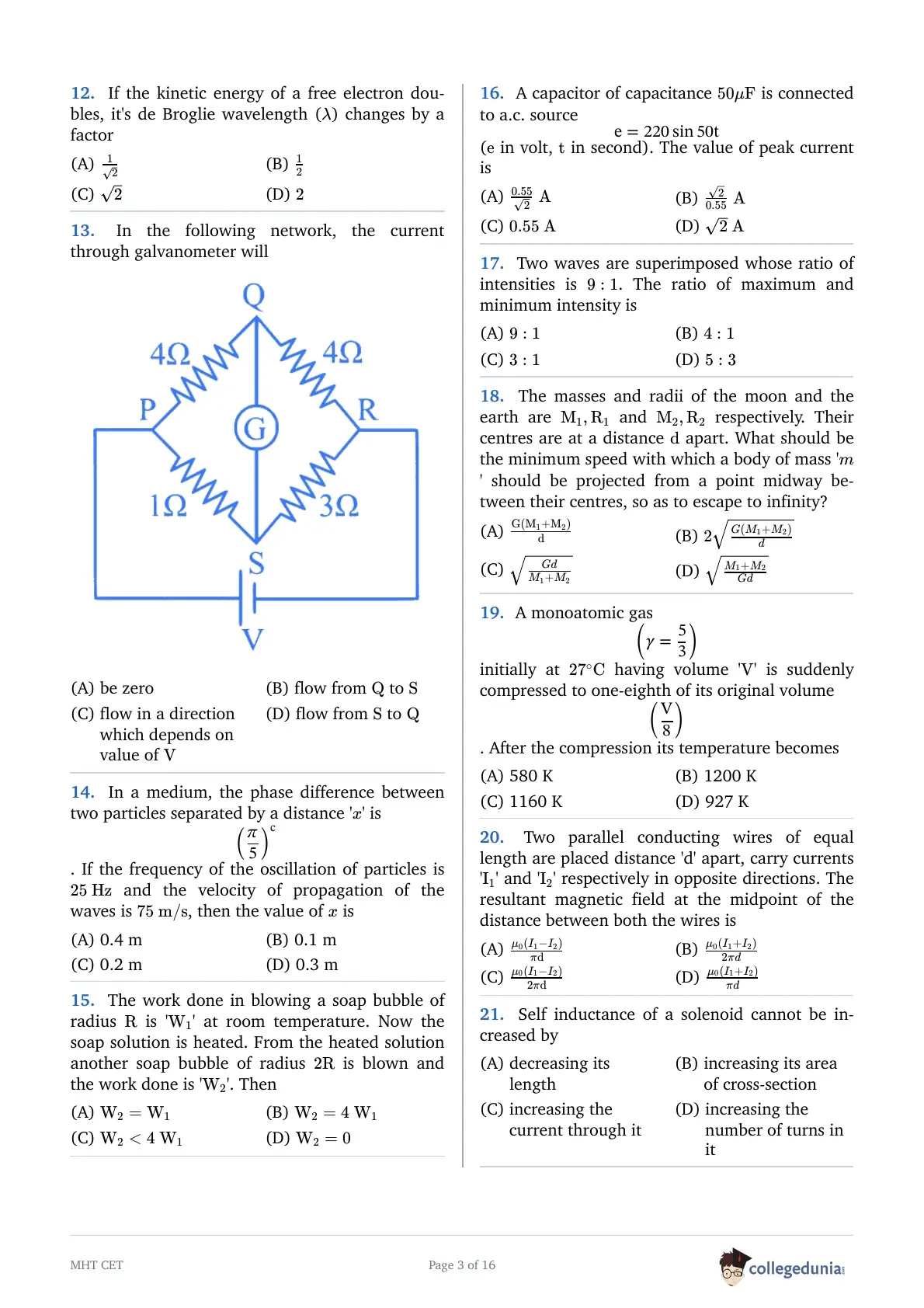
In the following network, the current through galvanometer will

  • (A) be zero
  • (B) flow from \(\mathrm{Q}\) to \(\mathrm{S}\)
  • (C) flow in a direction which depends on value of \(\mathrm{V}\)
  • (D) flow from \(\mathrm{S}\) to \(\mathrm{Q}\)

Question 14:

In a medium, the phase difference between two particles separated by a distance '\[x\]' is \[\left(\frac{\pi}{5}\right)^{\text {c }}\]. If the frequency of the oscillation of particles is \[25 \mathrm{~Hz}\] and the velocity of propagation of the waves is \[75 \mathrm{~m} / \mathrm{s}\], then the value of \[x\] is

  • (A) 0.4 m
  • (B) 0.1 m
  • (C) 0.2 m
  • (D) 0.3 m

Question 15:

The work done in blowing a soap bubble of radius \[\mathrm{R}\] is '\[\mathrm{W}_1\]' at room temperature. Now the soap solution is heated. From the heated solution another soap bubble of radius \[2 \mathrm{R}\] is blown and the work done is '\[\mathrm{W}_2\]'. Then

  • (A) \(\mathrm{W}_{2}=\mathrm{W}_{1}\)
  • (B) \(\mathrm{W}_{2}=4\text{ }\mathrm{W}_{1}\)
  • (C) \(\mathrm{W}_{2}<4\text{ }\mathrm{W}_{1}\)
  • (D) \(\mathrm{W}_{2}=0\)

Question 16:

A capacitor of capacitance \[50 \mu \mathrm{F}\] is connected to a.c. source \[\mathrm{e}=220 \sin 50 \mathrm{t}\] (\[\mathrm{e}\] in volt, \[\mathrm{t}\] in second). The value of peak current is

  • (A) \(\frac{0.55}{\sqrt{2}}\text{ }\mathrm{A}\)
  • (B) \(\frac{\sqrt{2}}{0.55}\text{ }\mathrm{A}\)
  • (C) \(0.55\text{ }\mathrm{A}\)
  • (D) \(\sqrt{2}\text{ }\mathrm{A}\)

Question 17:

Two waves are superimposed whose ratio of intensities is \[9: 1\]. The ratio of maximum and minimum intensity is

  • (A) \(9:1\)
  • (B) \(4:1\)
  • (C) \(3:1\)
  • (D) \(5:3\)

Question 18:

The masses and radii of the moon and the earth are \[\mathrm{M_1, R_1}\] and \[\mathrm{M_2, R_2}\] respectively. Their centres are at a distance \[\mathrm{d}\] apart. What should be the minimum speed with which a body of mass '\[m\]' should be projected from a point midway between their centres, so as to escape to infinity?

  • (A) \(\frac{\mathrm{G}(\mathrm{M}_{1}+\mathrm{M}_{2})}{\mathrm{d}}\)
  • (B) \(2\sqrt{\frac{G(M_{1}+M_{2})}{d}}\)
  • (C) \(\sqrt{\frac{Gd}{M_{1}+M_{2}}}\)
  • (D) \(\sqrt{\frac{M_{1}+M_{2}}{Gd}}\)

Question 19:

A monoatomic gas \[\left(\gamma=\frac{5}{3}\right)\] initially at \[27^{\circ} \mathrm{C}\] having volume '\[\mathrm{V}\]' is suddenly compressed to one-eighth of its original volume \[\left(\frac{\mathrm{V}}{8}\right)\]. After the compression its temperature becomes

  • (A) 580 K
  • (B) 1200 K
  • (C) 1160 K
  • (D) 927 K

Question 20:

Two parallel conducting wires of equal length are placed distance 'd' apart, carry currents '\[\mathrm{I}_1\]' and '\[\mathrm{I}_2\]' respectively in opposite directions. The resultant magnetic field at the midpoint of the distance between both the wires is

  • (A) \(\frac{\mu _{0}(I_{1}-I_{2})}{\pi \mathrm{d}}\)
  • (B) \(\frac{\mu _{0}(I_{1}+I_{2})}{2\pi d}\)
  • (C) \(\frac{\mu _{0}(I_{1}-I_{2})}{2\pi \mathrm{d}}\)
  • (D) \(\frac{\mu _{0}(I_{1}+I_{2})}{\pi d}\)

Question 21:

Self inductance of a solenoid cannot be increased by

  • (A) decreasing its length
  • (B) increasing its area of cross-section
  • (C) increasing the current through it
  • (D) increasing the number of turns in it

Question 22:

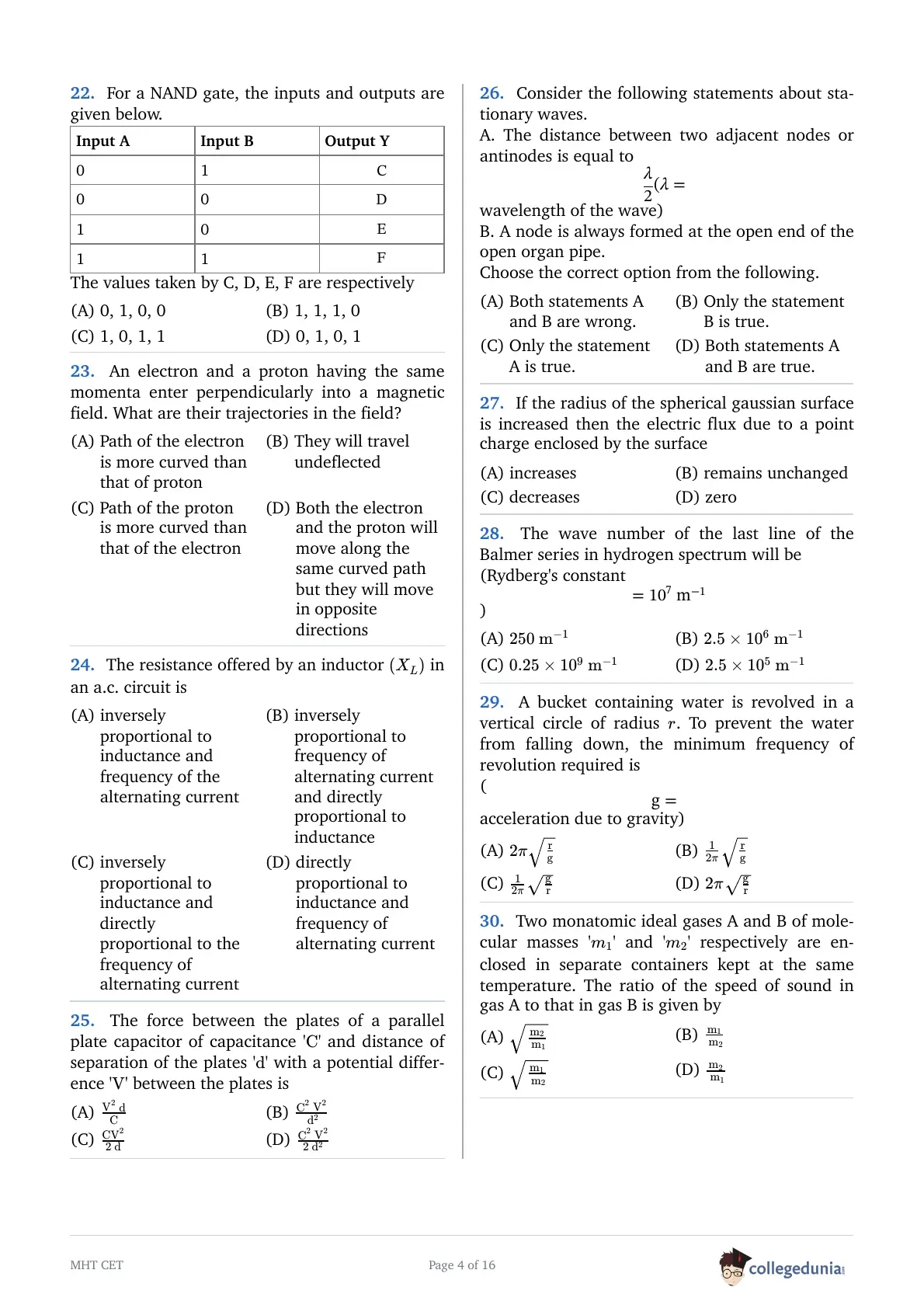
For a NAND gate, the inputs and outputs are given below.

Input AInput BOutput Y
01\[\mathrm{C}\]
00\[\mathrm{D}\]
10\[\mathrm{E}\]
11\[\mathrm{F}\]
  • (A) 0, 1, 0, 0
  • (B) 1, 1, 1, 0
  • (C) 1, 0, 1, 1
  • (D) 0, 1, 0, 1

Question 23:

An electron and a proton having the same momenta enter perpendicularly into a magnetic field. What are their trajectories in the field?

  • (A) Path of the electron is more curved than that of proton
  • (B) They will travel undeflected
  • (C) Path of the proton is more curved than that of the electron
  • (D) Both the electron and the proton will move along the same curved path but they will move in opposite directions

Question 24:

The resistance offered by an inductor \[\left(X_L\right)\] in an a.c. circuit is

  • (A) inversely proportional to inductance and frequency of the alternating current
  • (B) inversely proportional to frequency of alternating current and directly proportional to inductance
  • (C) inversely proportional to inductance and directly proportional to the frequency of alternating current
  • (D) directly proportional to inductance and frequency of alternating current

Question 25:

The force between the plates of a parallel plate capacitor of capacitance '\[\mathrm{C}\]' and distance of separation of the plates '\[\mathrm{d}\]' with a potential difference '\[\mathrm{V}\]' between the plates is

  • (A) \(\frac{\mathrm{V}^{2}\text{ }\mathrm{d}}{\mathrm{C}}\)
  • (B) \(\frac{\mathrm{C}^{2}\text{ }\mathrm{V}^{2}}{\text{ }\mathrm{d}^{2}}\)
  • (C) \(\frac{\mathrm{CV}^{2}}{2\text{ }\mathrm{d}}\)
  • (D) \(\frac{\mathrm{C}^{2}\text{ }\mathrm{V}^{2}}{2\text{ }\mathrm{d}^{2}}\)

Question 26:

Consider the following statements about stationary waves.

A. The distance between two adjacent nodes or antinodes is equal to \[\frac{\lambda}{2}(\lambda=\] wavelength of the wave)

B. A node is always formed at the open end of the open organ pipe.

Choose the correct option from the following.

  • (A) Both statements A and B are wrong.
  • (B) Only the statement B is true.
  • (C) Only the statement A is true.
  • (D) Both statements A and B are true.

Question 27:

If the radius of the spherical gaussian surface is increased then the electric flux due to a point charge enclosed by the surface

  • (A) increases
  • (B) remains unchanged
  • (C) decreases
  • (D) zero

Question 28:

The wave number of the last line of the Balmer series in hydrogen spectrum will be

(Rydberg's constant \[=10^7 \mathrm{~m}^{-1}\] )

  • (A) \(250\text{ }\mathrm{m}^{-1}\)
  • (B) \(2.5\times 10^{6}\text{ }\mathrm{m}^{-1}\)
  • (C) \(0.25\times 10^{9}\text{ }\mathrm{m}^{-1}\)
  • (D) \(2.5\times 10^{5}\text{ }\mathrm{m}^{-1}\)

Question 29:

A bucket containing water is revolved in a vertical circle of radius \[r\]. To prevent the water from falling down, the minimum frequency of revolution required is

(\[\mathrm{g}=\] acceleration due to gravity)

  • (A) \(2\pi \sqrt{\frac{\mathrm{r}}{\mathrm{g}}}\)
  • (B) \(\frac{1}{2\pi}\sqrt{\frac{\mathrm{r}}{\mathrm{g}}}\)
  • (C) \(\frac{1}{2\pi}\sqrt{\frac{\mathrm{g}}{\mathrm{r}}}\)
  • (D) \(2\pi \sqrt{\frac{\mathrm{g}}{\mathrm{r}}}\)

Question 30:

Two monatomic ideal gases A and B of molecular masses '\[m_1\]' and '\[m_2\]' respectively are enclosed in separate containers kept at the same temperature. The ratio of the speed of sound in gas A to that in gas B is given by

  • (A) \(\sqrt{\frac{\mathrm{m}_{2}}{\text{ }\mathrm{m}_{1}}}\)
  • (B) \(\frac{\mathrm{m}_{1}}{\text{ }\mathrm{m}_{2}}\)
  • (C) \(\sqrt{\frac{\mathrm{m}_{1}}{\text{ }\mathrm{m}_{2}}}\)
  • (D) \(\frac{\mathrm{m}_{2}}{\text{ }\mathrm{m}_{1}}\)

Question 31:

A particle starts oscillating simple harmonically from its mean position with time period '\[T\]'. At time \[t=\frac{T}{12}\], the ratio of the potential energy to kinetic energy of the particle is \[\left(\sin 30^{\circ}=\cos 60^{\circ}=0.5, \cos 30^{\circ}=\sin 60^{\circ}=\sqrt{3} / 2\right)\]

  • (A) \(1:2\)
  • (B) \(3:1\)
  • (C) \(2:1\)
  • (D) \(1:3\)

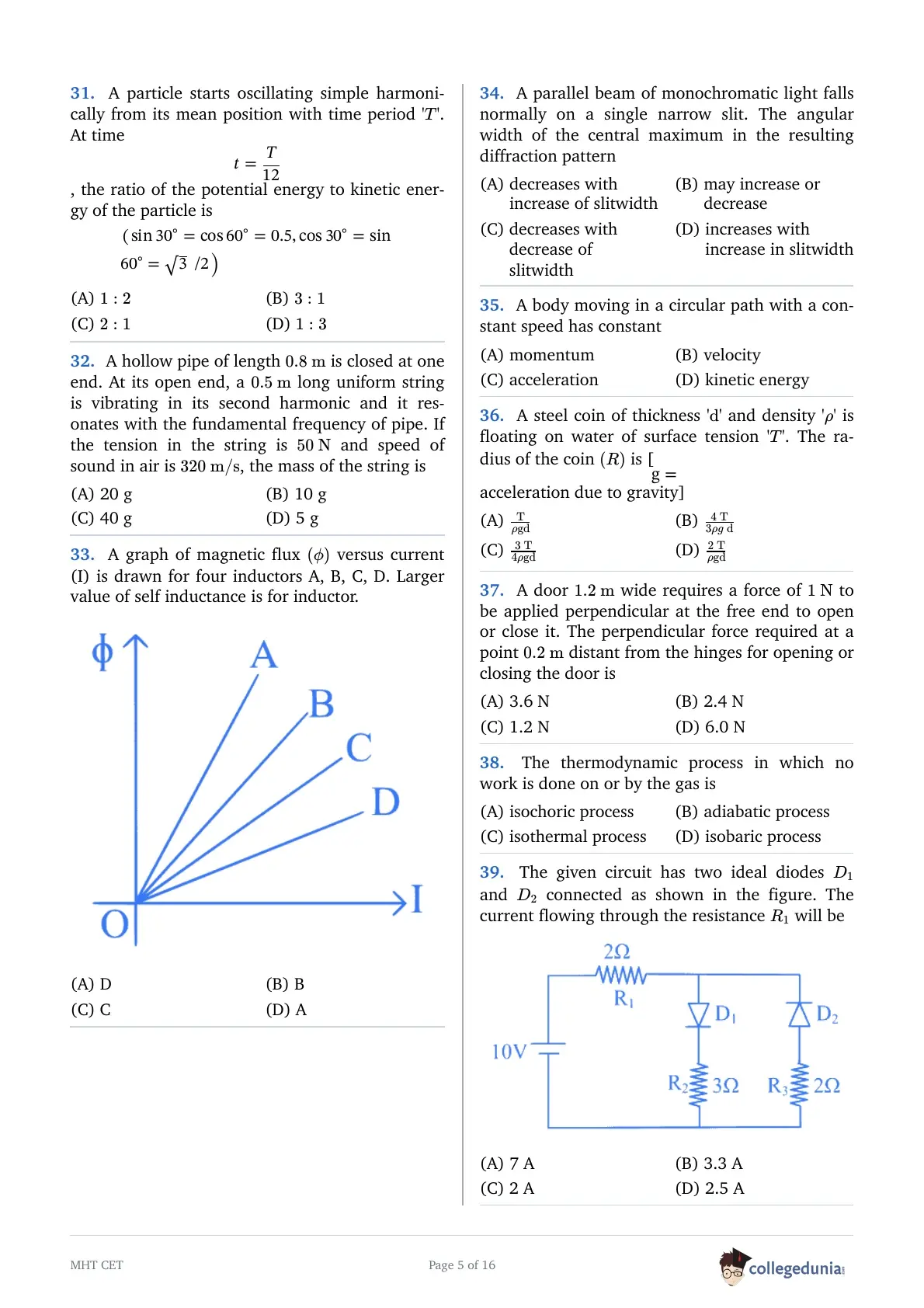
Question 33:

A graph of magnetic flux \[(\phi)\] versus current (I) is drawn for four inductors A, B, C, D. Larger value of self inductance is for inductor.

  • (A) D
  • (B) B
  • (C) C
  • (D) A

Question 34:

A parallel beam of monochromatic light falls normally on a single narrow slit. The angular width of the central maximum in the resulting diffraction pattern

  • (A) decreases with increase of slitwidth
  • (B) may increase or decrease
  • (C) decreases with decrease of slitwidth
  • (D) increases with increase in slitwidth

Question 35:

A body moving in a circular path with a constant speed has constant

  • (A) momentum
  • (B) velocity
  • (C) acceleration
  • (D) kinetic energy

Question 36:

A steel coin of thickness '\[\mathrm{d}\]' and density '\[\rho\]' is floating on water of surface tension '\[T\]'. The radius of the coin \[(R)\] is [\[\mathrm{g}=\] acceleration due to gravity]

  • (A) \(\frac{\mathrm{T}}{\rho \mathrm{gd}}\)
  • (B) \(\frac{4\text{ }\mathrm{T}}{3\rho g\text{ }\mathrm{d}}\)
  • (C) \(\frac{3\text{ }\mathrm{T}}{4\rho \mathrm{gd}}\)
  • (D) \(\frac{2\text{ }\mathrm{T}}{\rho \mathrm{gd}}\)

Question 37:

A door \[1.2 \mathrm{~m}\] wide requires a force of \[1 \mathrm{~N}\] to be applied perpendicular at the free end to open or close it. The perpendicular force required at a point \[0.2 \mathrm{~m}\] distant from the hinges for opening or closing the door is

  • (A) 3.6 N
  • (B) 2.4 N
  • (C) 1.2 N
  • (D) 6.0 N

Question 38:

The thermodynamic process in which no work is done on or by the gas is

  • (A) isochoric process
  • (B) adiabatic process
  • (C) isothermal process
  • (D) isobaric process

Question 39:

The given circuit has two ideal diodes \[D_1\] and \[D_2\] connected as shown in the figure. The current flowing through the resistance \[R_1\] will be

  • (A) 7 A
  • (B) 3.3 A
  • (C) 2 A
  • (D) 2.5 A

Question 40:

In a Fraunhofer diffraction at a single slit of width 'd' and incident light of wavelength \[5500 \mathop A\limits^o\], the first minimum is observed at an angle \[30^{\circ}\]. The first secondary maxima is observed at an angle \[\theta\], equal to

  • (A) \(\mathrm{sin}^{-1}(\frac{1}{4})\)
  • (B) \(\mathrm{sin}^{-1}(\frac{3}{4})\)
  • (C) \(\mathrm{sin}^{-1}(\frac{\sqrt{3}}{2})\)
  • (D) \(\mathrm{sin}^{-1}(\frac{1}{\sqrt{2}})\)

Question 41:

A galvanometer of resistance \[200 \Omega\] is to be converted into an ammeter. The value of shunt resistance which allows \[3 \%\] of the mains current through the galvanometer is equal to (nearly)

  • (A) \(6\Omega\)
  • (B) \(7\Omega\)
  • (C) \(10\Omega\)
  • (D) \(5\Omega\)

Question 42:

The speed of light in two media \[M_1\] and \[M_2\] are \[1.5 \times 10^8\] \[\mathrm{m} / \mathrm{s}\] and \[2 \times 10^8 \mathrm{~m} / \mathrm{s}\] respectively. If the light undergoes total internal reflection, the critical angle between the two media is

  • (A) \(\mathrm{sin}^{-1}(\frac{3}{2})\)
  • (B) \(\mathrm{sin}^{-1}(\frac{2}{3})\)
  • (C) \(\mathrm{sin}^{-1}(\frac{4}{3})\)
  • (D) \(\mathrm{sin}^{-1}(\frac{3}{4})\)

Question 43:

The minimum distance between an object and its real image formed by a convex lens of focal length 'f' is

  • (A) 2f
  • (B) 4f
  • (C) 1.5f
  • (D) 2.5f

Question 44:

Heat given to a body, which raises its temperature by 1ºC is known as

  • (A) specific heat
  • (B) thermal capacity
  • (C) water equivalent
  • (D) temperature gradient

Question 45:

A shell is fired at an angle of \[30^{\circ}\] to the horizontal with velocity \[196 \mathrm{~m} / \mathrm{s}\]. The time of flight is

\[\left[\sin 30^{\circ}=\frac{1}{2}=\cos 60^{\circ}\right]\]

  • (A) 6.5 s
  • (B) 20 s
  • (C) 16.5 s
  • (D) 10 s

Question 46:

Three equal charges '\[\mathrm{q}_1\]', '\[^{\prime} \mathrm{q}_2\]' and '\[\mathrm{q}_3\]' are placed on the three corners of a square of side 'a'. If the force between \[\mathrm{q}_1\] and \[\mathrm{q}_2\] is '\[\mathrm{F}_{12}\]' and that between \[\mathrm{q}_1\] and \[\mathrm{q}_3\] is '\[\mathrm{F}_{13}\]', then the ratio of magnitudes \[\left(\frac{F_{12}}{F_{13}}\right)\] is

  • (A) \(\frac{1}{2}\)
  • (B) \(\sqrt{2}\)
  • (C) \(\frac{1}{\sqrt{2}}\)
  • (D) \(2\)

Question 47:

A coil having an inductance of \[\frac{1}{\pi} \mathrm{H}\] is connected in series with a resistance of \[300 \Omega\]. If A.C. Source \[(20 \mathrm{~V}-200 \mathrm{~Hz})\] is connected across the combination, the phase angle between voltage and current is

  • (A) \(\mathrm{tan}^{-1}(\frac{3}{4})\)
  • (B) \(\mathrm{tan}^{-1}(\frac{4}{3})\)
  • (C) \(\mathrm{tan}^{-1}(\frac{5}{4})\)
  • (D) \(\mathrm{tan}^{-1}(\frac{4}{5})\)

Question 48:

In a full wave rectifier circuit without filter, the output current is

  • (A) an eddy current
  • (B) a constant direct current
  • (C) a sinusoidal current
  • (D) unidirectional but not steady current

Question 49:

The excess pressure inside a soap bubble of radius \[2 \mathrm{~cm}\] is 50 dyne/cm\[^2\]. The surface tension is

  • (A) 50 dyne/cm
  • (B) 60 dyne/cm
  • (C) 75 dyne/cm
  • (D) 25 dyne/cm

Chemistry (Q51 - Q100)

Question 51:

For the reaction \[\mathrm{N}_{2(\mathrm{~g})}+3 \mathrm{H}_{2(\mathrm{~g})} \rightarrow 2 \mathrm{NH}_{3(\mathrm{~g})}\], rate of disappearance of \[\mathrm{N}_{2(\mathrm{~g})}\] is \[2.22 \times 10^{-3} \mathrm{~mol} \mathrm{~dm}^{-3}\]. What is the rate of appearance of \[\mathrm{NH}_{3(\mathrm{~g})}\] ?

  • (A) \(2.22\times 10^{-3}\text{ }\mathrm{mol}\text{ }\mathrm{dm}^{-3}\)
  • (B) \(1.11\times 10^{-3}\text{ }\mathrm{mol}\text{ }\mathrm{dm}^{-3}\)
  • (C) \(4.44\times 10^{-3}\text{ }\mathrm{mol}\text{ }\mathrm{dm}^{-3}\)
  • (D) \(3.33\times 10^{-3}\text{ }\mathrm{mol}\text{ }\mathrm{dm}^{-3}\)

Question 52:

Identify the products obtained when chlorine reacts with hot and conc. \[\mathrm{NaOH}\].

  • (A) \(\mathrm{NaClO}_{3},\mathrm{NaCl}\) and \(\mathrm{H}_{2}\mathrm{O}\)
  • (B) \(\mathrm{NaCl}\) and \(\mathrm{HOCl}\)
  • (C) \(\mathrm{Na}_{2}\mathrm{O}\) and \(\mathrm{NaCl}\)
  • (D) \(\mathrm{NaOCl}\) and \(\mathrm{H}_{2}\mathrm{O}\)

Question 53:

Which from following elements does NOT react with water?

  • (A) Ca
  • (B) Sr
  • (C) Be
  • (D) Mg

Question 54:

Identify the type of hybridization involved in hexaaminecobalt (III) complex ion.

  • (A) \(\mathrm{sp}^{3}\)
  • (B) \(\mathrm{dsp}^{2}\)
  • (C) \(\mathrm{d}^{2}\mathrm{sp}^{3}\)
  • (D) \(\mathrm{sp}^{3}\mathrm{d}^{2}\)

Question 55:

Calculate the solubility of a gas in water at \[0.8 \mathrm{~atm}\] and \[25^{\circ} \mathrm{C}\].

[Henry's law constant is \[6.85 \times 10^{-4} \mathrm{~mol} \mathrm{~dm}^{-3} \mathrm{~atm}^{-1}\] ]

  • (A) \(2.74\times 10^{-4}\text{ }\mathrm{mol}\text{ }\mathrm{dm}^{-3}\)
  • (B) \(3.94\times 10^{-4}\text{ }\mathrm{mol}\text{ }\mathrm{dm}^{-3}\)
  • (C) \(6.85\times 10^{-4}\text{ }\mathrm{mol}\text{ }\mathrm{dm}^{-3}\)
  • (D) \(5.48\times 10^{-4}\text{ }\mathrm{mol}\text{ }\mathrm{dm}^{-3}\)

Question 56:

What is the value of temperature in degree Celsius at absolute zero ?

  • (A) \(273.15^{\circ}\mathrm{C}\)
  • (B) \(-373.15^{\circ}\mathrm{C}\)
  • (C) \(0^{\circ}\mathrm{C}\)
  • (D) \(-273.15^{\circ}\mathrm{C}\)

Question 57:

Which among the following reactions does NOT correctly match with its reagent?

  • (A) Stephen reaction: \(\mathrm{SnCl}_{2},\mathrm{HCl}\)
  • (B) Etard reaction : \(\mathrm{CrO}_{2}\mathrm{Cl}_{2}\)
  • (C) Gatterman - Koch formulation : \(\mathrm{CrO}_{3}/(\mathrm{CH}_{3}\mathrm{CO})_{2}\mathrm{O}\)
  • (D) Rosenmund reduction : \(\mathrm{H}_{2}/\mathrm{Pd}-\mathrm{BaSO}_{4}\)

Question 58:

Which among the following compounds is NOT prepared by Sandmeyer's reaction ?

  • (A)
  • (B)
  • (C)
  • (D)

Question 59:

Which among the following compounds undergoes SN\[^2\] reaction fastly ?

  • (A)
  • (B)
  • (C)
  • (D)

Question 60:

Which of the following molecules possesses highest dipole-dipole interactions ?

  • (A) HCl
  • (B) HI
  • (C) HBr
  • (D) HF

Question 61:

What is the total volume occupied by atoms in bcc unit cell ?

  • (A) 52.36%
  • (B) 68%
  • (C) 80%
  • (D) 74%

Question 62:

Which among the following metals is involved in preparation of Grignard reagent ?

  • (A) Magnesium
  • (B) Sodium
  • (C) Silver
  • (D) Zinc

Question 63:

Which among the following properties of lanthanoids is NOT true?

  • (A) Good conductors of heat and electricity
  • (B) All are non-radioactive elements
  • (C) Have greater co-ordination number than six
  • (D) Strongly paramagnetic

Question 64:

Which of the following is a Lewis acid but NOT a Bronsted acid?

  • (A) \(\mathrm{BCl}_{3}\)
  • (B) \(\mathrm{HNO}_{3}\)
  • (C) \(\mathrm{NH}_{3}\)
  • (D) \(\mathrm{HSO}_{4}^{-}\)

Question 65:

Which of the following aqueous solutions of salts will have highest \[\mathrm{pH}\] value?

  • (A) \(\mathrm{CH}_{3}\mathrm{COONH}_{4}\)
  • (B) \(\mathrm{Na}_{2}\mathrm{CO}_{3}\)
  • (C) \(\mathrm{NH}_{4}\mathrm{Cl}\)
  • (D) \(\mathrm{NaCl}\)

Question 66:

Which among the following compounds represents a soap molecule?

  • (A) Ammonium salt of higher fatty acids
  • (B) Sodium salt of formic acid
  • (C) Potassium salt of higher fatty acids
  • (D) Ammonium salt of formic acid

Question 67:

How long will it take to produce \[5.4 \mathrm{~g}\] of \[\mathrm{Ag}\] from molten \[\mathrm{AgCl}\] by passing \[5 \mathrm{~amp}\] current?

(Molar mass Ag = \[108 \mathrm{~g} \mathrm{~mol}^{-1}\] )

  • (A) 1930 second
  • (B) 193 second
  • (C) 965 second
  • (D) 9650 second

Question 69:

What is the number of unpaired electrons in \[\left[\mathrm{Co}\left(\mathrm{NH}_3\right)_6\right]^{3+}\] complex?

  • (A) Four
  • (B) Two
  • (C) Zero
  • (D) Six

Question 70:

Which among the following methods is used to prepare Grignard reagent?

  • (A) Action of magnesium powder on alkyl halide in aqueous medium
  • (B) Action of magnesium hydroxide on alkyl halide
  • (C) Action of magnesium metal on alkyl halide in presence of dry ether
  • (D) Action of \(\mathrm{MgCl}_{2}\) on alkyl halide in presence of dry ether

Question 71:

Calculate the density of metal having volume of unit cell \[64 \times 10^{-24} \mathrm{~cm}^3\] and molar mass of metal \[192 \mathrm{~g} \mathrm{~mol}^{-1}\] containing 4 particles in unit cell.

  • (A) \(14.92\text{ }\mathrm{g}\text{ }\mathrm{cm}^{-3}\)
  • (B) \(16.00\text{ }\mathrm{g}\text{ }\mathrm{cm}^{-3}\)
  • (C) \(19.93\text{ }\mathrm{g}\text{ }\mathrm{cm}^{-3}\)
  • (D) \(18.00\text{ }\mathrm{g}\text{ }\mathrm{cm}^{-3}\)

Question 72:

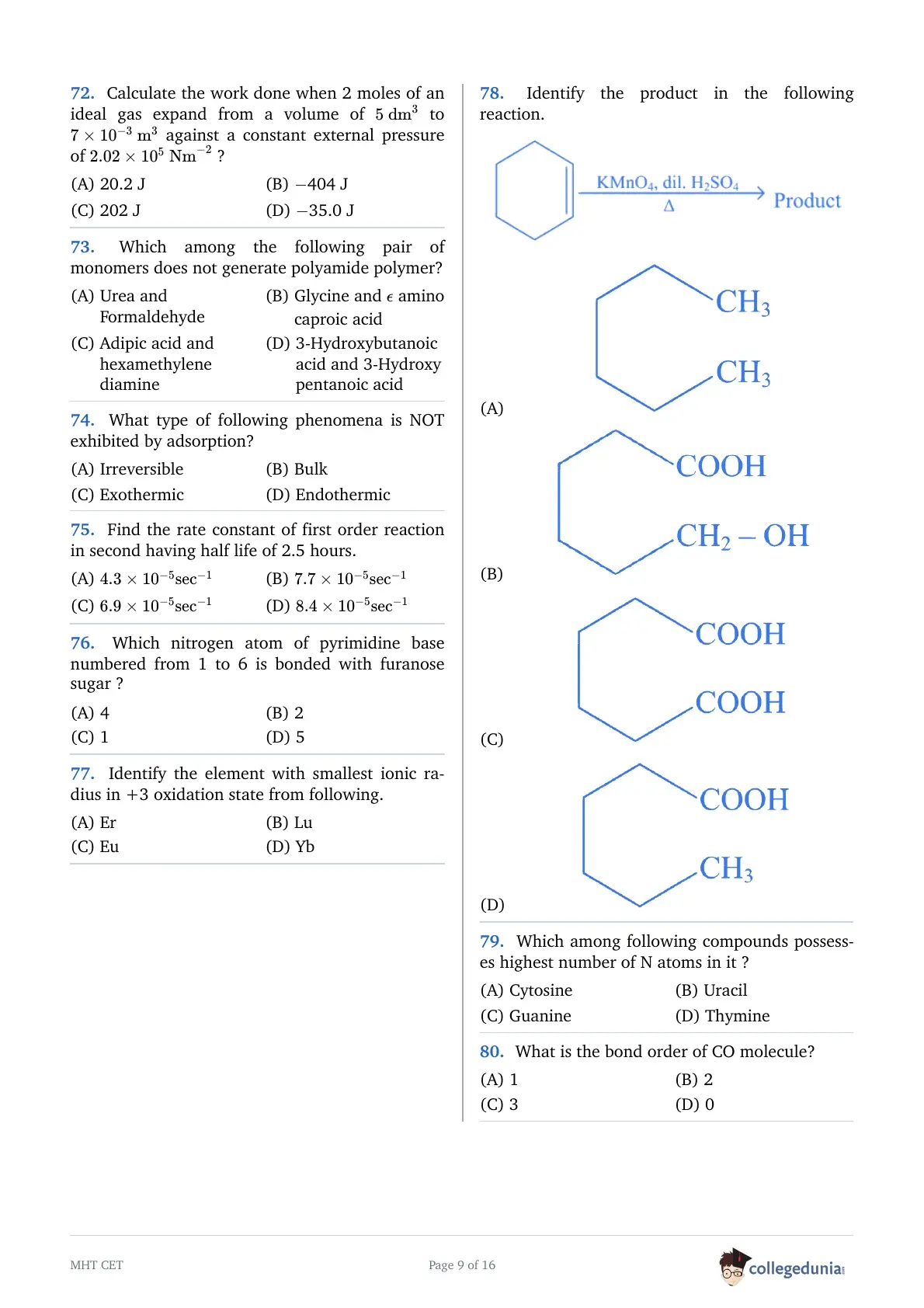
Calculate the work done when 2 moles of an ideal gas expand from a volume of \[5 \mathrm{~dm}^3\] to \[7 \times 10^{-3} \mathrm{~m}^3\] against a constant external pressure of \[2.02 \times 10^5 \mathrm{~Nm}^{-2}\] ?

  • (A) 20.2 J
  • (B) \(-\)404 J
  • (C) 202 J
  • (D) \(-\)35.0 J

Question 75:

Find the rate constant of first order reaction in second having half life of 2.5 hours.

  • (A) \(4.3\times 10^{-5}\mathrm{sec}^{-1}\)
  • (B) \(7.7\times 10^{-5}\mathrm{sec}^{-1}\)
  • (C) \(6.9\times 10^{-5}\mathrm{sec}^{-1}\)
  • (D) \(8.4\times 10^{-5}\mathrm{sec}^{-1}\)

Question 77:

Identify the element with smallest ionic radius in +3 oxidation state from following.

  • (A) Er
  • (B) Lu
  • (C) Eu
  • (D) Yb

Question 78:

Identify the product in the following reaction.

  • (A)
  • (B)
  • (C)
  • (D)

Question 79:

Which among following compounds possesses highest number of N atoms in it ?

  • (A) Cytosine
  • (B) Uracil
  • (C) Guanine
  • (D) Thymine

Question 80:

What is the bond order of CO molecule?

  • (A) 1
  • (B) 2
  • (C) 3
  • (D) 0

Question 81:

Which of the following is NOT hydrogen like species?

  • (A) \(\mathrm{He}\)
  • (B) \(\mathrm{He}^{+}\)
  • (C) \(\mathrm{Li}^{2+}\)
  • (D) \(\mathrm{Be}^{3+}\)

Question 82:

What is the intermediate compound formed when chlorobenzene is treated with fused \[\mathrm{NaOH}\] under pressure?

  • (A) Phenoxide ion
  • (B) Sodium phenoxide
  • (C) Benzene diazonium chloride
  • (D) Benzene

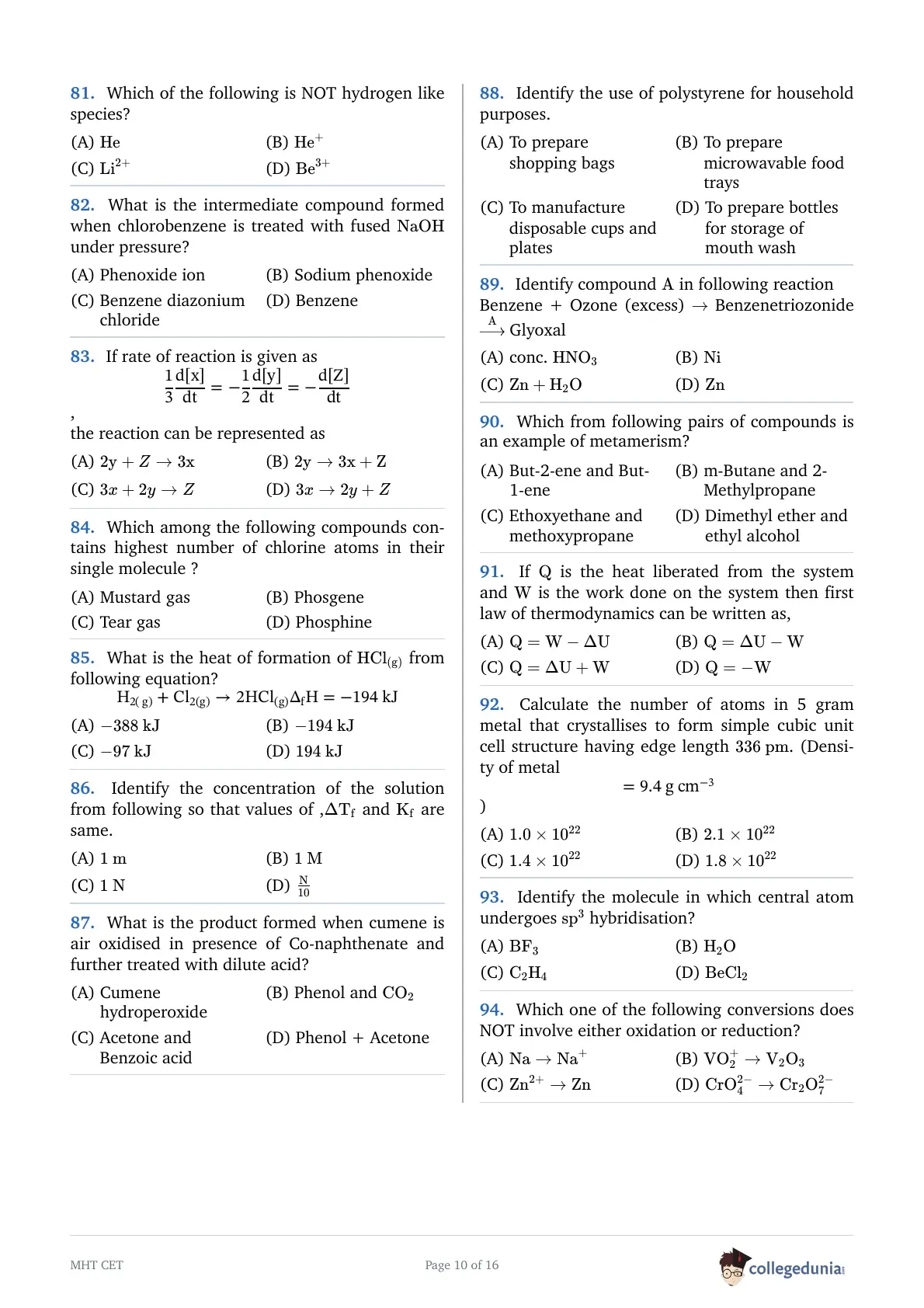
Question 83:

If rate of reaction is given as

\[\frac{1}{3} \frac{\mathrm{d}[\mathrm{x}]}{\mathrm{dt}}=-\frac{1}{2} \frac{\mathrm{d}[\mathrm{y}]}{\mathrm{dt}}=-\frac{\mathrm{d}[\mathrm{Z}]}{\mathrm{dt}}\],

the reaction can be represented as

  • (A) \(2\mathrm{y}+Z\rightarrow 3\mathrm{x}\)
  • (B) \(2\mathrm{y}\rightarrow 3\mathrm{x}+\mathrm{Z}\)
  • (C) \(3x+2y\rightarrow Z\)
  • (D) \(3x\rightarrow 2y+Z\)

Question 84:

Which among the following compounds contains highest number of chlorine atoms in their single molecule ?

  • (A) Mustard gas
  • (B) Phosgene
  • (C) Tear gas
  • (D) Phosphine

Question 85:

What is the heat of formation of \[\mathrm{HCl}_{(\mathrm{g})}\] from following equation?

\[\mathrm{H}_{2(\mathrm{~g})}+\mathrm{Cl}_{2(\mathrm{g})} \rightarrow 2 \mathrm{HCl}_{(\mathrm{g})} \Delta_{\mathrm{f}} \mathrm{H}=-194 \mathrm{~kJ}\]

  • (A) \(-388\text{ }\mathrm{kJ}\)
  • (B) \(-194\text{ }\mathrm{kJ}\)
  • (C) \(-97\text{ }\mathrm{kJ}\)
  • (D) \(194\text{ }\mathrm{kJ}\)

Question 86:

Identify the concentration of the solution from following so that values of ,\[\Delta \mathrm{T}_{\mathrm{f}}\] and \[\mathrm{K}_{\mathrm{f}}\] are same.

  • (A) \(1\text{ }\mathrm{m}\)
  • (B) \(1\text{ }\mathrm{M}\)
  • (C) \(1\text{ }\mathrm{N}\)
  • (D) \(\frac{\mathrm{N}}{10}\)

Question 87:

What is the product formed when cumene is air oxidised in presence of Co-naphthenate and further treated with dilute acid?

  • (A) Cumene hydroperoxide
  • (B) Phenol and \(\mathrm{CO}_{2}\)
  • (C) Acetone and Benzoic acid
  • (D) Phenol + Acetone

Question 88:

Identify the use of polystyrene for household purposes.

  • (A) To prepare shopping bags
  • (B) To prepare microwavable food trays
  • (C) To manufacture disposable cups and plates
  • (D) To prepare bottles for storage of mouth wash

Question 89:

Identify compound \[\mathrm{A}\] in following reaction

Benzene + Ozone (excess) \[\rightarrow\] Benzenetriozonide \[\xrightarrow{\mathrm{A}}\] Glyoxal

  • (A) conc. \(\mathrm{HNO}_{3}\)
  • (B) \(\mathrm{Ni}\)
  • (C) \(\mathrm{Zn}+\mathrm{H}_{2}\mathrm{O}\)
  • (D) \(\mathrm{Zn}\)

Question 90:

Which from following pairs of compounds is an example of metamerism?

  • (A) But-2-ene and But-1-ene
  • (B) m-Butane and 2-Methylpropane
  • (C) Ethoxyethane and methoxypropane
  • (D) Dimethyl ether and ethyl alcohol

Question 91:

If \[\mathrm{Q}\] is the heat liberated from the system and \[\mathrm{W}\] is the work done on the system then first law of thermodynamics can be written as,

  • (A) \(\mathrm{Q}=\mathrm{W}-\Delta \mathrm{U}\)
  • (B) \(\mathrm{Q}=\Delta \mathrm{U}-\mathrm{W}\)
  • (C) \(\mathrm{Q}=\Delta \mathrm{U}+\mathrm{W}\)
  • (D) \(\mathrm{Q}=-\mathrm{W}\)

Question 92:

Calculate the number of atoms in 5 gram metal that crystallises to form simple cubic unit cell structure having edge length \[336 \mathrm{~pm}\]. (Density of metal \[=9.4 \mathrm{~g} \mathrm{~cm}^{-3}\] )

  • (A) \(1.0\times 10^{22}\)
  • (B) \(2.1\times 10^{22}\)
  • (C) \(1.4\times 10^{22}\)
  • (D) \(1.8\times 10^{22}\)

Question 93:

Identify the molecule in which central atom undergoes \[\mathrm{sp}^3\] hybridisation?

  • (A) \(\mathrm{BF}_{3}\)
  • (B) \(\mathrm{H}_{2}\mathrm{O}\)
  • (C) \(\mathrm{C}_{2}\mathrm{H}_{4}\)
  • (D) \(\mathrm{BeCl}_{2}\)

Question 94:

Which one of the following conversions does NOT involve either oxidation or reduction?

  • (A) \(\mathrm{Na}\rightarrow \mathrm{Na}^{+}\)
  • (B) \(\mathrm{VO}_{2}^{+}\rightarrow \mathrm{V}_{2}\mathrm{O}_{3}\)
  • (C) \(\mathrm{Zn}^{2+}\rightarrow \mathrm{Zn}\)
  • (D) \(\mathrm{CrO}_{4}^{2-}\rightarrow \mathrm{Cr}_{2}\mathrm{O}_{7}^{2-}\)

Question 95:

Calculate \[\wedge_0\] of \[\mathrm{CH}_2 \mathrm{ClCOOH}\] if \[\wedge_0\] for \[\mathrm{HCl}, \mathrm{KCl}\] and \[\mathrm{CH}_2 \mathrm{ClCOOK}\] are \[4.2,1.5\] and \[1.1 \Omega^{-1} \mathrm{~cm}^2 \mathrm{~mol}^{-1}\] respectively?

  • (A) \(2.7\Omega ^{-1}\text{ }\mathrm{cm}^{2}\text{ }\mathrm{mol}^{-1}\)
  • (B) \(3.8\Omega ^{-1}\text{ }\mathrm{cm}^{2}\text{ }\mathrm{mol}^{-1}\)
  • (C) \(1.9\Omega ^{-1}\text{ }\mathrm{cm}^{2}\text{ }\mathrm{mol}^{-1}\)
  • (D) \(4.2\Omega ^{-1}\text{ }\mathrm{cm}^{2}\text{ }\mathrm{mol}^{-1}\)

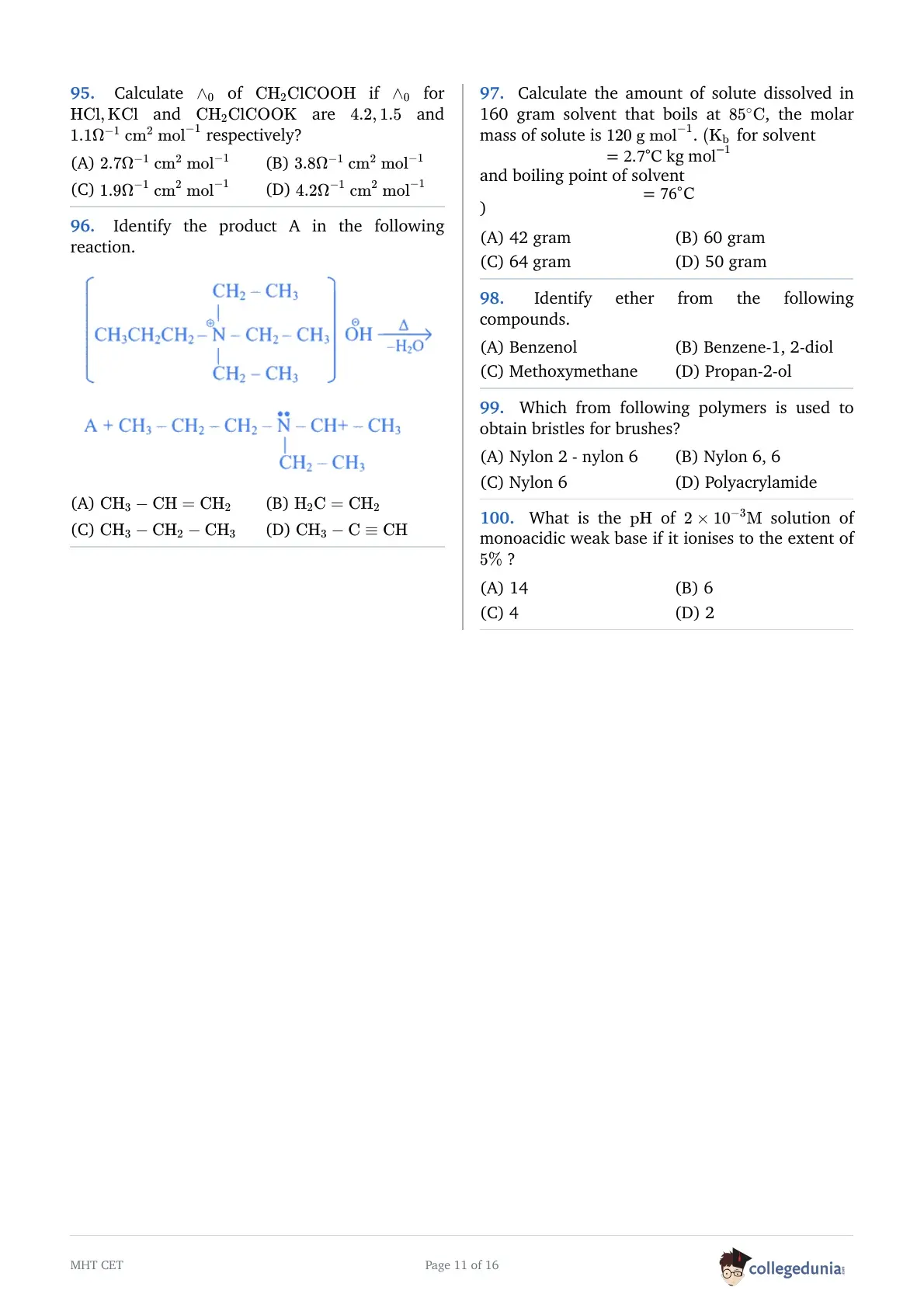
Question 96:

Identify the product A in the following reaction.

  • (A) \(\mathrm{CH}_{3}-\mathrm{CH}=\mathrm{CH}_{2}\)
  • (B) \(\mathrm{H}_{2}\mathrm{C}=\mathrm{CH}_{2}\)
  • (C) \(\mathrm{CH}_{3}-\mathrm{CH}_{2}-\mathrm{CH}_{3}\)
  • (D) \(\mathrm{CH}_{3}-\mathrm{C}\equiv \mathrm{CH}\)

Question 97:

Calculate the amount of solute dissolved in 160 gram solvent that boils at \[85^{\circ} \mathrm{C}\], the molar mass of solute is \[120 \mathrm{~g} \mathrm{~mol}^{-1}\]. \[\left(\mathrm{K}_{\mathrm{b}}\right.\] for solvent \[=2.7^{\circ} \mathrm{C} \mathrm{~kg} \mathrm{~mol}^{-1}\] and boiling point of solvent \[=76^{\circ} \mathrm{C}\])

  • (A) 42 gram
  • (B) 60 gram
  • (C) 64 gram
  • (D) 50 gram

Question 98:

Identify ether from the following compounds.

  • (A) Benzenol
  • (B) Benzene-1, 2-diol
  • (C) Methoxymethane
  • (D) Propan-2-ol

Question 99:

Which from following polymers is used to obtain bristles for brushes?

  • (A) Nylon 2 - nylon 6
  • (B) Nylon 6, 6
  • (C) Nylon 6
  • (D) Polyacrylamide

Mathematics (Q101 - Q150)

Question 101:

\[\int_\limits{\frac{\pi}{4}}^{\frac{3 \pi}{4}} \frac{\mathrm{d} x}{1+\cos x}\] is equal to

  • (A) \(-2\sqrt{2}\)
  • (B) \(2\)
  • (C) \(-2-2\sqrt{2}\)
  • (D) \(-2\)

Question 102:

If \[\tan ^{-1}\left(\frac{1-x}{1+x}\right)=\frac{1}{2} \tan ^{-1} x\], then \[x\] has the value

  • (A) 3
  • (B) 1
  • (C) \(\frac{1}{\sqrt{3}}\)
  • (D) \(\sqrt{3}\)

Question 103:

If \[p: \forall n \in I N, n^2+n\] is an even number \[q: \forall n \in I N, n^2-n\] is an odd numer, then the truth values of \[p \wedge q, p \vee q\] and \[p \rightarrow q\] are respectively

  • (A) \(F,T,F\)
  • (B) \(F,F,T\)
  • (C) \(T,T,F\)
  • (D) \(F,T,T\)

Question 104:

If the function \[f(x)=x^3-3(a-2) x^2+3 a x+7\], for some \[a \in I R\] is increasing in \[(0,1]\] and decreasing in \[[1,5)\], then a root of the equation \[\frac{f(x)-14}{(x-1)^2}=0(x \neq 1)\] is

  • (A) 14
  • (B) 7
  • (C) \(-\)14
  • (D) \(-\)7

Question 105:

If \[\bar{a}=\hat{\boldsymbol{i}}-\hat{\boldsymbol{k}}, \bar{b}=x \hat{\boldsymbol{i}}+\hat{\boldsymbol{j}}+(1-x) \hat{\boldsymbol{k}}\] and \[\bar{c}=y \hat{\boldsymbol{i}}+x \hat{\boldsymbol{j}}+(1+x-y) \hat{\boldsymbol{k}}\], then \[[\bar{a} \bar{b} \bar{c}]\] depends on

  • (A) only \(y\)
  • (B) neither \(x\) nor \(y\)
  • (C) both \(x\) and \(y\)
  • (D) only \(x\)

Question 106:

If \[\cot (A+B)=0\], then \[\sin (A+2 B)\] is equal to

  • (A) \(\mathrm{sin}A\)
  • (B) \(\mathrm{cos}2A\)
  • (C) \(\mathrm{sin}2A\)
  • (D) \(\mathrm{cos}A\)

Question 107:

The joint equation of pair of lines through the origin and making an equilateral triangle with the line \[y = 5\] is

  • (A) \(x^{2}-3y^{2}=0\)
  • (B) \(\sqrt{3}x^{2}-y^{2}=0\)
  • (C) \(3x^{2}-y^{2}=0\)
  • (D) \(5x^{2}-y^{2}=0\)

Question 108:

If \[f(x)=\sqrt{\tan x}\] and \[g(x)=\sin x \cdot \cos x\] then \[\int \frac{f(x)}{g(x)} \mathrm{d} x\] is equal to (where \[C\] is a constant of integration)

  • (A) \(2\sqrt{\mathrm{tan}x}+C\)
  • (B) \(\frac{1}{2}\sqrt{\mathrm{tan}x}+C\)
  • (C) \(\sqrt{\mathrm{tan}x}+C\)
  • (D) \(\frac{3}{2}\sqrt{\mathrm{tan}x}+C\)

Question 109:

The general solution of the differential equation \[\frac{\mathrm{d} y}{\mathrm{~d} x}=\frac{3 x+y}{x-y}\] is (where \[C\] is a constant of integration.)

  • (A) \(\mathrm{tan}^{-1}(\frac{y}{x})+\mathrm{log}(\frac{y^{2}+3x^{2}}{x^{2}})=\mathrm{log}(x)+C\)
  • (B) \(\frac{1}{\sqrt{3}}\mathrm{tan}^{-1}(\frac{y}{x\sqrt{3}})+\mathrm{log}(\frac{y^{2}+3x^{2}}{x^{2}})^{\frac{1}{2}}=\mathrm{log}(x)+C\)
  • (C) \(\frac{1}{\sqrt{3}}\mathrm{tan}^{-1}(\frac{y}{x\sqrt{3}})-\mathrm{log}(\frac{y^{2}+3x^{2}}{x^{2}})^{\frac{1}{2}}=\mathrm{log}(x)+C\)
  • (D) \(\mathrm{tan}^{-1}(\frac{x}{y})+\mathrm{log}(\frac{y^{2}+3x^{2}}{x^{2}})=\mathrm{log}(x)+C\)

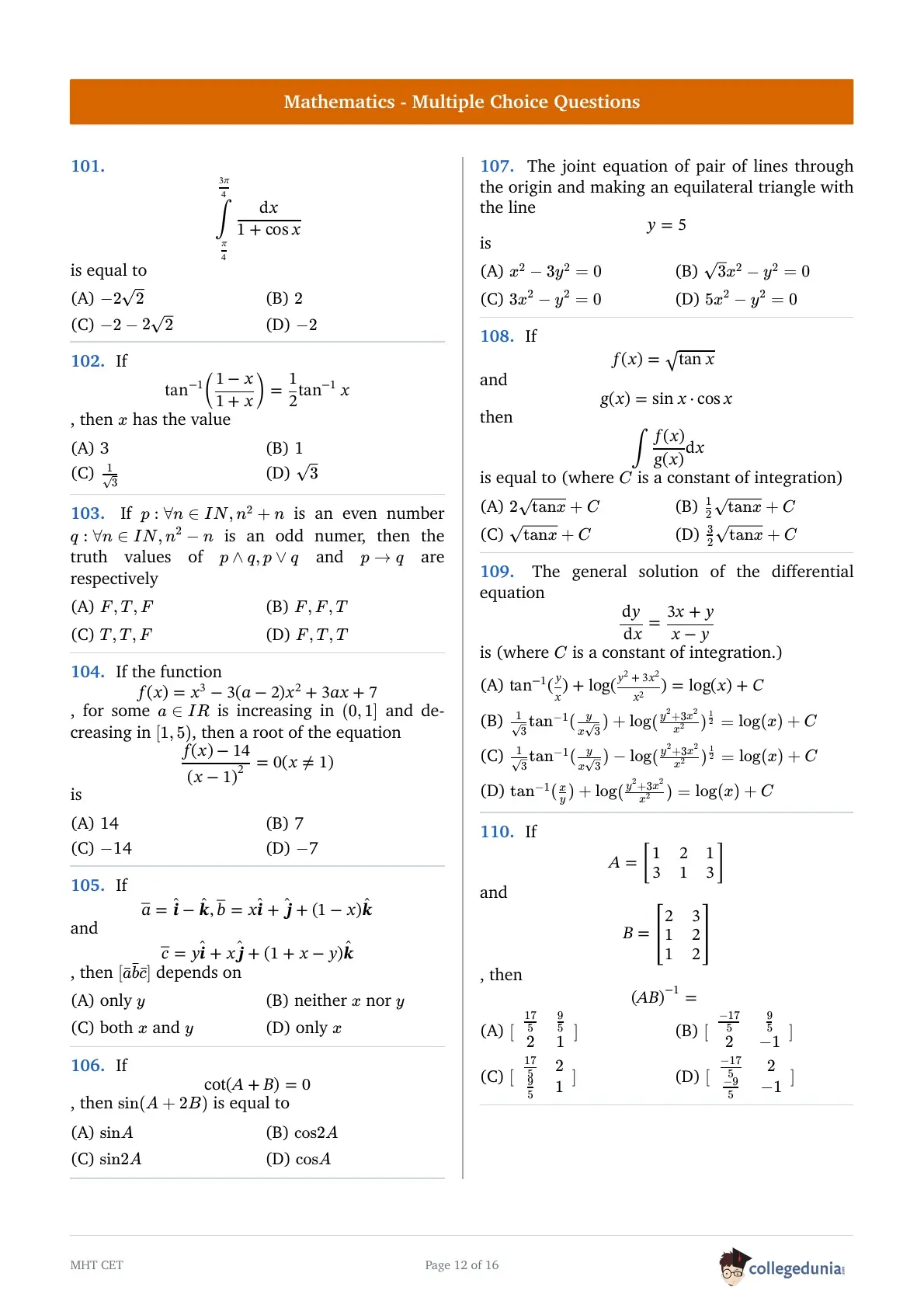
Question 110:

If \[A=\left[\begin{array}{lll}1 & 2 & 1 \\ 3 & 1 & 3\end{array}\right]\] and \[B=\left[\begin{array}{ll}2 & 3 \\ 1 & 2 \\ 1 & 2\end{array}\right]\], then \[(A B)^{-1}=\]

  • (A) \([\begin{array}{cc} \frac{17}{5} & \frac{9}{5} \\ 2 & 1 \end{array}]\)
  • (B) \([\begin{array}{cc} \frac{-17}{5} & \frac{9}{5} \\ 2 & -1 \end{array}]\)
  • (C) \([\begin{array}{cc} \frac{17}{5} & 2 \\ \frac{9}{5} & 1 \end{array}]\)
  • (D) \([\begin{array}{cc} \frac{-17}{5} & 2 \\ \frac{-9}{5} & -1 \end{array}]\)

Question 111:

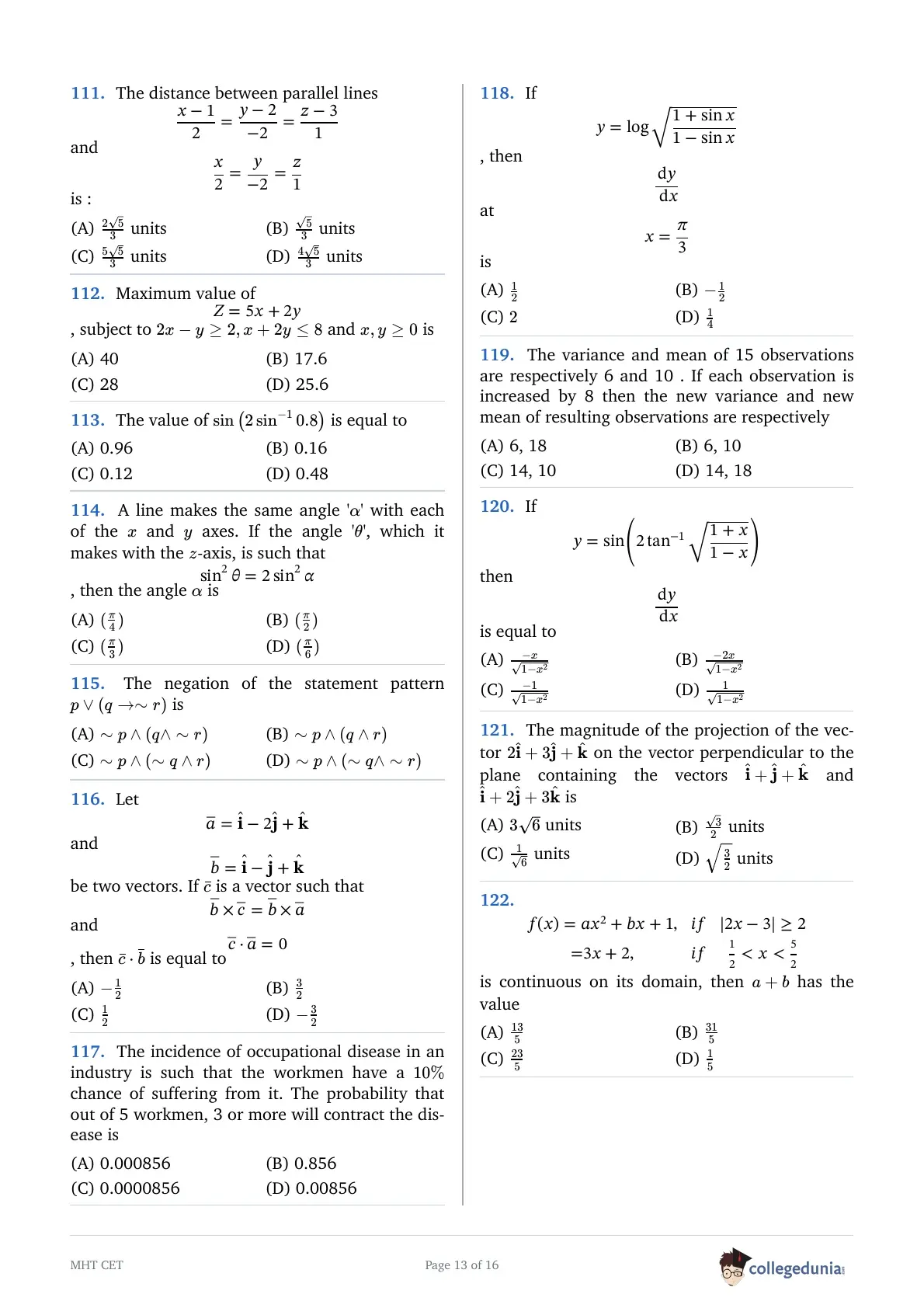
The distance between parallel lines

\[\frac{x-1}{2}=\frac{y-2}{-2}=\frac{z-3}{1}\] and

\[\frac{x}{2}=\frac{y}{-2}=\frac{z}{1}\] is :

  • (A) \(\frac{2\sqrt{5}}{3}\) units
  • (B) \(\frac{\sqrt{5}}{3}\) units
  • (C) \(\frac{5\sqrt{5}}{3}\) units
  • (D) \(\frac{4\sqrt{5}}{3}\) units

Question 112:

Maximum value of \[Z=5 x+2 y\], subject to \[2 x-y \geq 2, x+2 y \leq 8\] and \[x, y \geq 0\] is

  • (A) 40
  • (B) 17.6
  • (C) 28
  • (D) 25.6

Question 113:

The value of \[\sin \left(2 \sin ^{-1} 0.8\right)\] is equal to

  • (A) 0.96
  • (B) 0.16
  • (C) 0.12
  • (D) 0.48

Question 114:

A line makes the same angle '\[\alpha\]' with each of the \[x\] and \[y\] axes. If the angle '\[\theta\]', which it makes with the \[z\]-axis, is such that \[\sin ^2 \theta=2 \sin ^2 \alpha\], then the angle \[\alpha\] is

  • (A) \((\frac{\pi}{4})\)
  • (B) \((\frac{\pi}{2})\)
  • (C) \((\frac{\pi}{3})\)
  • (D) \((\frac{\pi}{6})\)

Question 115:

The negation of the statement pattern \[p \vee(q \rightarrow \sim r)\] is

  • (A) \(\sim p\wedge (q\wedge \sim r)\)
  • (B) \(\sim p\wedge (q\wedge r)\)
  • (C) \(\sim p\wedge (\sim q\wedge r)\)
  • (D) \(\sim p\wedge (\sim q\wedge \sim r)\)

Question 116:

Let \[\bar{a}=\hat{\mathbf{i}}-2 \hat{\mathbf{j}}+\hat{\mathbf{k}}\] and \[\bar{b}=\hat{\mathbf{i}}-\hat{\mathbf{j}}+\hat{\mathbf{k}}\] be two vectors. If \[\bar{c}\] is a vector such that \[\bar{b} \times \bar{c}=\bar{b} \times \bar{a}\] and \[\bar{c} \cdot \bar{a}=0\], then \[\bar{c} \cdot \bar{b}\] is equal to

  • (A) \(-\frac{1}{2}\)
  • (B) \(\frac{3}{2}\)
  • (C) \(\frac{1}{2}\)
  • (D) \(-\frac{3}{2}\)

Question 117:

The incidence of occupational disease in an industry is such that the workmen have a \[10 \%\] chance of suffering from it. The probability that out of 5 workmen, 3 or more will contract the disease is

  • (A) 0.000856
  • (B) 0.856
  • (C) 0.0000856
  • (D) 0.00856

Question 118:

If \[y=\log \sqrt{\frac{1+\sin x}{1-\sin x}}\], then \[\frac{\mathrm{d} y}{\mathrm{~d} x}\] at \[x=\frac{\pi}{3}\] is

  • (A) \(\frac{1}{2}\)
  • (B) \(-\frac{1}{2}\)
  • (C) \(2\)
  • (D) \(\frac{1}{4}\)

Question 119:

The variance and mean of 15 observations are respectively 6 and 10 . If each observation is increased by 8 then the new variance and new mean of resulting observations are respectively

  • (A) 6, 18
  • (B) 6, 10
  • (C) 14, 10
  • (D) 14, 18

Question 120:

If \[y=\sin \left(2 \tan ^{-1} \sqrt{\frac{1+x}{1-x}}\right)\] then \[\frac{\mathrm{d} y}{\mathrm{~d} x}\] is equal to

  • (A) \(\frac{-x}{\sqrt{1-x^{2}}}\)
  • (B) \(\frac{-2x}{\sqrt{1-x^{2}}}\)
  • (C) \(\frac{-1}{\sqrt{1-x^{2}}}\)
  • (D) \(\frac{1}{\sqrt{1-x^{2}}}\)

Question 121:

The magnitude of the projection of the vector \[2 \hat{\mathbf{i}}+ 3\hat{\mathbf{j}}+\hat{\mathbf{k}}\] on the vector perpendicular to the plane containing the vectors \[\hat{\mathbf{i}}+\hat{\mathbf{j}}+\hat{\mathbf{k}}\] and \[\hat{\mathbf{i}}+2 \hat{\mathbf{j}}+3 \hat{\mathbf{k}}\] is

  • (A) \(3\sqrt{6}\) units
  • (B) \(\frac{\sqrt{3}}{2}\) units
  • (C) \(\frac{1}{\sqrt{6}}\) units
  • (D) \(\sqrt{\frac{3}{2}}\) units

Question 122:

\(f(x)=\begin{cases} a x^2+bx+1, & \text{if } |2x-3| \ge 2 \\ 3x+2, & \text{if } \frac{1}{2}<x<\frac{5}{2} \end{cases}\)

is continuous on its domain, then \(a+b\) has the value

  • (A) \(\frac{13}{5}\)
  • (B) \(\frac{31}{5}\)
  • (C) \(\frac{23}{5}\)
  • (D) \(\frac{1}{5}\)

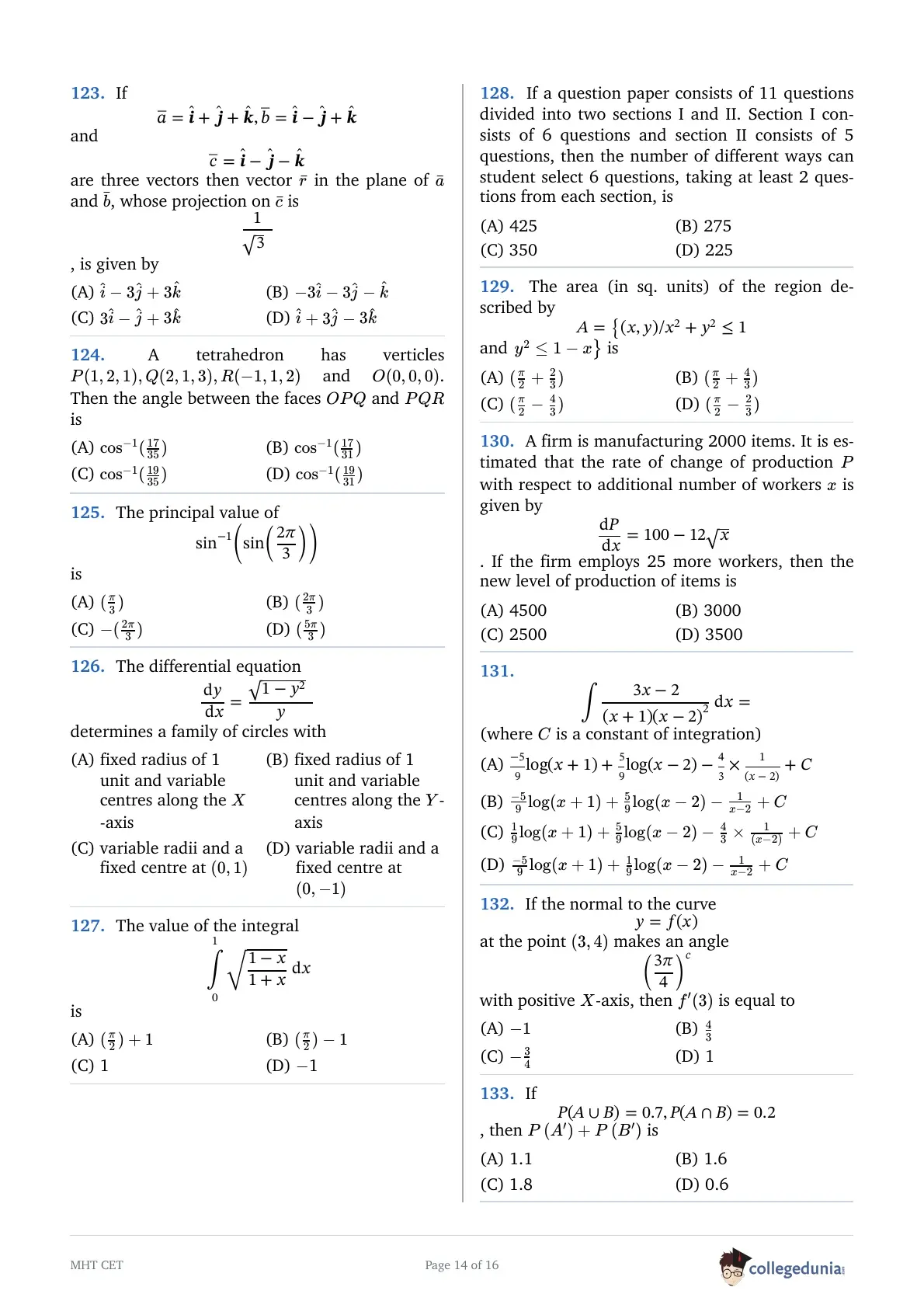
Question 123:

If \[\bar{a}=\hat{\boldsymbol{i}}+\hat{\boldsymbol{j}}+\hat{\boldsymbol{k}}, \bar{b}=\hat{\boldsymbol{i}}-\hat{\boldsymbol{j}}+\hat{\boldsymbol{k}}\] and \[\bar{c}=\hat{\boldsymbol{i}}-\hat{\boldsymbol{j}}-\hat{\boldsymbol{k}}\] are three vectors then vector \[\bar{r}\] in the plane of \[\bar{a}\] and \[\bar{b}\], whose projection on \[\bar{c}\] is \[\frac{1}{\sqrt{3}}\], is given by

  • (A) \(\hat{i}-3\hat{j}+3\hat{k}\)
  • (B) \(-3\hat{i}-3\hat{j}-\hat{k}\)
  • (C) \(3\hat{i}-\hat{j}+3\hat{k}\)
  • (D) \(\hat{i}+3\hat{j}-3\hat{k}\)

Question 124:

A tetrahedron has verticles \[P(1,2,1), Q(2,1,3), R(-1,1,2)\] and \[O(0,0,0)\]. Then the angle between the faces \[O P Q\] and \[P Q R\] is

  • (A) \(\mathrm{cos}^{-1}(\frac{17}{35})\)
  • (B) \(\mathrm{cos}^{-1}(\frac{17}{31})\)
  • (C) \(\mathrm{cos}^{-1}(\frac{19}{35})\)
  • (D) \(\mathrm{cos}^{-1}(\frac{19}{31})\)

Question 125:

The principal value of \[\sin ^{-1}\left(\sin \left(\frac{2 \pi}{3}\right)\right)\] is

  • (A) \((\frac{\pi}{3})\)
  • (B) \((\frac{2\pi}{3})\)
  • (C) \(-(\frac{2\pi}{3})\)
  • (D) \((\frac{5\pi}{3})\)

Question 126:

The differential equation \[\frac{\mathrm{d} y}{\mathrm{~d} x}=\frac{\sqrt{1-y^2}}{y}\] determines a family of circles with

  • (A) fixed radius of 1 unit and variable centres along the \(X\)-axis
  • (B) fixed radius of 1 unit and variable centres along the \(Y\)-axis
  • (C) variable radii and a fixed centre at \((0,1)\)
  • (D) variable radii and a fixed centre at \((0,-1)\)

Question 127:

The value of the integral \[\int_\limits0^1 \sqrt{\frac{1-x}{1+x}} \mathrm{~d} x\] is

  • (A) \((\frac{\pi}{2})+1\)
  • (B) \((\frac{\pi}{2})-1\)
  • (C) 1
  • (D) \(-\)1

Question 128:

If a question paper consists of 11 questions divided into two sections I and II. Section I consists of 6 questions and section II consists of 5 questions, then the number of different ways can student select 6 questions, taking at least 2 questions from each section, is

  • (A) 425
  • (B) 275
  • (C) 350
  • (D) 225

Question 129:

The area (in sq. units) of the region described by \[A=\left\{(x, y) / x^2+y^2 \leq 1\right.\] and \[\left.y^2 \leq 1-x\right\}\] is

  • (A) \((\frac{\pi}{2}+\frac{2}{3})\)
  • (B) \((\frac{\pi}{2}+\frac{4}{3})\)
  • (C) \((\frac{\pi}{2}-\frac{4}{3})\)
  • (D) \((\frac{\pi}{2}-\frac{2}{3})\)

Question 130:

A firm is manufacturing 2000 items. It is estimated that the rate of change of production \[P\] with respect to additional number of workers \[x\] is given by \[\frac{\mathrm{d} P}{\mathrm{~d} x}=100-12 \sqrt{x}\]. If the firm employs 25 more workers, then the new level of production of items is

  • (A) 4500
  • (B) 3000
  • (C) 2500
  • (D) 3500

Question 131:

\[\int \frac{3 x-2}{(x+1)(x-2)^2} \mathrm{~d} x=\]

(where \[C\] is a constant of integration)

  • (A) \(\frac{-5}{9}\mathrm{log}(x+1)+\frac{5}{9}\mathrm{log}(x-2)-\frac{4}{3}\times \frac{1}{(x-2)}+C\)
  • (B) \(\frac{-5}{9}\mathrm{log}(x+1)+\frac{5}{9}\mathrm{log}(x-2)-\frac{1}{x-2}+C\)
  • (C) \(\frac{1}{9}\mathrm{log}(x+1)+\frac{5}{9}\mathrm{log}(x-2)-\frac{4}{3}\times \frac{1}{(x-2)}+C\)
  • (D) \(\frac{-5}{9}\mathrm{log}(x+1)+\frac{1}{9}\mathrm{log}(x-2)-\frac{1}{x-2}+C\)

Question 132:

If the normal to the curve \[y=f(x)\] at the point \[(3,4)\] makes an angle \[\left(\frac{3 \pi}{4}\right)^c\] with positive \[X\]-axis, then \[f^{\prime}(3)\] is equal to

  • (A) \(-1\)
  • (B) \(\frac{4}{3}\)
  • (C) \(-\frac{3}{4}\)
  • (D) 1

Question 133:

If \[P(A \cup B)=0.7, P(A \cap B)=0.2\], then \[P\left(A^{\prime}\right)+P\left(B^{\prime}\right)\] is

  • (A) 1.1
  • (B) 1.6
  • (C) 1.8
  • (D) 0.6

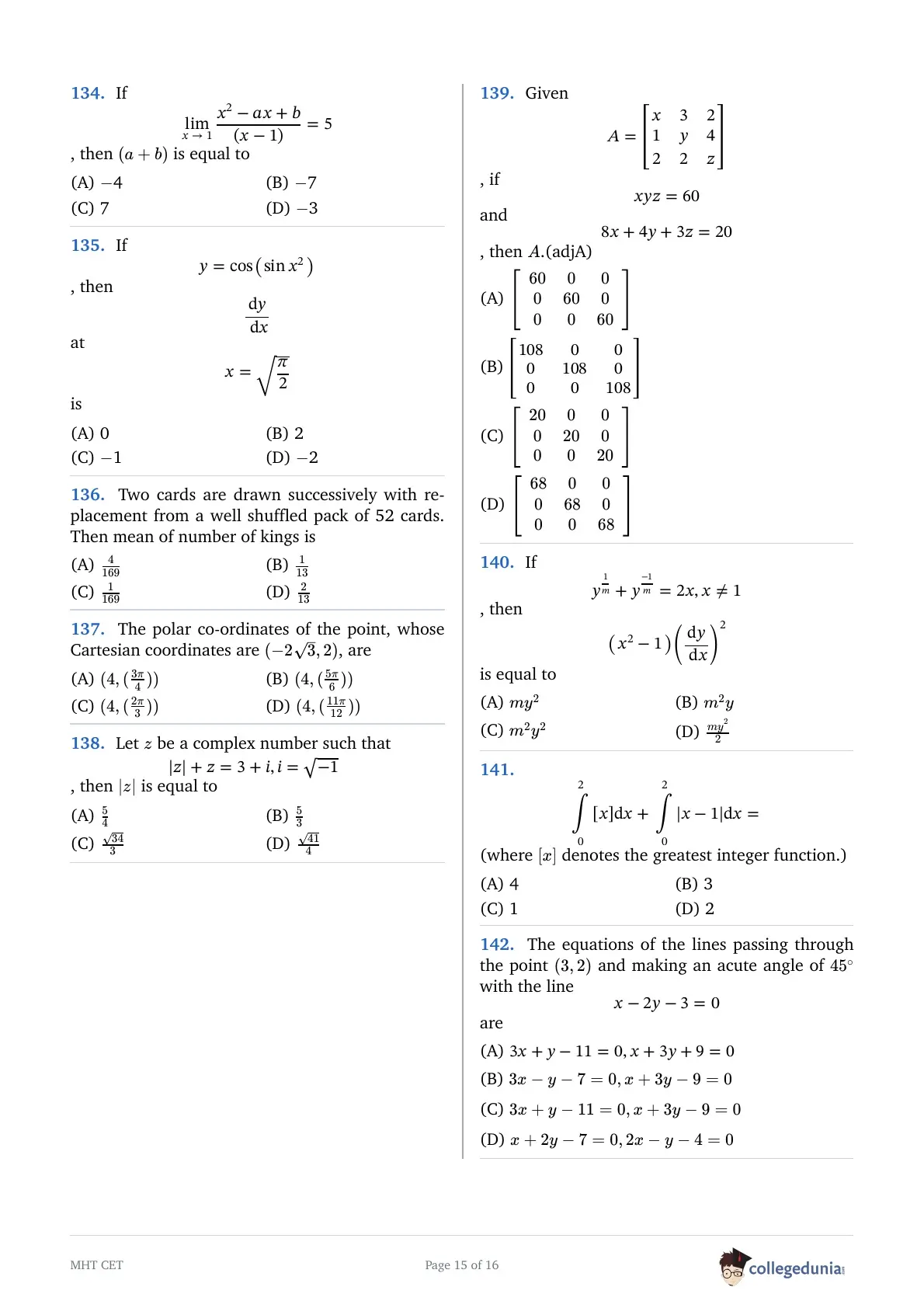
Question 134:

If \[\lim _\limits{x \rightarrow 1} \frac{x^2-a x+b}{(x-1)}=5\], then \[(a+b)\] is equal to

  • (A) \(-\)4
  • (B) \(-\)7
  • (C) 7
  • (D) \(-\)3

Question 135:

If \[y=\cos \left(\sin x^2\right)\], then \[\frac{\mathrm{d} y}{\mathrm{~d} x}\] at \[x=\sqrt{\frac{\pi}{2}}\] is

  • (A) 0
  • (B) 2
  • (C) \(-\)1
  • (D) \(-\)2

Question 136:

Two cards are drawn successively with replacement from a well shuffled pack of 52 cards. Then mean of number of kings is

  • (A) \(\frac{4}{169}\)
  • (B) \(\frac{1}{13}\)
  • (C) \(\frac{1}{169}\)
  • (D) \(\frac{2}{13}\)

Question 137:

The polar co-ordinates of the point, whose Cartesian coordinates are \[(-2 \sqrt{3}, 2)\], are

  • (A) \((4,(\frac{3\pi}{4}))\)
  • (B) \((4,(\frac{5\pi}{6}))\)
  • (C) \((4,(\frac{2\pi}{3}))\)
  • (D) \((4,(\frac{11\pi}{12}))\)

Question 138:

Let \[z\] be a complex number such that \[|z|+z=3+i, i=\sqrt{-1}\], then \[|z|\] is equal to

  • (A) \(\frac{5}{4}\)
  • (B) \(\frac{5}{3}\)
  • (C) \(\frac{\sqrt{34}}{3}\)
  • (D) \(\frac{\sqrt{41}}{4}\)

Question 139:

Given \[A=\left[\begin{array}{ccc}x & 3 & 2 \\ 1 & y & 4 \\ 2 & 2 & z\end{array}\right]\], if \[x y z=60\] and \[8 x+4 y+3 z=20\], then \[A\].(adjA)

  • (A) \(\left[\begin{array}{ccc} 60 & 0 & 0 \\ 0 & 60 & 0 \\ 0 & 0 & 60 \end{array}\right]\)
  • (B) \(\left[\begin{array}{ccc} 108 & 0 & 0 \\ 0 & 108 & 0 \\ 0 & 0 & 108 \end{array}\right]\)
  • (C) \(\left[\begin{array}{ccc} 20 & 0 & 0 \\ 0 & 20 & 0 \\ 0 & 0 & 20 \end{array}\right]\)
  • (D) \(\left[\begin{array}{ccc} 68 & 0 & 0 \\ 0 & 68 & 0 \\ 0 & 0 & 68 \end{array}\right]\)

Question 140:

If \[y^{\frac{1}{m}}+y^{\frac{-1}{m}}=2 x, x \neq 1\], then \[\left(x^2-1\right)\left(\frac{\mathrm{d} y}{\mathrm{~d} x}\right)^2\] is equal to

  • (A) \(my^{2}\)
  • (B) \(m^{2}y\)
  • (C) \(m^{2}y^{2}\)
  • (D) \(\frac{my^{2}}{2}\)

Question 141:

\[\int_\limits0^2[x] \mathrm{d} x+\int_\limits0^2|x-1| \mathrm{d} x=\]

(where \[[x]\] denotes the greatest integer function.)

  • (A) 4
  • (B) 3
  • (C) 1
  • (D) 2

Question 142:

The equations of the lines passing through the point \[(3,2)\] and making an acute angle of \[45^{\circ}\] with the line \[x-2 y-3=0\] are

  • (A) \(3x+y-11=0,x+3y+9=0\)
  • (B) \(3x-y-7=0,x+3y-9=0\)
  • (C) \(3x+y-11=0,x+3y-9=0\)
  • (D) \(x+2y-7=0,2x-y-4=0\)

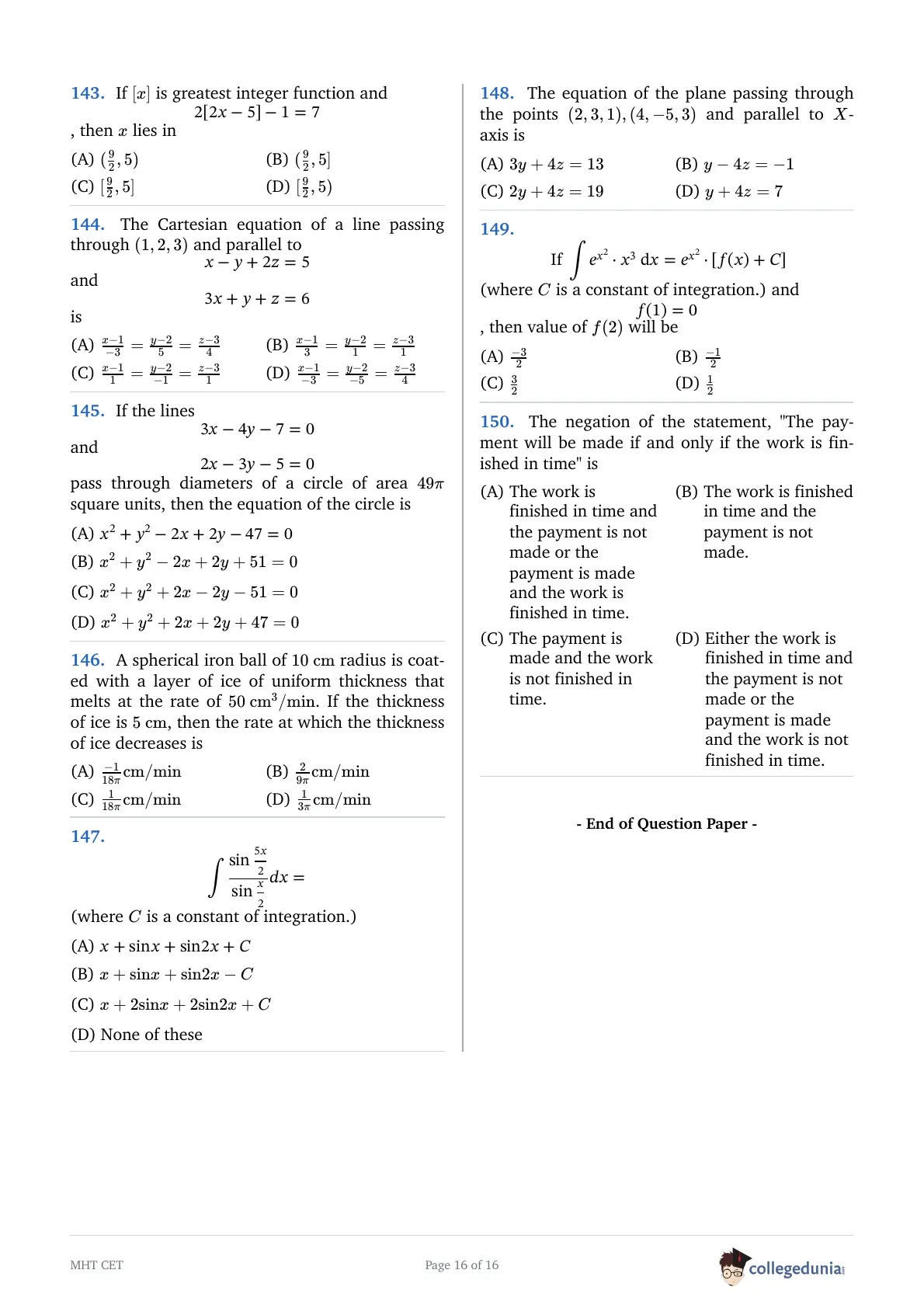
Question 143:

If \[[x]\] is greatest integer function and \[2[2 x-5]-1=7\], then \[x\] lies in

  • (A) \((\frac{9}{2},5)\)
  • (B) \((\frac{9}{2},5]\)
  • (C) \([\frac{9}{2},5]\)
  • (D) \([\frac{9}{2},5)\)

Question 145:

If the lines \[3 x-4 y-7=0\] and \[2 x-3 y-5=0\] pass through diameters of a circle of area \[49 \pi\] square units, then the equation of the circle is

  • (A) \(x^{2}+y^{2}-2x+2y-47=0\)
  • (B) \(x^{2}+y^{2}-2x+2y+51=0\)
  • (C) \(x^{2}+y^{2}+2x-2y-51=0\)
  • (D) \(x^{2}+y^{2}+2x+2y+47=0\)

Question 146:

A spherical iron ball of \[10 \mathrm{~cm}\] radius is coated with a layer of ice of uniform thickness that melts at the rate of \[50 \mathrm{~cm}^3 / \mathrm{min}\]. If the thickness of ice is \[5 \mathrm{~cm}\], then the rate at which the thickness of ice decreases is

  • (A) \(\frac{-1}{18\pi}\mathrm{cm}/\mathrm{min}\)
  • (B) \(\frac{2}{9\pi}\mathrm{cm}/\mathrm{min}\)
  • (C) \(\frac{1}{18\pi}\mathrm{cm}/\mathrm{min}\)
  • (D) \(\frac{1}{3\pi}\mathrm{cm}/\mathrm{min}\)

Question 147:

\[\int \frac{\sin \frac{5 x}{2}}{\sin \frac{x}{2}} d x=\]

(where \[C\] is a constant of integration.)

  • (A) \(x+\mathrm{sin}x+\mathrm{sin}2x+C\)
  • (B) \(x+\mathrm{sin}x+\mathrm{sin}2x-C\)
  • (C) \(x+2\mathrm{sin}x+2\mathrm{sin}2x+C\)
  • (D) None of these

Question 148:

The equation of the plane passing through the points \[(2,3,1),(4,-5,3)\] and parallel to \[X\]-axis is

  • (A) \(3y+4z=13\)
  • (B) \(y-4z=-1\)
  • (C) \(2y+4z=19\)
  • (D) \(y+4z=7\)

Question 149:

\[\text { If } \int e^{x^2} \cdot x^3 \mathrm{~d} x=e^{x^2} \cdot[f(x)+C]\] (where \[C\] is a constant of integration.) and \[f(1)=0\], then value of \[f(2)\] will be

  • (A) \(\frac{-3}{2}\)
  • (B) \(\frac{-1}{2}\)
  • (C) \(\frac{3}{2}\)
  • (D) \(\frac{1}{2}\)

Question 150:

The negation of the statement, "The payment will be made if and only if the work is finished in time" is

  • (A) The work is finished in time and the payment is not made or the payment is made and the work is finished in time.
  • (B) The work is finished in time and the payment is not made.
  • (C) The payment is made and the work is not finished in time.
  • (D) Either the work is finished in time and the payment is not made or the payment is made and the work is not finished in time.

MHT CET 2022 PCM Exam Pattern and Marking Scheme

Parameter Details
Conducting Body Maharashtra Common Entrance Test Cell (Maharashtra CET Cell)
Exam Mode Online (Computer-Based Test)
Duration 180 minutes (3 hours)
Groups / Subjects PCM (Physics, Chemistry, Mathematics) for Engineering
Total Questions

150

Total Marks 200
Question Type Multiple Choice Questions (MCQs)
Marks Distribution
  • Mathematics – 2 marks/question
  • Physics and Chemistry – 1 mark/question
Negative Marking No
Syllabus Weightage
  • Class 12 – 80%
  • Class 11 – 20%