




MHT CET 2022 Aug 10 Shift 1 PCM Question Paper is available for download here. Maharashtra State CET Cell conducted MHT CET 2022 PCM Exam on Aug 10 in Shift 1 from 9 AM to 12 PM in CBT mode.
The MHT CET 2022 PCM question paper includes the following:
- The MHT CET 2022 PCM Question Paper consists of 150 multiple-choice questions (MCQs) totalling 200 marks divided into 3 sections: Physics, Chemistry, and Mathematics, with 50 questions in each subject.
- Physics and Chemistry questions carry 1 mark each while Mathematics questions carry 2 marks each.
- There is no negative marking for incorrect answers.
MHT CET 2022 Aug 10 Shift 1 PCM Question Paper with Solution PDF
| CD PDF | CD PDF with Solutions |
|---|---|
| Download Collegedunia PDF 0.88 MB | - |
Also Check:
MHT CET 2022 Aug 10 Shift 1 PCM Questions with Solutions
Physics (Q1 - Q50)
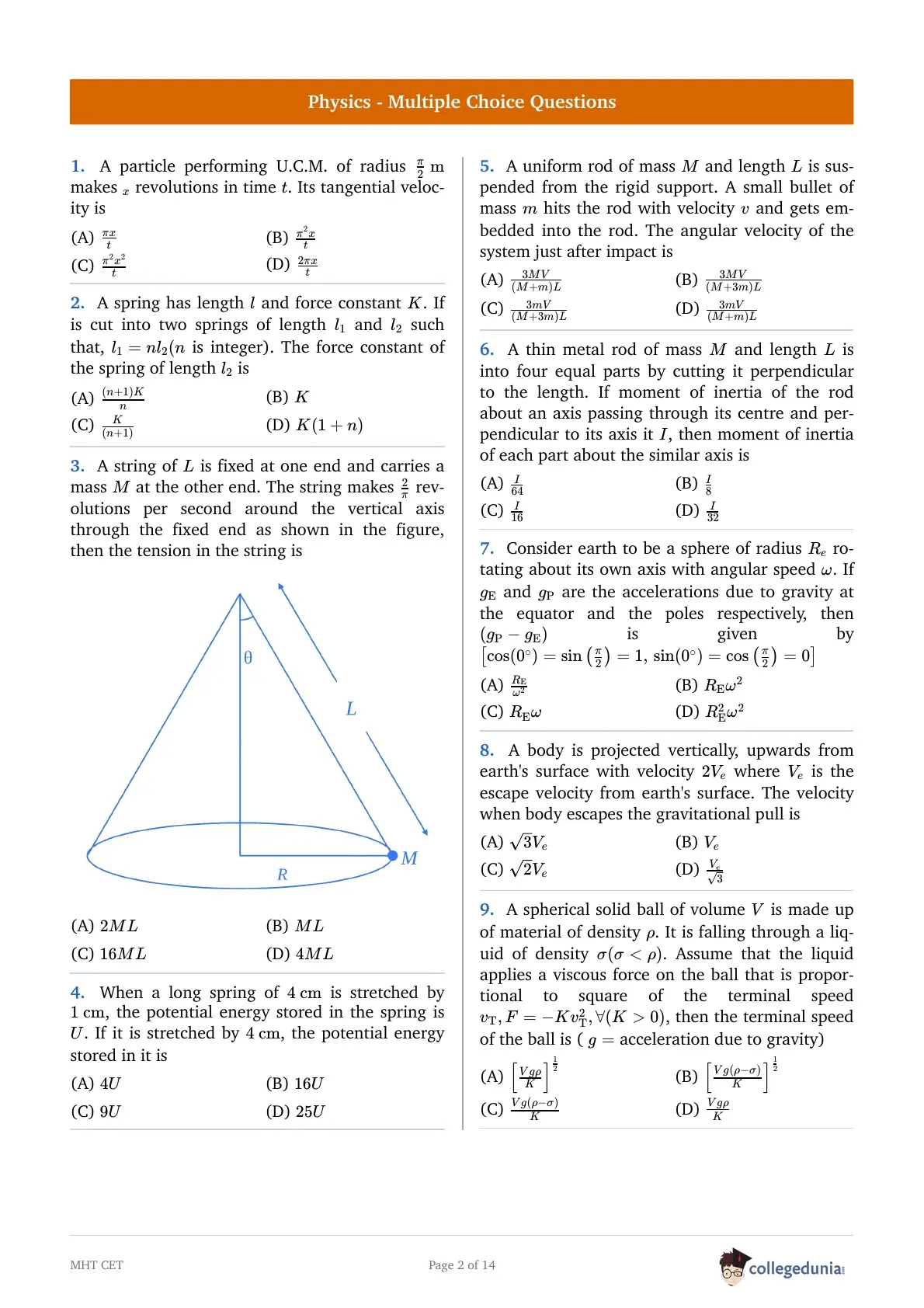
A particle performing U.C.M. of radius \(\frac{\pi }{2}\ \mathrm{m}\) makes \({}_{x}\) revolutions in time \(t\). Its tangential velocity is
A spring has length \(l\) and force constant \(K\). If is cut into two springs of length \(l_{1}\) and \(l_{2}\) such that, \(l_{1}=nl_{2}(n\) is integer). The force constant of the spring of length \(l_{2}\) is
A string of \(L\) is fixed at one end and carries a mass \(M\) at the other end. The string makes \(\frac{2}{\pi }\) revolutions per second around the vertical axis through the fixed end as shown in the figure, then the tension in the string is

When a long spring of \(4\ \mathrm{cm}\) is stretched by \(1\ \mathrm{cm}\), the potential energy stored in the spring is \(U\). If it is stretched by \(4\ \mathrm{cm}\), the potential energy stored in it is
A uniform rod of mass \(M\) and length \(L\) is suspended from the rigid support. A small bullet of mass \(m\) hits the rod with velocity \(v\) and gets embedded into the rod. The angular velocity of the system just after impact is
A thin metal rod of mass \(M\) and length \(L\) is into four equal parts by cutting it perpendicular to the length. If moment of inertia of the rod about an axis passing through its centre and perpendicular to its axis it \(I\), then moment of inertia of each part about the similar axis is
Consider earth to be a sphere of radius \(R_{e}\) rotating about its own axis with angular speed \(\omega\). If \(g_{\mathrm{E}}\) and \(g_{\mathrm{P}}\) are the accelerations due to gravity at the equator and the poles respectively, then \((g_{\mathrm{P}}-g_{\mathrm{E}})\) is given by \(\left[\cos (0^{\circ })=\sin \left(\frac{\pi }{2}\right)=1,\,\sin (0^{\circ })=\cos \left(\frac{\pi }{2}\right)=0\right]\)
A body is projected vertically, upwards from earth's surface with velocity \(2V_{e}\) where \(V_{e}\) is the escape velocity from earth's surface. The velocity when body escapes the gravitational pull is
A spherical solid ball of volume \(V\) is made up of material of density \(\rho\). It is falling through a liquid of density \(\sigma (\sigma \lt \rho )\). Assume that the liquid applies a viscous force on the ball that is proportional to square of the terminal speed \(v_{\mathrm{T}},F=-Kv_{\mathrm{T}}^{2},\forall (K>0)\), then the terminal speed of the ball is ( \(g=\) acceleration due to gravity)
A square wire frame of each side \(L\) is dipped in soap solution. On taking out, a membrane is formed. If the surface tension of solution is \(T\), the force acting on the frame will be
Water rises up to a height \(h\) in a capillary tube immersed vertically in water. When this whole arrangement is taken to a depth \(d\) in a mine, the water level rises up to a height \(h'\). If \(R\) is the radius of the earth, then the ratio \(\frac{h}{h'}\) is
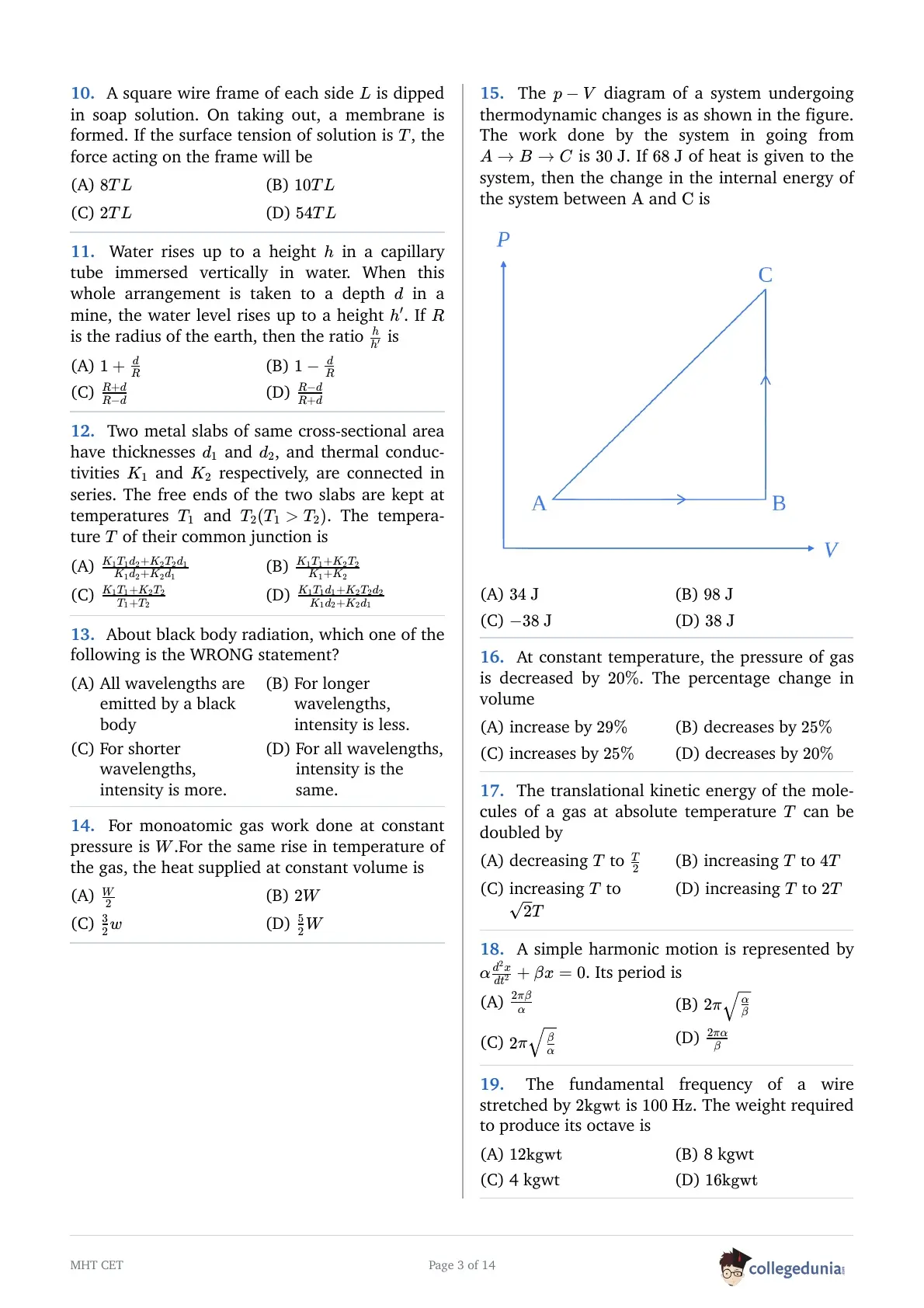
Two metal slabs of same cross-sectional area have thicknesses \(d_{1}\) and \(d_{2}\), and thermal conductivities \(K_{1}\) and \(K_{2}\) respectively, are connected in series. The free ends of the two slabs are kept at temperatures \(T_{1}\) and \(T_{2}(T_{1}>T_{2})\). The temperature \(T\) of their common junction is
About black body radiation, which one of the following is the WRONG statement?
For monoatomic gas work done at constant pressure is \(W\).For the same rise in temperature of the gas, the heat supplied at constant volume is
The \(p-V\) diagram of a system undergoing thermodynamic changes is as shown in the figure. The work done by the system in going from \(A\rightarrow B\rightarrow C\) is \(30\ \mathrm{J}\). If \(68\ \mathrm{J}\) of heat is given to the system, then the change in the internal energy of the system between \(\mathrm{A}\) and \(\mathrm{C}\) is

At constant temperature, the pressure of gas is decreased by \(20\%\). The percentage change in volume
The translational kinetic energy of the molecules of a gas at absolute temperature \(T\) can be doubled by
A simple harmonic motion is represented by \(\alpha \frac{d^{2}x}{dt^{2}}+\beta x=0\). Its period is
The fundamental frequency of a wire stretched by \(2\mathrm{kgwt}\) is \(100\ \mathrm{Hz}\). The weight required to produce its octave is
The equation of stationary wave on a string clamped at both ends and vibrating in third harmonic is \(Y=0.5\,\sin (0.314x)\cos (600\pi t)\) where \(x\) and \(y\) are in \(\mathrm{cm},t\) in second. The length of the vibrating string is
A cylindrical tube open at both ends has fundamental frequency \(f\) in air. When the tube is dipped vertically in water so that one-third part of the tube is in water, the fundamental frequency of air column becomes (neglect end correction)
A string of mass \(M\) is under a tension \(T\). The length of the string is \(L\). A transverse wave starts at one end of the string., the time required for the disturbance to reach the other end is
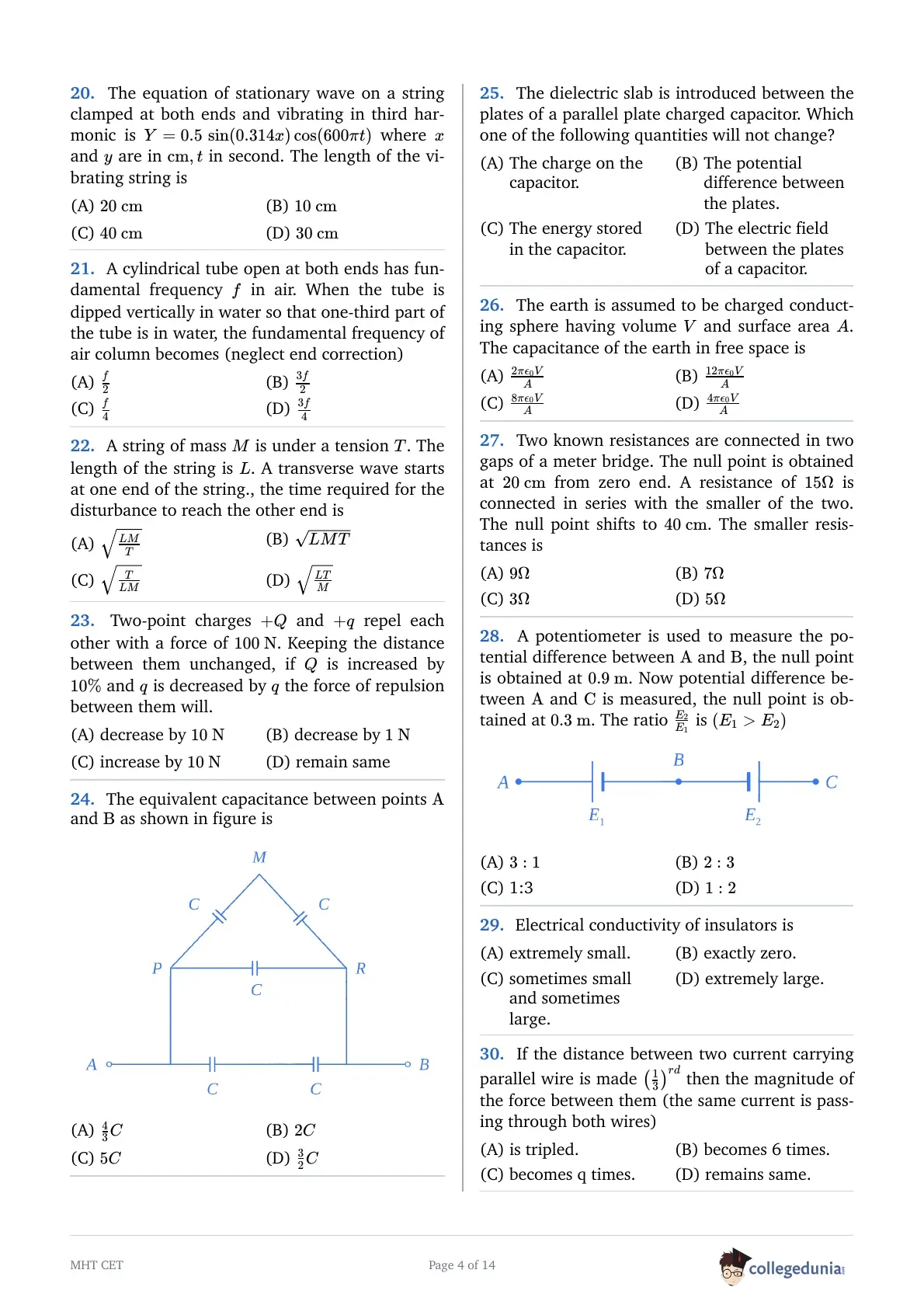
The equivalent capacitance between points \(\mathrm{A}\) and \(\mathrm{B}\) as shown in figure is

The dielectric slab is introduced between the plates of a parallel plate charged capacitor. Which one of the following quantities will not change?
The earth is assumed to be charged conducting sphere having volume \(V\) and surface area \(A\). The capacitance of the earth in free space is
Two known resistances are connected in two gaps of a meter bridge. The null point is obtained at \(20\ \mathrm{cm}\) from zero end. A resistance of \(15\Omega\) is connected in series with the smaller of the two. The null point shifts to \(40\ \mathrm{cm}\). The smaller resistances is
A potentiometer is used to measure the potential difference between \(\mathrm{A}\) and \(\mathrm{B}\), the null point is obtained at \(0.9\ \mathrm{m}\). Now potential difference between \(\mathrm{A}\) and \(\mathrm{C}\) is measured, the null point is obtained at \(0.3\ \mathrm{m}\). The ratio \(\frac{E_{2}}{E_{1}}\) is \((E_{1}>E_{2})\)

Electrical conductivity of insulators is
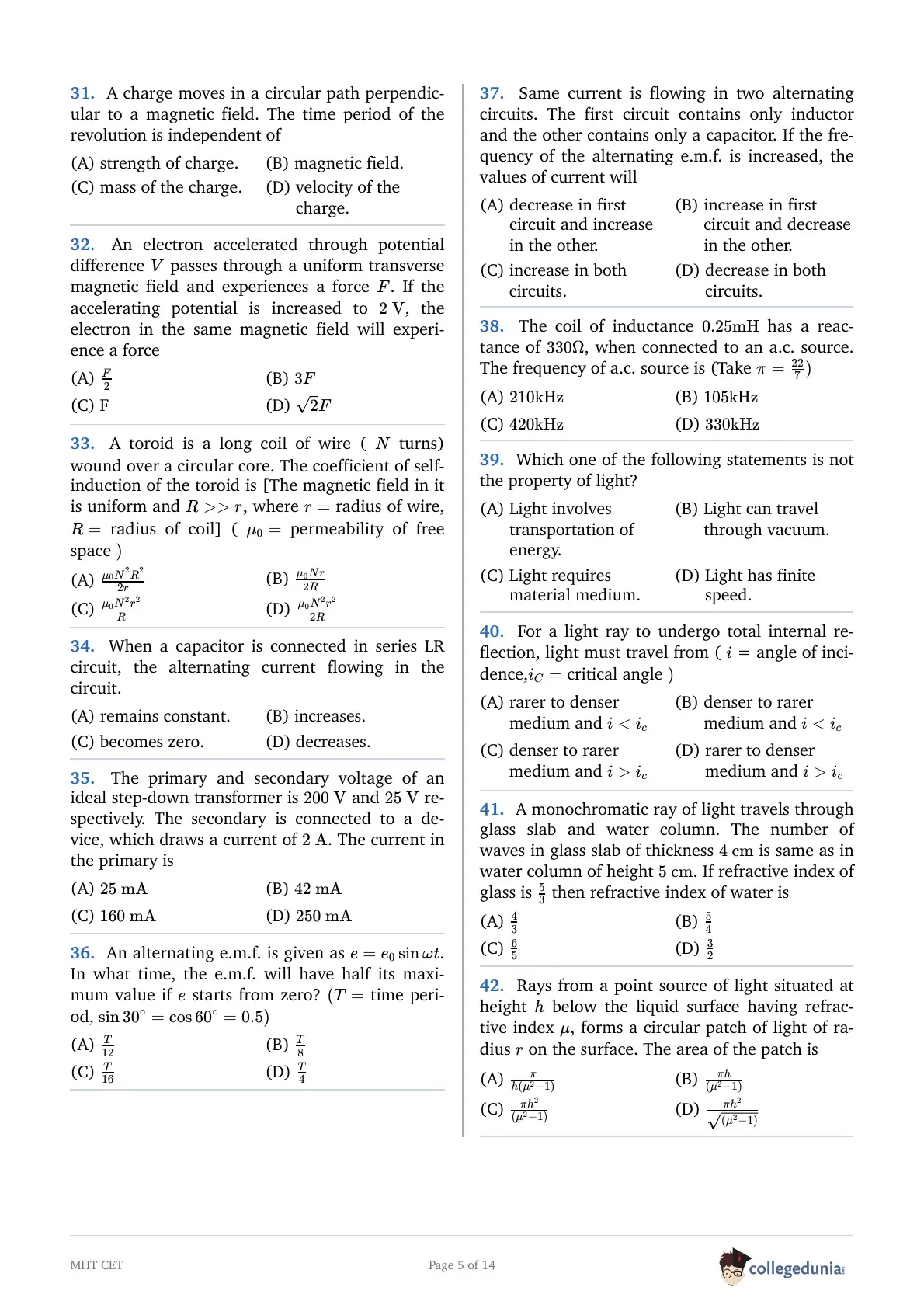
A charge moves in a circular path perpendicular to a magnetic field. The time period of the revolution is independent of
An electron accelerated through potential difference \(V\) passes through a uniform transverse magnetic field and experiences a force \(F\). If the accelerating potential is increased to \(2\ \mathrm{V}\), the electron in the same magnetic field will experience a force
A toroid is a long coil of wire ( \(N\) turns) wound over a circular core. The coefficient of self-induction of the toroid is [The magnetic field in it is uniform and \(R>>r\), where \(r=\) radius of wire, \(R=\) radius of coil] ( \(\mu _{0}=\) permeability of free space \()\)
The primary and secondary voltage of an ideal step-down transformer is \(200\ \mathrm{V}\) and \(25\ \mathrm{V}\) respectively. The secondary is connected to a device, which draws a current of \(2\ \mathrm{A}\). The current in the primary is
An alternating e.m.f. is given as \(e=e_{0}\sin \omega t\). In what time, the e.m.f. will have half its maximum value if \(e\) starts from zero? \((T=\) time period, \(\sin 30^{\circ }=\cos 60^{\circ }=0.5)\)
Same current is flowing in two alternating circuits. The first circuit contains only inductor and the other contains only a capacitor. If the frequency of the alternating e.m.f. is increased, the values of current will
The coil of inductance \(0.25\mathrm{mH}\) has a reactance of \(330\Omega\), when connected to an a.c. source. The frequency of a.c. source is (Take \(\pi =\frac{22}{7})\)
Which one of the following statements is not the property of light?
For a light ray to undergo total internal reflection, light must travel from ( \(i\) = angle of incidence,\(i_{C}=\) critical angle \()\)
A monochromatic ray of light travels through glass slab and water column. The number of waves in glass slab of thickness \(4\ \mathrm{cm}\) is same as in water column of height \(5\ \mathrm{cm}\). If refractive index of glass is \(\frac{5}{3}\) then refractive index of water is
Rays from a point source of light situated at height \(h\) below the liquid surface having refractive index \(\mu\), forms a circular patch of light of radius \(r\) on the surface. The area of the patch is
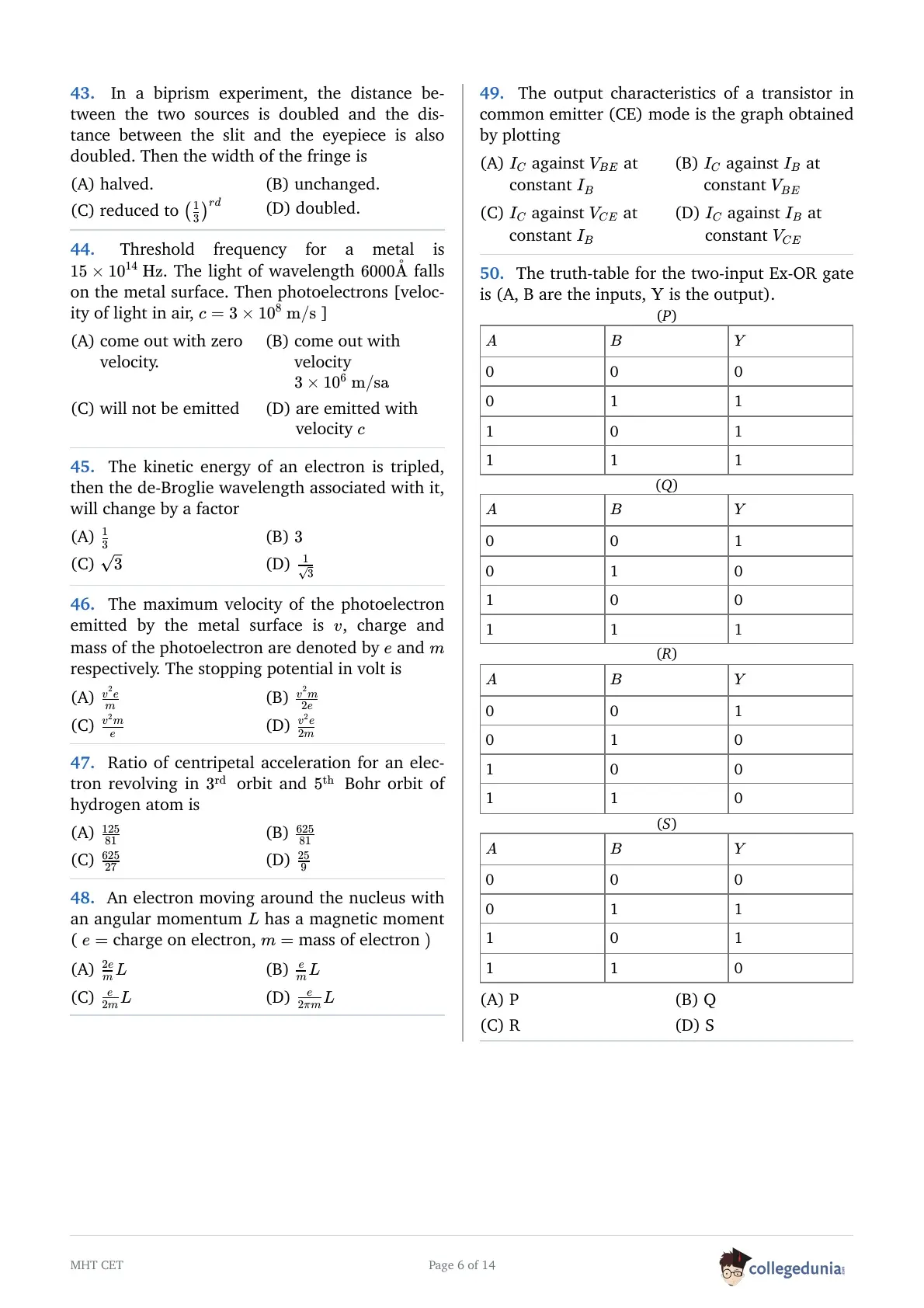
In a biprism experiment, the distance between the two sources is doubled and the distance between the slit and the eyepiece is also doubled. Then the width of the fringe is
Threshold frequency for a metal is \(15\times 10^{14}\ \mathrm{Hz}\). The light of wavelength \(6000\text{Å}\) falls on the metal surface. Then photoelectrons [velocity of light in air, \(c=3\times 10^{8}\ \mathrm{m}/\mathrm{s}\) ]
The kinetic energy of an electron is tripled, then the de-Broglie wavelength associated with it, will change by a factor
The maximum velocity of the photoelectron emitted by the metal surface is \(v\), charge and mass of the photoelectron are denoted by \(e\) and \(m\) respectively. The stopping potential in volt is
Ratio of centripetal acceleration for an electron revolving in \(3^{\text{rd }}\) orbit and \(5^{\text{th }}\) Bohr orbit of hydrogen atom is
An electron moving around the nucleus with an angular momentum \(L\) has a magnetic moment ( \(e=\) charge on electron, \(m=\) mass of electron \()\)
The output characteristics of a transistor in common emitter (CE) mode is the graph obtained by plotting
The truth-table for the two-input Ex-OR gate is (A, B are the inputs, \(\mathrm{Y}\) is the output).
| \(A\) | \(B\) | \(Y\) |
| 0 | 0 | 0 |
| 0 | 1 | 1 |
| 1 | 0 | 1 |
| 1 | 1 | 1 |
| \(A\) | \(B\) | \(Y\) |
| 0 | 0 | 1 |
| 0 | 1 | 0 |
| 1 | 0 | 0 |
| 1 | 1 | 1 |
| \(A\) | \(B\) | \(Y\) |
| 0 | 0 | 1 |
| 0 | 1 | 0 |
| 1 | 0 | 0 |
| 1 | 1 | 0 |
| \(A\) | \(B\) | \(Y\) |
| 0 | 0 | 0 |
| 0 | 1 | 1 |
| 1 | 0 | 1 |
| 1 | 1 | 0 |
Chemistry (Q51 - Q100)
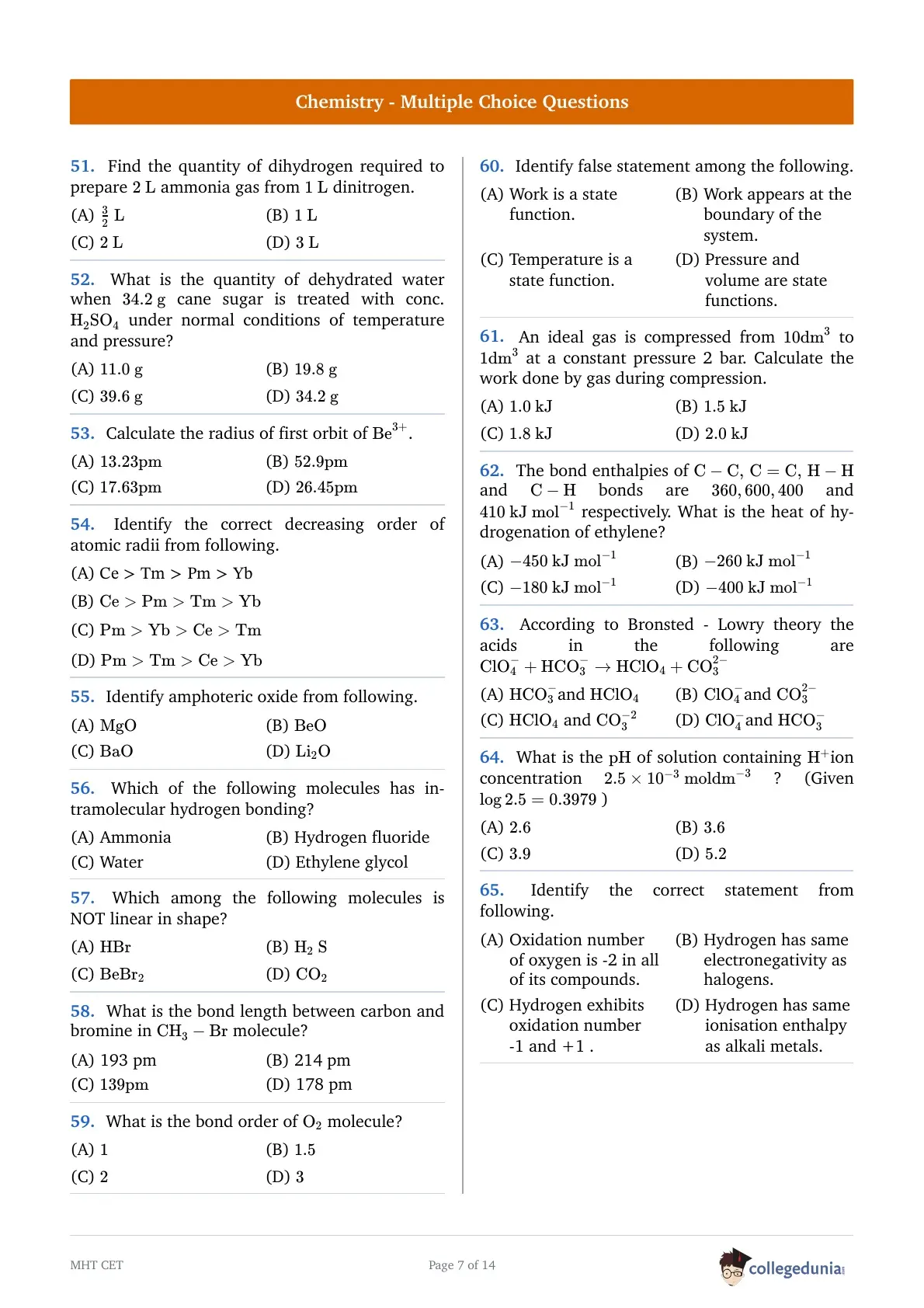
Find the quantity of dihydrogen required to prepare \(2\ \mathrm{L}\) ammonia gas from \(1\ \mathrm{L}\) dinitrogen.
What is the quantity of dehydrated water when \(34.2\ \mathrm{g}\) cane sugar is treated with conc. \(\mathrm{H}_{2}\mathrm{SO}_{4}\) under normal conditions of temperature and pressure?
Calculate the radius of first orbit of \(\mathrm{Be}^{3+}\).
Identify the correct decreasing order of atomic radii from following.
Identify amphoteric oxide from following.
Which of the following molecules has intramolecular hydrogen bonding?
Which among the following molecules is NOT linear in shape?
What is the bond length between carbon and bromine in \(\mathrm{CH}_{3}-\mathrm{Br}\) molecule?
What is the bond order of \(\mathrm{O}_{2}\) molecule?
Identify false statement among the following.
An ideal gas is compressed from \(10\mathrm{dm}^{3}\) to \(1\mathrm{dm}^{3}\) at a constant pressure 2 bar. Calculate the work done by gas during compression.
The bond enthalpies of \(\mathrm{C}-\mathrm{C},\,\mathrm{C}=\mathrm{C},\,\mathrm{H}-\mathrm{H}\) and \(\mathrm{C}-\mathrm{H}\) bonds are \(360,600,400\) and \(410\ \mathrm{kJ}\ \mathrm{mol}^{-1}\) respectively. What is the heat of hydrogenation of ethylene?
According to Bronsted - Lowry theory the acids in the following are \(\mathrm{ClO}_{4}^{-}+\mathrm{HCO}_{3}^{-}\rightarrow \mathrm{HClO}_{4}+\mathrm{CO}_{3}^{2-}\)
What is the \(\mathrm{pH}\) of solution containing \(\mathrm{H}^{+}\)ion concentration \(2.5\times 10^{-3}\ \mathrm{mol}\mathrm{dm}^{-3}\) ? (Given \(\log 2.5=0.3979\) )
Identify the correct statement from following.
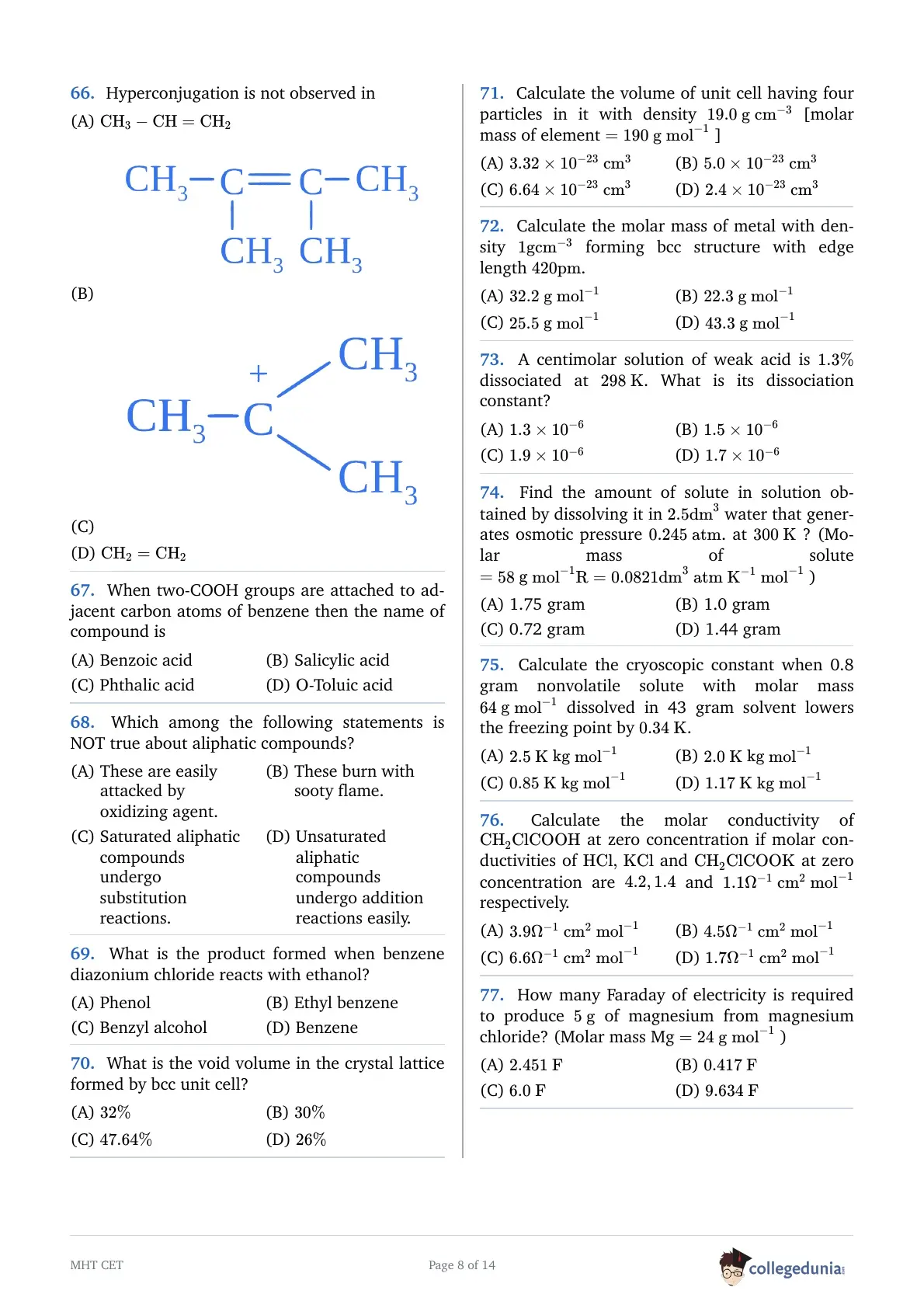
Hyperconjugation is not observed in
- (A) \(\mathrm{CH}_{3}-\mathrm{CH}=\mathrm{CH}_{2}\)
- (B)
![]()
- (C)
![]()
- (D) \(\mathrm{CH}_{2}=\mathrm{CH}_{2}\)


When two-COOH groups are attached to adjacent carbon atoms of benzene then the name of compound is
Which among the following statements is NOT true about aliphatic compounds?
What is the product formed when benzene diazonium chloride reacts with ethanol?
What is the void volume in the crystal lattice formed by bcc unit cell?
Calculate the volume of unit cell having four particles in it with density \(19.0\ \mathrm{g}\ \mathrm{cm}^{-3}\) [molar mass of element \(=190\ \mathrm{g}\ \mathrm{mol}^{-1}\) ]
Calculate the molar mass of metal with density \(1\mathrm{gcm}^{-3}\) forming bcc structure with edge length \(420\mathrm{pm}\).
A centimolar solution of weak acid is \(1.3\%\) dissociated at \(298\ \mathrm{K}\). What is its dissociation constant?
Find the amount of solute in solution obtained by dissolving it in \(2.5\mathrm{dm}^{3}\) water that generates osmotic pressure \(0.245\ \mathrm{atm}\). at \(300\ \mathrm{K}\) ? (Molar mass of solute \(=58\ \mathrm{g}\ \mathrm{mol}^{-1}\mathrm{R}=0.0821\mathrm{dm}^{3}\ \mathrm{atm}\ \mathrm{K}^{-1}\ \mathrm{mol}^{-1}\) )
Calculate the cryoscopic constant when 0.8 gram nonvolatile solute with molar mass \(64\ \mathrm{g}\ \mathrm{mol}^{-1}\) dissolved in 43 gram solvent lowers the freezing point by \(0.34\ \mathrm{K}\).
Calculate the molar conductivity of \(\mathrm{CH}_{2}\mathrm{ClCOOH}\) at zero concentration if molar conductivities of \(\mathrm{HCl},\,\mathrm{KCl}\) and \(\mathrm{CH}_{2}\mathrm{ClCOOK}\) at zero concentration are \(4.2,1.4\) and \(1.1\Omega ^{-1}\ \mathrm{cm}^{2}\ \mathrm{mol}^{-1}\) respectively.
How many Faraday of electricity is required to produce \(5\ \mathrm{g}\) of magnesium from magnesium chloride? (Molar mass Mg \(=24\ \mathrm{g}\ \mathrm{mol}^{-1}\) )
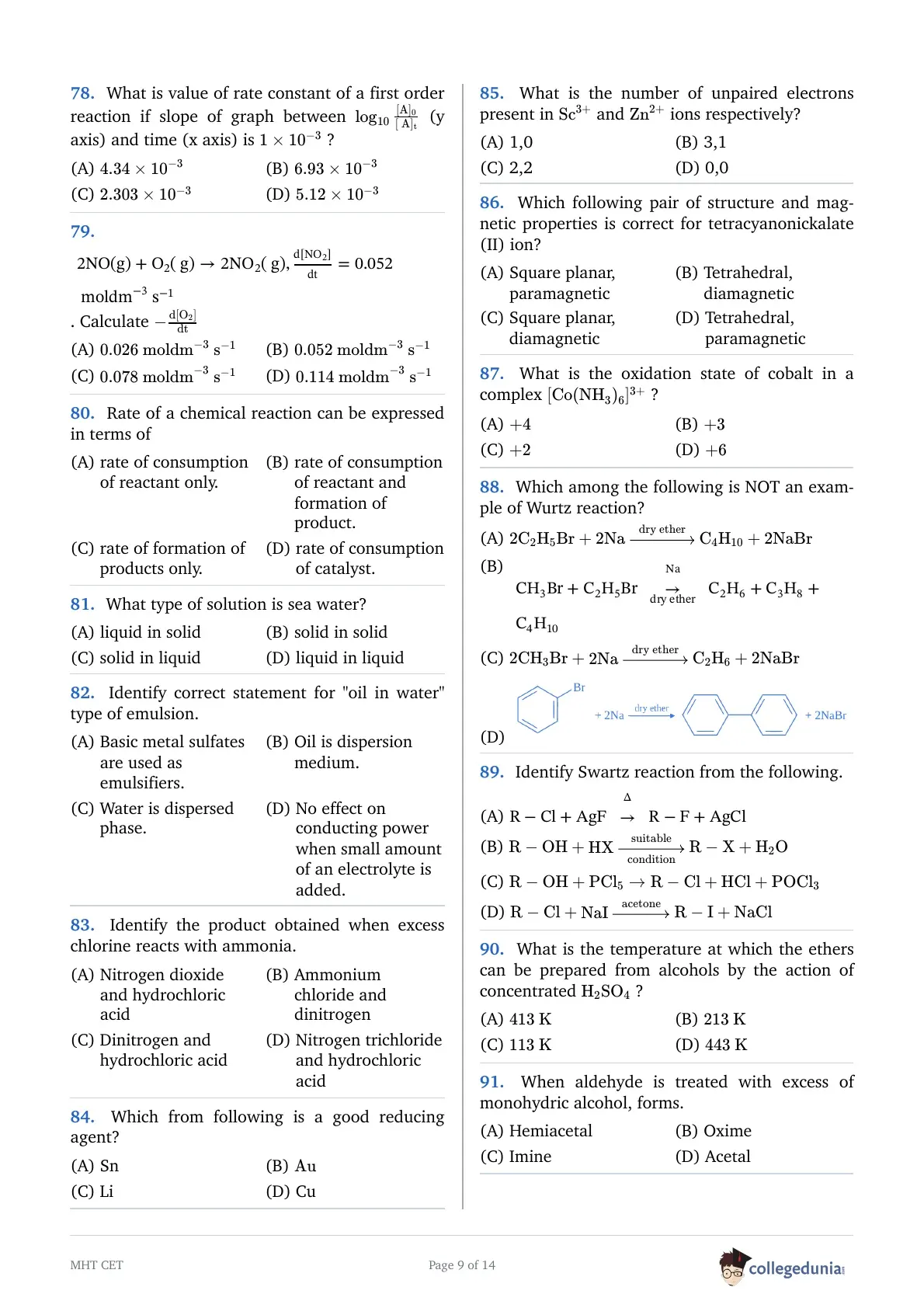
What is value of rate constant of a first order reaction if slope of graph between \(\log _{10}\frac{[\mathrm{A}]_{0}}{[\ \mathrm{A}]_{\mathrm{t}}}\) (y axis) and time (x axis) is \(1\times 10^{-3}\) ?
\(2\mathrm{NO}(\mathrm{g})+\mathrm{O}_{2}(\ \mathrm{g})\rightarrow 2\mathrm{NO}_{2}(\ \mathrm{g}),\frac{\mathrm{d}[\mathrm{NO}_{2}]}{\mathrm{dt}}=0.052\ \mathrm{mol}\mathrm{dm}^{-3}\ \mathrm{s}^{-1}\). Calculate \(-\frac{\mathrm{d}[\mathrm{O}_{2}]}{\mathrm{dt}}\)
Rate of a chemical reaction can be expressed in terms of
What type of solution is sea water?
Identify correct statement for "oil in water" type of emulsion.
Identify the product obtained when excess chlorine reacts with ammonia.
Which from following is a good reducing agent?
What is the number of unpaired electrons present in \(\mathrm{Sc}^{3+}\) and \(\mathrm{Zn}^{2+}\) ions respectively?
Which following pair of structure and magnetic properties is correct for tetracyanonickalate (II) ion?
What is the oxidation state of cobalt in a complex \([\mathrm{Co}(\mathrm{NH}_{3})_{6}]^{3+}\) ?
Which among the following is NOT an example of Wurtz reaction?
- (A) \(2\mathrm{C}_{2}\mathrm{H}_{5}\mathrm{Br}+2\mathrm{Na}\xrightarrow{\text{ dry ether }}\mathrm{C}_{4}\mathrm{H}_{10}+2\mathrm{NaBr}\)
- (B) \(\mathrm{CH}_{3}\mathrm{Br}+\mathrm{C}_{2}\mathrm{H}_{5}\mathrm{Br}\xrightarrow[\text{ dry ether }]{\mathrm{Na}}\mathrm{C}_{2}\mathrm{H}_{6}+\mathrm{C}_{3}\mathrm{H}_{8}+\mathrm{C}_{4}\mathrm{H}_{10}\)
- (C) \(2\mathrm{CH}_{3}\mathrm{Br}+2\mathrm{Na}\xrightarrow{\text{ dry ether }}\mathrm{C}_{2}\mathrm{H}_{6}+2\mathrm{NaBr}\)
- (D)
![]()

Identify Swartz reaction from the following.
What is the temperature at which the ethers can be prepared from alcohols by the action of concentrated \(\mathrm{H}_{2}\mathrm{SO}_{4}\) ?
When aldehyde is treated with excess of monohydric alcohol, forms.
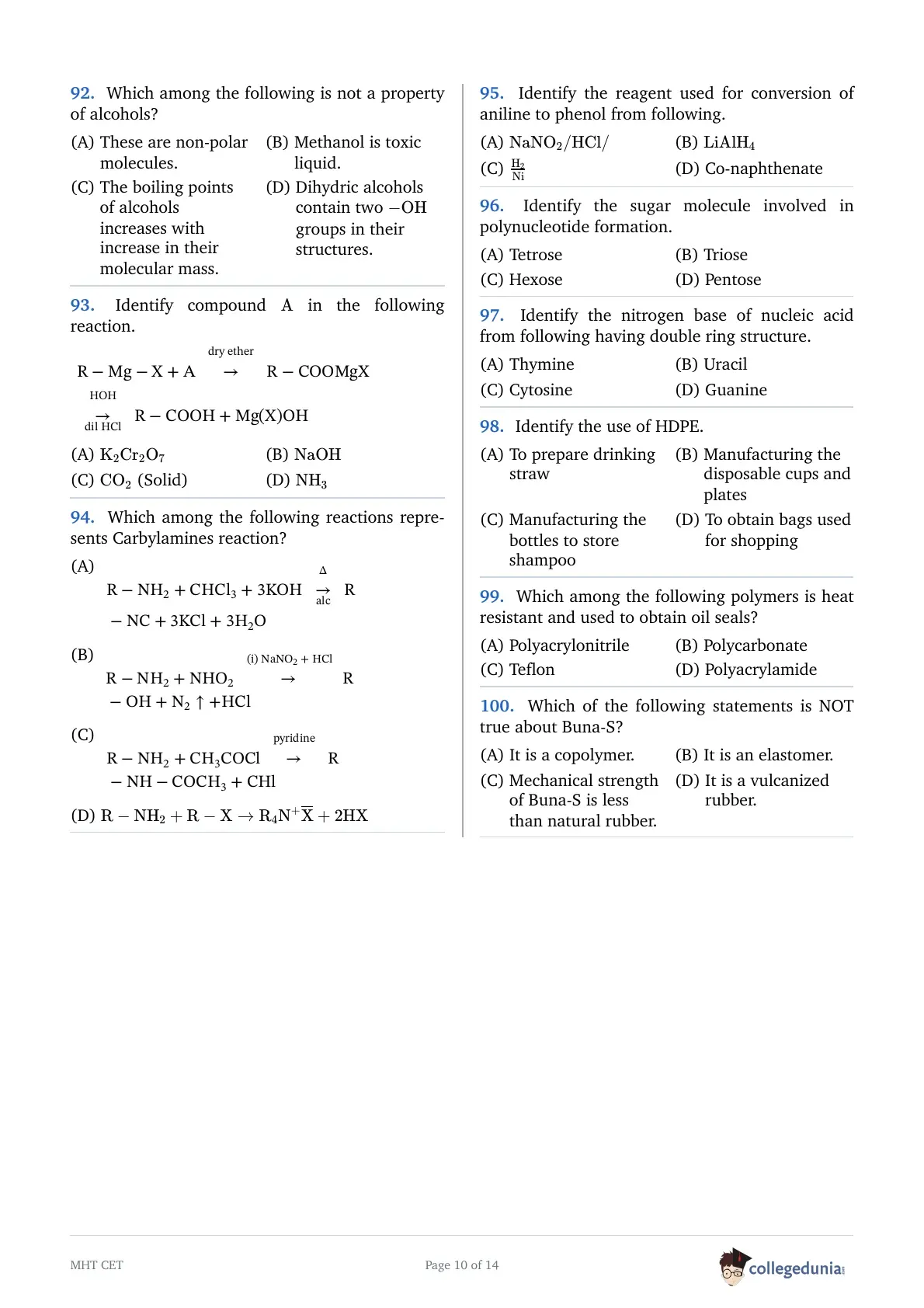
Which among the following is not a property of alcohols?
Identify compound \(\mathrm{A}\) in the following reaction. \(\mathrm{R}-\mathrm{Mg}-\mathrm{X}+\mathrm{A}\xrightarrow{\text{ dry ether }}\mathrm{R}-\mathrm{COOMgX}\xrightarrow[\text{ dil HCl }]{\mathrm{HOH}}\mathrm{R}-\mathrm{COOH}+\mathrm{Mg}(\mathrm{X})\mathrm{OH}\)
Which among the following reactions represents Carbylamines reaction?
Identify the reagent used for conversion of aniline to phenol from following.
Identify the sugar molecule involved in polynucleotide formation.
Identify the nitrogen base of nucleic acid from following having double ring structure.
Identify the use of HDPE.
Which among the following polymers is heat resistant and used to obtain oil seals?
Which of the following statements is NOT true about Buna-S?
Mathematics (Q101 - Q150)
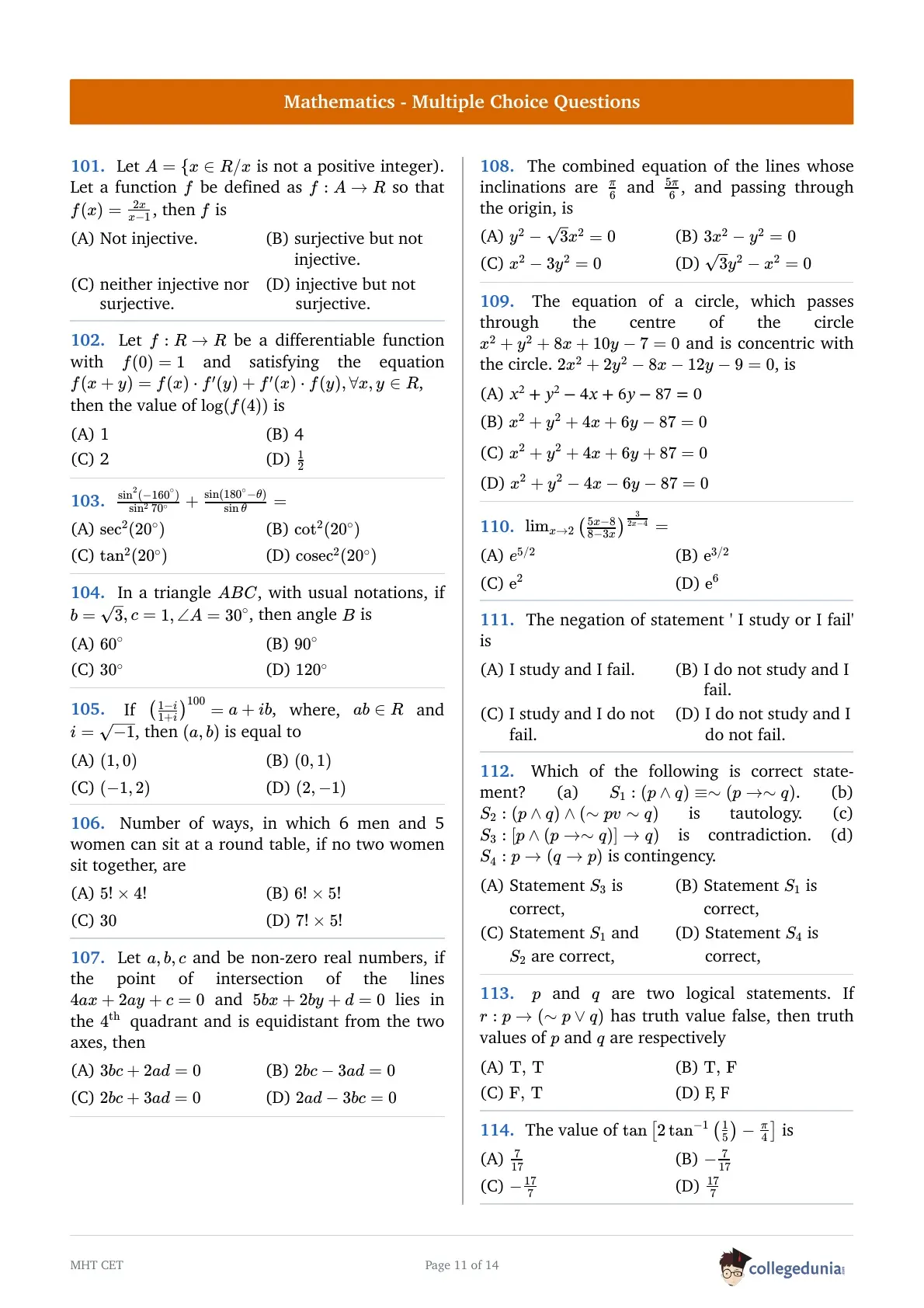
Let \(A=\{x\in R/x\) is not a positive integer). Let a function \(f\) be defined as \(f:A\rightarrow R\) so that \(f(x)=\frac{2x}{x-1}\), then \(f\) is
Let \(f:R\rightarrow R\) be a differentiable function with \(f(0)=1\) and satisfying the equation \(f(x+y)=f(x)\cdot f'(y)+f'(x)\cdot f(y),\forall x,y\in R\), then the value of \(\log (f(4))\) is
\(\frac{\sin ^{2}(-160^{\circ })}{\sin ^{2}70^{\circ }}+\frac{\sin (180^{\circ }-\theta )}{\sin \theta }=\)
In a triangle \(ABC\), with usual notations, if \(b=\sqrt{3},c=1,\angle A=30^{\circ }\), then angle \(B\) is
If \(\left(\frac{1-i}{1+i}\right)^{100}=a+ib\), where, \(ab\in R\) and \(i=\sqrt{-1}\), then \((a,b)\) is equal to
Number of ways, in which 6 men and 5 women can sit at a round table, if no two women sit together, are
Let \(a,b,c\) and be non-zero real numbers, if the point of intersection of the lines \(4ax+2ay+c=0\) and \(5bx+2by+d=0\) lies in the \(4^{\text{th }}\) quadrant and is equidistant from the two axes, then
The combined equation of the lines whose inclinations are \(\frac{\pi }{6}\) and \(\frac{5\pi }{6}\), and passing through the origin, is
The equation of a circle, which passes through the centre of the circle \(x^{2}+y^{2}+8x+10y-7=0\) and is concentric with the circle. \(2x^{2}+2y^{2}-8x-12y-9=0\), is
\(\lim _{x\rightarrow 2}\left(\frac{5x-8}{8-3x}\right)^{\frac{3}{2x-4}}=\)
The negation of statement ' I study or I fail' is
Which of the following is correct statement? (a) \(S_{1}:(p\wedge q)\equiv \sim (p\rightarrow \sim q)\). (b) \(S_{2}:(p\wedge q)\wedge (\sim pv\sim q)\) is tautology. (c) \(S_{3}:[p\wedge (p\rightarrow \sim q)]\rightarrow q)\) is contradiction. (d) \(S_{4}:p\rightarrow (q\rightarrow p)\) is contingency.
\(p\) and \(q\) are two logical statements. If \(r:p\rightarrow (\sim p\vee q)\) has truth value false, then truth values of \(p\) and \(q\) are respectively
The value of \(\tan \left[2\tan ^{-1}\left(\frac{1}{5}\right)-\frac{\pi }{4}\right]\) is
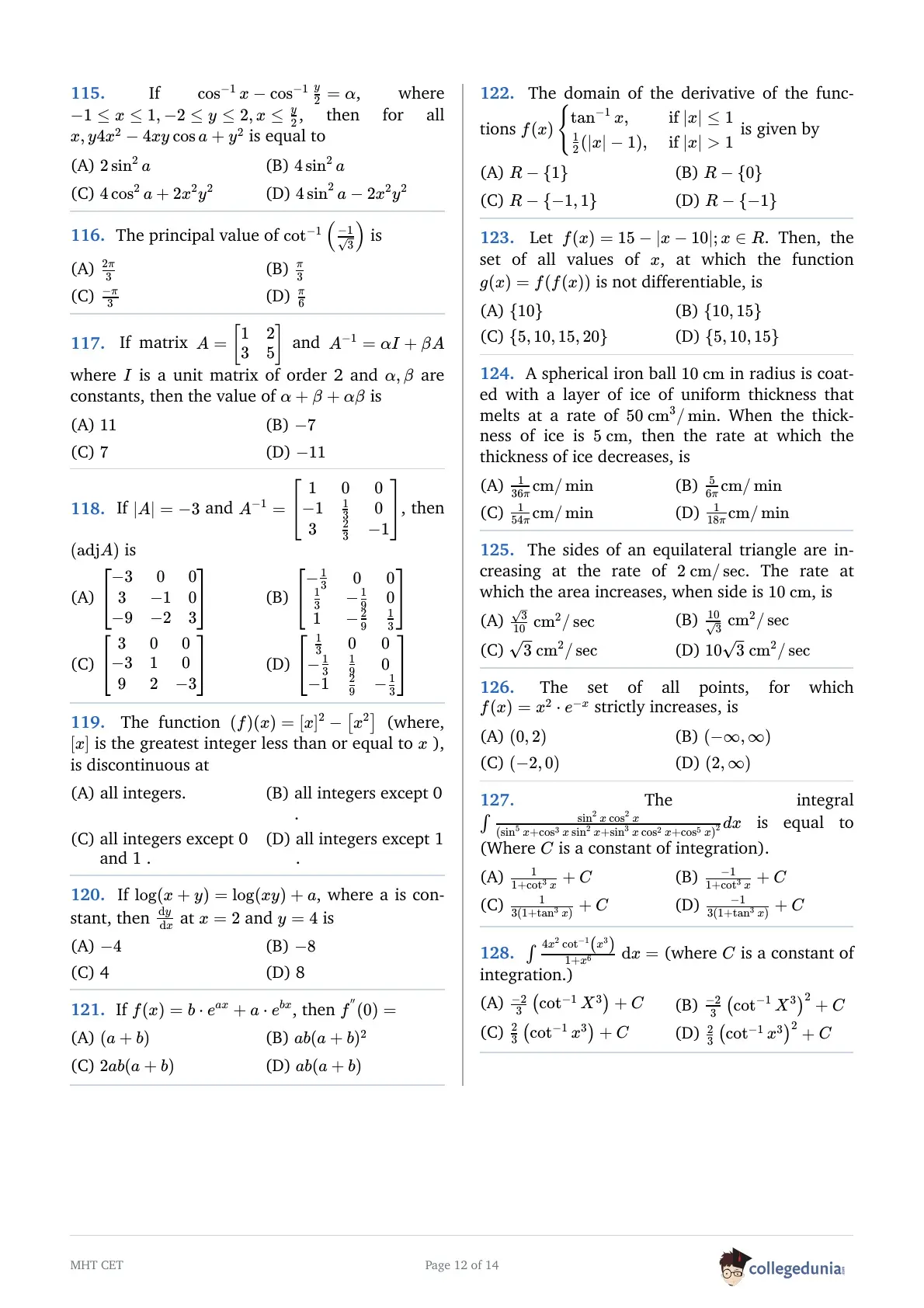
If \(\cos ^{-1}x-\cos ^{-1}\frac{y}{2}=\alpha\), where \(-1\leq x\leq 1,-2\leq y\leq 2,x\leq \frac{y}{2}\), then for all \(x,y4x^{2}-4xy\cos a+y^{2}\) is equal to
The principal value of \(\cot ^{-1}\left(\frac{-1}{\sqrt{3}}\right)\) is
If matrix \(A=\begin{bmatrix} 1 & 2 \\ 3 & 5 \end{bmatrix}\) and \(A^{-1}=\alpha I+\beta A\) where \(I\) is a unit matrix of order 2 and \(\alpha ,\beta\) are constants, then the value of \(\alpha +\beta +\alpha \beta\) is
If \(|A|=-3\) and \(A^{-1}=\begin{bmatrix} 1 & 0 & 0 \\ -1 & \frac{1}{3} & 0 \\ 3 & \frac{2}{3} & -1 \end{bmatrix}\), then \((\mathrm{adj}A)\) is
The function \((f)(x)=[x]^{2}-\left[x^{2}\right]\) (where, \([x]\) is the greatest integer less than or equal to \(x\) ), is discontinuous at
If \(\log (x+y)=\log (xy)+a\), where a is constant, then \(\frac{\mathrm{d}y}{\ \mathrm{d}x}\) at \(x=2\) and \(y=4\) is
If \(f(x)=b\cdot e^{ax}+a\cdot e^{bx}\), then \(f^{''}(0)=\)
The domain of the derivative of the functions \(f(x)\begin{cases} \tan ^{-1}x, & \text{ if }|x|\leq 1 \\ \frac{1}{2}(|x|-1), & \text{ if }|x|>1 \end{cases}\) is given by
Let \(f(x)=15-|x-10|;x\in R\). Then, the set of all values of \(x\), at which the function \(g(x)=f(f(x))\) is not differentiable, is
A spherical iron ball \(10\ \mathrm{cm}\) in radius is coated with a layer of ice of uniform thickness that melts at a rate of \(50\ \mathrm{cm}^{3}/\min\). When the thickness of ice is \(5\ \mathrm{cm}\), then the rate at which the thickness of ice decreases, is
The sides of an equilateral triangle are increasing at the rate of \(2\ \mathrm{cm}/\sec\). The rate at which the area increases, when side is \(10\ \mathrm{cm}\), is
The set of all points, for which \(f(x)=x^{2}\cdot e^{-x}\) strictly increases, is
The integral \(\int \frac{\sin ^{2}x\cos ^{2}x}{\left(\sin ^{5}x+\cos ^{3}x\sin ^{2}x+\sin ^{3}x\cos ^{2}x+\cos ^{5}x\right)^{2}}dx\) is equal to (Where \(C\) is a constant of integration).
\(\int \frac{4x^{2}\cot ^{-1}\left(x^{3}\right)}{1+x^{6}}\ \mathrm{d}x=\) (where \(C\) is a constant of integration.)
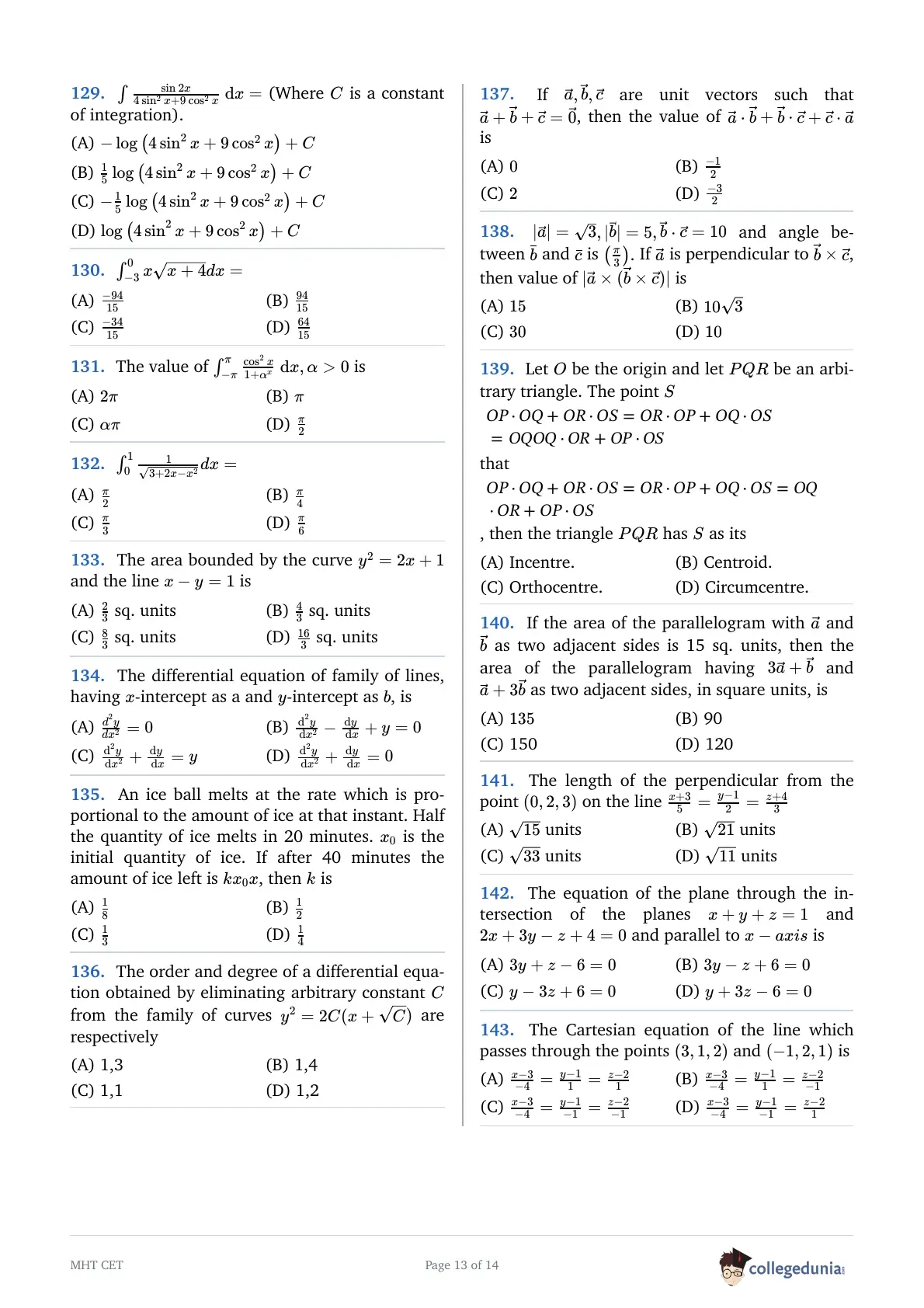
\(\int \frac{\sin 2x}{4\sin ^{2}x+9\cos ^{2}x}\ \mathrm{d}x=\) (Where \(C\) is a constant of integration).
\(\int _{-3}^{0}x\sqrt{x+4}dx=\)
The value of \(\int _{-\pi }^{\pi }\frac{\cos ^{2}x}{1+\alpha ^{x}}\ \mathrm{d}x,\alpha >0\) is
\(\int _{0}^{1}\frac{1}{\sqrt{3+2x-x^{2}}}dx=\)
The area bounded by the curve \(y^{2}=2x+1\) and the line \(x-y=1\) is
The differential equation of family of lines, having \(x\)-intercept as a and \(y\)-intercept as \(b\), is
An ice ball melts at the rate which is proportional to the amount of ice at that instant. Half the quantity of ice melts in 20 minutes. \(x_{0}\) is the initial quantity of ice. If after 40 minutes the amount of ice left is \(kx_{0}x\), then \(k\) is
The order and degree of a differential equation obtained by eliminating arbitrary constant \(C\) from the family of curves \(y^{2}=2C(x+\sqrt{C})\) are respectively
If \(\vec{a},\vec{b},\vec{c}\) are unit vectors such that \(\vec{a}+\vec{b}+\vec{c}=\vec{0}\), then the value of \(\vec{a}\cdot \vec{b}+\vec{b}\cdot \vec{c}+\vec{c}\cdot \vec{a}\) is
\(|\vec{a}|=\sqrt{3},|\vec{b}|=5,\vec{b}\cdot \vec{c}=10\) and angle between \(\bar{b}\) and \(\bar{c}\) is \(\left(\frac{\pi }{3}\right)\). If \(\vec{a}\) is perpendicular to \(\vec{b}\times \vec{c}\), then value of \(|\vec{a}\times (\vec{b}\times \vec{c})|\) is
Let \(O\) be the origin and let \(PQR\) be an arbitrary triangle. The point \(S\) \(\overline{OP}\cdot \overline{OQ}+\overline{OR}\cdot \overline{OS}=\overline{OR}\cdot \overline{OP}+\overline{OQ}\cdot \overline{OS}=\overline{OQ}\overline{OQ}\cdot \overline{OR}+\overline{OP}\cdot \overline{OS}\) that \(\overline{OP}\cdot \overline{OQ}+\overline{OR}\cdot \overline{OS}=\overline{OR}\cdot \overline{OP}+\overline{OQ}\cdot \overline{OS}=\overline{OQ}\cdot \overline{OR}+\overline{OP}\cdot \overline{OS}\), then the triangle \(PQR\) has \(S\) as its
If the area of the parallelogram with \(\vec{a}\) and \(\vec{b}\) as two adjacent sides is 15 sq. units, then the area of the parallelogram having \(3\vec{a}+\vec{b}\) and \(\vec{a}+3\vec{b}\) as two adjacent sides, in square units, is
The length of the perpendicular from the point \((0,2,3)\) on the line \(\frac{x+3}{5}=\frac{y-1}{2}=\frac{z+4}{3}\)
The equation of the plane through the intersection of the planes \(x+y+z=1\) and \(2x+3y-z+4=0\) and parallel to \(x-axis\) is
The Cartesian equation of the line which passes through the points \((3,1,2)\) and \((-1,2,1)\) is
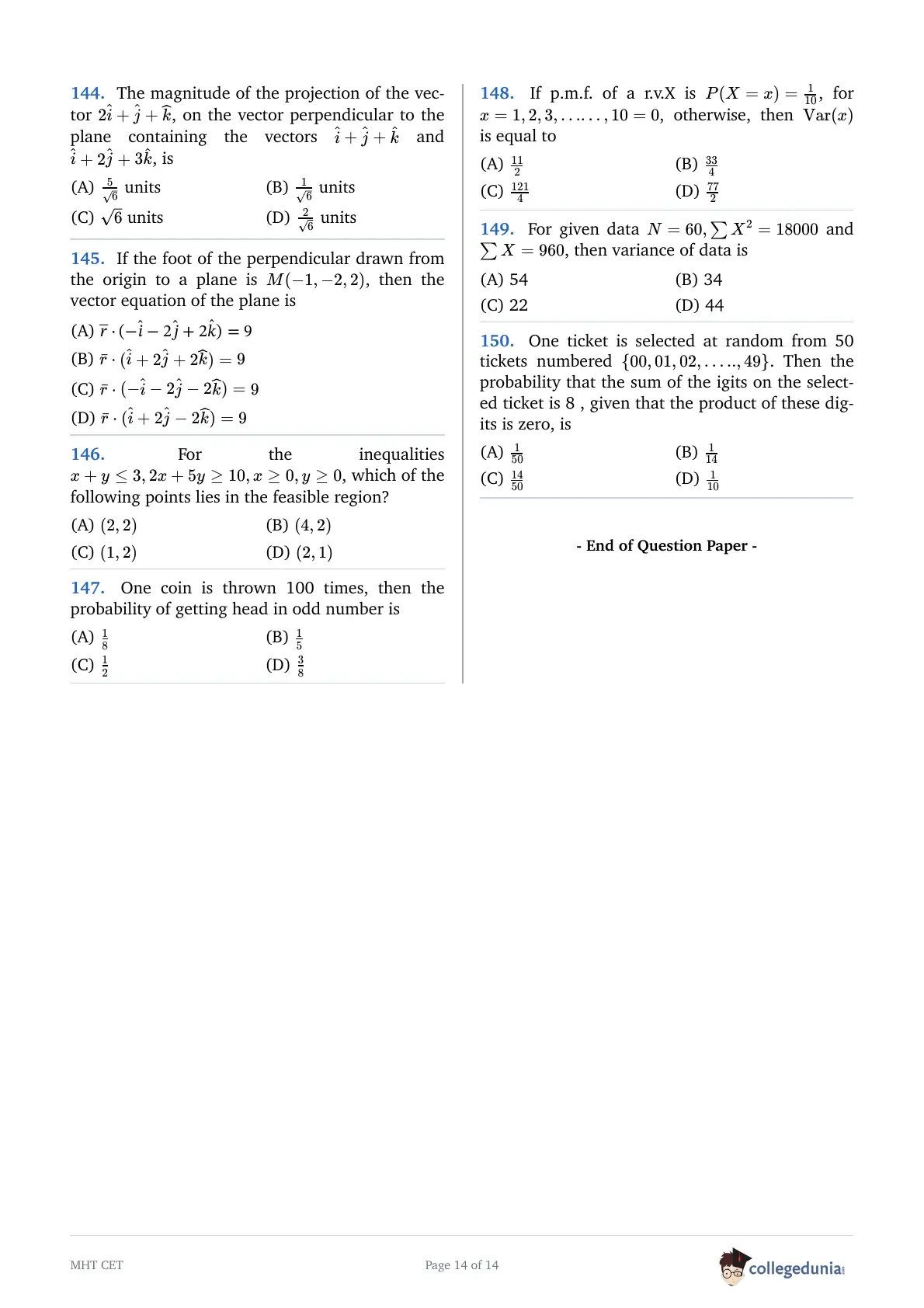
The magnitude of the projection of the vector \(2\hat{i}+\hat{j}+\widehat{k}\), on the vector perpendicular to the plane containing the vectors \(\hat{i}+\hat{j}+\hat{k}\) and \(\hat{i}+2\hat{j}+3\hat{k}\), is
If the foot of the perpendicular drawn from the origin to a plane is \(M(-1,-2,2)\), then the vector equation of the plane is
For the inequalities \(x+y\leq 3,2x+5y\geq 10,x\geq 0,y\geq 0\), which of the following points lies in the feasible region?
One coin is thrown 100 times, then the probability of getting head in odd number is
If p.m.f. of a r.v.X is \(P(X=x)=\frac{1}{10}\), for \(x=1,2,3,\ldots \ldots ,10=0\), otherwise, then \(\mathrm{Var}(x)\) is equal to
For given data \(N=60,\sum X^{2}=18000\) and \(\sum X=960\), then variance of data is
One ticket is selected at random from 50 tickets numbered \(\{00,01,02,\ldots ..,49\}\). Then the probability that the sum of the igits on the selected ticket is 8 , given that the product of these digits is zero, is
MHT CET 2022 PCM Exam Pattern and Marking Scheme
| Parameter | Details |
|---|---|
| Conducting Body | Maharashtra Common Entrance Test Cell (Maharashtra CET Cell) |
| Exam Mode | Online (Computer-Based Test) |
| Duration | 180 minutes (3 hours) |
| Groups / Subjects | PCM (Physics, Chemistry, Mathematics) for Engineering |
| Total Questions |
150 |
| Total Marks | 200 |
| Question Type | Multiple Choice Questions (MCQs) |
| Marks Distribution |
|
| Negative Marking | No |
| Syllabus Weightage |
|



Comments