




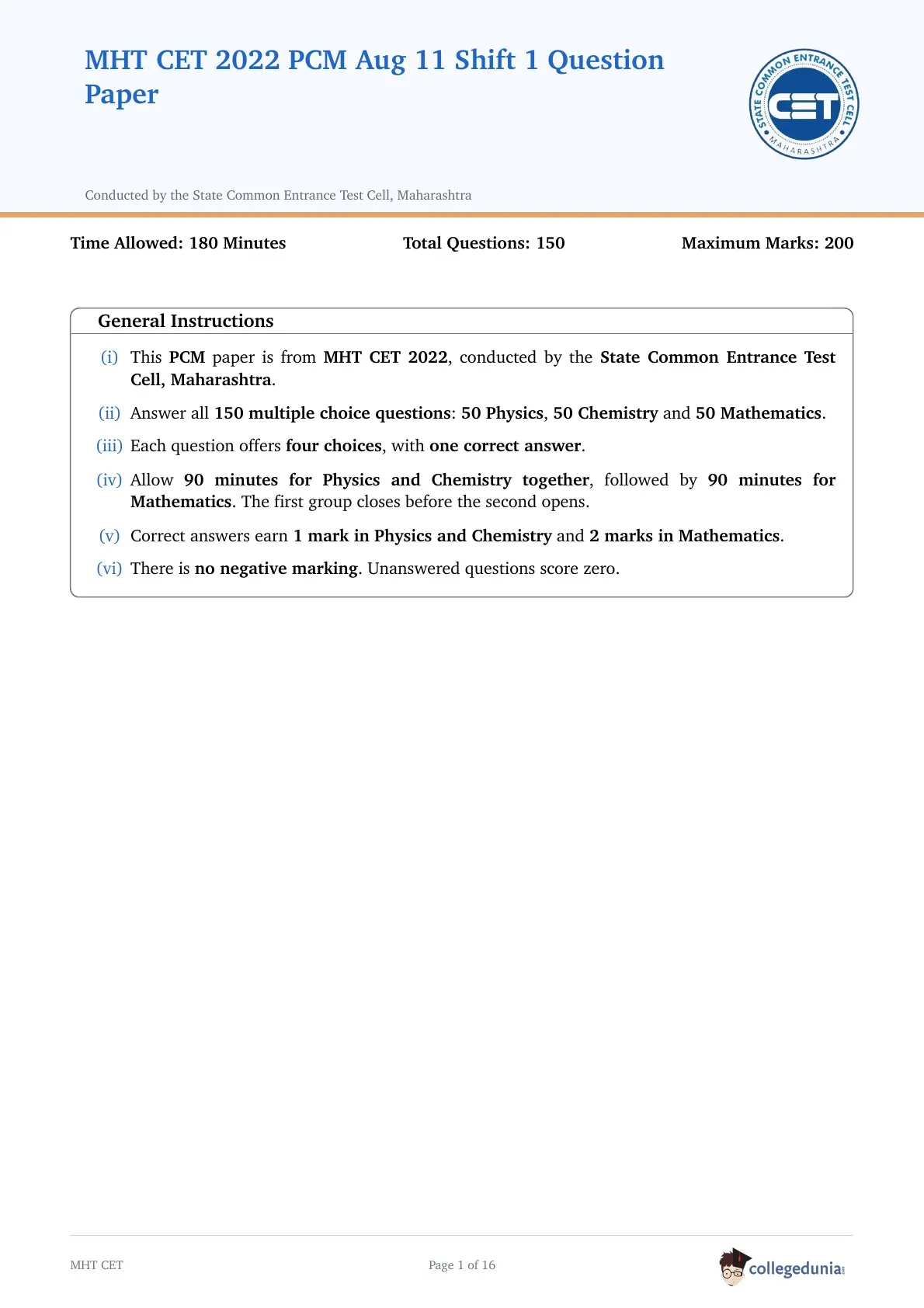
MHT CET 2022 Aug 11 Shift 1 PCM Question Paper is available for download here. Maharashtra State CET Cell conducted MHT CET 2022 PCM Exam on Aug 11 in Shift 1 from 9 AM to 12 PM in CBT mode.
The MHT CET 2022 PCM question paper includes the following:
- The MHT CET 2022 PCM Question Paper consists of 150 multiple-choice questions (MCQs) totalling 200 marks divided into 3 sections: Physics, Chemistry, and Mathematics, with 50 questions in each subject.
- Physics and Chemistry questions carry 1 mark each while Mathematics questions carry 2 marks each.
- There is no negative marking for incorrect answers.
MHT CET 2022 Aug 11 Shift 1 PCM Question Paper with Solution PDF
| CD PDF | CD PDF with Solutions |
|---|---|
| Download Collegedunia PDF 1.72 MB | - |
Also Check:
MHT CET 2022 Aug 11 Shift 1 PCM Questions with Solutions
Physics (Q1 - Q50)
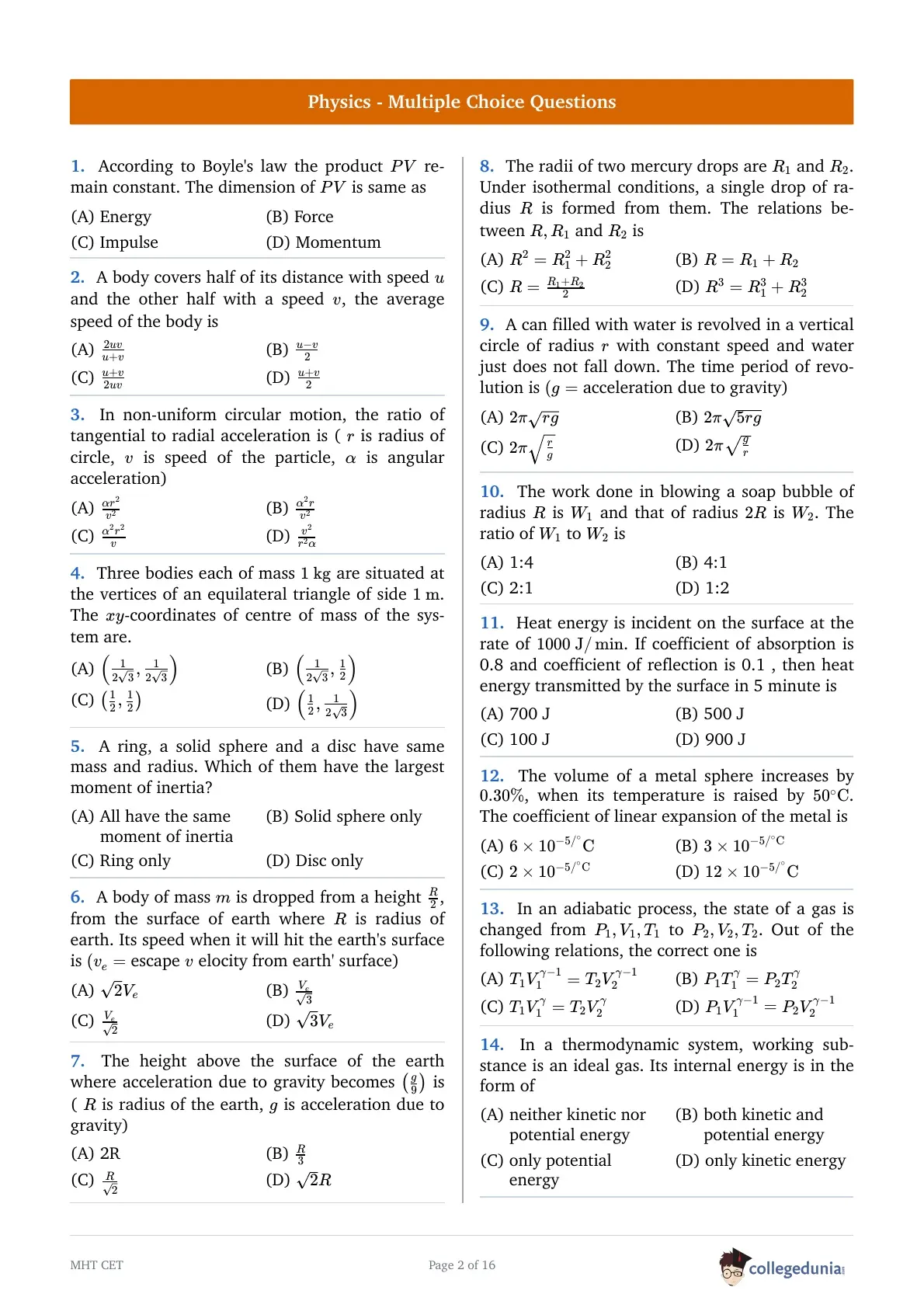
According to Boyle's law the product \(PV\) remain constant. The dimension of \(PV\) is same as
A body covers half of its distance with speed \(u\) and the other half with a speed \(v\), the average speed of the body is
In non-uniform circular motion, the ratio of tangential to radial acceleration is ( \(r\) is radius of circle, \(v\) is speed of the particle, \(\alpha\) is angular acceleration)
Three bodies each of mass \(1\ \mathrm{kg}\) are situated at the vertices of an equilateral triangle of side \(1\ \mathrm{m}\). The \(xy\)-coordinates of centre of mass of the system are.
A ring, a solid sphere and a disc have same mass and radius. Which of them have the largest moment of inertia?
A body of mass \(m\) is dropped from a height \(\frac{R}{2}\), from the surface of earth where \(R\) is radius of earth. Its speed when it will hit the earth's surface is \((v_{e}=\) escape \(v\) elocity from earth' surface)
The height above the surface of the earth where acceleration due to gravity becomes \(\left(\frac{g}{9}\right)\) is ( \(R\) is radius of the earth, \(g\) is acceleration due to gravity)
The radii of two mercury drops are \(R_{1}\) and \(R_{2}\). Under isothermal conditions, a single drop of radius \(R\) is formed from them. The relations between \(R,R_{1}\) and \(R_{2}\) is
A can filled with water is revolved in a vertical circle of radius \(r\) with constant speed and water just does not fall down. The time period of revolution is \((g=\) acceleration due to gravity)
The work done in blowing a soap bubble of radius \(R\) is \(W_{1}\) and that of radius \(2R\) is \(W_{2}\). The ratio of \(W_{1}\) to \(W_{2}\) is
Heat energy is incident on the surface at the rate of \(1000\ \mathrm{J}/\min\). If coefficient of absorption is 0.8 and coefficient of reflection is 0.1 , then heat energy transmitted by the surface in 5 minute is
The volume of a metal sphere increases by \(0.30\%\), when its temperature is raised by \(50^{\circ }\mathrm{C}\). The coefficient of linear expansion of the metal is
In an adiabatic process, the state of a gas is changed from \(P_{1},V_{1},T_{1}\) to \(P_{2},V_{2},T_{2}\). Out of the following relations, the correct one is
In a thermodynamic system, working substance is an ideal gas. Its internal energy is in the form of
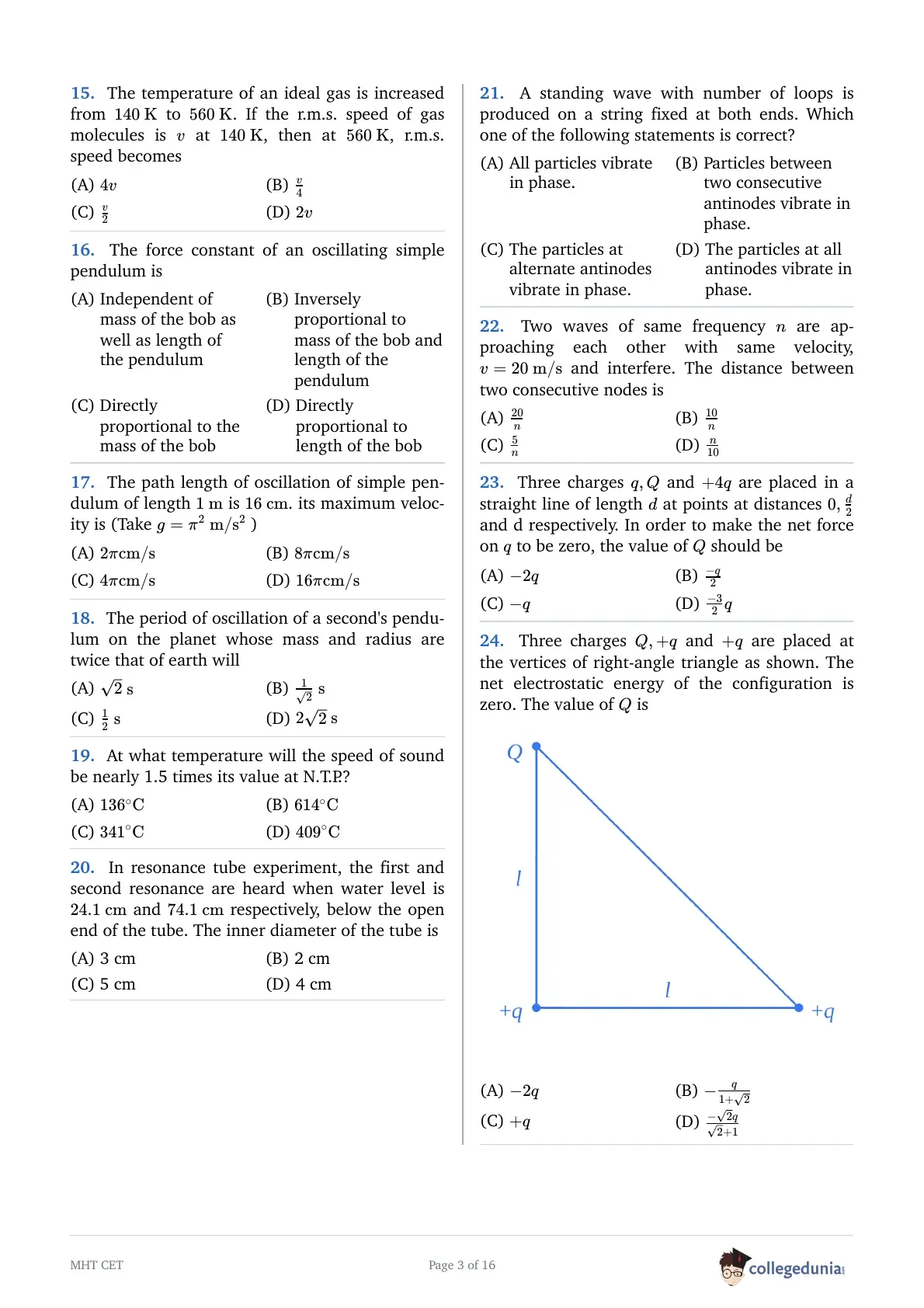
The temperature of an ideal gas is increased from \(140\ \mathrm{K}\) to \(560\ \mathrm{K}\). If the r.m.s. speed of gas molecules is \(v\) at \(140\ \mathrm{K}\), then at \(560\ \mathrm{K}\), r.m.s. speed becomes
The force constant of an oscillating simple pendulum is
The path length of oscillation of simple pendulum of length \(1\ \mathrm{m}\) is \(16\ \mathrm{cm}\). its maximum velocity is (Take \(g=\pi ^{2}\ \mathrm{m}/\mathrm{s}^{2}\) )
The period of oscillation of a second's pendulum on the planet whose mass and radius are twice that of earth will
At what temperature will the speed of sound be nearly 1.5 times its value at N.T.P.?
In resonance tube experiment, the first and second resonance are heard when water level is \(24.1\ \mathrm{cm}\) and \(74.1\ \mathrm{cm}\) respectively, below the open end of the tube. The inner diameter of the tube is
A standing wave with number of loops is produced on a string fixed at both ends. Which one of the following statements is correct?
Two waves of same frequency \(n\) are approaching each other with same velocity, \(v=20\ \mathrm{m}/\mathrm{s}\) and interfere. The distance between two consecutive nodes is
Three charges \(q,Q\) and \(+4q\) are placed in a straight line of length \(d\) at points at distances \(0,\frac{d}{2}\) and d respectively. In order to make the net force on \(q\) to be zero, the value of \(Q\) should be
Three charges \(Q,+q\) and \(+q\) are placed at the vertices of right-angle triangle as shown. The net electrostatic energy of the configuration is zero. The value of \(Q\) is

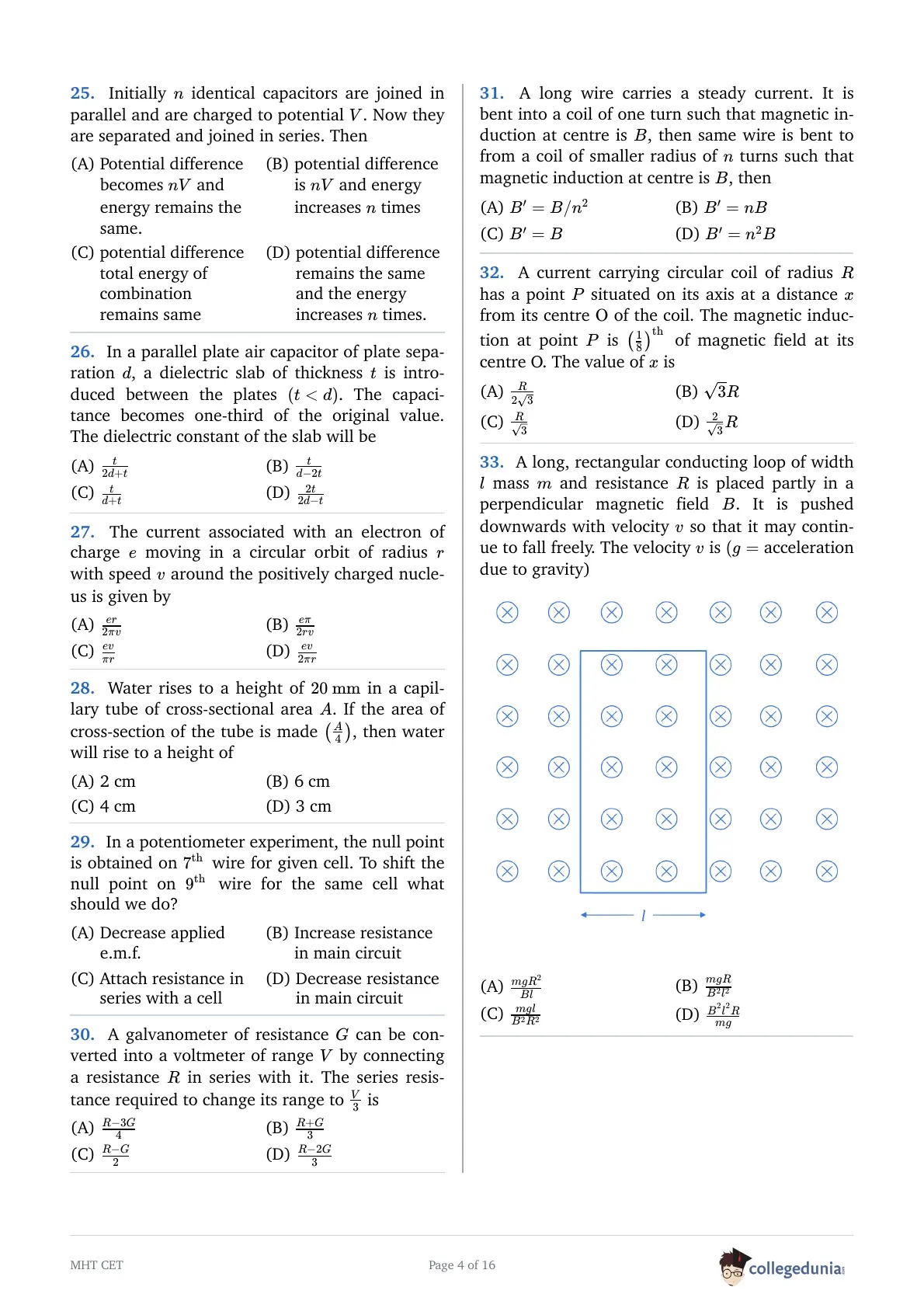
Initially \(n\) identical capacitors are joined in parallel and are charged to potential \(V\). Now they are separated and joined in series. Then
The current associated with an electron of charge \(e\) moving in a circular orbit of radius \(r\) with speed \(v\) around the positively charged nucleus is given by
Water rises to a height of \(20\ \mathrm{mm}\) in a capillary tube of cross-sectional area \(A\). If the area of cross-section of the tube is made \(\left(\frac{A}{4}\right)\), then water will rise to a height of
A galvanometer of resistance \(G\) can be converted into a voltmeter of range \(V\) by connecting a resistance \(R\) in series with it. The series resistance required to change its range to \(\frac{V}{3}\) is
A long wire carries a steady current. It is bent into a coil of one turn such that magnetic induction at centre is \(B\), then same wire is bent to from a coil of smaller radius of \(n\) turns such that magnetic induction at centre is \(B\), then
A current carrying circular coil of radius \(R\) has a point \(P\) situated on its axis at a distance \(x\) from its centre \(\mathrm{O}\) of the coil. The magnetic induction at point \(P\) is \(\left(\frac{1}{8}\right)^{\text{th }}\) of magnetic field at its centre O. The value of \(x\) is
A long, rectangular conducting loop of width \(l\) mass \(m\) and resistance \(R\) is placed partly in a perpendicular magnetic field \(B\). It is pushed downwards with velocity \(v\) so that it may continue to fall freely. The velocity \(v\) is \((g=\) acceleration due to gravity)

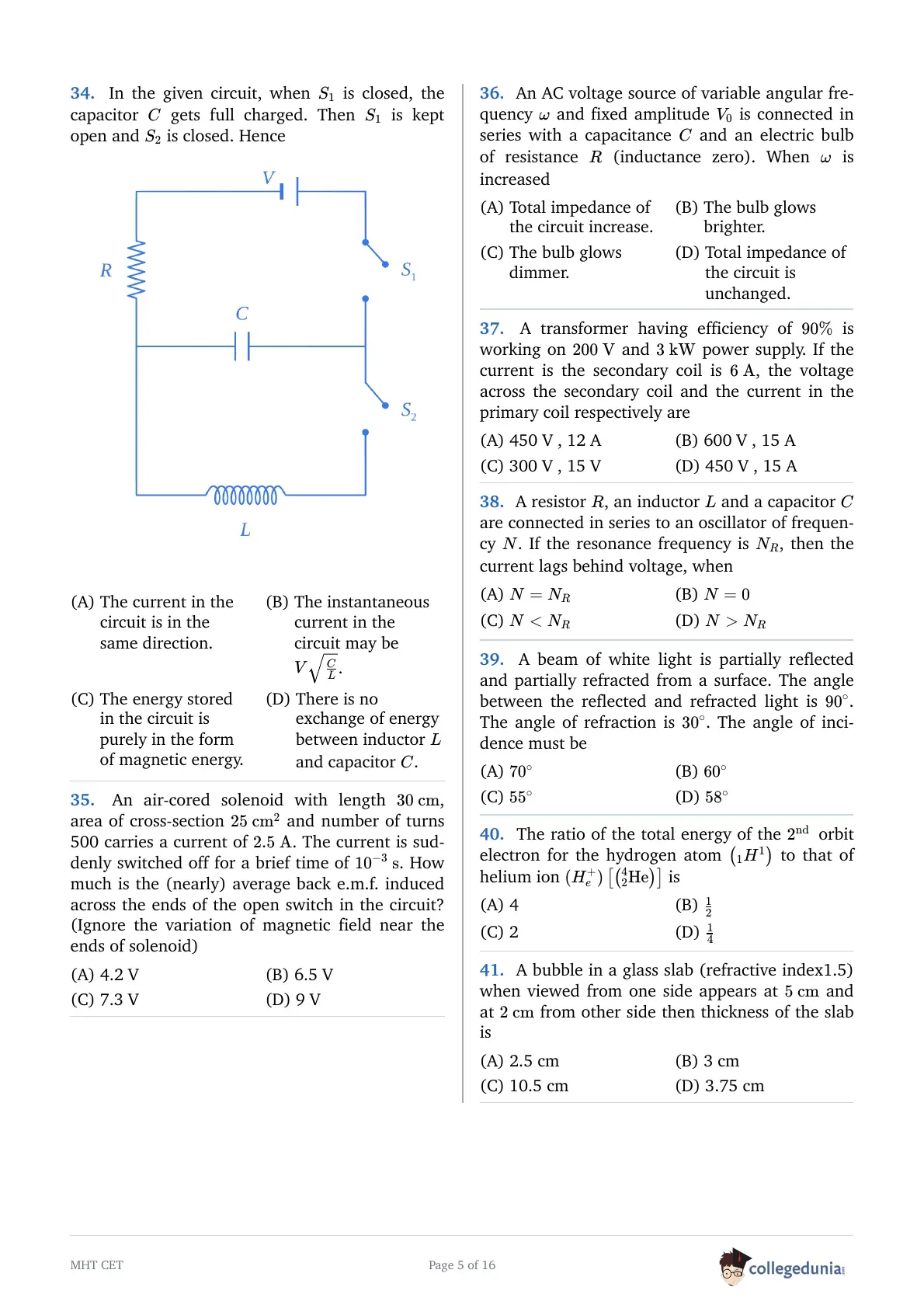
In the given circuit, when \(S_{1}\) is closed, the capacitor \(C\) gets full charged. Then \(S_{1}\) is kept open and \(S_{2}\) is closed. Hence

An air-cored solenoid with length \(30\ \mathrm{cm}\), area of cross-section \(25\ \mathrm{cm}^{2}\) and number of turns 500 carries a current of \(2.5\ \mathrm{A}\). The current is suddenly switched off for a brief time of \(10^{-3}\ \mathrm{s}\). How much is the (nearly) average back e.m.f. induced across the ends of the open switch in the circuit? (Ignore the variation of magnetic field near the ends of solenoid)
An AC voltage source of variable angular frequency \(\omega\) and fixed amplitude \(V_{0}\) is connected in series with a capacitance \(C\) and an electric bulb of resistance \(R\) (inductance zero). When \(\omega\) is increased
A transformer having efficiency of \(90\%\) is working on \(200\ \mathrm{V}\) and \(3\ \mathrm{kW}\) power supply. If the current is the secondary coil is \(6\ \mathrm{A}\), the voltage across the secondary coil and the current in the primary coil respectively are
A resistor \(R\), an inductor \(L\) and a capacitor \(C\) are connected in series to an oscillator of frequency \(N\). If the resonance frequency is \(N_{R}\), then the current lags behind voltage, when
A beam of white light is partially reflected and partially refracted from a surface. The angle between the reflected and refracted light is \(90^{\circ }\). The angle of refraction is \(30^{\circ }\). The angle of incidence must be
The ratio of the total energy of the \(2^{\text{nd }}\) orbit electron for the hydrogen atom \(\left({}_{1}H^{1}\right)\) to that of helium ion \((H_{e}^{+})\left[\left({}_{2}^{4}\mathrm{He}\right)\right]\) is
A bubble in a glass slab (refractive index1.5) when viewed from one side appears at \(5\ \mathrm{cm}\) and at \(2\ \mathrm{cm}\) from other side then thickness of the slab is
Consider the following statements about interference of light A. The interference fringes are equally bright and equally spaced B. At the centre of a bright fringe, the intensity is four times the intensity of the incident wave C. For constructive interference of two waves, the crest of one wave coincides with trough of another wave. Which of the above statements are correct?
In Young's double slit experiment, the slit separation is made threefold by keeping remaining setup same, the fringe width becomes
A thin transparent plate of thickness \(t\) and refractive index \(\mu\) is introduced in the path of one of the two interfering waves. The path difference between these waves is changed by half the wavelength of light \(\lambda\). The thickness of the plate is
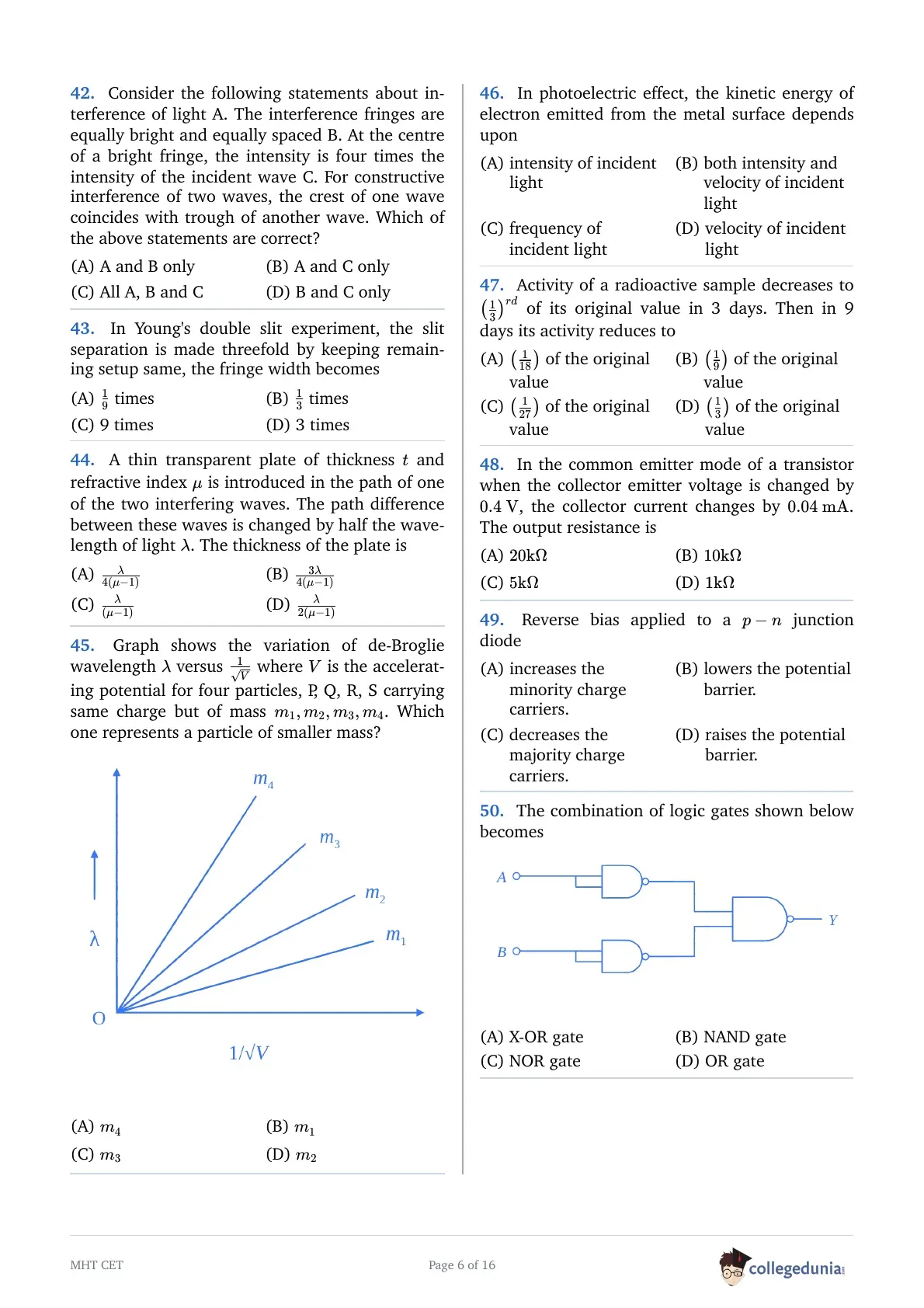
Graph shows the variation of de-Broglie wavelength \(\lambda\) versus \(\frac{1}{\sqrt{V}}\) where \(V\) is the accelerating potential for four particles, P, Q, R, S carrying same charge but of mass \(m_{1},m_{2},m_{3},m_{4}\). Which one represents a particle of smaller mass?

In photoelectric effect, the kinetic energy of electron emitted from the metal surface depends upon
Activity of a radioactive sample decreases to \(\left(\frac{1}{3}\right)^{rd}\) of its original value in 3 days. Then in 9 days its activity reduces to
In the common emitter mode of a transistor when the collector emitter voltage is changed by \(0.4\ \mathrm{V}\), the collector current changes by \(0.04\ \mathrm{mA}\). The output resistance is
Reverse bias applied to a \(p-n\) junction diode

Chemistry (Q51 - Q100)
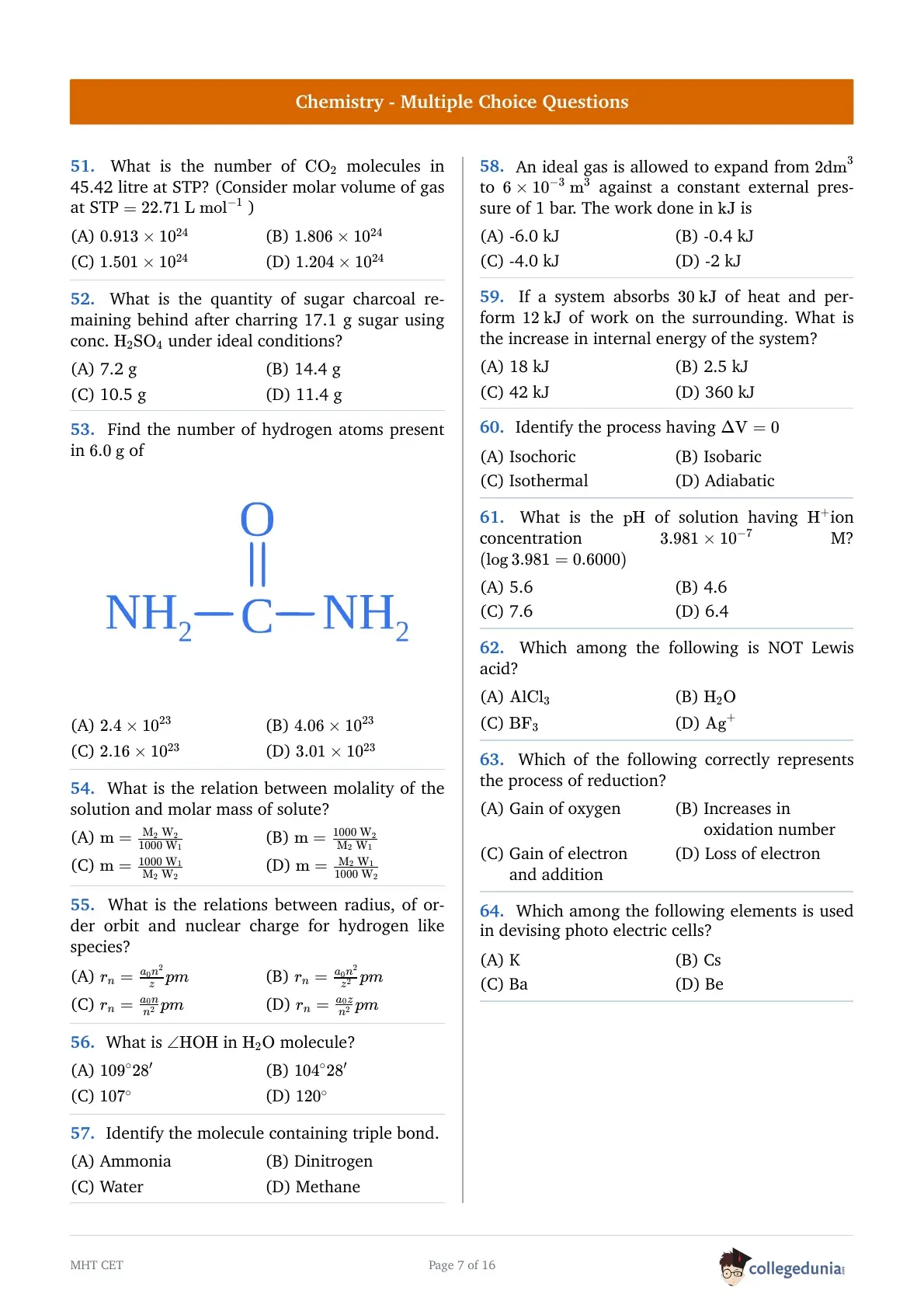
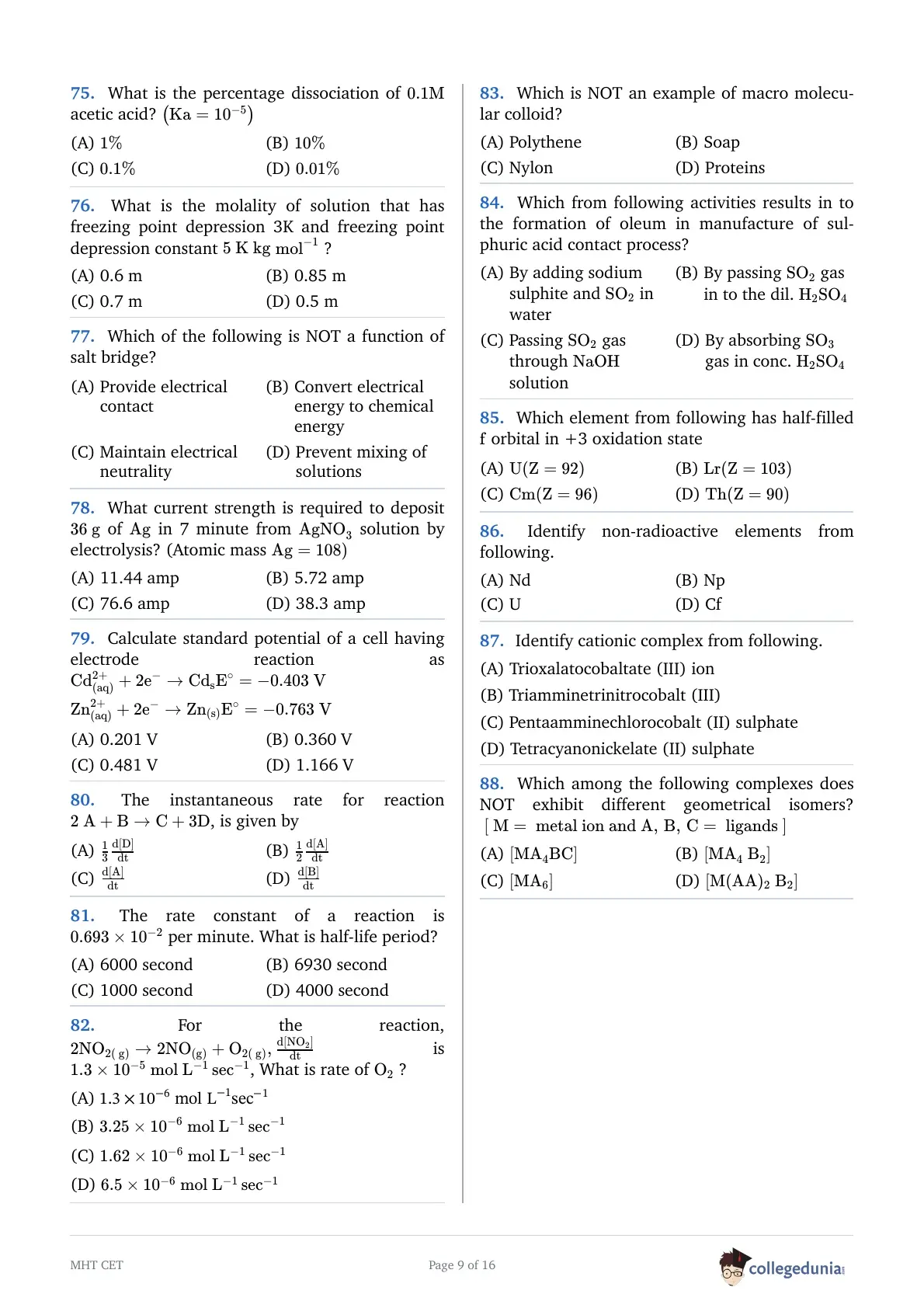
What is the number of \(\mathrm{CO}_{2}\) molecules in 45.42 litre at STP? (Consider molar volume of gas at STP \(=22.71\ \mathrm{L}\ \mathrm{mol}^{-1}\) )
What is the quantity of sugar charcoal remaining behind after charring 17.1 g sugar using conc. \(\mathrm{H}_{2}\mathrm{SO}_{4}\) under ideal conditions?

What is the relation between molality of the solution and molar mass of solute?
What is the relations between radius, of order orbit and nuclear charge for hydrogen like species?
What is \(\angle \mathrm{HOH}\) in \(\mathrm{H}_{2}\mathrm{O}\) molecule?
Identify the molecule containing triple bond.
An ideal gas is allowed to expand from \(2\mathrm{dm}^{3}\) to \(6\times 10^{-3}\ \mathrm{m}^{3}\) against a constant external pressure of 1 bar. The work done in \(\mathrm{kJ}\) is
If a system absorbs \(30\ \mathrm{kJ}\) of heat and perform \(12\ \mathrm{kJ}\) of work on the surrounding. What is the increase in internal energy of the system?
Identify the process having \(\Delta \mathrm{V}=0\)
What is the \(\mathrm{pH}\) of solution having \(\mathrm{H}^{+}\)ion concentration \(3.981\times 10^{-7}\) M? \((\log 3.981=0.6000)\)
Which among the following is NOT Lewis acid?
Which of the following correctly represents the process of reduction?
Which among the following elements is used in devising photo electric cells?

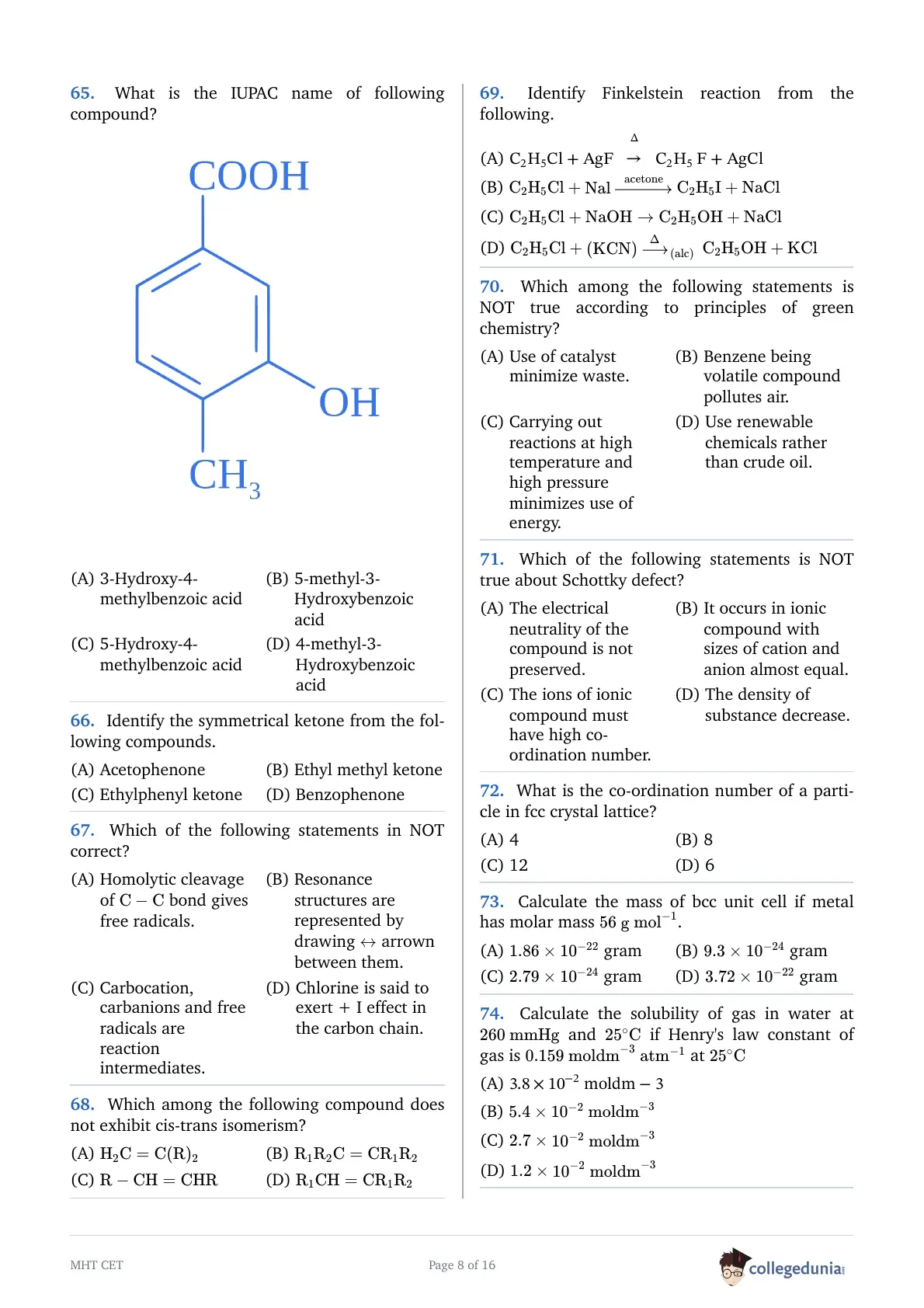
Identify the symmetrical ketone from the following compounds.
Which of the following statements in NOT correct?
Which among the following compound does not exhibit cis-trans isomerism?
Identify Finkelstein reaction from the following.
Which among the following statements is NOT true according to principles of green chemistry?
Which of the following statements is NOT true about Schottky defect?
What is the co-ordination number of a particle in fcc crystal lattice?
Calculate the mass of bcc unit cell if metal has molar mass \(56\ \mathrm{g}\ \mathrm{mol}^{-1}\).
Calculate the solubility of gas in water at \(260\ \mathrm{mm}\mathrm{Hg}\) and \(25^{\circ }\mathrm{C}\) if Henry's law constant of gas is \(0.159\ \mathrm{mol}\mathrm{dm}^{-3}\ \mathrm{atm}^{-1}\) at \(25^{\circ }\mathrm{C}\)
What is the percentage dissociation of \(0.1\mathrm{M}\) acetic acid? \(\left(\mathrm{Ka}=10^{-5}\right)\)
What is the molality of solution that has freezing point depression 3K and freezing point depression constant \(5\ \mathrm{K}\ \mathrm{kg}\) \(\mathrm{mol}^{-1}\) ?
Which of the following is NOT a function of salt bridge?
What current strength is required to deposit \(36\ \mathrm{g}\) of \(\mathrm{Ag}\) in 7 minute from \(\mathrm{AgNO}_{3}\) solution by electrolysis? (Atomic mass \(\mathrm{Ag}=108)\)
Calculate standard potential of a cell having electrode reaction as \(\begin{aligned} & \mathrm{Cd}_{(\mathrm{aq})}^{2+}+2\mathrm{e}^{-}\rightarrow \mathrm{Cd}_{\mathrm{s}}\mathrm{E}^{\circ }=-0.403\ \mathrm{V} \\ & \mathrm{Zn}_{(\mathrm{aq})}^{2+}+2\mathrm{e}^{-}\rightarrow \mathrm{Zn}_{(\mathrm{s})}\mathrm{E}^{\circ }=-0.763\ \mathrm{V} \end{aligned}\)
The instantaneous rate for reaction \(2\ \mathrm{A}+\mathrm{B}\rightarrow \mathrm{C}+3\mathrm{D}\), is given by
The rate constant of a reaction is \(0.693\times 10^{-2}\) per minute. What is half-life period?
For the reaction, \(2\mathrm{NO}_{2(\ \mathrm{g})}\rightarrow 2\mathrm{NO}_{(\mathrm{g})}+\mathrm{O}_{2(\ \mathrm{g})},\frac{\mathrm{d}[\mathrm{NO}_{2}]}{\mathrm{dt}}\) is \(1.3\times 10^{-5}\ \mathrm{mol}\ \mathrm{L}^{-1}\sec ^{-1}\), What is rate of \(\mathrm{O}_{2}\) ?
Which is NOT an example of macro molecular colloid?
Which from following activities results in to the formation of oleum in manufacture of sulphuric acid contact process?
Which element from following has half-filled \(\mathrm{f}\) orbital in +3 oxidation state
Identify non-radioactive elements from following.
Identify cationic complex from following.
Which among the following complexes does NOT exhibit different geometrical isomers? \(\text{ [ }\mathrm{M}=\text{ metal ion and }\mathrm{A},\,\mathrm{B},\,\mathrm{C}=\text{ ligands }]\)
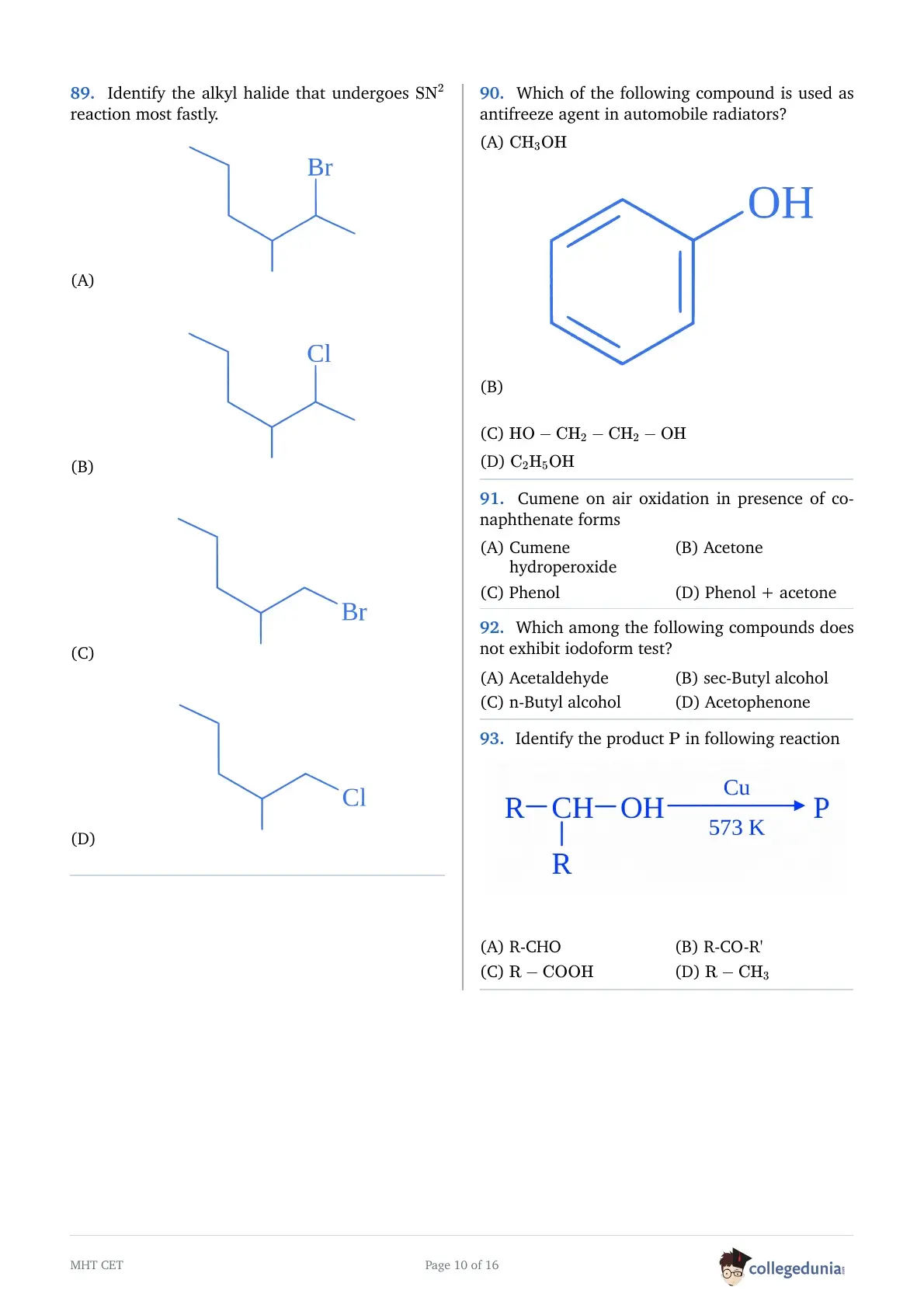
Identify the alkyl halide that undergoes \(\mathrm{SN}^{2}\) reaction most fastly.
- (A)
![]()
- (B)
![]()
- (C)
![]()
- (D)
![]()


Which of the following compound is used as antifreeze agent in automobile radiators?
- (A) \(\mathrm{CH}_{3}\mathrm{OH}\)
- (B)
![]()
- (C) \(\mathrm{HO}-\mathrm{CH}_{2}-\mathrm{CH}_{2}-\mathrm{OH}\)
- (D) \(\mathrm{C}_{2}\mathrm{H}_{5}\mathrm{OH}\)

Cumene on air oxidation in presence of co-naphthenate forms
Which among the following compounds does not exhibit iodoform test?

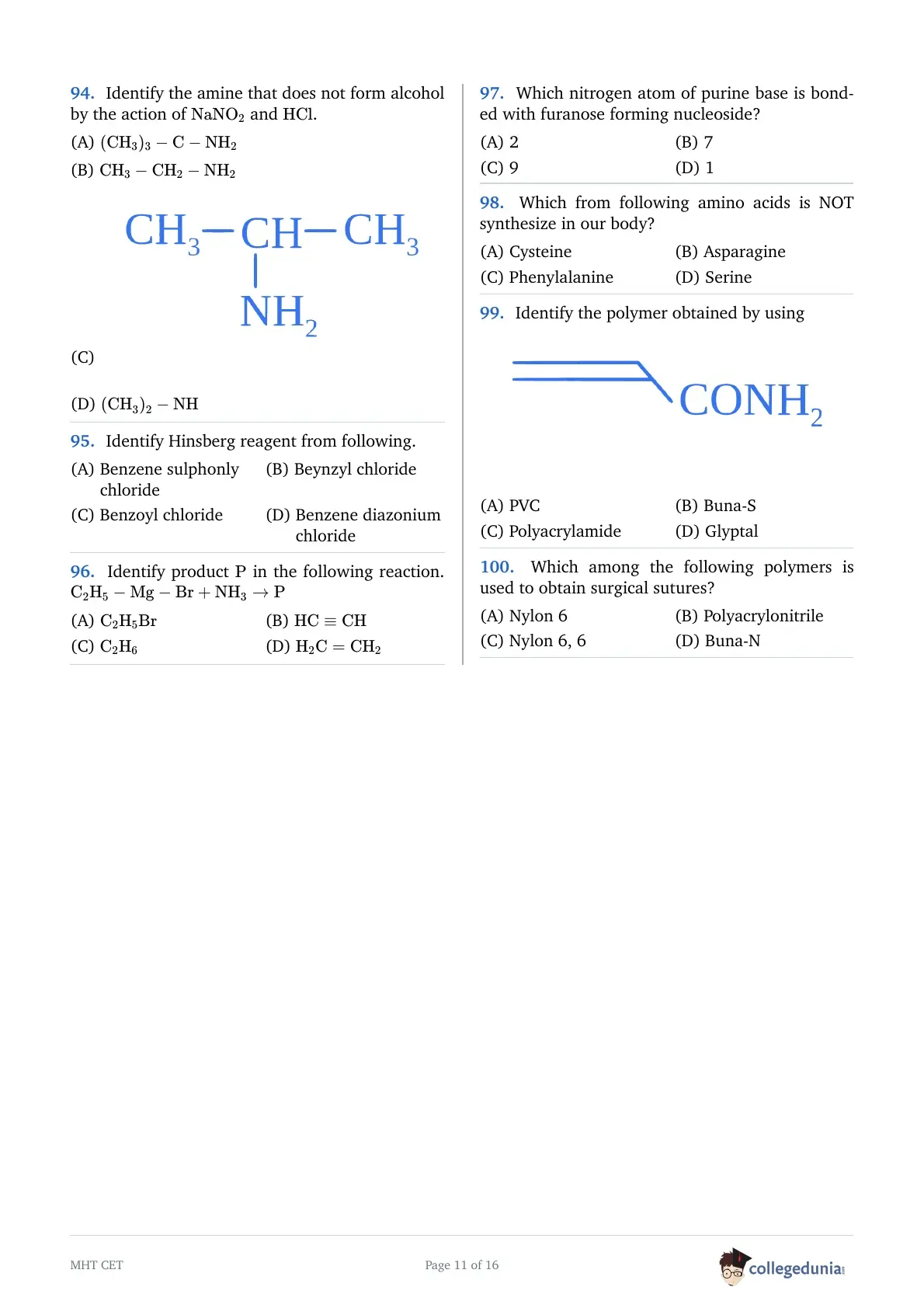
Identify the amine that does not form alcohol by the action of \(\mathrm{NaNO}_{2}\) and \(\mathrm{HCl}\).
- (A) \((\mathrm{CH}_{3})_{3}-\mathrm{C}-\mathrm{NH}_{2}\)
- (B) \(\mathrm{CH}_{3}-\mathrm{CH}_{2}-\mathrm{NH}_{2}\)
- (C)
![]()
- (D) \((\mathrm{CH}_{3})_{2}-\mathrm{NH}\)

Identify Hinsberg reagent from following.
Identify product \(\mathrm{P}\) in the following reaction. \(\mathrm{C}_{2}\mathrm{H}_{5}-\mathrm{Mg}-\mathrm{Br}+\mathrm{NH}_{3}\rightarrow \mathrm{P}\)
Which nitrogen atom of purine base is bonded with furanose forming nucleoside?
Which from following amino acids is NOT synthesize in our body?

Which among the following polymers is used to obtain surgical sutures?
Mathematics (Q101 - Q150)
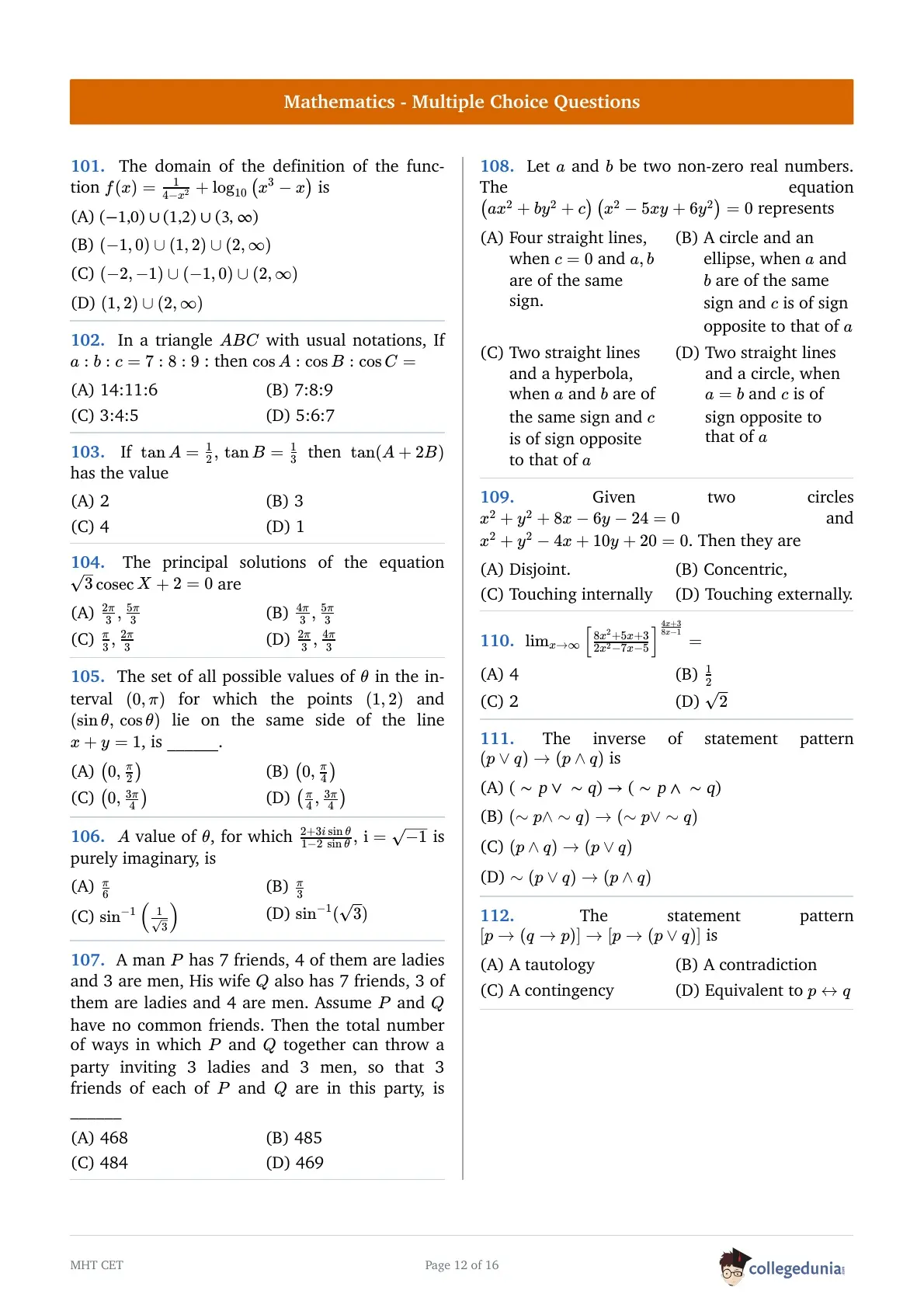
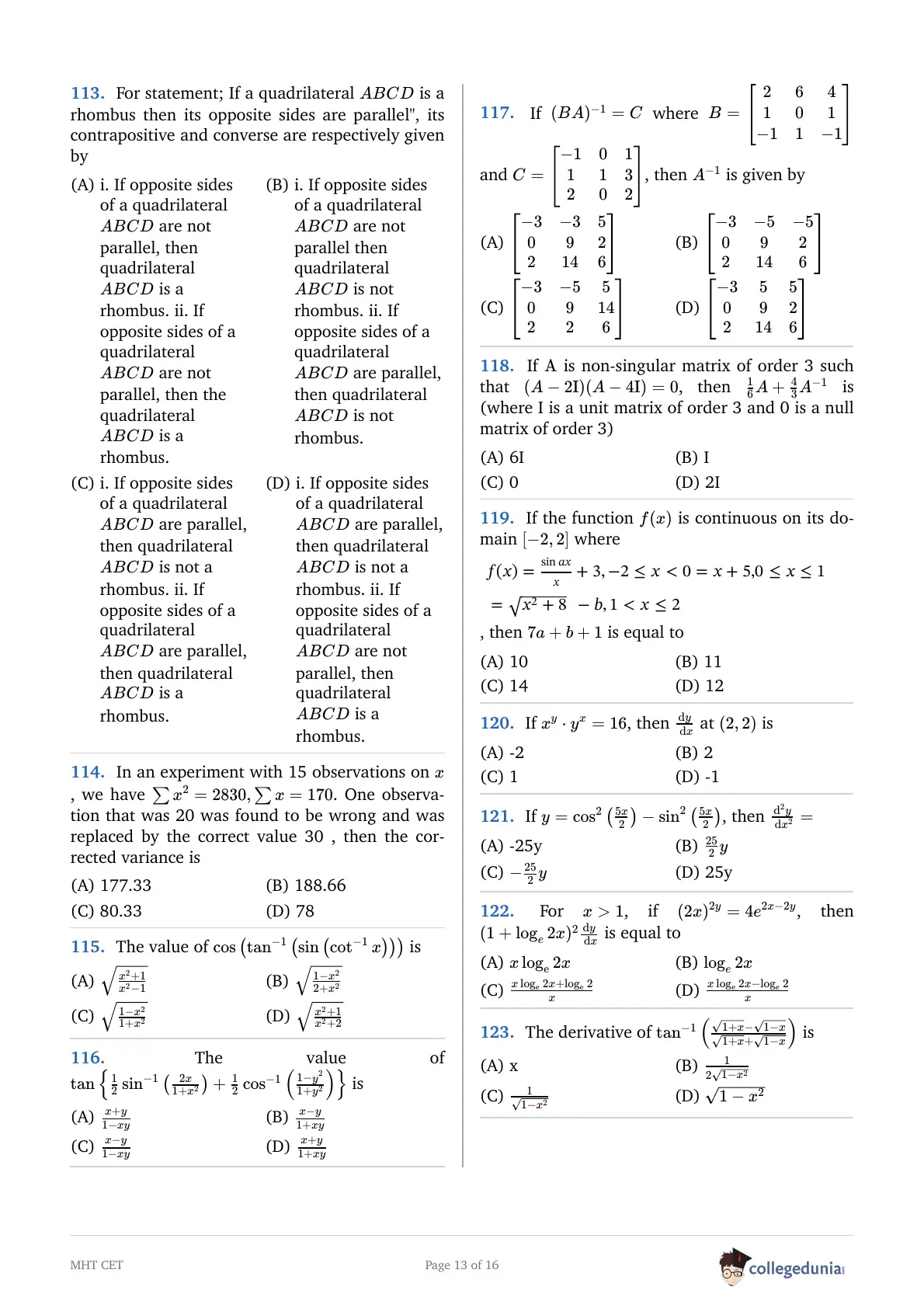
The domain of the definition of the function \(f(x)=\frac{1}{4-x^{2}}+\log _{10}\left(x^{3}-x\right)\) is
In a triangle \(ABC\) with usual notations, If \(a:b:c=7:8:9\) : then \(\cos A:\cos B:\cos C=\)
If \(\tan A=\frac{1}{2},\,\tan B=\frac{1}{3}\) then \(\tan (A+2B)\) has the value
The principal solutions of the equation \(\sqrt{3}\operatorname{cosec} X+2=0\) are
The set of all possible values of \(\theta\) in the interval \((0,\pi )\) for which the points \((1,2)\) and \((\sin \theta ,\,\cos \theta )\) lie on the same side of the line \(x+y=1\), is ______.
A man \(P\) has 7 friends, 4 of them are ladies and 3 are men, His wife \(Q\) also has 7 friends, 3 of them are ladies and 4 are men. Assume \(P\) and \(Q\) have no common friends. Then the total number of ways in which \(P\) and \(Q\) together can throw a party inviting 3 ladies and 3 men, so that 3 friends of each of \(P\) and \(Q\) are in this party, is ______
Let \(a\) and \(b\) be two non-zero real numbers. The equation \(\left(ax^{2}+by^{2}+c\right)\left(x^{2}-5xy+6y^{2}\right)=0\) represents
Given two circles \(x^{2}+y^{2}+8x-6y-24=0\) and \(x^{2}+y^{2}-4x+10y+20=0\). Then they are
\(\lim _{x\rightarrow \infty }\left[\frac{8x^{2}+5x+3}{2x^{2}-7x-5}\right]^{\frac{4x+3}{8x-1}}=\)
The inverse of statement pattern \((p\vee q)\rightarrow (p\wedge q)\) is
The statement pattern \([p\rightarrow (q\rightarrow p)]\rightarrow [p\rightarrow (p\vee q)]\) is
In an experiment with 15 observations on \(x\), we have \(\sum x^{2}=2830,\sum x=170\). One observation that was 20 was found to be wrong and was replaced by the correct value 30 , then the corrected variance is
The value of \(\cos \left(\tan ^{-1}\left(\sin \left(\cot ^{-1}x\right)\right)\right)\) is
The value of \(\tan \left\{\frac{1}{2}\sin ^{-1}\left(\frac{2x}{1+x^{2}}\right)+\frac{1}{2}\cos ^{-1}\left(\frac{1-y^{2}}{1+y^{2}}\right)\right\}\) is
If \((BA)^{-1}=C\) where \(B=\begin{bmatrix} 2 & 6 & 4 \\ 1 & 0 & 1 \\ -1 & 1 & -1 \end{bmatrix}\) and \(C=\begin{bmatrix} -1 & 0 & 1 \\ 1 & 1 & 3 \\ 2 & 0 & 2 \end{bmatrix}\), then \(A^{-1}\) is given by
If \(\mathrm{A}\) is non-singular matrix of order 3 such that \((A-2\mathrm{I})(A-4\mathrm{I})=0\), then \(\frac{1}{6}A+\frac{4}{3}A^{-1}\) is (where I is a unit matrix of order 3 and 0 is a null matrix of order 3)
If the function \(f(x)\) is continuous on its domain \([-2,2]\) where \(f(x)=\frac{\sin ax}{x}+3,-2\leq x\lt 0=x+5,0\leq x\leq 1=\sqrt{x^{2}+8}-b,1\lt x\leq 2\), then \(7a+b+1\) is equal to
If \(x^{y}\cdot y^{x}=16\), then \(\frac{\mathrm{d}y}{\ \mathrm{d}x}\) at \((2,2)\) is
If \(y=\cos ^{2}\left(\frac{5x}{2}\right)-\sin ^{2}\left(\frac{5x}{2}\right)\), then \(\frac{\mathrm{d}^{2}y}{\ \mathrm{d}x^{2}}=\)
For \(x>1\), if \((2x)^{2y}=4e^{2x-2y}\), then \((1+\log _{e}2x)^{2}\frac{\mathrm{d}y}{\ \mathrm{d}x}\) is equal to
The derivative of \(\tan ^{-1}\left(\frac{\sqrt{1+x}-\sqrt{1-x}}{\sqrt{1+x}+\sqrt{1-x}}\right)\) is
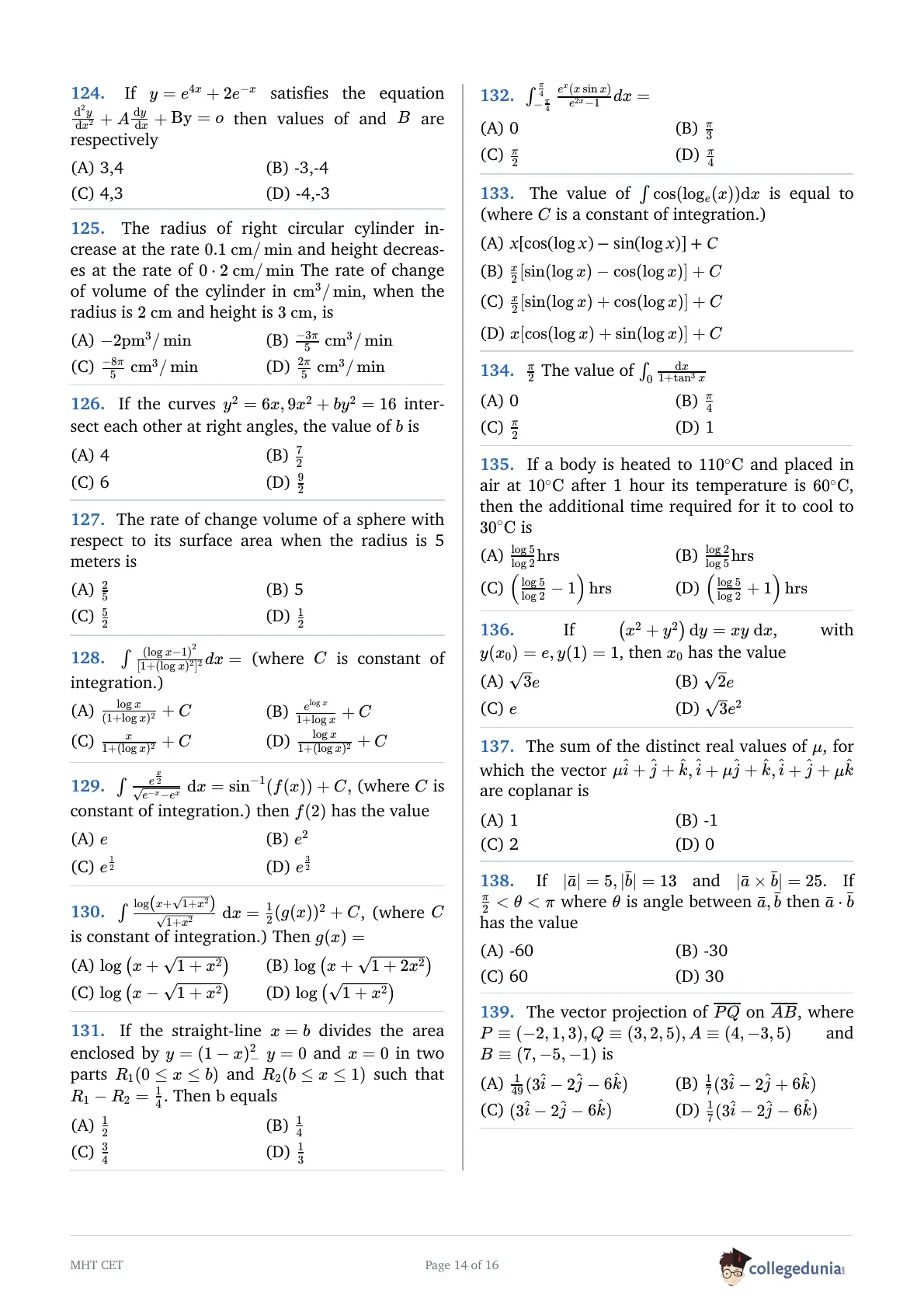
If \(y=e^{4x}+2e^{-x}\) satisfies the equation \(\frac{\mathrm{d}^{2}y}{\ \mathrm{d}x^{2}}+A\frac{\mathrm{d}y}{\ \mathrm{d}x}+\mathrm{By}=o\) then values of and \(B\) are respectively
The radius of right circular cylinder increase at the rate \(0.1\ \mathrm{cm}/\min\) and height decreases at the rate of \(0\cdot 2\ \mathrm{cm}/\min\) The rate of change of volume of the cylinder in \(\mathrm{cm}^{3}/\min\), when the radius is \(2\ \mathrm{cm}\) and height is \(3\ \mathrm{cm}\), is
If the curves \(y^{2}=6x,9x^{2}+by^{2}=16\) intersect each other at right angles, the value of \(b\) is
The rate of change volume of a sphere with respect to its surface area when the radius is 5 meters is
\(\int \frac{(\log x-1)^{2}}{[1+(\log x)^{2}]^{2}}dx=\) (where \(C\) is constant of integration.)
\(\int \frac{e^{\frac{x}{2}}}{\sqrt{e^{-x}-e^{x}}}\ \mathrm{d}x=\sin ^{-1}(f(x))+C,\) (where \(C\) is constant of integration.) then \(f(2)\) has the value
\(\int \frac{\log \left(x+\sqrt{1+x^{2}}\right)}{\sqrt{1+x^{2}}}\ \mathrm{d}x=\frac{1}{2}(g(x))^{2}+C\), (where \(C\) is constant of integration.) Then \(g(x)=\)
If the straight-line \(x=b\) divides the area enclosed by \(y=(1-x)_{-}^{2}\) \(y=0\) and \(x=0\) in two parts \(R_{1}(0\leq x\leq b)\) and \(R_{2}(b\leq x\leq 1)\) such that \(R_{1}-R_{2}=\frac{1}{4}\). Then \(\mathrm{b}\) equals
\(\int _{-\frac{\pi }{4}}^{\frac{\pi }{4}}\frac{e^{x}(x\sin x)}{e^{2x}-1}dx=\)
The value of \(\int \cos (\log _{e}(x))\mathrm{d}x\) is equal to (where \(C\) is a constant of integration.)
\(\frac{\pi }{2}\) The value of \(\int _{0}\frac{\mathrm{d}x}{1+\tan ^{3}x}\)
If a body is heated to \(110^{\circ }\mathrm{C}\) and placed in air at \(10^{\circ }\mathrm{C}\) after 1 hour its temperature is \(60^{\circ }\mathrm{C}\), then the additional time required for it to cool to \(30^{\circ }\mathrm{C}\) is
If \(\left(x^{2}+y^{2}\right)\mathrm{d}y=xy\ \mathrm{d}x\), with \(y(x_{0})=e,y(1)=1\), then \(x_{0}\) has the value
The sum of the distinct real values of \(\mu\), for which the vector \(\mu \hat{i}+\hat{j}+\hat{k},\hat{i}+\mu \hat{j}+\hat{k},\hat{i}+\hat{j}+\mu \hat{k}\) are coplanar is
If \(|\bar{a}|=5,|\bar{b}|=13\) and \(|\bar{a}\times \bar{b}|=25\). If \(\frac{\pi }{2}\lt \theta \lt \pi\) where \(\theta\) is angle between \(\bar{a},\bar{b}\) then \(\bar{a}\cdot \bar{b}\) has the value
The vector projection of \(\overline{PQ}\) on \(\overline{AB}\), where \(P\equiv (-2,1,3),Q\equiv (3,2,5),A\equiv (4,-3,5)\) and \(B\equiv (7,-5,-1)\) is
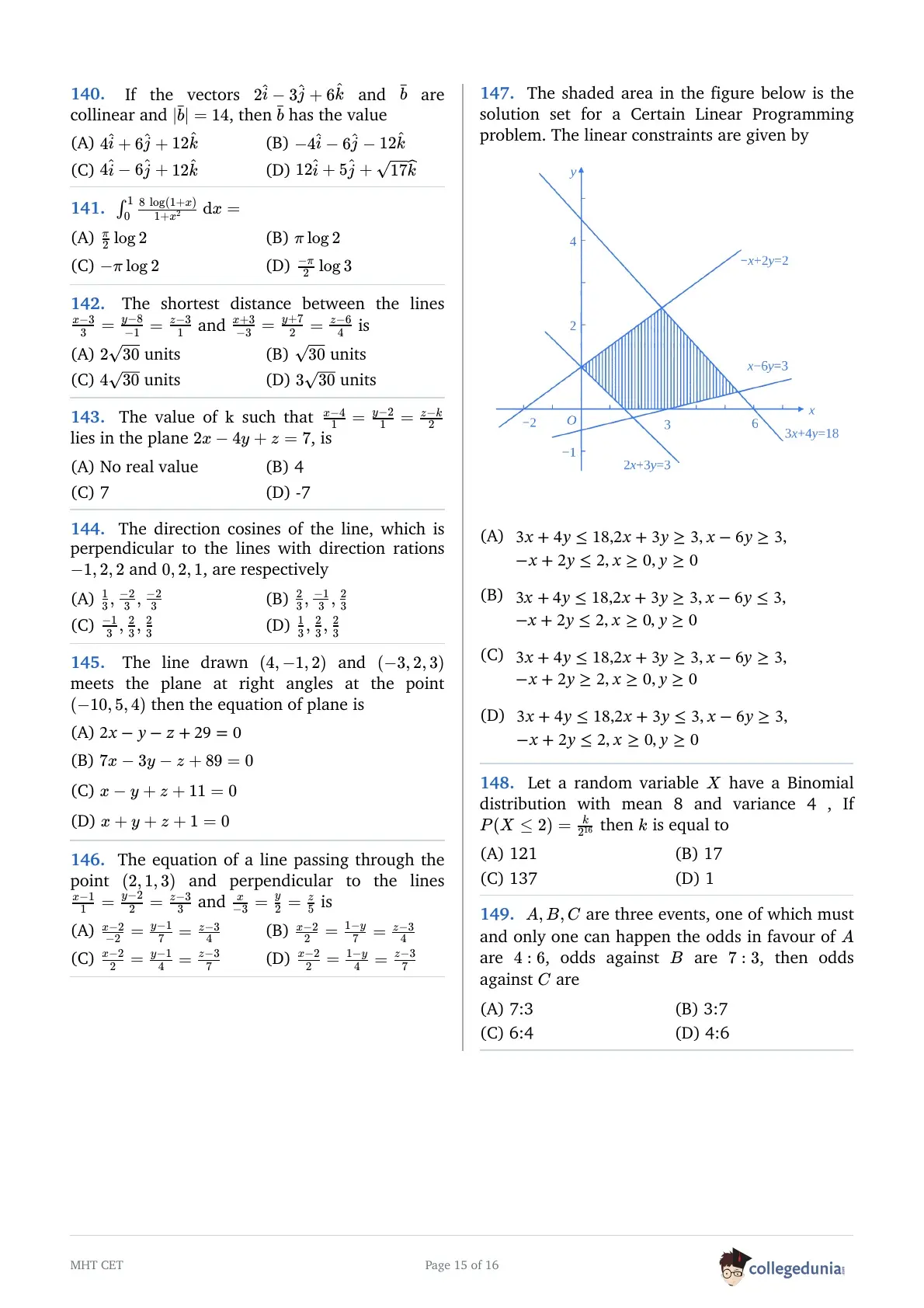
If the vectors \(2\hat{i}-3\hat{j}+6\hat{k}\) and \(\bar{b}\) are collinear and \(|\bar{b}|=14\), then \(\bar{b}\) has the value
\(\int _{0}^{1}\frac{8\,\log (1+x)}{1+x^{2}}\ \mathrm{d}x=\)
The shortest distance between the lines \(\frac{x-3}{3}=\frac{y-8}{-1}=\frac{z-3}{1}\) and \(\frac{x+3}{-3}=\frac{y+7}{2}=\frac{z-6}{4}\) is
The value of \(\mathrm{k}\) such that \(\frac{x-4}{1}=\frac{y-2}{1}=\frac{z-k}{2}\) lies in the plane \(2x-4y+z=7\), is
The direction cosines of the line, which is perpendicular to the lines with direction rations \(-1,2,2\) and \(0,2,1\), are respectively
The line drawn \((4,-1,2)\) and \((-3,2,3)\) meets the plane at right angles at the point \((-10,5,4)\) then the equation of plane is
The equation of a line passing through the point \((2,1,3)\) and perpendicular to the lines \(\frac{x-1}{1}=\frac{y-2}{2}=\frac{z-3}{3}\) and \(\frac{x}{-3}=\frac{y}{2}=\frac{z}{5}\) is
The shaded area in the figure below is the solution set for a Certain Linear Programming problem. The linear constraints are given by

Let a random variable \(X\) have a Binomial distribution with mean 8 and variance 4 , If \(P(X\leq 2)=\frac{k}{2^{16}}\) then \(k\) is equal to
\(A,B,C\) are three events, one of which must and only one can happen the odds in favour of \(A\) are \(4:6\), odds against \(B\) are \(7:3\), then odds against \(C\) are
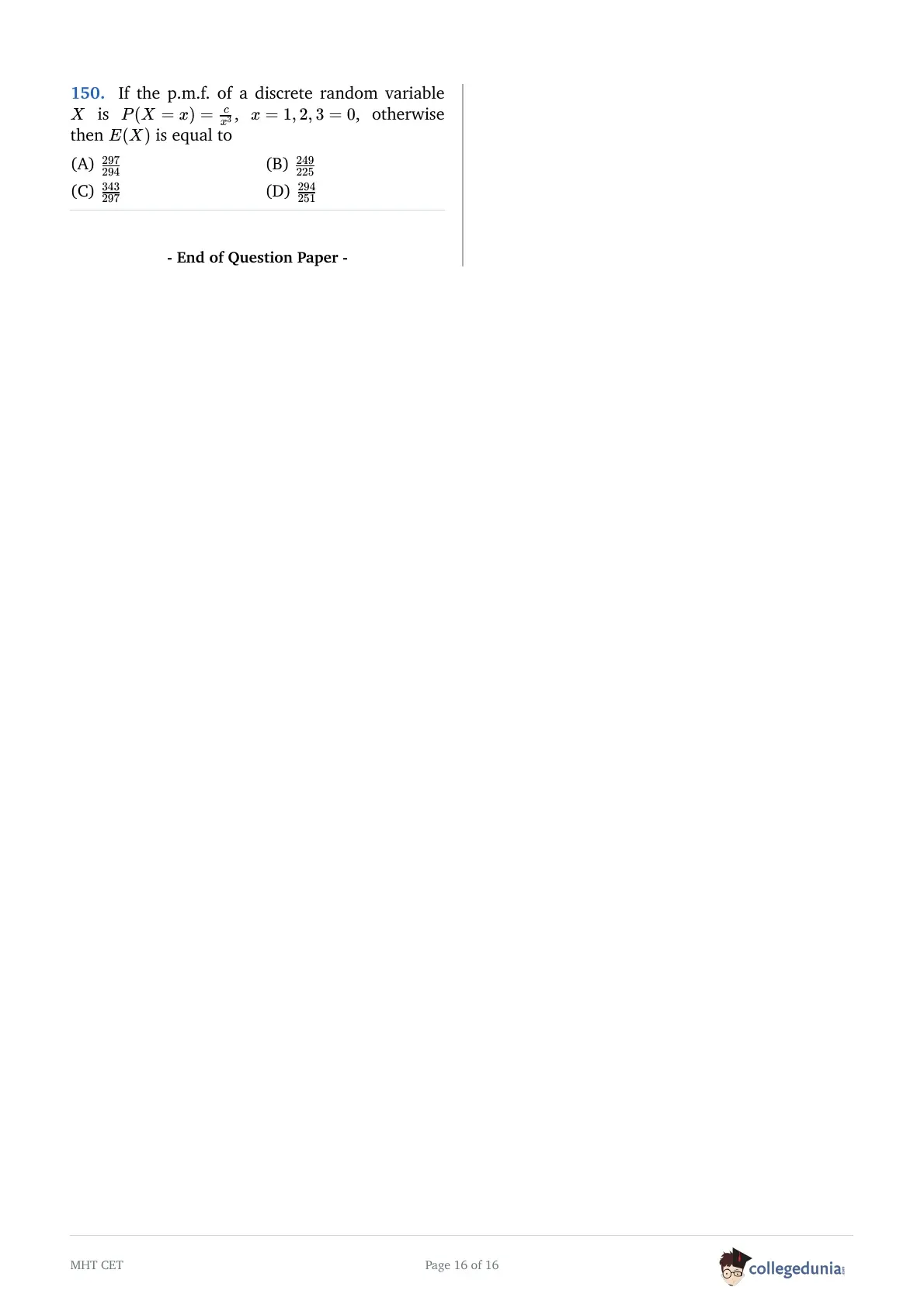
If the p.m.f. of a discrete random variable \(X\) is \(P(X=x)=\frac{c}{x^{3}}\), \(x=1,2,3=0\), otherwise then \(E(X)\) is equal to
MHT CET 2022 PCM Exam Pattern and Marking Scheme
| Parameter | Details |
|---|---|
| Conducting Body | Maharashtra Common Entrance Test Cell (Maharashtra CET Cell) |
| Exam Mode | Online (Computer-Based Test) |
| Duration | 180 minutes (3 hours) |
| Groups / Subjects | PCM (Physics, Chemistry, Mathematics) for Engineering |
| Total Questions |
150 |
| Total Marks | 200 |
| Question Type | Multiple Choice Questions (MCQs) |
| Marks Distribution |
|
| Negative Marking | No |
| Syllabus Weightage |
|



Comments