MHT CET 2020 Oct 1 Shift 2 PCB Question Paper is available for download here. Maharashtra State CET Cell conducted MHT CET 2020 PCB Exam on Oct 1 in Shift 2 from 2 PM to 5 PM in CBT mode. This paper is memory-based: it is compiled from the questions candidates recalled after the exam, so it does not contain every question of the shift.

The MHT CET 2020 PCB question paper includes the following:

  • The MHT CET 2020 PCB Question Paper consists of 200 multiple-choice questions (MCQs) totalling 200 marks divided into 3 sections: Physics (50 questions), Chemistry (50 questions), and Biology (100 questions).
  • All questions carry 1 mark each. There is no negative marking for incorrect answers.

MHT CET 2020 Oct 1 Shift 2 PCB Question Paper with Solution PDF

CD PDF CD PDF with Solutions
Download Collegedunia PDF 0.55 MB -

Also Check:

MHT CET 2020 Oct 1 Shift 2 PCB Questions with Solutions


Biology (Q101 - Q200)

Question 101:

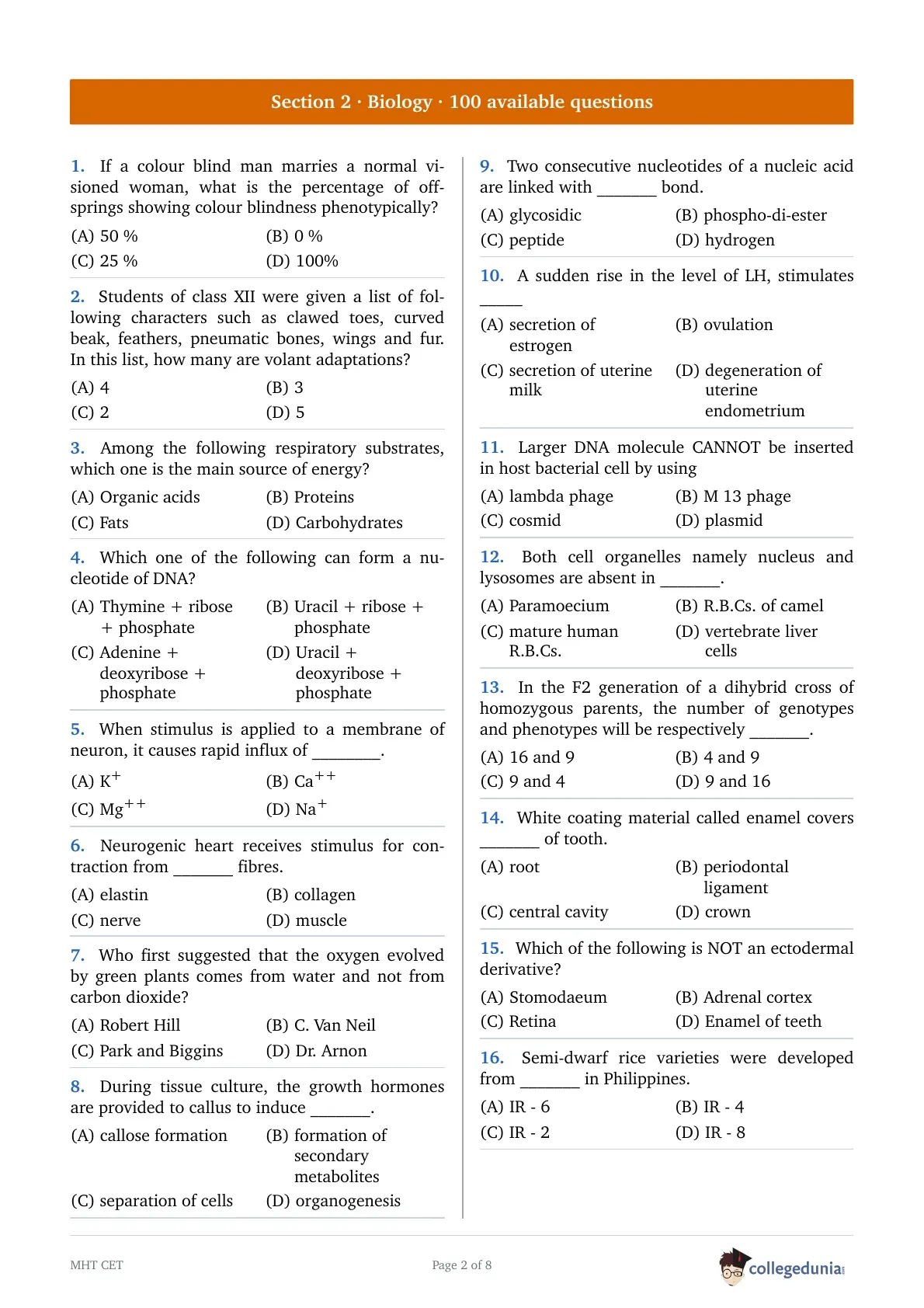
If a colour blind man marries a normal visioned woman, what is the percentage of offsprings showing colour blindness phenotypically?

  • (A) 50%
  • (B) 0%
  • (C) 25%
  • (D) 100%

Question 102:

Students of class XII were given a list of following characters such as clawed toes, curved beak, feathers, pneumatic bones, wings and fur. In this list, how many are volant adaptations?

  • (A) 4
  • (B) 3
  • (C) 2
  • (D) 5

Question 103:

Among the following respiratory substrates, which one is the main source of energy?

  • (A) Organic acids
  • (B) Proteins
  • (C) Fats
  • (D) Carbohydrates

Question 104:

Which one of the following can form a nucleotide of DNA?

  • (A) Thymine + ribose + phosphate
  • (B) Uracil + ribose + phosphate
  • (C) Adenine + deoxyribose + phosphate
  • (D) Uracil + deoxyribose + phosphate

Question 105:

When stimulus is applied to a membrane of neuron, it causes rapid influx of ________________.

  • (A) K\(^+\)
  • (B) Ca\(^{++}\)
  • (C) Mg\(^{++}\)
  • (D) Na\(^+\)

Question 106:

Neurogenic heart receives stimulus for contraction from ______________ fibres.

  • (A) elastin
  • (B) collagen
  • (C) nerve
  • (D) muscle

Question 107:

Who first suggested that the oxygen evolved by green plants comes from water and not from carbon dioxide?

  • (A) Robert Hill
  • (B) C. Van Neil
  • (C) Park and Biggins
  • (D) Dr. Arnon

Question 109:

Two consecutive nucleotides of a nucleic acid are linked with ______________ bond.

  • (A) glycosidic
  • (B) phospho-di-ester
  • (C) peptide
  • (D) hydrogen

Question 110:

A sudden rise in the level of LH stimulates ______________.

  • (A) secretion of estrogen
  • (B) ovulation
  • (C) secretion of uterine milk
  • (D) degeneration of uterine endometrium

Question 112:

Both cell organelles namely nucleus and lysosomes are absent in ______________.

  • (A) Paramoecium
  • (B) R.B.Cs. of camel
  • (C) mature human R.B.Cs.
  • (D) vertebrate liver cells

Question 114:

White coating material called enamel covers ______________ of tooth.

  • (A) root
  • (B) periodontal ligament
  • (C) central cavity
  • (D) crown

Question 115:

Which of the following is NOT an ectodermal derivative?

  • (A) Stomodaeum
  • (B) Adrenal cortex
  • (C) Retina
  • (D) Enamel of teeth

Question 117:

The large number of genetically identical offsprings produced by micropropagation are called ______________.

  • (A) drones
  • (B) clones
  • (C) siblings
  • (D) twins

Question 118:

Following are classified as plasma proteins EXCEPT ______________.

  • (A) albumin
  • (B) prothrombin
  • (C) thromboplastin
  • (D) fibrinogen

Question 119:

The technique developed to identify a person with the help of DNA restriction analysis is ______________.

  • (A) Cloning
  • (B) r-DNA technology
  • (C) restriction digestion
  • (D) DNA profiling

Question 120:

In the secondary treatment of STP, the masses of bacteria associated with fungal filaments are called ______________.

  • (A) mycelium
  • (B) flakes
  • (C) flocs
  • (D) hyphae

Question 121:

The suspensor of the embryo in angiosperms develops from ______________ cell.

  • (A) lateral
  • (B) embryonal
  • (C) apical
  • (D) basal

Question 124:

In the reproductive system of a male human being, the ejaculatory ducts open into ______________.

  • (A) prostatic urethra
  • (B) spongial urethra
  • (C) penile urethra
  • (D) membranous urethra

Question 125:

______________ is obtained from fermented grains of mostly barley.

  • (A) Whisky
  • (B) Rum
  • (C) Beer
  • (D) Wine

Question 126:

The glans penis is a derivative of ______________.

  • (A) corpus spongiosum
  • (B) corpus callosum
  • (C) corpora cavernosa
  • (D) corpus albicans

Question 127:

Genome of an organism CANNOT be altered by ______________.

  • (A) genetic engineering
  • (B) mutation
  • (C) cloning
  • (D) gene manipulation

Question 128:

Select the INCORRECT statement.

  • (A) During cell division, the spindle fibres originate from microtubules.
  • (B) Microfilaments are composed of protein keratin.
  • (C) Intermediate filaments provide tensile strength to the cell.
  • (D) The components of cytoskeleton are microfilaments, microtubules and intermediate filaments.

Question 130:

Struvite stones are derived from ______________.

  • (A) urea
  • (B) creatinine
  • (C) guanine
  • (D) uric acid

Question 131:

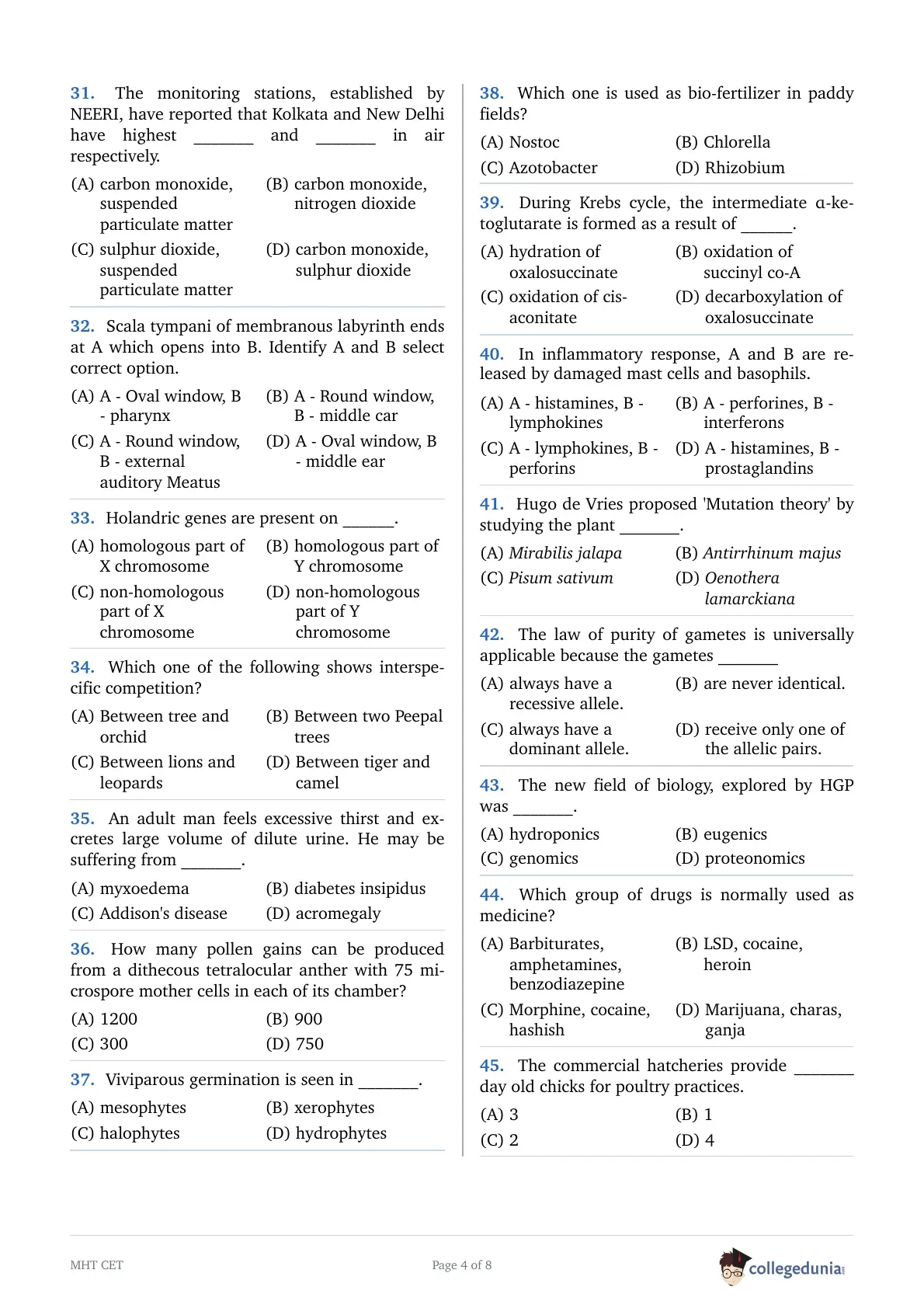
The monitoring stations, established by NEERI, have reported that Kolkata and New Delhi have highest ______________ and ______________ in air respectively.

  • (A) carbon monoxide, suspended particulate matter
  • (B) carbon monoxide, nitrogen dioxide
  • (C) sulphur dioxide, suspended particulate matter
  • (D) carbon monoxide, sulphur dioxide

Question 132:

Scala tympani of membranous labyrinth ends at A which opens into B. Identify A and B and select correct option.

  • (A) A – oval window, B – pharynx
  • (B) A – round window, B – middle ear
  • (C) A – round window, B – external auditory meatus
  • (D) A – oval window, B – middle ear

Question 133:

Holandric genes are present on ______________.

  • (A) homologous part of X chromosome
  • (B) homologous part of Y chromosome
  • (C) non-homologous part of X chromosome
  • (D) non-homologous part of Y chromosome

Question 134:

Which one of the following shows interspecific competition?

  • (A) Between tree and orchid
  • (B) Between two Peepal trees
  • (C) Between lions and leopards
  • (D) Between tiger and camel

Question 135:

An adult man feels excessive thirst and excretes large volume of dilute urine. He may be suffering from ______________.

  • (A) myxoedema
  • (B) diabetes insipidus
  • (C) Addison’s disease
  • (D) acromegaly

Question 137:

Viviparous germination is seen in ______________.

  • (A) mesophytes
  • (B) xerophytes
  • (C) halophytes
  • (D) hydrophytes

Question 138:

Which one is used as biofertilizer in paddy fields?

  • (A) Nostoc
  • (B) Chlorella
  • (C) Azotobacter
  • (D) Rhizobium

Question 139:

During Krebs cycle, the intermediate \(\alpha\)-ketoglutarate is formed as a result of ______________.

  • (A) hydration of oxalosuccinate
  • (B) oxidation of succinyl co-A
  • (C) oxidation of cis-aconitate
  • (D) decarboxylation of oxalosuccinate

Question 140:

In inflammatory response, A and B are released by damaged mast cells and basophils.

  • (A) A – histamines, B – lymphokines
  • (B) A – perforins, B – interferons
  • (C) A – lymphokines, B – perforins
  • (D) A – histamines, B – prostaglandins

Question 141:

Hugo de Vries proposed ‘Mutation theory’ by studying the plant ______________.

  • (A) Mirabilis jalapa
  • (B) Antirrhinum majus
  • (C) Pisum sativum
  • (D) Oenothera lamarckiana

Question 142:

The law of purity of gametes is universally applicable because the gametes _______

  • (A) always have a recessive allele.
  • (B) are never identical.
  • (C) always have a dominant allele.
  • (D) receive only one of the allelic pairs.

Question 143:

The new field of biology, explored by HGP was ______________.

  • (A) hydroponics
  • (B) eugenics
  • (C) genomics
  • (D) proteonomics

Question 144:

Which group of drugs is normally used as medicine?

  • (A) Barbiturates, amphetamines, benzodiazepine
  • (B) LSD, cocaine, heroin
  • (C) Morphine, cocaine, hashish
  • (D) Marijuana, charas, ganja

Question 145:

The commercial hatcheries provide ______________ day old chicks for poultry practices.

  • (A) 3
  • (B) 1
  • (C) 2
  • (D) 4

Question 146:

A better conserver of water with respect to excretion of nitrogenous waste is ______________.

  • (A) toad
  • (B) tadpole larva of frog
  • (C) lizard
  • (D) turtle

Question 147:

Which one of the following is a carbohydrate but does NOT follow the general formula of carbohydrate?

  • (A) Lactose
  • (B) Fructose
  • (C) Glucose
  • (D) Rhamnose

Question 148:

Reduced coenzyme FADH\(_2\) is formed between which of the following intermediates in Krebs cycle?

  • (A) Isocitrate and oxalosuccinate
  • (B) Succinate and fumarate
  • (C) Malate and oxaloacetate
  • (D) Fumarate and malate

Question 149:

Which one of the following shows clover leaf model?

  • (A) DNA
  • (B) t-RNA
  • (C) m-RNA
  • (D) r-RNA

Question 150:

In sickle cell anaemia, the RBCs become half moon shaped due to ______________ deficiency.

  • (A) water
  • (B) carbon dioxide
  • (C) oxygen
  • (D) haemoglobin

Question 152:

The endodermal cells show Casparian strips made up of ______________.

  • (A) cellulose
  • (B) cutin
  • (C) suberin
  • (D) pectin

Question 153:

Select homologous organs from the following.

  • (A) Forelimbs of lizard and wings of birds
  • (B) Wings of birds and insects
  • (C) Wings of pterodactyl and insect
  • (D) Vermiform appendix and sacrum in human

Question 154:

Which one of the following is NOT purely a nitrogenous base?

  • (A) Guanosine
  • (B) Adenine
  • (C) Cytosine
  • (D) Thymine

Question 155:

The fungi are separated from kingdom plantae on the basis of ______________.

  • (A) cell organization
  • (B) ecological role
  • (C) body organization
  • (D) mode of nutrition

Question 157:

Genome of a prokaryotic cell is ______________.

  • (A) genes contained in diploid number of chromosomes
  • (B) total number of genes present in the chromosome
  • (C) total number of genes on sex chromosome
  • (D) genes contained in the plasmid

Question 158:

Most important photosynthetic pigments in higher plants are ______________.

  • (A) anthocyanin
  • (B) carotenoids
  • (C) phycobilins
  • (D) chlorophylls

Question 160:

One of the factors which may help to differentiate chronic kidney disease from acute kidney injury is ______________.

  • (A) deranged acid levels
  • (B) proteinuria
  • (C) abnormal fluid levels
  • (D) small kidney size

Question 161:

Control and co-ordination of head movements in response to visual and auditory stimuli is carried out by ______________.

  • (A) corpora striata
  • (B) corpora cavernosa
  • (C) crura cerebrii
  • (D) corpora quadrigemina

Question 162:

A population is a group of all ______________ in a given time.

  • (A) individuals on this planet
  • (B) individuals belonging to same species
  • (C) plants only
  • (D) animals only

Question 163:

An elephant produces six young ones in its life span of 100 years. If this continues, then in 750 years, 19 million elephants will be produced. It is NOT possible in reality mainly due to ______________.

  • (A) prodigality
  • (B) mutation
  • (C) competition
  • (D) mutualism

Question 165:

During phase of cell enlargement in plant growth, solute concentration favours ______________.

  • (A) endosmosis
  • (B) plasmolysis
  • (C) imbibition
  • (D) exosmosis

Question 166:

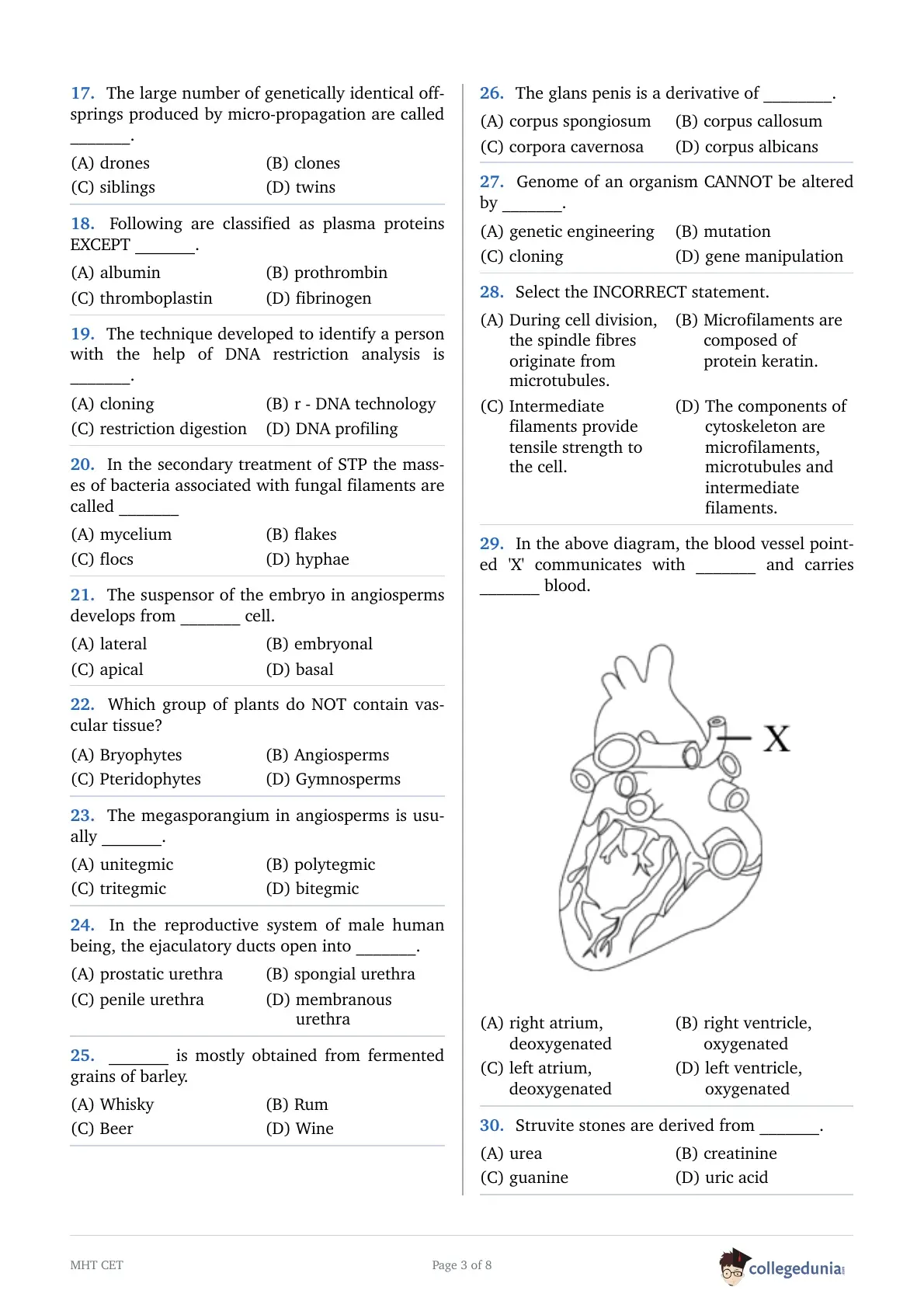
Right atrium : coronary sinus :: left atrium : ______________.

  • (A) coronary artery
  • (B) inferior vena cava
  • (C) pulmonary artery
  • (D) pulmonary vein

Question 168:

After birth, infant receives antibodies IgA through colostrum from mother. This is an example of ______________ immunity.

  • (A) natural acquired active
  • (B) innate (natural)
  • (C) artificial acquired passive
  • (D) natural acquired passive

Question 169:

The pCO\(_2\) of inspired air is ______________ mm Hg during external respiration.

  • (A) 30
  • (B) 100
  • (C) 40
  • (D) 80

Question 170:

Identify the WRONG match of the crop variety and its resistance to pest or disease.

  • (A) Pusa Shubhra --- curl blight and black rot
  • (B) Pusa Sawni and Pusa A4 --- shoot and fruit borer
  • (C) Pusa sadabahar --- stem borer and aphids
  • (D) Pusa Gaurav --- aphids

Question 172:

Capacity of living nucleated cell to differentiate into any other type of cell and form a complete new organism is called ______________.

  • (A) totipotency
  • (B) polymorphism
  • (C) autophagy
  • (D) heterophagy

Question 173:

The first germinal layer formed in human embryo is ______________.

  • (A) mesoderm
  • (B) trophectoderm
  • (C) ectoderm
  • (D) endoderm

Question 174:

Silage supplemented with oil cakes, vitamins etc. makes up good feed for rearing breeds of ______________.

  • (A) buffalo
  • (B) fowl
  • (C) carp
  • (D) silkworm

Question 175:

The anticoagulant ‘heparin’ is secreted by ______________.

  • (A) mast cells
  • (B) adipocytes
  • (C) macrophages
  • (D) fibroblasts

Question 176:

Epihydrophily is observed in which of the following plants?

  • (A) Vallisneria
  • (B) Lotus
  • (C) Ceratophyllum
  • (D) Zostera

Question 177:

Neuroglia cells show following characters EXCEPT ______________.

  • (A) Nourishment
  • (B) Regeneration
  • (C) Excitability
  • (D) Phagocytosis

Question 178:

The sound producing organ in human respiratory system is ______________.

  • (A) pharynx
  • (B) larynx
  • (C) trachea
  • (D) tongue

Question 179:

Cotton is protected from boll worm by using bacterium ______________.

  • (A) Escherichia coli
  • (B) Bacillus thuringiensis
  • (C) Rhizobium leguminosarum
  • (D) Salmonella typhimurium

Question 180:

One of the following is NOT a thyroid hormone. It is ______________.

  • (A) thyrocalcitonin
  • (B) tyrosine
  • (C) triiodothyronine
  • (D) tetraiodothyronine

Question 181:

Which one of the following elements is an important binding agent in ribosomes during protein synthesis?

  • (A) Magnesium
  • (B) Sulphur
  • (C) Phosphorus
  • (D) Manganese

Question 182:

Normally a somatic cell in human beings contains ______________ number of chromosomes.

  • (A) 16
  • (B) 8
  • (C) 32
  • (D) 46

Question 183:

Select the mis-match pair.

  • (A) Ephydatia – Gemmule formation
  • (B) Ascidians – Gemmule formation
  • (C) Hydra – Budding
  • (D) Planarians – Regeneration

Question 185:

Johann Mendel is considered a genius much ahead of his times, as he has given the concept of ‘factors’ now called genes, is based on the fact that ______________.

  • (A) he was the first to conduct experiments in plant hybridization
  • (B) he was the first to suggest the concept
  • (C) he gave the concept before the discovery of mitosis, meiosis and chromosomes
  • (D) he was the first to use a microscope

Question 187:

The ventricular diastole has a duration of ______________ seconds.

  • (A) 0.5
  • (B) 0.8
  • (C) 0.1
  • (D) 0.3

Question 188:

Which pair of blood corpuscles is non-phagocytic?

  • (A) Eosinophil and Basophil
  • (B) Monocyte and Lymphocyte
  • (C) Neutrophil and Lymphocyte
  • (D) Monocyte and Eosinophil

Question 190:

CO\(_2\) concentrating mechanism is NOT seen in ______________.

  • (A) Amaranthus
  • (B) Jowar
  • (C) Gram
  • (D) Maize

Question 191:

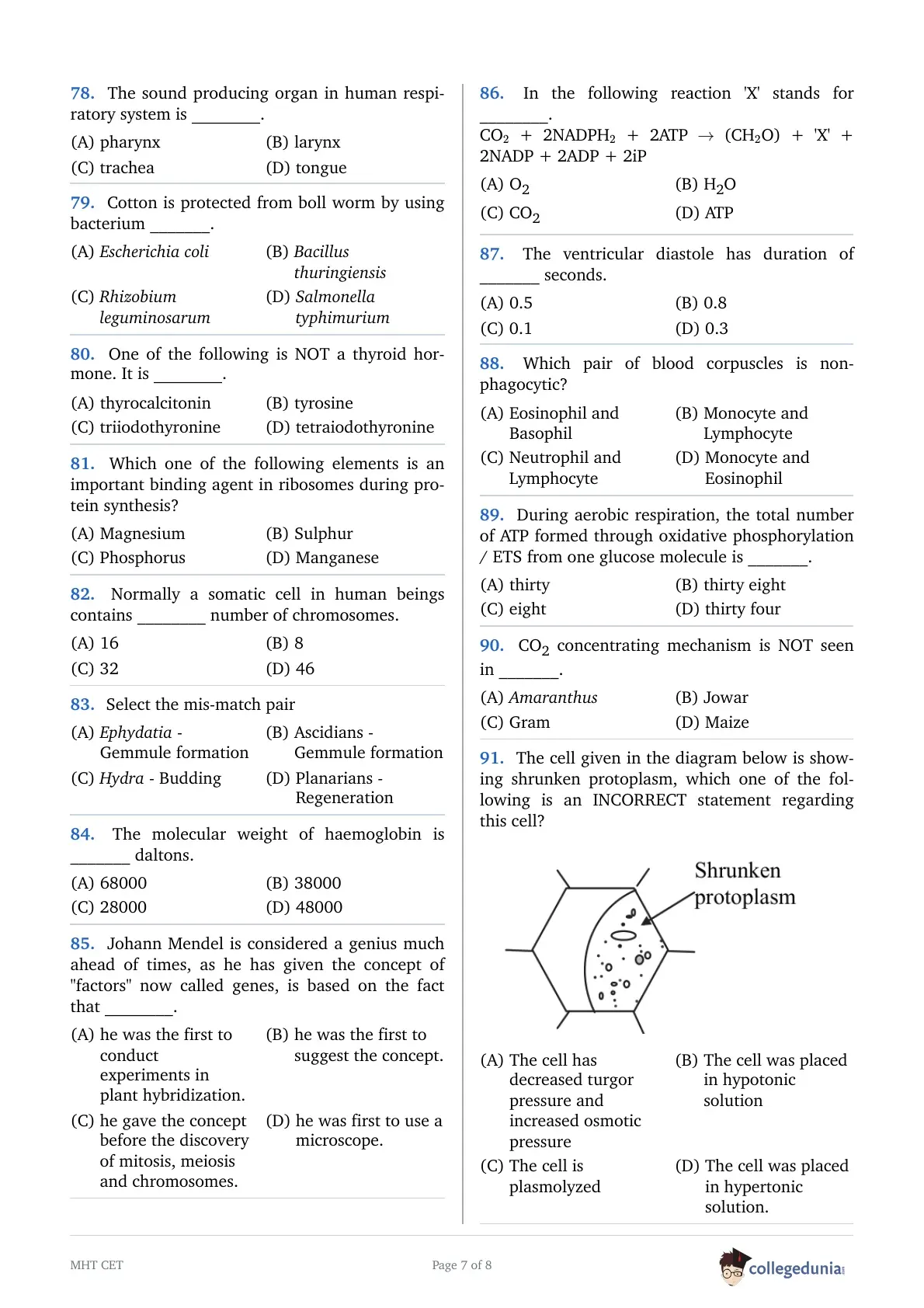
The cell given in the diagram below is showing shrunken protoplasm. Which one of the following is an INCORRECT statement regarding this cell?

  • (A) The cell has decreased turgor pressure and increased osmotic pressure
  • (B) The cell was placed in hypotonic solution
  • (C) The cell is plasmolyzed
  • (D) The cell was placed in hypertonic solution

Question 192:

Mark the CORRECT sequence of structures in the breast from inner to outer side.

  • (A) Lactiferous ducts \(\rightarrow\) Lactiferous sinuses \(\rightarrow\) Lactiferous glands
  • (B) Lactiferous sinuses \(\rightarrow\) Lactiferous ducts \(\rightarrow\) Lactiferous glands
  • (C) Lactiferous glands \(\rightarrow\) Lactiferous sinuses \(\rightarrow\) Lactiferous ducts
  • (D) Lactiferous glands \(\rightarrow\) Lactiferous ducts \(\rightarrow\) Lactiferous sinuses

Question 193:

During Calvin cycle, phosphoglyceraldehyde is formed from 1,3-diPGA by ...........

  • (A) phosphorylation
  • (B) oxidation
  • (C) reduction
  • (D) oxidative decarboxylation

Question 195:

Dark yellow urine, whitish stools, itching of skin, pale face etc. are main symptoms of ........

  • (A) Jaundice
  • (B) Constipation
  • (C) Kwashiorkor
  • (D) Diarrhoea

Question 196:

In human beings, usually the gestation period lasts for about ......... days, from beginning of the last menstrual cycle.

  • (A) 280
  • (B) 266
  • (C) 256
  • (D) 243

Question 197:

Sewall Wright effect is ............

  • (A) transfer of genes between populations
  • (B) exchange of genetic material between communities
  • (C) any alteration in allele frequency of a natural population by pure chance
  • (D) changes in chemical make up of a gene

Question 198:

The deposition of pesticides in fatty tissue of the organisms is called ............

  • (A) Biomagnification
  • (B) Bioaccumulation
  • (C) Bioconcentration
  • (D) Biodegradation

Question 200:

Identify the correct sequence of seral stages in the Xerarch Succession.

  • (A) lichens \(\rightarrow\) mosses \(\rightarrow\) herbs \(\rightarrow\) shrubs \(\rightarrow\) trees
  • (B) mosses \(\rightarrow\) lichens \(\rightarrow\) herbs \(\rightarrow\) shrubs \(\rightarrow\) trees
  • (C) herbs \(\rightarrow\) shrubs \(\rightarrow\) mosses \(\rightarrow\) lichens \(\rightarrow\) trees
  • (D) lichens \(\rightarrow\) herbs \(\rightarrow\) mosses \(\rightarrow\) shrubs \(\rightarrow\) trees

MHT CET 2020 PCB Exam Pattern and Marking Scheme

Parameter Details
Conducting Body Maharashtra Common Entrance Test Cell (Maharashtra CET Cell)
Exam Mode Online (Computer-Based Test)
Duration 180 minutes (3 hours)
Groups / Subjects PCB (Physics, Chemistry, Biology) for Pharmacy and Agriculture
Total Questions

200

Total Marks 200
Question Type Multiple Choice Questions (MCQs)
Marking Scheme 1 mark for each correct answer
Negative Marking No
Syllabus Weightage
  • Class 12 – 80%
  • Class 11 – 20%