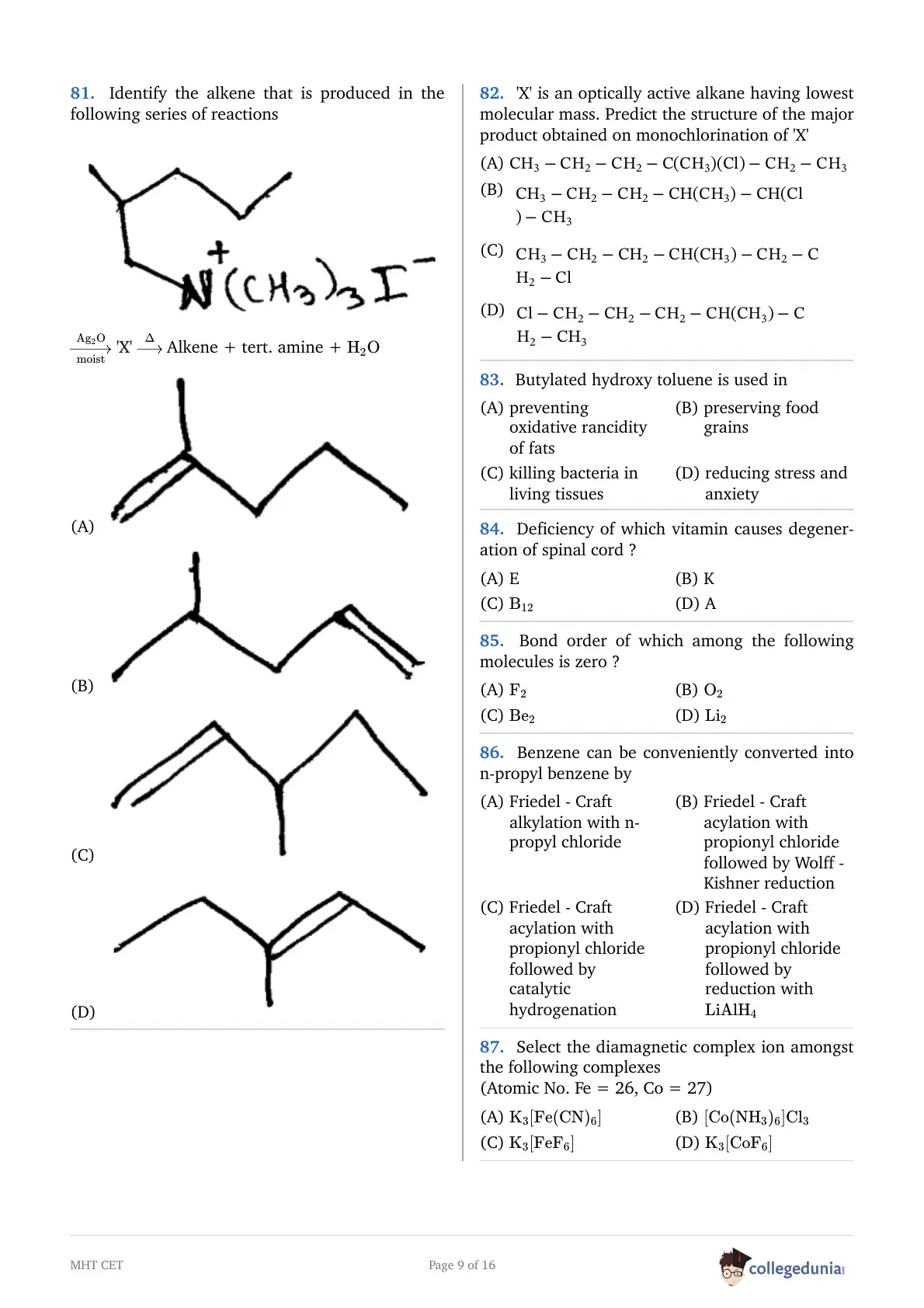
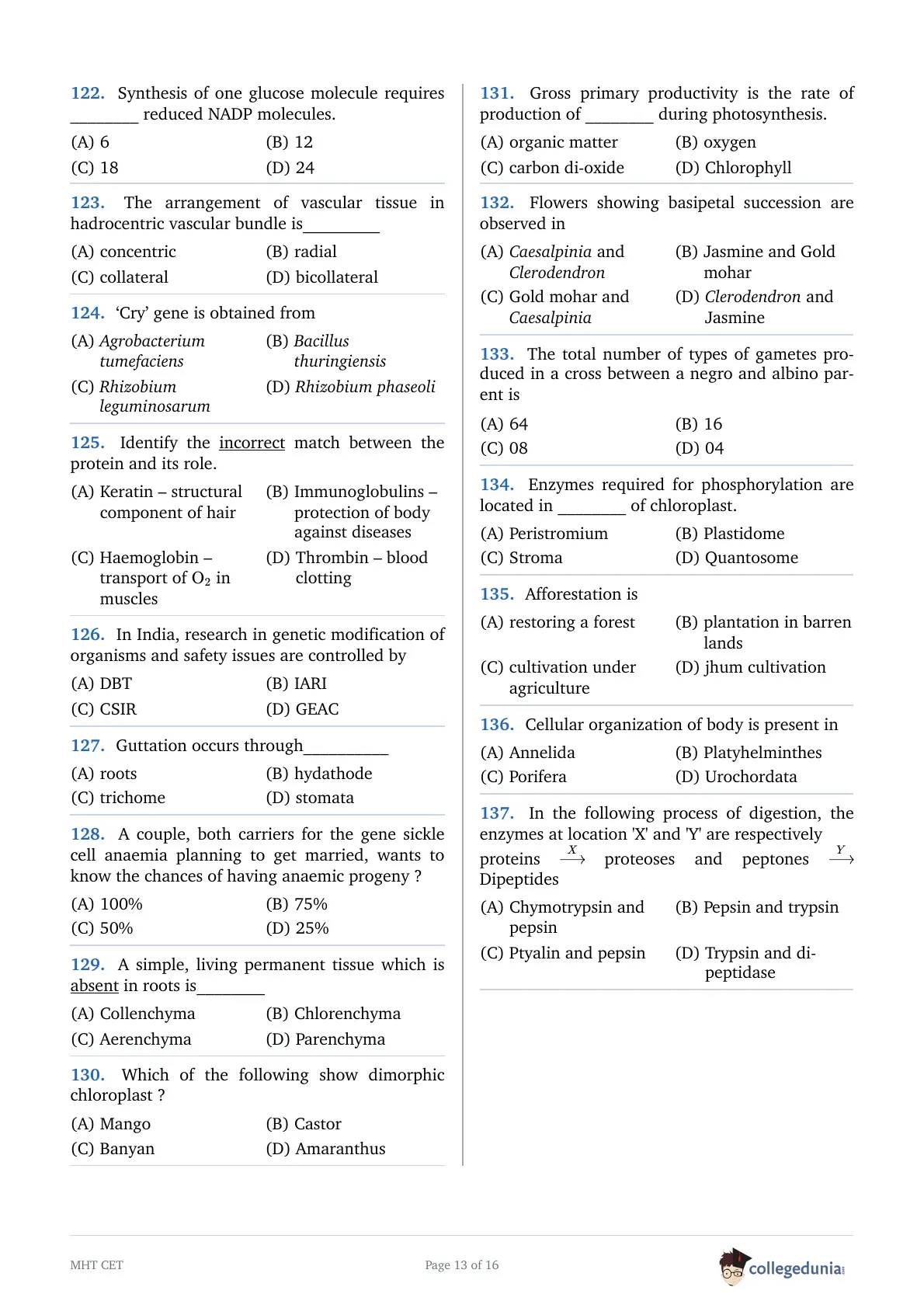
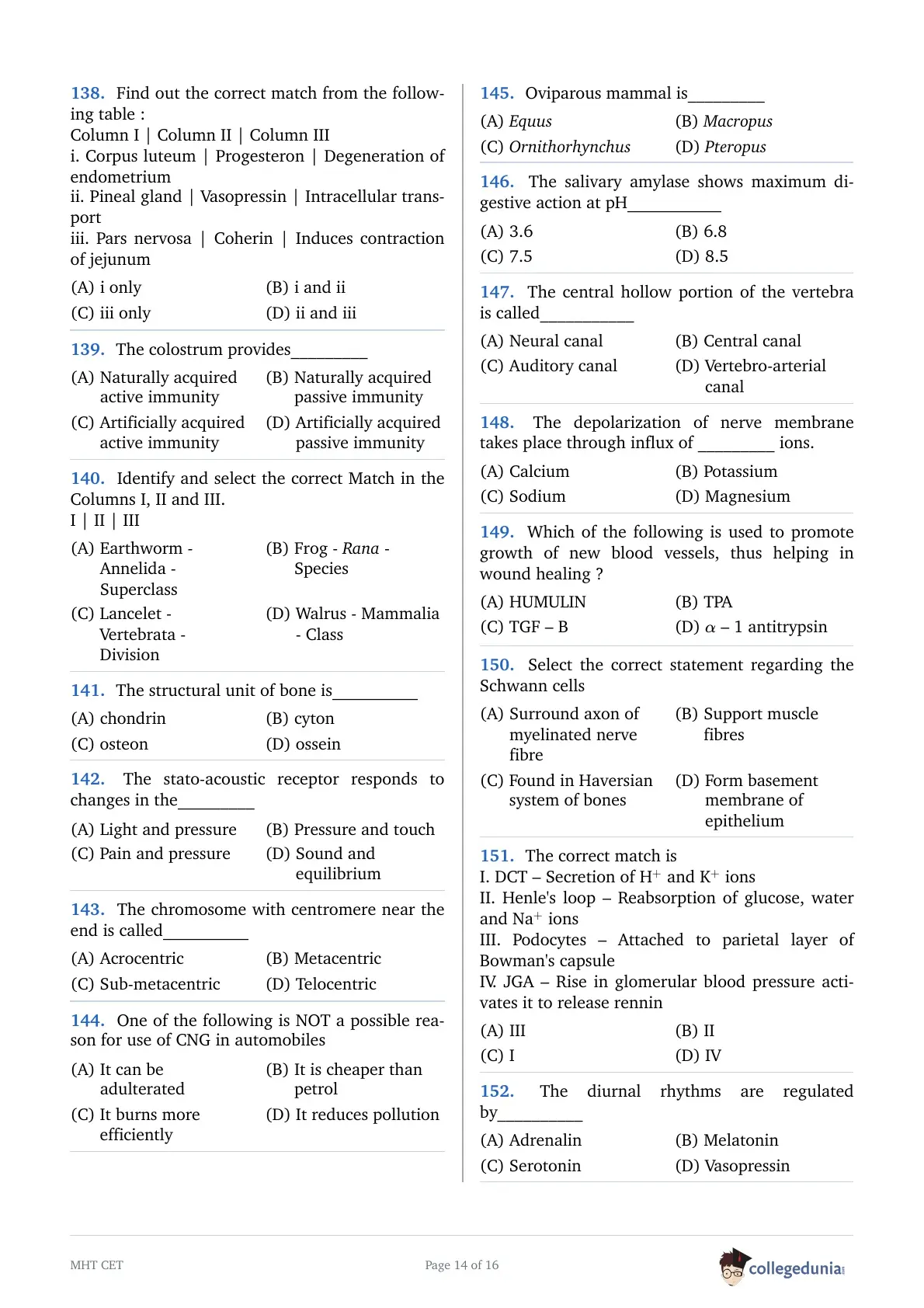
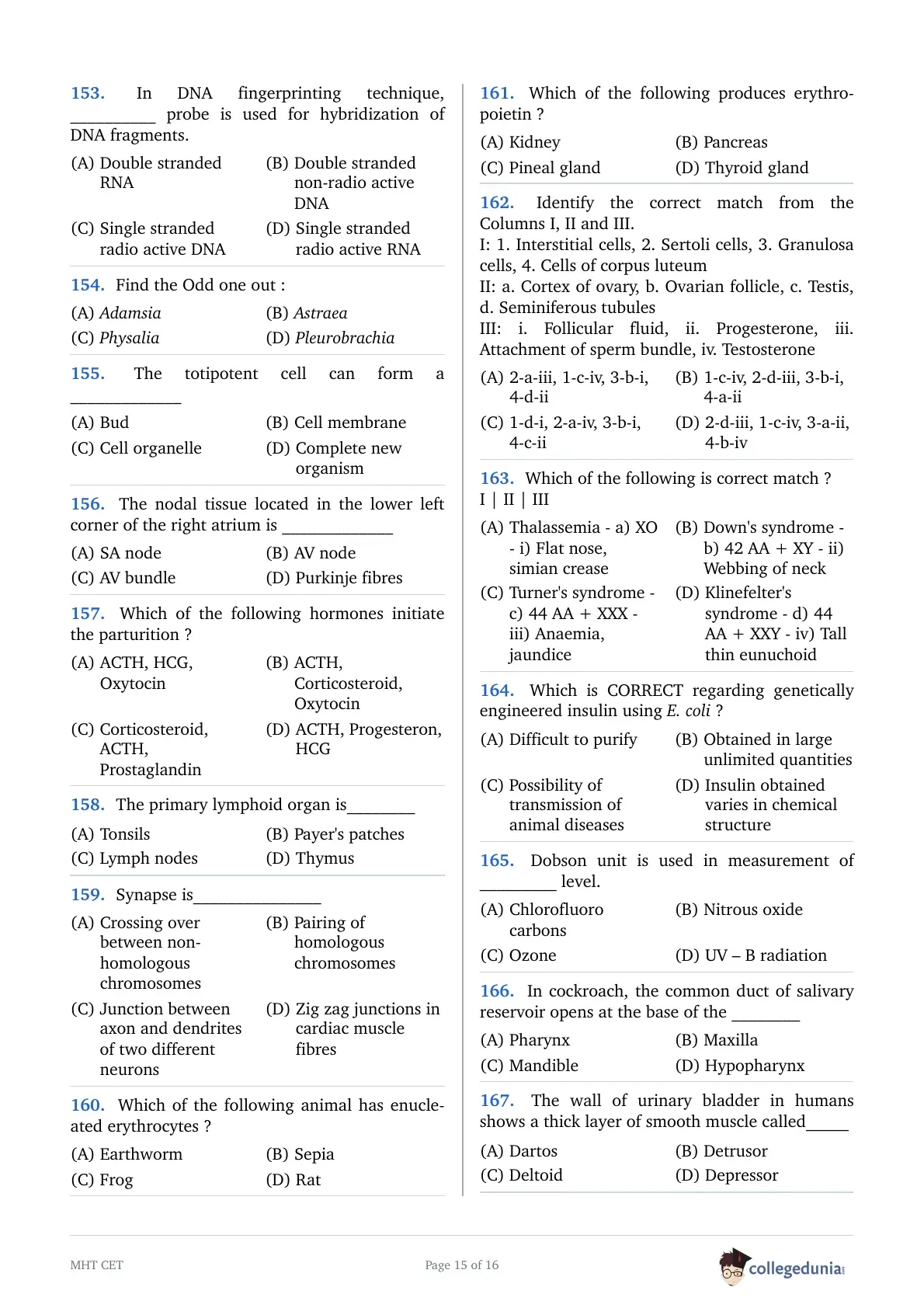
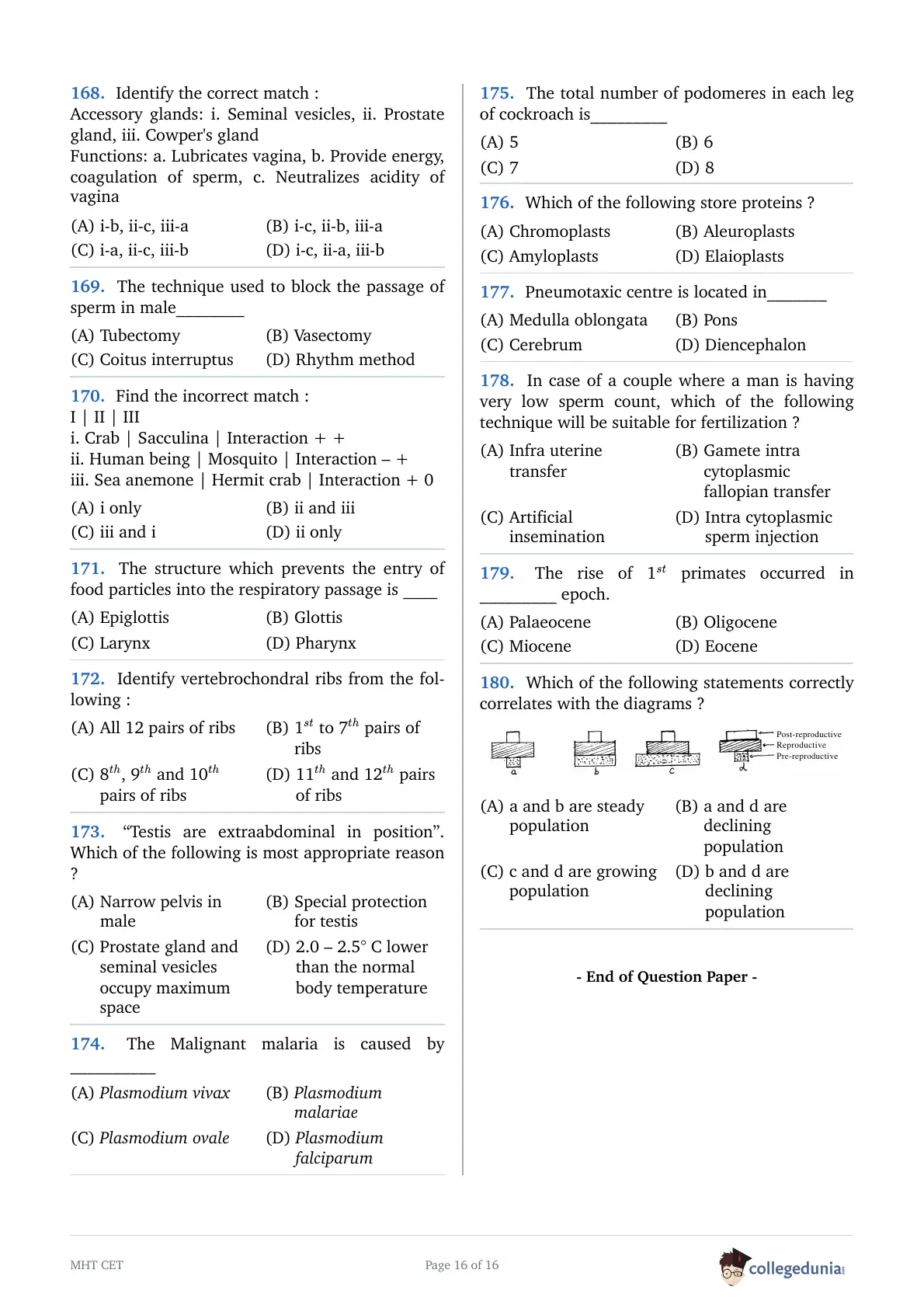
MHT CET 2014 PCB Question Paper is available for download here. Maharashtra State CET Cell conducted MHT CET 2014 on 8 May 2014.

The MHT CET 2014 PCB Question Paper includes the following:

  • The MHT CET 2014 PCB paper consists of 180 multiple-choice questions (MCQs) totalling 720 marks: Physics (45 questions), Chemistry (45 questions) and Biology (90 questions).
  • The time allowed is 180 minutes.

MHT CET 2014 PCB Question Paper with Solution PDF

CD PDF CD PDF with Solutions
Download Collegedunia PDF 0.89 MB -

Also Check:

MHT CET 2014 PCB Questions with Solutions


Physics (Q1 - Q45)

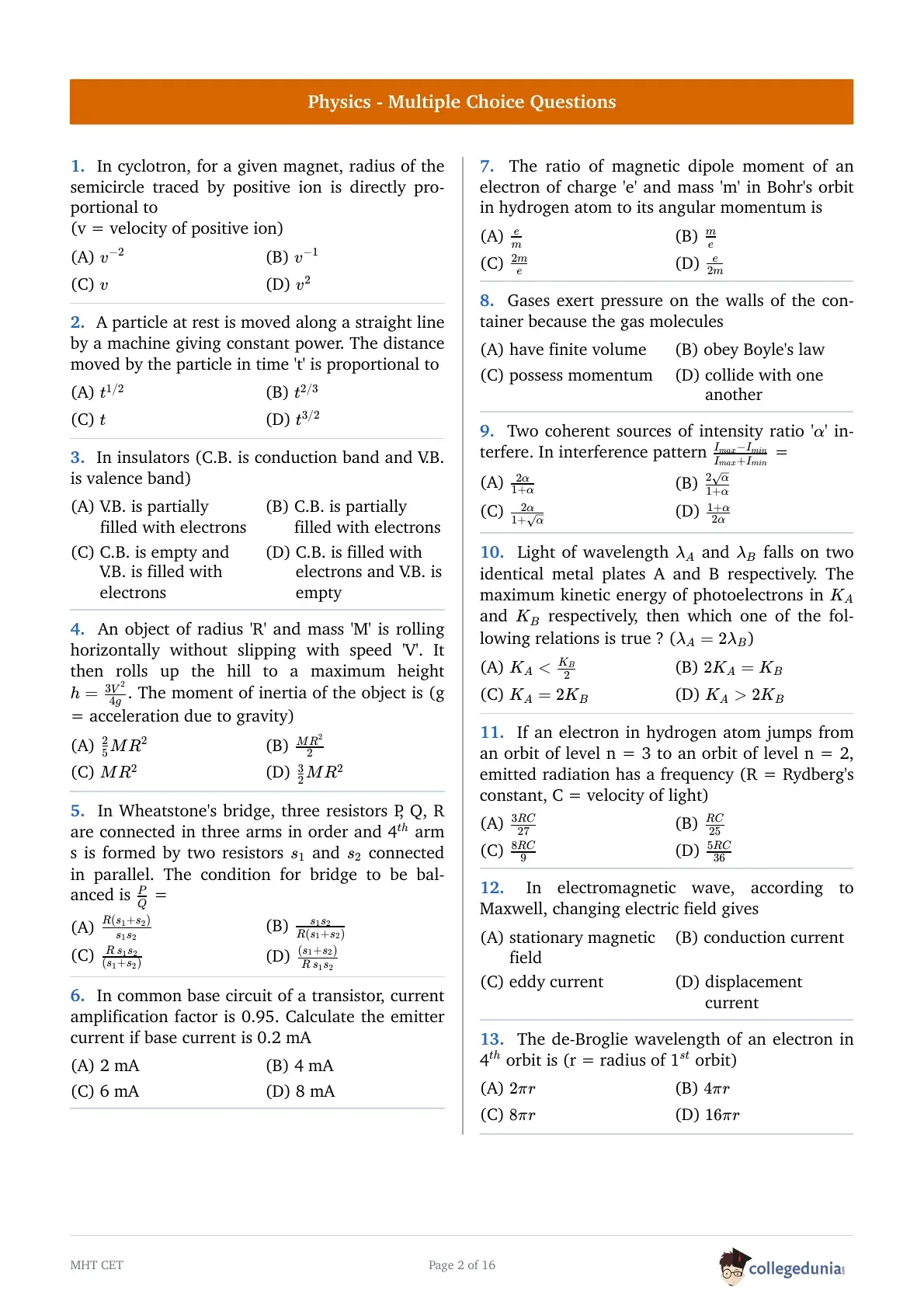
Question 1:

In cyclotron, for a given magnet, radius of the semicircle traced by positive ion is directly proportional to
(v = velocity of positive ion)

  • (A) \(v^{-2}\)
  • (B) \(v^{-1}\)
  • (C) \(v\)
  • (D) \(v^{2}\)

Question 2:

A particle at rest is moved along a straight line by a machine giving constant power. The distance moved by the particle in time 't' is proportional to

  • (A) \(t^{1/2}\)
  • (B) \(t^{2/3}\)
  • (C) \(t\)
  • (D) \(t^{3/2}\)

Question 3:

In insulators (C.B. is conduction band and V.B. is valence band)

  • (A) V.B. is partially filled with electrons
  • (B) C.B. is partially filled with electrons
  • (C) C.B. is empty and V.B. is filled with electrons
  • (D) C.B. is filled with electrons and V.B. is empty

Question 4:

An object of radius 'R' and mass 'M' is rolling horizontally without slipping with speed 'V'. It then rolls up the hill to a maximum height \(h = \frac{3V^{2}}{4g}\). The moment of inertia of the object is (g = acceleration due to gravity)

  • (A) \(\frac{2}{5}MR^{2}\)
  • (B) \(\frac{MR^{2}}{2}\)
  • (C) \(MR^{2}\)
  • (D) \(\frac{3}{2}MR^{2}\)

Question 5:

In Wheatstone's bridge, three resistors P, Q, R are connected in three arms in order and 4\(^{th}\) arm s is formed by two resistors \(s_1\) and \(s_2\) connected in parallel. The condition for bridge to be balanced is \(\frac{P}{Q}\) =

  • (A) \(\frac{R(s_1+s_2)}{s_1 s_2}\)
  • (B) \(\frac{s_1 s_2}{R(s_1+s_2)}\)
  • (C) \(\frac{R\,s_1 s_2}{(s_1+s_2)}\)
  • (D) \(\frac{(s_1+s_2)}{R\,s_1 s_2}\)

Question 6:

In common base circuit of a transistor, current amplification factor is 0.95. Calculate the emitter current if base current is 0.2 mA

  • (A) 2 mA
  • (B) 4 mA
  • (C) 6 mA
  • (D) 8 mA

Question 7:

The ratio of magnetic dipole moment of an electron of charge 'e' and mass 'm' in Bohr's orbit in hydrogen atom to its angular momentum is

  • (A) \(\frac{e}{m}\)
  • (B) \(\frac{m}{e}\)
  • (C) \(\frac{2m}{e}\)
  • (D) \(\frac{e}{2m}\)

Question 8:

Gases exert pressure on the walls of the container because the gas molecules

  • (A) have finite volume
  • (B) obey Boyle's law
  • (C) possess momentum
  • (D) collide with one another

Question 9:

Two coherent sources of intensity ratio '\(\alpha\)' interfere. In interference pattern \(\frac{I_{max}-I_{min}}{I_{max}+I_{min}}\) =

  • (A) \(\frac{2\alpha}{1+\alpha}\)
  • (B) \(\frac{2\sqrt{\alpha}}{1+\alpha}\)
  • (C) \(\frac{2\alpha}{1+\sqrt{\alpha}}\)
  • (D) \(\frac{1+\alpha}{2\alpha}\)

Question 10:

Light of wavelength \(\lambda_A\) and \(\lambda_B\) falls on two identical metal plates A and B respectively. The maximum kinetic energy of photoelectrons in \(K_A\) and \(K_B\) respectively, then which one of the following relations is true ? (\(\lambda_A = 2\lambda_B\))

  • (A) \(K_A < \frac{K_B}{2}\)
  • (B) \(2K_A = K_B\)
  • (C) \(K_A = 2K_B\)
  • (D) \(K_A > 2K_B\)

Question 11:

If an electron in hydrogen atom jumps from an orbit of level n = 3 to an orbit of level n = 2, emitted radiation has a frequency (R = Rydberg's constant, C = velocity of light)

  • (A) \(\frac{3RC}{27}\)
  • (B) \(\frac{RC}{25}\)
  • (C) \(\frac{8RC}{9}\)
  • (D) \(\frac{5RC}{36}\)

Question 12:

In electromagnetic wave, according to Maxwell, changing electric field gives

  • (A) stationary magnetic field
  • (B) conduction current
  • (C) eddy current
  • (D) displacement current

Question 13:

The de-Broglie wavelength of an electron in 4\(^{th}\) orbit is (r = radius of 1\(^{st}\) orbit)

  • (A) \(2\pi r\)
  • (B) \(4\pi r\)
  • (C) \(8\pi r\)
  • (D) \(16\pi r\)

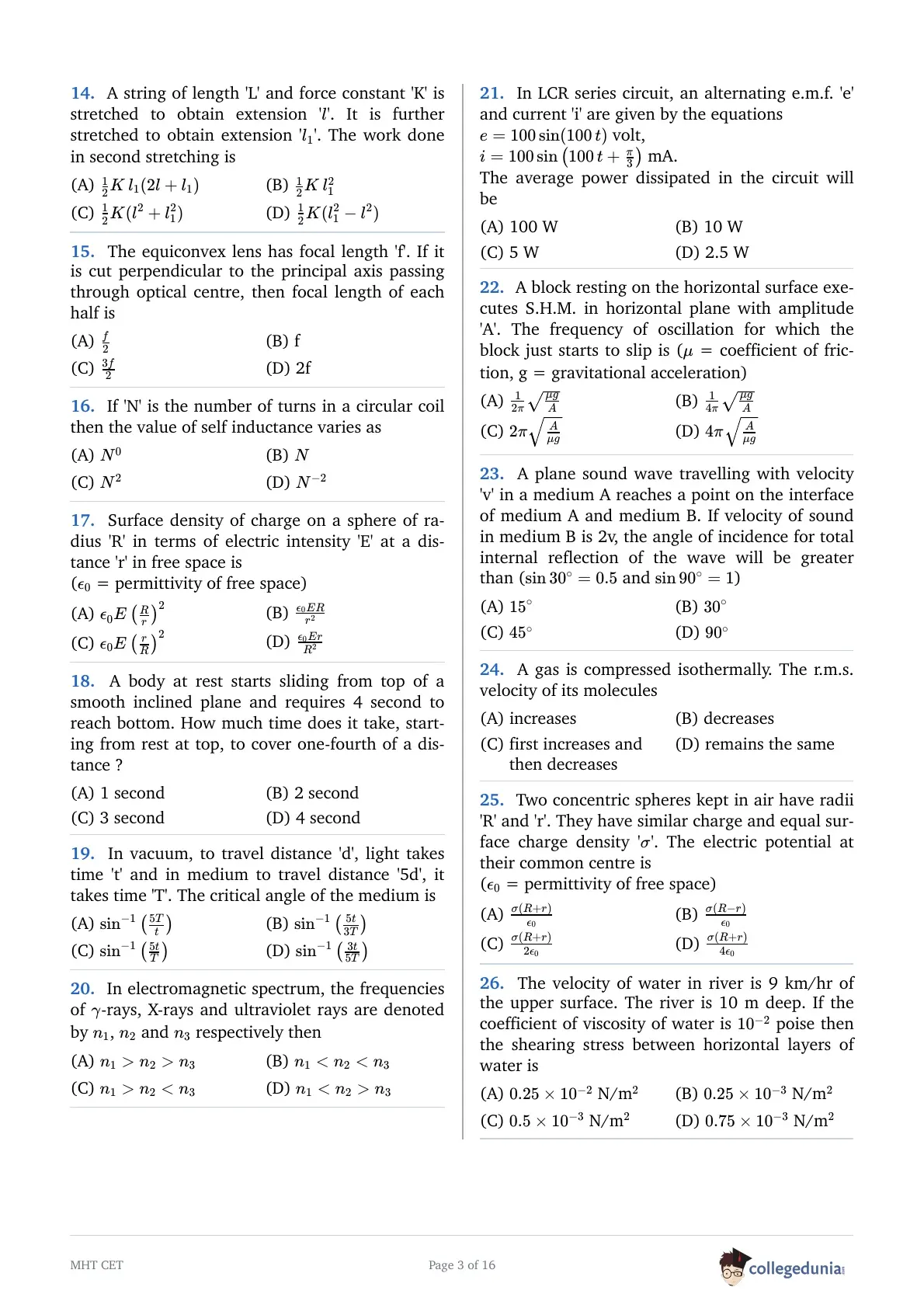
Question 14:

A string of length 'L' and force constant 'K' is stretched to obtain extension '\(l\)'. It is further stretched to obtain extension '\(l_1\)'. The work done in second stretching is

  • (A) \(\frac{1}{2}K\,l_1(2l+l_1)\)
  • (B) \(\frac{1}{2}K\,l_1^{2}\)
  • (C) \(\frac{1}{2}K(l^{2}+l_1^{2})\)
  • (D) \(\frac{1}{2}K(l_1^{2}-l^{2})\)

Question 15:

The equiconvex lens has focal length 'f'. If it is cut perpendicular to the principal axis passing through optical centre, then focal length of each half is

  • (A) \(\frac{f}{2}\)
  • (B) f
  • (C) \(\frac{3f}{2}\)
  • (D) 2f

Question 16:

If 'N' is the number of turns in a circular coil then the value of self inductance varies as

  • (A) \(N^{0}\)
  • (B) \(N\)
  • (C) \(N^{2}\)
  • (D) \(N^{-2}\)

Question 17:

Surface density of charge on a sphere of radius 'R' in terms of electric intensity 'E' at a distance 'r' in free space is
(\(\epsilon_0\) = permittivity of free space)

  • (A) \(\epsilon_0 E\left(\frac{R}{r}\right)^{2}\)
  • (B) \(\frac{\epsilon_0 E R}{r^{2}}\)
  • (C) \(\epsilon_0 E\left(\frac{r}{R}\right)^{2}\)
  • (D) \(\frac{\epsilon_0 E r}{R^{2}}\)

Question 18:

A body at rest starts sliding from top of a smooth inclined plane and requires 4 second to reach bottom. How much time does it take, starting from rest at top, to cover one-fourth of a distance ?

  • (A) 1 second
  • (B) 2 second
  • (C) 3 second
  • (D) 4 second

Question 19:

In vacuum, to travel distance 'd', light takes time 't' and in medium to travel distance '5d', it takes time 'T'. The critical angle of the medium is

  • (A) \(\sin^{-1}\left(\frac{5T}{t}\right)\)
  • (B) \(\sin^{-1}\left(\frac{5t}{3T}\right)\)
  • (C) \(\sin^{-1}\left(\frac{5t}{T}\right)\)
  • (D) \(\sin^{-1}\left(\frac{3t}{5T}\right)\)

Question 20:

In electromagnetic spectrum, the frequencies of \(\gamma\)-rays, X-rays and ultraviolet rays are denoted by \(n_1\), \(n_2\) and \(n_3\) respectively then

  • (A) \(n_1 > n_2 > n_3\)
  • (B) \(n_1 < n_2 < n_3\)
  • (C) \(n_1 > n_2 < n_3\)
  • (D) \(n_1 < n_2 > n_3\)

Question 21:

In LCR series circuit, an alternating e.m.f. 'e' and current 'i' are given by the equations
\(e = 100\sin(100\,t)\) volt,
\(i = 100\sin\left(100\,t + \frac{\pi}{3}\right)\) mA.
The average power dissipated in the circuit will be

  • (A) 100 W
  • (B) 10 W
  • (C) 5 W
  • (D) 2.5 W

Question 22:

A block resting on the horizontal surface executes S.H.M. in horizontal plane with amplitude 'A'. The frequency of oscillation for which the block just starts to slip is (\(\mu\) = coefficient of friction, g = gravitational acceleration)

  • (A) \(\frac{1}{2\pi}\sqrt{\frac{\mu g}{A}}\)
  • (B) \(\frac{1}{4\pi}\sqrt{\frac{\mu g}{A}}\)
  • (C) \(2\pi\sqrt{\frac{A}{\mu g}}\)
  • (D) \(4\pi\sqrt{\frac{A}{\mu g}}\)

Question 23:

A plane sound wave travelling with velocity 'v' in a medium A reaches a point on the interface of medium A and medium B. If velocity of sound in medium B is 2v, the angle of incidence for total internal reflection of the wave will be greater than (\(\sin 30^\circ = 0.5\) and \(\sin 90^\circ = 1\))

  • (A) \(15^\circ\)
  • (B) \(30^\circ\)
  • (C) \(45^\circ\)
  • (D) \(90^\circ\)

Question 24:

A gas is compressed isothermally. The r.m.s. velocity of its molecules

  • (A) increases
  • (B) decreases
  • (C) first increases and then decreases
  • (D) remains the same

Question 25:

Two concentric spheres kept in air have radii 'R' and 'r'. They have similar charge and equal surface charge density '\(\sigma\)'. The electric potential at their common centre is
(\(\epsilon_0\) = permittivity of free space)

  • (A) \(\frac{\sigma(R+r)}{\epsilon_0}\)
  • (B) \(\frac{\sigma(R-r)}{\epsilon_0}\)
  • (C) \(\frac{\sigma(R+r)}{2\epsilon_0}\)
  • (D) \(\frac{\sigma(R+r)}{4\epsilon_0}\)

Question 26:

The velocity of water in river is 9 km/hr of the upper surface. The river is 10 m deep. If the coefficient of viscosity of water is \(10^{-2}\) poise then the shearing stress between horizontal layers of water is

  • (A) \(0.25\times10^{-2}\) N/m\(^2\)
  • (B) \(0.25\times10^{-3}\) N/m\(^2\)
  • (C) \(0.5\times10^{-3}\) N/m\(^2\)
  • (D) \(0.75\times10^{-3}\) N/m\(^2\)

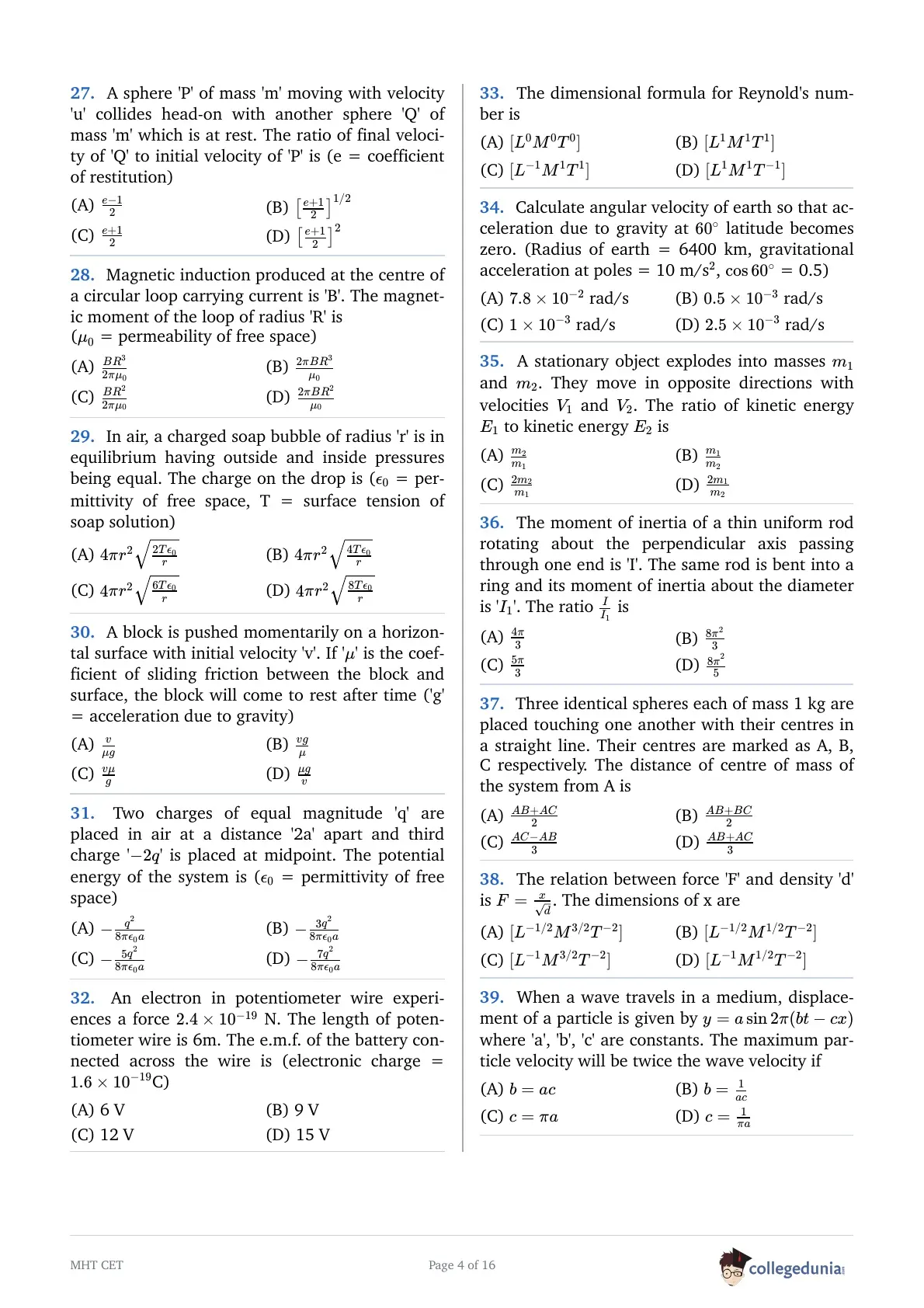
Question 27:

A sphere 'P' of mass 'm' moving with velocity 'u' collides head-on with another sphere 'Q' of mass 'm' which is at rest. The ratio of final velocity of 'Q' to initial velocity of 'P' is (e = coefficient of restitution)

  • (A) \(\frac{e-1}{2}\)
  • (B) \(\left[\frac{e+1}{2}\right]^{1/2}\)
  • (C) \(\frac{e+1}{2}\)
  • (D) \(\left[\frac{e+1}{2}\right]^{2}\)

Question 28:

Magnetic induction produced at the centre of a circular loop carrying current is 'B'. The magnetic moment of the loop of radius 'R' is
(\(\mu_0\) = permeability of free space)

  • (A) \(\frac{BR^{3}}{2\pi\mu_0}\)
  • (B) \(\frac{2\pi BR^{3}}{\mu_0}\)
  • (C) \(\frac{BR^{2}}{2\pi\mu_0}\)
  • (D) \(\frac{2\pi BR^{2}}{\mu_0}\)

Question 29:

In air, a charged soap bubble of radius 'r' is in equilibrium having outside and inside pressures being equal. The charge on the drop is (\(\epsilon_0\) = permittivity of free space, T = surface tension of soap solution)

  • (A) \(4\pi r^{2}\sqrt{\frac{2T\epsilon_0}{r}}\)
  • (B) \(4\pi r^{2}\sqrt{\frac{4T\epsilon_0}{r}}\)
  • (C) \(4\pi r^{2}\sqrt{\frac{6T\epsilon_0}{r}}\)
  • (D) \(4\pi r^{2}\sqrt{\frac{8T\epsilon_0}{r}}\)

Question 30:

A block is pushed momentarily on a horizontal surface with initial velocity 'v'. If '\(\mu\)' is the coefficient of sliding friction between the block and surface, the block will come to rest after time ('g' = acceleration due to gravity)

  • (A) \(\frac{v}{\mu g}\)
  • (B) \(\frac{vg}{\mu}\)
  • (C) \(\frac{v\mu}{g}\)
  • (D) \(\frac{\mu g}{v}\)

Question 31:

Two charges of equal magnitude 'q' are placed in air at a distance '2a' apart and third charge '\(-2q\)' is placed at midpoint. The potential energy of the system is (\(\epsilon_0\) = permittivity of free space)

  • (A) \(-\frac{q^{2}}{8\pi\epsilon_0 a}\)
  • (B) \(-\frac{3q^{2}}{8\pi\epsilon_0 a}\)
  • (C) \(-\frac{5q^{2}}{8\pi\epsilon_0 a}\)
  • (D) \(-\frac{7q^{2}}{8\pi\epsilon_0 a}\)

Question 32:

An electron in potentiometer wire experiences a force \(2.4\times10^{-19}\) N. The length of potentiometer wire is 6m. The e.m.f. of the battery connected across the wire is (electronic charge = \(1.6\times10^{-19}\)C)

  • (A) 6 V
  • (B) 9 V
  • (C) 12 V
  • (D) 15 V

Question 33:

The dimensional formula for Reynold's number is

  • (A) \([L^{0}M^{0}T^{0}]\)
  • (B) \([L^{1}M^{1}T^{1}]\)
  • (C) \([L^{-1}M^{1}T^{1}]\)
  • (D) \([L^{1}M^{1}T^{-1}]\)

Question 34:

Calculate angular velocity of earth so that acceleration due to gravity at \(60^\circ\) latitude becomes zero. (Radius of earth = 6400 km, gravitational acceleration at poles = 10 m/s\(^2\), \(\cos 60^\circ\) = 0.5)

  • (A) \(7.8\times10^{-2}\) rad/s
  • (B) \(0.5\times10^{-3}\) rad/s
  • (C) \(1\times10^{-3}\) rad/s
  • (D) \(2.5\times10^{-3}\) rad/s

Question 35:

A stationary object explodes into masses \(m_1\) and \(m_2\). They move in opposite directions with velocities \(V_1\) and \(V_2\). The ratio of kinetic energy \(E_1\) to kinetic energy \(E_2\) is

  • (A) \(\frac{m_2}{m_1}\)
  • (B) \(\frac{m_1}{m_2}\)
  • (C) \(\frac{2m_2}{m_1}\)
  • (D) \(\frac{2m_1}{m_2}\)

Question 36:

The moment of inertia of a thin uniform rod rotating about the perpendicular axis passing through one end is 'I'. The same rod is bent into a ring and its moment of inertia about the diameter is '\(I_1\)'. The ratio \(\frac{I}{I_1}\) is

  • (A) \(\frac{4\pi}{3}\)
  • (B) \(\frac{8\pi^{2}}{3}\)
  • (C) \(\frac{5\pi}{3}\)
  • (D) \(\frac{8\pi^{2}}{5}\)

Question 37:

Three identical spheres each of mass 1 kg are placed touching one another with their centres in a straight line. Their centres are marked as A, B, C respectively. The distance of centre of mass of the system from A is

  • (A) \(\frac{AB+AC}{2}\)
  • (B) \(\frac{AB+BC}{2}\)
  • (C) \(\frac{AC-AB}{3}\)
  • (D) \(\frac{AB+AC}{3}\)

Question 38:

The relation between force 'F' and density 'd' is \(F = \frac{x}{\sqrt{d}}\). The dimensions of x are

  • (A) \([L^{-1/2}M^{3/2}T^{-2}]\)
  • (B) \([L^{-1/2}M^{1/2}T^{-2}]\)
  • (C) \([L^{-1}M^{3/2}T^{-2}]\)
  • (D) \([L^{-1}M^{1/2}T^{-2}]\)

Question 39:

When a wave travels in a medium, displacement of a particle is given by \(y = a\sin 2\pi(bt - cx)\) where 'a', 'b', 'c' are constants. The maximum particle velocity will be twice the wave velocity if

  • (A) \(b = ac\)
  • (B) \(b = \frac{1}{ac}\)
  • (C) \(c = \pi a\)
  • (D) \(c = \frac{1}{\pi a}\)

Question 40:

Electromagnets are made of soft iron because soft iron has

  • (A) high susceptibility and low retentivity
  • (B) low susceptibility and high retentivity
  • (C) low susceptibility and low retentivity
  • (D) high susceptibility and high retentivity

Question 41:

The masses of three copper wires are in the ratio 1 : 3 : 5 and their lengths are in the ratio 5 : 3 : 1. The ratio of their resistance is

  • (A) 25 : 1 : 125
  • (B) 1 : 125 : 25
  • (C) 125 : 1 : 25
  • (D) 125 : 15 : 1

Question 42:

A body of mass 'm' is raised to a height '10 R' from the surface of earth, where 'R' is the radius of earth. The increase in potential energy is (G = universal constant of gravitation, M = mass of earth and g = acceleration due to gravity)

  • (A) \(\frac{GMm}{11R}\)
  • (B) \(\frac{GMm}{10R}\)
  • (C) \(\frac{mgR}{11G}\)
  • (D) \(\frac{10\,GMm}{11R}\)

Question 43:

The angle \(\theta\) between the vector \(\vec{p} = \hat{i}+\hat{j}+\hat{k}\) and unit vector along x-axis is

  • (A) \(\cos^{-1}\left(\frac{1}{\sqrt{3}}\right)\)
  • (B) \(\cos^{-1}\left(\frac{1}{\sqrt{2}}\right)\)
  • (C) \(\cos^{-1}\left(\frac{\sqrt{3}}{2}\right)\)
  • (D) \(\cos^{-1}\left(\frac{1}{2}\right)\)

Question 44:

A small metal ball of mass 'm' is dropped in a liquid contained in a vessel, attains a terminal velocity 'v'. If a metal ball of same material but of mass '8m' is dropped in same liquid then the terminal velocity will be

  • (A) V
  • (B) 2V
  • (C) 4V
  • (D) 8V

Question 45:

A wooden block of mass 8 kg slides down an inclined plane of inclination \(30^\circ\) to the horizontal with constant acceleration 0.4 m/s\(^2\). The force of friction between the block and inclined plane is (g = 10 m/s\(^2\))

  • (A) 12.2 N
  • (B) 24.4 N
  • (C) 36.8 N
  • (D) 48.8 N

Chemistry (Q46 - Q90)

Question 46:

Which of the following complexes has lowest molar conductance ?

  • (A) \(\mathrm{CoCl_3\cdot 3NH_3}\)
  • (B) \(\mathrm{CoCl_3\cdot 4NH_3}\)
  • (C) \(\mathrm{CoCl_3\cdot 5NH_3}\)
  • (D) \(\mathrm{CoCl_3\cdot 6NH_3}\)

Question 47:

The volume of oxygen evolved at STP, by decomposition of 0.68 g '20 volume' hydrogen peroxide solution, is

  • (A) 2.24 mL
  • (B) 22.4 mL
  • (C) 224 mL
  • (D) 2240 mL

Question 48:

What is the molality of a solution containing 200 mg of urea (molar mass 60 g \(\mathrm{mol^{-1}}\)) dissolved in 40 g of water ?

  • (A) 0.0833
  • (B) 0.825
  • (C) 0.498
  • (D) 0.0013

Question 49:

Alkaline hydrolysis of which among the following compounds leads to the formation of a racemate ?

  • (A) 1-Bromo-1-phenylethane
  • (B) 1-Chloro-3-methylbutane
  • (C) Bromoethane
  • (D) 1-Chloropropane

Question 50:

The work done when two mole of an ideal gas is compressed from a volume of 5 \(\mathrm{m^3}\) to 1 \(\mathrm{dm^3}\) at 300 K, under a pressure of 100 kPa is

  • (A) 499.9 kJ
  • (B) \(-\) 499.9 kJ
  • (C) \(-\)99.5 kJ
  • (D) 42495 kJ

Question 51:

Which among the following group 16 elements exists in more than two allotropic states ?

  • (A) Polonium
  • (B) Tellurium
  • (C) Selenium
  • (D) Oxygen

Question 52:

Solubility of which among the following substances in water increases slightly with rise in temperature ?

  • (A) Potassium bromide
  • (B) Potassium chloride
  • (C) Potassium nitrate
  • (D) Sodium nitrate

Question 53:

Assuming enthalpy of combustion of hydrogen at 273 K, \(-\)286 kJ and enthalpy of fusion of ice at the same temperature to be + 6.0 kJ, calculate enthalpy change during formation of 100 g of ice

  • (A) + 1622 kJ
  • (B) \(-\) 1622 kJ
  • (C) +292 kJ
  • (D) \(-\)292 kJ

Question 54:

How is electrical conductance of a conductor related with length and area of cross section of the conductor ?

  • (A) G = \(l\) . a. \(k^{-1}\)
  • (B) G = k . \(l\). \(a^{-1}\)
  • (C) G = k. a. \(l^{-1}\)
  • (D) G = k. \(l\). \(a^{-2}\)

Question 55:

What is the orbital angular momentum of an electron in 'f' orbital ?

  • (A) \(\frac{1.5\,h}{\pi}\)
  • (B) \(\frac{\sqrt{6}\,h}{\pi}\)
  • (C) \(\frac{\sqrt{3}\,h}{\pi}\)
  • (D) \(\frac{\sqrt{3}\,h}{2\pi}\)

Question 56:

Which statement is NOT correct about fullerene \(\mathrm{C_{60}}\) ?

  • (A) It contains 20 six membered rings and 12 five membered rings
  • (B) All carbon atoms undergo \(\mathrm{SP^2}\) hybridization
  • (C) A six membered ring is fused with six membered rings only
  • (D) A five membered ring is fused with six membered ring only

Question 57:

The product of molar concentrations of hydrogen ions and hydroxide ions in a 0.01 M aqueous solution of sodium chloride is known as

  • (A) Hydrolysis constant of salt
  • (B) Dissociation constant of acid
  • (C) Dissociation constant of base
  • (D) Ionic product of water

Question 58:

Select the coloured compound amongst the following :
(Atomic no. Ti = 22, Cr = 24, Cu = 29, Zn = 30)

  • (A) \(\mathrm{TiCl_4}\)
  • (B) \(\mathrm{CrCl_3}\)
  • (C) \(\mathrm{ZnCl_2}\)
  • (D) CuCl

Question 59:

Which among the following solids crystalises as a face centred cube ?

  • (A) Iron
  • (B) Rubidium
  • (C) Uranium
  • (D) Platinum

Question 60:

What is the pH of millimolar solution of ammonium hydroxide which is 20% dissociated ?

  • (A) 3.699
  • (B) 10.301
  • (C) 4.691
  • (D) 9.301

Question 61:

What is the geometry of molecule of bromine penta fluoride ?

  • (A) square planar
  • (B) trigonal bipyramidal
  • (C) square pyramidal
  • (D) octahedral

Question 62:

Identify the compound 'D' in the following series of reactions
\(\mathrm{CH_3-CH(CH_3)-CH_2-CH_2-Br}\) \(\xrightarrow[\Delta]{\text{alc. KOH}}\) 'A' \(\xrightarrow[\text{(ii) }\mathrm{H_2O,\ \Delta}]{\text{(i) Conc. }\mathrm{H_2SO_4}}\) 'B' + 'C' (Major product) (Minor product)
'B' \(\xrightarrow[-\mathrm{H_2O}]{\mathrm{HI,\ \Delta}}\) 'D' + 'E' (Major product) (Minor product)

  • (A) \(\mathrm{CH_3-CH(CH_3)-CH(I)-CH_3}\)
  • (B) \(\mathrm{CH_3-C(CH_3)(I)-CH_2-CH_3}\)
  • (C) \(\mathrm{CH_3-CH(CH_3)-CH_2-CH_2-I}\)
  • (D) \(\mathrm{CH_3-CH_2-CH(CH_3)-CH_2-I}\)

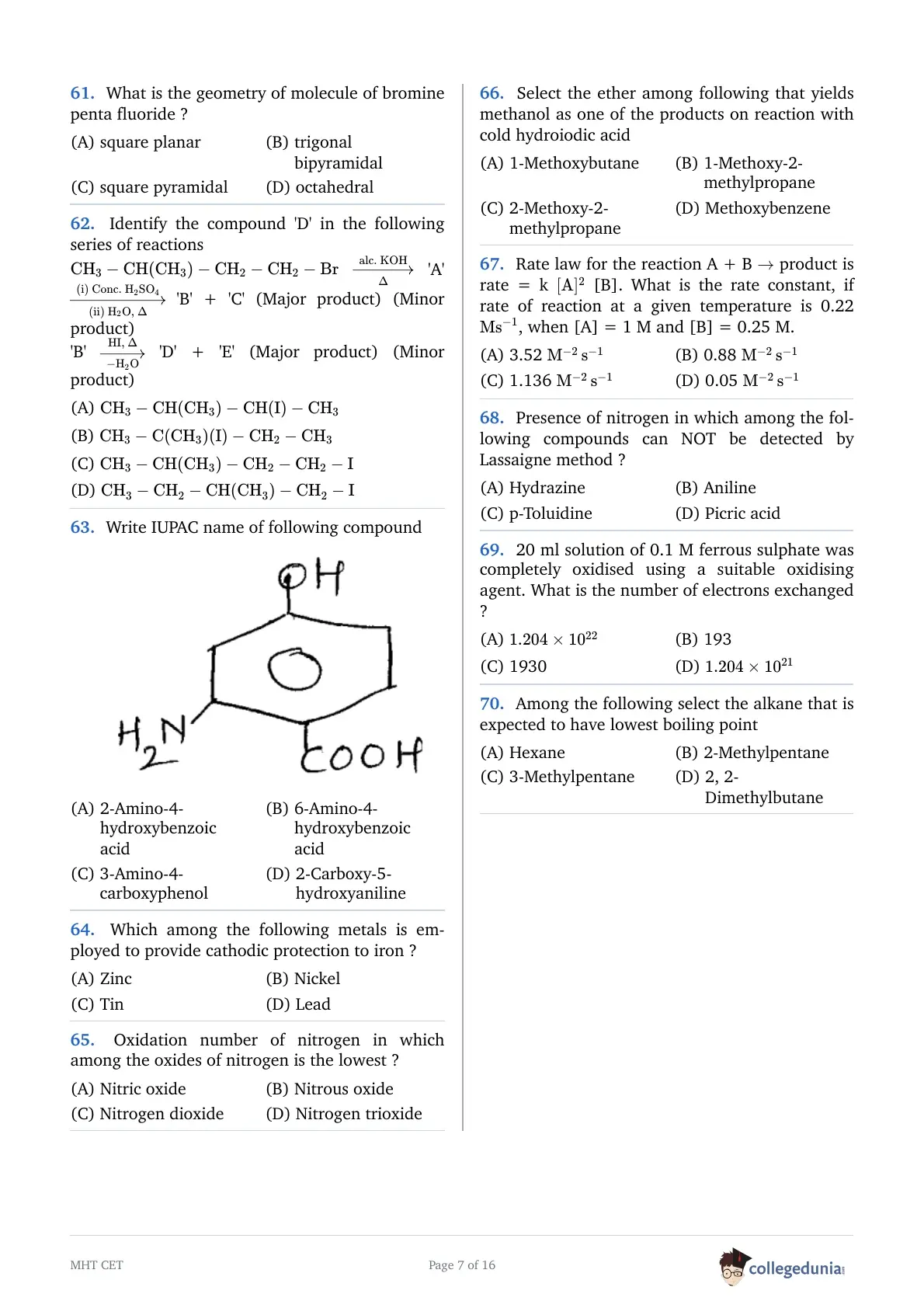
Question 63:

Write IUPAC name of following compound

  • (A) 2-Amino-4-hydroxybenzoic acid
  • (B) 6-Amino-4-hydroxybenzoic acid
  • (C) 3-Amino-4-carboxyphenol
  • (D) 2-Carboxy-5-hydroxyaniline

Question 64:

Which among the following metals is employed to provide cathodic protection to iron ?

  • (A) Zinc
  • (B) Nickel
  • (C) Tin
  • (D) Lead

Question 65:

Oxidation number of nitrogen in which among the oxides of nitrogen is the lowest ?

  • (A) Nitric oxide
  • (B) Nitrous oxide
  • (C) Nitrogen dioxide
  • (D) Nitrogen trioxide

Question 66:

Select the ether among following that yields methanol as one of the products on reaction with cold hydroiodic acid

  • (A) 1-Methoxybutane
  • (B) 1-Methoxy-2-methylpropane
  • (C) 2-Methoxy-2-methylpropane
  • (D) Methoxybenzene

Question 67:

Rate law for the reaction A + B \(\rightarrow\) product is rate = k \([\mathrm{A}]^2\) [B]. What is the rate constant, if rate of reaction at a given temperature is 0.22 \(\mathrm{Ms^{-1}}\), when [A] = 1 M and [B] = 0.25 M.

  • (A) 3.52 \(\mathrm{M^{-2}\,s^{-1}}\)
  • (B) 0.88 \(\mathrm{M^{-2}\,s^{-1}}\)
  • (C) 1.136 \(\mathrm{M^{-2}\,s^{-1}}\)
  • (D) 0.05 \(\mathrm{M^{-2}\,s^{-1}}\)

Question 68:

Presence of nitrogen in which among the following compounds can NOT be detected by Lassaigne method ?

  • (A) Hydrazine
  • (B) Aniline
  • (C) p-Toluidine
  • (D) Picric acid

Question 69:

20 ml solution of 0.1 M ferrous sulphate was completely oxidised using a suitable oxidising agent. What is the number of electrons exchanged ?

  • (A) \(1.204\times10^{22}\)
  • (B) 193
  • (C) 1930
  • (D) \(1.204\times10^{21}\)

Question 70:

Among the following select the alkane that is expected to have lowest boiling point

  • (A) Hexane
  • (B) 2-Methylpentane
  • (C) 3-Methylpentane
  • (D) 2, 2-Dimethylbutane

Question 72:

Which among the following gases can be liquified easily ?

  • (A) Chlorine
  • (B) Nitrogen
  • (C) Oxygen
  • (D) Hydrogen

Question 73:

What is the mass of one molecule of yellow phosphorus ? (Atomic mass, P = 30)

  • (A) \(1.993\times10^{-22}\) kg
  • (B) \(1.993\times10^{-19}\) mg
  • (C) \(4.983\times10^{-20}\) mg
  • (D) \(4.983\times10^{-23}\) kg

Question 74:

Ozone is present as a chief constituent in which region of the atmosphere ?

  • (A) Troposphere
  • (B) Stratosphere
  • (C) Mesosphere
  • (D) Thermosphere

Question 75:

The plot of square root of frequency of X-ray emitted against atomic number led to suggestion of which law/rule ?

  • (A) Periodic law
  • (B) Modern periodic law
  • (C) Hund's rule
  • (D) Newland's law

Question 76:

The compound that yields only ketonic compound/s on ozonolysis is

  • (A) But-2-ene
  • (B) Pent-2-ene
  • (C) 2, 3-Dimethylbut-2-ene
  • (D) 2-Methylbut-2-ene

Question 77:

Which among the following metals is refined by electrolytic method ?

  • (A) Aluminium
  • (B) Bismuth
  • (C) Tin
  • (D) Lead

Question 78:

The two monomers used in the preparation of dextron are

  • (A) 3-hydroxy butanoic acid and 3-hydroxy pentanoic acid
  • (B) \(\in\) amino caproic acid and glycine
  • (C) Isobutylene and isoprene
  • (D) Lactic acid and glycolic acid

Question 79:

Which oxyacid of sulphur contains S-S single bond ?

  • (A) Oleum
  • (B) Marshall's acid
  • (C) Dithionic acid
  • (D) Thiosulphuric acid

Question 80:

Amongst the followings, select the element having highest ionization enthalpy

  • (A) Sodium
  • (B) Potassium
  • (C) Beryllium
  • (D) Magnesium

Question 81:

Identify the alkene that is produced in the following series of reactions
2-Methylpentyl trimethylammonium iodide, \(\mathrm{CH_3CH_2CH_2CH(CH_3)CH_2N^+(CH_3)_3\,I^-}\) \(\xrightarrow[\text{moist}]{\mathrm{Ag_2O}}\) 'X' \(\xrightarrow{\Delta}\) Alkene + tert. amine + \(\mathrm{H_2O}\)

  • (A) A
  • (B) B
  • (C) C
  • (D) D

Question 82:

'X' is an optically active alkane having lowest molecular mass. Predict the structure of the major product obtained on monochlorination of 'X'

  • (A) \(\mathrm{CH_3-CH_2-CH_2-C(CH_3)(Cl)-CH_2-CH_3}\)
  • (B) \(\mathrm{CH_3-CH_2-CH_2-CH(CH_3)-CH(Cl)-CH_3}\)
  • (C) \(\mathrm{CH_3-CH_2-CH_2-CH(CH_3)-CH_2-CH_2-Cl}\)
  • (D) \(\mathrm{Cl-CH_2-CH_2-CH_2-CH(CH_3)-CH_2-CH_3}\)

Question 83:

Butylated hydroxy toluene is used in

  • (A) preventing oxidative rancidity of fats
  • (B) preserving food grains
  • (C) killing bacteria in living tissues
  • (D) reducing stress and anxiety

Question 84:

Deficiency of which vitamin causes degeneration of spinal cord ?

  • (A) E
  • (B) K
  • (C) \(\mathrm{B_{12}}\)
  • (D) A

Question 85:

Bond order of which among the following molecules is zero ?

  • (A) \(\mathrm{F_2}\)
  • (B) \(\mathrm{O_2}\)
  • (C) \(\mathrm{Be_2}\)
  • (D) \(\mathrm{Li_2}\)

Question 86:

Benzene can be conveniently converted into n-propyl benzene by

  • (A) Friedel - Craft alkylation with n-propyl chloride
  • (B) Friedel - Craft acylation with propionyl chloride followed by Wolff - Kishner reduction
  • (C) Friedel - Craft acylation with propionyl chloride followed by catalytic hydrogenation
  • (D) Friedel - Craft acylation with propionyl chloride followed by reduction with \(\mathrm{LiAlH_4}\)

Question 87:

Select the diamagnetic complex ion amongst the following complexes
(Atomic No. Fe = 26, Co = 27)

  • (A) \(\mathrm{K_3[Fe(CN)_6]}\)
  • (B) \(\mathrm{[Co(NH_3)_6]Cl_3}\)
  • (C) \(\mathrm{K_3[FeF_6]}\)
  • (D) \(\mathrm{K_3[CoF_6]}\)

Question 88:

One mole of stachyose on hydrolysis yields

  • (A) 1 mole of glucose + 1 mole of fructose + 2 mole of galactose
  • (B) 2 mole of glucose + 1 mole of fructose + 1 mole of galactose
  • (C) 1 mole of glucose + 2 mole of fructose + 1 mole of galactose
  • (D) 2 mole of glucose + 2 mole of fructose

Question 89:

An organic compound 'X' having molecular formula \(\mathrm{C_4H_{11}N}\) reacts with p-toluene sulphonyl chloride to form a compound 'Y' that is soluble in aqueous KOH. Compound 'X' is optically active and reacts with acetyl chloride to form compound 'Z'. Identify the compound 'Z'

  • (A) \(\mathrm{CH_3CH_2CH_2CH_2NHCOCH_3}\)
  • (B) \(\mathrm{CH_3CH_2CH(CH_3)NHCOCH_3}\)
  • (C) \(\mathrm{(CH_3)_2CHCH_2NHCOCH_3}\)
  • (D) \(\mathrm{(CH_3)_3C-NHCOCH_3}\)

Question 90:

If average velocity of a sample of gas molecules at 300 K is 5 \(\mathrm{cm\,s^{-1}}\), what is RMS velocity of same sample of gas molecules at the same temperature ? (Given, \(\alpha\) : u : v = 1 : 1.224 : 1.127)

  • (A) 6.112 cm/s
  • (B) 4.605 cm/s
  • (C) 4.085 cm/s
  • (D) 5.430 cm/s

Biology (Q91 - Q180)

Question 91:

Animals obtain all their carbon through

  • (A) plants
  • (B) soil
  • (C) air
  • (D) water

Question 92:

Which one of the following is NOT true about monocotyledonae ?

  • (A) embryo has single cotyledon
  • (B) leaves show parallel venation
  • (C) flowers are generally trimerous
  • (D) vascular bundles are conjoint, collateral and open

Question 93:

How many NAD molecules get reduced in complete oxidation of one glucose molecule ?

  • (A) 2
  • (B) 5
  • (C) 10
  • (D) 12

Question 94:

Which one of the following is used in the production of citric acid ?

  • (A) Aspergillus niger
  • (B) Rhizopus arrhizus
  • (C) Acetobacter aceti
  • (D) Saccharomyces cerevisiae

Question 95:

What will be the number of histone molecules in a chromatin fibre having 50 nucleosomes ?

  • (A) 400
  • (B) 450
  • (C) 500
  • (D) 1000

Question 96:

Which one of the following is the first group of vascular plants ?

  • (A) Thallophyta
  • (B) Bryophyta
  • (C) Pteridophyta
  • (D) Spermatophyta

Question 97:

An angiospermic male plant with 24 chromosomes in its pollen mother cells is crossed with female plant bearing 24 chromosomes in its root cells. What would be the ploidy of embryo and endosperm respectively formed after this cross ?

  • (A) 24 and 48
  • (B) 24 and 24
  • (C) 48 and 72
  • (D) 24 and 36

Question 98:

Which one of the following has bast fibres ?

  • (A) parenchyma
  • (B) sclerenchyma
  • (C) phloem
  • (D) xylem

Question 99:

In how many interlocking rings are the carbon atoms arranged in a steroid molecule ?

  • (A) 1
  • (B) 2
  • (C) 3
  • (D) 4

Question 100:

What are the spindle fibres that connect the centromere of chromosome to the respective poles called ?

  • (A) Astral rays
  • (B) Interpolar fibres
  • (C) Chromosomal fibres
  • (D) Inter chromosomal fibres

Question 101:

In plant breeding, the entire collection of plants/seeds having the diverse alleles of all genes in a particular organism is called

  • (A) gene bank
  • (B) cDNA library
  • (C) genomic library
  • (D) germ plasm

Question 102:

Acetylation of Pyruvate takes place in the _________

  • (A) perimitochondrial space
  • (B) mitochondrial matrix
  • (C) cristae
  • (D) \(\mathrm{F_1}\) particles

Question 103:

Cross pollination does not occur in

  • (A) allogamous flowers
  • (B) geitonogamous flowers
  • (C) cleistogamous flowers
  • (D) chasmogamous flowers

Question 104:

Which one of the following is a dicot weedicide ?

  • (A) 2, 4-D
  • (B) NAA
  • (C) IBA
  • (D) IAA

Question 105:

Senescence in plants leads into ___________ of cells.

  • (A) increase in size
  • (B) increase in number
  • (C) death
  • (D) differentiation

Question 106:

In Albizzia, vegetative propagation takes place with the help of

  • (A) fasciculated tuberous roots
  • (B) epiphyllous buds
  • (C) subaerial branches
  • (D) nonfleshy roots

Question 107:

Which of the following cross will give recessive progeny in \(\mathrm{F_1}\) generation ?

  • (A) TT \(\times\) tt
  • (B) Tt \(\times\) TT
  • (C) tt \(\times\) tt
  • (D) TT \(\times\) TT

Question 108:

Select the correct statements from the following :
I. Endosperm is generally triploid in angiosperms.
II. All angiosperms have monosporic and endosporic embryo sac.
III. Angiosperms are characterised by double-fertilization.
IV. All angiosperms show-indirect pollination and siphonogamy.

  • (A) I, II and III
  • (B) II, III and IV
  • (C) I, II and IV
  • (D) I, II, III and IV

Question 109:

The structure producing basidium in Basidiomycetes is formed by the fusion of

  • (A) two vegetative cells
  • (B) two male gametes
  • (C) two female gametes
  • (D) male and female gametes

Question 110:

The sequence of nucleotides AUGCUUCUC indicates that it is a segment of

  • (A) sense strand of DNA
  • (B) anti sense strand of DNA
  • (C) RNA
  • (D) polypeptide chain

Question 111:

The largest collection of herbarium in India is

  • (A) Central National Herbarium, Kolkata
  • (B) Southern Circle Herbarium, Coimbatore
  • (C) Central Circle Herbarium, Allahabad
  • (D) Blatter Herbarium, Mumbai

Question 112:

Enzyme enolase catalyses the conversion of 2 PGA to phosphoenol Pyruvic acid in presence of __________ which is the cofactor.

  • (A) \(\mathrm{Mn^{++}}\)
  • (B) \(\mathrm{Fe^{++}}\)
  • (C) \(\mathrm{Mg^{++}}\)
  • (D) \(\mathrm{Zn^{++}}\)

Question 113:

Excess of Manganese inhibits the translocation of _________ to the shoot apex.

  • (A) Calcium
  • (B) Potassium
  • (C) Iron
  • (D) Magnesium

Question 114:

The correct sequence of the substages of Prophase I is

  • (A) Diakinesis \(\rightarrow\) Pachytene \(\rightarrow\) Diplotene \(\rightarrow\) Zygotene \(\rightarrow\) Leptotene
  • (B) Leptotene \(\rightarrow\) Zygotene \(\rightarrow\) Pachytene \(\rightarrow\) Diplotene \(\rightarrow\) Diakinesis
  • (C) Pachytene \(\rightarrow\) Zygotene \(\rightarrow\) Leptotene \(\rightarrow\) Diplotene \(\rightarrow\) Diakinesis
  • (D) Leptotene \(\rightarrow\) Zygotene \(\rightarrow\) Diplotene \(\rightarrow\) Diakinesis \(\rightarrow\) Pachytene

Question 115:

Capsule is a kind of _________ fruit.

  • (A) simple, dry and dehiscent
  • (B) simple, dry and indehiscent
  • (C) an aggregate
  • (D) simple and fleshy

Question 116:

The inactive protoxin is activated in the gut of the insect by

  • (A) acidic pH
  • (B) alkaline pH
  • (C) low temperature
  • (D) high temperature

Question 117:

In angiosperms, the formation of two male gametes from a pollen grain involves _________ divisions.

  • (A) one meiotic and one mitotic
  • (B) two meiotic and two mitotic
  • (C) only two mitotic
  • (D) only two meiotic

Question 118:

In a plant cell the Diffusion Pressure Deficit is zero when it is_________

  • (A) plasmolysed
  • (B) turgid
  • (C) flaccid
  • (D) incipient

Question 119:

The life cycle of algae such as Spirogyra is

  • (A) haplontic
  • (B) diplontic
  • (C) haplo-diplontic
  • (D) diplo-haplontic

Question 120:

During which stage of Prophase I, genetic recombination of parental characters, takes place ?

  • (A) Zygotene
  • (B) Pachytene
  • (C) Diplotene
  • (D) Diakinesis

Question 121:

Multicostate divergent reticulate venation is seen in _________ leaf.

  • (A) Zizyphus
  • (B) Bamboo
  • (C) Castor
  • (D) Mango

Question 122:

Synthesis of one glucose molecule requires ________ reduced NADP molecules.

  • (A) 6
  • (B) 12
  • (C) 18
  • (D) 24

Question 123:

The arrangement of vascular tissue in hadrocentric vascular bundle is_________

  • (A) concentric
  • (B) radial
  • (C) collateral
  • (D) bicollateral

Question 124:

‘Cry’ gene is obtained from

  • (A) Agrobacterium tumefaciens
  • (B) Bacillus thuringiensis
  • (C) Rhizobium leguminosarum
  • (D) Rhizobium phaseoli

Question 125:

Identify the incorrect match between the protein and its role.

  • (A) Keratin – structural component of hair
  • (B) Immunoglobulins – protection of body against diseases
  • (C) Haemoglobin – transport of \(\mathrm{O_2}\) in muscles
  • (D) Thrombin – blood clotting

Question 126:

In India, research in genetic modification of organisms and safety issues are controlled by

  • (A) DBT
  • (B) IARI
  • (C) CSIR
  • (D) GEAC

Question 127:

Guttation occurs through__________

  • (A) roots
  • (B) hydathode
  • (C) trichome
  • (D) stomata

Question 128:

A couple, both carriers for the gene sickle cell anaemia planning to get married, wants to know the chances of having anaemic progeny ?

  • (A) 100%
  • (B) 75%
  • (C) 50%
  • (D) 25%

Question 129:

A simple, living permanent tissue which is absent in roots is________

  • (A) Collenchyma
  • (B) Chlorenchyma
  • (C) Aerenchyma
  • (D) Parenchyma

Question 130:

Which of the following show dimorphic chloroplast ?

  • (A) Mango
  • (B) Castor
  • (C) Banyan
  • (D) Amaranthus

Question 131:

Gross primary productivity is the rate of production of ________ during photosynthesis.

  • (A) organic matter
  • (B) oxygen
  • (C) carbon di-oxide
  • (D) Chlorophyll

Question 132:

Flowers showing basipetal succession are observed in

  • (A) Caesalpinia and Clerodendron
  • (B) Jasmine and Gold mohar
  • (C) Gold mohar and Caesalpinia
  • (D) Clerodendron and Jasmine

Question 133:

The total number of types of gametes produced in a cross between a negro and albino parent is

  • (A) 64
  • (B) 16
  • (C) 08
  • (D) 04

Question 134:

Enzymes required for phosphorylation are located in ________ of chloroplast.

  • (A) Peristromium
  • (B) Plastidome
  • (C) Stroma
  • (D) Quantosome

Question 135:

Afforestation is

  • (A) restoring a forest
  • (B) plantation in barren lands
  • (C) cultivation under agriculture
  • (D) jhum cultivation

Question 136:

Cellular organization of body is present in

  • (A) Annelida
  • (B) Platyhelminthes
  • (C) Porifera
  • (D) Urochordata

Question 137:

In the following process of digestion, the enzymes at location 'X' and 'Y' are respectively
proteins \(\xrightarrow{X}\) proteoses and peptones \(\xrightarrow{Y}\) Dipeptides

  • (A) Chymotrypsin and pepsin
  • (B) Pepsin and trypsin
  • (C) Ptyalin and pepsin
  • (D) Trypsin and di-peptidase

Question 138:

Find out the correct match from the following table :
Column I | Column II | Column III
i. Corpus luteum | Progesteron | Degeneration of endometrium
ii. Pineal gland | Vasopressin | Intracellular transport
iii. Pars nervosa | Coherin | Induces contraction of jejunum

  • (A) i only
  • (B) i and ii
  • (C) iii only
  • (D) ii and iii

Question 139:

The colostrum provides_________

  • (A) Naturally acquired active immunity
  • (B) Naturally acquired passive immunity
  • (C) Artificially acquired active immunity
  • (D) Artificially acquired passive immunity

Question 140:

Identify and select the correct Match in the Columns I, II and III.
I | II | III

  • (A) Earthworm - Annelida - Superclass
  • (B) Frog - Rana - Species
  • (C) Lancelet - Vertebrata - Division
  • (D) Walrus - Mammalia - Class

Question 141:

The structural unit of bone is__________

  • (A) chondrin
  • (B) cyton
  • (C) osteon
  • (D) ossein

Question 142:

The stato-acoustic receptor responds to changes in the_________

  • (A) Light and pressure
  • (B) Pressure and touch
  • (C) Pain and pressure
  • (D) Sound and equilibrium

Question 143:

The chromosome with centromere near the end is called__________

  • (A) Acrocentric
  • (B) Metacentric
  • (C) Sub-metacentric
  • (D) Telocentric

Question 144:

One of the following is NOT a possible reason for use of CNG in automobiles

  • (A) It can be adulterated
  • (B) It is cheaper than petrol
  • (C) It burns more efficiently
  • (D) It reduces pollution

Question 145:

Oviparous mammal is_________

  • (A) Equus
  • (B) Macropus
  • (C) Ornithorhynchus
  • (D) Pteropus

Question 146:

The salivary amylase shows maximum digestive action at pH___________

  • (A) 3.6
  • (B) 6.8
  • (C) 7.5
  • (D) 8.5

Question 147:

The central hollow portion of the vertebra is called___________

  • (A) Neural canal
  • (B) Central canal
  • (C) Auditory canal
  • (D) Vertebro-arterial canal

Question 148:

The depolarization of nerve membrane takes place through influx of _________ ions.

  • (A) Calcium
  • (B) Potassium
  • (C) Sodium
  • (D) Magnesium

Question 149:

Which of the following is used to promote growth of new blood vessels, thus helping in wound healing ?

  • (A) HUMULIN
  • (B) TPA
  • (C) TGF – B
  • (D) \(\alpha\) – 1 antitrypsin

Question 150:

Select the correct statement regarding the Schwann cells

  • (A) Surround axon of myelinated nerve fibre
  • (B) Support muscle fibres
  • (C) Found in Haversian system of bones
  • (D) Form basement membrane of epithelium

Question 151:

The correct match is
I. DCT – Secretion of H\(^+\) and K\(^+\) ions
II. Henle's loop – Reabsorption of glucose, water and Na\(^+\) ions
III. Podocytes – Attached to parietal layer of Bowman's capsule
IV. JGA – Rise in glomerular blood pressure activates it to release rennin

  • (A) III
  • (B) II
  • (C) I
  • (D) IV

Question 152:

The diurnal rhythms are regulated by__________

  • (A) Adrenalin
  • (B) Melatonin
  • (C) Serotonin
  • (D) Vasopressin

Question 153:

In DNA fingerprinting technique, __________ probe is used for hybridization of DNA fragments.

  • (A) Double stranded RNA
  • (B) Double stranded non-radio active DNA
  • (C) Single stranded radio active DNA
  • (D) Single stranded radio active RNA

Question 154:

Find the Odd one out :

  • (A) Adamsia
  • (B) Astraea
  • (C) Physalia
  • (D) Pleurobrachia

Question 155:

The totipotent cell can form a _____________

  • (A) Bud
  • (B) Cell membrane
  • (C) Cell organelle
  • (D) Complete new organism

Question 156:

The nodal tissue located in the lower left corner of the right atrium is _____________

  • (A) SA node
  • (B) AV node
  • (C) AV bundle
  • (D) Purkinje fibres

Question 157:

Which of the following hormones initiate the parturition ?

  • (A) ACTH, HCG, Oxytocin
  • (B) ACTH, Corticosteroid, Oxytocin
  • (C) Corticosteroid, ACTH, Prostaglandin
  • (D) ACTH, Progesteron, HCG

Question 158:

The primary lymphoid organ is________

  • (A) Tonsils
  • (B) Payer's patches
  • (C) Lymph nodes
  • (D) Thymus

Question 159:

Synapse is_______________

  • (A) Crossing over between non-homologous chromosomes
  • (B) Pairing of homologous chromosomes
  • (C) Junction between axon and dendrites of two different neurons
  • (D) Zig zag junctions in cardiac muscle fibres

Question 160:

Which of the following animal has enucleated erythrocytes ?

  • (A) Earthworm
  • (B) Sepia
  • (C) Frog
  • (D) Rat

Question 161:

Which of the following produces erythropoietin ?

  • (A) Kidney
  • (B) Pancreas
  • (C) Pineal gland
  • (D) Thyroid gland

Question 162:

Identify the correct match from the Columns I, II and III.
I: 1. Interstitial cells, 2. Sertoli cells, 3. Granulosa cells, 4. Cells of corpus luteum
II: a. Cortex of ovary, b. Ovarian follicle, c. Testis, d. Seminiferous tubules
III: i. Follicular fluid, ii. Progesterone, iii. Attachment of sperm bundle, iv. Testosterone

  • (A) 2-a-iii, 1-c-iv, 3-b-i, 4-d-ii
  • (B) 1-c-iv, 2-d-iii, 3-b-i, 4-a-ii
  • (C) 1-d-i, 2-a-iv, 3-b-i, 4-c-ii
  • (D) 2-d-iii, 1-c-iv, 3-a-ii, 4-b-iv

Question 163:

Which of the following is correct match ?
I | II | III

  • (A) Thalassemia - a) XO - i) Flat nose, simian crease
  • (B) Down's syndrome - b) 42 AA + XY - ii) Webbing of neck
  • (C) Turner's syndrome - c) 44 AA + XXX - iii) Anaemia, jaundice
  • (D) Klinefelter's syndrome - d) 44 AA + XXY - iv) Tall thin eunuchoid

Question 164:

Which is CORRECT regarding genetically engineered insulin using E. coli ?

  • (A) Difficult to purify
  • (B) Obtained in large unlimited quantities
  • (C) Possibility of transmission of animal diseases
  • (D) Insulin obtained varies in chemical structure

Question 165:

Dobson unit is used in measurement of _________ level.

  • (A) Chlorofluoro carbons
  • (B) Nitrous oxide
  • (C) Ozone
  • (D) UV – B radiation

Question 166:

In cockroach, the common duct of salivary reservoir opens at the base of the ________

  • (A) Pharynx
  • (B) Maxilla
  • (C) Mandible
  • (D) Hypopharynx

Question 167:

The wall of urinary bladder in humans shows a thick layer of smooth muscle called_____

  • (A) Dartos
  • (B) Detrusor
  • (C) Deltoid
  • (D) Depressor

Question 168:

Identify the correct match :
Accessory glands: i. Seminal vesicles, ii. Prostate gland, iii. Cowper's gland
Functions: a. Lubricates vagina, b. Provide energy, coagulation of sperm, c. Neutralizes acidity of vagina

  • (A) i-b, ii-c, iii-a
  • (B) i-c, ii-b, iii-a
  • (C) i-a, ii-c, iii-b
  • (D) i-c, ii-a, iii-b

Question 169:

The technique used to block the passage of sperm in male________

  • (A) Tubectomy
  • (B) Vasectomy
  • (C) Coitus interruptus
  • (D) Rhythm method

Question 170:

Find the incorrect match :
I | II | III
i. Crab | Sacculina | Interaction + +
ii. Human being | Mosquito | Interaction – +
iii. Sea anemone | Hermit crab | Interaction + 0

  • (A) i only
  • (B) ii and iii
  • (C) iii and i
  • (D) ii only

Question 171:

The structure which prevents the entry of food particles into the respiratory passage is ____

  • (A) Epiglottis
  • (B) Glottis
  • (C) Larynx
  • (D) Pharynx

Question 172:

Identify vertebrochondral ribs from the following :

  • (A) All 12 pairs of ribs
  • (B) 1\(^{st}\) to 7\(^{th}\) pairs of ribs
  • (C) 8\(^{th}\), 9\(^{th}\) and 10\(^{th}\) pairs of ribs
  • (D) 11\(^{th}\) and 12\(^{th}\) pairs of ribs

Question 173:

“Testis are extraabdominal in position”. Which of the following is most appropriate reason ?

  • (A) Narrow pelvis in male
  • (B) Special protection for testis
  • (C) Prostate gland and seminal vesicles occupy maximum space
  • (D) 2.0 – 2.5° C lower than the normal body temperature

Question 174:

The Malignant malaria is caused by __________

  • (A) Plasmodium vivax
  • (B) Plasmodium malariae
  • (C) Plasmodium ovale
  • (D) Plasmodium falciparum

Question 175:

The total number of podomeres in each leg of cockroach is_________

  • (A) 5
  • (B) 6
  • (C) 7
  • (D) 8

Question 176:

Which of the following store proteins ?

  • (A) Chromoplasts
  • (B) Aleuroplasts
  • (C) Amyloplasts
  • (D) Elaioplasts

Question 177:

Pneumotaxic centre is located in_______

  • (A) Medulla oblongata
  • (B) Pons
  • (C) Cerebrum
  • (D) Diencephalon

Question 178:

In case of a couple where a man is having very low sperm count, which of the following technique will be suitable for fertilization ?

  • (A) Infra uterine transfer
  • (B) Gamete intra cytoplasmic fallopian transfer
  • (C) Artificial insemination
  • (D) Intra cytoplasmic sperm injection

Question 179:

The rise of 1\(^{st}\) primates occurred in _________ epoch.

  • (A) Palaeocene
  • (B) Oligocene
  • (C) Miocene
  • (D) Eocene

Question 180:

Which of the following statements correctly correlates with the diagrams ?

  • (A) a and b are steady population
  • (B) a and d are declining population
  • (C) c and d are growing population
  • (D) b and d are declining population