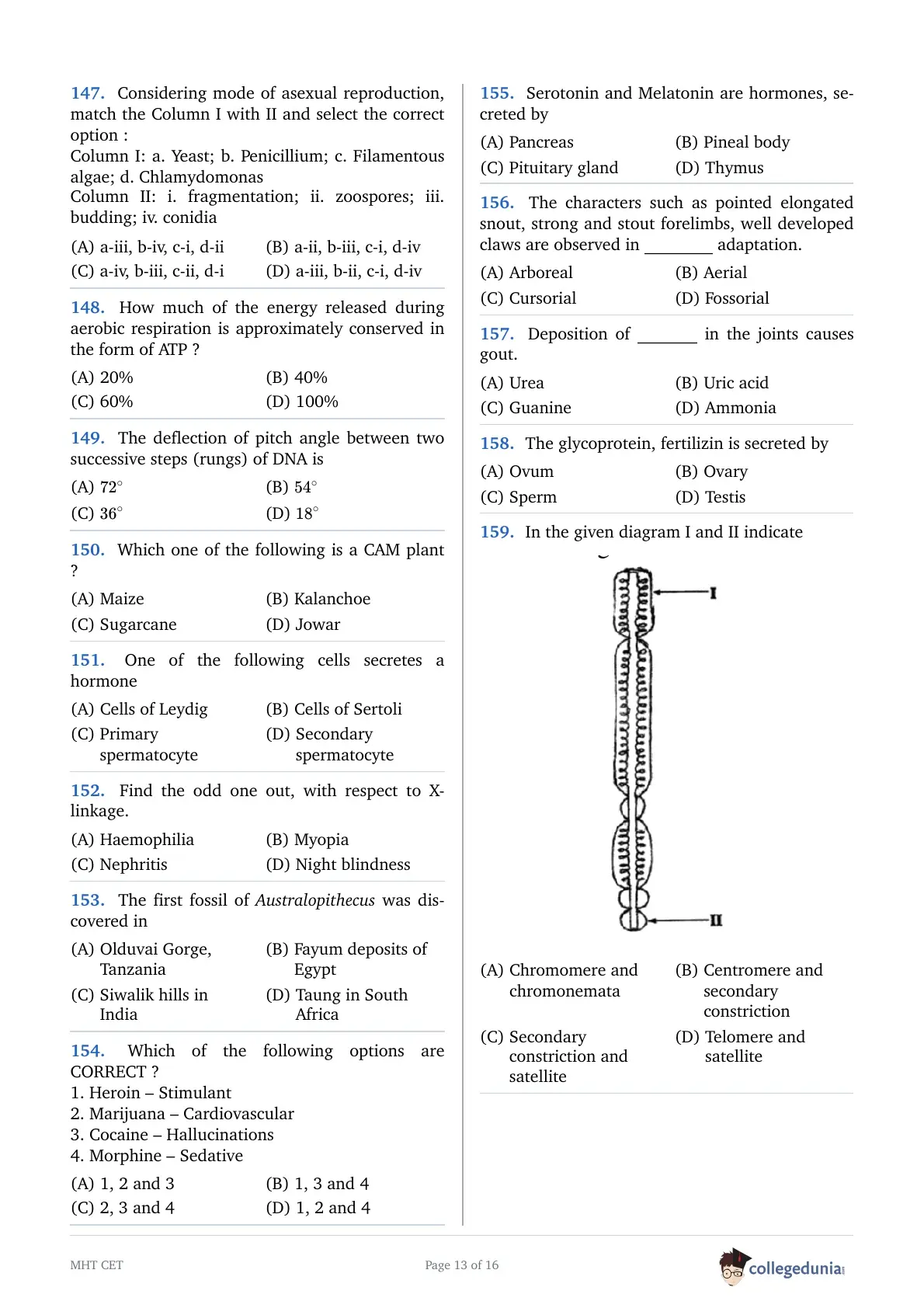
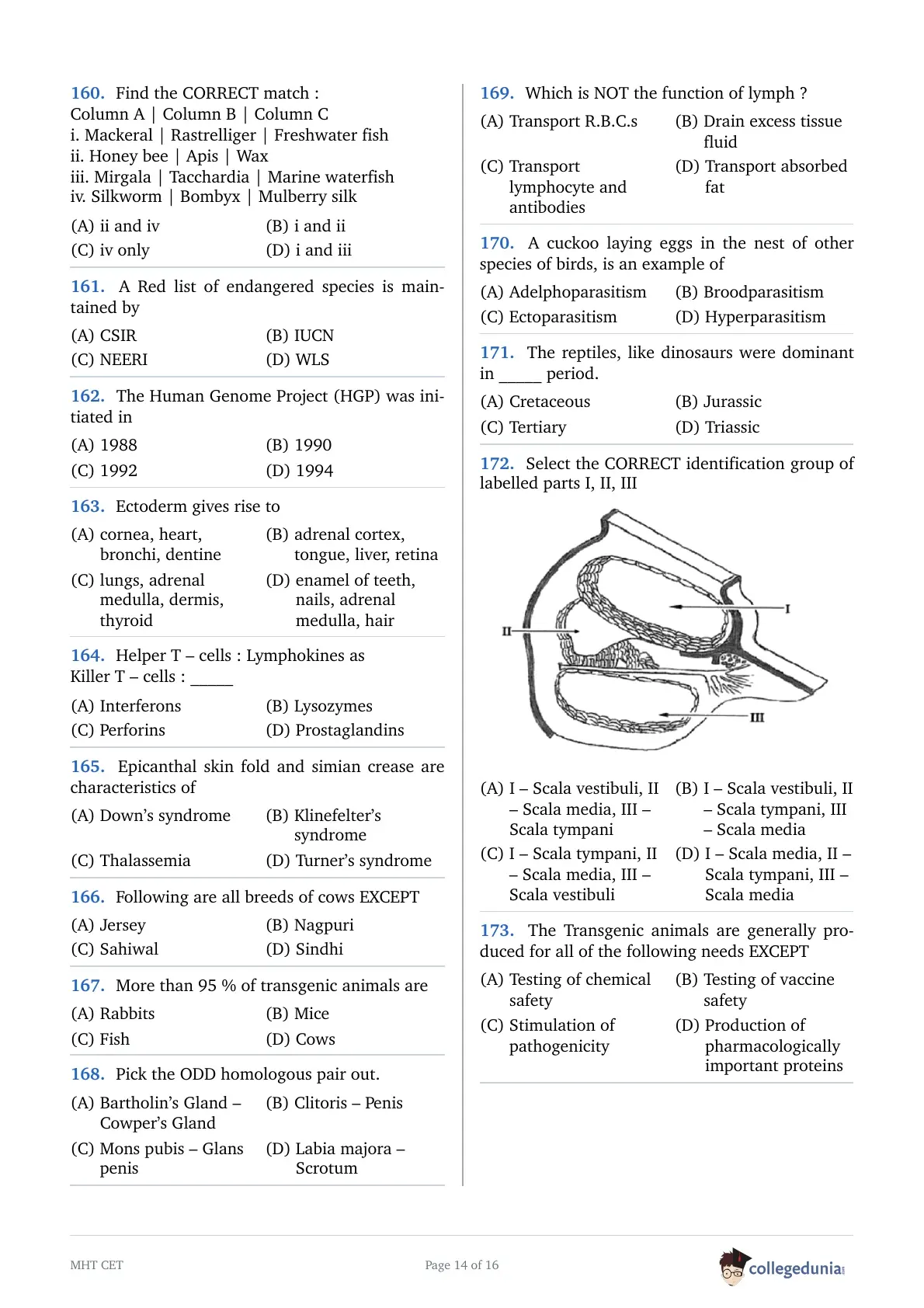
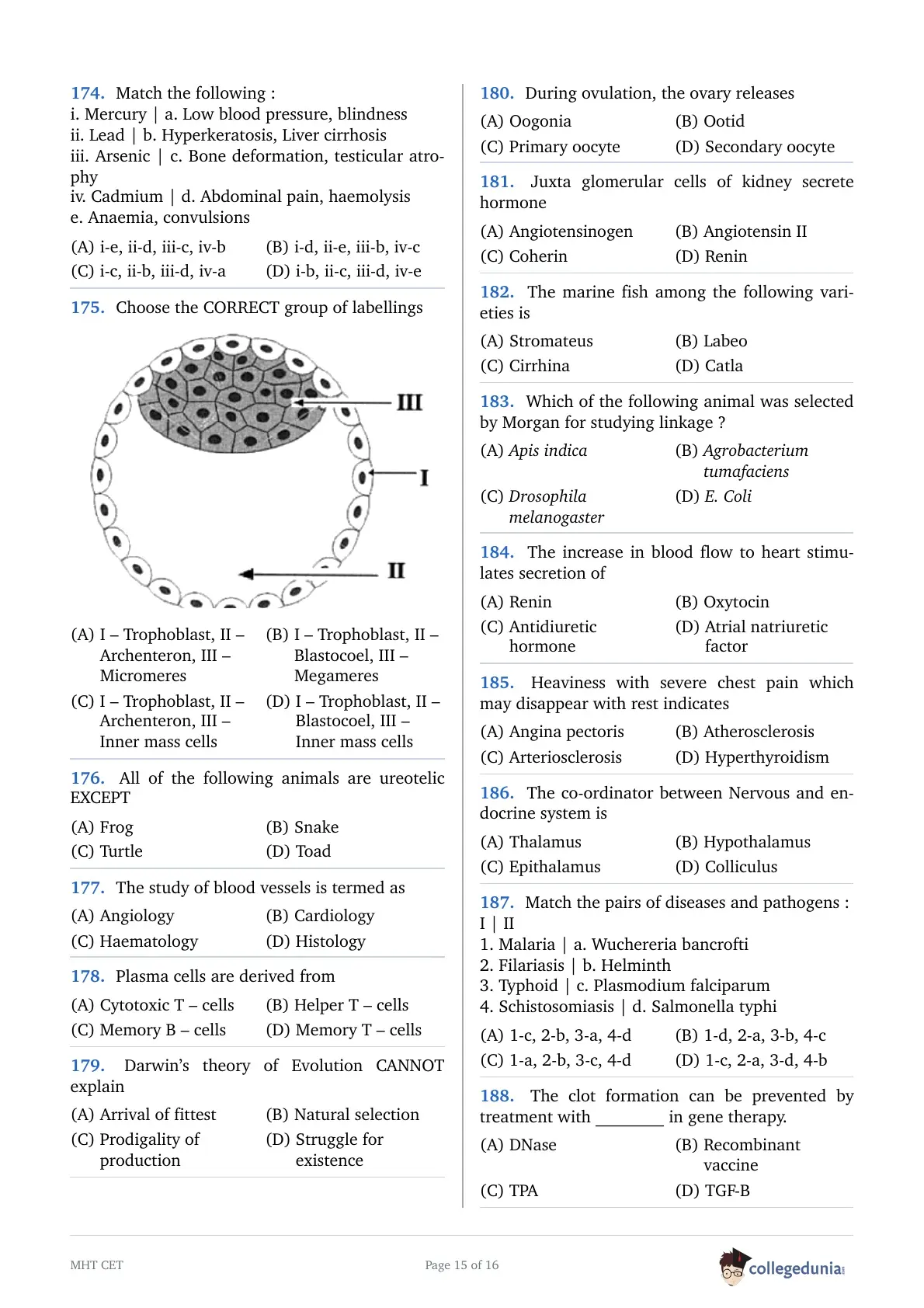
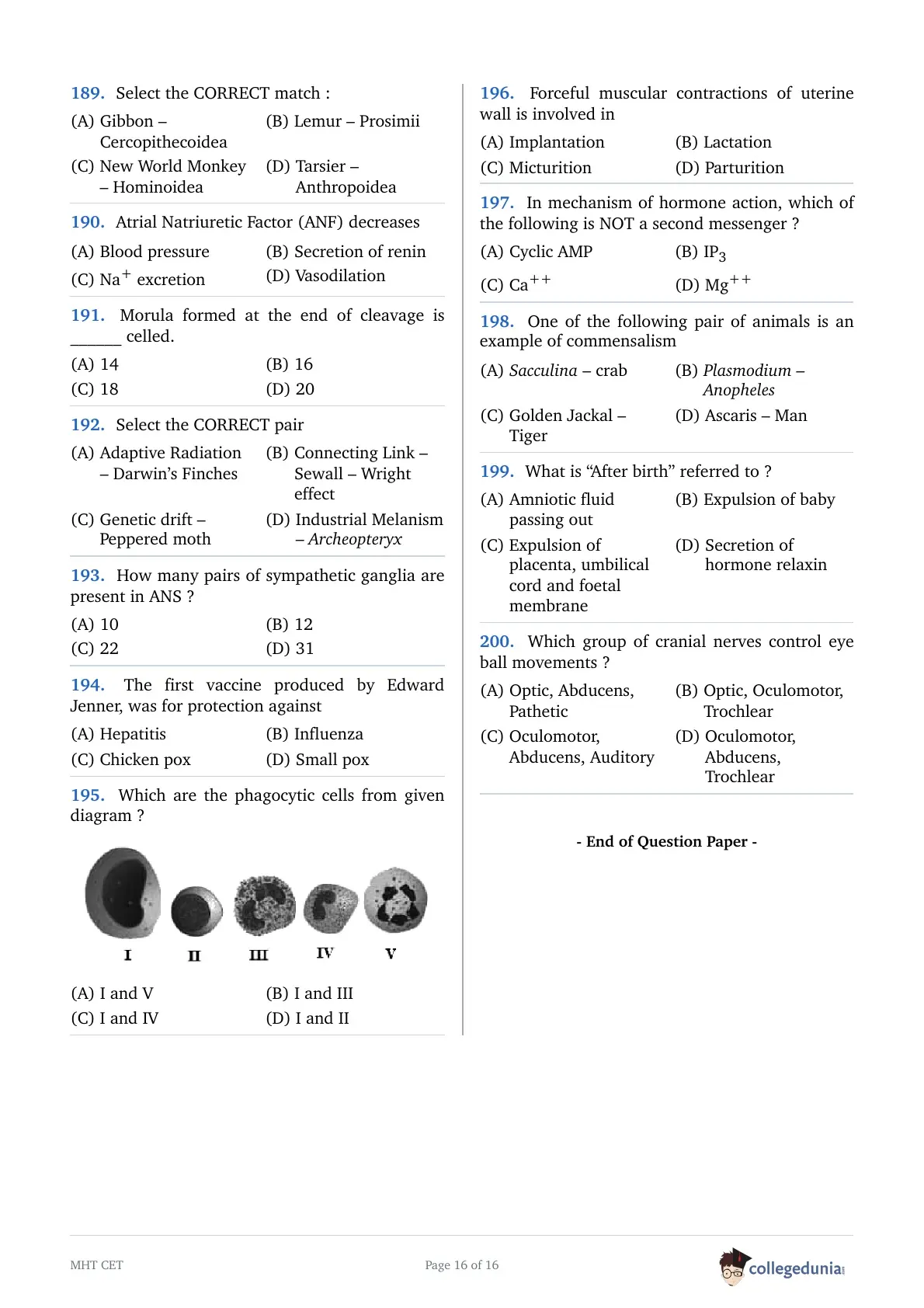
MHT CET 2015 PCB (Code 11) Question Paper is available for download here. Maharashtra State CET Cell conducted MHT CET 2015 on 7 May 2015.

The MHT CET 2015 PCB (Code 11) Question Paper includes the following:

  • The MHT CET 2015 PCB paper consists of 200 multiple-choice questions (MCQs) totalling 200 marks: Physics (50 questions), Chemistry (50 questions) and Biology (100 questions).
  • The time allowed is 180 minutes.

MHT CET 2015 PCB (Code 11) Question Paper with Solution PDF

CD PDF CD PDF with Solutions
Download Collegedunia PDF 1.10 MB -

Also Check:

MHT CET 2015 PCB (Code 11) Questions with Solutions


Physics (Q1 - Q50)

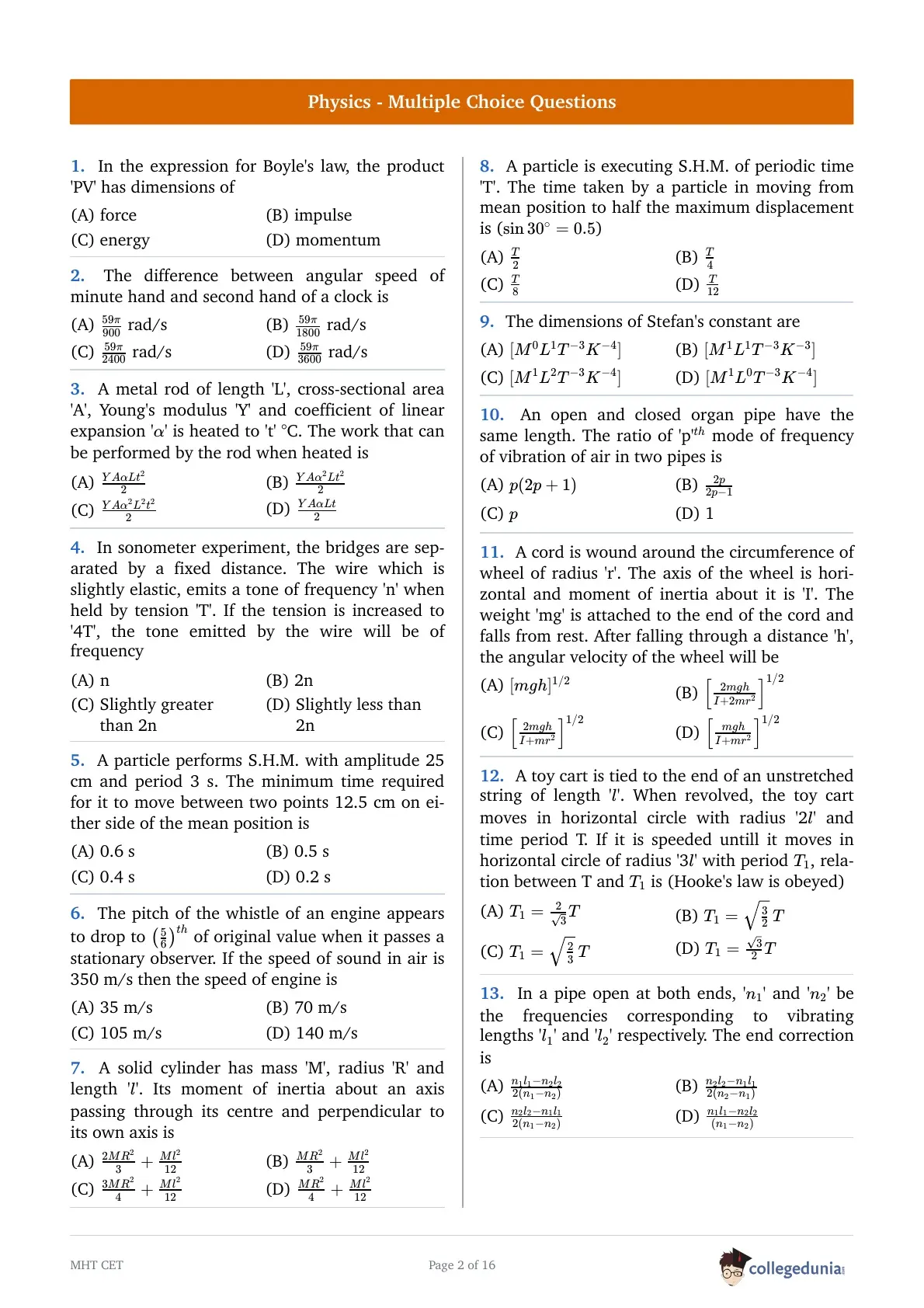
Question 1:

In the expression for Boyle's law, the product 'PV' has dimensions of

  • (A) force
  • (B) impulse
  • (C) energy
  • (D) momentum

Question 2:

The difference between angular speed of minute hand and second hand of a clock is

  • (A) \(\frac{59\pi}{900}\) rad/s
  • (B) \(\frac{59\pi}{1800}\) rad/s
  • (C) \(\frac{59\pi}{2400}\) rad/s
  • (D) \(\frac{59\pi}{3600}\) rad/s

Question 3:

A metal rod of length 'L', cross-sectional area 'A', Young's modulus 'Y' and coefficient of linear expansion '\(\alpha\)' is heated to 't' °C. The work that can be performed by the rod when heated is

  • (A) \(\frac{YA\alpha Lt^{2}}{2}\)
  • (B) \(\frac{YA\alpha^{2}Lt^{2}}{2}\)
  • (C) \(\frac{YA\alpha^{2}L^{2}t^{2}}{2}\)
  • (D) \(\frac{YA\alpha Lt}{2}\)

Question 4:

In sonometer experiment, the bridges are separated by a fixed distance. The wire which is slightly elastic, emits a tone of frequency 'n' when held by tension 'T'. If the tension is increased to '4T', the tone emitted by the wire will be of frequency

  • (A) n
  • (B) 2n
  • (C) Slightly greater than 2n
  • (D) Slightly less than 2n

Question 5:

A particle performs S.H.M. with amplitude 25 cm and period 3 s. The minimum time required for it to move between two points 12.5 cm on either side of the mean position is

  • (A) 0.6 s
  • (B) 0.5 s
  • (C) 0.4 s
  • (D) 0.2 s

Question 6:

The pitch of the whistle of an engine appears to drop to \(\left(\frac{5}{6}\right)^{th}\) of original value when it passes a stationary observer. If the speed of sound in air is 350 m/s then the speed of engine is

  • (A) 35 m/s
  • (B) 70 m/s
  • (C) 105 m/s
  • (D) 140 m/s

Question 7:

A solid cylinder has mass 'M', radius 'R' and length '\(l\)'. Its moment of inertia about an axis passing through its centre and perpendicular to its own axis is

  • (A) \(\frac{2MR^{2}}{3}+\frac{Ml^{2}}{12}\)
  • (B) \(\frac{MR^{2}}{3}+\frac{Ml^{2}}{12}\)
  • (C) \(\frac{3MR^{2}}{4}+\frac{Ml^{2}}{12}\)
  • (D) \(\frac{MR^{2}}{4}+\frac{Ml^{2}}{12}\)

Question 8:

A particle is executing S.H.M. of periodic time 'T'. The time taken by a particle in moving from mean position to half the maximum displacement is (\(\sin 30^{\circ}=0.5\))

  • (A) \(\frac{T}{2}\)
  • (B) \(\frac{T}{4}\)
  • (C) \(\frac{T}{8}\)
  • (D) \(\frac{T}{12}\)

Question 9:

The dimensions of Stefan?? constant are

  • (A) \([M^0 \,L^1\, T^{-3} \,K^{-4}]\)
  • (B) \([M\, L^1\, T^{-3}\, K^{-3}]\)
  • (C) \([M\, L^2\, T^{-3}\, K^{-4}]\)
  • (D) \([M \,L^0\, T^{-3} \,K^{-4}]\)

Question 10:

An open and closed organ pipe have the same length. The ratio of 'p'\(^{th}\) mode of frequency of vibration of air in two pipes is

  • (A) \(p(2p+1)\)
  • (B) \(\frac{2p}{2p-1}\)
  • (C) \(p\)
  • (D) 1

Question 11:

A cord is wound around the circumference of wheel of radius 'r'. The axis of the wheel is horizontal and moment of inertia about it is 'I'. The weight 'mg' is attached to the end of the cord and falls from rest. After falling through a distance 'h', the angular velocity of the wheel will be

  • (A) \([mgh]^{1/2}\)
  • (B) \(\left[\frac{2mgh}{I+2mr^{2}}\right]^{1/2}\)
  • (C) \(\left[\frac{2mgh}{I+mr^{2}}\right]^{1/2}\)
  • (D) \(\left[\frac{mgh}{I+mr^{2}}\right]^{1/2}\)

Question 12:

A toy cart is tied to the end of an unstretched string of length '\(l\)'. When revolved, the toy cart moves in horizontal circle with radius '2\(l\)' and time period T. If it is speeded untill it moves in horizontal circle of radius '3\(l\)' with period \(T_1\), relation between T and \(T_1\) is (Hooke's law is obeyed)

  • (A) \(T_1=\frac{2}{\sqrt{3}}T\)
  • (B) \(T_1=\sqrt{\frac{3}{2}}\,T\)
  • (C) \(T_1=\sqrt{\frac{2}{3}}\,T\)
  • (D) \(T_1=\frac{\sqrt{3}}{2}T\)

Question 13:

In a pipe open at both ends, '\(n_1\)' and '\(n_2\)' be the frequencies corresponding to vibrating lengths '\(l_1\)' and '\(l_2\)' respectively. The end correction is

  • (A) \(\frac{n_1l_1-n_2l_2}{2(n_1-n_2)}\)
  • (B) \(\frac{n_2l_2-n_1l_1}{2(n_2-n_1)}\)
  • (C) \(\frac{n_2l_2-n_1l_1}{2(n_1-n_2)}\)
  • (D) \(\frac{n_1l_1-n_2l_2}{(n_1-n_2)}\)

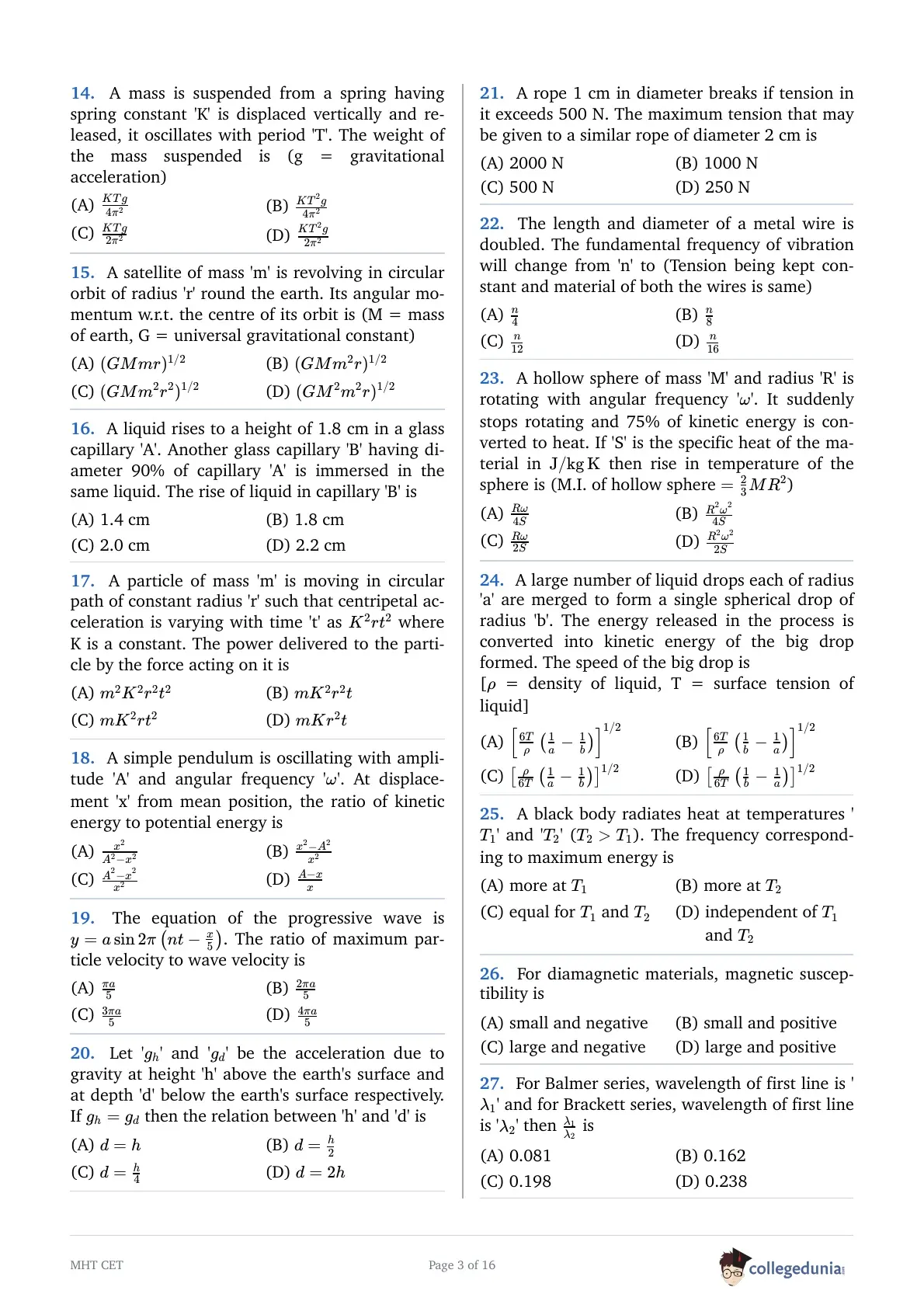
Question 14:

A mass is suspended from a spring having spring constant 'K' is displaced vertically and released, it oscillates with period 'T'. The weight of the mass suspended is (g = gravitational acceleration)

  • (A) \(\frac{KTg}{4\pi^{2}}\)
  • (B) \(\frac{KT^{2}g}{4\pi^{2}}\)
  • (C) \(\frac{KTg}{2\pi^{2}}\)
  • (D) \(\frac{KT^{2}g}{2\pi^{2}}\)

Question 15:

A satellite of mass 'm' is revolving in circular orbit of radius 'r' round the earth. Its angular momentum w.r.t. the centre of its orbit is (M = mass of earth, G = universal gravitational constant)

  • (A) \((GMmr)^{1/2}\)
  • (B) \((GMm^{2}r)^{1/2}\)
  • (C) \((GMm^{2}r^{2})^{1/2}\)
  • (D) \((GM^{2}m^{2}r)^{1/2}\)

Question 16:

A liquid rises to a height of 1.8 cm in a glass capillary 'A'. Another glass capillary 'B' having diameter 90% of capillary 'A' is immersed in the same liquid. The rise of liquid in capillary 'B' is

  • (A) 1.4 cm
  • (B) 1.8 cm
  • (C) 2.0 cm
  • (D) 2.2 cm

Question 17:

A particle of mass 'm' is moving in circular path of constant radius 'r' such that centripetal acceleration is varying with time 't' as \(K^{2}rt^{2}\) where K is a constant. The power delivered to the particle by the force acting on it is

  • (A) \(m^{2}K^{2}r^{2}t^{2}\)
  • (B) \(mK^{2}r^{2}t\)
  • (C) \(mK^{2}rt^{2}\)
  • (D) \(mKr^{2}t\)

Question 18:

A simple pendulum is oscillating with amplitude 'A' and angular frequency '\(\omega\)'. At displacement 'x' from mean position, the ratio of kinetic energy to potential energy is

  • (A) \(\frac{x^{2}}{A^{2}-x^{2}}\)
  • (B) \(\frac{x^{2}-A^{2}}{x^{2}}\)
  • (C) \(\frac{A^{2}-x^{2}}{x^{2}}\)
  • (D) \(\frac{A-x}{x}\)

Question 19:

The equation of the progressive wave is \(y=a\sin 2\pi\left(nt-\frac{x}{5}\right)\). The ratio of maximum particle velocity to wave velocity is

  • (A) \(\frac{\pi a}{5}\)
  • (B) \(\frac{2\pi a}{5}\)
  • (C) \(\frac{3\pi a}{5}\)
  • (D) \(\frac{4\pi a}{5}\)

Question 20:

Let '\(g_h\)' and '\(g_d\)' be the acceleration due to gravity at height 'h' above the earth's surface and at depth 'd' below the earth's surface respectively. If \(g_h=g_d\) then the relation between 'h' and 'd' is

  • (A) \(d=h\)
  • (B) \(d=\frac{h}{2}\)
  • (C) \(d=\frac{h}{4}\)
  • (D) \(d=2h\)

Question 21:

A rope 1 cm in diameter breaks if tension in it exceeds 500 N. The maximum tension that may be given to a similar rope of diameter 2 cm is

  • (A) 2000 N
  • (B) 1000 N
  • (C) 500 N
  • (D) 250 N

Question 22:

The length and diameter of a metal wire is doubled. The fundamental frequency of vibration will change from 'n' to (Tension being kept constant and material of both the wires is same)

  • (A) \(\frac{n}{4}\)
  • (B) \(\frac{n}{8}\)
  • (C) \(\frac{n}{12}\)
  • (D) \(\frac{n}{16}\)

Question 23:

A hollow sphere of mass 'M' and radius 'R' is rotating with angular frequency '\(\omega\)'. It suddenly stops rotating and 75% of kinetic energy is converted to heat. If 'S' is the specific heat of the material in \(\mathrm{J/kg\,K}\) then rise in temperature of the sphere is (M.I. of hollow sphere \(=\frac{2}{3}MR^{2}\))

  • (A) \(\frac{R\omega}{4S}\)
  • (B) \(\frac{R^{2}\omega^{2}}{4S}\)
  • (C) \(\frac{R\omega}{2S}\)
  • (D) \(\frac{R^{2}\omega^{2}}{2S}\)

Question 24:

A large number of liquid drops each of radius 'a' are merged to form a single spherical drop of radius 'b'. The energy released in the process is converted into kinetic energy of the big drop formed. The speed of the big drop is
[\(\rho\) = density of liquid, T = surface tension of liquid]

  • (A) \(\left[\frac{6T}{\rho}\left(\frac{1}{a}-\frac{1}{b}\right)\right]^{1/2}\)
  • (B) \(\left[\frac{6T}{\rho}\left(\frac{1}{b}-\frac{1}{a}\right)\right]^{1/2}\)
  • (C) \(\left[\frac{\rho}{6T}\left(\frac{1}{a}-\frac{1}{b}\right)\right]^{1/2}\)
  • (D) \(\left[\frac{\rho}{6T}\left(\frac{1}{b}-\frac{1}{a}\right)\right]^{1/2}\)

Question 25:

A black body radiates heat at temperatures '\(T_1\)' and '\(T_2\)' (\(T_2>T_1\)). The frequency corresponding to maximum energy is

  • (A) more at \(T_1\)
  • (B) more at \(T_2\)
  • (C) equal for \(T_1\) and \(T_2\)
  • (D) independent of \(T_1\) and \(T_2\)

Question 26:

For diamagnetic materials, magnetic susceptibility is

  • (A) small and negative
  • (B) small and positive
  • (C) large and negative
  • (D) large and positive

Question 27:

For Balmer series, wavelength of first line is '\(\lambda_1\)' and for Brackett series, wavelength of first line is '\(\lambda_2\)' then \(\frac{\lambda_1}{\lambda_2}\) is

  • (A) 0.081
  • (B) 0.162
  • (C) 0.198
  • (D) 0.238

Question 28:

The distance of a point on the screen from two slits in biprism experiment is \(1.8\times10^{-5}\) m and \(1.23\times10^{-5}\) m. If wavelength of light used is 6000 Å, the fringe formed at that point is

  • (A) 10\(^{th}\) bright
  • (B) 10\(^{th}\) dark
  • (C) 9\(^{th}\) bright
  • (D) 9\(^{th}\) dark

Question 29:

Same current is flowing in two a.c. circuits. First contains only inductance and second contains only capacitance. If frequency of a.c. is increased for both, the current will

  • (A) increase in first circuit and decrease in second
  • (B) increase in both circuits
  • (C) decrease in both circuits
  • (D) decrease in first circuit and increase in second

Question 30:

The difference in the effective capacity of two similar capacitors when joined in series and then in parallel is \(6\,\mu\)F. The capacity of each capacitor is

  • (A) \(2\,\mu\)F
  • (B) \(4\,\mu\)F
  • (C) \(8\,\mu\)F
  • (D) \(16\,\mu\)F

Question 31:

Which logic gate produces 'LOW' output when any of the inputs is 'HIGH' ?

  • (A) AND
  • (B) OR
  • (C) NAND
  • (D) NOR

Question 32:

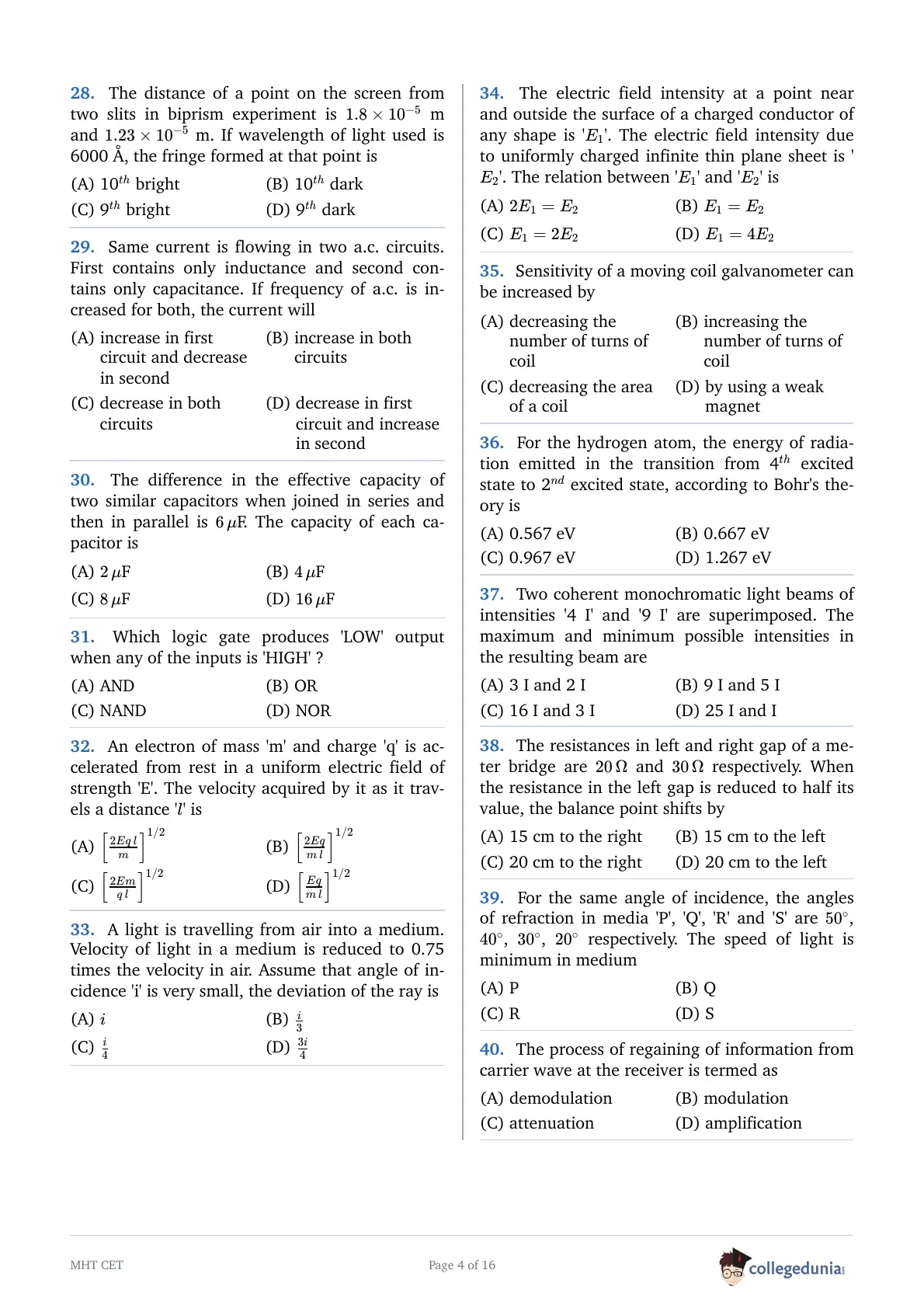
An electron of mass 'm' and charge 'q' is accelerated from rest in a uniform electric field of strength 'E'. The velocity acquired by it as it travels a distance '\(l\)' is

  • (A) \(\left[\frac{2Eq\,l}{m}\right]^{1/2}\)
  • (B) \(\left[\frac{2Eq}{m\,l}\right]^{1/2}\)
  • (C) \(\left[\frac{2Em}{q\,l}\right]^{1/2}\)
  • (D) \(\left[\frac{Eq}{m\,l}\right]^{1/2}\)

Question 33:

A light is travelling from air into a medium. Velocity of light in a medium is reduced to 0.75 times the velocity in air. Assume that angle of incidence 'i' is very small, the deviation of the ray is

  • (A) \(i\)
  • (B) \(\frac{i}{3}\)
  • (C) \(\frac{i}{4}\)
  • (D) \(\frac{3i}{4}\)

Question 34:

The electric field intensity at a point near and outside the surface of a charged conductor of any shape is '\(E_1\)'. The electric field intensity due to uniformly charged infinite thin plane sheet is '\(E_2\)'. The relation between '\(E_1\)' and '\(E_2\)' is

  • (A) \(2E_1=E_2\)
  • (B) \(E_1=E_2\)
  • (C) \(E_1=2E_2\)
  • (D) \(E_1=4E_2\)

Question 35:

Sensitivity of a moving coil galvanometer can be increased by

  • (A) decreasing the number of turns of coil
  • (B) increasing the number of turns of coil
  • (C) decreasing the area of a coil
  • (D) by using a weak magnet

Question 36:

For the hydrogen atom, the energy of radiation emitted in the transition from 4\(^{th}\) excited state to 2\(^{nd}\) excited state, according to Bohr's theory is

  • (A) 0.567 eV
  • (B) 0.667 eV
  • (C) 0.967 eV
  • (D) 1.267 eV

Question 37:

Two coherent monochromatic light beams of intensities '4 I' and '9 I' are superimposed. The maximum and minimum possible intensities in the resulting beam are

  • (A) 3 I and 2 I
  • (B) 9 I and 5 I
  • (C) 16 I and 3 I
  • (D) 25 I and I

Question 38:

The resistances in left and right gap of a meter bridge are \(20\,\Omega\) and \(30\,\Omega\) respectively. When the resistance in the left gap is reduced to half its value, the balance point shifts by

  • (A) 15 cm to the right
  • (B) 15 cm to the left
  • (C) 20 cm to the right
  • (D) 20 cm to the left

Question 39:

For the same angle of incidence, the angles of refraction in media 'P', 'Q', 'R' and 'S' are \(50^{\circ}\), \(40^{\circ}\), \(30^{\circ}\), \(20^{\circ}\) respectively. The speed of light is minimum in medium

  • (A) P
  • (B) Q
  • (C) R
  • (D) S

Question 40:

The process of regaining of information from carrier wave at the receiver is termed as

  • (A) demodulation
  • (B) modulation
  • (C) attenuation
  • (D) amplification

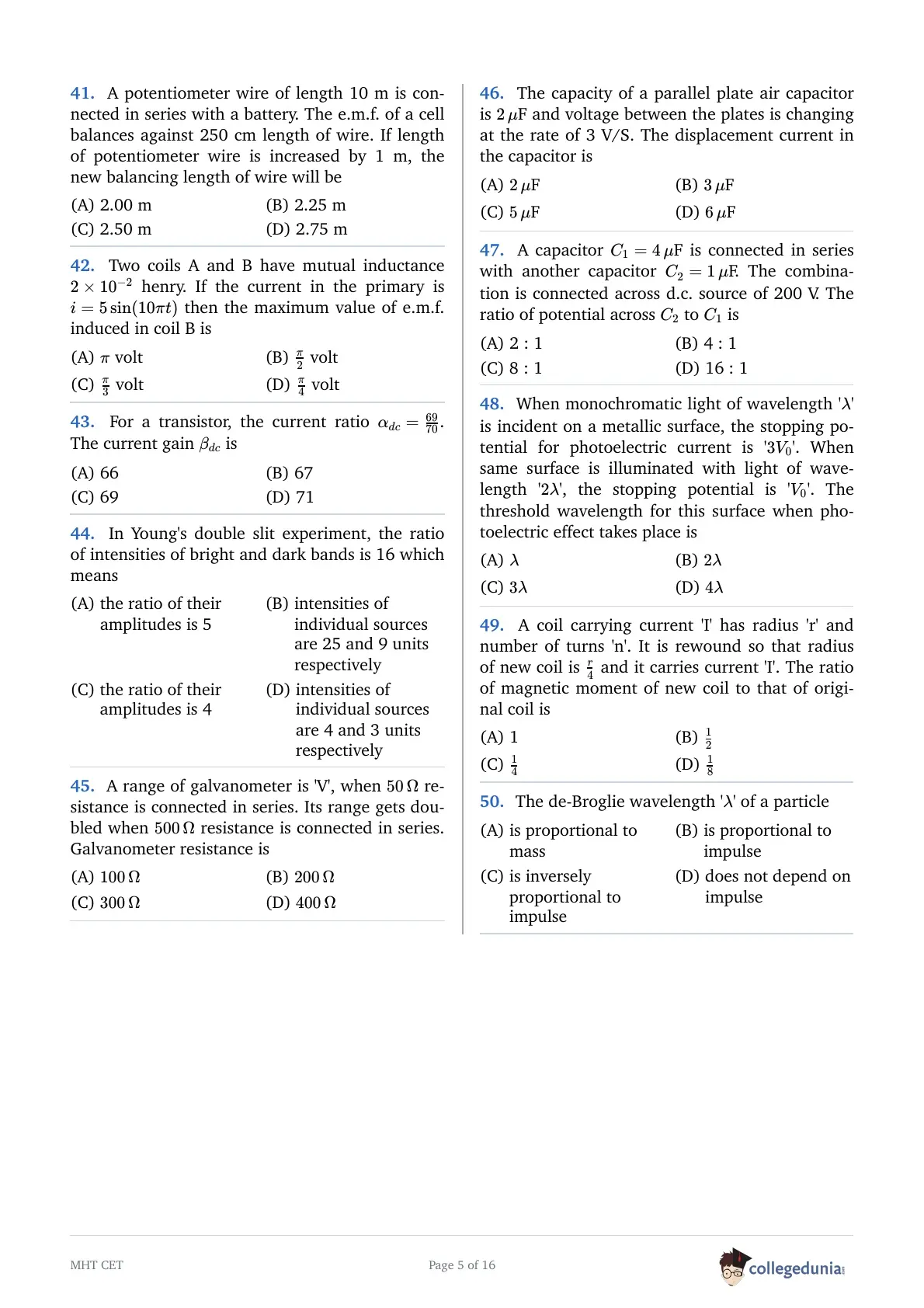
Question 41:

A potentiometer wire of length 10 m is connected in series with a battery. The e.m.f. of a cell balances against 250 cm length of wire. If length of potentiometer wire is increased by 1 m, the new balancing length of wire will be

  • (A) 2.00 m
  • (B) 2.25 m
  • (C) 2.50 m
  • (D) 2.75 m

Question 42:

Two coils A and B have mutual inductance \(2\times10^{-2}\) henry. If the current in the primary is \(i=5\sin(10\pi t)\) then the maximum value of e.m.f. induced in coil B is

  • (A) \(\pi\) volt
  • (B) \(\frac{\pi}{2}\) volt
  • (C) \(\frac{\pi}{3}\) volt
  • (D) \(\frac{\pi}{4}\) volt

Question 43:

For a transistor, the current ratio \(\alpha_{dc}=\frac{69}{70}\). The current gain \(\beta_{dc}\) is

  • (A) 66
  • (B) 67
  • (C) 69
  • (D) 71

Question 44:

In Young's double slit experiment, the ratio of intensities of bright and dark bands is 16 which means

  • (A) the ratio of their amplitudes is 5
  • (B) intensities of individual sources are 25 and 9 units respectively
  • (C) the ratio of their amplitudes is 4
  • (D) intensities of individual sources are 4 and 3 units respectively

Question 45:

A range of galvanometer is 'V', when \(50\,\Omega\) resistance is connected in series. Its range gets doubled when \(500\,\Omega\) resistance is connected in series. Galvanometer resistance is

  • (A) \(100\,\Omega\)
  • (B) \(200\,\Omega\)
  • (C) \(300\,\Omega\)
  • (D) \(400\,\Omega\)

Question 46:

The capacity of a parallel plate air capacitor is \(2\,\mu\)F and voltage between the plates is changing at the rate of 3 V/s. The displacement current in the capacitor is

  • (A) \(2\,\mu\)A
  • (B) \(3\,\mu\)A
  • (C) \(5\,\mu\)A
  • (D) \(6\,\mu\)A

Question 47:

A capacitor \(C_1=4\,\mu\)F is connected in series with another capacitor \(C_2=1\,\mu\)F. The combination is connected across d.c. source of 200 V. The ratio of potential across \(C_2\) to \(C_1\) is

  • (A) 2 : 1
  • (B) 4 : 1
  • (C) 8 : 1
  • (D) 16 : 1

Question 48:

When monochromatic light of wavelength '\(\lambda\)' is incident on a metallic surface, the stopping potential for photoelectric current is '\(3V_0\)'. When same surface is illuminated with light of wavelength '\(2\lambda\)', the stopping potential is '\(V_0\)'. The threshold wavelength for this surface when photoelectric effect takes place is

  • (A) \(\lambda\)
  • (B) \(2\lambda\)
  • (C) \(3\lambda\)
  • (D) \(4\lambda\)

Question 49:

A coil carrying current 'I' has radius 'r' and number of turns 'n'. It is rewound so that radius of new coil is \(\frac{r}{4}\) and it carries current 'I'. The ratio of magnetic moment of new coil to that of original coil is

  • (A) 1
  • (B) \(\frac{1}{2}\)
  • (C) \(\frac{1}{4}\)
  • (D) \(\frac{1}{8}\)

Question 50:

The de-Broglie wavelength '\(\lambda\)' of a particle

  • (A) is proportional to mass
  • (B) is proportional to impulse
  • (C) is inversely proportional to impulse
  • (D) does not depend on impulse

Chemistry (Q51 - Q100)

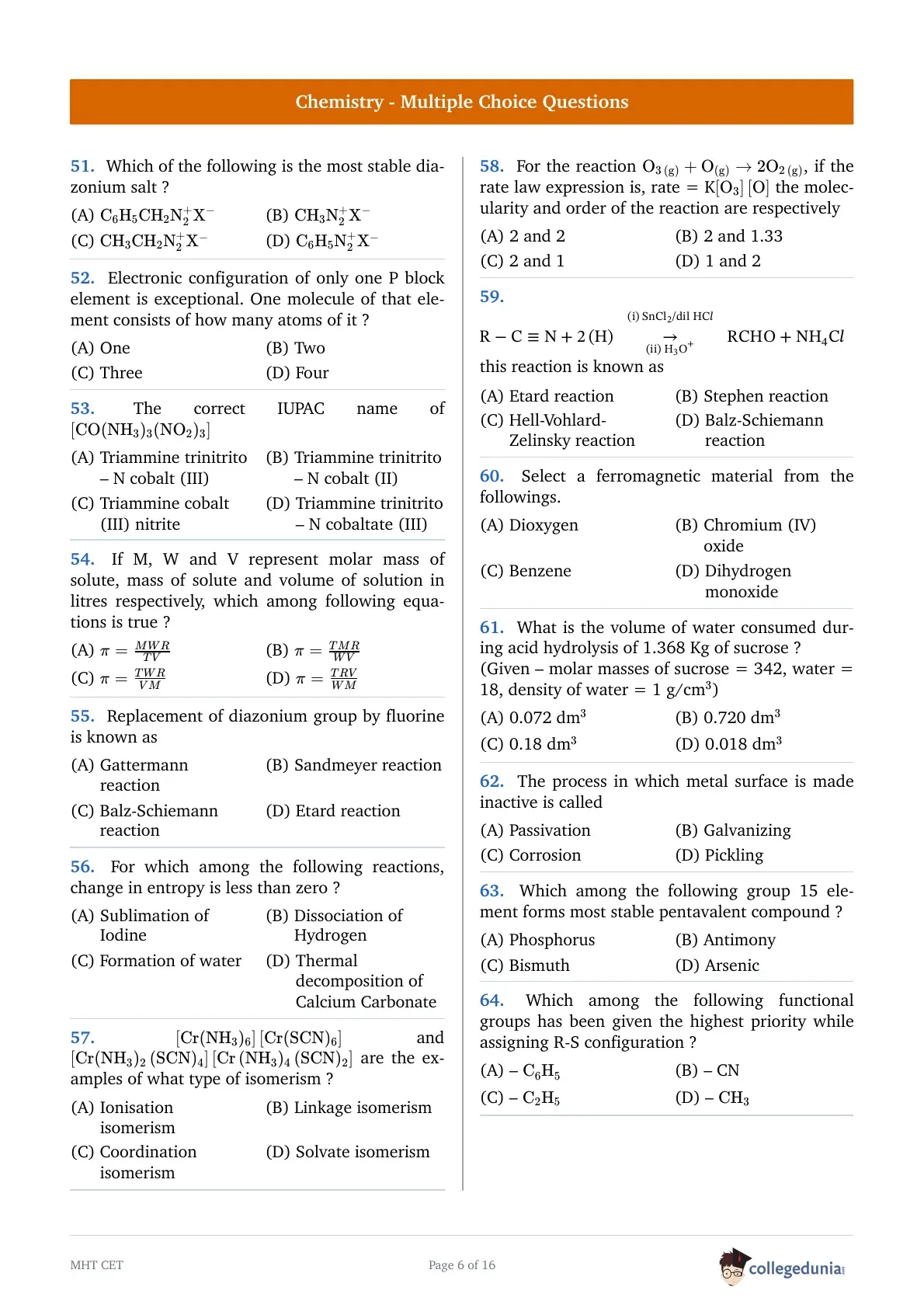
Question 51:

Which of the following is the most stable diazonium salt ?

  • (A) \(\mathrm{C_6H_5CH_2N_2^+X^-}\)
  • (B) \(\mathrm{CH_3N_2^+X^-}\)
  • (C) \(\mathrm{CH_3CH_2N_2^+X^-}\)
  • (D) \(\mathrm{C_6H_5N_2^+X^-}\)

Question 52:

Electronic configuration of only one P block element is exceptional. One molecule of that element consists of how many atoms of it ?

  • (A) One
  • (B) Two
  • (C) Three
  • (D) Four

Question 53:

The correct IUPAC name of \([\mathrm{CO(NH_3)_3(NO_2)_3}]\)

  • (A) Triammine trinitrito – N cobalt (III)
  • (B) Triammine trinitrito – N cobalt (II)
  • (C) Triammine cobalt (III) nitrite
  • (D) Triammine trinitrito – N cobaltate (III)

Question 54:

If M, W and V represent molar mass of solute, mass of solute and volume of solution in litres respectively, which among following equations is true ?

  • (A) \(\pi=\frac{MWR}{TV}\)
  • (B) \(\pi=\frac{TMR}{WV}\)
  • (C) \(\pi=\frac{TWR}{VM}\)
  • (D) \(\pi=\frac{TRV}{WM}\)

Question 55:

Replacement of diazonium group by fluorine is known as

  • (A) Gattermann reaction
  • (B) Sandmeyer reaction
  • (C) Balz-Schiemann reaction
  • (D) Etard reaction

Question 56:

For which among the following reactions, change in entropy is less than zero ?

  • (A) Sublimation of Iodine
  • (B) Dissociation of Hydrogen
  • (C) Formation of water
  • (D) Thermal decomposition of Calcium Carbonate

Question 57:

\([\mathrm{Cr(NH_3)_6}]\,[\mathrm{Cr(SCN)_6}]\) and \([\mathrm{Cr(NH_3)_2\,(SCN)_4}]\,[\mathrm{Cr\,(NH_3)_4\,(SCN)_2}]\) are the examples of what type of isomerism ?

  • (A) Ionisation isomerism
  • (B) Linkage isomerism
  • (C) Coordination isomerism
  • (D) Solvate isomerism

Question 58:

For the reaction \(\mathrm{O_{3\,(g)} + O_{(g)} \rightarrow 2O_{2\,(g)}}\), if the rate law expression is, rate = K\([\mathrm{O_3}]\,[\mathrm{O}]\) the molecularity and order of the reaction are respectively

  • (A) 2 and 2
  • (B) 2 and 1.33
  • (C) 2 and 1
  • (D) 1 and 2

Question 59:

\(\mathrm{R-C\equiv N + 2\,(H)}\ \xrightarrow[\text{(ii) }\mathrm{H_3O^+}]{\text{(i) }\mathrm{SnCl_2}/\text{dil HC}l}\ \mathrm{RCHO + NH_4C}l\) this reaction is known as

  • (A) Etard reaction
  • (B) Stephen reaction
  • (C) Hell-Vohlard-Zelinsky reaction
  • (D) Balz-Schiemann reaction

Question 60:

Select a ferromagnetic material from the followings.

  • (A) Dioxygen
  • (B) Chromium (IV) oxide
  • (C) Benzene
  • (D) Dihydrogen monoxide

Question 61:

What is the volume of water consumed during acid hydrolysis of 1.368 Kg of sucrose ?
(Given – molar masses of sucrose = 342, water = 18, density of water = 1 g/cm\(^3\))

  • (A) 0.072 dm\(^3\)
  • (B) 0.720 dm\(^3\)
  • (C) 0.18 dm\(^3\)
  • (D) 0.018 dm\(^3\)

Question 62:

The process in which metal surface is made inactive is called

  • (A) Passivation
  • (B) Galvanizing
  • (C) Corrosion
  • (D) Pickling

Question 63:

Which among the following group 15 element forms most stable pentavalent compound ?

  • (A) Phosphorus
  • (B) Antimony
  • (C) Bismuth
  • (D) Arsenic

Question 64:

Which among the following functional groups has been given the highest priority while assigning R-S configuration ?

  • (A) – \(\mathrm{C_6H_5}\)
  • (B) – CN
  • (C) – \(\mathrm{C_2H_5}\)
  • (D) – \(\mathrm{CH_3}\)

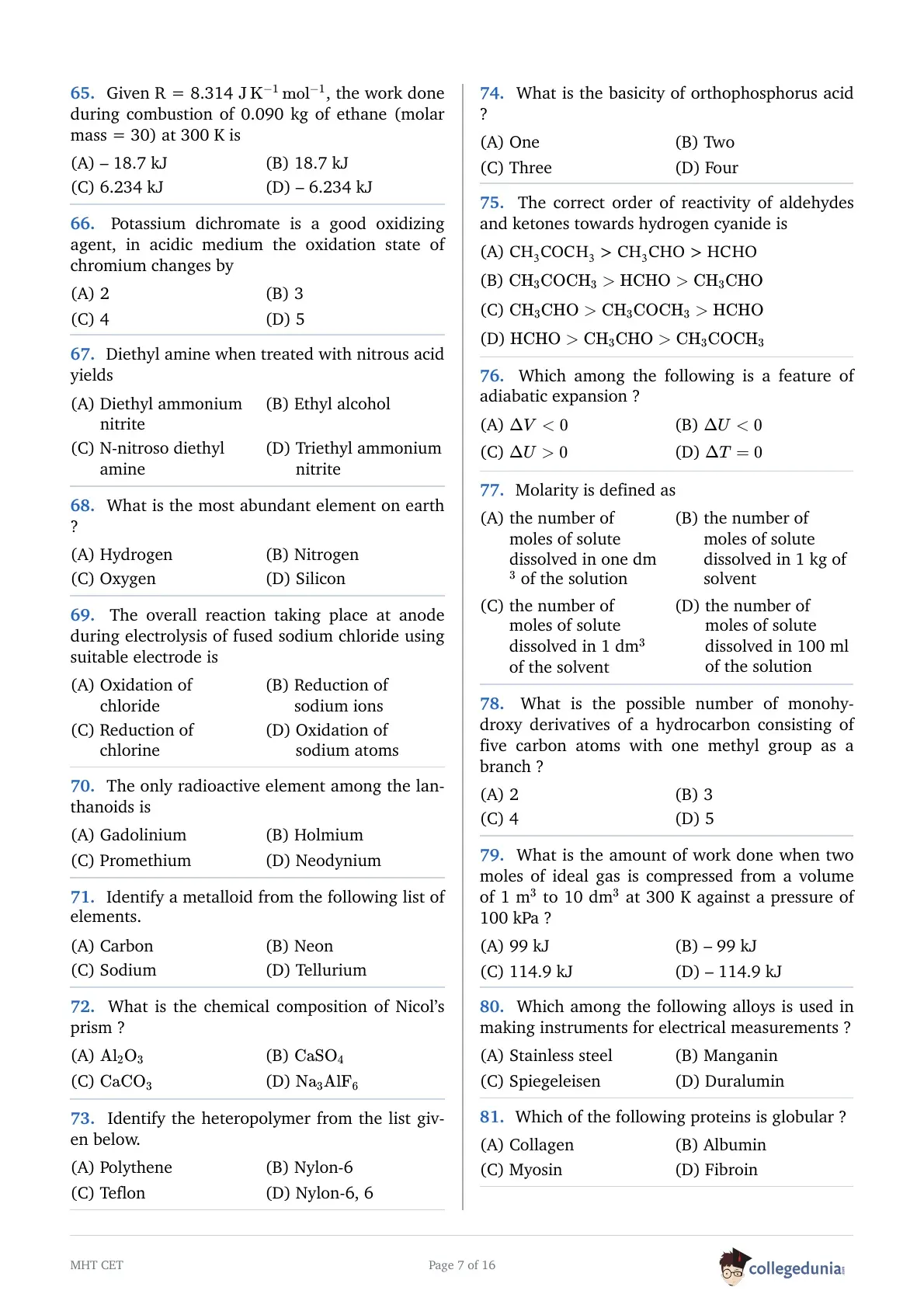
Question 65:

Given R = 8.314 \(\mathrm{J\,K^{-1}\,mol^{-1}}\), the work done during combustion of 0.090 kg of ethane (molar mass = 30) at 300 K is

  • (A) – 18.7 kJ
  • (B) 18.7 kJ
  • (C) 6.234 kJ
  • (D) – 6.234 kJ

Question 66:

Potassium dichromate is a good oxidizing agent, in acidic medium the oxidation state of chromium changes by

  • (A) 2
  • (B) 3
  • (C) 4
  • (D) 5

Question 67:

Diethyl amine when treated with nitrous acid yields

  • (A) Diethyl ammonium nitrite
  • (B) Ethyl alcohol
  • (C) N-nitroso diethyl amine
  • (D) Triethyl ammonium nitrite

Question 68:

What is the most abundant element on earth ?

  • (A) Hydrogen
  • (B) Nitrogen
  • (C) Oxygen
  • (D) Silicon

Question 69:

The overall reaction taking place at anode during electrolysis of fused sodium chloride using suitable electrode is

  • (A) Oxidation of chloride
  • (B) Reduction of sodium ions
  • (C) Reduction of chlorine
  • (D) Oxidation of sodium atoms

Question 70:

The only radioactive element among the lanthanoids is

  • (A) Gadolinium
  • (B) Holmium
  • (C) Promethium
  • (D) Neodynium

Question 71:

Identify a metalloid from the following list of elements.

  • (A) Carbon
  • (B) Neon
  • (C) Sodium
  • (D) Tellurium

Question 72:

What is the chemical composition of Nicol’s prism ?

  • (A) \(\mathrm{Al_2O_3}\)
  • (B) \(\mathrm{CaSO_4}\)
  • (C) \(\mathrm{CaCO_3}\)
  • (D) \(\mathrm{Na_3AlF_6}\)

Question 73:

Identify the heteropolymer from the list given below.

  • (A) Polythene
  • (B) Nylon-6
  • (C) Teflon
  • (D) Nylon-6, 6

Question 74:

What is the basicity of orthophosphorus acid ?

  • (A) One
  • (B) Two
  • (C) Three
  • (D) Four

Question 75:

The correct order of reactivity of aldehydes and ketones towards hydrogen cyanide is

  • (A) \(\mathrm{CH_3COCH_3} > \mathrm{CH_3CHO} > \mathrm{HCHO}\)
  • (B) \(\mathrm{CH_3COCH_3} > \mathrm{HCHO} > \mathrm{CH_3CHO}\)
  • (C) \(\mathrm{CH_3CHO} > \mathrm{CH_3COCH_3} > \mathrm{HCHO}\)
  • (D) \(\mathrm{HCHO} > \mathrm{CH_3CHO} > \mathrm{CH_3COCH_3}\)

Question 76:

Which among the following is a feature of adiabatic expansion ?

  • (A) \(\Delta V < 0\)
  • (B) \(\Delta U < 0\)
  • (C) \(\Delta U > 0\)
  • (D) \(\Delta T = 0\)

Question 77:

Molarity is defined as

  • (A) the number of moles of solute dissolved in one dm\(^3\) of the solution
  • (B) the number of moles of solute dissolved in 1 kg of solvent
  • (C) the number of moles of solute dissolved in 1 dm\(^3\) of the solvent
  • (D) the number of moles of solute dissolved in 100 ml of the solution

Question 78:

What is the possible number of monohydroxy derivatives of a hydrocarbon consisting of five carbon atoms with one methyl group as a branch ?

  • (A) 2
  • (B) 3
  • (C) 4
  • (D) 5

Question 79:

What is the amount of work done when two moles of ideal gas is compressed from a volume of 1 m\(^3\) to 10 dm\(^3\) at 300 K against a pressure of 100 kPa ?

  • (A) 99 kJ
  • (B) – 99 kJ
  • (C) 114.9 kJ
  • (D) – 114.9 kJ

Question 80:

Which among the following alloys is used in making instruments for electrical measurements ?

  • (A) Stainless steel
  • (B) Manganin
  • (C) Spiegeleisen
  • (D) Duralumin

Question 81:

Which of the following proteins is globular ?

  • (A) Collagen
  • (B) Albumin
  • (C) Myosin
  • (D) Fibroin

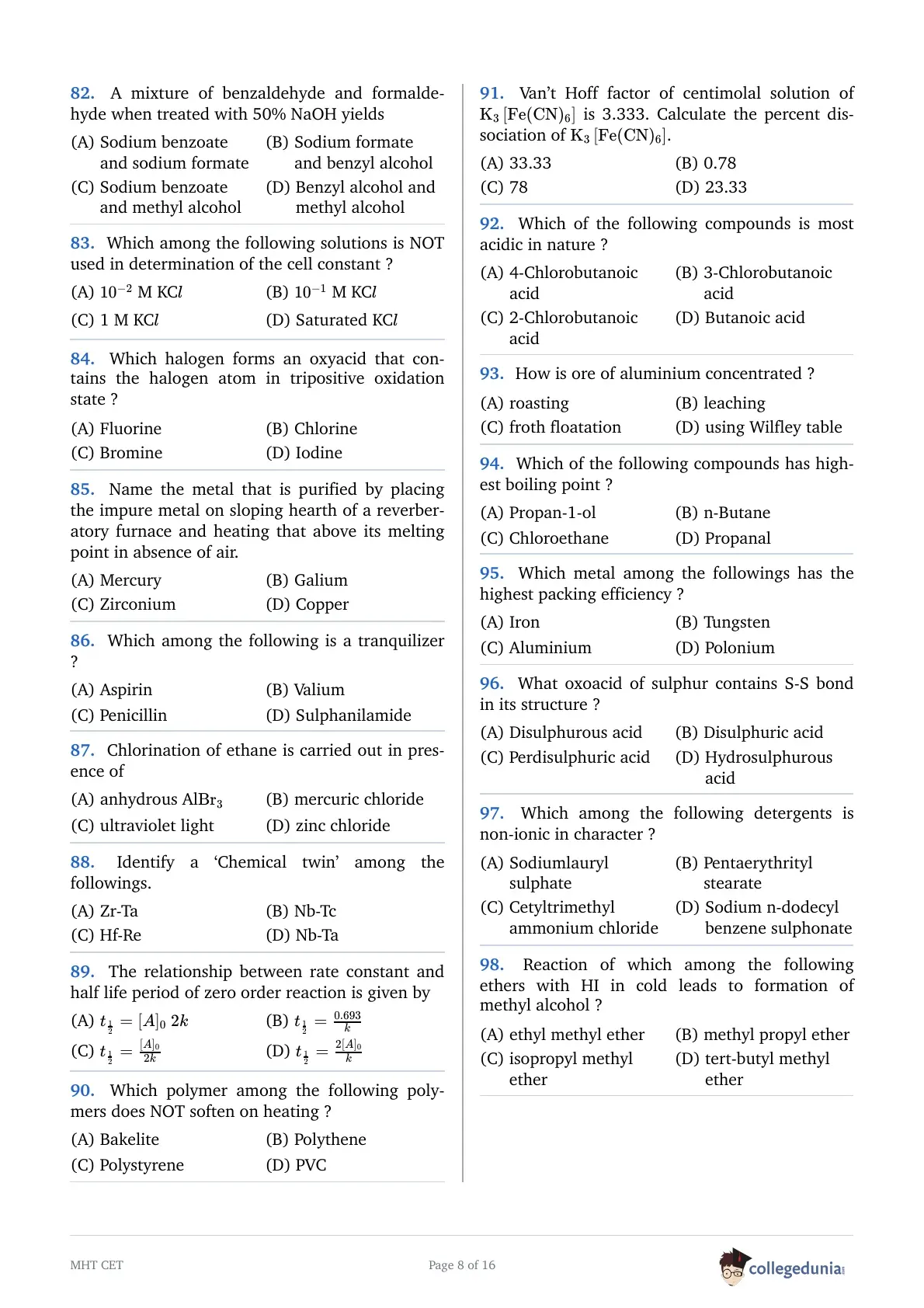
Question 82:

A mixture of benzaldehyde and formaldehyde when treated with 50% NaOH yields

  • (A) Sodium benzoate and sodium formate
  • (B) Sodium formate and benzyl alcohol
  • (C) Sodium benzoate and methyl alcohol
  • (D) Benzyl alcohol and methyl alcohol

Question 83:

Which among the following solutions is NOT used in determination of the cell constant ?

  • (A) \(10^{-2}\) M KC\(l\)
  • (B) \(10^{-1}\) M KC\(l\)
  • (C) 1 M KC\(l\)
  • (D) Saturated KC\(l\)

Question 84:

Which halogen forms an oxyacid that contains the halogen atom in tripositive oxidation state ?

  • (A) Fluorine
  • (B) Chlorine
  • (C) Bromine
  • (D) Iodine

Question 85:

Name the metal that is purified by placing the impure metal on sloping hearth of a reverberatory furnace and heating that above its melting point in absence of air.

  • (A) Mercury
  • (B) Galium
  • (C) Zirconium
  • (D) Copper

Question 86:

Which among the following is a tranquilizer ?

  • (A) Aspirin
  • (B) Valium
  • (C) Penicillin
  • (D) Sulphanilamide

Question 87:

Chlorination of ethane is carried out in presence of

  • (A) anhydrous Al\(\mathrm{Br_3}\)
  • (B) mercuric chloride
  • (C) ultraviolet light
  • (D) zinc chloride

Question 88:

Identify a ‘Chemical twin’ among the followings.

  • (A) Zr-Ta
  • (B) Nb-Tc
  • (C) Hf-Re
  • (D) Nb-Ta

Question 89:

The relationship between rate constant and half life period of zero order reaction is given by

  • (A) \(t_{\frac{1}{2}} = [A]_0\ 2k\)
  • (B) \(t_{\frac{1}{2}} = \frac{0.693}{k}\)
  • (C) \(t_{\frac{1}{2}} = \frac{[A]_0}{2k}\)
  • (D) \(t_{\frac{1}{2}} = \frac{2[A]_0}{k}\)

Question 90:

Which polymer among the following polymers does NOT soften on heating ?

  • (A) Bakelite
  • (B) Polythene
  • (C) Polystyrene
  • (D) PVC

Question 91:

Van’t Hoff factor of centimolal solution of \(\mathrm{K_3\,[Fe(CN)_6]}\) is 3.333. Calculate the percent dissociation of \(\mathrm{K_3\,[Fe(CN)_6]}\).

  • (A) 33.33
  • (B) 0.78
  • (C) 78
  • (D) 23.33

Question 92:

Which of the following compounds is most acidic in nature ?

  • (A) 4-Chlorobutanoic acid
  • (B) 3-Chlorobutanoic acid
  • (C) 2-Chlorobutanoic acid
  • (D) Butanoic acid

Question 93:

How is ore of aluminium concentrated ?

  • (A) roasting
  • (B) leaching
  • (C) froth floatation
  • (D) using Wilfley table

Question 94:

Which of the following compounds has highest boiling point ?

  • (A) Propan-1-ol
  • (B) n-Butane
  • (C) Chloroethane
  • (D) Propanal

Question 95:

Which metal among the followings has the highest packing efficiency ?

  • (A) Iron
  • (B) Tungsten
  • (C) Aluminium
  • (D) Polonium

Question 96:

What oxoacid of sulphur contains S-S bond in its structure ?

  • (A) Disulphurous acid
  • (B) Disulphuric acid
  • (C) Perdisulphuric acid
  • (D) Hydrosulphurous acid

Question 97:

Which among the following detergents is non-ionic in character ?

  • (A) Sodiumlauryl sulphate
  • (B) Pentaerythrityl stearate
  • (C) Cetyltrimethyl ammonium chloride
  • (D) Sodium n-dodecyl benzene sulphonate

Question 98:

Reaction of which among the following ethers with HI in cold leads to formation of methyl alcohol ?

  • (A) ethyl methyl ether
  • (B) methyl propyl ether
  • (C) isopropyl methyl ether
  • (D) tert-butyl methyl ether

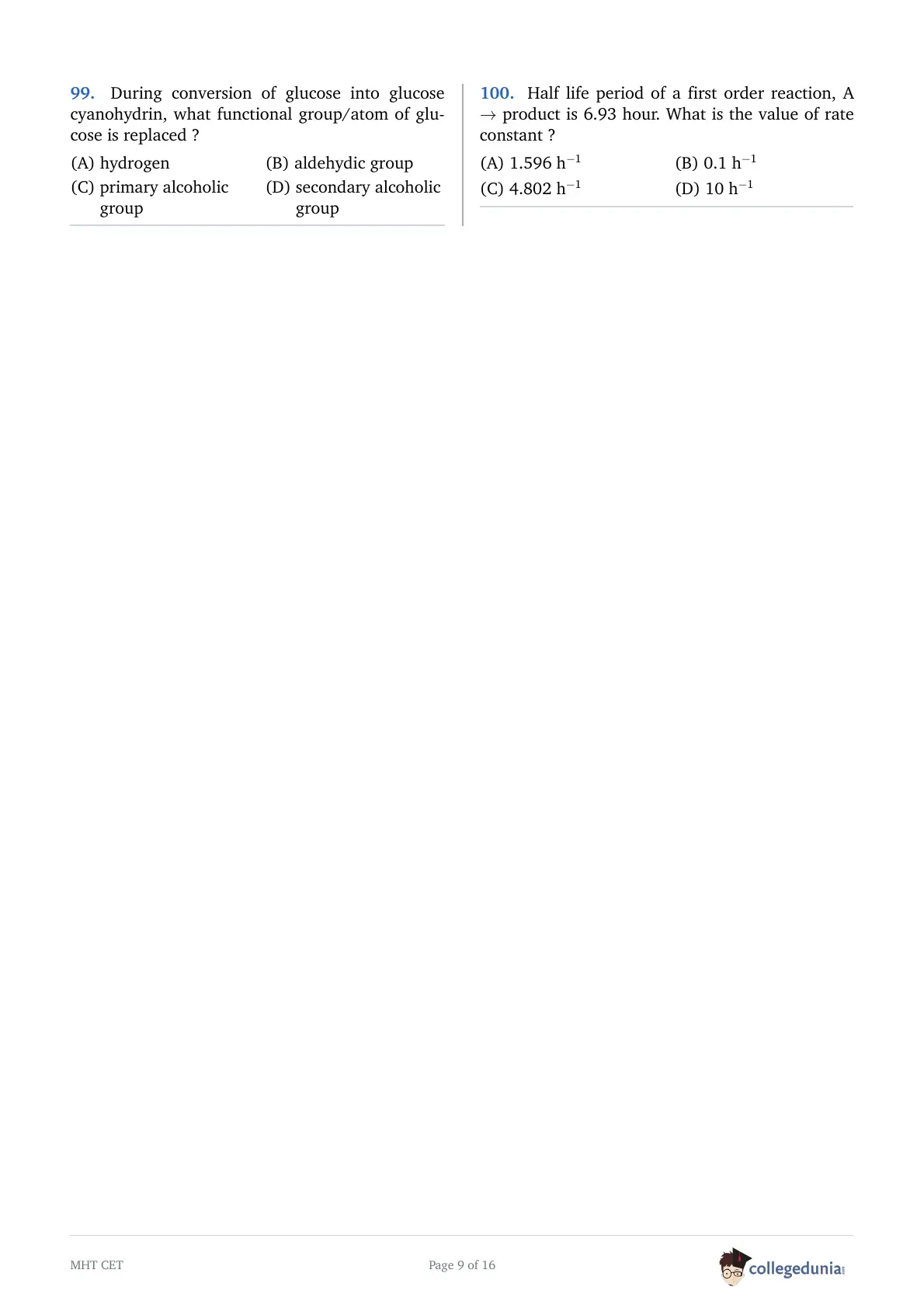
Question 99:

During conversion of glucose into glucose cyanohydrin, what functional group/atom of glucose is replaced ?

  • (A) hydrogen
  • (B) aldehydic group
  • (C) primary alcoholic group
  • (D) secondary alcoholic group

Question 100:

Half life period of a first order reaction, A \(\rightarrow\) product is 6.93 hour. What is the value of rate constant ?

  • (A) 1.596 h\(^{-1}\)
  • (B) 0.1 h\(^{-1}\)
  • (C) 4.802 h\(^{-1}\)
  • (D) 10 h\(^{-1}\)

Biology (Q101 - Q200)

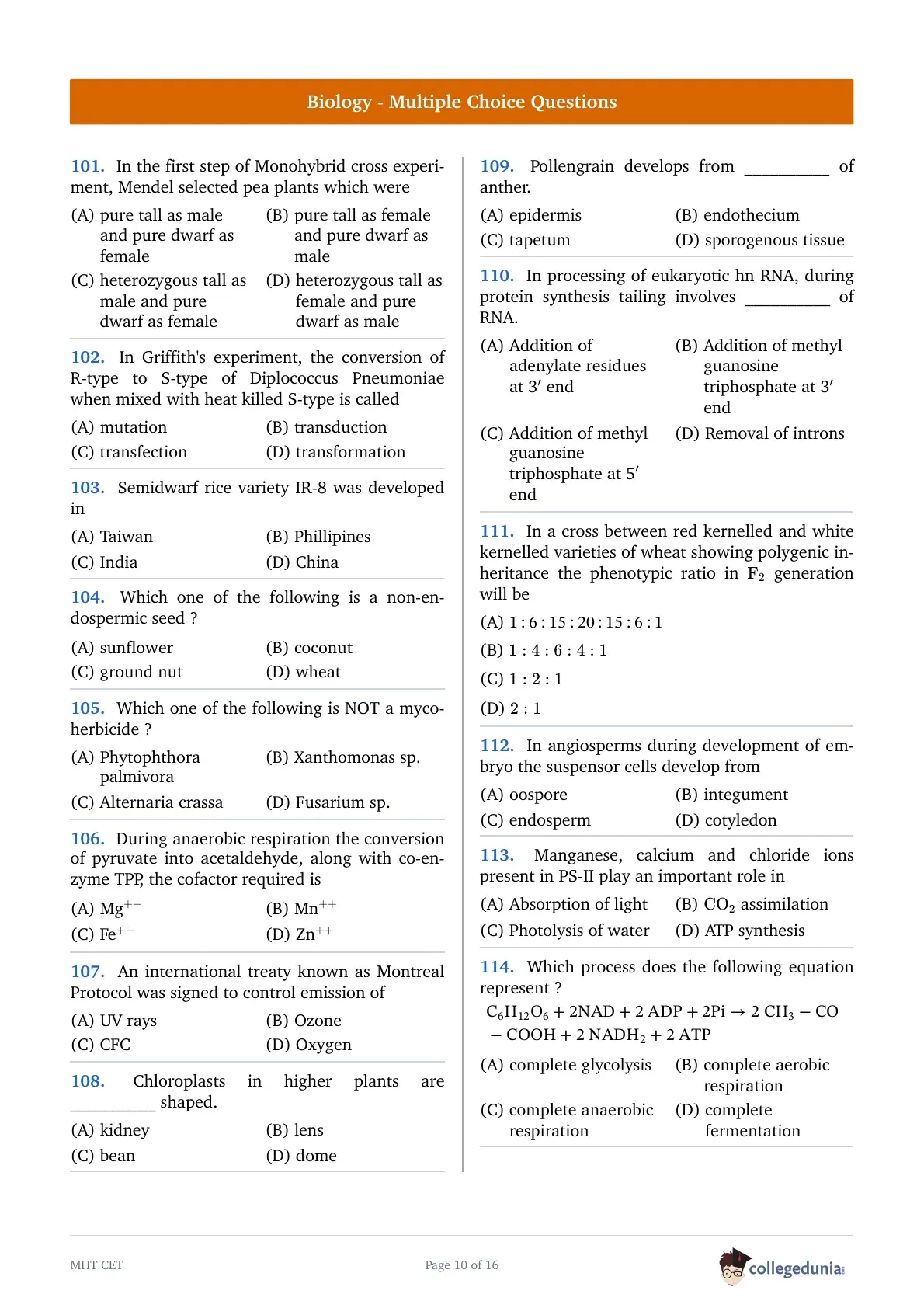
Question 101:

In the first step of Monohybrid cross experiment, Mendel selected pea plants which were

  • (A) pure tall as male and pure dwarf as female
  • (B) pure tall as female and pure dwarf as male
  • (C) heterozygous tall as male and pure dwarf as female
  • (D) heterozygous tall as female and pure dwarf as male

Question 102:

In Griffith's experiment, the conversion of R-type to S-type of Diplococcus Pneumoniae when mixed with heat killed S-type is called

  • (A) mutation
  • (B) transduction
  • (C) transfection
  • (D) transformation

Question 103:

Semidwarf rice variety IR-8 was developed in

  • (A) Taiwan
  • (B) Phillipines
  • (C) India
  • (D) China

Question 104:

Which one of the following is a non-endospermic seed ?

  • (A) sunflower
  • (B) coconut
  • (C) ground nut
  • (D) wheat

Question 105:

Which one of the following is NOT a mycoherbicide ?

  • (A) Phytophthora palmivora
  • (B) Xanthomonas sp.
  • (C) Alternaria crassa
  • (D) Fusarium sp.

Question 106:

During anaerobic respiration the conversion of pyruvate into acetaldehyde, along with co-enzyme TPP, the cofactor required is

  • (A) Mg\(^{++}\)
  • (B) Mn\(^{++}\)
  • (C) Fe\(^{++}\)
  • (D) Zn\(^{++}\)

Question 107:

An international treaty known as Montreal Protocol was signed to control emission of

  • (A) UV rays
  • (B) Ozone
  • (C) CFC
  • (D) Oxygen

Question 108:

Chloroplasts in higher plants are __________ shaped.

  • (A) kidney
  • (B) lens
  • (C) bean
  • (D) dome

Question 109:

Pollengrain develops from __________ of anther.

  • (A) epidermis
  • (B) endothecium
  • (C) tapetum
  • (D) sporogenous tissue

Question 110:

In processing of eukaryotic hn RNA, during protein synthesis tailing involves __________ of RNA.

  • (A) Addition of adenylate residues at 3\('\) end
  • (B) Addition of methyl guanosine triphosphate at 3\('\) end
  • (C) Addition of methyl guanosine triphosphate at 5\('\) end
  • (D) Removal of introns

Question 111:

In a cross between red kernelled and white kernelled varieties of wheat showing polygenic inheritance the phenotypic ratio in \(\mathrm{F_2}\) generation will be

  • (A) \(1:6:15:20:15:6:1\)
  • (B) \(1:4:6:4:1\)
  • (C) \(1:2:1\)
  • (D) \(2:1\)

Question 112:

In angiosperms during development of embryo the suspensor cells develop from

  • (A) oospore
  • (B) integument
  • (C) endosperm
  • (D) cotyledon

Question 113:

Manganese, calcium and chloride ions present in PS-II play an important role in

  • (A) Absorption of light
  • (B) \(\mathrm{CO_2}\) assimilation
  • (C) Photolysis of water
  • (D) ATP synthesis

Question 114:

Which process does the following equation represent ?
\(\mathrm{C_6H_{12}O_6 + 2NAD + 2\ ADP + 2Pi \rightarrow 2\ CH_3 - CO - COOH + 2\ NADH_2 + 2\ ATP}\)

  • (A) complete glycolysis
  • (B) complete aerobic respiration
  • (C) complete anaerobic respiration
  • (D) complete fermentation

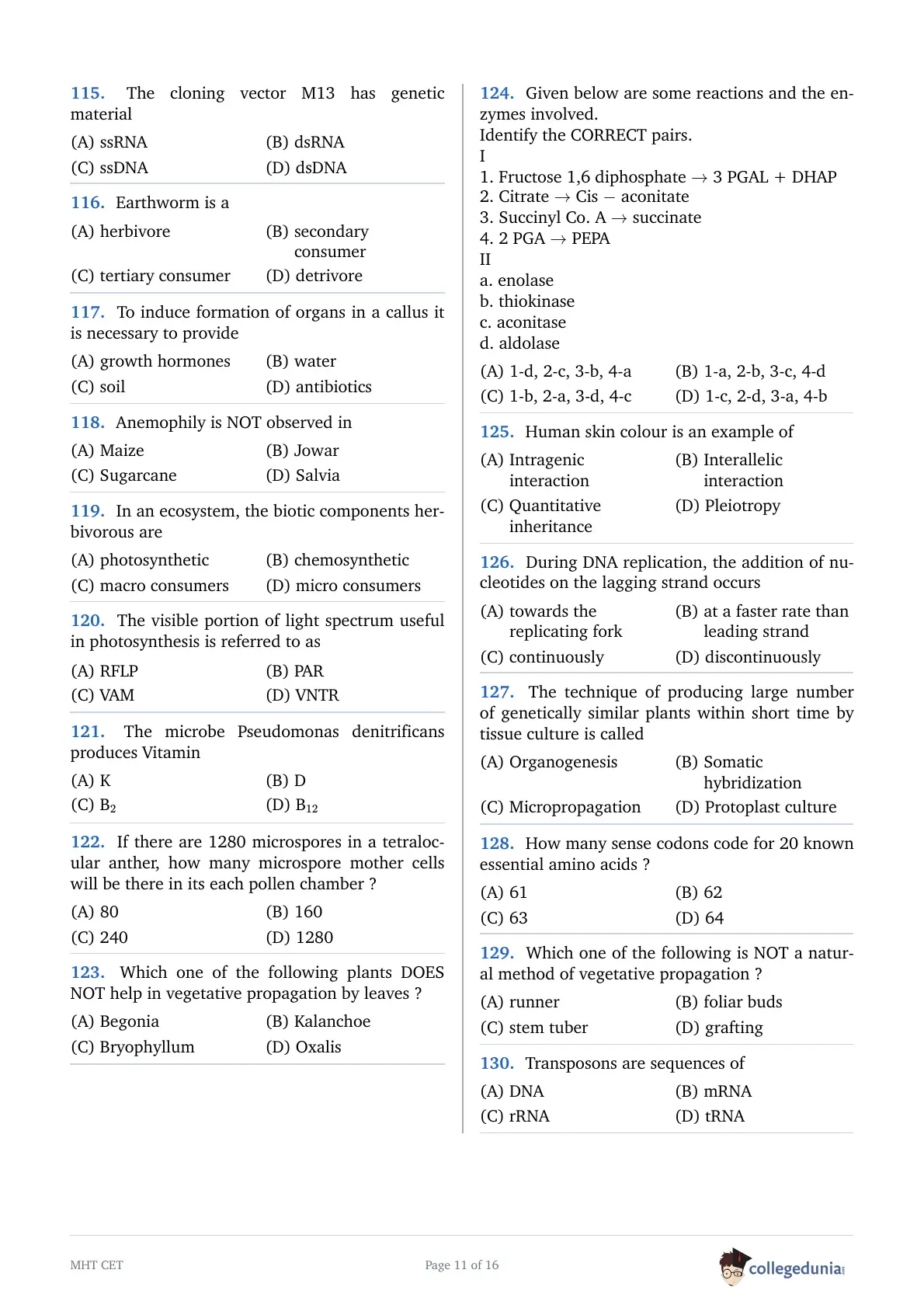
Question 115:

The cloning vector M13 has genetic material

  • (A) ssRNA
  • (B) dsRNA
  • (C) ssDNA
  • (D) dsDNA

Question 116:

Earthworm is a

  • (A) herbivore
  • (B) secondary consumer
  • (C) tertiary consumer
  • (D) detrivore

Question 117:

To induce formation of organs in a callus it is necessary to provide

  • (A) growth hormones
  • (B) water
  • (C) soil
  • (D) antibiotics

Question 118:

Anemophily is NOT observed in

  • (A) Maize
  • (B) Jowar
  • (C) Sugarcane
  • (D) Salvia

Question 119:

In an ecosystem, the biotic components herbivorous are

  • (A) photosynthetic
  • (B) chemosynthetic
  • (C) macro consumers
  • (D) micro consumers

Question 120:

The visible portion of light spectrum useful in photosynthesis is referred to as

  • (A) RFLP
  • (B) PAR
  • (C) VAM
  • (D) VNTR

Question 121:

The microbe Pseudomonas denitrificans produces Vitamin

  • (A) K
  • (B) D
  • (C) B\(_2\)
  • (D) B\(_{12}\)

Question 122:

If there are 1280 microspores in a tetralocular anther, how many microspore mother cells will be there in its each pollen chamber ?

  • (A) 80
  • (B) 160
  • (C) 240
  • (D) 1280

Question 123:

Which one of the following plants DOES NOT help in vegetative propagation by leaves ?

  • (A) Begonia
  • (B) Kalanchoe
  • (C) Bryophyllum
  • (D) Oxalis

Question 124:

Given below are some reactions and the enzymes involved.
Identify the CORRECT pairs.
I
1. Fructose 1,6 diphosphate \(\rightarrow\) 3 PGAL + DHAP
2. Citrate \(\rightarrow\) Cis \(-\) aconitate
3. Succinyl Co. A \(\rightarrow\) succinate
4. 2 PGA \(\rightarrow\) PEPA
II
a. enolase
b. thiokinase
c. aconitase
d. aldolase

  • (A) 1-d, 2-c, 3-b, 4-a
  • (B) 1-a, 2-b, 3-c, 4-d
  • (C) 1-b, 2-a, 3-d, 4-c
  • (D) 1-c, 2-d, 3-a, 4-b

Question 125:

Human skin colour is an example of

  • (A) Intragenic interaction
  • (B) Interallelic interaction
  • (C) Quantitative inheritance
  • (D) Pleiotropy

Question 126:

During DNA replication, the addition of nucleotides on the lagging strand occurs

  • (A) towards the replicating fork
  • (B) at a faster rate than leading strand
  • (C) continuously
  • (D) discontinuously

Question 127:

The technique of producing large number of genetically similar plants within short time by tissue culture is called

  • (A) Organogenesis
  • (B) Somatic hybridization
  • (C) Micropropagation
  • (D) Protoplast culture

Question 128:

How many sense codons code for 20 known essential amino acids ?

  • (A) 61
  • (B) 62
  • (C) 63
  • (D) 64

Question 129:

Which one of the following is NOT a natural method of vegetative propagation ?

  • (A) runner
  • (B) foliar buds
  • (C) stem tuber
  • (D) grafting

Question 130:

Transposons are sequences of

  • (A) DNA
  • (B) mRNA
  • (C) rRNA
  • (D) tRNA

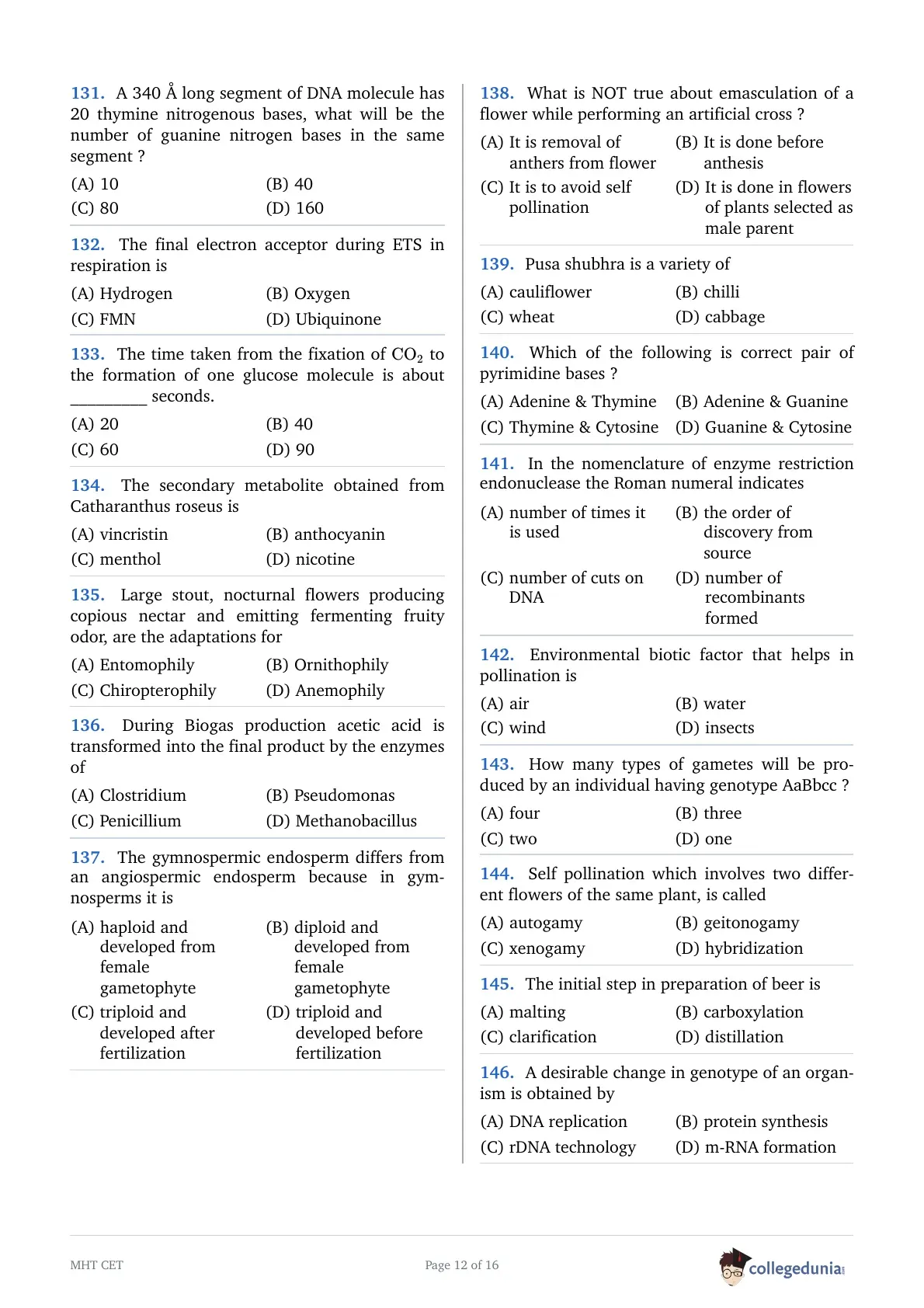
Question 131:

A 340 Å long segment of DNA molecule has 20 thymine nitrogenous bases, what will be the number of guanine nitrogen bases in the same segment ?

  • (A) 10
  • (B) 40
  • (C) 80
  • (D) 160

Question 132:

The final electron acceptor during ETS in respiration is

  • (A) Hydrogen
  • (B) Oxygen
  • (C) FMN
  • (D) Ubiquinone

Question 133:

The time taken from the fixation of \(\mathrm{CO_2}\) to the formation of one glucose molecule is about _________ seconds.

  • (A) 20
  • (B) 40
  • (C) 60
  • (D) 90

Question 134:

The secondary metabolite obtained from Catharanthus roseus is

  • (A) vincristin
  • (B) anthocyanin
  • (C) menthol
  • (D) nicotine

Question 135:

Large stout, nocturnal flowers producing copious nectar and emitting fermenting fruity odor, are the adaptations for

  • (A) Entomophily
  • (B) Ornithophily
  • (C) Chiropterophily
  • (D) Anemophily

Question 136:

During Biogas production acetic acid is transformed into the final product by the enzymes of

  • (A) Clostridium
  • (B) Pseudomonas
  • (C) Penicillium
  • (D) Methanobacillus

Question 137:

The gymnospermic endosperm differs from an angiospermic endosperm because in gymnosperms it is

  • (A) haploid and developed from female gametophyte
  • (B) diploid and developed from female gametophyte
  • (C) triploid and developed after fertilization
  • (D) triploid and developed before fertilization

Question 138:

What is NOT true about emasculation of a flower while performing an artificial cross ?

  • (A) It is removal of anthers from flower
  • (B) It is done before anthesis
  • (C) It is to avoid self pollination
  • (D) It is done in flowers of plants selected as male parent

Question 139:

Pusa shubhra is a variety of

  • (A) cauliflower
  • (B) chilli
  • (C) wheat
  • (D) cabbage

Question 140:

Which of the following is correct pair of pyrimidine bases ?

  • (A) Adenine & Thymine
  • (B) Adenine & Guanine
  • (C) Thymine & Cytosine
  • (D) Guanine & Cytosine

Question 141:

In the nomenclature of enzyme restriction endonuclease the Roman numeral indicates

  • (A) number of times it is used
  • (B) the order of discovery from source
  • (C) number of cuts on DNA
  • (D) number of recombinants formed

Question 142:

Environmental biotic factor that helps in pollination is

  • (A) air
  • (B) water
  • (C) wind
  • (D) insects

Question 143:

How many types of gametes will be produced by an individual having genotype AaBbcc ?

  • (A) four
  • (B) three
  • (C) two
  • (D) one

Question 144:

Self pollination which involves two different flowers of the same plant, is called

  • (A) autogamy
  • (B) geitonogamy
  • (C) xenogamy
  • (D) hybridization

Question 145:

The initial step in preparation of beer is

  • (A) malting
  • (B) carboxylation
  • (C) clarification
  • (D) distillation

Question 146:

A desirable change in genotype of an organism is obtained by

  • (A) DNA replication
  • (B) protein synthesis
  • (C) rDNA technology
  • (D) m-RNA formation

Question 147:

Considering mode of asexual reproduction, match the Column I with II and select the correct option :
Column I: a. Yeast; b. Penicillium; c. Filamentous algae; d. Chlamydomonas
Column II: i. fragmentation; ii. zoospores; iii. budding; iv. conidia

  • (A) a-iii, b-iv, c-i, d-ii
  • (B) a-ii, b-iii, c-i, d-iv
  • (C) a-iv, b-iii, c-ii, d-i
  • (D) a-iii, b-ii, c-i, d-iv

Question 148:

How much of the energy released during aerobic respiration is approximately conserved in the form of ATP ?

  • (A) 20%
  • (B) 40%
  • (C) 60%
  • (D) 100%

Question 149:

The deflection of pitch angle between two successive steps (rungs) of DNA is

  • (A) \(72^{\circ}\)
  • (B) \(54^{\circ}\)
  • (C) \(36^{\circ}\)
  • (D) \(18^{\circ}\)

Question 150:

Which one of the following is a CAM plant ?

  • (A) Maize
  • (B) Kalanchoe
  • (C) Sugarcane
  • (D) Jowar

Question 151:

One of the following cells secretes a hormone

  • (A) Cells of Leydig
  • (B) Cells of Sertoli
  • (C) Primary spermatocyte
  • (D) Secondary spermatocyte

Question 152:

Find the odd one out, with respect to X-linkage.

  • (A) Haemophilia
  • (B) Myopia
  • (C) Nephritis
  • (D) Night blindness

Question 153:

The first fossil of Australopithecus was discovered in

  • (A) Olduvai Gorge, Tanzania
  • (B) Fayum deposits of Egypt
  • (C) Siwalik hills in India
  • (D) Taung in South Africa

Question 154:

Which of the following options are CORRECT ?
1. Heroin – Stimulant
2. Marijuana – Cardiovascular
3. Cocaine – Hallucinations
4. Morphine – Sedative

  • (A) 1, 2 and 3
  • (B) 1, 3 and 4
  • (C) 2, 3 and 4
  • (D) 1, 2 and 4

Question 155:

Serotonin and Melatonin are hormones, secreted by

  • (A) Pancreas
  • (B) Pineal body
  • (C) Pituitary gland
  • (D) Thymus

Question 156:

The characters such as pointed elongated snout, strong and stout forelimbs, well developed claws are observed in ________ adaptation.

  • (A) Arboreal
  • (B) Aerial
  • (C) Cursorial
  • (D) Fossorial

Question 157:

Deposition of _______ in the joints causes gout.

  • (A) Urea
  • (B) Uric acid
  • (C) Guanine
  • (D) Ammonia

Question 158:

The glycoprotein, fertilizin is secreted by

  • (A) Ovum
  • (B) Ovary
  • (C) Sperm
  • (D) Testis

Question 159:

In the given diagram I and II indicate

  • (A) Chromomere and chromonemata
  • (B) Centromere and secondary constriction
  • (C) Secondary constriction and satellite
  • (D) Telomere and satellite

Question 160:

Find the CORRECT match :
Column A | Column B | Column C
i. Mackeral | Rastrelliger | Freshwater fish
ii. Honey bee | Apis | Wax
iii. Mirgala | Tacchardia | Marine waterfish
iv. Silkworm | Bombyx | Mulberry silk

  • (A) ii and iv
  • (B) i and ii
  • (C) iv only
  • (D) i and iii

Question 161:

A Red list of endangered species is maintained by

  • (A) CSIR
  • (B) IUCN
  • (C) NEERI
  • (D) WLS

Question 162:

The Human Genome Project (HGP) was initiated in

  • (A) 1988
  • (B) 1990
  • (C) 1992
  • (D) 1994

Question 163:

Ectoderm gives rise to

  • (A) cornea, heart, bronchi, dentine
  • (B) adrenal cortex, tongue, liver, retina
  • (C) lungs, adrenal medulla, dermis, thyroid
  • (D) enamel of teeth, nails, adrenal medulla, hair

Question 164:

Helper T – cells : Lymphokines as
Killer T – cells : _____

  • (A) Interferons
  • (B) Lysozymes
  • (C) Perforins
  • (D) Prostaglandins

Question 165:

Epicanthal skin fold and simian crease are characteristics of

  • (A) Down’s syndrome
  • (B) Klinefelter’s syndrome
  • (C) Thalassemia
  • (D) Turner’s syndrome

Question 166:

Following are all breeds of cows EXCEPT

  • (A) Jersey
  • (B) Nagpuri
  • (C) Sahiwal
  • (D) Sindhi

Question 167:

More than 95 % of transgenic animals are

  • (A) Rabbits
  • (B) Mice
  • (C) Fish
  • (D) Cows

Question 168:

Pick the ODD homologous pair out.

  • (A) Bartholin’s Gland – Cowper’s Gland
  • (B) Clitoris – Penis
  • (C) Mons pubis – Glans penis
  • (D) Labia majora – Scrotum

Question 169:

Which is NOT the function of lymph ?

  • (A) Transport R.B.C.s
  • (B) Drain excess tissue fluid
  • (C) Transport lymphocyte and antibodies
  • (D) Transport absorbed fat

Question 170:

A cuckoo laying eggs in the nest of other species of birds, is an example of

  • (A) Adelphoparasitism
  • (B) Broodparasitism
  • (C) Ectoparasitism
  • (D) Hyperparasitism

Question 171:

The reptiles, like dinosaurs were dominant in _____ period.

  • (A) Cretaceous
  • (B) Jurassic
  • (C) Tertiary
  • (D) Triassic

Question 172:

Select the CORRECT identification group of labelled parts I, II, III

  • (A) I – Scala vestibuli, II – Scala media, III – Scala tympani
  • (B) I – Scala vestibuli, II – Scala tympani, III – Scala media
  • (C) I – Scala tympani, II – Scala media, III – Scala vestibuli
  • (D) I – Scala media, II – Scala tympani, III – Scala media

Question 173:

The Transgenic animals are generally produced for all of the following needs EXCEPT

  • (A) Testing of chemical safety
  • (B) Testing of vaccine safety
  • (C) Stimulation of pathogenicity
  • (D) Production of pharmacologically important proteins

Question 174:

Match the following :
i. Mercury | a. Low blood pressure, blindness
ii. Lead | b. Hyperkeratosis, Liver cirrhosis
iii. Arsenic | c. Bone deformation, testicular atrophy
iv. Cadmium | d. Abdominal pain, haemolysis
e. Anaemia, convulsions

  • (A) i-e, ii-d, iii-c, iv-b
  • (B) i-d, ii-e, iii-b, iv-c
  • (C) i-c, ii-b, iii-d, iv-a
  • (D) i-b, ii-c, iii-d, iv-e

Question 175:

Choose the CORRECT group of labellings

  • (A) I – Trophoblast, II – Archenteron, III – Micromeres
  • (B) I – Trophoblast, II – Blastocoel, III – Megameres
  • (C) I – Trophoblast, II – Archenteron, III – Inner mass cells
  • (D) I – Trophoblast, II – Blastocoel, III – Inner mass cells

Question 176:

All of the following animals are ureotelic EXCEPT

  • (A) Frog
  • (B) Snake
  • (C) Turtle
  • (D) Toad

Question 177:

The study of blood vessels is termed as

  • (A) Angiology
  • (B) Cardiology
  • (C) Haematology
  • (D) Histology

Question 178:

Plasma cells are derived from

  • (A) Cytotoxic T – cells
  • (B) Helper T – cells
  • (C) Memory B – cells
  • (D) Memory T – cells

Question 179:

Darwin’s theory of Evolution CANNOT explain

  • (A) Arrival of fittest
  • (B) Natural selection
  • (C) Prodigality of production
  • (D) Struggle for existence

Question 180:

During ovulation, the ovary releases

  • (A) Oogonia
  • (B) Ootid
  • (C) Primary oocyte
  • (D) Secondary oocyte

Question 181:

Juxta glomerular cells of kidney secrete hormone

  • (A) Angiotensinogen
  • (B) Angiotensin II
  • (C) Coherin
  • (D) Renin

Question 182:

The marine fish among the following varieties is

  • (A) Stromateus
  • (B) Labeo
  • (C) Cirrhina
  • (D) Catla

Question 183:

Which of the following animal was selected by Morgan for studying linkage ?

  • (A) Apis indica
  • (B) Agrobacterium tumafaciens
  • (C) Drosophila melanogaster
  • (D) E. Coli

Question 184:

The increase in blood flow to heart stimulates secretion of

  • (A) Renin
  • (B) Oxytocin
  • (C) Antidiuretic hormone
  • (D) Atrial natriuretic factor

Question 185:

Heaviness with severe chest pain which may disappear with rest indicates

  • (A) Angina pectoris
  • (B) Atherosclerosis
  • (C) Arteriosclerosis
  • (D) Hyperthyroidism

Question 186:

The co-ordinator between Nervous and endocrine system is

  • (A) Thalamus
  • (B) Hypothalamus
  • (C) Epithalamus
  • (D) Colliculus

Question 187:

Match the pairs of diseases and pathogens :
I | II
1. Malaria | a. Wuchereria bancrofti
2. Filariasis | b. Helminth
3. Typhoid | c. Plasmodium falciparum
4. Schistosomiasis | d. Salmonella typhi

  • (A) 1-c, 2-b, 3-a, 4-d
  • (B) 1-d, 2-a, 3-b, 4-c
  • (C) 1-a, 2-b, 3-c, 4-d
  • (D) 1-c, 2-a, 3-d, 4-b

Question 188:

The clot formation can be prevented by treatment with ________ in gene therapy.

  • (A) DNase
  • (B) Recombinant vaccine
  • (C) TPA
  • (D) TGF-B

Question 189:

Select the CORRECT match :

  • (A) Gibbon – Cercopithecoidea
  • (B) Lemur – Prosimii
  • (C) New World Monkey – Hominoidea
  • (D) Tarsier – Anthropoidea

Question 190:

Atrial Natriuretic Factor (ANF) decreases

  • (A) Blood pressure
  • (B) Secretion of renin
  • (C) Na+ excretion
  • (D) Vasodilation

Question 191:

Morula formed at the end of cleavage is ______ celled.

  • (A) 14
  • (B) 16
  • (C) 18
  • (D) 20

Question 192:

Select the CORRECT pair

  • (A) Adaptive Radiation – Darwin’s Finches
  • (B) Connecting Link – Sewall – Wright effect
  • (C) Genetic drift – Peppered moth
  • (D) Industrial Melanism – Archeopteryx

Question 193:

How many pairs of sympathetic ganglia are present in ANS ?

  • (A) 10
  • (B) 12
  • (C) 22
  • (D) 31

Question 194:

The first vaccine produced by Edward Jenner, was for protection against

  • (A) Hepatitis
  • (B) Influenza
  • (C) Chicken pox
  • (D) Small pox

Question 195:

Which are the phagocytic cells from given diagram ?

  • (A) I and V
  • (B) I and III
  • (C) I and IV
  • (D) I and II

Question 196:

Forceful muscular contractions of uterine wall is involved in

  • (A) Implantation
  • (B) Lactation
  • (C) Micturition
  • (D) Parturition

Question 197:

In mechanism of hormone action, which of the following is NOT a second messenger ?

  • (A) Cyclic AMP
  • (B) IP3
  • (C) Ca++
  • (D) Mg++

Question 198:

One of the following pair of animals is an example of commensalism

  • (A) Sacculina – crab
  • (B) Plasmodium – Anopheles
  • (C) Golden Jackal – Tiger
  • (D) Ascaris – Man

Question 199:

What is “After birth” referred to ?

  • (A) Amniotic fluid passing out
  • (B) Expulsion of baby
  • (C) Expulsion of placenta, umbilical cord and foetal membrane
  • (D) Secretion of hormone relaxin

Question 200:

Which group of cranial nerves control eye ball movements ?

  • (A) Optic, Abducens, Pathetic
  • (B) Optic, Oculomotor, Trochlear
  • (C) Oculomotor, Abducens, Auditory
  • (D) Oculomotor, Abducens, Trochlear