


BITSAT 2026 Question Paper for May 24 Shift 2 is available here. BITS Pilani conducted BITSAT Session 2 exam on May 24, 2026 in Shift 2 from 2 PM to 5 PM. BITSAT exam is held in a CBT Mode at various exam centres in India and abroad for students to apply for Integrated programs at BITS Campuses in Pilani, Goa and Hyderabad.
- BITSAT question paper contains 130 questions divided into 5 sections- Physics and Chemistry with 30 questions each, English Proficiency with 10 questions, Logical Reasoning with 20 questions and Mathematics or Biology with 40 questions.
- Each correct answer gets you 3 marks while incorrect answer has an negative marking of 1.
Candidates can download BITSAT 2026 May 24 Shift 2 Question Paper with answer key and solution PDF from the links provided below.
BITSAT 2026 May 24 Shift 2 Question Paper with Solution PDF (Memory-Based)
| BITSAT 2026 Question Paper May 24 Shift 2 | Download PDF | Check Solutions |

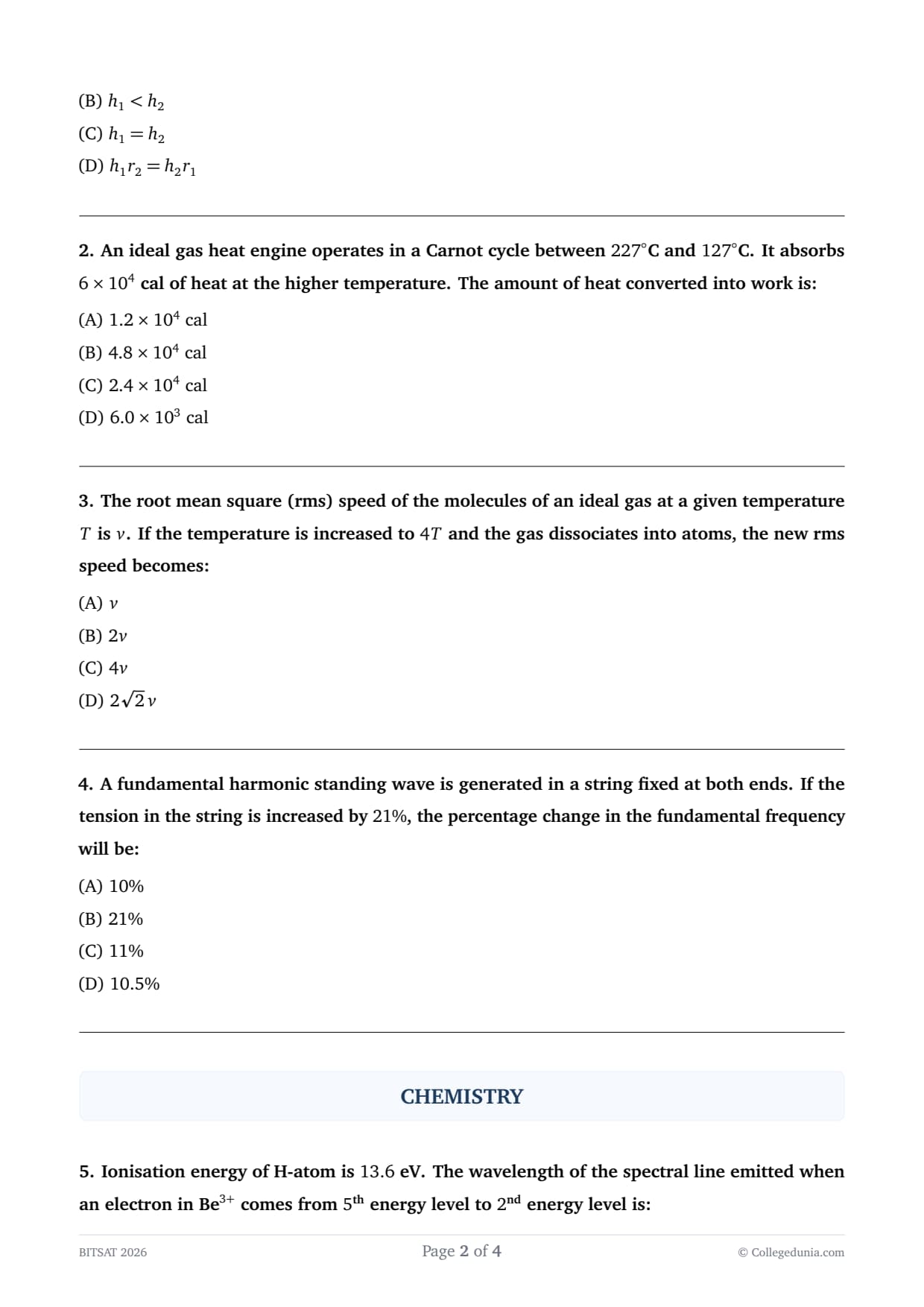


Two capillary tubes of radii \(r_1\) and \(r_2\) \((r_1 > r_2)\) are dipped vertically in the same liquid. The rise of liquid in the tubes \(h_1\) and \(h_2\) satisfies:
An ideal gas heat engine operates in a Carnot cycle between \(227^°C\) and \(127^°C\). It absorbs \(6 \times 10^4 cal\) of heat at the higher temperature. The amount of heat converted into work is:
The root mean square (rms) speed of the molecules of an ideal gas at a given temperature \(T\) is \(v\). If the temperature is increased to \(4T\) and the gas dissociates into atoms, the new rms speed becomes:
A fundamental harmonic standing wave is generated in a string fixed at both ends. If the tension in the string is increased by \(21%\), the percentage change in the fundamental frequency will be:
Ionisation energy of H-atom is \(13.6 eV\). The wavelength of the spectral line emitted when an electron in \(Be^{3+}\) comes from \(5^{th}\) energy level to \(2^{nd}\) energy level is:
\(10 g\) each of \(CH_4\) and \(O_2\) are kept in cylinders of same volume under same temperature, give the pressure ratio of two gases:
In a cyclic \(pV\) process forming a square loop from \((p = 1 atm, V = 2L)\) to \((p = 3 atm, V = 4L)\), then, the net heat absorbed by the gas is:
The temperature in K at which \(\Delta G = 0\), for a given reaction with \(\Delta H = -20.5 kJ mol^{-1}\) and \(\Delta S = -50.0 J K^{-1} mol^{-1}\) is:
The value of \(\lim_{n \rightarrow \infty} \prod_{r=3}^{n} \frac{r^3 - 8}{r^3 + 8}\) equals to:
The point of inflexion for the curve \(y = (x - a)^n\), where \(n\) is an odd integer and \(n \ge 3\) is:
If \(y^x = e^{y - x}\), then \(\frac{dy}{dx}\) is equal to:
The domain of the function \(f(x) = \sqrt{x - \sqrt{1 - x^2}}\) is:
BITSAT 2026 Chapter-Wise Weightage
Physics
| Chapter | Expected Weightage (%) |
|---|---|
| Laws of Motion | 8–10% |
| Current Electricity | 7–9% |
| Ray Optics & Wave Optics | 6–8% |
| Thermodynamics | 6–7% |
| Electrostatics | 5–7% |
Chemistry
| Chapter | Expected Weightage (%) |
|---|---|
| Chemical Bonding | 8–10% |
| Organic Chemistry (Basics + Reactions) | 10–12% |
| Coordination Compounds | 6–8% |
| Electrochemistry | 5–7% |
| p-Block Elements | 6–8% |
Mathematics
| Chapter | Expected Weightage (%) |
|---|---|
| Calculus (Limits, Integration, Differentiation) | 12–15% |
| Vectors & 3D Geometry | 8–10% |
| Complex Numbers & Quadratic Equations | 6–8% |
| Probability | 6–8% |
| Coordinate Geometry | 7–9% |



Comments