




BITSAT 2010 Question Paper PDF is available for download. BITSAT 2010 was conducted in online CBT mode by BITS Pilani. BITSAT 2010 Question Paper had 150 questions to be attempted in 3 hours.
BITSAT 2010 Question Paper with Answer Key PDF
| BITSAT 2010 Question Paper with Solution PDF | Download PDF | Check Solutions |
If \( P \) represents radiation pressure, \( c \) represents speed of light and \( Q \) represents radiation energy striking a unit area per second, the non-zero integers \( x, y \) and \( z \) such that \( P^{x} Q^{y} c^{z} \) is dimensionless, are:
The position \( x \) of a particle varies with time \( t \) as \( x = At^{2} - Bt^{3} \). The acceleration at the time of the maximum velocity will be equal to zero. What is the value of \( t \)?
Two projectiles A and B are thrown with the same speed but at angles \(40^\circ\) and \(50^\circ\) with the horizontal. Then
A body is travelling in a circle at a constant speed. It
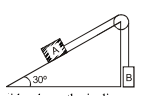
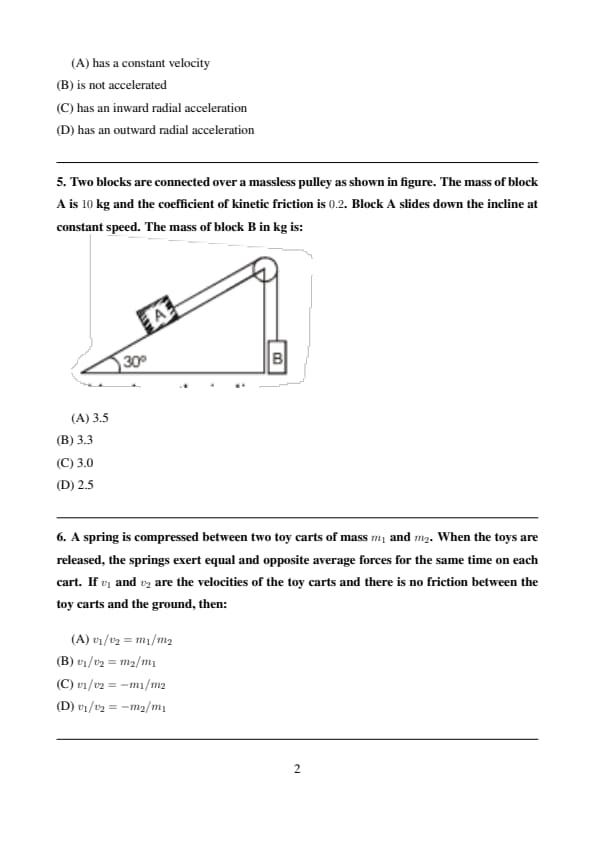
Two blocks are connected over a massless pulley as shown in figure. The mass of block A is \(10 kg\) and the coefficient of kinetic friction is \(0.2\). Block A slides down the incline at constant speed. The mass of block B in kg is:
A spring is compressed between two toy carts of mass \( m_1 \) and \( m_2 \). When the toys are released, the springs exert equal and opposite average forces for the same time on each cart. If \( v_1 \) and \( v_2 \) are the velocities of the toy carts and there is no friction between the toy carts and the ground, then:
The potential energy for a force field is given by \( U(x,y) = \cos(x+y) \). The force acting on a particle at position given by coordinates \( (0, \pi/4) \) is:
A long string is stretched by 2 cm and the potential energy is \(V\). If the spring is stretched by 10 cm, its potential energy will be
The ratio of the accelerations for a solid sphere (mass \(m\) and radius \(R\)) rolling down an incline of angle \( \theta \) without slipping and slipping down the incline without rolling is
A system consists of three particles each of mass \(m\) and located at (1,1), (2,2) and (3,3). The coordinates of the centre of mass are
Suppose the gravitational force varies inversely as the \(n\)th power of distance. Then the time period of a planet in circular orbit of radius \(R\) around the sun will be proportional to
Two planets A and B have the same material density. If the radius of A is twice that of B, then the ratio of the escape velocity \(v_A/v_B\) is
The upper end of a wire of diameter 12 mm and length 1 m is clamped and its other end is twisted through an angle of \(30^\circ\). The angle of shear is
A spherical ball is dropped in a long column of viscous liquid. The speed \(v\) of the ball as a function of time \(t\) may be best represented by

Two mercury drops (each of radius \(r\)) merge to form a bigger drop. The surface energy of the bigger drop, if the surface tension is \(T\), is
Two circular plates of radius 5 cm each have a 0.01 mm thick water film between them. What will be the force required to separate these plates? (Surface tension of water = 73 dyne/cm)
One kilogram of ice at \(0^\circC\) is mixed with one kilogram of water at \(80^\circC\). The final temperature of the mixture is (Take specific heat of water = \(4200\,J kg^{-1}K^{-1}\), Latent heat of ice = \(336\,kJ kg^{-1}\))
In the equation \(PV^\gamma=constant\), the value of \(\gamma\) is unity. Then the process is
An ideal refrigerator has a freezer at a temperature of \(130^\circC\). The coefficient of performance of the engine is 5. The temperature of the air (to which heat is rejected) is
3 moles of an ideal gas at temperature \(27^\circC\) are mixed with 2 moles of an ideal gas at temperature \(227^\circC\). Determine the equilibrium temperature of the mixture, assuming no loss of energy.
A simple pendulum has time period \(T\). Its time period in a lift which is moving upwards with acceleration \(3\,m s^{-2}\) is
A wave \(y=a\sin(\omega t-kx)\) on a string meets with another wave producing a node at \(x=0\). Then the equation of the unknown wave is
A source has wavelength 60 cm when it is stationary. If the speed of sound in air is \(320\,m s^{-1}\) and the source moves with speed \(20\,m s^{-1}\), the wavelength in the forward direction will be
A charge \(+q\) is at a distance \(L/2\) above a square of side \(L\). Then what is the flux linked with the surface?
Two metallic spheres of radii 1 cm and 3 cm are given charges of \(-1\times10^{-2}\,C\) and \(5\times10^{-2}\,C\) respectively. If these are connected by a conducting wire, the final charge on the bigger sphere is
In a region, the potential is represented by \(V(x,y,z)=6x-8xy-8y+6yz\), where \(V\) is in volts and \(x,y,z\) are in metres. The electric force experienced by a charge of 2 coulomb situated at point \((1,1,1)\) is:
The power dissipated in the circuit shown in the figure is \(30\,W\). The value of \(R\) is

Which of the following quantities does not change when a resistor connected to a battery is heated due to the current?
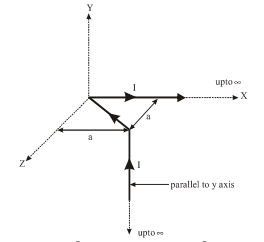
The magnetic field at the origin due to the current flowing in the wire shown is
The back emf induced in a coil, when current changes from 1 ampere to zero in one milli-second, is 4 volts. The self inductance of the coil is
Two solenoids of same cross-sectional area have their lengths and number of turns in ratio of \(1:2\). The ratio of self-inductance of two solenoids is
An alternating voltage \(V=V_0\sin\omega t\) is applied across a circuit. As a result, a current \(I=I_0\sin(\omega t-\pi/2)\) flows in it. The power consumed per cycle is
A resistance \(R\) and inductance \(L\) and a capacitor \(C\) are connected in series with an AC supply. The resistance of \(R\) is \(16\,\Omega\), inductive reactance \(=24\,\Omega\) and capacitive reactance \(=12\,\Omega\). If the current in the circuit is \(5\,A\), find the potential difference across \(R, L\) and \(C\).
The diameter of the objective of a telescope is \(a\), its magnifying power is \(m\) and wavelength of light is \(\lambda\). The resolving power of the telescope is
The photoelectric threshold of a metal is \(2000\AA\). The energy of electrons ejected from the surface by ultraviolet light of wavelength \(1500\AA\) is
A material particle with a rest mass \(m_0\) is moving with a velocity of light \(c\). Then the wavelength of the de Broglie wave associated with it is
Hydrogen atom in ground state is excited by a monochromatic radiation of \(\lambda=975\AA\). Number of spectral lines in the resulting spectrum emitted will be
Which of the following is best nuclear fuel
A transistor has a base current of \(1\,mA\) and emitter current \(90\,mA\). The collector current will be
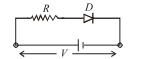
A d.c. battery of \(V\) volts is connected to a series combination of a resistor \(R\) and an ideal diode \(D\) as shown in the figure below. The potential difference across \(R\) will be
The vapour density of ozone is
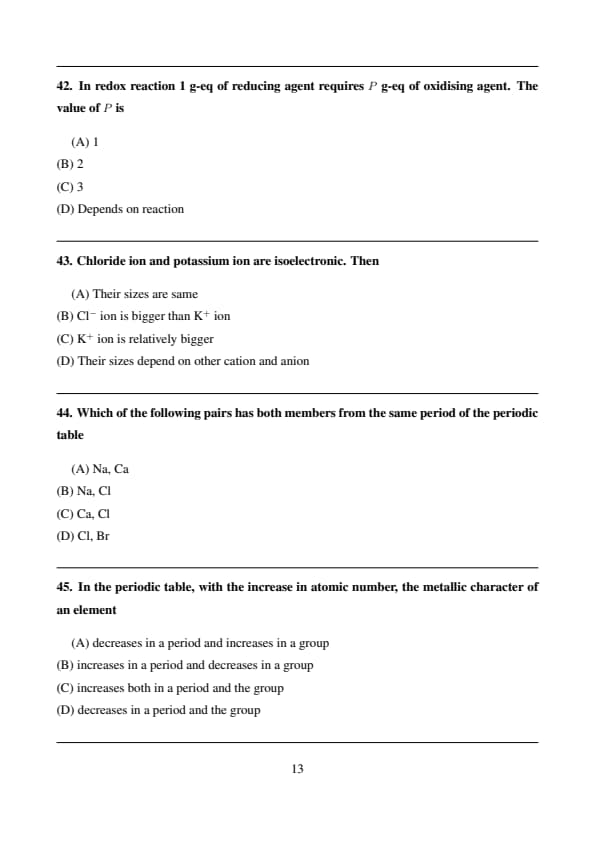
In redox reaction 1 g-eq of reducing agent requires \(P\) g-eq of oxidising agent. The value of \(P\) is
Chloride ion and potassium ion are isoelectronic. Then
Which of the following pairs has both members from the same period of the periodic table
In the periodic table, with the increase in atomic number, the metallic character of an element
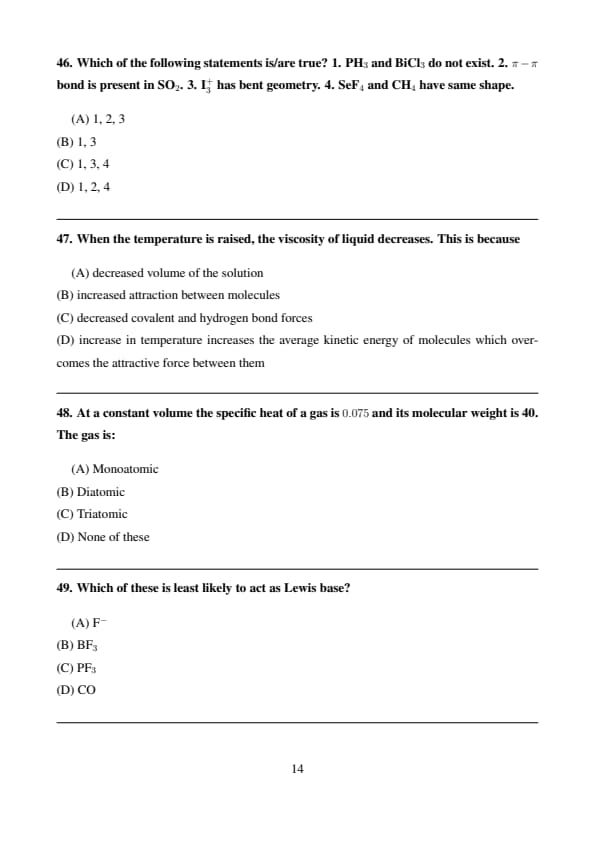
Which of the following statements is/are true?
1. PH\(_3\) and BiCl\(_3\) do not exist.
2. \(\pi-\pi\) bond is present in SO\(_2\).
3. I\(_3^+\) has bent geometry.
4. SeF\(_4\) and CH\(_4\) have same shape.
When the temperature is raised, the viscosity of liquid decreases. This is because
At a constant volume the specific heat of a gas is \(0.075\) and its molecular weight is 40. The gas is:
Which of these is least likely to act as Lewis base?
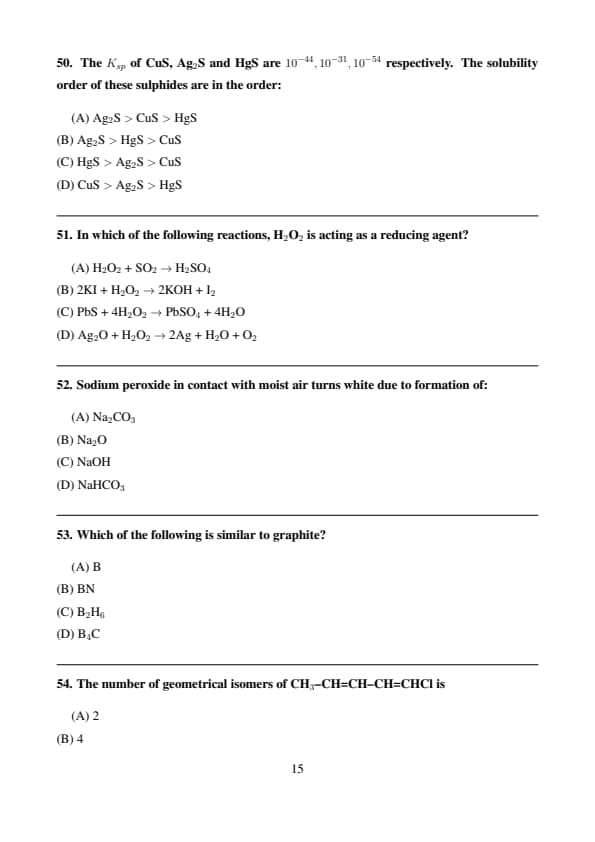
The \(K_{sp}\) of CuS, Ag\(_2\)S and HgS are \(10^{-44}, 10^{-31}, 10^{-54}\) respectively. The solubility order of these sulphides are in the order:
In which of the following reactions, H\(_2\)O\(_2\) is acting as a reducing agent?
Sodium peroxide in contact with moist air turns white due to formation of:
Which of the following is similar to graphite?
The number of geometrical isomers of CH\(_3\)–CH=CH–CH=CHCl is
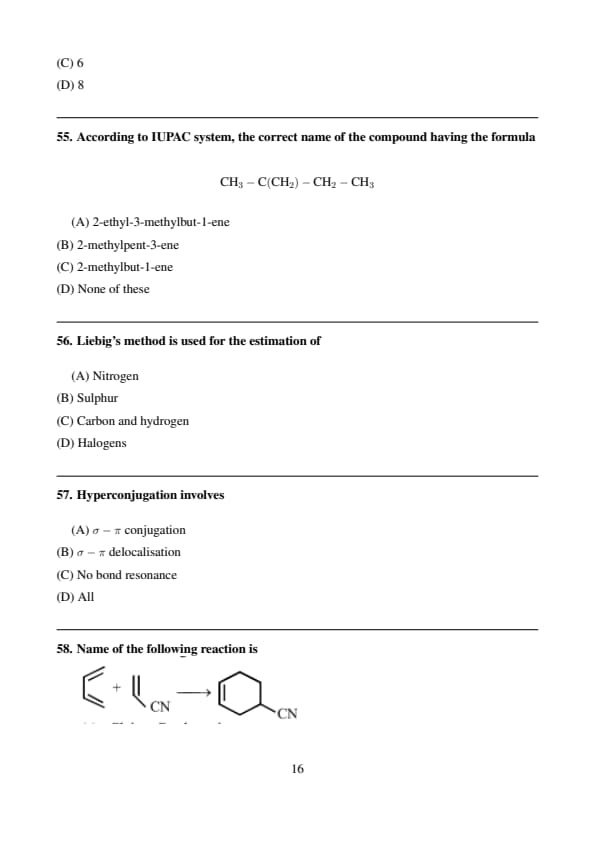
According to IUPAC system, the correct name of the compound having the formula
\[ CH_3-C(CH_2)-CH_2-CH_3 \]
Liebig’s method is used for the estimation of
Hyperconjugation involves
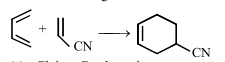
Name of the following reaction is
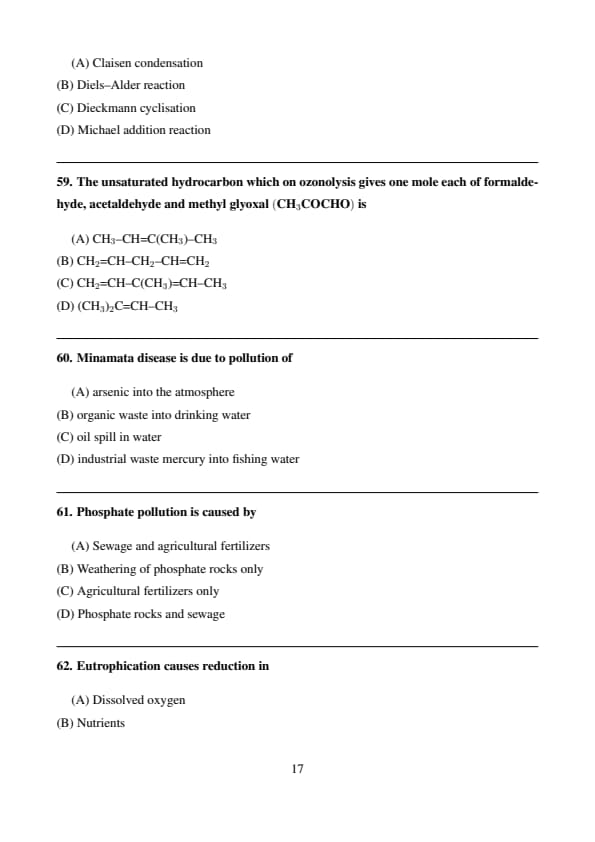
The unsaturated hydrocarbon which on ozonolysis gives one mole each of formaldehyde, acetaldehyde and methyl glyoxal \((CH_3COCHO)\) is
Minamata disease is due to pollution of
Phosphate pollution is caused by
Eutrophication causes reduction in
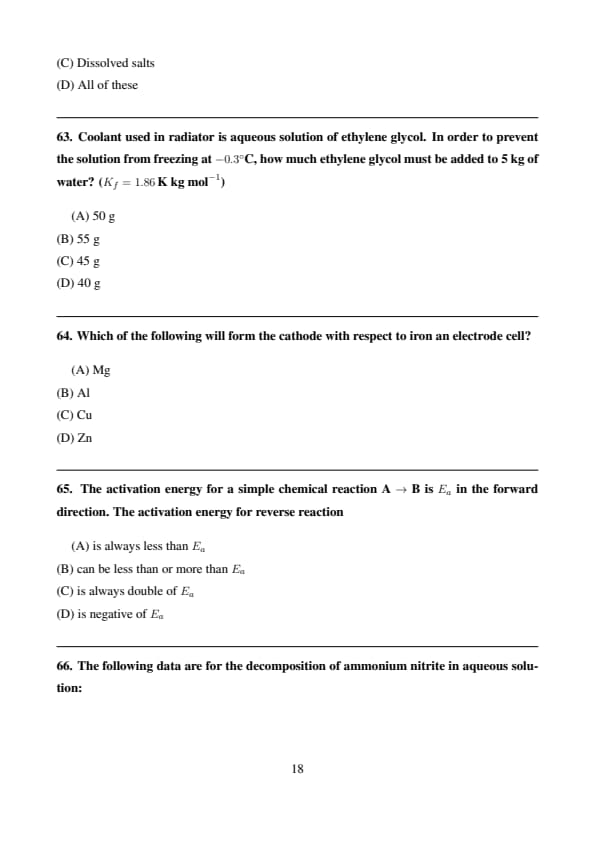
Coolant used in radiator is aqueous solution of ethylene glycol. In order to prevent the solution from freezing at \(-0.3^\circC\), how much ethylene glycol must be added to 5 kg of water?
(\(K_f = 1.86\,K kg mol^{-1}\))
Which of the following will form the cathode with respect to iron an electrode cell?
The activation energy for a simple chemical reaction A \(\rightarrow\) B is \(E_a\) in the forward direction. The activation energy for reverse reaction
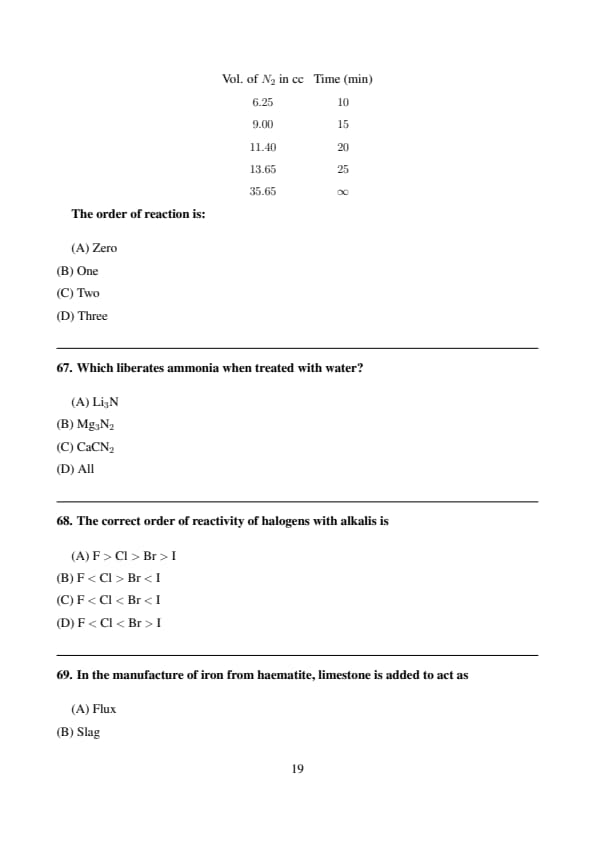
The following data are for the decomposition of ammonium nitrite in aqueous solution:
\[ \begin{array}{c c} Vol. of N_2 in cc & Time (min)
6.25 & 10
9.00 & 15
11.40 & 20
13.65 & 25
35.65 & \infty \end{array} \]
The order of reaction is:
Which liberates ammonia when treated with water?
The correct order of reactivity of halogens with alkalis is
In the manufacture of iron from haematite, limestone is added to act as
Which of the following has square planar geometry?
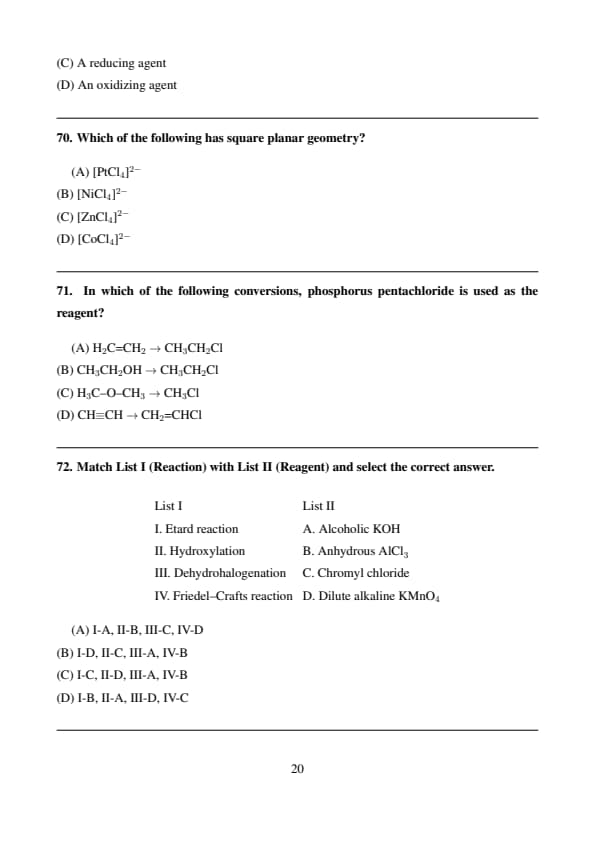
In which of the following conversions, phosphorus pentachloride is used as the reagent?
Match List I (Reaction) with List II (Reagent) and select the correct answer.
\[ \begin{array}{l l} List I & List II
I. Etard reaction & A. Alcoholic KOH
II. Hydroxylation & B. Anhydrous AlCl_3
III. Dehydrohalogenation & C. Chromyl chloride
IV. Friedel–Crafts reaction & D. Dilute alkaline KMnO_4 \end{array} \]
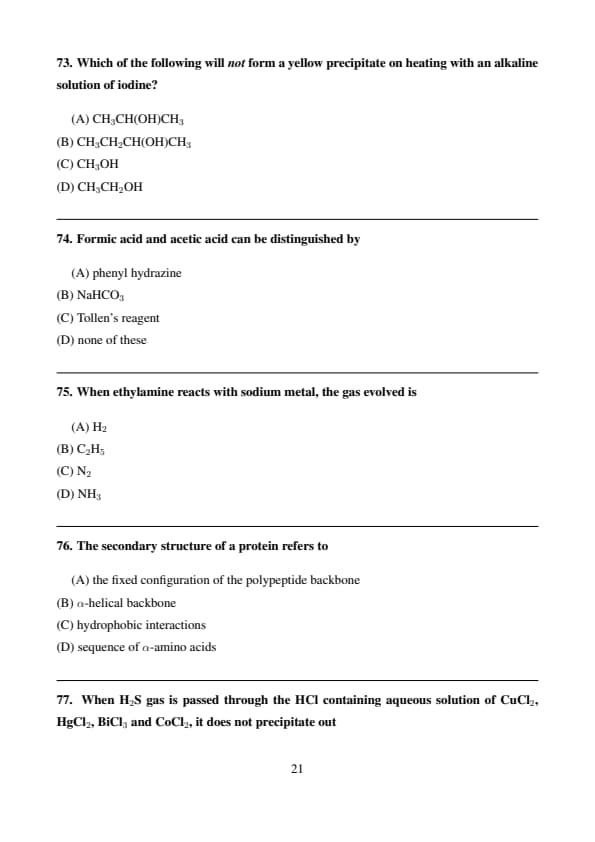
Which of the following will not form a yellow precipitate on heating with an alkaline solution of iodine?
Formic acid and acetic acid can be distinguished by
When ethylamine reacts with sodium metal, the gas evolved is
The secondary structure of a protein refers to
When H\(_2\)S gas is passed through the HCl containing aqueous solution of CuCl\(_2\), HgCl\(_2\), BiCl\(_3\) and CoCl\(_2\), it does not precipitate out
Which one of the following statements is correct?
Three separate samples of a solution of a single salt gave these results. One formed a white precipitate with excess ammonia solution, one formed a white precipitate with dil. HCl solution and one formed a black precipitate with H\(_2\)S. The salt could be
Experiment to study kinetics of the dissociation of hydrogen peroxide must be performed by group of two or three so that
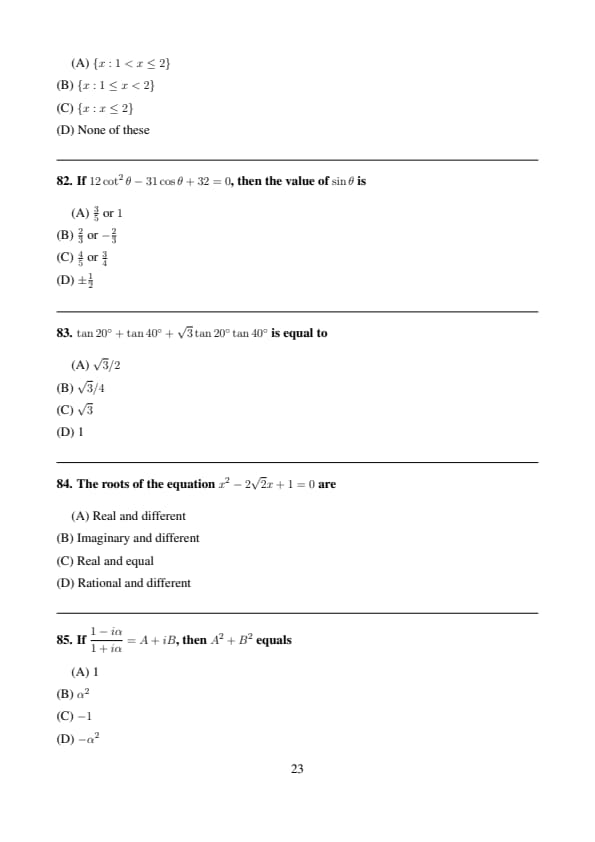
Let \(A=\{x:x\in \mathbb{R}, |x|<1\}\); \(B=\{x:x\in \mathbb{R}, |x-1|\ge 1\}\) and \(A\cup B=\mathbb{R}-D\), then the set \(D\) is
If \(12\cot^2\theta-31\cos\theta+32=0\), then the value of \(\sin\theta\) is
\(\tan20^\circ+\tan40^\circ+\sqrt{3}\tan20^\circ\tan40^\circ\) is equal to
The roots of the equation \(x^2-2\sqrt{2}x+1=0\) are
If \(\dfrac{1-i\alpha}{1+i\alpha}=A+iB\), then \(A^2+B^2\) equals
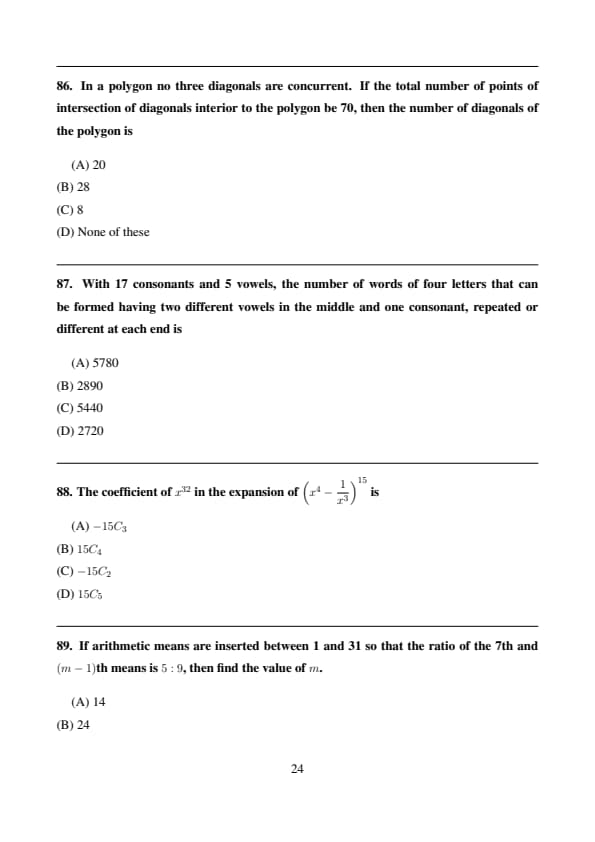
In a polygon no three diagonals are concurrent. If the total number of points of intersection of diagonals interior to the polygon be 70, then the number of diagonals of the polygon is
With 17 consonants and 5 vowels, the number of words of four letters that can be formed having two different vowels in the middle and one consonant, repeated or different at each end is
The coefficient of \(x^{32}\) in the expansion of \(\left(x^{4}-\dfrac{1}{x^{3}}\right)^{15}\) is
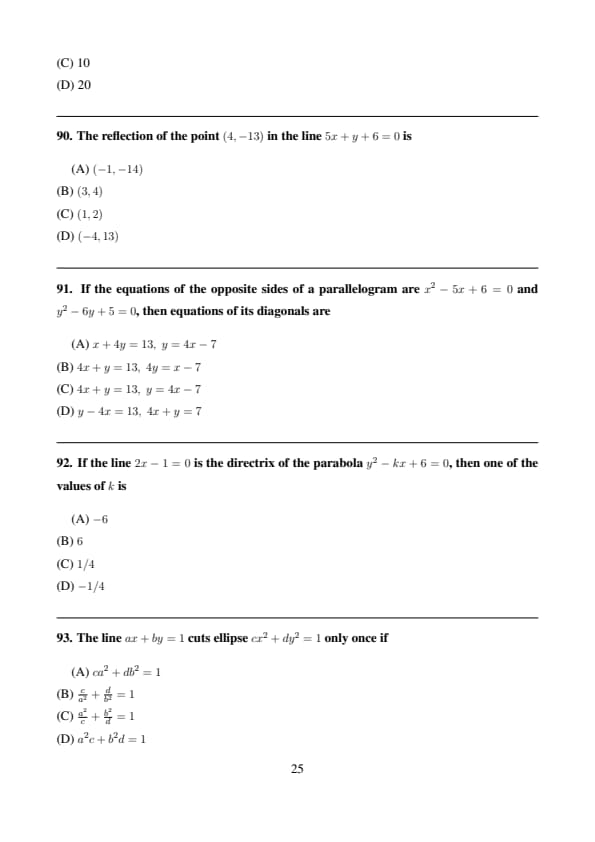
If arithmetic means are inserted between 1 and 31 so that the ratio of the 7th and \((m-1)\)th means is \(5:9\), then find the value of \(m\).
The reflection of the point \((4,-13)\) in the line \(5x+y+6=0\) is
If the equations of the opposite sides of a parallelogram are \(x^2-5x+6=0\) and \(y^2-6y+5=0\), then equations of its diagonals are
If the line \(2x-1=0\) is the directrix of the parabola \(y^2-kx+6=0\), then one of the values of \(k\) is
The line \(ax+by=1\) cuts ellipse \(cx^2+dy^2=1\) only once if
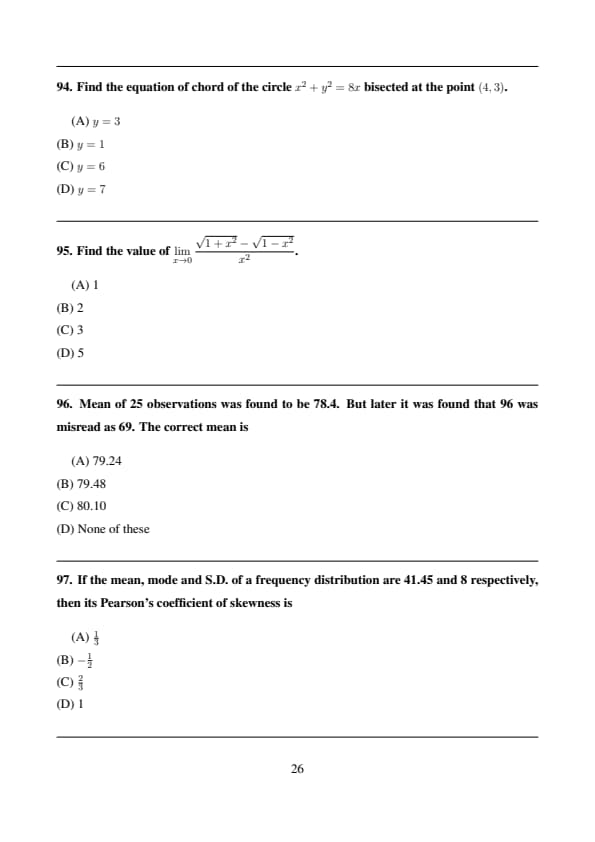
Find the equation of chord of the circle \(x^2+y^2=8x\) bisected at the point \((4,3)\).
Find the value of \(\displaystyle\lim_{x\to0}\frac{\sqrt{1+x^2}-\sqrt{1-x^2}}{x^2}\).
Mean of 25 observations was found to be 78.4. But later it was found that 96 was misread as 69. The correct mean is
If the mean, mode and S.D. of a frequency distribution are 41.45 and 8 respectively, then its Pearson’s coefficient of skewness is
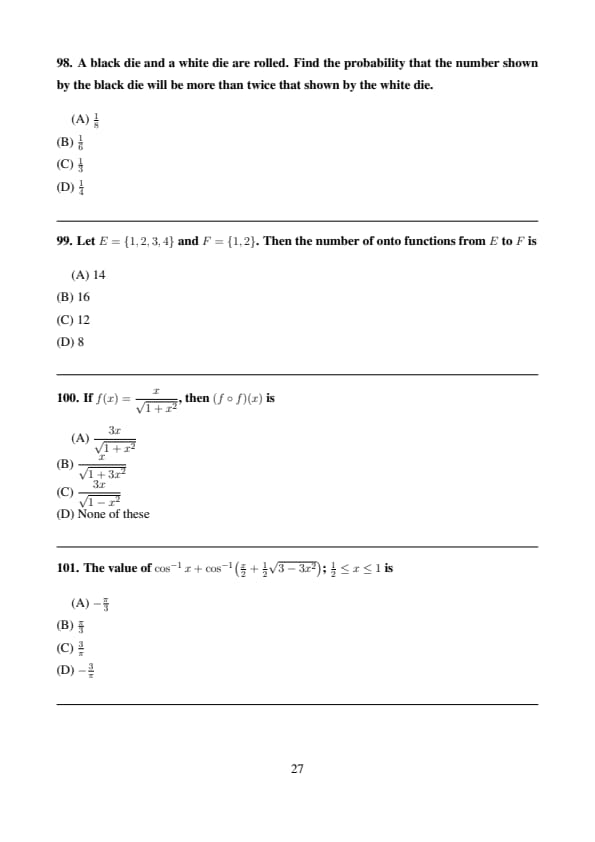
A black die and a white die are rolled. Find the probability that the number shown by the black die will be more than twice that shown by the white die.
Let \(E=\{1,2,3,4\}\) and \(F=\{1,2\}\). Then the number of onto functions from \(E\) to \(F\) is
If \(f(x)=\dfrac{x}{\sqrt{1+x^2}}\), then \((f\circ f)(x)\) is
The value of \(\cos^{-1}x+\cos^{-1}\!\left(\frac{x}{2}+\frac{1}{2}\sqrt{3-3x^2}\right)\); \(\frac12\le x\le1\) is
If \(A=\begin{bmatrix}1&3
3&2
2&5\end{bmatrix}\) and \(B=\begin{bmatrix}-1&-2
0&5
3&1\end{bmatrix}\) and \(A+B-D=0\) (zero matrix), then \(D\) matrix will be
The value of \[ \begin{vmatrix} 1 & 2 & 3
-4 & 3 & 6
2 & -7 & 9 \end{vmatrix} \]
is
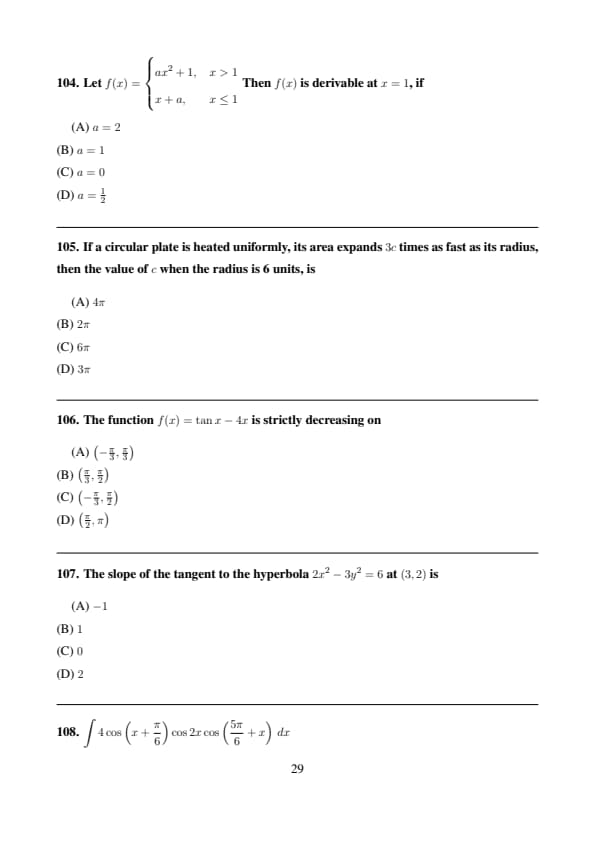
Let \(f(x)=\begin{cases} ax^2+1, & x>1
x+a, & x\le1 \end{cases}\)
Then \(f(x)\) is derivable at \(x=1\), if
If a circular plate is heated uniformly, its area expands \(3c\) times as fast as its radius, then the value of \(c\) when the radius is 6 units, is
The function \(f(x)=\tan x-4x\) is strictly decreasing on
The slope of the tangent to the hyperbola \(2x^2-3y^2=6\) at \((3,2)\) is
\(\displaystyle \int 4\cos\left(x+\frac{\pi}{6}\right)\cos2x\cos\left(\frac{5\pi}{6}+x\right)\,dx\)
If \(I_m=\displaystyle\int_0^1 (\ln x)^m dx\), where \(m\in\mathbb{N}\), then \(I_{10}+10I_9\) is equal to
The area of the region bounded by the curve \(y=x|x|\), x-axis and the ordinates \(x=1, x=-1\) is given by
What is the solution of \(\dfrac{dy}{dx}+2y=1\) satisfying \(y(0)=0\)?
The solution of differential equation \(2x\dfrac{dy}{dx}-y=3\) represents a family of
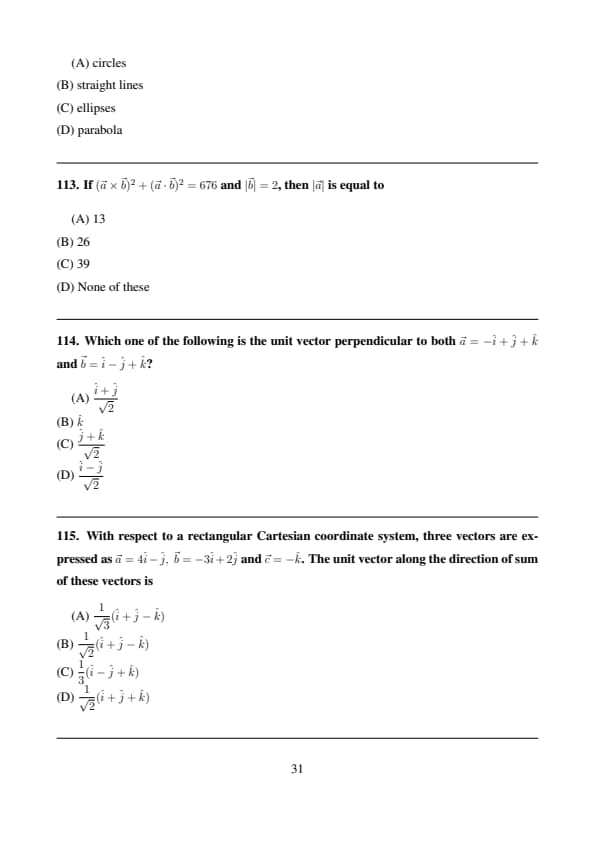
If \((\vec a \times \vec b)^2 + (\vec a \cdot \vec b)^2 = 676\) and \(|\vec b| = 2\), then \(|\vec a|\) is equal to
Which one of the following is the unit vector perpendicular to both \(\vec a = -\hat i + \hat j + \hat k\) and \(\vec b = \hat i - \hat j + \hat k\)?
With respect to a rectangular Cartesian coordinate system, three vectors are expressed as \(\vec a = 4\hat i-\hat j,\; \vec b=-3\hat i+2\hat j\) and \(\vec c=-\hat k\).
The unit vector along the direction of sum of these vectors is
If the midpoints of sides \(BC, CA, AB\) of triangle \(ABC\) are respectively \(D, E, F\), then position vector of centre of triangle \(DEF\), when position vectors of \(A, B, C\) are respectively \(\hat i+\hat j,\; \hat j+\hat k,\; \hat k+\hat i\), is
The perpendicular distance of point \(P(1,2,3)\) from the line \(\dfrac{x-6}{3}=\dfrac{y-7}{2}=\dfrac{z-7}{-2}\) is
The equation of the plane containing the line \(\dfrac{x-x_1}{\ell}=\dfrac{y-y_1}{m}=\dfrac{z-z_1}{n}\)
is \(a(x-x_1)+b(y-y_1)+c(z-z_1)=0\), then
If mean of a Poisson distribution of a random variable \(X\) is 2, then the value of \(P(X>1.5)\) is
If \(P(A\cup B)=\dfrac{2}{3},\; P(A\cap B)=\dfrac{1}{6}\) and \(P(A)=\dfrac{1}{3}\), then
A flagstaff of 6 metres high placed on the top of a tower throws a shadow of \(2\sqrt3\) metres along the ground, when the angle (in degrees) which the sun makes with the ground is
A wholesale merchant wants to start the business of cereal with ₹24000. Wheat is ₹400 per quintal and rice is ₹600 per quintal. He has capacity to store 200 quintal cereal. He earns the profit ₹25 per quintal on wheat and ₹40 per quintal on rice. If he stores \(x\) quintal rice and \(y\) quintal wheat, then maximum profit is the objective function
The minimum value of \(\dfrac{x^4+y^4+z^4}{xyz}\) for positive real numbers \(x,y,z\) is
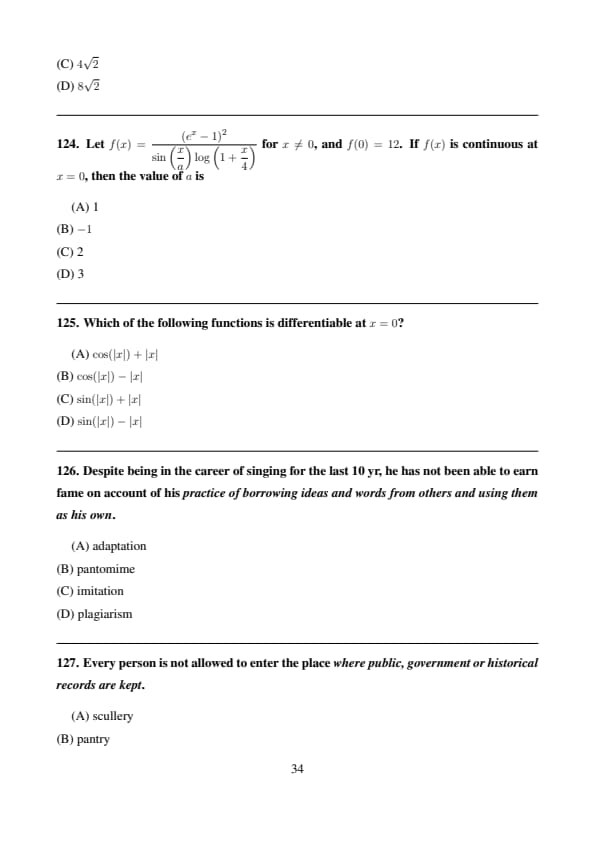
Let \(f(x)=\dfrac{(e^x-1)^2}{\sin\left(\dfrac{x}{a}\right)\log\left(1+\dfrac{x}{4}\right)}\) for \(x\neq0\), and \(f(0)=12\).
If \(f(x)\) is continuous at \(x=0\), then the value of \(a\) is
Which of the following functions is differentiable at \(x=0\)?
Despite being in the career of singing for the last 10 yr, he has not been able to earn fame on account of his practice of borrowing ideas and words from others and using them as his own.
Every person is not allowed to enter the place where public, government or historical records are kept.
The advertisement assured the public that the medicine would give back to the users, their youthful vigour and appearance.
Choose the alternative which is most similar in meaning to the word given in capital letters.
\textbf{PARAMOUR}
Choose the alternative which is most similar in meaning to the word given in capital letters.
\textbf{REFECTORY}
Choose the alternative which is most similar in meaning to the word given in capital letters.
\textbf{ASSENT}
Choose the alternative which expresses the meaning of the given idiom/phrase.
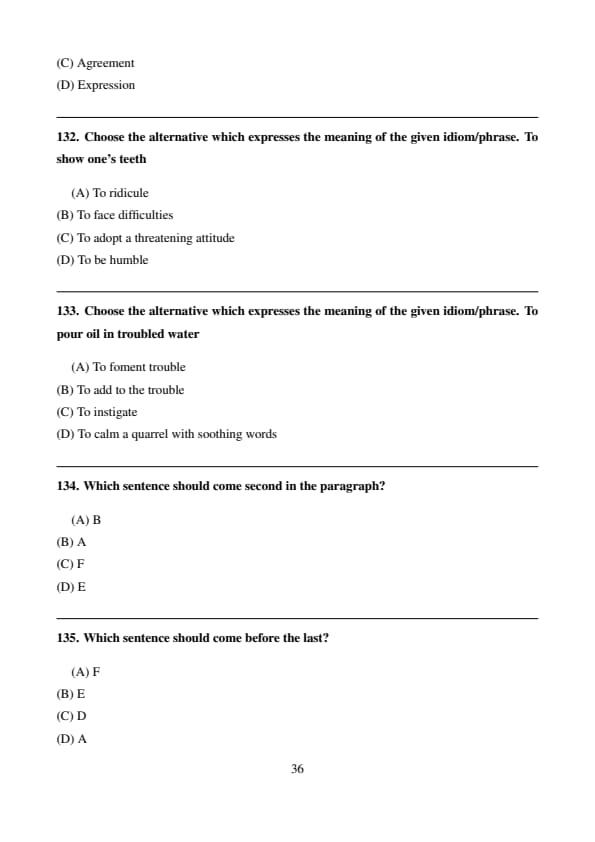
\textbf{To show one’s teeth}
Choose the alternative which expresses the meaning of the given idiom/phrase.
\textbf{To pour oil in troubled water}
Which sentence should come second in the paragraph?
Which sentence should come before the last?
Which sentence will come complete the passage?
Which sentence will come third after the rearrangement?
Which sentence will start the passage?
A novel of real \hspace{1cm} must invent its own language, and this one does.
Information technology, and the hardware and software \hspace{1cm} with the IT industry.
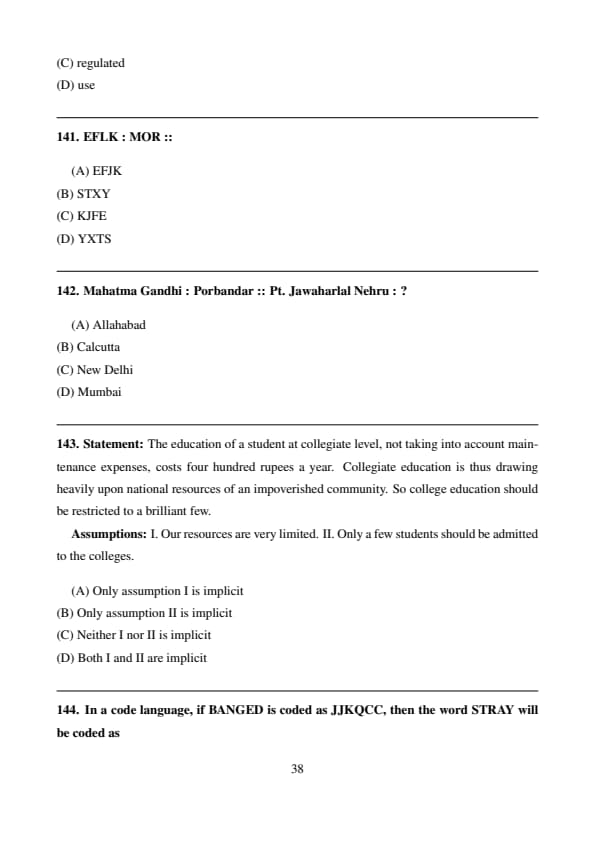
EFLK : MOR ::
Mahatma Gandhi : Porbandar :: Pt. Jawaharlal Nehru : ?
Statement: The education of a student at collegiate level, not taking into account maintenance expenses, costs four hundred rupees a year. Collegiate education is thus drawing heavily upon national resources of an impoverished community. So college education should be restricted to a brilliant few.
Assumptions:
I. Our resources are very limited.
II. Only a few students should be admitted to the colleges.
In a code language, if BANGED is coded as JJKQCC, then the word STRAY will be coded as
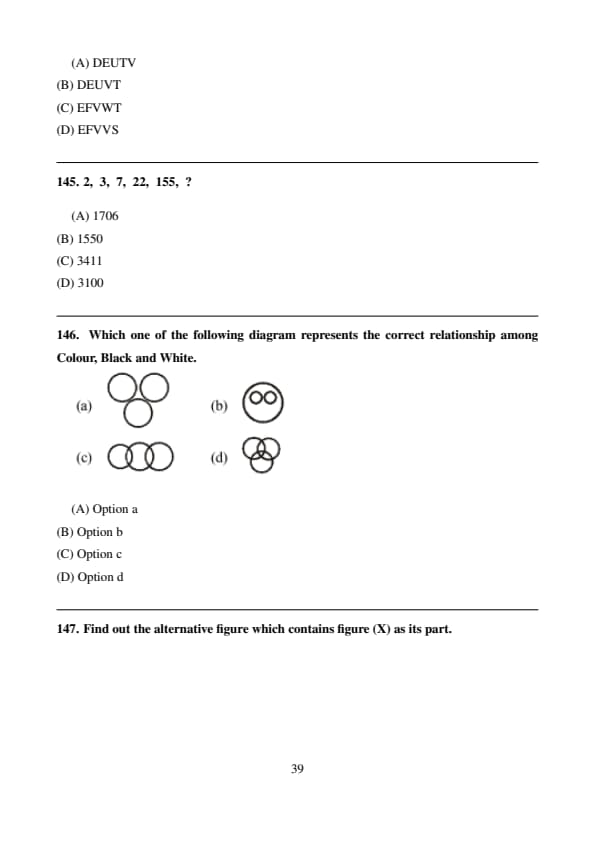
2,\; 3,\; 7,\; 22,\; 155,\; ?
Which one of the following diagram represents the correct relationship among Colour, Black and White.

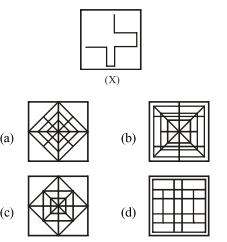
Find out the alternative figure which contains figure (X) as its part.
A piece of paper is folded and cut. From the figures given, indicate how it will appear when opened.


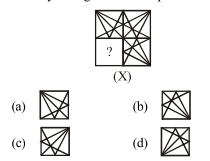
Identify the figure that completes the pattern.
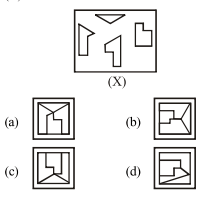
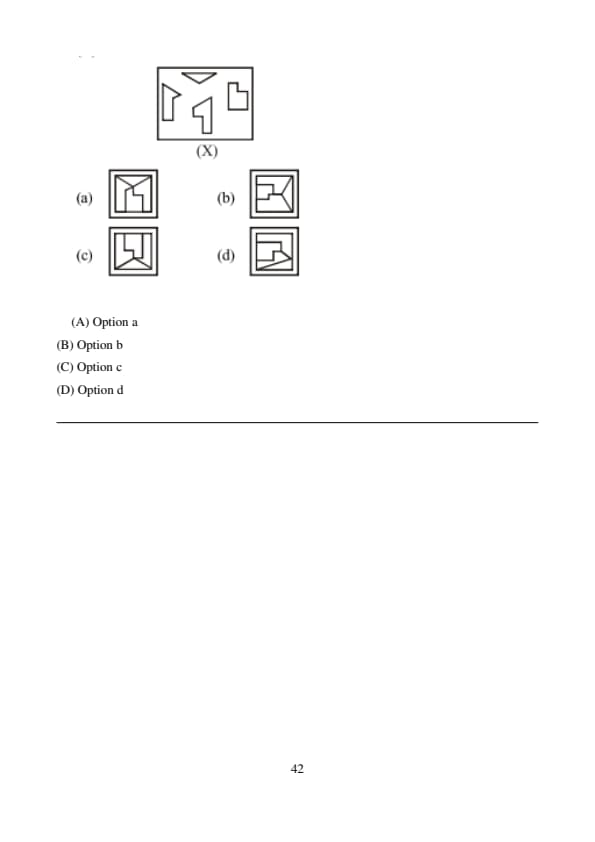
Find out which of the figures (a), (b), (c) and (d) can be formed from the pieces given in figure (X).















Comments