




KCET 2022 Biology C-1 Question Paper with Answer Key pdf is available for download. The exam was conducted by Karnataka Examination Authority (KEA) on June 16, 2022 In terms of difficulty level, KCET Biology was of Easy to Moderate level. The question paper comprised a total of 60 questions.
KCET 2022 Biology (C-1) Question Paper with Answer Key
| KCET Biology (C-1) Question Paper 2022 with Answer Key |  Download Download |
Check Solution |

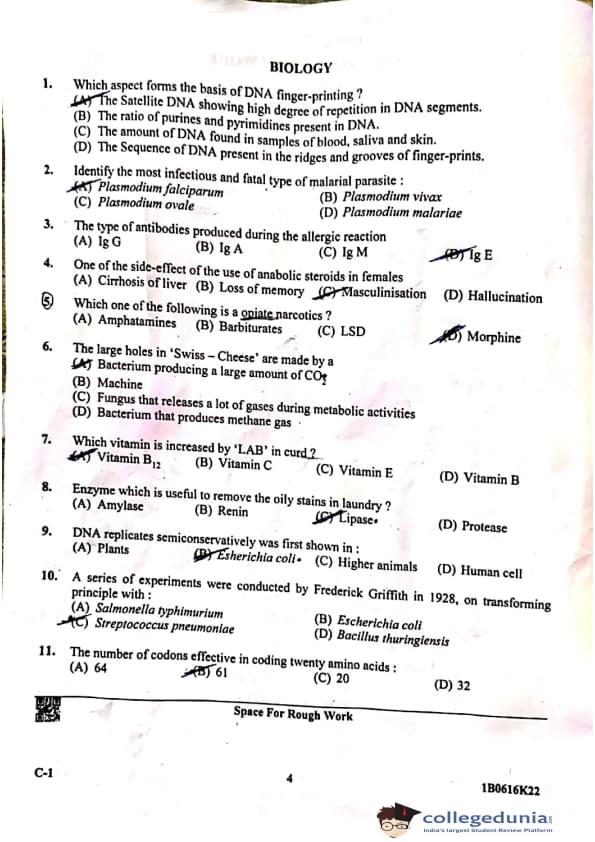
Which aspect forms the basis of DNA finger-printing?
View Solution
Step 1: DNA fingerprinting uses VNTRs (Variable Number Tandem Repeats) in satellite DNA.
Step 2: These are highly repetitive, non-coding regions with variable repeat lengths.
Step 3: Produce unique banding patterns after restriction digestion and gel electrophoresis. Quick Tip: Alec Jeffreys (1984) → father of DNA fingerprinting.
Identify the most infectious and fatal type of malarial parasite:
View Solution
Step 1: P. falciparum causes malignant tertian malaria.
Step 2: High parasitemia, cytoadherence → cerebral malaria.
Step 3: Highest mortality rate. Quick Tip: Falciparum → ring forms, banana gametocytes.
The type of antibodies produced during the allergic reaction:
View Solution
Step 1: Type I hypersensitivity → mediated by IgE.
Step 2: Binds to mast cells → histamine release on allergen exposure.
Step 3: Causes asthma, hay fever, anaphylaxis. Quick Tip: Desensitization → allergen immunotherapy.
One of the side-effects of the use of anabolic steroids in females:
View Solution
Step 1: Anabolic steroids → synthetic androgens.
Step 2: In females → virilization: hirsutism, voice deepening, clitoral enlargement.
Step 3: Liver damage possible but not gender-specific. Quick Tip: Nandrolone, stanozolol → common anabolic steroids.
Which one of the following is an opiate narcotics?
View Solution
Step 1: Opiates → derived from opium (Papaver somniferum).
Step 2: Morphine → principal alkaloid → analgesic, sedative.
Step 3: LSD (hallucinogen), amphetamines (stimulant), barbiturates (sedative). Quick Tip: Codeine, heroin → semi-synthetic opiates.
The large holes in ‘Swiss – Cheese’ are made by a:
View Solution
Step 1: Propionibacterium shermanii used in Swiss cheese.
Step 2: Ferments lactate → propionic acid + CO₂.
Step 3: CO₂ trapped → forms eyes (holes). Quick Tip: Emmental cheese → large eyes.
Which vitamin is increased by ‘LAB’ in curd?
View Solution
Step 1: Lactic Acid Bacteria (LAB) synthesize B₁₂ during milk fermentation.
Step 2: Curd → rich source of cobalamin.
Step 3: Important for vegetarians. Quick Tip: Yogurt → probiotic + B₁₂.
Enzyme which is useful to remove the oily stains in laundry?
View Solution
Step 1: Oily stains → triglycerides.
Step 2: Lipase hydrolyzes fats → glycerol + fatty acids.
Step 3: Used in biological detergents. Quick Tip: Tide, Ariel → contain lipase, protease.
DNA replicates semiconservatively was first shown in:
View Solution
Step 1: Meselson-Stahl experiment (1958).
Step 2: Used E. coli with ¹⁵N (heavy) → switched to ¹⁴N.
Step 3: Density gradient → hybrid band → semiconservative. Quick Tip: Conservative, dispersive → ruled out.
A series of experiments were conducted by Frederick Griffith in 1928, on transforming principle with:
View Solution
Step 1: Griffith’s transformation experiment.
Step 2: S strain (virulent) + heat-killed S + R strain → virulent mice.
Step 3: Transforming principle = DNA (later proved). Quick Tip: Avery, MacLeod, McCarty (1944) → DNA is genetic material.
The number of codons effective in coding twenty amino acids:
View Solution
Step 1: Total codons = 4³ = 64.
Step 2: 3 stop codons (UAA, UAG, UGA).
Step 3: 61 codons code for 20 amino acids (degenerate code). Quick Tip: AUG → start + methionine.
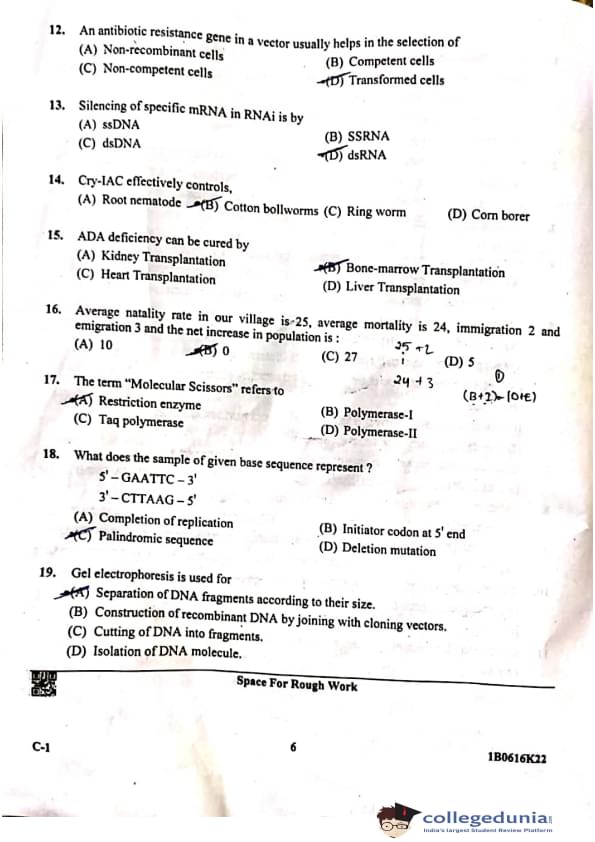
An antibiotic resistance gene in a vector usually helps in the selection of
View Solution
Step 1: Antibiotic resistance gene (e.g., amp\^R) is a selectable marker in vectors.
Step 2: Only transformed cells (that uptake plasmid) survive on antibiotic medium.
Step 3: Non-transformed cells die → selection of transformed cells. Quick Tip: Blue-white screening → insertional inactivation.
Silencing of specific mRNA in RNAi is by
View Solution
Step 1: RNA interference (RNAi) → gene silencing.
Step 2: dsRNA is processed by Dicer → siRNA.
Step 3: siRNA + RISC → degrades target mRNA. Quick Tip: RNAi → natural defense against viruses.
Cry-IAC effectively controls
View Solution
Step 1: Cry-IAC → Bt toxin from Bacillus thuringiensis.
Step 2: Toxic to lepidopteran larvae (bollworm).
Step 3: Used in Bt cotton. Quick Tip: Cry-IAc, Cry-IAb → bollworm; Cry-IIAb → corn borer.
ADA deficiency can be cured by
View Solution
Step 1: ADA deficiency → SCID (no T-cells).
Step 2: Bone marrow contains stem cells → produce ADA enzyme.
Step 3: Bone marrow transplant restores immunity. Quick Tip: First gene therapy (1990) → ADA deficiency.
Average natality rate in our village is 25, average mortality is 24, immigration 2 and emigration 3 and the net increase in population is:
View Solution
Step 1: Net change = (Births + Immigration) – (Deaths + Emigration)
Step 2: = (25 + 2) – (24 + 3) = 27 – 27 = 0
Step 3: Natural increase = 1; Net migration = –1 → 0 Quick Tip: ΔP = (B – D) + (I – E)
The term “Molecular Scissors” refers to
View Solution
Step 1: Restriction enzymes cut DNA at specific sites.
Step 2: Called molecular scissors in genetic engineering.
Step 3: e.g., EcoRI, HindIII. Quick Tip: Sticky ends → cohesive ends.
What does the sample of given base sequence represent? 5' – GAATTC – 3' 3' – CTTAAG – 5'
View Solution
Step 1: Sequence reads same forward and backward on complementary strands.
Step 2: 5'-GAATTC-3' = 3'-CTTAAG-5' reversed → palindrome.
Step 3: Recognition site for EcoRI. Quick Tip: Palindrome → symmetry in DNA.
Gel electrophoresis is used for
View Solution
Step 1: Agarose gel + electric field.
Step 2: DNA (–ve charge) moves to anode.
Step 3: Smaller fragments move faster → size-based separation. Quick Tip: Ethidium bromide → UV visualization.
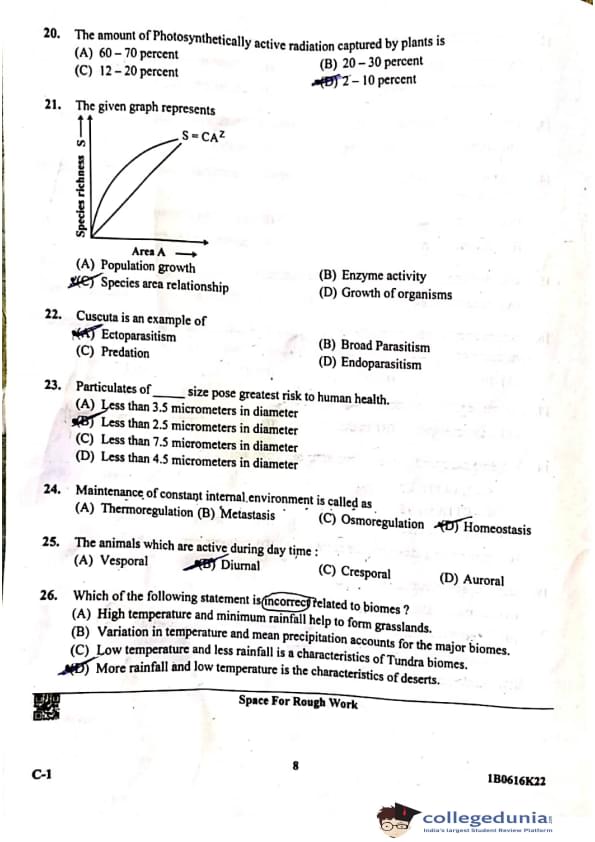
The amount of Photosynthetically active radiation captured by plants is
View Solution
Step 1: PAR (Photosynthetically Active Radiation) = 400–700 nm.
Step 2: Plants capture only 2–10% of incident solar energy.
Step 3: Most lost as heat, reflection, or unused wavelengths. Quick Tip: Only ~1% of solar energy reaches Earth; plants use fraction of PAR.
The given graph represents:

View Solution
Step 1: Equation S = cA\^z → species-area relationship (Humboldt).
Step 2: S = species richness, A = area.
Step 3: Log form: log S = log c + z log A → straight line. Quick Tip: z = 0.1–0.2 (mainland), 0.2–0.3 (islands).
Cuscuta is an example of
View Solution
Step 1: Cuscuta (dodder) → parasitic plant.
Step 2: Grows externally on host → haustoria penetrate phloem.
Step 3: Ectoparasite (outside host body). Quick Tip: Cuscuta → yellow twining stem, no chlorophyll.
Particulates of phantom{abcde} size pose greatest risk to human health.
View Solution
Step 1: PM2.5 (≤2.5 μm) → fine particulates.
Step 2: Enter alveoli, bloodstream.
Step 3: Cause asthma, COPD, heart disease → highest risk. Quick Tip: PM10 → upper airways; PM2.5 → deep lungs.
Maintenance of constant internal environment is called as
View Solution
Step 1: Homeostasis → stable internal conditions.
Step 2: Includes temperature, pH, ion balance.
Step 3: Osmoregulation, thermoregulation → components of homeostasis. Quick Tip: Walter Cannon coined "homeostasis".
The animals which are active during day time:
View Solution
Step 1: Diurnal → active in daylight (e.g., humans, birds).
Step 2: Nocturnal → night; Crepuscular → dawn/dusk.
Step 3: Vesporal, auroral → not standard. Quick Tip: Diurnal animals have good color vision.
Which of the following statement is incorrect related to biomes?
View Solution
Step 1: Deserts → high temperature, <25 cm/year rainfall.
Step 2: Option (D) says more rainfall + low temperature → incorrect.
Step 3:
- Tundra: cold, low rain
- Grasslands: moderate rain, warm
- Biomes depend on temp + precipitation Quick Tip: Tropical rainforests → high rain + high temp.
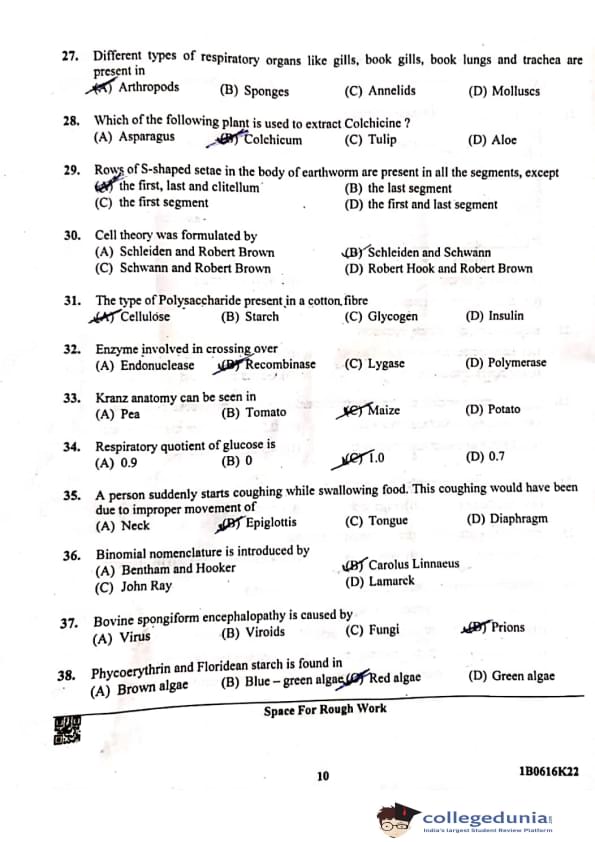
Different types of respiratory organs like gills, book gills, book lungs and trachea are present in
View Solution
Step 1: Arthropods show diverse respiratory organs:
- Gills (crustaceans)
- Book gills (horseshoe crabs)
- Book lungs (scorpions, spiders)
- Trachea (insects)
Step 2: No other phylum has all these.
Molluscs → ctenidia; Annelids → skin; Sponges → no organs. Quick Tip: Tracheae → air-filled tubes in insects.
Which of the following plant is used to extract Colchicine?
View Solution
Step 1: Colchicine → alkaloid from Colchicum autumnale (autumn crocus).
Step 2: Inhibits spindle formation → used in polyploidy induction.
Step 3: Not from tulip, aloe, or asparagus. Quick Tip: Colchicine → doubles chromosomes.
Rows of S-shaped setae in the body of earthworm are present in all the segments, except
View Solution
Step 1: Setae → locomotion in earthworm.
Step 2: Absent in:
- 1st segment (peristomium)
- Last segment (anal)
- Clitellum (14–16 segments, glandular)
Step 3: Option (A) correct. Quick Tip: Clitellum → cocoon secretion.
Cell theory was formulated by
View Solution
Step 1: M.J. Schleiden (1838) → plants made of cells.
Step 2: T. Schwann (1839) → animals made of cells.
Step 3: Cell theory (1839): all organisms cellular.
Robert Brown → nucleus (1831); Hooke → cell (1665). Quick Tip: Cell theory: 1. Cell = unit of life, 2. All organisms cellular.
The type of Polysaccharide present in a cotton fibre
View Solution
Step 1: Cotton → cell wall of seed hairs.
Step 2: Plant cell wall → cellulose (β-1,4-glucose).
Step 3: Cotton ≈ 95% cellulose → textile fiber.
Starch (storage), glycogen (animal), insulin (hormone). Quick Tip: Humans lack cellulase → can't digest cellulose.
Enzyme involved in crossing over
View Solution
Step 1: Crossing over → pachytene of meiosis.
Step 2: Recombinase (e.g., DMC1, RAD51) → strand exchange.
Step 3: Forms chiasmata → recombination.
Endonuclease → cuts DNA; ligase → seals. Quick Tip: Synaptonemal complex → holds homologues.
Kranz anatomy can be seen in
View Solution
Step 1: Kranz anatomy → C4 plants.
Step 2: Bundle sheath cells with chloroplasts.
Step 3: Maize → C4; Pea, tomato, potato → C3. Quick Tip: C4 → Hatch-Slack pathway → high efficiency.
Respiratory quotient of glucose is
View Solution
Step 1: RQ = CO₂ / O₂
Step 2: Glucose: C₆H₁₂O₆ + 6O₂ → 6CO₂ + 6H₂O
Step 3: RQ = 6/6 = 1.0
Fats → 0.7; proteins → 0.9. Quick Tip: RQ > 1 → anaerobic respiration.
A person suddenly starts coughing while swallowing food. This coughing would have been due to improper movement of
View Solution
Step 1: Epiglottis → cartilage flap over trachea.
Step 2: Closes during swallowing → prevents food entry.
Step 3: Improper closure → food in windpipe → cough reflex. Quick Tip: Choking → Heimlich maneuver.
Binomial nomenclature is introduced by
View Solution
Step 1: Carolus Linnaeus → Species Plantarum (1753).
Step 2: Binomial: Genus + species.
Step 3: Universal system → e.g., Homo sapiens. Quick Tip: ICBN → plants; ICZN → animals.
Bovine spongiform encephalopathy is caused by
View Solution
Step 1: BSE (Mad Cow) → neurodegenerative.
Step 2: Caused by prions (PrP\^Sc) → misfolded proteins.
Step 3: No nucleic acid → infects brain. Quick Tip: Prions → CJD, Kuru, Scrapie.
Phycoerythrin and Floridean starch is found in
View Solution
Step 1: Red algae → phycoerythrin (red pigment).
Step 2: Store floridean starch (α-1,4-glucan).
Step 3: Deep water → absorb blue light. Quick Tip: Agar → Gelidium, Gracilaria.
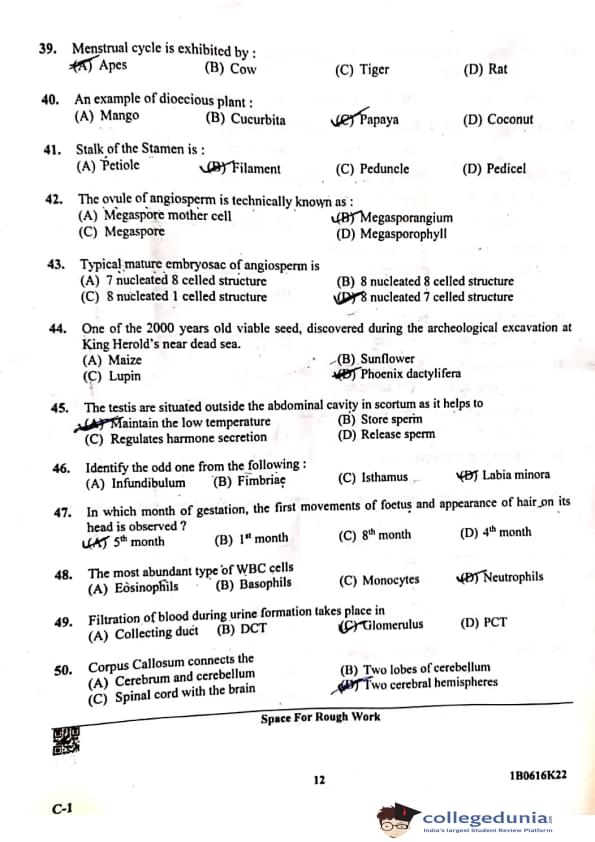
Menstrual cycle is exhibited by:
View Solution
Step 1: Menstrual cycle → shedding of uterine lining (bleeding).
Step 2: Seen in primates (humans, apes, monkeys).
Step 3: Cow, tiger, rat → estrous cycle (no menstruation). Quick Tip: Human cycle ≈ 28 days; apes similar.
An example of dioecious plant:
View Solution
Step 1: Dioecious → male and female flowers on separate plants.
Step 2: Papaya → male and female trees.
Step 3: Mango, cucurbita, coconut → monoecious. Quick Tip: Date palm → dioecious.
Stalk of the Stamen is:
View Solution
Step 1: Stamen = anther + filament.
Step 2: Filament → stalk supporting anther.
Step 3: Peduncle (inflorescence), pedicel (flower), petiole (leaf). Quick Tip: Androecium → stamens.
The ovule of angiosperm is technically known as:
View Solution
Step 1: Ovule = integumented megasporangium.
Step 2: Nucellus = megasporangium tissue.
Step 3: Produces megaspore from MMC. Quick Tip: Ovule → seed.
Typical mature embryosac of angiosperm is
View Solution
Step 1: Polygonum type → 7 cells: egg, 2 synergids, 3 antipodals, 1 central cell.
Step 2: Central cell → 2 polar nuclei → 8 nuclei total.
Step 3: 8-nucleated, 7-celled. Quick Tip: Female gametophyte = embryosac.
One of the 2000 years old viable seed, discovered during the archeological excavation at King Herod’s near dead sea:
View Solution
Step 1: Date palm seed from Masada (Israel).
Step 2: Germinated in 2005 → ~2000 years old.
Step 3: Oldest viable seed. Quick Tip: "Judean date palm" → extinct variety revived.
The testis are situated outside the abdominal cavity in scrotum as it helps to
View Solution
Step 1: Spermatogenesis needs 2–3°C below body temperature.
Step 2: Scrotum → external sac.
Step 3: Pampiniform plexus → heat exchange. Quick Tip: Cryptorchidism → infertility.
Identify the odd one from the following:
View Solution
Step 1: Infundibulum, fimbriae, isthmus → fallopian tube.
Step 2: Labia minora → external genitalia (vulva).
Step 3: Odd one → labia minora. Quick Tip: Fallopian tube: infundibulum → ampulla → isthmus.
In which month of gestation, the first movements of foetus and appearance of hair on its head is observed?
View Solution
Step 1: Quickening → 5th month (mother feels movement).
Step 2: Lanugo (head hair) → 5th month.
Step 3: Heartbeat → 1st month; limbs → 8th week. Quick Tip: Gestation = 280 days ≈ 40 weeks.
The most abundant type of WBC cells
View Solution
Step 1: Neutrophils → 60–65% of WBCs.
Step 2: Phagocytic, first responders.
Step 3: Multilobed nucleus. Quick Tip: WBC count: 4,000–11,000/μL.
Filtration of blood during urine formation takes place in
View Solution
Step 1: Ultrafiltration → glomerulus.
Step 2: High pressure → plasma into Bowman’s capsule.
Step 3: Forms glomerular filtrate. Quick Tip: GFR ≈ 125 mL/min.
Corpus Callosum connects the
View Solution
Step 1: Corpus callosum → white matter bundle.
Step 2: Connects left and right cerebral hemispheres.
Step 3: Enables inter-hemispheric communication. Quick Tip: Split-brain → corpus callosum sectioned.
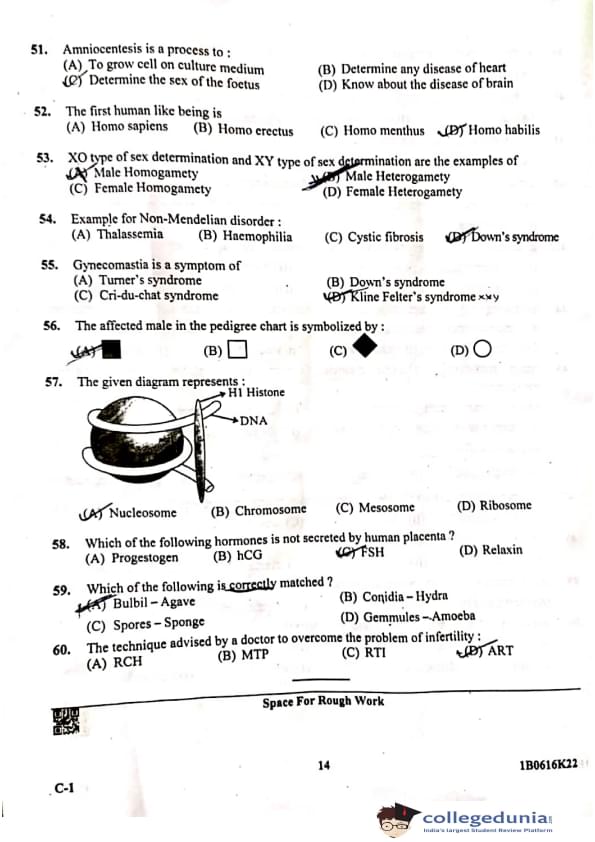
Amniocentesis is a process to:
View Solution
Step 1: Amniocentesis → 15–20 weeks; amniotic fluid extracted.
Step 2: Fetal cells cultured → karyotyping.
Step 3: Detects sex (XX/XY), chromosomal disorders.
Banned for sex determination in India (PCPNDT Act). Quick Tip: Amniocentesis → diagnostic, not therapeutic.
The first human like being is
View Solution
Step 1: Homo habilis (2.4–1.4 mya) → earliest Homo.
Step 2: Brain ~650 cm³, Oldowan tools.
Step 3: "Handy man" → first human-like.
H. erectus → later (1.8 mya). Quick Tip: Evolution: Australopithecus → H. habilis → H. erectus → H. sapiens.
XO type of sex determination and XY type of sex determination are the examples of
View Solution
Step 1: XO-type (grasshopper): female XO → heterogametic.
Step 2: XY-type: male XY → heterogametic.
Step 3: Question focuses on XO → female heterogamety. Quick Tip: ZW (birds) → female heterogamety.
Example for Non-Mendelian disorder:
View Solution
Step 1: Mendelian → single gene (thalassemia, haemophilia, CF).
Step 2: Down’s syndrome → trisomy 21 (nondisjunction).
Step 3: Chromosomal → non-Mendelian. Quick Tip: Non-Mendelian: chromosomal, polygenic, mitochondrial.
Gynecomastia is a symptom of
View Solution
Step 1: Klinefelter’s (47, XXY) → male.
Step 2: Extra X → low testosterone, high estrogen → gynecomastia (breast development).
Step 3: Turner’s → female (XO). Quick Tip: Klinefelter: tall, sterile, gynecomastia.
The affected male in the pedigree chart is symbolized by:
View Solution
Step 1: Pedigree symbols:
- Square → male
- Circle → female
- Filled → affected
Step 2: Affected male → filled square (■). Quick Tip: Carrier → half-filled.
The given diagram represents:

View Solution
Step 1: Nucleosome → DNA wrapped around histone octamer.
Step 2: H1 histone → linker between nucleosomes.
Step 3: Diagram shows DNA + H1 → nucleosome. Quick Tip: Beads-on-string → 11 nm fiber.
Which of the following hormones is not secreted by human placenta?
View Solution
Step 1: Placenta secretes: hCG, hPL, progestogen, relaxin.
Step 2: FSH → anterior pituitary.
Step 3: Not placental. Quick Tip: hCG → pregnancy test.
Which of the following is correctly matched?
View Solution
Step 1: Bulbil → vegetative propagule in Agave.
Step 2: Gemmules → sponge; conidia → fungi.
Step 3: Correct → Bulbil – Agave. Quick Tip: Runner → grass; offset → Eichhornia.
The technique advised by a doctor to overcome the problem of infertility:
View Solution
Step 1: ART (Assisted Reproductive Technology) → IVF, IUI, ZIFT, GIFT.
Step 2: Treats infertility.
Step 3: MTP → abortion; RTI → infection; RCH → program. Quick Tip: First IVF baby: Louise Brown (1978).





Comments