




KCET 2022 Biology A-1 Question Paper with Answer Key pdf is available for download. The exam was conducted by Karnataka Examination Authority (KEA) on June 16, 2022. In terms of difficulty level, KCET Biology was of Easy to Moderate level. The question paper comprised a total of 60 questions.
KCET 2022 Biology (A-1) Question Paper with Answer Key
| KCET Biology (A-1) Question Paper 2022 with Answer Key |  Download Download |
Check Solution |

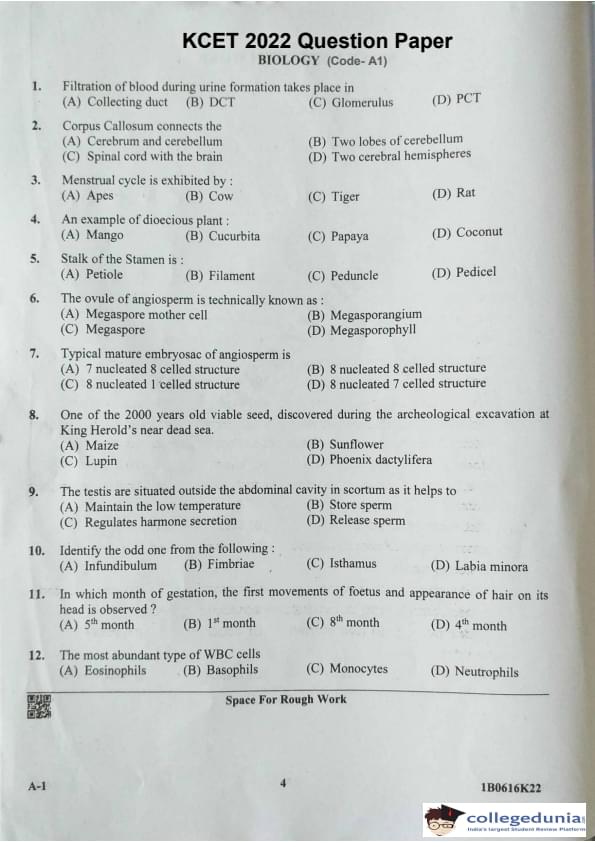
Filtration of blood during urine formation takes place in
View Solution
Step 1: Urine formation begins with filtration of blood plasma.
Step 2: This occurs in the glomerulus, a tuft of capillaries in the nephron.
Step 3: High pressure forces water, ions, urea, glucose into Bowman's capsule → glomerular filtrate.
Step 4: PCT, DCT, collecting duct handle reabsorption/secretion, not filtration.
Hence, filtration takes place only in the glomerulus. Quick Tip: Urine formation steps: 1. Glomerular filtration (Glomerulus) 2. Tubular reabsorption (PCT, Loop of Henle, DCT) 3. Tubular secretion (DCT, Collecting duct)
Corpus Callosum connects the
View Solution
Step 1: The brain has left and right cerebral hemispheres.
Step 2: Corpus callosum is a broad band of ~200 million nerve fibers.
Step 3: It connects left ↔ right cerebral hemispheres for coordination.
Step 4: Cerebellum is connected via cerebellar peduncles; spinal cord via medulla oblongata.
Thus, only (D) is correct. Quick Tip: - Corpus Callosum → Lateral integration (left-right brain) - Cerebellar Peduncles → Cerebrum ↔ Cerebellum - Brainstem → Brain ↔ Spinal cord
Menstrual cycle is exhibited by :
View Solution
Step 1: Menstrual cycle → shedding of uterine lining (menstruation).
Step 2: Occurs in primates (humans, apes, monkeys).
Step 3: Other mammals (cow, tiger, rat) have estrous cycle → endometrium reabsorbed, no bleeding.
Hence, only apes exhibit menstrual cycle. Quick Tip: - Menstrual cycle → Primates (visible bleeding) - Estrous cycle → Most mammals (no bleeding)
An example of dioecious plant :
View Solution
Step 1: Dioecious → male and female flowers on separate plants.
Step 2:
- Papaya: Male, female, hermaphrodite plants → dioecious.
- Mango, Cucurbita, Coconut: Both flowers on same plant → monoecious.
Hence, only papaya is dioecious. Quick Tip: - Dioecious: ♂ and ♀ on different plants - Monoecious: ♂ and ♀ on same plant
Stalk of the Stamen is:
View Solution
Step 1: Stamen = anther (pollen) + stalk.
Step 2: Stalk is called filament.
Step 3:
- Petiole → leaf stalk
- Peduncle → inflorescence axis
- Pedicel → flower stalk
Only filament is part of stamen. Quick Tip: - Stamen: Anther + Filament - Flower stalk: Pedicel - Inflorescence stalk: Peduncle
The ovule of angiosperm is technically known as:
View Solution
Step 1: Ovule is the female reproductive unit in angiosperms.
Step 2: Contains nucellus (tissue), integuments, and megaspore mother cell (MMC).
Step 3: MMC → meiosis → megaspore → embryo sac.
Step 4: Entire ovule is homologous to megasporangium in lower plants.
Hence, ovule = megasporangium. Quick Tip: - Ovule = Megasporangium + Integuments - MMC → inside nucellus → forms megaspore
Typical mature embryosac of angiosperm is
View Solution
Step 1: Polygonum type (common) embryo sac:
- Megaspore → 3 mitotic divisions → 8 nuclei.
Step 2: Arrangement:
- 3 antipodals
- 2 synergids
- 1 egg cell
- 1 central cell (2 polar nuclei → binucleate)
Step 3: Total: 7 cells, 8 nuclei.
Hence, (D) is correct. Quick Tip: Embryo sac (Polygonum type): - 7 cells: 3 antipodal + 2 synergid + 1 egg + 1 central (2 nuclei) - 8 nuclei total
One of the 2000 years old viable seed, discovered during the archeological excavation at King Herold's near dead sea.
View Solution
Step 1: Excavation at Masada (King Herod’s fortress), near Dead Sea.
Step 2: Date palm seed (~2000 years old) found.
Step 3: Germinated in 2005 → named “Methuselah”.
Step 4: Scientific name: Phoenix dactylifera.
Hence, (D) is correct. Quick Tip: Oldest viable seed: Phoenix dactylifera (Date palm) → ~2000 years Location: Masada, Israel
The testis are situated outside the abdominal cavity in scortum as it helps to
View Solution
Step 1: Spermatogenesis needs 2–3°C below body temperature (37°C).
Step 2: Scrotum keeps testes outside abdomen → cooler environment.
Step 3:
- Sperm storage → epididymis
- Hormone secretion → Leydig cells
- Release → vas deferens
Only temperature regulation is the primary reason. Quick Tip: - Scrotum → Thermoregulation for sperm production - Pampiniform plexus → Cools arterial blood
Identify the odd one from the following:
View Solution
Step 1: Parts of fallopian tube:
- Infundibulum → funnel end
- Fimbriae → finger-like projections
- Isthmus → narrow part near uterus
Step 2: Labia minora → part of external genitalia (vulva).
Step 3: (A), (B), (C) → internal; (D) → external.
Hence, labia minora is the odd one. Quick Tip: Fallopian tube parts: Infundibulum → Fimbriae → Ampulla → Isthmus Labia minora → Vulva (external)
In which month of gestation, the first movements of foetus and appearance of hair on its head is observed?
View Solution
Step 1: Fetal development timeline:
- 4th month: Limbs fully formed, heartbeat detectable.
- 5th month: Quickening (first fetal movements felt by mother), lanugo (fine hair) appears on head and body.
- 8th month: Subcutaneous fat increases, hair thickens.
Hence, first movements + hair on head → 5th month. Quick Tip: - Quickening: 18–20 weeks (~5th month) - Lanugo: Appears at ~5th month, sheds by 7–8th month
The most abundant type of WBC cells
View Solution
Step 1: Normal WBC differential count:
- Neutrophils: 50–70% (most abundant)
- Lymphocytes: 20–40%
- Monocytes: 2–8%
- Eosinophils: 1–4%
- Basophils: 0.5–1%
Step 2: Neutrophils → first responders in bacterial infection.
Hence, most abundant → neutrophils. Quick Tip: WBC order (abundance): Neutrophils > Lymphocytes > Monocytes > Eosinophils > Basophils ("Never Let Monkeys Eat Bananas")
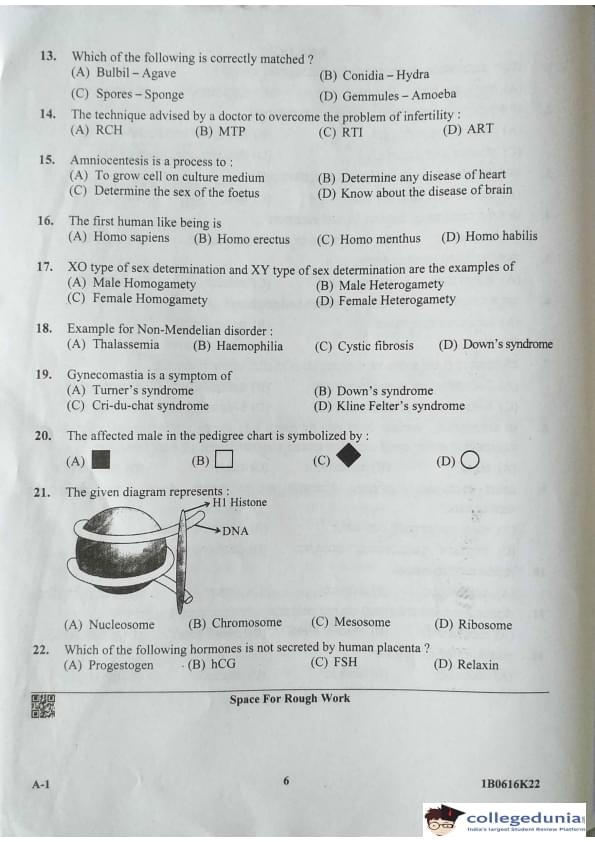
Which of the following is correctly matched ?
View Solution
Step 1:
- Bulbil: Vegetative bud → Agave (correct).
- Conidia: Asexual spores → Penicillium, not Hydra.
- Spores: Sexual/asexual → Ferns, not sponges.
- Gemmules: Internal buds → Sponges, not Amoeba.
Hence, only (A) is correct. Quick Tip: - Bulbil: Agave, Garlic - Gemmule: Sponges - Conidia: Fungi - Budding: Hydra
The technique advised by a doctor to overcome the problem of infertility:
View Solution
Step 1:
- RCH: Reproductive & Child Health (program)
- MTP: Medical Termination of Pregnancy
- RTI: Reproductive Tract Infection
- ART: Assisted Reproductive Technology (IVF, IUI, ZIFT, GIFT)
Step 2: To treat infertility → ART.
Hence, (D) is correct. Quick Tip: - Infertility treatment: ART (IVF, ICSI, etc.) - Contraception: MTP, IUD - Health programs: RCH
Amniocentesis is a process to :
View Solution
Step 1: Amniocentesis: Sampling of amniotic fluid (16–18 weeks).
Step 2: Contains fetal cells → karyotyping → sex determination, genetic disorders (Down’s, thalassemia).
Step 3:
- Cell culture → secondary use
- Heart/brain disease → ultrasound
Hence, primary use → sex & genetic diagnosis. Quick Tip: - Amniocentesis: 16–18 weeks → Fetal cells → Karyotype - Chorionic Villus Sampling (CVS): 10–12 weeks - Banned in India for sex determination
The first human like being is
View Solution
Step 1: Human evolution:
- Australopithecus → Homo habilis (2.4–1.4 mya)
- Homo habilis: "Handy man", used stone tools, first in Homo genus.
- Homo erectus: Later, used fire.
- Homo sapiens: Modern humans.
Hence, first human-like → Homo habilis. Quick Tip: Human evolution order: H. habilis → H. erectus → H. sapiens
XO type of sex determination and XY type of sex determination are the examples of
View Solution
Step 1:
- XY system (humans): Male = XY (heterogametic), Female = XX (homogametic)
- XO system (grasshopper): Male = XO (heterogametic), Female = XX
Step 2: In both, male produces two types of gametes → male heterogamety.
Hence, (B) is correct. Quick Tip: - Male heterogamety: XY, XO, XY (male produces X & Y or X & O) - Female heterogamety: ZW (birds)
Example for Non-Mendelian disorder :
View Solution
Step 1: Mendelian disorders: Gene mutations → single gene (thalassemia, haemophilia, cystic fibrosis).
Step 2: Non-Mendelian: Chromosomal abnormalities → Down’s syndrome (trisomy 21).
Hence, (D) is non-Mendelian. Quick Tip: - Mendelian: Sickle cell, Haemophilia - Non-Mendelian: Down’s, Turner’s, Klinefelter’s (aneuploidy)
Gynecomastia is a symptom of
View Solution
Step 1: Klinefelter’s syndrome: XXY male.
Step 2: Symptoms:
- Tall, underdeveloped testes
- Gynecomastia (breast development due to estrogen imbalance)
Step 3: Turner’s (XO) → female, no gynecomastia.
Hence, (D) is correct. Quick Tip: - Klinefelter’s (XXY): Male + gynecomastia, sterile - Turner’s (XO): Female, short, infertile
The affected male in the pedigree chart is symbolized by:
View Solution
Step 1: Pedigree symbols:
- Square → Male
- Circle → Female
- Shaded → Affected
- Unshaded → Normal
Step 2: Affected male → shaded square.
Hence, (A) is correct. Quick Tip: Pedigree: - Male: □ (normal), ■ (affected) - Female: ○ (normal), ● (affected)
The given diagram represents:

View Solution
Step 1: The diagram typically shows DNA wrapped around histone octamer with a linker.
Step 2: This structure is "beads on a string" → nucleosome.
Step 3:
- Chromosome: Condensed chromatin
- Mesosome: Bacterial membrane infolding
- Ribosome: Protein synthesis organelle
Hence, the diagram is nucleosome. Quick Tip: - Nucleosome = DNA + Histone octamer (H2A, H2B, H3, H4) × 2 - "Beads on a string" → 11 nm fiber
Which of the following hormones is not secreted by human placenta ?
View Solution
Step 1: Placenta secretes:
- hCG (maintains corpus luteum)
- hPL (human placental lactogen)
- Progestogens (progesterone)
- Relaxin (late pregnancy)
Step 2: FSH → secreted by anterior pituitary, not placenta.
Hence, (C) is correct. Quick Tip: - Placental hormones: hCG, hPL, Progesterone, Estrogen, Relaxin - Pituitary: FSH, LH, TSH, ACTH
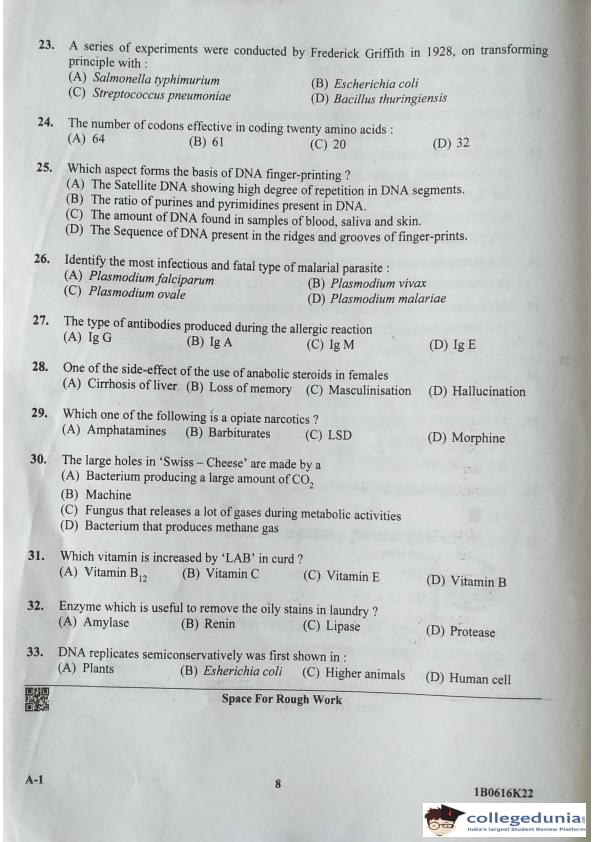
A series of experiments were conducted by Frederick Griffith in 1928, on transforming principle with:
View Solution
Step 1: Griffith used S (smooth) and R (rough) strains of Streptococcus pneumoniae.
Step 2: Heat-killed S + live R → mice died → transformation.
Step 3: Led to discovery of DNA as genetic material.
Hence, (C) is correct. Quick Tip: - Griffith (1928): S. pneumoniae (R + heat-killed S → virulent) - Avery, MacLeod, McCarty (1944): DNA is transforming principle
The number of codons effective in coding twenty amino acids :
View Solution
Step 1: Total codons = \(4^3 = 64\)
Step 2:
- 3 stop codons: UAA, UAG, UGA → no amino acid
- 61 sense codons → code for 20 amino acids (degenerate code)
Hence, 61 codons code for amino acids. Quick Tip: - 64 codons total - 61 code amino acids - 3 stop codons - AUG: Start + Methionine
Which aspect forms the basis of DNA finger-printing?
View Solution
Step 1: DNA fingerprinting uses VNTRs (Variable Number Tandem Repeats).
Step 2: These are satellite DNA → highly repetitive, non-coding.
Step 3: Number of repeats varies between individuals → unique pattern.
Step 4: Purine/pyrimidine ratio, DNA amount, fingerprint ridges → not used.
Hence, (A) is correct. Quick Tip: - DNA Fingerprinting: VNTRs (minisatellites) - Alec Jeffreys (1984) - Probe + Southern blot + Autoradiography
Identify the most infectious and fatal type of malarial parasite:
View Solution
Step 1:
- P. falciparum: Cerebral malaria, high parasitemia, most fatal.
- P. vivax: Benign tertian, relapses
- P. malariae: Quartan, chronic
- P. ovale: Mild, rare
Step 2: Causes blackwater fever, multi-organ failure.
Hence, most infectious & fatal → P. falciparum. Quick Tip: - P. falciparum: Malignant tertian, cerebral, fatal - P. vivax: Benign tertian, Duffy antigen
The type of antibodies produced during the allergic reaction
View Solution
Step 1: Type I hypersensitivity → mediated by IgE.
Step 2: Allergen → binds IgE on mast cells/basophils → histamine release.
Step 3:
- IgG, IgM: Immunity
- IgA: Mucosal
Hence, allergy → IgE. Quick Tip: - Allergy: IgE → Mast cell degranulation → Histamine - Anaphylaxis: Severe IgE reaction
One of the side-effect of the use of anabolic steroids in females
View Solution
Step 1: Anabolic steroids → androgenic effects in females.
Step 2: Causes:
- Deep voice
- Facial hair
- Enlarged clitoris → masculinisation
Step 3: Liver damage possible, but masculinisation is classic in females.
Hence, (C) is correct. Quick Tip: - Anabolic steroids in females: Virilization (masculinisation) - In males: Gynecomastia, testicular atrophy
Which one of the following is a opiate narcotics?
View Solution
Step 1: Opiates → derived from opium poppy (Papaver somniferum).
Step 2:
- Morphine, Heroin, Codeine → opiates
- Amphetamines: Stimulants
- Barbiturates: Sedatives
- LSD: Hallucinogen
Hence, morphine is opiate narcotic. Quick Tip: - Opiates: Morphine, Heroin (CNS depressant, analgesic) - Cannabinoids: Marijuana - Cocaine: Stimulant
The large holes in 'Swiss - Cheese' are made by a
View Solution
Step 1: Swiss cheese → made with Propionibacterium shermanii.
Step 2: Ferments lactic acid → propionic acid + CO₂.
Step 3: CO₂ forms large bubbles → holes (eyes) in cheese.
Step 4: Not methane, not fungus, not machine.
Hence, (A) is correct. Quick Tip: - Swiss cheese holes: CO₂ by Propionibacterium - Roquefort: Penicillium roqueforti (blue veins)
Which vitamin is increased by 'LAB' in curd ?
View Solution
Step 1: LAB → Lactic Acid Bacteria (e.g., Lactobacillus) used in curd formation.
Step 2: During fermentation, LAB synthesizes Vitamin \(B_{12}\) (cobalamin).
Step 3:
- Vitamin C → not produced
- Vitamin E → fat-soluble, not microbial
- Vitamin B → vague; \(B_{12}\) is specific
Hence, Vitamin \(B_{12}\) increases in curd. Quick Tip: - Curd (Yogurt): LAB → ↑ Vitamin \(B_{12}\), folate - Sauerkraut, Kimchi: Also ↑ \(B_{12}\)
Enzyme which is useful to remove the oily stains in laundry?
View Solution
Step 1: Oily stains → lipids/fats.
Step 2: Lipase → hydrolyzes triglycerides → glycerol + fatty acids.
Step 3:
- Amylase: Starch
- Renin: Milk clotting (not in laundry)
- Protease: Proteins
Hence, lipase removes oily stains. Quick Tip: - Detergent enzymes: – Lipase → Oil – Protease → Protein (blood, egg) – Amylase → Starch
DNA replicates semiconservatively was first shown in :
View Solution
Step 1: Meselson & Stahl (1958) used E. coli.
Step 2: Grew in \(^{15}\)NH₄Cl → heavy DNA → transferred to \(^{14}\)N medium.
Step 3: Density gradient centrifugation → hybrid band after one generation → semiconservative replication.
Hence, first shown in E. coli. Quick Tip: - Meselson-Stahl: \(^{15}\)N → \(^{14}\)N → Hybrid DNA - Conservative: HH + LL - Dispersive: All intermediate
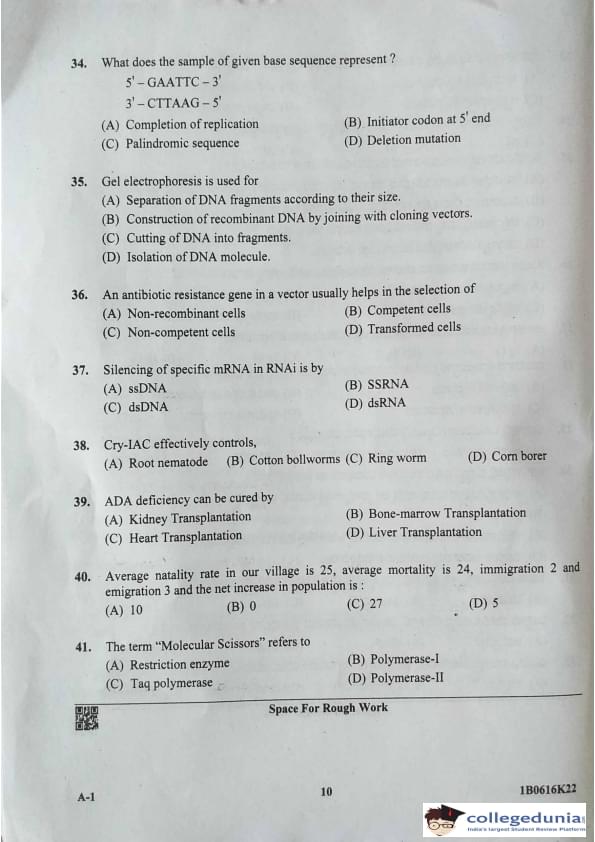
What does the sample of given base sequence represent? \(5^{\prime}\)-GAATTC-\(3^{\prime}\) \(3^{\prime}\)-CTTAAG-\(5^{\prime}\)
View Solution
Step 1: Sequence: \(5^{\prime}\)-GAATTC-\(3^{\prime}\) \(3^{\prime}\)-CTTAAG-\(5^{\prime}\)
Step 2: Reads same on complementary strand in opposite direction → palindrome.
Step 3: Recognized by EcoRI (restriction enzyme).
Step 4: Not replication, codon, or mutation.
Hence, palindromic sequence. Quick Tip: - Palindrome: 5'-GAATTC-3' = 3'-CTTAAG-5' (reverse complement) - EcoRI: Cuts between G and A
Gel electrophoresis is used for
View Solution
Step 1: Agarose gel electrophoresis → DNA moves toward anode (negative charge).
Step 2: Smaller fragments move faster → separate by size.
Step 3:
- Ligation → recombinant DNA
- Restriction enzyme → cutting
- PCR/Extraction → isolation
Hence, separation by size. Quick Tip: - Gel electrophoresis: – Small DNA → travels far – Large DNA → stays near well
An antibiotic resistance gene in a vector usually helps in the selection of
View Solution
Step 1: Vector has ampicillin resistance gene (ampᵣ).
Step 2: Only transformed cells (took up plasmid) grow on ampicillin plate.
Step 3: Non-recombinants also grow → use insertional inactivation (e.g., lacZ).
Step 4: First selection → transformed cells.
Hence, (D) is correct. Quick Tip: - Selectable marker: ampᵣ, tetᵣ → selects transformants - Blue-white screening: X-gal → recombinants (white)
Silencing of specific mRNA in RNAi is by
View Solution
Step 1: RNAi → dsRNA introduced.
Step 2: Dicer cuts dsRNA → siRNA (21–23 nt).
Step 3: RISC uses siRNA → degrades complementary mRNA.
Step 4: ssDNA, ssRNA, dsDNA → not used.
Hence, dsRNA triggers RNAi. Quick Tip: - RNAi pathway: dsRNA → Dicer → siRNA → RISC → mRNA cleavage
Cry-IAC effectively controls,
View Solution
Step 1: Cry-IAC → Bt toxin from Bacillus thuringiensis.
Step 2: Specific to lepidopteran larvae (butterflies/moths).
Step 3: Cotton bollworm (Helicoverpa armigera) → lepidopteran → controlled by Cry-IAC.
Step 4:
- Cry-IIAB: Nematodes
- Corn borer: Cry-IA (different)
Hence, cotton bollworms. Quick Tip: - Cry-I: Lepidoptera (bollworm) - Cry-II: Diptera + Lepidoptera - Cry-III: Coleoptera (beetle)
ADA deficiency can be cured by
View Solution
Step 1: ADA → Adenosine Deaminase → needed in T-lymphocytes.
Step 2: Deficiency → SCID (no immunity).
Step 3: Bone marrow → source of hematopoietic stem cells → produce healthy lymphocytes.
Step 4: First gene therapy → ADA gene into lymphocytes.
Hence, bone-marrow transplantation. Quick Tip: - ADA deficiency: SCID - Treatment: Bone marrow transplant or Gene therapy
Average natality rate in our village is 25, average mortality is 24, immigration 2 and emigration 3 and the net increase in population is :
View Solution
Step 1: Population change = (Births + Immigration) – (Deaths + Emigration)
Step 2:
- Births (natality) = 25
- Deaths (mortality) = 24
- Immigration = 2
- Emigration = 3
Step 3: \[ \Delta P = (25 + 2) - (24 + 3) = 27 - 27 = 0 \]
Hence, net increase = 0. Quick Tip: - Population growth: \(\Delta P = (B + I) - (D + E)\) - Zero growth: \(B + I = D + E\)
The term "Molecular Scissors" refers to
View Solution
Step 1: Molecular scissors → cut DNA at specific sites.
Step 2: Restriction enzymes (e.g., EcoRI, HindIII) recognize palindromic sequences and cleave DNA.
Step 3: Used in rDNA technology for cloning.
Step 4: Polymerases → synthesize DNA/RNA, not cut.
Hence, restriction enzyme. Quick Tip: - Restriction enzyme → "Molecular scissors" - Ligase → "Molecular glue"
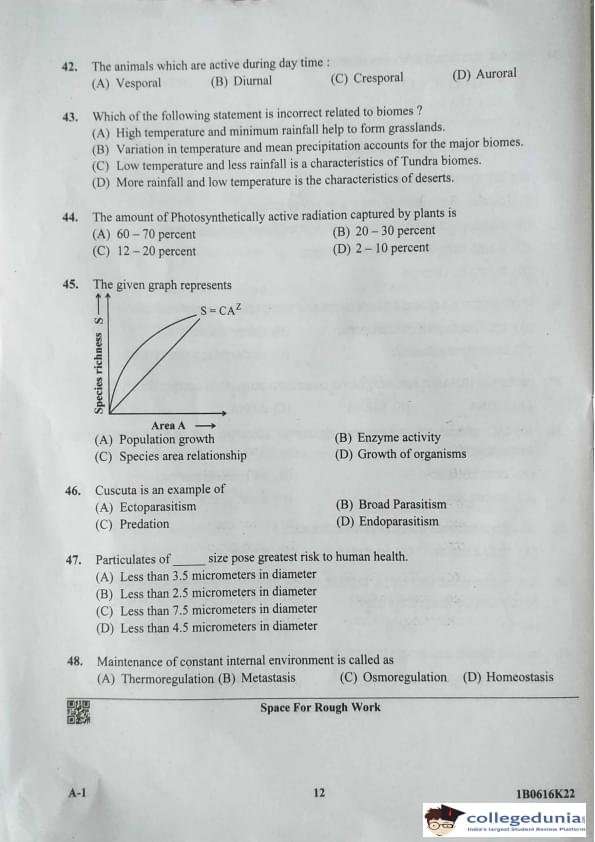
The animals which are active during day time:
View Solution
Step 1:
- Diurnal: Active during day (e.g., humans, birds).
- Nocturnal: Active at night (e.g., owls).
- Crepuscular: Dawn/dusk.
Step 2: Vesporal, Cresporal, Auroral → not standard terms.
Hence, diurnal. Quick Tip: - Diurnal → Day - Nocturnal → Night - Crepuscular → Twilight
Which of the following statement is incorrect related to biomes ?
View Solution
Step 1: Deserts: High temperature + very low rainfall (<25 cm/year).
Step 2: (D) says more rainfall + low temperature → incorrect.
Step 3:
- (A): Grasslands → moderate rain, warm
- (B): Temperature + precipitation → biome distribution
- (C): Tundra → cold, low precipitation
Hence, (D) is incorrect. Quick Tip: - Desert: Hot, <25 cm rain - Tundra: Cold, <25 cm rain - Rainforest: >200 cm rain
The amount of Photosynthetically active radiation captured by plants is
View Solution
Step 1: PAR (400–700 nm) → used in photosynthesis.
Step 2: Of total solar radiation:
- ~50% is PAR
- Plants capture 2–10% of PAR for gross primary productivity.
Step 3: Most energy lost as heat, reflection, transmission.
Hence, 2–10%. Quick Tip: - PAR: 50% of solar radiation - Plants use: 2–10% of PAR - NPP: ~1–2% of solar energy
The given graph represents \(S=CA^{Z}\)

View Solution
Step 1: Equation: \( S = cA^Z \)
- \( S \): Species richness
- \( A \): Area
- \( c, Z \): Constants
Step 2: Species-area relationship (Alexander von Humboldt).
Step 3: Log form: \(\log S = \log c + Z \log A\) → straight line.
Hence, species-area relationship. Quick Tip: - \( S = cA^Z \) → Species-area curve - Z: 0.1–0.2 (mainland), 0.6–1.0 (islands)
Cuscuta is an example of
View Solution
Step 1: Cuscuta → yellow, leafless vine.
Step 2: Attaches to host stem externally → penetrates via haustoria → absorbs water/nutrients.
Step 3:
- Ectoparasite: Lives outside host (e.g., lice, Cuscuta)
- Endoparasite: Lives inside (e.g., tapeworm)
Hence, ectoparasitism. Quick Tip: - Cuscuta: Stem holoparasite → ectoparasite - Rafflesia: Root endoparasite
Particulates of \phantom{abcde} size pose greatest risk to human health.
View Solution
Step 1: PM₂.₅ → particles < 2.5 μm.
Step 2: Small size → enter deep into lungs → alveoli → blood.
Step 3: Cause respiratory disease, heart attack, cancer.
Step 4: PM₁₀ (>2.5 μm) → trapped in upper airways.
Hence, < 2.5 μm → greatest risk. Quick Tip: - PM₂.₅: < 2.5 μm → lung alveoli - PM₁₀: < 10 μm → nose/throat - WHO limit: PM₂.₅ < 10 μg/m³ (annual)
Maintenance of constant internal environment is called as
View Solution
Step 1: Homeostasis → maintaining stable internal conditions (pH, temperature, ions).
Step 2:
- Thermoregulation: Temperature
- Osmoregulation: Water/salt
- Metastasis: Cancer spread
Step 3: Homeostasis includes all.
Hence, homeostasis. Quick Tip: - Homeostasis → "Same standing" (Claude Bernard) - Feedback loops: Negative (most), Positive (rare)
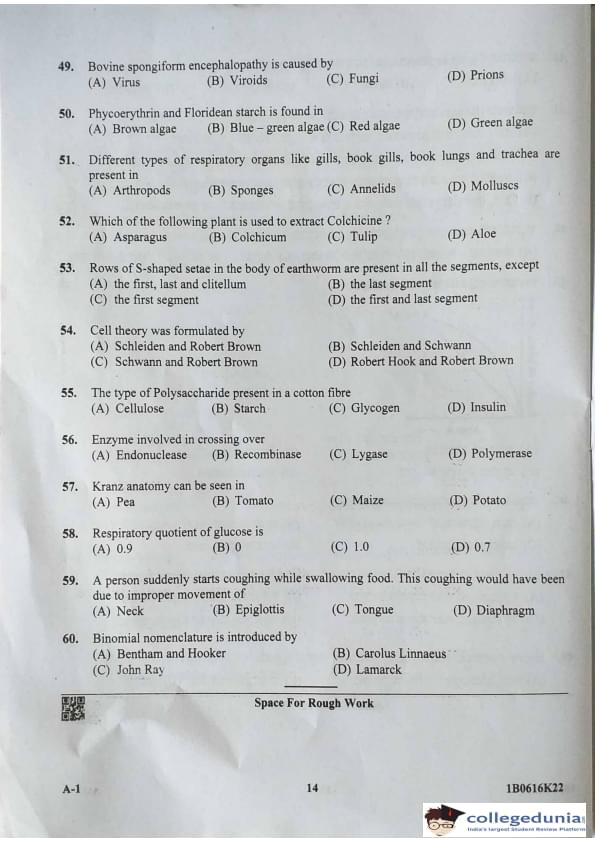
Bovine spongiform encephalopathy is caused by
View Solution
Step 1: BSE → Mad Cow Disease.
Step 2: Caused by prions → misfolded PrP proteins.
Step 3: No nucleic acid → resistant to heat, radiation.
Step 4: Human form → vCJD.
Hence, prions. Quick Tip: - Prions: Proteinaceous infectious particles - Diseases: BSE, CJD, Kuru, Scrapie
Phycoerythrin and Floridean starch is found in
View Solution
Step 1: Red algae (Rhodophyta):
- Pigment: Phycoerythrin (red)
- Storage: Floridean starch (similar to glycogen)
Step 2:
- Brown algae: Fucoxanthin, laminarin
- BGA: Phycocyanin, glycogen
- Green algae: Chlorophyll, starch
Hence, red algae. Quick Tip: - Red algae: – Phycoerythrin (red) – Floridean starch – Agar, carrageenan
Different types of respiratory organs like gills, book gills, book lungs and trachea are present in
View Solution
Step 1: Arthropods show diverse respiratory adaptations:
- Gills: Aquatic (crabs, prawns)
- Book gills: Limulus (horseshoe crab)
- Book lungs: Scorpions, spiders
- Trachea: Insects
Step 2:
- Sponges → no organs
- Annelids → moist skin
- Molluscs → gills, ctenidia
Hence, only arthropods have all four. Quick Tip: - Arthropod respiration: – Aquatic: Gills – Terrestrial: Trachea, book lungs, book gills
Which of the following plant is used to extract Colchicine?
View Solution
Step 1: Colchicine → alkaloid used in polyploidy induction.
Step 2: Extracted from corms of Colchicum autumnale (autumn crocus).
Step 3: Inhibits spindle formation → arrests mitosis at metaphase.
Hence, Colchicum. Quick Tip: - Colchicine source: Colchicum autumnale - Use: Polyploidy, gout treatment
Rows of S-shaped setae in the body of earthworm are present in all the segments except
View Solution
Step 1: Setae → locomotion in earthworm.
Step 2: Present in all segments except:
- 1st segment (peristomium)
- Last segment (anus)
- Clitellar segments (14–16) → no setae
Step 3: Clitellum → gland for cocoon.
Hence, first, last, and clitellum. Quick Tip: - Earthworm setae: – Absent in 1st, last, 14–16 (clitellum) – S-shaped, 4 pairs/segment
Cell theory was formulated by
View Solution
Step 1: Cell Theory (1838–1839):
- M.J. Schleiden (plants)
- Theodor Schwann (animals)
Step 2: Postulates:
1. All organisms made of cells
2. Cell → basic unit of life
Step 3: Rudolf Virchow (1855): "Omnis cellula-e-cellula".
Hence, Schleiden and Schwann. Quick Tip: - Cell Theory: – Schleiden (1838): Plants – Schwann (1839): Animals – Virchow (1855): Cell division
The type of Polysaccharide present in a cotton fibre
View Solution
Step 1: Cotton fiber → seed hair of Gossypium.
Step 2: Composed of >90% cellulose (β-1,4 glucose polymer).
Step 3:
- Starch → storage (plants)
- Glycogen → animal storage
- Insulin → hormone
Hence, cellulose. Quick Tip: - Cotton: Cellulose (95%) - Jute: Lignin + cellulose - Silk: Protein
Enzyme involved in crossing over
View Solution
Step 1: Crossing over → exchange of genetic material in pachytene.
Step 2: Recombinase (e.g., Spo11, RAD51) → forms Holliday junction.
Step 3:
- Endonuclease → cuts DNA
- Ligase → joins
- Polymerase → fills gaps
But recombinase initiates recombination.
Hence, recombinase. Quick Tip: - Crossing over: – Synaptonemal complex → Recombinase → Chiasma
Kranz anatomy can be seen in
View Solution
Step 1: Kranz anatomy → C4 plants.
Step 2: Features:
- Bundle sheath cells with chloroplasts
- Mesophyll → radial chloroplasts
Step 3: Maize → C4 plant.
Pea, tomato, potato → C3.
Hence, maize. Quick Tip: - Kranz anatomy: – C4 plants (maize, sugarcane) – Bundle sheath → CO₂ fixation (PEP carboxylase)
Respiratory quotient of glucose is
View Solution
Step 1: RQ = \(\frac{CO_2 produced}{O_2 consumed}\)
Step 2: Glucose: \[ C_6H_{12}O_6 + 6O_2 \rightarrow 6CO_2 + 6H_2O \]
Step 3: \[ RQ = \frac{6}{6} = 1.0 \]
Hence, 1.0. Quick Tip: - RQ values: – Carbohydrate: 1.0 – Fat: 0.7 – Protein: 0.9 – Anaerobic: ∞
A person suddenly starts coughing while swallowing food. This coughing would have been due to improper movement of
View Solution
Step 1: Epiglottis → cartilage flap.
Step 2: Closes larynx during swallowing → food enters esophagus.
Step 3: If fails → food enters trachea → choking reflex (cough).
Hence, epiglottis. Quick Tip: - Swallowing: – Epiglottis closes larynx – Soft palate closes nasopharynx
Binomial nomenclature is introduced by
View Solution
Step 1: Binomial nomenclature → Genus + species.
Step 2: Introduced by Carolus Linnaeus in "Systema Naturae" (1758) and "Species Plantarum" (1753).
Step 3:
- Bentham & Hooker → classification
- John Ray → early binomial
Hence, Linnaeus. Quick Tip: - Binomial system: Linnaeus - ICBN/ICZN: Rules for naming - Homo sapiens: Linnaeus



Comments