



“Generation Z is changing PGDM/MBA - not by rejecting it, but by re imagining what it means."
There is a powerful shift taking place in India's management education space. The PGDM/MBA model, which at one point was predominately unidimensional thinking along traditional sub-disciplines such as Finance / Marketing / HR and to an extent Consulting, has undergone a fundamental shift and is becoming an innovative, cross-disciplinary credential. Central to this shift is Gen Z - a digitally native, globally connected young adult cohort that values social impact and social connection, while innovating for the future.
Gen Z's New Career Mindset
Similar to previous generations, today's aspirants want to prepare for a career - but their aspirations are different from what their predecessors were.
- To prepare for career paths that are sustainable and have purpose
- Worked with automation, analytics and digital devices
- Interested in careers in health care, media, public policy, climate change, digital marketing and fintech
- Work in interdisciplinary and hybrid careers
In turn, schools have adapted their academic priorities a cross management institutions in India. As a consequence, the demand to study Emerging Specializations, has shifted PGDM/MBA itself. Some of the Emerging Specializations (which tend to be following two broad areas have shifted previously established disciplinary thinking and the types of specializations.) are AI & Data Science, Research and Business Analytics, Finance & Fintech, Digital Marketing, Healthcare & Hospital Management, Sustainability & ESG, Supply Chain & Logistics, and Public Policy & Development.
These specialization areas seems to be the part of a much larger global narrative, where it is impossible to unbundle management from technology, sustainability, and social betterment.
Key Trends Shaping the Future of PGDM/MBA
The future of PGDM/MBA learning is actually influenced by various key trends. Technology-driven learning is going to reshape pedagogies and pedagogical processes via simulation labs, AI-enabled teaching tools, and learning on the digital platform. Interdisciplinary program like hybrid degrees that blends together management with data science or public policy. They are emerging and soon to be common place. International collaborations are also gaining momentum as institutes are now providing international immersion programs, dual degrees, and partnering with foreign universities. Ethics, sustainability, and governance are one of the area of focus to nurture responsible leaders and integrate ESG in the curriculum.
Institutions make use AI-driven tools in the admissions process, and for personalized learner outcomes with placements. The above represents a change towards future-ready management education that satisfies the global market demand.
What Employers Expect from PGDM/MBA Graduates in 2026?
Employers in 2026 will expect graduates at the postgraduate level to be tech-savvy and agile, as well as ethical and collaborative. The most expected competencies involves the skill to ‘make data-driven decisions’, ‘literacy around digital and AI’, ‘innovation and entrepreneurship’, ‘cross functional team work’, ‘adaptability and resilience’, ‘leadership paired with a social lens’.
To be effective, managers now need to blend strategic thinking, human centricity with technical literacy– a combination essential for AI-Human enabled workplaces to thrive.
Implications for PGDM/MBA Aspirants
With the exception of a small subset in the top 50–100 range, top B-schools have a consistent strong fill rate and placement outcomes. In today's fast changing environment, specialization plays a leading role in sustaining a long-term ROI, particularly in domains such AI, Analytics, Fintech, Digital marketing, Sustainability and healthcare. As the market becomes more discerning, the quality of the postgraduate program becomes more important than the quantity - making it very difficult for many Tier-3 institutions to survive unless they significantly enhance their curriculum, partnerships with industry and global reach.
Meanwhile classrooms are becoming more diverse (in terms of females, non-engineers and senior working professionals). Ultimately, ROI is no longer driven by the brand name alone; it will be driven by specialization, institutional prestige, induction into the profession, alumni and the institution's network.
Specialized, ethical, tech-integrated, and globally-relevant PGDM/MBA programs will pave the way for the future of business programs preparatory for complex, innovative, and changing world with some mix of global business leadership.
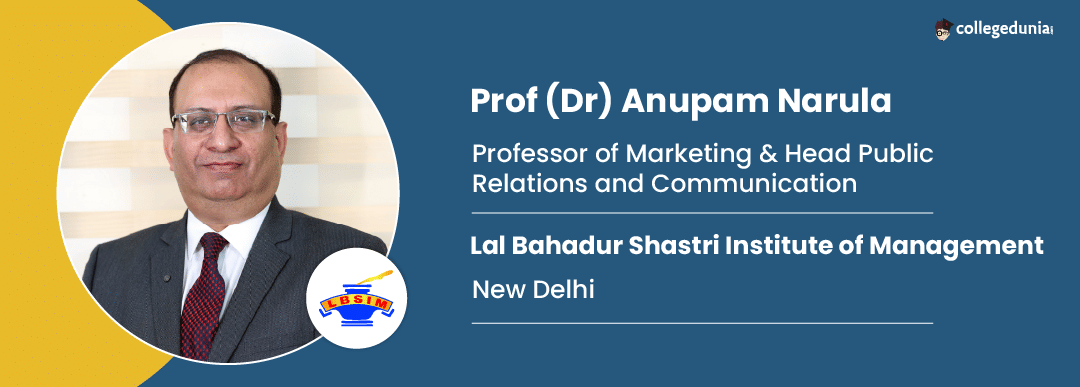
Dr. Anupam Narula is a Professor of Marketing at Lal Bahadur Shastri Institute of Management, New Delhi. With over three decades of distinguished experience in the higher education sector, he has also served as the Founder and Director of leading business schools in the Delhi NCR region of India.

 (1).png?h=132&w=263&mode=stretch)





 (1).png?h=78&w=78&mode=stretch)
-min.png?h=78&w=78&mode=stretch)











![MBA/PGDM | admission | 2024 | Narsee Monjee Institute of Management Studies - [NMIMS Deemed to be University]](https://image-static.collegedunia.com/public/college_data/images/logos/1506323004Logo.jpg?h=72&w=72&mode=stretch)


![MBA/PGDM | admission | 2024 | Indian Institute of Management - [IIMC]](https://image-static.collegedunia.com/public/college_data/images/logos/1488950580d2.png?h=72&w=72&mode=stretch)








 (1).png?h=72&w=72&mode=stretch)
-min.png?h=72&w=72&mode=stretch)





Comments