


NCERT Solutions for Class 10 Maths Chapter 2 Polynomials Exercise 2.4

Jasmine Grover logo

Jasmine Grover

Education Journalist | Study Abroad Lead

NCERT Solutions for Class 10 Maths Chapter 2 Polynomials Exercise 2.4 is given in this article. Class 10 Maths Chapter 2 Exercise 2.3 has 5 exercise questions that cover various important concepts of polynomials such as degree of a polynomial, zeroes of a polynomial and roots of polynomials

Download PDF: NCERT Solutions for Class 10 Maths Chapter 2 Exercise 2.4

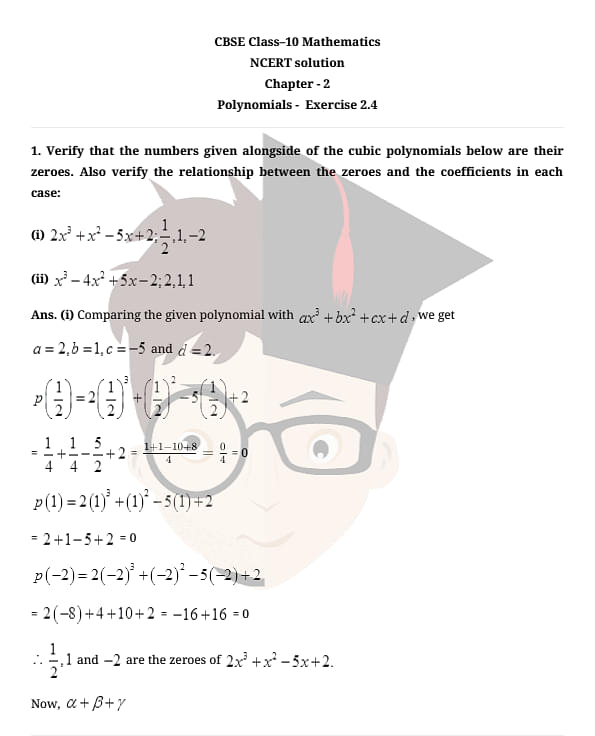
Check out the solutions of Class 10 Maths NCERT solutions chapter 2 Polynomics Exercise 2.4
Read More: NCERT Solutions For Class 10 Maths Polynomials

Check out other exercise solutions of Class 10 Maths Chapter 2 Polynomials

Class 10 Chapter 2 Polynomials Topics:

CBSE Class 10 Maths Study Guides:

CBSE X Related Questions

  • 1.
    A kite is flying at a height of \(60 \text{ m}\) above the ground level. Ravi, standing at the roof of the house is holding the string straight and observes the angle of elevation of kite as \(30^{\circ}\). From the bottom of the same building, the angle of elevation of kite is \(45^{\circ}\). Find the length of the string and height of roof from the ground. (Use \(\sqrt{3} = 1.73\))


      • 2.
        The natural number 1 is :

          • a prime number.
          • a composite number.
          • prime as well as composite.
          • neither prime nor composite.

        • 3.
          Two water taps together can fill a tank in $8\frac{8}{9}$ hours. The tap of larger diameter takes 4 hours less than the smaller one to fill the tank separately. Find the time in which each tap can separately fill the tank.


            • 4.
              If \(\alpha, \beta\) are the zeroes of the polynomial \(p(x) = x^2 - 3x - 1\), then find the value of \(\frac{1}{\alpha} + \frac{1}{\beta}\).


                • 5.
                  If the pair of linear equations : \( a_1x + b_1y + c_1 = 0 \) and \( a_2x + b_2y + c_2 = 0 \) is consistent and dependent, then

                    • \( \frac{a_1}{a_2} \neq \frac{b_1}{b_2} \)
                    • \( \frac{a_1}{a_2} = \frac{b_1}{b_2} = \frac{c_1}{c_2} \)
                    • \( \frac{a_1}{a_2} = \frac{b_1}{b_2} \neq \frac{c_1}{c_2} \)
                    • \( \frac{a_1}{a_2} = \frac{b_1}{b_2} = \frac{c_1}{c_2} \)

                  • 6.
                    \(ABCD\) is a parallelogram such that \(AF = 7 \text{ cm}\), \(FB = 3 \text{ cm}\) and \(EF = 4 \text{ cm}\), length \(FD\) equals

                      • \(\frac{21}{4} \text{ cm}\)
                      • \(\frac{28}{3} \text{ cm}\)
                      • \(\frac{12}{7} \text{ cm}\)
                      • \(5.5 \text{ cm}\)

                    Comments


                    No Comments To Show
