


NCERT Solutions for Class 10 Maths Chapter 2 Polynomials Exercise 2.3

Jasmine Grover logo

Jasmine Grover

Education Journalist | Study Abroad Lead

NCERT Solutions for Class 10 Maths Chapter 2 Polynomials Exercise 2.3 is provided in this article with step by step explanation. Class 10 Maths Chapter 2 Exercise 2.3 has 5 exercises that covers division algorithm for polynomials.

Download PDF: NCERT Solutions for Class 10 Maths Chapter 2 Exercise 2.3

Check out the solutions of Class 10 Maths NCERT solutions chapter 2 Polynomics Exercise 2.3
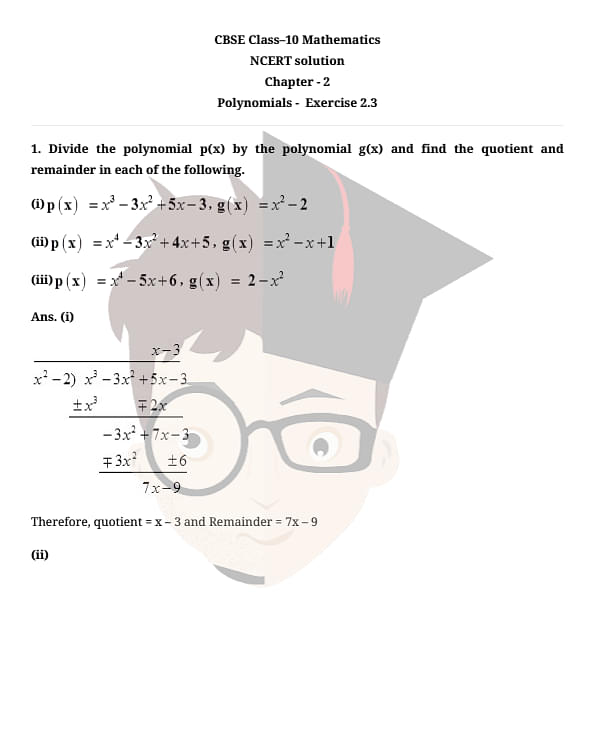
Read More: NCERT Solutions For Class 10 Maths Polynomials

Check out other exercise solutions of Class 10 Maths Chapter 2 Polynomials


Class 10 Chapter 2 Polynomials Topics:

CBSE Class 10 Maths Study Guides:

CBSE X Related Questions

  • 1.
    \(ABCD\) is a parallelogram such that \(AF = 7 \text{ cm}\), \(FB = 3 \text{ cm}\) and \(EF = 4 \text{ cm}\), length \(FD\) equals

      • \(\frac{21}{4} \text{ cm}\)
      • \(\frac{28}{3} \text{ cm}\)
      • \(\frac{12}{7} \text{ cm}\)
      • \(5.5 \text{ cm}\)

    • 2.
      In the figure given above, \(\triangle ABC \sim \triangle XYZ\), then find the values of \(x\) and \(y\).


        • 3.
          If the zeroes of a polynomial p(x) are $-3$ and 8, then p(x) equals

            • $x^2 + 5x - 4$
            • $(x + 3) (-x + 8)$
            • $a(x^2 + 5x - 24)$
            • $x^2 - 24$

          • 4.
            If \(\alpha, \beta\) are the zeroes of the polynomial \(p(x) = x^2 - 3x - 1\), then find the value of \(\frac{1}{\alpha} + \frac{1}{\beta}\).


              • 5.
                If the pair of linear equations : \( a_1x + b_1y + c_1 = 0 \) and \( a_2x + b_2y + c_2 = 0 \) is consistent and dependent, then

                  • \( \frac{a_1}{a_2} \neq \frac{b_1}{b_2} \)
                  • \( \frac{a_1}{a_2} = \frac{b_1}{b_2} = \frac{c_1}{c_2} \)
                  • \( \frac{a_1}{a_2} = \frac{b_1}{b_2} \neq \frac{c_1}{c_2} \)
                  • \( \frac{a_1}{a_2} = \frac{b_1}{b_2} = \frac{c_1}{c_2} \)

                • 6.
                  PQ and PR are two tangents to a circle with centre O and radius 5 cm. AB is another tangent to the circle at C which lies on OP. If \(OP = 13\) cm, then find the length AB and PA.

                    Comments


                    No Comments To Show