



BAMS (Bachelor of Ayurvedic Medicine and Surgery) is a 5.5-year undergraduate (UG) medical programme, including a 1-year compulsory internship, that focuses on Ayurvedic medicine, diagnosis, treatment, herbal medicine and traditional healthcare practices.
- Admission – Admission is based on NEET UG scores, followed by AACCC counselling for eligible All India Quota, Central and Deemed University seats, or state-level AYUSH counselling for applicable state quota seats.
- Eligibility Criteria – Students must complete Class 12 with Physics, Chemistry, Biology/Biotechnology and English from a recognised board and meet the applicable NEET UG eligibility requirements. Candidates must be at least 17 years old by December 31 of the admission year.
- Course Scope – Graduates can work as Ayurvedic doctors, medical officers, wellness consultants, Ayurvedic healthcare practitioners and researchers, or pursue higher studies such as MD/MS in Ayurveda.
BAMS Course Highlights
| Top Colleges | Total Course Fees | Specialisation Areas | Average Starting Salary |
|---|---|---|---|
| BHU Varanasi, Government Medical College / Rajindra Hospital, Patiala & Dr DY Patil Vidyapeeth, Pune | INR 10.5 K to INR 45.02 Lakh | Kayachikitsa, Panchakarma, Shalya Tantra, Shalakya Tantra, Dravyaguna, Prasuti Tantra | INR 2.5–5 LPA (approximate early-career market range) |
BAMS Quick Facts
- Duration: 5.5 years, 4.5 years of academic education across three professional phases, followed by a 12-month compulsory rotatory internship.
- Eligibility: Class 12 or equivalent with Physics, Chemistry, Biology and English; candidates must meet the applicable NEET eligibility requirements.
- Entrance Exam: NEET UG is the required national entrance examination for regular BAMS admission.
- Selection: NEET UG qualification and rank, category, seat availability, counselling preferences, document verification and fee payment.
- Government Institutional Fee Range: INR 10.5 K (Kaloji Narayana Rao University of Health Sciences, Warangal) to INR 25 Lakh (Rajkiya Ayurvedic College & Hospital, Patna)
- Private Institutional Fee Range: INR 23.1 K (Assam Govt Homoeopathic Medical College and Hospital, Nagaon) to INR 45.02 (DY Patil University, Navi Mumbai)
- Admission Season: February to November, starting with NEET UG registration and followed by AYUSH counselling.
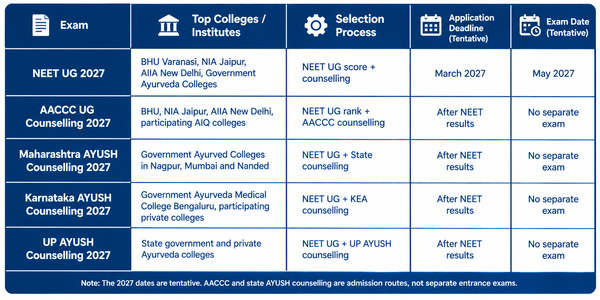
Top Entrance Exams for BAMS
Three Myths Busted
- Myth: Students can pursue BAMS after Class 12 from any stream.
- Fact: Students must meet the prescribed Science subject requirements, including Physics, Chemistry and Biology. Arts and Commerce students without the required subjects are not eligible.
- Myth: Private BAMS colleges offer direct admission without NEET.
- Fact: Regular BAMS admissions require NEET UG qualification and an authorised counselling process. Management or institutional quota seats do not automatically provide a NEET exemption.
- Myth: BAMS graduates can only open Ayurveda clinics.
- Fact: Graduates can pursue clinical practice, Panchakarma services, research, teaching after suitable postgraduate qualifications, public-health roles and careers in Ayurvedic pharmaceutical companies.
Ques. Can students get direct admission to BAMS without NEET?
Ans. No universal NEET-free direct admission route is available for recognised regular BAMS programmes. Private colleges and management quota seats must also comply with the applicable NEET and counselling requirements. Students should avoid admission offers that bypass mandatory eligibility or counselling.
Ques. What is the NEET cutoff for BAMS government colleges?
Ans. There is no single NEET score that guarantees admission to every government BAMS college. Cutoffs differ by institution, category, quota, counselling round, available seats and yearly competition. The minimum NEET qualifying percentile is not the same as the admission cutoff. Students should compare official opening and closing ranks from the relevant counselling authority.
Ques. Can students get a government BAMS college with low NEET marks?
Ans. Admission depends on whether the student qualifies NEET and meets the closing rank for an available seat in the relevant category and quota. Lower-ranked candidates may have options in certain counselling rounds, but no admission can be assured merely by meeting the qualifying percentile.
Ques. Which BAMS colleges are budget-friendly in India?
Ans. Institutions such as Banaras Hindu University, Varanasi, and the National Institute of Ayurveda, Jaipur, are considered to be budget-friendly, as both have comparatively lower programme fees than many private deemed universities. The final payable amount depends on the latest fee schedule, admission category and additional charges.
Ques. What is the average starting salary after BAMS?
Ans. A broad indicative starting salary range is approximately INR 2.5–5 LPA in India. Earnings vary by role, employer, experience, location and clinical skills. Government recruitment may follow prescribed pay scales, while income from private practice depends on patient volume and operating expenses.
Ques. Do BAMS colleges provide campus placements?
Ans. Some institutions provide career support, recruitment opportunities or hospital employment pathways. However, campus placement systems are not uniform across BAMS colleges. Graduates also pursue internships, postgraduate study, clinical practice and government recruitment. Students should request BAMS-specific placement records instead of relying on overall university placement figures.
Ques. What is the difference between BAMS and MBBS?
Ans. BAMS focuses on Ayurveda and its recognised medical education and practice framework, while MBBS focuses on modern medicine. Both are professional medical degrees with clinical training, but their syllabi, regulatory systems, professional registration and scope of practice differ. A BAMS qualification does not automatically grant unrestricted authority to practise modern medicine; applicable legal provisions and state-specific rules govern practice.
Ques. What is the difference between BAMS and BHMS?
Ans. BAMS is based on the Ayurvedic system of medicine, while BHMS is based on Homoeopathy. Both courses generally take 5.5 years, including an internship, and admission is through NEET UG. Their treatment principles, subjects, postgraduate pathways and professional practice frameworks differ.
Ques. Which BAMS specialisation is suitable for clinical practice?
Ans. Kayachikitsa is a relevant postgraduate option for students interested in internal medicine and general Ayurvedic clinical treatment. Panchakarma is suitable for students interested in Ayurveda procedures and therapeutic care. Shalya Tantra and Shalakya Tantra cover other specialised clinical areas. The choice should depend on career interests and postgraduate eligibility.
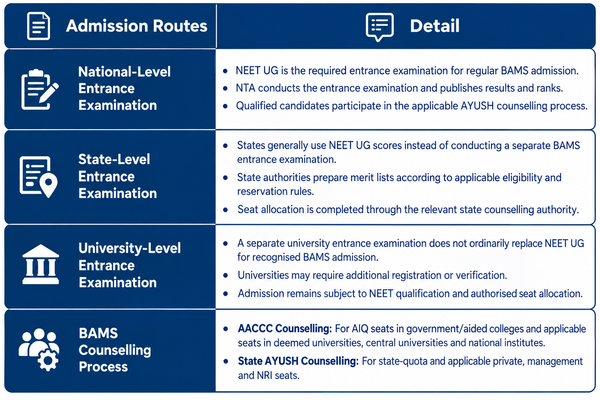
Types of Admission Routes in India
BAMS Admission Process
- Qualifying Examination: Class 12 or an equivalent recognised examination with the required subjects.
- Eligible Streams: Science stream with Physics, Chemistry, Biology and English. Subject-equivalence cases must follow the current admission bulletin.
- Minimum Marks: Generally 50% aggregate in PCB for General candidates and 40% for SC/ST/OBC candidates under the cited NEET BAMS eligibility provisions. PwBD candidates must follow the applicable category-specific criteria.
- Entrance Registration: Apply for NEET UG 2027 through the official NTA portal after registration opens.
- Entrance Result: Download the NEET scorecard and check the qualifying percentile, All India Rank and category rank.
- Counselling/Application: Register through AACCC or the relevant state AYUSH counselling portal according to the eligible seat category.
- Document Verification: Usually requires Class 10 and 12 certificates, NEET scorecard, admit card, identity proof, photographs, domicile and category/PwBD certificates where applicable.
- Seat Confirmation: Accept the allotted seat, report to the allotted institution and pay the prescribed admission fee within the deadline.
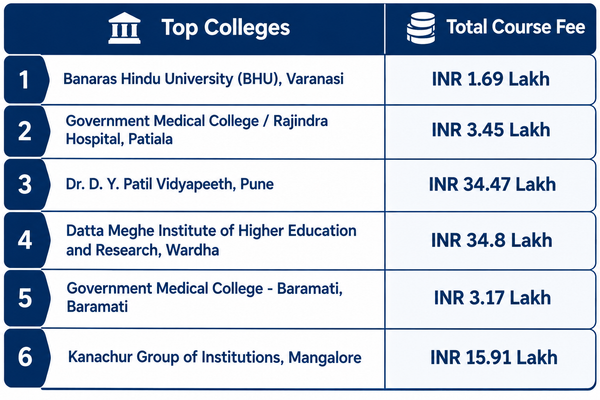
Top BAMS Colleges in India
BAMS Scholarships
- Merit-Based Scholarships: Some universities offer merit scholarships or concessions based on academic performance. Availability and renewal conditions are institution-specific.
- Entrance-Score Scholarships: Selected private institutions may offer NEET-score-linked awards or financial assistance. Students should verify whether the offer specifically covers BAMS.
- Need-Based Scholarships: Eligible students may receive tuition assistance, freeships or financial support based on family income.
- Government Scholarships: Students can explore eligible schemes on the National Scholarship Portal, including central and state post-matric schemes.
- Category-Based Scholarships: Eligible SC, ST, OBC, EBC and other designated categories can apply for applicable state or central schemes. For example, the National Scholarship Portal lists the Post-Matric Scholarship for SC Students and the PM YASASVI Post-Matric Scholarship for OBC, EBC and DNT students in Delhi.
- Sports Scholarships: Some universities provide sports-related concessions. BAMS eligibility must be confirmed with the institution.
- Institution-Specific Financial Support: Selected government and national institutes may provide internship stipends or student assistance. For example, the National Institute of Ayurveda, Jaipur, lists a BAMS internship stipend in its available course information. An internship stipend is not the same as a tuition scholarship.
Career Opportunities After BAMS
| Career Option | Average Salary (Approx. Starting Years) |
|---|---|
| Ayurvedic Medical Officer | INR 3–6 LPA |
| Ayurvedic Doctor in a Private Hospital | INR 2.4–4.8 LPA |
| Ayurvedic Clinical Practitioner | INR 2–5 LPA |
| Panchakarma Physician | INR 2.4–4.5 LPA |
| Ayurvedic Wellness Consultant | INR 2.4–5 LPA |
| Ayurvedic Research Assistant | INR 2.5–4.5 LPA |
| Ayurvedic Pharmaceutical Executive | INR 2.5–5 LPA |
| Medical Content Writer (Ayurveda) | INR 2.4–4.5 LPA |
| Clinical Research Coordinator | INR 3–5 LPA |
| Public Health Programme Associate | INR 3–5.5 LPA |
| Ayurveda Teleconsultation Doctor | INR 2.5–5 LPA |
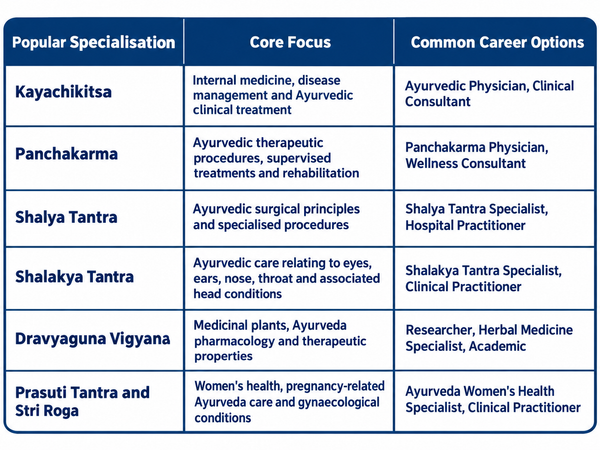
Popular BAMS Specialisations
Top Recruiters
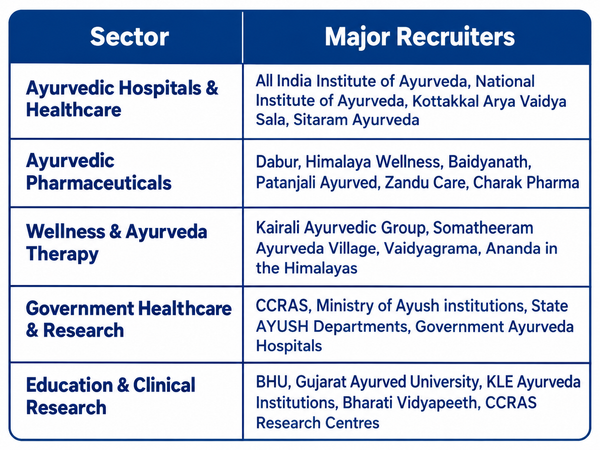
Higher Education Options After BAMS
| Course | Duration |
|---|---|
| MD Ayurveda (Kayachikitsa, Panchakarma, Dravyaguna, etc.) | 3 Years |
| MS Ayurveda (Shalya Tantra, Shalakya Tantra, Prasuti Tantra and Stri Roga, etc.) | 3 Years |
| Master of Public Health (MPH) | 2 Years |
| MBA in Healthcare/Hospital Management | 2 Years |
| MSc in Clinical Research or Related Life Sciences | 2 Years; eligibility varies |
| Postgraduate Diploma/Certificate in Panchakarma or Ayurveda-related Fields | 6 Months–2 Years; programme-dependent |
| PhD in Ayurveda or Related Research Fields | 3 Years or More; specific eligibility applies |
FAQs
Ques. Is NEET compulsory for BAMS admission in 2027?
Ans. Yes. Under the existing regulations, NEET UG qualification is compulsory for regular BAMS admission in India. Students must subsequently participate in the appropriate AACCC or state counselling process. The final 2027 requirements will be governed by the official admission notifications.
Ques. What is the minimum percentage required for BAMS admission?
Ans. Under the cited NEET eligibility rules, General category students generally require at least 50% aggregate marks in Physics, Chemistry and Biology in Class 12. SC/ST/OBC students generally require 40%. Separate provisions apply to PwBD candidates. Students must also qualify NEET UG and satisfy the applicable admission requirements.
Ques. Is Biology compulsory for BAMS?
Ans. Yes. Biology is a required subject for BAMS admission under the standard eligibility requirements. Students must also have Physics, Chemistry and the required English qualification. Candidates with additional or equivalent subjects should check the latest official NEET bulletin.
Ques. Can Commerce and Arts students apply for BAMS?
Ans. Students who have studied only Arts or Commerce subjects without the required Physics, Chemistry and Biology qualifications are not eligible. Students who later complete the recognised required subjects must still satisfy the current NEET and admission eligibility conditions.
Ques. Can BAMS graduates become government medical officers?
Ans. Yes, BAMS graduates may apply for eligible Ayurvedic Medical Officer and AYUSH Medical Officer posts advertised by state governments and other public authorities. Recruitment requirements typically include a recognised BAMS degree, required internship completion, professional registration and any prescribed examination or selection process.
Ques. What can students study after completing BAMS?
Ans. After completing BAMS, MD Ayurveda and MS Ayurveda are the main postgraduate clinical pathways. Students may also explore MPH, healthcare management, Ayurveda-related postgraduate diplomas and eligible research programmes. AIAPGET is the main entrance examination for participating in MD/MS Ayurveda postgraduate admissions.



Comments