




MHT CET 2026 April 13 Shift 1 PCM Question Paper is available for download here. Maharashtra State CET Cell conducted MHT CET 2026 PCM Exam on April 13 in Shift 1 from 9 AM to 12 PM in CBT mode.
- The MHT CET 2026 PCM Question Paper consists of 150 multiple-choice questions (MCQs) totalling 200 marks divided into 3 sections: Physics, Chemistry, and Mathematics, with 50 questions in each subject.
- Physics and Chemistry questions carry 1 mark each while Mathematics questions carry 2 marks each.
- There is no negative marking for incorrect answers.
Download MHT CET 2026 April 13 Shift 1 PCM Question Paper with Solutions PDF from the links provided below.
MHT CET 2026 April 13 Shift 1 PCM Question Paper PDF Download
| MHT CET 2026 April 13 Shift 1 Question Paper | Download PDF | Check Solution |

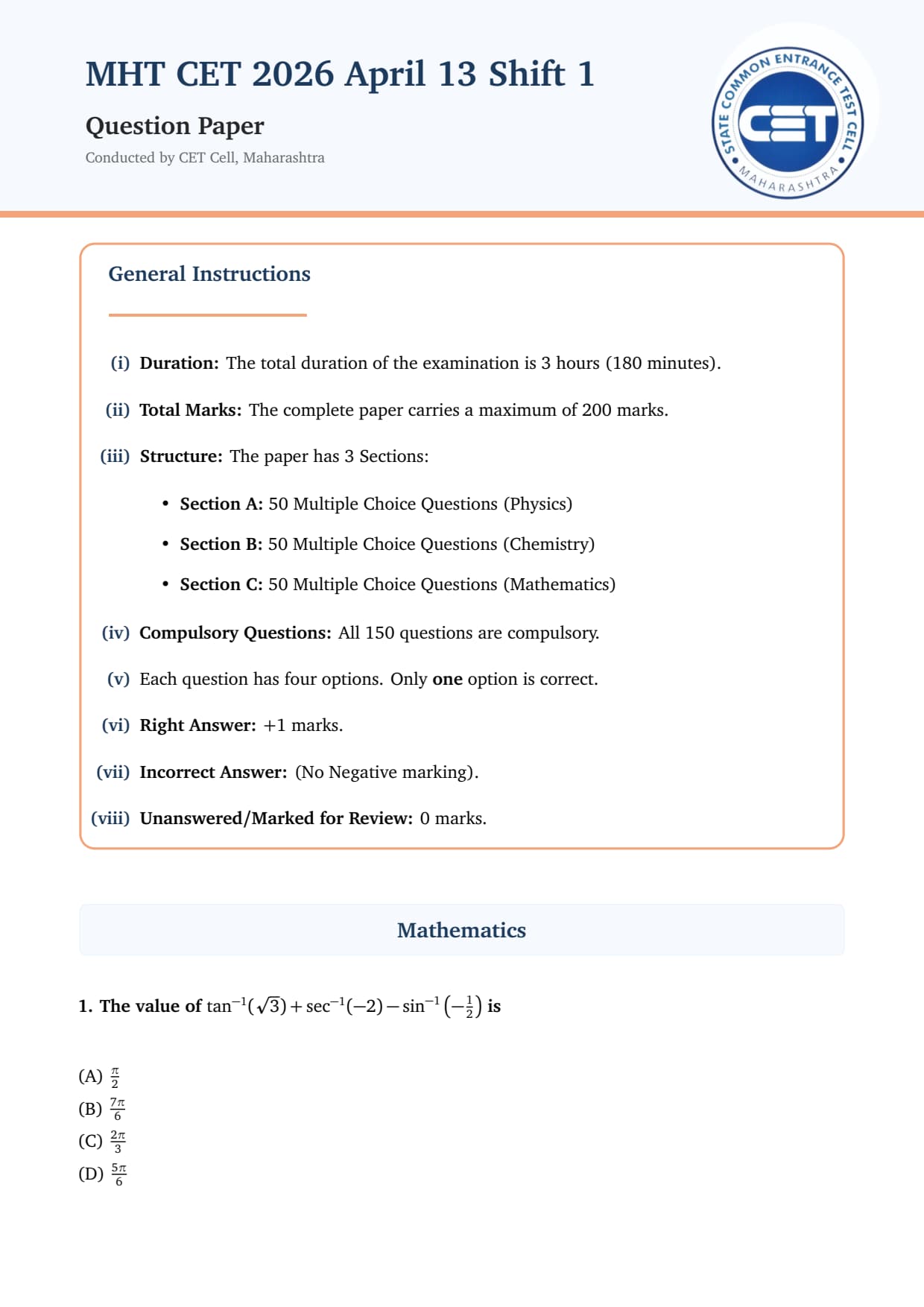
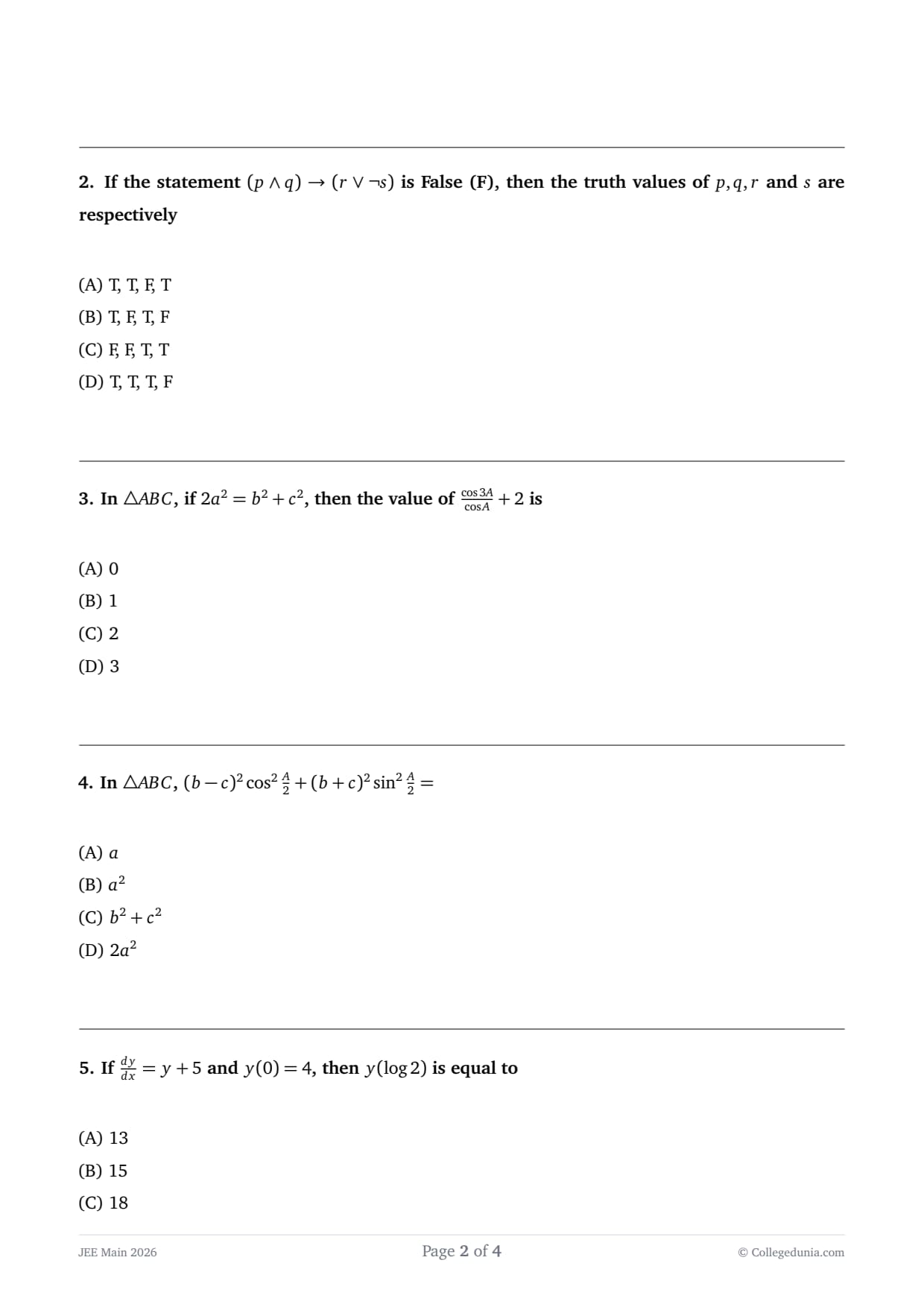
The value of \(\tan^{-1}(\sqrt{3}) + \sec^{-1}(-2) - \sin^{-1}\left(-\frac{1}{2}\right)\) is
View Solution
Concept:
To evaluate inverse trigonometric expressions, we must use their principal value ranges:
\(\tan^{-1}x \in \left(-\frac{\pi}{2},\,\frac{\pi}{2}\right)\)
\(\sec^{-1}x \in [0,\pi] \setminus \left\{\frac{\pi}{2}\right\}\)
\(\sin^{-1}x \in \left[-\frac{\pi}{2},\,\frac{\pi}{2}\right]\)
Step 1: Evaluate \( \tan^{-1}(\sqrt{3}) \).
Since
\[ \tan\left(\frac{\pi}{3}\right) = \sqrt{3} \]
and \(\frac{\pi}{3}\) lies in the principal range,
\[ \tan^{-1}(\sqrt{3}) = \frac{\pi}{3} \]
Step 2: Evaluate \( \sec^{-1}(-2) \).
Let
\[ \sec^{-1}(-2) = \theta \quad \Rightarrow \quad \sec\theta = -2 \]
\[ \cos\theta = -\frac{1}{2} \]
In the principal range \([0,\pi]\), this occurs at:
\[ \theta = \frac{2\pi}{3} \]
Thus,
\[ \sec^{-1}(-2) = \frac{2\pi}{3} \]
Step 3: Evaluate \( \sin^{-1}\left(-\frac{1}{2}\right) \).
We know
\[ \sin\left(\frac{\pi}{6}\right) = \frac{1}{2} \]
Using the property \( \sin^{-1}(-x) = -\sin^{-1}(x) \):
\[ \sin^{-1}\left(-\frac{1}{2}\right) = -\frac{\pi}{6} \]
Step 4: Add the values.
\[ \frac{\pi}{3} + \frac{2\pi}{3} - \left(-\frac{\pi}{6}\right) \]
\[ = \pi + \frac{\pi}{6} \]
\[ = \frac{7\pi}{6} \]
Step 5: Conclusion.
\[ \tan^{-1}(\sqrt{3}) + \sec^{-1}(-2) - \sin^{-1}\left(-\frac{1}{2}\right) = \frac{7\pi}{6} \] Quick Tip: Remember principal value rules: \(\sin^{-1}(-x) = -\sin^{-1}(x)\) \(\tan^{-1}(-x) = -\tan^{-1}(x)\) \(\sec^{-1}(-x) = \pi - \sec^{-1}(x)\) These shortcuts help evaluate inverse trigonometric expressions quickly.
If the statement \((p \wedge q) \rightarrow (r \vee \neg s)\) is False (F), then the truth values of \(p, q, r\) and \(s\) are respectively
View Solution
Concept:
For a conditional statement \(P \rightarrow Q\):
\[ It is False only when P = T and Q = F \]
Also remember:
Conjunction \(P \wedge Q\) is True only when both are True.
Disjunction \(P \vee Q\) is False only when both are False.
Step 1: Use the condition for implication to be false.
Given:
\[ (p \wedge q) \rightarrow (r \vee \neg s) \equiv F \]
An implication is False only when:
\[ (p \wedge q) = T \quad and \quad (r \vee \neg s) = F \]
Step 2: Evaluate \(p\) and \(q\).
For the conjunction:
\[ (p \wedge q) = T \]
both statements must be True:
\[ p = T, \quad q = T \]
Step 3: Evaluate \(r\) and \(s\).
For the disjunction:
\[ (r \vee \neg s) = F \]
both components must be False:
\[ r = F \]
\[ \neg s = F \Rightarrow s = T \]
Step 4: Write the final truth values.
\[ (p,q,r,s) = (T,\,T,\,F,\,T) \]
Step 5: Conclusion.
Thus, the required truth values are:
\[ T,\,T,\,F,\,T \] Quick Tip: The key rule for implication is: \[ T \rightarrow F = F \] This is the \textbf{only case} when a conditional statement becomes False. Use this rule first to determine the truth values of compound logical expressions.
In \(\triangle ABC\), if \(2a^2 = b^2 + c^2\), then the value of \(\frac{\cos 3A}{\cos A} + 2\) is
View Solution
Concept:
To simplify expressions involving multiple angles, use the triple–angle identity:
\[ \cos 3A = 4\cos^3 A - 3\cos A \]
Also, in a triangle the Cosine Rule gives:
\[ \cos A = \frac{b^2 + c^2 - a^2}{2bc} \]
Step 1: Simplify the given expression.
\[ E = \frac{\cos 3A}{\cos A} + 2 \]
Using the identity \( \cos 3A = 4\cos^3 A - 3\cos A \):
\[ E = \frac{4\cos^3 A - 3\cos A}{\cos A} + 2 \]
\[ E = 4\cos^2 A - 3 + 2 \]
\[ E = 4\cos^2 A - 1 \]
Step 2: Use the given condition.
Given:
\[ 2a^2 = b^2 + c^2 \]
This condition is satisfied by an equilateral triangle where:
\[ a=b=c \]
In an equilateral triangle:
\[ A = 60^\circ \]
Step 3: Substitute \(A = 60^\circ\).
\[ E = 4\cos^2 60^\circ - 1 \]
\[ \cos 60^\circ = \frac{1}{2} \]
\[ E = 4\left(\frac{1}{2}\right)^2 - 1 \]
\[ E = 4\left(\frac{1}{4}\right) - 1 \]
\[ E = 1 - 1 = 0 \]
Step 4: Conclusion.
\[ \frac{\cos 3A}{\cos A} + 2 = 0 \] Quick Tip: If a triangle problem gives a relation among sides and the answer options are constants, try substituting convenient values (such as an equilateral triangle when possible). This often simplifies the calculation quickly.
In \(\triangle ABC\), \((b-c)^2 \cos^2 \frac{A}{2} + (b+c)^2 \sin^2 \frac{A}{2} =\)
View Solution
Concept:
To simplify expressions involving half–angles in a triangle, use the identities:
\[ \sin^2\theta + \cos^2\theta = 1 \]
\[ \cos^2\theta - \sin^2\theta = \cos 2\theta \]
Also, the Cosine Rule for a triangle is:
\[ a^2 = b^2 + c^2 - 2bc\cos A \]
Step 1: Rewrite the given expression.
\[ (b-c)^2\cos^2\frac{A}{2} + (b+c)^2\sin^2\frac{A}{2} \]
Expand the squares:
\[ (b^2 + c^2 - 2bc)\cos^2\frac{A}{2} + (b^2 + c^2 + 2bc)\sin^2\frac{A}{2} \]
Step 2: Group similar terms.
\[ (b^2+c^2)\left(\cos^2\frac{A}{2}+\sin^2\frac{A}{2}\right) -2bc\cos^2\frac{A}{2} +2bc\sin^2\frac{A}{2} \]
Step 3: Apply trigonometric identities.
Since:
\[ \cos^2\theta + \sin^2\theta = 1 \]
the expression becomes:
\[ (b^2+c^2) -2bc\left(\cos^2\frac{A}{2}-\sin^2\frac{A}{2}\right) \]
Using:
\[ \cos^2\theta - \sin^2\theta = \cos 2\theta \]
\[ \cos^2\frac{A}{2}-\sin^2\frac{A}{2} = \cos A \]
Thus the expression becomes:
\[ b^2+c^2-2bc\cos A \]
Step 4: Use the cosine rule.
\[ a^2 = b^2 + c^2 - 2bc\cos A \]
Therefore,
\[ (b-c)^2\cos^2\frac{A}{2} + (b+c)^2\sin^2\frac{A}{2} = a^2 \]
Step 5: Conclusion.
Hence, the simplified value is:
\[ a^2 \] Quick Tip: In triangle identities involving half–angles, first expand algebraic terms and then apply identities like \(\sin^2\theta+\cos^2\theta=1\) and \(\cos^2\theta-\sin^2\theta=\cos2\theta\). Most such expressions finally reduce to the cosine rule \(a^2=b^2+c^2-2bc\cos A\).
If \(\frac{dy}{dx} = y + 5\) and \(y(0) = 4\), then \(y(\log 2)\) is equal to
View Solution
Concept:
The given equation is a first–order differential equation.
It can be solved using the separation of variables method:
\[ \int \frac{dy}{g(y)} = \int f(x)\,dx \]
Step 1: Separate the variables.
Given:
\[ \frac{dy}{dx} = y + 5 \]
Rearranging:
\[ \frac{dy}{y+5} = dx \]
Step 2: Integrate both sides.
\[ \int \frac{dy}{y+5} = \int dx \]
\[ \log|y+5| = x + C \]
Step 3: Apply the initial condition \(y(0)=4\).
Substitute \(x=0\), \(y=4\):
\[ \log(4+5) = C \]
\[ C = \log 9 \]
Thus the solution becomes:
\[ \log(y+5) = x + \log 9 \]
Step 4: Find \(y\) when \(x=\log 2\).
\[ \log(y+5) = \log 2 + \log 9 \]
Using logarithmic property:
\[ \log(y+5) = \log(18) \]
\[ y+5 = 18 \]
\[ y = 13 \]
Step 5: Conclusion.
\[ y(\log 2) = 13 \] Quick Tip: While solving differential equations involving logarithms, writing the constant as \(\log C\) often simplifies calculations because logarithmic identities like \(\log a + \log b = \log(ab)\) can be applied directly.
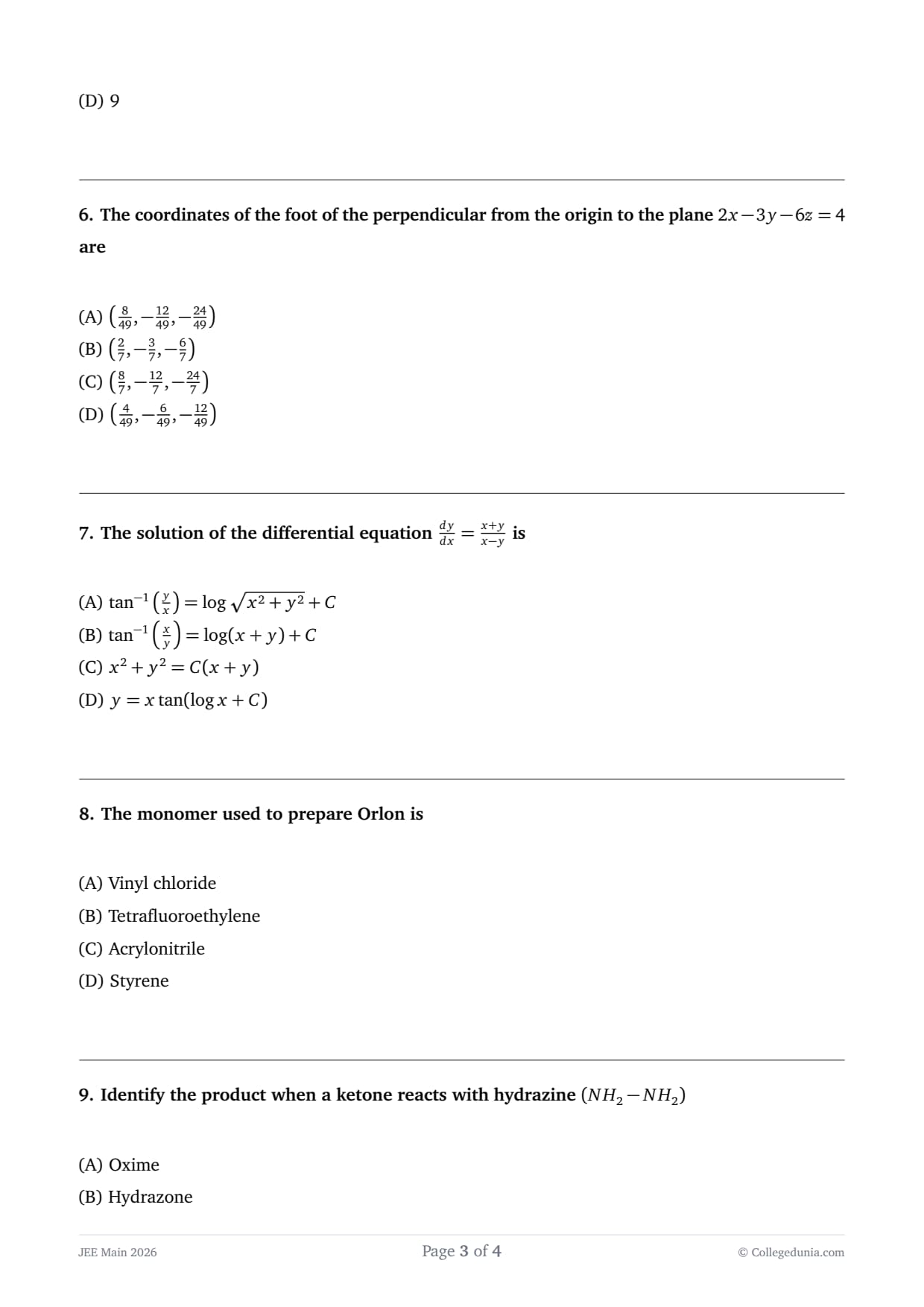
The coordinates of the foot of the perpendicular from the origin to the plane \(2x - 3y - 6z = 4\) are
View Solution
Concept:
The point on a plane that is closest to the origin is the foot of the perpendicular drawn from the origin to that plane.
For a plane of the form:
\[ ax + by + cz = d \]
the coordinates of the foot of the perpendicular from the origin \((0,0,0)\) are given by:
\[ \left(\frac{ad}{a^2+b^2+c^2},\frac{bd}{a^2+b^2+c^2},\frac{cd}{a^2+b^2+c^2}\right) \]
Step 1: Identify the coefficients from the plane equation.
Given plane:
\[ 2x - 3y - 6z = 4 \]
Thus,
\[ a=2,\quad b=-3,\quad c=-6,\quad d=4 \]
Step 2: Compute \(a^2+b^2+c^2\).
\[ a^2+b^2+c^2 =2^2+(-3)^2+(-6)^2 \]
\[ =4+9+36=49 \]
Step 3: Substitute into the formula.
\[ x=\frac{2\times4}{49}=\frac{8}{49} \]
\[ y=\frac{-3\times4}{49}=-\frac{12}{49} \]
\[ z=\frac{-6\times4}{49}=-\frac{24}{49} \]
Step 4: Write the coordinates of the point.
\[ \left(\frac{8}{49}, -\frac{12}{49}, -\frac{24}{49}\right) \]
Step 5: Conclusion.
Hence, the coordinates of the foot of the perpendicular from the origin to the given plane are:
\[ \left(\frac{8}{49}, -\frac{12}{49}, -\frac{24}{49}\right) \] Quick Tip: For a plane \(ax+by+cz=d\), the foot of the perpendicular from the origin can be quickly found using \[ \left(\frac{ad}{a^2+b^2+c^2},\frac{bd}{a^2+b^2+c^2},\frac{cd}{a^2+b^2+c^2}\right) \] This shortcut saves time in coordinate geometry and vector problems.
The solution of the differential equation \(\frac{dy}{dx} = \frac{x+y}{x-y}\) is
View Solution
Concept:
The given differential equation is a homogeneous differential equation because the numerator and denominator contain terms of the same degree.
Such equations can be solved using the substitution:
\[ y = vx \quad \Rightarrow \quad \frac{dy}{dx} = v + x\frac{dv}{dx} \]
Step 1: Substitute \(y = vx\).
\[ v + x\frac{dv}{dx} = \frac{x + vx}{x - vx} \]
\[ = \frac{1+v}{1-v} \]
Step 2: Simplify the equation.
\[ x\frac{dv}{dx} = \frac{1+v}{1-v} - v \]
\[ = \frac{1+v - v + v^2}{1-v} \]
\[ = \frac{1+v^2}{1-v} \]
Step 3: Separate the variables.
\[ \frac{1-v}{1+v^2} dv = \frac{dx}{x} \]
Step 4: Integrate both sides.
\[ \int \left(\frac{1}{1+v^2} - \frac{v}{1+v^2}\right) dv = \int \frac{dx}{x} \]
\[ \tan^{-1} v - \frac{1}{2}\log(1+v^2) = \log x + C \]
Step 5: Substitute \(v=\frac{y}{x}\).
\[ \tan^{-1}\left(\frac{y}{x}\right) - \frac{1}{2}\log\left(1+\frac{y^2}{x^2}\right) = \log x + C \]
Simplifying the logarithmic terms:
\[ \tan^{-1}\left(\frac{y}{x}\right) = \log\left(x\sqrt{1+\frac{y^2}{x^2}}\right) + C \]
\[ \tan^{-1}\left(\frac{y}{x}\right) = \log\sqrt{x^2+y^2} + C \]
Step 6: Conclusion.
Thus, the general solution of the differential equation is:
\[ \tan^{-1}\left(\frac{y}{x}\right) = \log\sqrt{x^2+y^2} + C \] Quick Tip: For homogeneous differential equations of the form \( \frac{dy}{dx} = f\!\left(\frac{y}{x}\right) \), use the substitution \(y = vx\). This converts the equation into a separable form, which often leads to solutions involving logarithmic and inverse trigonometric functions.
The monomer used to prepare Orlon is
View Solution
Concept:
Many synthetic fibres are produced through addition polymerization of vinyl monomers.
Orlon is the commercial name of polyacrylonitrile (PAN), a polymer formed by the polymerization of acrylonitrile.
Step 1: Identify the polymer.
Orlon is a synthetic fibre made from polyacrylonitrile. Therefore, its repeating unit comes from the monomer acrylonitrile.
Step 2: Write the structure of the monomer.
Acrylonitrile (also called vinyl cyanide) has the structure:
\[ CH_2 = CH - CN \]
Step 3: Polymerization reaction.
During addition polymerization, many molecules of acrylonitrile combine to form polyacrylonitrile:
\[ n\,CH_2 = CHCN \xrightarrow{Polymerization} -[CH_2 - CH(CN)]_n- \]
This polymer is commercially known as Orlon.
Step 4: Conclusion.
Hence, the monomer used in the preparation of Orlon is:
\[ Acrylonitrile \] Quick Tip: Important commercial polymer names: Polyacrylonitrile (PAN) \(\rightarrow\) Orlon / Acrilan Polytetrafluoroethylene (PTFE) \(\rightarrow\) Teflon Polyvinyl chloride (PVC) \(\rightarrow\) PVC plastic Polystyrene (PS) \(\rightarrow\) Styron
Identify the product when a ketone reacts with hydrazine \((NH_2-NH_2)\)
View Solution
Concept:
Aldehydes and ketones undergo nucleophilic addition–elimination reactions with ammonia derivatives of the type \(NH_2-G\).
In these reactions, the nucleophile attacks the carbonyl carbon, followed by the elimination of a water molecule, forming a compound containing a \(C=N-G\) linkage.
Step 1: Identify the reacting reagent.
The given reagent is hydrazine \((H_2N-NH_2)\), which is an ammonia derivative.
Step 2: Write the general reaction.
Ketones react with hydrazine in the presence of acid catalyst to form hydrazone:
\[ R_2C=O + H_2N-NH_2 \xrightarrow{H^+} R_2C=N-NH_2 + H_2O \]
In this reaction:
The nucleophile \(H_2N-NH_2\) attacks the carbonyl carbon.
A molecule of water is eliminated.
A double bond \(C=N\) is formed.
Step 3: Name the product.
When the group \(G = -NH_2\) (from hydrazine), the product formed is called a hydrazone.
Step 4: Conclusion.
Therefore, the product formed in this reaction is:
\[ Hydrazone \] Quick Tip: Important carbonyl derivatives formed with ammonia derivatives: Hydroxylamine \(\rightarrow\) Oxime Hydrazine \(\rightarrow\) Hydrazone Semicarbazide \(\rightarrow\) Semicarbazone 2,4-DNP \(\rightarrow\) 2,4-DNP derivative (orange precipitate)
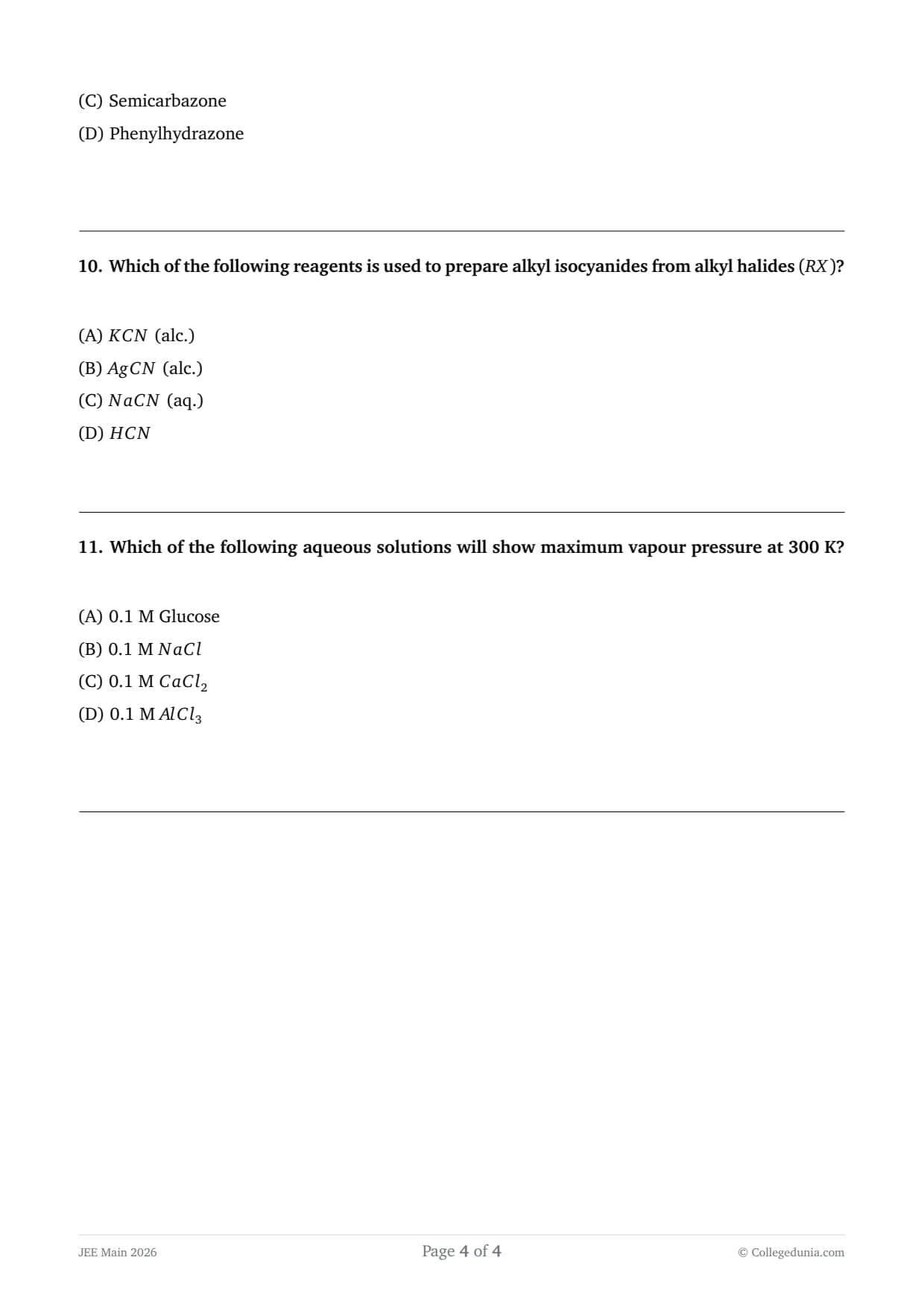
Which of the following reagents is used to prepare alkyl isocyanides from alkyl halides \((RX)\)?
View Solution
Concept:
The cyanide ion \(CN^-\) is an ambident nucleophile, meaning it has two possible sites of attack:
Carbon end \((C)\)
Nitrogen end \((N)\)
The type of reagent used determines which atom participates in the nucleophilic attack, thereby deciding the final product.
Step 1: Reaction with \(KCN\).
\(KCN\) is an ionic compound and dissociates completely in solution to give free \(CN^-\) ions.
The nucleophilic attack occurs through the carbon atom, forming a \(C-C\) bond and producing alkyl cyanides (nitriles).
\[ R-X + KCN \rightarrow R-CN \]
Step 2: Reaction with \(AgCN\).
\(AgCN\) is largely covalent in nature. In this compound, the carbon atom is strongly bonded to silver, leaving the nitrogen atom available for nucleophilic attack.
As a result, the reaction forms alkyl isocyanides.
\[ R-X + AgCN \rightarrow R-NC \]
Step 3: Conclusion.
Since the formation of alkyl isocyanides occurs when nucleophilic attack takes place through nitrogen, the reagent required is:
\[ AgCN (alc.) \] Quick Tip: Important ambident nucleophile results: \(KCN/NaCN \rightarrow\) Alkyl cyanide (Nitrile, \(R-CN\)) \(AgCN \rightarrow\) Alkyl isocyanide (\(R-NC\)) \(KNO_2 \rightarrow\) Alkyl nitrite (\(R-ONO\)) \(AgNO_2 \rightarrow\) Nitroalkane (\(R-NO_2\))
Which of the following aqueous solutions will show maximum vapour pressure at 300 K?
View Solution
Concept:
Vapour pressure is a colligative property. The presence of a solute lowers the vapour pressure of a solvent, and the extent of this lowering depends only on the number of solute particles present in the solution.
The relative lowering of vapour pressure is proportional to the effective concentration of solute particles:
\[ Lowering of V.P. \propto i \times M \]
where \(i\) = van't Hoff factor (number of particles produced after dissociation) \(M\) = molarity of the solution.
Thus, more particles \( \Rightarrow \) greater lowering of vapour pressure \( \Rightarrow \) smaller vapour pressure.
Step 1: Identify the number of particles produced by each solute.
For all options, \(M = 0.1\).
Glucose: Non–electrolyte, does not dissociate. \(i = 1\)
\(NaCl \rightarrow Na^+ + Cl^-\), \(i = 2\)
\(CaCl_2 \rightarrow Ca^{2+} + 2Cl^-\), \(i = 3\)
\(AlCl_3 \rightarrow Al^{3+} + 3Cl^-\), \(i = 4\)
Step 2: Calculate effective particle concentration \(i \times M\).
\[ Glucose: 0.1 \times 1 = 0.1 \]
\[ NaCl: 0.1 \times 2 = 0.2 \]
\[ CaCl_2: 0.1 \times 3 = 0.3 \]
\[ AlCl_3: 0.1 \times 4 = 0.4 \]
Step 3: Compare vapour pressures.
Since vapour pressure decreases with increasing number of solute particles, the solution with the smallest value of \(i \times M\) will have the maximum vapour pressure.
Among the given options, glucose has the lowest effective particle concentration.
Step 4: Conclusion.
Therefore, the solution with the maximum vapour pressure is:
\[ 0.1 M Glucose \] Quick Tip: For colligative properties, always consider the \textbf{effective number of solute particles} \((i \times M)\). Larger \(i \times M\) \( \Rightarrow \) greater lowering of vapour pressure Larger \(i \times M\) \( \Rightarrow \) higher boiling point Larger \(i \times M\) \( \Rightarrow \) lower freezing point Larger \(i \times M\) \( \Rightarrow \) higher osmotic pressure
MHT CET PCM Exam Pattern 2026
| Parameter | Details |
|---|---|
| Conducting Body | Maharashtra Common Entrance Test Cell (Maharashtra CET Cell) |
| Exam Mode | Online (Computer-Based Test) |
| Duration | 180 minutes (3 hours) |
| Groups / Subjects | PCM (Physics, Chemistry, Mathematics) for Engineering |
| Total Questions |
150 |
| Total Marks | 200 |
| Question Type | Multiple Choice Questions (MCQs) |
| Marks Distribution |
|
| Negative Marking | No |
| Syllabus Weightage |
|



Comments