




In The MHT CET 2026 Chemistry, Thermodynamics, p-Block Elements, d- and f-Block Elements, and Coordination Compounds are the highest weightage topics with 4 expected questions each. It is paper 2 of a combined exam of Physics & Chemistry. Each question carries 1 mark and negative marking does not apply to it.
- Thermodynamics (8% weightage) and p-Block Elements (8% weightage) is expected to have 4 questions each.
- Chemical Kinetics (7% weightage) and Electrochemistry (7% weightage) is expected to have 3-4 questions each.
- Chemical Bonding & Molecular Structure (5% weightage) is expected to have 2-3 Questions.
- Atomic Structure with 4 % of weightage can have 2 expected questions.
In this article, we will discuss the chapter -wise weightage for Chemistry along with other details of it.
Also Read:
Key Summary
- High-weightage Class 12 chapters like Thermodynamics, p-Block, d- & f-Block, and Coordination Compounds can contribute around 3–4 questions each.
- Important numerical-based units include Chemical Kinetics and Electrochemistry, are expected to be around 3–4 questions each.
- In Class 11, chapters such as Chemical Bonding and Equilibrium can contribute 2–3 questions each.
MHT CET 2026 Chemistry Weightage: Class 11th
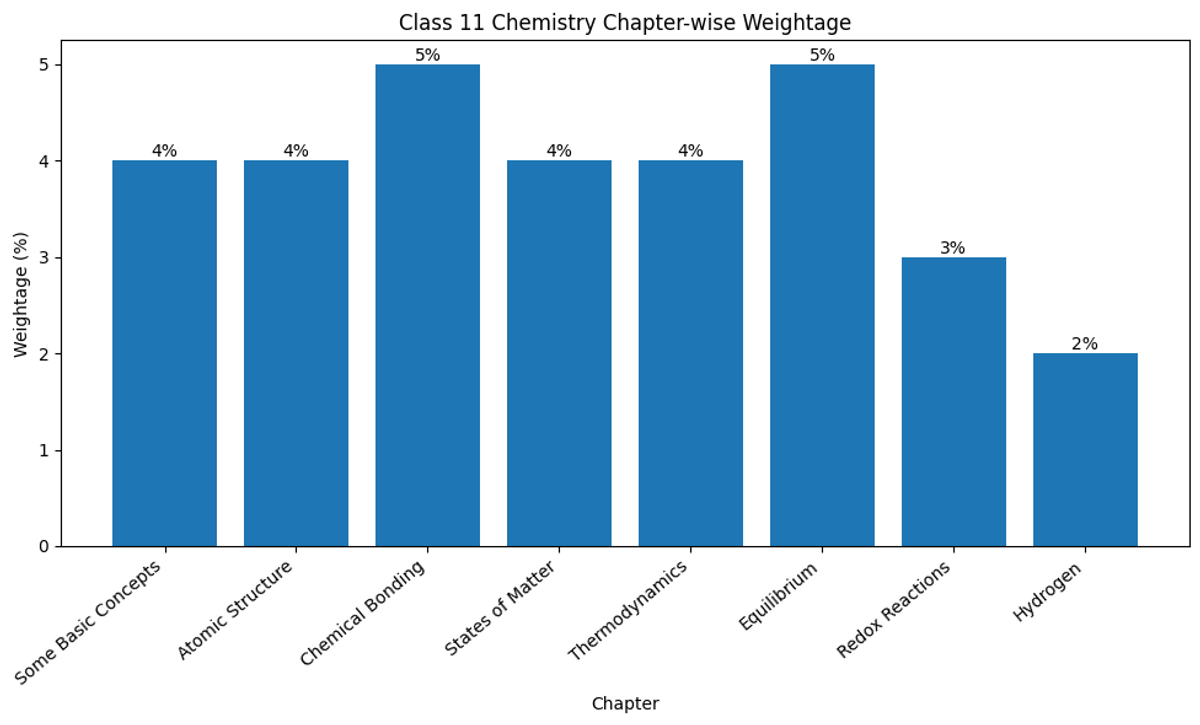
Class 11th Chemistry syllabus in MHT CET 2026 contributes a moderate share of around 20% of the total questions. Here is the approx weightage and number of questions of class 11th Chemistry in MHT CET 2026.
- Most of the chapters carry 4–5% weightage that can be approx 2 questions per chapter.
- Chemical Bonding & Molecular Structure and Equilibrium may contribute 2–3 questions.
- Chapters such as Some Basic Concepts, Atomic Structure, States of Matter, and Thermodynamics are expected to have around 2 questions each.
- Redox Reactions with 3% weightage may contribute 1–2 questions.
| Class 11 Chapters | Weightage | Possible No. of Questions (Out of 50) |
|---|---|---|
| Some Basic Concepts of Chemistry | 4% | 2 Questions |
| Atomic Structure | 4% | 2 Questions |
| Chemical Bonding & Molecular Structure | 5% | 2-3 Questions |
| States of Matter | 4% | 2 Questions |
| Thermodynamics | 4% | 2 Questions |
| Equilibrium | 5% | 2-3 Questions |
| Redox Reactions | 3% | 1-2 Questions |
| Hydrogen | 2% | 1 Question |
MHT CET 2026 Mock Test Subject-wise
| MHT CET Physics Mock Test | Take Test |
| MHT CET Chemistry Mock Test | Take Test |
| MHT CET Biology Mock Test | Take Test |
| MHT CET Maths Mock Test | Take Test |
MHT CET 2026 Chemistry Weightage: Class 12th
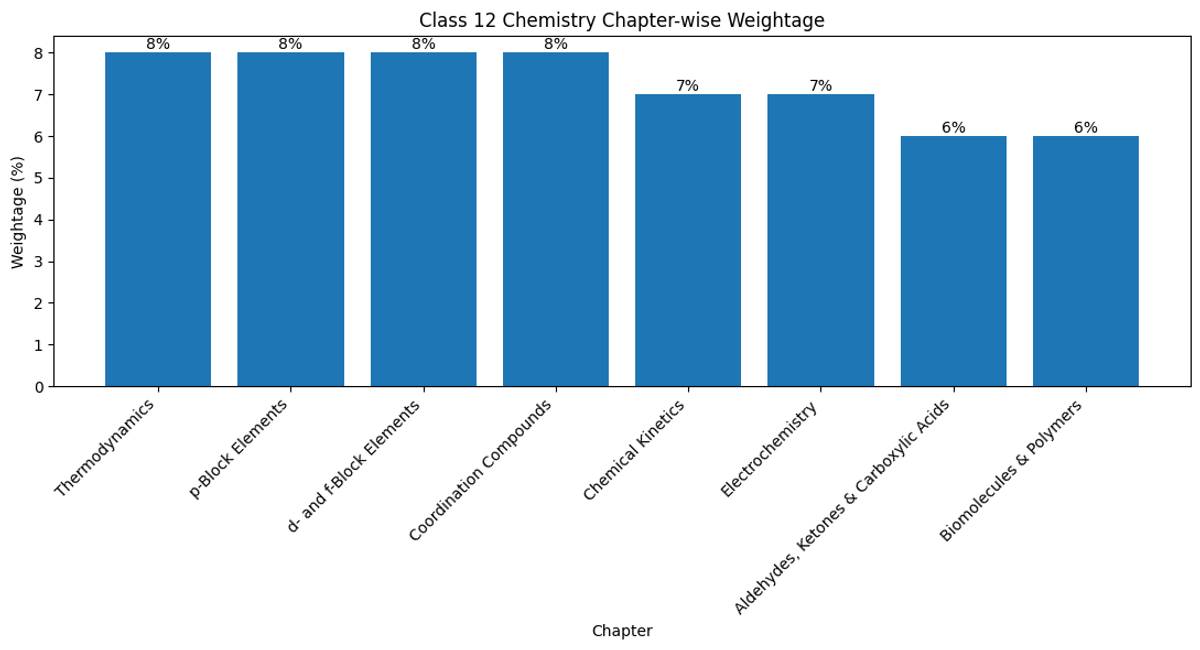
In MHT CET 2026, the class 12th Chemistry syllabus weightage is mostly higher in comparison to class 11th syllabus. The total questions are 50 with chapters like Thermodynamics, p-Block Elements, d- and f-Block Elements, and Coordination Compounds.
- The four major subjects in class 12th Chemistry are Thermodynamics, p-Block, d- & f-Block, and Coordination Compounds.
- These subjects can contribute around 4 questions each that makes them the most scoring subjects.
- Chemical Kinetics and Electrochemistry are expected to contribute around 3–4 questions.
- Organic chapters such as Aldehydes, Ketones & Carboxylic Acids and Biomolecules & Polymers may contribute around 3 questions each.
- Focus on conceptual clarity and repeated question patterns from previous years can maximize scoring potential in these units.
| Class 12 Chapters | Weightage | Possible No. of Questions (Out of 50) |
|---|---|---|
| Thermodynamics | 8% | 4 Questions |
| p-Block Elements | 8% | 4 Questions |
| d- and f-Block Elements | 8% | 4 Questions |
| Coordination Compounds | 8% | 4 Questions |
| Chemical Kinetics | 7% | 3-4 Questions |
| Electrochemistry | 7% | 3-4 Questions |
| Aldehydes, Ketones & Carboxylic Acids | 6% | 3 Questions |
| Biomolecules & Polymers | 6% | 3 Questions |
Ques. Does MHT CET 2026 have negative marking?
Ans. No, negative marking is not applicable on MHT CET 2026.
Check:
Important Chemistry Chapters for MHT CET 2026
Candidates appearing in MHT CET 2026 can enhance their performance in the Chemistry section by focusing more on formulas and practicing problems. Here are some of the MHT CET important topics/chapters in Chemistry that students can focus to increase their score.
| Topics | Sub-Topics |
|---|---|
| States of Matter |
|
| Basic Concepts of Chemistry |
|
| Chemistry Thermodynamics and Energetics |
|
| Redox Reactions |
|
| Chemical Kinetics |
|
| Solutions and Colligative Properties |
|
| Solid State |
|
| Basic Principles and Techniques in Organic Chemistry |
|
| Electrochemistry |
|
| An organic compound containing nitrogen |
|
| p-Block elements, d-Block elements, f-Block Elements |
|
| Polymers |
|
Users Discussing Chapter Wise Weightage for Chemistry on Quora
Users on Reddit are discussing the chapter-wise weightage for Chemistry. A user mentioned the expected percentage of chapters for every chapters of Chemistry. Other users found it to be useful and some are giving their opinion in the comment section.
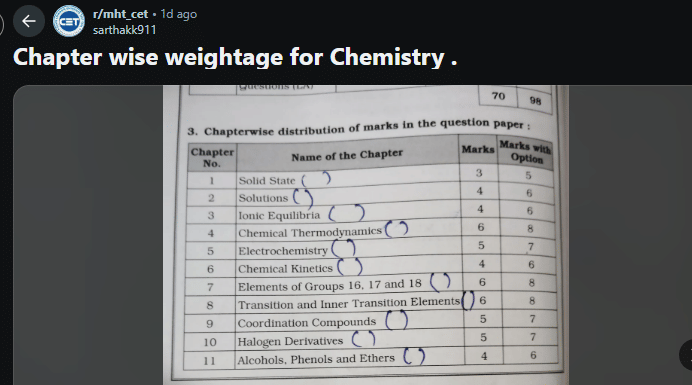
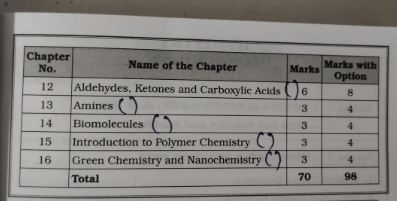
Another user provided another weightage in the comment section.
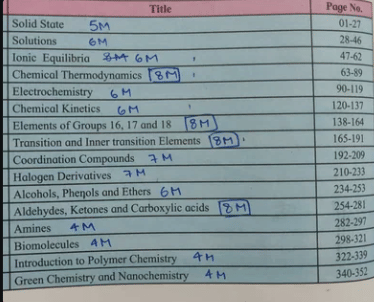
Source: This information is taken from the users discussion on Reddit.
MHT CET Chemistry: Previous Years’ Most Repeated Topics
MHT CET Chemistry previous years’ analysis shows the chapter-wise weightage and question pattern that can be helpful for candidates.
- Chemical Kinetics and Electrochemistry (Physical Chemistry topics) with 3-4 questions from each are highly repeated topics.
- From Coordination Compounds of Inorganic Chemistry IUPAC naming, isomerism, hybridisation types of questions are asked.
- From Organic Chemistry focus on Aldol, Cannizzaro, Friedel–Crafts, Sandmeyer
- Preparation & reactions, Reaction trends, tests types of questions.
| Unit | Chapter / Topic | Commonly Asked From | Repeat Frequency |
|---|---|---|---|
| Physical Chemistry | Chemical Kinetics | Rate law, order, half-life, Arrhenius equation | Very High |
| Electrochemistry | Nernst equation, EMF, conductivity | Very High | |
| Thermodynamics | ΔH, ΔG, spontaneity conditions | High | |
| Solutions | Raoult’s law, osmotic pressure, colligative properties | High | |
| Surface Chemistry | Adsorption isotherms, colloids | Moderate | |
| Inorganic Chemistry | Coordination Compounds | IUPAC naming, isomerism, hybridisation | Very High |
| p-Block Elements | Trends, important compounds | High | |
| d & f Block Elements | Oxidation states, properties | High | |
| Organic Chemistry | Named Reactions | Aldol, Cannizzaro, Friedel–Crafts, Sandmeyer | Very High |
| Alcohols, Phenols & Ethers | Preparation & reactions | High | |
| Aldehydes, Ketones & Acids | Reaction trends, tests | High |
Ques. Is the MHT CET 2026 syllabus the same as the NCERT syllabus?
Ans. Some topics of MHT CET 2026 syllabus are similar with NERT, but it is not identical. It follows Maharashtra Board syllabus, not NCERT.
Ques. How is the weightage of chapters distributed between Class 11 and Class 12 for MHT CET?
Ans. The weightage of Class 11th syllabus is 20% and Class 12th syllabus is 80% in MHT CET.
Ques. Can I pass MHT CET by only studying high-weightage chapters?
Ans. It can be a smart decision to study only high-weightage chapter in MHT CET, but it is not always a smart choice. Understanding all the topics in MHT CET is recommended.
Ques. Has the MHT CET 2026 syllabus changed from last year?
Ans. No, MHT CET 2026 syllabus has not changed from last year. It is same as 2025.
Related News:



Comments