



Content Writer
Morphology of Flowering Plants refers to a group of land plants that includes root, stem, leaves, flower, fruit, and seeds. The flowering plants or the angiosperms show a great degree of diversity.
- Morphology of Flowering Plants includes the pollination cycle of flowering plants.
- It includes adaptions to various habitats for protection and storage.
- Morphology is the branch of biology that deals with phenotypic features.
- The phenotypic features include the structures and forms of an organism.
- It fundamentally refers to the study of the organization of different parts and their arrangement in a plant or animal body.
- Flowering plants are also known as angiosperms or phanerogams.
- In these types of plants, seeds are enclosed inside the fruits.
- The above portion of the flowering plants forms the shoot system.
Read More: NCERT Solutions For Class 11 Biology Chapter 5: Morphology of Flowering Plants
| Table of Content |
Key Terms: Morphology of Flowering Plants, Morphology, Flowering Plants, Root, Leaves, Flowers, Seed, Fruits, Angiosperms, Gymnosperms, Reproductive Organ, Carpel, Stigma
Flowering Plants
[Click Here for Sample Questions]
Flowering plants, or angiosperms, are the most diverse group in the plant kingdom. It covers almost 80% of the known plant species. Simply put, these are the plants that produce seeds enclosed in hollow ovaries.
- The ovary may itself be enclosed in a flower.
- Thus, fruits are derived from the maturing flowering organs of the plant.
- Flowering plants tend to evolve in the Triassic period
- From the evolutionary perspective, the angiosperms are thought to have evolved some 140 million years ago.
- It is the most important characteristic of angiosperm plants.
- In contrast to this, in the case of the gymnosperms, the seeds are not enclosed but borne exposed.
- It helps in the adaptation of ecological niches.
Read More: Morphology of flowering plants MCQs
Flowering plants undergo through the process of pollination. In the process, pollen grains are first transferred from the anther part of male flowers. They are transferred to the stigma part of the female flower.
- Next, the fertilization of grains takes place.
- Finally, seeds are formed from the flowering plants.
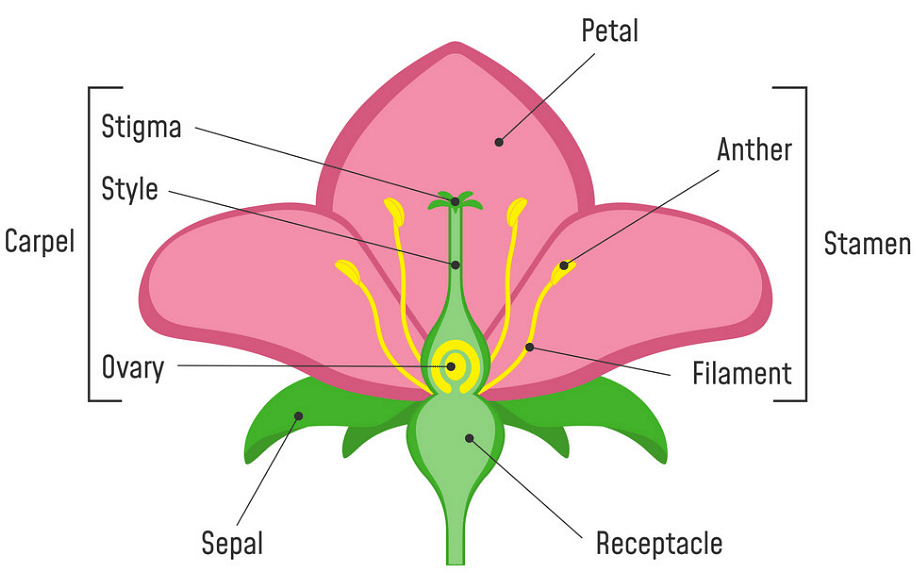
Flowering Plant (schematic)
Read More: Vegetative propagation
Root System
[Click Here for Sample Questions]
The root is a non-green, positively geotropic, underground part of the plant. It helps to anchor the plant and absorb the nutrients from the soil.
- They are used for storage, anchorage and absorption of water and minerals.
- The elongation of the radicle forms primary roots.
- The roots are originated from the base of stems.
- They are used for the absorption of water and minerals from the soil.
- The root cap, region of maturation and region of elongation are three regions of the root system.
Read More:
Characteristics of Root System
Some important characteristics of the root system are as follows:
- The root system is the underground descending part of the plant system.
- It is positively geotropic and negatively phototropic.
- They are non-green plants, which means they do not possess chlorophyllous tissue.
- It does not have any node or internode.
- Lateral roots arise from the pericycle region of the root.
- In the case of a tap root system, the apex of the root is usually protected by the root cap.
Read More: Morphology of Flowering Plants: Important Questions
Types of Root System
There are mainly three types of root systems which are as follows:
Tap Root System
The tap root system is predominant in dicotyledonous plants. It develops from the radicle part of the germinating seed. Along with primary roots and branches, it gives rise to the whole tap root system.
Example of Tap Root SystemExample: Mangoes, Magnolia, Banyan are a few common examples of the dicotyledonous plants with taproot systems. |

Tap root and Fibrous root System
Fibrous Root System
The fibrous root system is predominant in monocotyledonous plants. These roots develop from the thin, moderately branched roots or primary roots growing directly from the stem.
- These kinds of roots do not penetrate the soil deeply.
- Therefore, on maturity, these roots look like a mat or carpet on the floor.
Example of Fibrous Root SystemExample: Paddy, Wheat, Onion, Grasses are a few common examples of angiosperms that show fibrous root systems. |
Adventitious Root System
Adventitious roots are the roots that originate from any part of the plant body other than the radicle of the germinating seed. This kind of root system is found in monocotyledonous plants.
- This adventitious root system is used for multiple purposes including mechanical support, vegetative propagation, etc.
Example of Adventitious Root SystemExample: Maize, Oak trees, grasses are some of the common examples of plants that show adventitious root systems. |

Adventitious Root System
Read More: Difference Between Fertilizers and Manure
Functions of Root System
The general functions of the root system are as follows-
- The root system is used for anchorage.
- They are used for the absorption of water and soil nutrients.
- The root system is used for storage purposes.

Read More: Transportation in Plants
Shoot System
[Click Here for Sample Questions]
Shoot system is the ascending part of the plants that are positively phototropic and negatively geotropic. The part of the plant body that bears the leaves, flowers, buds, fruits, etc.
- The shoot system helps in the conduction of water and minerals to different parts of the plant body.
- It develops from the plumule part of the germinating seed.
- The stem portion is usually green at a young age, but it turns brown upon maturing.
Characteristics of Shoot System
Some of the main characteristics of the shoot system of a plant
- Shoot system develops from the plumule and epicotyl region of the embryo.
- It is positively phototropic, which means it grows towards the light.
- They are negatively geotropic, which means they grow to erect away from the soil.
- The stem is differentiated into nodes and internodes.
- Young stems are usually photosynthetic.
- In most cases, multicellular hairs are present.
- The mature stems and their branches bear leaves, flowers, and fruits.

Parts of a Stem
Modification of Stems
Apart from axial stability, the shoot or the stem may undergo different modifications. The modified stem may provide protection, can be used for vegetative propagation and storage.
Example of Modification of StemsExample: Here are some examples of modified stems-
|
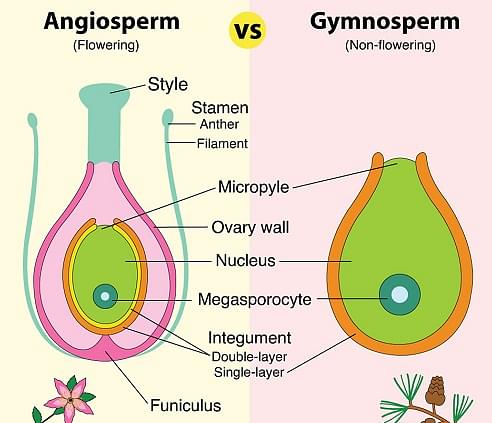
Gymnosperms and Angiosperms
Read More: Double Fertilization
Leaves
[Click Here for Sample Questions]
Leaves are green, flat, thin, and laterally expanded organs of the plant body, which are used as the main site for photosynthesis. It absorbs light with the help of chlorophyll and carries out gaseous exchange through stomata.
- Leaves grow at the node and bear buds at their axils.
- Structurally, a leaf is made of three parts- leaf lamina or leaf blade, petiole, and leaf base.
- The leaves are green as they contain photosynthetic pigments called chlorophylls and serve as the main photosynthetic site of the plant.
The leaves grow on the stem in an acropetal order, and the pattern of the leaf development on the stem is called phyllotaxy. The flowering plants show a great degree of variation in phyllotaxy.
Read More: Difference between Autotrophs and heterotrophs

Structure of Leaves
Characteristics of leaves
Some of the main characteristics of the leaves of a plant-
- Leaves grow as a lateral appendage on the stem.
- It is always borne on the node of the stem.
- Leaf carries an axillary bud at its base or axil.
- It has three main parts: lamina, petiole and leaf base.
- In addition to that, it may possess two small lateral outgrowths called stipules.
- Leaves are the main photosynthetic part of a plant’s body.
- Lamina is traversed by prominent vascular strands known as veins.
- Different venation patterns can be found in different types of plants.
Example of LeavesExample: In dicot plants usually, a reticulate type of venation is found while in the monocotyledonous leaves parallel venation is usually found. |
Function of Leaves
The important functions of the leaves are as follows-
- Leaves help in the process of photosynthesis
- It is used for the transpiration process.
- Leaves help in storage and defence mechanisms.
Modifications of Leaves
Sometimes, the leaves are modified into different structural forms according to the functions they perform.
Example of Modification of LeavesExample: Here are some examples of such modification-
|
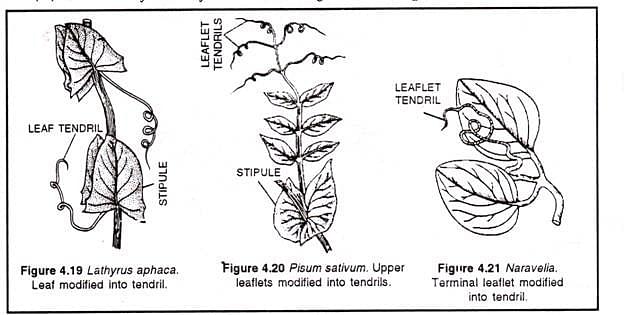
Modifications of Leaves
Read More:
Flowers
[Click Here for Sample Questions]
Flowers are the reproductive part of the plants. The arrangement of flowers on a floral axis is called an Inflorescence. It is divided into two major categories, namely racemose, where the floral axis is of indefinite growth.
- Cymose is the second category, where the growth of the floral axis becomes limited after a certain period.
- The individual flower is composed of four whorls, successively arranged on the swollen end of the pedicel and receptacle.
Calyx
Calyx is the outermost whorl, usually photosynthetic. It is made up of sepals. The calyx can be gamosepalous (where the sepals are united) or polysepalous (where the sepals are free)

Parts of a Flower
Read More: Insectivorous Plants
Corolla
Corolla forms the second whorl from the outer side. It is composed of petals that can be of different colours, shapes, and structures. The corolla can also be polypetalous or gamopetalous.
Androecium
Androecium is the third whorl composed of stamens. It is the male reproductive part of the flower. Each stamen is composed of a filament and an anther. Anther is a bilobed structure and contains two chambers called pollen sacs.
- The pollen grains are produced in the pollen sacs.
The stamens can be fused, and the flowers can be classified into the following types based on:
- Epiphyllous: When the stamens are fused with the perianth, then they are called Epiphyllous.
- Polyandrous: When the stamens remain free in a flower, they are called Polyandrous.
- Monadelphous: When the stamens are united to form a single bundle, they are called Monadelphous.
- Diadelphous: When the stamens are united into two bundles, they are called Diadelphous.
- Polyadelphous: Here, the stamens are bundled in more than two bundles.

Androecium
Gynoecium
Gynoecium is the innermost whorl of the flower and serves as the female reproductive part of the flower. It is composed of three parts-a basal ovary, style, and apical stigma. Each ovary bears one or more ovules that are attached to flattened tissue called the placenta.

Gynoecium
Perianth
In some cases, the calyx and corolla are not distinctly separated. This structure is called perianth. The reproduction process is called pollination, in which the pollen grains are transferred by various means to the stigma of the gynoecium, and fertilization takes place.Read More: Fibrous Root System
Fruits
[Click Here for Sample Questions]
Fruit is the seed-bearing structure which is mature or ripened ovary enclosing seeds. When the ovary wall ripens, it changes into a pericarp. It is a thick and fleshy structure, composed of the following parts:
- Outermost Layer: Epicarp is the outermost layer of the fruits.
- Middle Layer: Mesocarp is the middle layer of the fruits.
- Innermost Layer: Endocarp is the innermost layer of the fruits.
Types of Fruits
Based on the mode of development, fruits can be classified into the following type which are as follows:
Simple Fruits
Simple Fruits are fruits that are developed from the monocarpellary ovary or multicarpellary syncarpous ovary. Thus, only one fruit is formed in the ovary. The fruit can either be fleshy or dry.
Aggregate Fruits
When the fruits develop from the multi carpellary apocarpous ovary, they become fruitlets as each carpel is separated from the other. Different types of aggregate fruits include etaerio of follicles, etaerio of achenes, etaerio of berries, etaerio of drupes, etc.
Composite Fruits
Composite Fruits consist of many ovaries and other floral parts which combine to form the fruit. It is a false fruit. They are of two types, namely, sorosis and sycosis.

Types of Fruits
Read More:
| Class 11 Biology Related Concepts | ||
|---|---|---|
| Fertilisation in Plants | Diversity in Living Organisms | Pteridophyta |
| Plant Growth Regulators | Agriculture Soil | Double Fertilization in Angiosperms |
Seeds
[Click Here for Sample Questions]
Seeds are formed when ovules are fertilized. It is composed of two parts, namely, a seed coat and the embryo. The embryo is composed of a radicle, an embryonal axis, and one or two cotyledons.
- In angiosperms, the seeds are found enclosed in the fruit, which is the mature form of the ovary.
Types of seeds
The seed can be of two types:
Monocotyledonous Seeds
In monocotyledonous seeds, only one cotyledon is present. There is only the outer layering of the seed coat.
Dicotyledonous Seeds
In the dicotyledonous seeds case, the number of cotyledons is two.

Monocotyledon and Dicotyledon
Read More: Pollination by Snails
Things To Remember
- Morphology of Flowering Plants is divided into six categories: root, stem, leaves, flower, fruit, and seeds.
- Flowering plants or angiosperms are plants that produce seeds enclosed in hollow ovaries.
- The root is an underground part of the plant that helps absorb water and nutrients from the soil.
- Shoot system is the aerial part of the plant, which is phototropic and bears other organs such as leaves, flowers, fruits, and seeds, etc.
- The leaves are the main chlorophyllous parts of a plant.
- Flowers are the main reproductive part of the plants.
- Fruits are the mature ovary of a flower, and it contains the seed.
- Seeds are the basic part of the flowering plants.
Read More:
Sample Questions
Ques: Explain: (A) Morphology (B) Angiosperms? (2 marks)
Ans: (A) Morphology is a field of Biology that deals with the study of the form and structure of organisms and their specific structural features. It is a very important tool used in taxonomy.
(B) Angiosperms or flowering plants are those plants that have flowers and produce seeds enclosed within a carpel. It is the largest group of the kingdom Plantae and comprises 80% of all plants.
Ques: Explain: (A) Haustoria (B) Mixed inflorescence? (2 marks)
Ans: (A) Haustoria are highly modified forms of the root of the parasitic plants. It is a tube-like structure that is used to suck out the nutrients of the host plants.
(B) A mixed inflorescence is an inflorescence in which both racemose and cymose type of flower arrangements are found. Example: Banana.
Ques: Describe the modifications in stems for vegetative propagation (any two)? (3 marks)
Ans: Stem modifications are used for vegetative propagation. Here are two such examples-
- Runner: Underground stems of some plants can spread to new niches. When the old plant dies, new plants can grow from these parts. Example- grasses.
- Stolon- These are the slender lateral branches that grow aerially after arising from the base of the main axis. Example: Mint.
Ques: Describe leaf modifications in plants. (any two)? (2 marks)
Ans: In a lot of plants the modification of leaves performs various functions apart from photosynthesis. Examples of such modifications are-
- Tendrils- They help in plant climbing
- Spines- Used in plant defense.
Ques: What are the types of mature seeds? (2 marks)
Ans: The mature seeds are of two types-
- Albuminous- here the endosperm is present to supply nutrients to the embryo in the seed.
- Non- albuminous- Here, the seed does not contain any endosperm or other storage food.
Ques: Classify plants based on their habitat? (5 marks)
Ans: On the basis of the habitat the plants can be of four types-
- Hydrophytes- They are the plants that grow in the aquatic habitat.
- Mesophytes- They grow under moderate moisture and temperature conditions.
- Xerophytes- These plants grow in extreme conditions of deserts i.e. in the acute dearth of water.
- Halophytes: These plants grow in the extreme saline habitats such as salt estuaries, saline ponds, alkaline soil, etc.
- Epiphytes: These are the plants that grow on other plants.
Ques. With a neat, labelled diagram, describe the parts of a typical angiosperm ovule? (5 marks)
Ans:

A typical angiosperm ovule is a small structure that is formed in the ovary. Ovule first develops as a projection on the placenta and is composed of multilayered cellular tissue called the nucellus.
- The hypodermal cell of the nucellus enlarges and is transformed into a megaspore mother cell.
- This cell undergoes meiosis to produce four haploid cells only one of which develops and forms the embryo sac (female gametophyte).
- An ovule may be surrounded by one or two protective layers called integuments, leaving a small opening at one end termed as micropyle which acts as a passage for the entry of the pollen tube into the ovule.
- Thus, a typical ovule consists of a fully developed embryo sac with the nucellus and integuments.
Ques. What are chasmogamous flowers? Can cross-pollination occur in cleistogamous flowers? Give reasons for your answer? (4 marks)
Ans: Chasmogamous flowers are those flowers that are open with exposed anther and stigma. Cleistogamous flowers are those flowers that do not open at all.
- In these flowers, the anthers and stigma lie close to each other, when anthers dehisce in the flower buds, the pollen grains come in the contact with stigma to effect pollination.
- So these flowers are invariably self-pollinated as the flowers remain closed and there is no chance of cross pollen landing on the stigma.
- Pollination and seed setting are assured even in the absence of pollinators
Ques: What are characteristic of roots? (4 marks)
Ans: The characteristics of roots are as follows:
- The root system is the underground descending part of the plant system.
- It is positively geotropic.
- It is negatively phototropic.
- It is non-green which means it does not possess chlorophyllous tissue.
- It does not have any node or internode.
- Lateral roots arise from the pericycle region of the root.
- In the case of a tap root system, the apex of the root is usually protected by the root cap.
Ques: What is the difference between monocotyledonous seeds and dicotyledonous seeds? (5 marks)
Ans: The difference between monocotyledonous seeds and dicotyledonous seeds are as follows:
| Monocotyledons Seeds | Dicotyledons Seeds |
|---|---|
| Monocotyledons Seeds consists of single cotyledons. | Dicotyledons Seeds consists of two cotyledons. |
| It consists of fibrous root system. | It consists of tap root system. |
| They have parallel venation. | They have net venation. |
| Monocotyledons Seeds cannot increase in diameter. | Dicotyledons Seeds can increase in diameter. |
| Example: Garlic | Example: Apple |
Ques: What are the characteristics of leaf?(5marks)
Ans: The characteristics of leaf are as follows:
- The leaf grows as a lateral appendage on the stem.
- A leaf is always borne on the node of the stem.
- It carries an axillary bud at its base or axil.
- A leaf has three main parts: lamina, petiole and leaf base. In addition to that, it may possess two lateral small outgrowths called stipule.
- The leaf is the main photosynthetic part of a plant’s body.
- The leaf lamina is traversed by prominent vascular strands, known as veins. Different venation patterns can be found in different types of plants- in dicot plants usually, a reticulate type of venation is found while in the monocotyledonous leaves parallel venation is usually found.
For Latest Updates on Upcoming Board Exams, Click Here: https://t.me/class_10_12_board_updates
Check-Out:




Comments