



Content Curator
Stem is the part of a plant which bears leaves, flowers, and fruits. All of these form the shoot system of the plant. It mainly grows upwards, away from the soil, but in some plants, it can also grow downwards. Besides providing structure and support to the plant, stems also perform a wide range of functions depending upon the type of modifications they undergo.
Also Read: Transportation in Plants
Key Takeaways: Plumule, Nodes, Internodes, Adventitious Roots, Vegetative Propagation.
General Characteristics of Stem
[Click Here for Sample Questions]
Stem is the main axis of the plant that gives rise to other plant parts like flowers, leaves, etc. The general characteristics of the stem are:
- Stems arise from the plumule region.
- It may be branched or unbranched.
- The presence of nodes and internodes are the characteristics of the stem.
- It provides structural support to the plant.
- It helps in transporting absorbed nutrients and minerals from roots to other parts of the plant.
- It generally grows upwards, towards the light. Thus, it shows positive phototropism.
Read Also:
Types of Modifications in Stem
[Click Here for Sample Questions]
Plants need to perform different functions to survive in changing environmental conditions and protect themselves from being damaged by other organisms. Modification of the stem is a natural phenomenon seen in plants and helps them to meet different needs. Stem gets modified to form different structures that in turn perform different functions.
The types of modifications seen in stems are categorised as follows:
- Underground Modifications
- Sub-Aerial Modifications
- Aerial Modifications
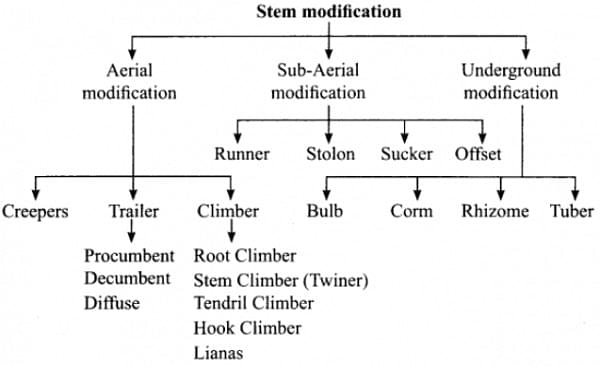
Flowchart showing types of modifications in stem
Read Also:
Underground Modification
In some plants, stems are modified to form underground structures that store food. Some examples of the underground stem are as follows:
Rhizome: They are non-green, fleshy structures that resemble roots in appearance. The presence of nodes and internodes distinguishes them from roots. When a rhizome grows horizontally, it is called Straggling Rhizome. This type of rhizome is seen in turmeric, ginger, etc. If a rhizome grows in an oblique direction, it is called RootStock Rhizome. This is found in bananas and alocasia.
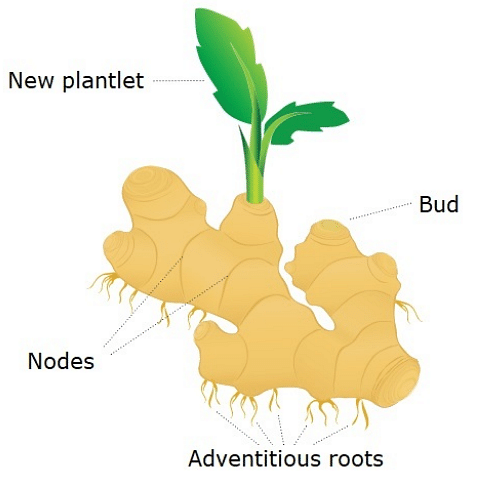
Rhizome
Bulb: This is a highly condensed structure having a terminal bud. The bulbs are of two types:
- Tunicated
- Scaly
Tunicated bulbs are covered by a membranous sheath called a tunic, as found in onion and garlic. Scaly bulbs do not contain tunic-like lilies.

Tunicated Bulb
Corm: This is almost spherical with a flattened base. Distinct nodes and internodes are present. Adventitious roots may arise either from the base or are present all over the body. This is found in plants like colocasia, amorphophallus.

Corm
Tuber: Tuber is a swollen tip of an underground stem. The outer covering contains small depressions called eyes. These eyes are nodes that bear buds. Adventitious roots are absent. A common example of this is the potato.

Tuber in Potato Plant
Read Also:
Sub-Aerial Modifications
In this type, a part of the stem grows aerially and the other part is found underground. Such plants are called Creepers and this modification mainly helps in vegetative propagation. They are of the following types:
Runner: They are found horizontally on the soil. They arise from an axillary bud. Runners can detach from the parent plant and grow into whole new plants, thus helping in vegetative propagation. They are seen in plants like oxalis, Centella, etc.
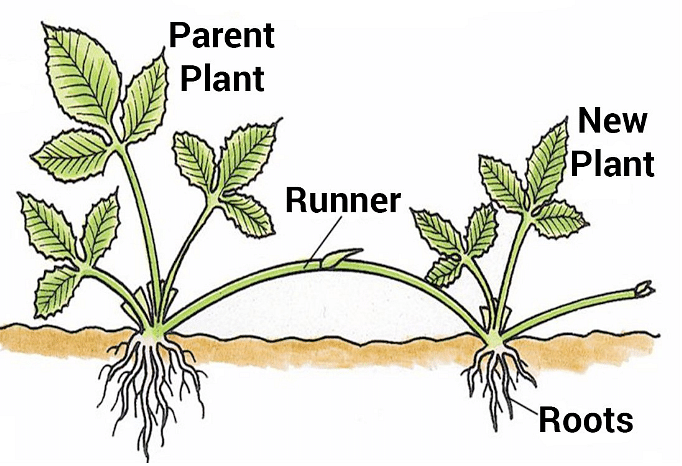
Runner
Sucker: The underground part of the main stem gives rise to suckers. It initially grows under the soil and then emerges out of the soil in an oblique direction. Suckers are found in strawberries, pineapple, chrysanthemum, etc.

Sucker
Stolon: Stolon arises from the base of the main stem and grows upwards for some time. It then bends towards the ground and its terminal bud forms new shoots and adventitious roots. This is found in plants like jasmine, Vallisneria.
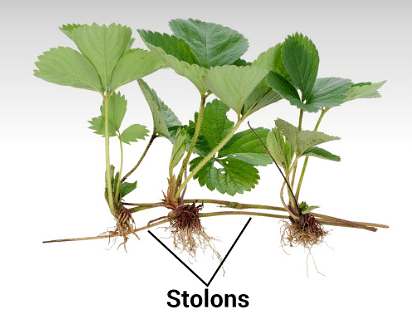
Stolon
Offset: They arise from leaf axils and grow horizontally. It then gives rise to a bunch of leaves above and adventitious roots grow downwards below the soil surface. They are commonly found in aquatic plants like pistia, Eichhornia, etc.
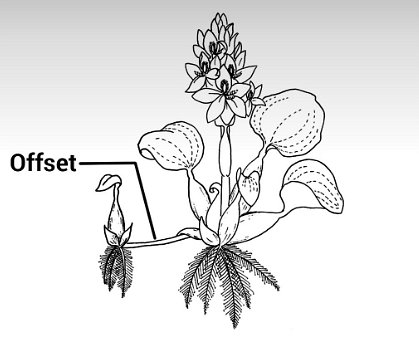
Offset in Pistia
Read More:
Aerial Modifications
These modifications generally occur for protection, climbing, vegetative propagation, etc. They are as follows:
Tendrils: Tendrils are green, thread-like structures that help in climbing. They can be branched or unbranched. Tendrils are of four types- axillary, extra-axillary, apical bud and floral bud. They are seen in plants like Grapevine, Antigonon, Cucurbita, etc.

Tendrils
Thorns: Thorns are hard, pointed structures that serve mainly for protection. In some plants, terminal and axillary buds get modified into thorns. They are generally called organs of defence but can also help in climbing. They are found in plants like citrus, carrissa, bougainvillea, etc.

Thorns
Read More:
Cladode: Cladodes are green, leaf-like structures that may be flattened or cylindrical. They show limited growth. They are mainly involved in the process of photosynthesis. They are present in plants like Asparagus, Ruscus, etc.
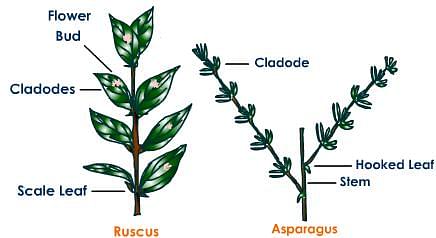
Cladode in Asparagus and Ruscus
Bulbil: Bulbils are modified floral buds and in some plants, they may form from axillary buds. They help in vegetative propagation. They are found in agave, lilies, etc.

Bulbil in Agave
Things to Remember
- Stem is the main axis of the plant which arises from the plumule region.
- Stems mainly provide structure and support to the plant and also act as a channel for transportation of nutrients and minerals.
- Stems undergo different types of modifications to help plants perform different functions.
- Stems mainly undergo three types of modifications: Underground, sub-aerial and aerial.
- Underground modifications are meant for storing food.
- Sub-aerial modifications mainly help in vegetative propagation.
- Aerial modifications serve the purpose of protection, climbing, etc.
Read More:
Sample Questions
Ques. What are the types of modifications seen in stems? (3 marks)
Ans. Stem mainly undergo three types of modifications:
- Underground Modifications- In this type, stems are modified to form underground structures that serve to store food.
- Sub-Aerial Modifications- In sub-aerial modifications, some part of the modified stem grows aerially while the other develops underground. They mainly help in vegetative propagation.
- Aerial Modifications- In this type, the modified stem grows above the soil i.e aerially, and serves for protection, climbing, etc.
Ques. How do tendrils grow? (3 marks)
Ans. Tendrils arise as a result of aerial modification of the stem. They are green, thread-like structures which help a plant in climbing. Tendrils show limited growth. During their development, they mainly undergo three phases-
- They develop openings called hydathodes which secrete water.
- Collenchyma cells develop in the cortex and xylem.
- Lignification of ray cells.
With time hydathodes degenerate and form pressure-sensitive cells. These pressure-sensitive cells promote cell growth when the tendril comes in contact with an object. Due to cellular growth, tendrils coil around the object and thus help in climbing and providing support to the plant. As they mature, tendrils become hard and rigid.
Ques. What are Rhizomes? (3 marks)
Ans. Rhizomes are the modified underground stems that grow horizontally or vertically under the soil. Their main function is to store food to help plants survive adverse environmental conditions. However, they are also capable of producing new shoots and roots, thus helping in the vegetative propagation of plants.
Rhizomes are mainly of two types-
- Dense Rhizomes- They grow vertically and their internode regions are short. They remain clustered at one place and do not spread on the ground.
- Running Rhizomes- They grow horizontally and have longer internodes. They spread on the ground as in Bamboo.
Ques. What are the different techniques of vegetative propagation in plants? (5 marks)
Ans. Vegetative propagation of plants can be carried out in the following ways-
- Tissue Culture: In this technique, an explant is taken and grown under artificial laboratory conditions. The artificially grown new plant is later planted in soil under natural conditions.
- Grafting: Grafting is the process of combining tissues of two different plants. The scion (branch) of one plant is cut and attached to the roots of another desirable plant whose branches are removed. In this way, the new plant gets desirable traits from both species.
- Layering: In this process, the branches of a plant are pushed downwards into the soil while remaining attached to the parent plant. It then grows adventitious roots in the soil and the fully grown new plant detaches itself from the parent plant.
- Cutting: It is similar to layering but in this, the branches do not remain attached to the parent plant. Instead, it grows individually in the soil.
Ques. What are the types of roots? (3 marks)
Ans. There are three types of roots seen in plants:
- Tap Root- In this type, radicles extend into the main root that grows deep into the soil. Lateral branches called secondary and tertiary roots arise from the main root. They are present in Dicot plants.
- Fibrous Root- In this type, there is no main branch of the root, instead, all the branches grow directly from the stem and form a branched network of roots. They are found in monocot plants.
- Adventitious Roots- Adventitious roots arise from other parts of the plant like stem, nodes, leaves, etc. except the radicle. They help in the vegetative propagation of plants.
Ques. What are the functions of roots? (5 marks)
Ans. Roots perform a wide range of functions necessary for the growth and survival of plants. Some of them are listed below-
- Roots absorb essential nutrients and minerals from the soil and pass them to the entire plant. It also absorbs water from the soil.
- Some plants even store food in the form of starch in the roots.
- Roots also anchor plants to the soil and help them stand upright.
- They check soil erosion and provide habitat to other organisms.
- In some plants, roots can also help in the process of reproduction.
Ques. What is phylloclade? How is it different from cladode? (3 marks)
Ans. Phylloclade is a flattened leaf-like structure in plants that is capable of doing photosynthesis. It is a modification of the stem. It is different from Cladode in the following ways-
| Phylloclade | Cladode |
|---|---|
| It is a flattened structure. | It may be flattened or cylindrical. |
| It contains both nodes and internodes. | Only internodes are present. |
| It has mucilage and is found in asparagus. | It does not have mucilage and is found in opuntia. |
Ques. What is a subaerial modification system? (2 marks)
Ans. In this type, a part of the stem grows aerially and the other part is found underground. Such plants are called Creepers and this modification mainly helps in vegetative propagation. They are of the following types:
- Runner
- Sucker
- Stolon
Read More:



Comments