



Education Journalist | Study Abroad Lead
Seed dormancy is a condition in which seeds are unable to germinate, even in conditions that are ordinarily favorable for their germination. The favorable conditions for the germination of seeds include appropriate light, water, temperature, gases, mechanical constraints, seed coverings, and hormone structures. Dormancy is a stage in the life cycle of a seed during which its development, growth, and numerous other physical activities are momentarily stopped.
Key Terms: Seed, Dormancy, Germination, Embryo, Plants, Seed Dispersal, Genes
What is Seed Dormancy?
[Click Here for Sample Questions]
Seed Dormancy is the state of the slow growth of seeds or other plant organs caused by internal factors. It is also known as the rest period. The plant benefits significantly from the dormancy of seed as they require a specific period of rest before they are able to germinate.
Causes of Seed Dormancy
[Click Here for Sample Questions]
Seed dormancy can be caused by a number of factors. Some of the possible causes of seed dormancy are as follows:
- Temperature
- Light
- Tough seed coat
- Inhibitors of germination
- Period after ripening
- Seed embryo immaturity
- Impermeability of seed coat to oxygen and water
- Mechanical resistance of seed coat
- Presence of high concentrations of solutes
Types of Seed Dormancy
[Click Here for Sample Questions]
The different types of dormancy of seed are as mentioned below:
- Induced Dormancy: When a seed has consumed water but is placed in severely unfavorable germination conditions, it enters induced dormancy. Then, even when the seed is put in more favourable conditions, the seed fails to germinate.
- Innate Dormancy: It is the condition of seeds that are incapable of germinating, despite the presence of conditions suitable for the growth of the seedling. In some species, this inability to germinate might be attributed to the embryo being immature at the time of dispersal.
- Enforced Dormancy: It is the state of seeds that are unable to germinate due to various environmental constraints such as a lack of appropriate moisture, light, oxygen, and proper temperature.
Read More: Vernalisation
Importance of Seed Dormancy
[Click Here for Sample Questions]
Seed Dormancy is important for plants for the following reasons –
- Dormancy allows the seeds to survive in the soil for several years. This ensures a steady supply of new plants even after the older plants of the area have died off due to various natural calamities.
- It promotes the preservation of seeds for later use by animals and humans.
- Desert plants benefit greatly from the dormancy produced by inhibitors found in seed coats.
- Dormancy allows the seeds to remain suspended without injury during cold or hot summer temperatures, as well as during drought.
| Frequently Asked Questions about Seed Dormancy Ques. What is it called when a seed starts to grow or wakes up after dormancy? (2 marks) Ans. The awakening of the dormant embryo is known as germination. The process through which the dormant embryo wakes and then begins to grow is referred to as Germination. Seed Emergence is coming above of seed, out of the soil surface by the seedling. Ques. What are the advantages of seed dormancy? (3 marks) Ans. The advantages of seed dormancy are –
Ques. What are the disadvantages of the dormancy of seed? (3 marks) Ans. The disadvantages of seed dormancy are –
|
Techniques to break Seed Dormancy
[Click Here for Sample Questions]
The techniques or strategies for breaking dormancy are as follows:
Naturally Breaking Seed Dormancy
When the embryo is exposed to an adequate environment, such as adaptive moisture and temperature, seed dormancy is naturally broken. The smoothing action of natural agents such as microorganisms, temperature, and abrasion by the digestive tract of birds and animals that eat these seeds, causes the seed coat of many species to become transparent. Other natural options are as follows:
- The phase of over-ripening came to an end.
- Inhibitors contained in the seed coat are leached.
- The use of cold, heat, and light to inactivate inhibitors.
- Excess and extremely concentrated solutes are leached from the seeds.
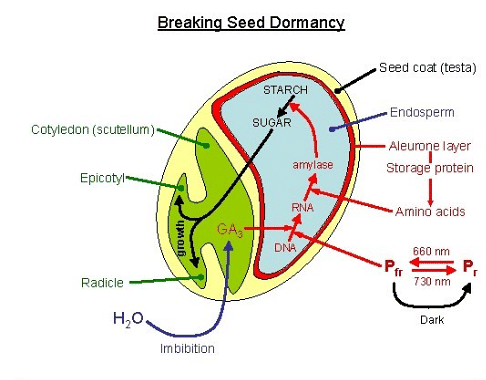
- Production of growth hormones that can counteract inhibitory effects.
Artificially Breaking Seed Dormancy
The artificial methods for breaking seed dormancy are:
- Waxes, surface inhibitors, and other substances are terminated with hot water.
- Seed coatings are ruptured by various separation techniques such as filing, chipping, or threshing in machines.
- Depending on the type of the dormancy of seed, it may be exposed to heat, cold, or light.
- Hydraulic pressure is applied for 5 to 20 minutes to weaken the strong seed coverings.
- To remove all remnants of the mineral acid, seed coats are treated with strong sulphuric acid.
Read More: Principal of Inheritance and Variation
Seed Dormancy Treatments
[Click Here for Sample Questions]
To overcome dormancy, there are several treatments available, which are further split into the following categories:
- Treatment of the seed coat
By weakening or shattering a hard seed coat, these treatments make the seed permeable to water or gases. Scarification is the term for this procedure. Chemical or physical therapeutic options are also available.
- Treatments for embryos
Stratification is the process of incubating seeds at a low temperature over a moist layer before shifting them to a temperature that is conducive to germination.
- Treatment at high temperatures
Incubation at 40-50°C for a few hours to a few days may help some species overcome dormancy. Rice seeds, for example, are soaked in hot water for at least 4 hours at 40°C.
- Treatments with chemicals
Induced germination growth regulators can be made from plant growth regulators or other substances.

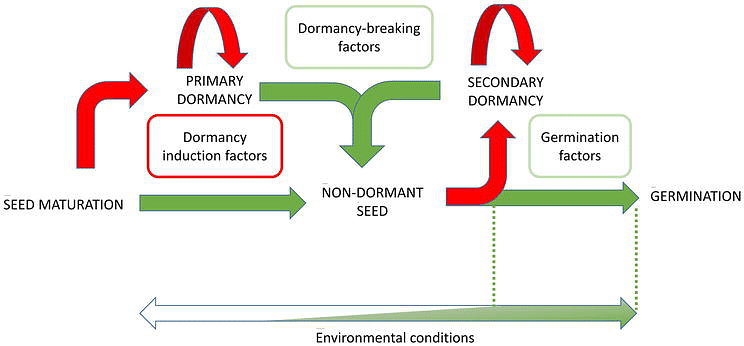
Seed Dormancy Cycle
Read More: Genetics
Seed Dormancy and Germination
[Click Here for Sample Questions]
Seed dormancy is regulated at different embryonic stages and through environmental factors. As all dormancy tests are based on seed germination, which is a result of a balance between the degree of dormancy and the embryo's ability to overcome hibernation, the problem of dormancy emerges.
- Factors that regulate dormancy and germination can be distinguished mechanically based on their effect on germination, which can be either inhibiting or stimulating.
- Genes that induce dormancy or suppress germination can be found in mutants that germinate better or faster.
- By identifying the timing and location of these components, a further differentiation can be created (during maturation or during imbibition of the seeds, in the embryo, the endosperm or in the testa).
- Before the seed is capable of germination, some physiological changes occur in the embryo during the dormancy period.
- Throughout nature, after-ripening takes place in the winter, the seeds ripen in the autumn, and germinate in the spring.

Read More: Hypogeal Germination
Factors Affecting Seed Dormancy
[Click Here for Sample Questions]
Some of the major factors are:
- Water Impermeability of seed coats
At maturity, the seed coverings of several species are totally impenetrable to water. Many legume seeds (e.g, clovers, alfalfa, etc), as well as water lotus and morning glory seeds, have this characteristic. Water must enter the seed coverings for germination to take place.
- Oxygen Impermeability of seed coats
The two seeds in a cocklebur (Xanthium) fruit are not dormant in the same way. The lower seed normally germinates in the spring following maturity in natural settings, while the top seed remains dormant until the following year. The impermeability of the seed covering to oxygen has been shown to be the cause of dormancy in these seeds.
- Mechanically Resistant seed coats
Seed coatings are so strong in some seeds, such as mustard (Brassica), pigweed (Amaranthus), shepherd's purse (Capsella), and others, that they do not yield to the pressure of the developing embryo. If the seed coats are removed, the embryos of these seeds have no dormancy period and will grow rapidly.
- Dormant Embryos
Even when the embryos are fully grown when the seed is ripe, seeds of many species fail to germinate, even when the environmental conditions are ideal. The physiological state of the embryo causes dormancy in such seeds. Even if the seed coverings are removed, the embryos of such seeds will not grow when they first mature.
- Rudimentary Embryos
When the seed is shed in plants like ginkgo (Ginkgo biloba), European ash (Fraxinus), holly (Ilex), and many orchids, the embryo is disorganised and develops fully before germinating.
- Low Temperature
As certain plants require a low temperature for germination, their seeds remain dormant even after harvest. These seeds germinate then in spring.
- Immaturity of the Embryo
Immaturity of the embryo occurs in the seeds of plants such as Orchids, Ginkgo, and others because the embryo fails to mature when the seeds are shed.
- Light sensitive seeds
The light affects the germination of some seeds, the absence of light causes the seeds to go dormant. Photoblastic seeds are those that are sensitive to sunshine and germinate due to light, whereas negatively photoblastic seeds are those that have their seed germination inhibited by light.
Read More:
Things to Remember
- Dormancy occurs when seeds do not germinate despite the presence of all necessary circumstances (temperature, humidity, oxygen, and light).
- Dormancy is caused by the impermeability of the hard seed coat or a lack of supply and activity of enzymes (internal dormancy), both of which are required for germination.
- Seed Dormancy is a significant factor in limiting productivity in field crops.
- There are three types of seed dormancy – innate dormancy, induced dormancy and enforced dormancy.
- The factors that play an important role in dormancy are mechanically resistive seed coats, light-sensitive seeds, low temperature, etc.
Sample Questions
Ques. When a seed remains dormant, what does it mean? (2 marks)
Ans. A dormant seed is one that is unable to germinate in a specific amount of time under a set of environmental conditions that would typically allow a non-dormant seed to germinate. Dormancy is a mechanism that prevents seedlings from germinating in unfavourable ecological settings with a poor chance of survival. These circumstances can change from day to day, month to month, and even year to year.
Ques. What is the significance of seed dormancy? How can dormancy in seeds be broken? (3 marks)
Ans. Seed dormancy is important as:
- The dormancy of seed permits seeds to survive drought, cold, and other adverse situations.
- It is necessary for seed dispersal.
- Seeds germinate only when there is enough water to drain off inhibitors and soften seed coverings.
- Dormancy allows humans to store grains, pulses, and other foodstuffs so that they can be used throughout the year and transported to regions where they are needed.
The following procedures can be used to break the dormancy of the seed:
- Embryo Maturity
- Mechanical Abrasion
- Mechanical Scarification
Ques. What are the benefits of seed dormancy? What hormone is responsible for it? (3 marks)
Ans. Seed dormancy is a situation in which a seed fails to germinate despite favourable environmental conditions for active growth. Dormancy has two advantages:
- It assists the seed in disseminating in time and space to reach maximum cooperation for the survival of species.
- They guarantee that the seeds germinate successfully in the best possible conditions.
The only hormone known to induce and maintain seed dormancy is Abscisic Acid (ABA). Seeds vary their ABA concentration and sensitivity in response to internal and external signals during seed growth and germination.
Gibberellins help seeds and winter buds come out of dormancy. It predominantly affects seed cotyledons, where it induces the manufacture of certain enzymes, causing dormancy of the seed to be broken.
Ques. How can we prevent seed germination? (2 marks)
Ans. Seed germination can be slowed or stopped by the presence of inhibitors, which are chemicals that hinder seeds from germinating. These are typically chemicals made by one or more plant organs.
Tomato juice, for example, prevents tomato seeds, as well as many other seeds, from germinating.
Inhibitors can be found in the embryo (for example, in Xanthium), endosperm (for example, in Iris), or seed coat (e.g., in Cucurbita). Abscisic acid (ABA) is one of the most regularly found germination inhibitors.
Ques. How does seed dormancy in embryos affect the plant? (2 marks)
Ans. Many types of seeds, even when they appear to be ripe, fail to germinate even when all environmental parameters are favourable. The embryo's growth in such seeds is stopped by the circumstances within the seeds. It allows the embryo to survive the colder months of the year and germinate when the conditions are favourable for seedling establishment.
In nature, the dormancy phase corresponds to an unfavourable period for the seedling of the species. Some plants require dormancy in seeds in order to prolong the life of some seeds prior to germination. In many circumstances, not all of a plant's seeds will germinate at the same time. Some seeds will remain dormant and will only germinate in stages.
Ques. Why do seeds go through a period of dormancy? (2 marks)
Ans. Seed dormancy is a widespread natural phenomenon in which the seeds fail to germinate due to a number of factors. Dormancy ensures interruption to the growth of plants for a while in non-tropical climates where drought or cold weather usually follows the vegetation season.
If such seeds germinate immediately, the resultant seedlings would become deadly frosts in the upcoming winter season. This is the main reason why most temperate species of plants have a distinct germination inhibition. Some species of plants such as Calendula are known to produce differently shaped seeds within the same flower head.
Ques. What are the differences between seed viability and seed dormancy? (2 marks)
Ans. The major differences between seed viability and seed dormancy are as follows:
| Seed Viability | Seed Dormancy |
|---|---|
| Seed viability determines whether the seeds will germinate or not. | Seed dormancy is associated with the inability to germinate seeds. |
| Seed viability is a measure of how many seeds are alive and could develop into plants that will reproduce themselves, given the appropriate conditions. | Seed dormancy describes a state of apparent metabolic arrest during which the normal progression of life activities and development is dramatically reduced. |
Also Read:



Comments