



Content Curator
The term inflorescence comes under the method morphology of flowering plants. The Morphology of flowering plants is the study of different parts of the plants, which includes the leaves, flowers, fruits, and stems. In a plant, the flowers either grow individually or in a set of groups, and the groups of flowers are referred to as inflorescence.
| Table of Content |
Key Terms: inflorescence,racemose, raceme, cythium, gynoecium
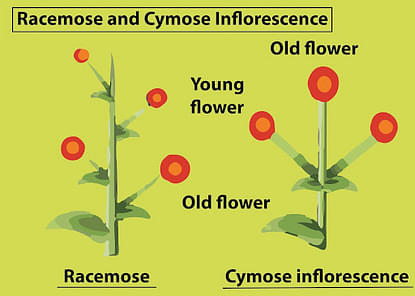
Inflorescence can also be referred to as the reproductive part of a plant that contains a group of flowers. It is responsible for the positioning of flowers on the floral axis and it is divided into two categories: racemose inflorescence and cymose inflorescence. In the racemose inflorescence, the main axis keeps on growing and the flower develops itself in an acropetal pattern while in the cymose inflorescence the termination of the main axis takes place and the flower grows in a basipetal pattern.

Inflorescence
Read more : Androecium
Types of Inflorescence
[Click Here for Sample Questions]
The different types of Inflorescence are- Racemose Inflorescence, Cymose Inflorescence and other special types of Inflorescence. Description on each of the mentioned above is given in details below-
Types of Inflorescence
Read more : floral formula of liliaceae
Racemose Inflorescence
[Click Here for Previous Years Questions]
The main axis continues to grow in the racemose influence and allows a flower to grow in an acropetal manner instead of termination in the flower. The racemose inflorescence arranges the old flowers on the lower side and newly grown flowers on the upper side.
Read More:
| Important Topics | ||
|---|---|---|
| Tap Root System | Fibrous Root System | Insectivorous Plants |
| Vegetative Characters of Solanaceae | Vegetative Characters of Liliaceae | tendril |
Categories in the Racemose Inflorescence
- Raceme: In this category, the flower is developed between the stem and the branch at the upper angle on an unbranched axis.
- Spike: It is similar to raceme, but here the flower develops from the stem instead of being borne on pedicels.
- Catkin: It is a spike where the flowers can be staminate(male) or carpellate(female)
- Spadix: It is a spike borne on a flesh stem which is one of the members of the Araceae family. It contains thick, long as well fleshy pedicels while the flowers are small, sessile, and unisexual.
- Corymb: Contains longer pedicels on the lower flowers as compared to the pedicels at the upper flowers.
- Umbel: Each pedicel in the umbel starts from the same point at the peduncle and forms a shape just like an umbrella.
- Capitulum: The peduncle does not grow in the capitulum, instead it flattens and becomes broad or concave.

Categories in the Racemose Inflorescence
Also Read: difference between radicle and plumule
Cymose Inflorescence
[Click Here for Sample Questions]
In Cymose inflorescence, the main axis or peduncle ends in a flower and it starts growing in a basipetal manner. The young flowers are arranged at the bottom and the old flowers are arranged at the top portion.
Related Articles:
| Chapter Related Topics | ||
|---|---|---|
| Interdependence of plants and animals | Plant Cell | Why are plants green? |
| Conservation of Plants and Animals | Biology difference between and comparison | Human Body |
Categories in the Cymose Inflorescence
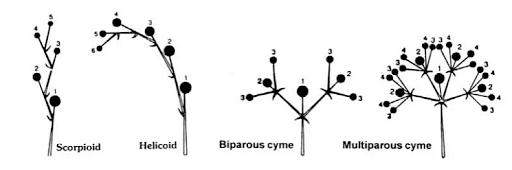
- Uniparous or Monochasial: A sideway branch is produced at A time in Uniparous Cyme. The two types of uniparous are Helicoid cyme and Scorpioid cyme.
- Biparous: In Biparous, two sideway branches arise from the basal part of the peduncle. Some of the examples of biparous cyme are jasmine, teak, and mirabilis.
- Multiparous: Numerous lateral branches are produced from the base of the flower and later end in a flower.
Categories in the Cymose Inflorescence
Special Types of Inflorescence
[Click Here for Previous Years Questions]
- Cyathium: Cythium has a cup-shaped structure at the edge. The center of the cup-shaped structure contains female flowers, surrounded by small male flowers. This type of inflorescence can be found in Euphorbia, Pedilanthus, and Poinsettia.
- Verticillaster: Verticillaster is usually found in Lamiaceae. The leaves are arranged opposite of the stem in Lamiaceae. Examples of Verticillaster: Coleus, Salvia, and Ocimum.
- Hypanthium: The peduncle is altered in a narrow cup-like structure in Hypanthium type of inflorescence.

Special Types of Inflorescence
Types of Flowers
[Click Here for Sample Questions]
- Hypogynous: The gynoecium in Hypogynous flowers is situated at the top position and the remaining parts are situated at the bottom. Example: mustard.
- Perigynous: The gynoecium in Perigynous flowers is situated at the center while the remaining parts of the flower are situated at the edge of the thalamus on the same level. Example: peach and plum rose.
- Epigynous: These types of flowers have the upward growing thalamus which completely encloses the ovary. The other parts of the flower are situated just above the ovary. Example: flower of Guava.

Types of Flowers
Also Read: Seed Dispersal
Things to Remember
- Inflorescence can also be referred to as the reproductive part of a plant that contains a group of flowers.
- It is responsible for the positioning of flowers on the floral axis and it is divided into two categories: racemose inflorescence and cymose inflorescence.
- The main axis continues to grow in the racemose influence and allows a flower to grow in an acropetal manner instead of termination in the flower.
- The racemose inflorescence arranges the old flowers on the lower side and newly grown flowers on the upper side.
- In Cymose inflorescence, the main axis or peduncle ends in a flower and it starts growing in a basipetal manner.
- The young flowers are arranged at the bottom and the old flowers are arranged at the top portion.
- The different varieties of flowers are Hypogynous like mustard, Perigynous like plum rose, and Epigynous like a guava flower.
Also Read: Class 11 Biology Chapter 5 Morphology of Flowering Plants
Previous Years Questions
- Which one of the following plants belongs to the Family Apocynaceae?….[COMEDK UGET 2009]
- Madhunashini is the popular name for…..[COMEDK UGET 2006]
- The roots that originate from the base of the stem are… [ NEET 2020]
- Bicarpellary gynoecium and oblique ovary occurs in...[ NEET 2001]
- Tetradynamous conditions occur in….[ NEET 2001]
- In which of the following plant sunken stomata are found...[ NEET 2001]
- What is the eye of potato?…[ NEET 2001]
- Edible part of banana...[ NEET 2001]
- Which is correct pair for edible part?….[ NEET 2001]
- Coconut fruit is a….[ NEET 2017]
- Commercial cork is obtained from… [NEET 1991]
- Botanical name of cauliflower is…. [NEET 1991]
- Banana is...[JKCET 2007]
- Tricarpellary syncarpous superior ovary is….[JKCET 2007]
- The edible part in hesperidium fruit is...[JKCET 2007]
- The bladders of Utricularia and pitchers of….[JKCET 2004]
- Phylloclades are...[JKCET 2004]
Sample Questions
Question.1: What is meant by the modification of root? (2 Marks)
Answer: The major function of the root is to absorb the water and minerals from the soil. The roots also can be modified in order to perform several other functions. Some roots may act as storage sites for food while others only absorb oxygen from the atmosphere.
Question.2: What type of modification of root is found in: Banyan tree, Turnip, and Mangrove trees? (3 Marks)
Answer:
Banyan Tree: The banyan has massive roots which grow from the aerial part of the stem. The roots grew beyond the ground and supported the tree.
Turnip: The roots of turnip helps in food storage. For example: radish, carrot and sweet potatoes.
Mangrove Trees: The roots grow vertically upwards from the soil in Mangrove trees. The roots absorb the oxygen from atmospheric soil due to poorly aerated soil. Example: pneumatophores.
Question.3: Define the term Inflorescence. Explain the basis of different types of inflorescence in Flowering plants. (3 Marks)
Answer: Inflorescence is the process in which the flowers are arranged on the floral axis. The inflorescence is also responsible for whether the floral axis will continue growing or ends in a flower. Inflorescence is categorized into 2 types which are racemose inflorescence and the cymose inflorescence. In the racemose inflorescence, the main axis keeps on growing while in the cymose inflorescence the termination of the main axis takes place.
Question.4: Write Floral formula of: (4 Marks)
A.Actinomorphic
B.Bisexual
C.Hypogynous flower with 5 united sepals, 5 free petals, 5 free stamens, 2 united carpels with superior and exile placentation
Answer:
The Floral Formula of the flower is represented by:

Actinomorphic flowers:
Bisexual flower:
Calyx contains 5 united sepals which can be represented as K5
Corolla consists of 5 free petals and it is represented as C5.
Androecium consists of five free stamens and is represented by A5.
The gynoecium consists of a superior ovary with two united carpels and axile placentation, which can be represented as

Question.5: Describe the arrangements of floral members in relation to insertion on thalamus. (3 Marks)
Answer: Based on the position of the calyx, corolla, and androecium the flowers are categorized as hypogynous flowers, perigynous flowers, and epigynous flowers.
In hypogynous flowers, the ovary occupies the highest position on the thalamus while other floral parts are situated below it. In such flowers, the ovary is superior e.gChina rose, mustard etc.
Do Check Out:



Comments