

-modified.png?h=56&w=56&mode=stretch)


The GMAT Syllabus 2026 is designed to test the core skills needed for business management: analytical thinking, problem-solving, and data interpretation. The GMAT covers 3 main areas: Quantitative Reasoning, which includes arithmetic, algebra, and word problems; Verbal Reasoning, focusing on reading comprehension and critical analysis of arguments; and Data Insights, a new section combining data interpretation and logical reasoning. Understanding this syllabus helps aspirants focus on high-weight topics and plan an effective preparation strategy.
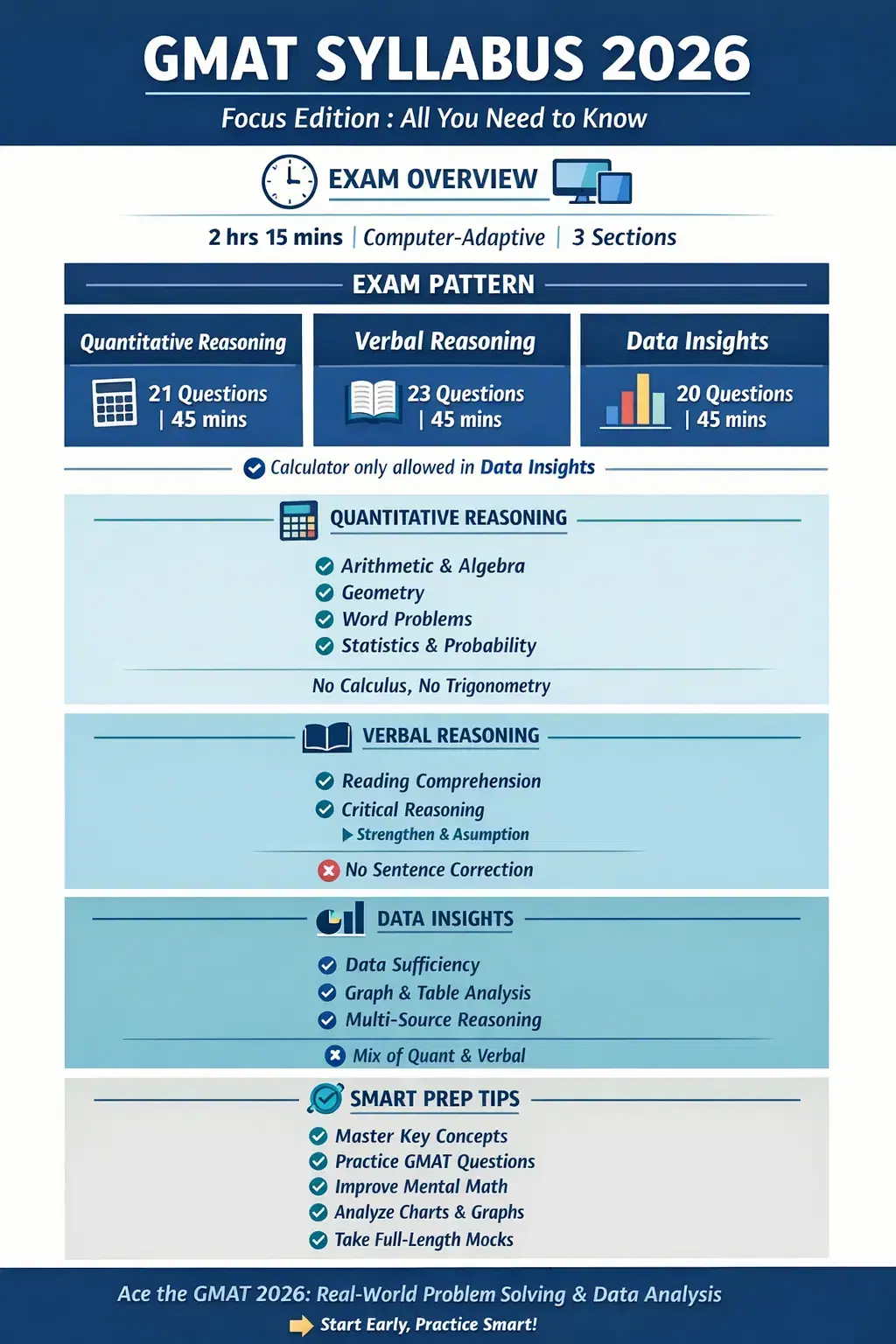
This article provides a detailed breakdown of the GMAT syllabus, section-wise topics, exam pattern, and preparation tips.
| If you’re planning your GMAT attempt in 2026, these related guides will help you complete the registration and scheduling process. | ||
|---|---|---|
| How to register for the GMAT? | What is the GMAT exam fee in India in 2026? | Upcoming GMAT exam dates 2026 |
- GMAT Practice Papers 2026
- GMAT Syllabus 2026
- GMAT Quant Syllabus 2026
3.1 Tips to Prepare for GMAT Quantitative Section
- GMAT Verbal Reasoning Syllabus 2026
4.1 Tips to Prepare for GMAT Verbal Section
- GMAT Data Insights Syllabus 2026
5.1 Tips to Prepare for GMAT Data Insights Section
- GMAT Syllabus 2026 Preparation Tips
- FAQs
GMAT Practice Papers 2026
Check out some free GMAT sample papers for 2026 by Collegedunia to understand the GMAT syllabus:
GMAT Syllabus 2026
The GMAT syllabus 2026 has been designed to test real-world problem-solving, critical thinking, and data interpretation skills that are essential for business management programs.
Before looking at the syllabus, you must understand the GMAT exam pattern in 2026:
| Section | Description | Number of questions | Duration |
|---|---|---|---|
| Quantitative Reasoning | Tests mathematical and problem-solving skills. | 21 | 45 minutes |
| Verbal Reasoning | Measures reading comprehension and critical reasoning. | 23 | 45 minutes |
| Data Insights | Evaluates analytical skills, data interpretation, and decision-making. | 20 | 45 minutes |
Notes:
- You can choose section order.
- All sections are adaptive at question level.
- Total test time is approximately 2 hours 15 minutes.
Are calculators allowed in the GMAT Focus Edition?
A basic on-screen calculator is provided only for the Data Insights section. For Quantitative Reasoning, calculations must be done manually.
GMAT Quant Syllabus 2026
The Quant section measures your ability to solve mathematical problems and interpret numerical data. It is designed to test logical thinking and analytical application rather than advanced math.
Key Topics:
- Arithmetic: Integers, fractions, decimals, percentages, ratios, proportions, averages, speed-distance-time, work, profit & loss, simple & compound interest.
- Algebra: Linear & quadratic equations, inequalities, exponents, absolute values, algebraic expressions, functions.
- Word Problems: Mixtures, sets, number properties.
- Geometry: Lines, angles, triangles, circles, polygons, coordinate geometry, perimeter, area, volume.
Notes: Advanced topics like trigonometry, calculus, and higher-level mathematics are not part of the GMAT syllabus.
Preparation Tips:
- Strengthen basics in arithmetic, algebra, and geometry instead of focusing on higher math.
- Practice mental calculations and shortcuts to save time.
- Solve official GMAT practice questions to understand the exam’s logic-based approach.
- Pay special attention to data sufficiency problems, which often appear tricky.
- Focus on accuracy first, then improve speed.
Also Check
GMAT Quant QuestionsHow important is mental math in GMAT Quant?
Mental math is very important for the quant section. Quick estimation and mental calculations save time and reduce errors, especially under the 45-minute time limit.
GMAT Verbal Syllabus 2026
The Verbal section evaluates reading comprehension, critical reasoning, and the ability to analyse arguments. It measures how well a candidate can understand and evaluate written material.
Key Topics:
- Reading Comprehension (RC):
- Main idea & passage structure
- Supporting details & examples
- Inference-based questions
- Author’s tone, purpose, and perspective
- Critical Reasoning (CR):
- Strengthen & weaken arguments
- Assumption-based questions
- Evaluate arguments
- Inference & conclusion-based questions
- Paradox & flaw detection
- Logical Structure of Arguments: Understanding the flow of reasoning and evidence.
Note: Sentence Correction (SC) questions, which were part of the old GMAT, have been completely removed in the GMAT Focus Edition.
Helpful Articles:
Preparation Tips:
- Develop a daily reading habit (editorials, academic journals, business case studies).
- Focus on identifying argument structures while practising critical reasoning questions.
- Learn to eliminate wrong answer choices systematically.
- Practice active reading: highlight keywords, tone shifts, and transitions.
- Manage time by not over-reading passages, and scan for key points.
Also Check
GMAT Verbal QuestionsIs knowing grammar rules important after Sentence Correction was removed?
Yes, indirectly. Grammar and sentence structure still matter for understanding meaning and logic in verbal passages.
GMAT Data Insights Syllabus 2026
The GMAT Data Insights section is unique to the GMAT Focus Edition. It combines data interpretation, logical reasoning, and decision-making. It is a combination of the earlier Integrated Reasoning and Data Sufficiency sections.
Key Topics:
- Data Sufficiency: Identify if the given data is enough to answer a problem.
- Multi-Source Reasoning: Analyze data from multiple sources like text, tables, or charts.
- Data Comparisons: Evaluate and compare datasets for accuracy and efficiency.
- Table Analysis: Interpret tabular data, identify trends, and make logical conclusions.
- Graphical Interpretation: Analyze data presented in bar charts, pie charts, line graphs, and scatter plots.
- Two-Part Analysis: Solve complex quantitative or verbal problems with two related components.
Note: The Data Insights section requires both quant and verbal reasoning skills since questions combine numbers, text, and logic.
Preparation Tips:
- Practice Graphic Interpretation, interpreting charts, and data tables quickly.
- Revise the concepts of probability, percentages, and ratios since they are often embedded in data sets.
- Learn to identify irrelevant data; don’t waste time analysing everything.
- Strengthen logical reasoning and quantitative fundamentals, as both are tested together.
- Time management is crucial; practice skipping lengthy calculations when data trends are obvious.
Should I attempt all Data Sufficiency questions first?
Not necessarily. Start with questions you understand. Strategic skipping can save time without losing accuracy.
How to Prepare for the GMAT Syllabus 2026?
Preparing for the GMAT Focus Edition syllabus requires a balanced approach across all 3 sections: Quantitative Reasoning, Verbal Reasoning, and Data Insights. Since the exam is adaptive and time-bound, you need both conceptual clarity and strategic test-taking skills.
- Understand the Exam Structure: Familiarise yourself with the updated syllabus and format before starting GMAT preparation.
- Build Conceptual Clarity: Strengthen basics in arithmetic, algebra, logical reasoning, and comprehension.
- Practice Data Interpretation: Since Data Insights is a major addition, practice analysing charts, tables, and complex datasets.
- Time Management: Allocate fixed time per question and practice full-length mock tests to improve pacing.
- Review & Revise Regularly: Create a revision schedule for formulas, reasoning strategies, and common question types.
- Use Official GMAT Prep Material: Stick to GMAC’s official GMAT practice sets and question banks for the most accurate preparation.
- Analyse Mistakes: Review incorrect answers to identify weak areas and focus more on them.
- Balanced Preparation: Avoid focusing too much on one section; maintain equal practice across Quant, Verbal, and Data Insights.
The GMAT syllabus 2026 is designed to test your real-world problem-solving, critical thinking, and data analysis skills. By understanding the topics in Quant, Verbal, and DI sections and following a smart preparation strategy, you can focus your efforts where they matter most. Stay consistent, practice regularly, and you’ll be ready to tackle the exam with confidence.
FAQs
Ques. How often does GMAC update the GMAT syllabus?
Ans. GMAC doesn't update the GMAT syllabus annually. Rather, updates are significant structural changes, such as the introduction of the GMAT Focus Edition, which replaced the GMAT Classic.
Ques. Can I prepare for the GMAT syllabus using only online resources?
Ans. Yes, many candidates succeed using online prep materials, practice tests, and official GMAT resources. However, supplementing with books or mock tests can improve time management and accuracy.
Ques. Does knowing the GMAT syllabus guarantee a high score?
Ans. Understanding the syllabus helps focus your preparation, but consistent practice, time management, and solving mock tests are essential to achieve a high score.
Ques. Is there a recommended order to attempt the sections in the GMAT?
Ans. The best section order depends on your strengths. Doing your weaker section first can help with timing, while saving it for later may lead to tougher questions and more pressure.
*The article might have information for the previous academic years, which will be updated soon subject to the notification issued by the University/College.



Comments
Found 2 Comments
Yes, you will get two to three questions from Coordinate Geometry in the GMAT quant section. Questions appear in variants, problem-solving, and data sufficiency. The concepts tested include finding the slope, identifying the quadrants through which a line passes, finding the length of a line segment, determining the equation of a line, equations of parallel and perpendicular lines, area of a triangle, and equation of circles.
The entire GMAT Syllabus is divided into four sections. The change in the new format of GMAT has been made in the Tutorial Screens and the Quant and Verbal Section (scored out of 800) only. The other sections -Analytical Writing Section (AWA) and Integrated Reasoning (IR) remain completely unchanged. GMAT will measure your analytical and reasoning skills through these sections.