



Tamil Nadu LLB Admission 2025 is organized by the Tamil Nadu Dr. Ambedkar Law University (TNDALU), which manages admissions for the School of Excellence in Law (SOEL) in Chennai and affiliated government and private law colleges of the state. Admission is on a merit basis with no entrance exam, and eligibility is established through Class 12 marks (for 5-Year LLB) or a graduation degree (for 3-Year LLB).
LLB (Bachelor of Laws) is a professional degree for students who want to build a career in the legal field. In Tamil Nadu, LLB is offered in both 3-year and 5-year formats, giving opportunities to graduates as well as students who have completed their 12th grade. Through this program, you will gain a strong foundation in constitutional law, criminal law, contract law, family law, and other important areas of legal studies, along with practical training through moot courts and internships.
Studying law in Tamil Nadu opens up doors to real career possibilities. After completing LLB, you can work in the judiciary, law firms, corporate companies, NGOs, or government services, depending on your interest. Many students also go on to specialise further through LLM or prepare for exams like judicial services and UPSC. With its wide range of affordable government colleges and well-recognised private institutions, Tamil Nadu has become a preferred destination for aspiring lawyers who want both quality education and strong career growth.
- Tamil Nadu LLB Admission 2025: Key Highlights
- Tamil Nadu Admission 2025: Eligibility Criteria
2.1 What is the Reservation Policy for Tamil Nadu LLB 2025?
- Tamil Nadu LLB Admission Process 2025
3.1 What is the Application Fee for Tamil Nadu LLB Admission?
3.2 Tamil Nadu LLB Admission 2025: Documents Required
3.3 Video Review: Tamil Nadu LLB Admission
- TNDALU LLB Admission 2025: Cut Off
- Top LLB Colleges in Tamil Nadu
- Tamil Nadu LLB Admission 2025: FAQs
Tamil Nadu LLB Admission 2025: Key Highlights
The following table summarizes the important details and key features of Tamil Nadu LLB Admission 2025. It provides a quick overview of courses, eligibility, application mode, and selection criteria for aspiring law students.
| Particulars | Details |
|---|---|
| Conducting Body | The Tamil Nadu Dr. Ambedkar Law University (TNDALU), Chennai |
| Courses Offered | 3-Year LLB, 5-Year Integrated LLB (BA LLB, BBA LLB, BCom LLB, BCA LLB, etc.) |
| Mode of Admission | Merit-based ( no entrance test) |
| Application Mode | Online via the official admission portal |
| Eligibility | 3-Year LLB: Bachelor’s degree with a minimum of 45–60% (category-wise)5-Year LLB: 10+2 with minimum 45–60% (category-wise) |
| Official website | tndalu.ac.in |
Tamil Nadu Admission 2025: Eligibility Criteria
The eligibility requirements for Tamil Nadu LLB programmes vary depending on whether candidates are applying for the 3-Year LLB or the 5-Year Integrated LLB courses. Applicants must ensure they meet the minimum academic qualifications and category-based requirements before applying.
1. 5-Year Integrated LLB
- Educational Qualification: Candidates must have completed 10+2 or equivalent from a recognized board.
- Minimum Marks:
- General / Others: 50–60%
- SC / ST / Reserved Categories: 45–55%
- Age Limit: Usually 17 years or above at the time of admission.
- Applicable Courses: BA LLB, BBA LLB, BCom LLB, BCA LLB, and other integrated law programmes.
2. 3-Year LLB
- Educational Qualification: Candidates must hold a Bachelor’s degree in any discipline from a recognized university.
- Minimum Marks:
- General / Others: 50–60% (varies by college)
- SC / ST / Reserved Categories: 45–55%
- Age Limit: Generally, no upper age limit, but the minimum age must be 20 years.
- Applicable Courses: Regular 3-Year LLB and Honours LLB programs at TNDALU SOEL and affiliated colleges.
What is the Reservation Policy for Tamil Nadu LLB 2025?
Tamil Nadu follows a state government-mandated reservation system for admissions to professional courses, including law. Seats in TNDALU and affiliated law colleges are allocated based on community and category, ensuring equitable access for students from various social groups.
| Category | Reservation Percentage |
|---|---|
| Scheduled Castes (SC) | 18% |
| Scheduled Tribes (ST) | 1% |
| Most Backward Classes (MBC) & Denotified Communities (DNC) | 20% |
| Backward Classes (BC) | 30% |
| Economically Weaker Sections (EWS) | 10% |
| Open / General Category | Remaining seats ( 21% approx.) |
Tamil Nadu LLB Admission Process 2025
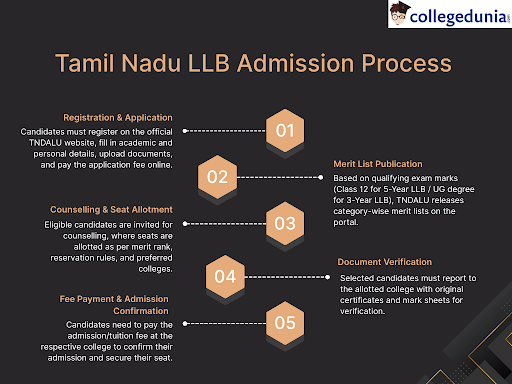
The admission procedure for LLB courses in Tamil Nadu is carried out through a merit system, mainly on the basis of performance in the qualifying test. Admissions for 3-Year LLB and 5-Year Integrated LLB are handled by TNDALU on its online website, making the application process transparent and smooth.
- Check Eligibility – Confirm whether you possess the necessary academic achievements and category-wise requirements for the 3-Year or 5-Year LLB course.
- Online Registration – Go to the official TNDALU website and register by providing your personal and academic information.
- Fill Application Form – Fill out the online application with course preference, academic marks, and contact details.
- Upload Documents – Upload scanned documents of mark sheets, certificates, ID proof, caste certificate (if required), and a recent passport-size photograph.
- Pay Application Fee – Pay the application fee as prescribed online via net banking, debit/credit card, or UPI.
- Submit Application – Check all the entered details once, submit the application form, and download a copy for future reference.
- Merit List Release – TNDALU releases merit lists on qualifying exam marks and reservation rules.
- Counselling & Seat Allotment – Selected candidates undergo online/offline counselling, and seats are assigned as per rank and choice.
- Document Verification – Candidates need to verify their original certificates at the college where the form is allotted prior to final admission.
- Admission Confirmation – Pay the admission fees and secure your seat; classes start according to the academic schedule.
What is the Application Fee for Tamil Nadu LLB Admission?
| Course | Fees (General / Others) |
Fees (SC / ST) |
|---|---|---|
| 3-Year LLB (SOEL – School of Excellence in Law) | INR 1000 | INR 500 |
| 3-Year LLB (Affiliated Colleges) | INR 600 | INR 300 |
| 5-Year Integrated LLB (SOEL – School of Excellence in Law) | INR 1000 | INR 500 |
| 5-Year Integrated LLB (Affiliated Colleges) | INR 600 | INR 300 |
Tamil Nadu LLB Admission 2025: Documents Required
The documents required for Tamil Nadu LLB Admission 2025 are as follows:
- Mark Sheets & Certificates
- Class 10 & 12 Mark Sheets and Passing Certificates (for 5-Year LLB)
- UG Degree Mark Sheets & Provisional / Degree Certificate (for 3-Year LLB)
- Transfer Certificate (TC) from the last attended institution
- Migration Certificate (for candidates from other boards/universities)
- Community / Caste Certificate (for SC/ST/OBC/MBC candidates claiming reservation)
- Nativity Certificate (for Tamil Nadu domicile quota)
- Income Certificate (if applying under certain reservation or fee concession categories)
- Special Category Certificates (if applicable – Differently Abled, Ex-Servicemen, etc.)
- Recent Passport-Size Photographs (as per specification)
- Signature (scanned copy for online application)
- Identity Proof (Aadhar Card / Passport / Voter ID)
- Application Form Copy (downloaded after submission)
- Payment Receipt / Transaction ID of the application fee
Video Review: Tamil Nadu LLB Admission
This video provides a step-by-step, easy-to-understand explanation of the TNDALU (Tamil Nadu Dr. Ambedkar Law University) law admission and counselling procedure for 2025 for BA LLB and LLB courses. The presenter explains registration, document verification, seat allotment process, and dates in an easy-to-comprehend format. The speed is student-friendly, and graphics or on-screen cues perhaps assist in portal or form navigating. On the whole, it acts as a helpful guide for Tamil Nadu law aspirants looking to have the steps ahead clarified in admission.
Key Moments & Highlights
- Explanation of the counselling/admission process steps: registration, document upload, choice filling, seat allotment.
- Details about which law courses are covered (BA LLB, LLB) under TNDALU’s admission scheme.
- Emphasis on important dates and timelines so candidates don’t miss deadlines.
- Mention of document verification/eligibility criteria — what proofs must be submitted.
- Tips or cautions—likely about checking details carefully, locking choices, or keeping backups of documents.
TNDALU LLB Admission 2025: Cut Off
The TNDALU LLB Cut-Off 2025 refers to the minimum score or percentage that applicants should achieve in order to gain admission to the 5-Year Integrated LLB and Honours courses of the Tamil Nadu Dr. Ambedkar Law University (SOEL and colleges affiliated with it). Open Category (OC), Backward Classes (BC), Most Backward Classes/Denotified Communities (MBC/DNC), Scheduled Caste (SC), Scheduled Caste (Arunthathiyar), and Scheduled Tribe (ST) candidates have separate cut-offs announced. The candidates who attain or surpass the specified cut-off are shortlisted in the merit list, while those who fall just a little short may be considered under the wait-list in the next rounds.
| Category | Merit List Cutoff | Wait List Cutoff |
|---|---|---|
| OC (General) | 94.250 | – |
| BC (Others) | 89.000 | 87.273 |
| BC (Muslim) | 89.750 | 88.500 |
| MBC / DNC | 89.500 | 87.500 |
| SC (Others) | 89.000 | 87.500 |
| SC (Arunthathiyar) [SC (A)] | 87.250 | 87.250 |
| ST | 82.750 | 80.750 |
Top LLB Colleges in Tamil Nadu
Tamil Nadu is also among the top states in India to pursue law education, having a variety of high-level government, private, and affiliated law colleges. With the likes of School of Excellence in Law (SOEL), Government Law Colleges, and TNDALU-affiliated private colleges, Tamil Nadu lures thousands of applicants annually who dream of making a career in law. The state is reputed to have a good academic syllabus, seasoned teachers, and rich placement in law firms, corporate legal units, and judiciary services.
Tamil Nadu currently has more than 20 reputed law colleges that run 3-Year LLB and 5-Year Integrated LLB courses. A few of the leading institutions are:
School of Excellence in Law (SOEL), Chennai
- The leading law school in Tamil Nadu, affiliated to TNDALU, with 5-Year integrated and Honours programs featuring world-class infrastructure and advanced moot court facilities.
- Government Law Colleges – These colleges are spread across Chennai, Madurai, Coimbatore, and Tiruchirappalli with a feature of low cost tuition, excellent faculty, and merit-based admission.
- Private and TNDALU-associated Colleges – Private colleges like Dr. Ambedkar Law College (Chennai), Sriram Law College (Chennai), and Bharathi College of Law (Chennai) offer contemporary legal education, internships, and international exposure through tie-ups.
Fee Structure in Tamil Nadu LLB Colleges
The fee structure differs greatly based on the category of college.
Government Law Colleges: The fees are usually INR 25,000 – INR 60,000 annually, making it possible for students with varied economic backgrounds to afford these institutions.
School of Excellence in Law (SOEL): Fees are slightly higher, ranging between INR 1.5 – 2 Lakhs per annum, due to the facilities, special courses, and placement support.
Private and Associated Law Colleges: Fees for one year vary between INR 1.5 – 4 Lakhs, based on the infrastructure, faculty, and international exposure provided.
With LLB admission 2025–26 in Tamil Nadu growing very competitive, candidates should remain informed about the application deadline, eligibility, and counselling dates through TNDALU. Though Tamil Nadu does not need an entrance exam for state law colleges, marks obtained in 10+2 (for 5-Year LLB) or UG degree (for 3-Year LLB) are a game-changer. Students targeting private colleges can also opt for national-level entrance exams for wider opportunities.
| CD Rank | College | Course Fees |
|---|---|---|
| 1 | TNNLU, Tiruchirappalli | INR 7,95,000 |
| 2 | Saveetha School of Law, Chennai | INR 7,05,000 |
| 3 | SASTRA University, Thanjavur | INR 7,00,000 |
| 4 | VISTAS, Chennai | INR 6,36,000 |
| 5 | Vel Tech, Chennai | INR 7,25,000 |
| 6 | VIT Chennai, Chennai | INR 10,00,000 |
| 7 | SRMIST, Chennai | INR 7,05,000 |
| 8 | Amrita Vishwa Vidyapeetham, Coimbatore | INR 27,05,000 |
| 9 | SIST, Chennai | INR 7,95,000 |
| 10 | Kalasalingam Academy of Research and Education, Krishnankovil | INR 7,05,000 |
Tamil Nadu LLB Admission 2025: FAQs
Ques. What are the best LLB colleges in Tamil Nadu?
Ans. Tamil Nadu is well known for its quality legal education, featuring a combination of government law colleges, TNDALU-associated private colleges, and the elite School of Excellence in Law (SOEL) in Chennai. SOEL is the state's flagship college, providing both 5-Year integrated and Honours programmes, state-of-the-art infrastructure, and specialized moot court facilities. Government Law Colleges in Chennai, Madurai, Coimbatore, and Tiruchirappalli are very popular with merit-based admissions, low fees, and experienced teachers. Some affiliated private colleges, such as Dr. Ambedkar Law College, Bharathi College of Law, and Sriram Law College, offer exposure to internships, legal research, and networking with law firms. Overall, these colleges serve a broad range of students, balancing affordability, academic intensity, and real-world experience.
Ques. What are the courses provided in LLB colleges in Tamil Nadu?
Ans. Law colleges in Tamil Nadu provide a variety of programmes for students based on their academic background. There is a 5-Year Integrated LLB programme for students after 12th and undergraduate and law studies combined, providing courses such as BA LL.B (Hons.), BBA LL.B (Hons.), B.Com LL.B (Hons.), and BCA LL.B (Hons.). The 3-Year LLB program is open to graduates of any stream and is devoted entirely to law subjects. Honours courses enable students to specialize in fields like corporate law, taxation, intellectual property, or constitutional law. Several colleges also include moot court training, legal aid clinics, internships, and research tasks in the curriculum so that the students acquire both theoretical knowledge and practical skills that are required in the legal profession.
Ques. What is the LLB admission eligibility in Tamil Nadu?
Ans. Eligibility for LLB programmes in Tamil Nadu differs by programme. For the 5-Year Integrated LLB, students are required to pass 10+2 or equivalent from a recognized board with marks as per the minimum marks required by TNDALU for different categories. Age constraints usually require candidates to be above 17 years of age. For 3-Year LLB, candidates should possess a graduate degree in any subject from a recognized university, and there is usually no age bar. Candidates applying under reserved categories like SC, ST, BC, or MBC/DNC need to provide valid caste/community certificates. Nativity certificates or domicile in Tamil Nadu may also be needed for admissions under state quota.
Ques. How is the admission process carried out for Tamil Nadu law colleges?
Ans. Admission to Tamil Nadu is mostly based on merit and administered by TNDALU. Candidates initially register online on the official website, entering personal and academic information and uploading necessary documents. Once the application fee has been paid, TNDALU publishes category-wise merit lists according to marks in the qualifying exam (Class 12 for 5-Year LLB and UG degree for 3-Year LLB). The shortlisted candidates are further called for counselling, where seats are assigned based on rank, reservation category, and college preference. Candidates have to undergo document verification at the assigned institution before accepting the seat by paying the requisite fees. Classes begin as per the academic calendar, allowing for a smooth transition for new entrants.
Ques. Is an entrance examination necessary for LLB admission in Tamil Nadu?
Ans. No, for Tamil Nadu state law colleges, such as SOEL, Government Law Colleges, and affiliated private colleges, there are no entrance exams required. The admissions are strictly based on merit in academics for the qualifying exam—Class 12 marks for the 5-Year Integrated LLB and graduation marks for the 3-Year LLB. But candidates can opt to take national-level law entrance tests such as CLAT, AILET, LSAT India, or SLAT if they are applying to top institutions beyond the state. This merit-based model in Tamil Nadu makes the process easier, decreases pressure on students, and ensures that reservation quotas and academic merit are kept at the core of admissions.
Ques. What is the fee structure for LLB colleges in Tamil Nadu?
Ans. The fee pattern differs in accordance with the institution and course type. The government Law Colleges have a one-time fee of INR 25,000 – 60,000 annually, making them accessible to students from all walks of life. SOEL Chennai, being a top-class institution, has stronger fees of around INR 1.5 – 2 Lakhs per annum, justifying its state-of-the-art infrastructure, moot court training, and placement. TNDALU-recognized and private colleges typically fix between INR 1.5 – 4 Lakhs per year, based on faculty, infrastructure, and international exposure programs. Several colleges also provide merit-based scholarship and fee waivers for students belonging to the reserved category, assisting in the sustainability of inclusivity in legal education.
Ques. What is the reservation policy for admissions to LLB in Tamil Nadu?
Ans. Tamil Nadu adheres stringently to the reservation policy as directed by the state government to facilitate fair access to legal education. Reservations are available to SC, ST, BC, MBC/DNC, and EWS candidates, with each category having separate merit lists. Reserved-category candidates need to provide valid caste/community certificates from competent authorities. Special reservations might be available to differently-abled students and children of ex-servicemen, dependent on documentation. Seats are allotted mostly within the candidate's category during counselling, but in case of remaining vacant seats, they can be provided to other eligible candidates. This system provides equal representation from all communities and still retains merit-based selection.
Ques. Are there placements offered after LLB completion in Tamil Nadu?
Ans. Yes, the top law colleges in Tamil Nadu have strong placement and career assistance. SOEL and top Government Law Colleges have good relationships with law firms, corporate legal departments, NGOs, and judicial services that provide campus recruitment and internships. Students themselves get involved in moot courts, legal aid clinics, internships, and workshops that further develop their practical experience and employability. Alumni from these colleges have attained jobs in premier national and international law firms, corporate houses, government legal services, and judicial clerkships. Career guidance sessions, networking, and seminars are also carried out by colleges to enable students to develop professional networks before graduation.
Ques. Can I pursue higher studies after completing LLB in Tamil Nadu?
Ans. Yes, Tamil Nadu LLB graduates have several options for pursuing further studies. One can go in for LLM programs, PhD in Law, or specialized diploma courses in corporate law, taxation, intellectual property rights, and cyber law. Students can also study for judicial service examinations, UPSC/State PSC law services, or competitive exams for government legal services. Preferred colleges promote research, moot court experience, and internships, which serve as a solid platform for postgraduate studies or professional practice. Some alumni also opt for international law programs outside India to attain international exposure and career prospects.
Ques. How do I decide between a government or private LLB college in Tamil Nadu?
Ans. Whether to select a government or private college would be based on budget, career choice, infrastructure, and course specialisation. Government Law Colleges are low-cost, merit-based, and have experienced staff, so they are perfect for students looking for quality education at a lower price. Private colleges and SOEL provide state-of-the-art facilities, international exposure, special courses, and more placement assistance, but at a higher price. Students must analyze faculty experience, internships, alumni network, location, and global exposure before taking a decision. The best option offers a balance of affordability, academic seriousness, and career potential in accordance with personal and professional aspirations.



Comments