




AP EAPCET 2026 Engineering Question Paper for May 15 Shift 1 is available for download here. JNTUK on behalf of APSCHE conducted AP EAPCET 2026 Engineering exam on May 15 in Shift 1 from 9 AM to 12 PM. AP EAPCET 2026 Engineering consists of 160 questions for a total of 160 marks to be attempted in 3 hours.
- AP EAPCET 2026 Engineering is divided into 3 sections- Mathematics with 80 questions and Physics and Chemistry with 40 questions each.
- Each correct answer carries 1 mark and there is no negative marking for incorrect answer.
AP EAPCET 2026 Engineering Question Paper PDF for May 15 Shift 1
| AP EAPCET 2026 Engineering Question Paper May 15 Shift 1 | Download PDF | Check Solutions |































The complete range of the function \( f(x) = [x]^2 + 5[x] + 6 \), where \([x]\) is the greatest integer function, is:
If a real valued function \( f:(1, 2] \rightarrow B \) defined by \( f(x) = \log_{10}(x-1) \) is a bijection, then \( B = \)
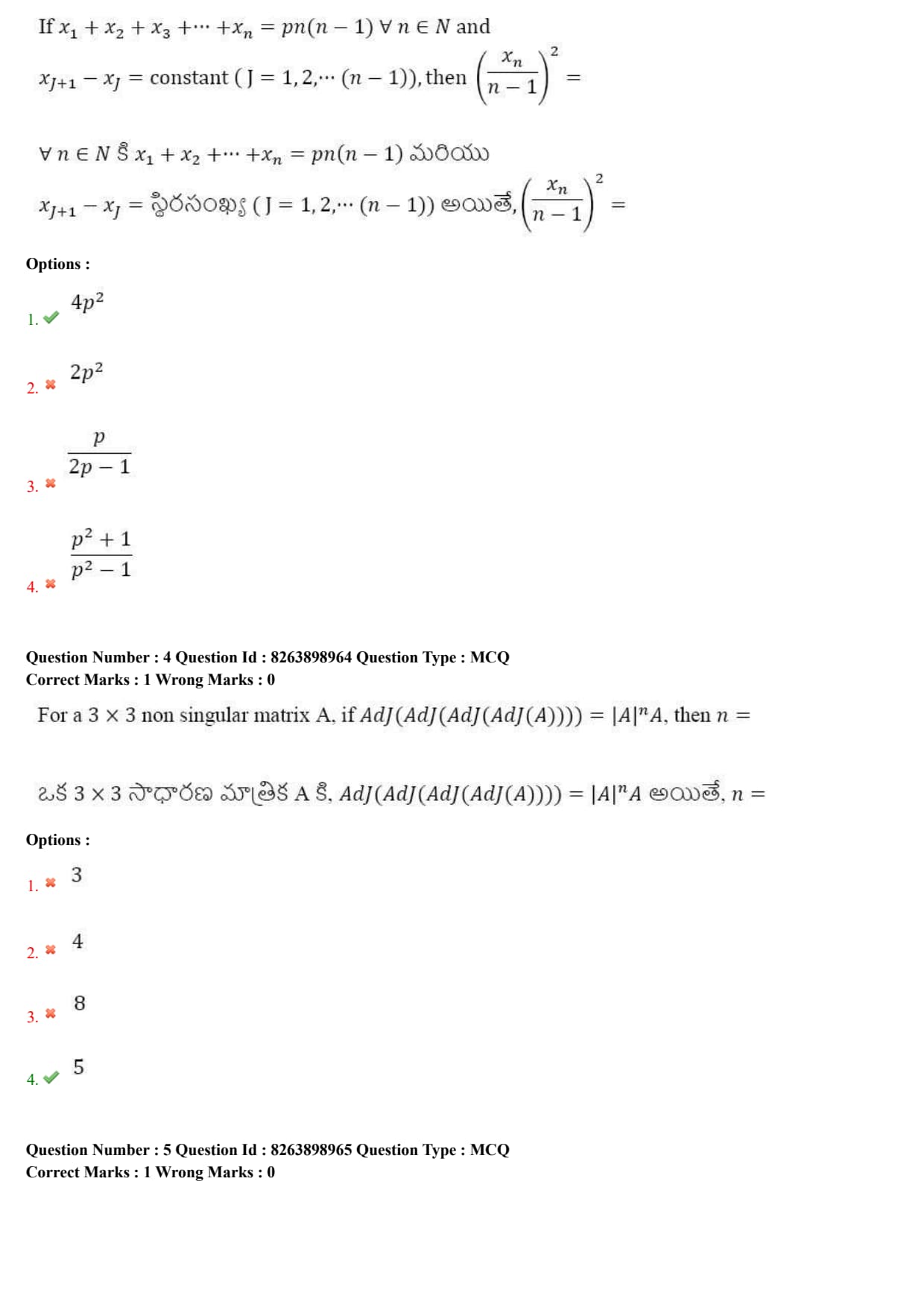
If \( x_1+x_2+x_3+\dots+x_n=pn(n-1) \forall n \in \mathbb{N} \) and \( x_{j+1}-x_j = constant \, (j=1,2,\dots,n-1) \), then \( (\frac{x_n}{n-1})^2 = \)
For a \( 3 \times 3 \) non singular matrix A, if \( Adj(Adj(Adj(Adj(A)))) = |A|^n A \), then \( n = \)
On a matrix A when three elementary operations namely interchange of \( R_1 \) and \( R_2 \), \( R_2 \rightarrow R_2 - 2R_1 \), \( R_3 \rightarrow R_3 - 3R_1 \) are applied successively, A is transformed to \[ \begin{bmatrix} 1 & 3 & 4 \\ 2 & 1 & 5 \\ 6 & 1 & 2 \end{bmatrix} \]. Then \( Tr(A) = \)
If the two systems of equations \( x+y-2z=0, 4x+4y-8z=0, 3x+3y-6z=0 \) and \( x+y+z=3, 2x+2y-z=\lambda, x+y-\mu z=1 \) have the same set of solutions, then \( \lambda+\mu = \)
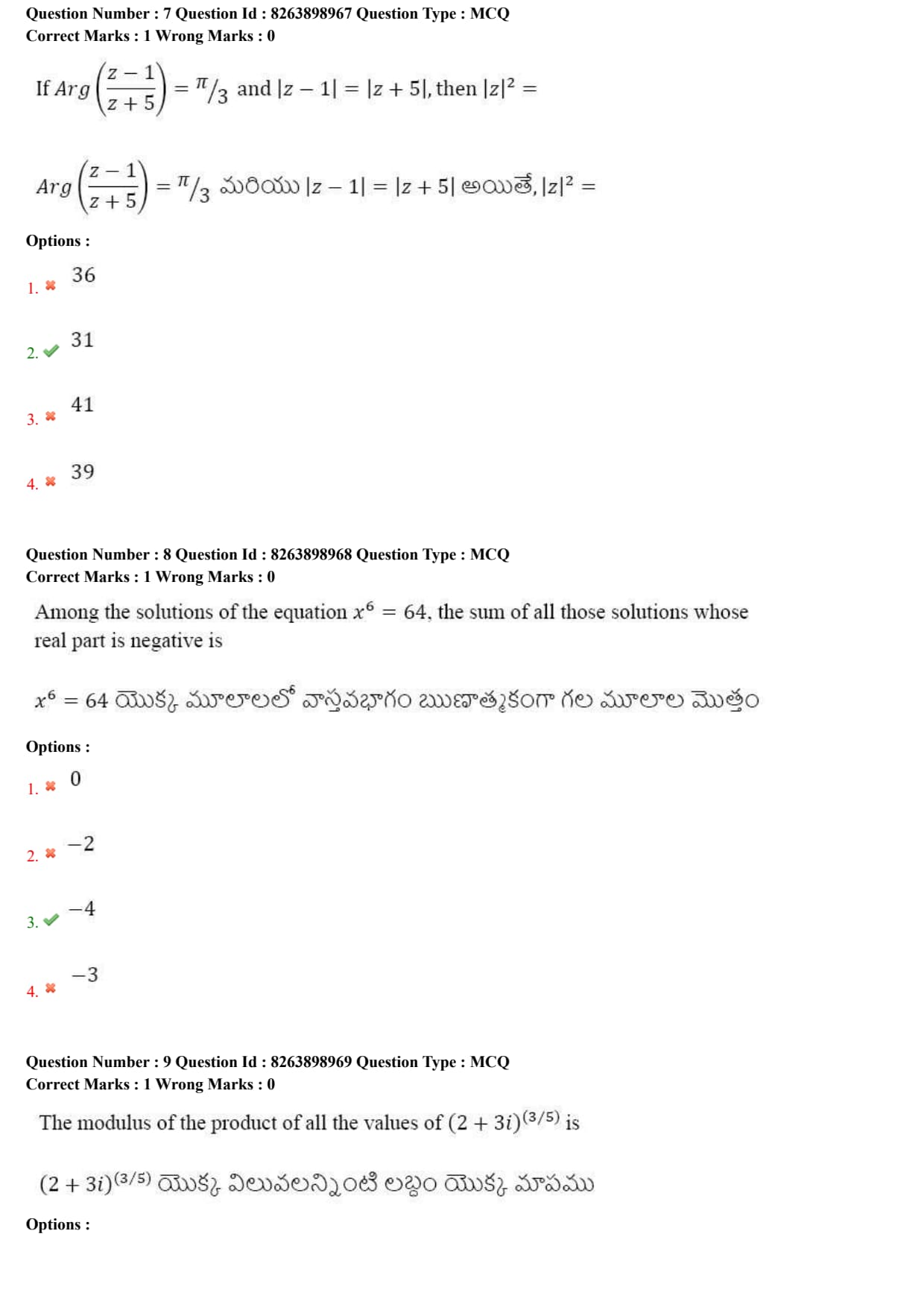
If \( Arg(\frac{z-1}{z+5}) = \pi/3 \) and \( |z-1|=|z+5| \), then \( |z|^2 = \)
Among the solutions of the equation \( x^6 = 64 \), the sum of all those solutions whose real part is negative is:
The modulus of the product of all the values of \( (2+3i)^{3/5} \) is:
Consider the quadratic expression \( f(x) = x^2 + (10-a)x - 10a \). The sum of all values of 'a', such that the roots of \( f(x)=3 \) are integers is:
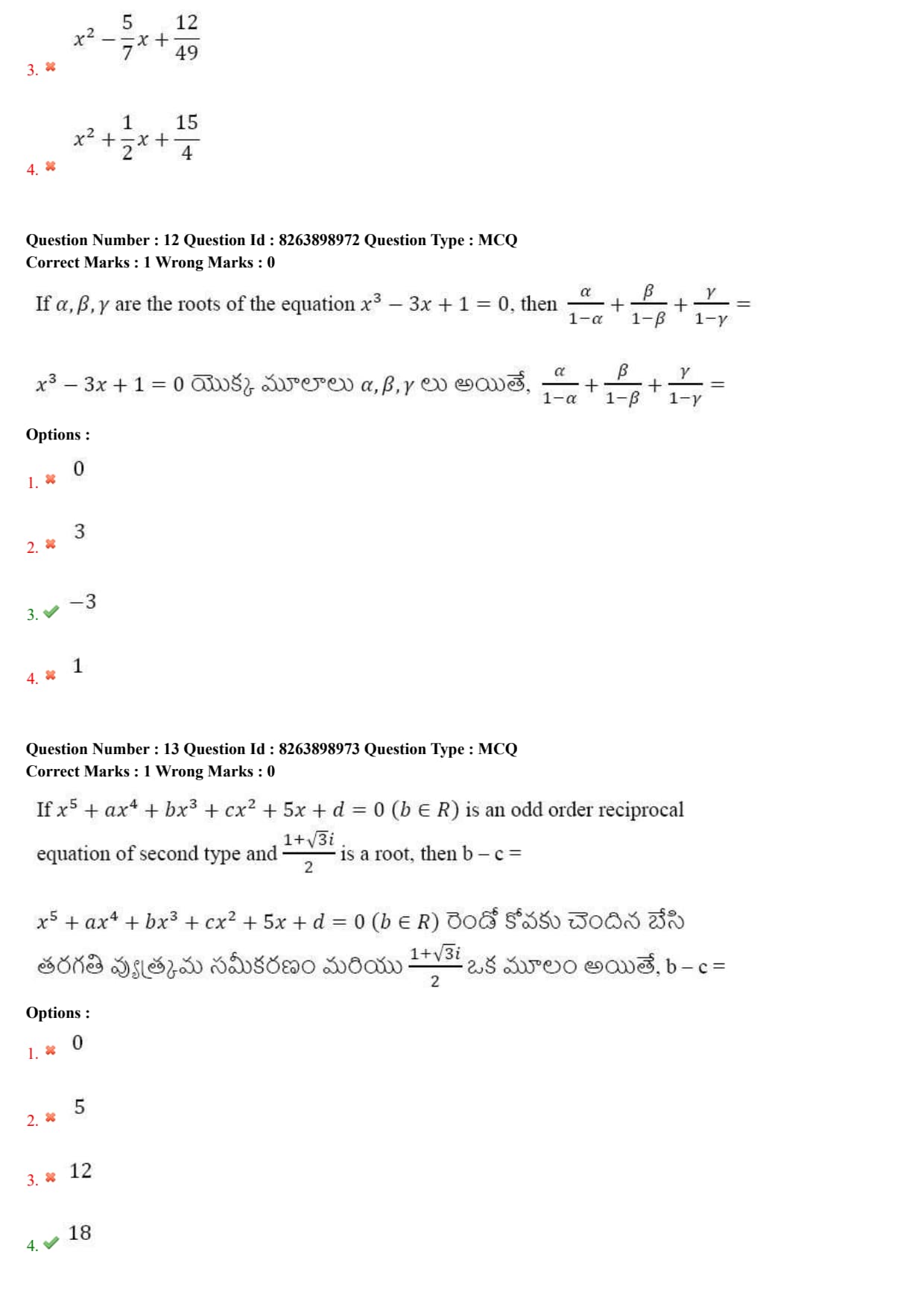
The quadratic expression having zero's equal to the non-integral roots of \( ||3x-4|-6|=5 \) is:
If \( \alpha, \beta, \gamma \) are the roots of the equation \( x^3 - 3x + 1 = 0 \), then \( \frac{\alpha}{1-\alpha} + \frac{\beta}{1-\beta} + \frac{\gamma}{1-\gamma} = \)
If \( x^5 + ax^4 + bx^3 + cx^2 + 5x + d = 0 \) is an odd order reciprocal equation of second type and \( \frac{1+\sqrt{3}i}{2} \) is a root, then \( b-c = \)
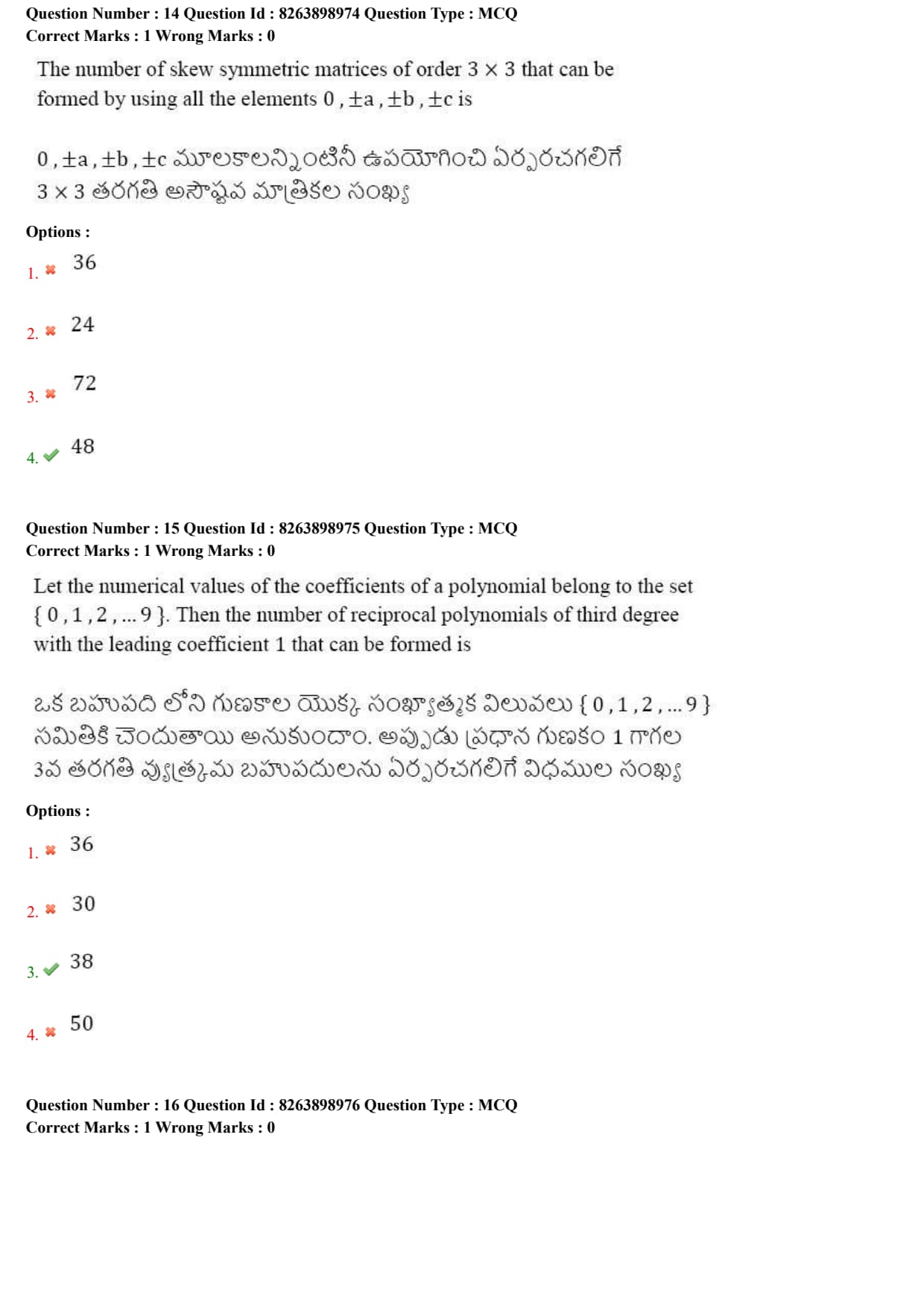
The number of skew symmetric matrices of order \( 3 \times 3 \) that can be formed by using all the elements 0, \( \pm a, \pm b, \pm c \) is:
Let the numerical values of the coefficients of a polynomial belong to the set \( \{0, 1, 2, \dots, 9\} \). Then the number of reciprocal polynomials of third degree with the leading coefficient 1 that can be formed is:
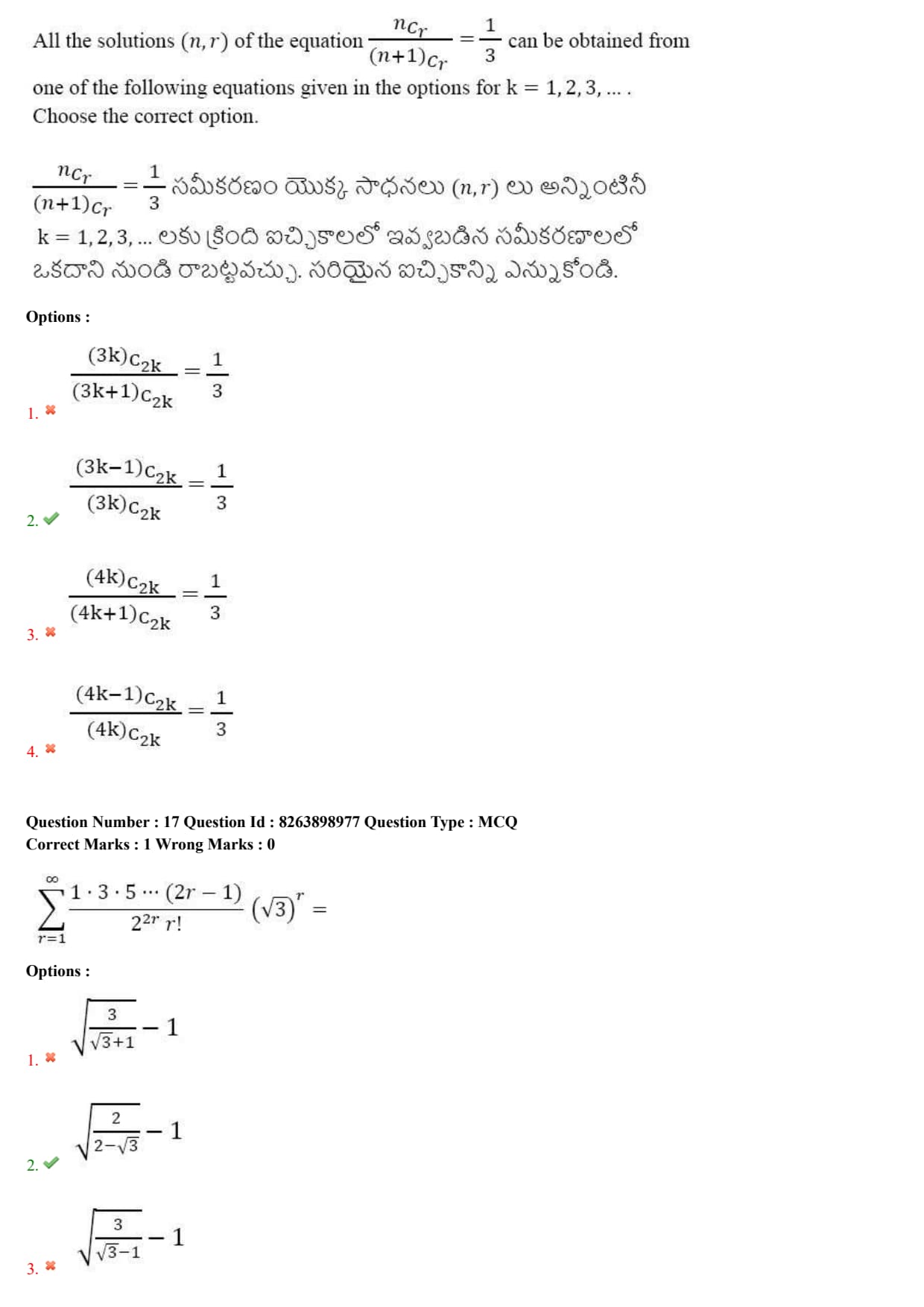
All the solutions \((n,r)\) of the equation \( \frac{{}^nC_r}{{}^{n+1}C_r} = \frac{1}{3} \) can be obtained from one of the following equations given in the options for \( k=1,2,3, \dots \):
Evaluate \[ \sum_{r=1}^{\infty} \frac{1\cdot3\cdot5\cdots(2r-1)} {2^{2r}r!} (\sqrt{3})^r : \]
If the expansion of \[ \left(\frac{1+15x}{1-3x}\right) \]
is valid and the coefficient of \(x^3\) in its expansion is \(k(3^3)\), then \(k=\)
If \[ \frac{3x^2+x+2} {(3x^2+x+4)(3x^2+x+1)} = \frac{Ax+B}{3x^2+x+4} + \frac{Cx+D}{3x^2+x+1}, \]
then \((A+B)+(C+D)\) is:
Calculate \[ \sin\frac{8\pi}{9}\, \sin\frac{7\pi}{9}\, \sin\frac{2\pi}{3}\, \sin\frac{5\pi}{9}. \]
If \( A+B+C=\pi \) and \( \cos A = \cos B \cos C \), then \( \tan A - \tan B - \tan C = \)
If \( 7\sin x + 15\sin y = 17 \), then the maximum value of \( 7\cos x + 15\cos y \) is:
All the values of \(\alpha\) satisfying the equations \( 2\cos^2 \alpha - 3\cos \alpha = 32\tan^8 \theta \) and \( 3\cos 2\theta = 1 \) are:
The domain of \( f(x) = \cos^{-1}[\log_2(x^2+5x+8)] \) is:
If \( \sinh^{-1}(2) + \sinh^{-1}(3) = \alpha \), then \( \cosh \alpha = \)
If the angles of triangle ABC are in arithmetic progression and the sides a, b and c satisfy \( \frac{\sqrt{3}}{2} < \frac{b}{a} < 1 \) and \( c < b \), then the possible values of the side c are:
In a \(\Delta ABC\) if \( a:b:c = 5:6:7 \), then the ratio of the radius of the circumcircle to that of the incircle is:
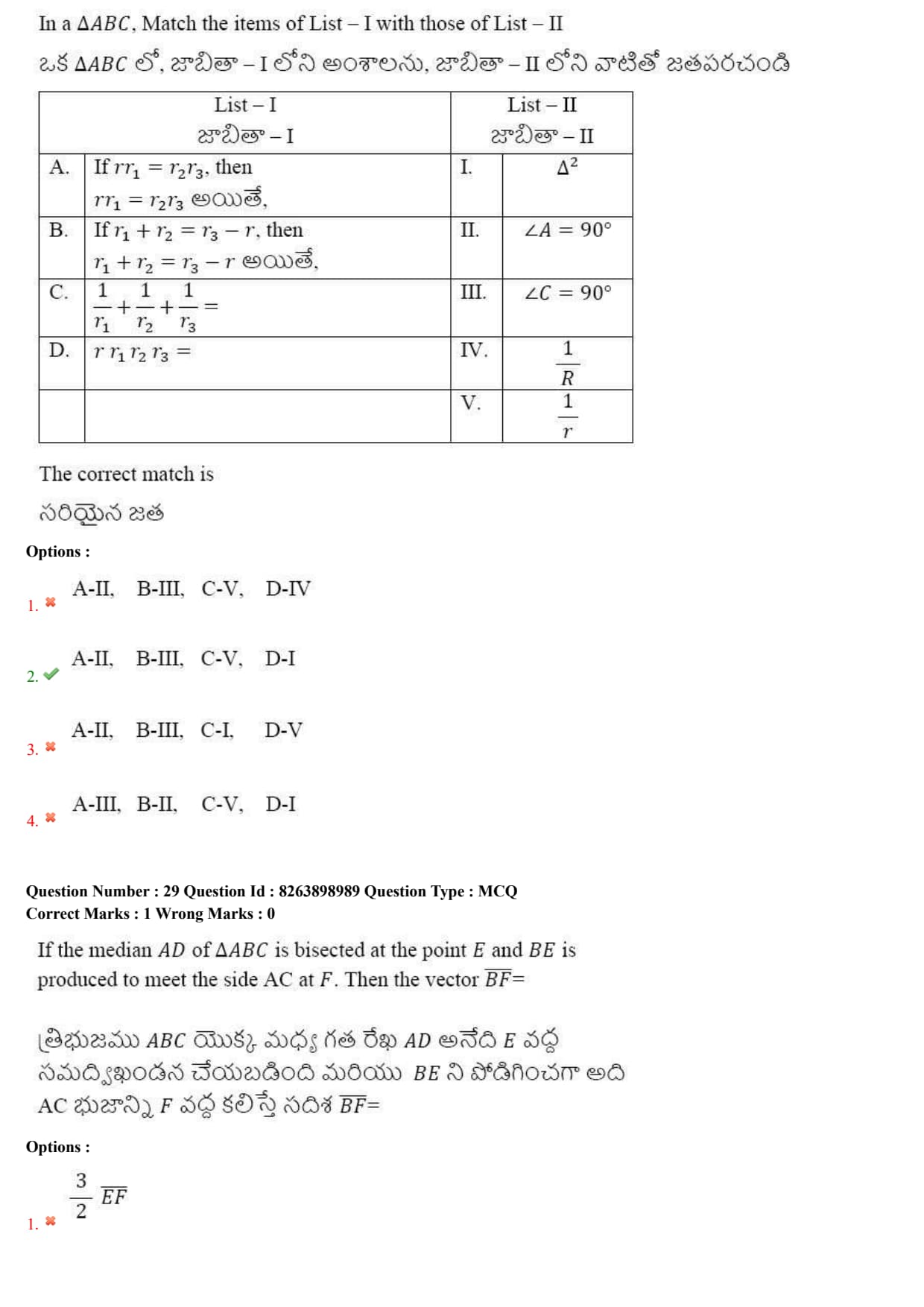
In a \(\triangle ABC\), let \(r\) be the inradius and \(r_1,r_2,r_3\) be the exradii opposite to vertices \(A,B,C\) respectively. Match the items of List-I with List-II.
\[ \begin{array}{|c|c|} \hline \text{List-I} & \text{List-II} \\ \hline A.\; rr_1 = r_2r_3 & I.\; \Delta^2 \\ B.\; r_1+r_2=r_3-r & II.\; \angle A = 90^\circ \\ C.\; \dfrac{1}{r_1}+\dfrac{1}{r_2}+\dfrac{1}{r_3} & III.\; \angle C = 90^\circ \\ D.\; rr_1r_2r_3 & IV.\; s^2 \\ & V.\; \dfrac{1}{r} \\ \hline \end{array} \]
If the median AD of \(\Delta ABC\) is bisected at the point E and BE is produced to meet the side AC at F. Then the vector \( \overline{BF} = \)
OABCD is a pentagon in which \(OA\) and \(CB\) are parallel and \(OD\) and \(AB\) are parallel. If \[ \overrightarrow{OA}=\overrightarrow{a}, \qquad \overrightarrow{OD}=\overrightarrow{d}, \]
and \[ \frac{OA}{CB}=2, \qquad \frac{OD}{AB}=\frac13, \]
then \[ \overrightarrow{AD}+\overrightarrow{OC}+\overrightarrow{DC} \]
is equal to:
Let \(\overline{a}=x\overline{i}-2\overline{j}+3\overline{k}\), \(\overline{b}=-2\overline{i}+x\overline{j}-\overline{k}\) and \(\overline{c}=7\overline{i}-2\overline{j}+x\overline{k}\). If \(x=x_0\) is the point of the local maxima of \(f(x)=\overline{a}\cdot(\overline{b}\times\overline{c})\), then at \(x=x_0\), \(\overline{a}\cdot\overline{b}+\overline{b}\cdot\overline{c}+\overline{c}\cdot\overline{a}=\)
\(\overline{V}=2\overline{i}+\overline{j}-\overline{k}\) and \(\overline{W}=\overline{i}+3\overline{k}\). If \(\overline{U}\) is a unit vector, then the maximum value of the scalar triple product \([\overline{U}\overline{V}\overline{W}]\) is
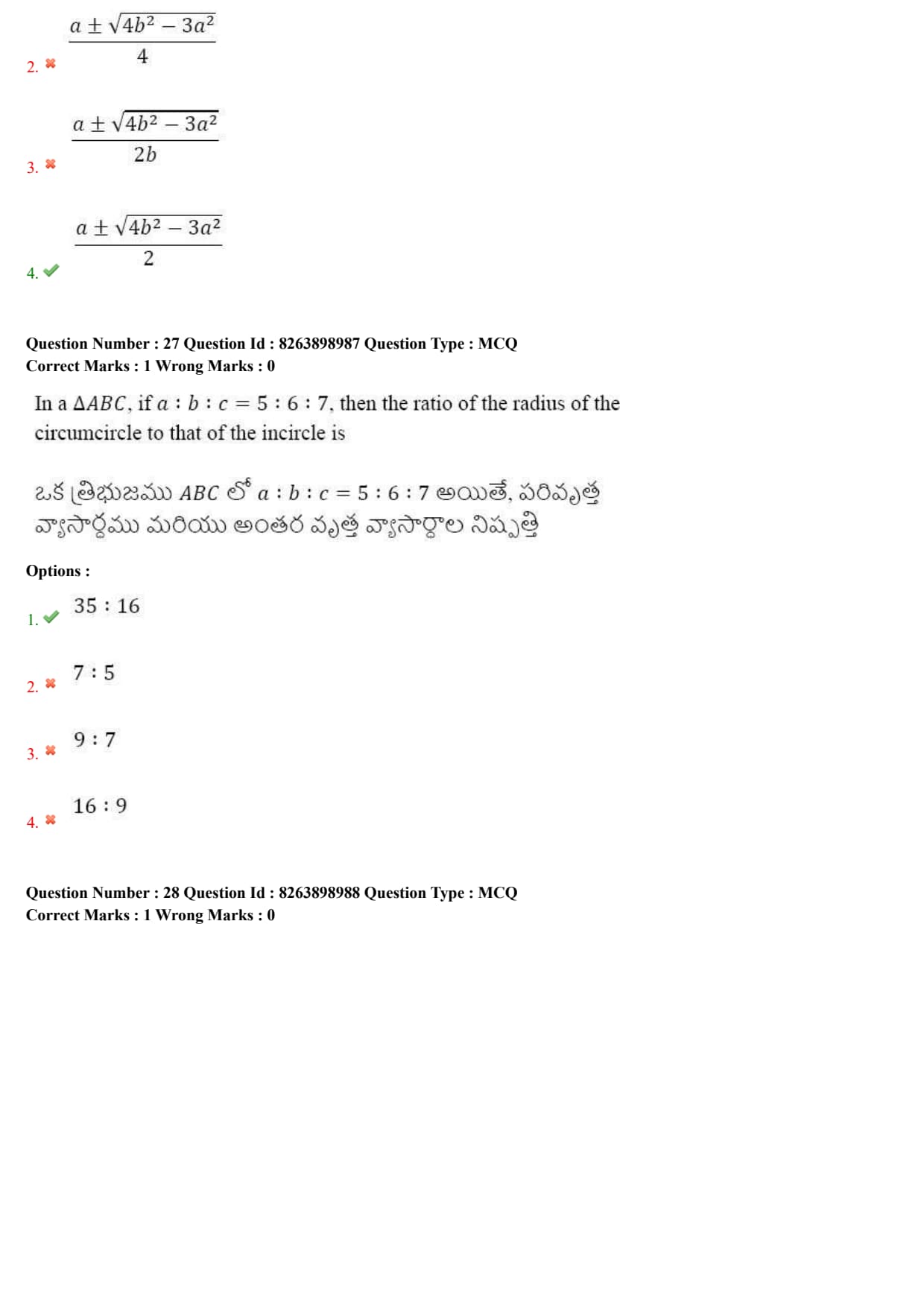
\(\overline{b}\) and \(\overline{c}\) are non-collinear vectors and \(\overline{a}\) is a vector such that \((\overline{c}\cdot\overline{c})\overline{a}=\overline{c}\). If \(\overline{a}\times(\overline{b}\times\overline{c})+(\overline{a}\cdot\overline{b})\overline{b}=(4-2\beta-sin~\alpha)\overline{b}+(\beta^{2}-1)\overline{c}\), then the values of the scalars \(\alpha\) and \(\beta\) are
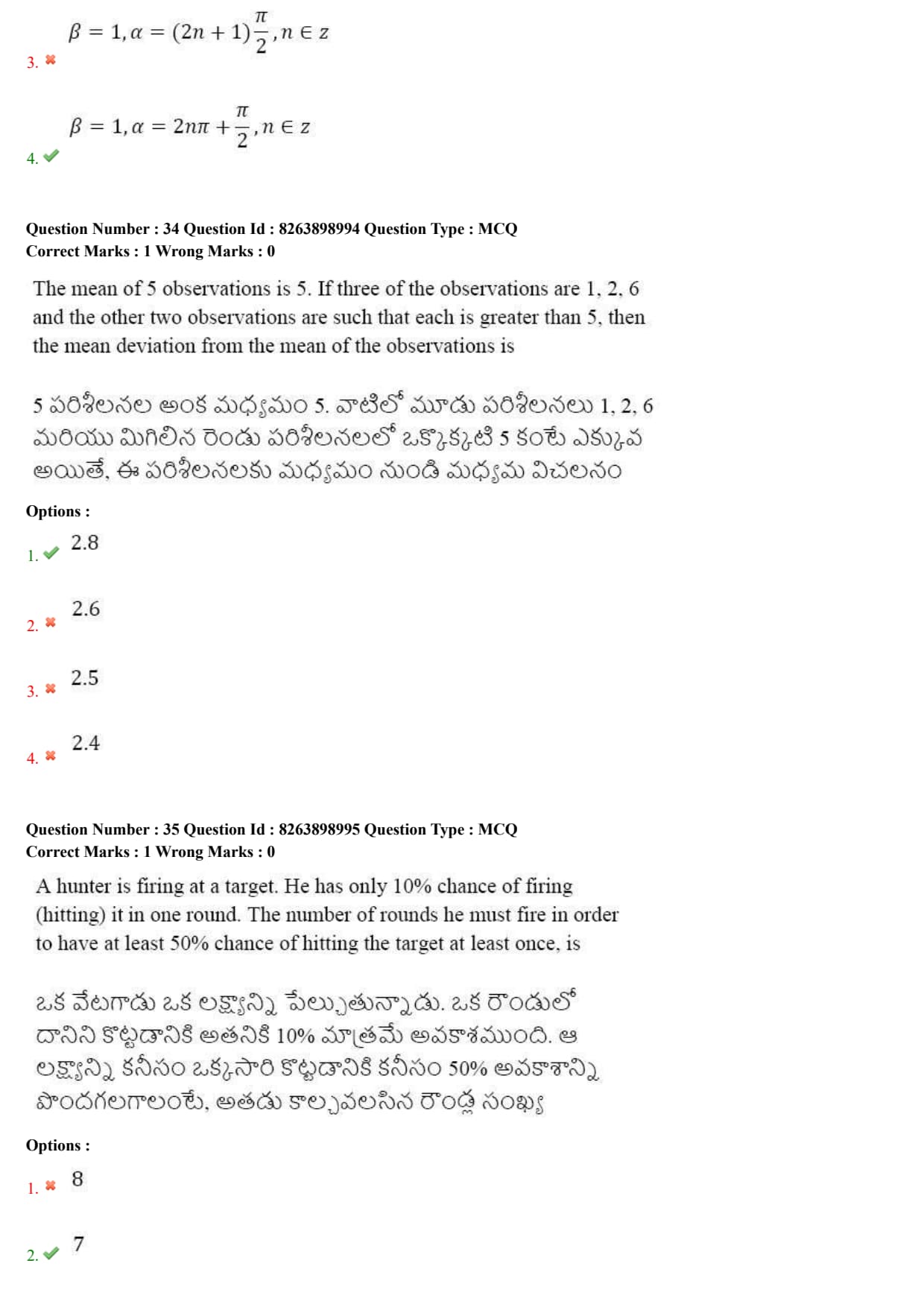
The mean of 5 observations is 5. If three of the observations are 1, 2, 6 and the other two observations are such that each is greater than 5, then the mean deviation from the mean of the observations is
A hunter is firing at a target. He has only 10% chance of hitting it in one round. The number of rounds he must fire in order to have at least 50% chance of hitting the target at least once, is
Two symmetric cubical dice are rolled once. Match the items of Column-I with the items of Column-II.
| Column-I | Column-II | ||
|---|---|---|---|
| A | Probability that the numbers appearing are equal | I | \(\frac{1}{12}\) |
| B | Probability that the numbers are all distinct | II | \(\frac{5}{36}\) |
| C | Probability that the sum of numbers is 10 | III | \(\frac{1}{6}\) |
| D | Probability that the sum of numbers is 6 | IV | \(\frac{4}{36}\) |

For a biased die, the probabilities for different faces are given by P(1)=0.1, P(2)=0.32, P(3)=0.21, P(4)=0.15, P(5)=0.05, P(6)=0.17. The die is tossed and it is known that either face 1 or 2 turned up. The probability that it is face 1 is:
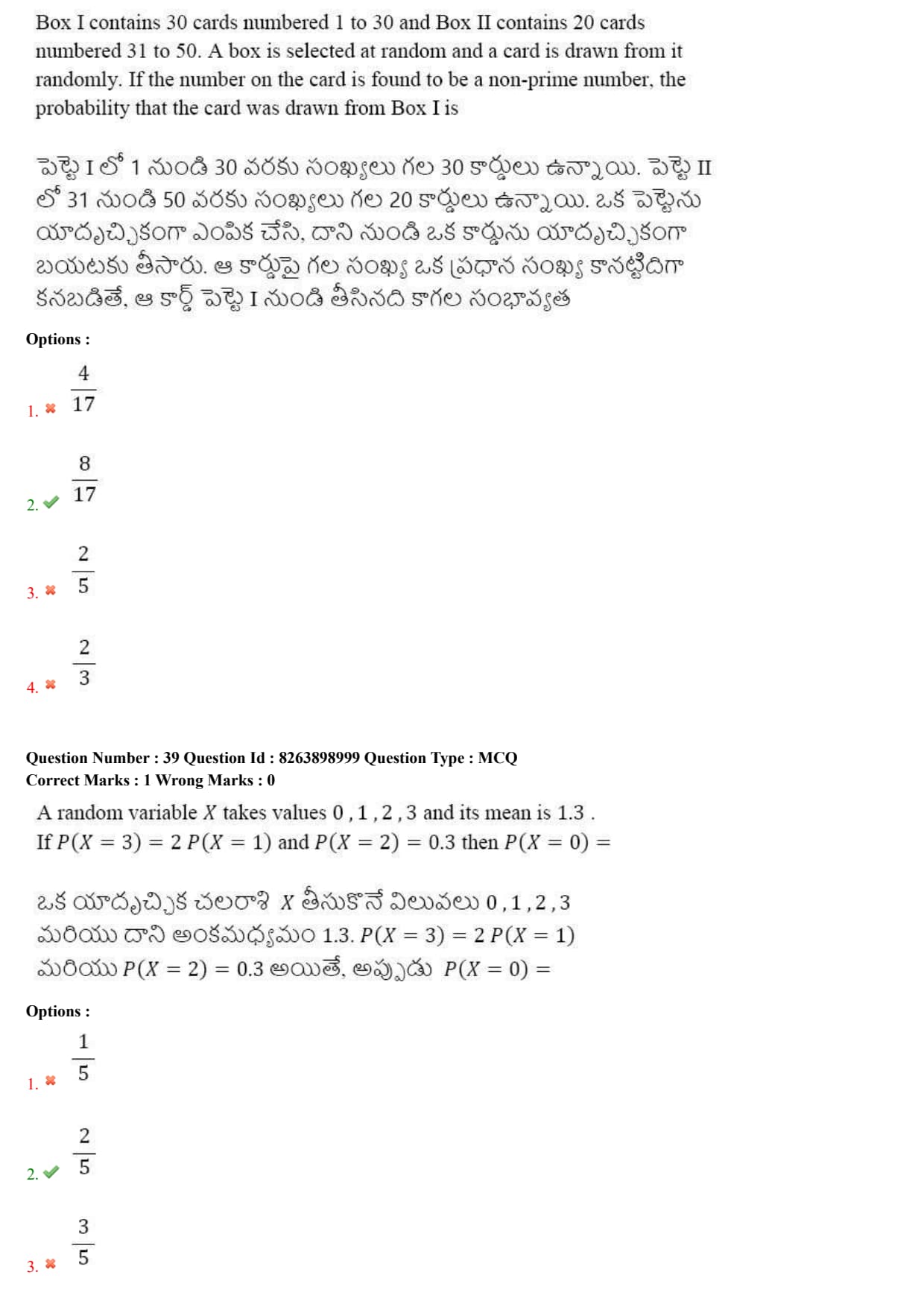
Box I contains 30 cards numbered 1 to 30 and Box II contains 20 cards numbered 31 to 50. A box is selected at random and a card is drawn. If the number is non-prime, the probability that it came from Box I is:
A random variable X takes values 0, 1, 2, 3 and its mean is 1.3. If \(P(X=3)=2P(X=1)\) and \(P(X=2)=0.3\), then find \(P(X=0)\).
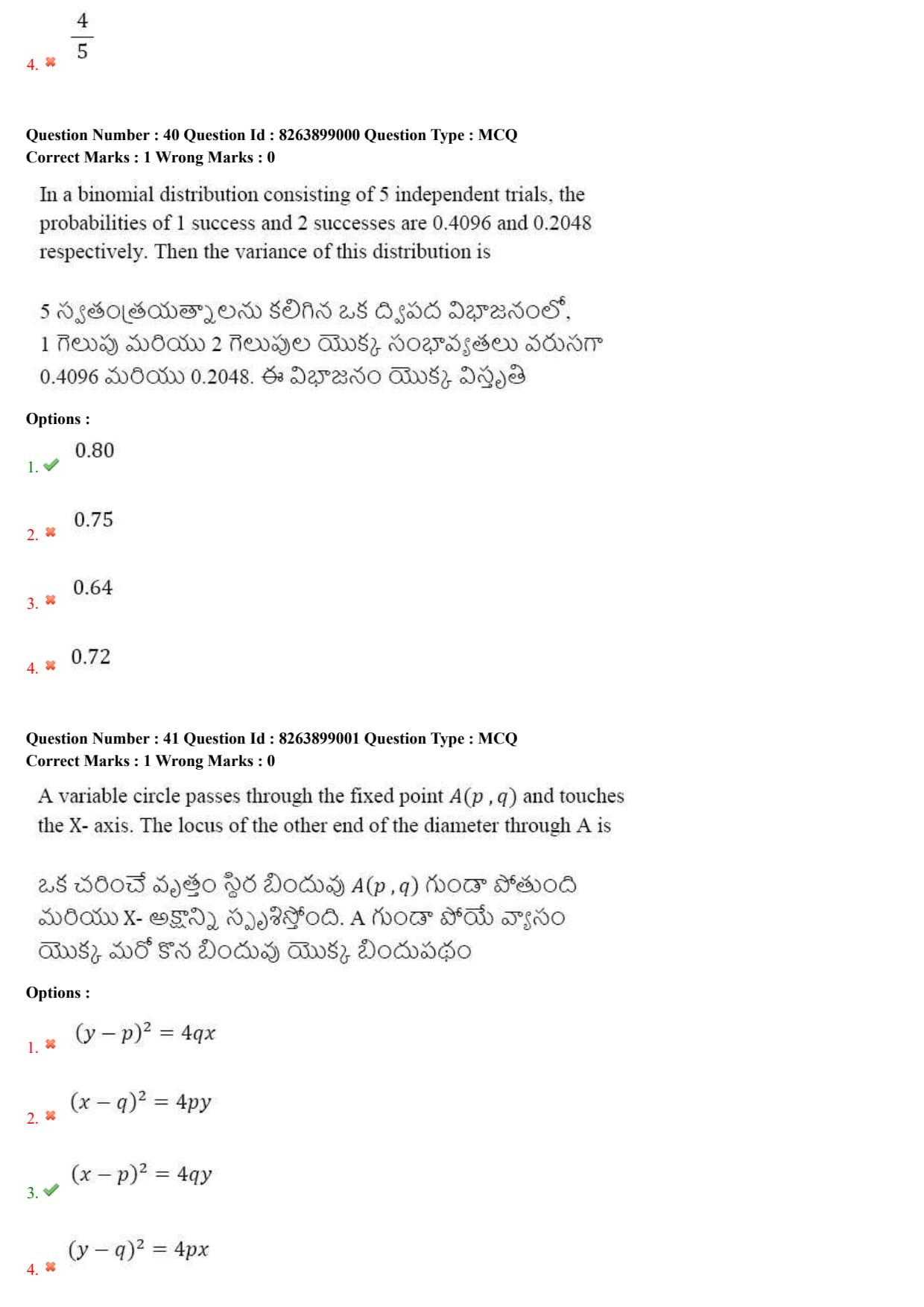
In a binomial distribution with 5 trials, the probabilities of 1 success and 2 successes are 0.4096 and 0.2048 respectively. Find the variance of the distribution.
A variable circle passes through the fixed point \(A(p,q)\) and touches the X-axis. The locus of the other end of the diameter through A is
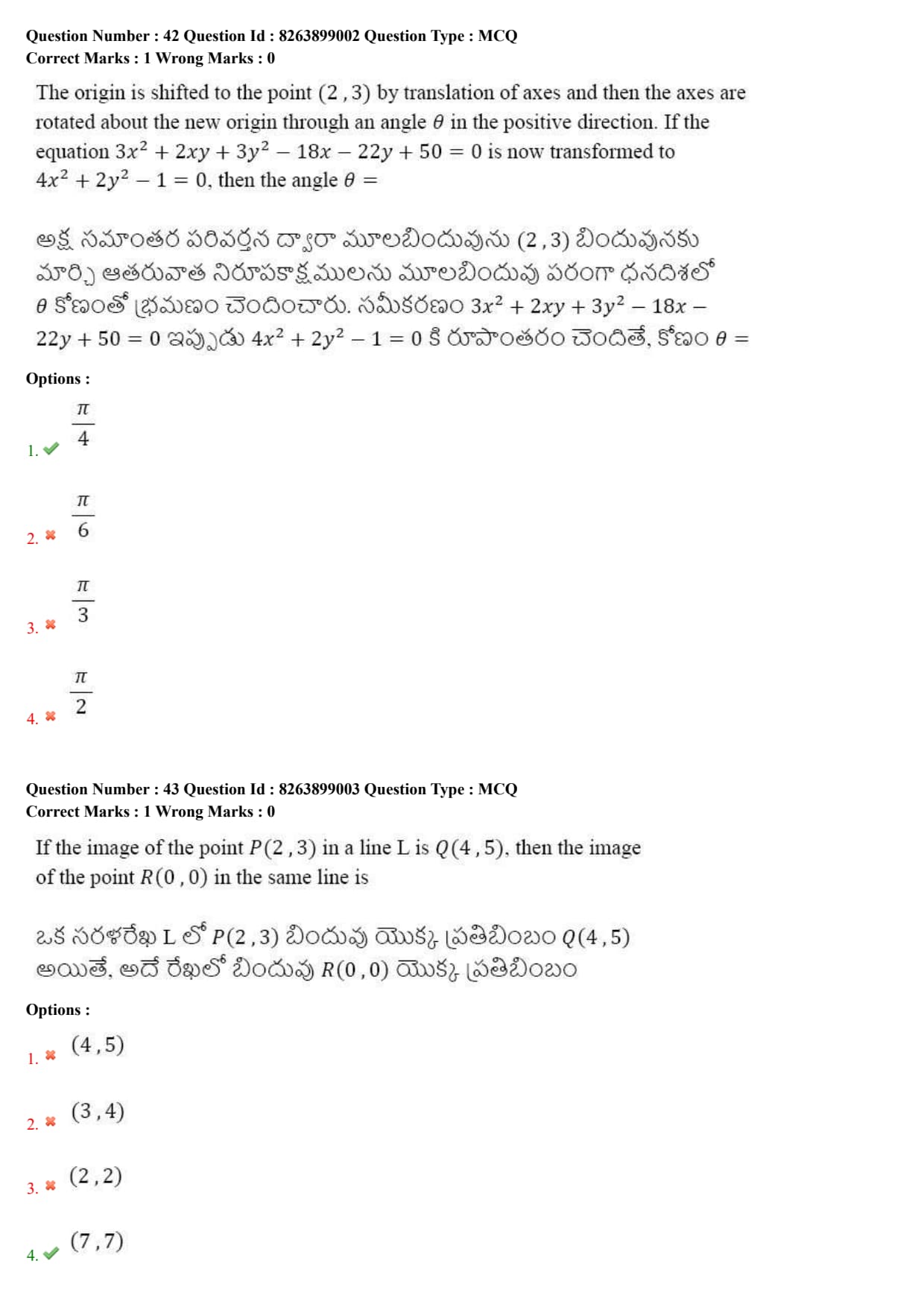
The origin is shifted to (2, 3) and axes are rotated through angle \(\theta\). If \(3x^2+2xy+3y^2-18x-22y+50=0\) transforms to \(4x^2+2y^2-1=0\), then \(\theta =\)
If the image of \(P(2,3)\) in a line \(L\) is \(Q(4,5)\), find the image of \(R(0,0)\) in the same line \(L\).
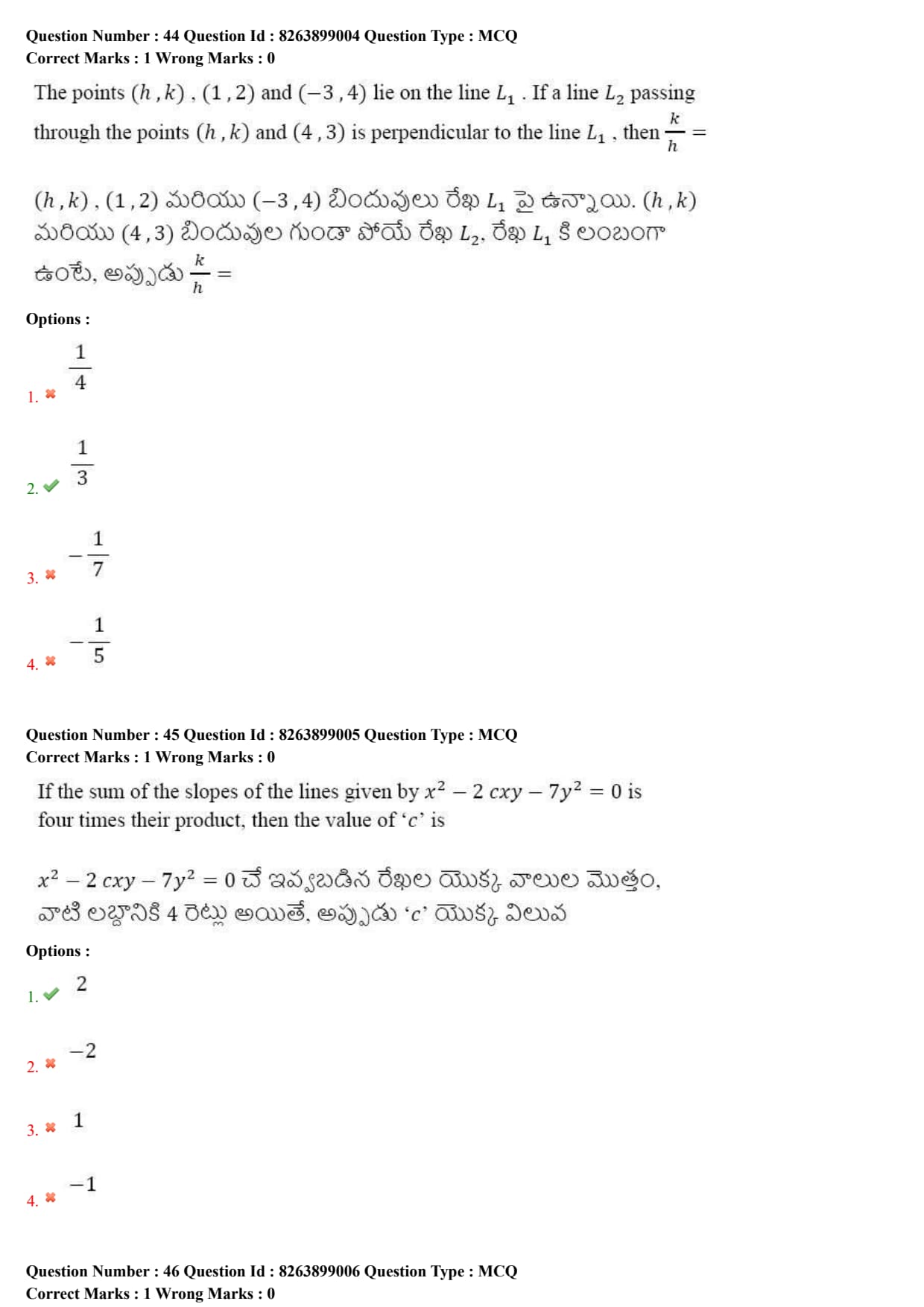
Points \((h,k)\), \((1,2)\), \((-3,4)\) lie on \(L_1\). Line \(L_2\) through \((h,k)\) and \((4,3)\) is perpendicular to \(L_1\). Find \(\frac{k}{h}\).
If the sum of the slopes of the lines given by \(x^2-2cxy-7y^2=0\) is four times their product, find the value of \(c\).
If one of the lines \(my^2 + (1-m^2)xy - mx^2 = 0\) is a bisector of the angle between the lines \(xy = 0\), find \(m\).
If a circle \(S\) passes through \((a, b)\) and cuts the circle \(x^2 + y^2 = 4\) orthogonally, then find the locus of the center of \(S\).
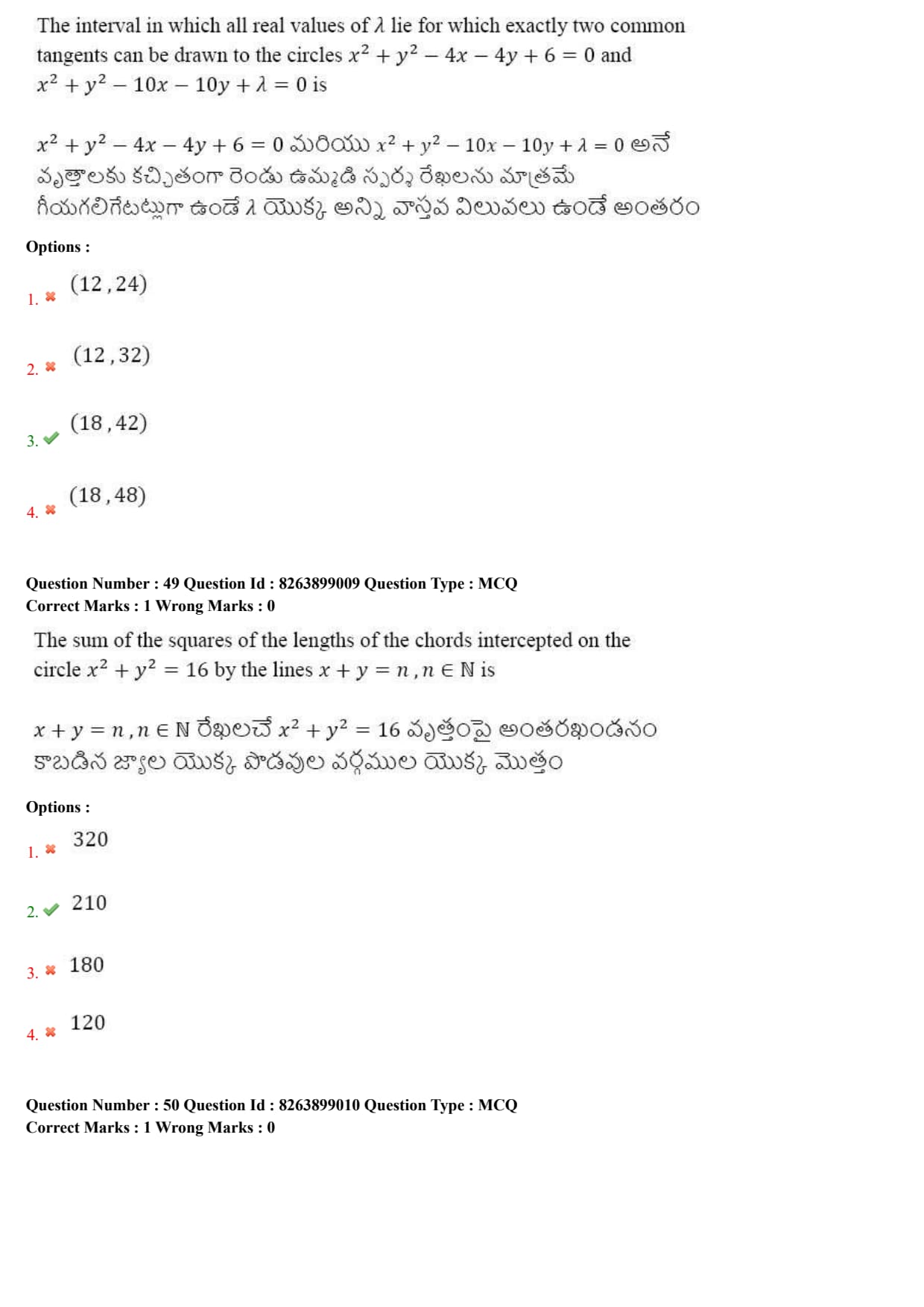
Find the interval of \(\lambda\) for which exactly two common tangents can be drawn to \(x^2+y^2-4x-4y+6=0\) and \(x^2+y^2-10x-10y+\lambda=0\).
The sum of the squares of the lengths of the chords intercepted on \(x^2+y^2=16\) by the lines \(x+y=n, n \in \mathbb{N}\) is:
Two circles, each of radius 5, touch at \((1,2)\). If the common tangent at the point of contact is \(4x+3y=10\), then the equation of one of the circles is:
A circle C cuts the circles \(x^{2}+y^{2}-4x+6y+4=0\) and \(x^{2}+y^{2}+6x-4y+9=0\) orthogonally. If origin lies on this circle C, then the radius of the circle C is
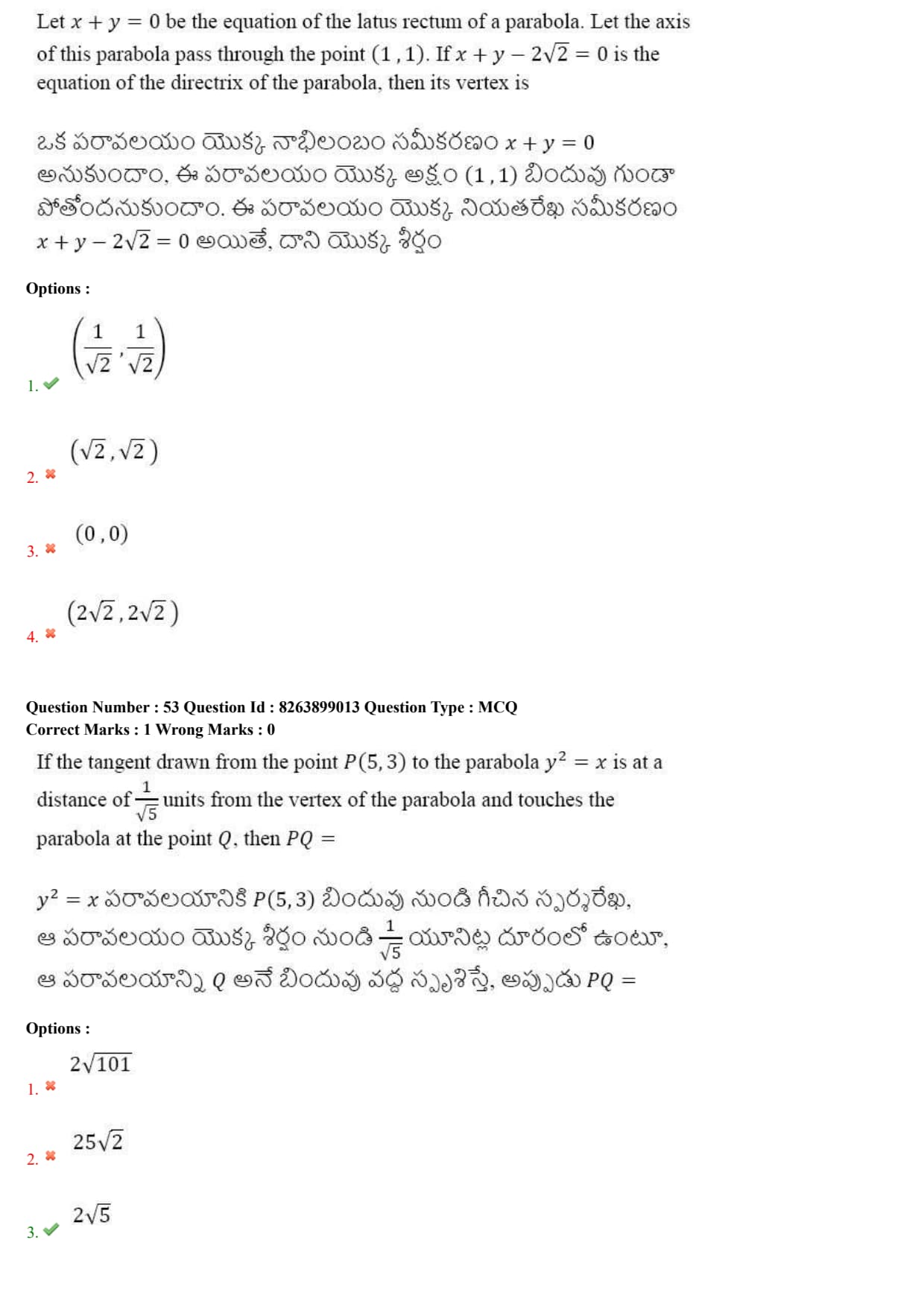
Let \(x+y=0\) be the equation of the latus rectum of a parabola. Let the axis of this parabola pass through the point (1, 1). If \(x+y-2\sqrt{2}=0\) is the equation of the directrix of the parabola, then its vertex is
If the tangent drawn from the point \(P(5,3)\) to the parabola \(y^{2}=x\) is at a distance of \(\frac{1}{\sqrt{5}}\) units from the vertex of the parabola and touches the parabola at the point Q, then \(PQ=\)
X axis is the major axis and origin is the centre of an ellipse. If the distance between its directrices is \(\frac{18}{\sqrt{5}}\) and the ratio between the distances from the centre of this ellipse to its focus and its corresponding directrices is \(5:9\), then the length of its latus rectum is
If \(d_1\) and \(d_2\) are the distances of the foci of the hyperbola \(4x^{2}-9y^{2}-16x+54y-101=0\) from the point (2,-3), then \(d_1+d_2=\)
\(A(-4,9,k)\), \(B(-1,k,k)\), \(C(0,7,10)\) form an isosceles right-angled triangle. If \(AB=BC\) and \(AC\) is an integer then the perimeter of \(\Delta ABC\) is
If N is the foot of the perpendicular drawn from the point \(P(5,-1,3)\) to the line passing through the points \(A(1,3,-5)\) and \(B(3,-1,5)\) then the ratio in which N divides AB is
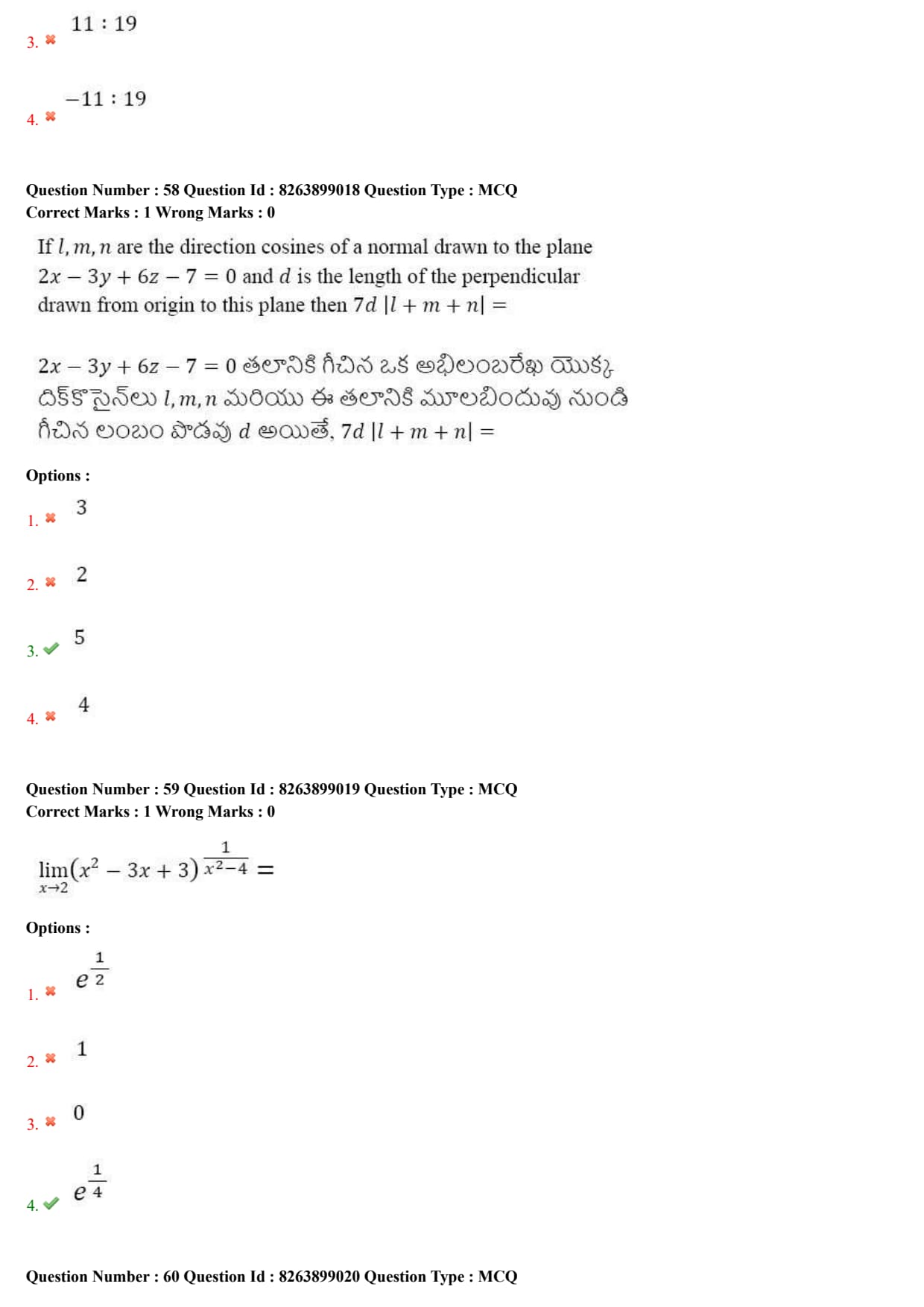
If l, m, n are the direction cosines of a normal drawn to the plane \(2x-3y+6z-7=0\) and d is the length of the perpendicular drawn from origin to this plane then \(7d|l+m+n|=\)
Evaluate \(\lim_{x\rightarrow2}(x^{2}-3x+3)^{\frac{1}{x^{2}-4}}\).
If \[ f(x)= \begin{cases} \dfrac{x^{2}-4}{\sqrt{2-x}}, & x<2
a, & x=2
\log(x-2), & x>2 \end{cases} \]
is a real valued function, then:
If \(f(x)=\frac{\cos^{4}x-1}{x^{2}}\), \(x\ne0\) and \(f(0)=2\) is a real valued function, then:
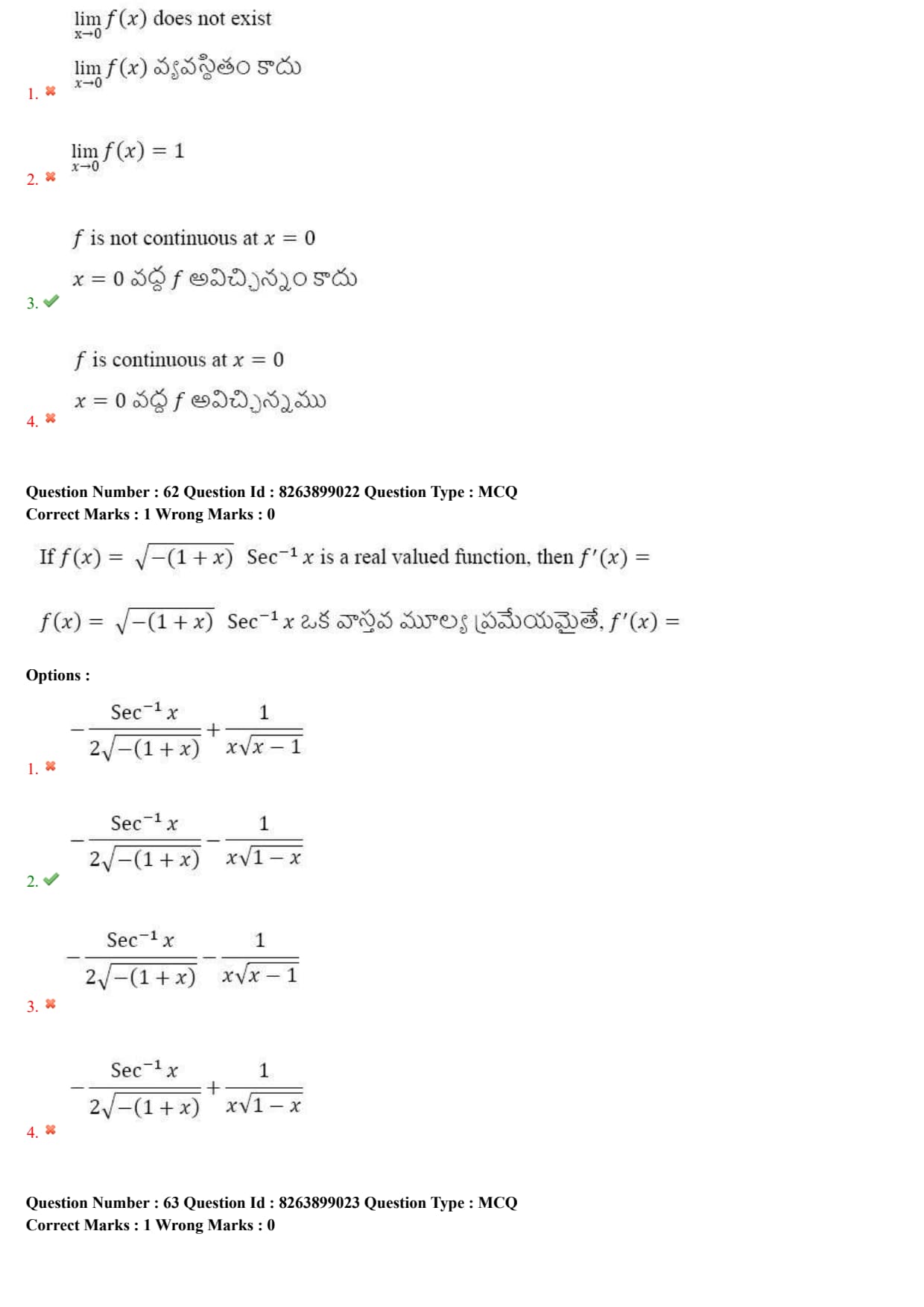
If \(f(x)=\sqrt{-(1+x)}\sec^{-1}x\) is a real valued function, then \(f'(x)=\)
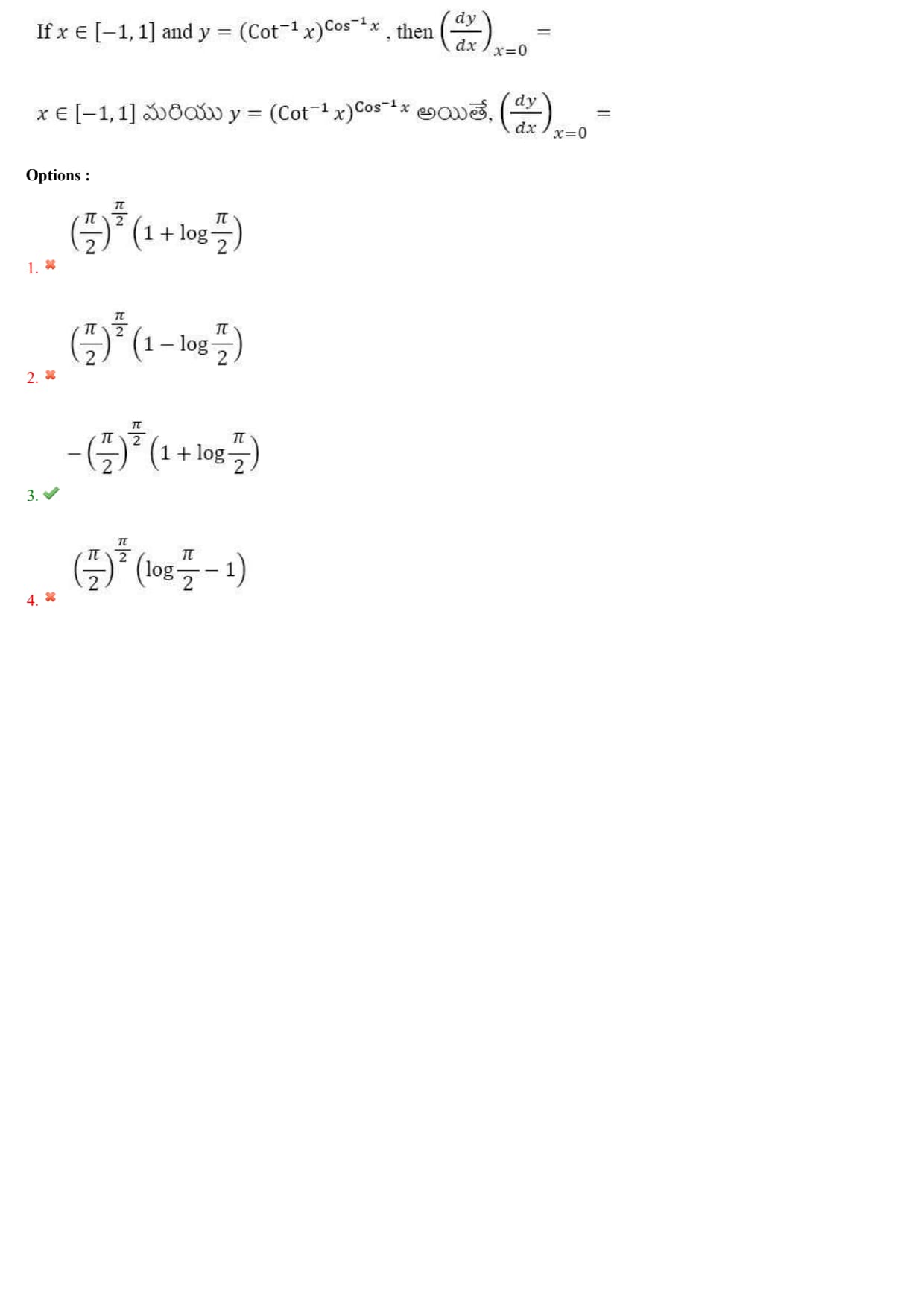
If \(x \in [-1,1]\) and \(y=(\cot^{-1}x)^{\cot^{-1}x}\), then \(\left(\frac{dy}{dx}\right)_{x=0}=\)
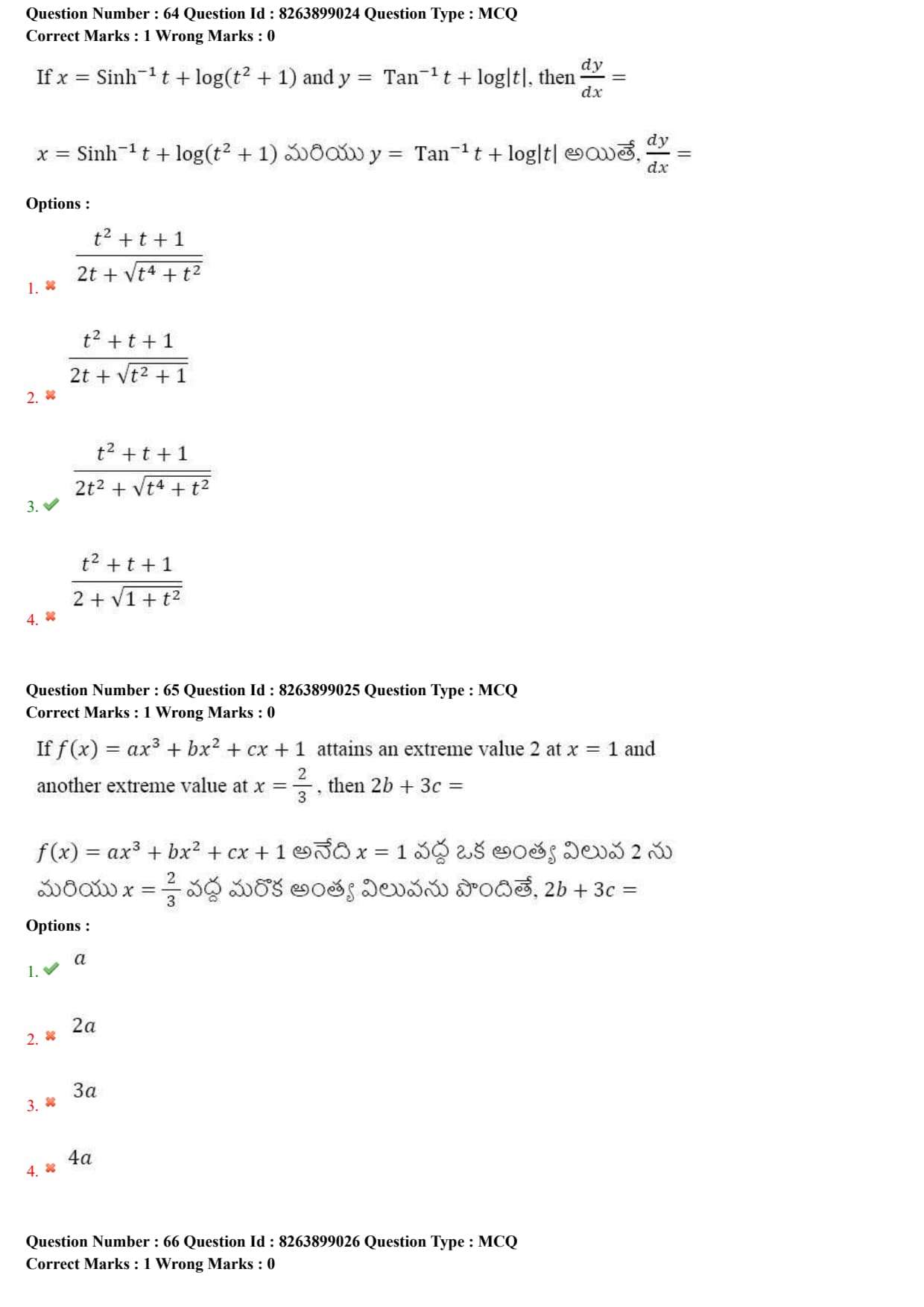
If \(x=\sinh^{-1}t+\log(t^{2}+1)\) and \(y=\tan^{-1}t+\log|t|\), then \(\frac{dy}{dx}=\)
If \(f(x)=ax^{3}+bx^{2}+cx+1\) attains an extreme value \(2\) at \(x=1\) and another extreme value at \(x=\frac{2}{3}\), then \(2b+3c\) is equal to
If a cylindrical tank of radius 3 m is filled with water at the rate of \(\frac{3}{2} \, m^3/sec \), then the rate of change of its water level in (m/sec) is:
The surface area of a cube is 150 sq. cm. If it is increased by 0.025 sq. cm, then the approximate increase in its volume (in c.c.) is:
The length of the tangent drawn at the point \(P(1, 3\sqrt{3})\) on the curve is \(\frac{x^2}{3} + \frac{y^2}{27} = 4\):
The value of the integral \(\int \frac{dx}{\cos 2x + \sin 2x + 2\sin^2 x}\) is:
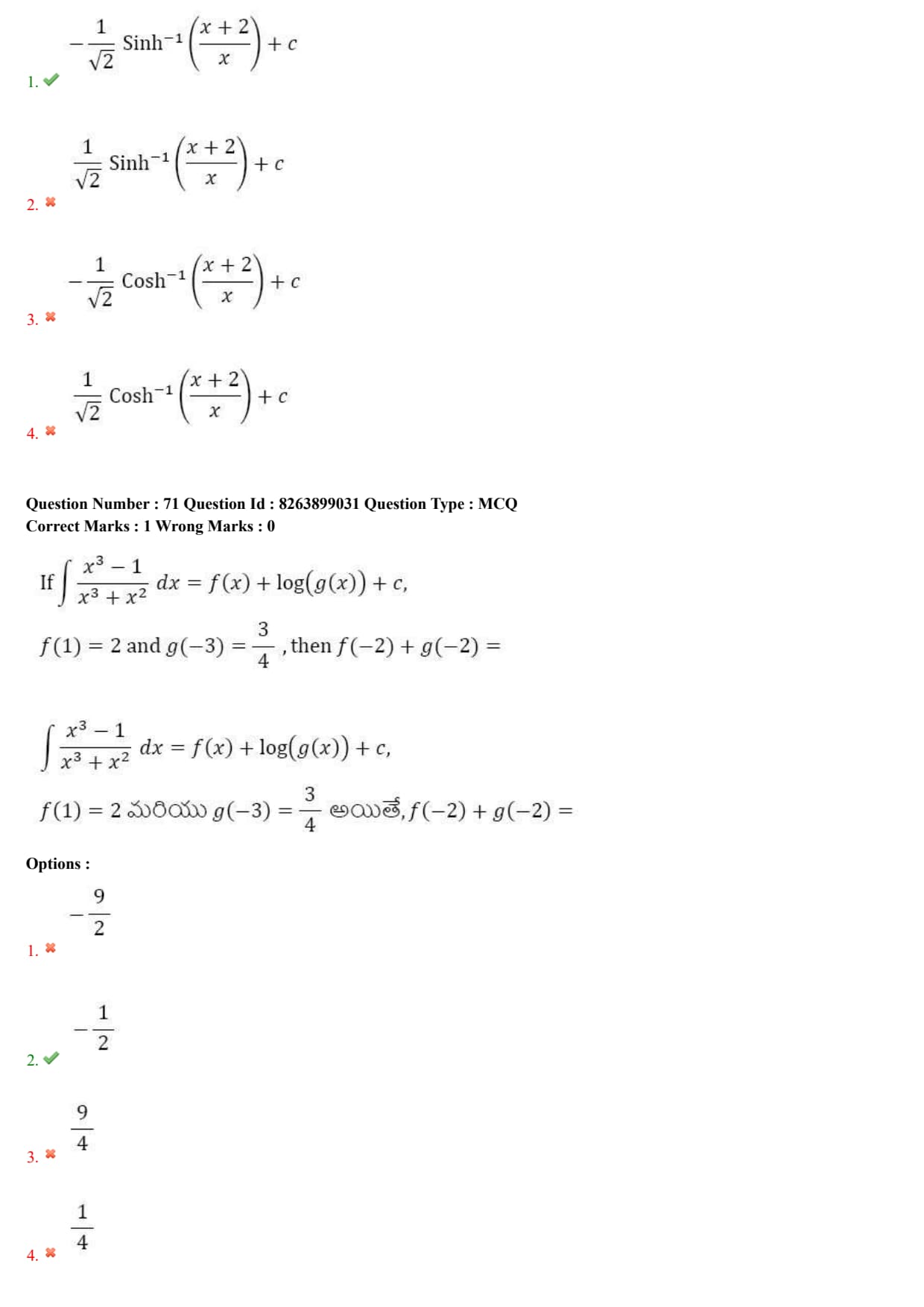
If \(x > 0\), then \(\int \frac{1}{\sqrt{x^4 + 2x^3 + 2x^2}} dx =\)
The function \(f(x) = \frac{x}{2} + \frac{2}{x}\) has a local minimum at
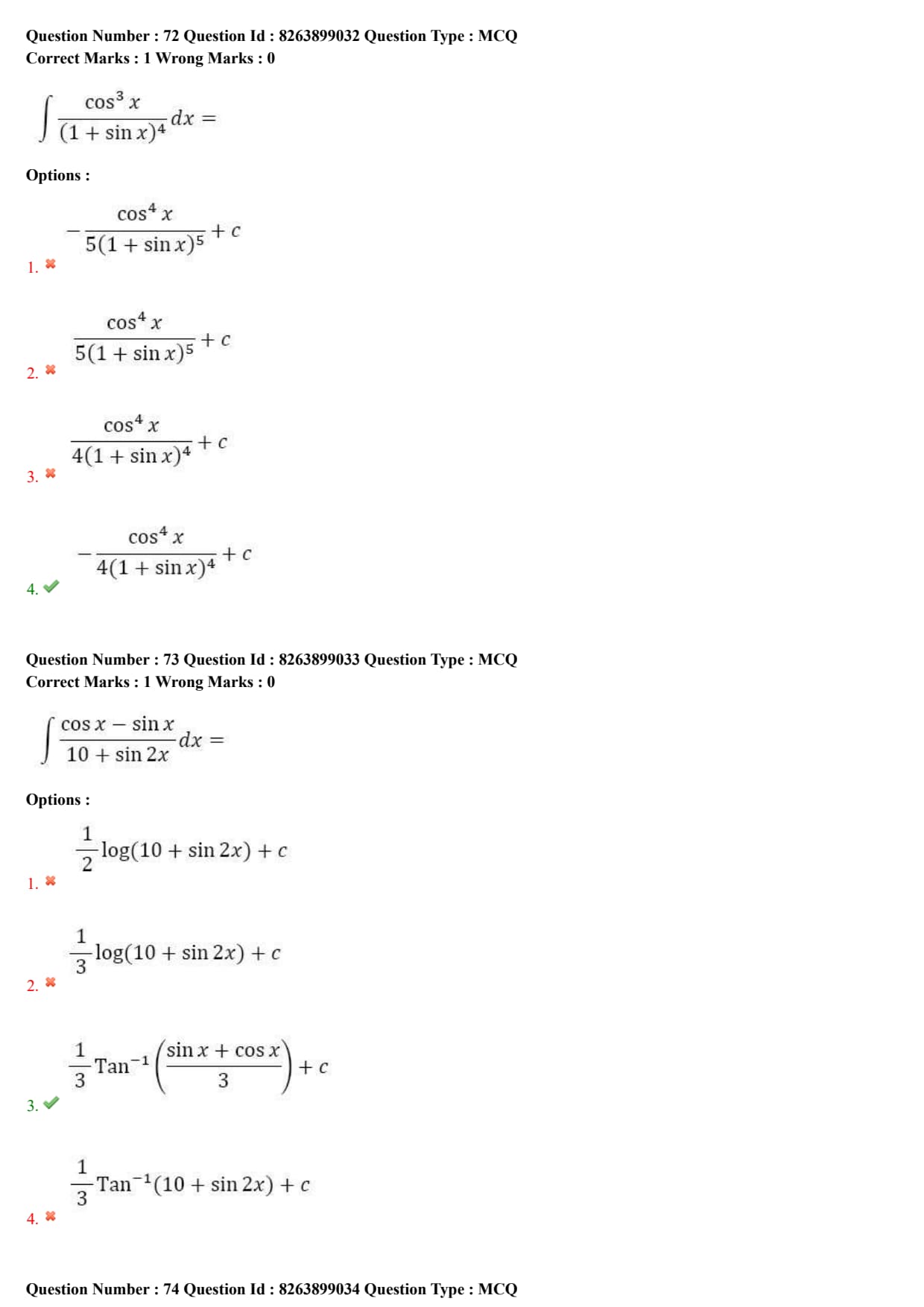
The integral \( \int \frac{\cos^3 x}{(1+\sin x)^4} dx \) is equal to:
The integral \( \int \frac{\cos x - \sin x}{10 + \sin 2x} dx \) is equal to:
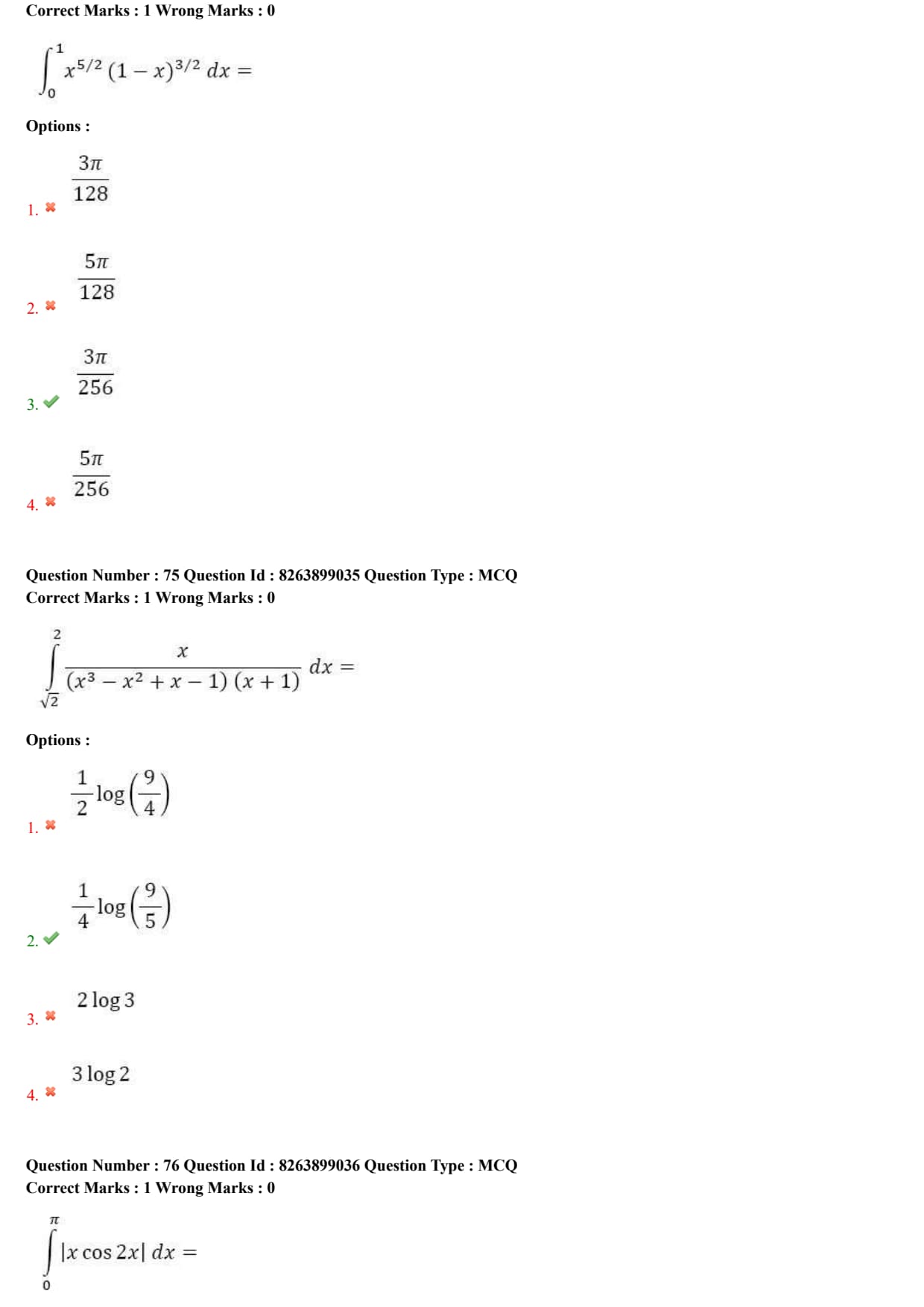
The integral \( \int_{0}^{1} x^{5/2} (1-x)^{3/2} dx \) is equal to:
The integral \( \int_{\sqrt{2}}^{2} \frac{x}{(x^3 - x^2 + x - 1)(x+1)} dx \) is equal to:
The integral \( \int_{0}^{\pi} |x \cos 2x| dx \) is equal to:
A circle passes through the ends of the latus rectum of parabola \( y^2=12x \) and has its centre at the vertex. The area inside the circle and outside the parabola in the \( 1^{st} \) quadrant is:
Consider the differential equations \(\frac{dy}{dx}(x+y+1)=1\) and \(\frac{dx}{dy}=3y+2x^2\).
Which of the following is correct regarding these two differential equations?
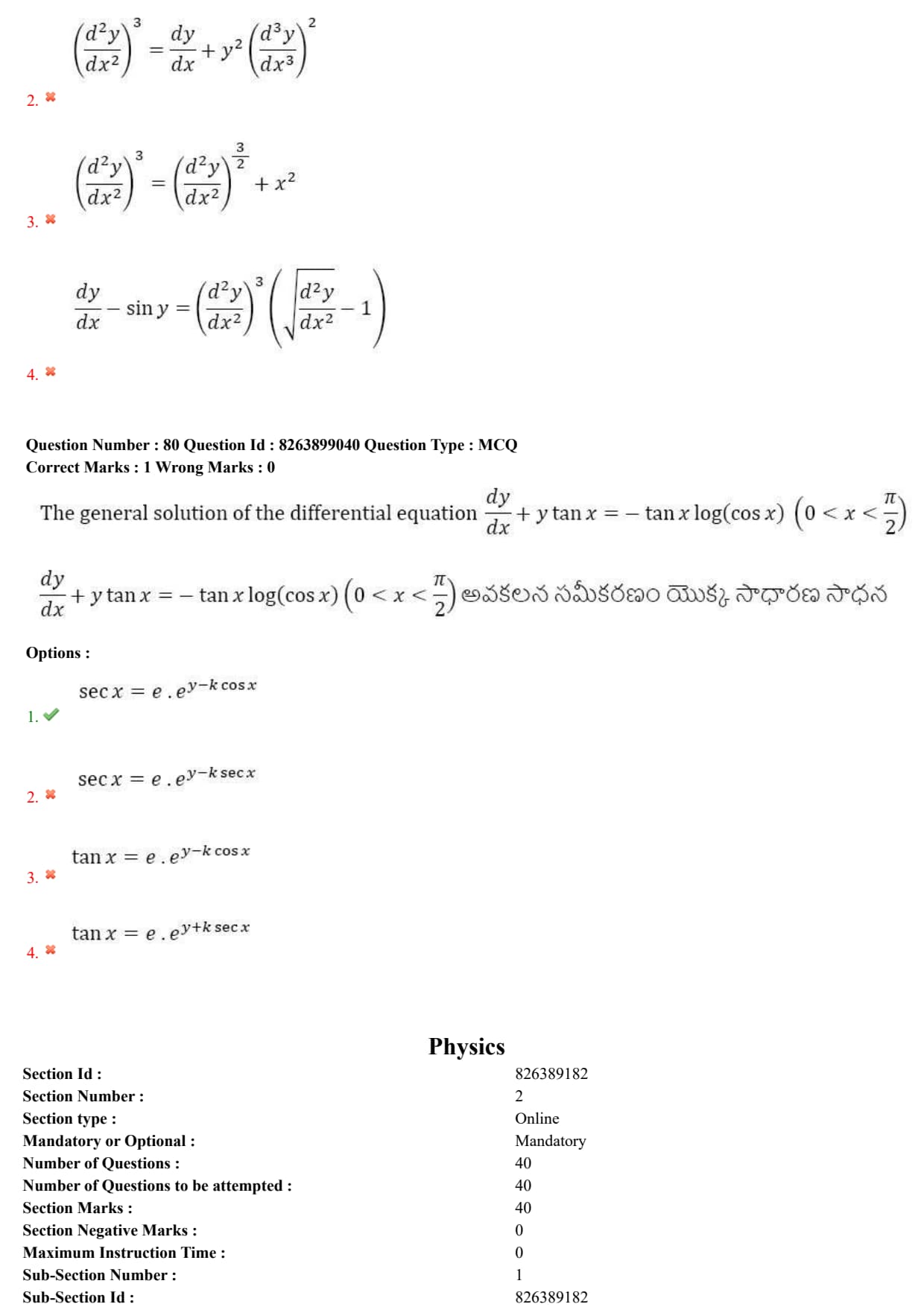
Among the following differential equations, the equation having order 2 and degree 3 is:
The general solution of the differential equation \( \frac{dy}{dx} + y \tan x = - \tan x \log(\cos x) \) (\(0 < x < \pi/2\)) is:
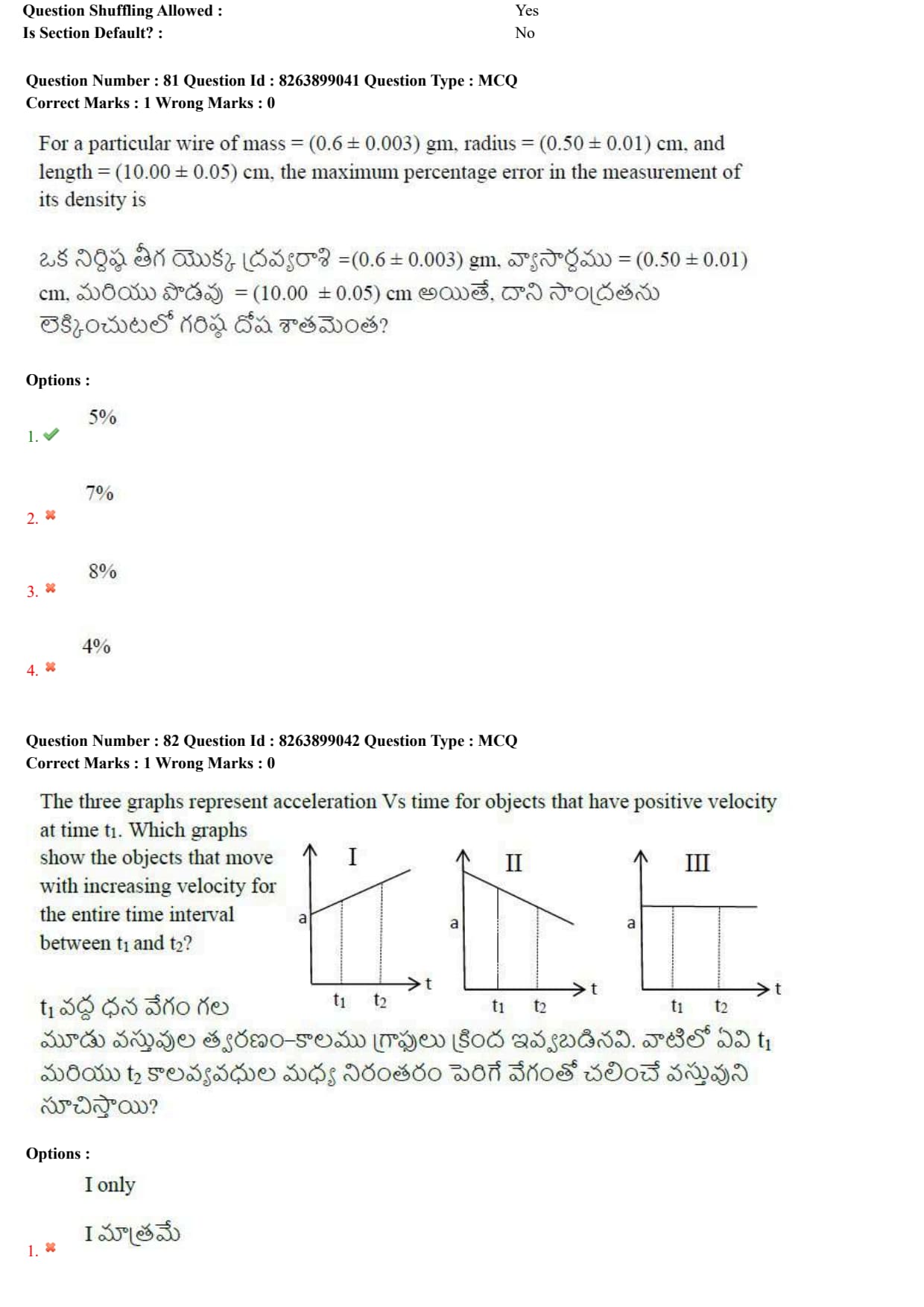
For a particular wire of \( mass = (0.6 \pm 0.003) \) gm, \( radius = (0.50 \pm 0.01) \) cm, and \( length = (10.00 \pm 0.05) \) cm, the maximum percentage error in the measurement of its density is:
The three graphs represent acceleration Vs time for objects that have positive velocity at time \( t_1 \). Which graphs show the objects that move with increasing velocity for the entire time interval between \( t_1 \) and \( t_2 \)?

Two objects A and B are projected with same velocity at angles \( \theta \) and \( 90-\theta \) respectively with the horizontal. Then the ratio of maximum heights they reached \( \frac{H_A}{H_B} \) is:
A particle has initial velocity \( 2\hat{i} + 3\hat{j} \) \( ms^{-1} \) and acceleration \( 0.8\hat{i} + 0.6\hat{j} \) \( ms^{-2} \). Its velocity after 5 sec is (in \( ms^{-1} \)):
An object is sliding from the top of the smooth inclined plane of height \( h \) from rest and it just completes a vertical circle of diameter 20 cm. Then the minimum height \( h \) of smooth inclined plane is:

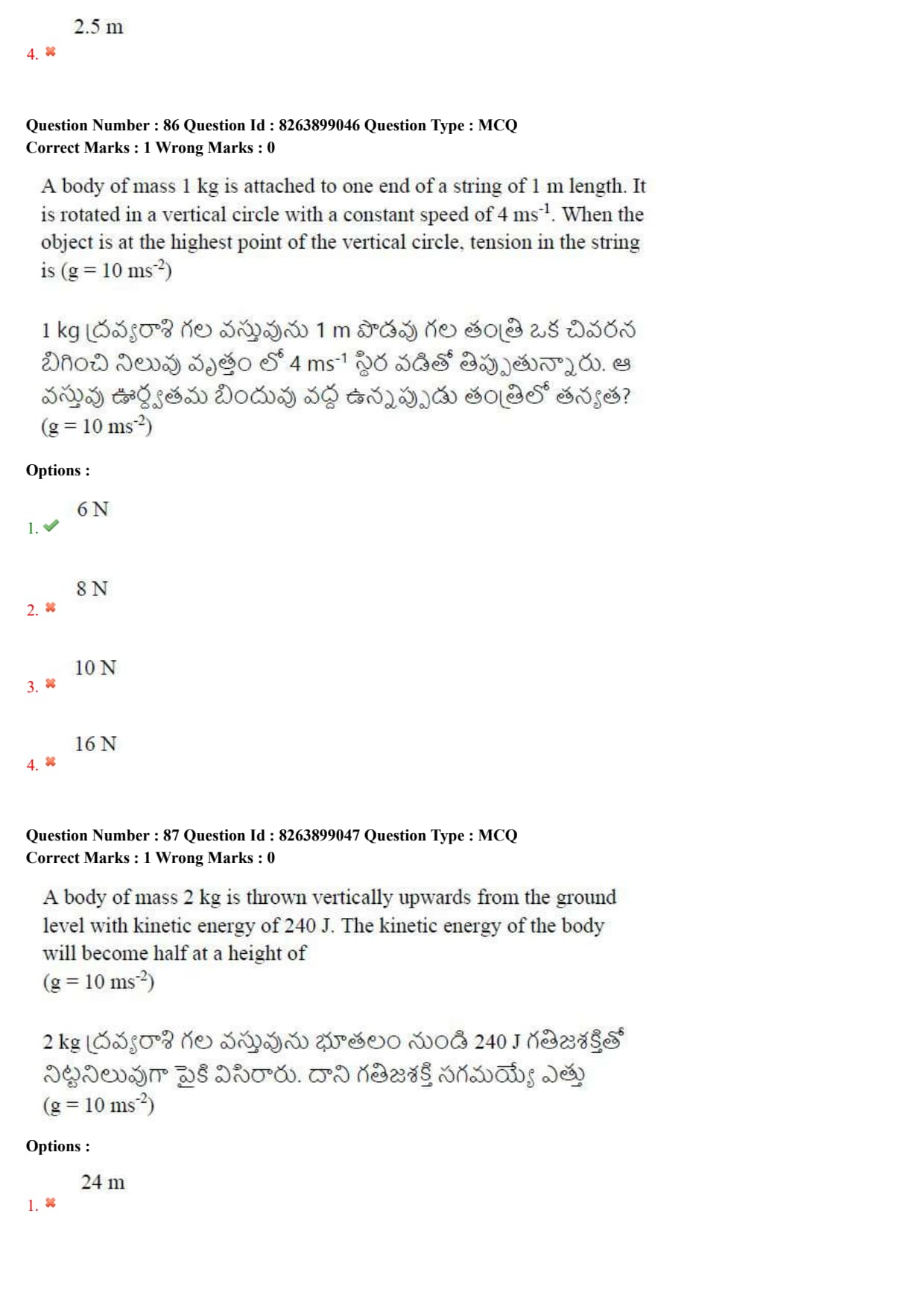
A body of mass 1 kg is attached to one end of a string of 1 m length. It is rotated in a vertical circle with a constant speed of \( 4 ms^{-1} \). When the object is at the highest point of the vertical circle, tension in the string is (\( g=10 ms^{-2} \)):
A body of mass 2 kg is thrown vertically upwards from the ground level with kinetic energy of 240 J. The kinetic energy of the body will become half at a height of (\( g=10 ms^{-2} \)):
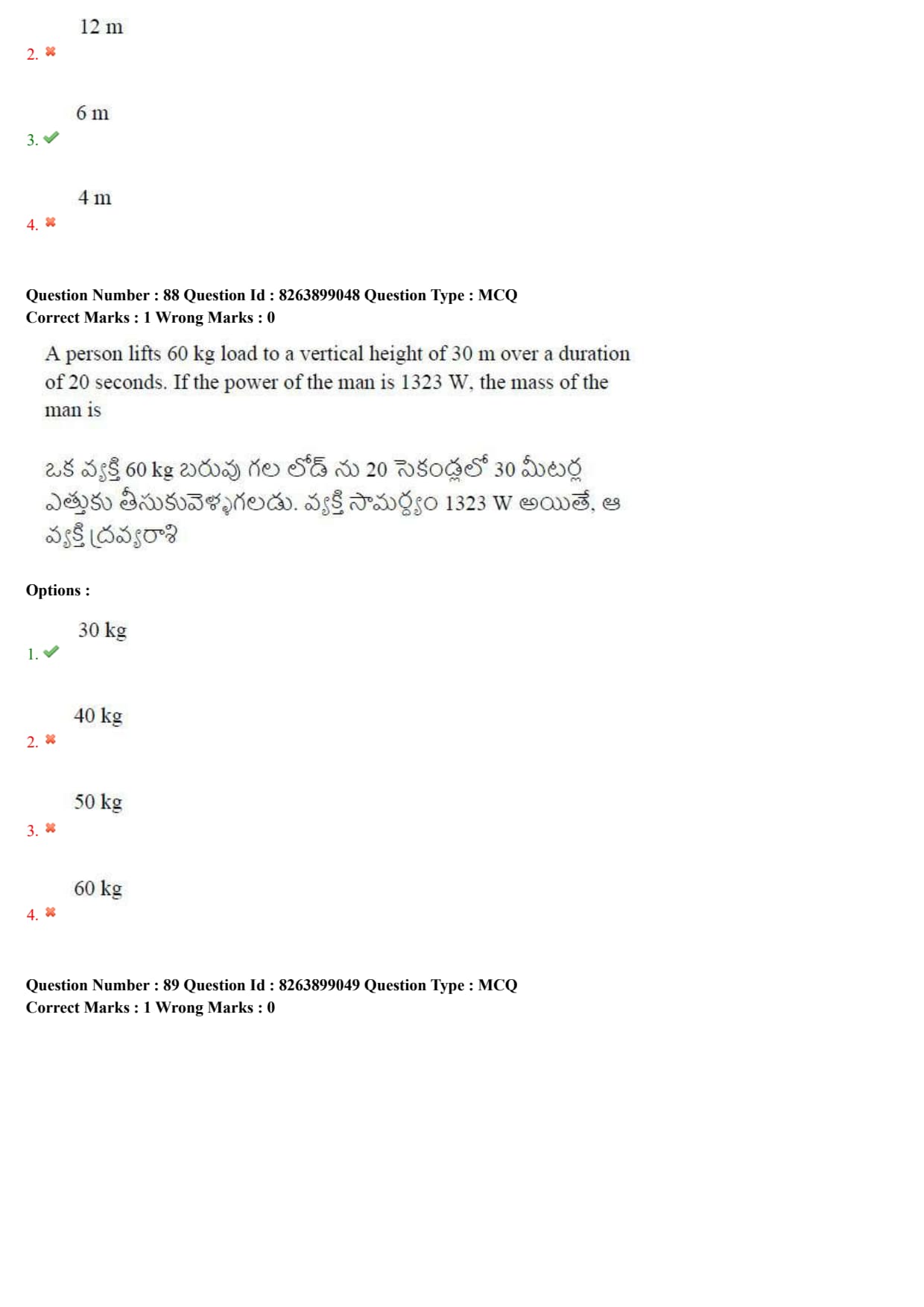
A person lifts 60 kg load to a vertical height of 30 m over a duration of 20 seconds. If the power of the man is 1323 W, the mass of the man is:
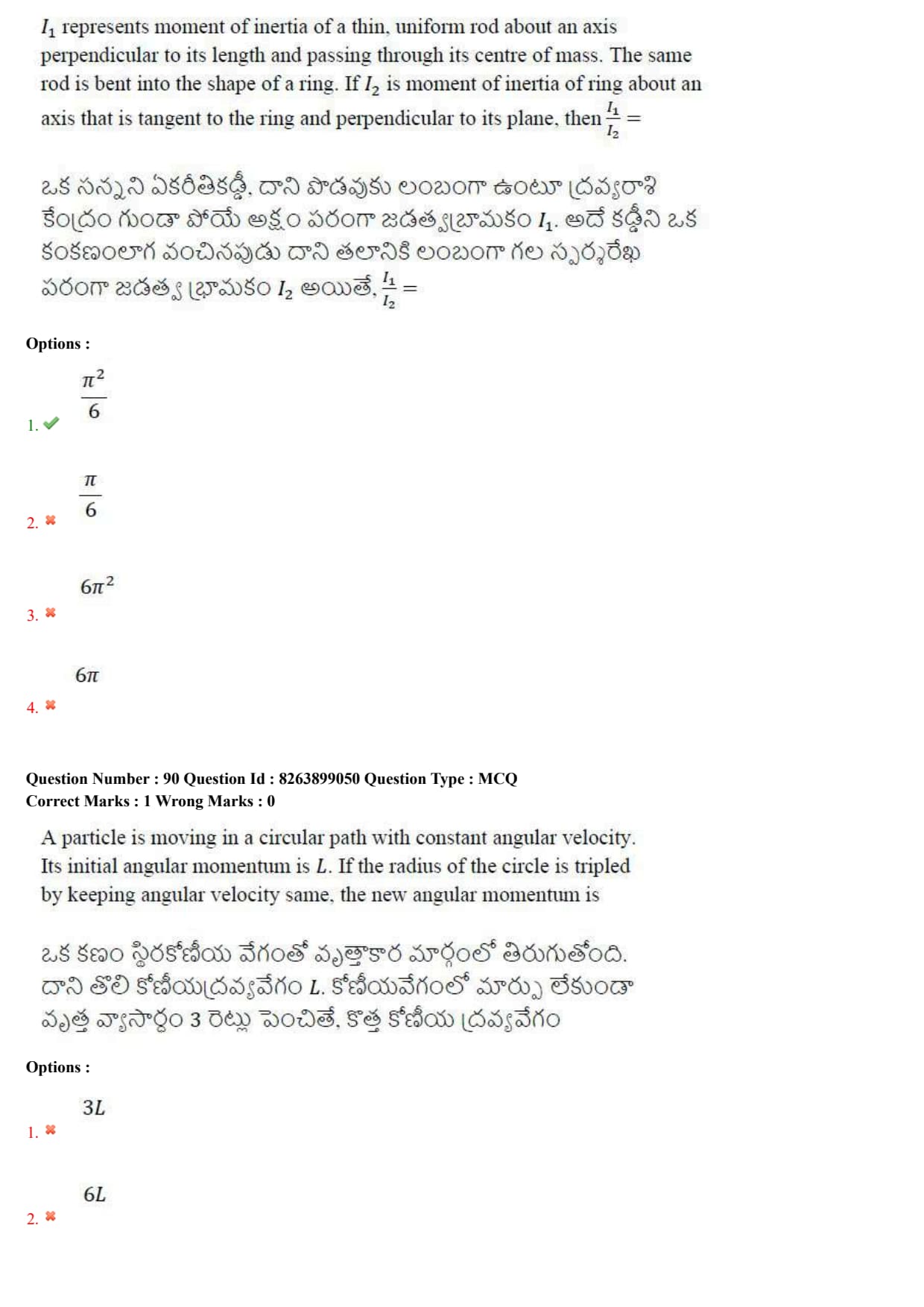
\( I_1 \) represents moment of inertia of a thin, uniform rod about an axis perpendicular to its length and passing through its centre of mass. The same rod is bent into the shape of a ring. If \( I_2 \) is moment of inertia of ring about an axis that is tangent to the ring and perpendicular to its plane, then \(\frac{I_1}{I_2}=\):
A particle is moving in a circular path with constant angular velocity. Its initial angular momentum is L. If the radius of the circle is tripled by keeping angular velocity same, the new angular momentum is:
The maximum kinetic energy of a pendulum executing simple harmonic motion is E. If the length of the pendulum is doubled and the amplitude of motion is halved, then the maximum kinetic energy of the pendulum is:
A particle executes two simple harmonic motions along mutually perpendicular axes, given by \( x = A \sin(\omega_1 t) \) and \( y = B \cos(\omega_2 t) \) where \( A \neq B \) and \( \omega_1 = \omega_2 \). Which of the following best describes the resultant motion of the particle?
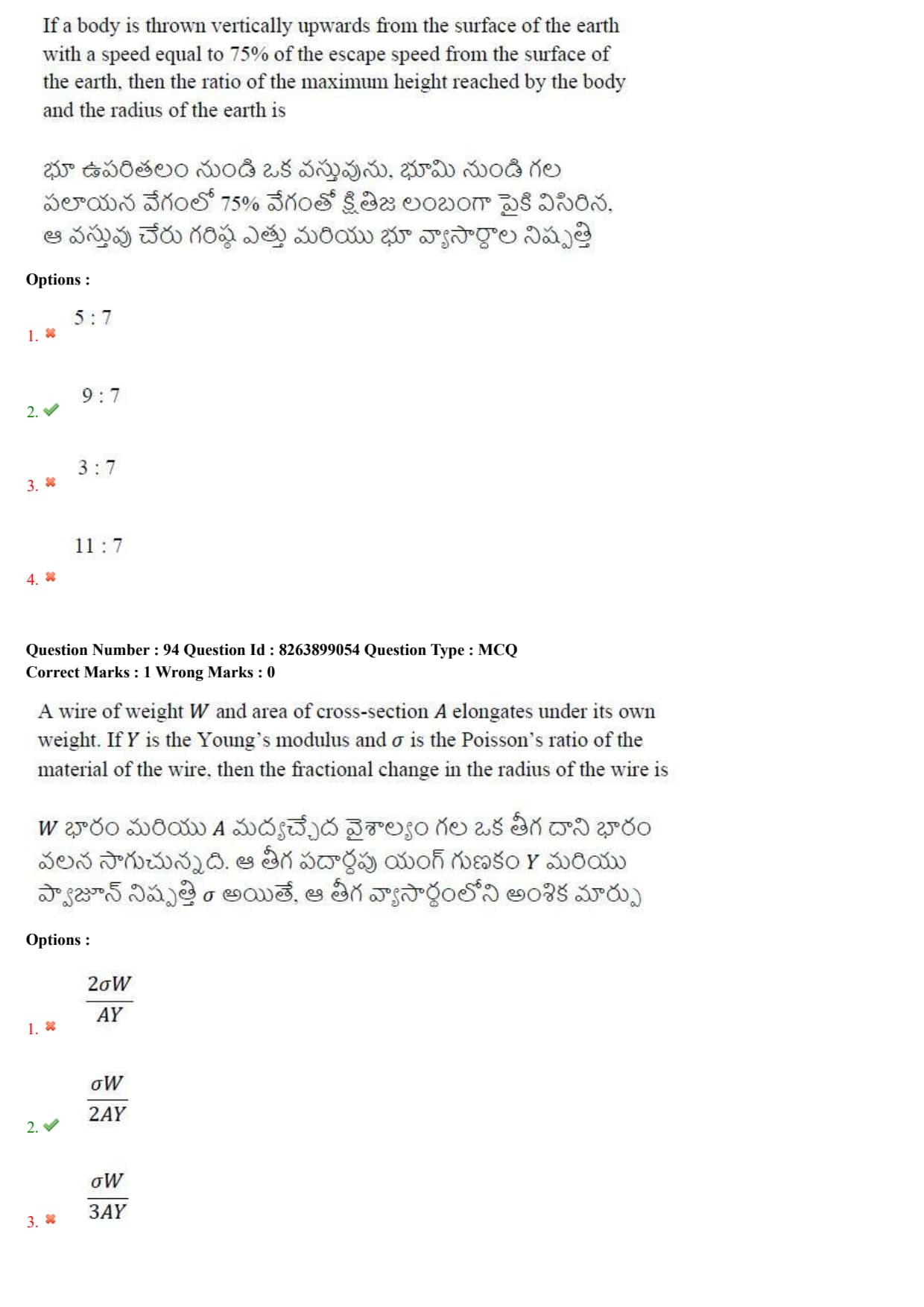
If a body is thrown vertically upwards from the surface of the earth with a speed equal to 75% of the escape speed from the surface of the earth, then the ratio of the maximum height reached by the body and the radius of the earth is:
A wire of weight W and area of cross-section A elongates under its own weight. If Y is the Young's modulus and \(\sigma\) is the Poisson's ratio of the material of the wire, then the fractional change in the radius of the wire is:
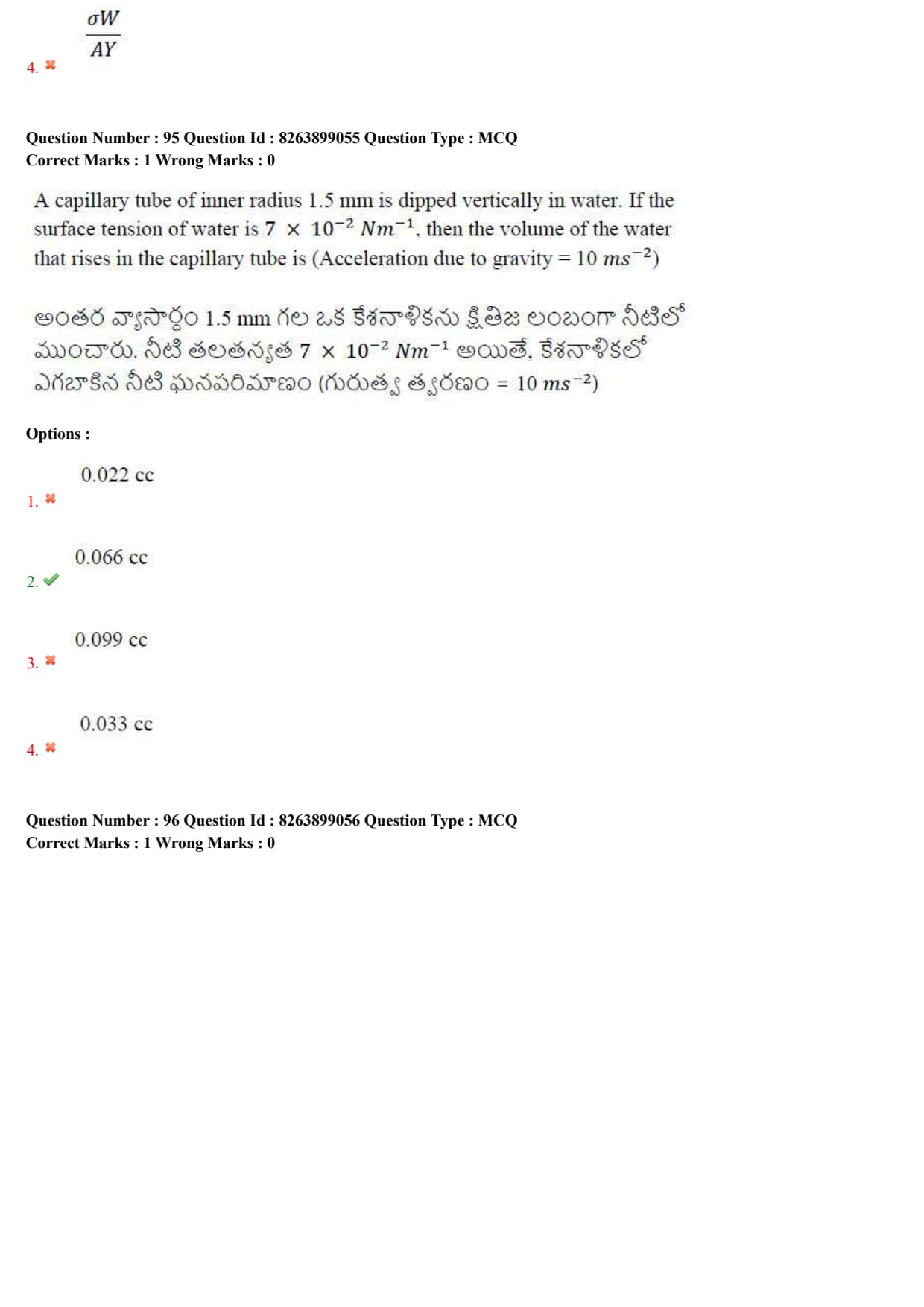
A capillary tube of inner radius 1.5 mm is dipped vertically in water. If the surface tension of water is \( 7 \times 10^{-2} Nm^{-1} \), then the volume of the water that rises in the capillary tube is (\( g=10 ms^{-2} \)):
Two semicircular rods AB and CD each of radius of curvature 14 cm and a straight rod BC of length 22 cm are connected in series. The three rods have equal area of cross-section and the thermal conductivities of the materials of the rods AB, BC and CD are in the ratio 1:2:3. In steady state, if the temperature difference between the ends of the middle rod BC is 30°C, then the temperature difference between the ends of the rods AB and CD are respectively:
If the temperature of a steel solid sphere of mass 4 kg and radius 5 cm is increased by 10°C then the increase in the moment of inertia of the sphere about its diameter is: (Coefficient of linear expansion of steel = \( 1.2 \times 10^{-5} K^{-1} \))
The pressure and density of a diatomic gas (\( \gamma = 7/5 \)) change adiabatically from \( (p, d) \) to \( (p', d') \). If \( \frac{d'}{d} = 32 \), then \( \frac{p'}{p} \) should be:
A geyser heats water flowing at the rate of 3.0 liters per minute from 27°C to 77°C. If the geyser operates on a gas burner and if its heat of combustion is \( 4.0 \times 10^4 J g^{-1} \), the rate of combustion of the fuel per minute is:
The approximate temperature at which the rms speed of Nitrogen gas molecule is \( 500 ms^{-1} \). Gas constant \( R=8.314 J mol^{-1} K^{-1} \), Mass number of Nitrogen = 28:
A car is approaching a cliff at a constant speed. It sounds a horn when it is at 0.9 km from the cliff. The reflected sound of the horn is heard by the car driver after 5 sec. The speed of the car is: (Velocity of sound in air is \( 330 ms^{-1} \))
Convex lens of focal length 20 cm and a concave lens of focal length of 30 cm are separated by a distance of 10 cm. Equivalent power of this arrangement is:
A rectangular glass block of thickness 10 cm and refractive index 1.5 is placed over a small coin. A beaker is filled with water of refractive index 4/3 to a height of 10 cm and placed over the glass block. The apparent depth of coin when viewed at near normal incidence is:
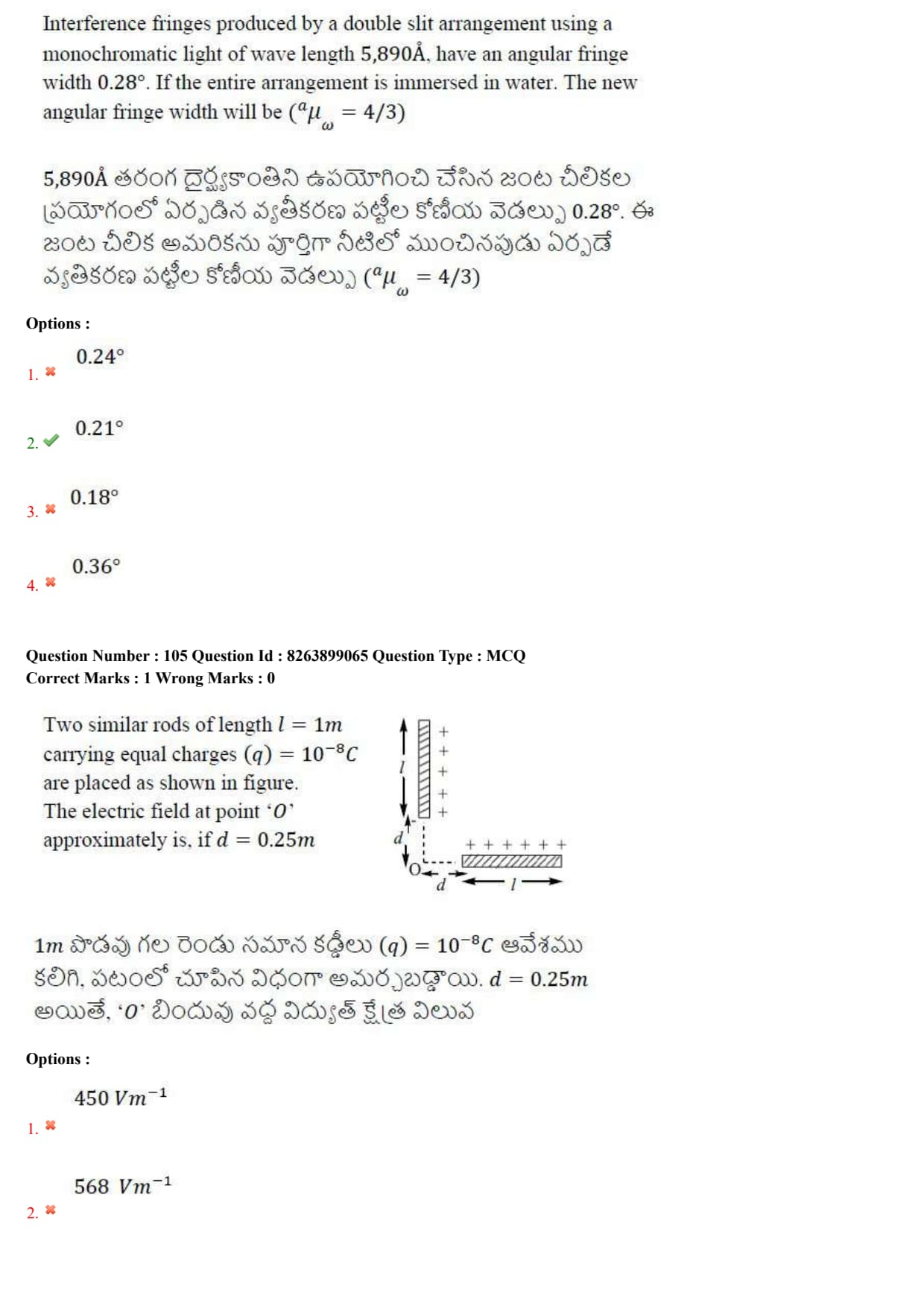
Interference fringes produced by a double slit arrangement using a monochromatic light of wave length 5,890Å have an angular fringe width \( 0.28^\circ \). If the entire arrangement is immersed in water, the new angular fringe width will be (\( ^a\mu_w = 4/3 \)):
Two similar rods of length \( l=1 m \) carrying equal charges \( (q) = 10^{-8} C \) are placed as shown in figure. The electric field at point 'O' approximately is, if \( d=0.25 m \):

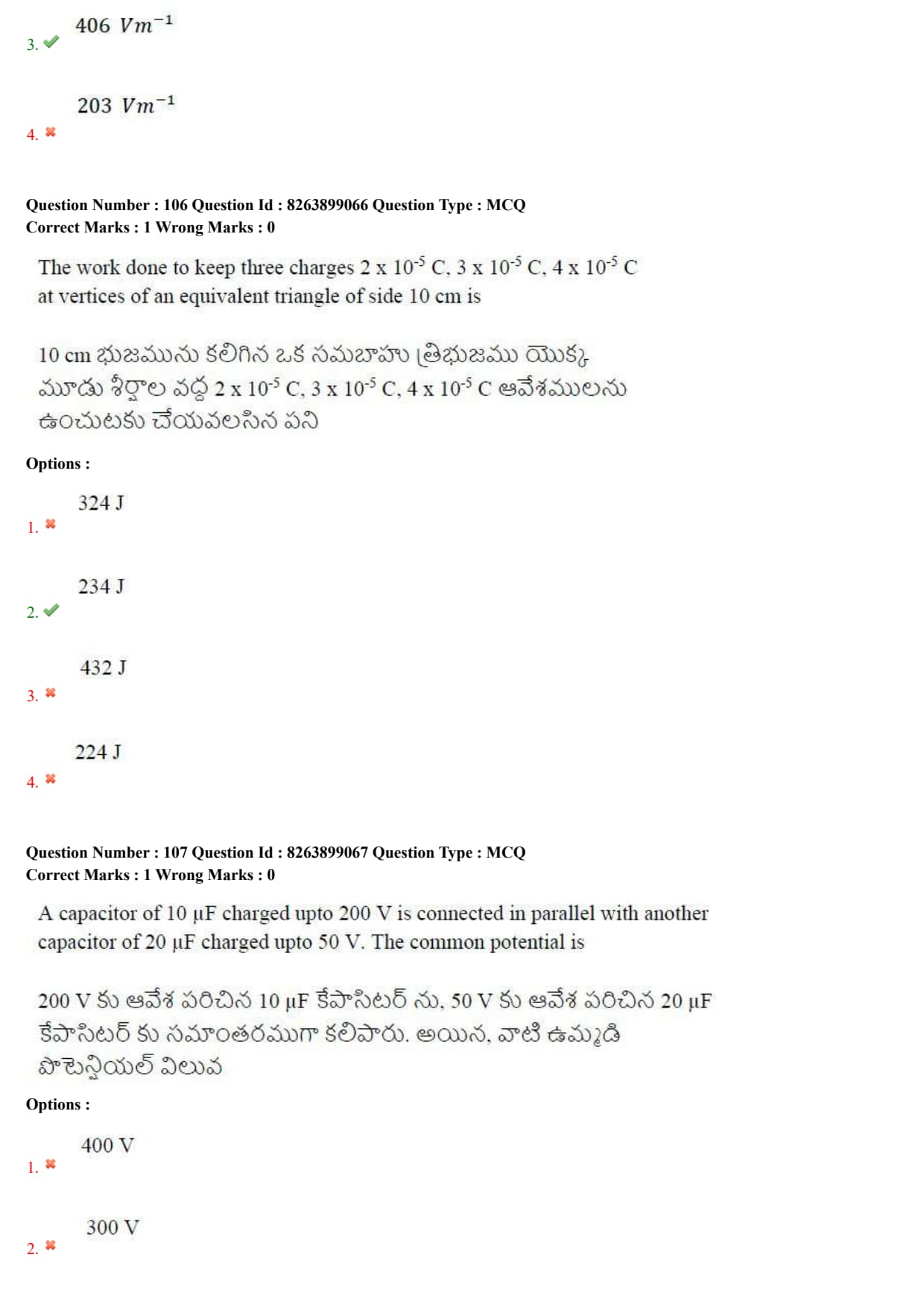
The work done to keep three charges \( 2 \times 10^{-5} C \), \( 3 \times 10^{-5} C \), \( 4 \times 10^{-5} C \) at vertices of an equilateral triangle of side 10 cm is:
A capacitor of \(10\,\mu F\) charged up to \(200\,V\) is connected in parallel with another capacitor of \(20\,\mu F\) charged up to \(50\,V\). The common potential is:
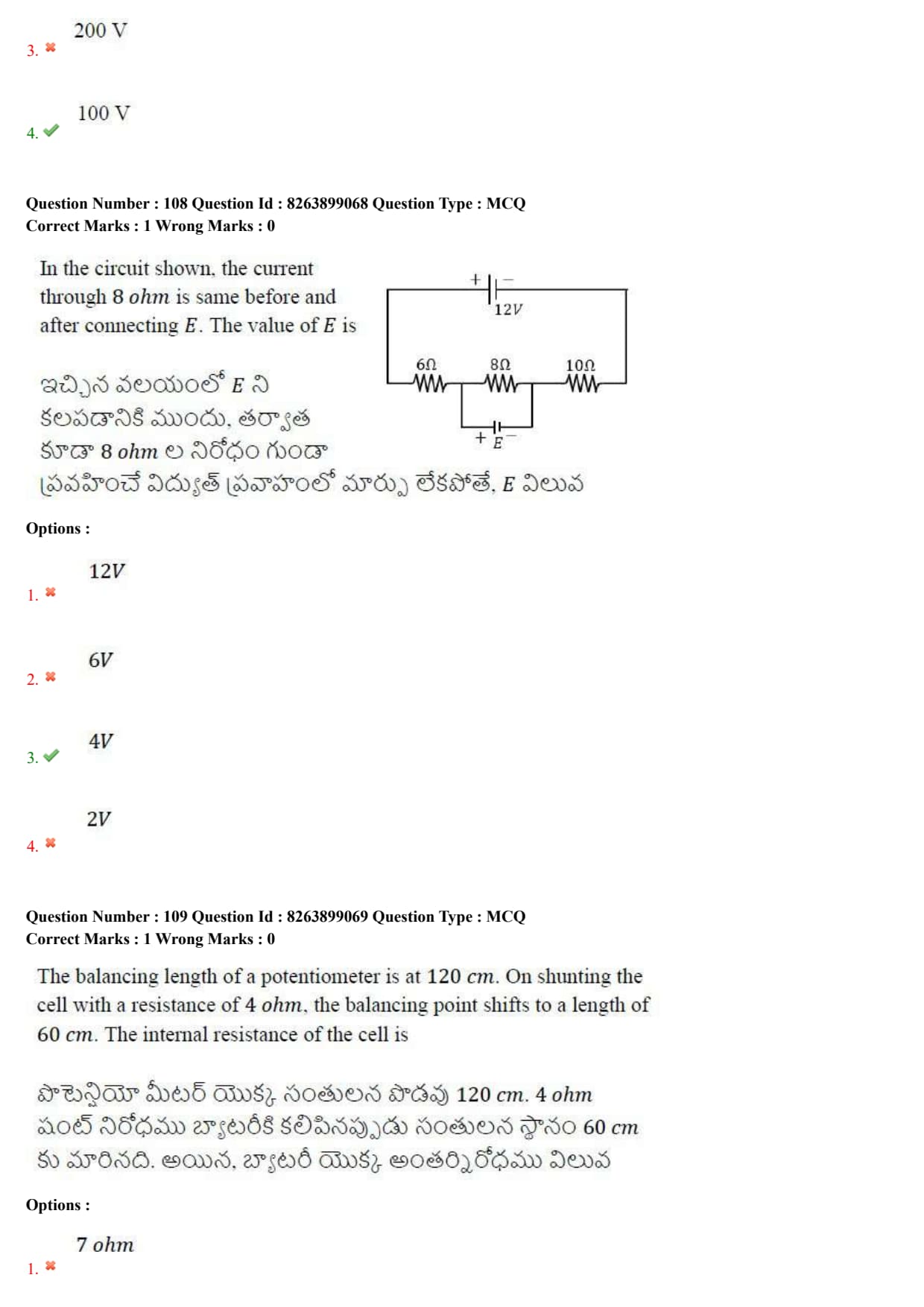
In the circuit shown, the current through 8 ohm is same before and after connecting E. The value of E is:

The balancing length of a potentiometer is at 120 cm. On shunting the cell with a resistance of 4 ohm, the balancing point shifts to a length of 60 cm. The internal resistance of the cell is:
A particle having charge 'q' enters a uniform transverse magnetic field \( \vec{B} \). It is deflected through a distance 'x' while travelling a distance 'y' as shown in figure. The magnitude of the momentum of the particle is:

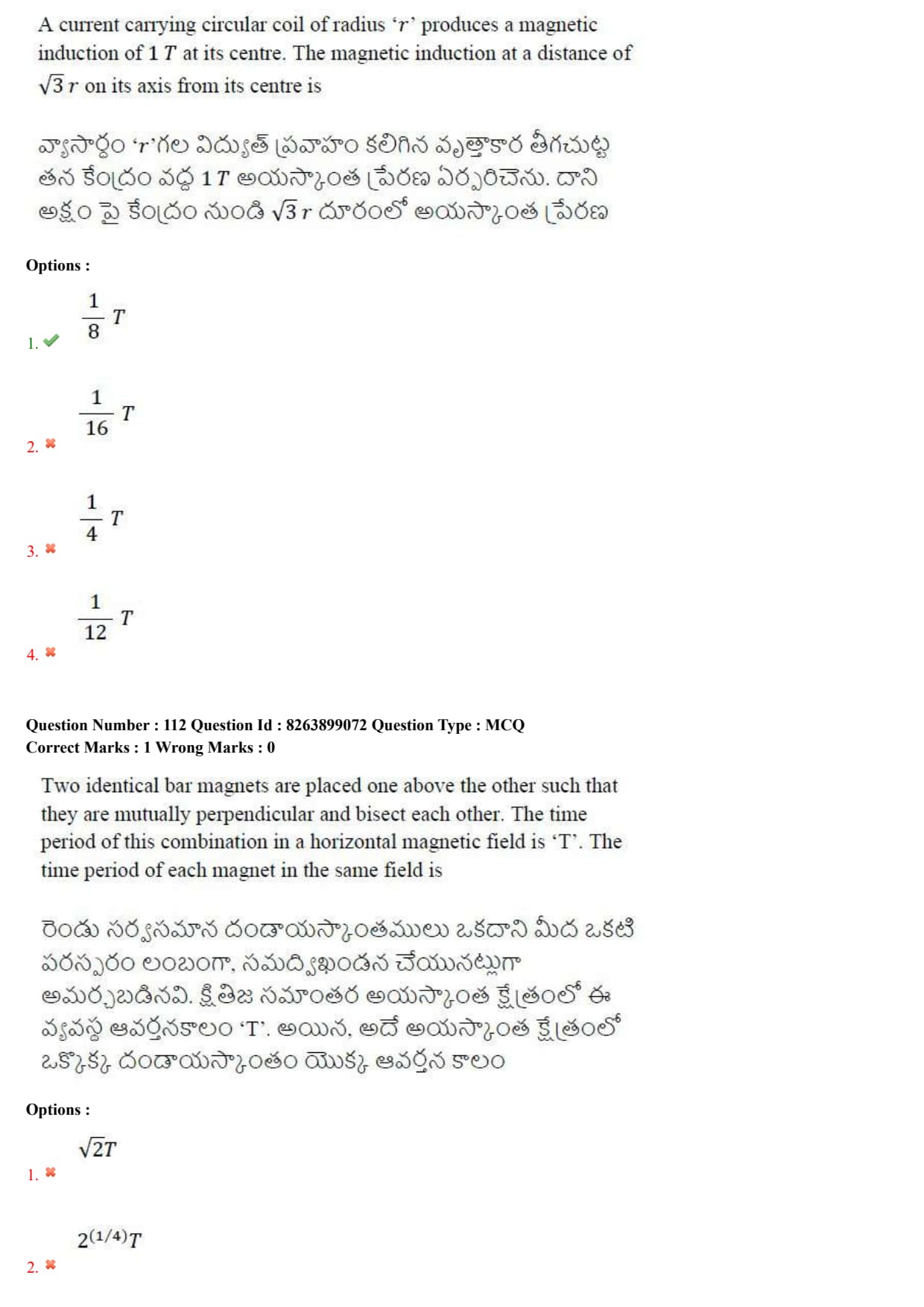
A current carrying circular coil of radius 'r' produces a magnetic induction of 1 T at its centre. The magnetic induction at a distance of \(\sqrt{3}r\) on its axis from its centre is:
Two identical bar magnets are placed one above the other such that they are mutually perpendicular and bisect each other. The time period of this combination in a horizontal magnetic field is 'T'. The time period of each magnet in the same field is:
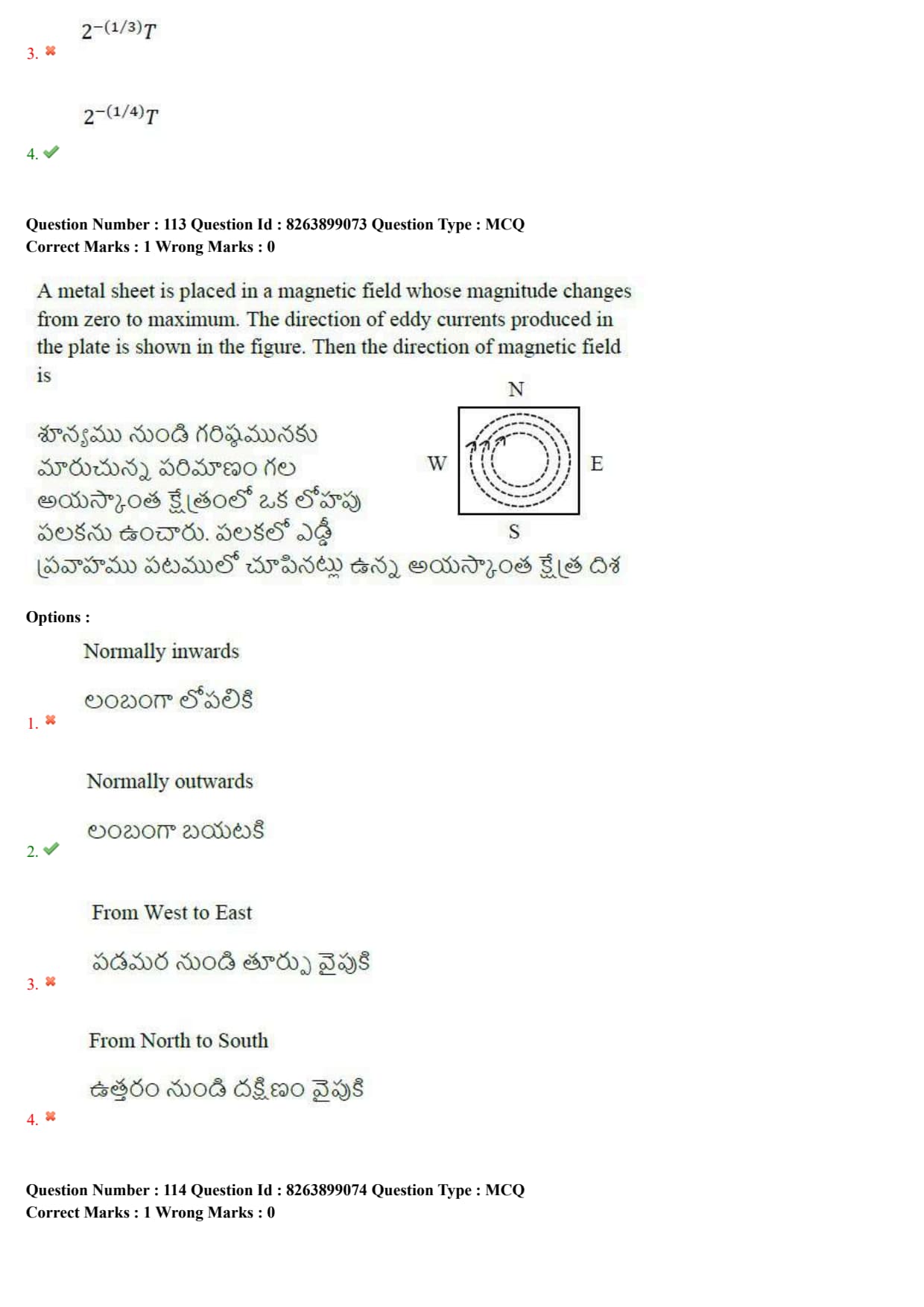
A metal sheet is placed in a magnetic field whose magnitude changes from zero to maximum. The direction of eddy currents produced in the plate is shown in the figure. Then the direction of magnetic field is:

In an ac circuit containing Resistance R and capacitance C, the current is I. Keeping the ac voltage constant, if the frequency is made \( \frac{1}{3} \), the current is \( \frac{I}{2} \). Then the ratio of initial reactance to the resistance is:
The electric field intensity produced by the radiations coming from 100W bulbs at 3m distance is E. The electric field intensity produced by the radiations coming from 50W bulbs at the same distance is:
Two identical photo cathodes receive light of frequencies \( f_1 \) and \( f_2 \). If the velocity of photo electrons (of mass m) coming out are respectively \( V_1 \) & \( V_2 \) then:
Suppose an electron is attracted towards the origin by a force \( K/r \), where K is a constant and r is the distance of the electron from the origin. By applying Bohr model to this system, the radius of the \( n^{th} \) orbit of the electron is found to be \( r_n \), and the kinetic energy of the electron to be \( T_n \), then which of the following is true?
The radioactivity of a certain radioactive element drops to 1/64 of its initial value in 30 sec. Its half-life is:
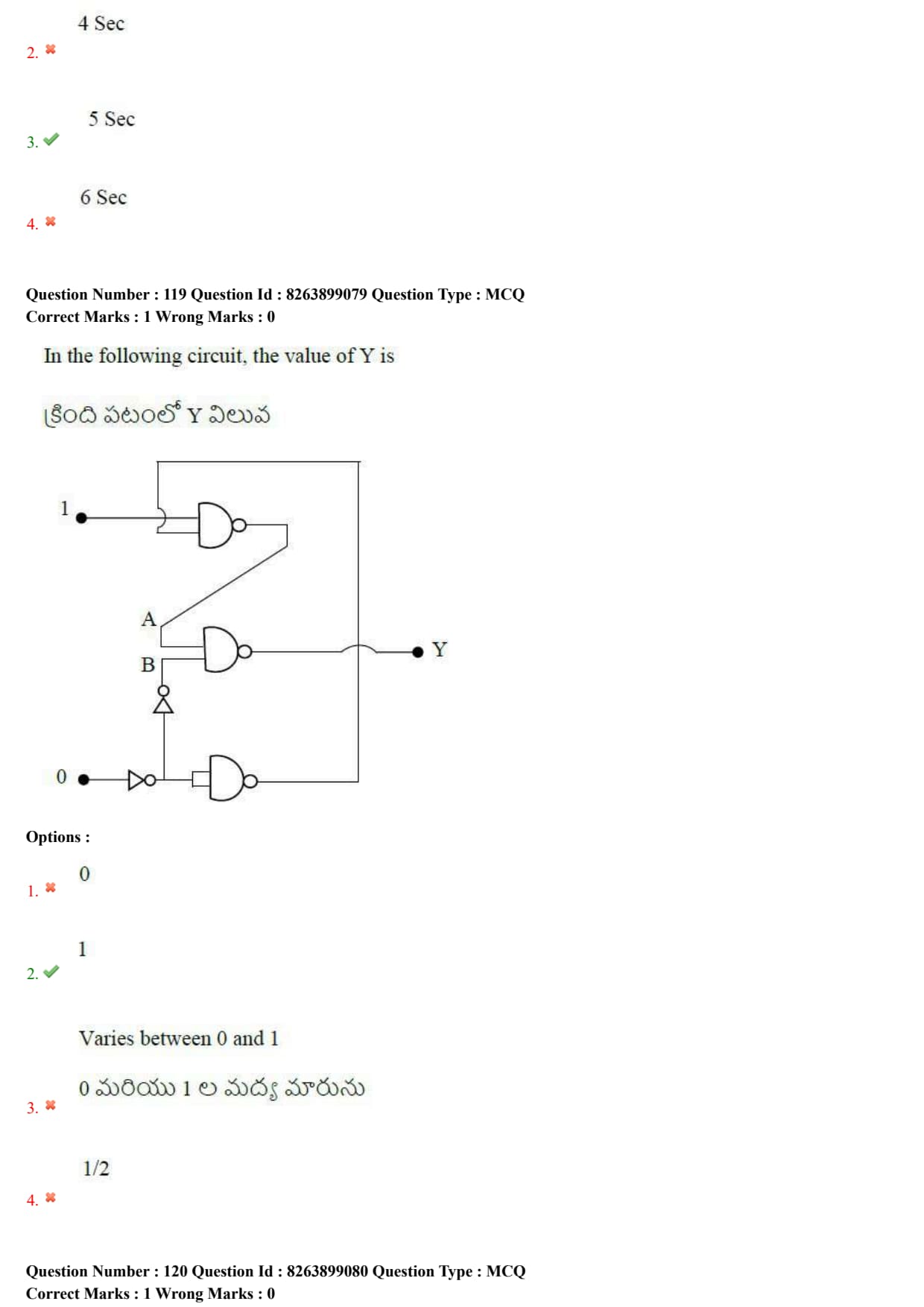
In the following circuit, the value of Y is:

An audio signal \( 10 \sin 2\pi(1500)t \) volt amplitude modulates a carrier \( 40 \sin 2\pi(10^5)t \) volts. The modulation factor and percentage modulation are:
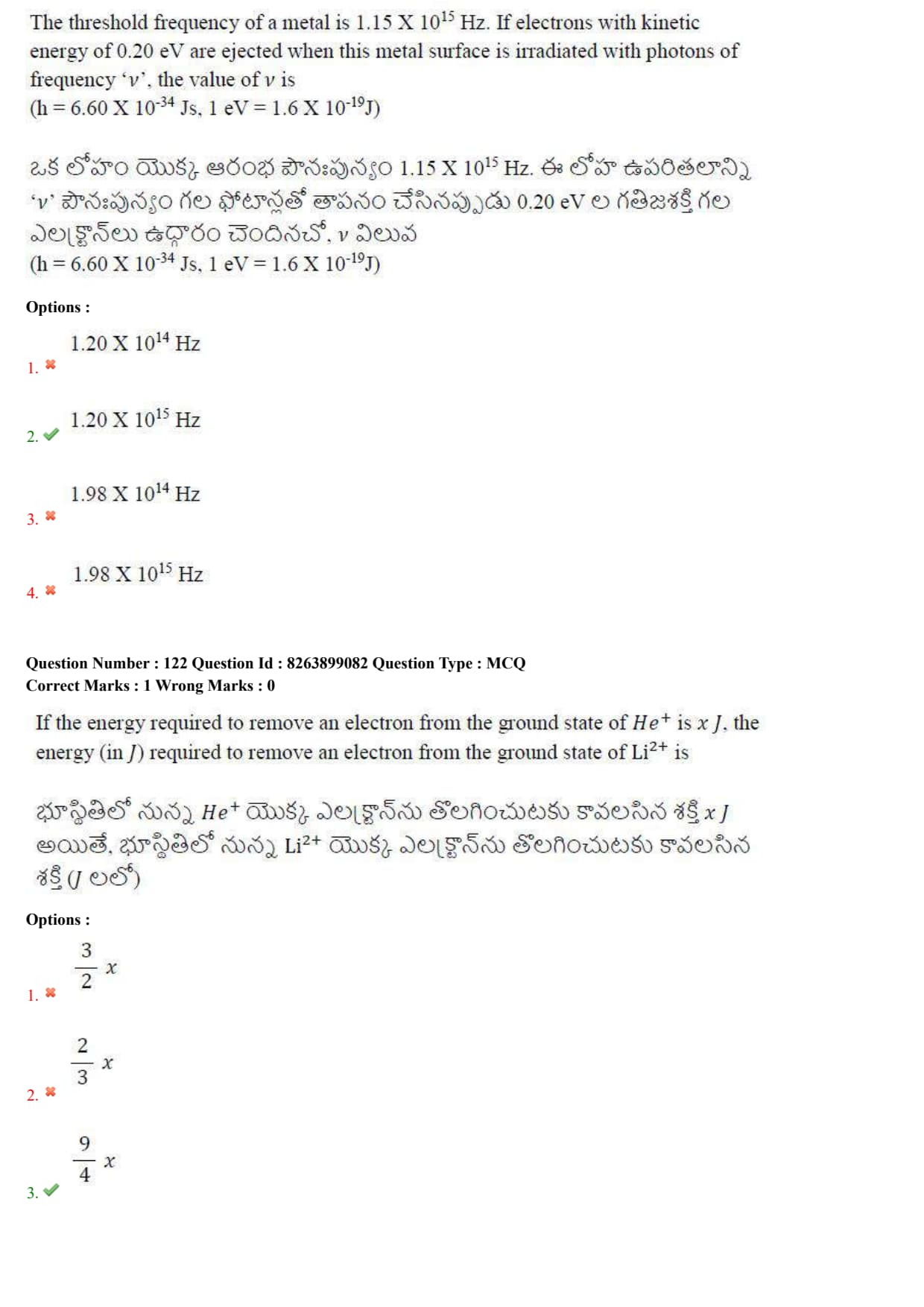
The threshold frequency of a metal is \(1.15 \times 10^{15}\) Hz. If electrons with kinetic energy of \(0.20\) eV are ejected when this metal surface is irradiated with photons of frequency '\(\nu\)', the value of \(\nu\) is (\(h=6.60 \times 10^{-34}\) Js, \(1\) eV \(=1.6 \times 10^{-19}\) J)
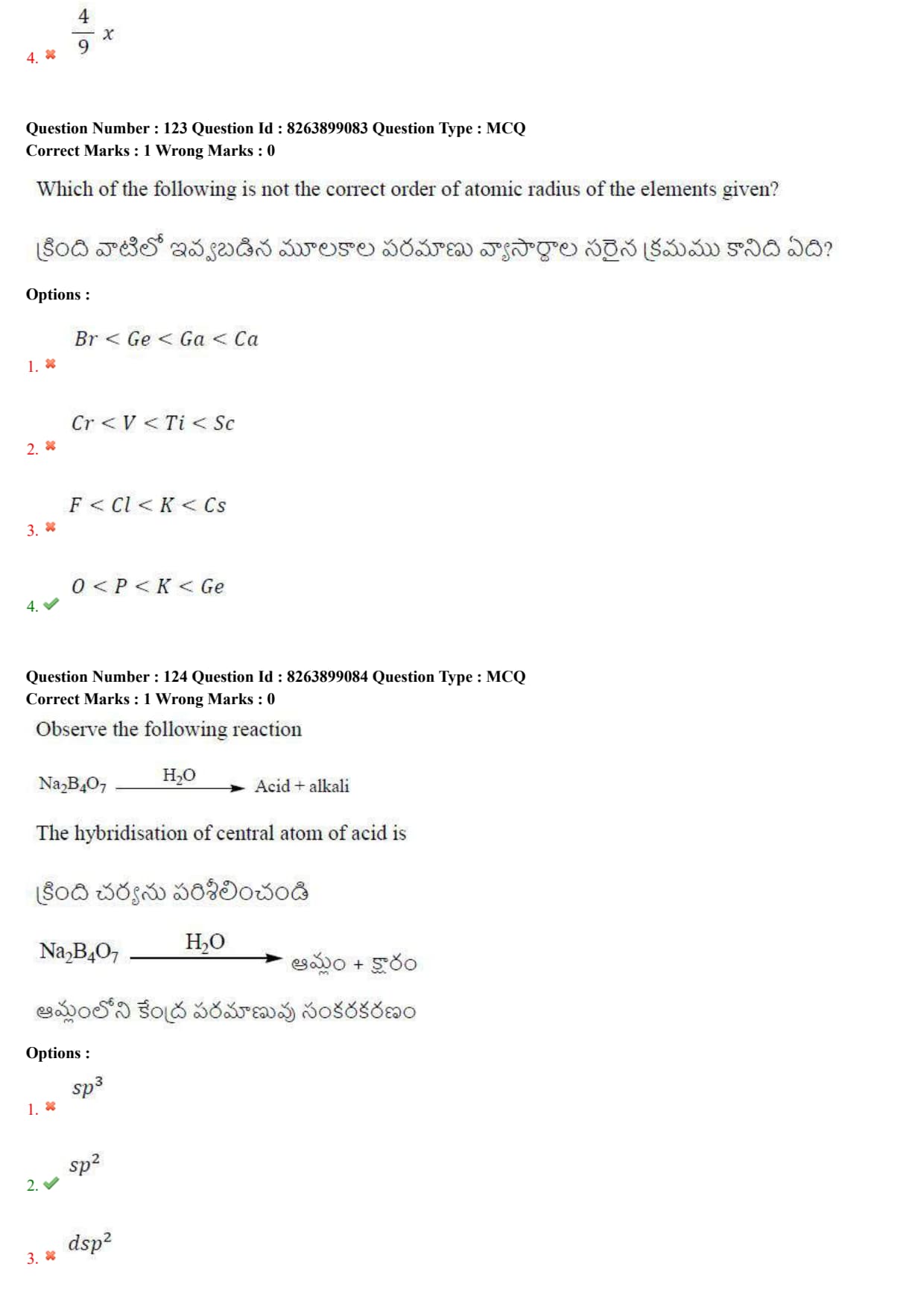
If the energy required to remove an electron from the ground state of \(He^+\) is \(x\) J, the energy (in J) required to remove an electron from the ground state of \(Li^{2+}\) is:
Which of the following is not the correct order of atomic radius of the elements given?
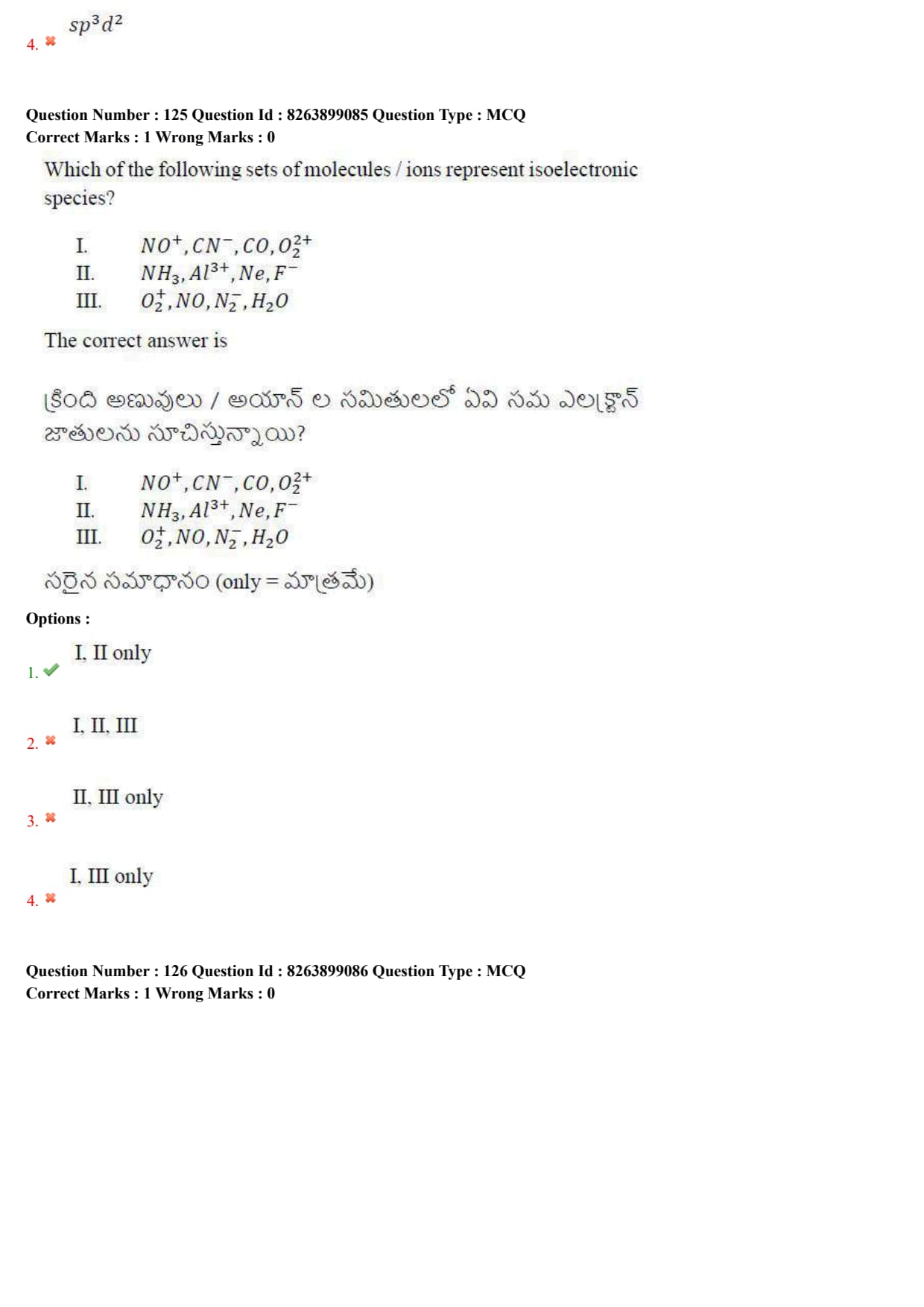
Observe the following reaction: \(Na_2B_4O_7 + H_2O \rightarrow Acid + Alkali\). The hybridisation of the central atom of the acid is:
Which of the following sets of molecules / ions represent isoelectronic species?

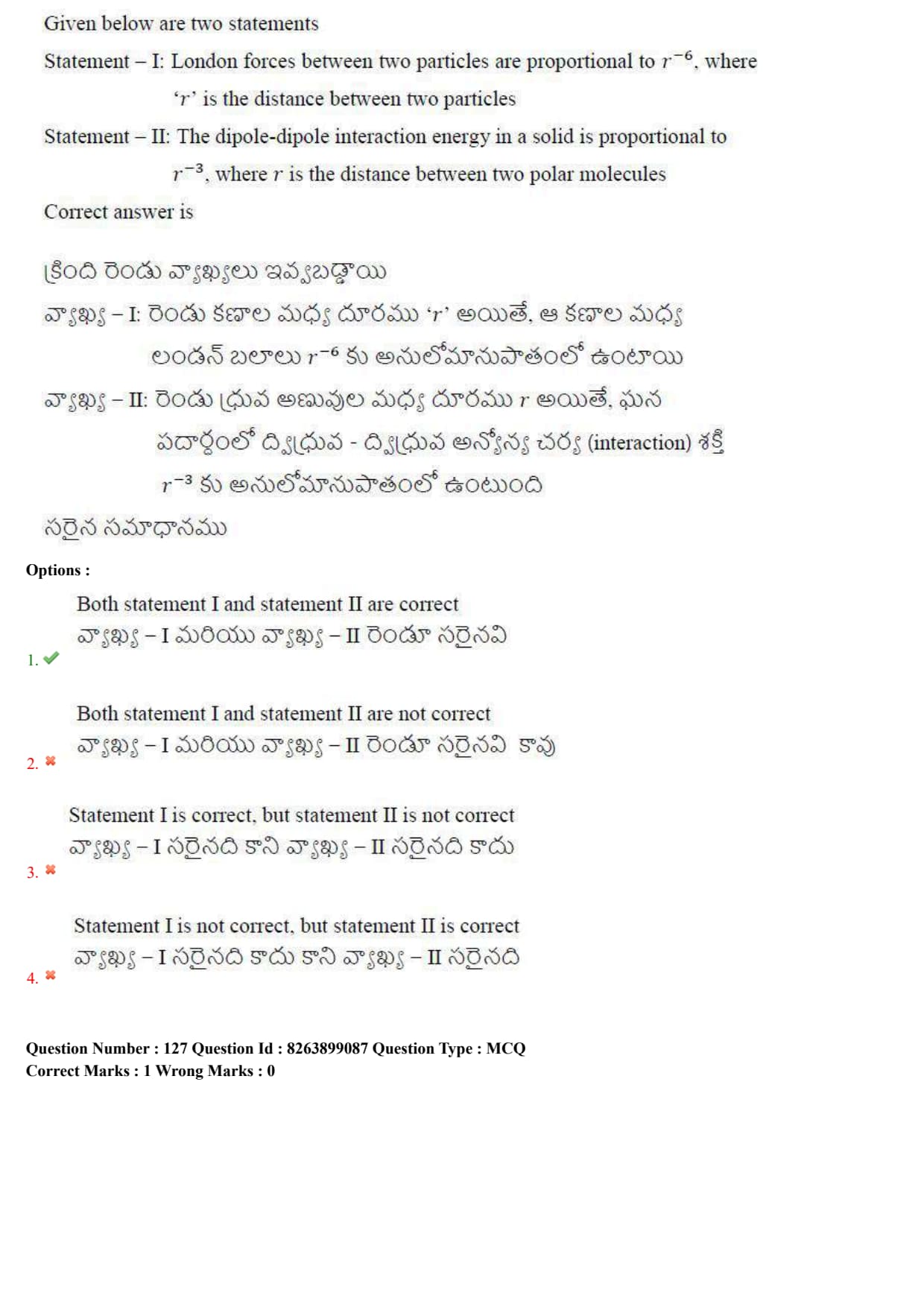
Given below are two statements:
Statement - I: London forces between two particles are proportional to \(r^{-6}\), where 'r' is the distance between two particles.
Statement - II: The dipole-dipole interaction energy in a solid is proportional to \(r^{-3}\) where r is the distance between two polar molecules.
The correct answer is:
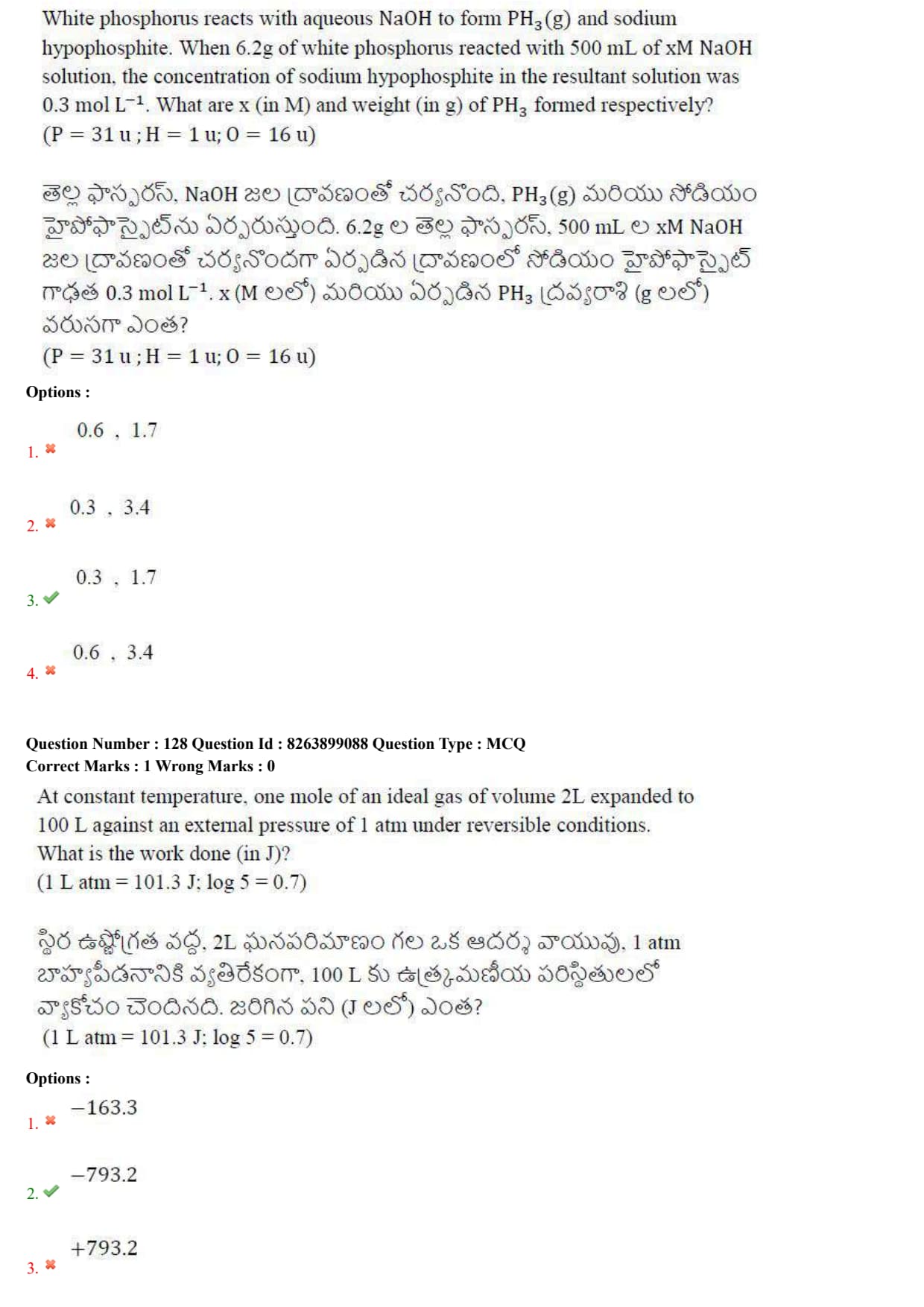
White phosphorus reacts with aqueous NaOH to form \(PH_3(g)\) and sodium hypophosphite. When 6.2g of white phosphorus reacted with 500 mL of xM NaOH solution, the concentration of sodium hypophosphite in the resultant solution was \(0.3 mol L^{-1}\). What are x (in M) and weight (in g) of \(PH_3\) formed respectively? (\(P=31\) u; \(H=1\) u; \(O=16\) u)
At constant temperature, one mole of an ideal gas of volume 2L expanded to 100 L against an external pressure of 1 atm under reversible conditions. What is the work done (in J)? (1 L atm = 101.3 J; \(\log 5 = 0.7\))
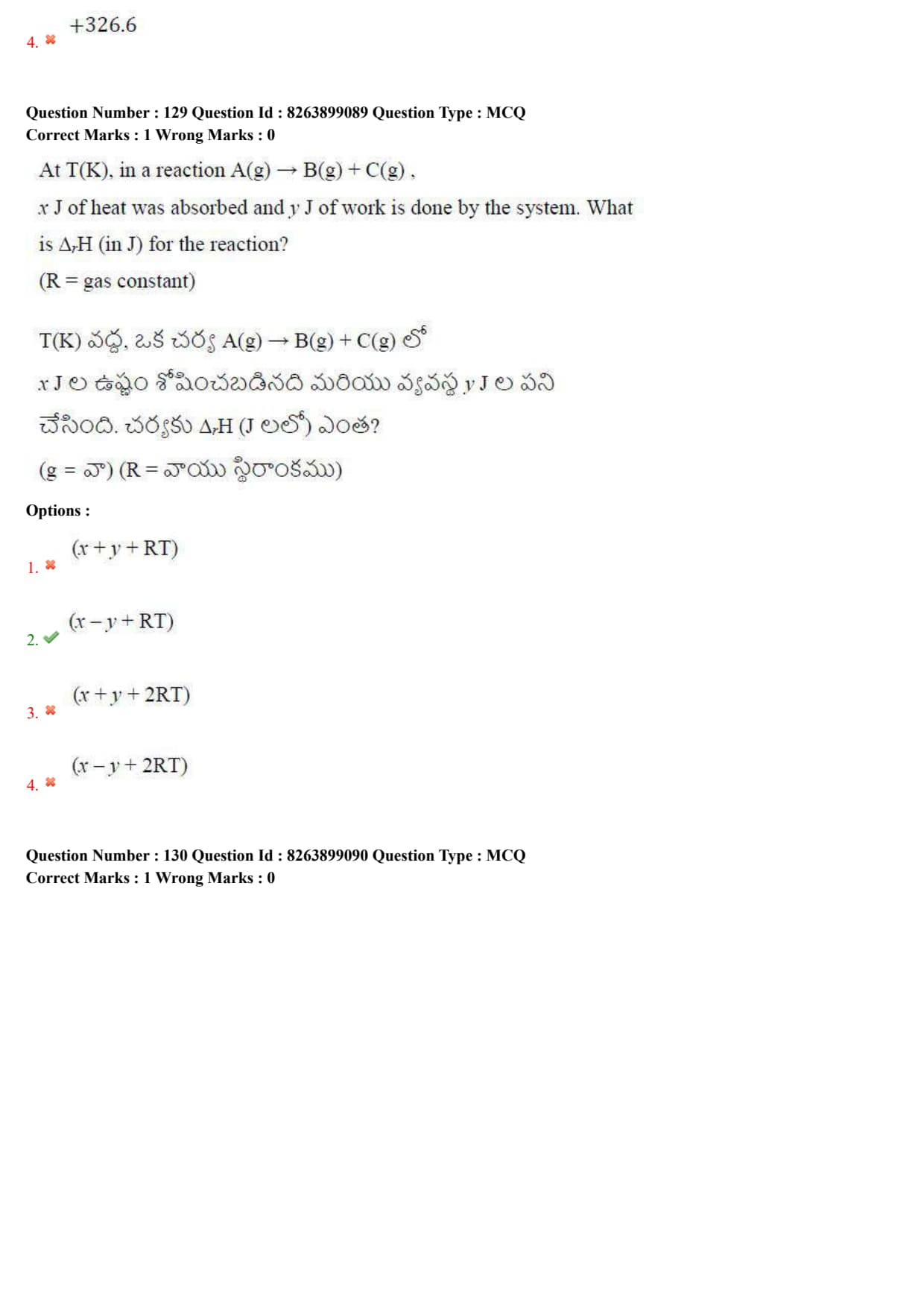
At T(K) in a reaction \(A(g) \rightarrow B(g) + C(g)\), x J of heat was absorbed and y J of work is done by the system. What is \(\Delta_r H\) (in J) for the reaction? (R= gas constant)
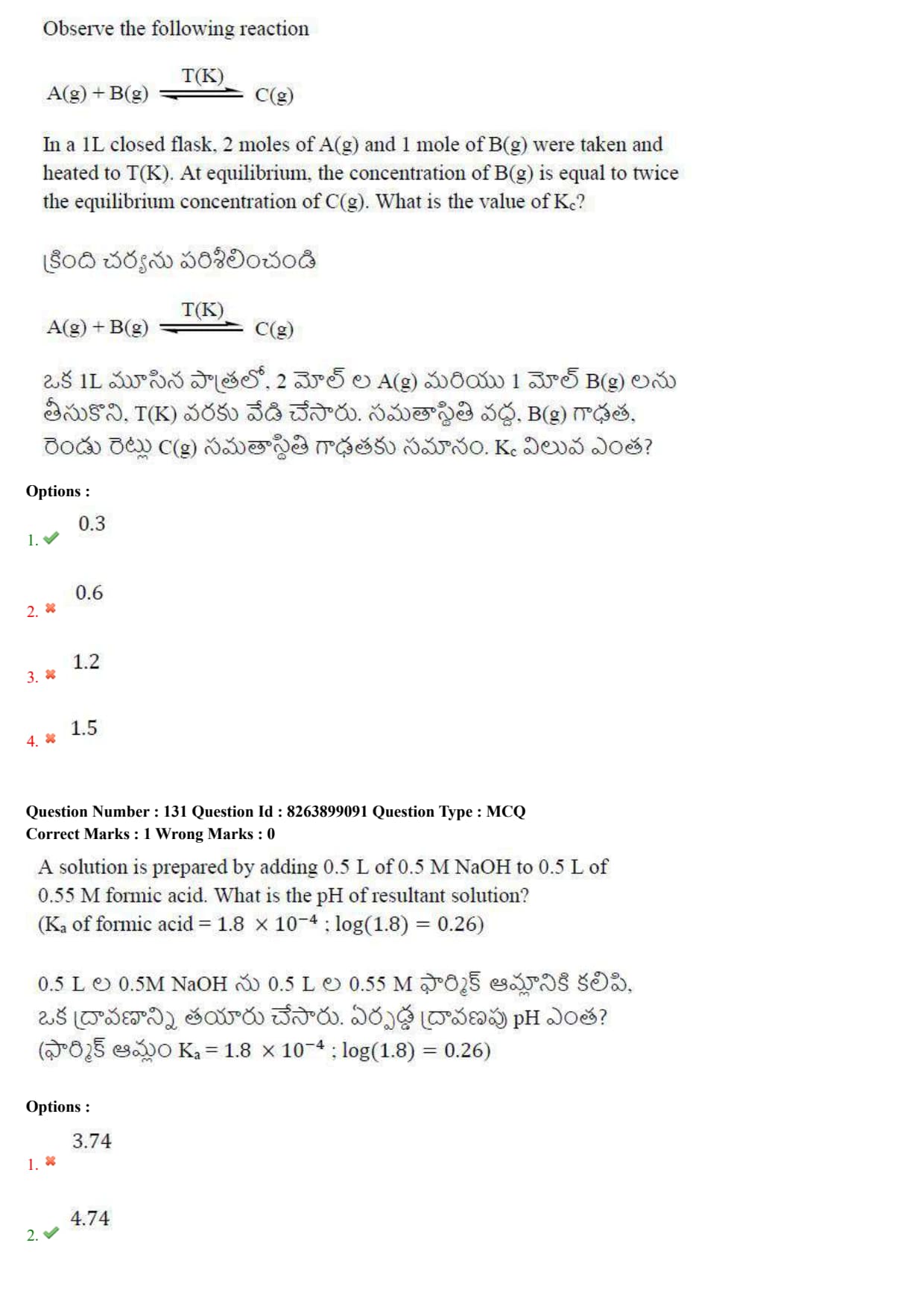
Observe the following reaction \(A(g) + B(g) \rightleftharpoons C(g)\). In a 1L closed flask, 2 moles of \(A(g)\) and 1 mole of \(B(g)\) were taken and heated to T(K). At equilibrium, the concentration of \(B(g)\) is equal to twice the equilibrium concentration of \(C(g)\). What is the value of \(K_c\)?
A solution is prepared by adding 0.5 L of 0.5 M NaOH to 0.5 L of 0.55 M formic acid. What is the pH of the resultant solution? (\(K_a\) of formic acid = \(1.8 \times 10^{-4}\); \(\log(1.8) = 0.26\))
In the reaction given below, water behaves as \(NH_3 + H_2O \rightleftharpoons NH_4^+ + OH^-\)
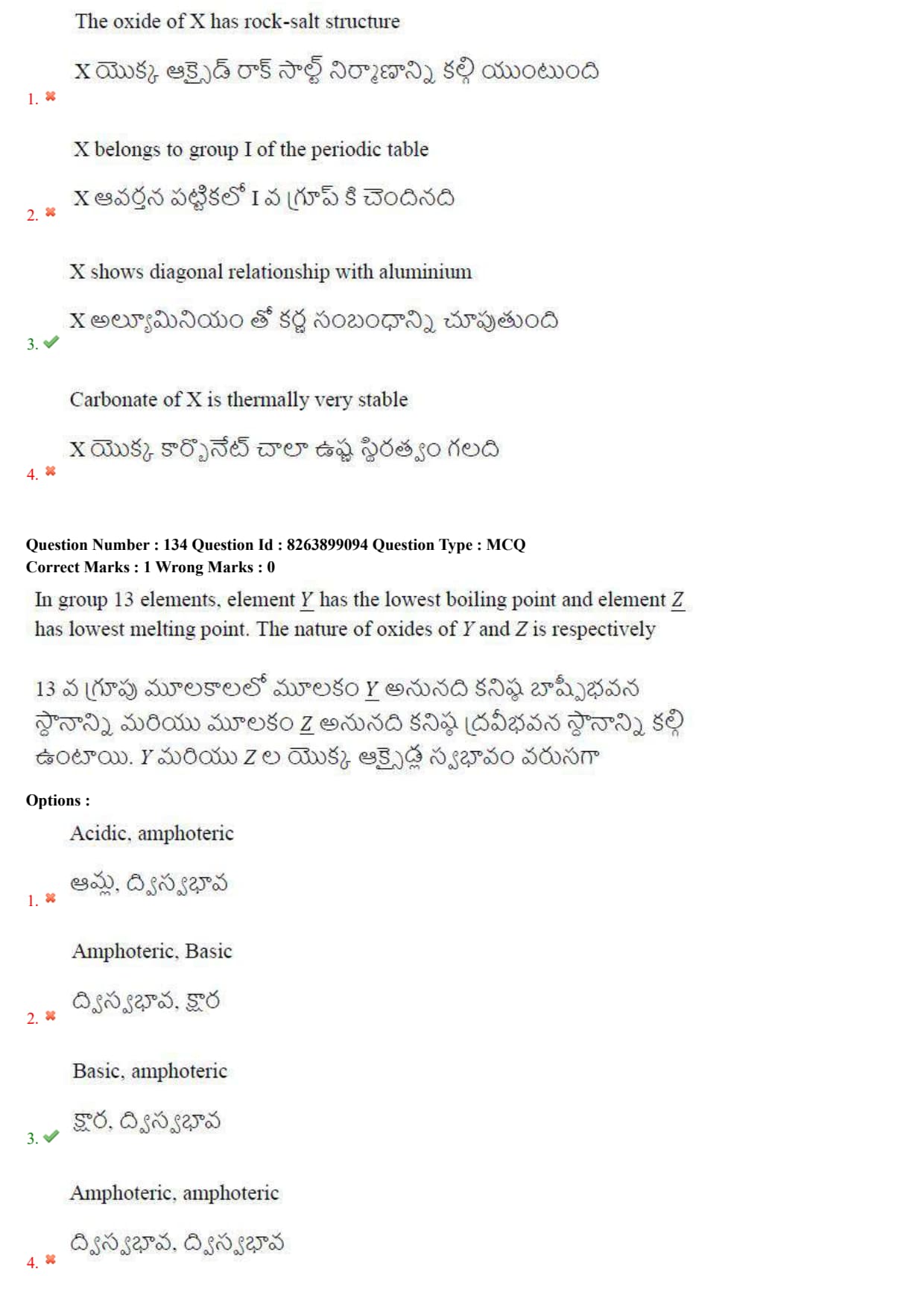
An element X reacts with air to form monoxide and nitride. This oxide is amphoteric. It can be converted to its chloride by heating with carbon and chlorine. Which of the following is correct for X?
In group 13 elements, element Y has the lowest boiling point and element Z has lowest melting point. The nature of oxides of Y and Z is respectively:
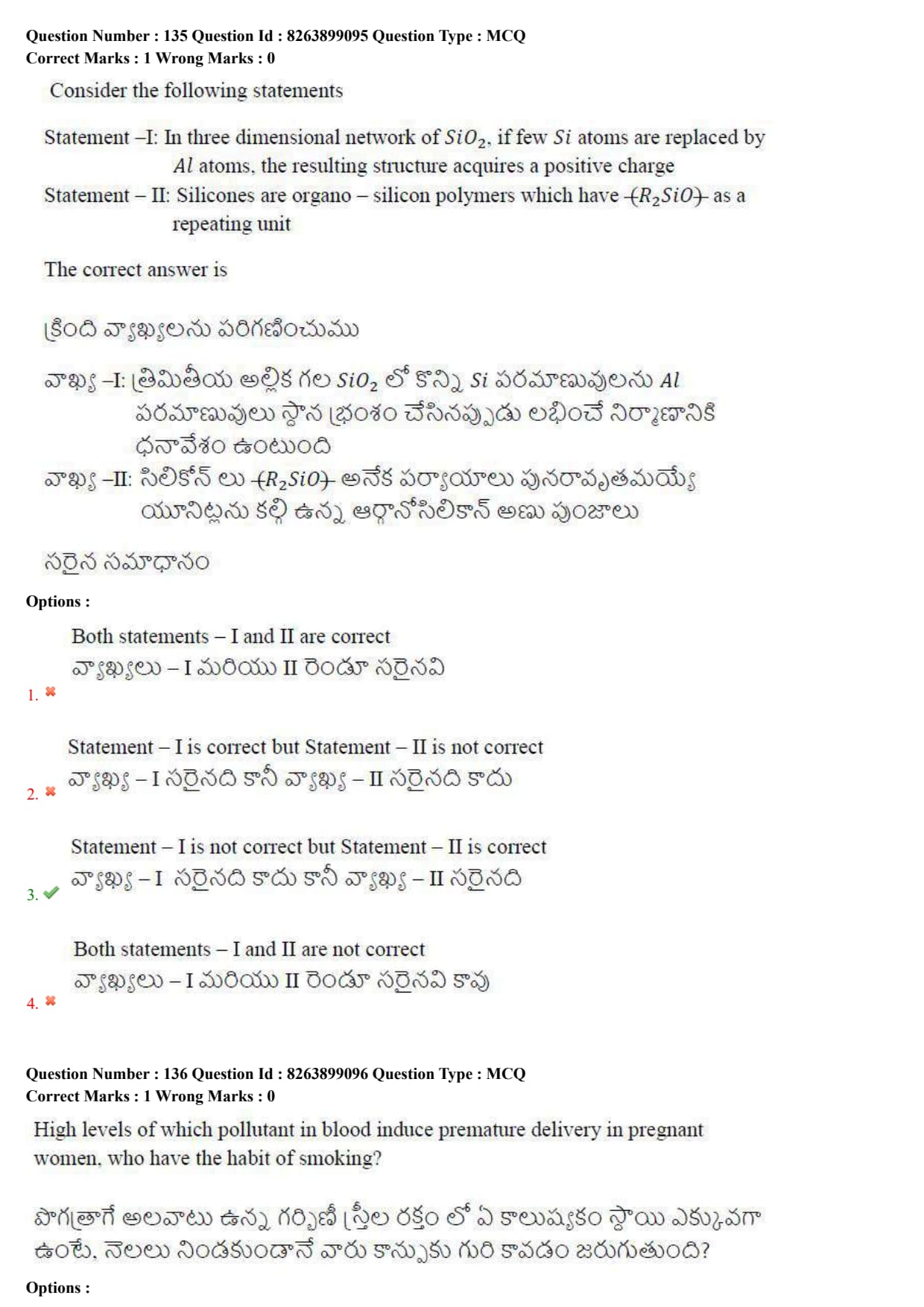
Consider the following statements:
Statement - I: In three dimensional network of \(SiO_2\), if few Si atoms are replaced by Al atoms, the resulting structure acquires a positive charge.
Statement - II: Silicones are organo - silicon polymers which have \((R_2SiO)\) as a repeating unit. The correct answer is:
High levels of which pollutant in blood induce premature delivery in pregnant women, who have the habit of smoking?
The IUPAC name of the following hydrocarbon is:

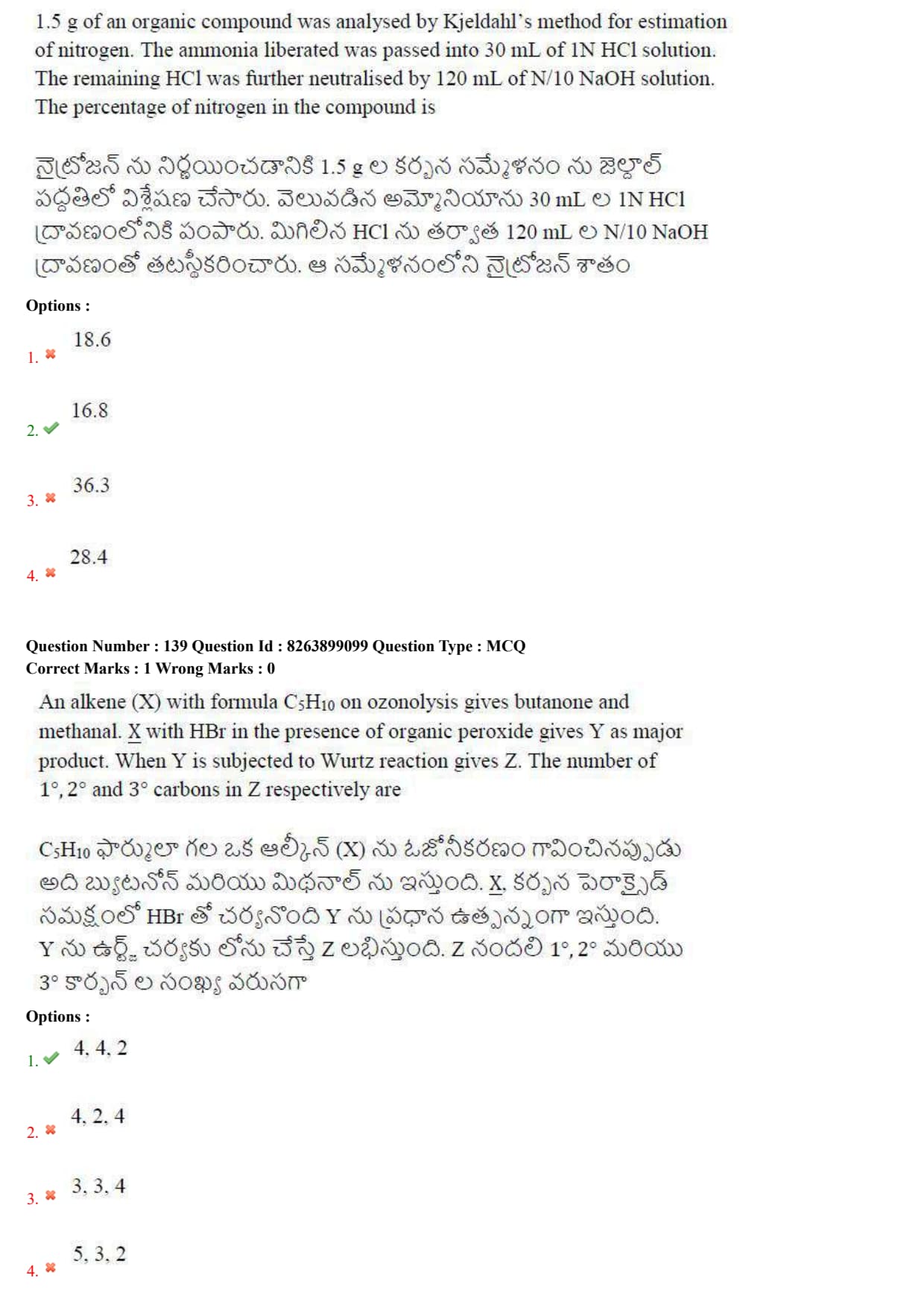
1.5 g of an organic compound was analysed by Kjeldahl's method for estimation of nitrogen. The ammonia liberated was passed into 30 mL of 1N HCl solution. The remaining HCl was further neutralised by 120 mL of N/10 NaOH solution. The percentage of nitrogen in the compound is:
An alkene (X) with formula \(C_5H_{10}\) on ozonolysis gives butanone and methanal. X with HBr in the presence of organic peroxide gives Y as major product. When Y is subjected to Wurtz reaction gives Z. The number of \(1^{\circ}, 2^{\circ}\) and \(3^{\circ}\) carbons in Z respectively are:
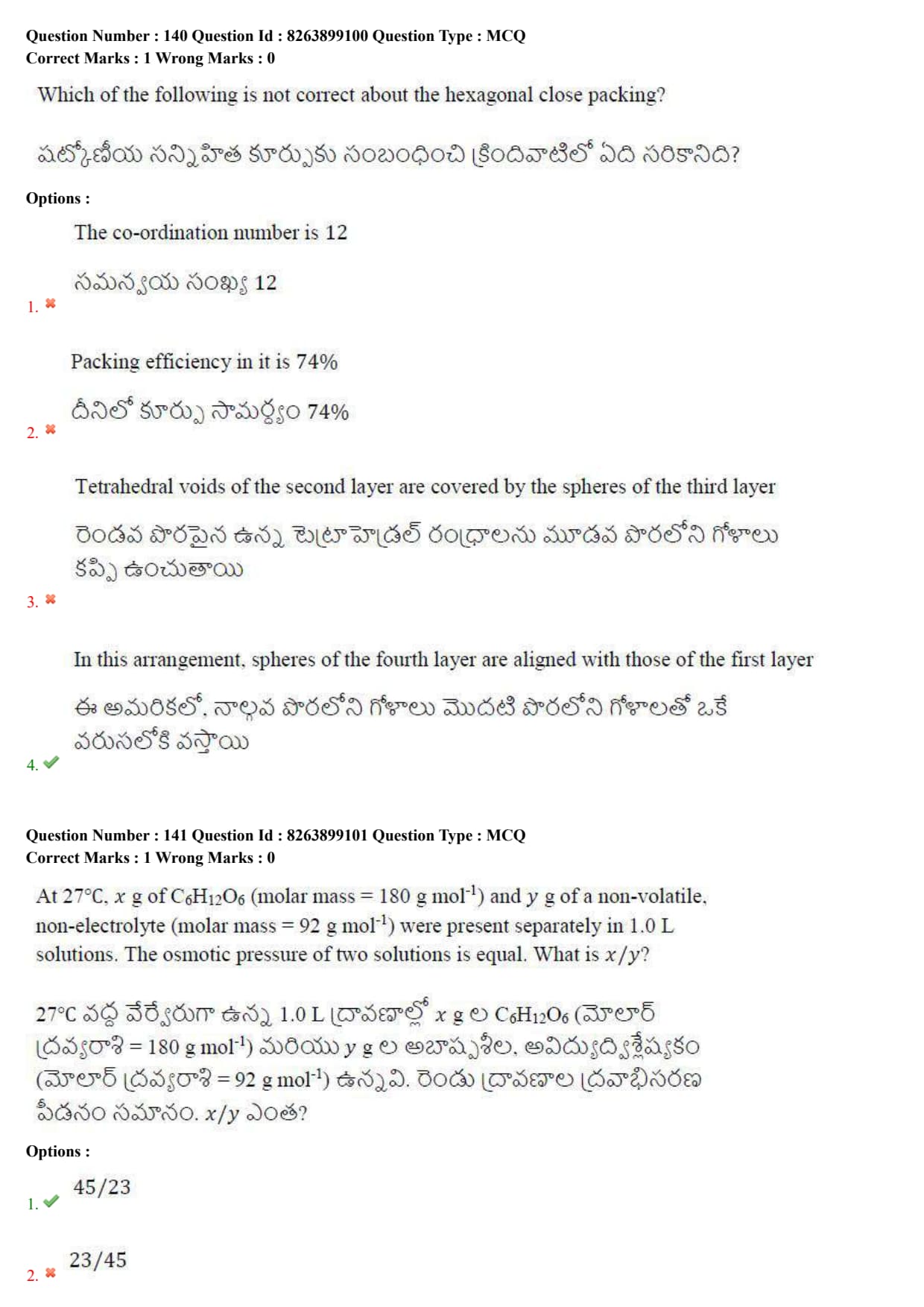
Which of the following is not correct about the hexagonal close packing?
At \(27^{\circ}C\), x g of \(C_6H_{12}O_6\) (molar mass = \(180 g mol^{-1}\)) and y g of a non-volatile, non-electrolyte (molar mass = \(92 g mol^{-1}\)) were present separately in 1.0 L solutions. The osmotic pressure of two solutions is equal. What is x/y?
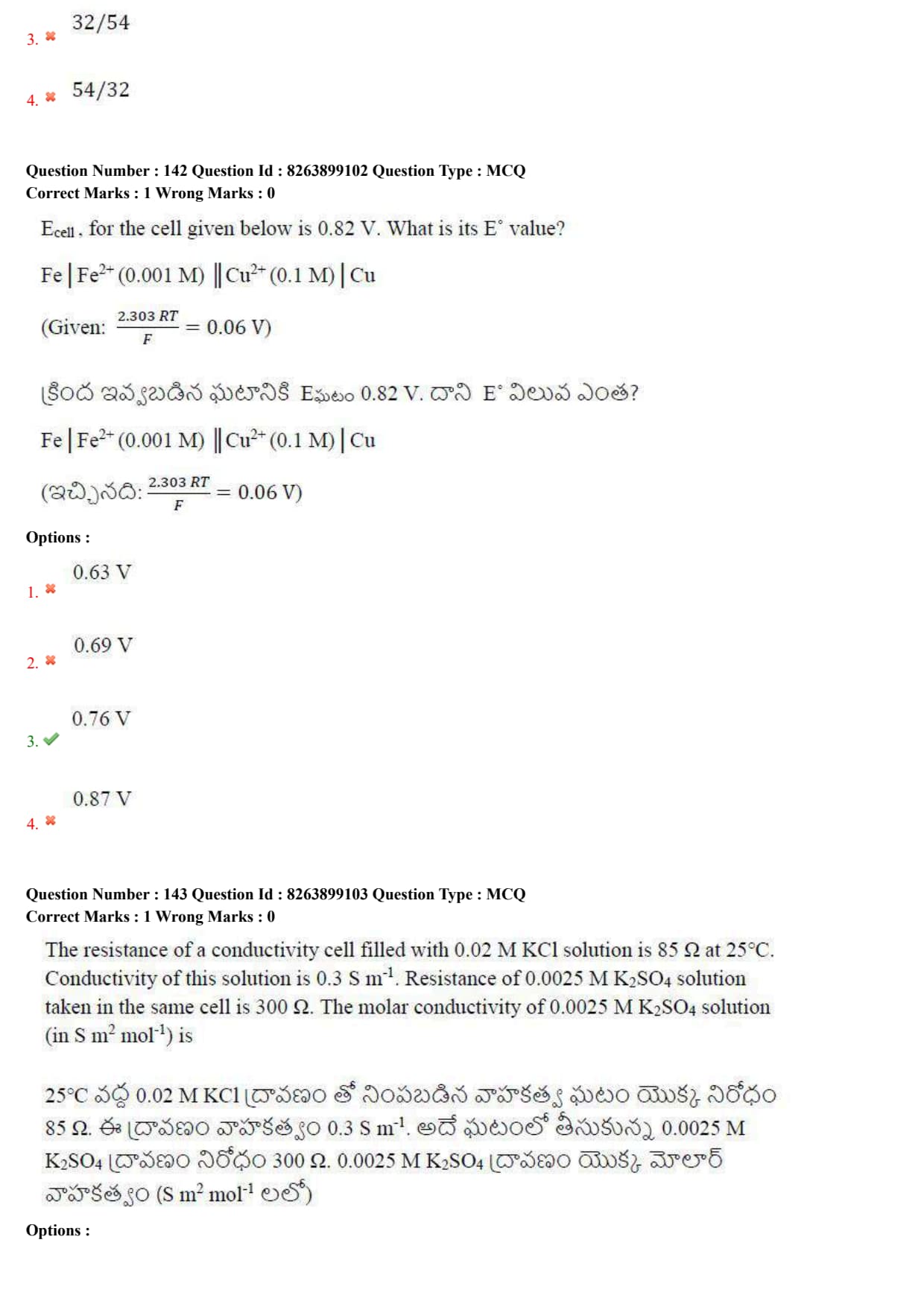
\(E_{cell}\), for the cell given below is 0.82 V. What is its \(E^{\circ}\) value? \(Fe | Fe^{2+}(0.001 M) || Cu^{2+}(0.1 M) | Cu\). (Given: \(\frac{2.303 RT}{F} = 0.06 V\))
The resistance of a conductivity cell filled with 0.02 M KCl solution is 85 \(\Omega\) at \(25^{\circ}C\). Conductivity of this solution is \(0.3 S m^{-1}\). Resistance of 0.0025 M \(K_2SO_4\) solution taken in the same cell is 300 \(\Omega\). The molar conductivity of 0.0025 M \(K_2SO_4\) solution (in S \(m^2 mol^{-1}\)) is:
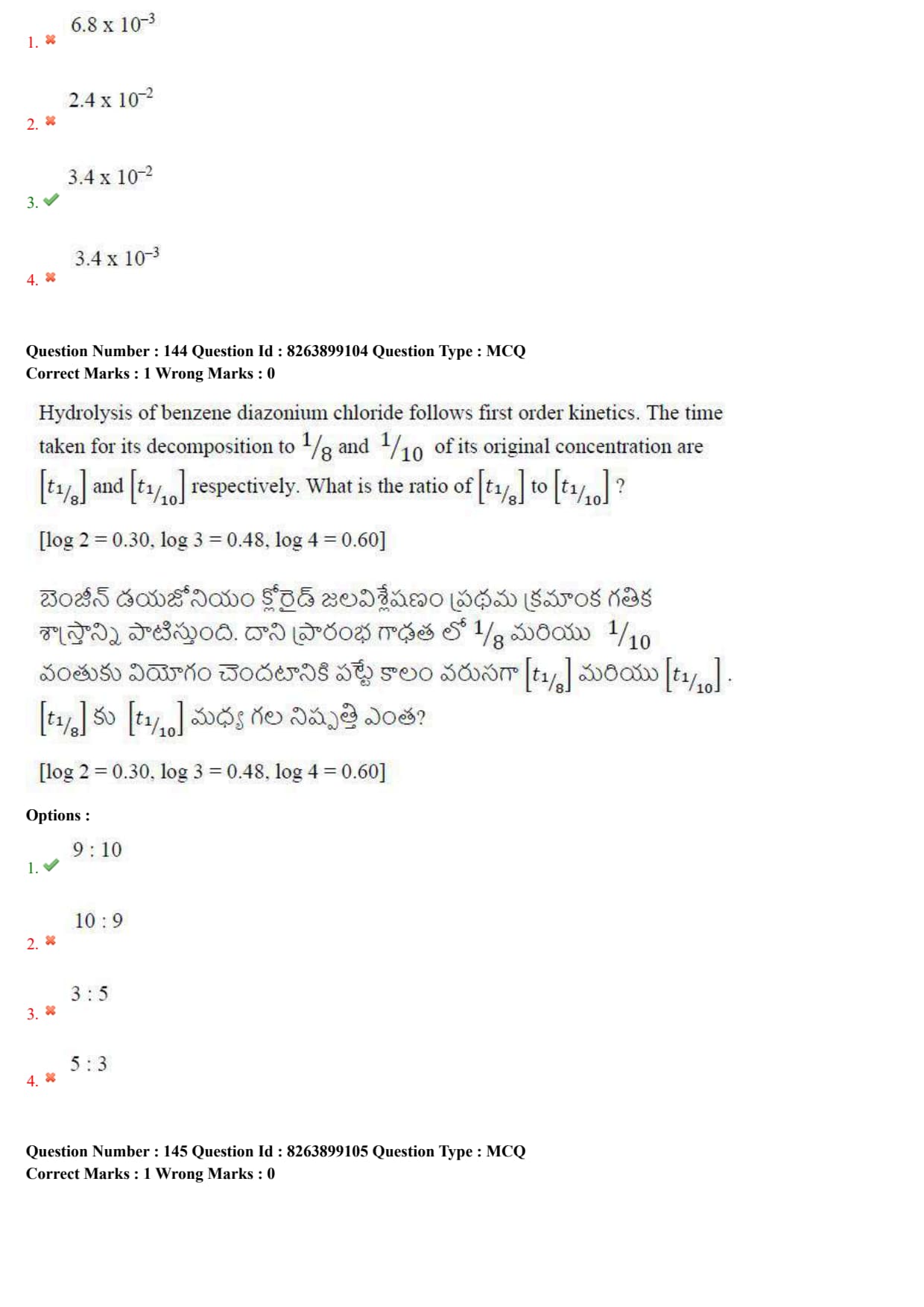
Hydrolysis of benzene diazonium chloride follows first order kinetics. The time taken for its decomposition to 1/8 and 1/10 of its original concentration are \([t_{1/8}]\) and \([t_{1/10}]\) respectively. What is the ratio of \([t_{1/8}]\) to \([t_{1/10}]\)? (\(\log 2=0.30\), \(\log 3=0.48\), \(\log 4=0.60\))
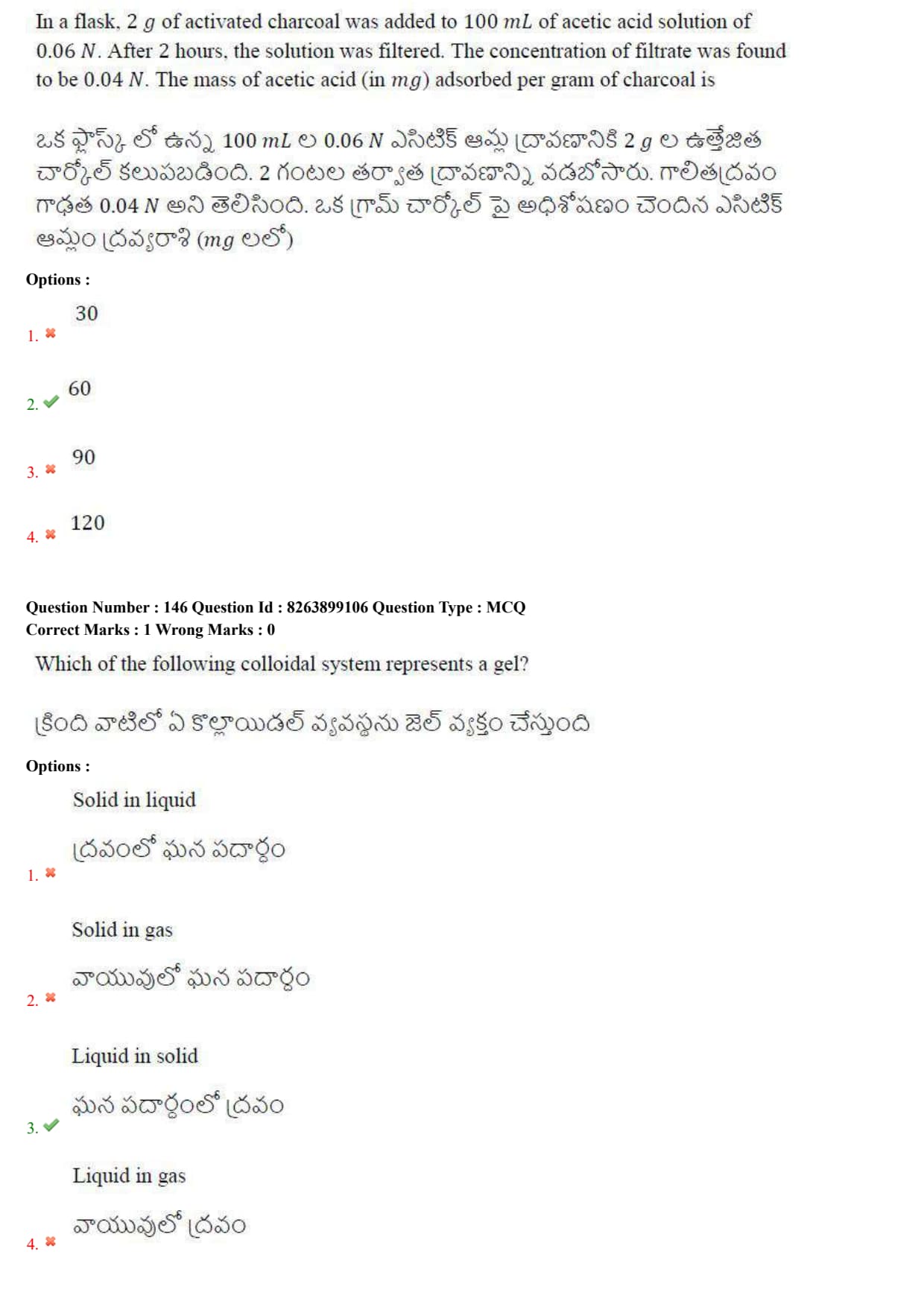
In a flask, 2 g of activated charcoal was added to 100 mL of acetic acid solution of 0.06 N. After 2 hours, the solution was filtered. The concentration of filtrate was found to be 0.04 N. The mass of acetic acid (in mg) adsorbed per gram of charcoal is:
Which of the following colloidal system represents a gel?
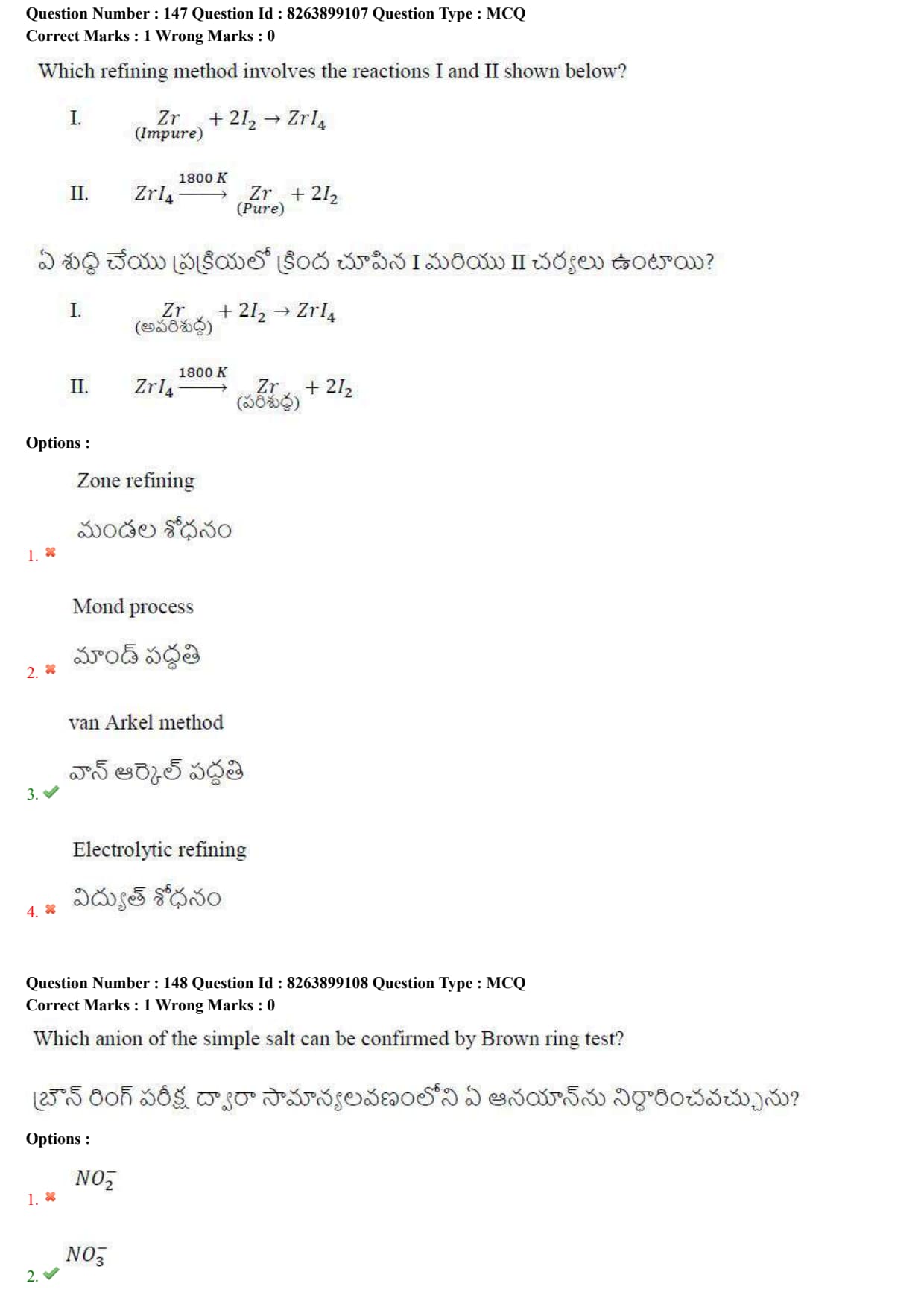
Which refining method involves the reactions I and II shown below? I. \(Zr_{(Impure)} + 2I_2 \rightarrow ZrI_4\) II. \(ZrI_4 \xrightarrow{1800 K} Zr_{(Pure)} + 2I_2\)
Which anion of the simple salt can be confirmed by Brown ring test?
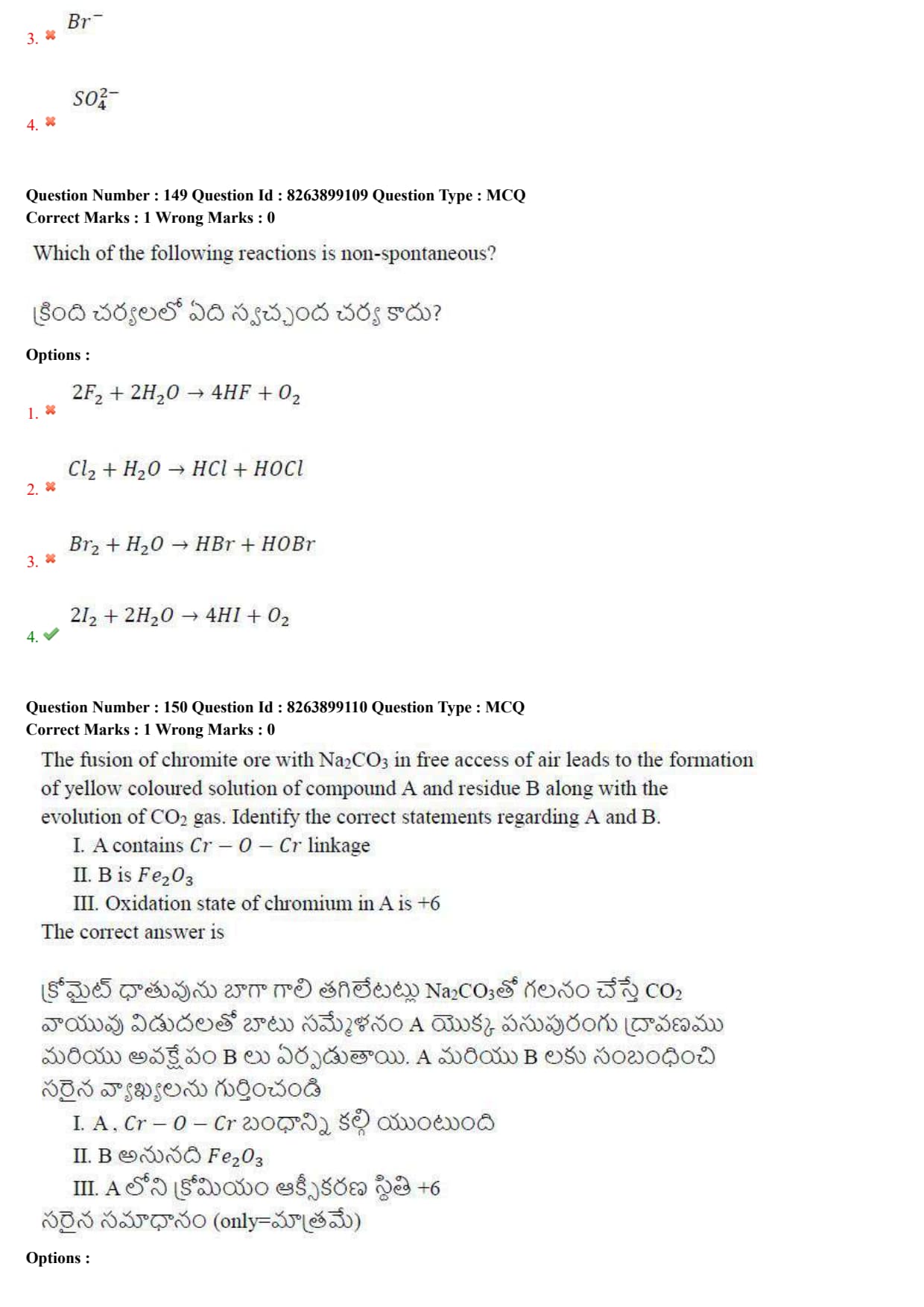
Which of the following reactions is non-spontaneous?
The fusion of chromite ore with \(Na_2CO_3\) in free access of air leads to the formation of yellow coloured solution of compound A and residue B along with the evolution of \(CO_2\) gas. Identify the correct statements regarding A and B.
I. A contains Cr-O-Cr linkage
II. B is \(Fe_2O_3\)
III. Oxidation state of chromium in A is +6
Which of the following exhibit only geometrical isomerism?
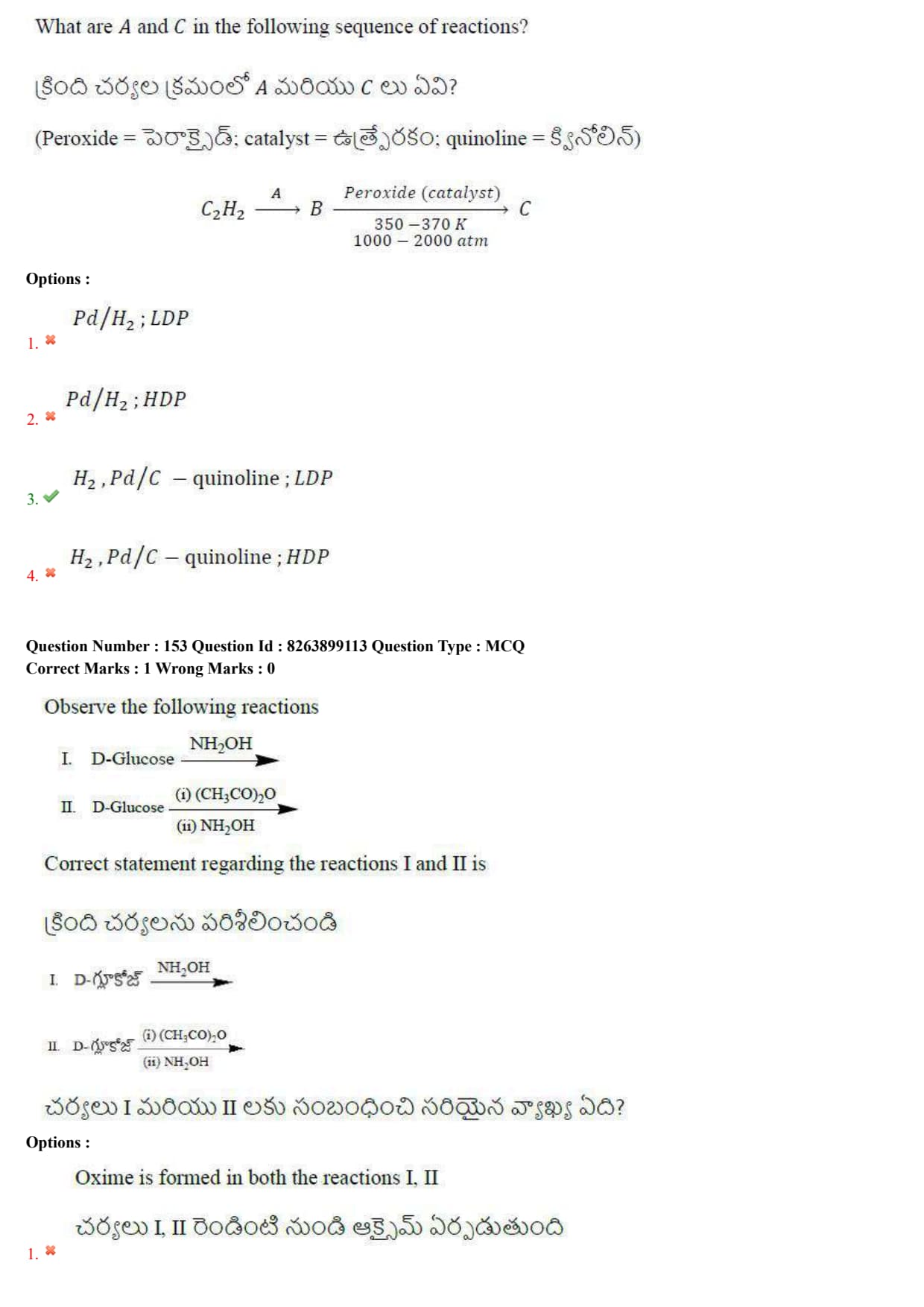
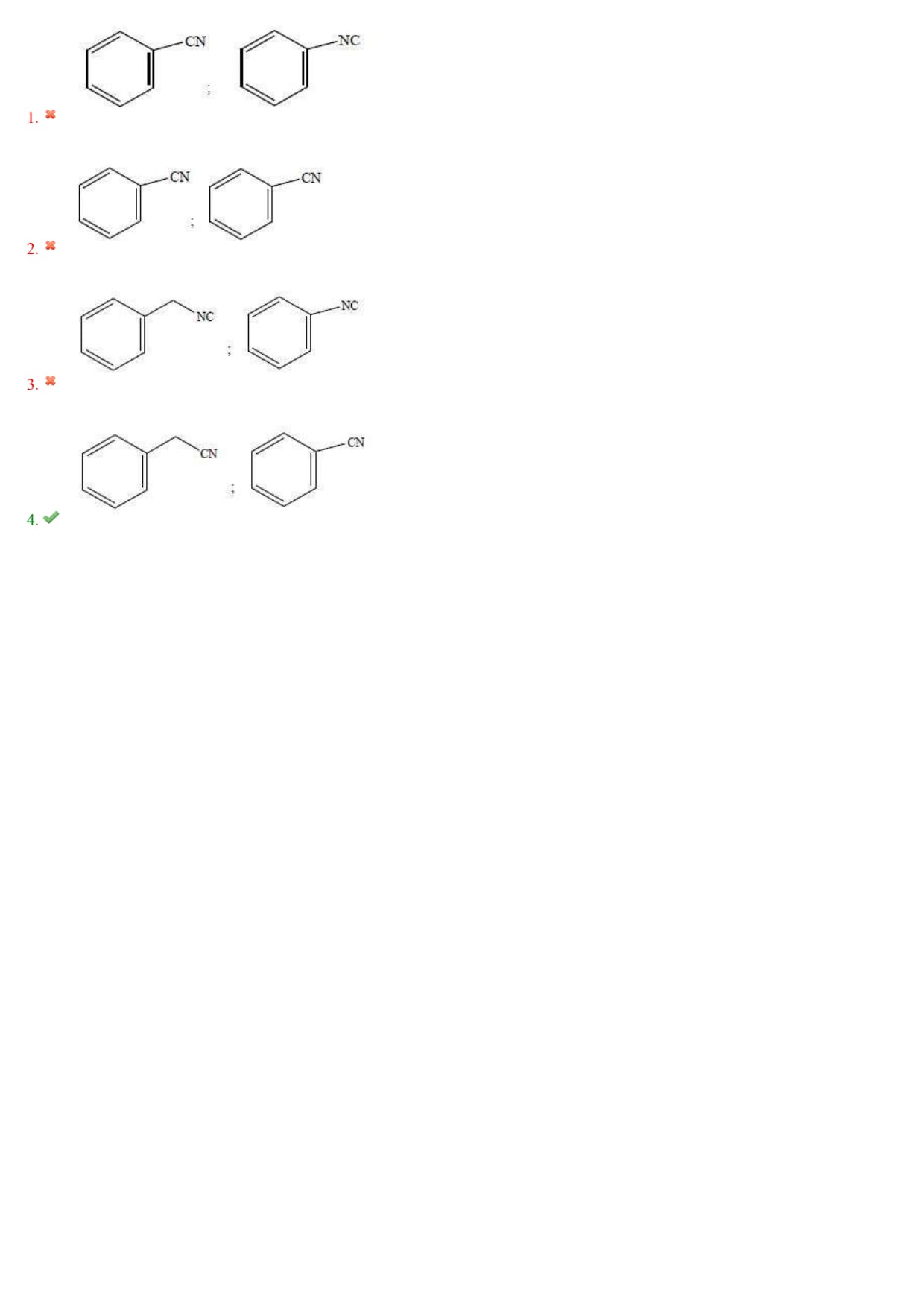
What are A and C in the following sequence of reactions? \(C_2H_2 \xrightarrow{A} B \xrightarrow{polymerisation} C\)
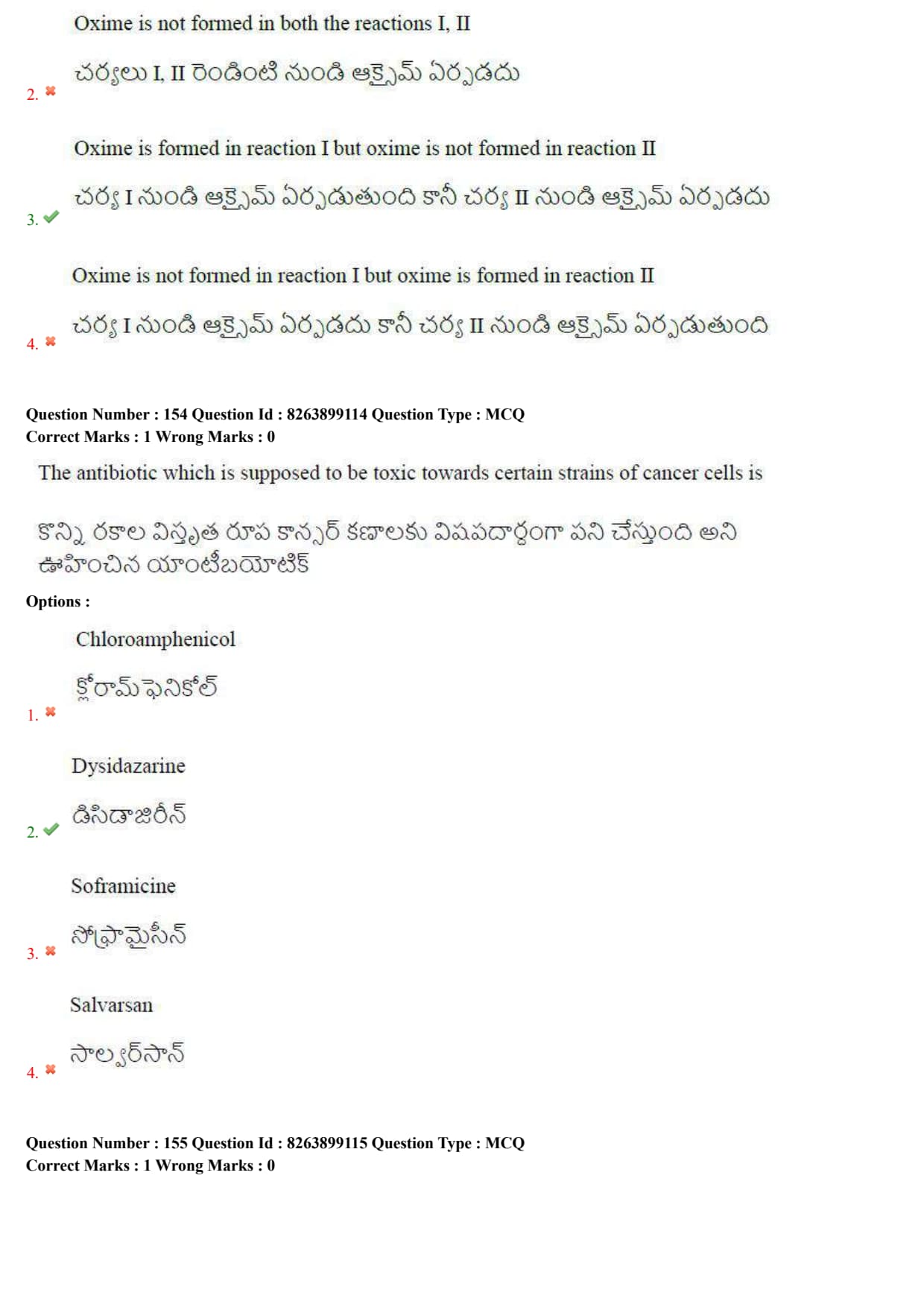
Observe the following reactions: I. D-Glucose \(\xrightarrow{NH_2OH}\) II. D-Glucose \(\xrightarrow[(ii) NH_2OH]{(i) (CH_3CO)_2O}\). Correct statement regarding the reactions I and II is:
The antibiotic which is supposed to be toxic towards certain strains of cancer cells is:
Consider the following organic halides:
(I) Bromobenzene,
(II) 2-Bromopropane,
(III) 1-Bromopropane.
The correct order of reactivity towards \(S_N2\) reaction is:

The number of \(\alpha\)-hydrogens present in the major product (X) in the given reaction is:
(Reaction: Alkyl halide + alc. KOH \(\rightarrow\) X)

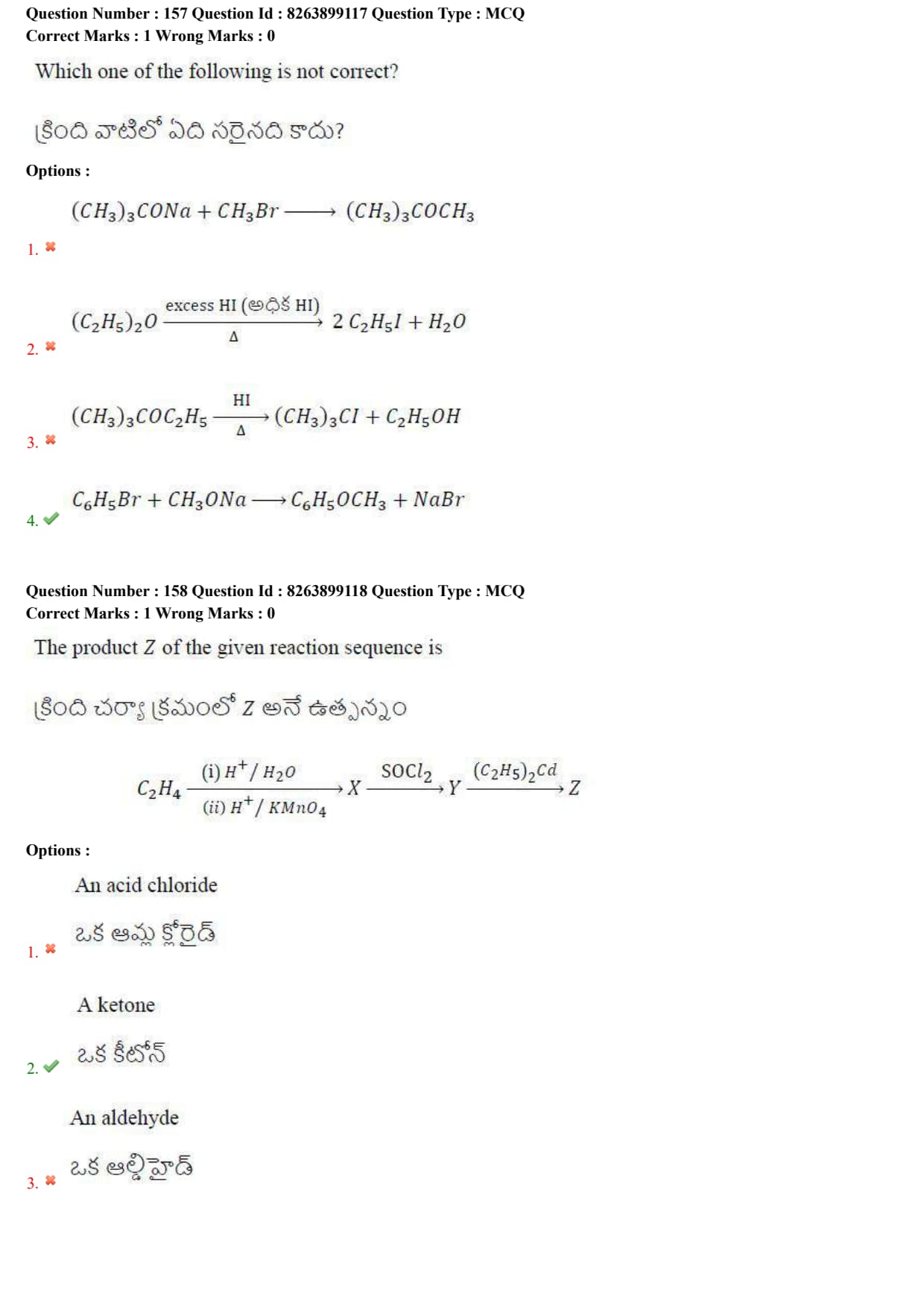
Which one of the following is not correct?
The product Z of the given reaction sequence is: \(C_2H_4 \xrightarrow[(ii)\ KMnO_4/H^+]{(i)\ H_2O/H^+} X \xrightarrow{SOCl_2} Y \xrightarrow{(C_2H_5)_2Cd} Z\)
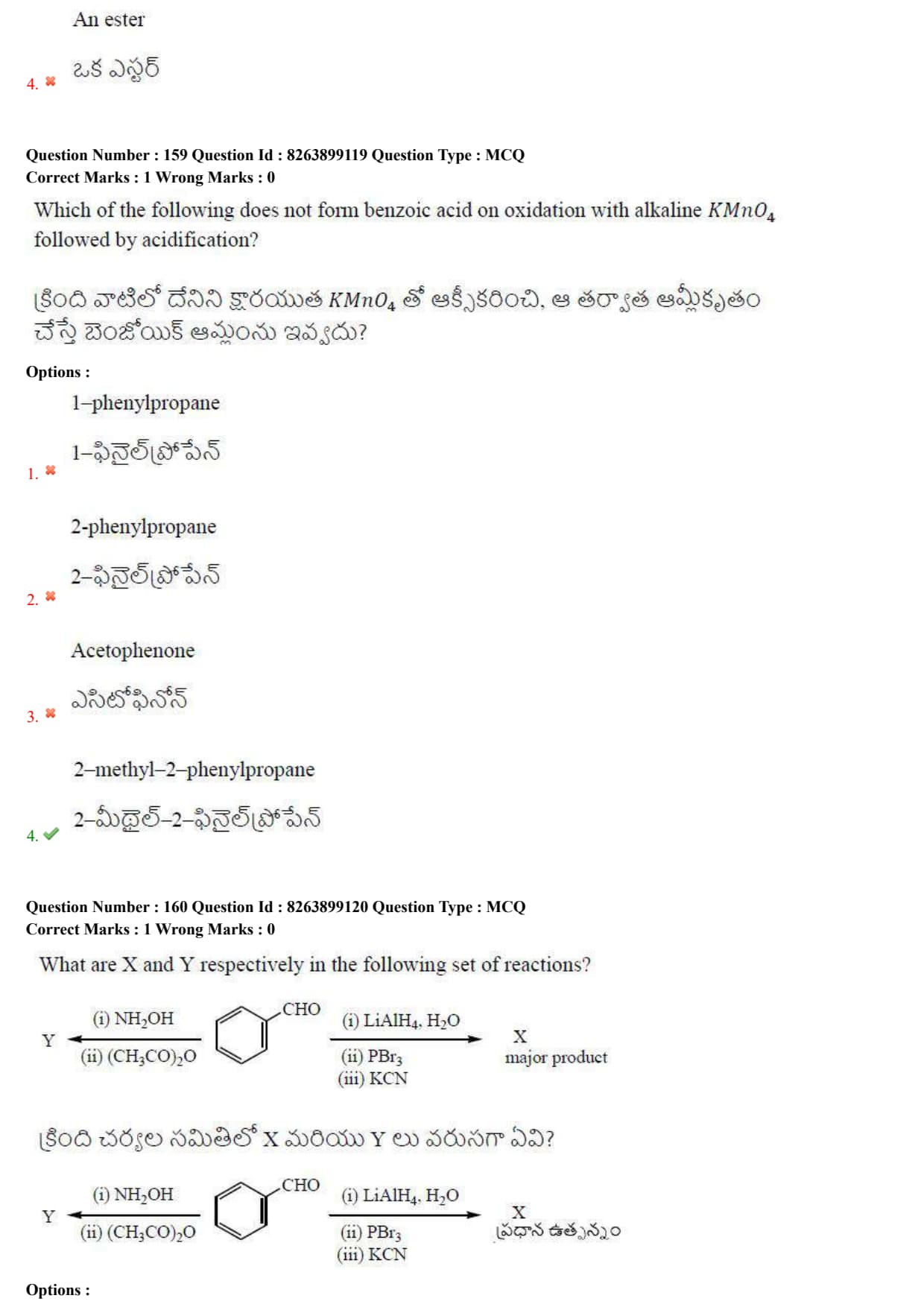
Which of the following does not form benzoic acid on oxidation with alkaline \(KMnO_4\) followed by acidification?
What are X and Y respectively in the following sequence of reactions?


AP EAPCET 2026 Paper Pattern – Engineering
| Section | Number of Questions | Marks per Question | Weightage | Total Marks |
|---|---|---|---|---|
| Mathematics | 80 | 1 | 80 | 80 |
| Physics | 40 | 1 | 40 | 40 |
| Chemistry | 40 | 1 | 40 | 40 |
| Total | 160 | 1 | 160 | 160 |



Comments