




MHT CET 2023 May 14 Shift 2 PCM Question Paper is available for download here. Maharashtra State CET Cell conducted MHT CET 2023 PCM Exam on May 14 in Shift 2 from 2 PM to 5 PM in CBT mode.
The MHT CET 2023 PCM question paper includes the following:
- The MHT CET 2023 PCM Question Paper consists of 150 multiple-choice questions (MCQs) totalling 200 marks divided into 3 sections: Physics, Chemistry, and Mathematics, with 50 questions in each subject.
- Physics and Chemistry questions carry 1 mark each while Mathematics questions carry 2 marks each.
- There is no negative marking for incorrect answers.
MHT CET 2023 May 14 Shift 2 PCM Question Paper with Solution PDF
| CD PDF | CD PDF with Solutions |
|---|---|
| Download Collegedunia PDF 1.21 MB | - |
Also Check:
MHT CET 2023 May 14 Shift 2 PCM Questions with Solutions
Physics (Q1 - Q50)
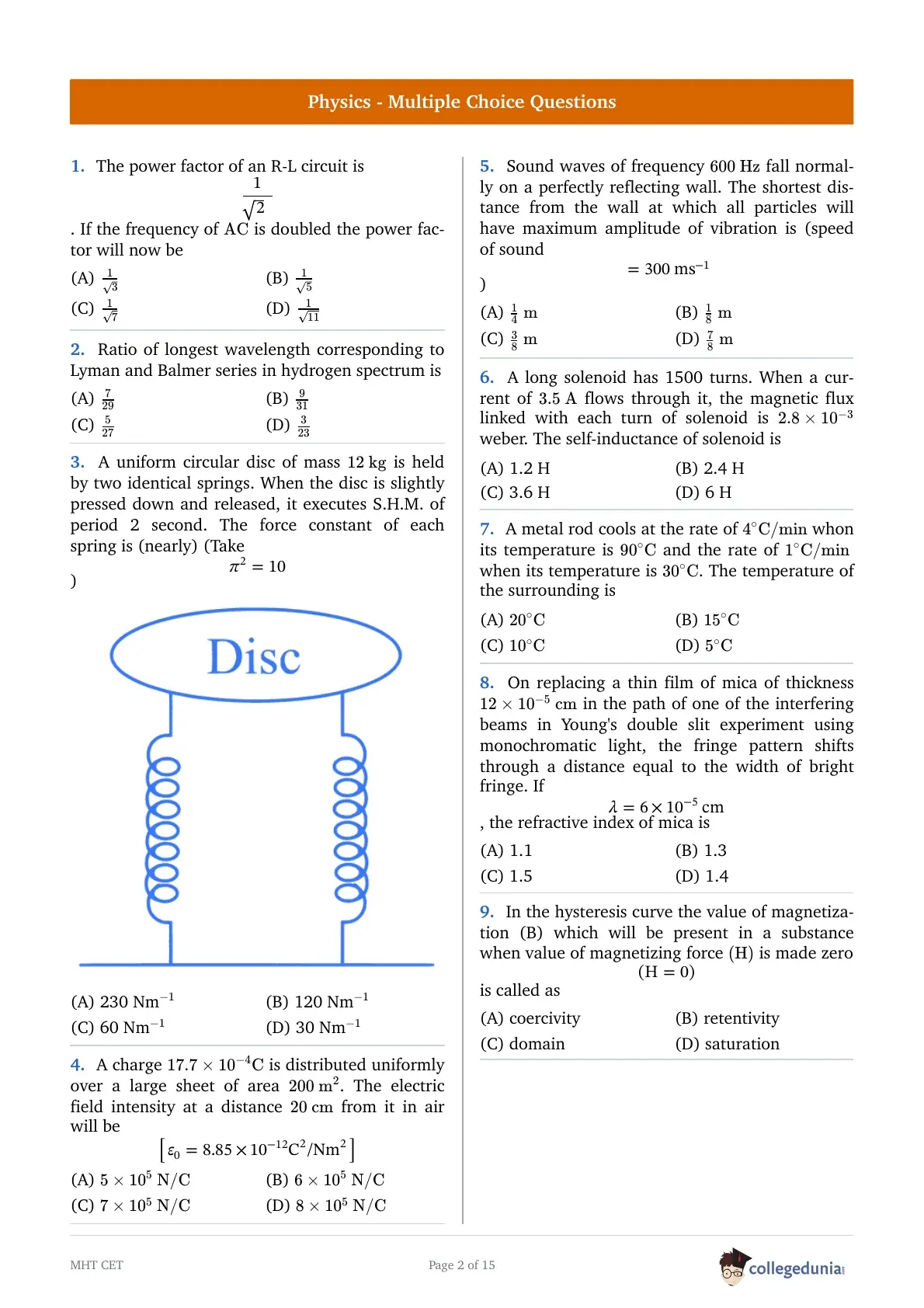
The power factor of an R-L circuit is \(\frac{1}{\sqrt{2}}\). If the frequency of \(\mathrm{AC}\) is doubled the power factor will now be
Ratio of longest wavelength corresponding to Lyman and Balmer series in hydrogen spectrum is
A uniform circular disc of mass \(12 \text{ kg}\) is held by two identical springs. When the disc is slightly pressed down and released, it executes S.H.M. of period \(2 \text{ second}\). The force constant of each spring is (Take \(\pi^2 = 10\))}

A charge \(17.7 \times 10^{-4}\text{ C}\) is distributed uniformly over a large sheet of area \(200 \text{ m}^2\). The electric field intensity at a distance \(20 \text{ cm}\) from it in air will be \([\epsilon_0 = 8.85 \times 10^{-12}\text{ C}^2/\text{Nm}^2]\)
Sound waves of frequency \(600\ \text{Hz}\) fall normally on a perfectly reflecting wall. The shortest distance from the wall at which all particles will have maximum amplitude of vibration is (speed of sound \(=300\ \text{ms}^{-1}\))
A long solenoid has 1500 turns. When a current of 3.5 A flows through it, the magnetic flux linked with each turn of solenoid is \(2.8 \times 10^{-3}\) weber. The self-inductance of solenoid is
A metal rod cools at the rate of \(4{ }^{\circ} \mathrm{C} / \mathrm{min}\) whon its temperature is \(90^{\circ} \mathrm{C}\) and the rate of \(1{ }^{\circ} \mathrm{C} / \mathrm{m}{\text {in }}\) when its temperature is \(30^{\circ} \mathrm{C}\). The temperature of the surrounding is
On replacing a thin film of mica of thickness \(12 \times 10^{-5}\) cm in the path of one of the interfering beams in Young's double slit experiment using monochromatic light, the fringe pattern shifts through a distance equal to the width of bright fringe. If \(\lambda = 6 \times 10^{-5}\) cm, the refractive index of mica is
In the hysteresis curve the value of magnetization (B) which will be present in a substance when value of magnetizing force (H) is made zero (H = 0) is called as

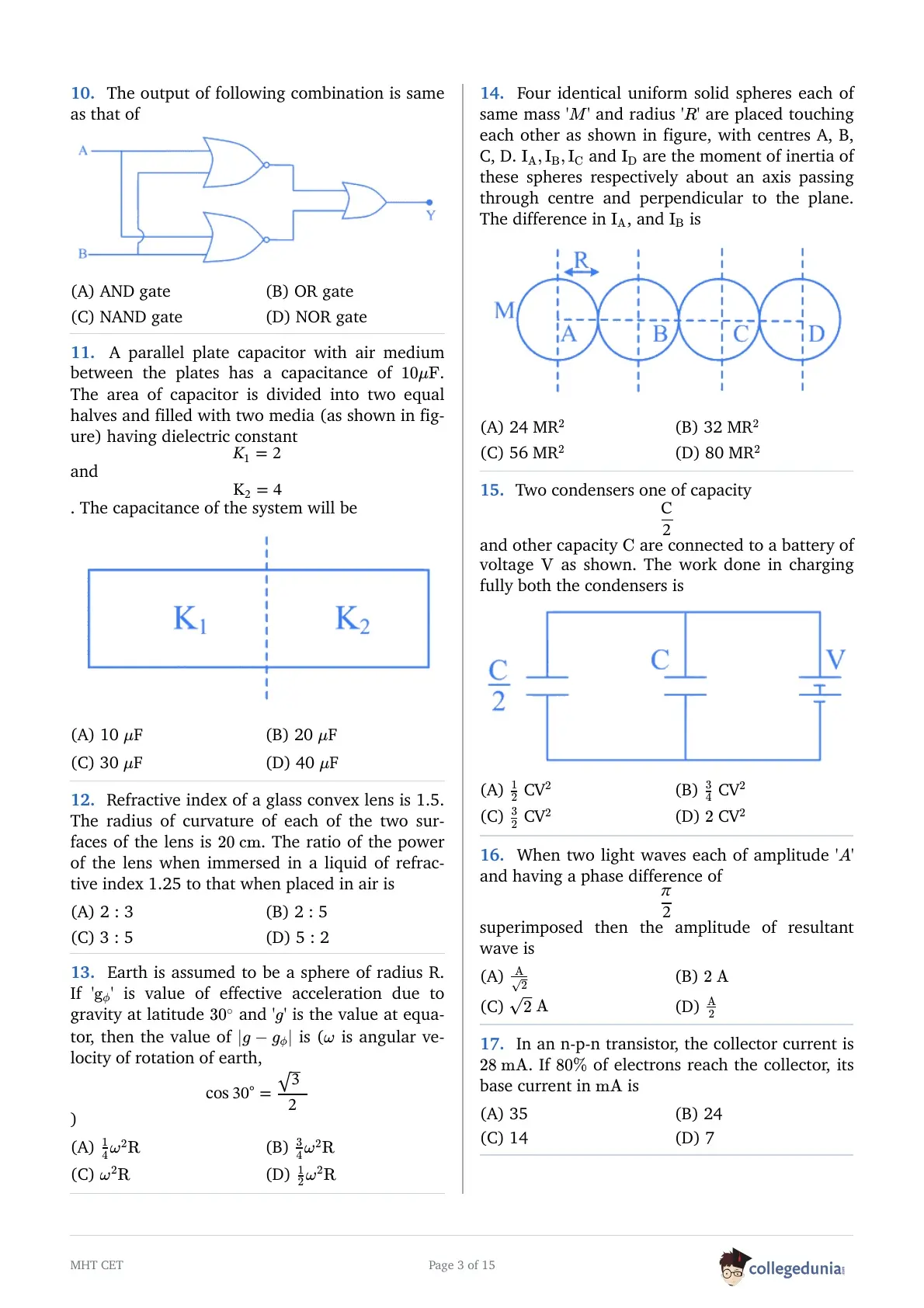
A parallel plate capacitor with air medium between the plates has a capacitance of \(10 \mu \mathrm{F}\). The area of capacitor is divided into two equal halves and filled with two media (as shown in figure) having dielectric constant \(K_1=2\) and \(\mathrm{K}_2=4\). The capacitance of the system will be

Refractive index of a glass convex lens is \(1.5\). The radius of curvature of each of the two surfaces of the lens is \(20 \text{ cm}\). The ratio of the power of the lens when immersed in a liquid of refractive index \(1.25\) to that when placed in air is
Earth is assumed to be a sphere of radius R. If '\(\mathrm{g}_\phi\)' is value of effective acceleration due to gravity at latitude \(30^{\circ}\) and '\(g\)' is the value at equator, then the value of \(\left|g-g_\phi\right|\) is (\(\omega\) is angular velocity of rotation of earth, \(\cos 30^{\circ}=\frac{\sqrt{3}}{2}\) )
Four identical uniform solid spheres each of same mass '\(M\)' and radius '\(R\)' are placed touching each other as shown in figure, with centres \(A\), \(B\), \(C\), \(D\). \(I_A\), \(I_B\), \(I_C\) and \(I_D\) are the moment of inertia of these spheres respectively about an axis passing through centre and perpendicular to the plane. The difference in \(I_A\), and \(I_B\) is

Two condensers one of capacity \(\frac{C}{2}\) and other capacity \(C\) are connected to a battery of voltage \(V\) as shown. The work done in charging fully both the condensers is

When two light waves each of amplitude '\(A\)' and having a phase difference of \(\frac{\pi}{2}\) superimposed then the amplitude of resultant wave is
In an \(n-p-n\) transistor, the collector current is \(28\) mA. If \(80%\) of electrons reach the collector, its base current in mA is
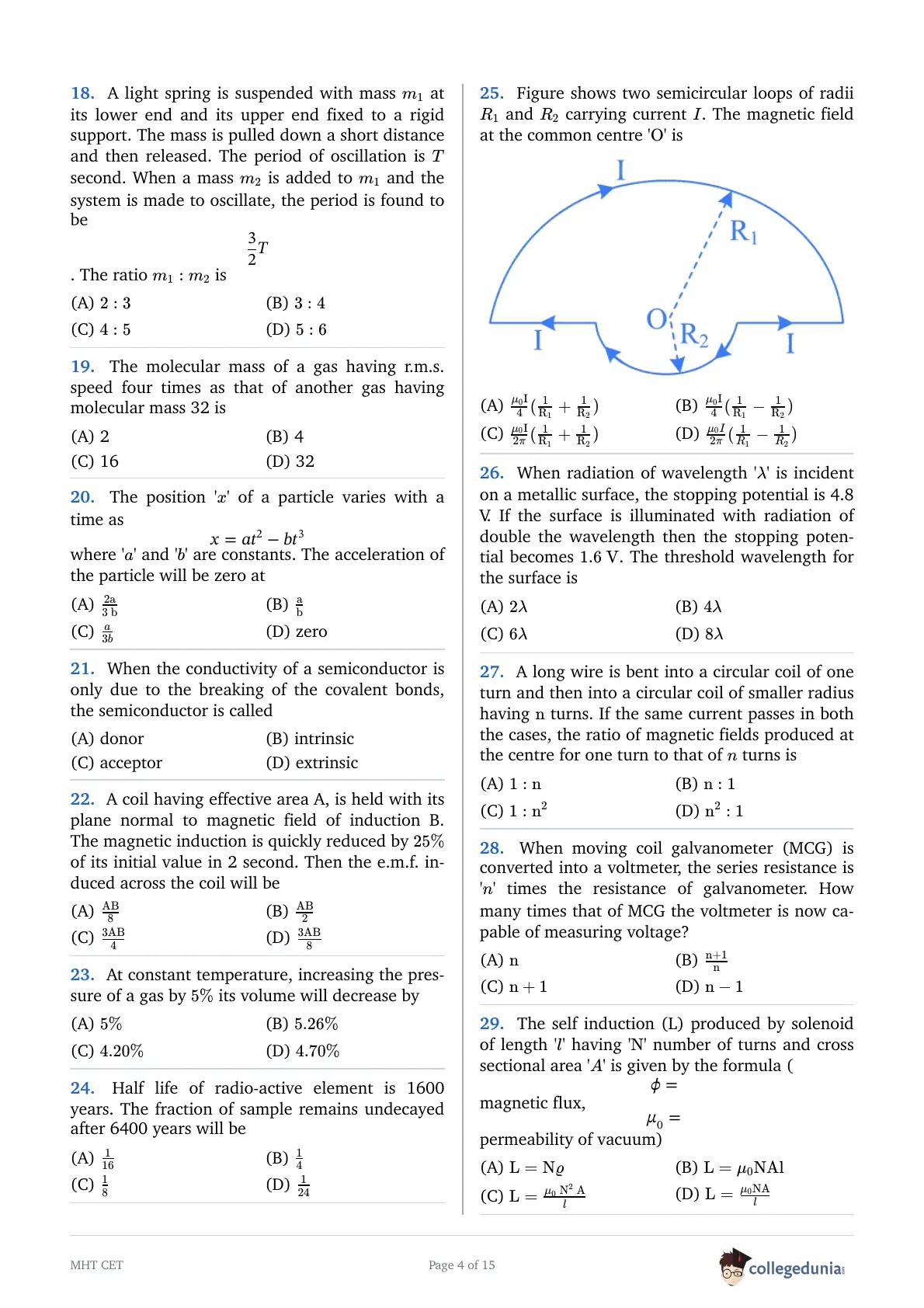
A light spring is suspended with mass \(m_1\) at its lower end and its upper end fixed to a rigid support. The mass is pulled down a short distance and then released. The period of oscillation is \(T\) second. When a mass \(m_2\) is added to \(m_1\) and the system is made to oscillate, the period is found to be \(\frac{3}{2}T\). The ratio \(m_1 : m_2\) is
The molecular mass of a gas having r.m.s. speed four times as that of another gas having molecular mass \(32\) is
The position '\(x\)' of a particle varies with a time as \(x=a t^2-b t^3\) where '\(a\)' and '\(b\)' are constants. The acceleration of the particle will be zero at
When the conductivity of a semiconductor is only due to the breaking of the covalent bonds, the semiconductor is called
A coil having effective area A, is held with its plane normal to magnetic field of induction B. The magnetic induction is quickly reduced by \(25 \%\) of its initial value in 2 second. Then the e.m.f. induced across the coil will be
At constant temperature, increasing the pressure of a gas by \(5%\) its volume will decrease by
Half life of radio-active element is 1600 years. The fraction of sample remains undecayed after 6400 years will be
Figure shows two semicircular loops of radii \(R_1\) and \(R_2\) carrying current \(I\). The magnetic field at the common centre '\(O\)' is

When radiation of wavelength '\[\lambda\]' is incident on a metallic surface, the stopping potential is 4.8 V. If the surface is illuminated with radiation of double the wavelength then the stopping potential becomes \[1.6 \mathrm{~V}\]. The threshold wavelength for the surface is
A long wire is bent into a circular coil of one turn and then into a circular coil of smaller radius having \(n\) turns. If the same current passes in both the cases, the ratio of magnetic fields produced at the centre for one turn to that of \(n\) turns is
When moving coil galvanometer (MCG) is converted into a voltmeter, the series resistance is '\(n\)' times the resistance of galvanometer. How many times that of MCG the voltmeter is now capable of measuring voltage?
The self induction (\(L\)) produced by solenoid of length '\(l\)' having '\(N\)' number of turns and cross sectional area '\(A\)' is given by the formula (\(\phi = \text{magnetic flux through one turn}, \mu_0 = \text{permeability of vacuum}\))
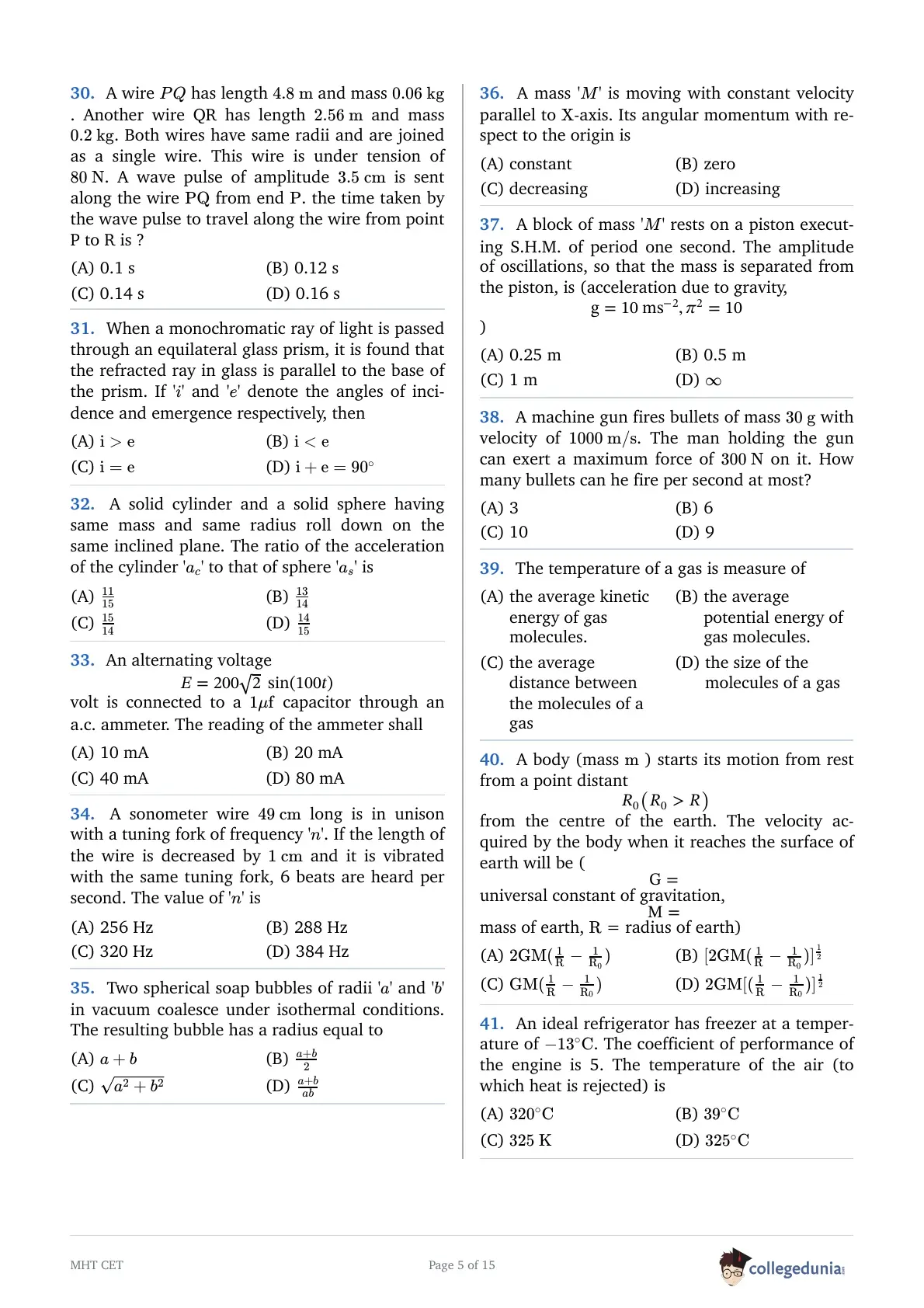
A wire \(PQ\) has length \(4.8\text{ m}\) and mass \(0.06\text{ kg}\). Another wire \(QR\) has length \(2.56\text{ m}\) and mass \(0.2\text{ kg}\). Both wires have same radii and are joined as a single wire. This wire is under tension of \(80\text{ N}\). A wave pulse of amplitude \(3.5\text{ cm}\) is sent along the wire \(PQ\) from end \(P\). The time taken by the wave pulse to travel along the wire from point \(P\) to \(R\) is?
When a monochromatic ray of light is passed through an equilateral glass prism, it is found that the refracted ray in glass is parallel to the base of the prism. If '\(i\)' and '\(e\)' denote the angles of incidence and emergence respectively, then
A solid cylinder and a solid sphere having same mass and same radius roll down on the same inclined plane. The ratio of the acceleration of the cylinder '\(a_c\)' to that of sphere '\(a_s\)' is
An alternating voltage \(E = 200\sqrt{2} \sin(100t)\) volt is connected to a \(1 \mu\text{F}\) capacitor through an a.c. ammeter. The reading of the ammeter shall
A sonometer wire 49 cm long is in unison with a tuning fork of frequency '\(n\)'. If the length of the wire is decreased by 1 cm and it is vibrated with the same tuning fork, 6 beats are heard per second. The value of '\(n\)' is
Two spherical soap bubbles of radii '\(a\)' and '\(b\)' in vacuum coalesce under isothermal conditions. The resulting bubble has a radius equal to
A mass '\(M\)' is moving with constant velocity parallel to X-axis. Its angular momentum with respect to the origin is
A block of mass '\(M\)' rests on a piston executing S.H.M. of period one second. The amplitude of oscillations, so that the mass is separated from the piston, is (acceleration due to gravity, \(g = 10 \text{ ms}^{-2}, \pi^2 = 10\) )
A machine gun fires bullets of mass \(30\text{ g}\) with velocity of \(1000\text{ m/s}\). The man holding the gun can exert a maximum force of \(300\text{ N}\) on it. How many bullets can he fire per second at most?
The temperature of a gas is measure of
A body (mass \(\mathrm{m}\) ) starts its motion from rest from a point distant \(R_0\left(R_0>R\right)\) from the centre of the earth. The velocity acquired by the body when it reaches the surface of earth will be ( \(\mathrm{G}=\) universal constant of gravitation, \(\mathrm{M}=\) mass of earth, \(\mathrm{R}\) = radius of earth)
An ideal refrigerator has freezer at a temperature of \(-13^{\circ} \mathrm{C}\). The coefficient of performance of the engine is 5. The temperature of the air (to which heat is rejected) is
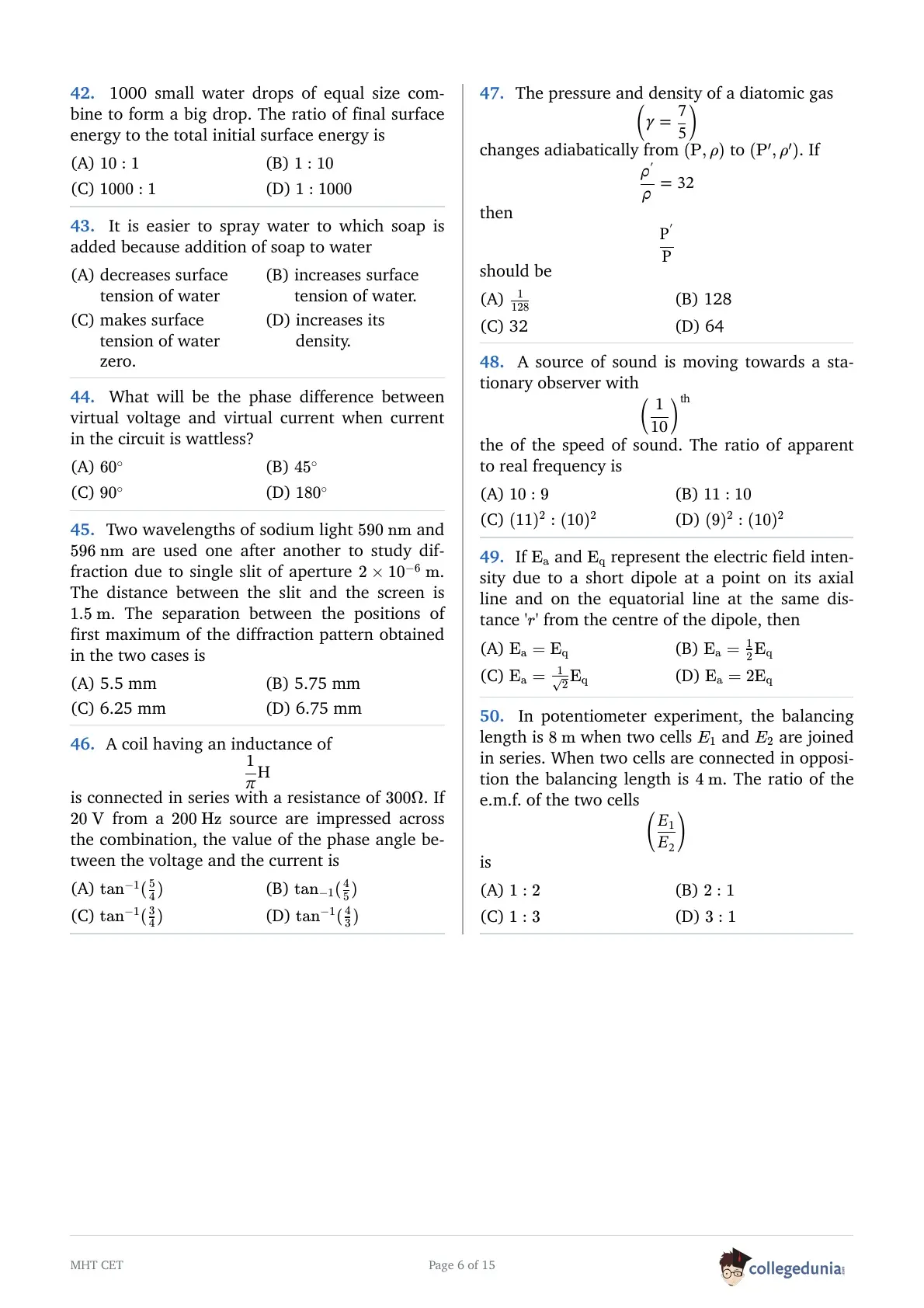
1000 small water drops of equal size combine to form a big drop. The ratio of final surface energy to the total initial surface energy is
It is easier to spray water to which soap is added because addition of soap to water
What will be the phase difference between virtual voltage and virtual current when current in the circuit is wattless?
Two wavelengths of sodium light \(590 \text{ nm}\) and \(596 \text{ nm}\) are used one after another to study diffraction due to single slit of aperture \(2 \times 10^{-6} \text{ m}\). The distance between the slit and the screen is \(1.5 \text{ m}\). The separation between the positions of first maximum of the diffraction pattern obtained in the two cases is
A coil having an inductance of \(\frac{1}{\pi} \text{ H}\) is connected in series with a resistance of \(300 \Omega\). If \(20 \text{ V}\) from a \(200 \text{ Hz}\) source are impressed across the combination, the value of the phase angle between the voltage and the current is
The pressure and density of a diatomic gas (\(\gamma = \frac{7}{5}\)) changes adiabatically from \((P, \rho)\) to \((P', \rho')\). If \(\frac{\rho'}{\rho} = 32\) then \(\frac{P'}{P}\) should be
A source of sound is moving towards a stationary observer with \(\left(\frac{1}{10}\right)^{\text{th}}\) the speed of sound. The ratio of apparent to real frequency is
If \(\mathrm{E}_{\mathrm{a}}\) and \(\mathrm{E}_{\mathrm{q}}\) represent the electric field intensity due to a short dipole at a point on its axial line and on the equatorial line at the same distance '\(r\)' from the centre of the dipole, then
In potentiometer experiment, the balancing length is \(8 \mathrm{~m}\) when two cells \(E_1\) and \(E_2\) are joined in series. When two cells are connected in opposition the balancing length is \(4 \mathrm{~m}\). The ratio of the e.m.f. of the two cells \(\left(\frac{E_1}{E_2}\right)\) is
Chemistry (Q51 - Q100)

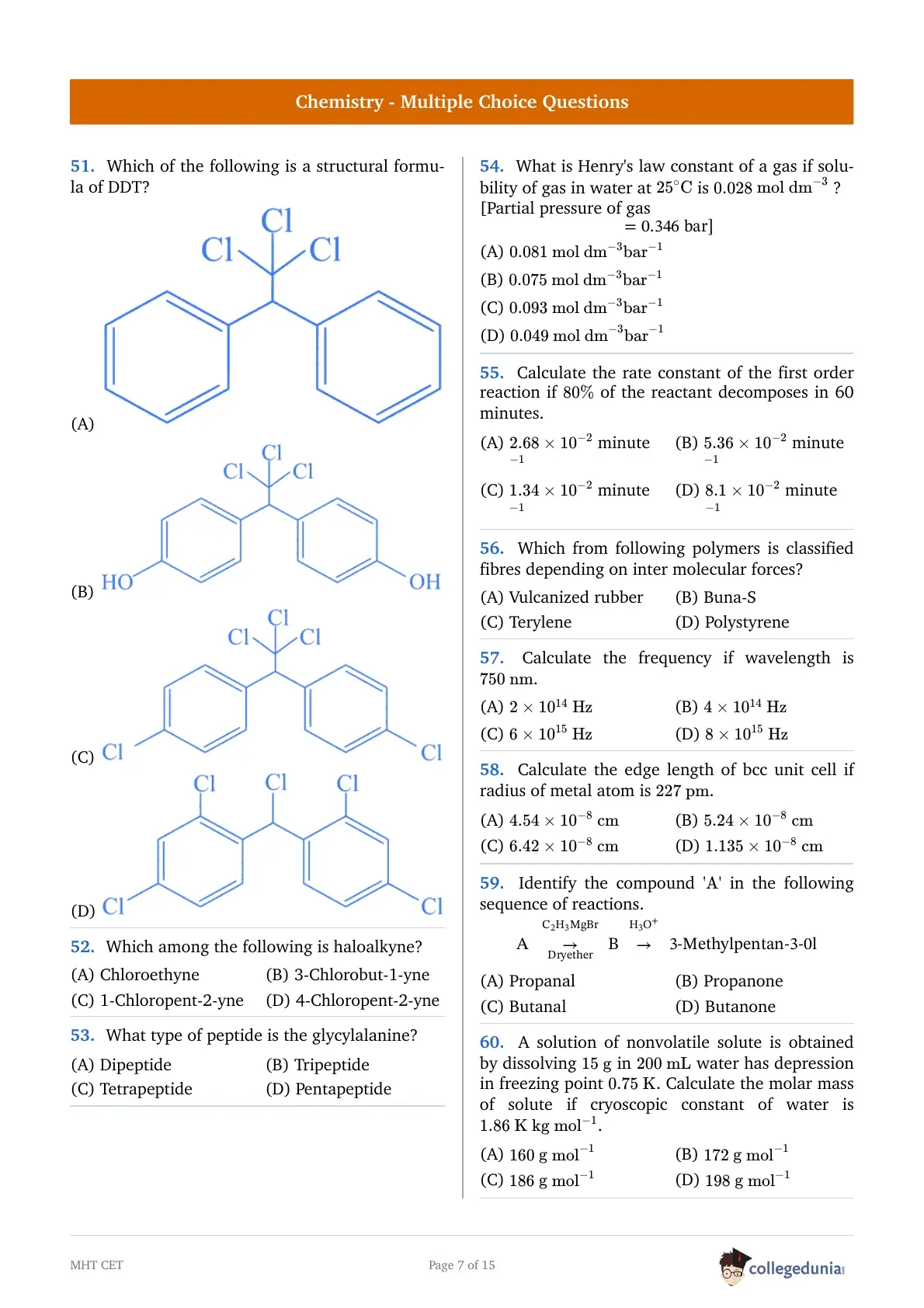
Which among the following is haloalkyne?
What is Henry's law constant of a gas if solubility of gas in water at 25\(\circ\)C is 0.028 mol dm\(^-3\)? [Partial pressure of gas = 0.346 bar]
Calculate the rate constant of the first order reaction if 80% of the reactant decomposes in 60 minutes.
Which from following polymers is classified fibres depending on inter molecular forces?
Calculate the edge length of bcc unit cell if radius of metal atom is 227 pm.
Identify the compound '\(\mathrm{A}\)' in the following sequence of reactions.
\(\text { A } \xrightarrow[\text { Dryether }]{\mathrm{C}_2 \mathrm{H}_3 \mathrm{MgBr}} \mathrm{B} \xrightarrow{\mathrm{H}_3 \mathrm{O}^{+}} \text {3-Methylpentan-3-0l }\)
A solution of nonvolatile solute is obtained by dissolving 15 g in 200 mL water has depression in freezing point 0.75 K. Calculate the molar mass of solute if cryoscopic constant of water is 1.86 K kg mol\(^{-1}\).
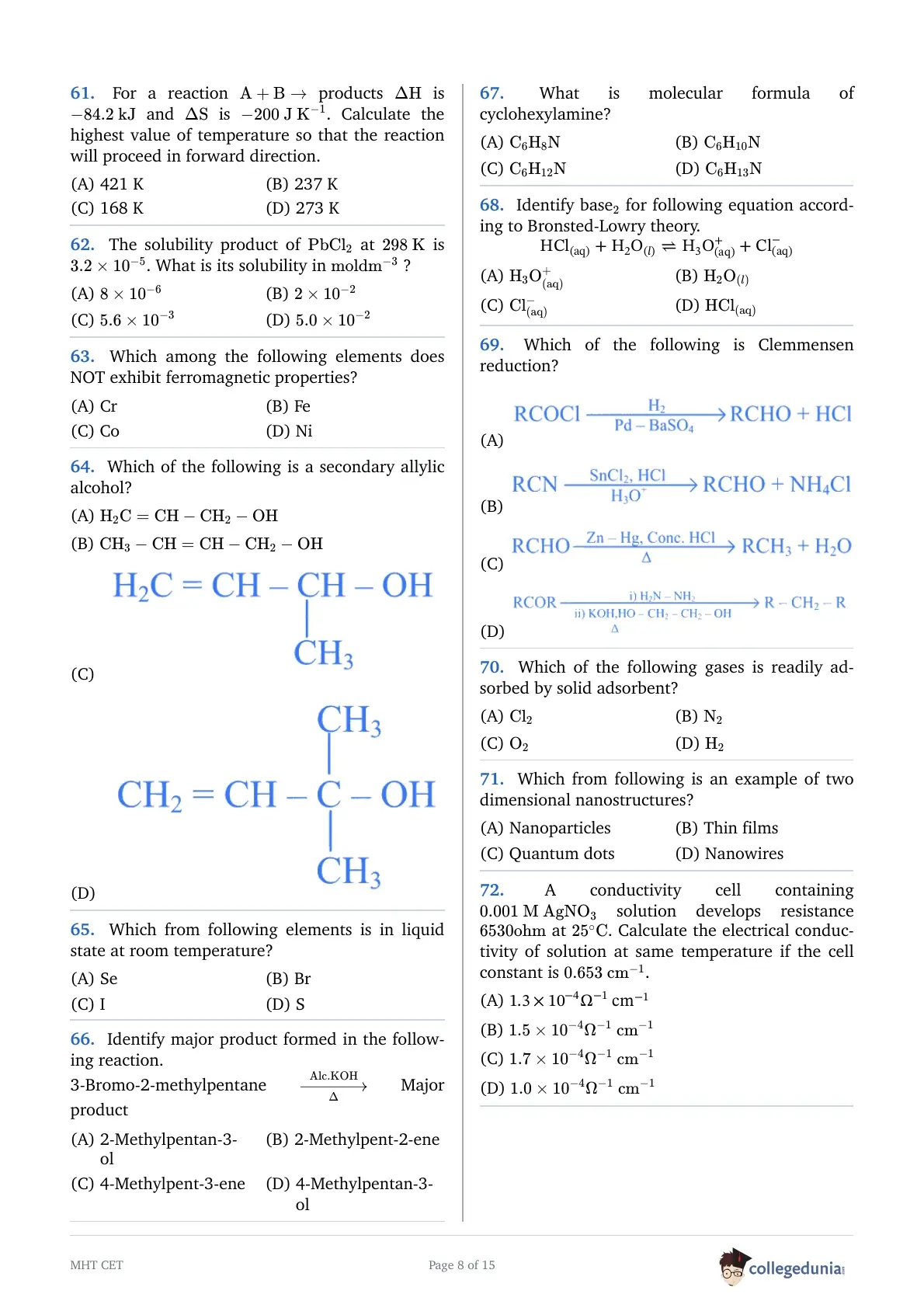
For a reaction \(\mathrm{A}+\mathrm{B} \rightarrow\) products \(\Delta \mathrm{H}\) is \(-84.2 \mathrm{~kJ}\) and \(\Delta \mathrm{S}\) is \(-200 \mathrm{~J} \mathrm{~K}^{-1}\). Calculate the highest value of temperature so that the reaction will proceed in forward direction.
The solubility product of PbCl2 at 298 K is \(3.2 \times 10^{-5}\). What is its solubility in moldm\(^{-3}\)?
Which among the following elements does NOT exhibit ferromagnetic properties?
Which of the following is a secondary allylic alcohol?
- (A) \(\mathrm{H}_{2}\mathrm{C}=\mathrm{CH}-\mathrm{CH}_{2}-\mathrm{OH}\)
- (B) \(\mathrm{CH}_{3}-\mathrm{CH}=\mathrm{CH}-\mathrm{CH}_{2}-\mathrm{OH}\)
- (C)
![]()
- (D)
![]()


Which from following elements is in liquid state at room temperature?
Identify major product formed in the following reaction. 3-Bromo-2-methylpentane \(\xrightarrow{Alc.KOH}\) Major product
What is molecular formula of cyclohexylamine?
Identify base\(_2\) for following equation according to Bronsted-Lowry theory. HCl\(_{(aq)}\) + H\(_2\)O\(_{(l)}\) \(\rightleftharpoons\) H\(_3\)O\(^+_{(aq)}\) + Cl\(^-_{(aq)}\)}

Which of the following gases is readily adsorbed by solid adsorbent?
Which from following is an example of two dimensional nanostructures?
A conductivity cell containing 0.001 M AgNO\(_3\) solution develops resistance 6530ohm at 25\(^{\circ}\)C. Calculate the electrical conductivity of solution at same temperature if the cell constant is 0.653 cm\(^{-1}\).
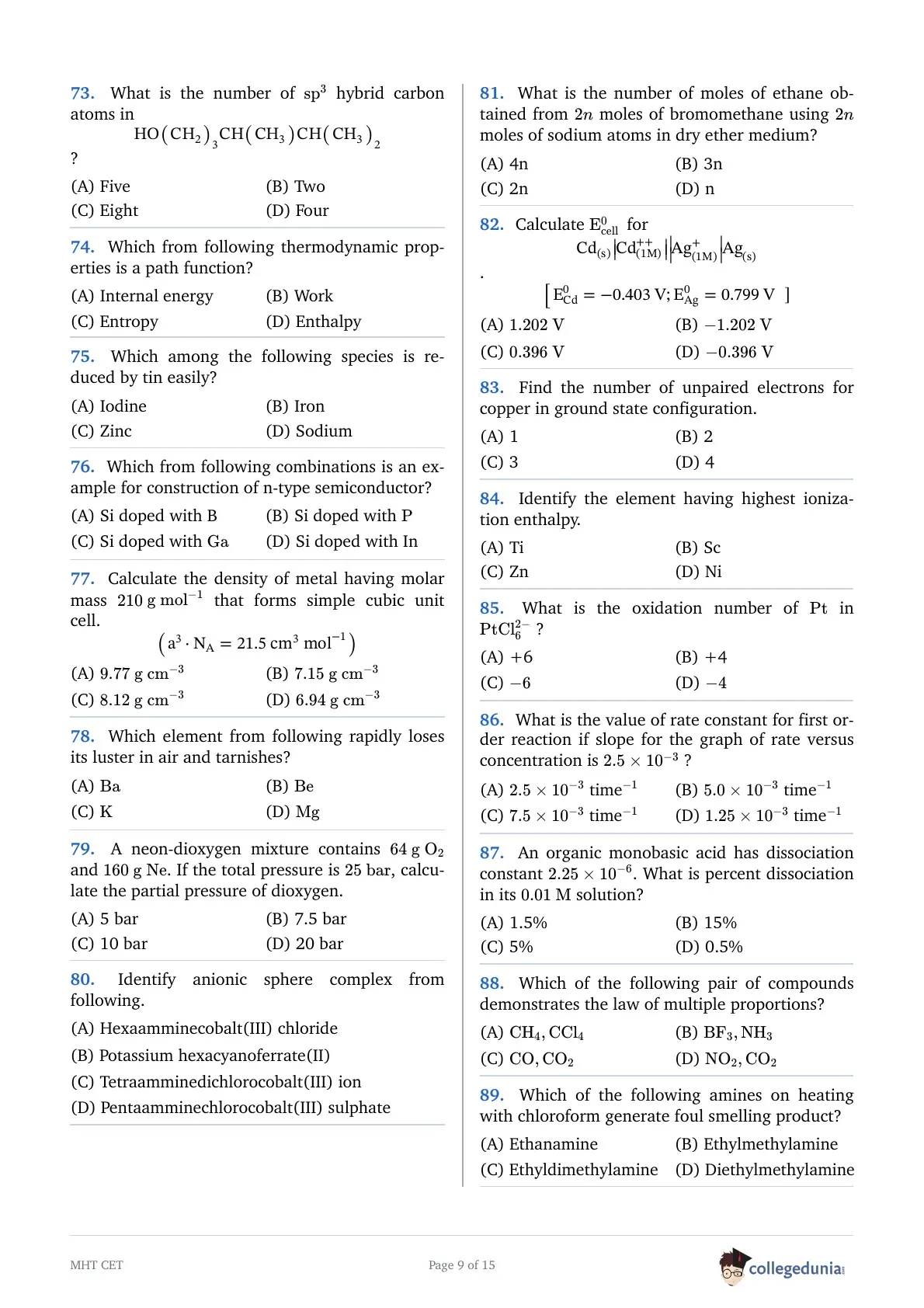
What is the number of \(\text{sp}^{3}\) hybrid carbon atoms in \(\text{HO(CH}_{2})_{3}\text{CH(CH}_{3})\text{CH(CH}_{3})_{2}\)?
Which from following thermodynamic properties is a path function?
Which among the following species is reduced by tin easily?
Which from following combinations is an example for construction of n-type semiconductor?
Calculate the density of metal having molar mass \(210 \mathrm{~g} \mathrm{~mol}^{-1}\) that forms simple cubic unit cell. \(\left(\mathrm{a}^3 \cdot \mathrm{N}_{\mathrm{A}}=21.5 \mathrm{~cm}^3 \mathrm{~mol}^{-1}\right)\)
Which element from following rapidly loses its its luster in air and tarnishes?
A neon-dioxygen mixture contains 64 g \(O_2\) and 160 g \(Ne\). If the total pressure is 25 bar, calculate the partial pressure of dioxygen.
Identify anionic sphere complex from following.
What is the number of moles of ethane obtained from 2n moles of bromomethane using 2n moles of sodium atoms in dry ether medium?
Calculate \(E^0_{cell}\) for \(Cd(s) | Cd^{++}(1M) | | Ag^{+}(1M) | Ag(s)\). Given \(E^0_{Cd} = -0.403 V\); \(E^0_{Ag} = 0.799 V\).
Find the number of unpaired electrons for copper in ground state configuration.
Identify the element having highest ionization enthalpy.
What is the oxidation number of Pt in PtCl\(_6^{2-}\)?
What is the value of rate constant for first order reaction if slope for the graph of rate versus concentration is \(2.5 \times 10^{-3}\)?
An organic monobasic acid has dissociation constant \(2.25 \times 10^{-6}\). What is percent dissociation in its \(0.01 \text{ M}\) solution?
Which of the following pair of compounds demonstrates the law of multiple proportions?
Which of the following amines on heating with chloroform generate foul smelling product?
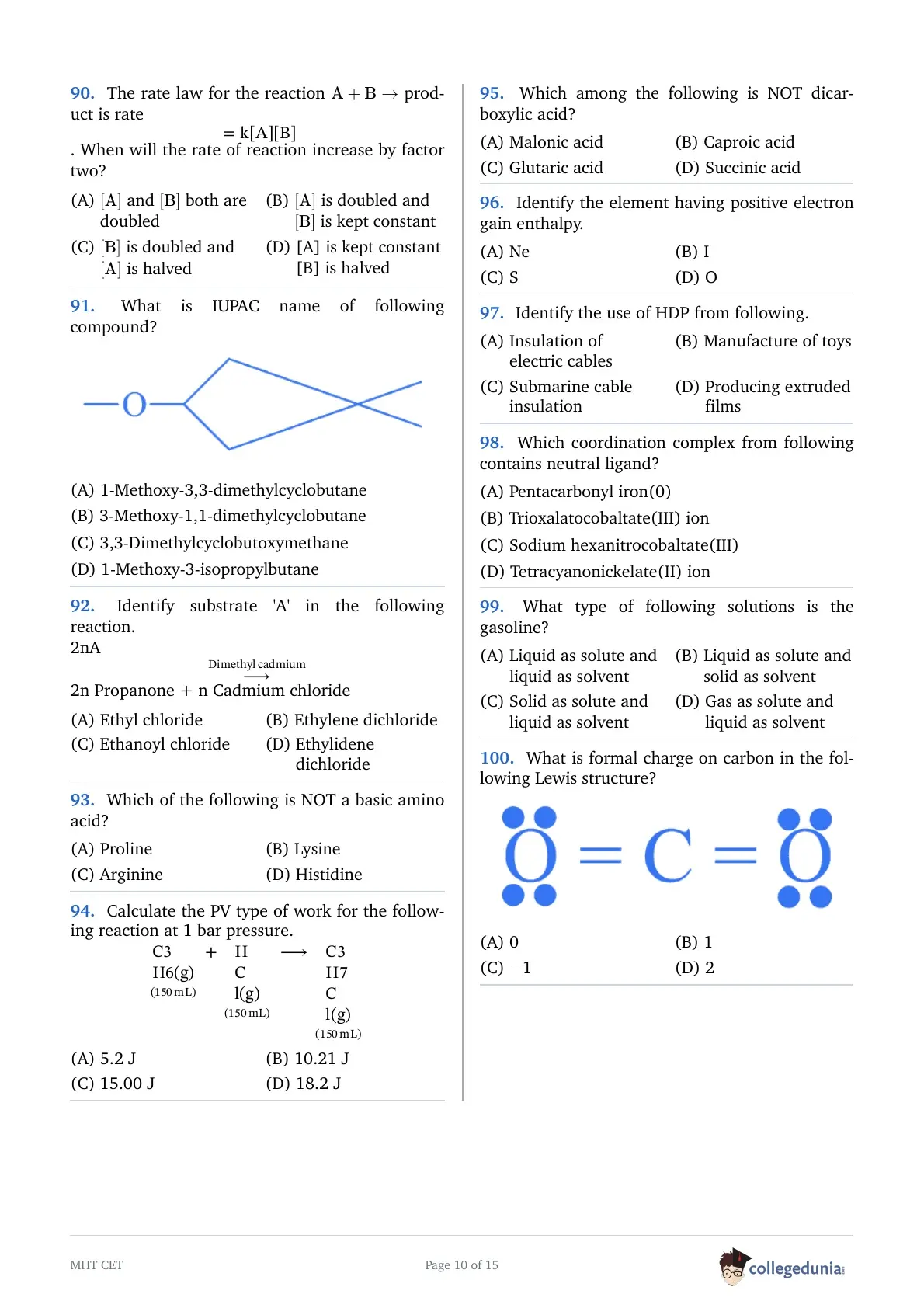
The rate law for the reaction A + B → product is rate = k[A][B]. When will the rate of reaction increase by factor two?

Identify substrate 'A' in the following reaction. 2nA Dimethyl cadmium → 2n Propanone + n Cadmium chloride
Calculate the PV type of work for the following reaction at 1 bar pressure.
\[\mathrm{\mathop {{C_3}{H_{6(g)}}}\limits_{(150\,mL)} + \mathop {HC{l_{(g)}}}\limits_{(150\,mL)} \buildrel {} \over \longrightarrow \mathop {{C_3}{H_7}C{l_{(g)}}}\limits_{(150\,mL)}}\]
Which among the following is NOT dicarboxylic acid?
Identify the element having positive electron gain enthalpy.
Identify the use of HDP from following.
Which coordination complex from following contains neutral ligand?
What type of following solutions is the gasoline?

Mathematics (Q101 - Q150)
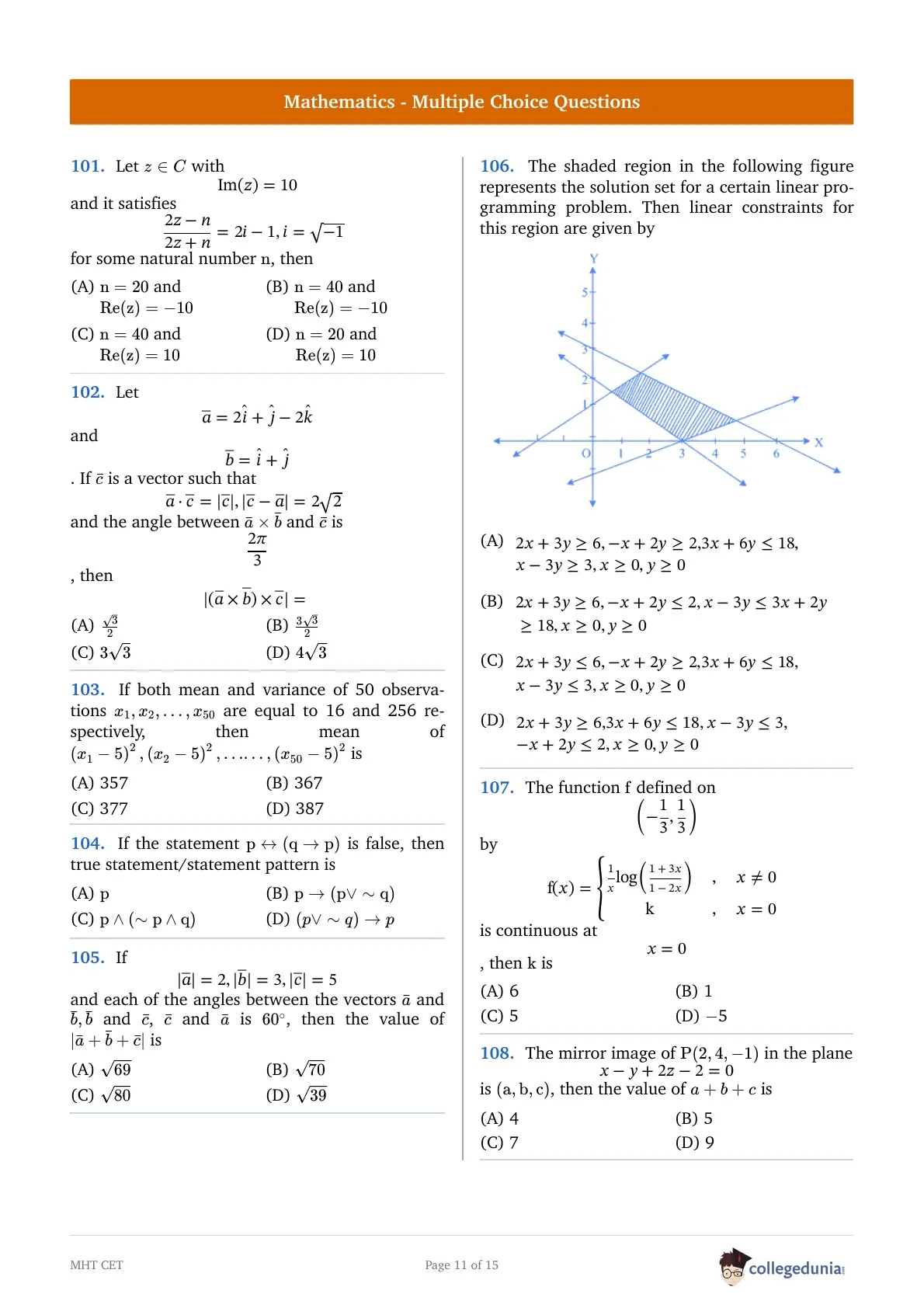
Let \(z \in C\) with \(\text{Im}(z) = 10\) and it satisfies \(\frac{2z-n}{2z+n} = 2i - 1\), \(i = \sqrt{-1}\) for some natural number \(n\), then
Let \(\bar{a}=2 \hat{i}+\hat{j}-2 \hat{k}\) and \(\bar{b}=\hat{i}+\hat{j}\). If \(\bar{c}\) is a vector such that \(\bar{a} \cdot \bar{c}=|\bar{c}|,|\bar{c}-\bar{a}|=2 \sqrt{2}\) and the angle between \(\bar{a} \times \bar{b}\) and \(\bar{c}\) is \(\frac{2 \pi}{3}\), then \(|(\bar{a} \times \bar{b}) \times \bar{c}|=\)
If both mean and variance of 50 observations \(x_1, x_2, \ldots, x_{50}\) are equal to 16 and 256 respectively, then mean of \((x_1-5)^2, (x_2-5)^2, \ldots, (x_{50}-5)^2\) is
If the statement \(p \leftrightarrow (q \rightarrow p)\) is false, then true statement/statement pattern is
If \(|\vec{a}| = 2\), \(|\vec{b}| = 3\), \(|\vec{c}| = 5\) and each of the angles between the vectors \(\vec{a}\) and \(\vec{b}\), \(\vec{b}\) and \(\vec{c}\), \(\vec{c}\) and \(\vec{a}\) is \(60^\circ\), then the value of \(|\vec{a} + \vec{b} + \vec{c}|\) is
The shaded region in the following figure represents the solution set for a certain linear programming problem. Then linear constraints for this region are given by
The function \(\mathrm{f}\) defined on \(\left(-\frac{1}{3}, \frac{1}{3}\right)\) by \(\mathrm{f}(x)=\left\{\begin{array}{cc} \frac{1}{x} \log \left(\frac{1+3 x}{1-2 x}\right) & , \quad x \neq 0 \\ \mathrm{k} & , \quad x=0 \end{array}\right.\) is continuous at \(x=0\), then \(\mathrm{k}\) is
The mirror image of \(P(2, 4, -1)\) in the plane \(x - y + 2z - 2 = 0\) is \((a, b, c)\), then the value of \(a+b+c\) is
If the slope of the tangent of the curve at any point is equal to \(-y+e^{-x}\), then the equation of the curve passing through origin is
If \(A = \begin{bmatrix} 1 & -1 \\ 2 & -1 \end{bmatrix}, B = \begin{bmatrix} 1 & 1 \\ 4 & -1 \end{bmatrix}\), then \((A+B)^{-1}\) is
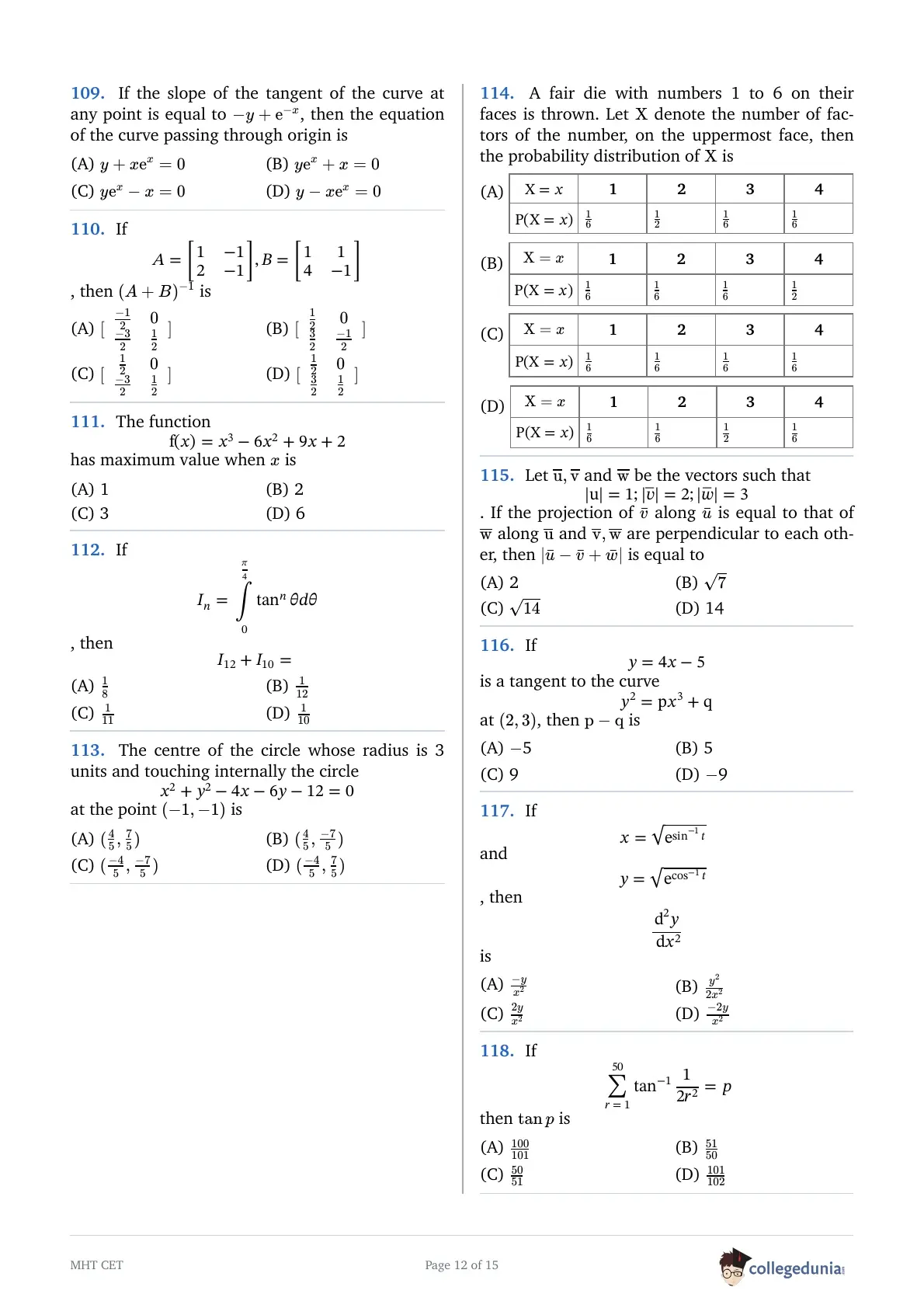
The function \(\mathrm{f}(x)=x^3-6 x^2+9 x+2\) has maximum value when \(x\) is
If \(I_n = \int_0^{\pi/4} \tan^n \theta d\theta\), then \(I_{12} + I_{10}\) is equal to
The centre of the circle whose radius is 3 units and touching internally the circle \(x^2 + y^2 - 4x - 6y - 12 = 0\) at the point \((-1, -1)\) is
A fair die with numbers 1 to 6 on their faces is thrown. Let \(X\) denote the number of factors of the number, on the uppermost face, then the probability distribution of \(X\) is
Let \(\vec{u}\), \(\vec{v}\) and \(\vec{w}\) be the vectors such that \(|\vec{u}| = 1\); \(|\vec{v}| = 2\); \(|\vec{w}| = 3\). If the projection of \(\vec{v}\) along \(\vec{u}\) is equal to that of \(\vec{w}\) along \(\vec{u}\) and \(\vec{v}\), \(\vec{w}\) are perpendicular to each other, then \(|\vec{u} - \vec{v} + \vec{w}|\) is equal to
If \(y = 4x - 5\) is a tangent to the curve \(y^{2} = px^{3} + q\) at \((2, 3)\), then \(p-q\) is
If \(x=\sqrt{\mathrm{e}^{\sin ^{-1} t}}\) and \(y=\sqrt{\mathrm{e}^{\cos ^{-1} t}}\), then \(\frac{\mathrm{d}^2 y}{\mathrm{~d} x^2}\) is
If \(\sum_{r=1}^{50} \tan^{-1}\frac{1}{2r^{2 = p}}\) then \(\tan p\) is
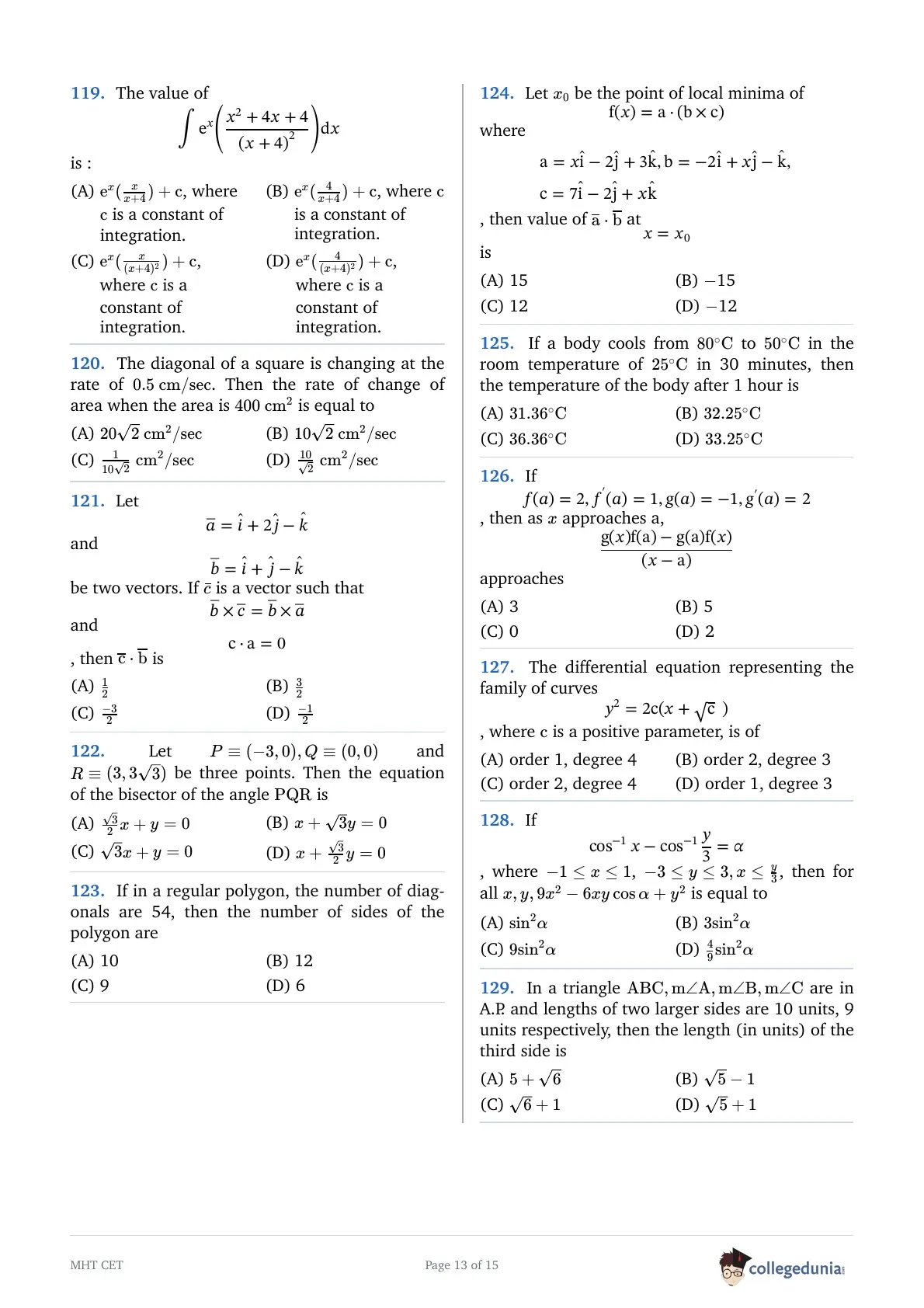
The value of \(\int \mathrm{e}^x\left(\frac{x^2+4 x+4}{(x+4)^2}\right) \mathrm{d} x\) is :
The diagonal of a square is changing at the rate of \(0.5 \mathrm{~cm} / \mathrm{sec}\). Then the rate of change of area when the area is \(400 \mathrm{~cm}^2\) is equal to
Let \(\bar{a}=\hat{i}+2 \hat{j}-\hat{k}\) and \(\bar{b}=\hat{i}+\hat{j}-\hat{k}\) be two vectors. If \(\bar{c}\) is a vector such that \(\bar{b} \times \bar{c}=\bar{b} \times \bar{a}\) and \(\overline{\mathrm{c}} \cdot \overline{\mathrm{a}}=0\), then \(\overline{\mathrm{c}} \cdot \overline{\mathrm{b}}\) is
Let \(P \equiv(-3,0), Q \equiv(0,0)\) and \(R \equiv(3,3 \sqrt{3})\) be three points. Then the equation of the bisector of the angle \(\mathrm{PQR}\) is
If in a regular polygon, the number of diagonals are 54, then the number of sides of the polygon are
Let \(x_0\) be the point of local minima of \(f(x) = \vec{a} \cdot (\vec{b} \times \vec{c})\) where \(\vec{a} = x\hat{i} - 2\hat{j} + 3\hat{k}\), \(\vec{b} = -2\hat{i} + x\hat{j} - \hat{k}\), \(\vec{c} = 7\hat{i} - 2\hat{j} + x\hat{k}\), then value of \(\vec{a} \cdot \vec{b}\) at \(x = x_0\) is
If a body cools from \[80^{\circ} \mathrm{C}\] to \[50^{\circ} \mathrm{C}\] in the room temperature of \[25^{\circ} \mathrm{C}\] in 30 minutes, then the temperature of the body after 1 hour is
If \(f(a)=2, f^{\prime}(a)=1, g(a)=-1, g^{\prime}(a)=2\), then as \(x\) approaches a, \(\frac{\mathrm{g}(x) \mathrm{f}(\mathrm{a})-\mathrm{g}(\mathrm{a}) \mathrm{f}(x)}{(x-\mathrm{a})}\) approaches
The differential equation representing the family of curves \(y^2 = 2c(x + \sqrt{c})\), where \(c\) is a positive parameter, is of
If \(\cos^{-1}x-\cos^{-1}\frac{y}{3}=\alpha\), where \(-1\le x\le1\), \(-3\le y\le3\), \(x\le\frac{y}{3}\), then for all \(x, y\), \(9x^{2}-6xy\cos\alpha+y^{2}\) is equal to
In a triangle ABC, \(m\angle A\), \(m\angle B\), \(m\angle C\) are in A.P. and lengths of two larger sides are 10 units, 9 units respectively, then the length (in units) of the third side is
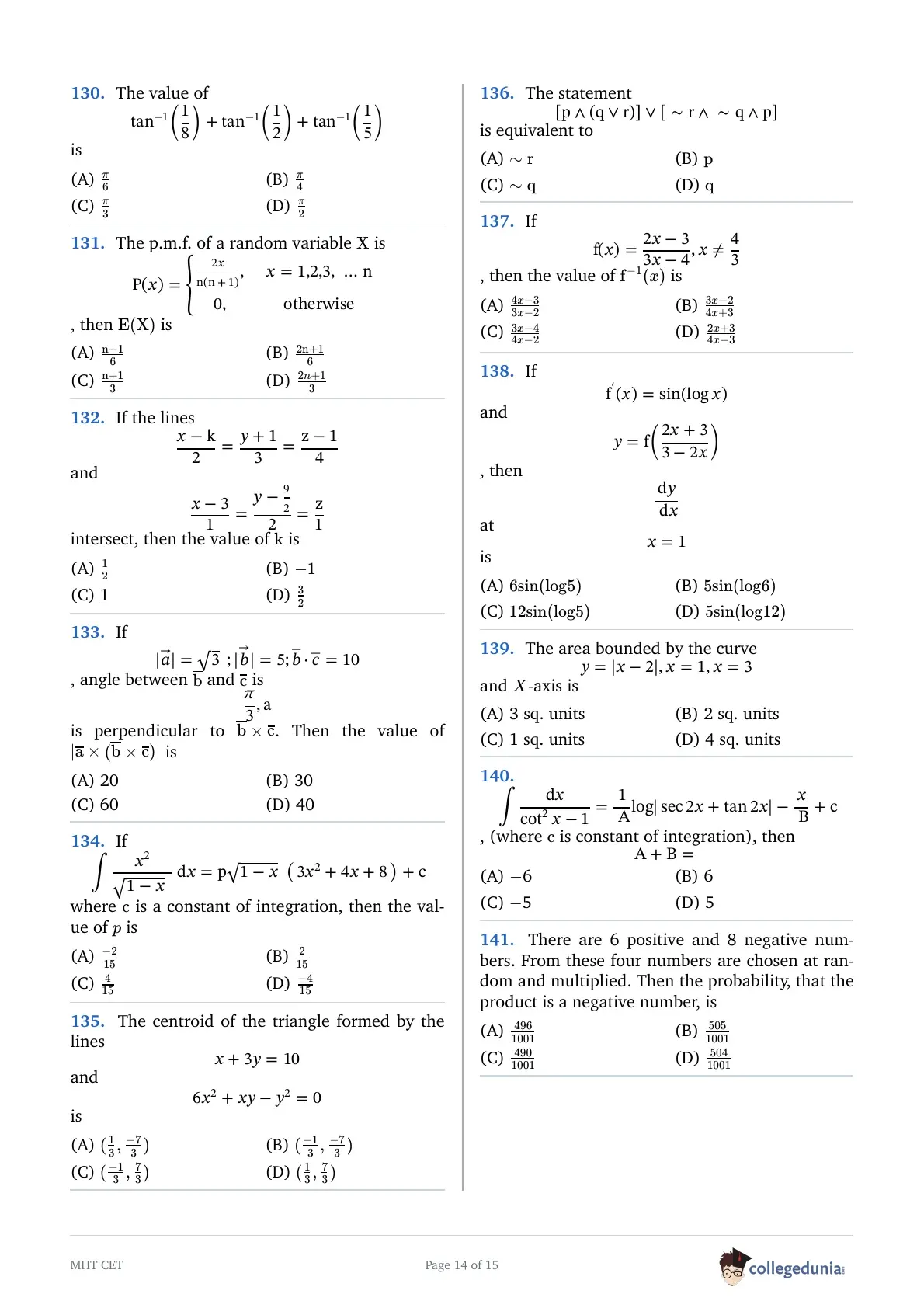
The value of \(\tan^{-1} \left(\frac{1}{8}\right) + \tan^{-1} \left(\frac{1}{2}\right) + \tan^{-1} \left(\frac{1}{5}\right)\) is
The p.m.f. of a random variable \[\mathrm{X}\] is \[\mathrm{P}(x)=\left\{\begin{array}{cl}\frac{2 x}{\mathrm{n}(\mathrm{n}+1)}, & x=1,2,3, \ldots \mathrm{n} \\ 0, & \text { otherwise }\end{array}\right.\], then \[\mathrm{E}(\mathrm{X})\] is
If the lines \(\frac{x-\mathrm{k}}{2}=\frac{y+1}{3}=\frac{\mathrm{z}-1}{4}\) and \(\frac{x-3}{1}=\frac{y-\frac{9}{2}}{2}=\frac{\mathrm{z}}{1}\) intersect, then the value of \(\mathrm{k}\) is
If \(|\vec{a}| = \sqrt{3}\); \(|\vec{b}| = 5\); \(\vec{b} \cdot \vec{c} = 10\), angle between \(\vec{b}\) and \(\vec{c}\) is \(\frac{\pi}{3}\), \(\vec{a}\) is perpendicular to \(\vec{b} \times \vec{c}\). Then the value of \(|\vec{a} \times (\vec{b} \times \vec{c})|\) is
If \(\int \frac{x^2}{\sqrt{1-x }}dx = p\sqrt{1-x} (3x^2 + 4x + 8) + c\) where \(c\) is a constant of integration, then the value of \(p\) is
The centroid of the triangle formed by the lines \(x + 3y = 10\) and \(6x^2 + xy - y^2 = 0\) is
The statement \([p \land (q \lor r)] \lor [\sim r \land \sim q \land p]\) is equivalent to
If \(f(x) = \frac{2x-3}{3x-4}, x \neq \frac{4}{3}\), then the value of \(f^{-1}(x)\) is
If \(f'(x) = \sin(\log x)\) and \(y = f\left(\frac{2x+3}{3-2x}\right)\), then \(\frac{dy}{dx}\) at \(x=1\) is
The area bounded by the curve \(y = |x - 2|\), \(x = 1\), \(x = 3\) and X-axis is
\(\int \frac{dx}{\cot^2 x - 1} = \frac{1}{A} \log |\sec 2x + \tan 2x| - \frac{x}{B} + c\), (where \(c\) is constant of integration), then \(A + B =\)
There are 6 positive and 8 negative numbers. From these four numbers are chosen at random and multiplied. Then the probability, that the product is a negative number, is
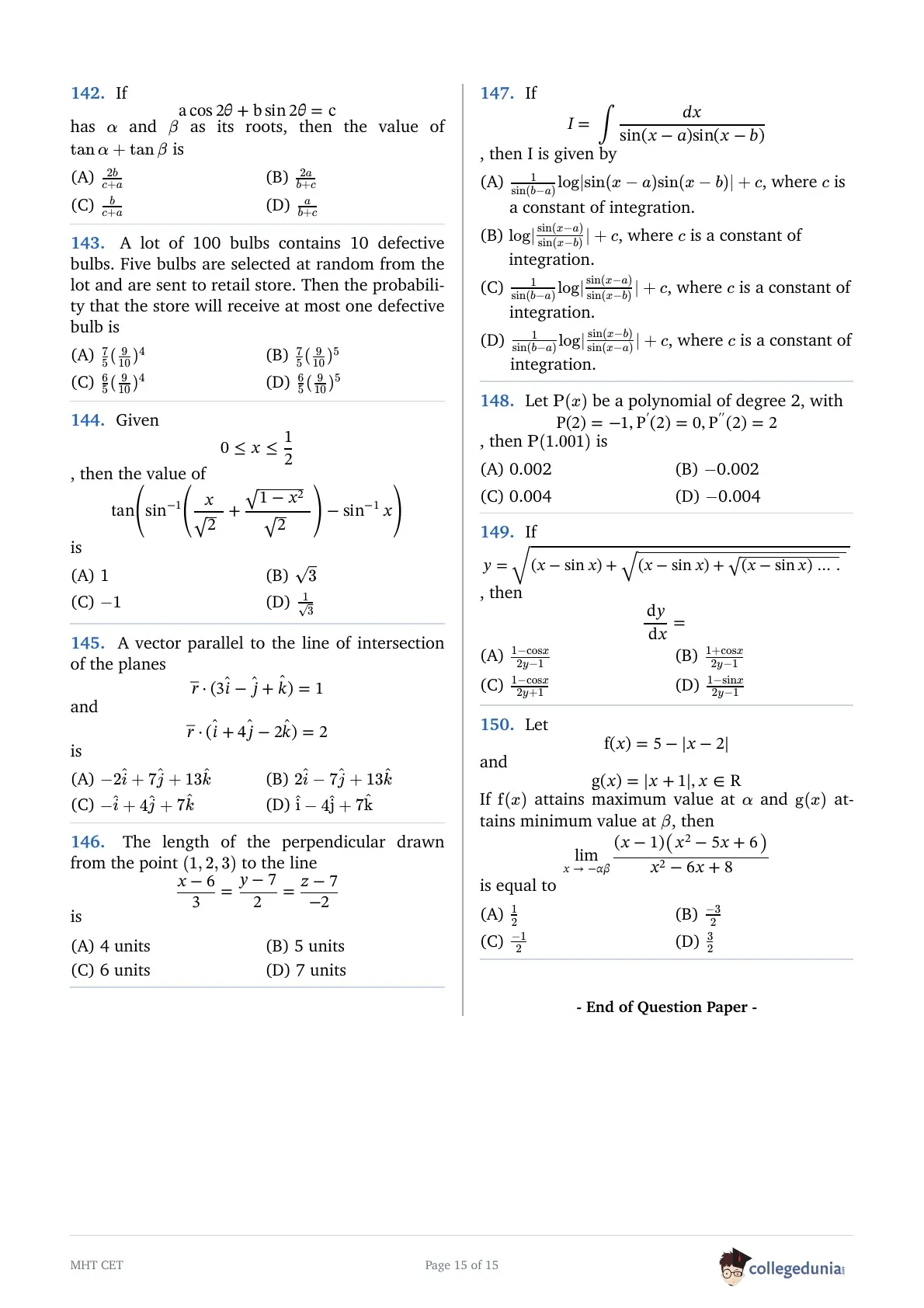
If \(a \cos 2\theta + b \sin 2\theta = c\) has \(\alpha\) and \(\beta\) as its roots, then the value of \(\tan \alpha + \tan \beta\) is
A lot of 100 bulbs contains 10 defective bulbs. Five bulbs are selected at random from the lot and are sent to retail store. Then the probability that the store will receive at most one defective bulb is
Given \(0 \leq x \leq \frac{1}{2}\), then the value of \(\tan \left(\sin ^{-1}\left(\frac{x}{\sqrt{2}}+\frac{\sqrt{1-x^2}}{\sqrt{2}}\right)-\sin ^{-1} x\right)\) is
A vector parallel to the line of intersection of the planes \(\vec{r} \cdot (3\hat{i} - \hat{j} + \hat{k}) = 1\) and \(\vec{r} \cdot (\hat{i} + 4\hat{j} - 2\hat{k}) = 2\) is
The length of the perpendicular drawn from the point \((1, 2, 3)\) to the line \(\frac{x-6}{3} = \frac{y-7}{2} = \frac{z-7}{-2}\) is
If \(I = \int \frac{dx}{\sin(x-a) \sin(x-b)}\), then \(I\) is given by
Let \(P(x)\) be a polynomial of degree 2, with \(P(2) = -1\), \(P'(2) = 0\), \(P''(2) = 2\), then \(P(1.001)\) is
If \[y=\sqrt{(x-\sin x)+\sqrt{(x-\sin x)+\sqrt{(x-\sin x) \ldots.}}}\], then \[\frac{\mathrm{d} y}{\mathrm{~d} x}=\]
Let \(f(x) = 5 - |x-2|\) and \(g(x) = |x + 1|\), \(x \in \mathbb{R}\). If \(f(x)\) attains maximum value at \(\alpha\) and \(g(x)\) attains minimum value at \(\beta\), then \(\lim_{x \to \alpha\beta} \frac{(x-1)(x^2-5x+6)}{x^2-6x+8}\) is equal to
MHT CET 2023 PCM Exam Pattern and Marking Scheme
| Parameter | Details |
|---|---|
| Conducting Body | Maharashtra Common Entrance Test Cell (Maharashtra CET Cell) |
| Exam Mode | Online (Computer-Based Test) |
| Duration | 180 minutes (3 hours) |
| Groups / Subjects | PCM (Physics, Chemistry, Mathematics) for Engineering |
| Total Questions |
150 |
| Total Marks | 200 |
| Question Type | Multiple Choice Questions (MCQs) |
| Marks Distribution |
|
| Negative Marking | No |
| Syllabus Weightage |
|



Comments