




The SNAP 2009 question paper is now available with detailed solutions for free download. SNAP 2009 was conducted by Symbiosis International (Deemed University), Pune in December 2009 for admission to its MBA and PGDM programmes, and the paper carried 150 objective questions across four sections in a 150-minute, paper-based test.
| SNAP 2009 Question Paper with Solutions | Download PDF | Check Solutions |
SNAP 2009 Combined paper Questions with Solutions
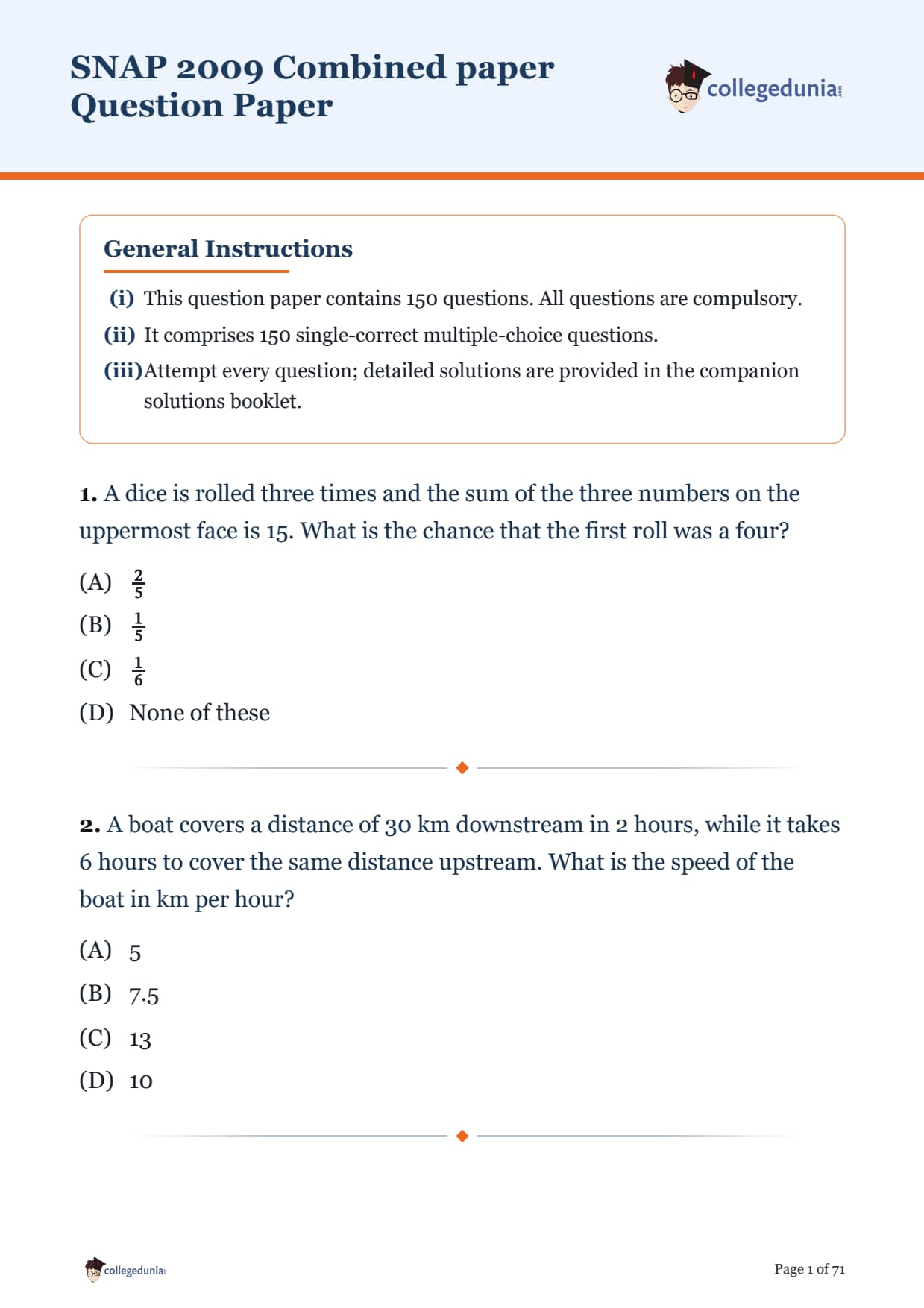
A dice is rolled three times and the sum of the three numbers on the uppermost face is 15. What is the chance that the first roll was a four?
A boat covers a distance of 30 km downstream in 2 hours, while it takes 6 hours to cover the same distance upstream. What is the speed of the boat in km per hour?
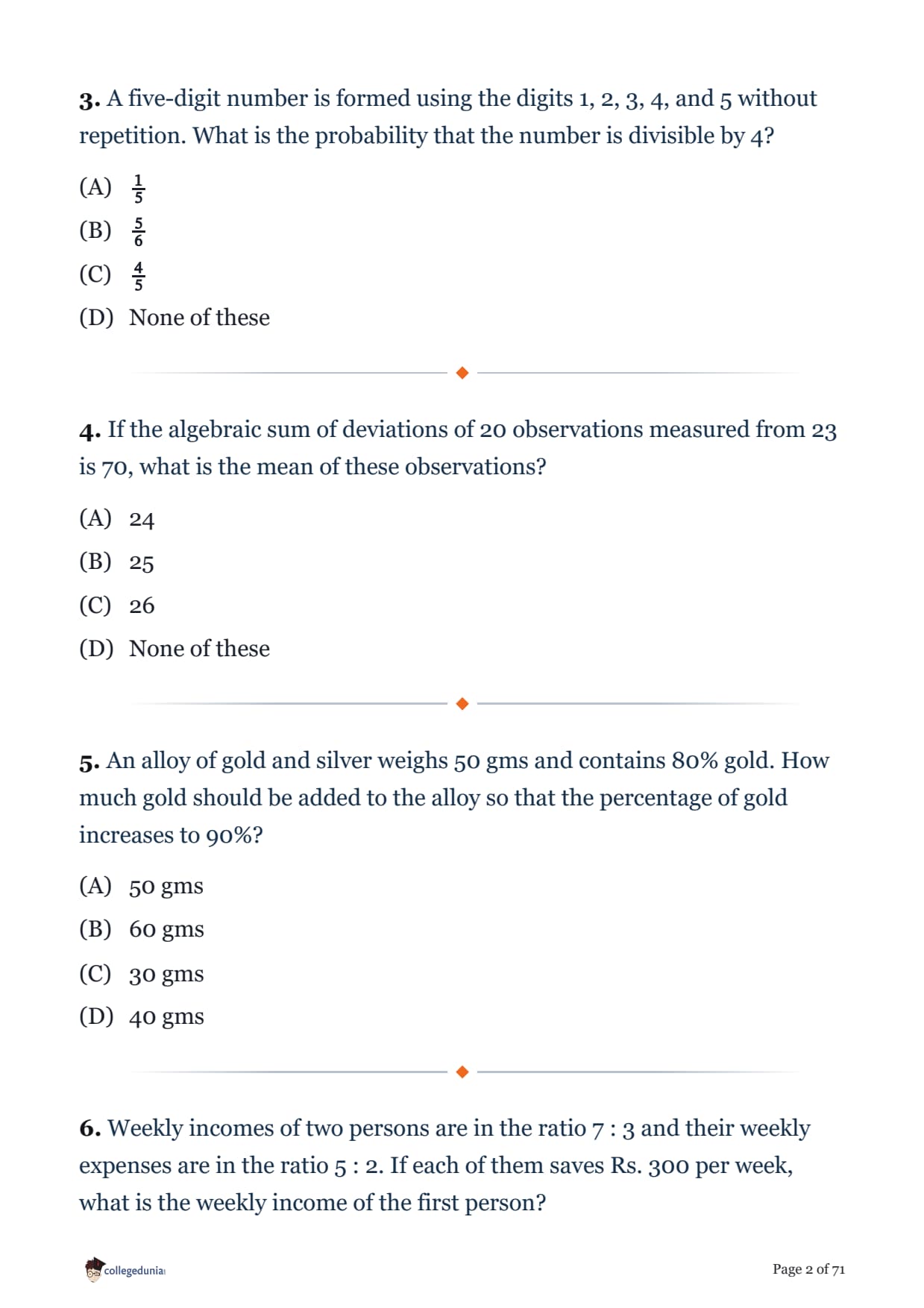
A five-digit number is formed using the digits 1, 2, 3, 4, and 5 without repetition. What is the probability that the number is divisible by 4?
If the algebraic sum of deviations of 20 observations measured from 23 is 70, what is the mean of these observations?
An alloy of gold and silver weighs 50 gms and contains 80% gold. How much gold should be added to the alloy so that the percentage of gold increases to 90%?
Weekly incomes of two persons are in the ratio 7 : 3 and their weekly expenses are in the ratio 5 : 2. If each of them saves Rs. 300 per week, what is the weekly income of the first person?
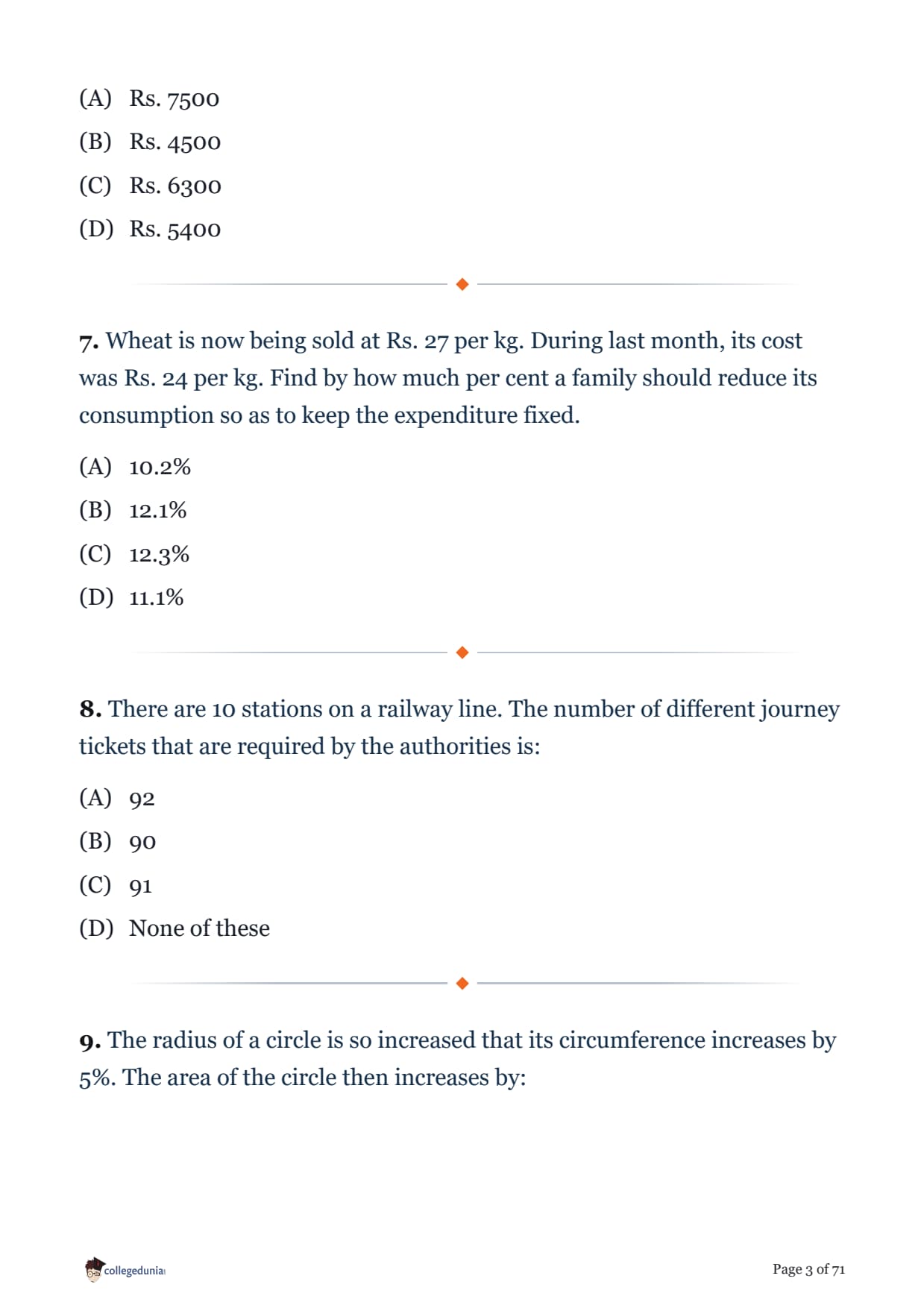
Wheat is now being sold at Rs. 27 per kg. During last month, its cost was Rs. 24 per kg. Find by how much per cent a family should reduce its consumption so as to keep the expenditure fixed.
There are 10 stations on a railway line. The number of different journey tickets that are required by the authorities is:
The radius of a circle is so increased that its circumference increases by 5%. The area of the circle then increases by:
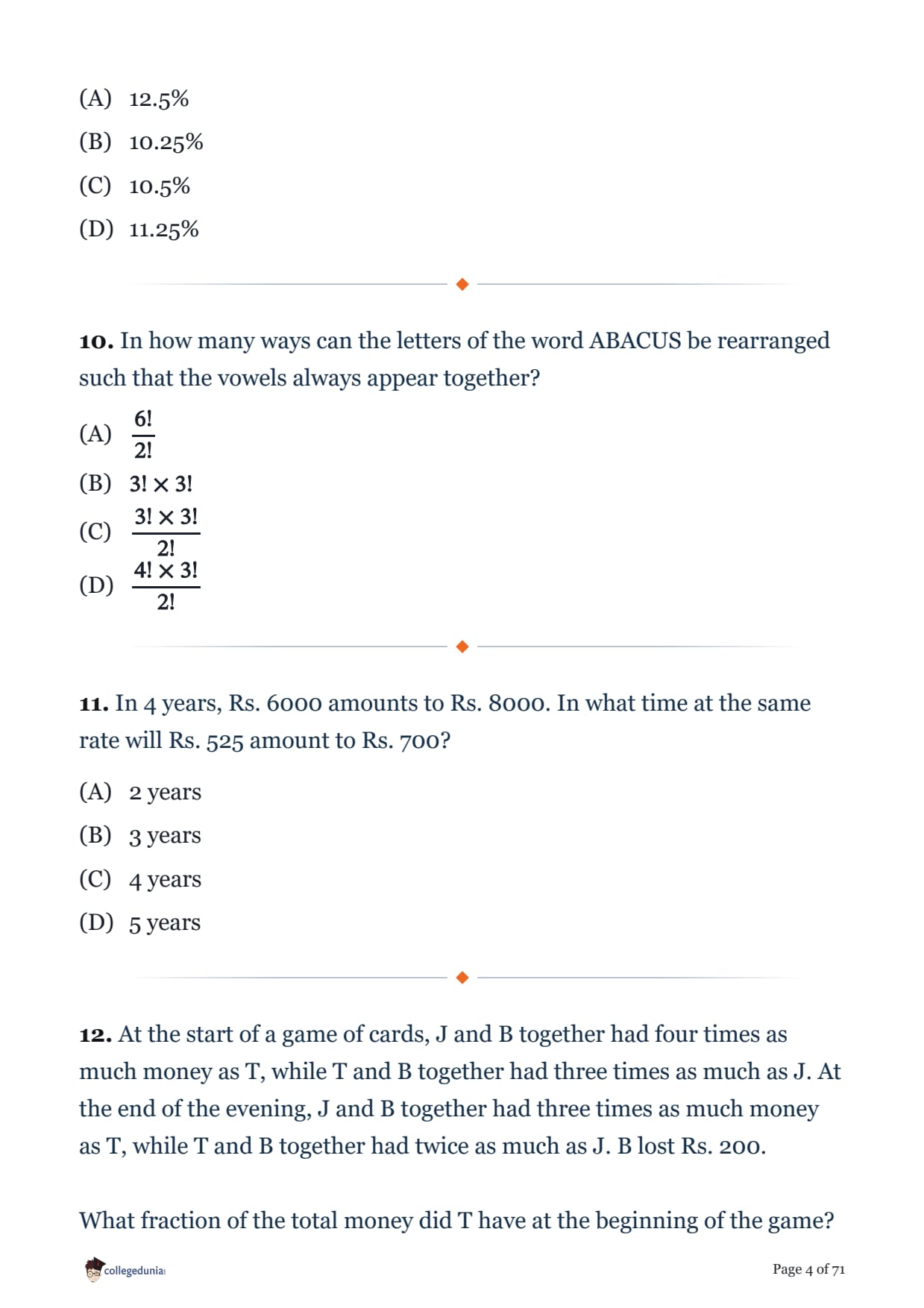
In how many ways can the letters of the word ABACUS be rearranged such that the vowels always appear together?
In 4 years, Rs. 6000 amounts to Rs. 8000. In what time at the same rate will Rs. 525 amount to Rs. 700?
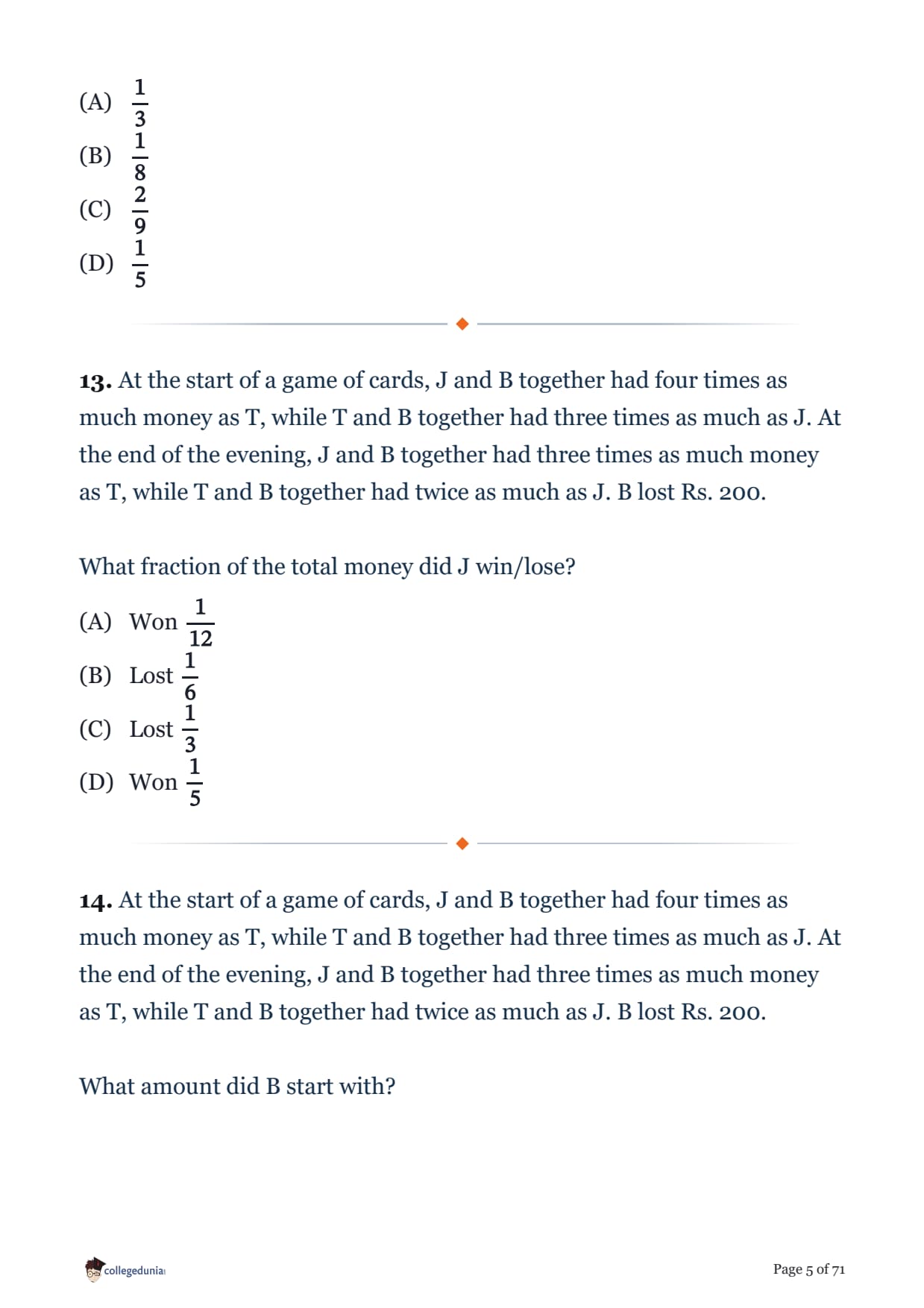
At the start of a game of cards, J and B together had four times as much money as T, while T and B together had three times as much as J. At the end of the evening, J and B together had three times as much money as T, while T and B together had twice as much as J. B lost Rs. 200.
What fraction of the total money did T have at the beginning of the game?
At the start of a game of cards, J and B together had four times as much money as T, while T and B together had three times as much as J. At the end of the evening, J and B together had three times as much money as T, while T and B together had twice as much as J. B lost Rs. 200.
What fraction of the total money did J win/lose?
At the start of a game of cards, J and B together had four times as much money as T, while T and B together had three times as much as J. At the end of the evening, J and B together had three times as much money as T, while T and B together had twice as much as J. B lost Rs. 200.
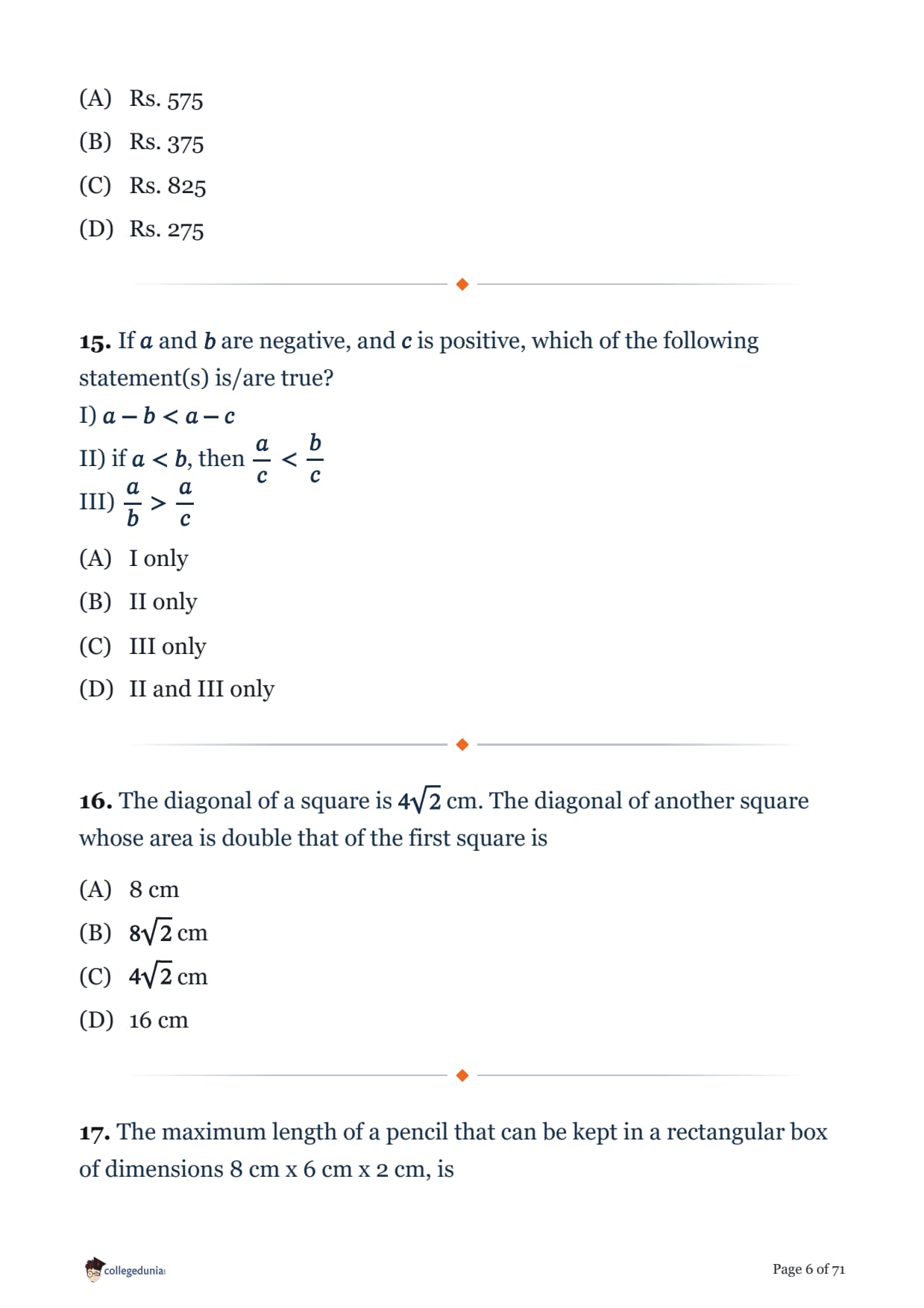
What amount did B start with?
If \(a\) and \(b\) are negative, and \(c\) is positive, which of the following statement(s) is/are true?
I) \(a - b < a - c\)
II) if \(a < b\), then \(\dfrac{a}{c} < \dfrac{b}{c}\)
III) \(\dfrac{a}{b} > \dfrac{a}{c}\)
The diagonal of a square is \(4\sqrt{2}\) cm. The diagonal of another square whose area is double that of the first square is
The maximum length of a pencil that can be kept in a rectangular box of dimensions 8 cm x 6 cm x 2 cm, is
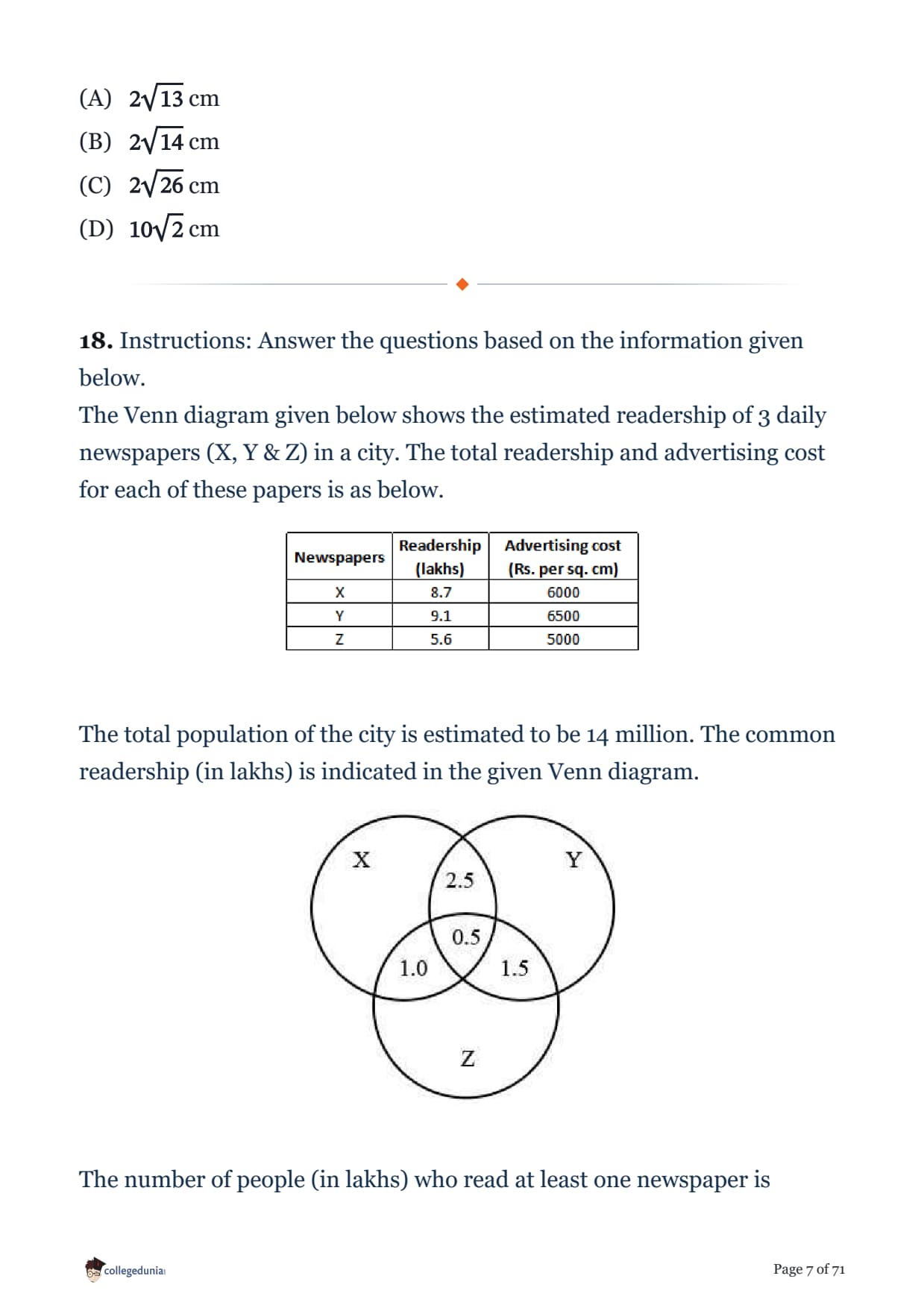
Instructions: Answer the questions based on the information given below.
The Venn diagram given below shows the estimated readership of 3 daily newspapers (X, Y & Z) in a city. The total readership and advertising cost for each of these papers is as below.

The total population of the city is estimated to be 14 million. The common readership (in lakhs) is indicated in the given Venn diagram.

The number of people (in lakhs) who read at least one newspaper is
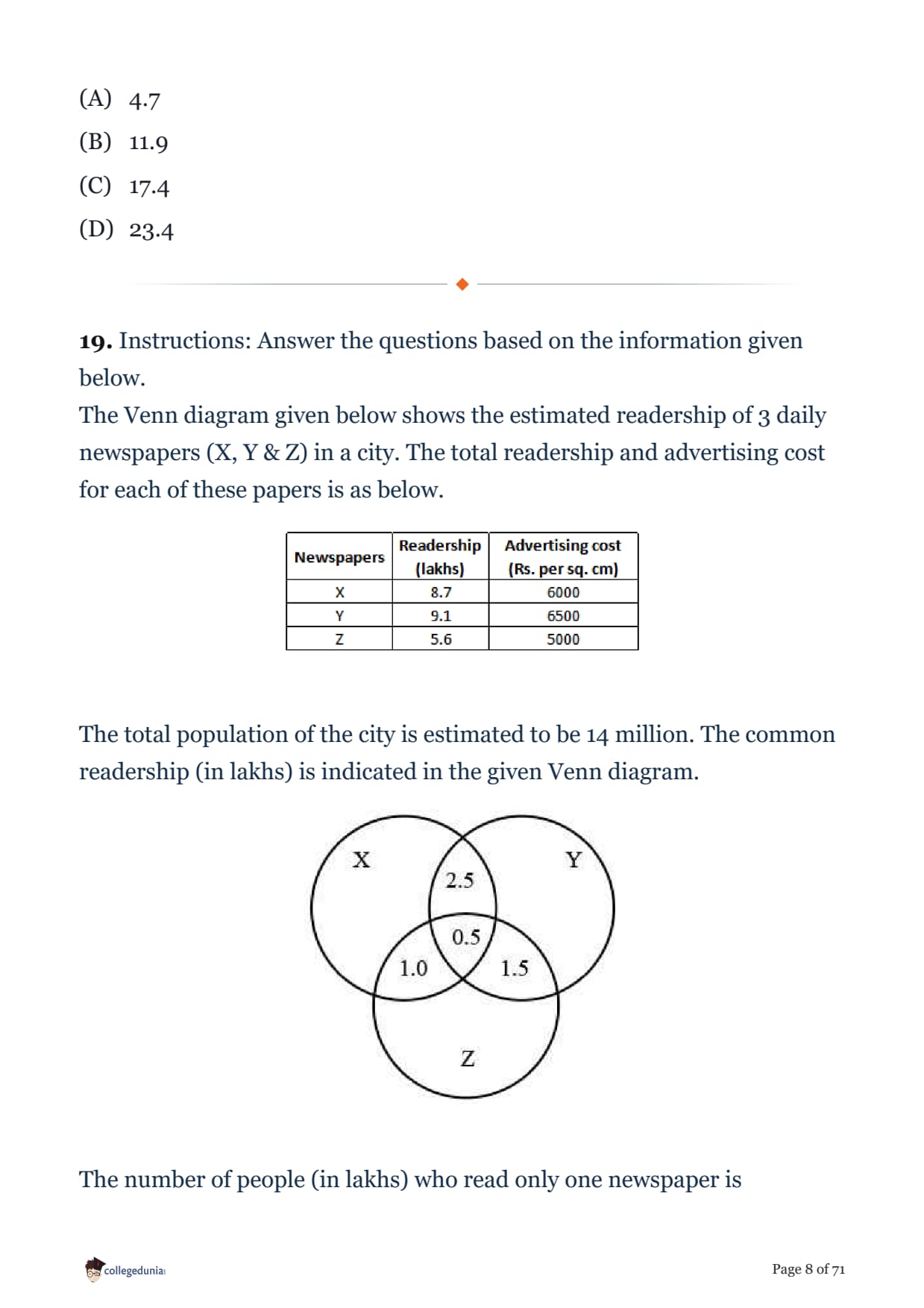
Instructions: Answer the questions based on the information given below.
The Venn diagram given below shows the estimated readership of 3 daily newspapers (X, Y & Z) in a city. The total readership and advertising cost for each of these papers is as below.
The total population of the city is estimated to be 14 million. The common readership (in lakhs) is indicated in the given Venn diagram.
The number of people (in lakhs) who read only one newspaper is
Sonali invests 15% of her monthly salary in insurance policies. She spends 55% of her monthly salary in shopping and on household expenses. She saves the remaining amount of Rs. 12,750. What is Sonali's monthly income?
How many kgs of tea worth Rs. 25 per kg must be blended with 30 kgs of tea worth Rs. 30 per kg so that by selling the blended variety at Rs. 30 per kg there should be a gain of 10%?
In an examination, out of 480 students, 85% of the girls and 70% of the boys passed. How many boys appeared in the examination if the total pass percentage was 75%?
300 gms of salt solution has 40% salt in it. How much salt should be added to make it 50% in the solution?


A five-digit number divisible by 3 is to be formed using the numerals 0, 1, 2, 3, 4 and 5 without repetition. The total number of ways this can be done is:
A contract is to be completed in 50 days and 105 men were set to work, each working 8 hours a day. After 25 days, \( \frac{2}{5} \) of the work is finished. How many additional men should be employed so that the work may be completed on time, with each man now working 9 hours a day?
A can build up a structure in 8 days and B can break it down in 3 days. A worked alone for 4 days, then B joined to work with A for another 2 days only. In how many days will A alone build up the remaining part of the structure?
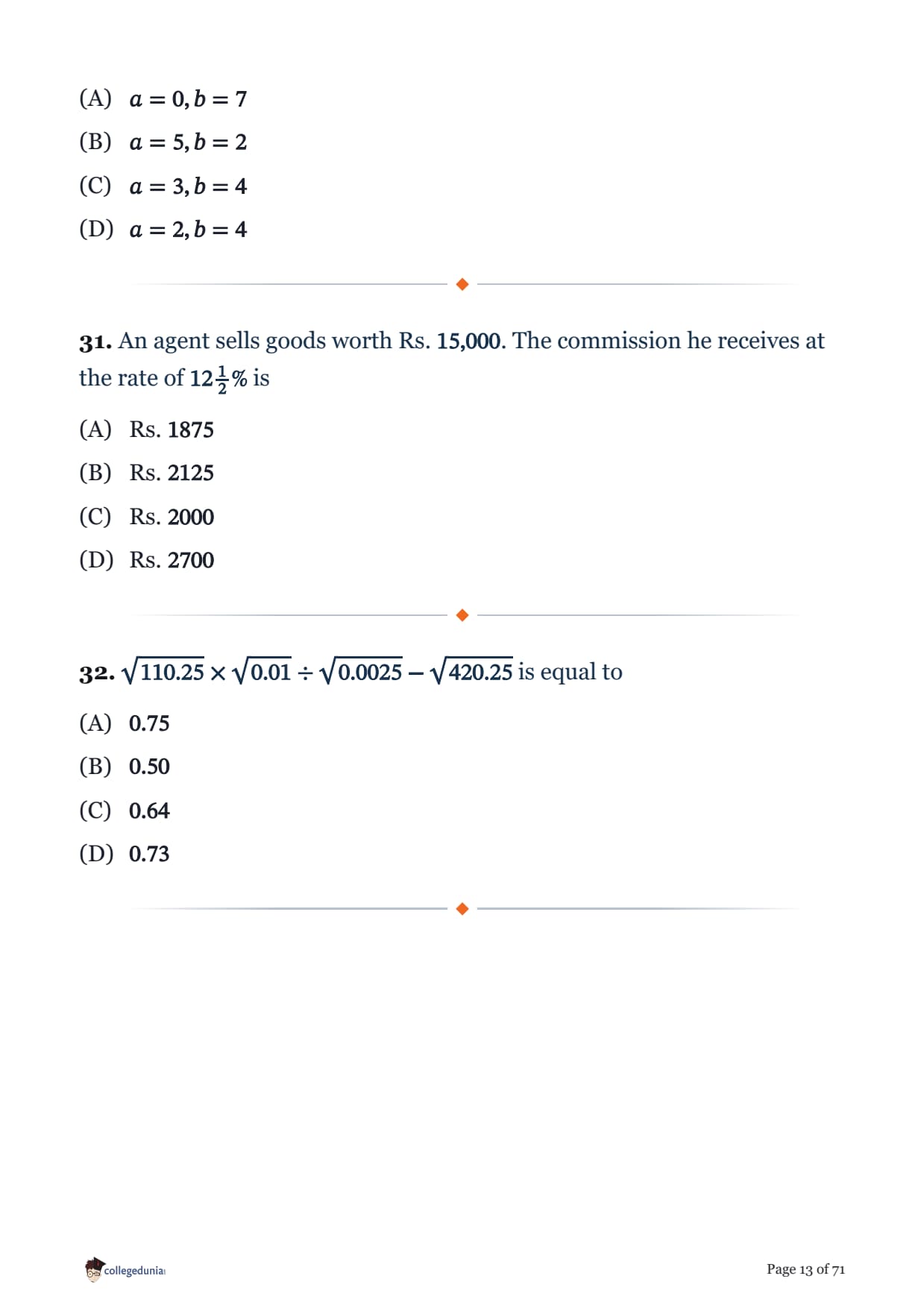
The first two terms of a geometric progression add up to \(12\). The sum of the third and fourth terms is \(48\). If the terms of the progression are alternately positive and negative, the first term is
The mean of the numbers \(a\), \(b\), \(8\), \(5\), \(10\) is \(6\) and the variance is \(6.80\). Which one of the following gives possible values of \(a\) and \(b\)?
An agent sells goods worth Rs. \(15{,}000\). The commission he receives at the rate of \(12\frac{1}{2}\%\) is
\(\sqrt{110.25} \times \sqrt{0.01} \div \sqrt{0.0025} - \sqrt{420.25}\) is equal to
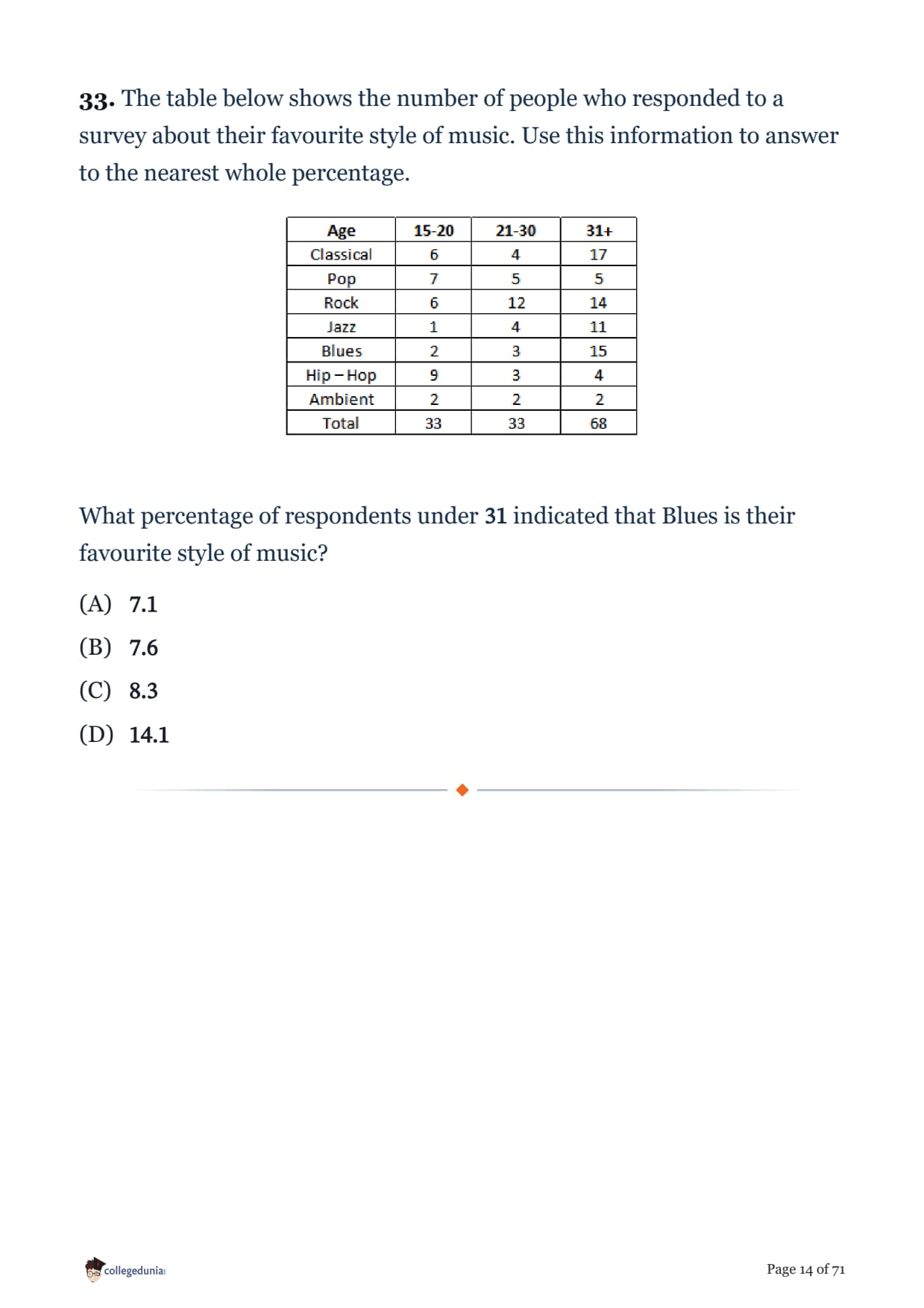
The table below shows the number of people who responded to a survey about their favourite style of music. Use this information to answer to the nearest whole percentage.

What percentage of respondents under \(31\) indicated that Blues is their favourite style of music?
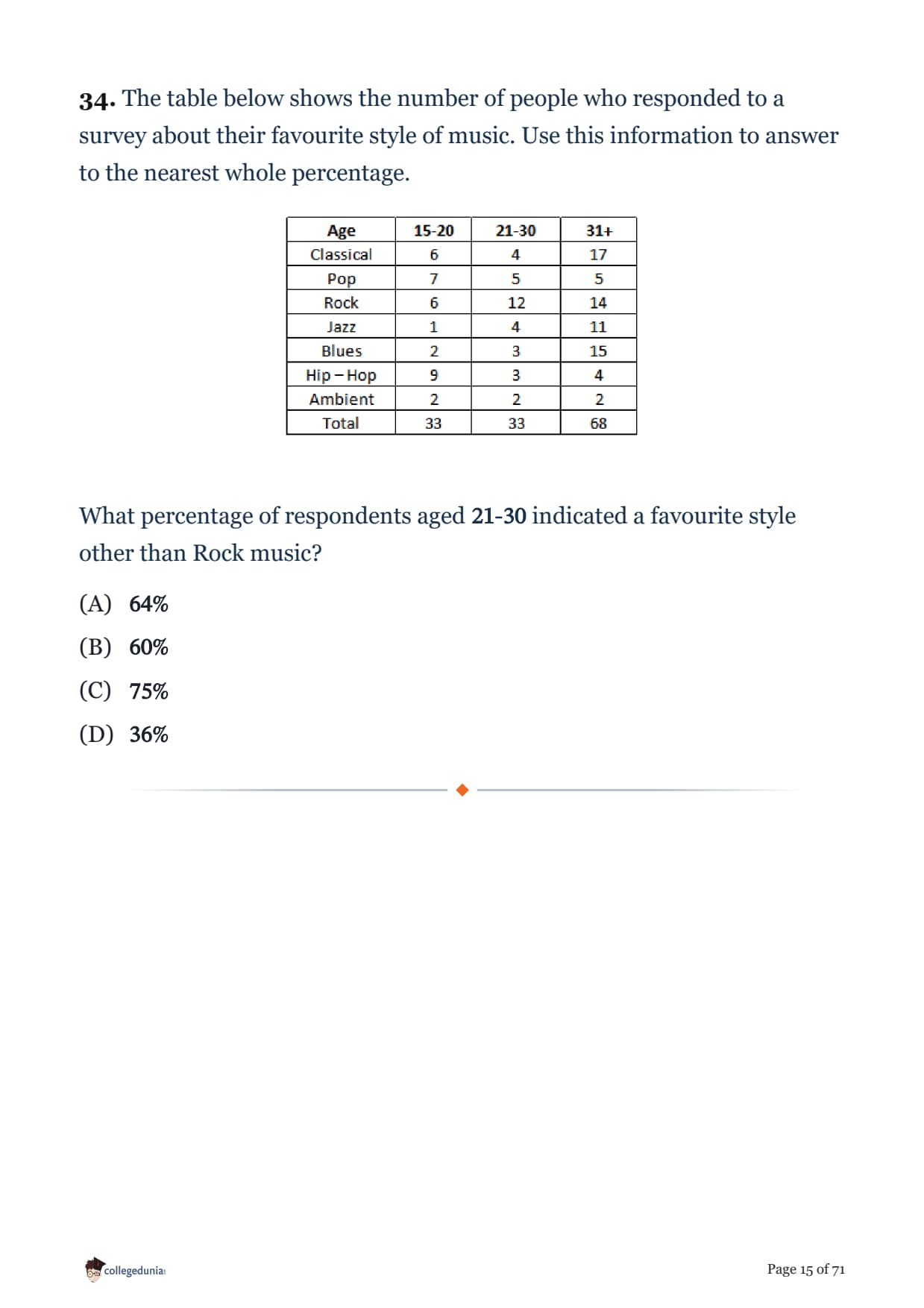
The table below shows the number of people who responded to a survey about their favourite style of music. Use this information to answer to the nearest whole percentage.
What percentage of respondents aged \(21\)-\(30\) indicated a favourite style other than Rock music?
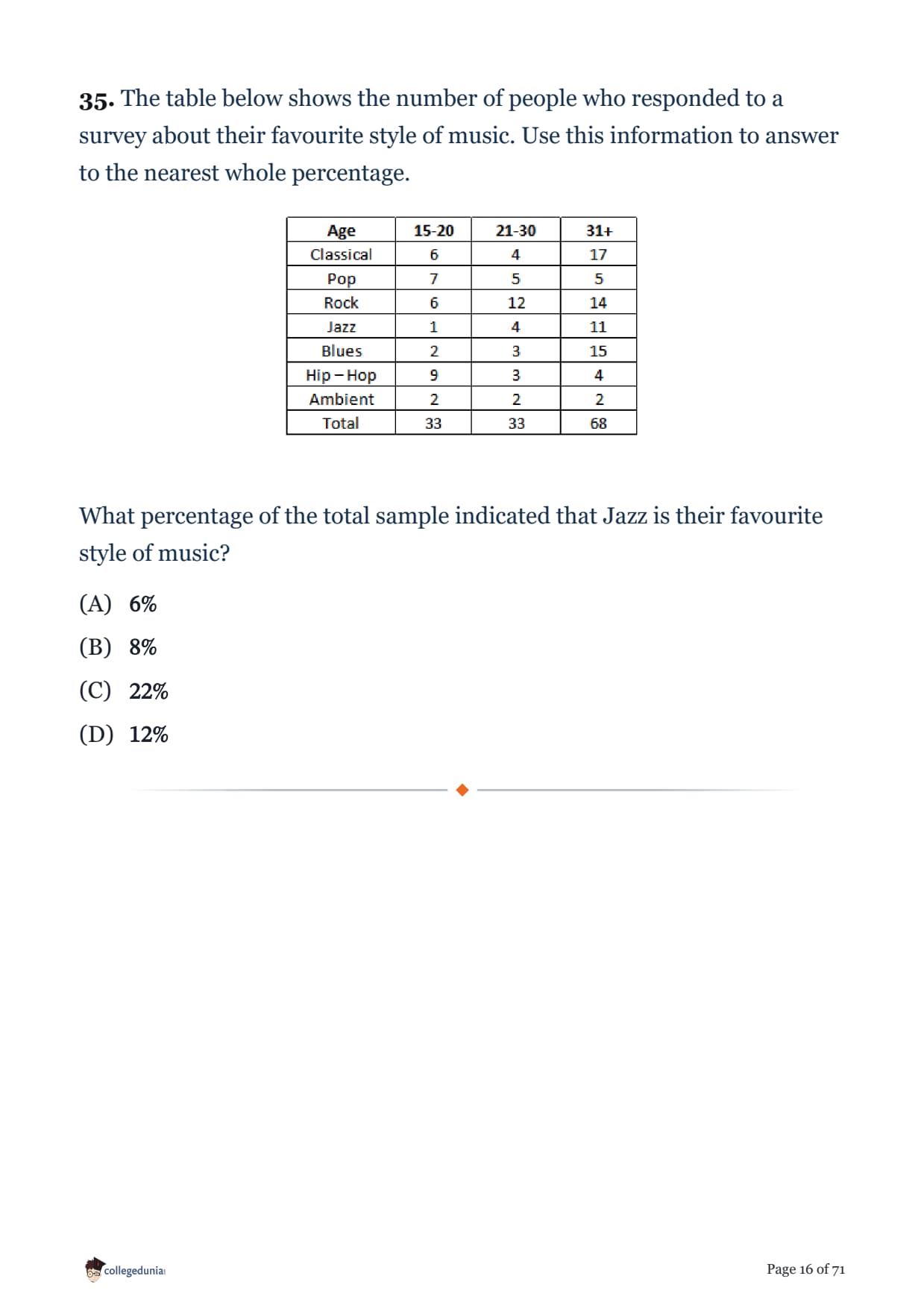
The table below shows the number of people who responded to a survey about their favourite style of music. Use this information to answer to the nearest whole percentage.
What percentage of the total sample indicated that Jazz is their favourite style of music?
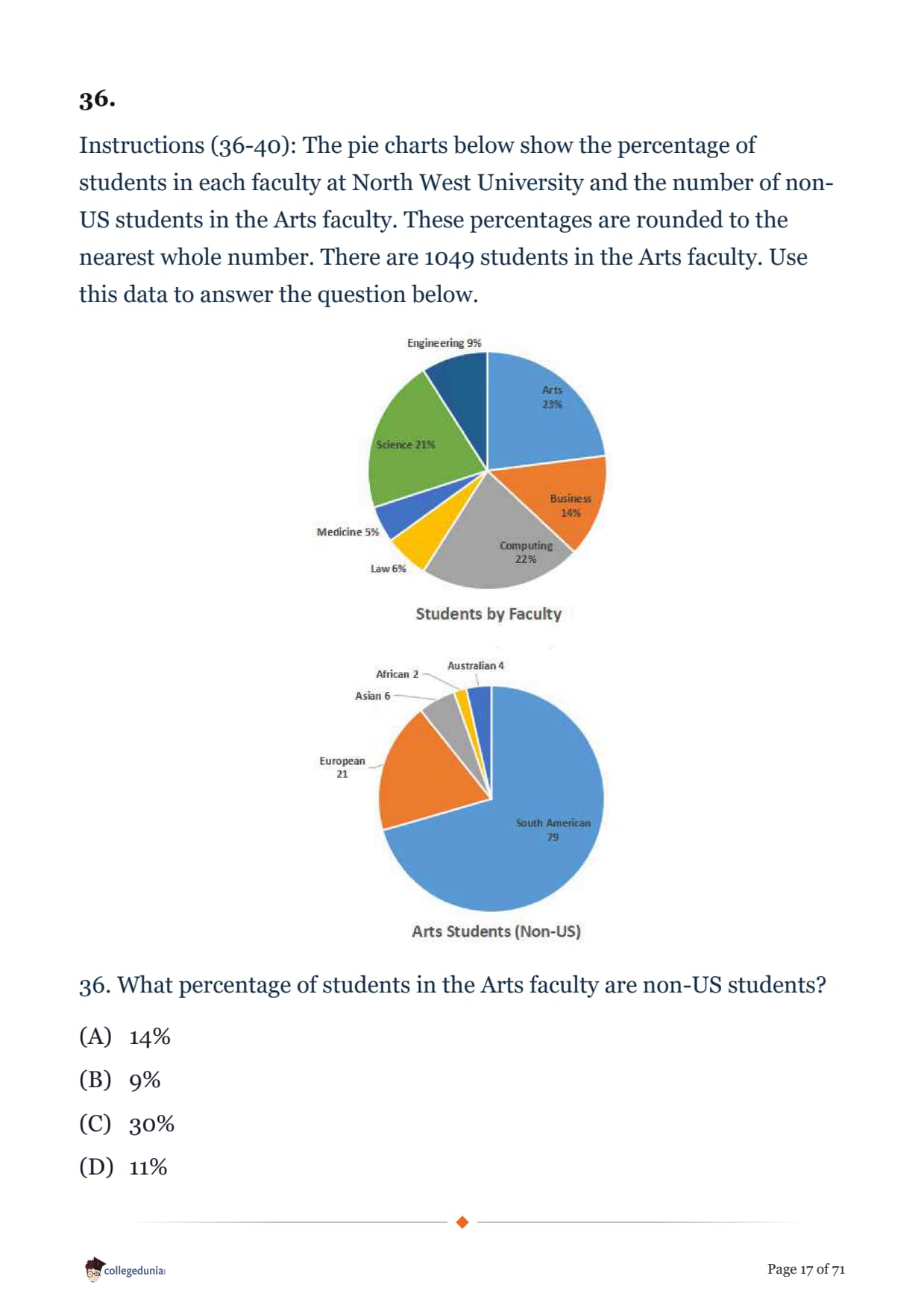
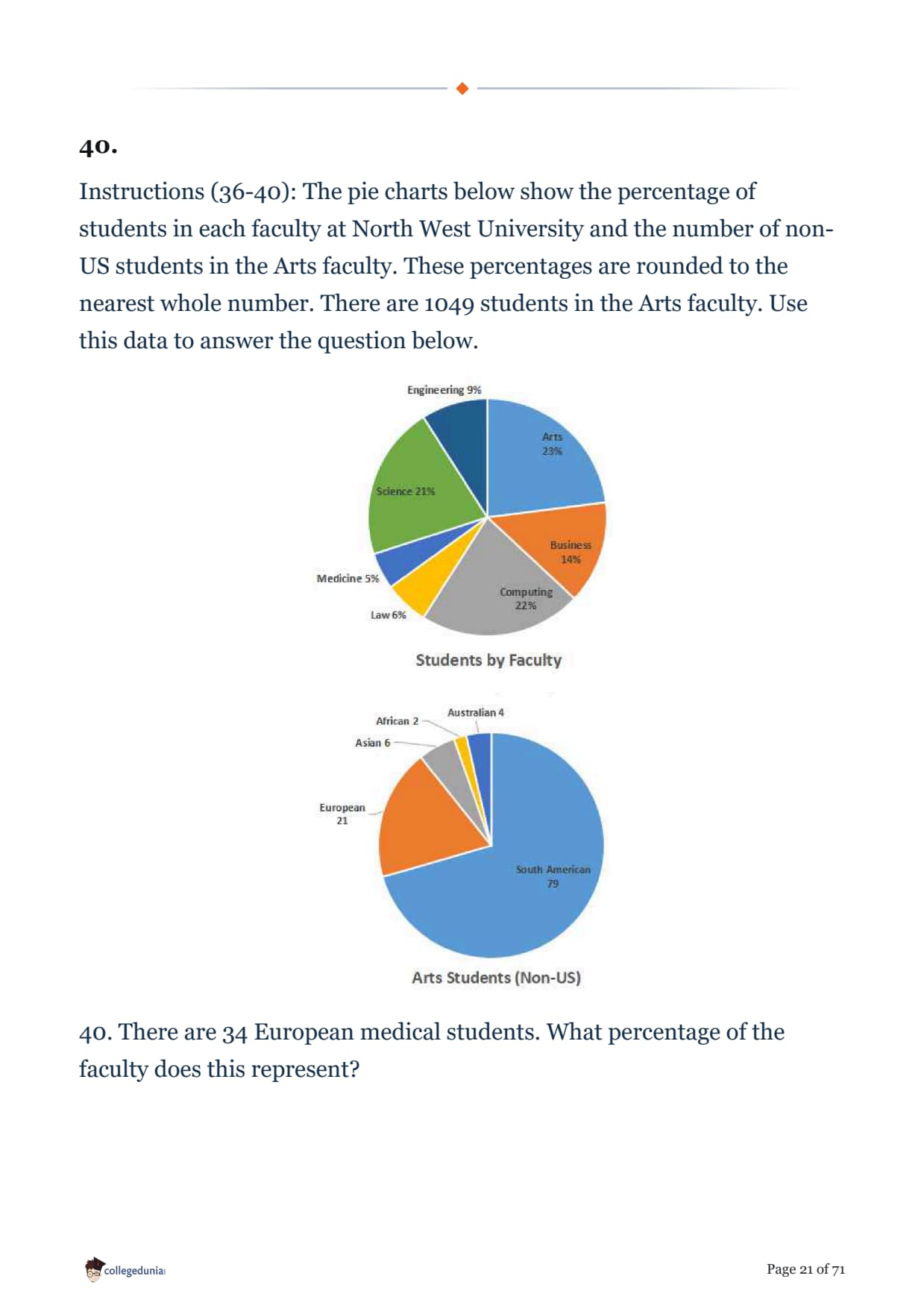
Instructions (36-40): The pie charts below show the percentage of students in each faculty at North West University and the number of non-US students in the Arts faculty. These percentages are rounded to the nearest whole number. There are 1049 students in the Arts faculty. Use this data to answer the question below.


36. What percentage of students in the Arts faculty are non-US students?
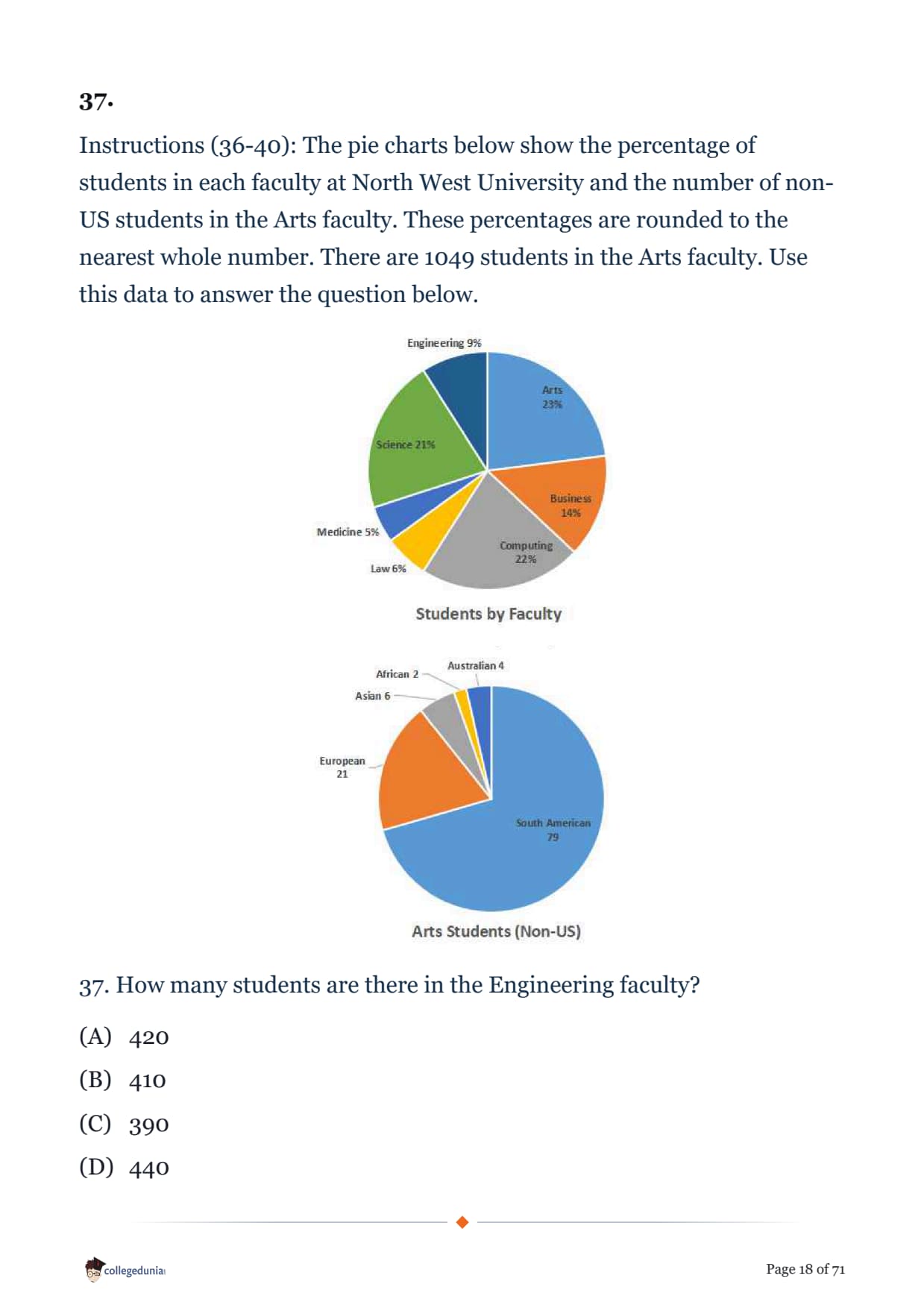
Instructions (36-40): The pie charts below show the percentage of students in each faculty at North West University and the number of non-US students in the Arts faculty. These percentages are rounded to the nearest whole number. There are 1049 students in the Arts faculty. Use this data to answer the question below.
37. How many students are there in the Engineering faculty?
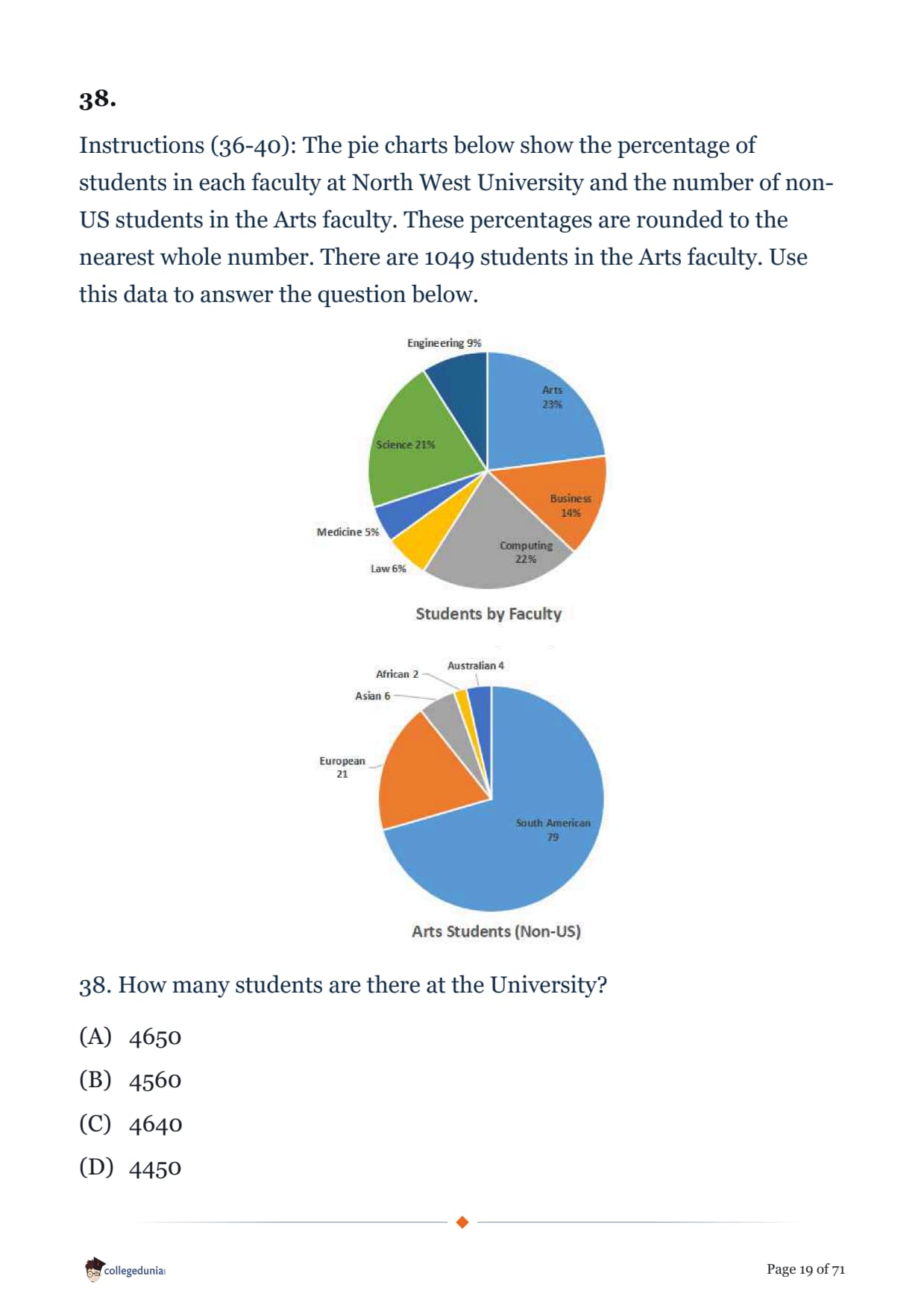
Instructions (36-40): The pie charts below show the percentage of students in each faculty at North West University and the number of non-US students in the Arts faculty. These percentages are rounded to the nearest whole number. There are 1049 students in the Arts faculty. Use this data to answer the question below.
38. How many students are there at the University?
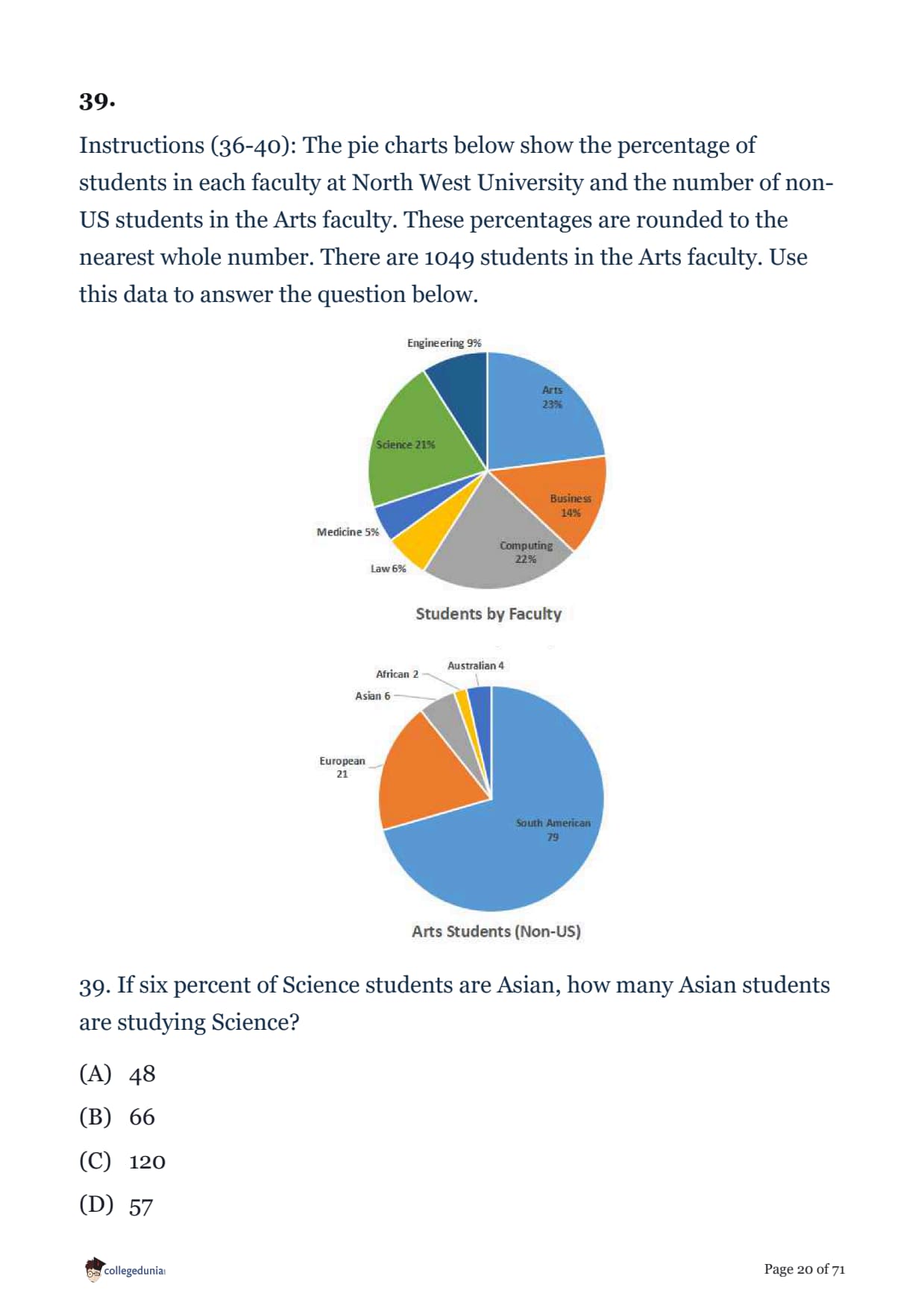
Instructions (36-40): The pie charts below show the percentage of students in each faculty at North West University and the number of non-US students in the Arts faculty. These percentages are rounded to the nearest whole number. There are 1049 students in the Arts faculty. Use this data to answer the question below.
39. If six percent of Science students are Asian, how many Asian students are studying Science?
Instructions (36-40): The pie charts below show the percentage of students in each faculty at North West University and the number of non-US students in the Arts faculty. These percentages are rounded to the nearest whole number. There are 1049 students in the Arts faculty. Use this data to answer the question below.
40. There are 34 European medical students. What percentage of the faculty does this represent?
41. There are three societies A, B and C, each having some tractors. A gives B and C as many tractors as they already have. After some days, B gives A and C as many tractors as they then have. After some more days, C gives A and B as many tractors as they then have. Finally, each society has 24 tractors. What was the original number of tractors each had at the start?
Although most of the fastest growing jobs in today's economy require a college degree, many of the new jobs being created, from home health aide to desktop publisher, need knowledge other than that gained from earning a degree. For workers in those jobs, good basic skills in reading, communication, and mathematics play an important role in getting a job and developing a career.
42. From the information given above, it can be validly concluded that, in today's economy:
According to the National Agricultural Aviation Society (NAAS), without the use of crop protection products to control insects, weeds, and diseases, crop yields per acre will drop by more than 50 percent. The first aerial application of insecticide occurred in 1921, and it was a huge success. By contrast, in today's economy all aircraft that are classified as aerial applicators do more than just apply insecticide; today, they also spread seeds and apply fertilizer.
From the information given above, it CANNOT be validly concluded that:
Lou observes that if flight 409 is cancelled, then the manager could not possibly arrive in time for the meeting. But the flight was not cancelled. Therefore, Lou concludes, the manager will certainly be on time. Evelyn replies that even if Lou's premises are true, his argument is fallacious. And therefore, she adds, the manager will not arrive on time after all.
Which of the following is the strongest thing that we can properly say about this discussion?
Cars are safer than planes. Fifty percent of plane accidents result in death, while only one percent of car accidents result in death. Which of the following, if true, would most seriously weaken the argument above?
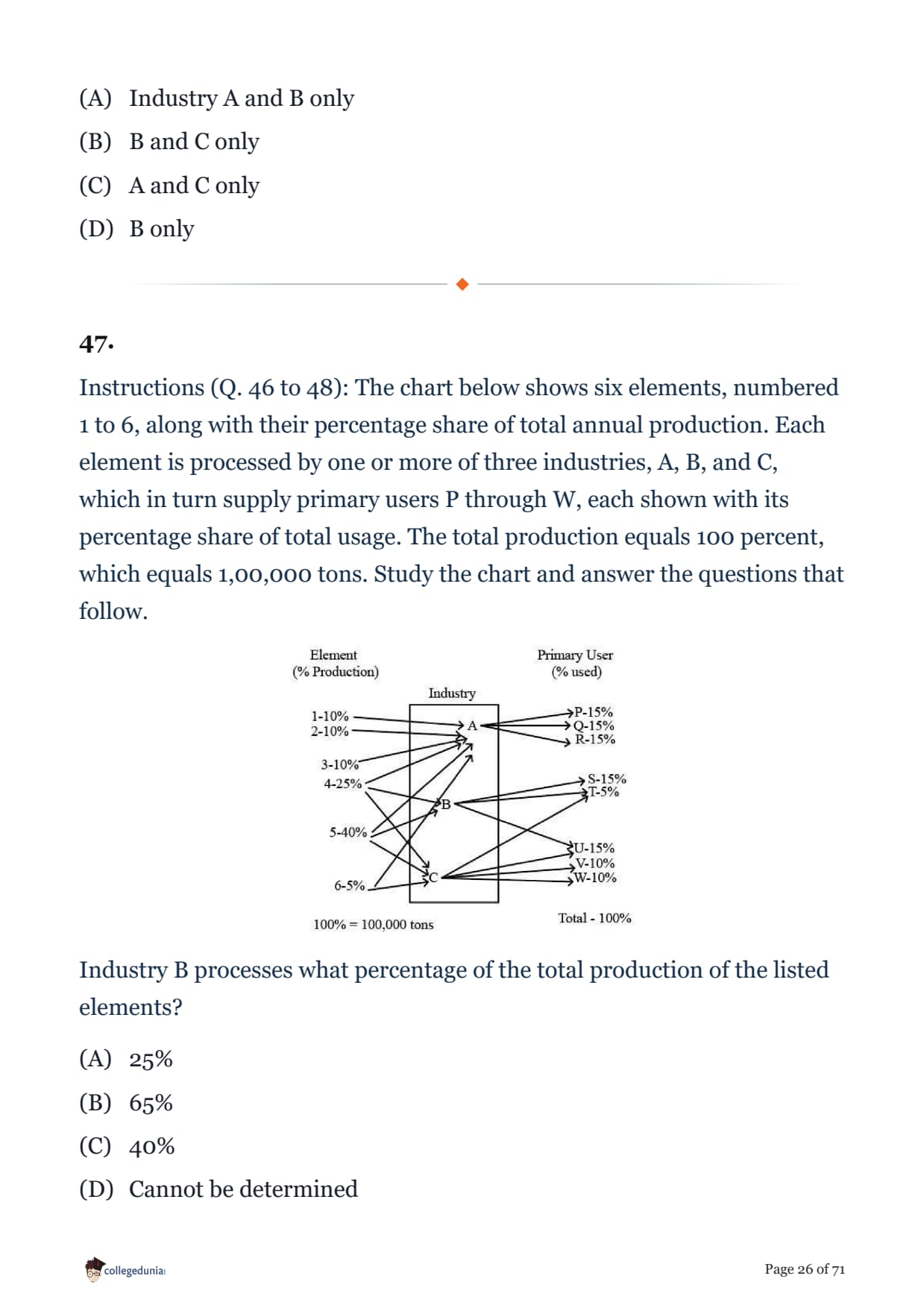
Instructions (Q. 46 to 48): The chart below shows six elements, numbered 1 to 6, along with their percentage share of total annual production. Each element is processed by one or more of three industries, A, B, and C, which in turn supply primary users P through W, each shown with its percentage share of total usage. The total production equals 100 percent, which equals 1,00,000 tons. Study the chart and answer the questions that follow.

Which industry or industries contribute to company S?
Instructions (Q. 46 to 48): The chart below shows six elements, numbered 1 to 6, along with their percentage share of total annual production. Each element is processed by one or more of three industries, A, B, and C, which in turn supply primary users P through W, each shown with its percentage share of total usage. The total production equals 100 percent, which equals 1,00,000 tons. Study the chart and answer the questions that follow.
Industry B processes what percentage of the total production of the listed elements?
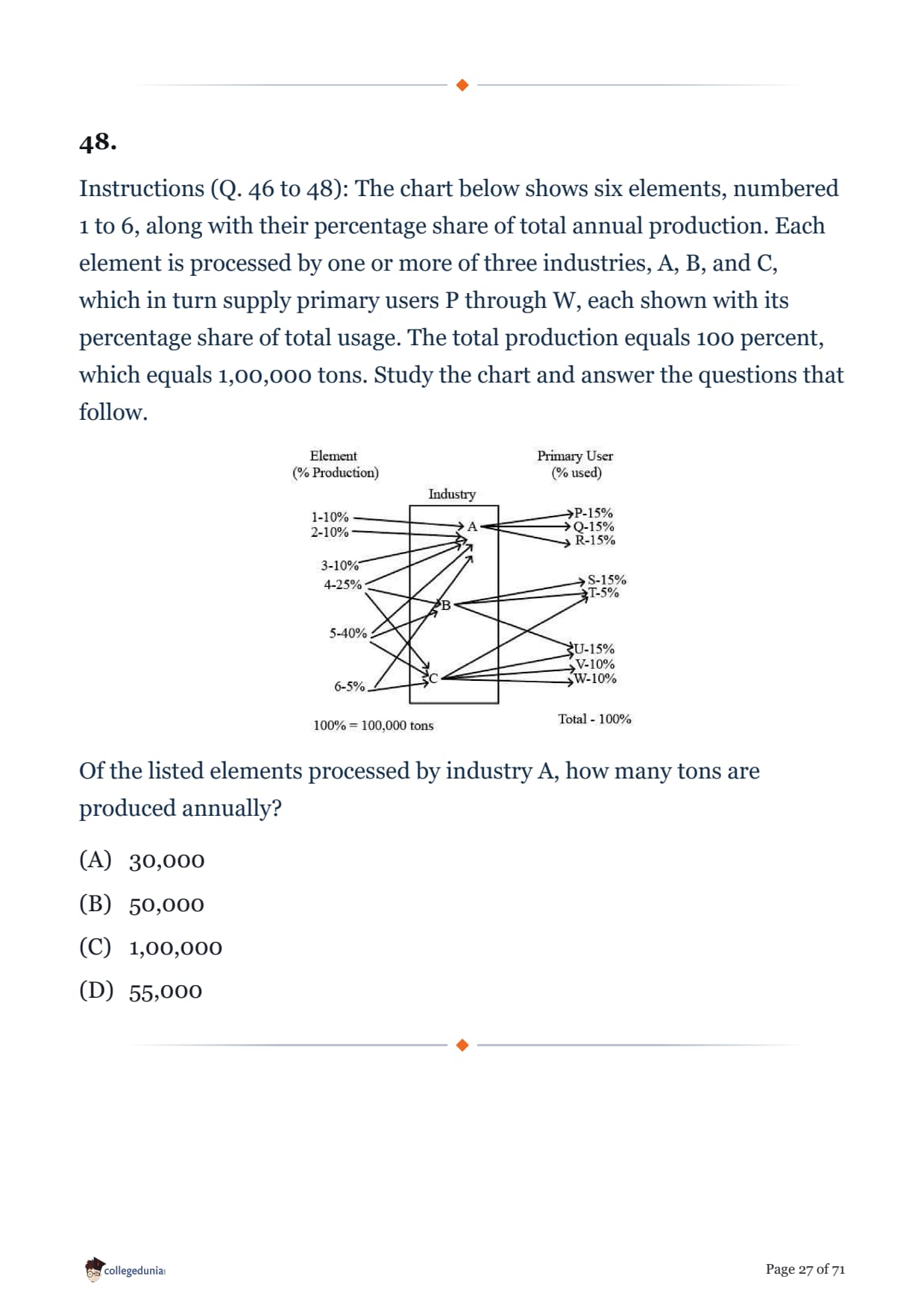
Instructions (Q. 46 to 48): The chart below shows six elements, numbered 1 to 6, along with their percentage share of total annual production. Each element is processed by one or more of three industries, A, B, and C, which in turn supply primary users P through W, each shown with its percentage share of total usage. The total production equals 100 percent, which equals 1,00,000 tons. Study the chart and answer the questions that follow.
Of the listed elements processed by industry A, how many tons are produced annually?
In the question below, there are two blanks marked I and II. The words to fill blank I are given as (A, B, C, D) and the words to fill blank II are given as (P, Q, R, S). The words on either side of the sign (::) share a similar relationship. Pick the alternative that fits this relationship.
I : Increase :: Descend : II
I. (A) Grow (B) Ascend (C) Rise (D) Price
II. (P) Reduce (Q) Down (R) Decrease (S) Mountain
Modern : I :: II : Old
I. (A) Ancient (B) Death (C) Famous (D) Civilization
II. (P) Industrialisation (Q) Young (R) Fashion (S) Western
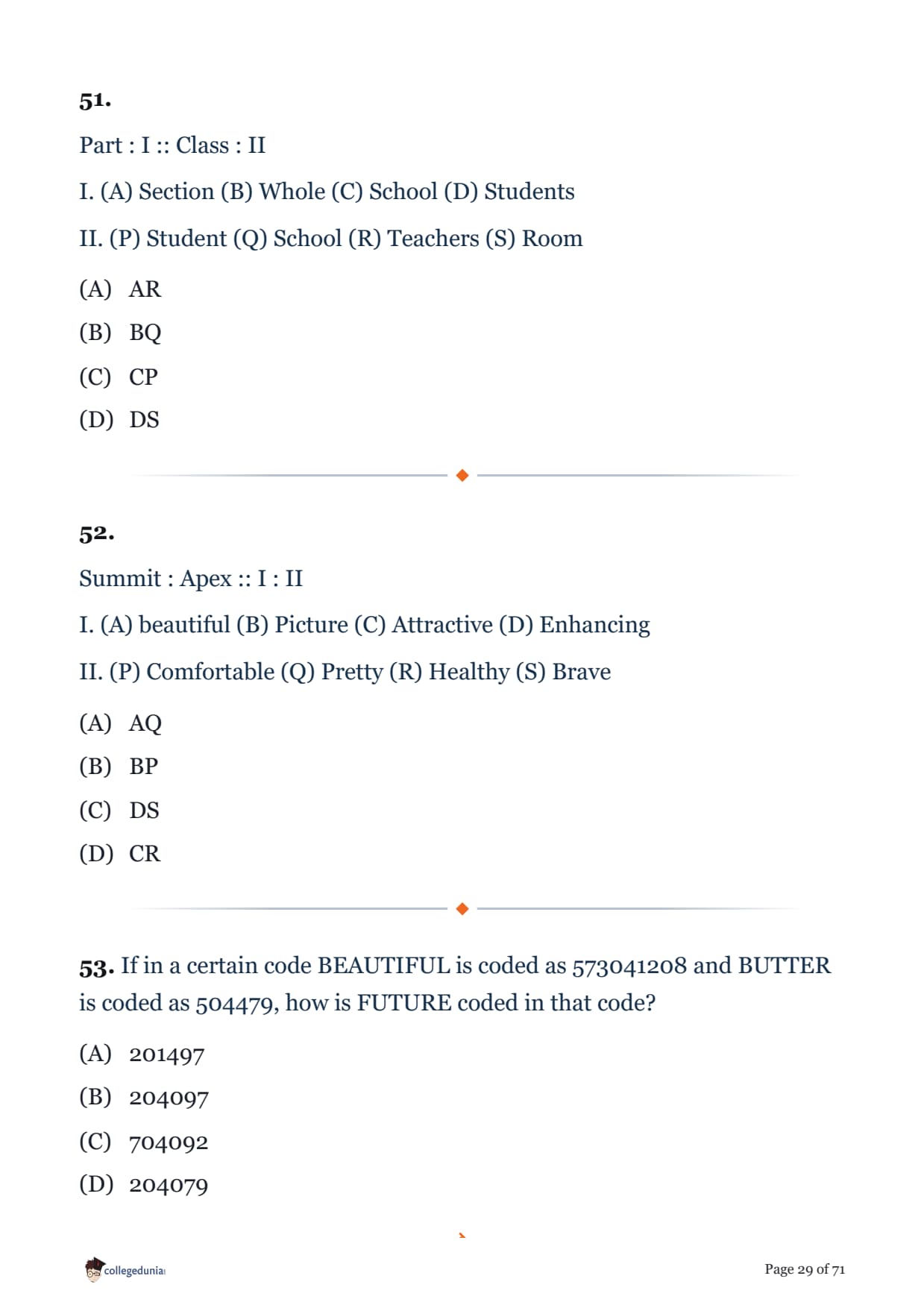
Part : I :: Class : II
I. (A) Section (B) Whole (C) School (D) Students
II. (P) Student (Q) School (R) Teachers (S) Room
Summit : Apex :: I : II
I. (A) beautiful (B) Picture (C) Attractive (D) Enhancing
II. (P) Comfortable (Q) Pretty (R) Healthy (S) Brave
If in a certain code BEAUTIFUL is coded as 573041208 and BUTTER is coded as 504479, how is FUTURE coded in that code?
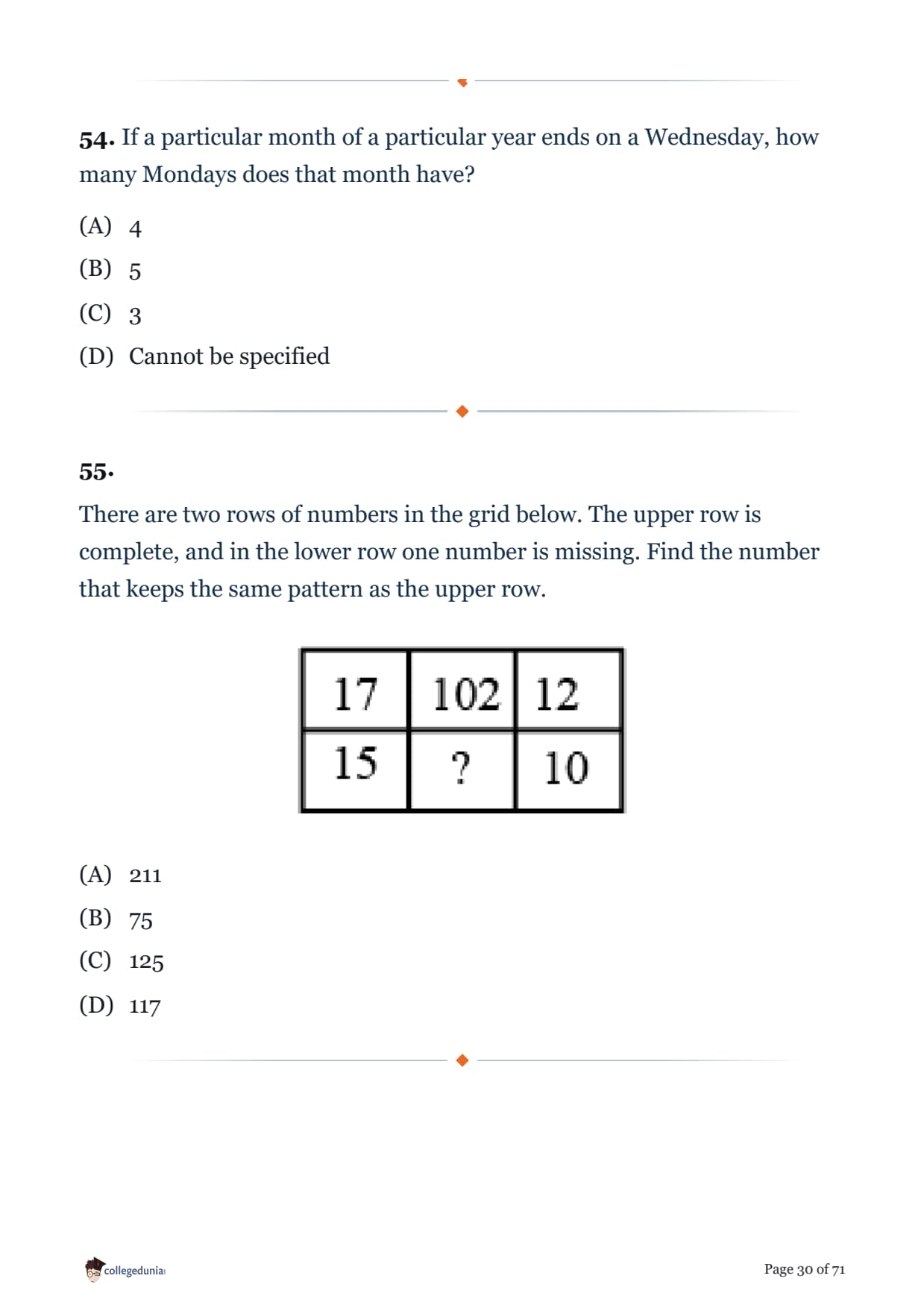
If a particular month of a particular year ends on a Wednesday, how many Mondays does that month have?
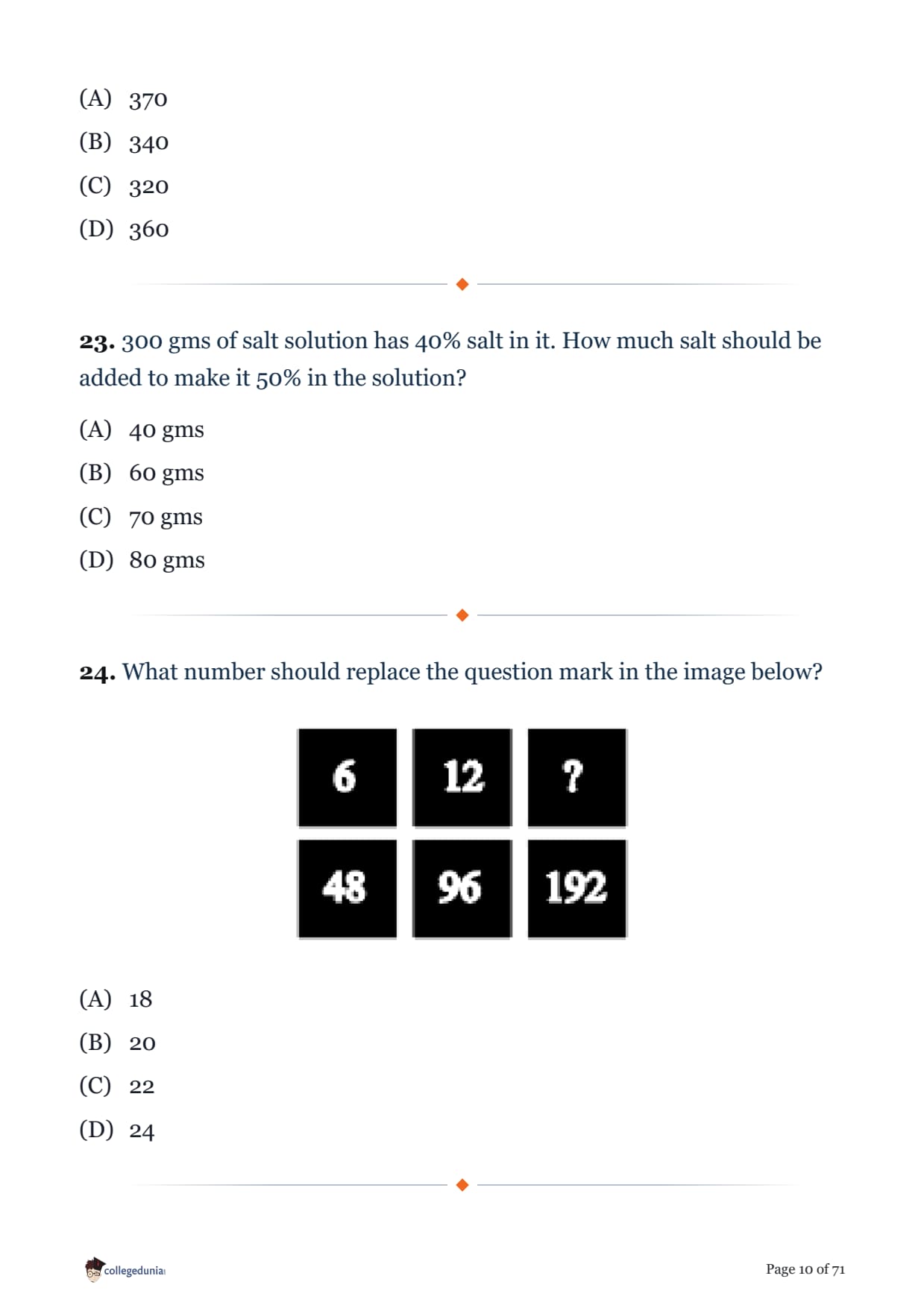
There are two rows of numbers in the grid below. The upper row is complete, and in the lower row one number is missing. Find the number that keeps the same pattern as the upper row.

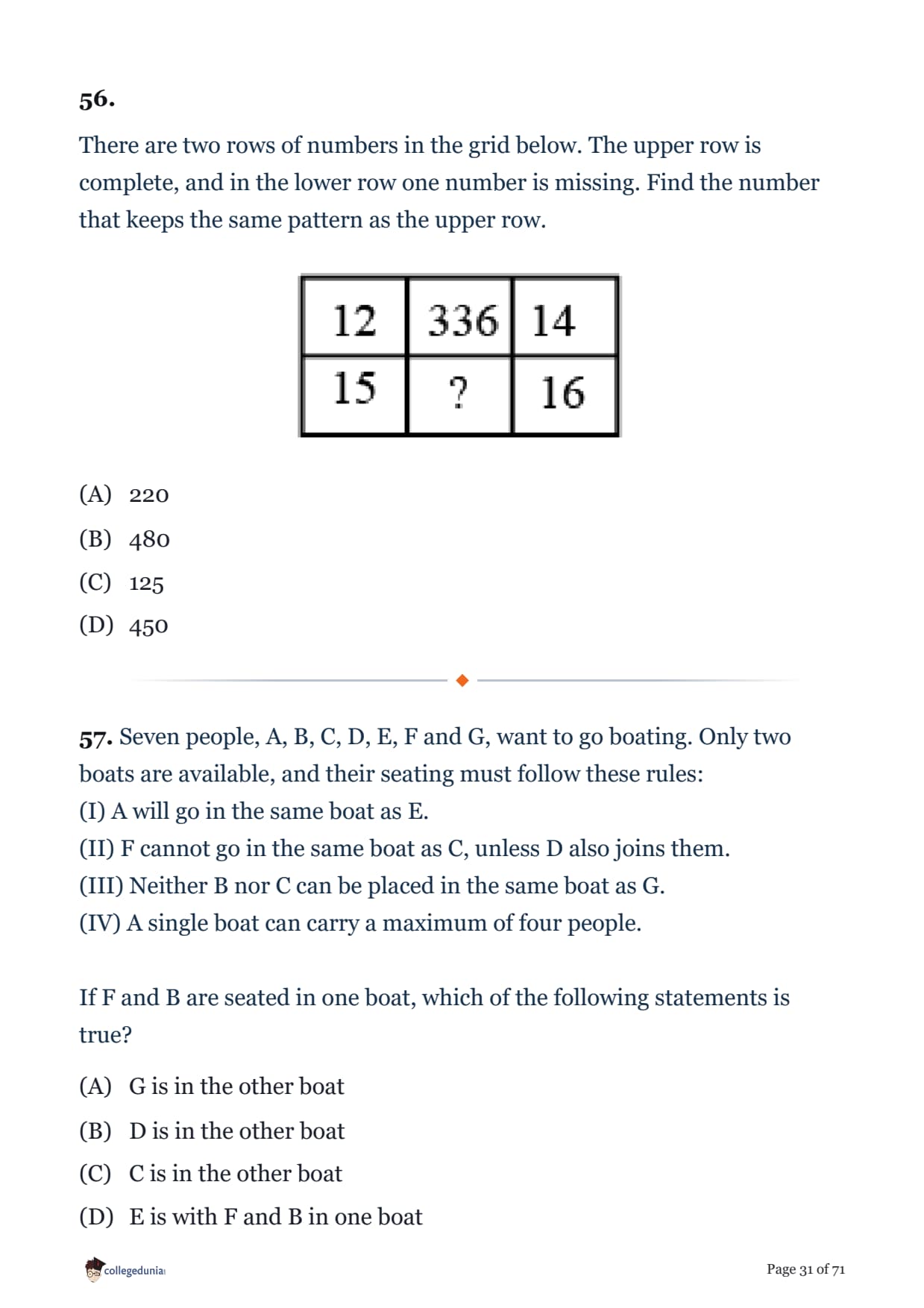
There are two rows of numbers in the grid below. The upper row is complete, and in the lower row one number is missing. Find the number that keeps the same pattern as the upper row.

Seven people, A, B, C, D, E, F and G, want to go boating. Only two boats are available, and their seating must follow these rules:
(I) A will go in the same boat as E.
(II) F cannot go in the same boat as C, unless D also joins them.
(III) Neither B nor C can be placed in the same boat as G.
(IV) A single boat can carry a maximum of four people.
If F and B are seated in one boat, which of the following statements is true?
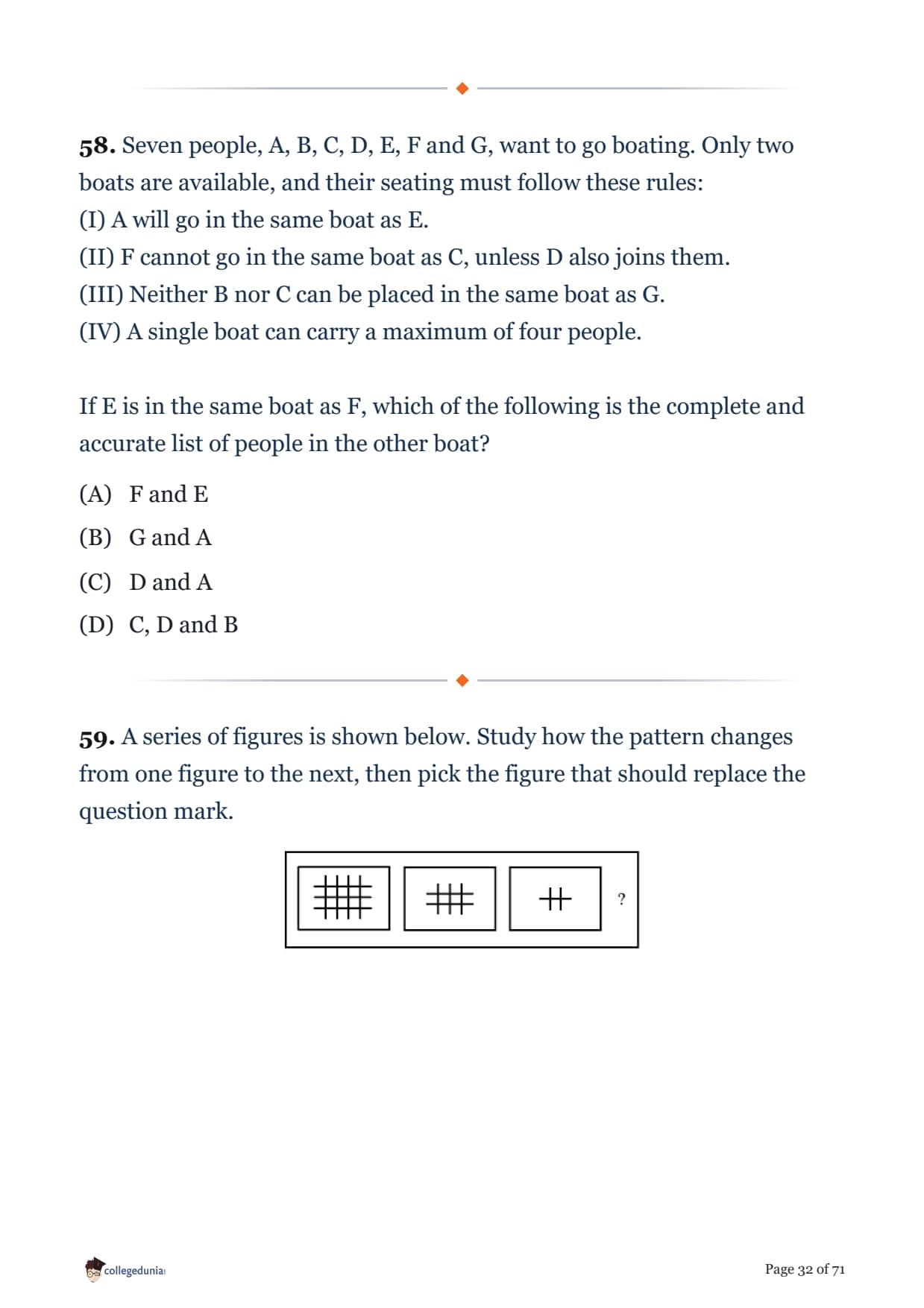
Seven people, A, B, C, D, E, F and G, want to go boating. Only two boats are available, and their seating must follow these rules:
(I) A will go in the same boat as E.
(II) F cannot go in the same boat as C, unless D also joins them.
(III) Neither B nor C can be placed in the same boat as G.
(IV) A single boat can carry a maximum of four people.
If E is in the same boat as F, which of the following is the complete and accurate list of people in the other boat?
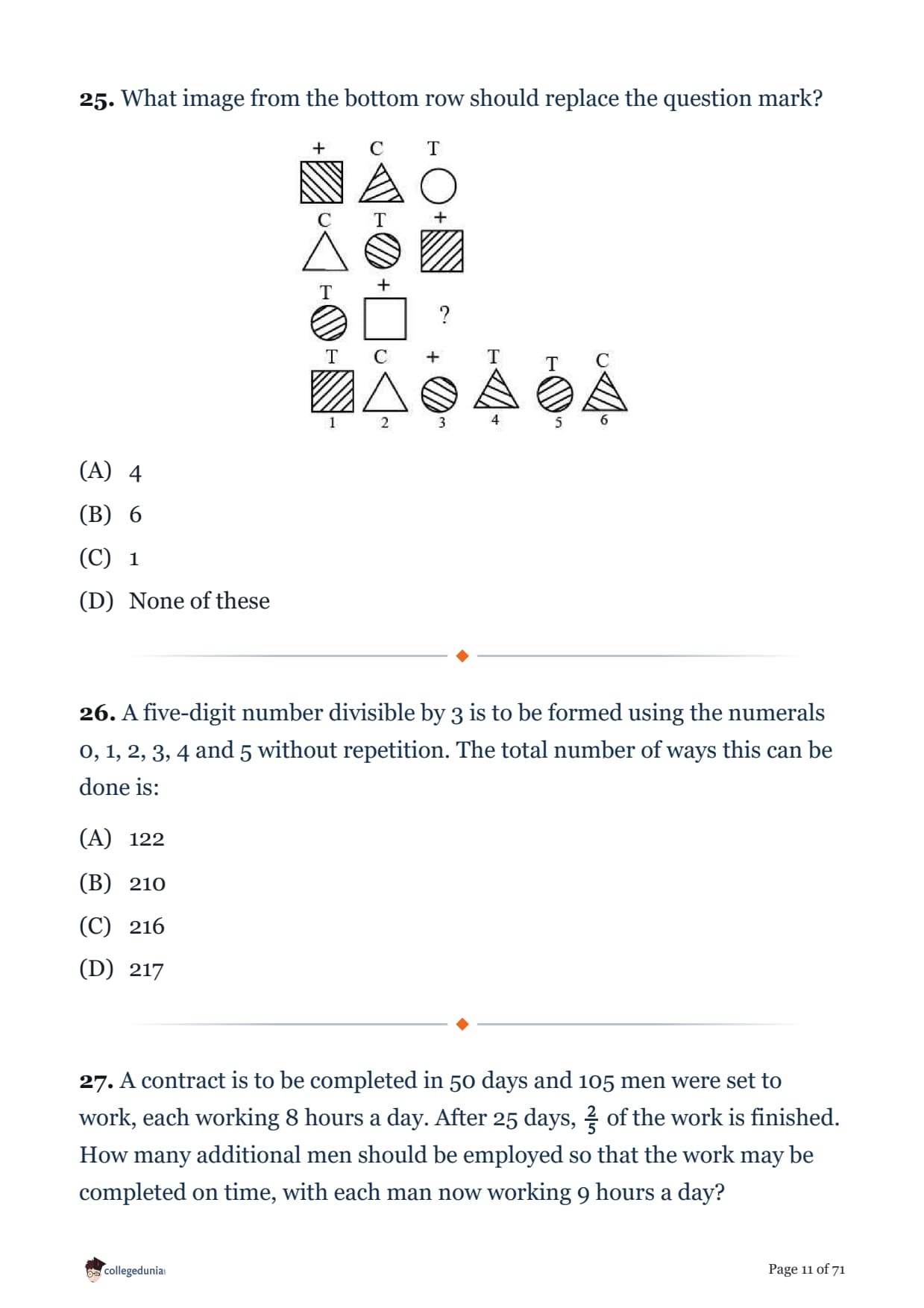
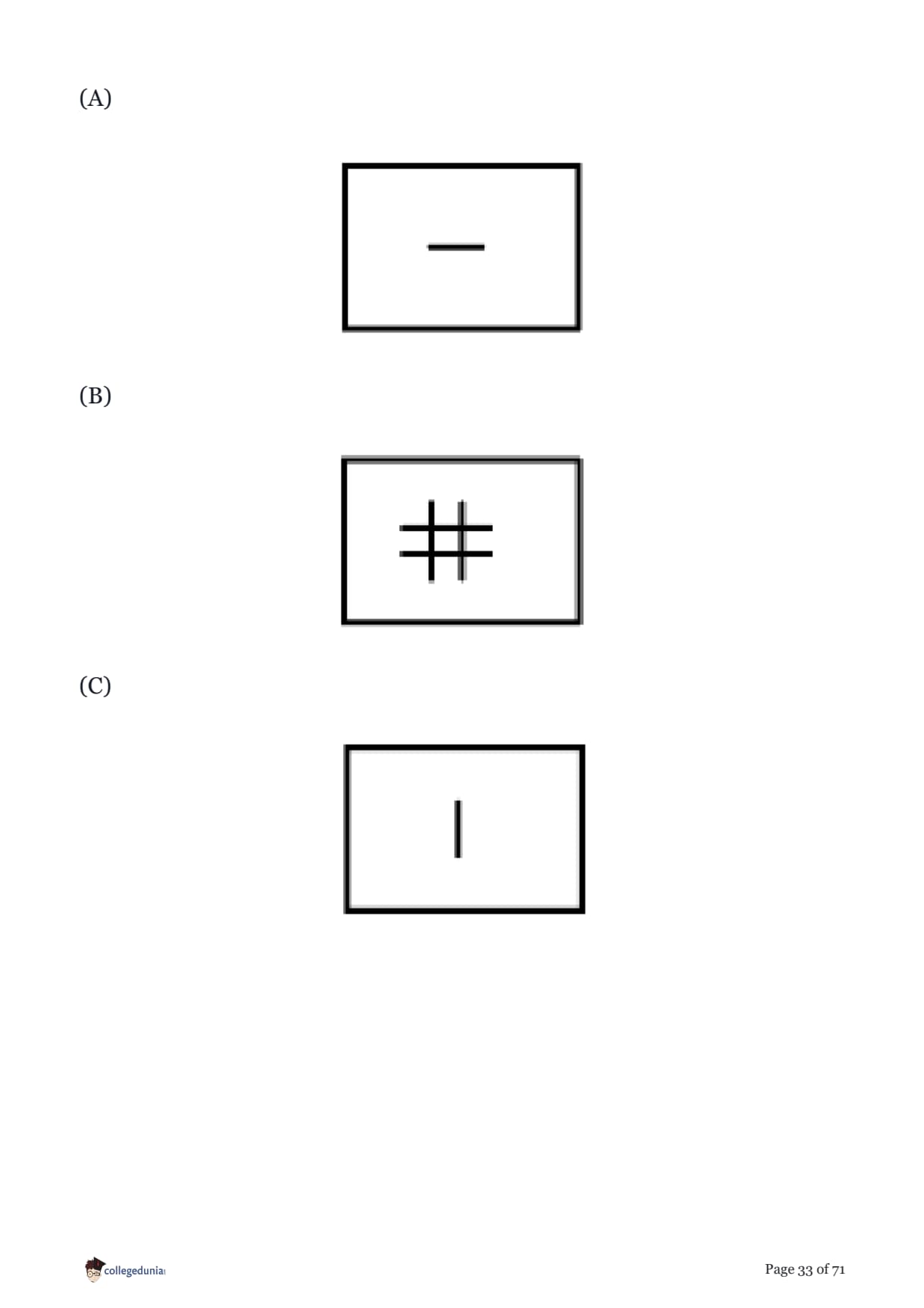
A series of figures is shown below. Study how the pattern changes from one figure to the next, then pick the figure that should replace the question mark.

- (A)
![]()
- (B)
![]()
- (C)
![]()
- (D)
![]()


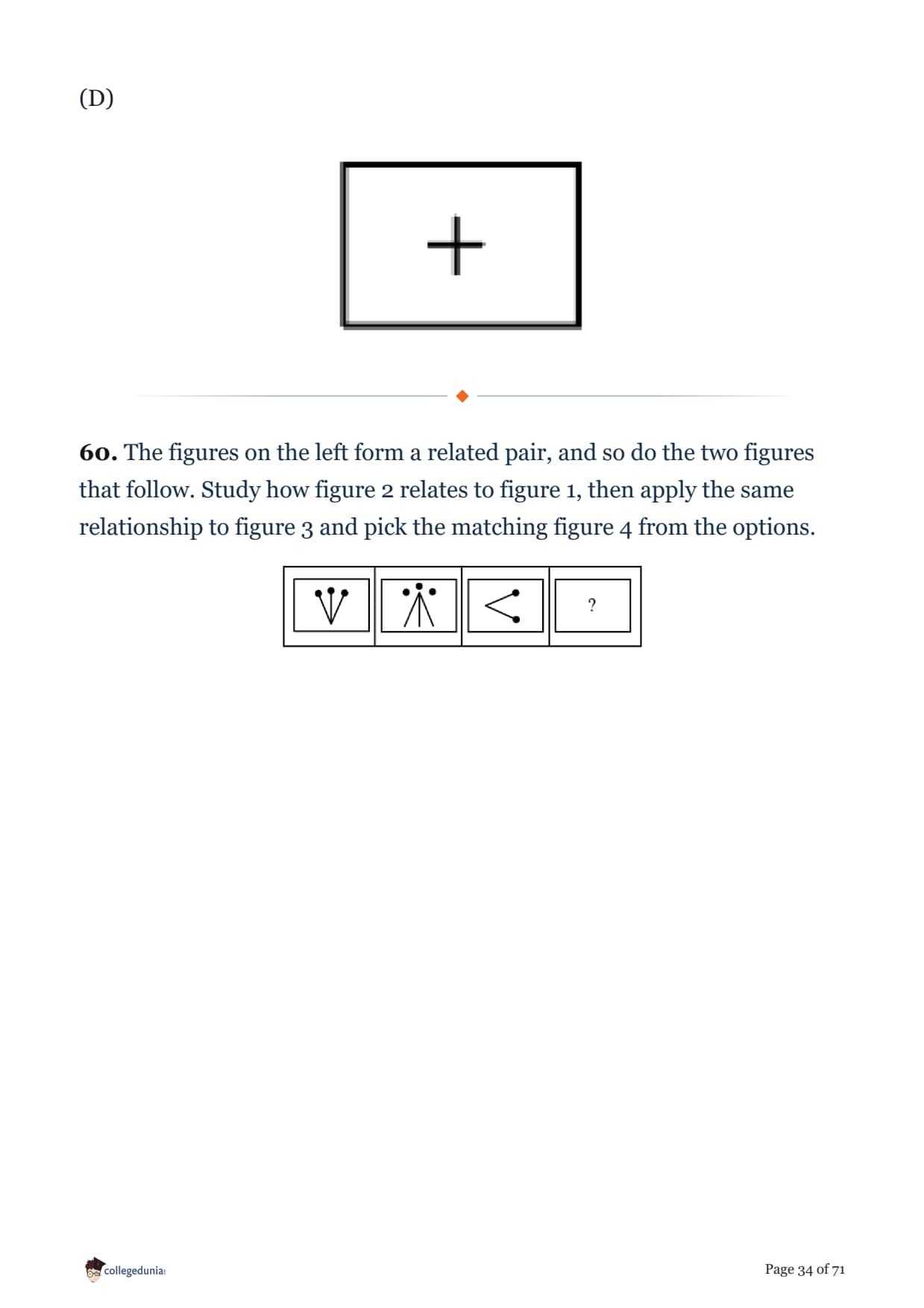
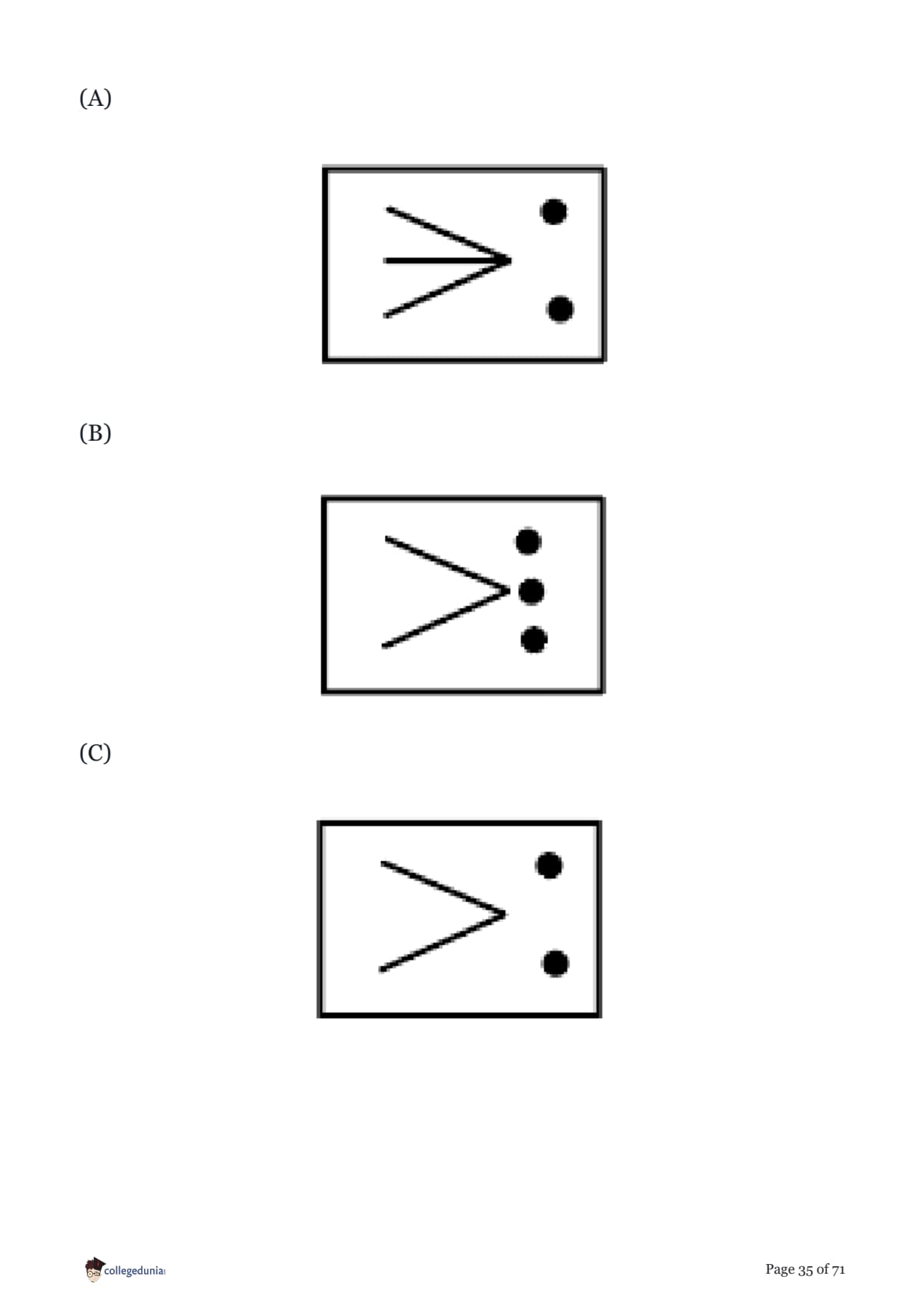
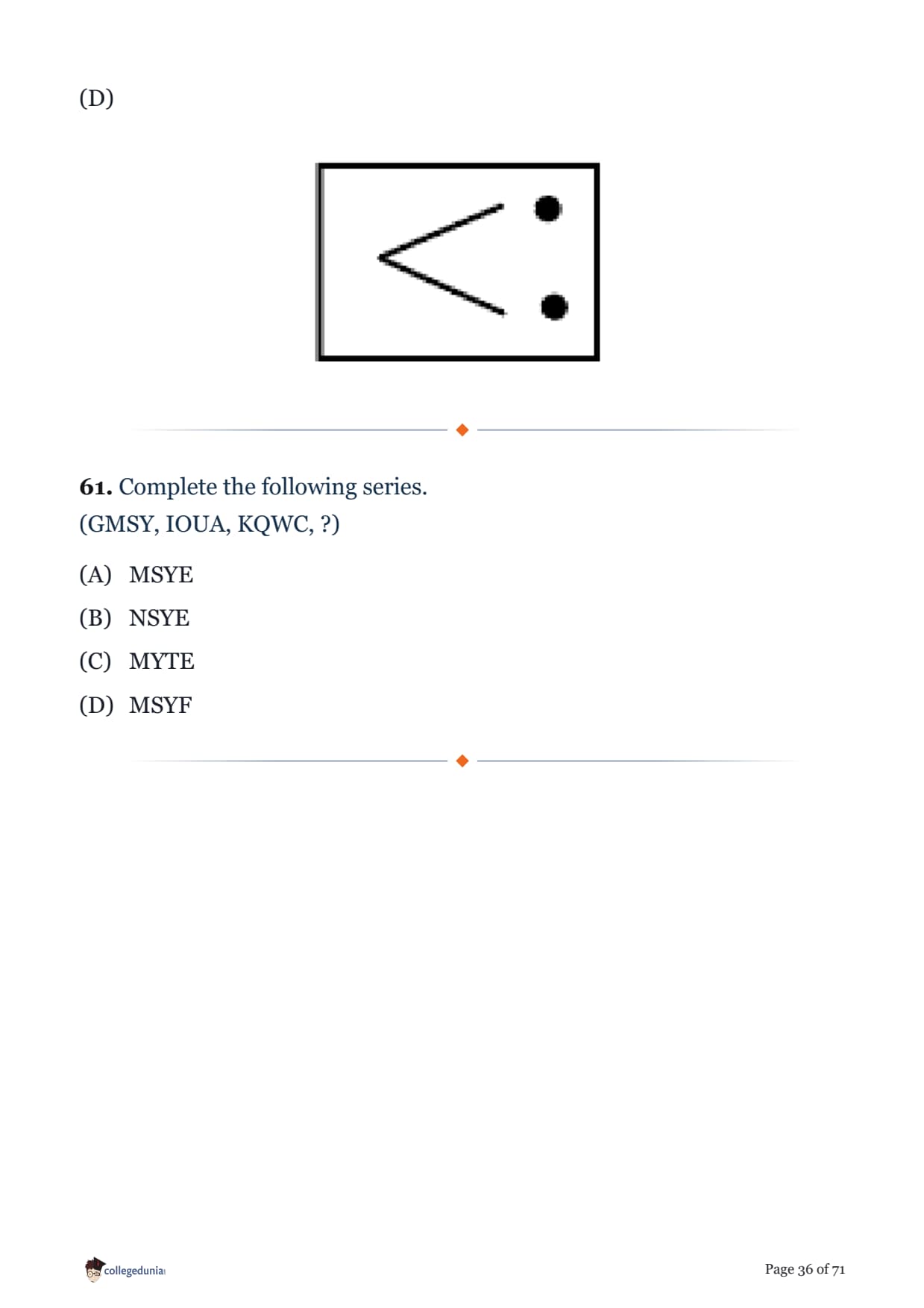
The figures on the left form a related pair, and so do the two figures that follow. Study how figure 2 relates to figure 1, then apply the same relationship to figure 3 and pick the matching figure 4 from the options.

- (A)
![]()
- (B)
![]()
- (C)
![]()
- (D)
![]()


Complete the following series.
(GMSY, IOUA, KQWC, ?)
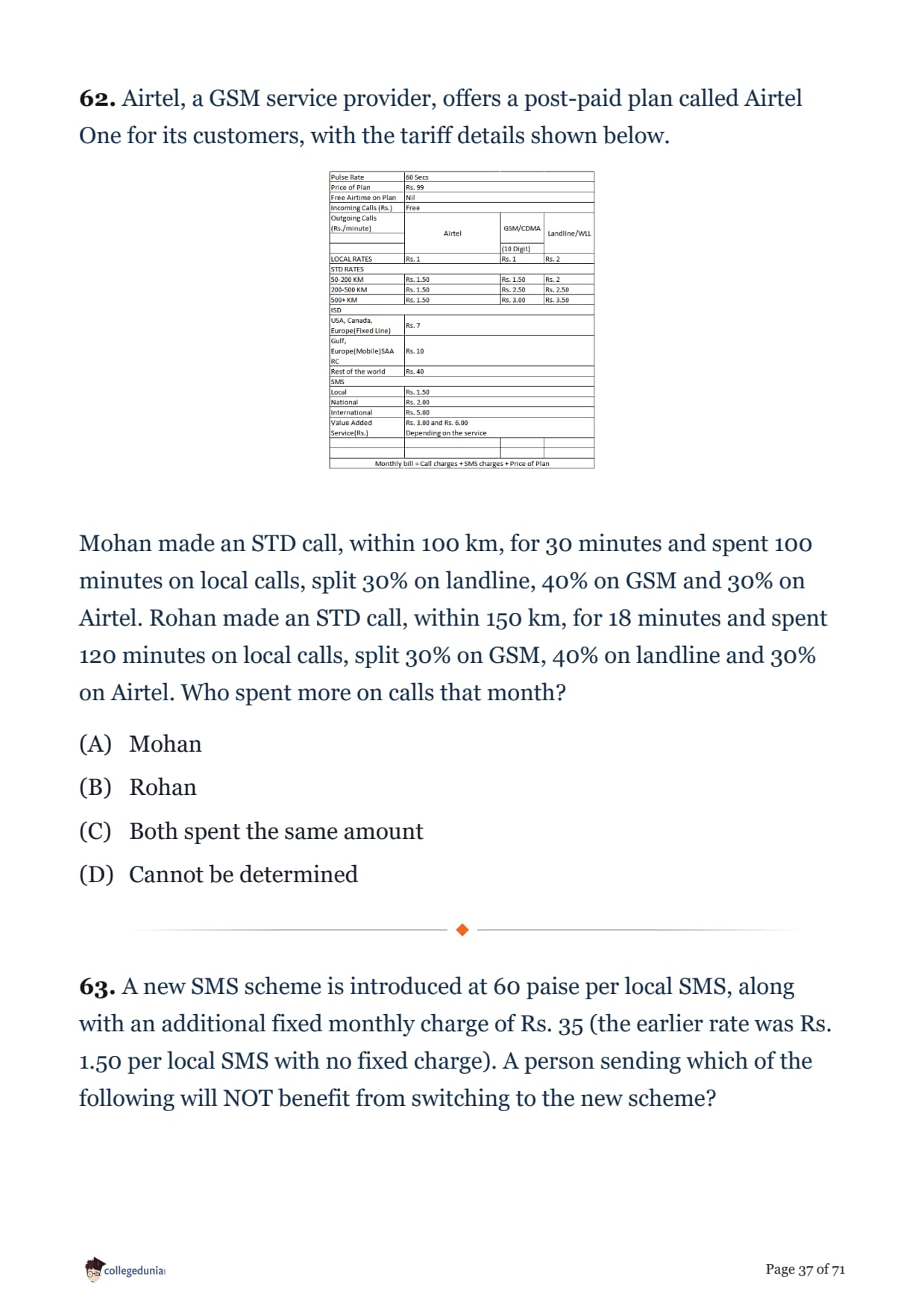
Airtel, a GSM service provider, offers a post-paid plan called Airtel One for its customers, with the tariff details shown below.

Mohan made an STD call, within 100 km, for 30 minutes and spent 100 minutes on local calls, split 30% on landline, 40% on GSM and 30% on Airtel. Rohan made an STD call, within 150 km, for 18 minutes and spent 120 minutes on local calls, split 30% on GSM, 40% on landline and 30% on Airtel. Who spent more on calls that month?
A new SMS scheme is introduced at 60 paise per local SMS, along with an additional fixed monthly charge of Rs. 35 (the earlier rate was Rs. 1.50 per local SMS with no fixed charge). A person sending which of the following will NOT benefit from switching to the new scheme?
Under the 'Airtel One' postpaid plan, the monthly rental is Rs. 99, and call charges are billed on top of this rent based on the distance slab and the network used. A bill of Rs. 199 in a month is definitely not possible when you make only:
Under the same 'Airtel One' plan, ISD calls to different groups of countries are billed at different per minute rates. A person makes a total of 12 minutes of ISD calls in a month. If 80% of his ISD bill amount came from calls made to the 'Rest of the World' group, then the ISD calls of the minimum duration were made to which of the following groups of countries?
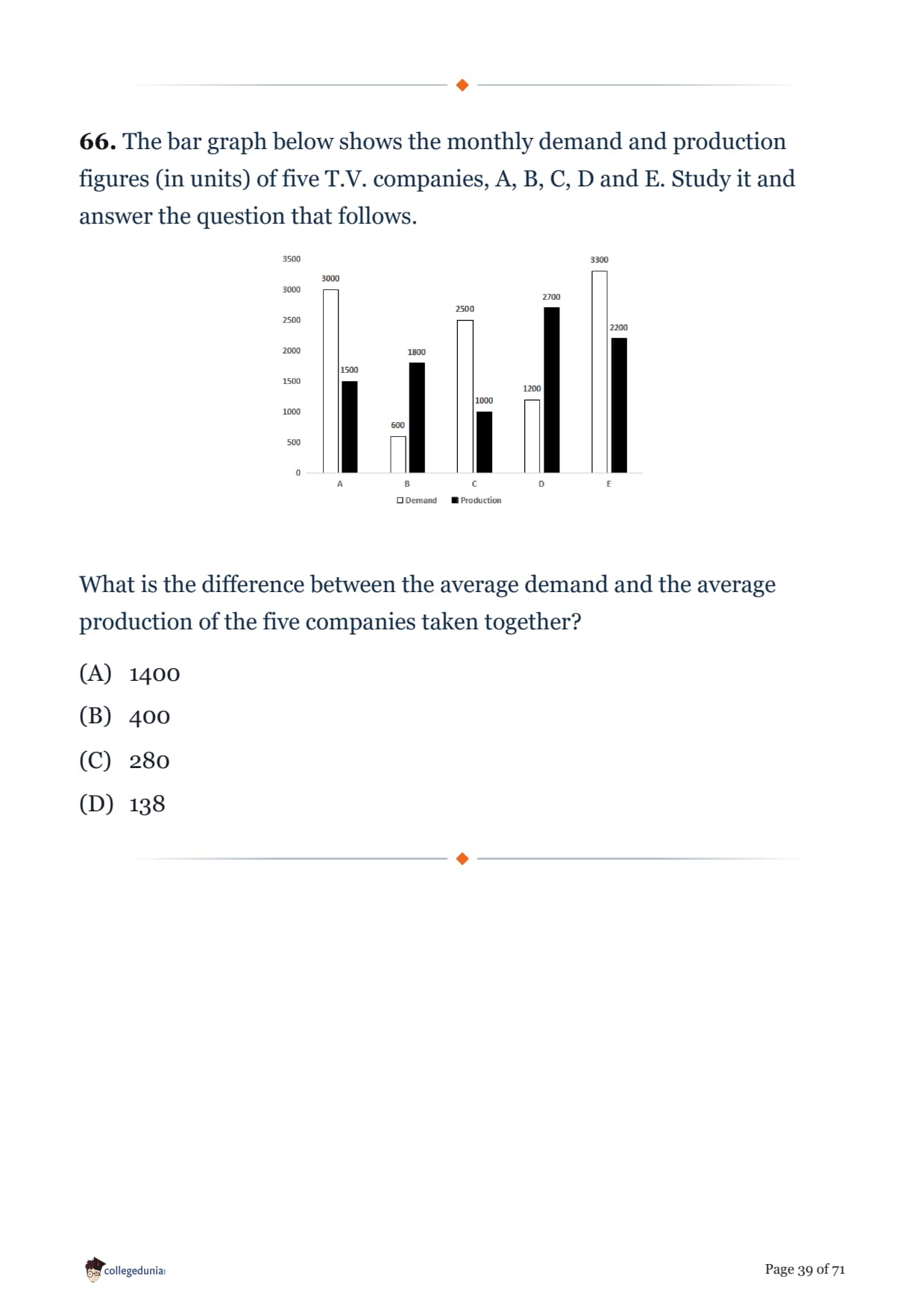
The bar graph below shows the monthly demand and production figures (in units) of five T.V. companies, A, B, C, D and E. Study it and answer the question that follows.

What is the difference between the average demand and the average production of the five companies taken together?
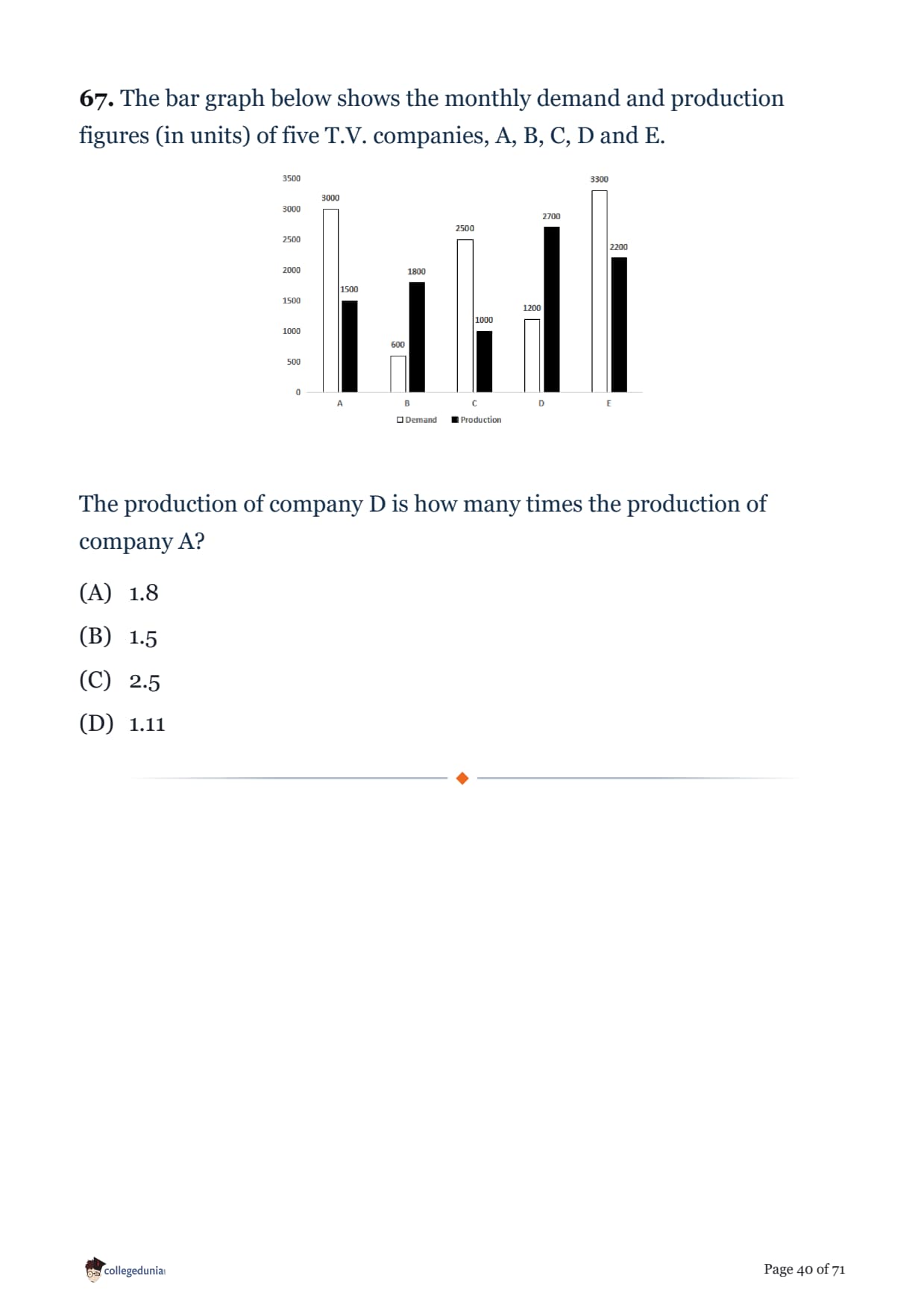
The bar graph below shows the monthly demand and production figures (in units) of five T.V. companies, A, B, C, D and E.
The production of company D is how many times the production of company A?
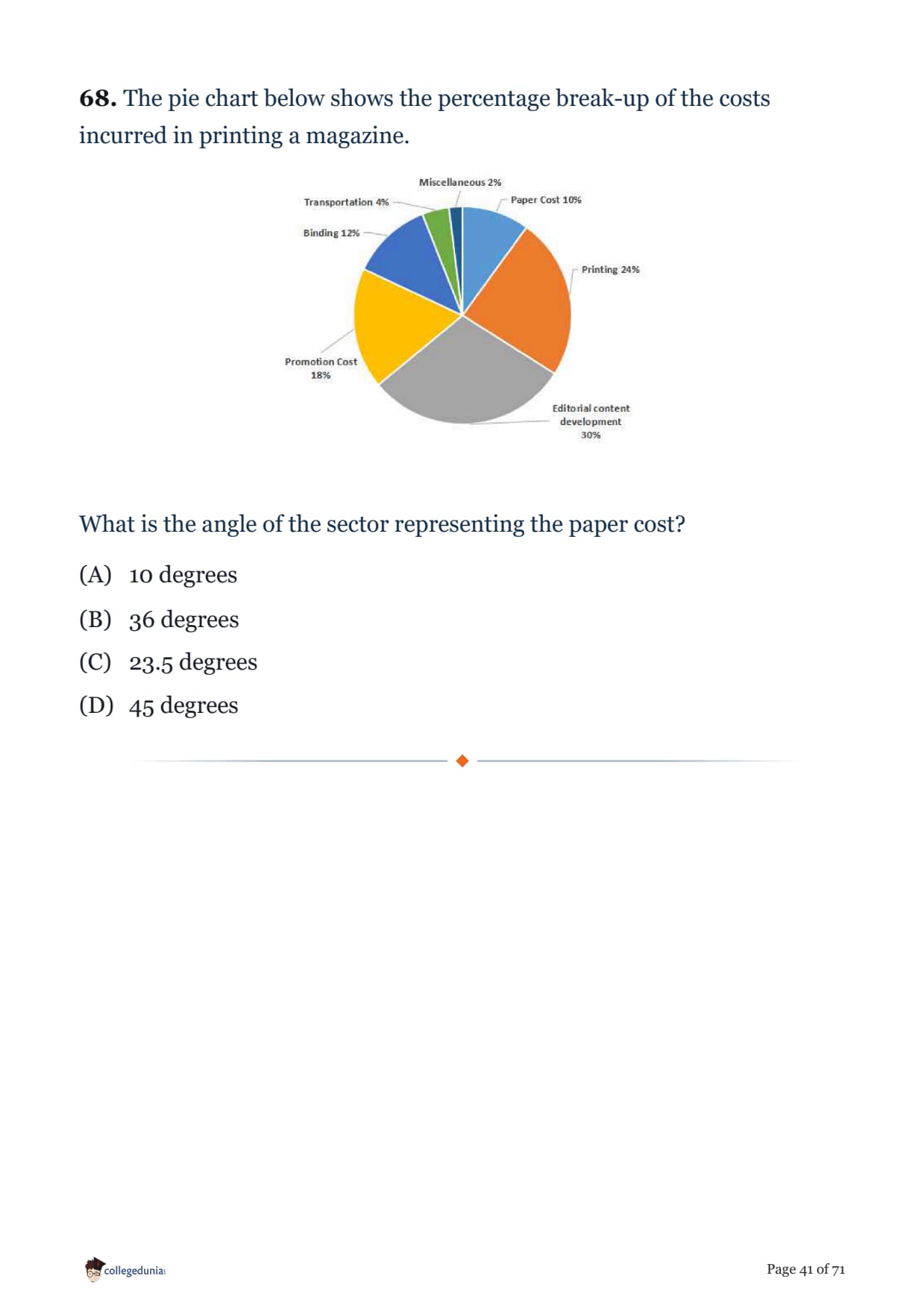
The pie chart below shows the percentage break-up of the costs incurred in printing a magazine.

What is the angle of the sector representing the paper cost?
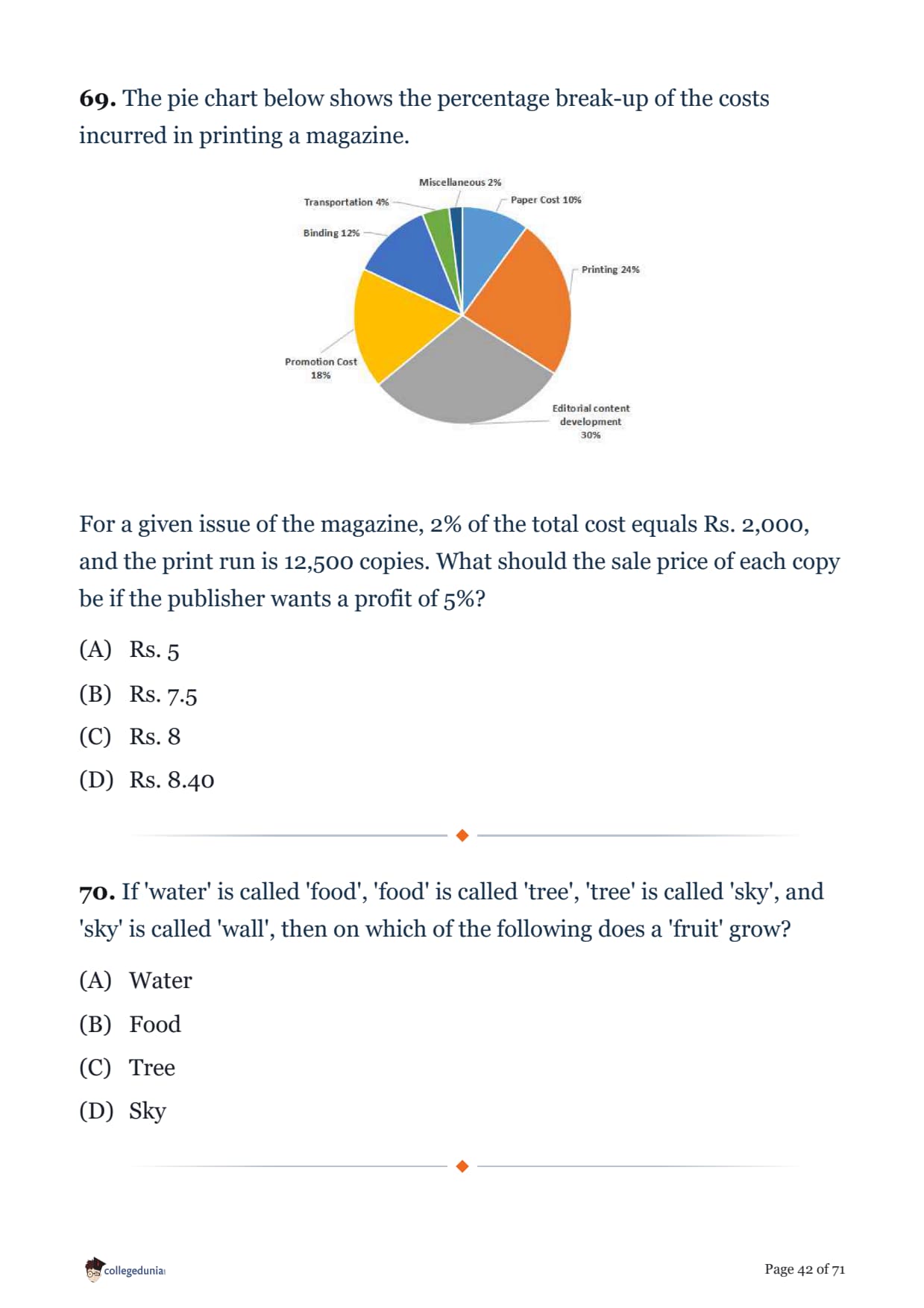
The pie chart below shows the percentage break-up of the costs incurred in printing a magazine.
For a given issue of the magazine, 2% of the total cost equals Rs. 2,000, and the print run is 12,500 copies. What should the sale price of each copy be if the publisher wants a profit of 5%?
If 'water' is called 'food', 'food' is called 'tree', 'tree' is called 'sky', and 'sky' is called 'wall', then on which of the following does a 'fruit' grow?
Choose the correct option to fill in the blank so that the sentence uses correct grammar.
She is a close friend of .
Choose the correct option to fill in the blank so that the sentence uses correct grammar.
He took care of her she was restored to health.
Choose the correct option to complete the sentence with correct grammar.
The man his appearance completely since then.
From the options below, choose the word with the incorrect spelling.
Choose the word spelt correctly.
Fill in the blanks with the correct pair of words.
He lives Bangaluru 115, Richmond Road.
Fill in the blanks with the correct pair of words.
'Aurally challenged' is a for the .
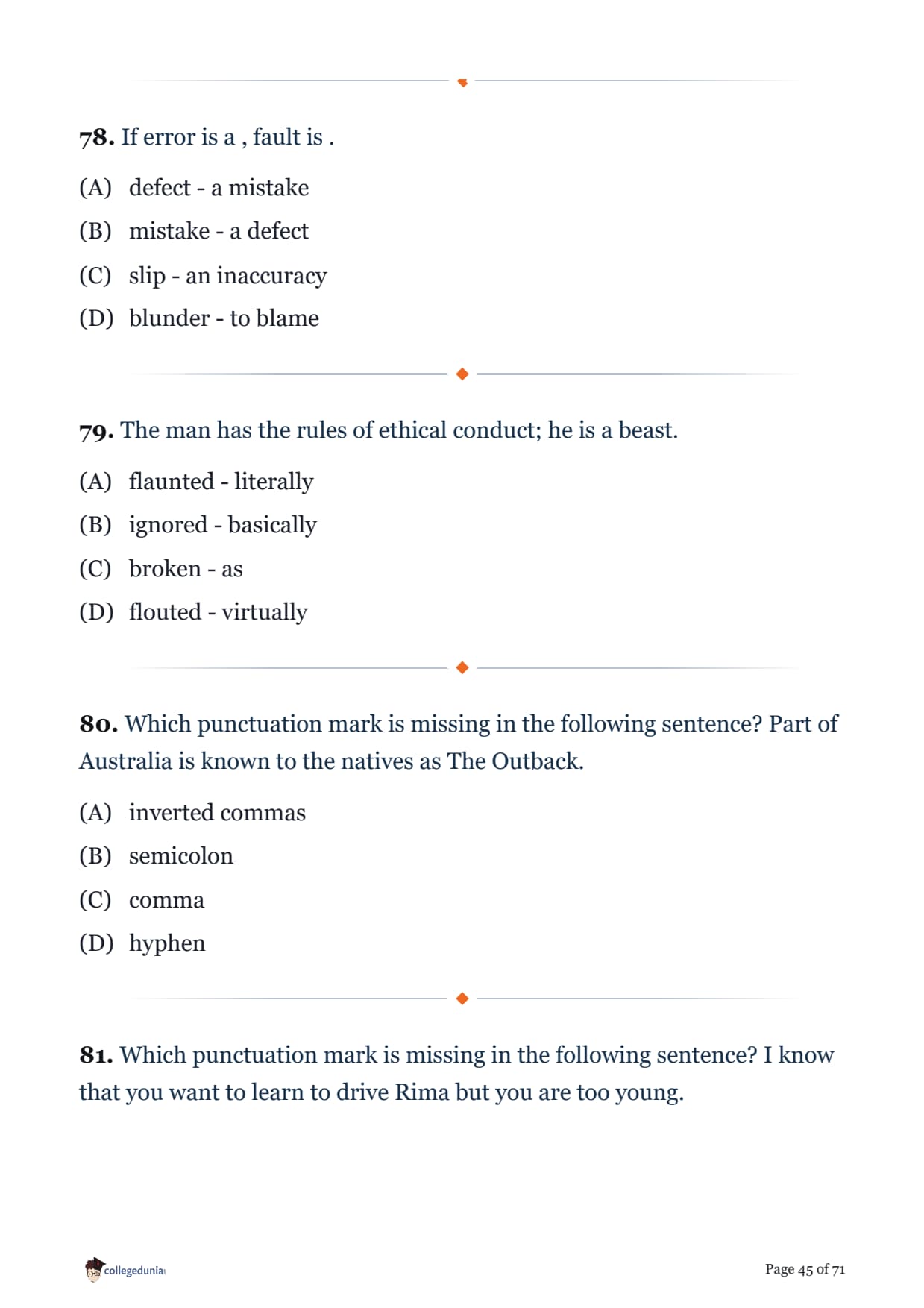
If error is a , fault is .
The man has the rules of ethical conduct; he is a beast.
Which punctuation mark is missing in the following sentence? Part of Australia is known to the natives as The Outback.
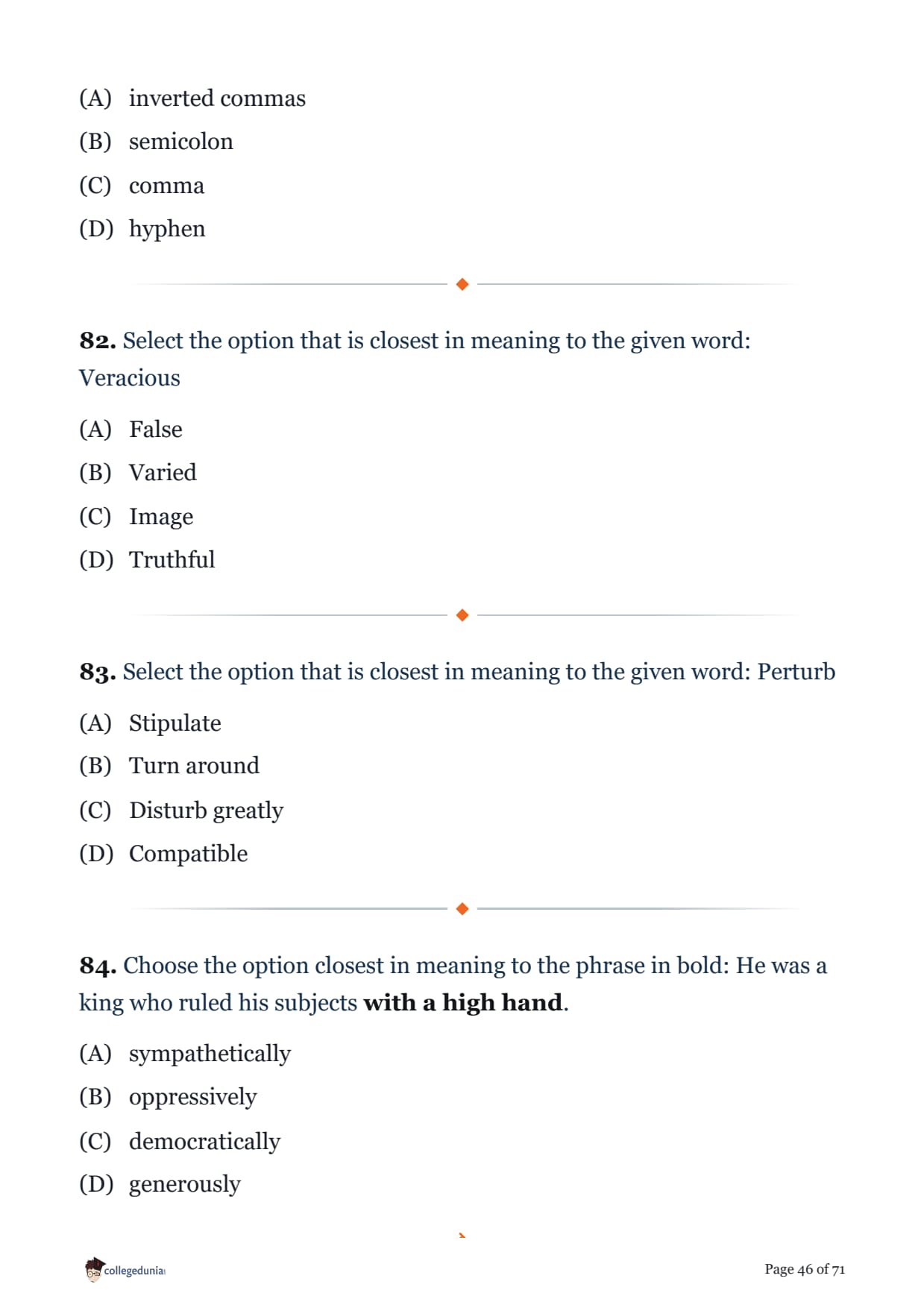
Which punctuation mark is missing in the following sentence? I know that you want to learn to drive Rima but you are too young.
Select the option that is closest in meaning to the given word: Veracious
Select the option that is closest in meaning to the given word: Perturb
Choose the option closest in meaning to the phrase in bold: He was a king who ruled his subjects with a high hand.
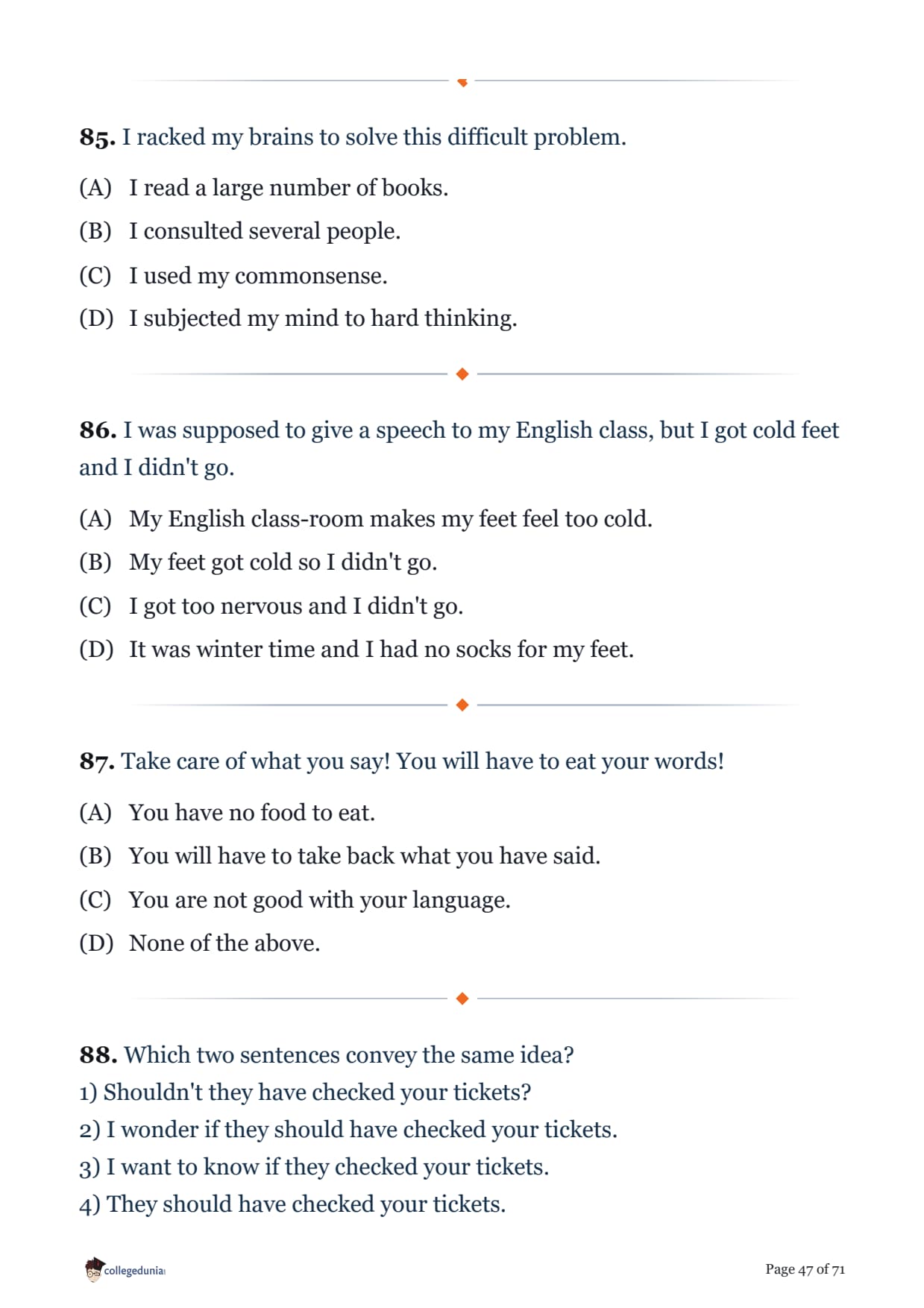
I racked my brains to solve this difficult problem.
I was supposed to give a speech to my English class, but I got cold feet and I didn't go.
Take care of what you say! You will have to eat your words!
Which two sentences convey the same idea?
1) Shouldn't they have checked your tickets?
2) I wonder if they should have checked your tickets.
3) I want to know if they checked your tickets.
4) They should have checked your tickets.
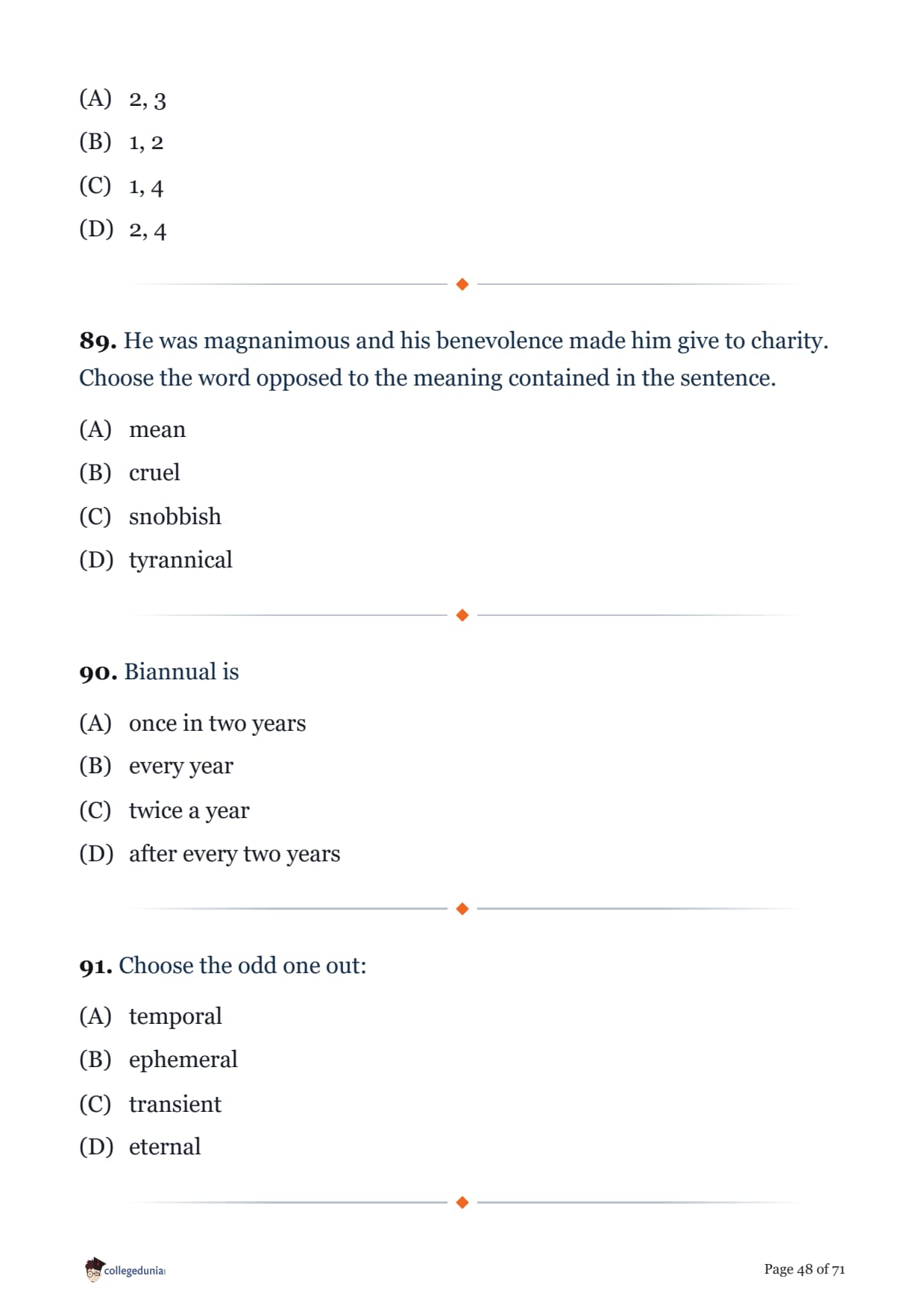
He was magnanimous and his benevolence made him give to charity. Choose the word opposed to the meaning contained in the sentence.
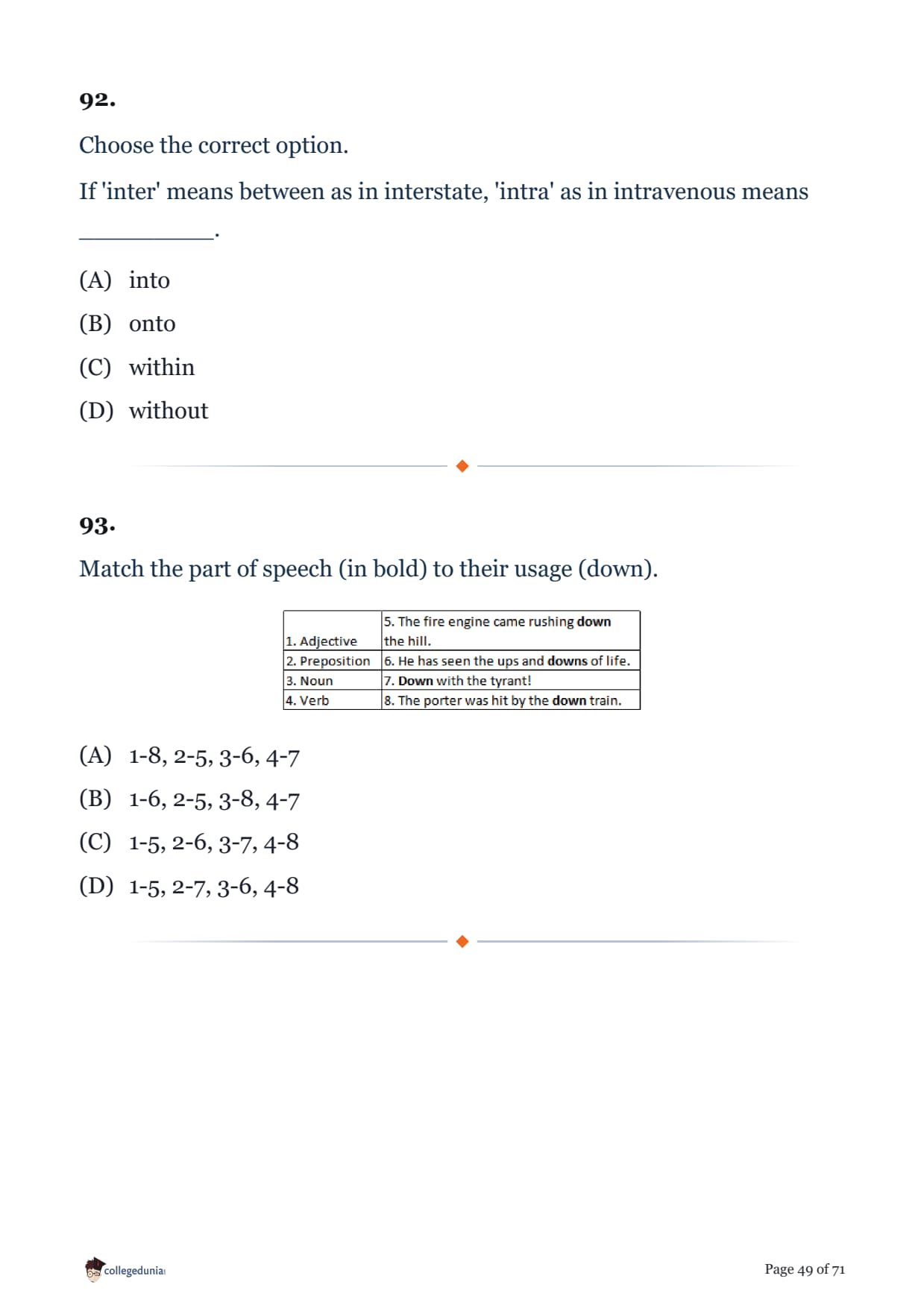
Biannual is
Choose the odd one out:
Choose the correct option.
If 'inter' means between as in interstate, 'intra' as in intravenous means _________.

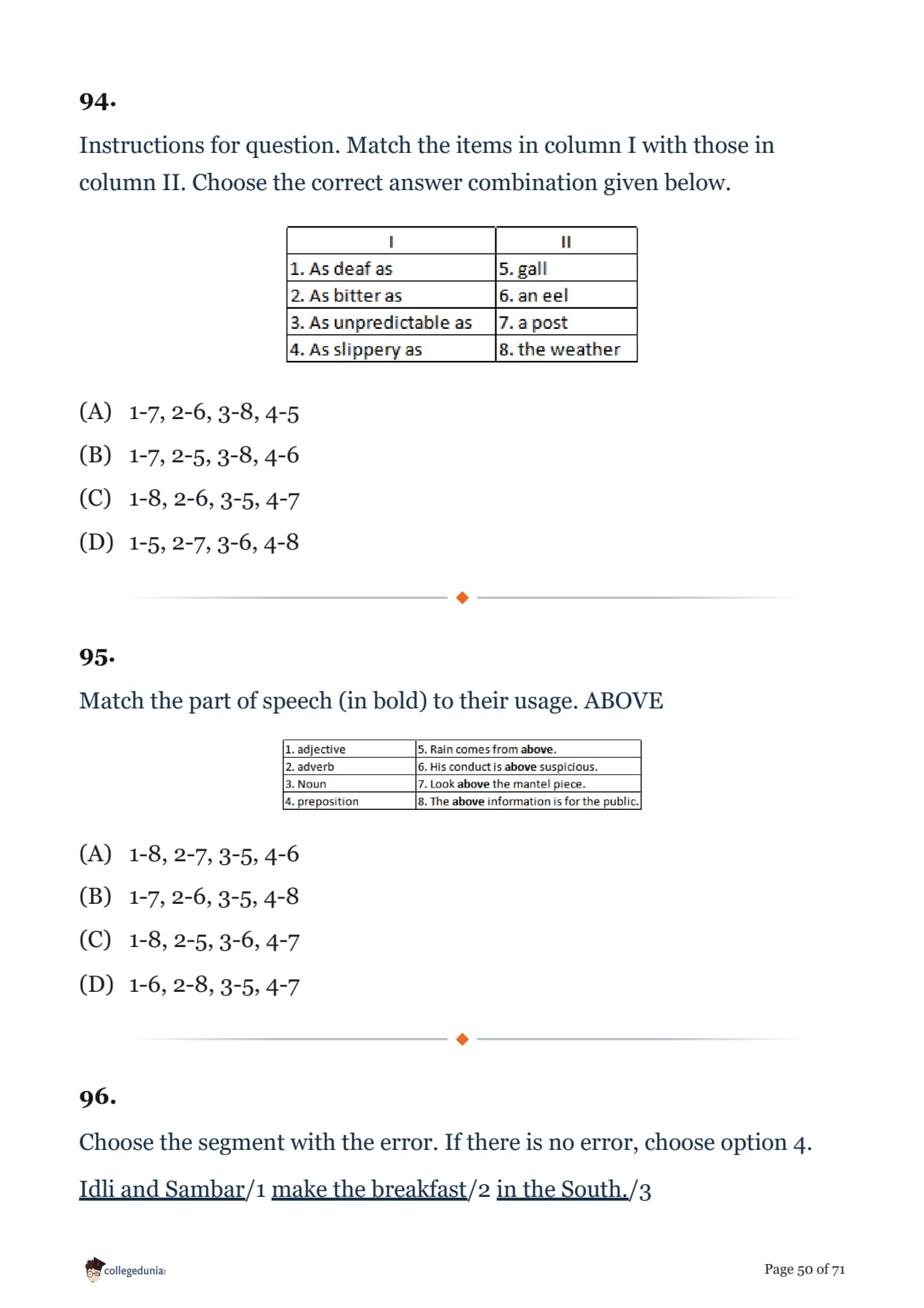
Instructions for question. Match the items in column I with those in column II. Choose the correct answer combination given below.


Choose the segment with the error. If there is no error, choose option 4.
Idli and Sambar/1 make the breakfast/2 in the South./3
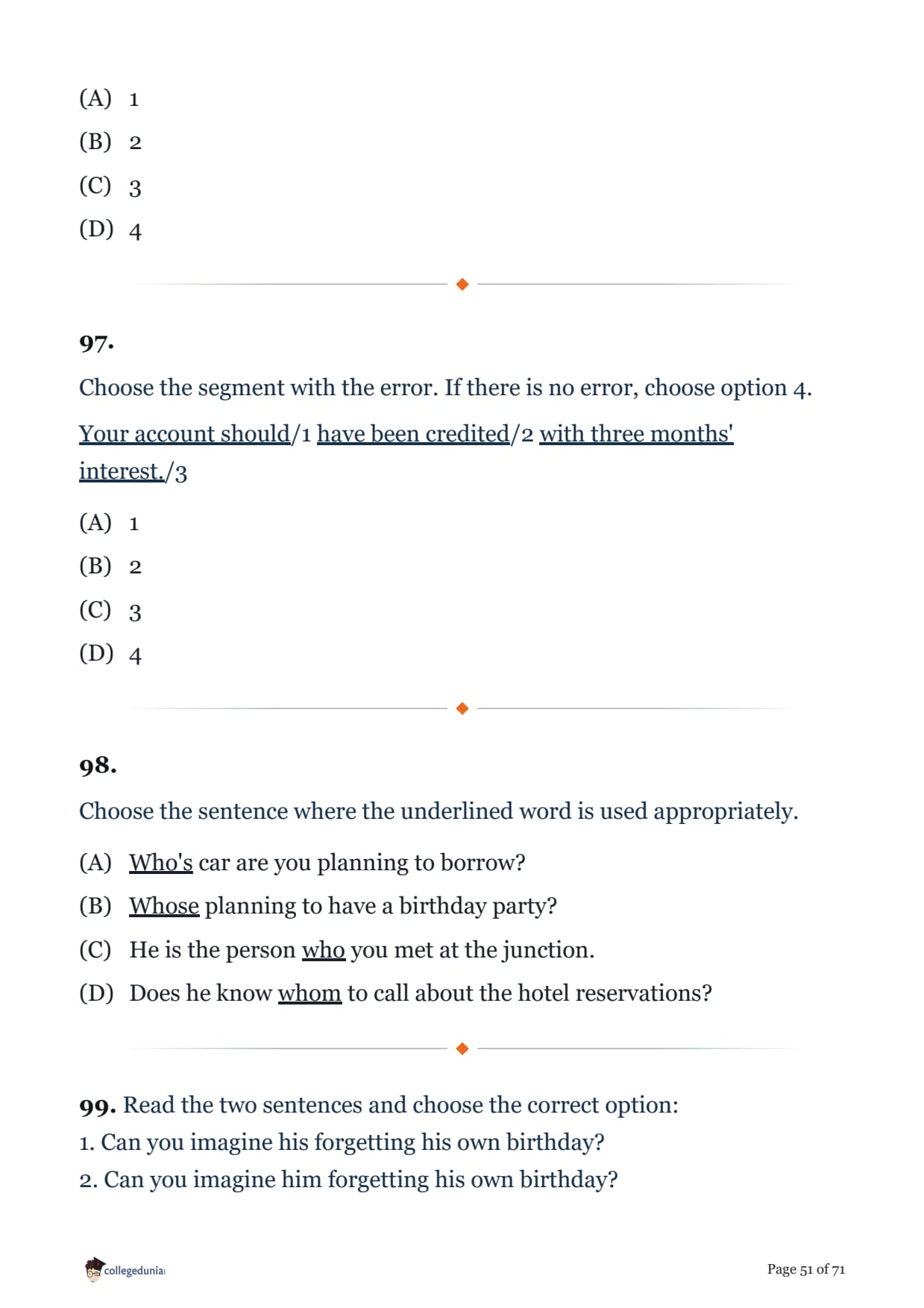
Choose the segment with the error. If there is no error, choose option 4.
Your account should/1 have been credited/2 with three months' interest./3
Read the two sentences and choose the correct option:
1. Can you imagine his forgetting his own birthday?
2. Can you imagine him forgetting his own birthday?
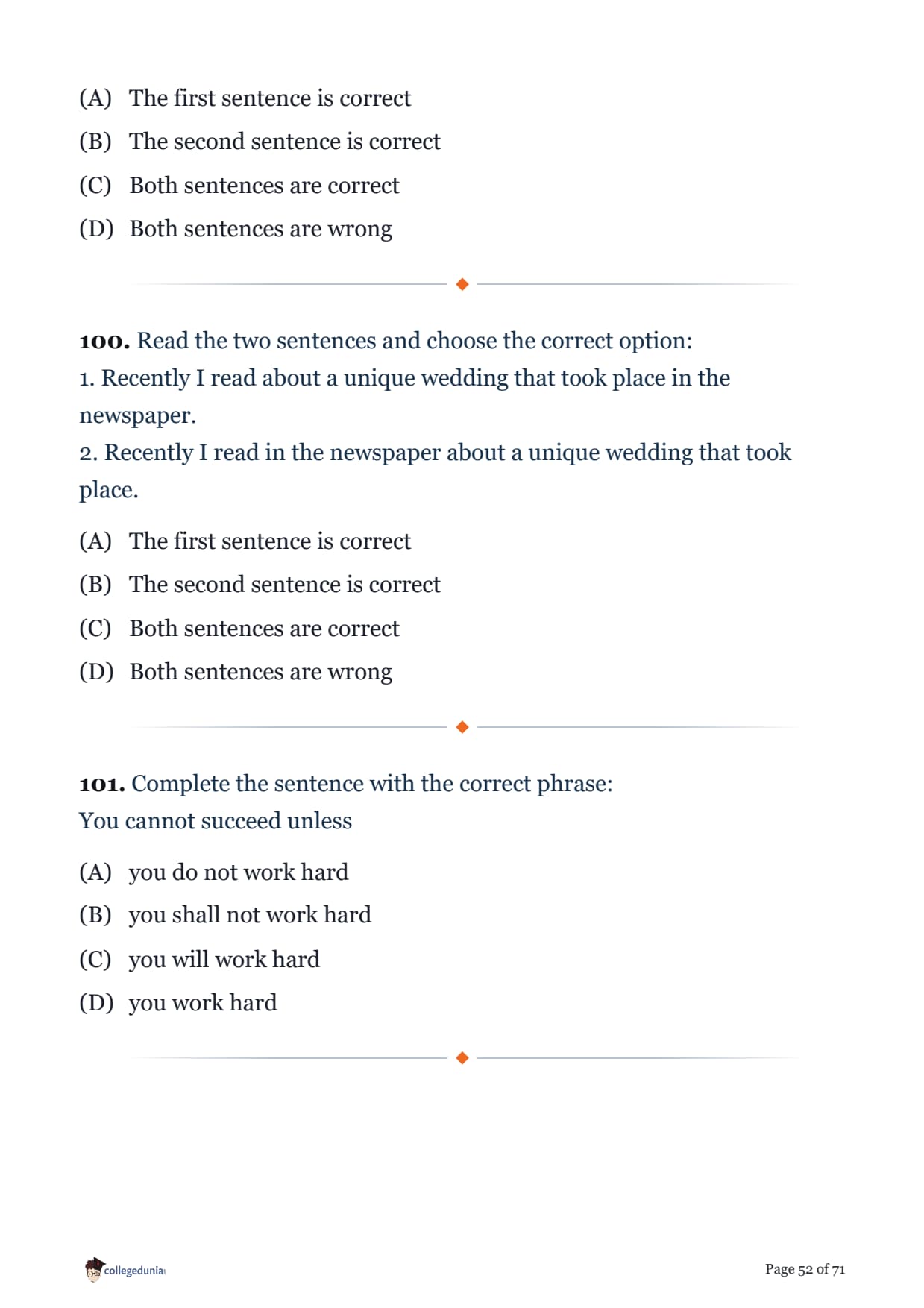
Read the two sentences and choose the correct option:
1. Recently I read about a unique wedding that took place in the newspaper.
2. Recently I read in the newspaper about a unique wedding that took place.
Complete the sentence with the correct phrase:
You cannot succeed unless
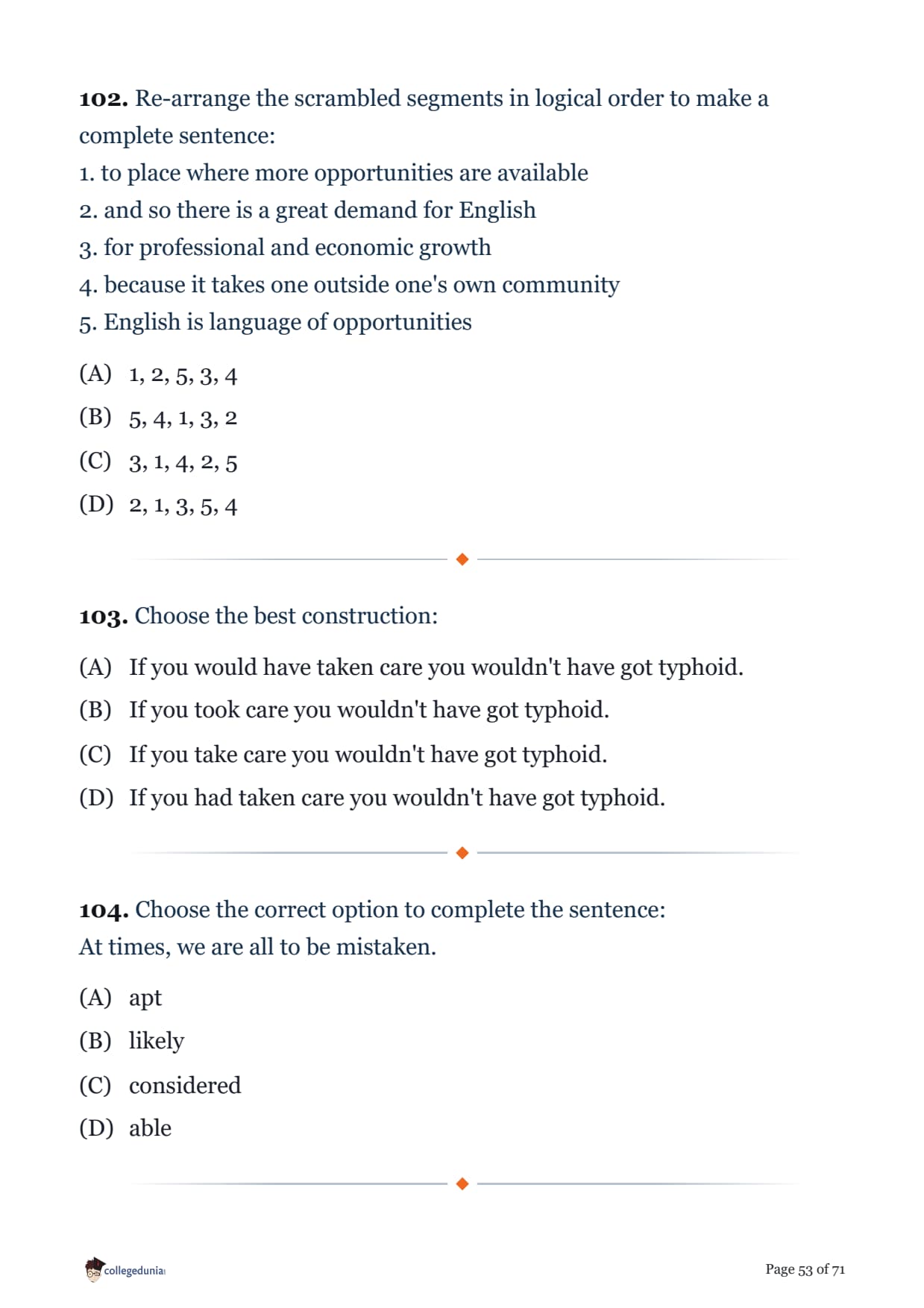
Re-arrange the scrambled segments in logical order to make a complete sentence:
1. to place where more opportunities are available
2. and so there is a great demand for English
3. for professional and economic growth
4. because it takes one outside one's own community
5. English is language of opportunities
Choose the best construction:
Choose the correct option to complete the sentence:
At times, we are all to be mistaken.
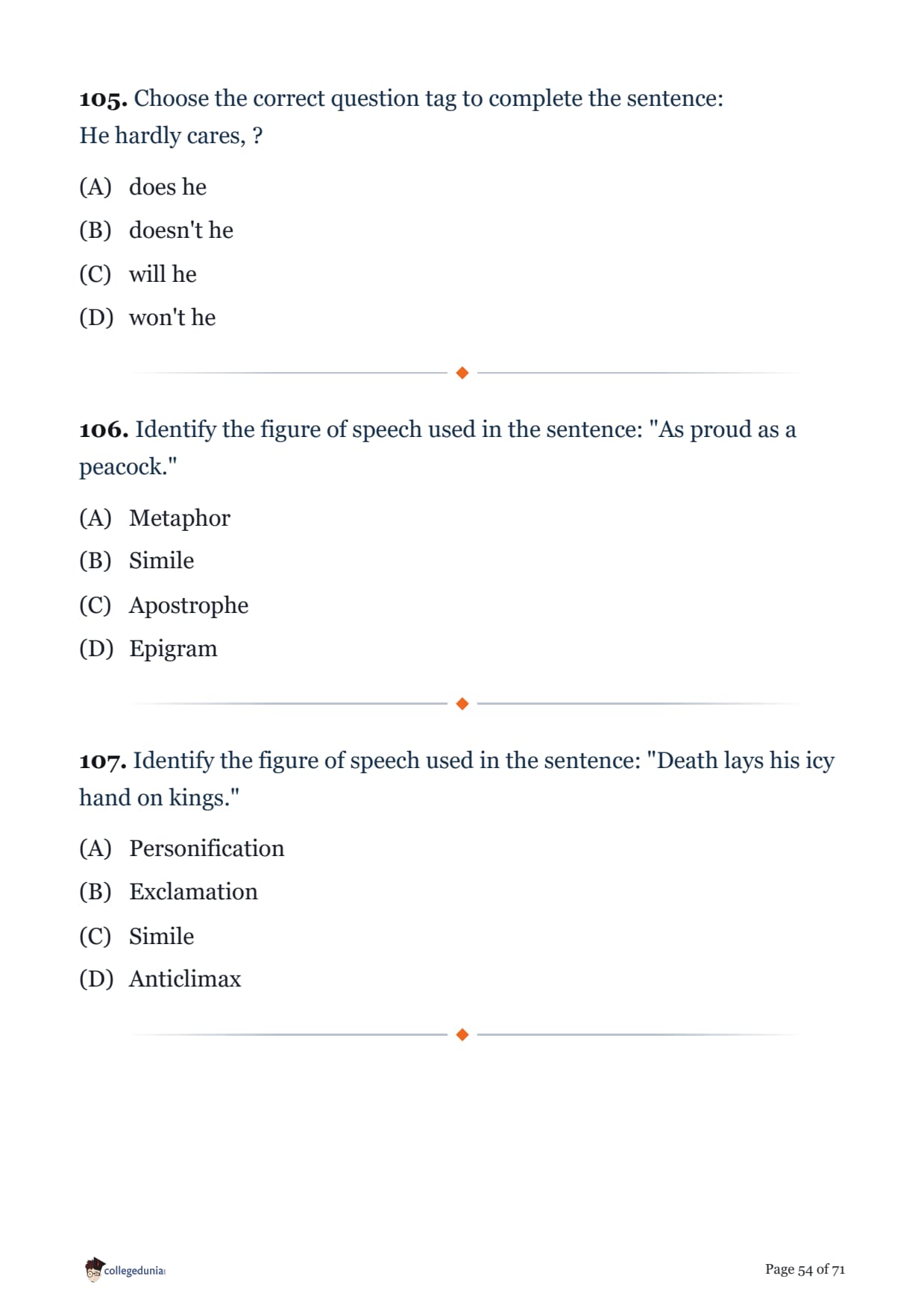
Choose the correct question tag to complete the sentence:
He hardly cares, ?
Identify the figure of speech used in the sentence: "As proud as a peacock."
Identify the figure of speech used in the sentence: "Death lays his icy hand on kings."
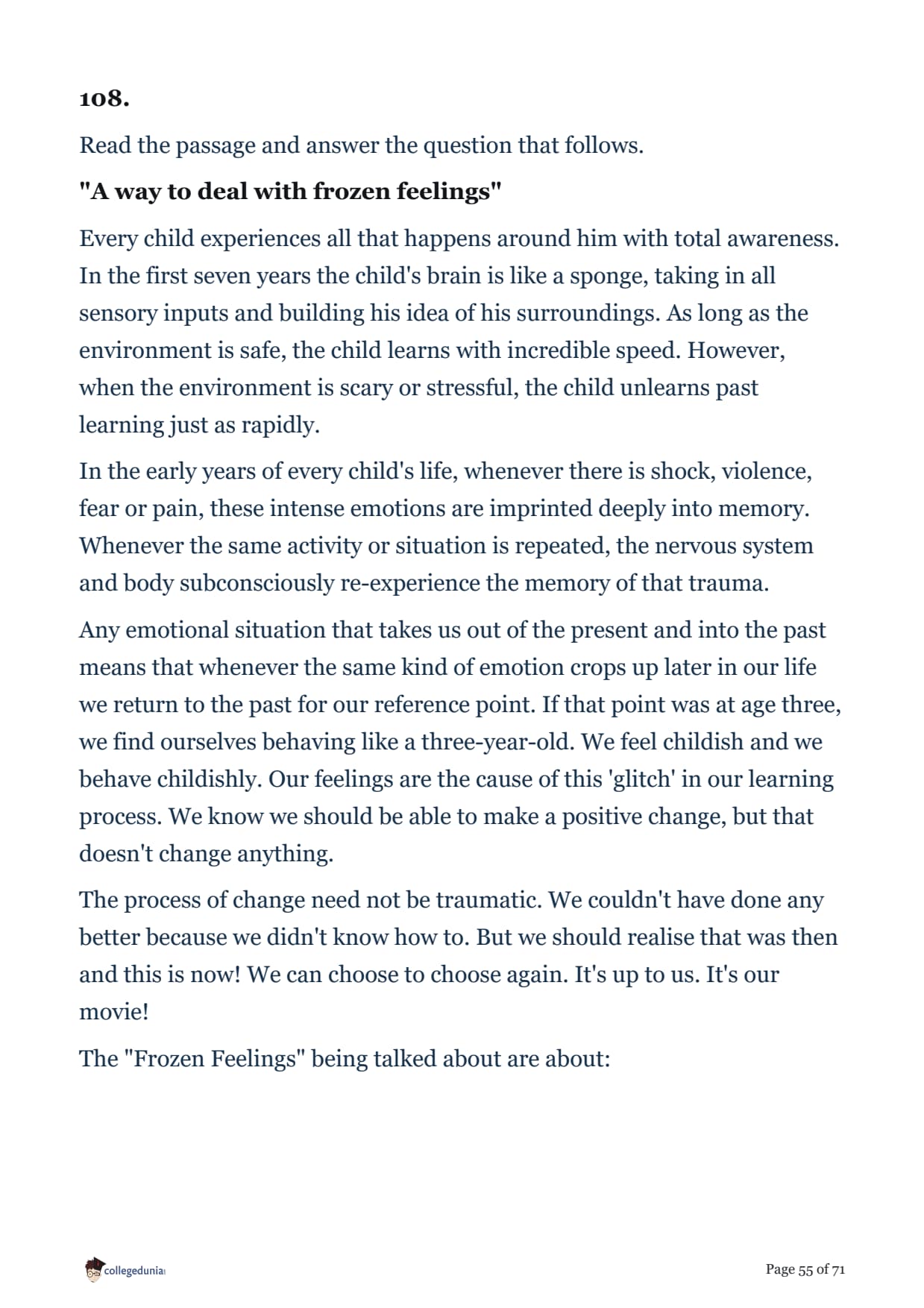
Read the passage and answer the question that follows.
"A way to deal with frozen feelings"
Every child experiences all that happens around him with total awareness. In the first seven years the child's brain is like a sponge, taking in all sensory inputs and building his idea of his surroundings. As long as the environment is safe, the child learns with incredible speed. However, when the environment is scary or stressful, the child unlearns past learning just as rapidly.
In the early years of every child's life, whenever there is shock, violence, fear or pain, these intense emotions are imprinted deeply into memory. Whenever the same activity or situation is repeated, the nervous system and body subconsciously re-experience the memory of that trauma.
Any emotional situation that takes us out of the present and into the past means that whenever the same kind of emotion crops up later in our life we return to the past for our reference point. If that point was at age three, we find ourselves behaving like a three-year-old. We feel childish and we behave childishly. Our feelings are the cause of this 'glitch' in our learning process. We know we should be able to make a positive change, but that doesn't change anything.
The process of change need not be traumatic. We couldn't have done any better because we didn't know how to. But we should realise that was then and this is now! We can choose to choose again. It's up to us. It's our movie!
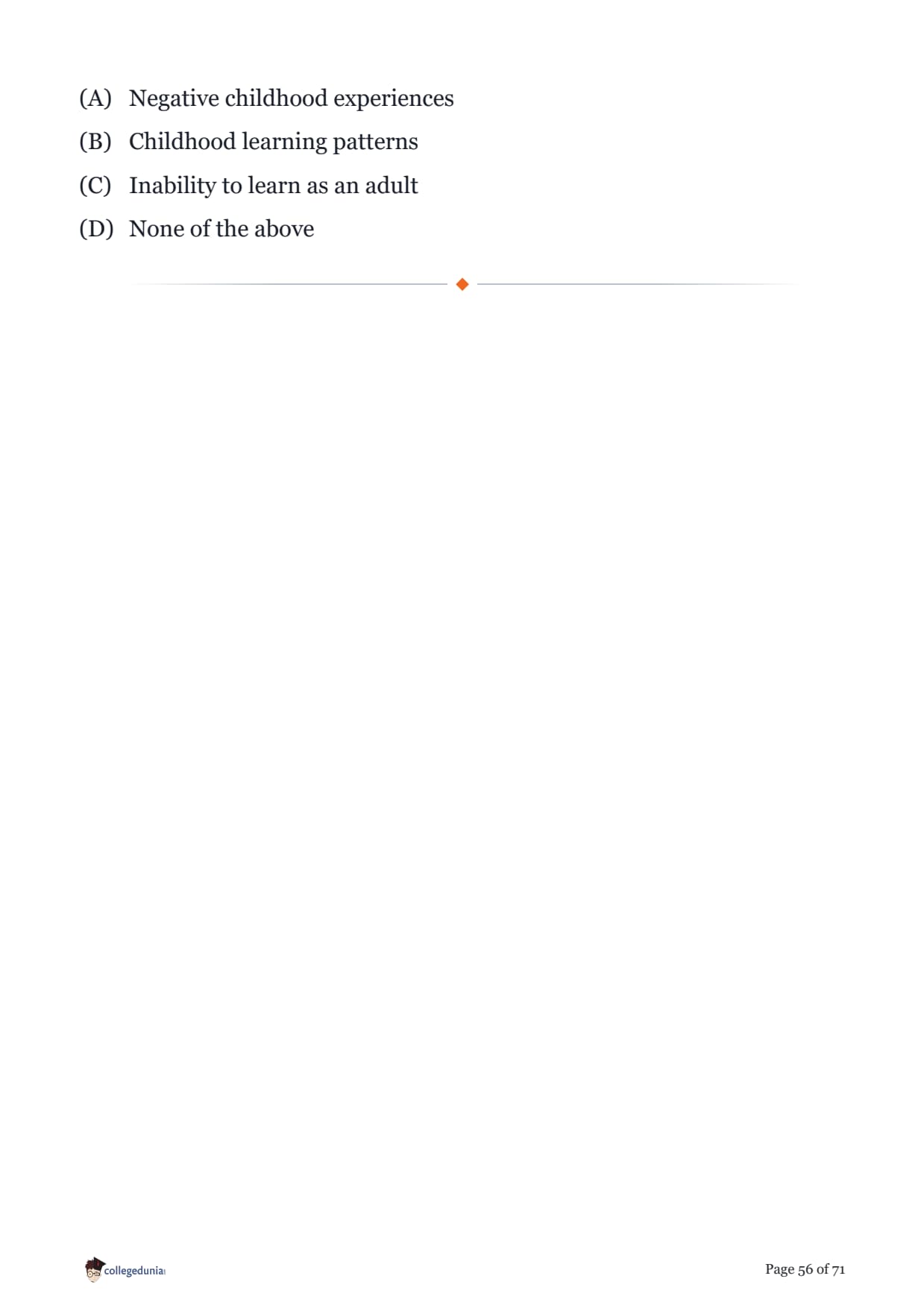
The "Frozen Feelings" being talked about are about:
Read the passage and answer the question that follows.
"A way to deal with frozen feelings"
Every child experiences all that happens around him with total awareness. In the first seven years the child's brain is like a sponge, taking in all sensory inputs and building his idea of his surroundings. As long as the environment is safe, the child learns with incredible speed. However, when the environment is scary or stressful, the child unlearns past learning just as rapidly.
In the early years of every child's life, whenever there is shock, violence, fear or pain, these intense emotions are imprinted deeply into memory. Whenever the same activity or situation is repeated, the nervous system and body subconsciously re-experience the memory of that trauma.
Any emotional situation that takes us out of the present and into the past means that whenever the same kind of emotion crops up later in our life we return to the past for our reference point. If that point was at age three, we find ourselves behaving like a three-year-old. We feel childish and we behave childishly. Our feelings are the cause of this 'glitch' in our learning process. We know we should be able to make a positive change, but that doesn't change anything.
The process of change need not be traumatic. We couldn't have done any better because we didn't know how to. But we should realise that was then and this is now! We can choose to choose again. It's up to us. It's our movie!
A 'glitch' is:
Read the passage and answer the question that follows.
"A way to deal with frozen feelings"
Every child experiences all that happens around him with total awareness. In the first seven years the child's brain is like a sponge, taking in all sensory inputs and building his idea of his surroundings. As long as the environment is safe, the child learns with incredible speed. However, when the environment is scary or stressful, the child unlearns past learning just as rapidly.
In the early years of every child's life, whenever there is shock, violence, fear or pain, these intense emotions are imprinted deeply into memory. Whenever the same activity or situation is repeated, the nervous system and body subconsciously re-experience the memory of that trauma.
Any emotional situation that takes us out of the present and into the past means that whenever the same kind of emotion crops up later in our life we return to the past for our reference point. If that point was at age three, we find ourselves behaving like a three-year-old. We feel childish and we behave childishly. Our feelings are the cause of this 'glitch' in our learning process. We know we should be able to make a positive change, but that doesn't change anything.
The process of change need not be traumatic. We couldn't have done any better because we didn't know how to. But we should realise that was then and this is now! We can choose to choose again. It's up to us. It's our movie!
Identify the correct sentence, based on the paragraph.
Sentence 1: The process of change needs to be traumatic.
Sentence 2: We feel childish and we behave childishly.
Dendrochronology is:
Which company launched the first mobile phone operation in India?
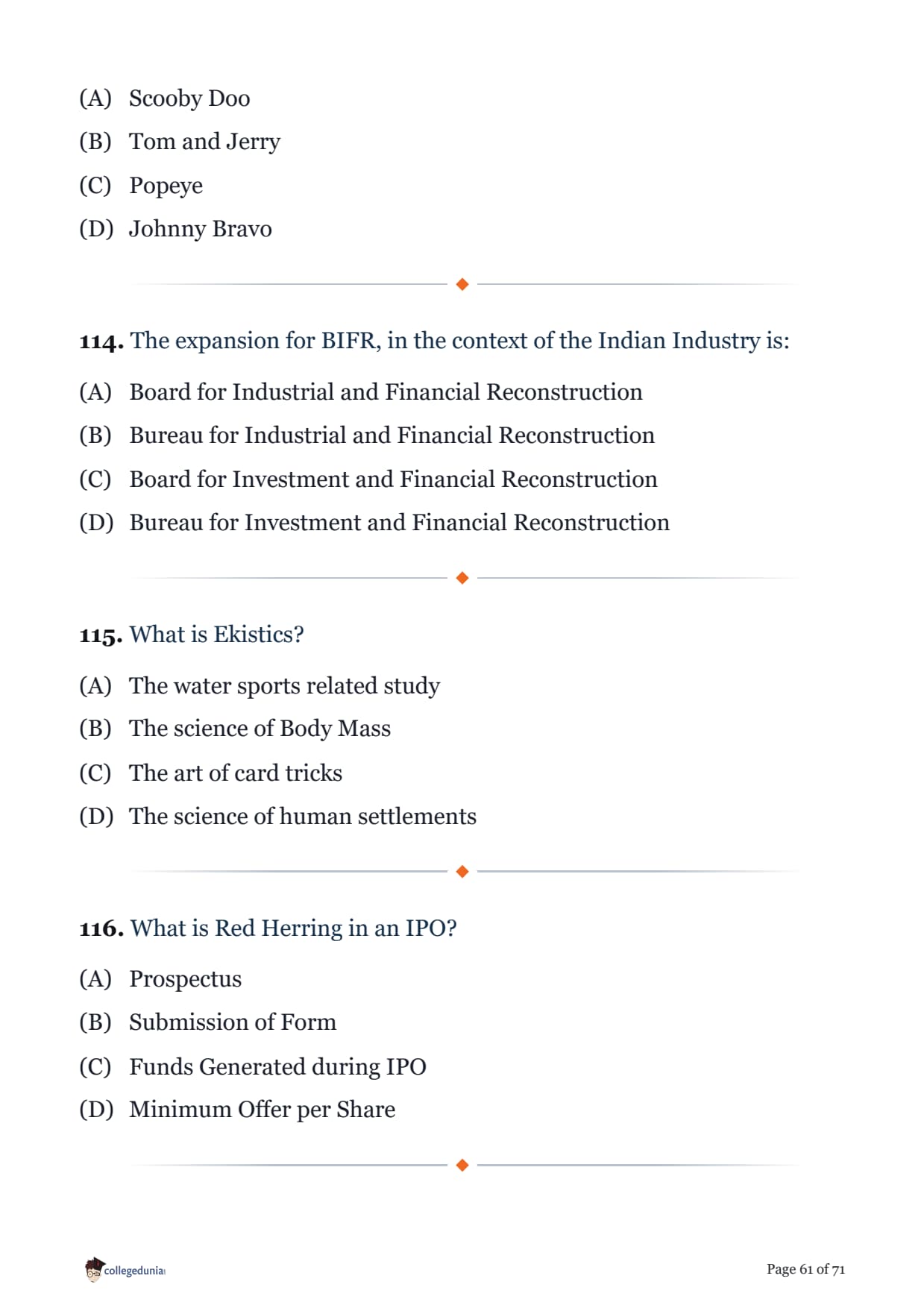
Which is the longest running English language TV cartoon in history, first launched by Warner Brothers in 1969 exclusively for television, and is now popular fare on the Cartoon Network?
The expansion for BIFR, in the context of the Indian Industry is:
What is Ekistics?
What is Red Herring in an IPO?
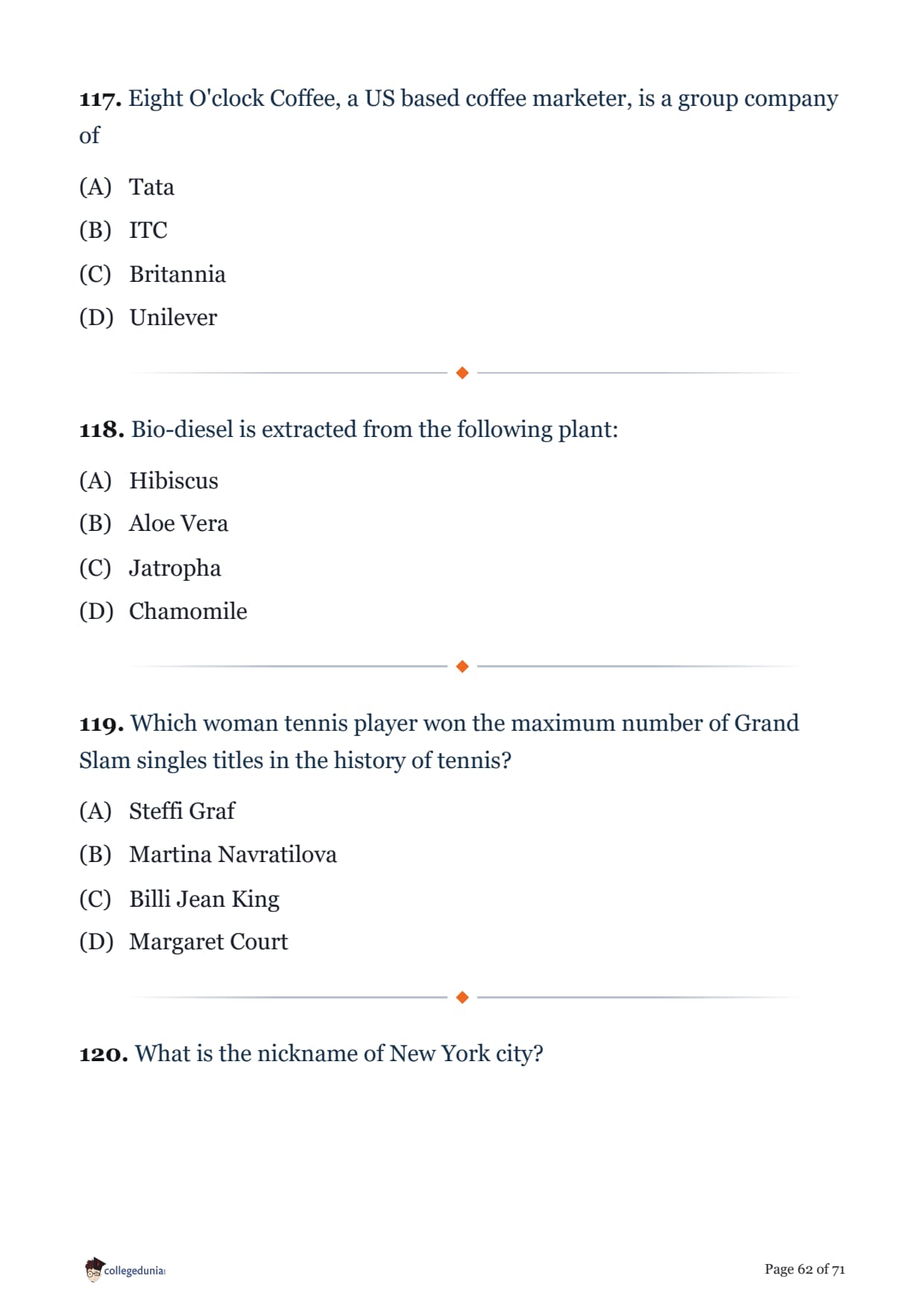
Eight O'clock Coffee, a US based coffee marketer, is a group company of
Bio-diesel is extracted from the following plant:
Which woman tennis player won the maximum number of Grand Slam singles titles in the history of tennis?
What is the nickname of New York city?
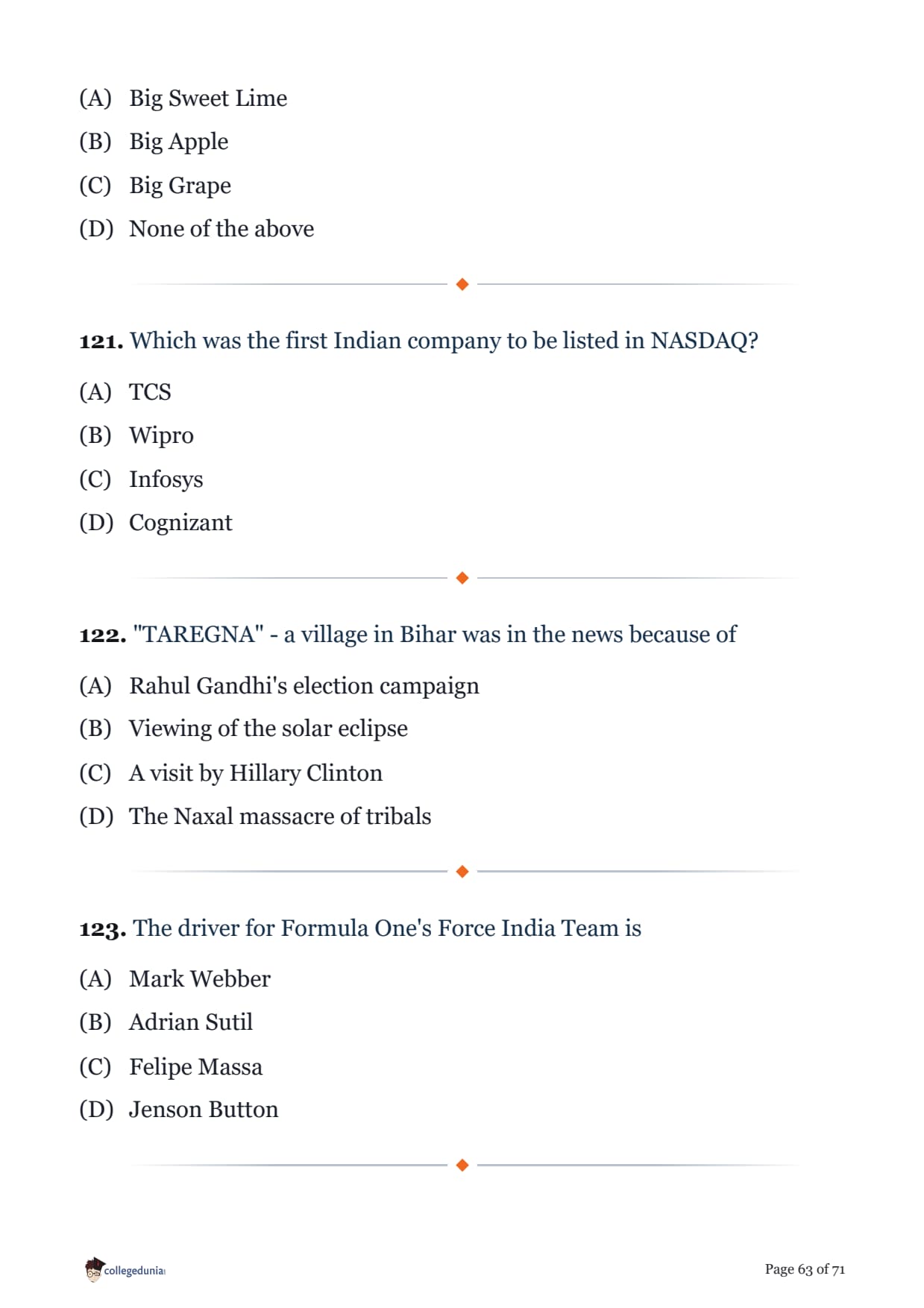
Which was the first Indian company to be listed in NASDAQ?
"TAREGNA" - a village in Bihar was in the news because of
The driver for Formula One's Force India Team is
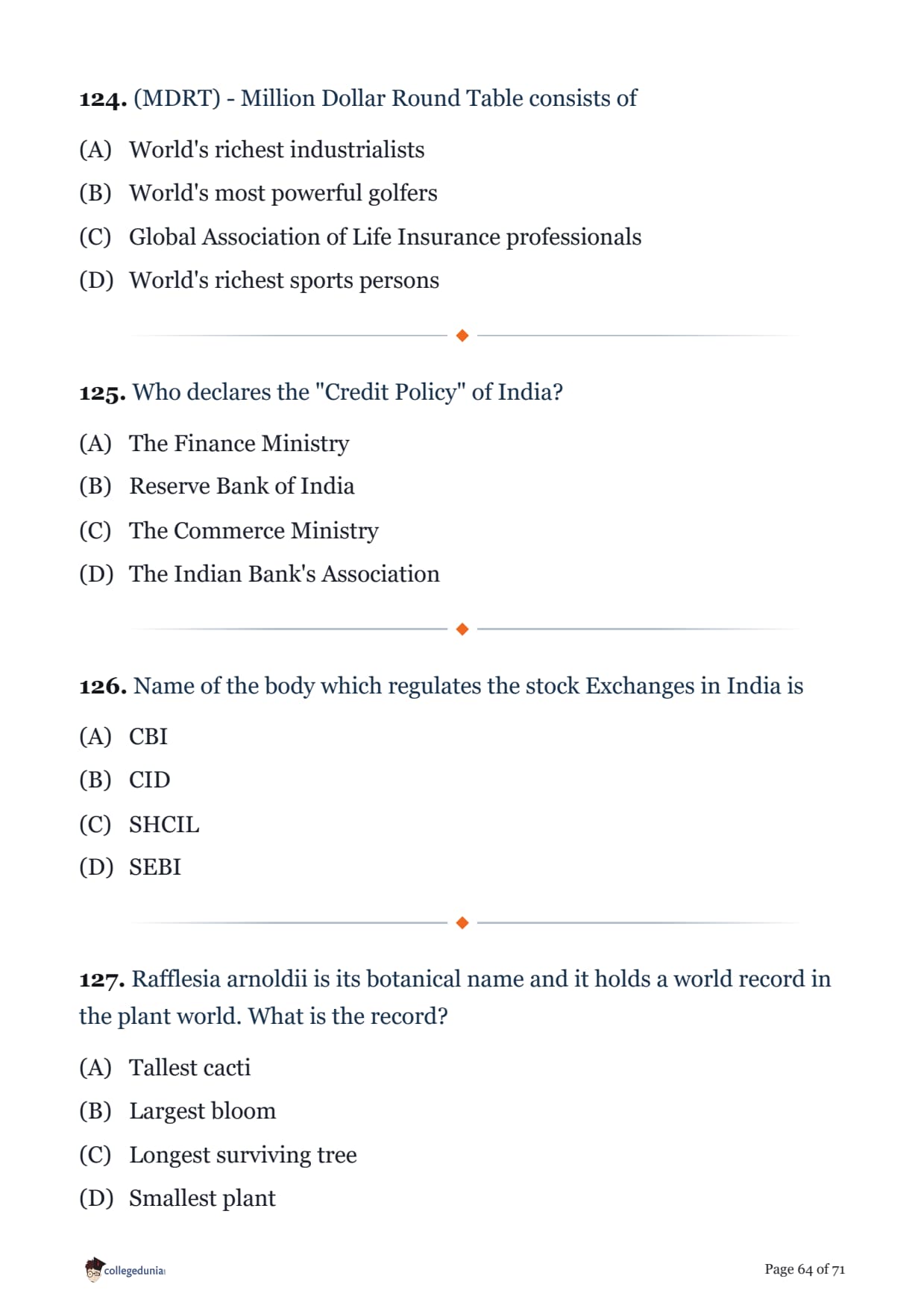
(MDRT) - Million Dollar Round Table consists of
Who declares the "Credit Policy" of India?
Name of the body which regulates the stock Exchanges in India is
Rafflesia arnoldii is its botanical name and it holds a world record in the plant world. What is the record?
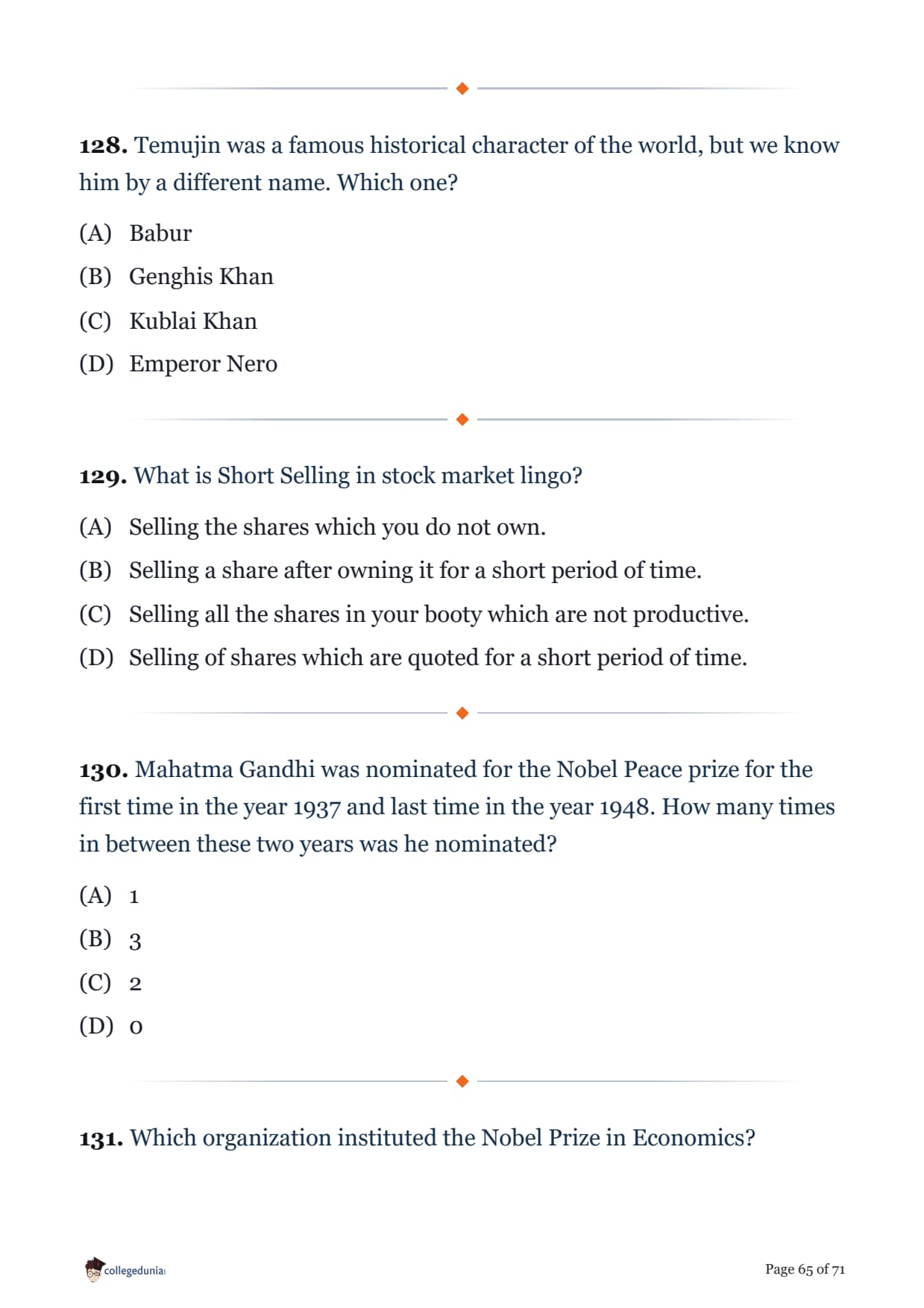
Temujin was a famous historical character of the world, but we know him by a different name. Which one?
What is Short Selling in stock market lingo?
Mahatma Gandhi was nominated for the Nobel Peace prize for the first time in the year 1937 and last time in the year 1948. How many times in between these two years was he nominated?
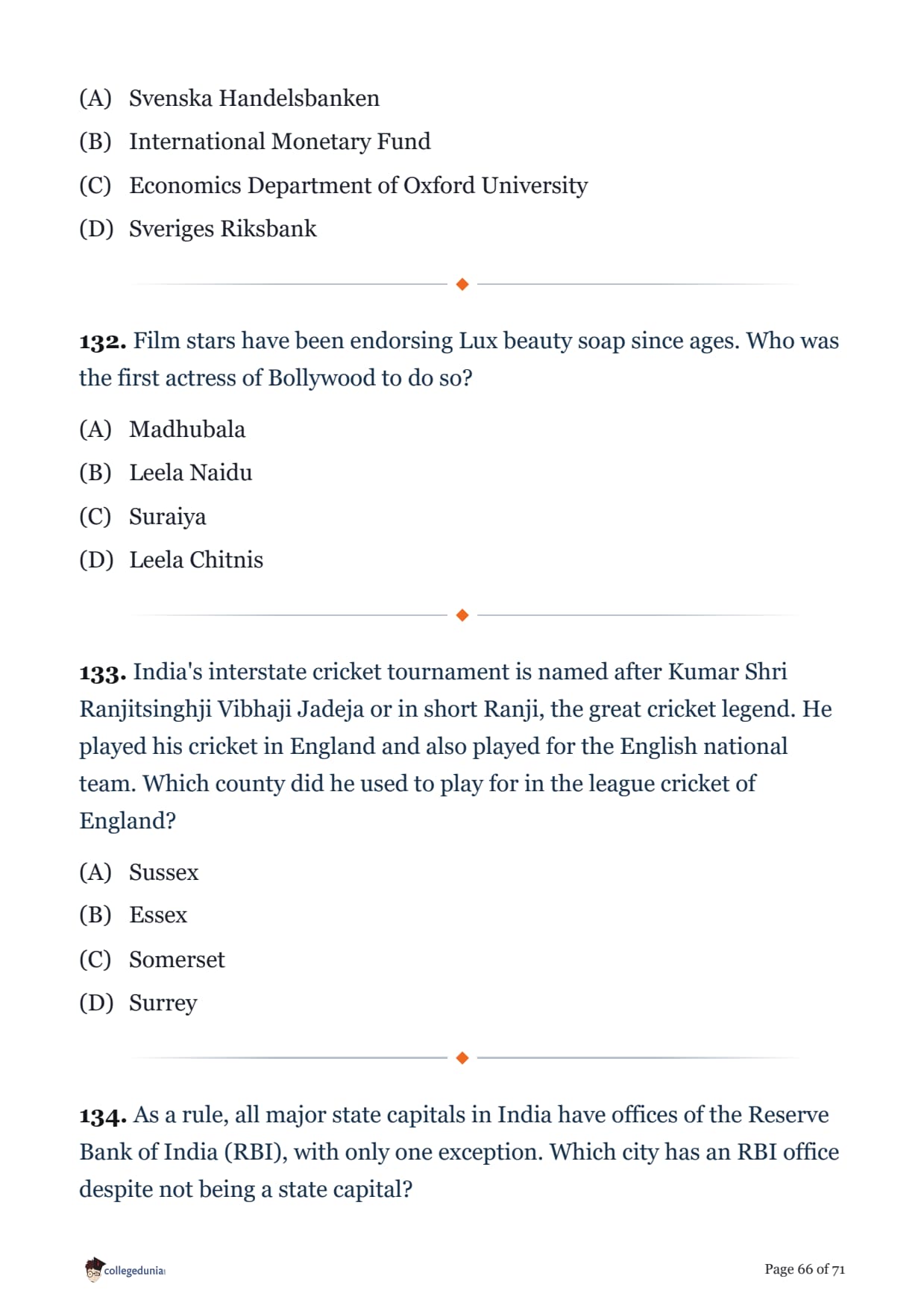
Which organization instituted the Nobel Prize in Economics?
Film stars have been endorsing Lux beauty soap since ages. Who was the first actress of Bollywood to do so?
India's interstate cricket tournament is named after Kumar Shri Ranjitsinghji Vibhaji Jadeja or in short Ranji, the great cricket legend. He played his cricket in England and also played for the English national team. Which county did he used to play for in the league cricket of England?
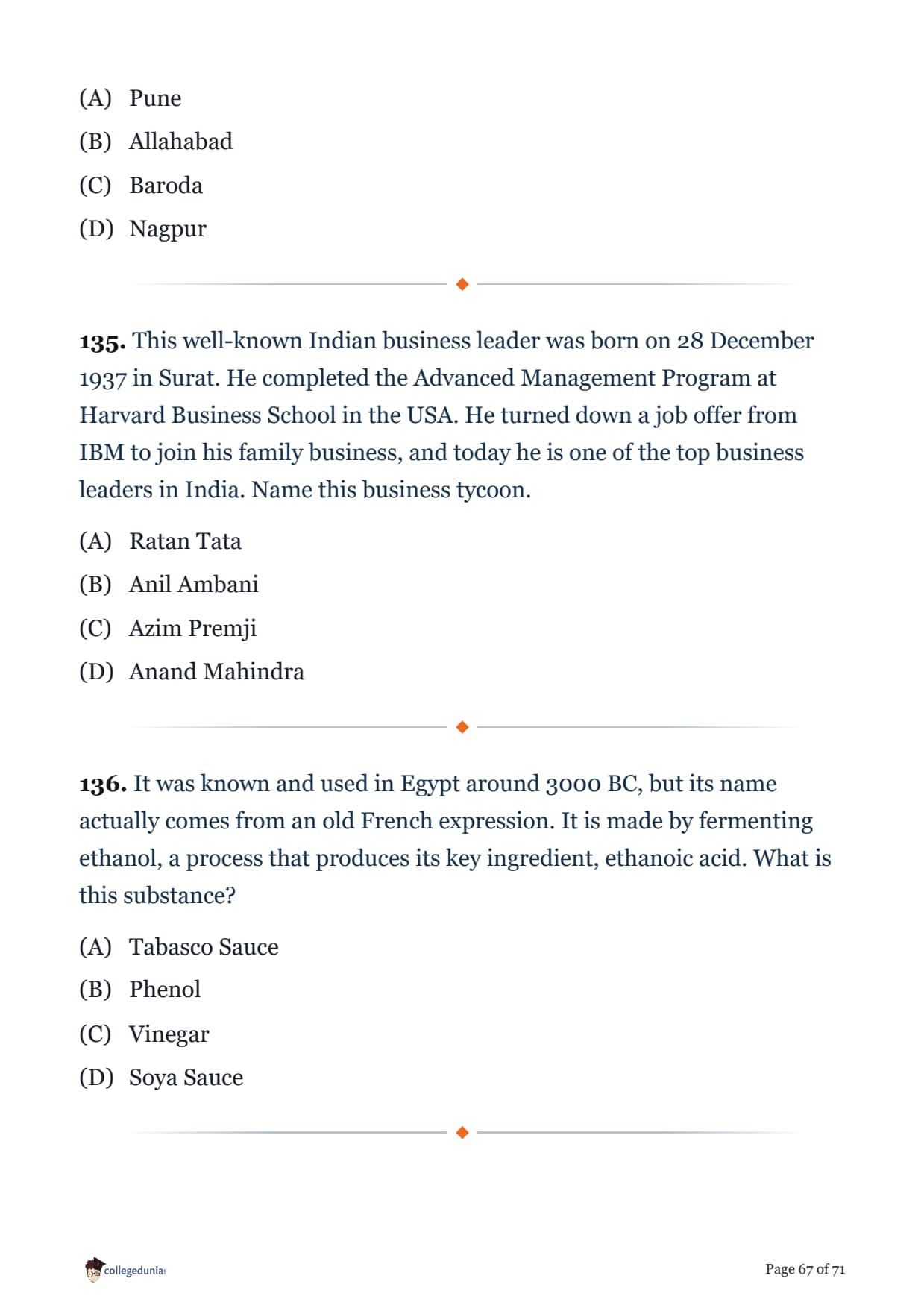
As a rule, all major state capitals in India have offices of the Reserve Bank of India (RBI), with only one exception. Which city has an RBI office despite not being a state capital?
This well-known Indian business leader was born on 28 December 1937 in Surat. He completed the Advanced Management Program at Harvard Business School in the USA. He turned down a job offer from IBM to join his family business, and today he is one of the top business leaders in India. Name this business tycoon.
It was known and used in Egypt around 3000 BC, but its name actually comes from an old French expression. It is made by fermenting ethanol, a process that produces its key ingredient, ethanoic acid. What is this substance?
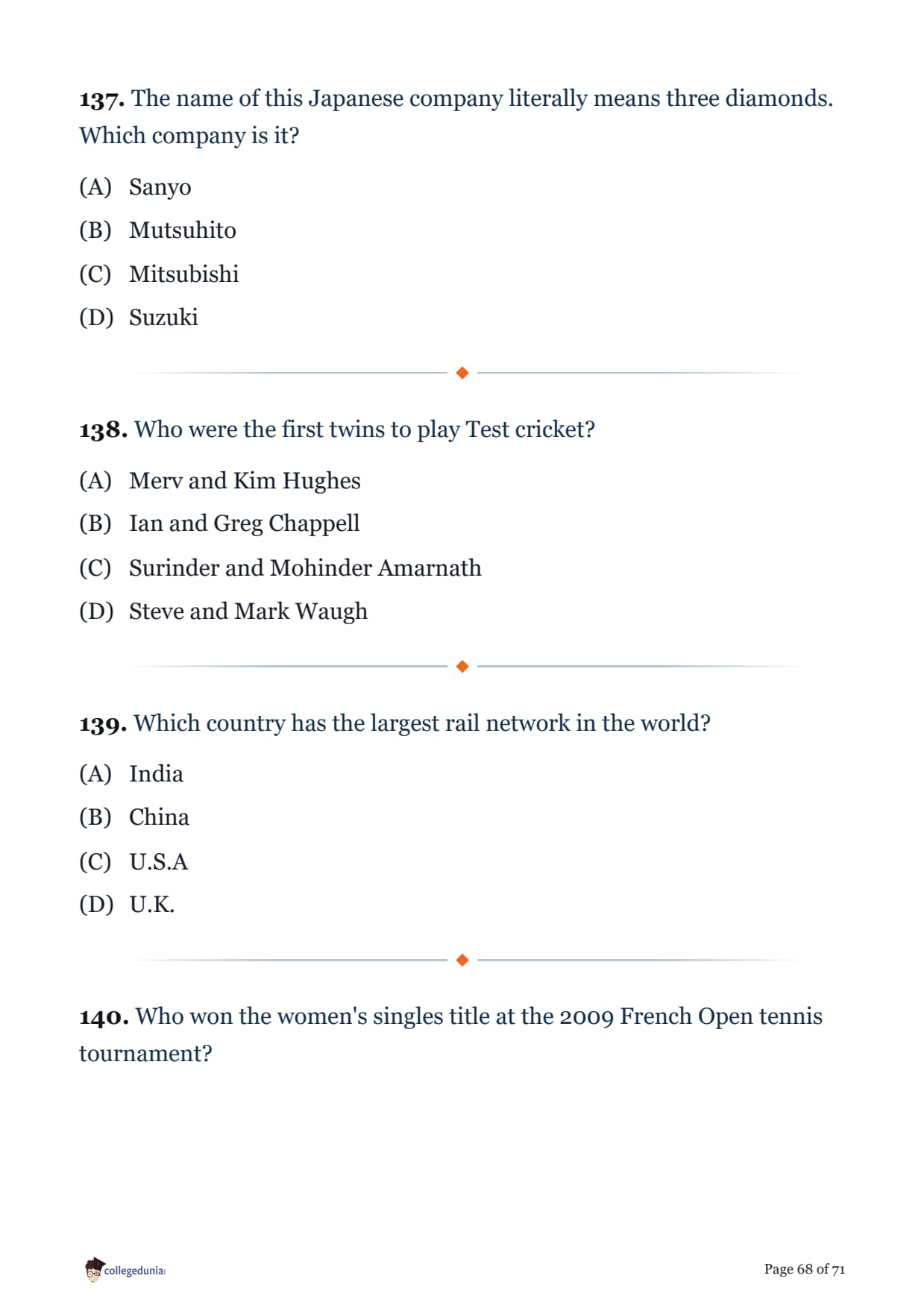
The name of this Japanese company literally means three diamonds. Which company is it?
Who were the first twins to play Test cricket?
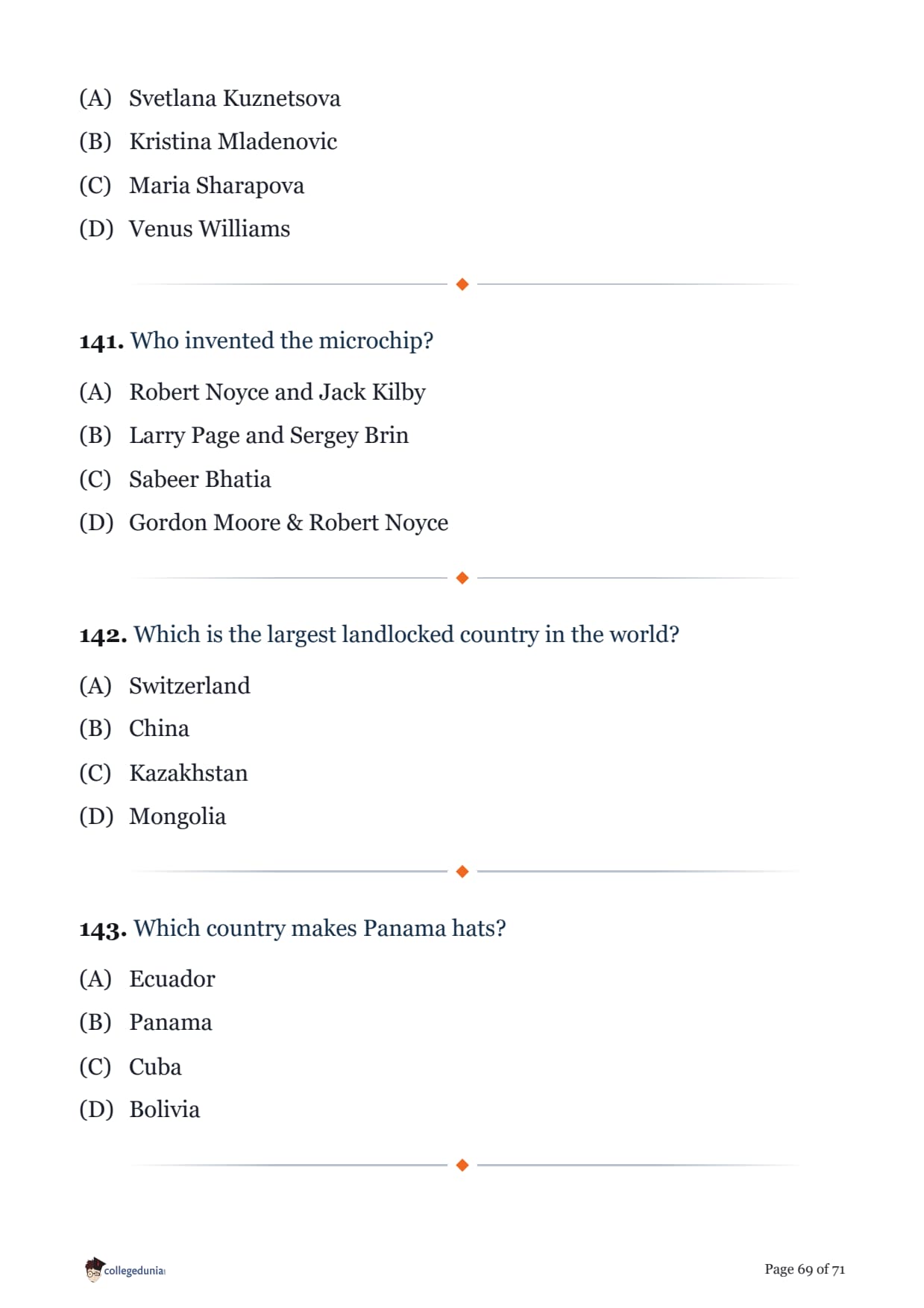
Which country has the largest rail network in the world?
Who won the women's singles title at the 2009 French Open tennis tournament?
Who invented the microchip?
Which is the largest landlocked country in the world?
Which country makes Panama hats?
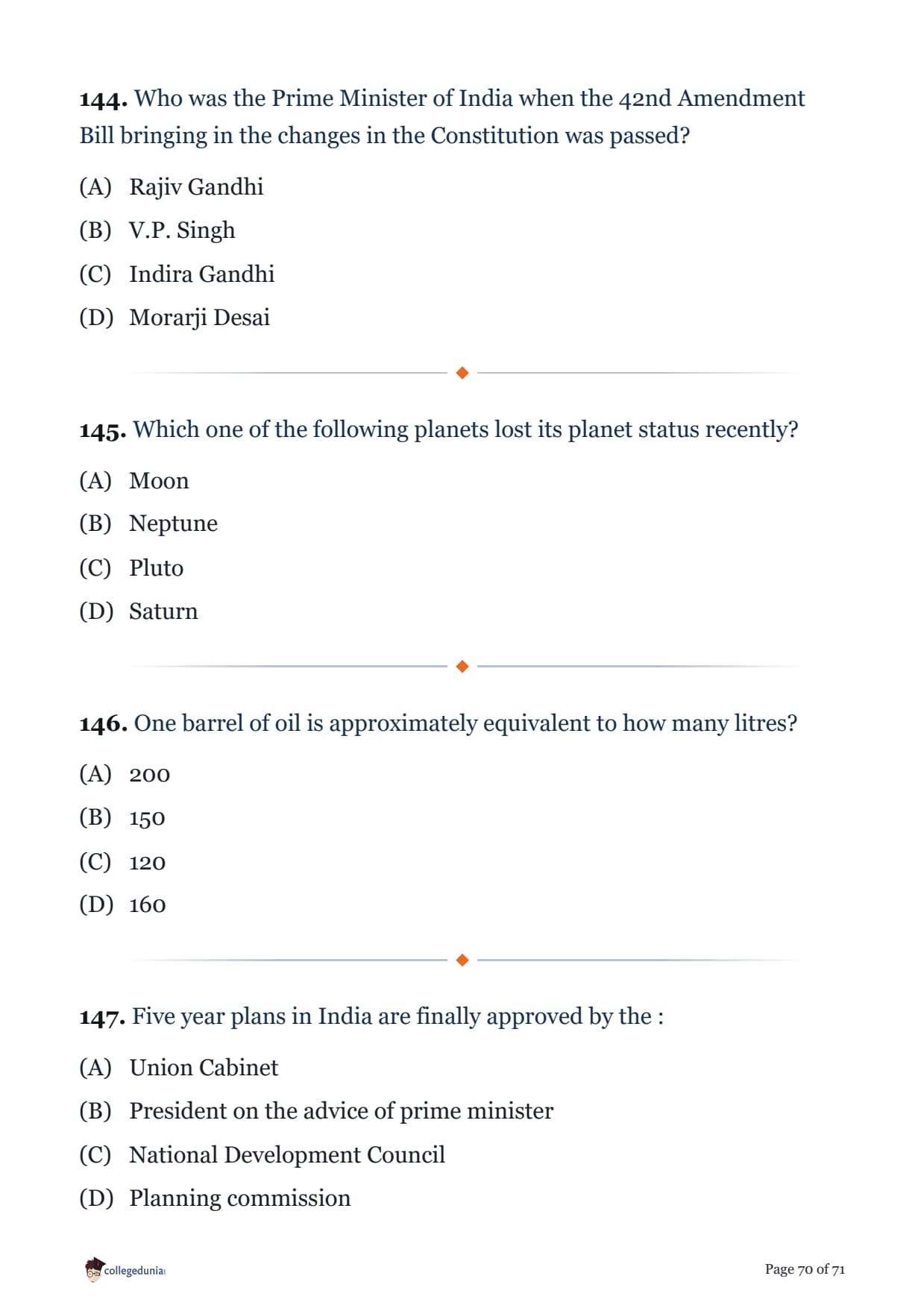
Who was the Prime Minister of India when the 42nd Amendment Bill bringing in the changes in the Constitution was passed?
Which one of the following planets lost its planet status recently?
One barrel of oil is approximately equivalent to how many litres?
Five year plans in India are finally approved by the :
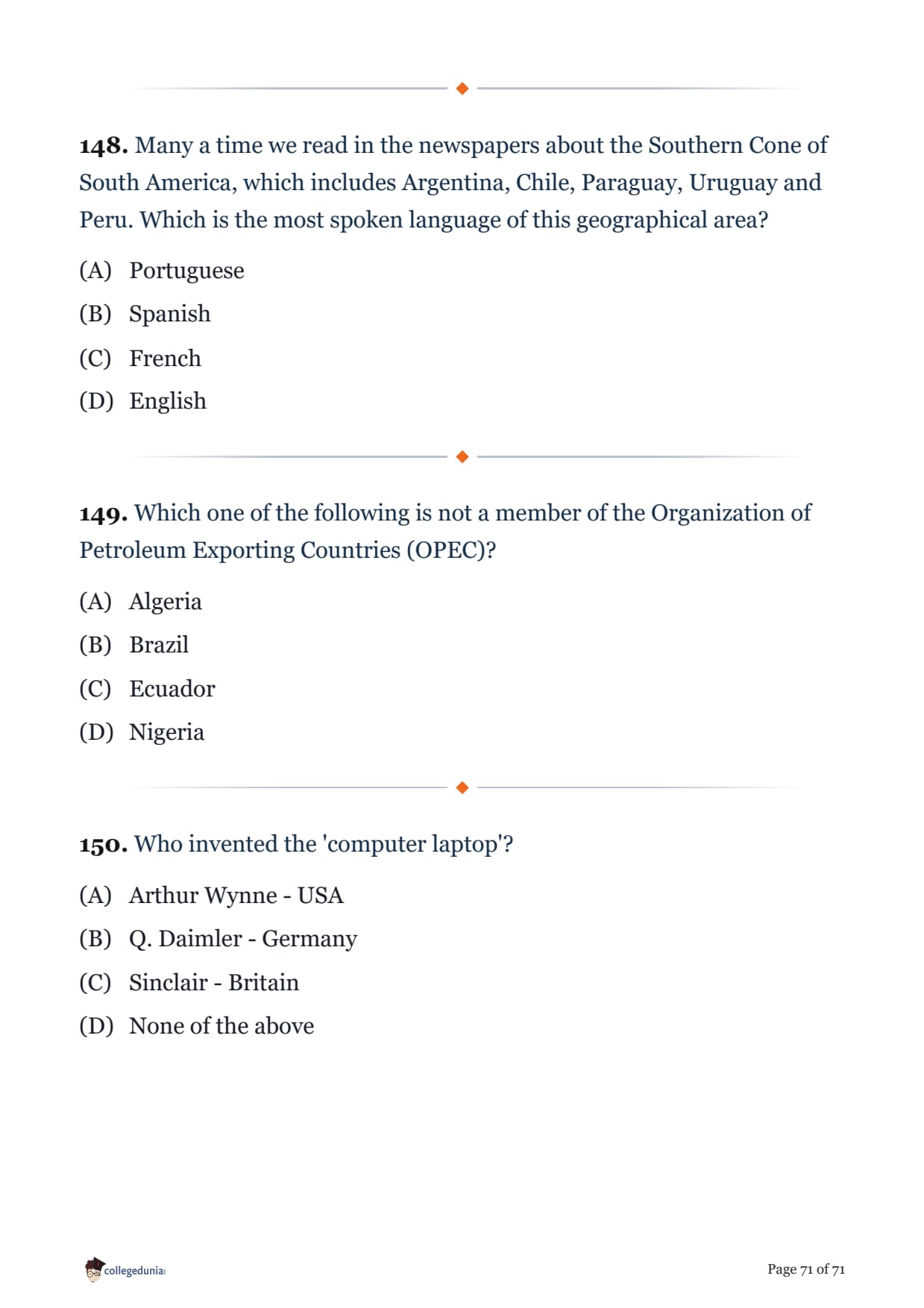
Many a time we read in the newspapers about the Southern Cone of South America, which includes Argentina, Chile, Paraguay, Uruguay and Peru. Which is the most spoken language of this geographical area?
Which one of the following is not a member of the Organization of Petroleum Exporting Countries (OPEC)?
Who invented the 'computer laptop'?
SNAP 2009 Exam Pattern and Marking Scheme Explained
SNAP 2009 was a pen-and-paper test with four sections in a single 150-minute sitting, held in December 2009, and each section carried its own marking rules.
- Total questions: 150 objective questions across four sections
- Quantitative Aptitude: 39 questions, +1 mark for a correct answer, -0.25 for a wrong one
- Analytical & Logical Reasoning: 31 questions, +2 marks for a correct answer, -0.5 for a wrong one
- General English: 40 questions, +1 mark for a correct answer, -0.25 for a wrong one
- General Awareness: 40 questions, +1 mark for a correct answer, -0.25 for a wrong one
- Duration: 150 minutes (2 hours 30 minutes) for the full paper
- Marking scheme: every question had four choices, with Reasoning carrying double the marks (and double the penalty) of the other three sections
High-Weightage Sections in SNAP 2009 to Focus On First
Analytical & Logical Reasoning carried the most marks per question in SNAP 2009, worth 2 marks against 1 mark in every other section, even though it had the fewest questions.
- Analytical & Logical Reasoning (31 questions): the highest-scoring section per question, covering puzzles, coding-decoding, number and figure series, and analogy sets
- General English (40 questions): reading comprehension, verbal ability, grammar, idioms and vocabulary questions
- General Awareness (40 questions): static GK, business awareness and current affairs current as of late 2009
- Quantitative Aptitude (39 questions): arithmetic, algebra, mensuration, probability, data interpretation and Venn diagram based questions
SNAP 2009 Question Paper Analysis Video
Source: Patrick100
How to Use the SNAP 2009 Question Paper for Practice
Solve the full paper as one timed 150-minute sitting first, then go through the solutions section by section.
- Attempt all 150 questions across Quantitative Aptitude, Analytical & Logical Reasoning, General English and General Awareness in one sitting before checking any answer
- Review every question against the solutions PDF and note down where you went wrong
- Practice the Analytical & Logical Reasoning section on its own first, since it carries double the marks of the other three sections
- Treat the General Awareness questions as a snapshot of late-2009 current affairs rather than a source of exam-day facts, since GK content dates quickly
- Time yourself section-wise to build the speed needed for a 150-minute, 150-question paper
SNAP 2009 Question Paper with Solutions FAQs
Ques. How many questions were there in SNAP 2009?
Ans. SNAP 2009 had 150 objective questions across four sections - 39 in Quantitative Aptitude, 31 in Analytical & Logical Reasoning, 40 in General English, and 40 in General Awareness.
Ques. Which section had the highest marks per question in SNAP 2009?
Ans. Analytical & Logical Reasoning carried the highest marks per question at +2 for a correct answer, twice the +1 mark given in the other three sections.
Ques. Was there negative marking in SNAP 2009?
Ans. Yes. A wrong answer cost 0.25 marks in Quantitative Aptitude, General English and General Awareness, and 0.5 marks in Analytical & Logical Reasoning, so guessing without eliminating options was risky.
Ques. What was the duration of the SNAP 2009 exam?
Ans. SNAP 2009 was a 150-minute, pen-and-paper test held in December 2009, covering all 150 questions in one sitting.
Ques. Who conducts the SNAP exam?
Ans. SNAP is conducted by Symbiosis International (Deemed University), Pune, for admission to its affiliated MBA and PGDM institutes.
Ques. Where can I download the SNAP 2009 question paper with solutions PDF for free?
Ans. Use the download table above on Collegedunia to get the SNAP 2009 question paper and its full solutions PDF. More details on the exam are available on the official site (snaptest.org).



Comments