




The SNAP 2007 question paper is now available with detailed solutions for free download. SNAP 2007 was conducted by Symbiosis International (Deemed University), Pune in December 2007 for admission to its MBA and PGDM programmes, and the paper carried 150 objective questions across four sections in a 120-minute, paper-based test.
| SNAP 2007 Question Paper with Solutions | Download PDF | Check Solutions |







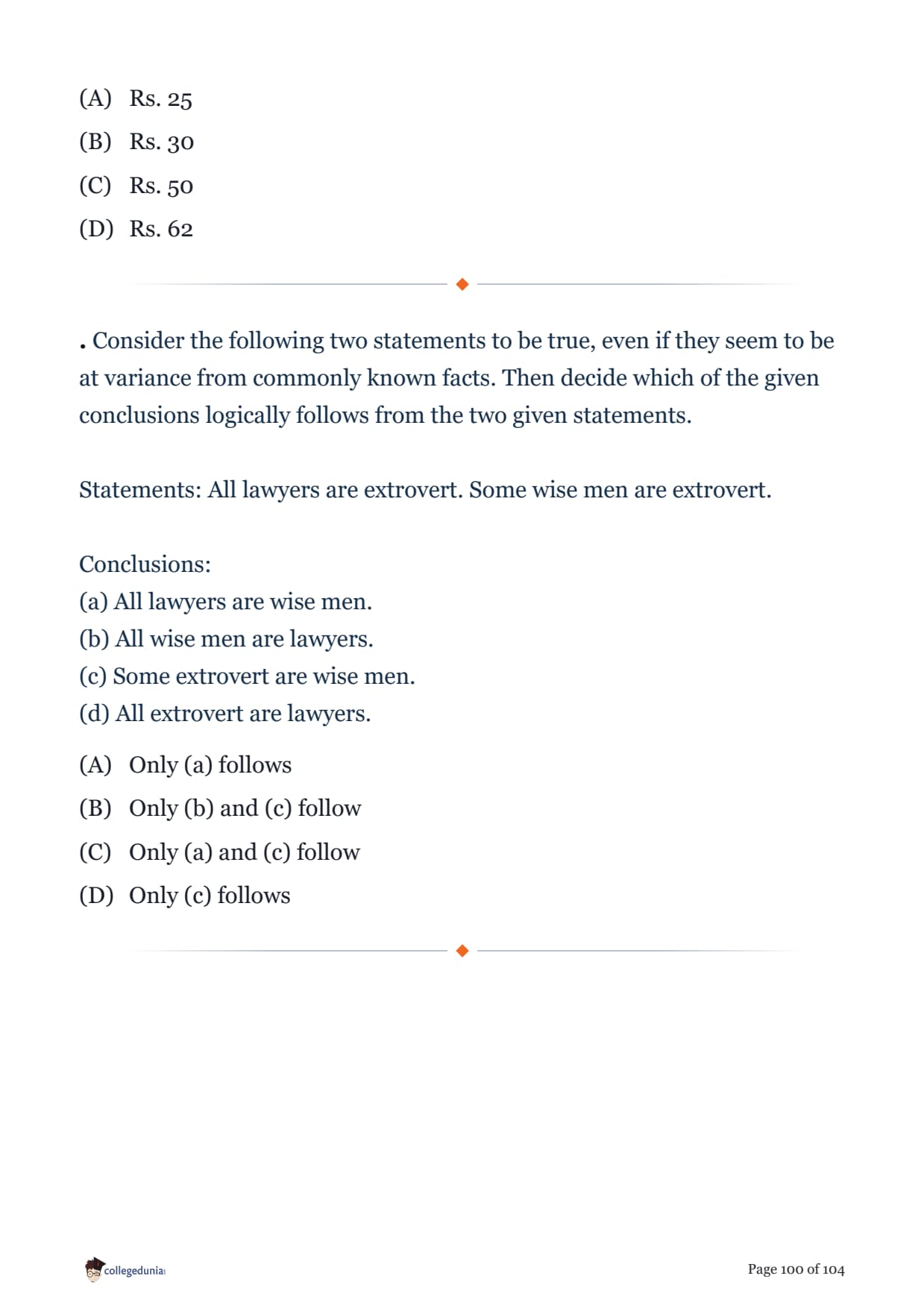
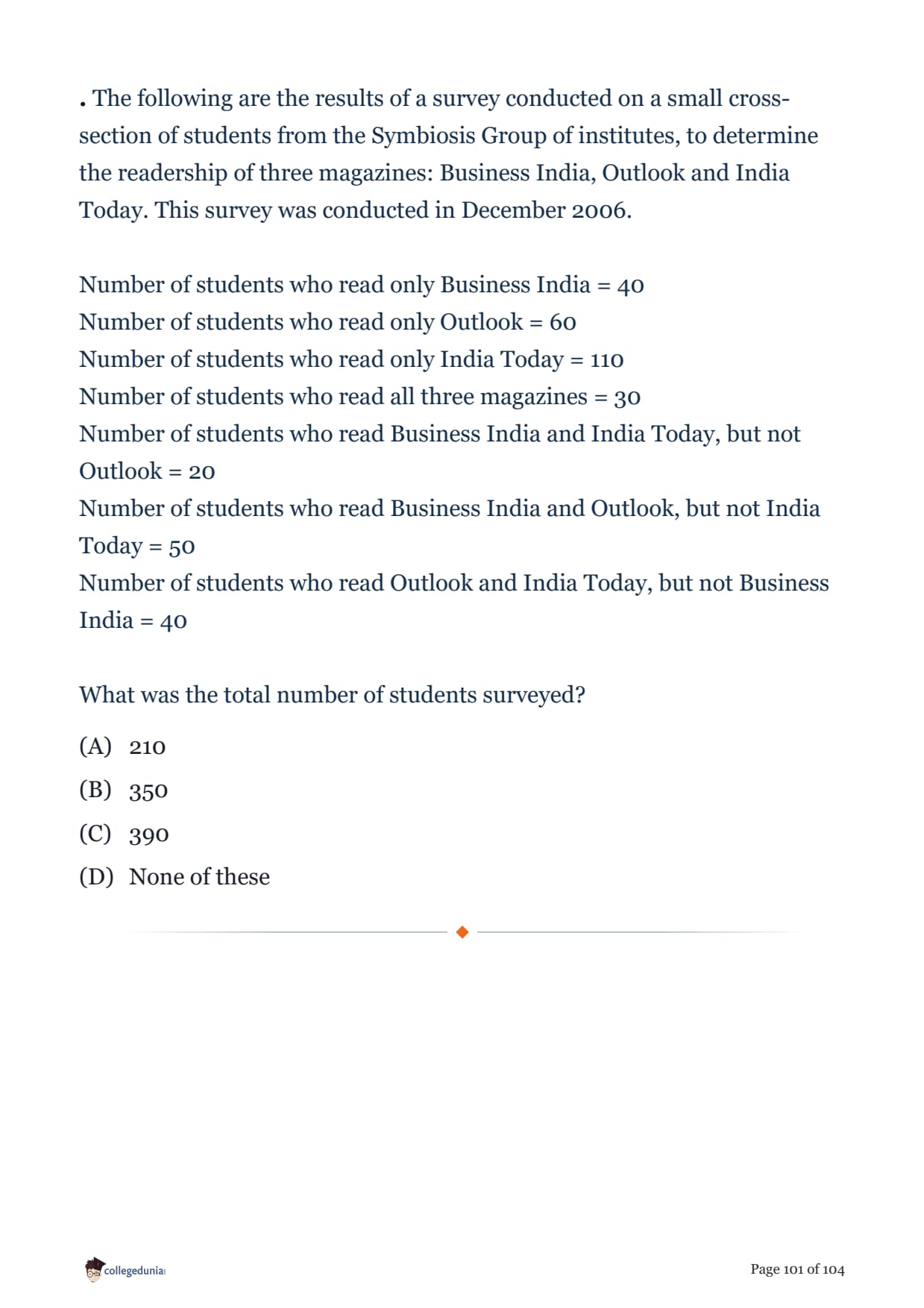
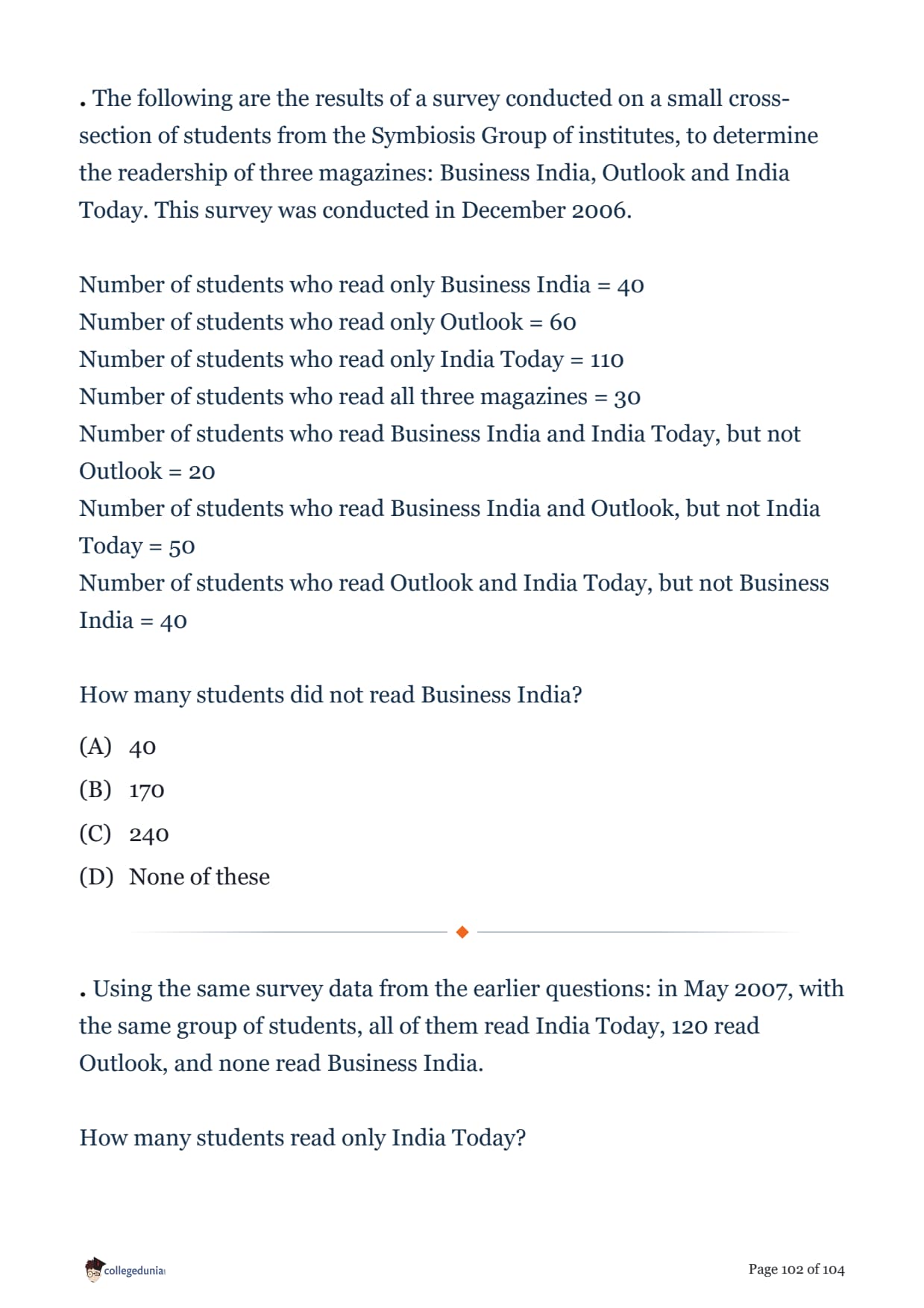
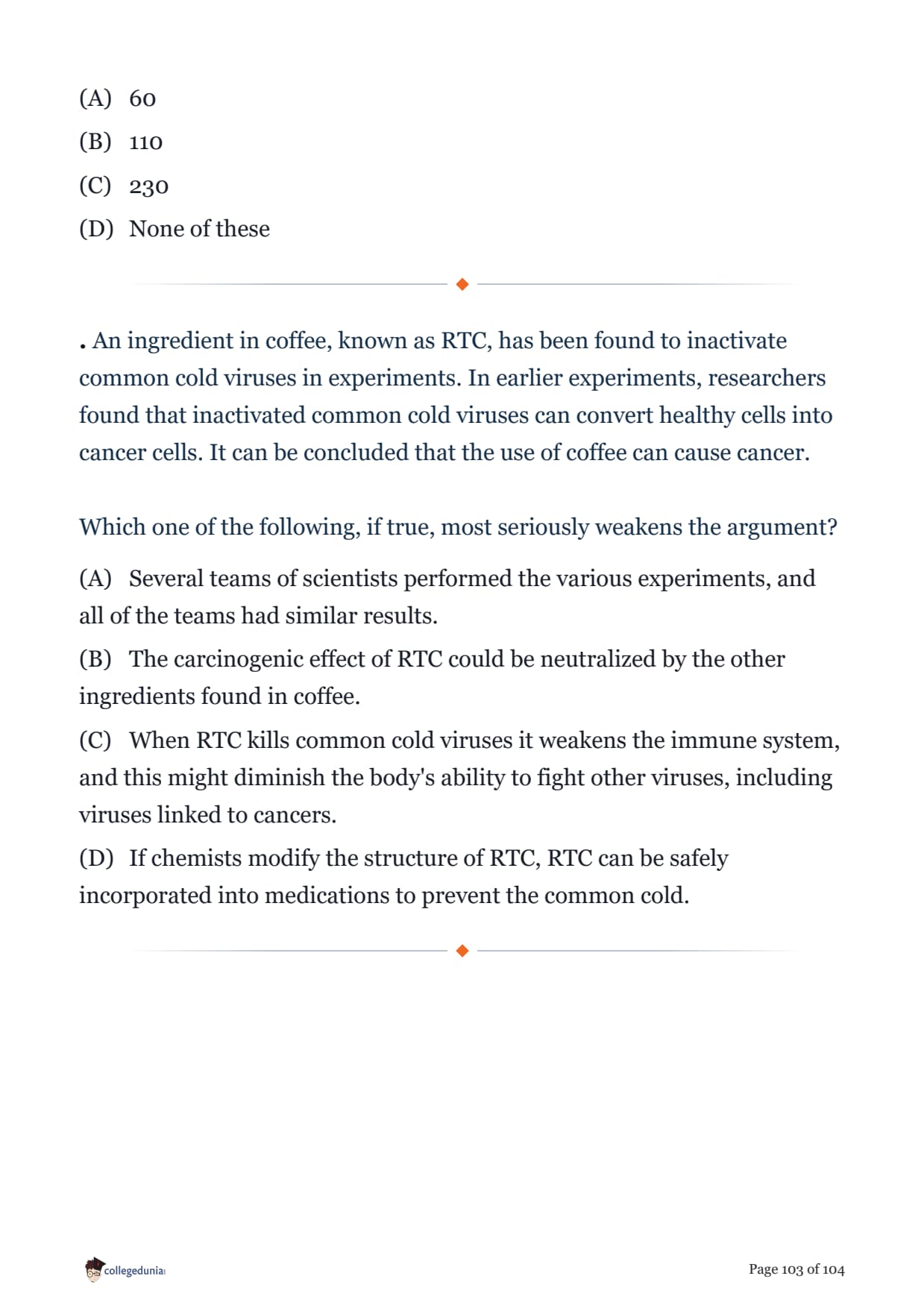
SNAP 2007 Combined Paper Questions with Solutions
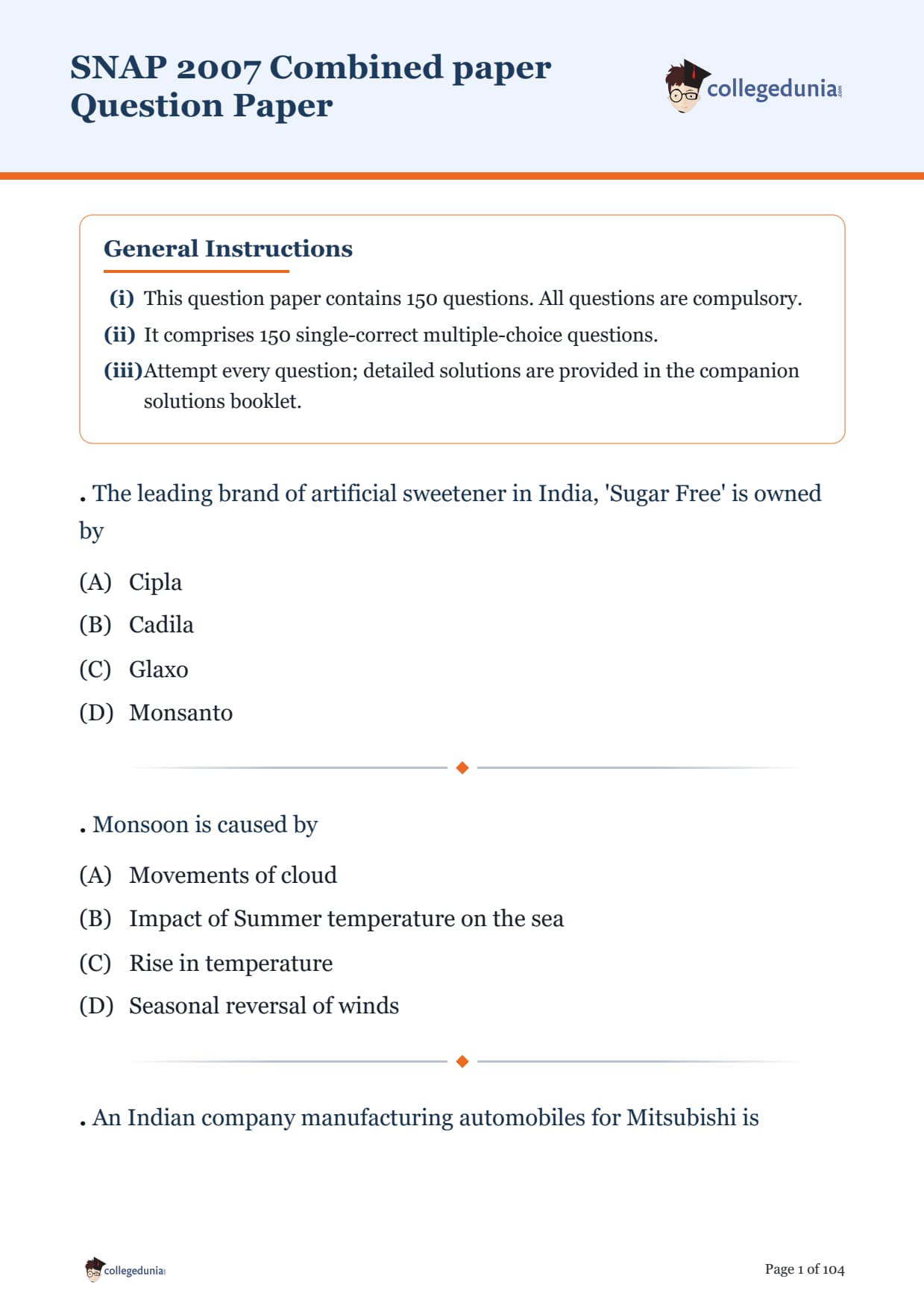
The leading brand of artificial sweetener in India, 'Sugar Free' is owned by
Monsoon is caused by
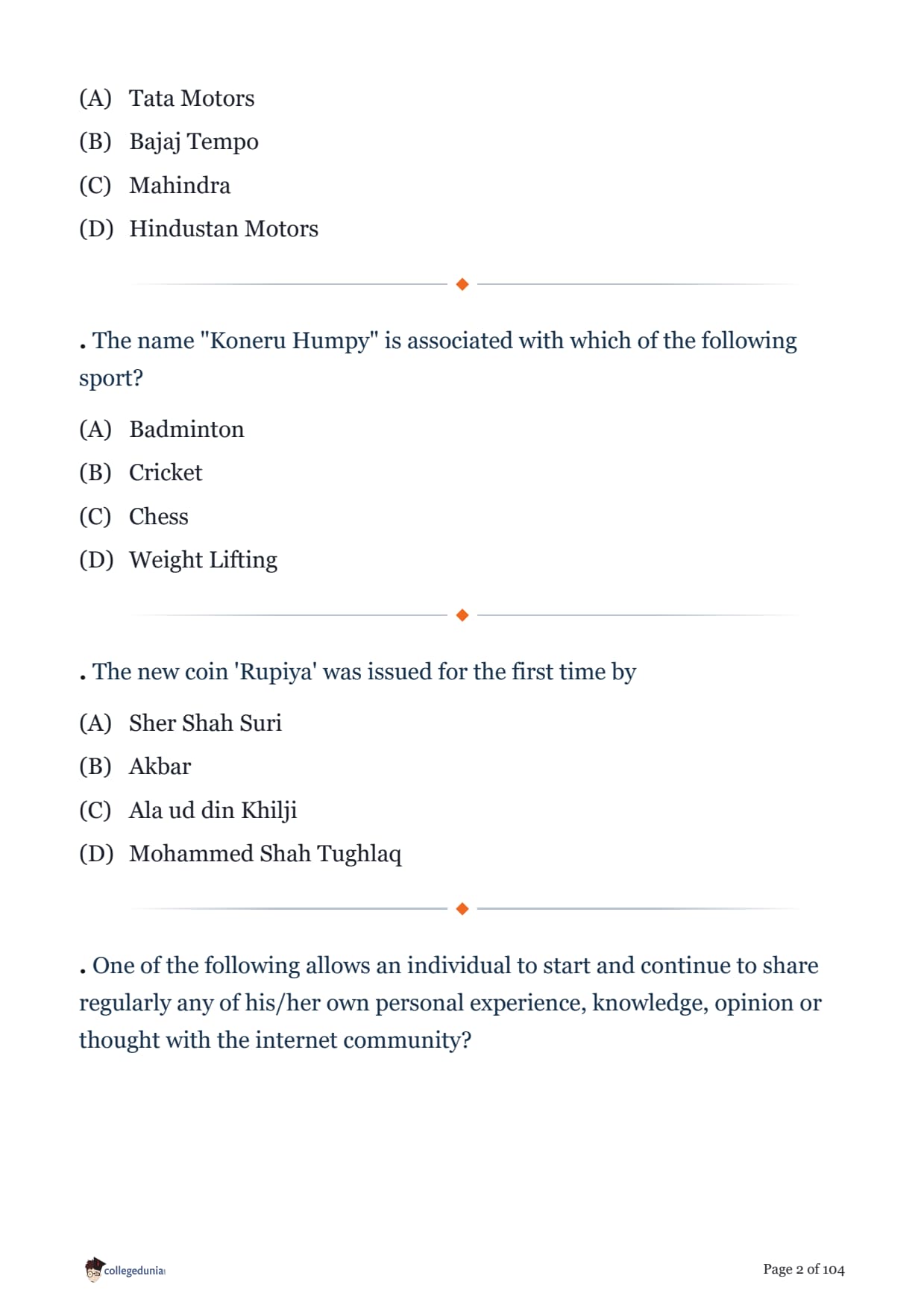
An Indian company manufacturing automobiles for Mitsubishi is
The name "Koneru Humpy" is associated with which of the following sport?
The new coin 'Rupiya' was issued for the first time by
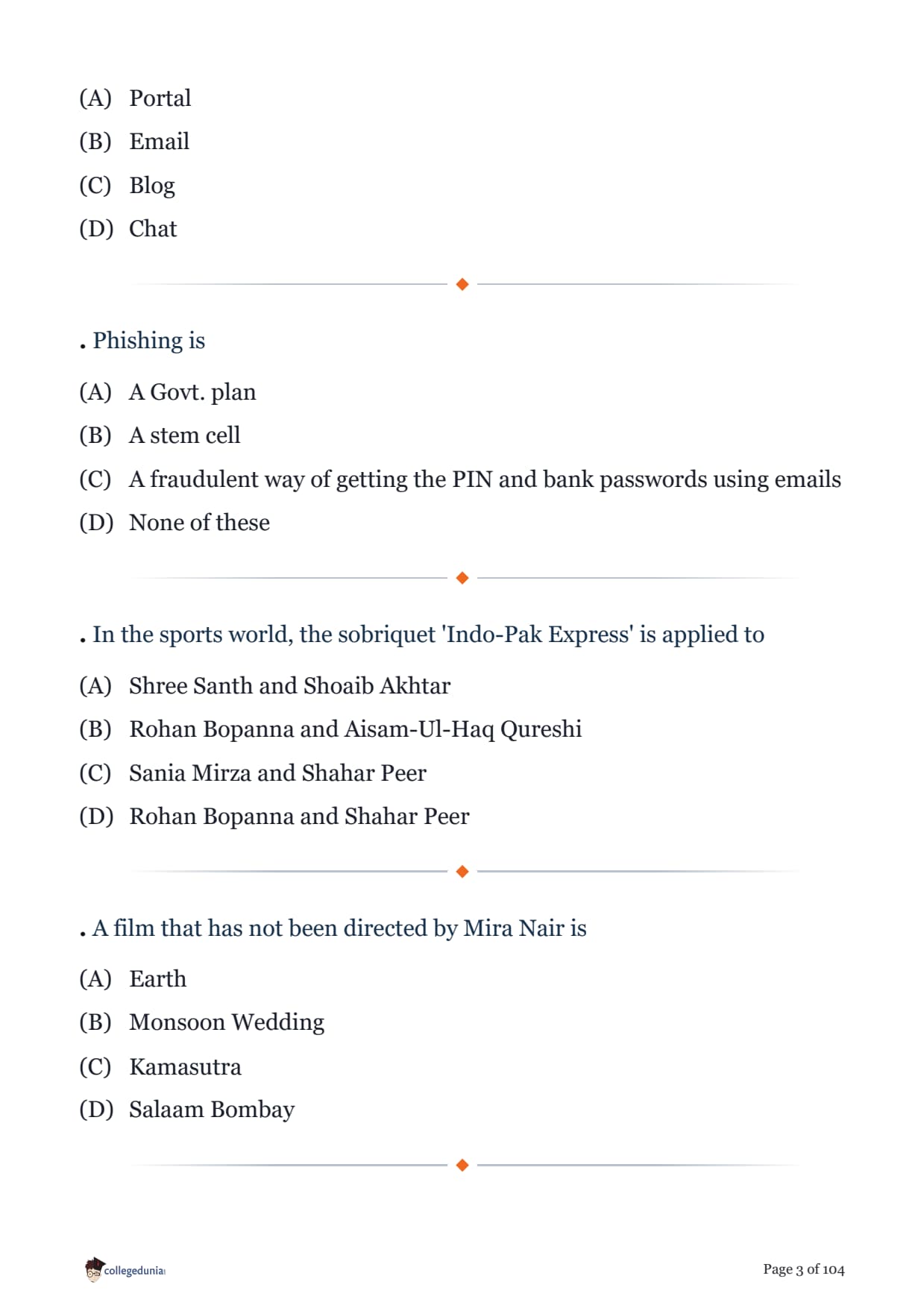
One of the following allows an individual to start and continue to share regularly any of his/her own personal experience, knowledge, opinion or thought with the internet community?
Phishing is
In the sports world, the sobriquet 'Indo-Pak Express' is applied to
A film that has not been directed by Mira Nair is
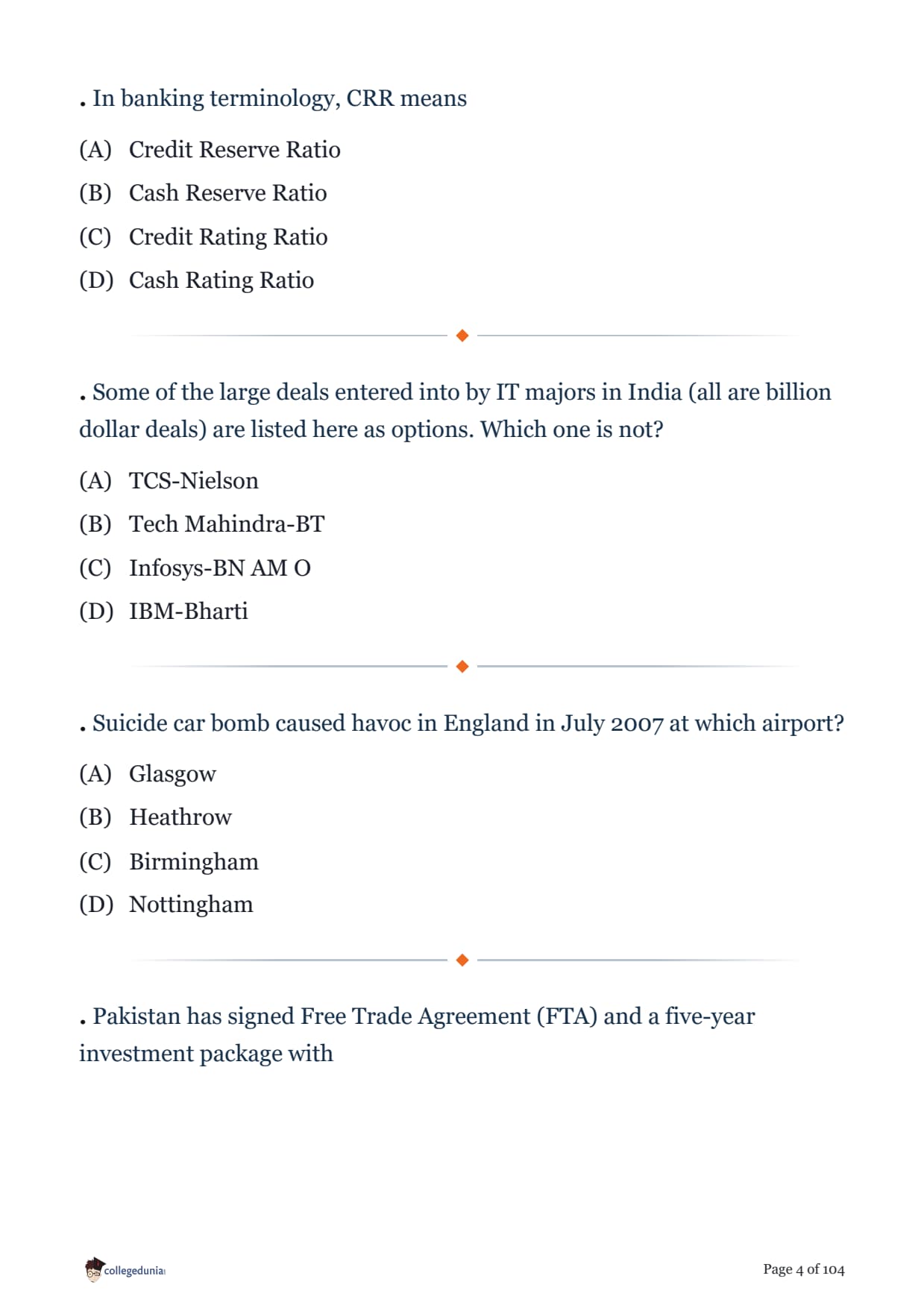
In banking terminology, CRR means
Some of the large deals entered into by IT majors in India (all are billion dollar deals) are listed here as options. Which one is not?
Suicide car bomb caused havoc in England in July 2007 at which airport?
Pakistan has signed Free Trade Agreement (FTA) and a five-year investment package with
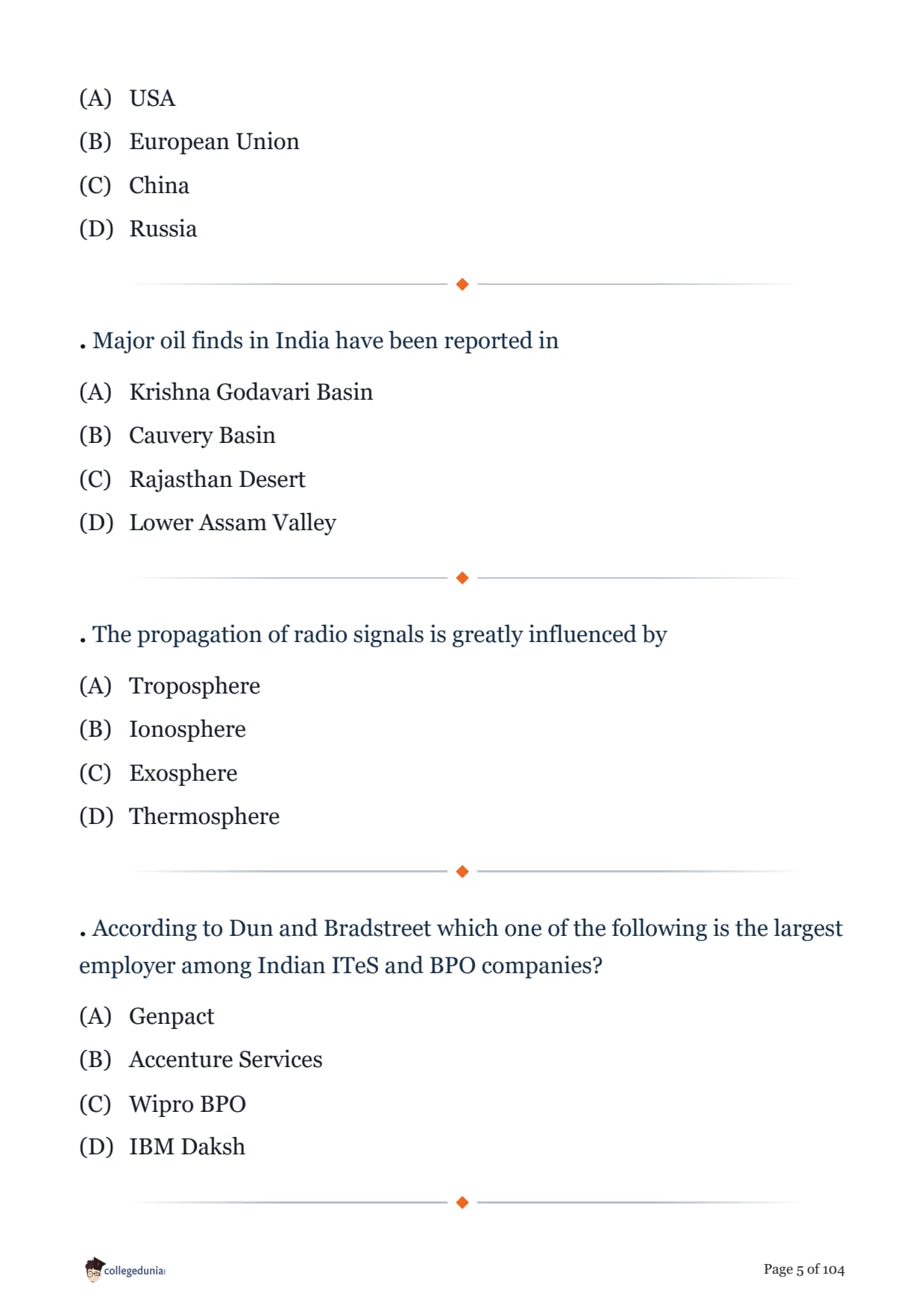
Major oil finds in India have been reported in
The propagation of radio signals is greatly influenced by
According to Dun and Bradstreet which one of the following is the largest employer among Indian ITeS and BPO companies?
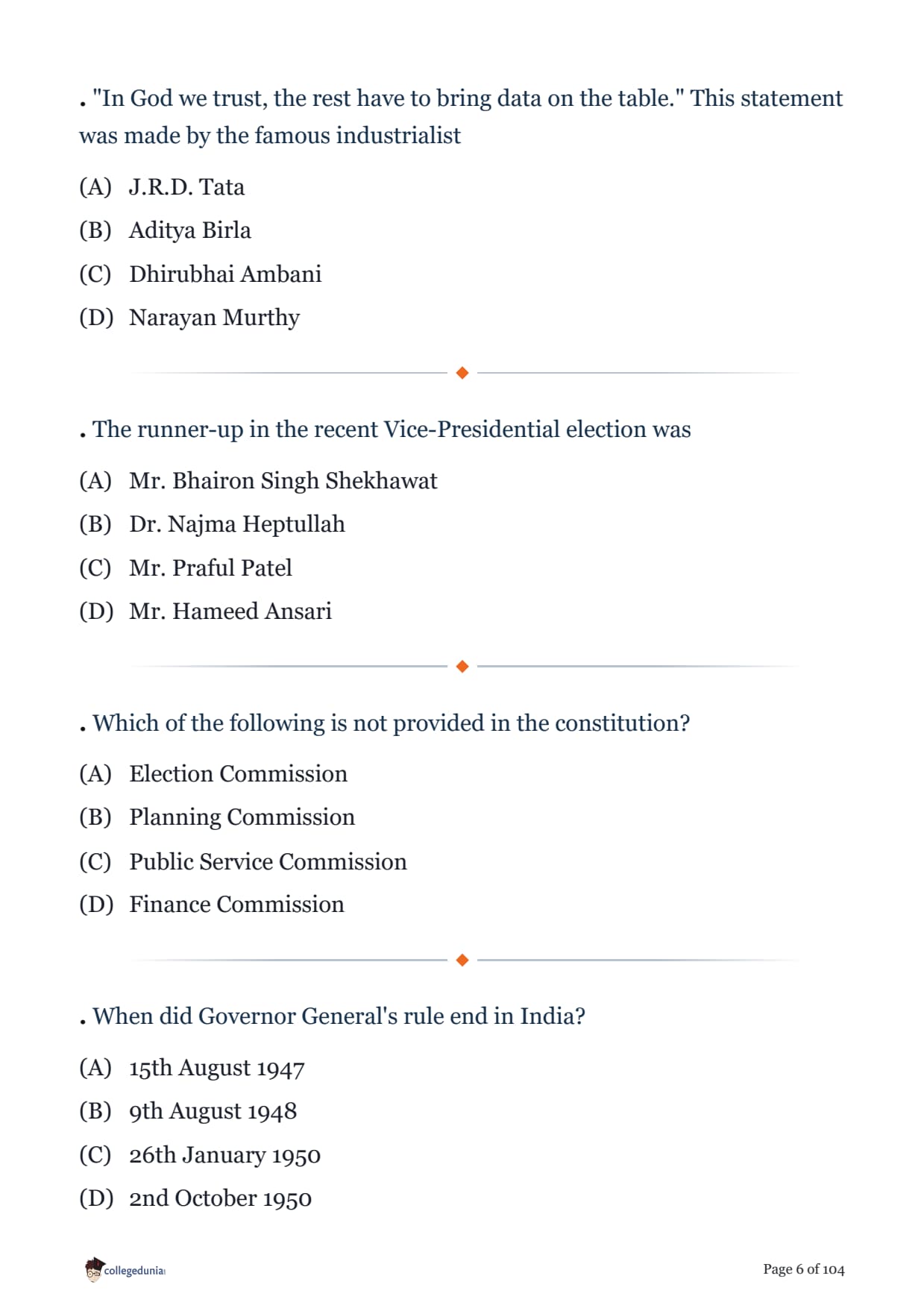
"In God we trust, the rest have to bring data on the table." This statement was made by the famous industrialist
The runner-up in the recent Vice-Presidential election was
Which of the following is not provided in the constitution?
When did Governor General's rule end in India?
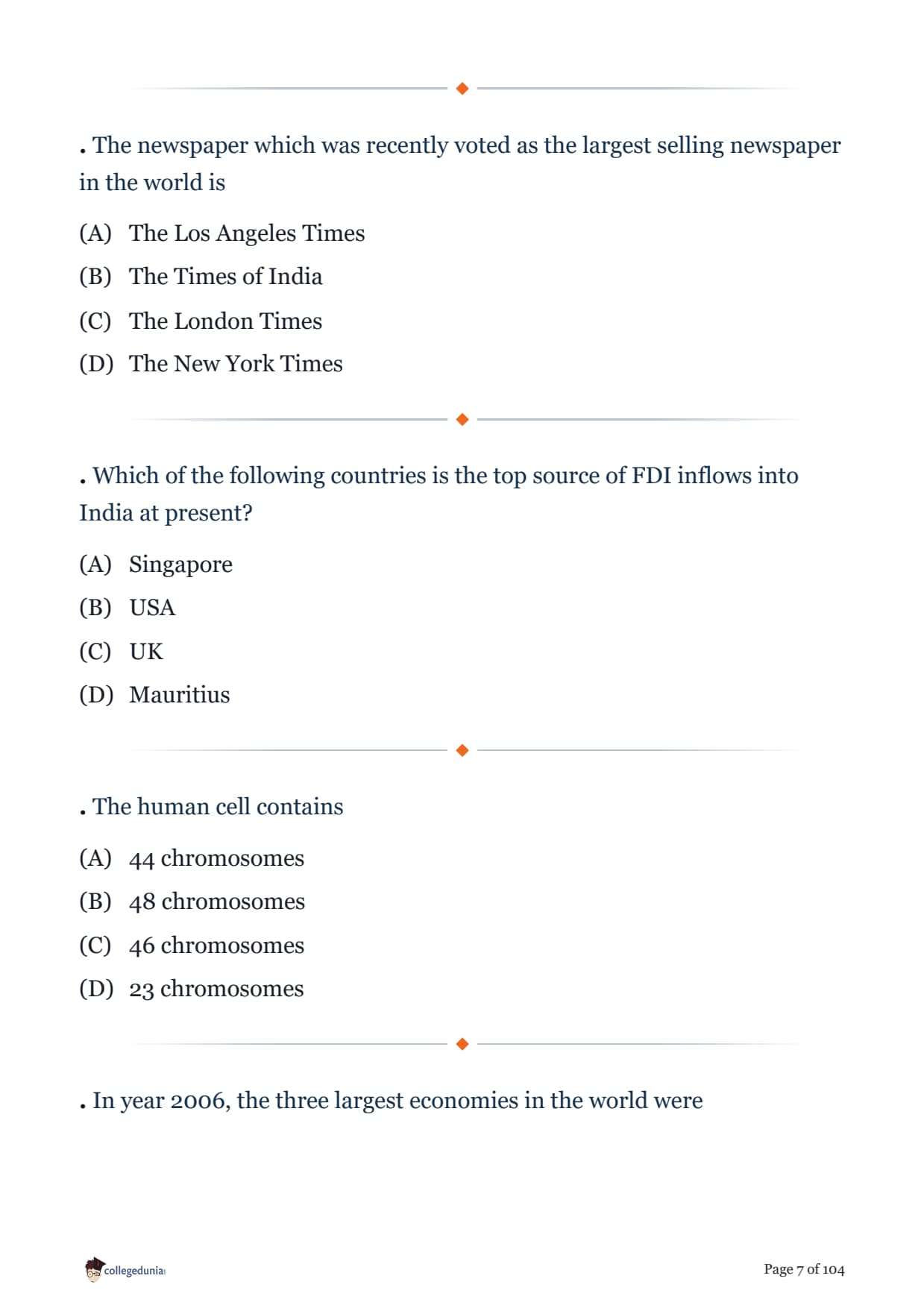
The newspaper which was recently voted as the largest selling newspaper in the world is
Which of the following countries is the top source of FDI inflows into India at present?
The human cell contains
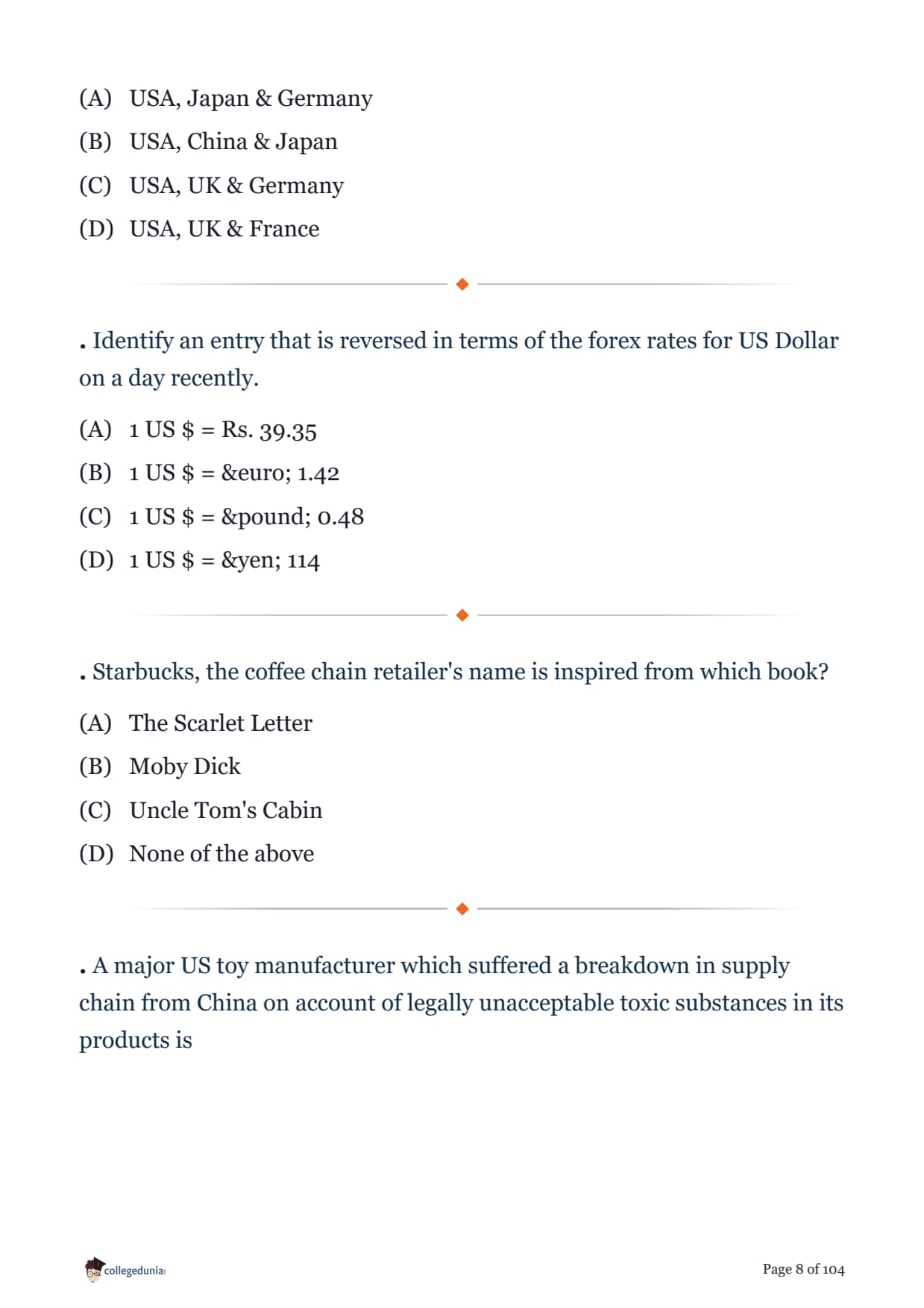
In year 2006, the three largest economies in the world were
Identify an entry that is reversed in terms of the forex rates for US Dollar on a day recently.
Starbucks, the coffee chain retailer's name is inspired from which book?
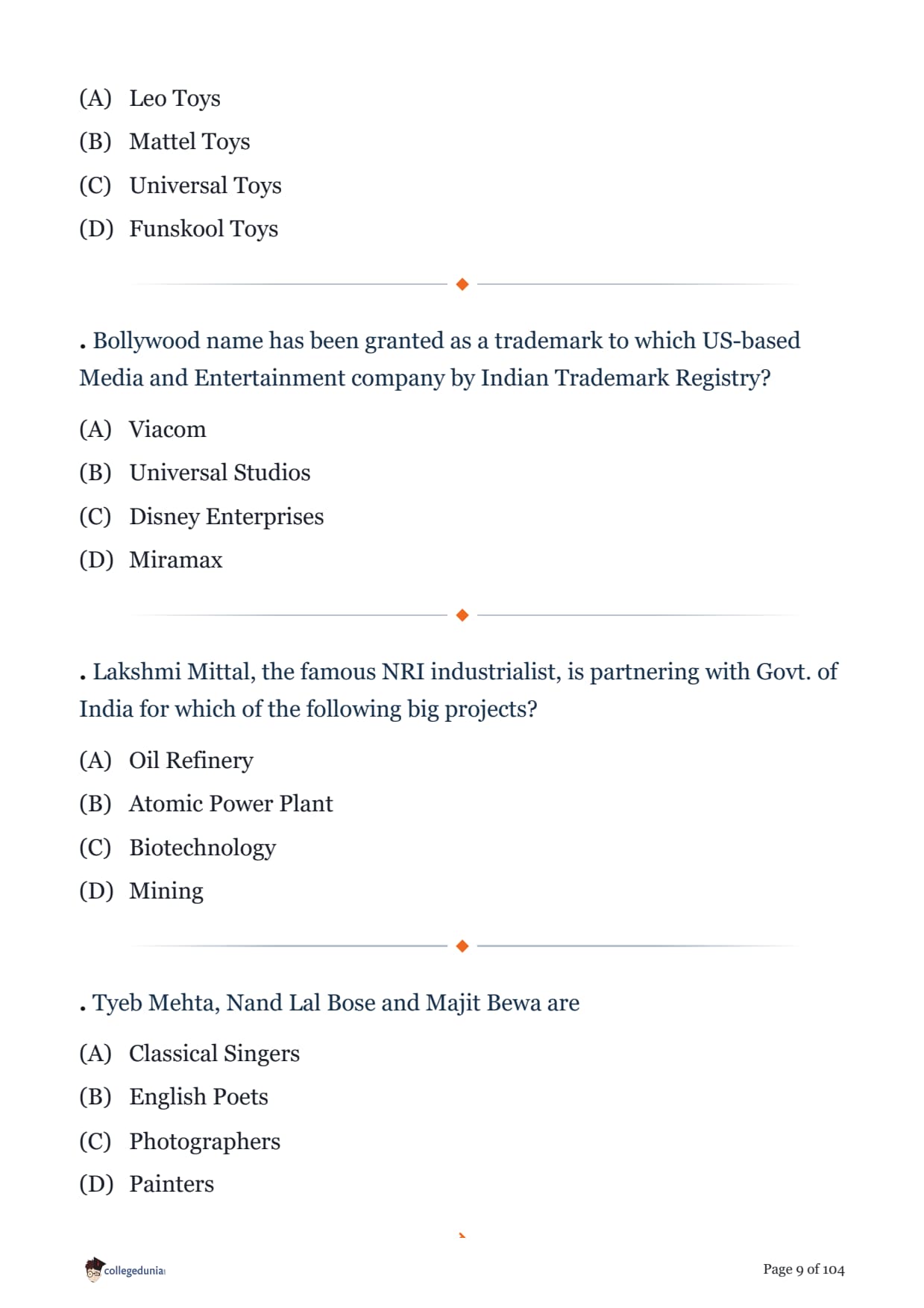
A major US toy manufacturer which suffered a breakdown in supply chain from China on account of legally unacceptable toxic substances in its products is
Bollywood name has been granted as a trademark to which US-based Media and Entertainment company by Indian Trademark Registry?
Lakshmi Mittal, the famous NRI industrialist, is partnering with Govt. of India for which of the following big projects?
Tyeb Mehta, Nand Lal Bose and Majit Bewa are
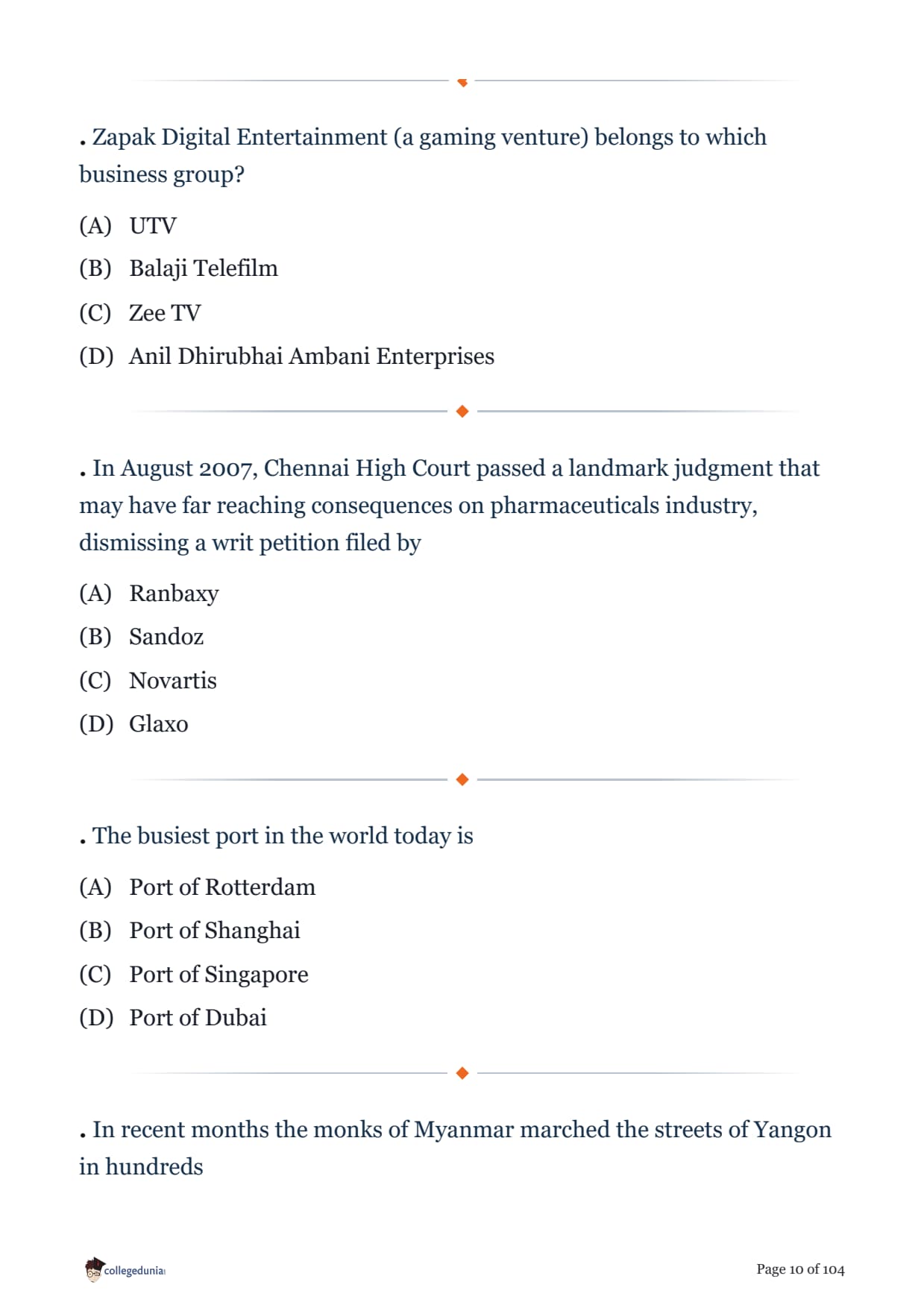
Zapak Digital Entertainment (a gaming venture) belongs to which business group?
In August 2007, Chennai High Court passed a landmark judgment that may have far reaching consequences on pharmaceuticals industry, dismissing a writ petition filed by
The busiest port in the world today is
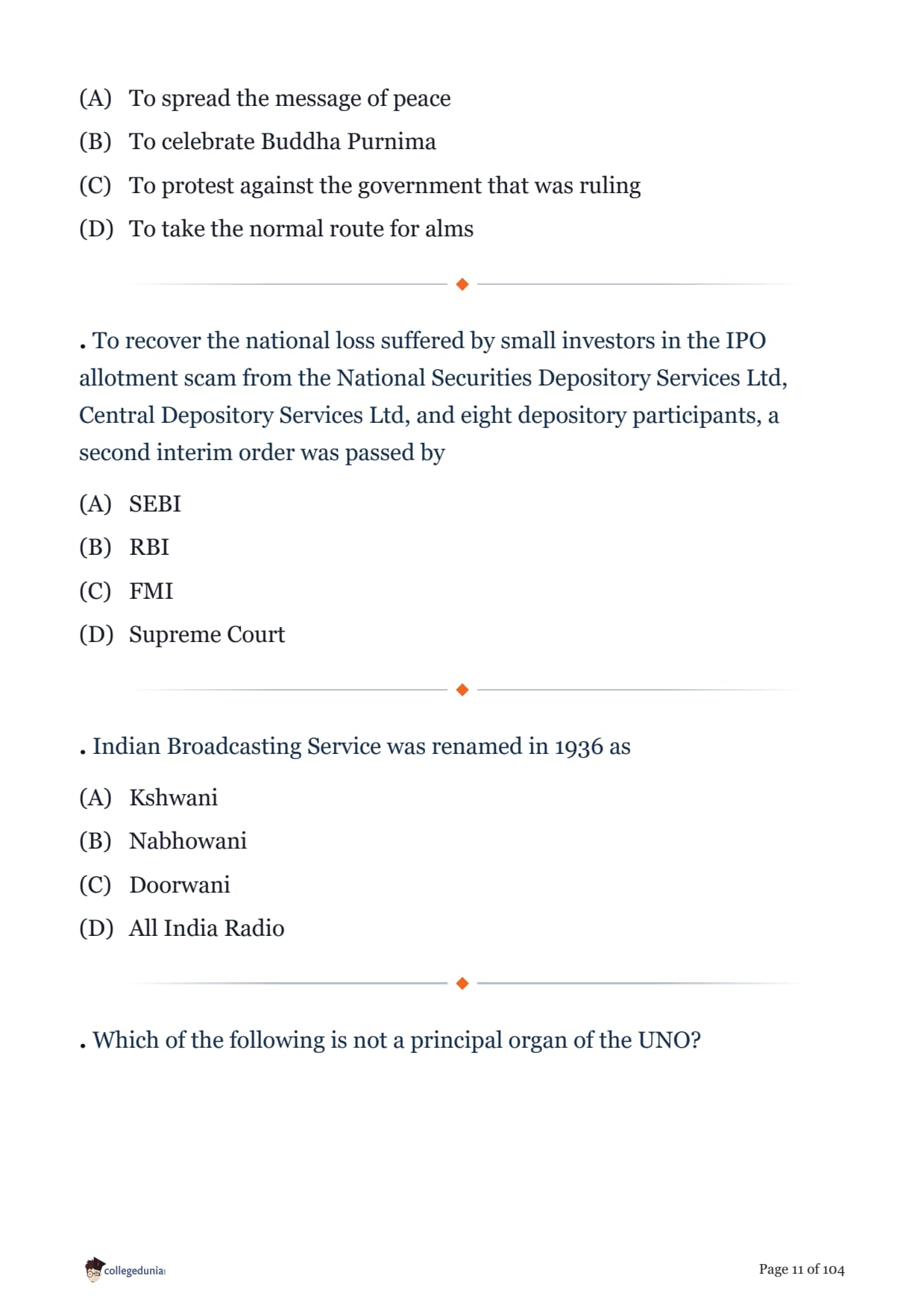
In recent months the monks of Myanmar marched the streets of Yangon in hundreds
To recover the national loss suffered by small investors in the IPO allotment scam from the National Securities Depository Services Ltd, Central Depository Services Ltd, and eight depository participants, a second interim order was passed by
Indian Broadcasting Service was renamed in 1936 as
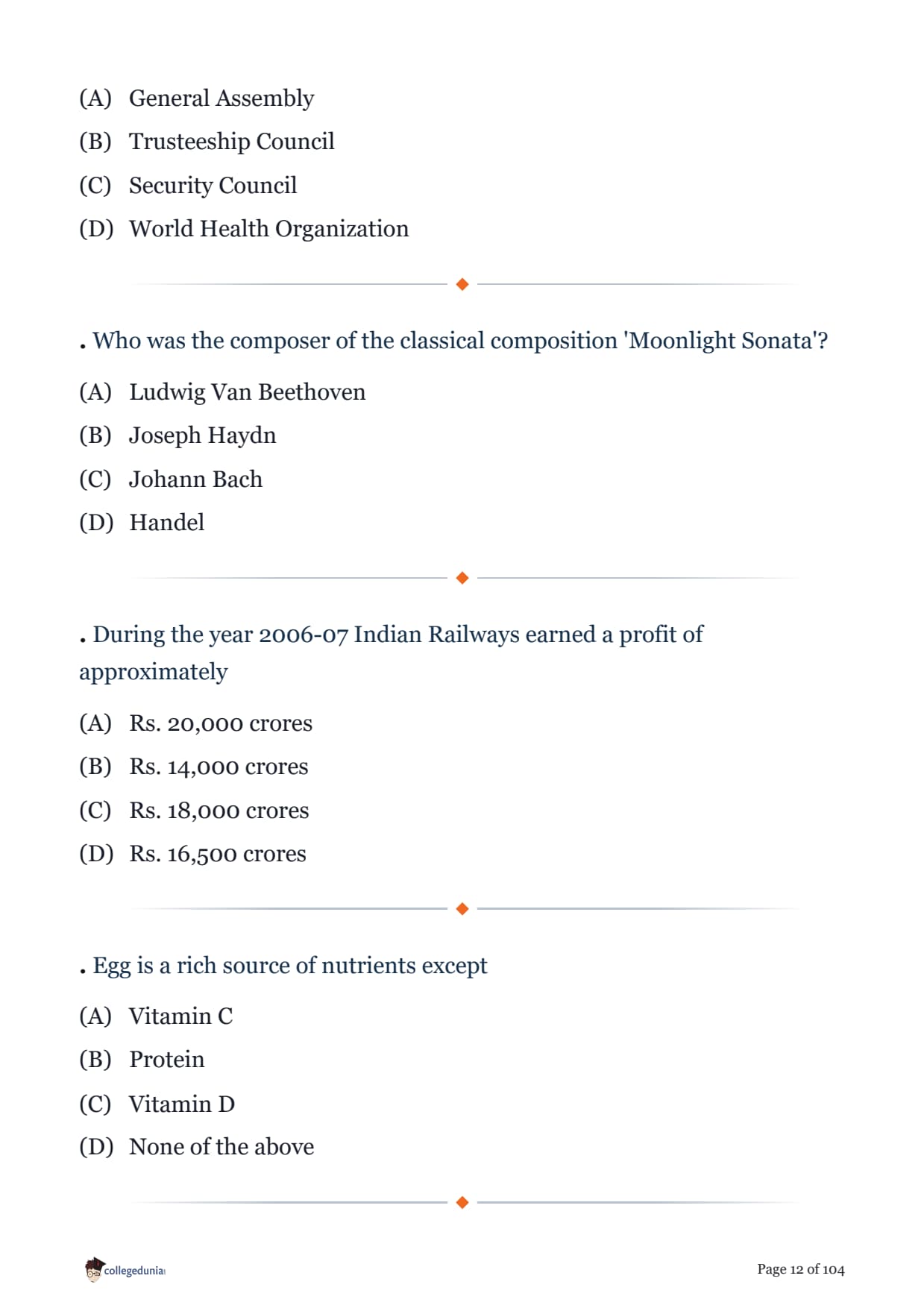
Which of the following is not a principal organ of the UNO?
Who was the composer of the classical composition 'Moonlight Sonata'?
During the year 2006-07 Indian Railways earned a profit of approximately
Egg is a rich source of nutrients except
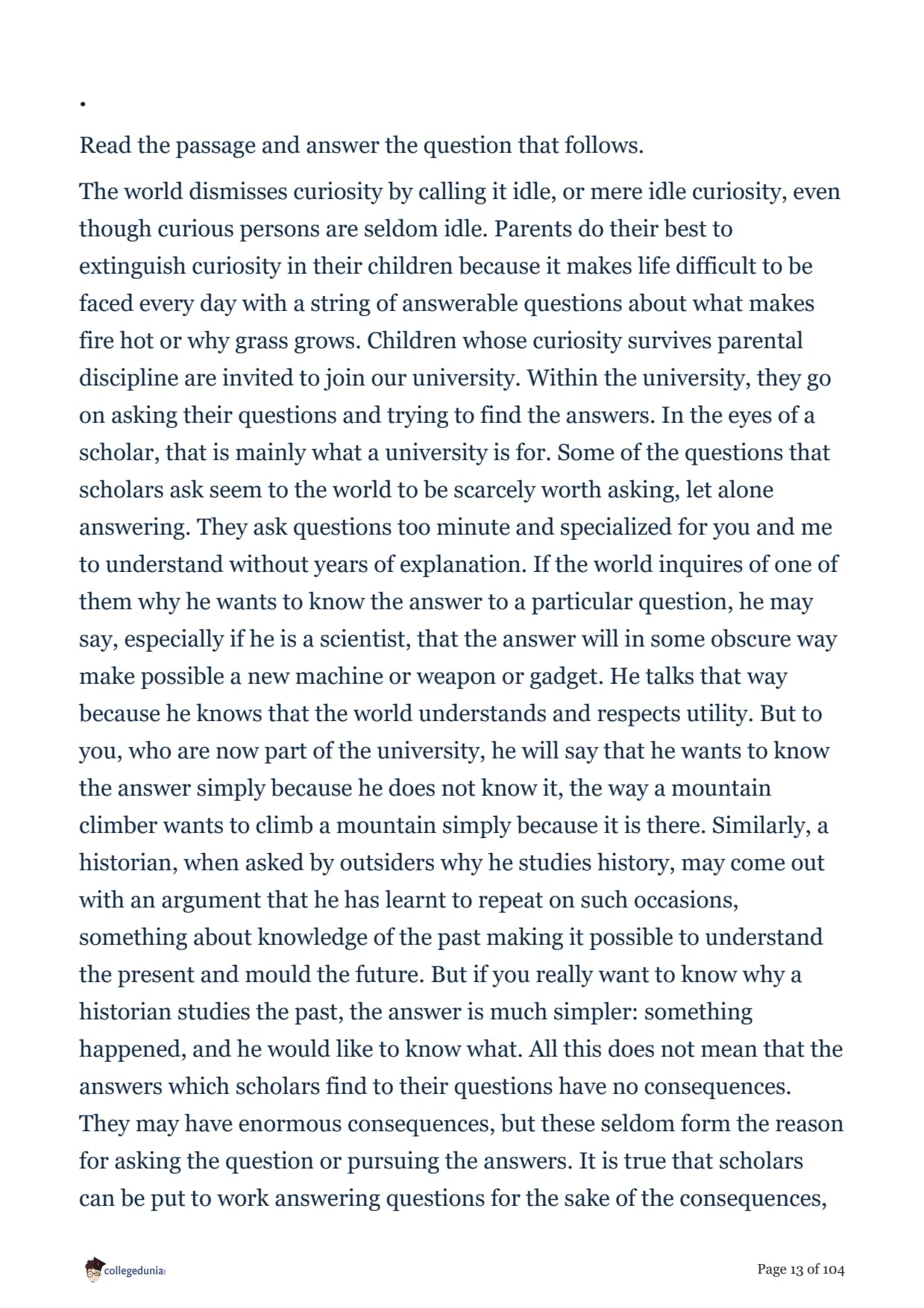
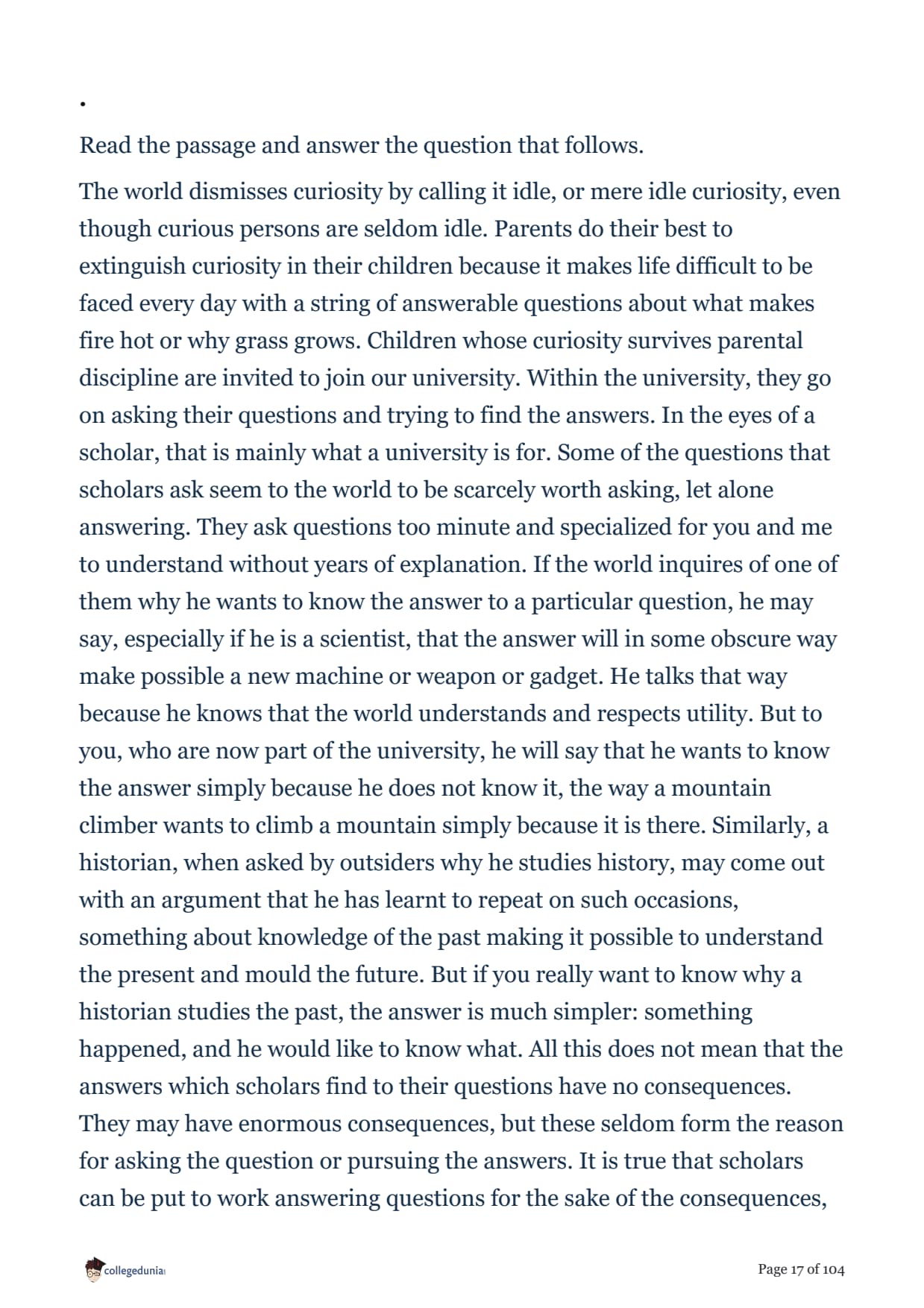
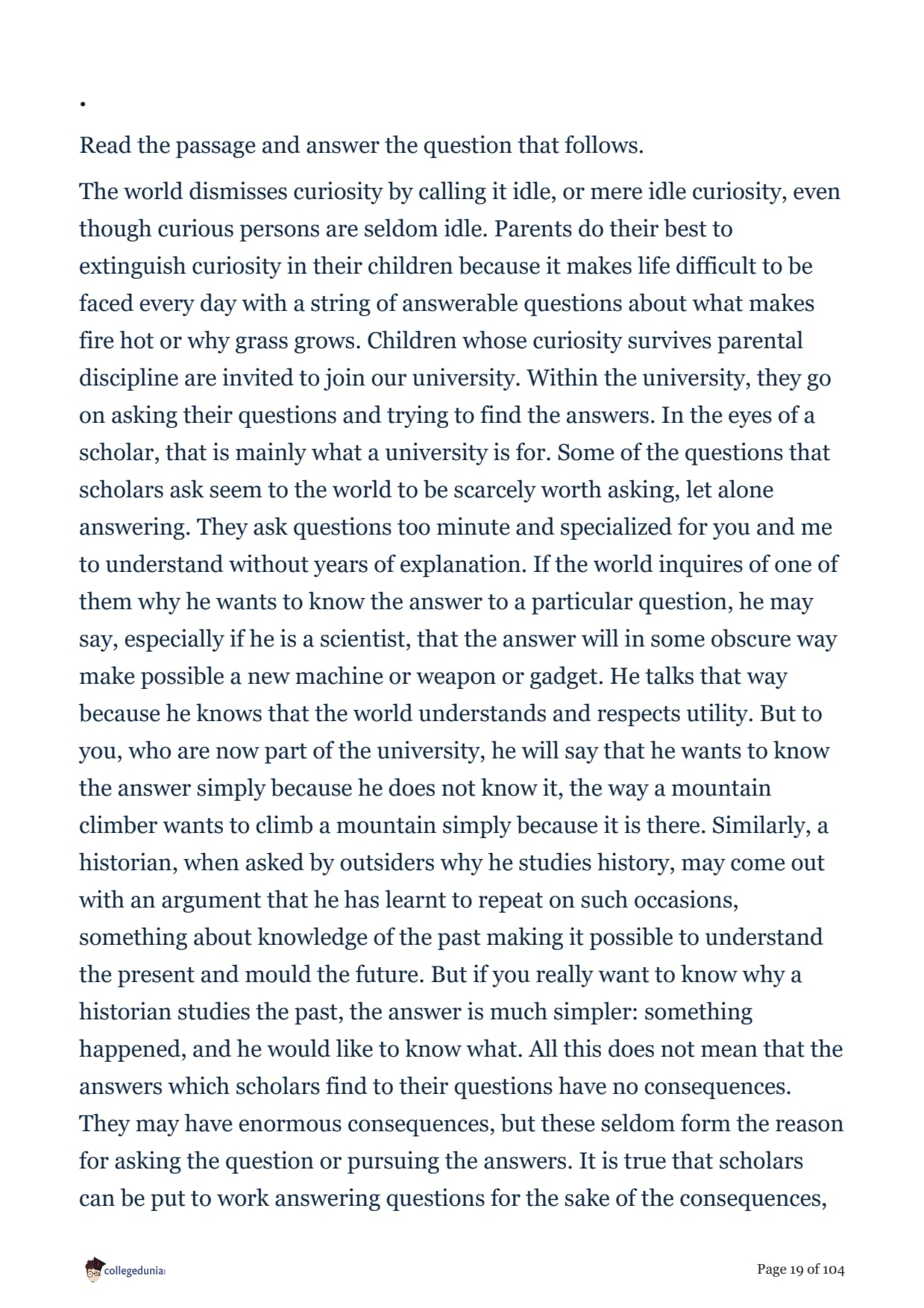
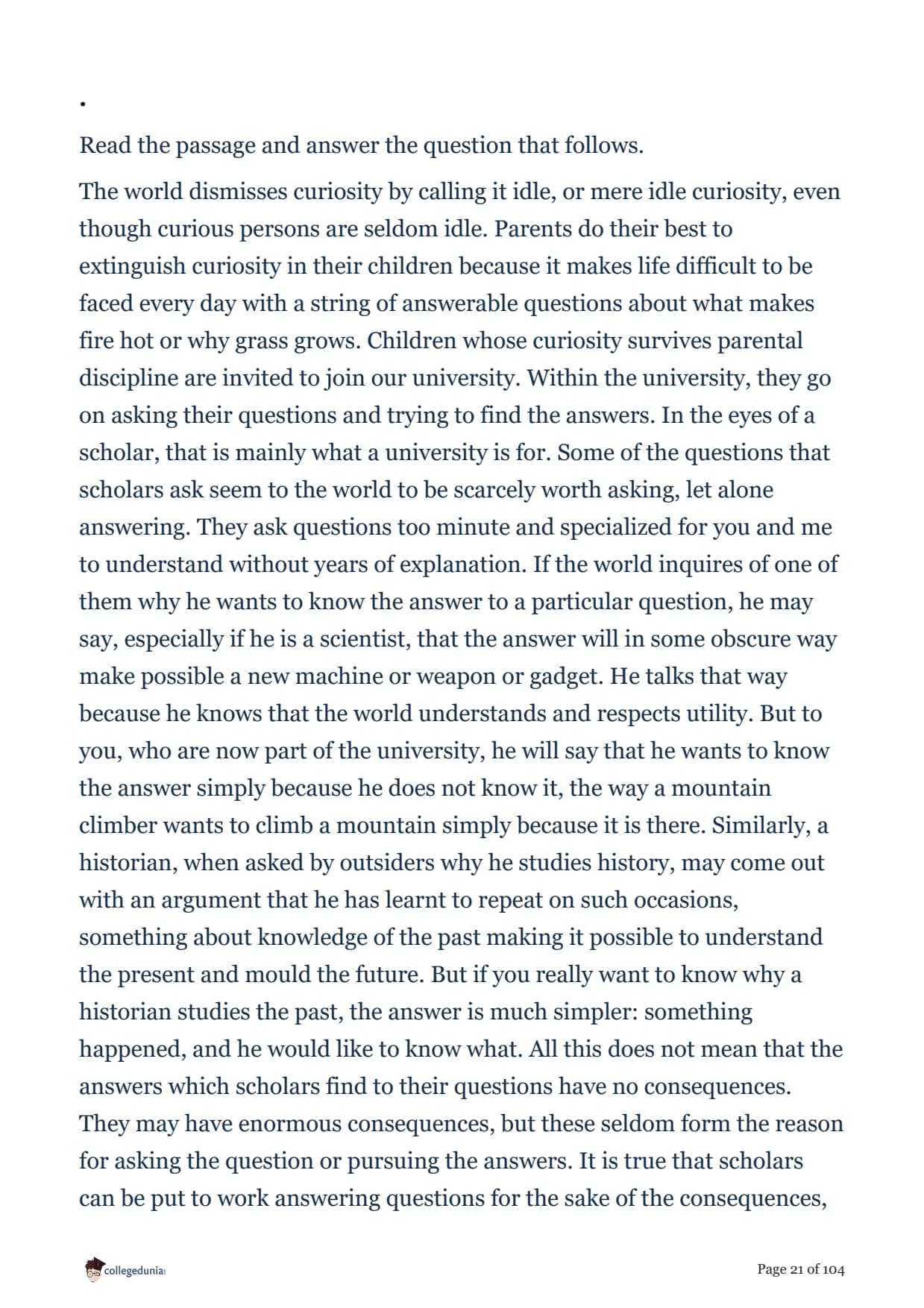
Read the passage and answer the question that follows.
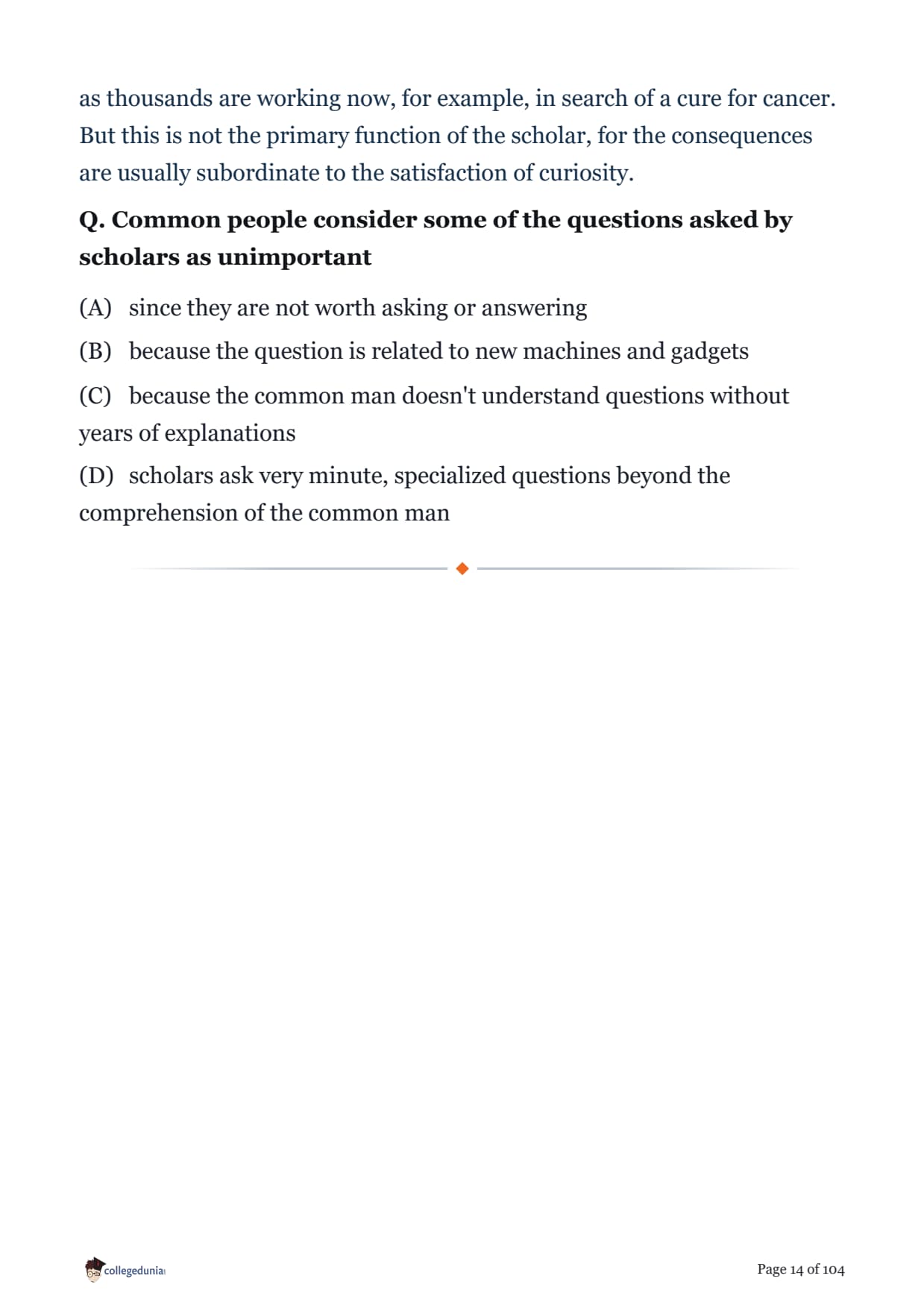
The world dismisses curiosity by calling it idle, or mere idle curiosity, even though curious persons are seldom idle. Parents do their best to extinguish curiosity in their children because it makes life difficult to be faced every day with a string of answerable questions about what makes fire hot or why grass grows. Children whose curiosity survives parental discipline are invited to join our university. Within the university, they go on asking their questions and trying to find the answers. In the eyes of a scholar, that is mainly what a university is for. Some of the questions that scholars ask seem to the world to be scarcely worth asking, let alone answering. They ask questions too minute and specialized for you and me to understand without years of explanation. If the world inquires of one of them why he wants to know the answer to a particular question, he may say, especially if he is a scientist, that the answer will in some obscure way make possible a new machine or weapon or gadget. He talks that way because he knows that the world understands and respects utility. But to you, who are now part of the university, he will say that he wants to know the answer simply because he does not know it, the way a mountain climber wants to climb a mountain simply because it is there. Similarly, a historian, when asked by outsiders why he studies history, may come out with an argument that he has learnt to repeat on such occasions, something about knowledge of the past making it possible to understand the present and mould the future. But if you really want to know why a historian studies the past, the answer is much simpler: something happened, and he would like to know what. All this does not mean that the answers which scholars find to their questions have no consequences. They may have enormous consequences, but these seldom form the reason for asking the question or pursuing the answers. It is true that scholars can be put to work answering questions for the sake of the consequences, as thousands are working now, for example, in search of a cure for cancer. But this is not the primary function of the scholar, for the consequences are usually subordinate to the satisfaction of curiosity.
Q. Common people consider some of the questions asked by scholars as unimportant
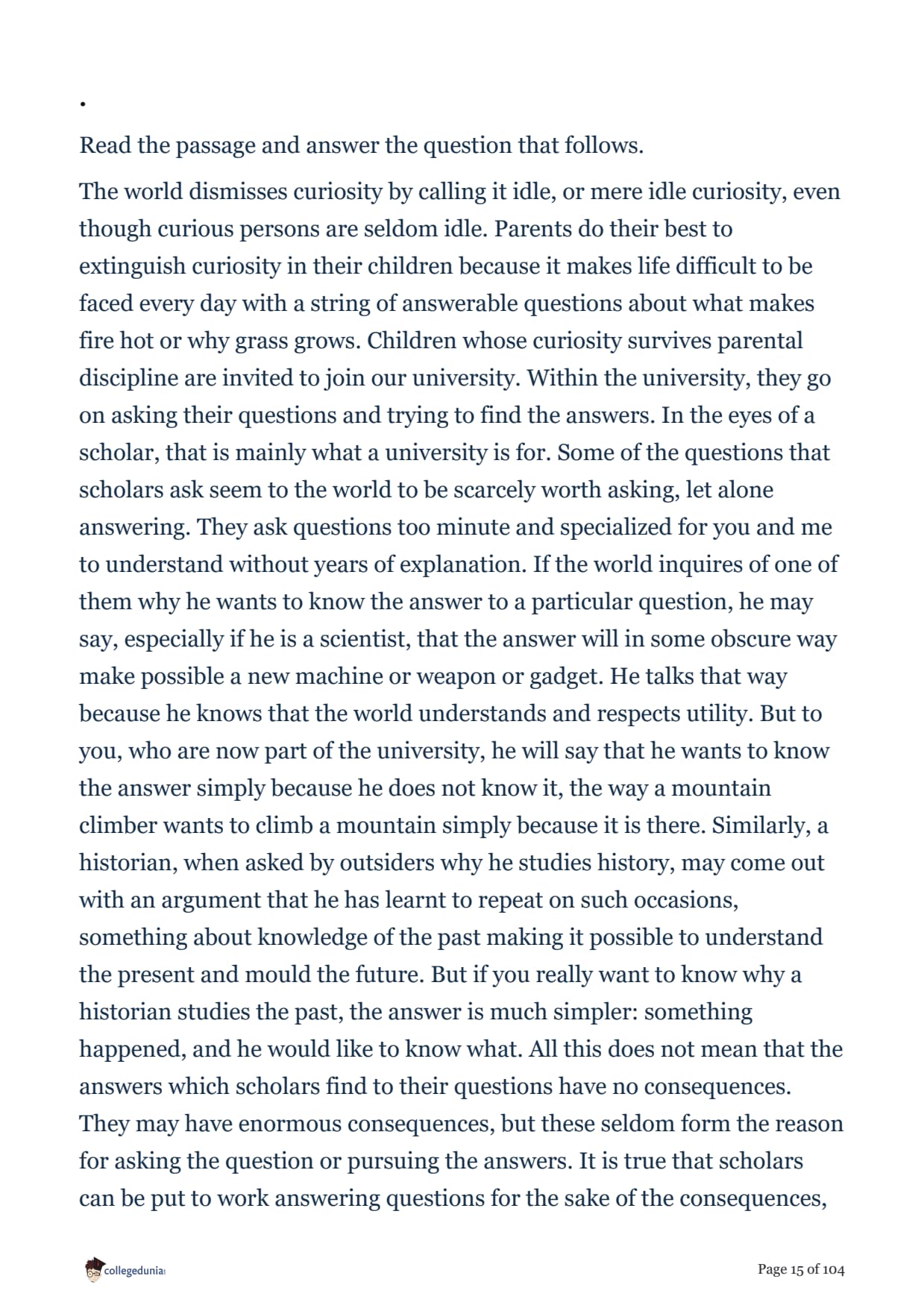
Read the passage and answer the question that follows.
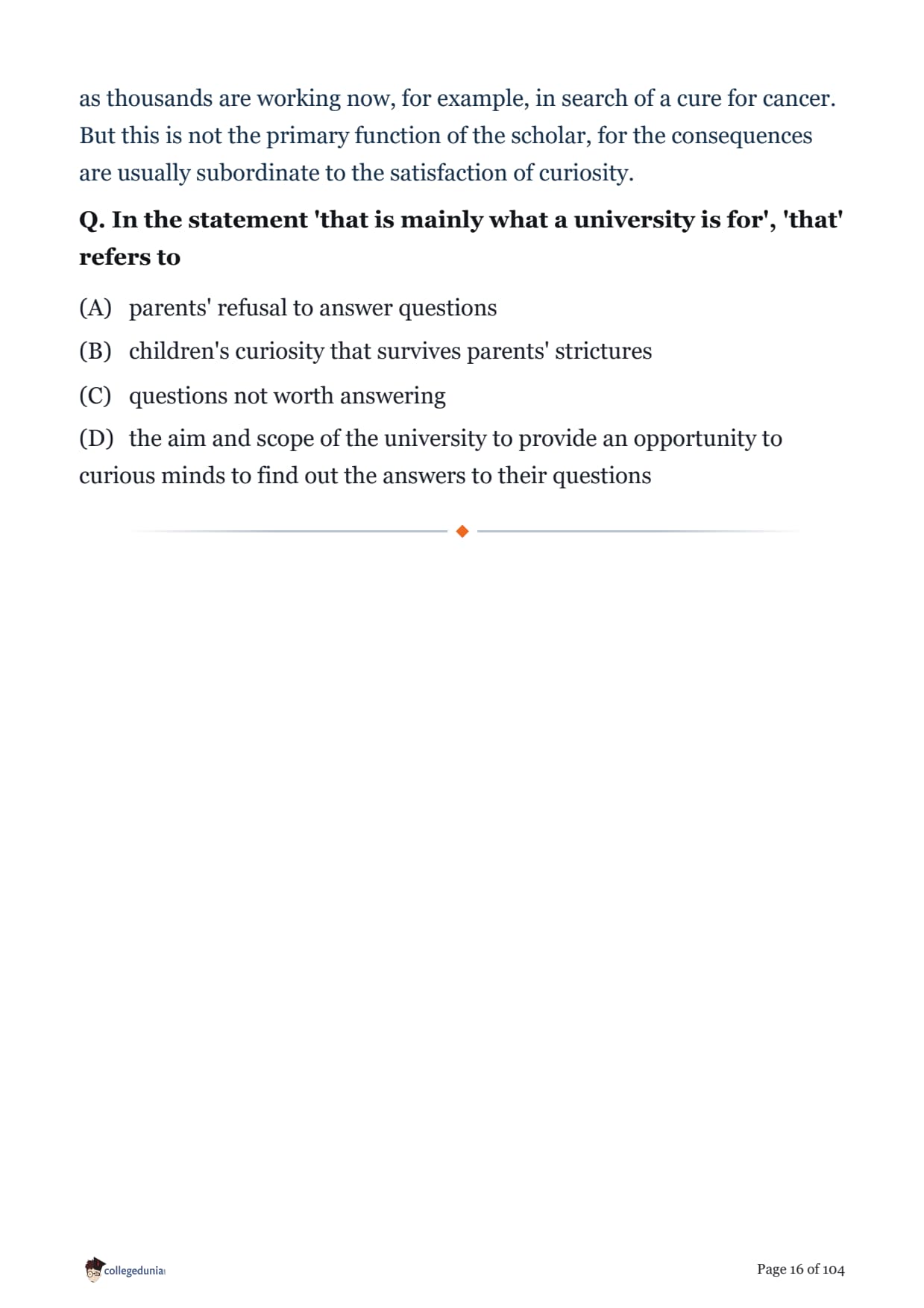
The world dismisses curiosity by calling it idle, or mere idle curiosity, even though curious persons are seldom idle. Parents do their best to extinguish curiosity in their children because it makes life difficult to be faced every day with a string of answerable questions about what makes fire hot or why grass grows. Children whose curiosity survives parental discipline are invited to join our university. Within the university, they go on asking their questions and trying to find the answers. In the eyes of a scholar, that is mainly what a university is for. Some of the questions that scholars ask seem to the world to be scarcely worth asking, let alone answering. They ask questions too minute and specialized for you and me to understand without years of explanation. If the world inquires of one of them why he wants to know the answer to a particular question, he may say, especially if he is a scientist, that the answer will in some obscure way make possible a new machine or weapon or gadget. He talks that way because he knows that the world understands and respects utility. But to you, who are now part of the university, he will say that he wants to know the answer simply because he does not know it, the way a mountain climber wants to climb a mountain simply because it is there. Similarly, a historian, when asked by outsiders why he studies history, may come out with an argument that he has learnt to repeat on such occasions, something about knowledge of the past making it possible to understand the present and mould the future. But if you really want to know why a historian studies the past, the answer is much simpler: something happened, and he would like to know what. All this does not mean that the answers which scholars find to their questions have no consequences. They may have enormous consequences, but these seldom form the reason for asking the question or pursuing the answers. It is true that scholars can be put to work answering questions for the sake of the consequences, as thousands are working now, for example, in search of a cure for cancer. But this is not the primary function of the scholar, for the consequences are usually subordinate to the satisfaction of curiosity.
Q. In the statement 'that is mainly what a university is for', 'that' refers to
Read the passage and answer the question that follows.
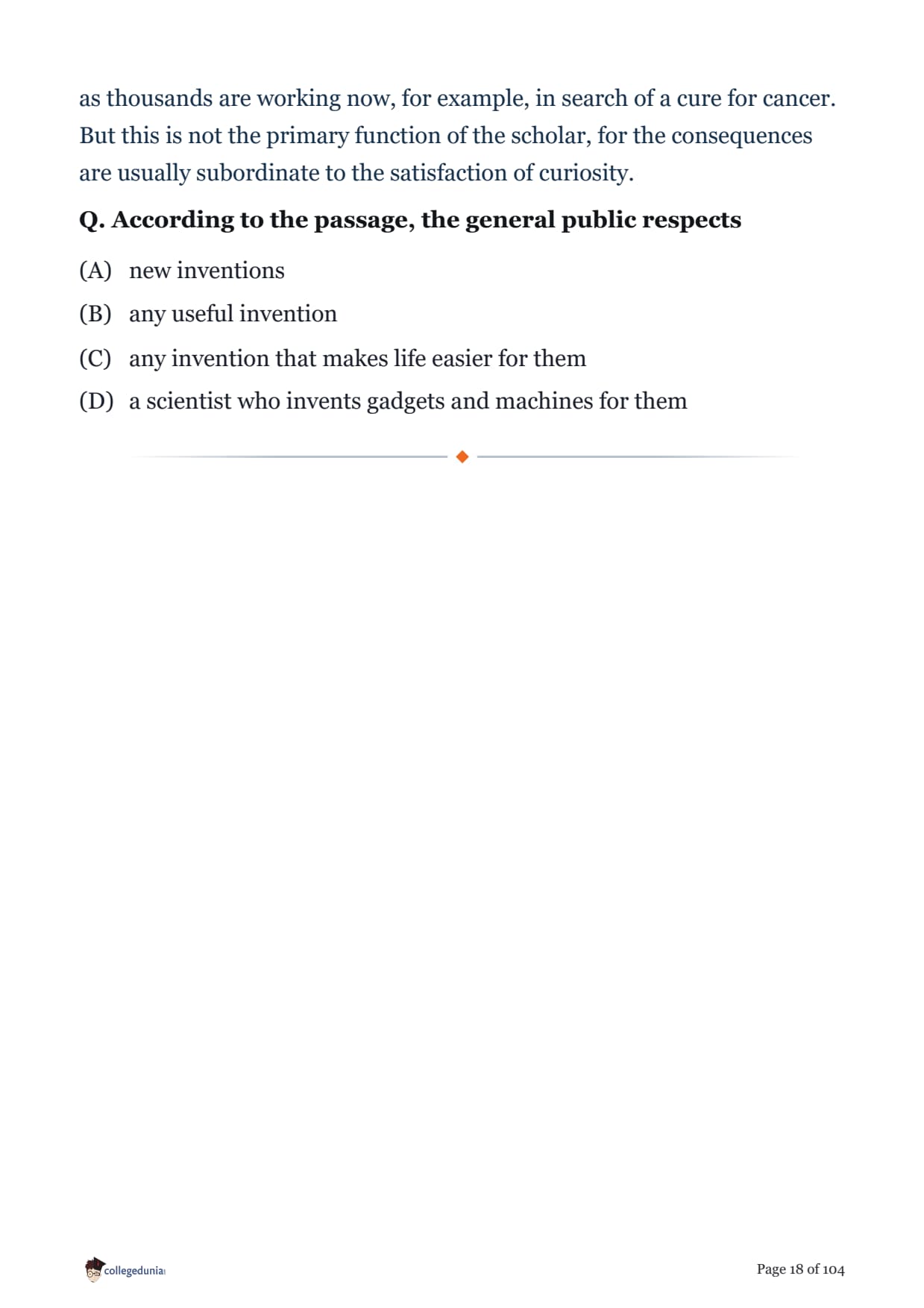
The world dismisses curiosity by calling it idle, or mere idle curiosity, even though curious persons are seldom idle. Parents do their best to extinguish curiosity in their children because it makes life difficult to be faced every day with a string of answerable questions about what makes fire hot or why grass grows. Children whose curiosity survives parental discipline are invited to join our university. Within the university, they go on asking their questions and trying to find the answers. In the eyes of a scholar, that is mainly what a university is for. Some of the questions that scholars ask seem to the world to be scarcely worth asking, let alone answering. They ask questions too minute and specialized for you and me to understand without years of explanation. If the world inquires of one of them why he wants to know the answer to a particular question, he may say, especially if he is a scientist, that the answer will in some obscure way make possible a new machine or weapon or gadget. He talks that way because he knows that the world understands and respects utility. But to you, who are now part of the university, he will say that he wants to know the answer simply because he does not know it, the way a mountain climber wants to climb a mountain simply because it is there. Similarly, a historian, when asked by outsiders why he studies history, may come out with an argument that he has learnt to repeat on such occasions, something about knowledge of the past making it possible to understand the present and mould the future. But if you really want to know why a historian studies the past, the answer is much simpler: something happened, and he would like to know what. All this does not mean that the answers which scholars find to their questions have no consequences. They may have enormous consequences, but these seldom form the reason for asking the question or pursuing the answers. It is true that scholars can be put to work answering questions for the sake of the consequences, as thousands are working now, for example, in search of a cure for cancer. But this is not the primary function of the scholar, for the consequences are usually subordinate to the satisfaction of curiosity.
Q. According to the passage, the general public respects
Read the passage and answer the question that follows.
The world dismisses curiosity by calling it idle, or mere idle curiosity, even though curious persons are seldom idle. Parents do their best to extinguish curiosity in their children because it makes life difficult to be faced every day with a string of answerable questions about what makes fire hot or why grass grows. Children whose curiosity survives parental discipline are invited to join our university. Within the university, they go on asking their questions and trying to find the answers. In the eyes of a scholar, that is mainly what a university is for. Some of the questions that scholars ask seem to the world to be scarcely worth asking, let alone answering. They ask questions too minute and specialized for you and me to understand without years of explanation. If the world inquires of one of them why he wants to know the answer to a particular question, he may say, especially if he is a scientist, that the answer will in some obscure way make possible a new machine or weapon or gadget. He talks that way because he knows that the world understands and respects utility. But to you, who are now part of the university, he will say that he wants to know the answer simply because he does not know it, the way a mountain climber wants to climb a mountain simply because it is there. Similarly, a historian, when asked by outsiders why he studies history, may come out with an argument that he has learnt to repeat on such occasions, something about knowledge of the past making it possible to understand the present and mould the future. But if you really want to know why a historian studies the past, the answer is much simpler: something happened, and he would like to know what. All this does not mean that the answers which scholars find to their questions have no consequences. They may have enormous consequences, but these seldom form the reason for asking the question or pursuing the answers. It is true that scholars can be put to work answering questions for the sake of the consequences, as thousands are working now, for example, in search of a cure for cancer. But this is not the primary function of the scholar, for the consequences are usually subordinate to the satisfaction of curiosity.
Q. The writer compares the scientist to
Read the passage and answer the question that follows.
The world dismisses curiosity by calling it idle, or mere idle curiosity, even though curious persons are seldom idle. Parents do their best to extinguish curiosity in their children because it makes life difficult to be faced every day with a string of answerable questions about what makes fire hot or why grass grows. Children whose curiosity survives parental discipline are invited to join our university. Within the university, they go on asking their questions and trying to find the answers. In the eyes of a scholar, that is mainly what a university is for. Some of the questions that scholars ask seem to the world to be scarcely worth asking, let alone answering. They ask questions too minute and specialized for you and me to understand without years of explanation. If the world inquires of one of them why he wants to know the answer to a particular question, he may say, especially if he is a scientist, that the answer will in some obscure way make possible a new machine or weapon or gadget. He talks that way because he knows that the world understands and respects utility. But to you, who are now part of the university, he will say that he wants to know the answer simply because he does not know it, the way a mountain climber wants to climb a mountain simply because it is there. Similarly, a historian, when asked by outsiders why he studies history, may come out with an argument that he has learnt to repeat on such occasions, something about knowledge of the past making it possible to understand the present and mould the future. But if you really want to know why a historian studies the past, the answer is much simpler: something happened, and he would like to know what. All this does not mean that the answers which scholars find to their questions have no consequences. They may have enormous consequences, but these seldom form the reason for asking the question or pursuing the answers. It is true that scholars can be put to work answering questions for the sake of the consequences, as thousands are working now, for example, in search of a cure for cancer. But this is not the primary function of the scholar, for the consequences are usually subordinate to the satisfaction of curiosity.
Q. The primary function of a scholar is different from the search for a cure for cancer because
Read the passage and answer the question that follows.
The world dismisses curiosity by calling it idle, or mere idle curiosity, even though curious persons are seldom idle. Parents do their best to extinguish curiosity in their children because it makes life difficult to be faced every day with a string of answerable questions about what makes fire hot or why grass grows. Children whose curiosity survives parental discipline are invited to join our university. Within the university, they go on asking their questions and trying to find the answers. In the eyes of a scholar, that is mainly what a university is for. Some of the questions that scholars ask seem to the world to be scarcely worth asking, let alone answering. They ask questions too minute and specialized for you and me to understand without years of explanation. If the world inquires of one of them why he wants to know the answer to a particular question, he may say, especially if he is a scientist, that the answer will in some obscure way make possible a new machine or weapon or gadget. He talks that way because he knows that the world understands and respects utility. But to you, who are now part of the university, he will say that he wants to know the answer simply because he does not know it, the way a mountain climber wants to climb a mountain simply because it is there. Similarly, a historian, when asked by outsiders why he studies history, may come out with an argument that he has learnt to repeat on such occasions, something about knowledge of the past making it possible to understand the present and mould the future. But if you really want to know why a historian studies the past, the answer is much simpler: something happened, and he would like to know what. All this does not mean that the answers which scholars find to their questions have no consequences. They may have enormous consequences, but these seldom form the reason for asking the question or pursuing the answers. It is true that scholars can be put to work answering questions for the sake of the consequences, as thousands are working now, for example, in search of a cure for cancer. But this is not the primary function of the scholar, for the consequences are usually subordinate to the satisfaction of curiosity.
Q. Idle curiosity means
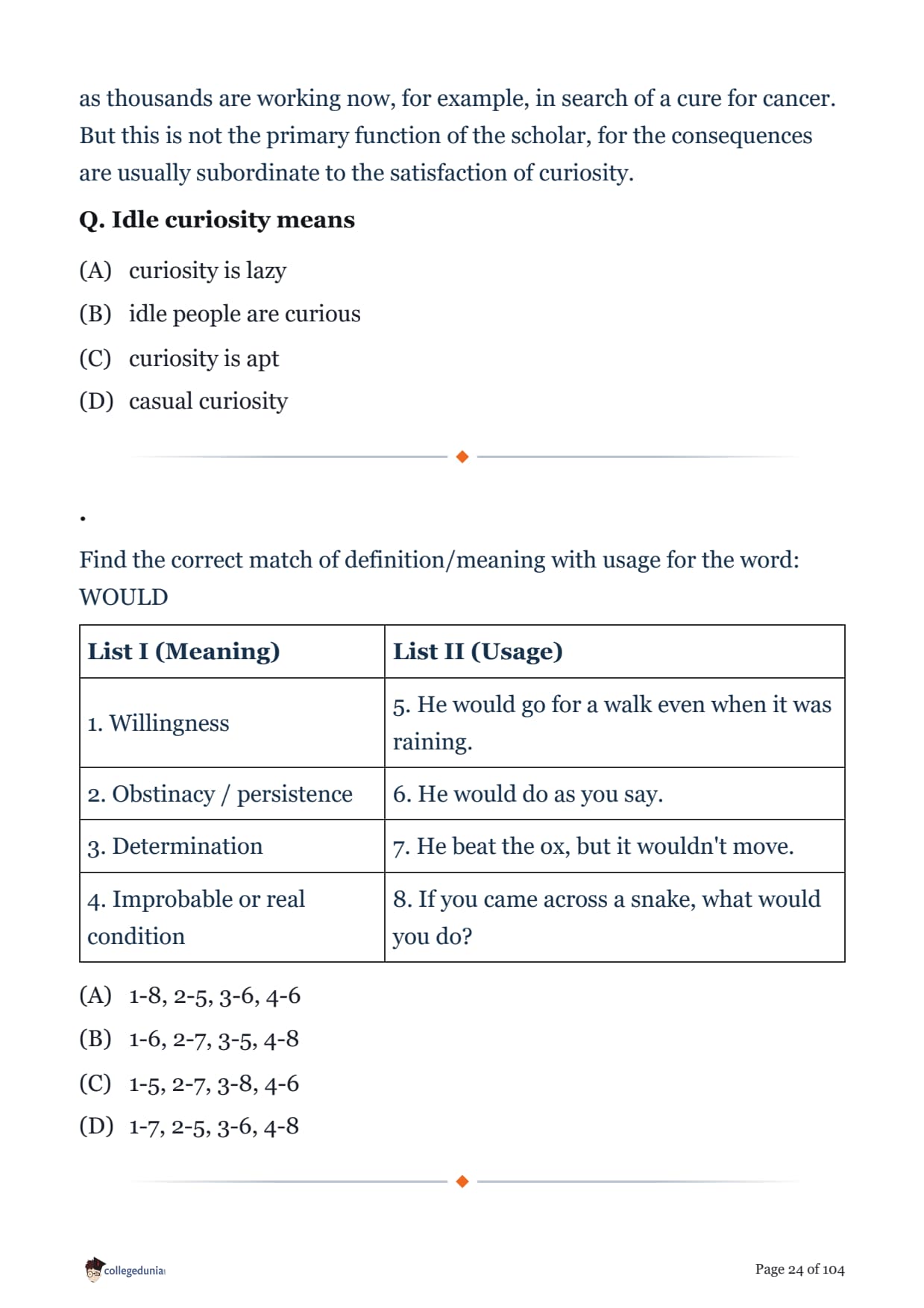
Find the correct match of definition/meaning with usage for the word: WOULD
| List I (Meaning) | List II (Usage) |
|---|---|
| 1. Willingness | 5. He would go for a walk even when it was raining. |
| 2. Obstinacy / persistence | 6. He would do as you say. |
| 3. Determination | 7. He beat the ox, but it wouldn't move. |
| 4. Improbable or real condition | 8. If you came across a snake, what would you do? |
Choose the most appropriate passive construction of the sentence: 'He is doing his job well.'
There are three underlined words below, followed by their usages. Determine the sentences in which the use of words is correct or appropriate: Pray, Prey, Prying.
A. If you pray with faith, they say, it will be answered.
B. He has fallen a prey to cheats.
C. Prying into the affairs of others is bad.
Instructions (Q50-54): The following is an excerpt from a recent article by David Ewing Duncan. Read the passage and answer the questions within its context.
Eye surgeon Virendar Sangwan has perfected a procedure so cutting-edge that most who have tried it have failed. In an operating theatre in the central Indian city of Hyderabad, he surgically implants corneas grown in a petri dish from stem cells by his colleague Geeta Vemuganti in patients with damaged eyes. Together they perform about 80 corneal regeneration procedures a year, making the L.V. Prasad Eye Institute, where they work, one of the most prolific facilities in the world using stem cells to regenerate tissues of any kind.
The Sangwan-Vemuganti team uses stem cells found in the tissues of living adults, not ones derived from embryos. Teams all over the world are working with adult stem cells, trying to coax them to regrow cells in hearts, brains, livers and other organs, but progress is slow. Besides corneas, scientists have had some success regrowing skin cells and bone tissues, but those procedures remain experimental. "A number of programs around the world have tried to perfect this treatment, but they have had bad outcomes," says University of Cincinnati eye surgeon and stem cell specialist Edward Holland. "It is impressive what they are doing at Prasad." In addition to the Hyderabad project, only Holland's program and a half-dozen others in the world conduct operations using corneas grown from stem cells. The treatment uses stem cells harvested from the limbus, located where the cornea touches the white of the eye. For those with damaged corneas, these cells, called "limbic" and "conjunctiva", are harvested from a patient's good eye, if he has one, or from a close relative. They are placed in a petri dish and chemically tweaked to grow into the lower layer of a cornea, called epithelium. It is then transplanted into the eye of the patient where in most cases it takes hold and grows. In 56% of the cases at the Prasad Institute, the patient could still see clearly 40 months later.
Indians are well known for reverse engineering, meaning they can deduce how drugs are made in order to produce generic versions. But in this case, Sangwan and Vemuganti, a pathologist, developed the technique on their own from reading papers and running experiments in the lab. Sangwan says he had a number of patients with burned eyes who could not be helped with standard corneal transplants from cadavers, so he persuaded Vemuganti to try growing corneas in her lab. "You know how to grow cells, and I know how to do the transplant surgery," Vemuganti recalls him saying. "Why don't we work together?" She smiles and shakes her head. "I had no clue if this was going to work." Vemuganti's major innovation was developing a platform on which to grow corneas. First she designed a circular glass tube about the size of a stack of coins. Then she overlaid the glass with tissue from a human placenta, which is "a good surface to grow corneas on," she says. After that she placed stem cells in four places around a circle, added a growth medium, and watched the corneas begin to grow. Commercial interest among stem cell companies for the procedure has been scant because of the perceived small volume of patients, says venture capitalist Antoun Nabhan, who sits on the board of Cellerant, a leading stem cell company in San Carlos, California. But corneal stem cell treatment may have wider applications, says ophthalmologist Ivan Schwab of the University of California at Davis. "These stem cells are similar to others in the body that make mucous membrane," he says. "These techniques of growing stem cells might one day be used to treat mucous-membrane tissue in the sinuses, bladder, and other organs."
Question: According to the article, Sangwan-Vemuganti team's cutting-edge procedure of implanting cornea grown from stem cells is considered a major advancement by the experts because
Instructions (Q50-54): The following is an excerpt from a recent article by David Ewing Duncan. Read the passage and answer the questions within its context.
Eye surgeon Virendar Sangwan has perfected a procedure so cutting-edge that most who have tried it have failed. In an operating theatre in the central Indian city of Hyderabad, he surgically implants corneas grown in a petri dish from stem cells by his colleague Geeta Vemuganti in patients with damaged eyes. Together they perform about 80 corneal regeneration procedures a year, making the L.V. Prasad Eye Institute, where they work, one of the most prolific facilities in the world using stem cells to regenerate tissues of any kind.
The Sangwan-Vemuganti team uses stem cells found in the tissues of living adults, not ones derived from embryos. Teams all over the world are working with adult stem cells, trying to coax them to regrow cells in hearts, brains, livers and other organs, but progress is slow. Besides corneas, scientists have had some success regrowing skin cells and bone tissues, but those procedures remain experimental. "A number of programs around the world have tried to perfect this treatment, but they have had bad outcomes," says University of Cincinnati eye surgeon and stem cell specialist Edward Holland. "It is impressive what they are doing at Prasad." In addition to the Hyderabad project, only Holland's program and a half-dozen others in the world conduct operations using corneas grown from stem cells. The treatment uses stem cells harvested from the limbus, located where the cornea touches the white of the eye. For those with damaged corneas, these cells, called "limbic" and "conjunctiva", are harvested from a patient's good eye, if he has one, or from a close relative. They are placed in a petri dish and chemically tweaked to grow into the lower layer of a cornea, called epithelium. It is then transplanted into the eye of the patient where in most cases it takes hold and grows. In 56% of the cases at the Prasad Institute, the patient could still see clearly 40 months later.
Indians are well known for reverse engineering, meaning they can deduce how drugs are made in order to produce generic versions. But in this case, Sangwan and Vemuganti, a pathologist, developed the technique on their own from reading papers and running experiments in the lab. Sangwan says he had a number of patients with burned eyes who could not be helped with standard corneal transplants from cadavers, so he persuaded Vemuganti to try growing corneas in her lab. "You know how to grow cells, and I know how to do the transplant surgery," Vemuganti recalls him saying. "Why don't we work together?" She smiles and shakes her head. "I had no clue if this was going to work." Vemuganti's major innovation was developing a platform on which to grow corneas. First she designed a circular glass tube about the size of a stack of coins. Then she overlaid the glass with tissue from a human placenta, which is "a good surface to grow corneas on," she says. After that she placed stem cells in four places around a circle, added a growth medium, and watched the corneas begin to grow. Commercial interest among stem cell companies for the procedure has been scant because of the perceived small volume of patients, says venture capitalist Antoun Nabhan, who sits on the board of Cellerant, a leading stem cell company in San Carlos, California. But corneal stem cell treatment may have wider applications, says ophthalmologist Ivan Schwab of the University of California at Davis. "These stem cells are similar to others in the body that make mucous membrane," he says. "These techniques of growing stem cells might one day be used to treat mucous-membrane tissue in the sinuses, bladder, and other organs."
Question: Sangwan-Vemuganti procedure is carried out on
Instructions (Q50-54): The following is an excerpt from a recent article by David Ewing Duncan. Read the passage and answer the questions within its context.
Eye surgeon Virendar Sangwan has perfected a procedure so cutting-edge that most who have tried it have failed. In an operating theatre in the central Indian city of Hyderabad, he surgically implants corneas grown in a petri dish from stem cells by his colleague Geeta Vemuganti in patients with damaged eyes. Together they perform about 80 corneal regeneration procedures a year, making the L.V. Prasad Eye Institute, where they work, one of the most prolific facilities in the world using stem cells to regenerate tissues of any kind.
The Sangwan-Vemuganti team uses stem cells found in the tissues of living adults, not ones derived from embryos. Teams all over the world are working with adult stem cells, trying to coax them to regrow cells in hearts, brains, livers and other organs, but progress is slow. Besides corneas, scientists have had some success regrowing skin cells and bone tissues, but those procedures remain experimental. "A number of programs around the world have tried to perfect this treatment, but they have had bad outcomes," says University of Cincinnati eye surgeon and stem cell specialist Edward Holland. "It is impressive what they are doing at Prasad." In addition to the Hyderabad project, only Holland's program and a half-dozen others in the world conduct operations using corneas grown from stem cells. The treatment uses stem cells harvested from the limbus, located where the cornea touches the white of the eye. For those with damaged corneas, these cells, called "limbic" and "conjunctiva", are harvested from a patient's good eye, if he has one, or from a close relative. They are placed in a petri dish and chemically tweaked to grow into the lower layer of a cornea, called epithelium. It is then transplanted into the eye of the patient where in most cases it takes hold and grows. In 56% of the cases at the Prasad Institute, the patient could still see clearly 40 months later.
Indians are well known for reverse engineering, meaning they can deduce how drugs are made in order to produce generic versions. But in this case, Sangwan and Vemuganti, a pathologist, developed the technique on their own from reading papers and running experiments in the lab. Sangwan says he had a number of patients with burned eyes who could not be helped with standard corneal transplants from cadavers, so he persuaded Vemuganti to try growing corneas in her lab. "You know how to grow cells, and I know how to do the transplant surgery," Vemuganti recalls him saying. "Why don't we work together?" She smiles and shakes her head. "I had no clue if this was going to work." Vemuganti's major innovation was developing a platform on which to grow corneas. First she designed a circular glass tube about the size of a stack of coins. Then she overlaid the glass with tissue from a human placenta, which is "a good surface to grow corneas on," she says. After that she placed stem cells in four places around a circle, added a growth medium, and watched the corneas begin to grow. Commercial interest among stem cell companies for the procedure has been scant because of the perceived small volume of patients, says venture capitalist Antoun Nabhan, who sits on the board of Cellerant, a leading stem cell company in San Carlos, California. But corneal stem cell treatment may have wider applications, says ophthalmologist Ivan Schwab of the University of California at Davis. "These stem cells are similar to others in the body that make mucous membrane," he says. "These techniques of growing stem cells might one day be used to treat mucous-membrane tissue in the sinuses, bladder, and other organs."
Question: The world recognises this Indian innovation because Indian scientists are normally known
Instructions (Q50-54): The following is an excerpt from a recent article by David Ewing Duncan. Read the passage and answer the questions within its context.
Eye surgeon Virendar Sangwan has perfected a procedure so cutting-edge that most who have tried it have failed. In an operating theatre in the central Indian city of Hyderabad, he surgically implants corneas grown in a petri dish from stem cells by his colleague Geeta Vemuganti in patients with damaged eyes. Together they perform about 80 corneal regeneration procedures a year, making the L.V. Prasad Eye Institute, where they work, one of the most prolific facilities in the world using stem cells to regenerate tissues of any kind.
The Sangwan-Vemuganti team uses stem cells found in the tissues of living adults, not ones derived from embryos. Teams all over the world are working with adult stem cells, trying to coax them to regrow cells in hearts, brains, livers and other organs, but progress is slow. Besides corneas, scientists have had some success regrowing skin cells and bone tissues, but those procedures remain experimental. "A number of programs around the world have tried to perfect this treatment, but they have had bad outcomes," says University of Cincinnati eye surgeon and stem cell specialist Edward Holland. "It is impressive what they are doing at Prasad." In addition to the Hyderabad project, only Holland's program and a half-dozen others in the world conduct operations using corneas grown from stem cells. The treatment uses stem cells harvested from the limbus, located where the cornea touches the white of the eye. For those with damaged corneas, these cells, called "limbic" and "conjunctiva", are harvested from a patient's good eye, if he has one, or from a close relative. They are placed in a petri dish and chemically tweaked to grow into the lower layer of a cornea, called epithelium. It is then transplanted into the eye of the patient where in most cases it takes hold and grows. In 56% of the cases at the Prasad Institute, the patient could still see clearly 40 months later.
Indians are well known for reverse engineering, meaning they can deduce how drugs are made in order to produce generic versions. But in this case, Sangwan and Vemuganti, a pathologist, developed the technique on their own from reading papers and running experiments in the lab. Sangwan says he had a number of patients with burned eyes who could not be helped with standard corneal transplants from cadavers, so he persuaded Vemuganti to try growing corneas in her lab. "You know how to grow cells, and I know how to do the transplant surgery," Vemuganti recalls him saying. "Why don't we work together?" She smiles and shakes her head. "I had no clue if this was going to work." Vemuganti's major innovation was developing a platform on which to grow corneas. First she designed a circular glass tube about the size of a stack of coins. Then she overlaid the glass with tissue from a human placenta, which is "a good surface to grow corneas on," she says. After that she placed stem cells in four places around a circle, added a growth medium, and watched the corneas begin to grow. Commercial interest among stem cell companies for the procedure has been scant because of the perceived small volume of patients, says venture capitalist Antoun Nabhan, who sits on the board of Cellerant, a leading stem cell company in San Carlos, California. But corneal stem cell treatment may have wider applications, says ophthalmologist Ivan Schwab of the University of California at Davis. "These stem cells are similar to others in the body that make mucous membrane," he says. "These techniques of growing stem cells might one day be used to treat mucous-membrane tissue in the sinuses, bladder, and other organs."
Question: The pathologist, Vemuganti, started growing cornea in a petri dish
Instructions (Q50-54): The following is an excerpt from a recent article by David Ewing Duncan. Read the passage and answer the questions within its context.
Eye surgeon Virendar Sangwan has perfected a procedure so cutting-edge that most who have tried it have failed. In an operating theatre in the central Indian city of Hyderabad, he surgically implants corneas grown in a petri dish from stem cells by his colleague Geeta Vemuganti in patients with damaged eyes. Together they perform about 80 corneal regeneration procedures a year, making the L.V. Prasad Eye Institute, where they work, one of the most prolific facilities in the world using stem cells to regenerate tissues of any kind.
The Sangwan-Vemuganti team uses stem cells found in the tissues of living adults, not ones derived from embryos. Teams all over the world are working with adult stem cells, trying to coax them to regrow cells in hearts, brains, livers and other organs, but progress is slow. Besides corneas, scientists have had some success regrowing skin cells and bone tissues, but those procedures remain experimental. "A number of programs around the world have tried to perfect this treatment, but they have had bad outcomes," says University of Cincinnati eye surgeon and stem cell specialist Edward Holland. "It is impressive what they are doing at Prasad." In addition to the Hyderabad project, only Holland's program and a half-dozen others in the world conduct operations using corneas grown from stem cells. The treatment uses stem cells harvested from the limbus, located where the cornea touches the white of the eye. For those with damaged corneas, these cells, called "limbic" and "conjunctiva", are harvested from a patient's good eye, if he has one, or from a close relative. They are placed in a petri dish and chemically tweaked to grow into the lower layer of a cornea, called epithelium. It is then transplanted into the eye of the patient where in most cases it takes hold and grows. In 56% of the cases at the Prasad Institute, the patient could still see clearly 40 months later.
Indians are well known for reverse engineering, meaning they can deduce how drugs are made in order to produce generic versions. But in this case, Sangwan and Vemuganti, a pathologist, developed the technique on their own from reading papers and running experiments in the lab. Sangwan says he had a number of patients with burned eyes who could not be helped with standard corneal transplants from cadavers, so he persuaded Vemuganti to try growing corneas in her lab. "You know how to grow cells, and I know how to do the transplant surgery," Vemuganti recalls him saying. "Why don't we work together?" She smiles and shakes her head. "I had no clue if this was going to work." Vemuganti's major innovation was developing a platform on which to grow corneas. First she designed a circular glass tube about the size of a stack of coins. Then she overlaid the glass with tissue from a human placenta, which is "a good surface to grow corneas on," she says. After that she placed stem cells in four places around a circle, added a growth medium, and watched the corneas begin to grow. Commercial interest among stem cell companies for the procedure has been scant because of the perceived small volume of patients, says venture capitalist Antoun Nabhan, who sits on the board of Cellerant, a leading stem cell company in San Carlos, California. But corneal stem cell treatment may have wider applications, says ophthalmologist Ivan Schwab of the University of California at Davis. "These stem cells are similar to others in the body that make mucous membrane," he says. "These techniques of growing stem cells might one day be used to treat mucous-membrane tissue in the sinuses, bladder, and other organs."
Question: In the context of the passage, choose the correct set of meanings for the words: PLATFORM and GENERIC
Choose the option which is closest in meaning to the word SUBTLE.
The following sentence has a missing punctuation mark. Choose the right answer.
"My mother who is from the village is very superstitious."
For the pair of sentences below, choose the right option.
1. Those are them.
2. Those are they.
Instructions: Read the following passage and answer the question based on it.
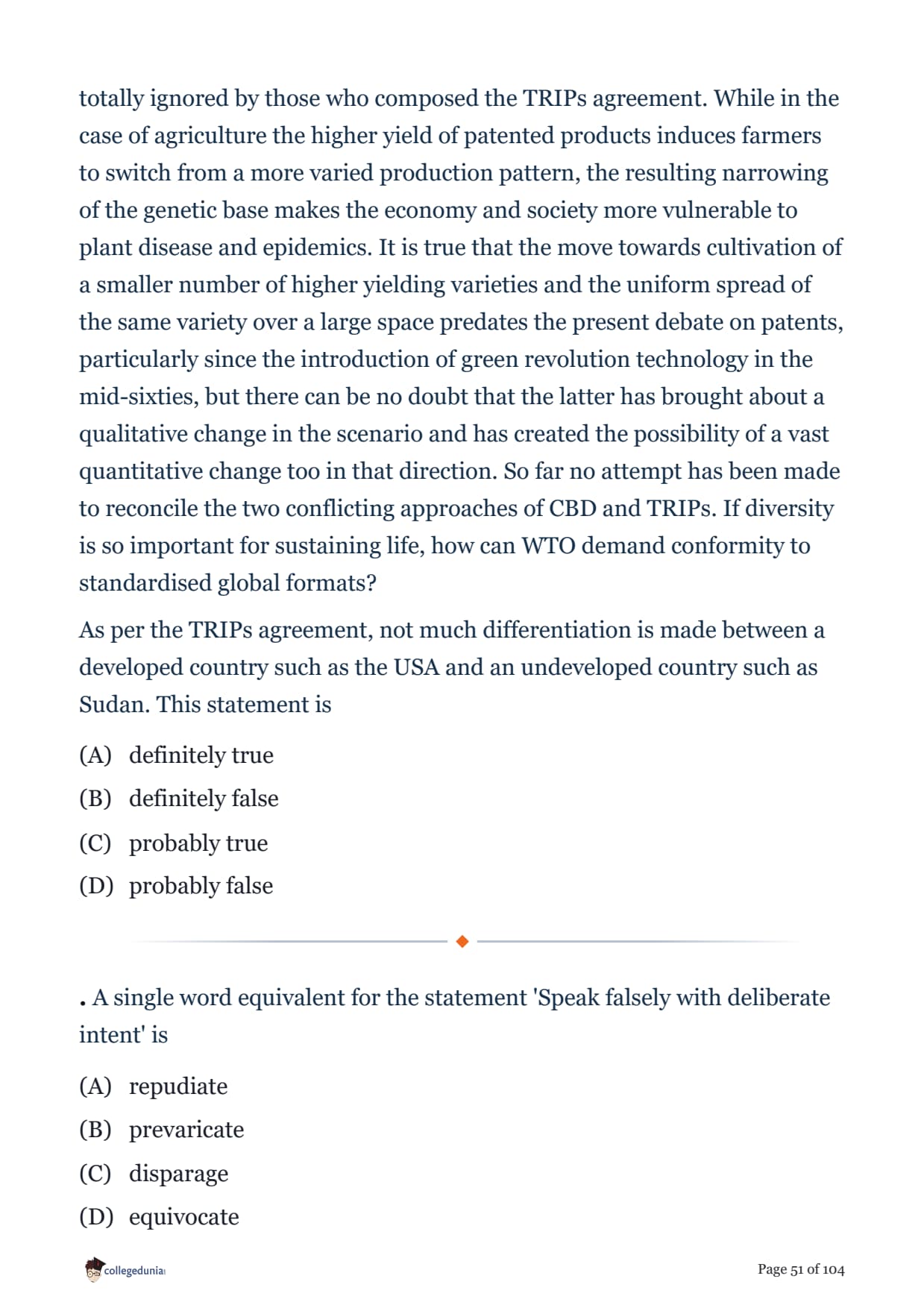
TRIPs agreement provides a comprehensive set of global trade rules for the protection of copyright, patents, trademarks, industrial designs, trade secrets, semiconductor layout designs, and geographical indications, that apply to all member countries irrespective of their levels of development, natural and human endowments and history. Every member country has been asked by the WTO to amend its national patent law to conform to that universal globalized format for legislation relating to pharmaceutical, agrochemical, food, alloys, etc. Under Article 65, the developed countries have been asked to change their laws within another five years, and the less developed countries within an additional five years. The least developed countries have been asked to make those changes by 2005 AD.
This attempt at global standardisation and uniformity by way of the TRIPs agreement is in conflict with the main thrust of the Rio Earth Summit of 1992 that set out the conditions for sustainable development. These two reveal two contrasting types of international approaches and norms. While the 1992 Earth Summit and the 1993 Convention on Biodiversity (CBD) focused on 'diversity' as being fundamental to sustain life and development, TRIPs and WTO are pushing for 'conformity' to international standardized norms on patents, services, labour, investment and what not, irrespective of their history, ecology, level of economic development, etc. But despite their diametrically opposed viewpoints, 170 countries signed CBD upholding the need for diversity, and 50 countries signed the TRIPs agreement in 1994 claiming the urgency of uniformity, with a very large element of common signatories (130) in both.
The Convention on Biodiversity (CBD), in its Article 16.5, specifically asserts that intellectual property rights must not be in conflict with conservation and sustainable use of biodiversity, a provision that has been totally ignored by those who composed the TRIPs agreement. While in the case of agriculture the higher yield of patented products induces farmers to switch from a more varied production pattern, the resulting narrowing of the genetic base makes the economy and society more vulnerable to plant disease and epidemics. It is true that the move towards cultivation of a smaller number of higher yielding varieties and the uniform spread of the same variety over a large space predates the present debate on patents, particularly since the introduction of green revolution technology in the mid-sixties, but there can be no doubt that the latter has brought about a qualitative change in the scenario and has created the possibility of a vast quantitative change too in that direction. So far no attempt has been made to reconcile the two conflicting approaches of CBD and TRIPs. If diversity is so important for sustaining life, how can WTO demand conformity to standardised global formats?
The author points out that intellectual property rights and their administration mechanism
Instructions: Read the following passage and answer the question based on it.
TRIPs agreement provides a comprehensive set of global trade rules for the protection of copyright, patents, trademarks, industrial designs, trade secrets, semiconductor layout designs, and geographical indications, that apply to all member countries irrespective of their levels of development, natural and human endowments and history. Every member country has been asked by the WTO to amend its national patent law to conform to that universal globalized format for legislation relating to pharmaceutical, agrochemical, food, alloys, etc. Under Article 65, the developed countries have been asked to change their laws within another five years, and the less developed countries within an additional five years. The least developed countries have been asked to make those changes by 2005 AD.
This attempt at global standardisation and uniformity by way of the TRIPs agreement is in conflict with the main thrust of the Rio Earth Summit of 1992 that set out the conditions for sustainable development. These two reveal two contrasting types of international approaches and norms. While the 1992 Earth Summit and the 1993 Convention on Biodiversity (CBD) focused on 'diversity' as being fundamental to sustain life and development, TRIPs and WTO are pushing for 'conformity' to international standardized norms on patents, services, labour, investment and what not, irrespective of their history, ecology, level of economic development, etc. But despite their diametrically opposed viewpoints, 170 countries signed CBD upholding the need for diversity, and 50 countries signed the TRIPs agreement in 1994 claiming the urgency of uniformity, with a very large element of common signatories (130) in both.
The Convention on Biodiversity (CBD), in its Article 16.5, specifically asserts that intellectual property rights must not be in conflict with conservation and sustainable use of biodiversity, a provision that has been totally ignored by those who composed the TRIPs agreement. While in the case of agriculture the higher yield of patented products induces farmers to switch from a more varied production pattern, the resulting narrowing of the genetic base makes the economy and society more vulnerable to plant disease and epidemics. It is true that the move towards cultivation of a smaller number of higher yielding varieties and the uniform spread of the same variety over a large space predates the present debate on patents, particularly since the introduction of green revolution technology in the mid-sixties, but there can be no doubt that the latter has brought about a qualitative change in the scenario and has created the possibility of a vast quantitative change too in that direction. So far no attempt has been made to reconcile the two conflicting approaches of CBD and TRIPs. If diversity is so important for sustaining life, how can WTO demand conformity to standardised global formats?
Which of the following has been said by the author in the passage?
Instructions: Read the following passage and answer the question based on it.
TRIPs agreement provides a comprehensive set of global trade rules for the protection of copyright, patents, trademarks, industrial designs, trade secrets, semiconductor layout designs, and geographical indications, that apply to all member countries irrespective of their levels of development, natural and human endowments and history. Every member country has been asked by the WTO to amend its national patent law to conform to that universal globalized format for legislation relating to pharmaceutical, agrochemical, food, alloys, etc. Under Article 65, the developed countries have been asked to change their laws within another five years, and the less developed countries within an additional five years. The least developed countries have been asked to make those changes by 2005 AD.
This attempt at global standardisation and uniformity by way of the TRIPs agreement is in conflict with the main thrust of the Rio Earth Summit of 1992 that set out the conditions for sustainable development. These two reveal two contrasting types of international approaches and norms. While the 1992 Earth Summit and the 1993 Convention on Biodiversity (CBD) focused on 'diversity' as being fundamental to sustain life and development, TRIPs and WTO are pushing for 'conformity' to international standardized norms on patents, services, labour, investment and what not, irrespective of their history, ecology, level of economic development, etc. But despite their diametrically opposed viewpoints, 170 countries signed CBD upholding the need for diversity, and 50 countries signed the TRIPs agreement in 1994 claiming the urgency of uniformity, with a very large element of common signatories (130) in both.
The Convention on Biodiversity (CBD), in its Article 16.5, specifically asserts that intellectual property rights must not be in conflict with conservation and sustainable use of biodiversity, a provision that has been totally ignored by those who composed the TRIPs agreement. While in the case of agriculture the higher yield of patented products induces farmers to switch from a more varied production pattern, the resulting narrowing of the genetic base makes the economy and society more vulnerable to plant disease and epidemics. It is true that the move towards cultivation of a smaller number of higher yielding varieties and the uniform spread of the same variety over a large space predates the present debate on patents, particularly since the introduction of green revolution technology in the mid-sixties, but there can be no doubt that the latter has brought about a qualitative change in the scenario and has created the possibility of a vast quantitative change too in that direction. So far no attempt has been made to reconcile the two conflicting approaches of CBD and TRIPs. If diversity is so important for sustaining life, how can WTO demand conformity to standardised global formats?
Out of the countries that signed CBD, the percentage of those that signed the TRIPs also, is
Instructions: Read the following passage and answer the question based on it.
TRIPs agreement provides a comprehensive set of global trade rules for the protection of copyright, patents, trademarks, industrial designs, trade secrets, semiconductor layout designs, and geographical indications, that apply to all member countries irrespective of their levels of development, natural and human endowments and history. Every member country has been asked by the WTO to amend its national patent law to conform to that universal globalized format for legislation relating to pharmaceutical, agrochemical, food, alloys, etc. Under Article 65, the developed countries have been asked to change their laws within another five years, and the less developed countries within an additional five years. The least developed countries have been asked to make those changes by 2005 AD.
This attempt at global standardisation and uniformity by way of the TRIPs agreement is in conflict with the main thrust of the Rio Earth Summit of 1992 that set out the conditions for sustainable development. These two reveal two contrasting types of international approaches and norms. While the 1992 Earth Summit and the 1993 Convention on Biodiversity (CBD) focused on 'diversity' as being fundamental to sustain life and development, TRIPs and WTO are pushing for 'conformity' to international standardized norms on patents, services, labour, investment and what not, irrespective of their history, ecology, level of economic development, etc. But despite their diametrically opposed viewpoints, 170 countries signed CBD upholding the need for diversity, and 50 countries signed the TRIPs agreement in 1994 claiming the urgency of uniformity, with a very large element of common signatories (130) in both.
The Convention on Biodiversity (CBD), in its Article 16.5, specifically asserts that intellectual property rights must not be in conflict with conservation and sustainable use of biodiversity, a provision that has been totally ignored by those who composed the TRIPs agreement. While in the case of agriculture the higher yield of patented products induces farmers to switch from a more varied production pattern, the resulting narrowing of the genetic base makes the economy and society more vulnerable to plant disease and epidemics. It is true that the move towards cultivation of a smaller number of higher yielding varieties and the uniform spread of the same variety over a large space predates the present debate on patents, particularly since the introduction of green revolution technology in the mid-sixties, but there can be no doubt that the latter has brought about a qualitative change in the scenario and has created the possibility of a vast quantitative change too in that direction. So far no attempt has been made to reconcile the two conflicting approaches of CBD and TRIPs. If diversity is so important for sustaining life, how can WTO demand conformity to standardised global formats?
According to the author, a higher-yield seed variety is not always welcome as it also ultimately leads to
Instructions: Read the following passage and answer the question based on it.
TRIPs agreement provides a comprehensive set of global trade rules for the protection of copyright, patents, trademarks, industrial designs, trade secrets, semiconductor layout designs, and geographical indications, that apply to all member countries irrespective of their levels of development, natural and human endowments and history. Every member country has been asked by the WTO to amend its national patent law to conform to that universal globalized format for legislation relating to pharmaceutical, agrochemical, food, alloys, etc. Under Article 65, the developed countries have been asked to change their laws within another five years, and the less developed countries within an additional five years. The least developed countries have been asked to make those changes by 2005 AD.
This attempt at global standardisation and uniformity by way of the TRIPs agreement is in conflict with the main thrust of the Rio Earth Summit of 1992 that set out the conditions for sustainable development. These two reveal two contrasting types of international approaches and norms. While the 1992 Earth Summit and the 1993 Convention on Biodiversity (CBD) focused on 'diversity' as being fundamental to sustain life and development, TRIPs and WTO are pushing for 'conformity' to international standardized norms on patents, services, labour, investment and what not, irrespective of their history, ecology, level of economic development, etc. But despite their diametrically opposed viewpoints, 170 countries signed CBD upholding the need for diversity, and 50 countries signed the TRIPs agreement in 1994 claiming the urgency of uniformity, with a very large element of common signatories (130) in both.
The Convention on Biodiversity (CBD), in its Article 16.5, specifically asserts that intellectual property rights must not be in conflict with conservation and sustainable use of biodiversity, a provision that has been totally ignored by those who composed the TRIPs agreement. While in the case of agriculture the higher yield of patented products induces farmers to switch from a more varied production pattern, the resulting narrowing of the genetic base makes the economy and society more vulnerable to plant disease and epidemics. It is true that the move towards cultivation of a smaller number of higher yielding varieties and the uniform spread of the same variety over a large space predates the present debate on patents, particularly since the introduction of green revolution technology in the mid-sixties, but there can be no doubt that the latter has brought about a qualitative change in the scenario and has created the possibility of a vast quantitative change too in that direction. So far no attempt has been made to reconcile the two conflicting approaches of CBD and TRIPs. If diversity is so important for sustaining life, how can WTO demand conformity to standardised global formats?
As per the TRIPs agreement, not much differentiation is made between a developed country such as the USA and an undeveloped country such as Sudan. This statement is
A single word equivalent for the statement 'Speak falsely with deliberate intent' is
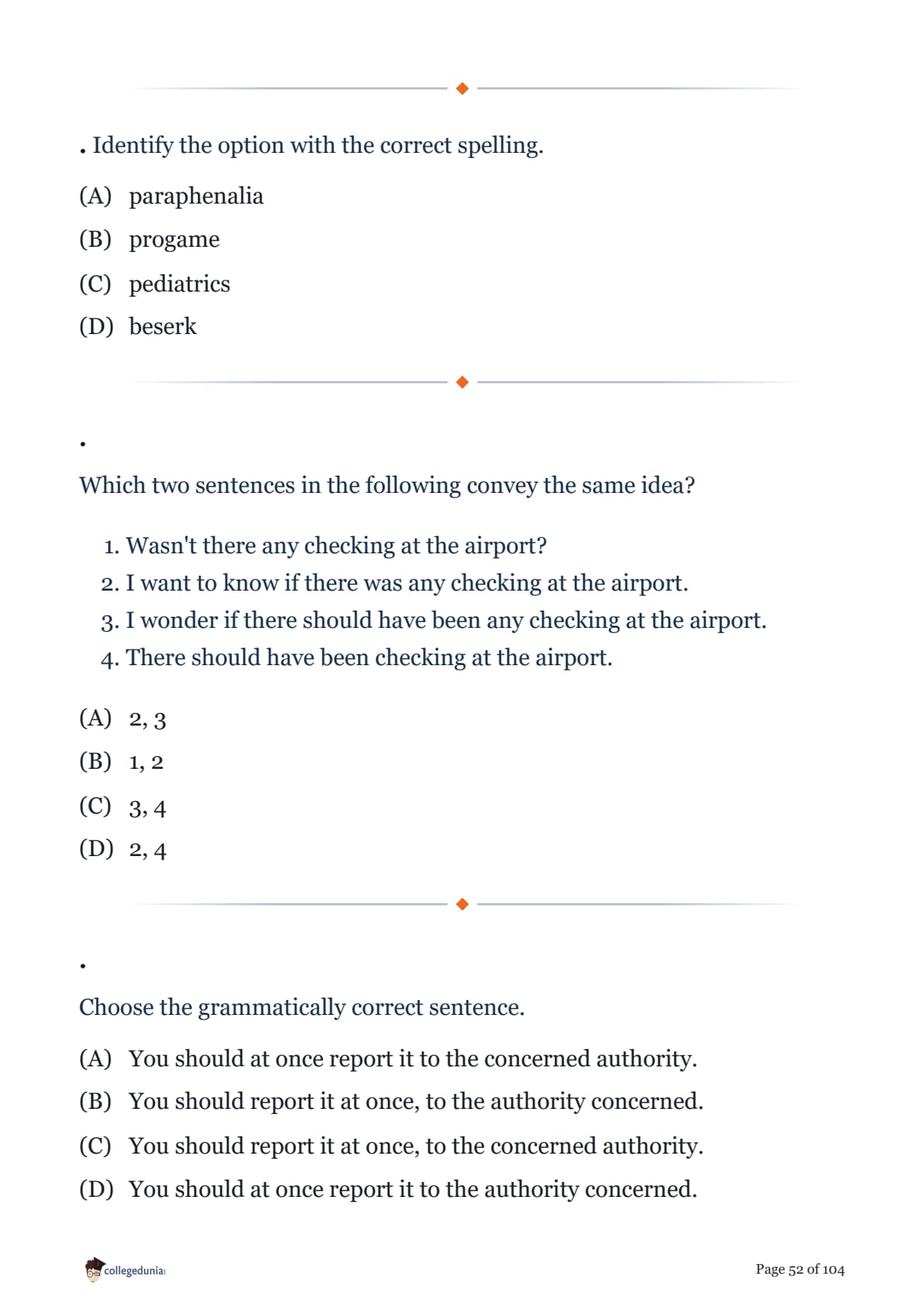
Identify the option with the correct spelling.
Which two sentences in the following convey the same idea?
- Wasn't there any checking at the airport?
- I want to know if there was any checking at the airport.
- I wonder if there should have been any checking at the airport.
- There should have been checking at the airport.
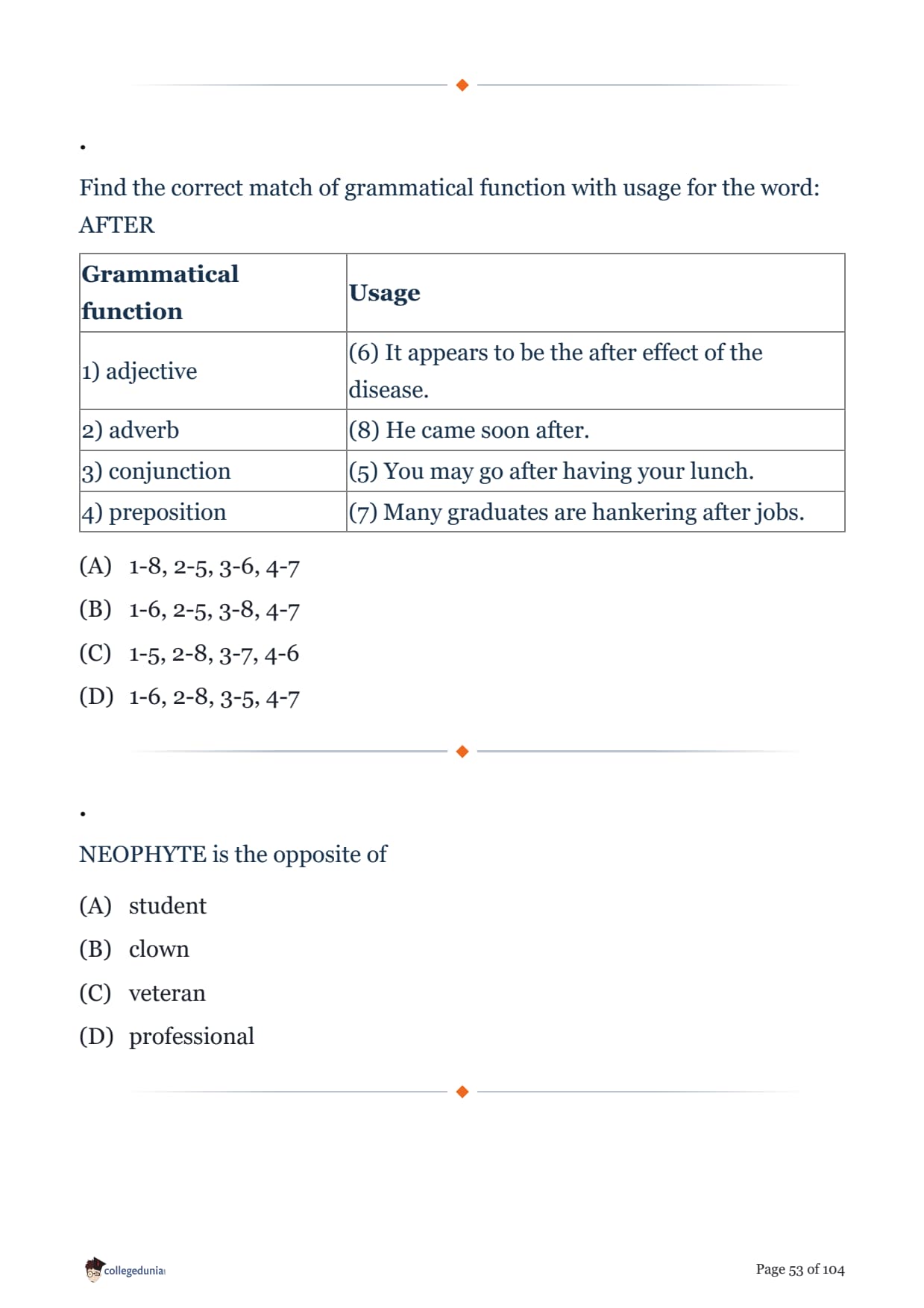
Find the correct match of grammatical function with usage for the word: AFTER
| Grammatical function | Usage |
|---|---|
| 1) adjective | (6) It appears to be the after effect of the disease. |
| 2) adverb | (8) He came soon after. |
| 3) conjunction | (5) You may go after having your lunch. |
| 4) preposition | (7) Many graduates are hankering after jobs. |
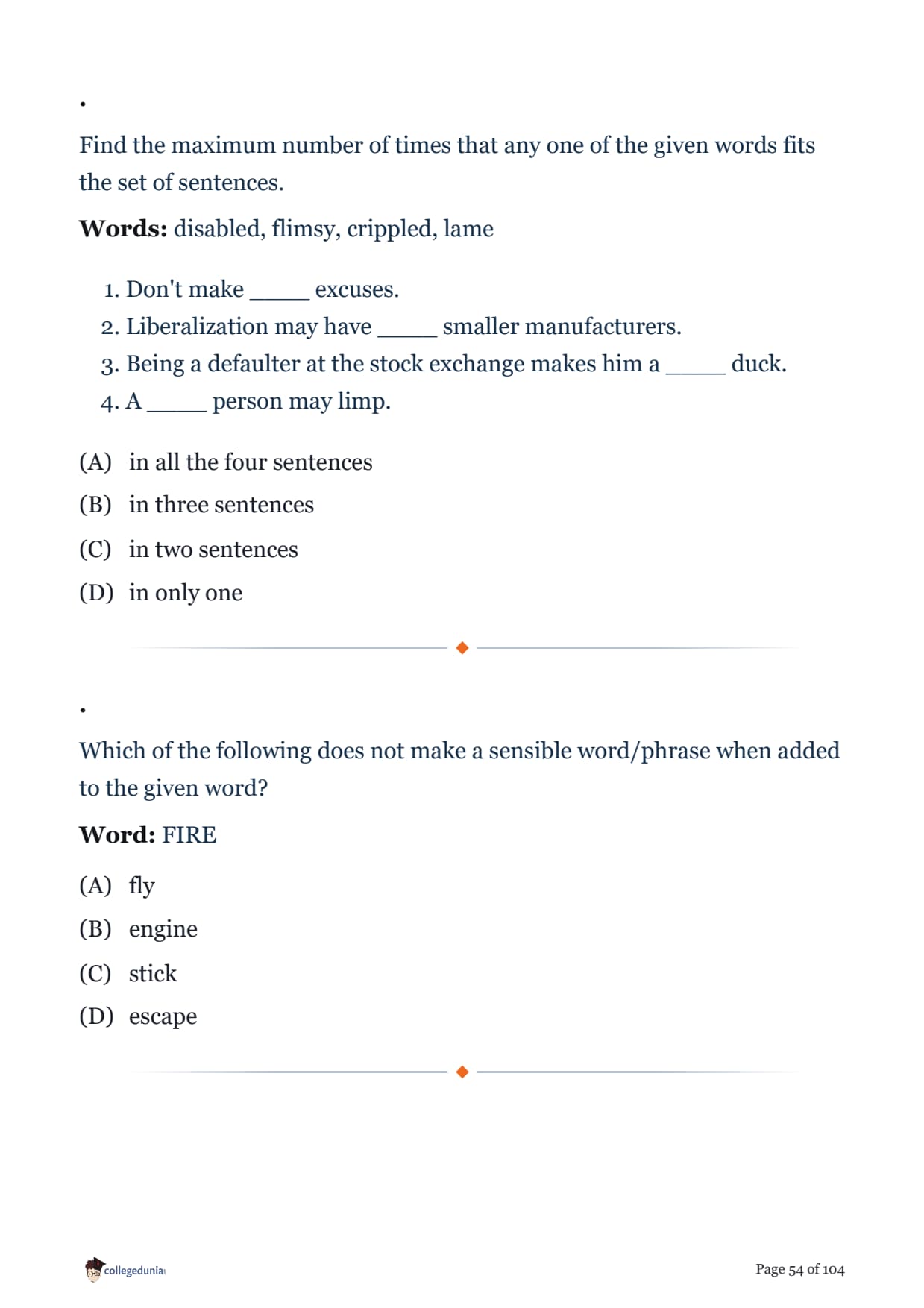
Find the maximum number of times that any one of the given words fits the set of sentences.
Words: disabled, flimsy, crippled, lame
- Don't make ____ excuses.
- Liberalization may have ____ smaller manufacturers.
- Being a defaulter at the stock exchange makes him a ____ duck.
- A ____ person may limp.
Which of the following does not make a sensible word/phrase when added to the given word?
Word: FIRE
Arrange the sentences 1, 2, 3, 4 to form a logical sequence between sentences I and II. Choose the alternative where the four combinations make a meaningful sentence.
I. We all value having the freedom
- which many of us fail to honour
- to make the choices we want in our careers
- but with great freedom comes great responsibility
- so most companies fall prey to the policies which become rigid
II. and that's probably one reason we find most companies not following what they preach
Instructions [72-74]: Read the edited excerpt of an article by Nelson Vinod Moses and answer the question in this context.
A successful non-resident Indian employed in the United States returns to a backward Indian village and transforms the lives of the villagers. Sounds familiar? At 31, Ashwin Naik is pacing through the path Shah Rukh Khan traced in his off-bear Bollywood movie, Swades. Naik had just quit his cushy job in a genomics firm in the US to join MIT Sloan School of Business. With a month in hand, he headed home a travelled through the remote areas of Bagalkot district in Karnataka. The woeful social conditions he saw moved him. Naik chucked the MBA course and in six months set up Vaatsalya Healthcare, a rural healthcare delivery system. In February 2005, Vaatsalya's first hospital opened in Hubli. Two more centres were opened in Gadag and Karwar to offer specialist services of surgeons and facilities such as physiotherapy for children suffering from cerebral palsy. "We introduced paediatric surgery for infants below six months," says Naik. "Else, patients would have to be taken to distant cities of Hubli or Bangalore." Naik plans 100 more units in five states in the next three years. Mere charity by an affluent, middle-class professional? Far from it. Vaatsalya is one among rapidly spreading 'for profit' social enterprises that serve the poor and bring in profit. Mumbai-based Ziqitza, an imbalance services company, is another. It never refuses a patient for money, and charges Rs. 50 to 200. Done fleetingly in India and elsewhere till now, entrepreneurial minds with a social conscience are methodically creating such models at a greater pace. "There has been a boom in the past two years," says Varun Sahni, country director of Acumen Fund, a US based social fund that invests in companies that target low income communities. "Currently, there are about 1,000 in India." The timing seems perfect. There is a wide market acceptance and funding has been coming in easily. These enterprises work across a swathe of areas including healthcare, education, rural energy, agriculture, arts and crafts, banking and more. 'For profit' entrepreneurs are obsessed with social and environmental impact in addition to the financial returns. Since they are answerable to the investors, they try expanding the business rapidly. SKS Microfinance, for instance, started in 1998 and has now over 900,000 customers, 440 branches and an outstanding loan disbursement of over Rs. 452 crores as of August 2007.
Identify the appropriate business model of the kind of enterprise described by the author.
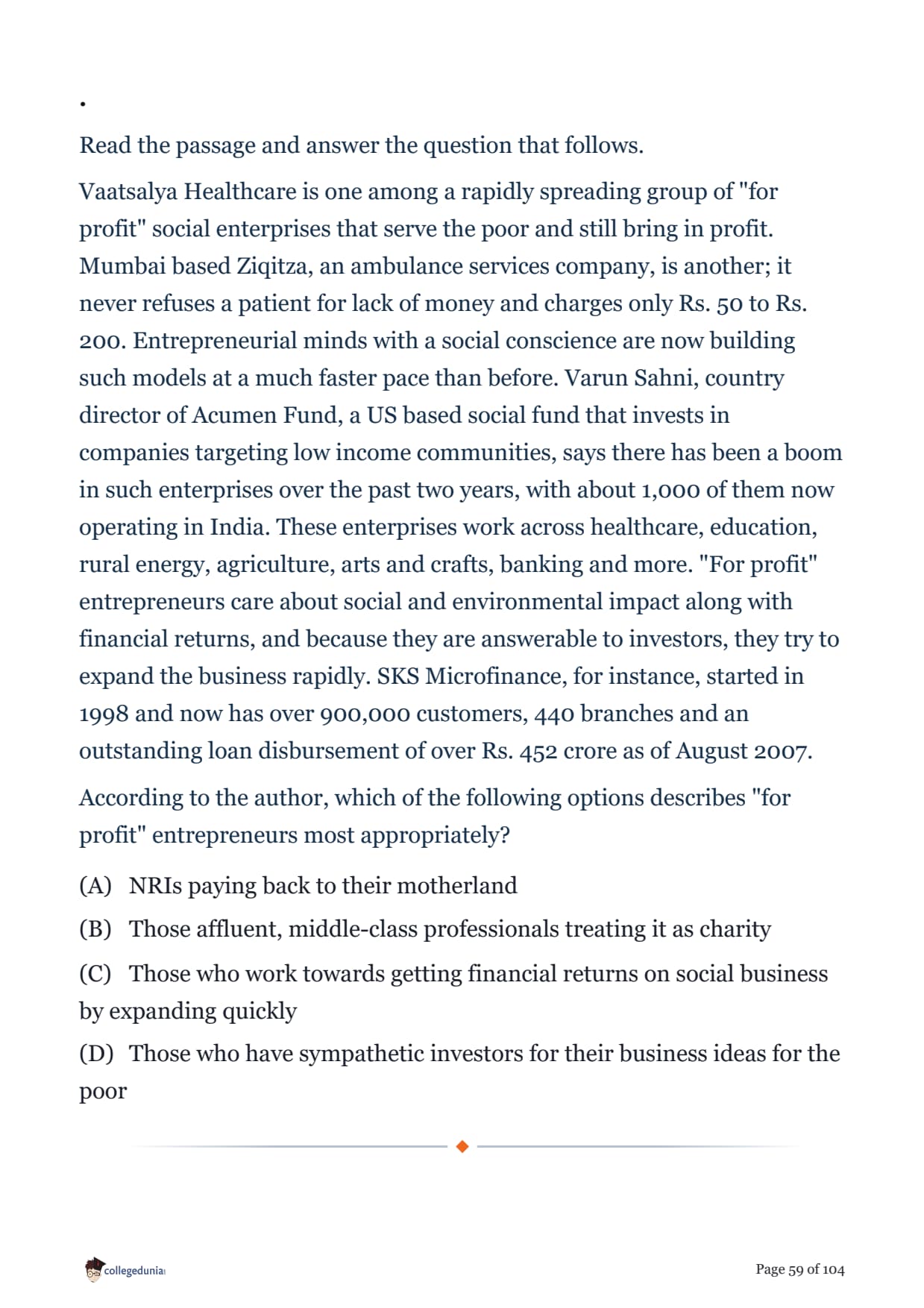
Read the passage and answer the question that follows.
Vaatsalya Healthcare is one among a rapidly spreading group of "for profit" social enterprises that serve the poor and still bring in profit. Mumbai based Ziqitza, an ambulance services company, is another; it never refuses a patient for lack of money and charges only Rs. 50 to Rs. 200. Entrepreneurial minds with a social conscience are now building such models at a much faster pace than before. Varun Sahni, country director of Acumen Fund, a US based social fund that invests in companies targeting low income communities, says there has been a boom in such enterprises over the past two years, with about 1,000 of them now operating in India. These enterprises work across healthcare, education, rural energy, agriculture, arts and crafts, banking and more. "For profit" entrepreneurs care about social and environmental impact along with financial returns, and because they are answerable to investors, they try to expand the business rapidly. SKS Microfinance, for instance, started in 1998 and now has over 900,000 customers, 440 branches and an outstanding loan disbursement of over Rs. 452 crore as of August 2007.
Which of the following companies does not illustrate the idea explained by the author?
Read the passage and answer the question that follows.
Vaatsalya Healthcare is one among a rapidly spreading group of "for profit" social enterprises that serve the poor and still bring in profit. Mumbai based Ziqitza, an ambulance services company, is another; it never refuses a patient for lack of money and charges only Rs. 50 to Rs. 200. Entrepreneurial minds with a social conscience are now building such models at a much faster pace than before. Varun Sahni, country director of Acumen Fund, a US based social fund that invests in companies targeting low income communities, says there has been a boom in such enterprises over the past two years, with about 1,000 of them now operating in India. These enterprises work across healthcare, education, rural energy, agriculture, arts and crafts, banking and more. "For profit" entrepreneurs care about social and environmental impact along with financial returns, and because they are answerable to investors, they try to expand the business rapidly. SKS Microfinance, for instance, started in 1998 and now has over 900,000 customers, 440 branches and an outstanding loan disbursement of over Rs. 452 crore as of August 2007.
According to the author, which of the following options describes "for profit" entrepreneurs most appropriately?
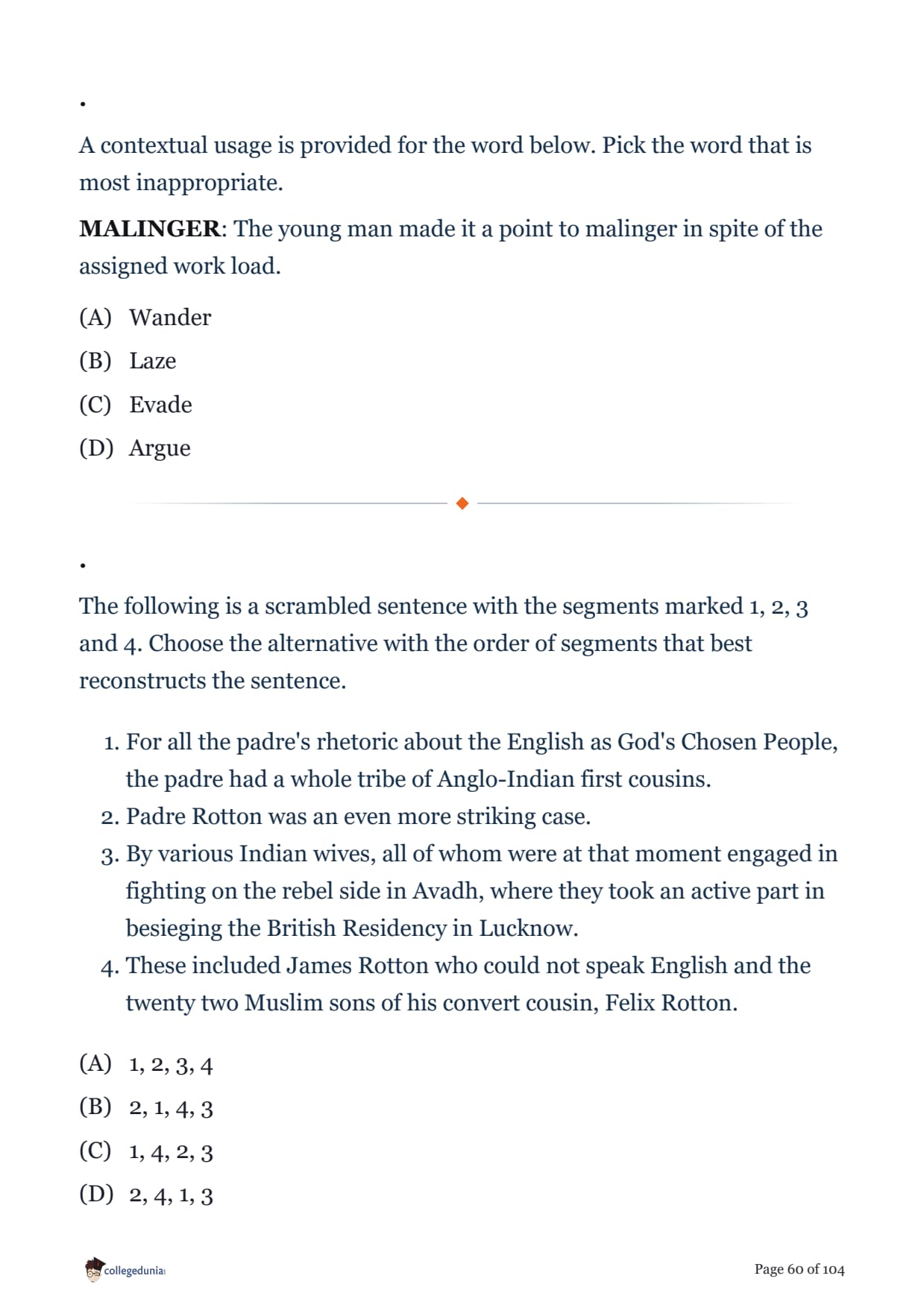
A contextual usage is provided for the word below. Pick the word that is most inappropriate.
MALINGER: The young man made it a point to malinger in spite of the assigned work load.
The following is a scrambled sentence with the segments marked 1, 2, 3 and 4. Choose the alternative with the order of segments that best reconstructs the sentence.
- For all the padre's rhetoric about the English as God's Chosen People, the padre had a whole tribe of Anglo-Indian first cousins.
- Padre Rotton was an even more striking case.
- By various Indian wives, all of whom were at that moment engaged in fighting on the rebel side in Avadh, where they took an active part in besieging the British Residency in Lucknow.
- These included James Rotton who could not speak English and the twenty two Muslim sons of his convert cousin, Felix Rotton.
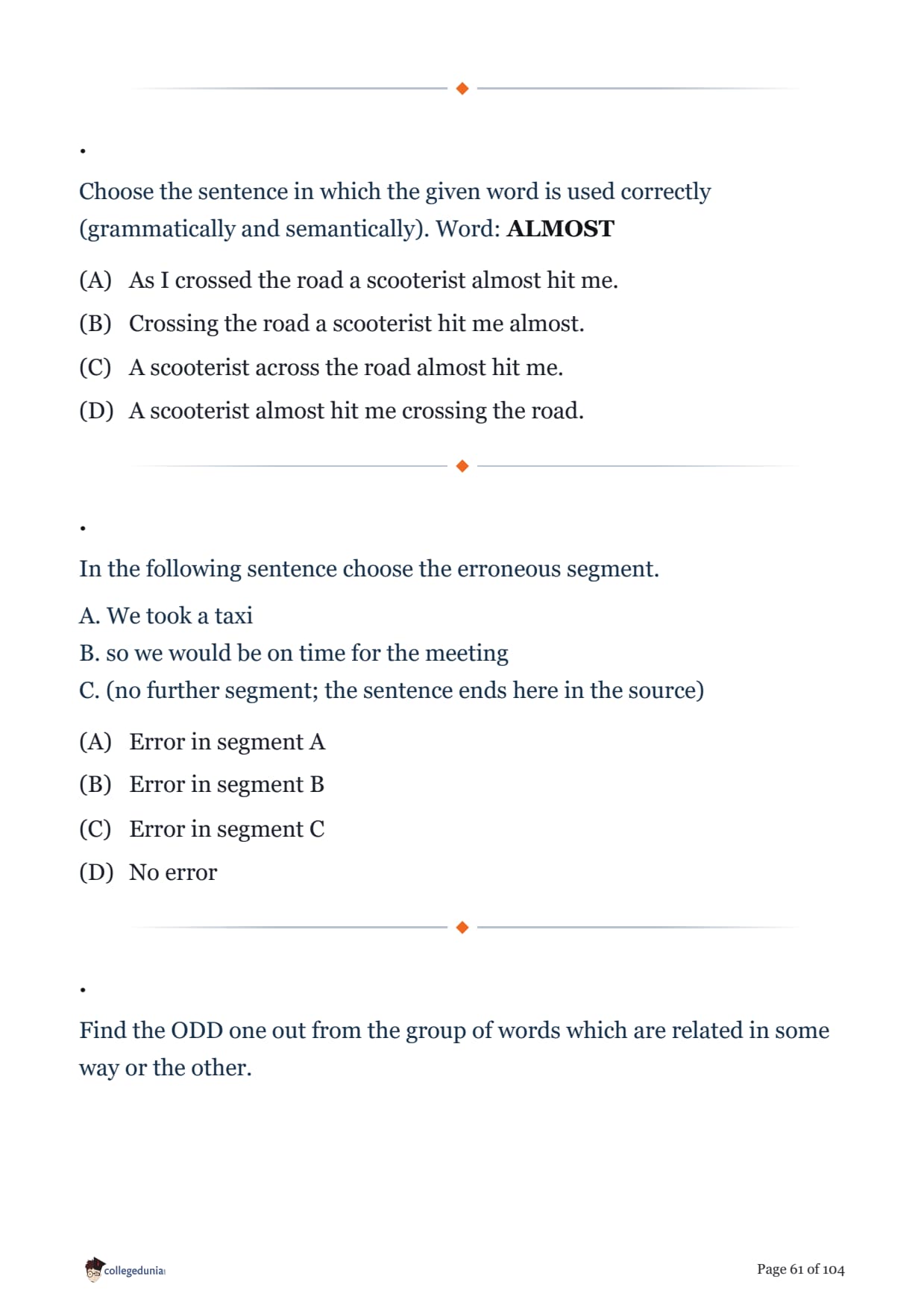
Choose the sentence in which the given word is used correctly (grammatically and semantically). Word: ALMOST
In the following sentence choose the erroneous segment.
A. We took a taxi
B. so we would be on time for the meeting
C. (no further segment; the sentence ends here in the source)
Find the ODD one out from the group of words which are related in some way or the other.
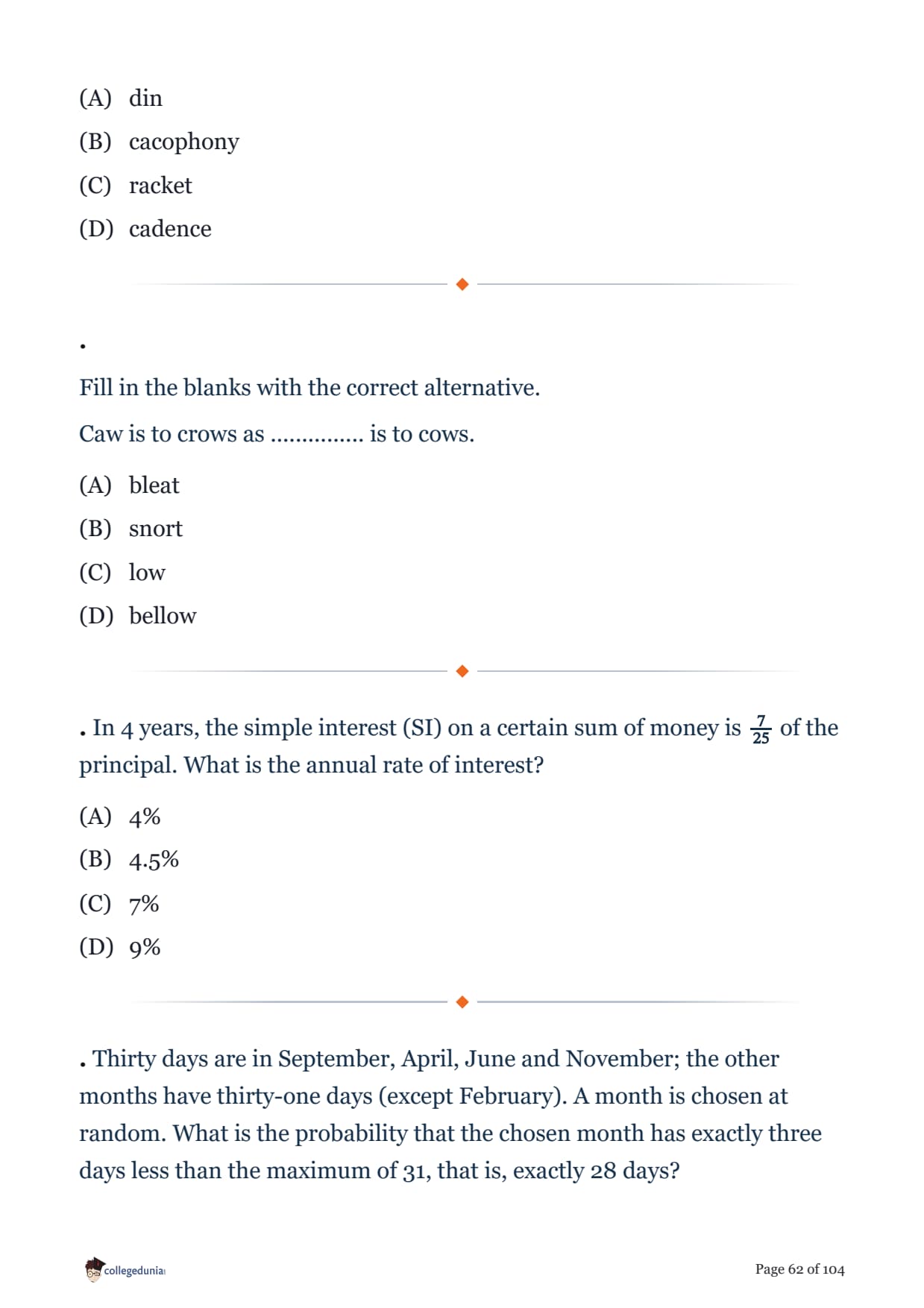
Fill in the blanks with the correct alternative.
Caw is to crows as ............... is to cows.
In 4 years, the simple interest (SI) on a certain sum of money is \(\frac{7}{25}\) of the principal. What is the annual rate of interest?
Thirty days are in September, April, June and November; the other months have thirty-one days (except February). A month is chosen at random. What is the probability that the chosen month has exactly three days less than the maximum of 31, that is, exactly 28 days?
Two people are climbing up two different moving escalators, each of which has 120 visible steps. The ratio of the first person's stepping speed to the speed of the first escalator is 2:3. The ratio of the second person's stepping speed to the speed of the second escalator is 3:5. Find the total number of steps the two people actually step on, added together.
The table below shows the noon-time temperatures (in \(^{\circ}F\)) recorded in a city over one week.
| Day | Mon | Tue | Wed | Thu | Fri | Sat | Sun |
|---|---|---|---|---|---|---|---|
| Temperature | 66 | 78 | 75 | 69 | 78 | 77 | 70 |
If \(m\) is the median temperature, \(f\) is the temperature that occurs most often (the mode), and \(a\) is the average (arithmetic mean) of the seven temperatures, which of the following gives the correct order of \(m\), \(f\) and \(a\)?
Inside a triangular park, a flower bed forms a triangle similar to the park's boundary. A uniform path runs around the flower bed, so that each side of the park is exactly double the corresponding side of the flower bed. What is the ratio of the area of the path to the area of the flower bed?
Consider the piecewise function \[ f(x) = \begin{cases} 3 - x, & x \leq 0 \\ x^2 + 2, & x > 0 \end{cases} \] Evaluate \(f(-3)\).
A special lottery is to be held to select one student who will live in the only deluxe room in a hostel. There are 100 Year-III, 150 Year-II and 200 Year-I students who applied. Each Year-III student's name is placed in the lottery drum 3 times, each Year-II student's name 2 times, and each Year-I student's name 1 time. What is the probability that a Year-III student's name will be drawn?
The average of nine numbers is \(M\), and the average of three of these numbers is \(P\). If the average of the remaining six numbers is \(N\), which of the following must be true?
The intersection of two cubes cannot be:
In a factory, the expected number of accidents per day is linearly related to the overtime hours \(x\). On a day with \(x = 1000\) overtime hours there were 8 accidents; on a day with \(x = 400\) hours there were 5 accidents. What is the expected number of accidents when no overtime is logged (\(x = 0\))?
A rainy day occurs once in every 10 days. Half of the rainy days produce rainbows. What percent of all days do not produce a rainbow?
Bags I, II, and III contain at least one ball each and together have 10 balls. How many balls are in each bag? Decide whether the statements are sufficient.
(1) Bag I contains five balls more than Bag III.
(2) Bag II contains half as many balls as Bag I.
Area of a square natural lake is 50 sq. kms. A diver wishing to cross the lake diagonally will have to swim a distance of:
If \(n = 1 + x\), where \(x\) is the product of 4 consecutive positive integers, then which of the following is/are true?
1. \(n\) is odd
2. \(n\) is prime
3. \(n\) is a perfect square
How many arrangements can be formed out of the letters of the word EXAMINATION so that vowels always occupy odd places?
In a school drill, a number of children are asked to stand in a circle. They are evenly spaced and the 6th child is diametrically opposite the 16th child. How many children are made to stand in the circle?
A man purchased 40 fruits (apples and oranges) for Rs. 17. Had he purchased as many oranges as apples and as many apples as oranges (i.e., interchanged the counts), he would have paid Rs. 15. Find the cost of one pair consisting of one apple and one orange.
The number 311311311311311311311 is
A man earns 6% SI on his deposits in Bank A while he earns 8% simple interest on his deposits in Bank B. If the total interest he earns is Rs. 1800 in three years on an investment of Rs. 9000, what is the amount invested at 6%?
Two identical trains A and B running in opposite directions at the same speed take 2 minutes to cross each other completely. The number of bogies of A are increased from 12 to 16. How much more time would they now require to cross each other?
A ladder is lying against a wall which is 5 metres high. If the ladder slips 2 metres away from the wall, the top of the ladder touches the foot of the wall. The length of the ladder is
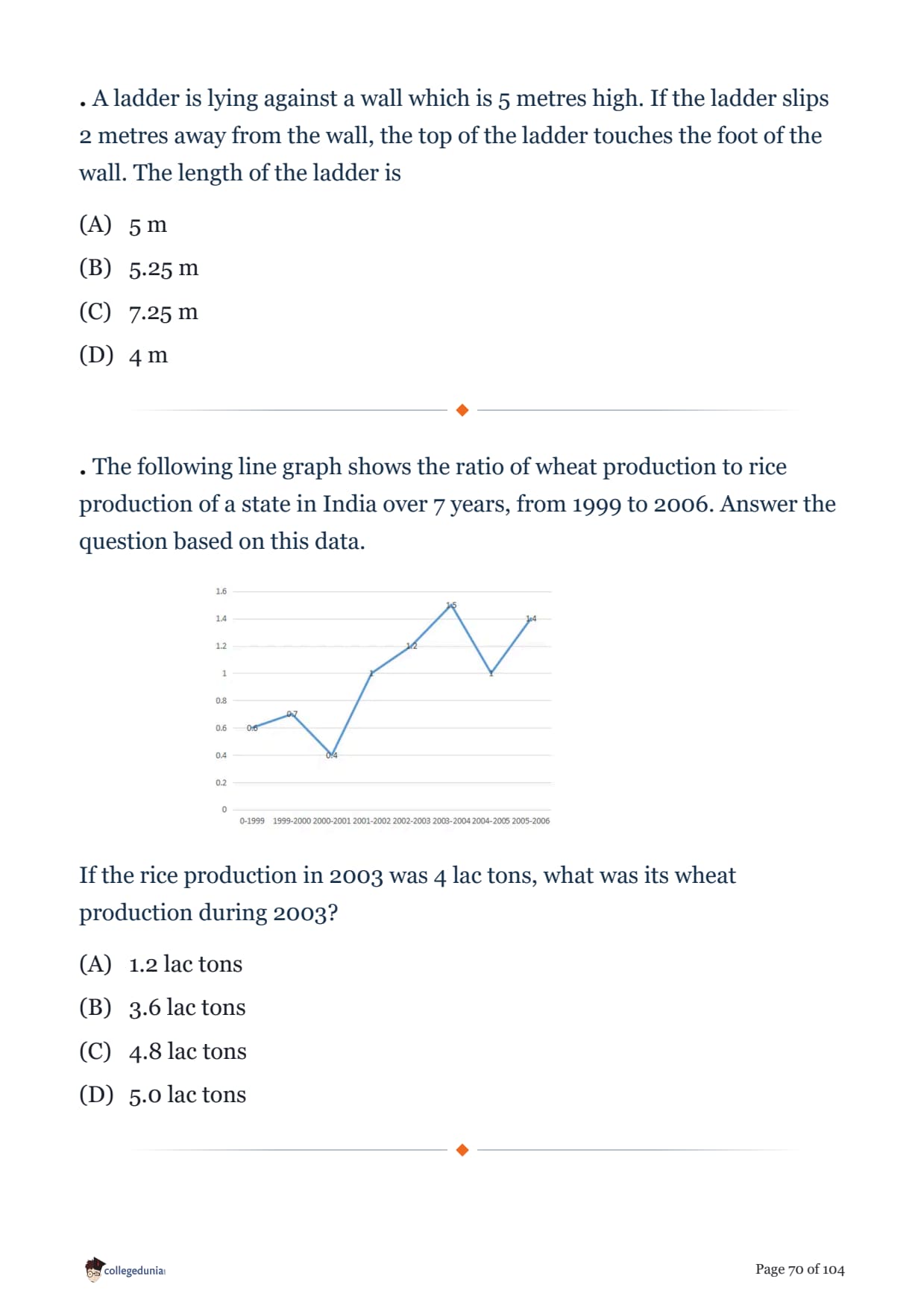
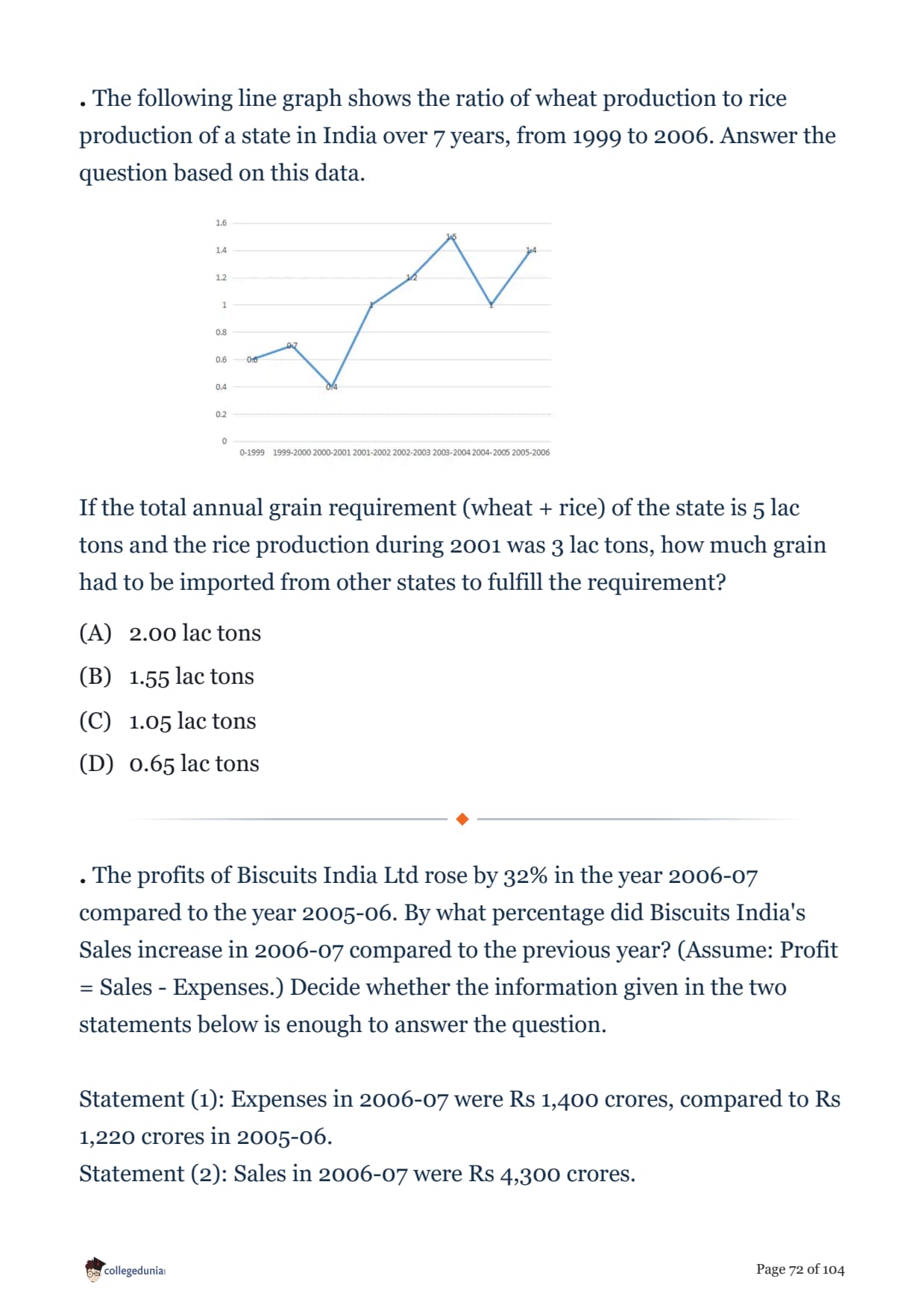
The following line graph shows the ratio of wheat production to rice production of a state in India over 7 years, from 1999 to 2006. Answer the question based on this data.

If the rice production in 2003 was 4 lac tons, what was its wheat production during 2003?
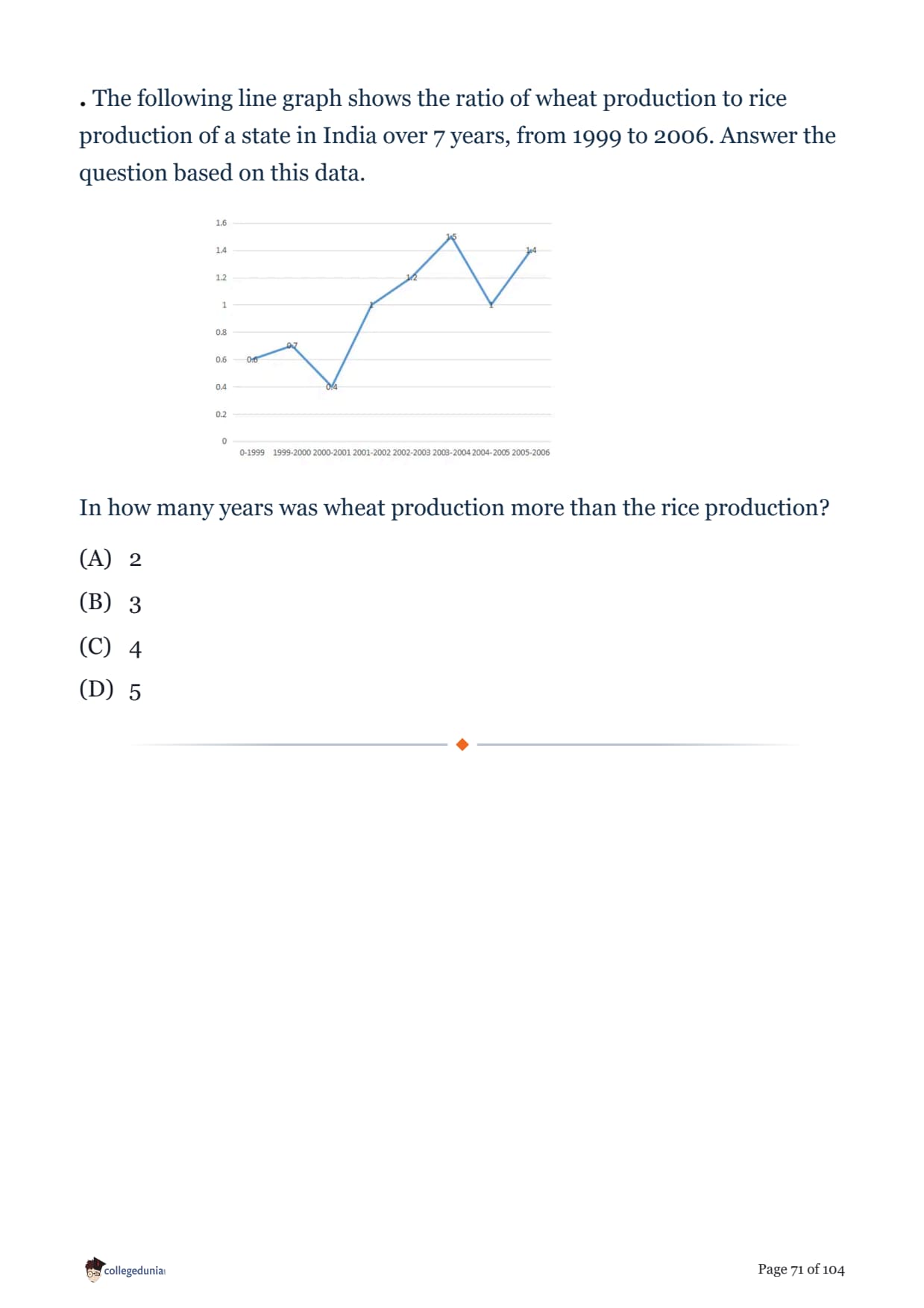
The following line graph shows the ratio of wheat production to rice production of a state in India over 7 years, from 1999 to 2006. Answer the question based on this data.

In how many years was wheat production more than the rice production?
The following line graph shows the ratio of wheat production to rice production of a state in India over 7 years, from 1999 to 2006. Answer the question based on this data.

If the total annual grain requirement (wheat + rice) of the state is 5 lac tons and the rice production during 2001 was 3 lac tons, how much grain had to be imported from other states to fulfill the requirement?
The profits of Biscuits India Ltd rose by 32% in the year 2006-07 compared to the year 2005-06. By what percentage did Biscuits India's Sales increase in 2006-07 compared to the previous year? (Assume: Profit = Sales - Expenses.) Decide whether the information given in the two statements below is enough to answer the question.
Statement (1): Expenses in 2006-07 were Rs 1,400 crores, compared to Rs 1,220 crores in 2005-06.
Statement (2): Sales in 2006-07 were Rs 4,300 crores.
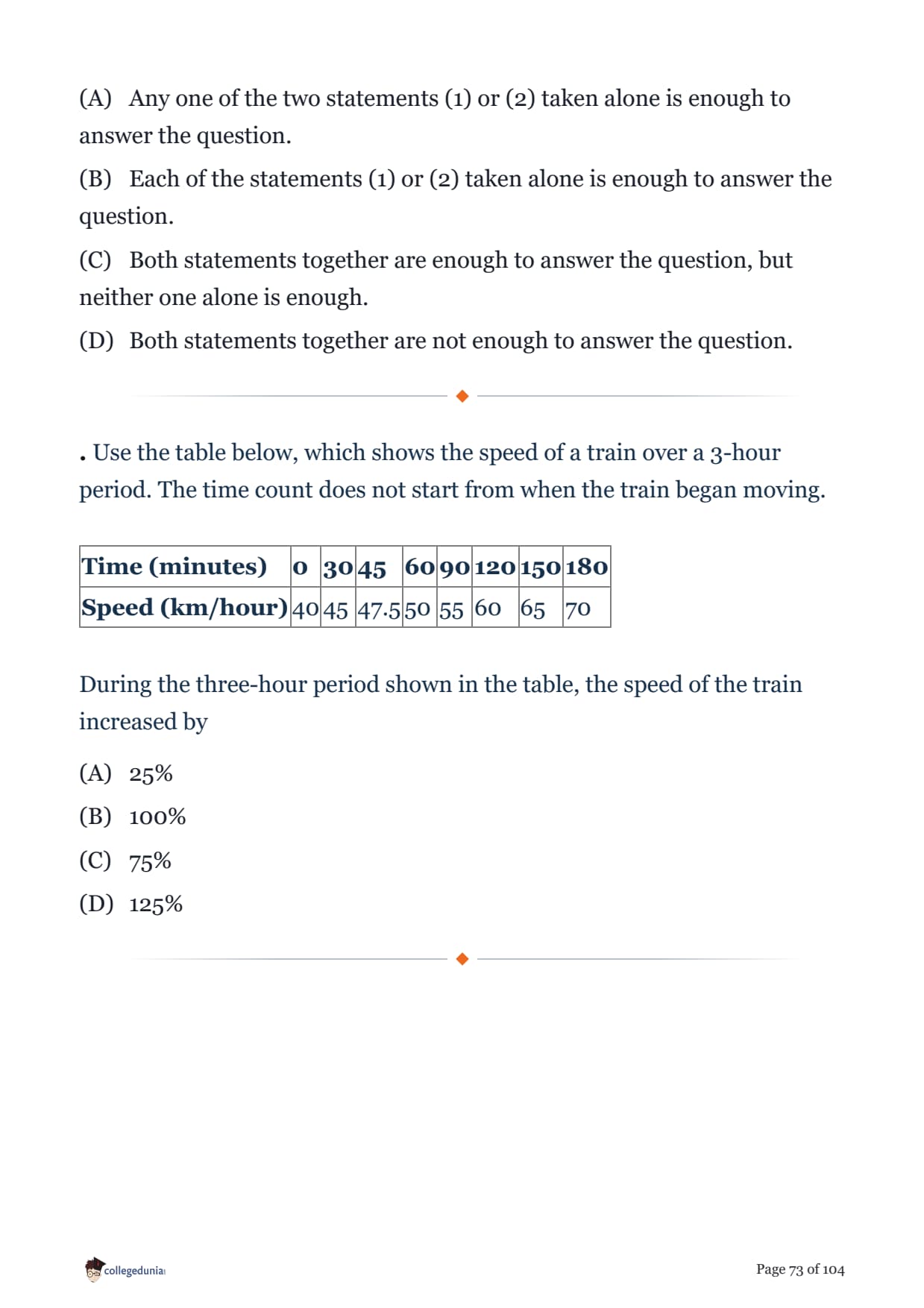
Use the table below, which shows the speed of a train over a 3-hour period. The time count does not start from when the train began moving.
| Time (minutes) | 0 | 30 | 45 | 60 | 90 | 120 | 150 | 180 |
|---|---|---|---|---|---|---|---|---|
| Speed (km/hour) | 40 | 45 | 47.5 | 50 | 55 | 60 | 65 | 70 |
During the three-hour period shown in the table, the speed of the train increased by
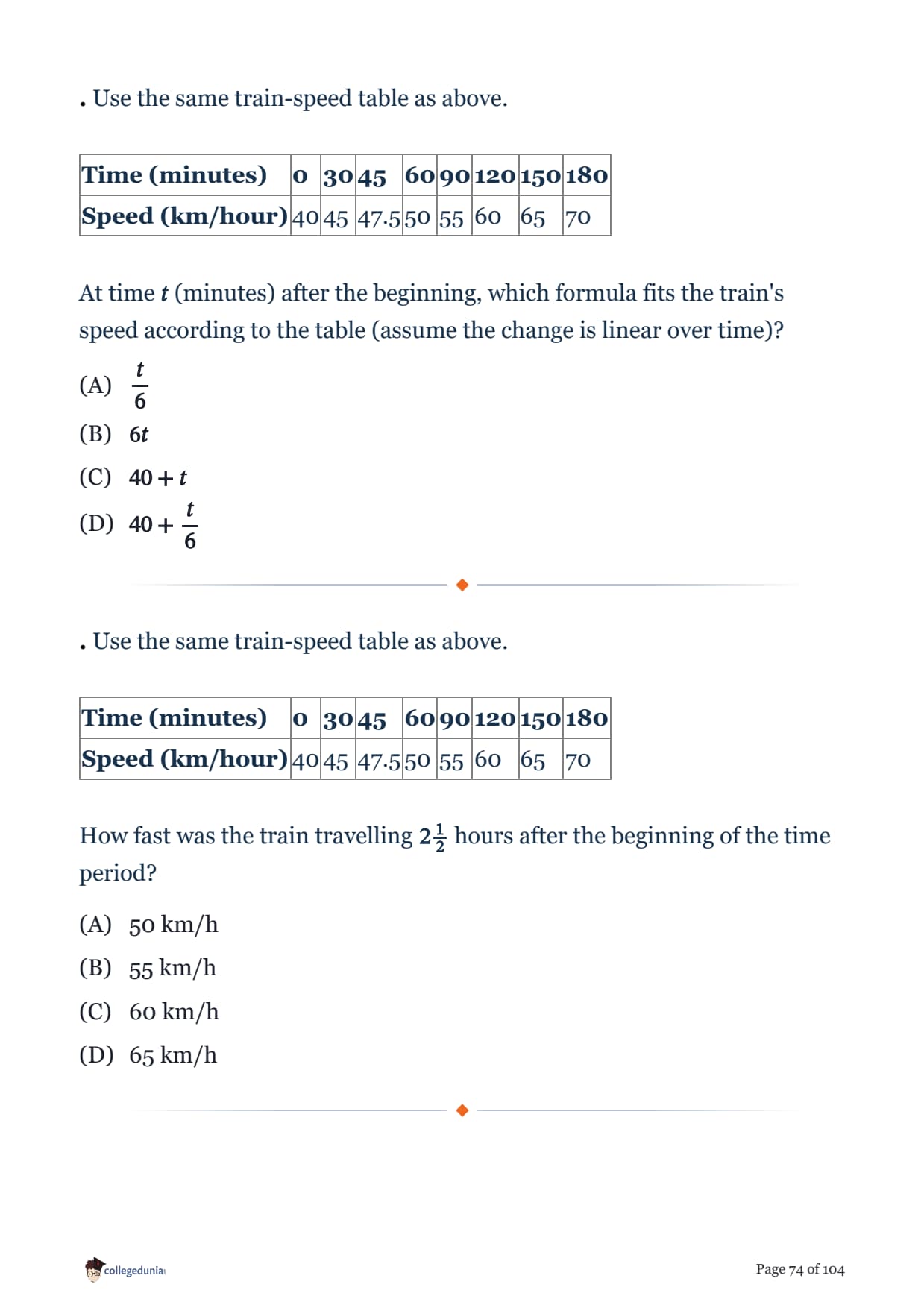
Use the same train-speed table as above.
| Time (minutes) | 0 | 30 | 45 | 60 | 90 | 120 | 150 | 180 |
|---|---|---|---|---|---|---|---|---|
| Speed (km/hour) | 40 | 45 | 47.5 | 50 | 55 | 60 | 65 | 70 |
At time \(t\) (minutes) after the beginning, which formula fits the train's speed according to the table (assume the change is linear over time)?
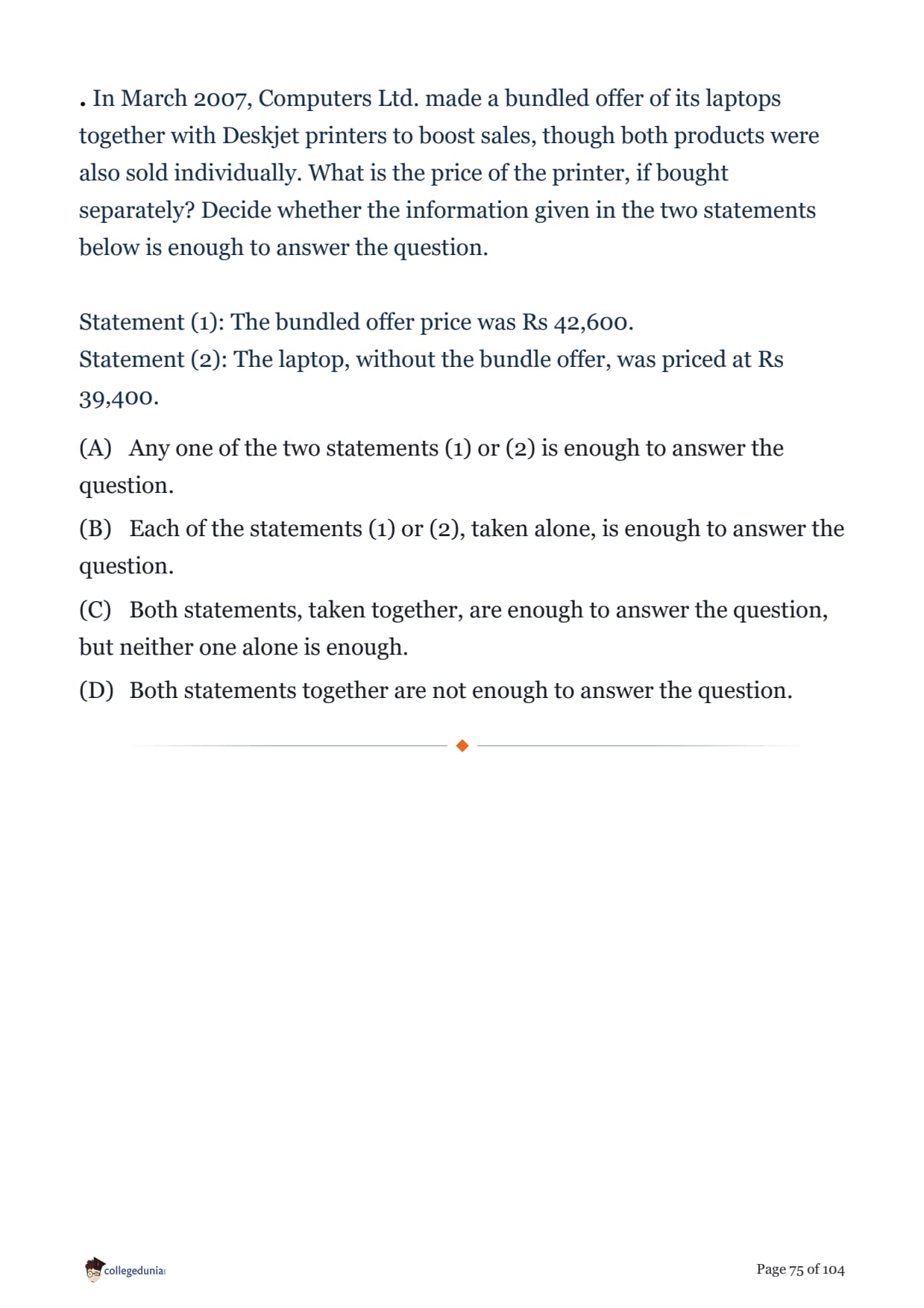
Use the same train-speed table as above.
| Time (minutes) | 0 | 30 | 45 | 60 | 90 | 120 | 150 | 180 |
|---|---|---|---|---|---|---|---|---|
| Speed (km/hour) | 40 | 45 | 47.5 | 50 | 55 | 60 | 65 | 70 |
How fast was the train travelling \(2\frac{1}{2}\) hours after the beginning of the time period?
In March 2007, Computers Ltd. made a bundled offer of its laptops together with Deskjet printers to boost sales, though both products were also sold individually. What is the price of the printer, if bought separately? Decide whether the information given in the two statements below is enough to answer the question.
Statement (1): The bundled offer price was Rs 42,600.
Statement (2): The laptop, without the bundle offer, was priced at Rs 39,400.
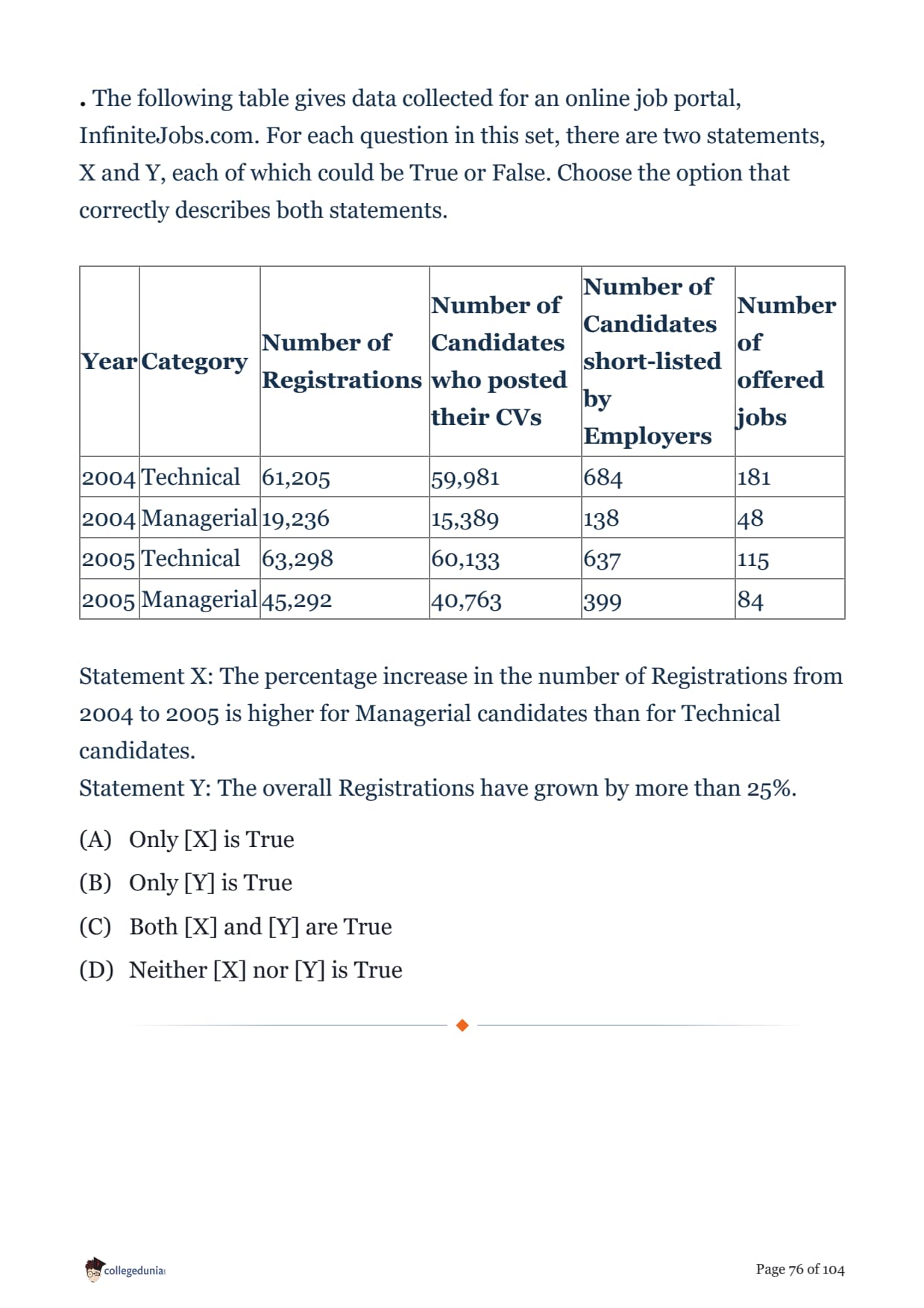
The following table gives data collected for an online job portal, InfiniteJobs.com. For each question in this set, there are two statements, X and Y, each of which could be True or False. Choose the option that correctly describes both statements.
| Year | Category | Number of Registrations | Number of Candidates who posted their CVs | Number of Candidates short-listed by Employers | Number of offered jobs |
|---|---|---|---|---|---|
| 2004 | Technical | 61,205 | 59,981 | 684 | 181 |
| 2004 | Managerial | 19,236 | 15,389 | 138 | 48 |
| 2005 | Technical | 63,298 | 60,133 | 637 | 115 |
| 2005 | Managerial | 45,292 | 40,763 | 399 | 84 |
Statement X: The percentage increase in the number of Registrations from 2004 to 2005 is higher for Managerial candidates than for Technical candidates.
Statement Y: The overall Registrations have grown by more than 25%.
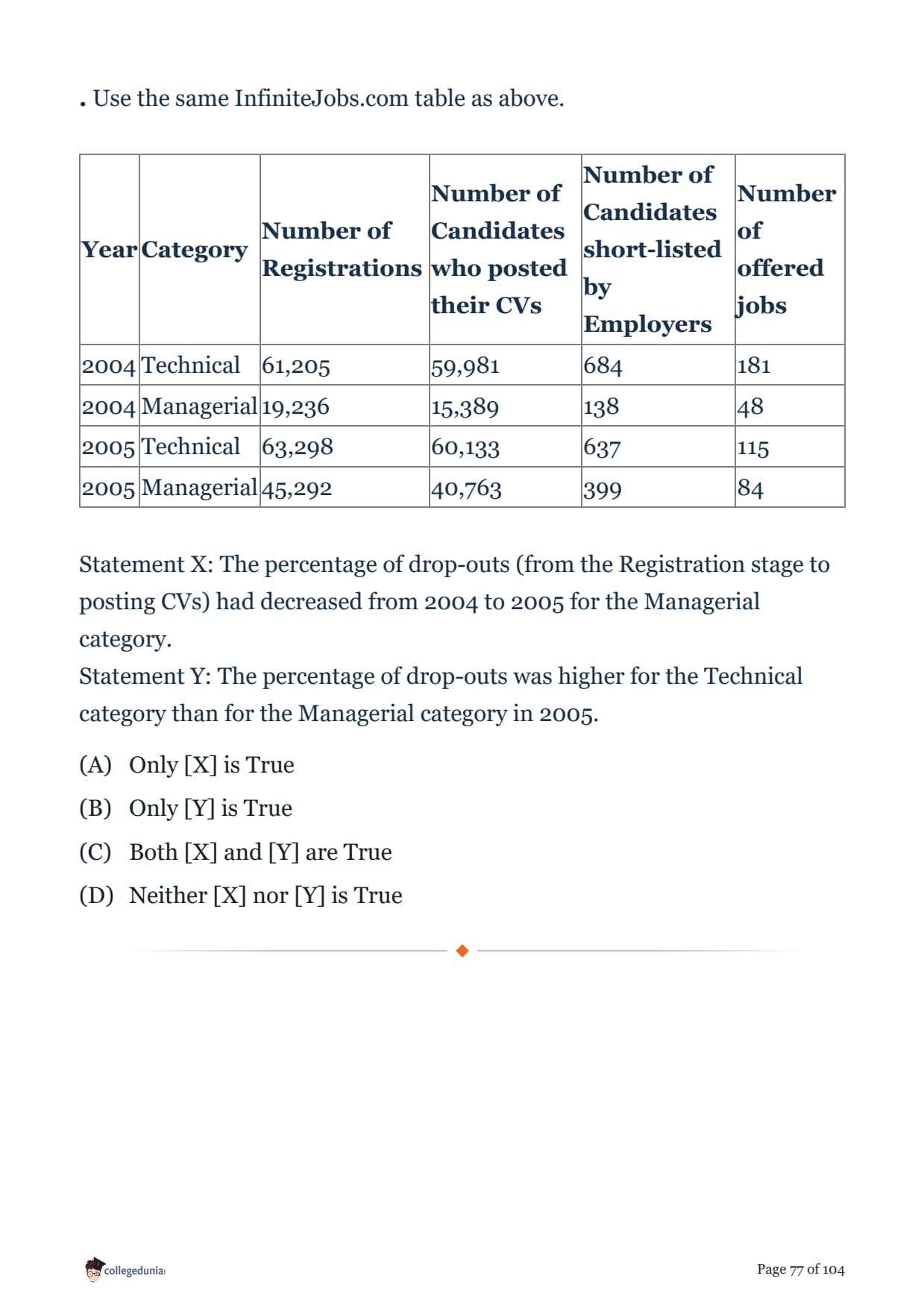
Use the same InfiniteJobs.com table as above.
| Year | Category | Number of Registrations | Number of Candidates who posted their CVs | Number of Candidates short-listed by Employers | Number of offered jobs |
|---|---|---|---|---|---|
| 2004 | Technical | 61,205 | 59,981 | 684 | 181 |
| 2004 | Managerial | 19,236 | 15,389 | 138 | 48 |
| 2005 | Technical | 63,298 | 60,133 | 637 | 115 |
| 2005 | Managerial | 45,292 | 40,763 | 399 | 84 |
Statement X: The percentage of drop-outs (from the Registration stage to posting CVs) had decreased from 2004 to 2005 for the Managerial category.
Statement Y: The percentage of drop-outs was higher for the Technical category than for the Managerial category in 2005.
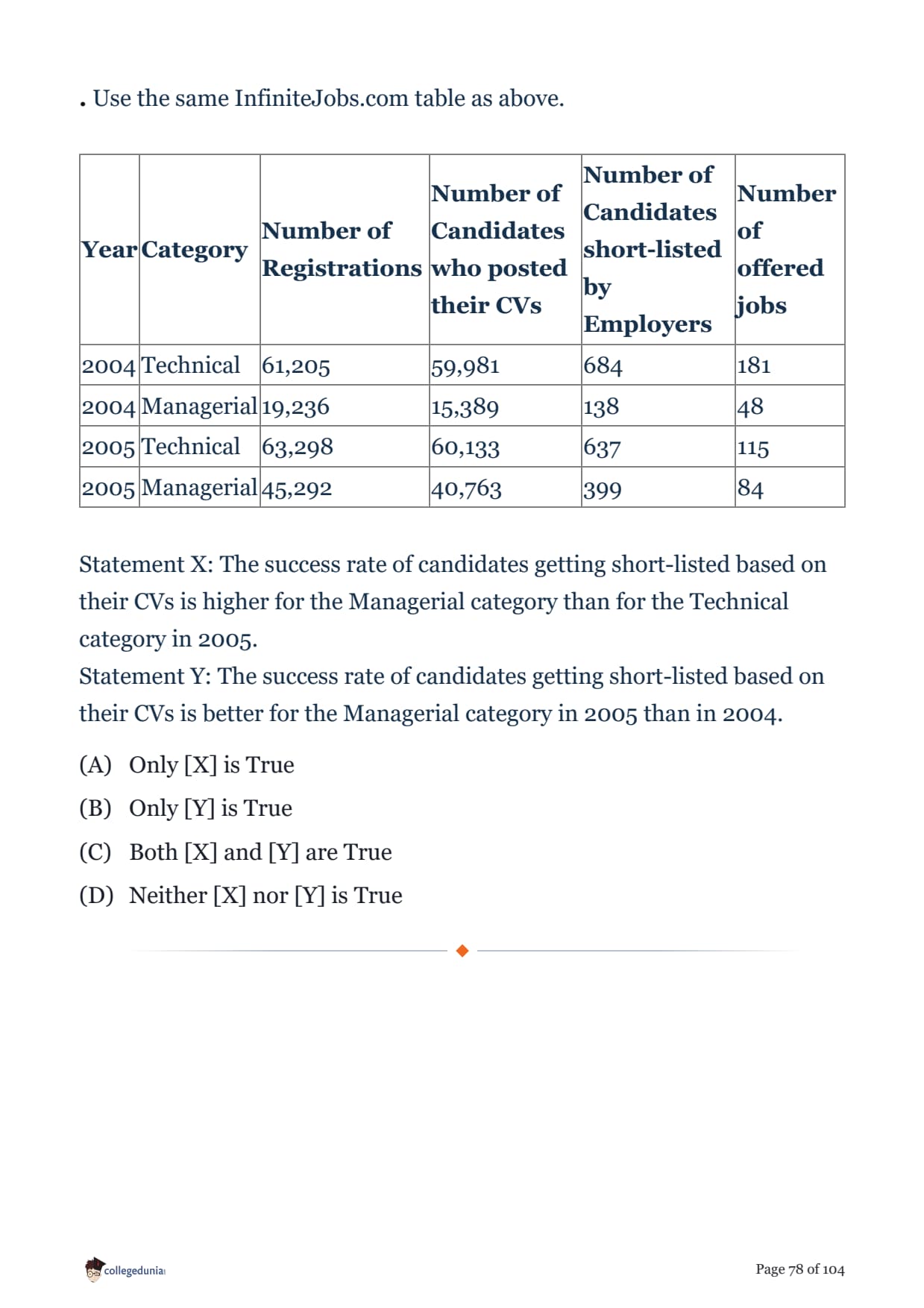
Use the same InfiniteJobs.com table as above.
| Year | Category | Number of Registrations | Number of Candidates who posted their CVs | Number of Candidates short-listed by Employers | Number of offered jobs |
|---|---|---|---|---|---|
| 2004 | Technical | 61,205 | 59,981 | 684 | 181 |
| 2004 | Managerial | 19,236 | 15,389 | 138 | 48 |
| 2005 | Technical | 63,298 | 60,133 | 637 | 115 |
| 2005 | Managerial | 45,292 | 40,763 | 399 | 84 |
Statement X: The success rate of candidates getting short-listed based on their CVs is higher for the Managerial category than for the Technical category in 2005.
Statement Y: The success rate of candidates getting short-listed based on their CVs is better for the Managerial category in 2005 than in 2004.
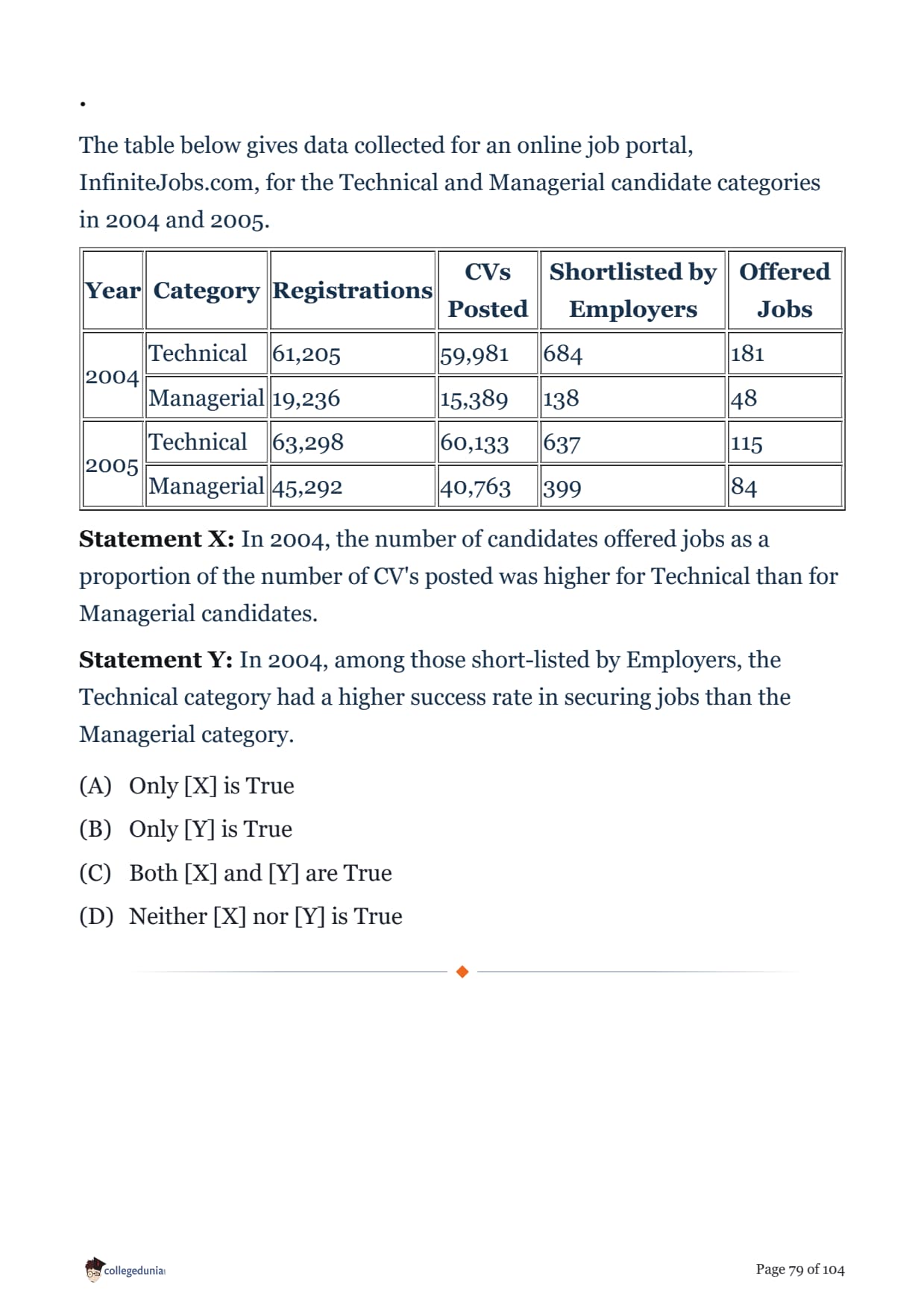
The table below gives data collected for an online job portal, InfiniteJobs.com, for the Technical and Managerial candidate categories in 2004 and 2005.
| Year | Category | Registrations | CVs Posted | Shortlisted by Employers | Offered Jobs |
|---|---|---|---|---|---|
| 2004 | Technical | 61,205 | 59,981 | 684 | 181 |
| Managerial | 19,236 | 15,389 | 138 | 48 | |
| 2005 | Technical | 63,298 | 60,133 | 637 | 115 |
| Managerial | 45,292 | 40,763 | 399 | 84 |
Statement X: In 2004, the number of candidates offered jobs as a proportion of the number of CV's posted was higher for Technical than for Managerial candidates.
Statement Y: In 2004, among those short-listed by Employers, the Technical category had a higher success rate in securing jobs than the Managerial category.
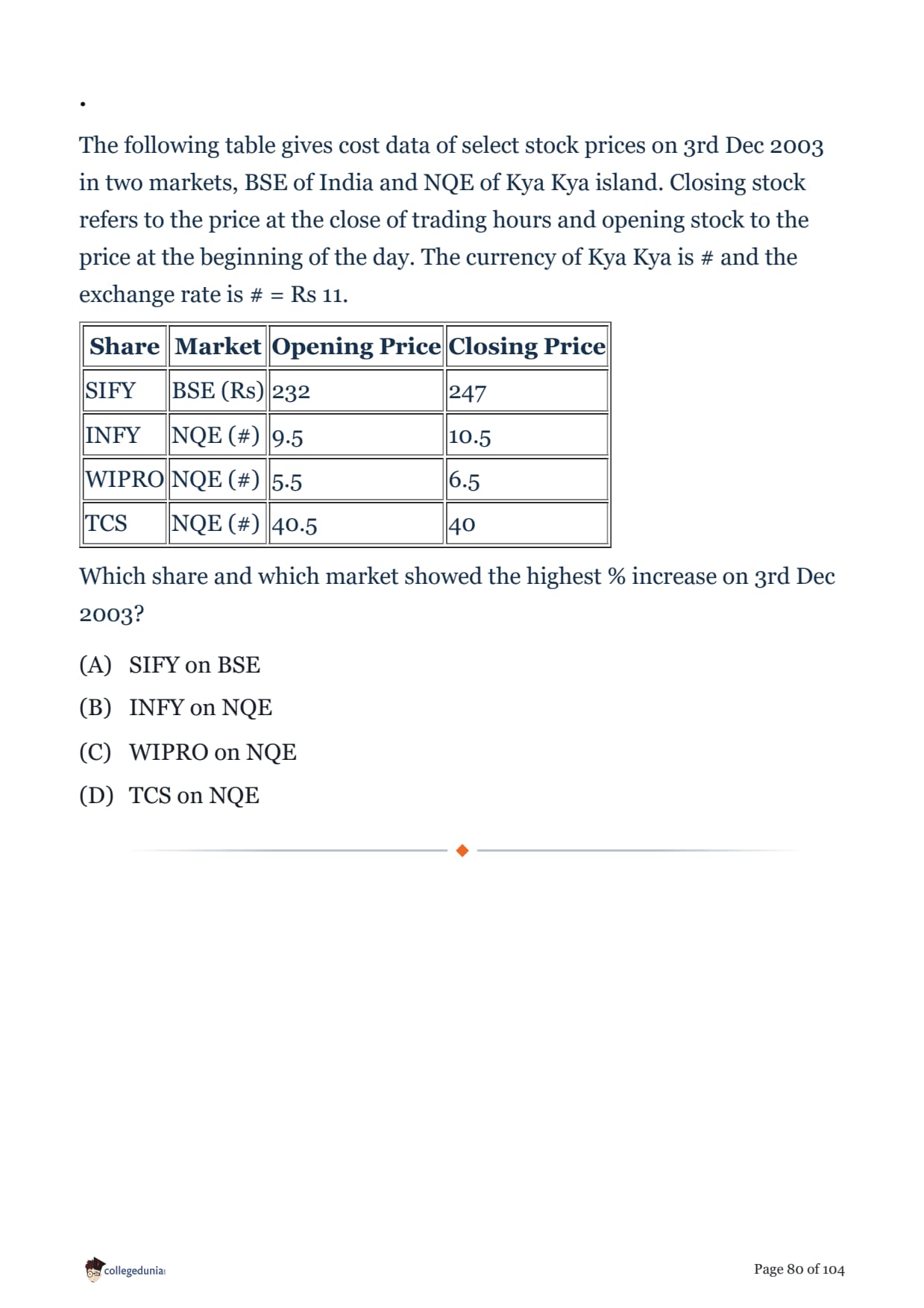
The following table gives cost data of select stock prices on 3rd Dec 2003 in two markets, BSE of India and NQE of Kya Kya island. Closing stock refers to the price at the close of trading hours and opening stock to the price at the beginning of the day. The currency of Kya Kya is # and the exchange rate is # = Rs 11.
| Share | Market | Opening Price | Closing Price |
|---|---|---|---|
| SIFY | BSE (Rs) | 232 | 247 |
| INFY | NQE (#) | 9.5 | 10.5 |
| WIPRO | NQE (#) | 5.5 | 6.5 |
| TCS | NQE (#) | 40.5 | 40 |
Which share and which market showed the highest % increase on 3rd Dec 2003?
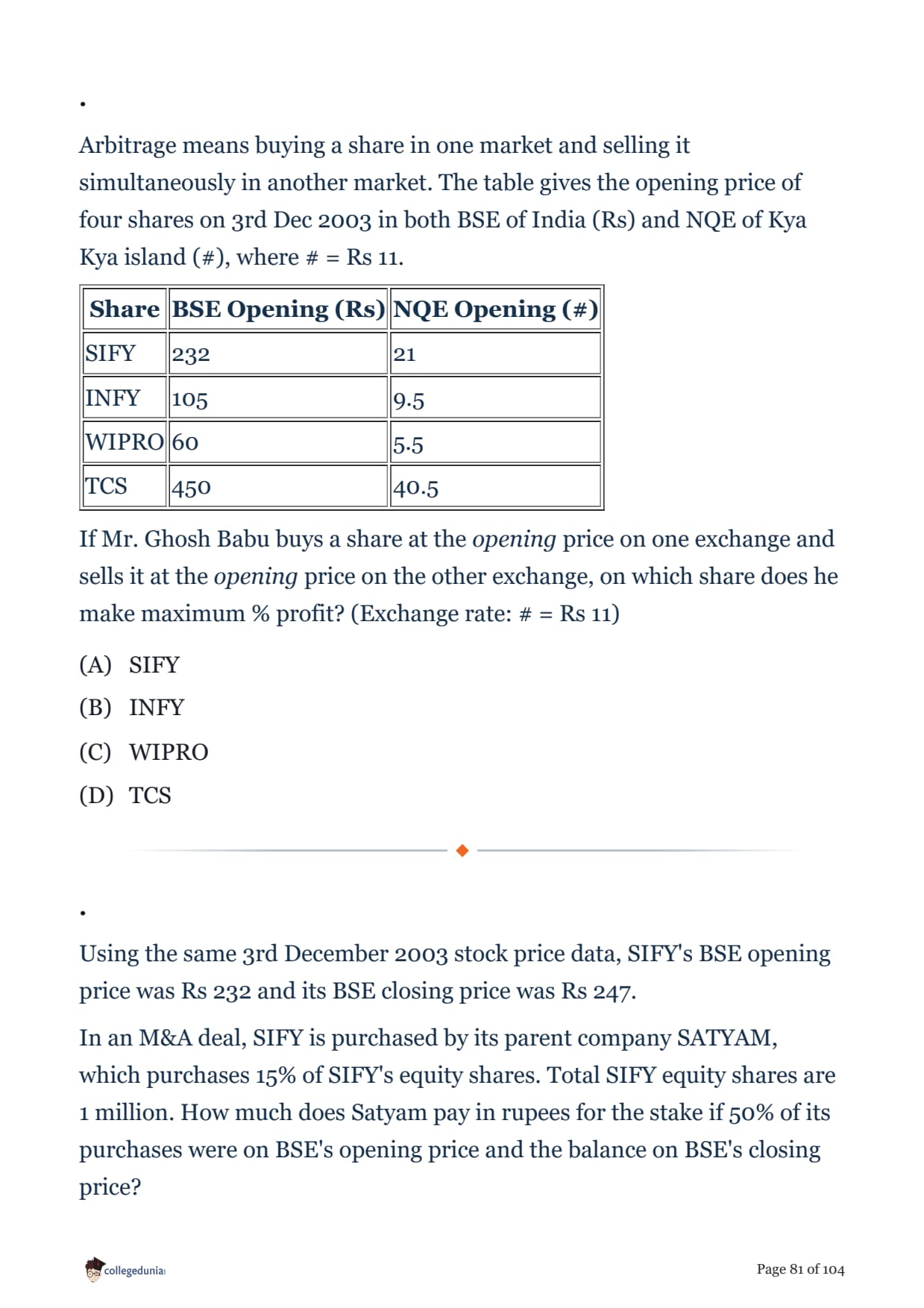
Arbitrage means buying a share in one market and selling it simultaneously in another market. The table gives the opening price of four shares on 3rd Dec 2003 in both BSE of India (Rs) and NQE of Kya Kya island (#), where # = Rs 11.
| Share | BSE Opening (Rs) | NQE Opening (#) |
|---|---|---|
| SIFY | 232 | 21 |
| INFY | 105 | 9.5 |
| WIPRO | 60 | 5.5 |
| TCS | 450 | 40.5 |
If Mr. Ghosh Babu buys a share at the opening price on one exchange and sells it at the opening price on the other exchange, on which share does he make maximum % profit? (Exchange rate: # = Rs 11)
Using the same 3rd December 2003 stock price data, SIFY's BSE opening price was Rs 232 and its BSE closing price was Rs 247.
In an M&A deal, SIFY is purchased by its parent company SATYAM, which purchases 15% of SIFY's equity shares. Total SIFY equity shares are 1 million. How much does Satyam pay in rupees for the stake if 50% of its purchases were on BSE's opening price and the balance on BSE's closing price?
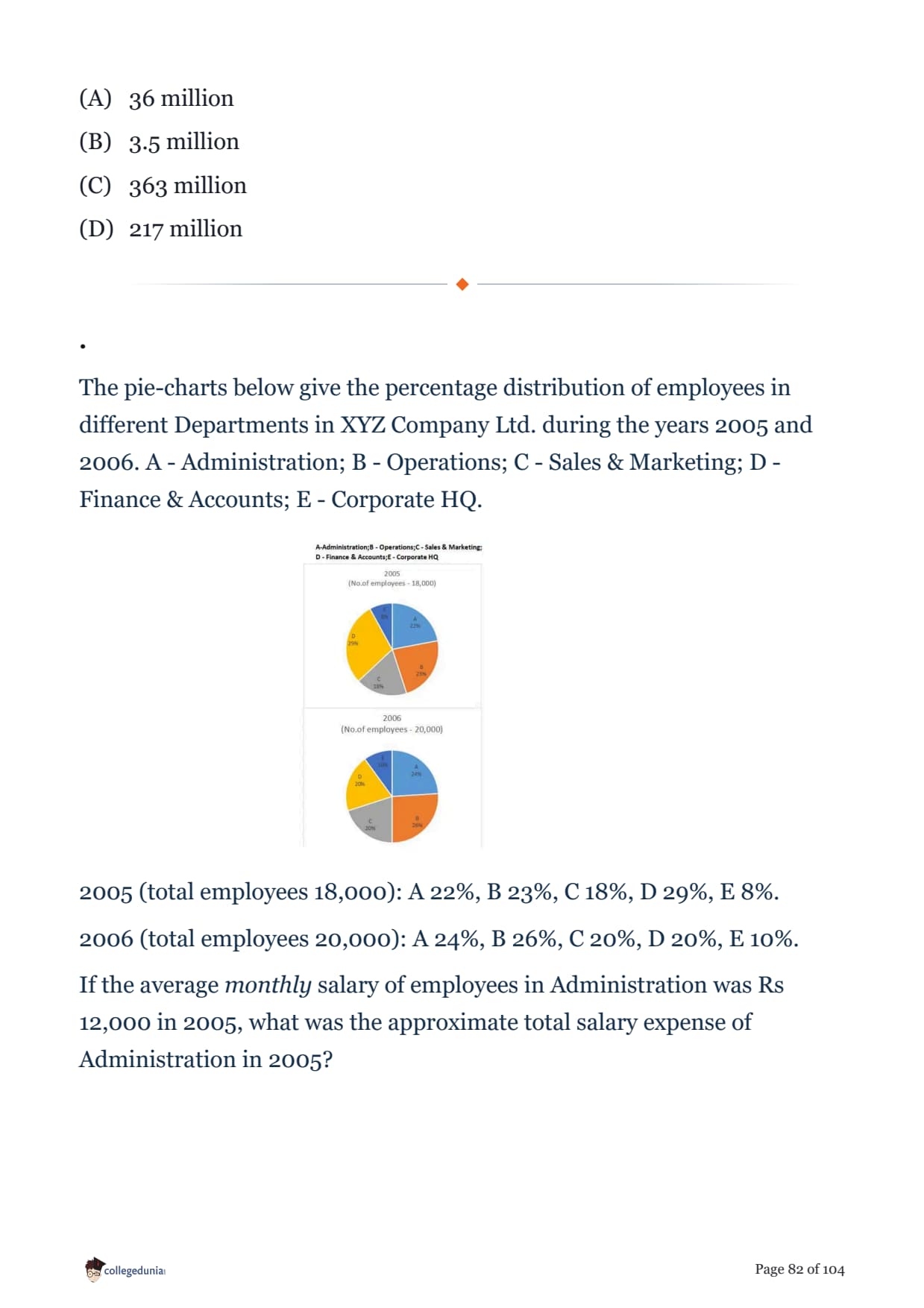
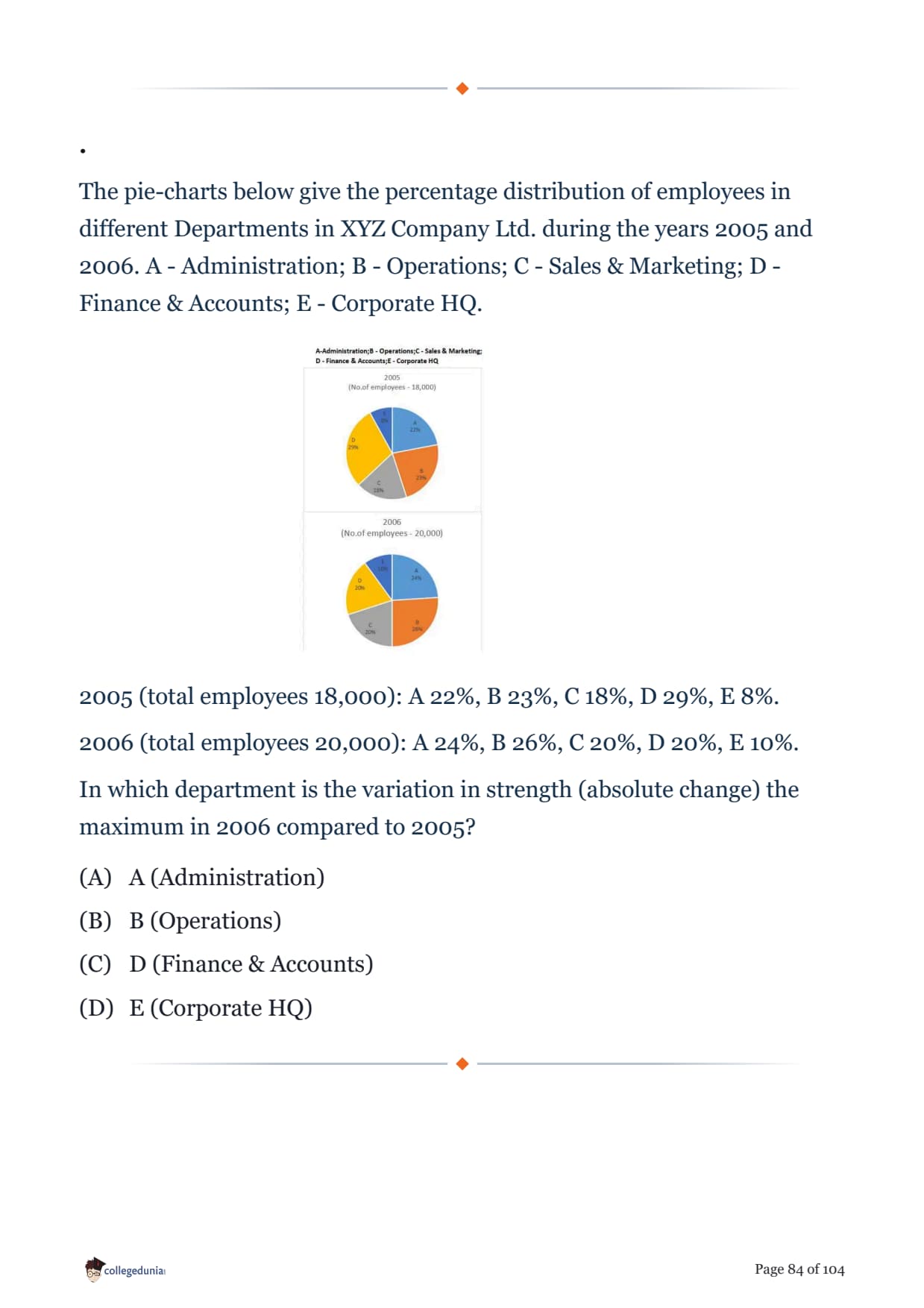
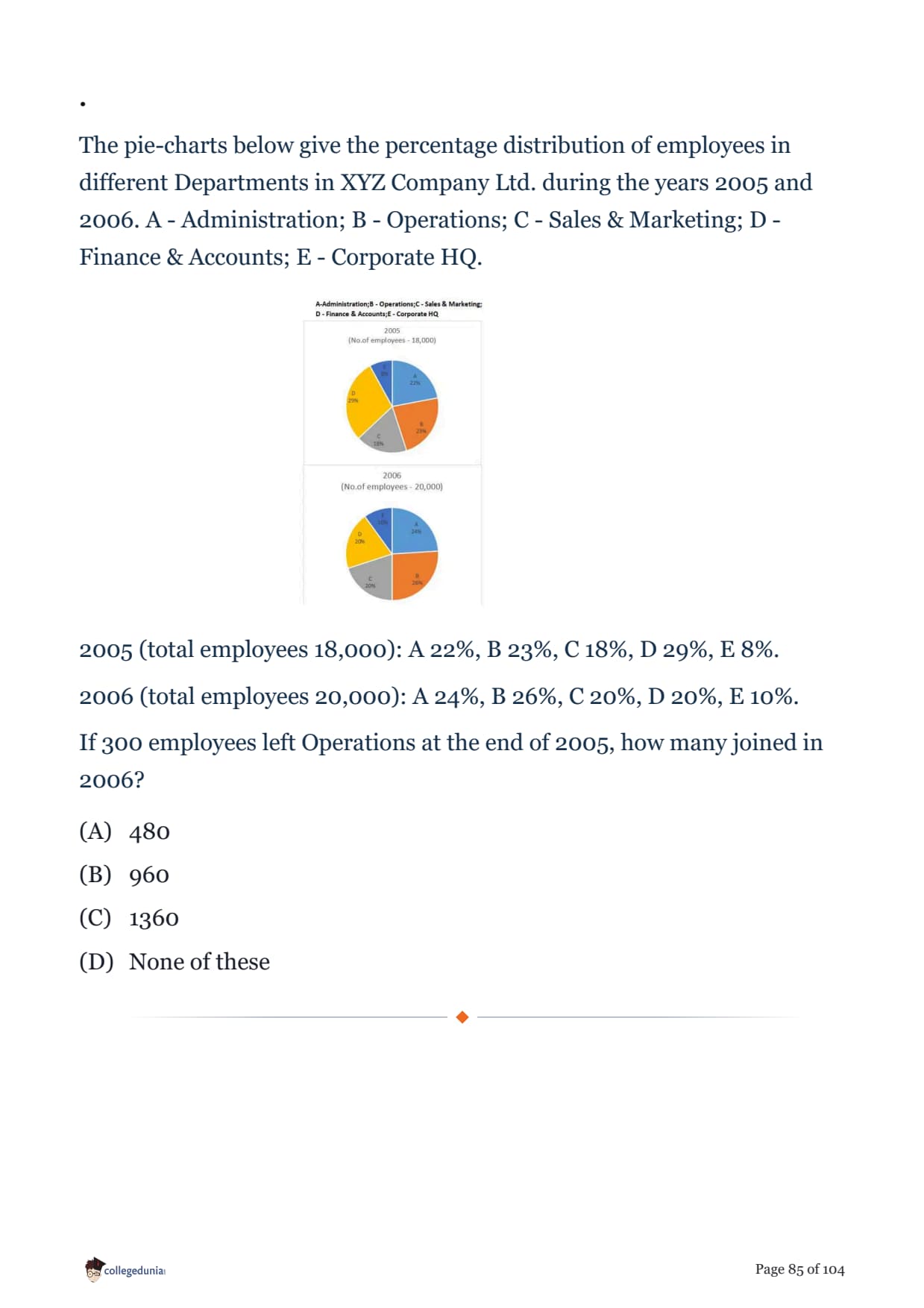
The pie-charts below give the percentage distribution of employees in different Departments in XYZ Company Ltd. during the years 2005 and 2006. A - Administration; B - Operations; C - Sales & Marketing; D - Finance & Accounts; E - Corporate HQ.

2005 (total employees 18,000): A 22%, B 23%, C 18%, D 29%, E 8%.
2006 (total employees 20,000): A 24%, B 26%, C 20%, D 20%, E 10%.
If the average monthly salary of employees in Administration was Rs 12,000 in 2005, what was the approximate total salary expense of Administration in 2005?
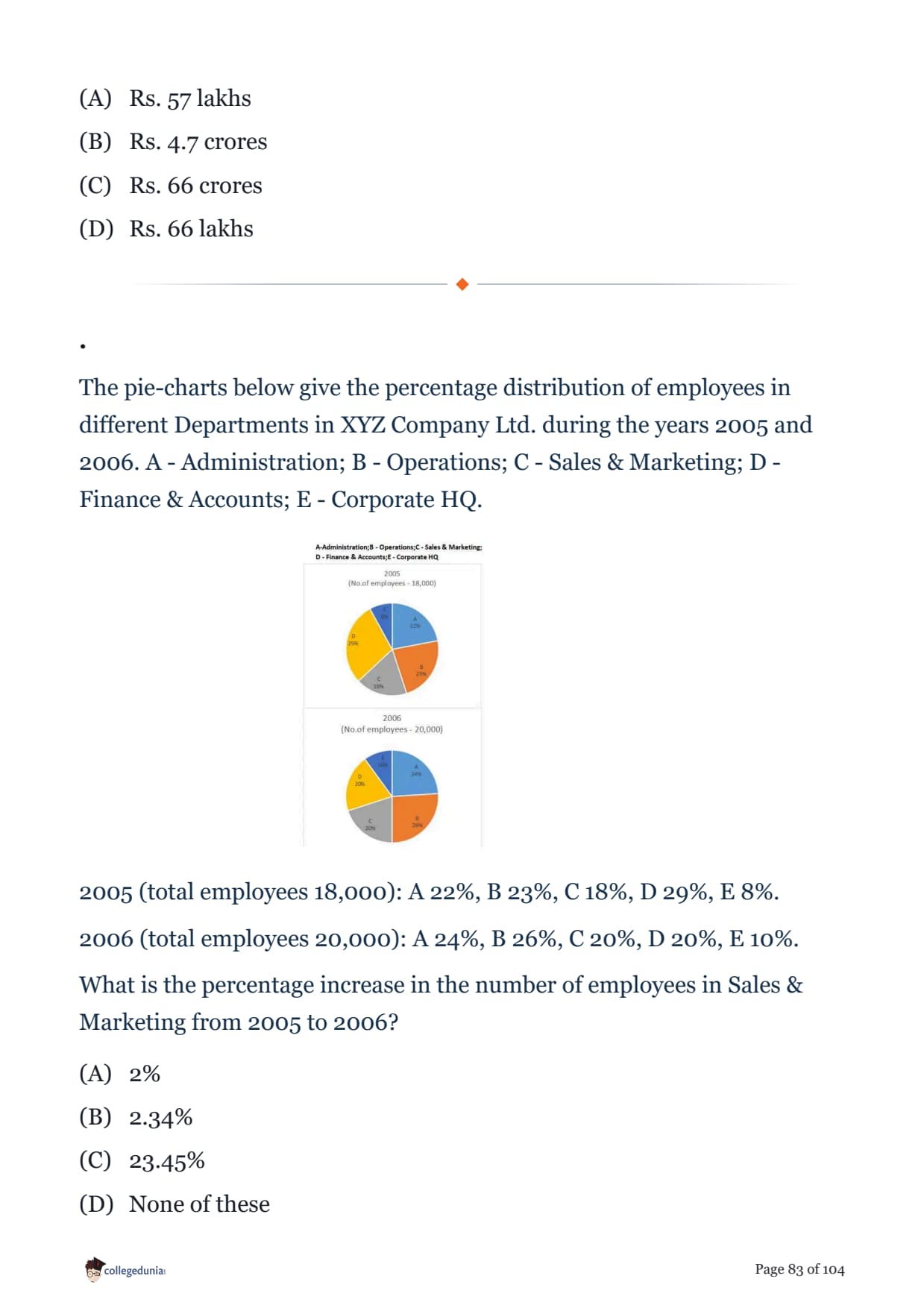
The pie-charts below give the percentage distribution of employees in different Departments in XYZ Company Ltd. during the years 2005 and 2006. A - Administration; B - Operations; C - Sales & Marketing; D - Finance & Accounts; E - Corporate HQ.

2005 (total employees 18,000): A 22%, B 23%, C 18%, D 29%, E 8%.
2006 (total employees 20,000): A 24%, B 26%, C 20%, D 20%, E 10%.
What is the percentage increase in the number of employees in Sales & Marketing from 2005 to 2006?
The pie-charts below give the percentage distribution of employees in different Departments in XYZ Company Ltd. during the years 2005 and 2006. A - Administration; B - Operations; C - Sales & Marketing; D - Finance & Accounts; E - Corporate HQ.

2005 (total employees 18,000): A 22%, B 23%, C 18%, D 29%, E 8%.
2006 (total employees 20,000): A 24%, B 26%, C 20%, D 20%, E 10%.
In which department is the variation in strength (absolute change) the maximum in 2006 compared to 2005?
The pie-charts below give the percentage distribution of employees in different Departments in XYZ Company Ltd. during the years 2005 and 2006. A - Administration; B - Operations; C - Sales & Marketing; D - Finance & Accounts; E - Corporate HQ.

2005 (total employees 18,000): A 22%, B 23%, C 18%, D 29%, E 8%.
2006 (total employees 20,000): A 24%, B 26%, C 20%, D 20%, E 10%.
If 300 employees left Operations at the end of 2005, how many joined in 2006?
You have three chests in front of you. The first chest is labeled "GOLD", the second is labeled "SILVER" and the third is labeled "GOLD OR SILVER". You have been told that all the labels are on the wrong chests and that one chest contains gold coins, one contains silver coins and one contains bronze coins. How many chests do you need to open to deduce which label goes on which chest?
How many minutes before 12 noon is it when it is 27 minutes past 10 am?
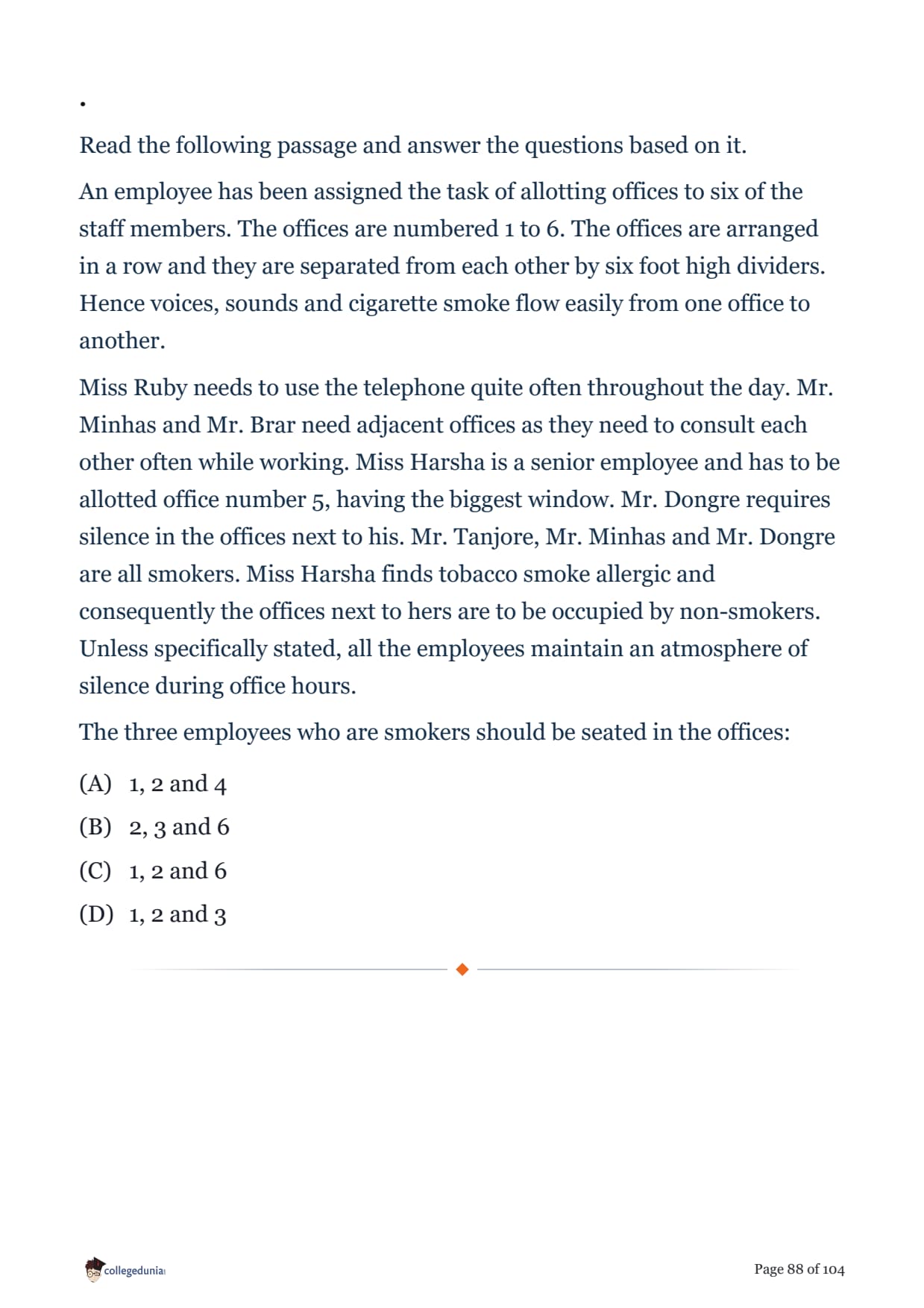
Read the following passage and answer the questions based on it.
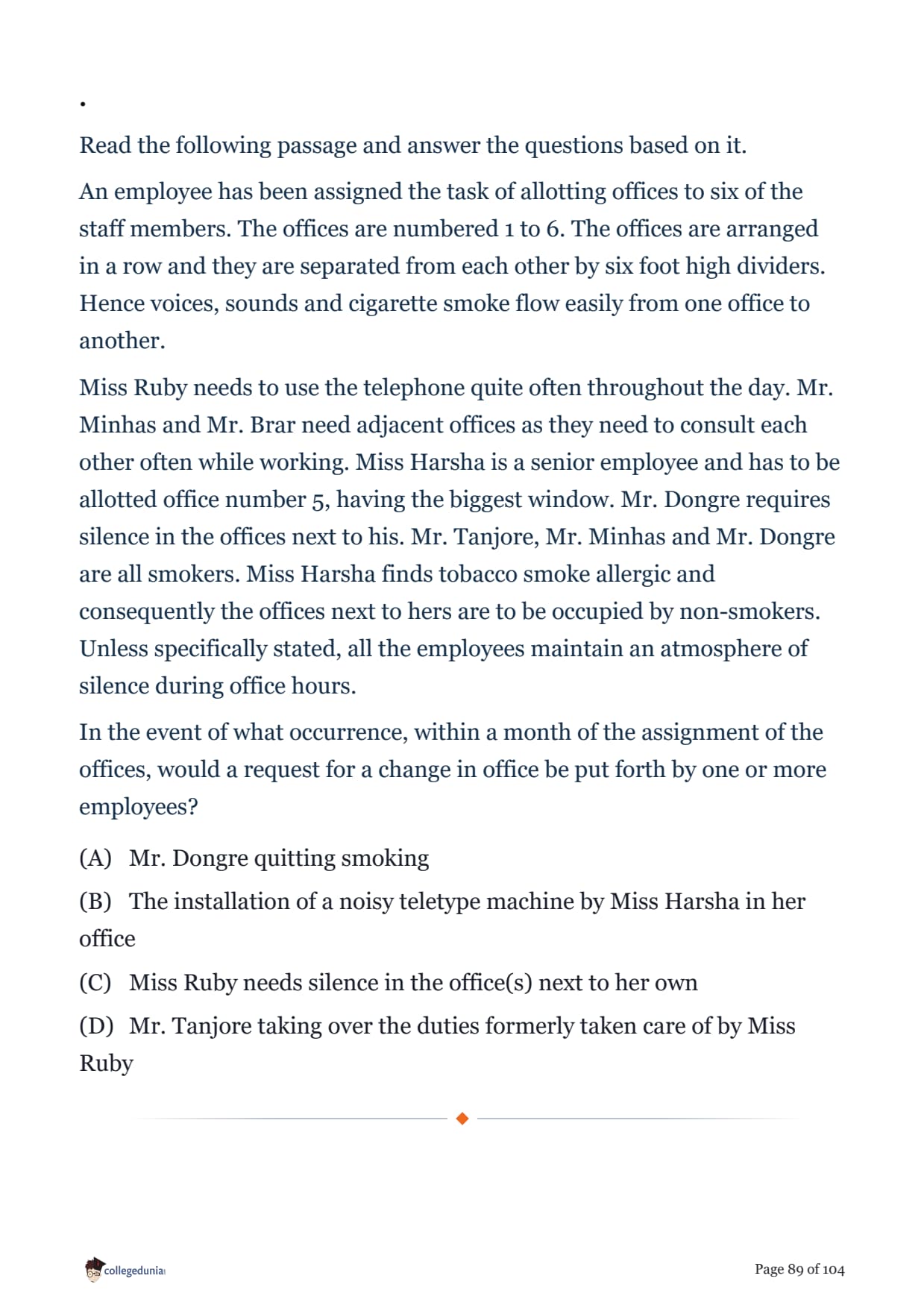
An employee has been assigned the task of allotting offices to six of the staff members. The offices are numbered 1 to 6. The offices are arranged in a row and they are separated from each other by six foot high dividers. Hence voices, sounds and cigarette smoke flow easily from one office to another.
Miss Ruby needs to use the telephone quite often throughout the day. Mr. Minhas and Mr. Brar need adjacent offices as they need to consult each other often while working. Miss Harsha is a senior employee and has to be allotted office number 5, having the biggest window. Mr. Dongre requires silence in the offices next to his. Mr. Tanjore, Mr. Minhas and Mr. Dongre are all smokers. Miss Harsha finds tobacco smoke allergic and consequently the offices next to hers are to be occupied by non-smokers. Unless specifically stated, all the employees maintain an atmosphere of silence during office hours.
The ideal candidate to occupy the office furthest from Mr. Brar would be:
Read the following passage and answer the questions based on it.
An employee has been assigned the task of allotting offices to six of the staff members. The offices are numbered 1 to 6. The offices are arranged in a row and they are separated from each other by six foot high dividers. Hence voices, sounds and cigarette smoke flow easily from one office to another.
Miss Ruby needs to use the telephone quite often throughout the day. Mr. Minhas and Mr. Brar need adjacent offices as they need to consult each other often while working. Miss Harsha is a senior employee and has to be allotted office number 5, having the biggest window. Mr. Dongre requires silence in the offices next to his. Mr. Tanjore, Mr. Minhas and Mr. Dongre are all smokers. Miss Harsha finds tobacco smoke allergic and consequently the offices next to hers are to be occupied by non-smokers. Unless specifically stated, all the employees maintain an atmosphere of silence during office hours.
The three employees who are smokers should be seated in the offices:
Read the following passage and answer the questions based on it.
An employee has been assigned the task of allotting offices to six of the staff members. The offices are numbered 1 to 6. The offices are arranged in a row and they are separated from each other by six foot high dividers. Hence voices, sounds and cigarette smoke flow easily from one office to another.
Miss Ruby needs to use the telephone quite often throughout the day. Mr. Minhas and Mr. Brar need adjacent offices as they need to consult each other often while working. Miss Harsha is a senior employee and has to be allotted office number 5, having the biggest window. Mr. Dongre requires silence in the offices next to his. Mr. Tanjore, Mr. Minhas and Mr. Dongre are all smokers. Miss Harsha finds tobacco smoke allergic and consequently the offices next to hers are to be occupied by non-smokers. Unless specifically stated, all the employees maintain an atmosphere of silence during office hours.
In the event of what occurrence, within a month of the assignment of the offices, would a request for a change in office be put forth by one or more employees?
Shankar and Jwala are both members of a Youth club, though they are not speaking to each other and refuse to work with each other. Chaya, the club president, is appointing members to the fundraising committee, but she has resolved that she will not appoint anyone without his or her explicit consent. Shankar says, "I will not consent unless I know whether Jwala is to be a member." Jwala says, "I will not consent unless I know whether Shankar is to be a member." If all three stick to these resolutions, then:
A bank customer had Rs. 100 in his account. He then made 6 withdrawals, totaling Rs. 100. He kept a record of these withdrawals, and the balance remaining in the account, as follows:
| Withdrawals | Balance left |
|---|---|
| Rs. 50 | Rs. 50 |
| Rs. 25 | Rs. 25 |
| Rs. 10 | Rs. 15 |
| Rs. 8 | Rs. 7 |
| Rs. 5 | Rs. 2 |
| Rs. 2 | Rs. 0 |
| Rs. 100 | Rs. 99 |
So, why are the totals not exactly right?

A wedge shape is to a diamond shape as a vertical bar is to which of the given figures?

Which pattern from the bottom line (A, B, C, D or E) is missing from the top line?

During their school Silver Jubilee Reunion, four alumni were discussing their starting annual salaries back in 1981. The salaries in question were Rupees 40, 50, 60 and 70 thousand per year. Of course, the present MD of a private company earned the most. Arvind earned more than Biswajeet, and the doctor earned more than Dhruv the engineer. Chinmay could not remember what he started on. Biswajeet the lawyer did not start on Rs. 50,000, nor did Dhruv.
What is Chinmay's current profession?
During their school Silver Jubilee Reunion, four alumni were discussing their starting annual salaries back in 1981. The salaries in question were Rupees 40, 50, 60 and 70 thousand per year. Of course, the present MD of a private company earned the most. Arvind earned more than Biswajeet, and the doctor earned more than Dhruv the engineer. Chinmay could not remember what he started on. Biswajeet the lawyer did not start on Rs. 50,000, nor did Dhruv.
What was the Lawyer's starting salary?
During their school Silver Jubilee Reunion, four alumni were discussing their starting annual salaries back in 1981. The salaries in question were Rupees 40, 50, 60 and 70 thousand per year. Of course, the present MD of a private company earned the most. Arvind earned more than Biswajeet, and the doctor earned more than Dhruv the engineer. Chinmay could not remember what he started on. Biswajeet the lawyer did not start on Rs. 50,000, nor did Dhruv.
Who received the highest starting salary?
A man has a job which requires him to work 8 straight days and rest on the ninth day. If he started work on a Monday, the 12th time he rests will be on what day of the week?

Babloo and Bunty describe the result of a race among Snehal, Tanmay, and Waman.
Babloo: "Tanmay won; Waman was second."
Bunty: "Snehal won; Tanmay came second."
Each boy made exactly one true and one false statement. What was the correct finishing order (1st, 2nd, 3rd)?
What is the number of routes from \(P\) to \(Q\) in the network shown?


Eight of the nine numbers \(2, 3, 4, 5, 7, 10, 11, 12, 13\) are to be placed in the empty cells of the \(3 \times 4\) array (with \(1, 9, 14, 15\) already placed) so that the arithmetic average of the numbers in each row and each column is the same integer. Which one number must be left out?


At a family reunion were the following people: one grandfather, one grandmother, two fathers, two mothers, four children, three grandchildren, one brother, two sisters, two sons, two daughters, one father-in-law, one mother-in-law, and one daughter-in-law. But not as many people attended as it sounds. How many people were there?
On the counter are six squares marked 1, 2, 3, 4, 5, 6. Players are invited to place as much money as they wish on any one square. Three dice are then thrown.
- If your number appears on one die only, you get your money back plus the same amount.
- If two dice show your number, you get your money back plus twice the amount you placed on the square.
- If your number appears on all three dice, you get your money back plus three times the amount.
- If the number is not on any of the dice, the operator gets your money.
Jaideep was given some money by his mother on his birthday. Jaideep spent all of it in five stores. In each store he spent one rupee more than half of what he had when he came in. How much did he get from his mother?
Consider the following two statements to be true, even if they seem to be at variance from commonly known facts. Then decide which of the given conclusions logically follows from the two given statements.
Statements: All lawyers are extrovert. Some wise men are extrovert.
Conclusions:
(a) All lawyers are wise men.
(b) All wise men are lawyers.
(c) Some extrovert are wise men.
(d) All extrovert are lawyers.
The following are the results of a survey conducted on a small cross-section of students from the Symbiosis Group of institutes, to determine the readership of three magazines: Business India, Outlook and India Today. This survey was conducted in December 2006.
Number of students who read only Business India = 40
Number of students who read only Outlook = 60
Number of students who read only India Today = 110
Number of students who read all three magazines = 30
Number of students who read Business India and India Today, but not Outlook = 20
Number of students who read Business India and Outlook, but not India Today = 50
Number of students who read Outlook and India Today, but not Business India = 40
What was the total number of students surveyed?
The following are the results of a survey conducted on a small cross-section of students from the Symbiosis Group of institutes, to determine the readership of three magazines: Business India, Outlook and India Today. This survey was conducted in December 2006.
Number of students who read only Business India = 40
Number of students who read only Outlook = 60
Number of students who read only India Today = 110
Number of students who read all three magazines = 30
Number of students who read Business India and India Today, but not Outlook = 20
Number of students who read Business India and Outlook, but not India Today = 50
Number of students who read Outlook and India Today, but not Business India = 40
How many students did not read Business India?
Using the same survey data from the earlier questions: in May 2007, with the same group of students, all of them read India Today, 120 read Outlook, and none read Business India.
How many students read only India Today?
An ingredient in coffee, known as RTC, has been found to inactivate common cold viruses in experiments. In earlier experiments, researchers found that inactivated common cold viruses can convert healthy cells into cancer cells. It can be concluded that the use of coffee can cause cancer.
Which one of the following, if true, most seriously weakens the argument?
A census taker approaches a house and asks the woman, "How many children do you have, and what are their ages?"
Woman: "I have three children. The product of their ages is 36, and the sum of their ages is equal to the house number of the house next door."
The census taker checks the house number, then says, "I need more information."
Woman: "My oldest child is sleeping upstairs."
What are the ages of the three children?
SNAP 2007 Exam Pattern and Marking Scheme Explained
SNAP 2007 was a pen-and-paper test with four sections in a single 120-minute sitting, and every wrong answer cost you a quarter mark.
- Total questions: 150 objective questions across four sections
- Quantitative Ability, Data Interpretation & Data Sufficiency: 40 questions, 40 marks
- General Awareness: 40 questions, 40 marks
- General English: 40 questions, 40 marks
- Analytical & Logical Reasoning: 30 questions, 60 marks (2 marks each)
- Duration: 120 minutes for the full paper
- Marking scheme: each question had four choices, and a wrong answer lost 25% of that question's maximum marks
High-Weightage Sections in SNAP 2007 to Focus On First
Analytical & Logical Reasoning carried the most marks despite having the fewest questions, since each of its 30 questions was worth 2 marks instead of 1.
- Analytical & Logical Reasoning (30 questions, 60 marks): the highest-scoring section per question, covering puzzles, arrangements and logical deduction sets
- Quantitative Ability, DI & DS (40 questions, 40 marks): arithmetic, algebra, data interpretation and data sufficiency questions
- General Awareness (40 questions, 40 marks): static GK, current affairs and business awareness current as of late 2007
- General English (40 questions, 40 marks): reading comprehension, verbal ability, grammar and vocabulary questions
SNAP 2007 Question Paper Analysis Video
Source: Mathological
How to Use the SNAP 2007 Question Paper for Practice
Solve the full paper as one timed 120-minute sitting first, then go through the solutions section by section.
- Attempt all 150 questions across Quantitative Ability, General Awareness, General English, and Analytical & Logical Reasoning in one sitting before checking any answer
- Review every question against the solutions PDF and note down where you went wrong
- Practice the Analytical & Logical Reasoning section on its own first, since it carries the highest per-question weight
- Treat the General Awareness questions as a snapshot of late-2007 current affairs rather than a source of exam-day facts, since GK content dates quickly
- Time yourself section-wise to build the speed needed for a 120-minute, 150-question paper
SNAP 2007 Question Paper with Solutions FAQs
Ques. How many questions were there in SNAP 2007?
Ans. SNAP 2007 had 150 objective questions across four sections - 40 in Quantitative Ability, DI & DS, 40 in General Awareness, 40 in General English, and 30 in Analytical & Logical Reasoning.
Ques. Which section had the highest marks in SNAP 2007?
Ans. Analytical & Logical Reasoning carried the most marks at 60, even though it had only 30 questions, since each question in that section was worth 2 marks instead of 1.
Ques. Was there negative marking in SNAP 2007?
Ans. Yes. Every wrong answer in SNAP 2007 cost 25% of that question's maximum marks, so guessing without eliminating options was risky.
Ques. What was the duration of the SNAP 2007 exam?
Ans. SNAP 2007 was a 120-minute, pen-and-paper test covering all 150 questions in one sitting.
Ques. Who conducts the SNAP exam?
Ans. SNAP is conducted by Symbiosis International (Deemed University), Pune, for admission to its affiliated MBA and PGDM institutes.
Ques. Where can I download the SNAP 2007 question paper with solutions PDF for free?
Ans. Use the download table above on Collegedunia to get the SNAP 2007 question paper and its full solutions PDF. More details on the exam are available on the official site (snaptest.org).



Comments