




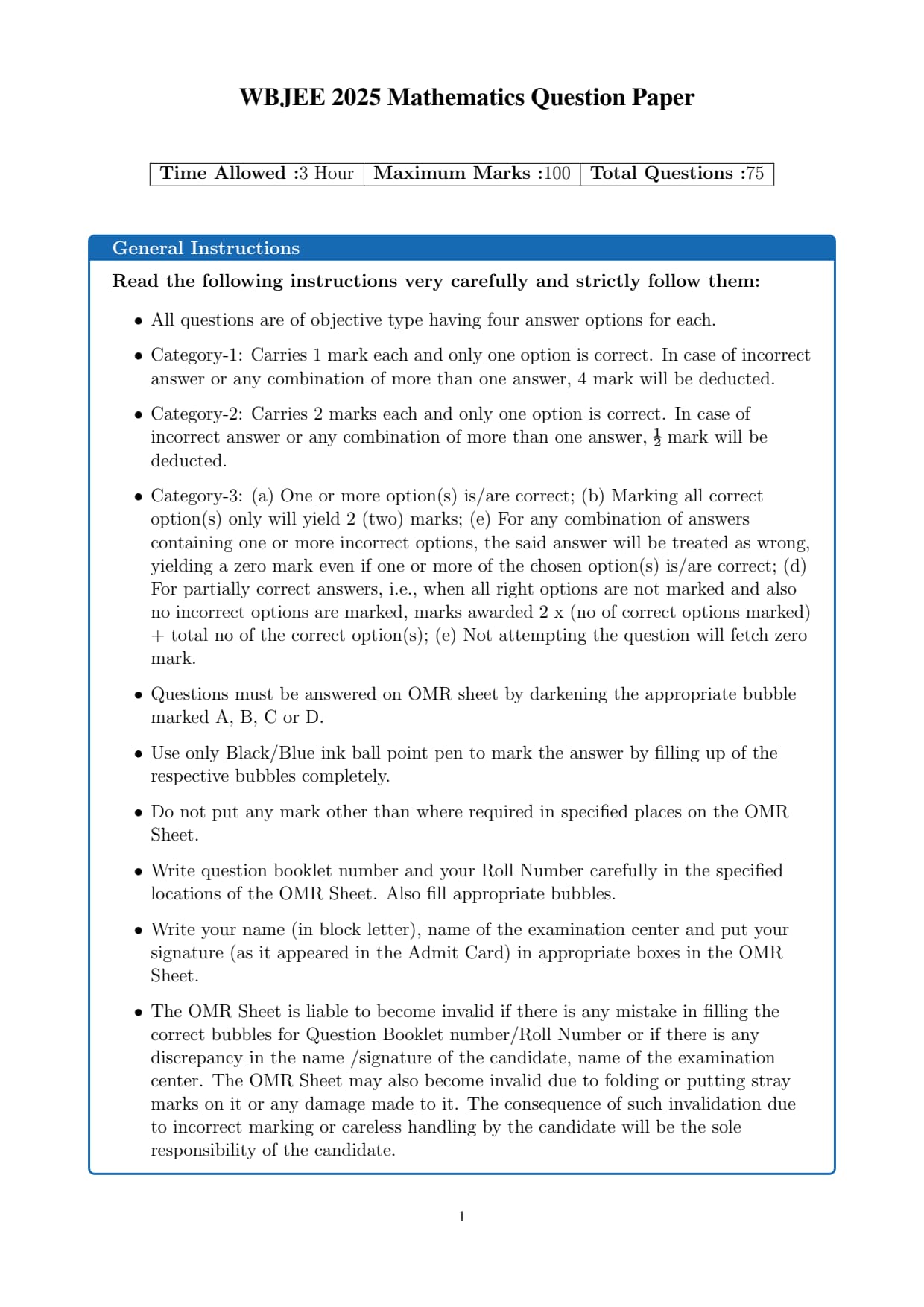
The WBJEE 2025 Mathematics Question Paper is available for download here to assist candidates in their preparation for the West Bengal Joint Entrance Examination. This comprehensive resource includes the solved question paper, detailed step-by-step solutions, and an accurate answer key aligned with the latest WBJEE board standards.
By practicing the WBJEE 2025 Mathematics paper PDF, students can effectively master complex formulas, improve their problem-solving speed, and refine their time management strategies for one of the most challenging sections of the exam.
WBJEE 2025 Mathematics Question Paper with Solution PDF
| WBJEE 2025 Mathematics Question Paper with Solution PDF | Download PDF | Check Solutions |
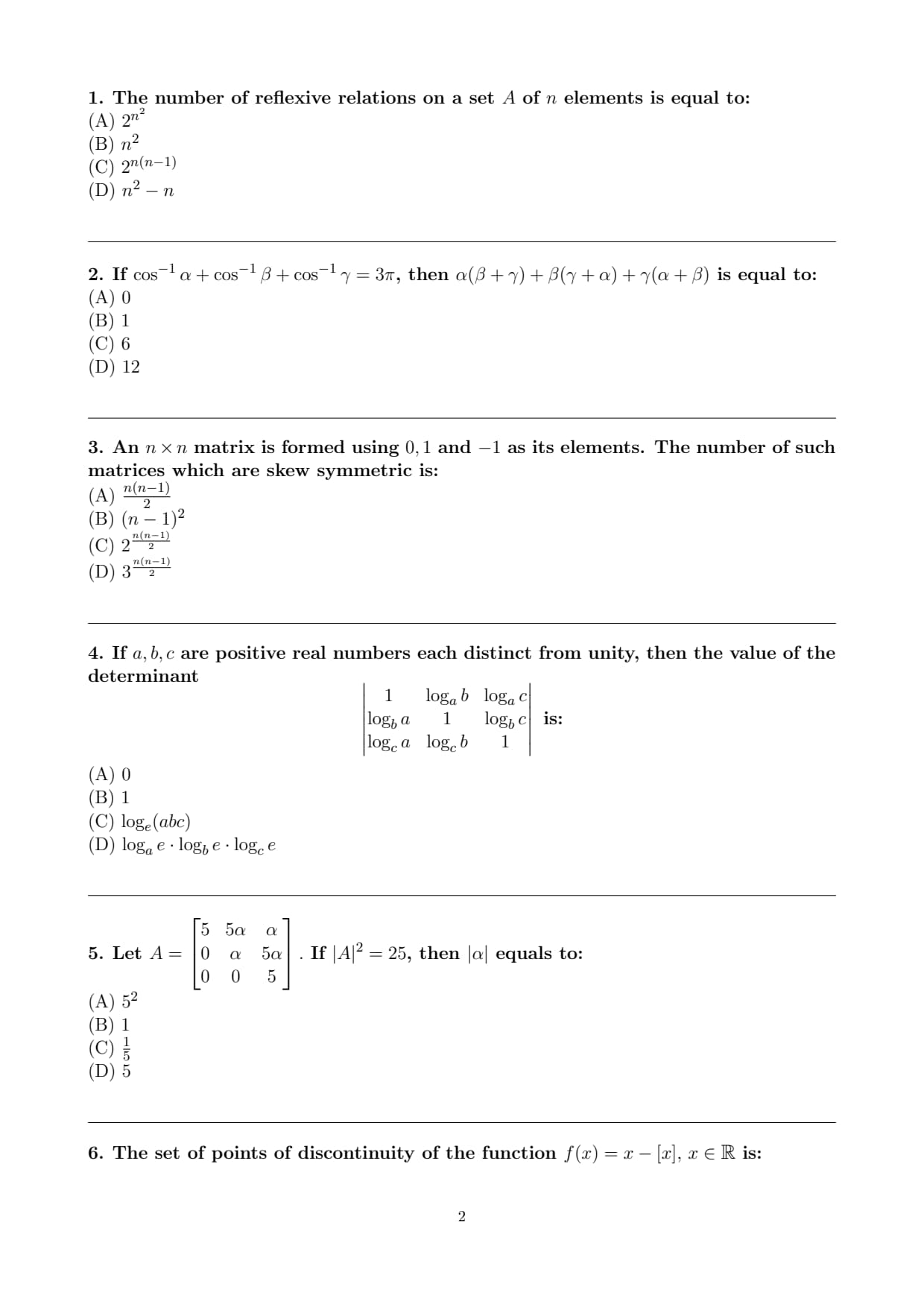
The number of reflexive relations on a set \( A \) of \( n \) elements is equal to:
If \( \cos^{-1}\alpha + \cos^{-1}\beta + \cos^{-1}\gamma = 3\pi \), then \( \alpha(\beta+\gamma) + \beta(\gamma+\alpha) + \gamma(\alpha+\beta) \) is equal to:
An \( n \times n \) matrix is formed using \( 0, 1 \) and \( -1 \) as its elements. The number of such matrices which are skew symmetric is:
If \( a, b, c \) are positive real numbers each distinct from unity, then the value of the determinant \[ \begin{vmatrix} 1 & \log_a b & \log_a c
\log_b a & 1 & \log_b c
\log_c a & \log_c b & 1 \end{vmatrix} \textbf{ is:} \]
Let \( A = \begin{bmatrix} 5 & 5\alpha & \alpha
0 & \alpha & 5\alpha
0 & 0 & 5 \end{bmatrix}. \) If \( |A|^2 = 25 \), then \( |\alpha| \) equals to:
The set of points of discontinuity of the function \( f(x) = x - [x], \, x \in \mathbb{R} \) is:
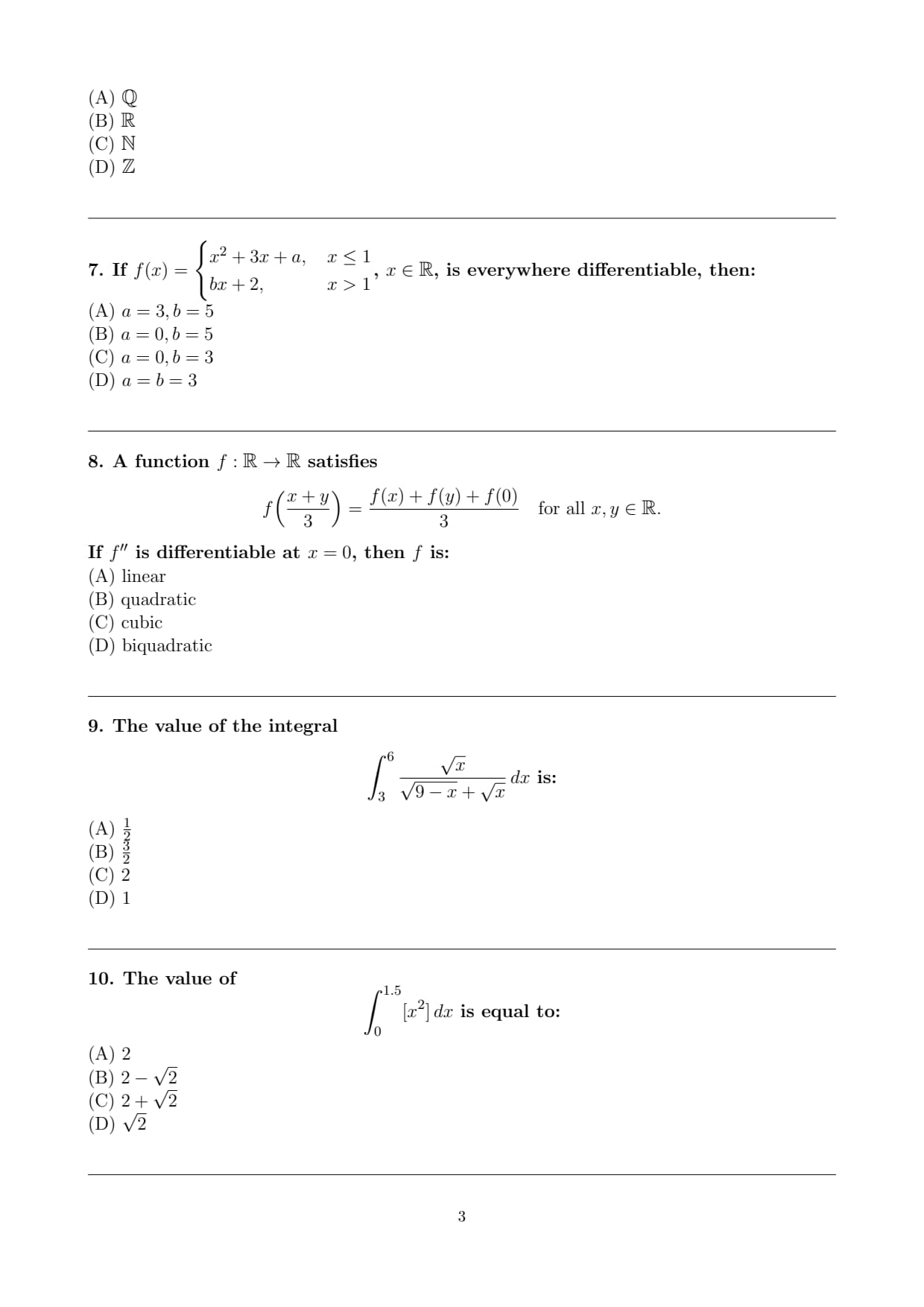
If \( f(x) = \begin{cases} x^2 + 3x + a, & x \le 1
bx + 2, & x > 1 \end{cases} \), \( x \in \mathbb{R} \), is everywhere differentiable, then:
A function \( f : \mathbb{R} \to \mathbb{R} \) satisfies \[ f\!\left(\frac{x+y}{3}\right) = \frac{f(x) + f(y) + f(0)}{3} \quad for all x,y \in \mathbb{R}. \]
If \( f'' \) is differentiable at \( x = 0 \), then \( f \) is:
The value of the integral \[ \int_{3}^{6} \frac{\sqrt{x}}{\sqrt{9 - x} + \sqrt{x}} \, dx \textbf{ is:} \]
The value of \[ \int_0^{1.5} [x^2] \, dx \textbf{ is equal to:} \]
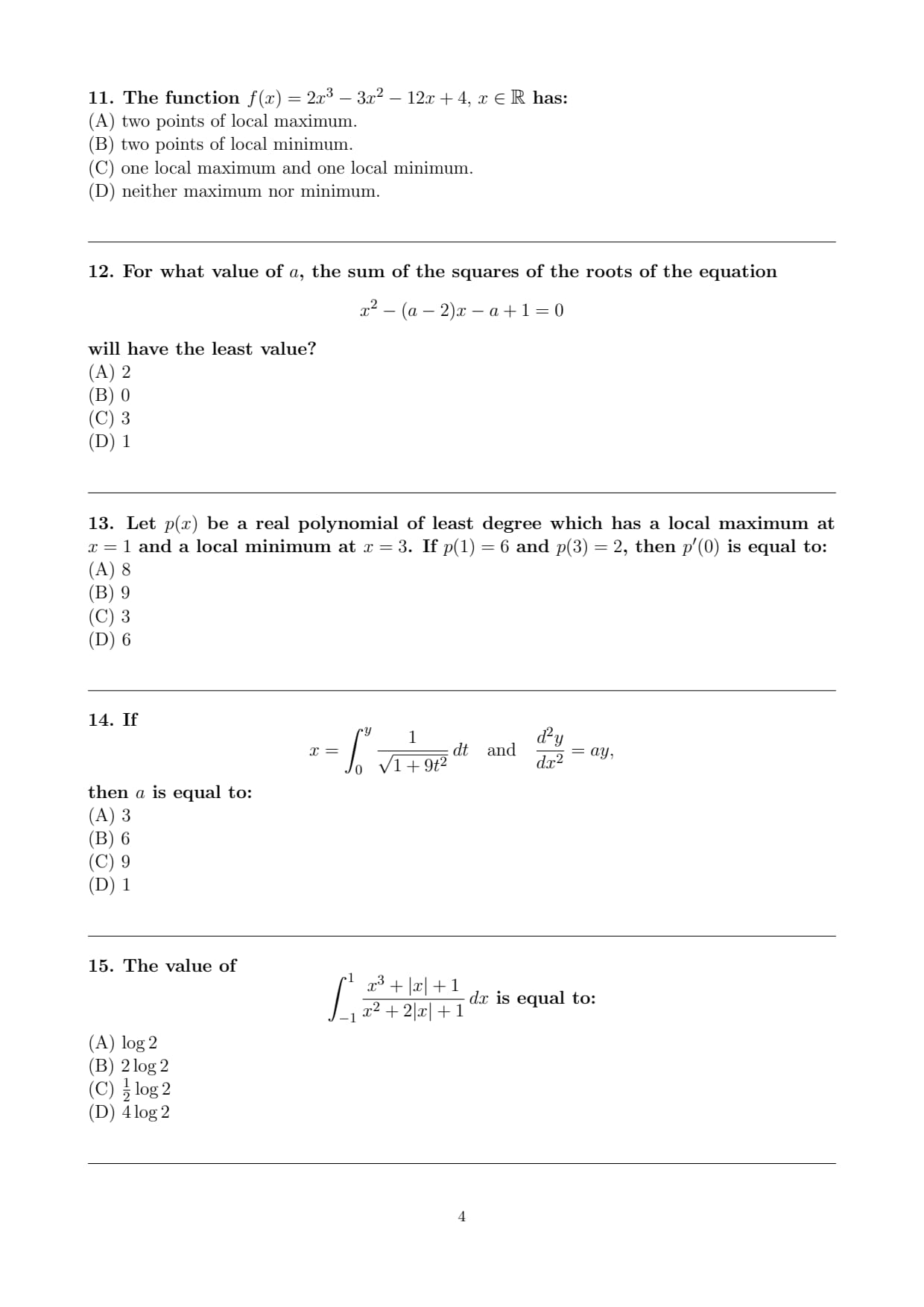
The function \( f(x) = 2x^3 - 3x^2 - 12x + 4, \, x \in \mathbb{R} \) has:
For what value of \( a \), the sum of the squares of the roots of the equation \[ x^2 - (a-2)x - a + 1 = 0 \]
will have the least value?
Let \( p(x) \) be a real polynomial of least degree which has a local maximum at \( x = 1 \) and a local minimum at \( x = 3 \). If \( p(1) = 6 \) and \( p(3) = 2 \), then \( p'(0) \) is equal to:
If \[ x = \int_0^y \frac{1}{\sqrt{1+9t^2}} \, dt \quad and \quad \frac{d^2 y}{dx^2} = ay, \]
then \( a \) is equal to:
The value of \[ \int_{-1}^{1} \frac{x^3 + |x| + 1}{x^2 + 2|x| + 1} \, dx \textbf{ is equal to:} \]
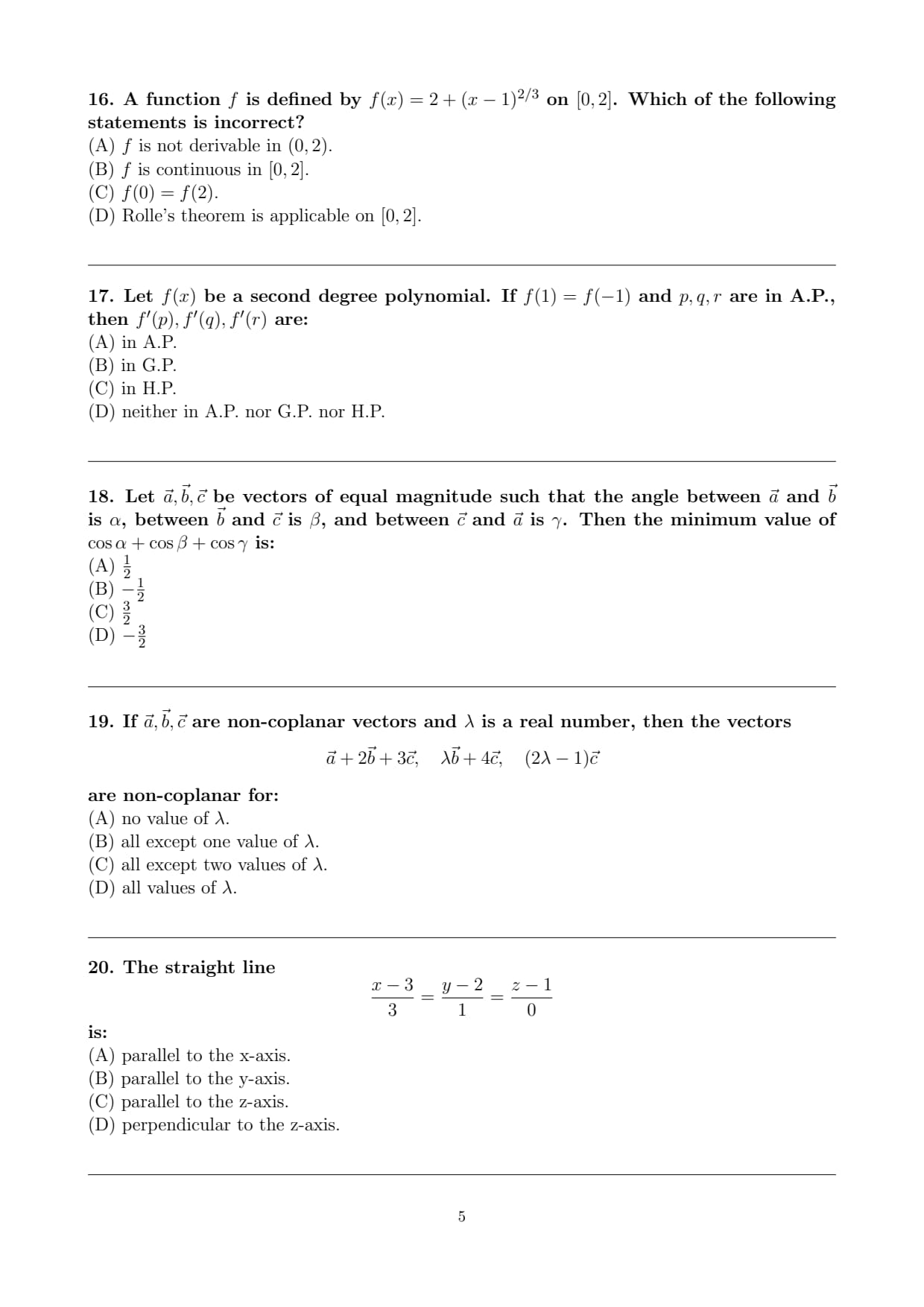
A function \( f \) is defined by \( f(x) = 2 + (x-1)^{2/3} \) on \( [0,2] \). Which of the following statements is incorrect?
Let \( f(x) \) be a second degree polynomial. If \( f(1)=f(-1) \) and \( p,q,r \) are in A.P., then \( f'(p), f'(q), f'(r) \) are:
Let \( \vec{a}, \vec{b}, \vec{c} \) be vectors of equal magnitude such that the angle between \( \vec{a} \) and \( \vec{b} \) is \( \alpha \), between \( \vec{b} \) and \( \vec{c} \) is \( \beta \), and between \( \vec{c} \) and \( \vec{a} \) is \( \gamma \). Then the minimum value of \( \cos\alpha + \cos\beta + \cos\gamma \) is:
If \( \vec{a}, \vec{b}, \vec{c} \) are non-coplanar vectors and \( \lambda \) is a real number, then the vectors \[ \vec{a} + 2\vec{b} + 3\vec{c}, \quad \lambda\vec{b} + 4\vec{c}, \quad (2\lambda - 1)\vec{c} \]
are non-coplanar for:
The straight line \[ \frac{x-3}{3} = \frac{y-2}{1} = \frac{z-1}{0} \]
is:
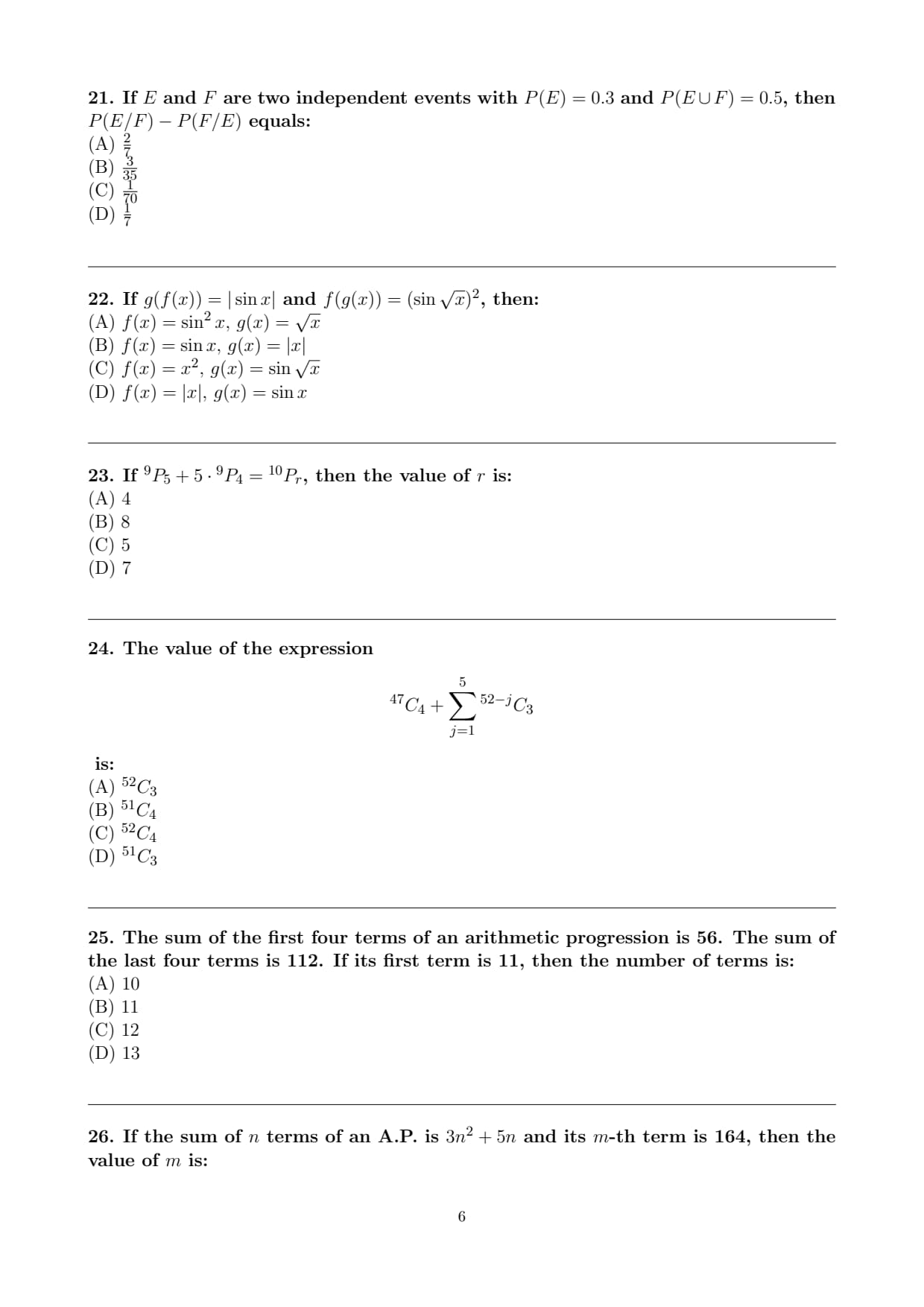
If \( E \) and \( F \) are two independent events with \( P(E)=0.3 \) and \( P(E\cup F)=0.5 \), then \( P(E/F) - P(F/E) \) equals:
If \( g(f(x)) = |\sin x| \) and \( f(g(x)) = (\sin\sqrt{x})^2 \), then:
If \( {}^9P_5 + 5 \cdot {}^9P_4 = {}^{10}P_r \), then the value of \( r \) is:
The value of the expression \[ {}^{47}C_4 + \sum_{j=1}^{5} {}^{52-j}C_3 \]
is:
The sum of the first four terms of an arithmetic progression is 56. The sum of the last four terms is 112. If its first term is 11, then the number of terms is:
If the sum of \( n \) terms of an A.P. is \( 3n^2 + 5n \) and its \( m \)-th term is 164, then the value of \( m \) is:
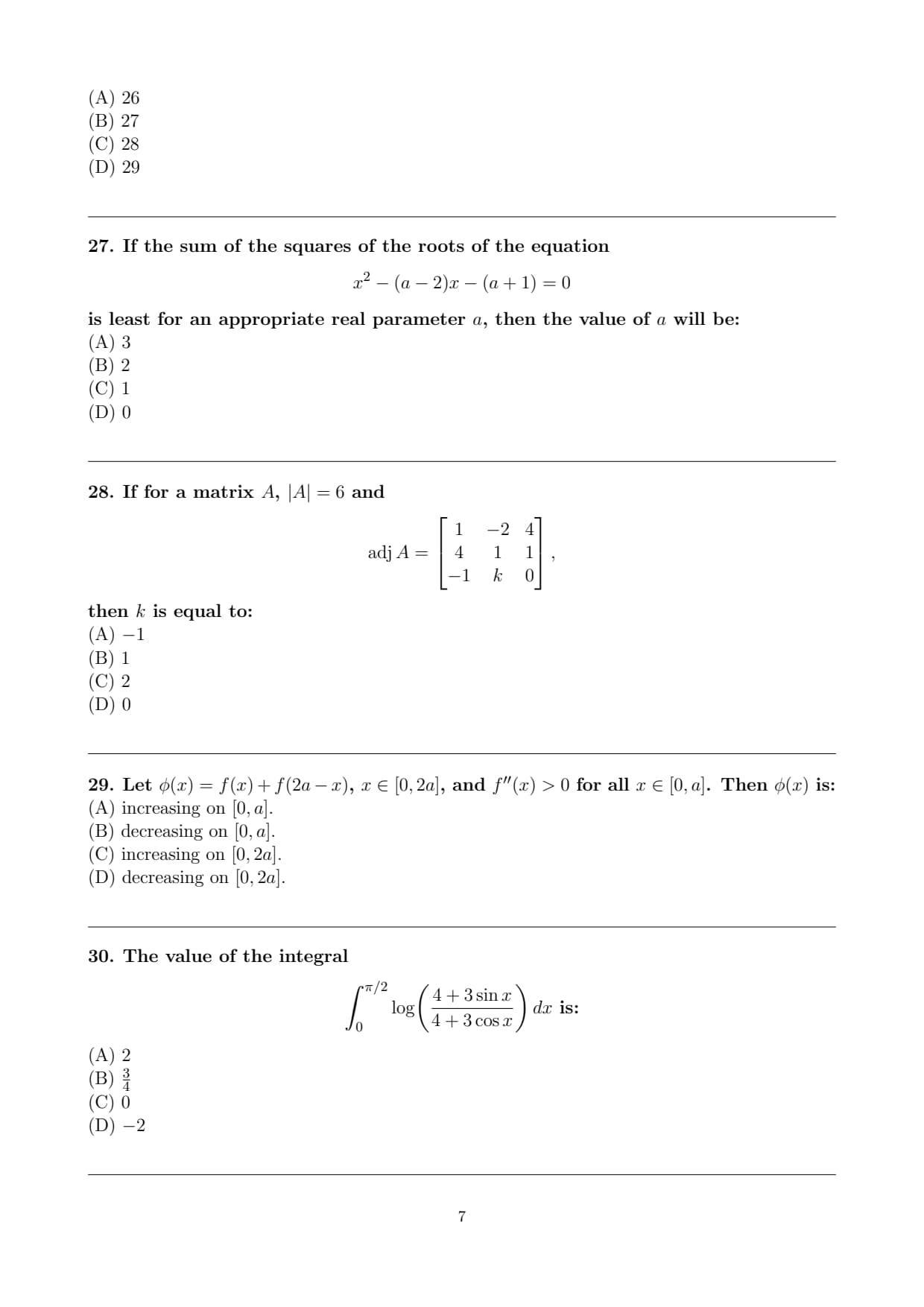
If the sum of the squares of the roots of the equation \[ x^2 - (a-2)x - (a+1) = 0 \]
is least for an appropriate real parameter \( a \), then the value of \( a \) will be:
If for a matrix \( A \), \( |A| = 6 \) and \[ \operatorname{adj}A = \begin{bmatrix} 1 & -2 & 4
4 & 1 & 1
-1 & k & 0 \end{bmatrix}, \]
then \( k \) is equal to:
Let \( \phi(x) = f(x) + f(2a - x) \), \( x \in [0,2a] \), and \( f''(x) > 0 \) for all \( x \in [0,a] \). Then \( \phi(x) \) is:
The value of the integral
\[
\int_0^{\pi/2 \log\!\left(\frac{4+3\sin x{4+3\cos x\right) dx
is:
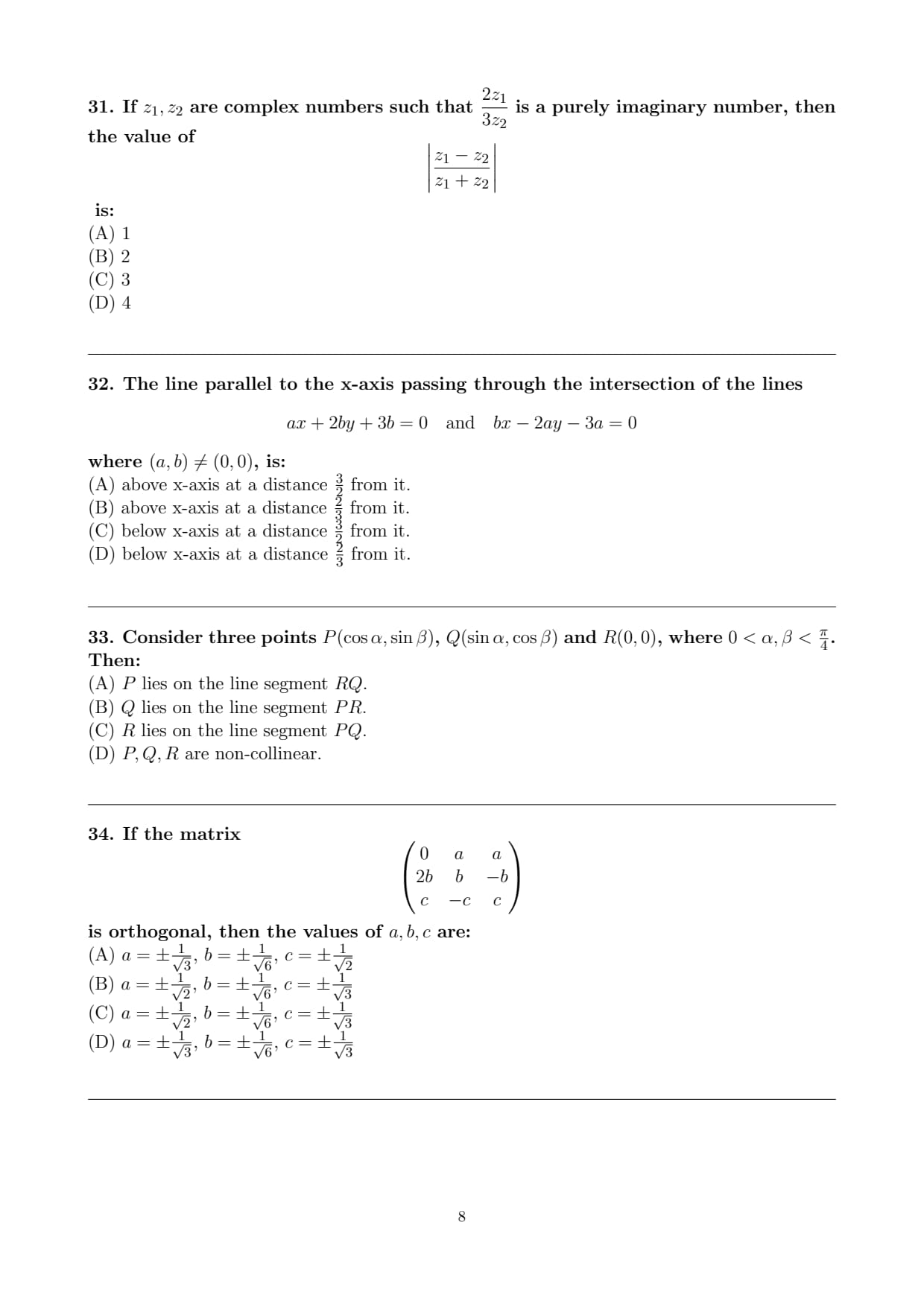
If \( z_1, z_2 \) are complex numbers such that \( \dfrac{2z_1}{3z_2} \) is a purely imaginary number, then the value of \[ \left|\frac{z_1 - z_2}{z_1 + z_2}\right| \]
is:
The line parallel to the x-axis passing through the intersection of the lines \[ ax + 2by + 3b = 0 \quad and \quad bx - 2ay - 3a = 0 \]
where \( (a,b) \neq (0,0) \), is:
Consider three points \( P(\cos\alpha, \sin\beta) \), \( Q(\sin\alpha, \cos\beta) \) and \( R(0,0) \), where \( 0 < \alpha, \beta < \frac{\pi}{4} \). Then:
If the matrix \[ \begin{pmatrix} 0 & a & a
2b & b & -b
c & -c & c \end{pmatrix} \]
is orthogonal, then the values of \( a,b,c \) are:
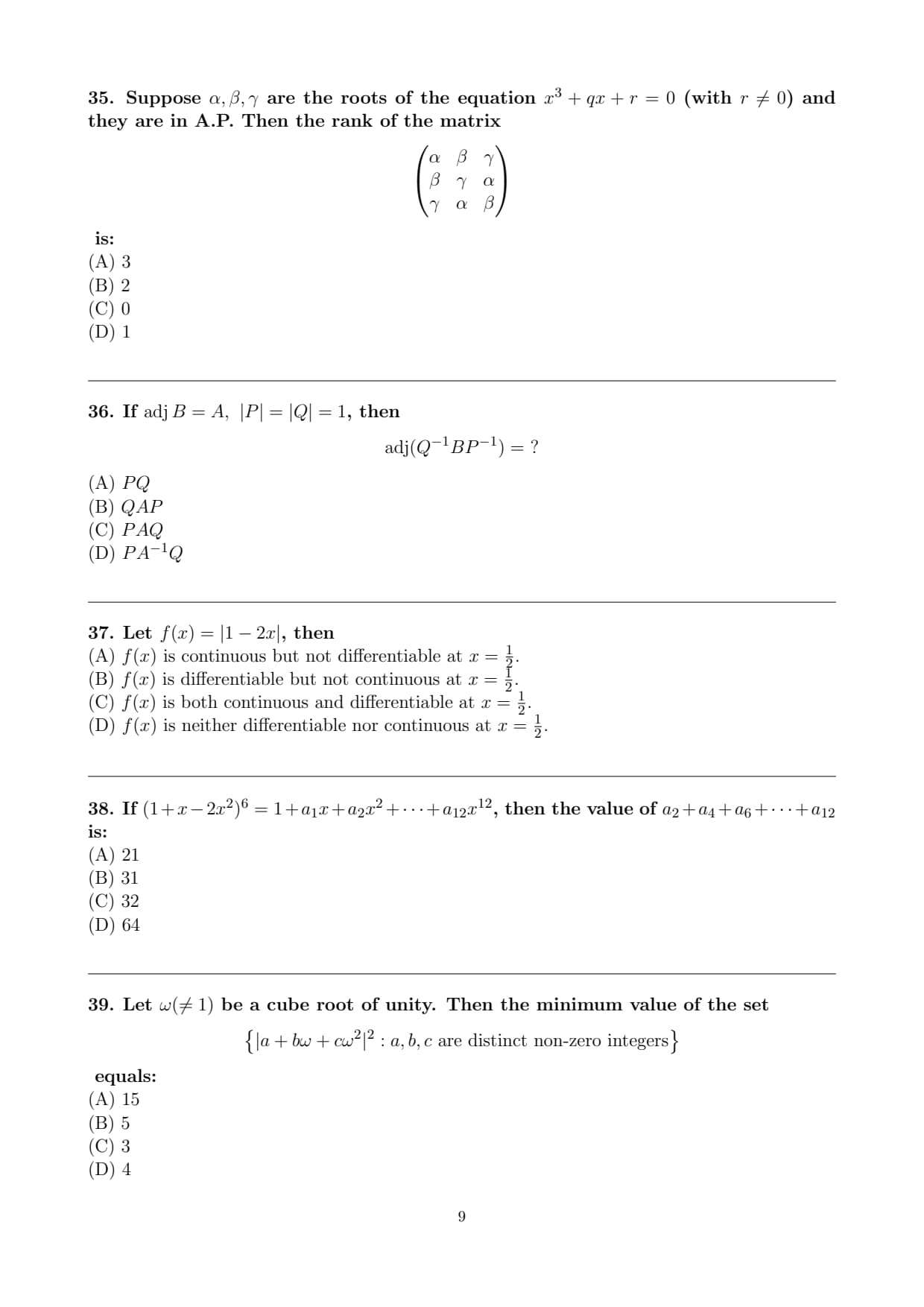
Suppose \( \alpha, \beta, \gamma \) are the roots of the equation \( x^3 + qx + r = 0 \) (with \( r \ne 0 \)) and they are in A.P. Then the rank of the matrix \[ \begin{pmatrix} \alpha & \beta & \gamma
\beta & \gamma & \alpha
\gamma & \alpha & \beta \end{pmatrix} \]
is:
If \( \operatorname{adj} B = A, \ |P|=|Q|=1 \), then \[ \operatorname{adj}(Q^{-1} B P^{-1}) = \ ? \]
Let \( f(x) = |1 - 2x| \), then
If \( (1 + x - 2x^2)^6 = 1 + a_1 x + a_2 x^2 + \cdots + a_{12}x^{12} \), then the value of \( a_2 + a_4 + a_6 + \cdots + a_{12} \) is:
Let \( \omega (\ne 1) \) be a cube root of unity. Then the minimum value of the set \[ \left\{ |a + b\omega + c\omega^2|^2 : a,b,c are distinct non-zero integers \right\} \]
equals:
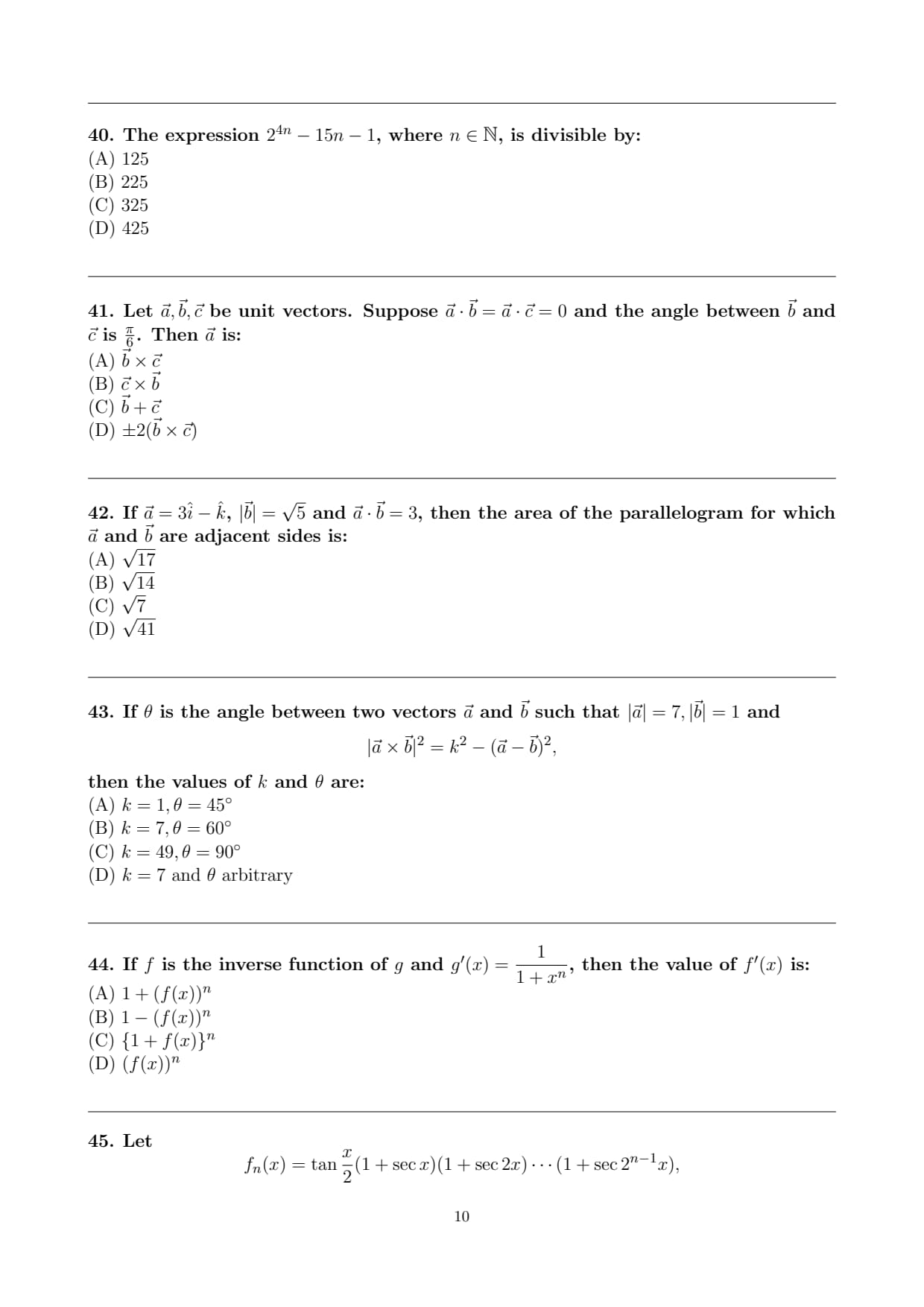
The expression \( 2^{4n} - 15n - 1 \), where \( n \in \mathbb{N} \), is divisible by:
Let \( \vec{a}, \vec{b}, \vec{c} \) be unit vectors. Suppose \( \vec{a}\cdot\vec{b} = \vec{a}\cdot\vec{c} = 0 \) and the angle between \( \vec{b} \) and \( \vec{c} \) is \( \frac{\pi}{6} \). Then \( \vec{a} \) is:
If \( \vec{a} = 3\hat{i} - \hat{k} \), \( |\vec{b}| = \sqrt{5} \) and \( \vec{a} \cdot \vec{b} = 3 \), then the area of the parallelogram for which \( \vec{a} \) and \( \vec{b} \) are adjacent sides is:
If \( \theta \) is the angle between two vectors \( \vec{a} \) and \( \vec{b} \) such that \( |\vec{a}| = 7, |\vec{b}| = 1 \) and \[ |\vec{a} \times \vec{b}|^2 = k^2 - (\vec{a} - \vec{b})^2, \]
then the values of \( k \) and \( \theta \) are:
If \( f \) is the inverse function of \( g \) and \( g'(x) = \dfrac{1}{1 + x^n} \), then the value of \( f'(x) \) is:
Let \[ f_n(x) = \tan\frac{x}{2}(1+\sec x)(1+\sec 2x)\cdots(1+\sec 2^{n-1}x), \]
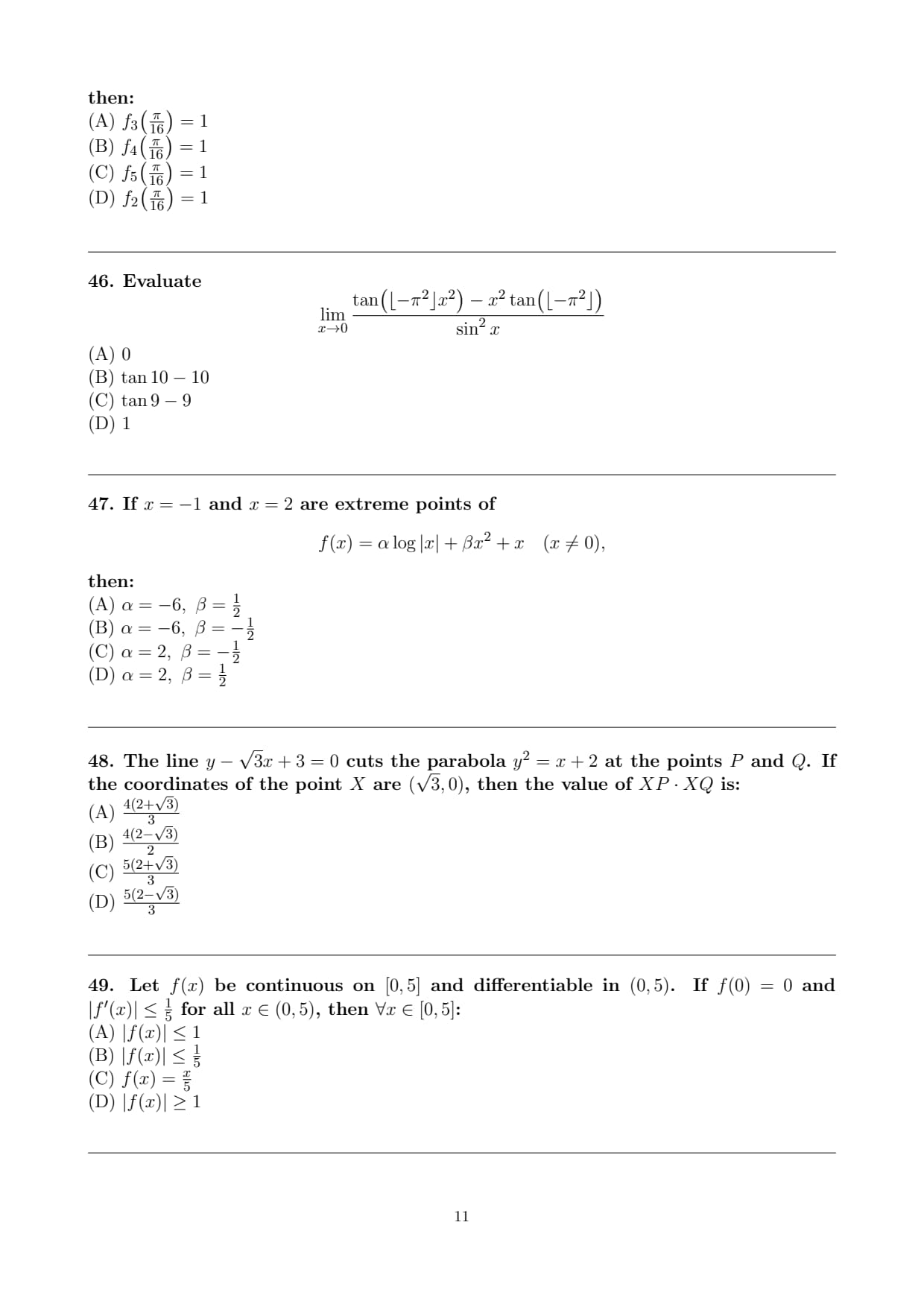
then:
Evaluate \[ \lim_{x \to 0} \frac{\tan\!\left(\lfloor -\pi^2 \rfloor x^2\right) - x^2 \tan\!\left(\lfloor -\pi^2 \rfloor\right)}{\sin^2 x} \]
If \( x=-1 \) and \( x=2 \) are extreme points of \[ f(x) = \alpha \log|x| + \beta x^2 + x \quad (x \ne 0), \]
then:
The line \( y - \sqrt{3}x + 3 = 0 \) cuts the parabola \( y^2 = x + 2 \) at the points \( P \) and \( Q \). If the coordinates of the point \( X \) are \( (\sqrt{3}, 0) \), then the value of \( XP \cdot XQ \) is:
Let \( f(x) \) be continuous on \( [0,5] \) and differentiable in \( (0,5) \). If \( f(0)=0 \) and \( |f'(x)| \le \frac{1}{5} \) for all \( x \in (0,5) \), then \( \forall x \in [0,5] \):
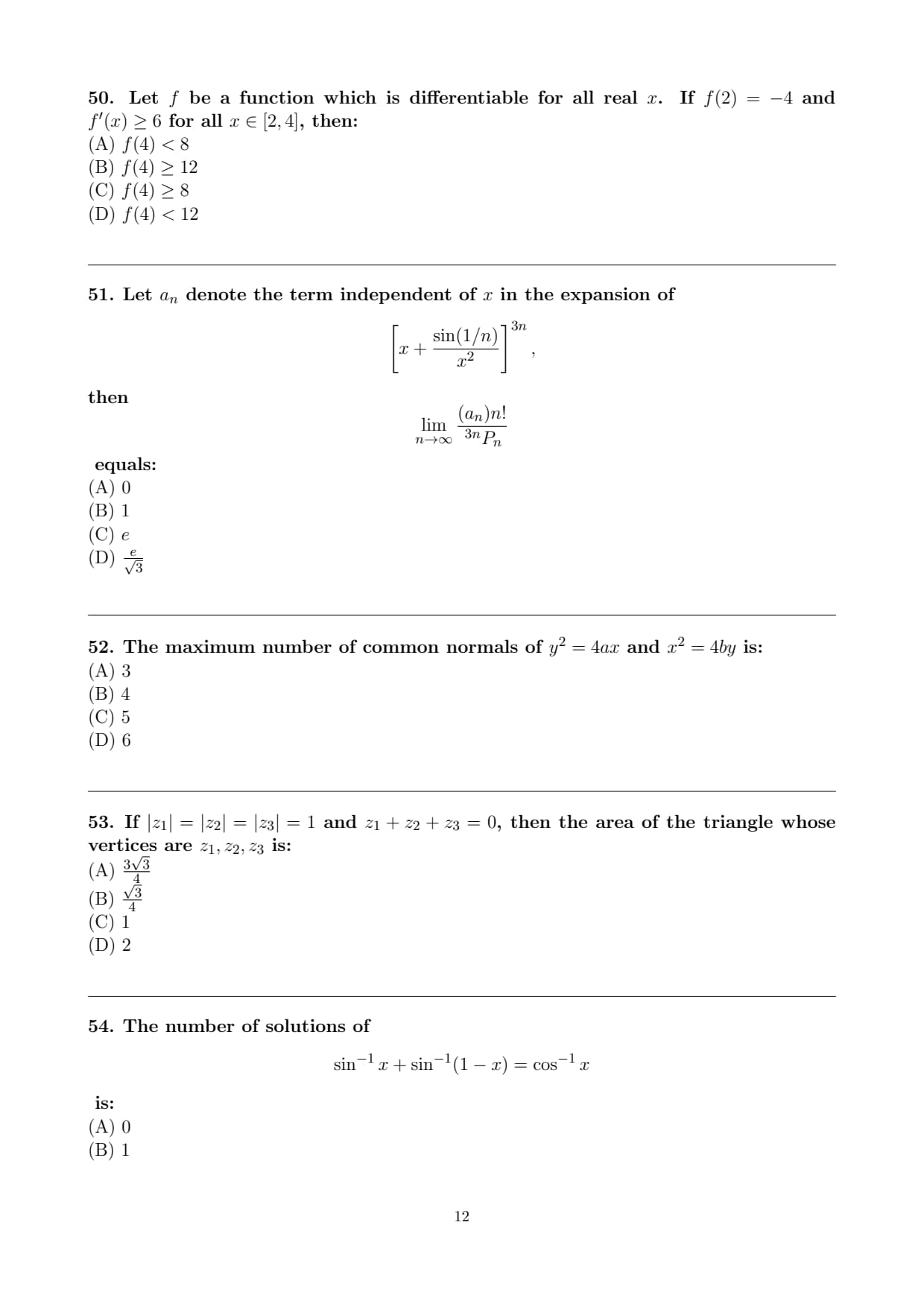
Let \( f \) be a function which is differentiable for all real \( x \). If \( f(2) = -4 \) and \( f'(x) \ge 6 \) for all \( x \in [2,4] \), then:
Let \( a_n \) denote the term independent of \( x \) in the expansion of \[ \left[x + \frac{\sin(1/n)}{x^2}\right]^{3n}, \]
then \[ \lim_{n\to\infty} \frac{(a_n)n!}{\,{}^{3n}P_n} \]
equals:
The maximum number of common normals of \( y^2 = 4ax \) and \( x^2 = 4by \) is:
If \( |z_1|=|z_2|=|z_3|=1 \) and \( z_1+z_2+z_3=0 \), then the area of the triangle whose vertices are \( z_1,z_2,z_3 \) is:
The number of solutions of \[ \sin^{-1} x + \sin^{-1}(1-x) = \cos^{-1} x \]
is:
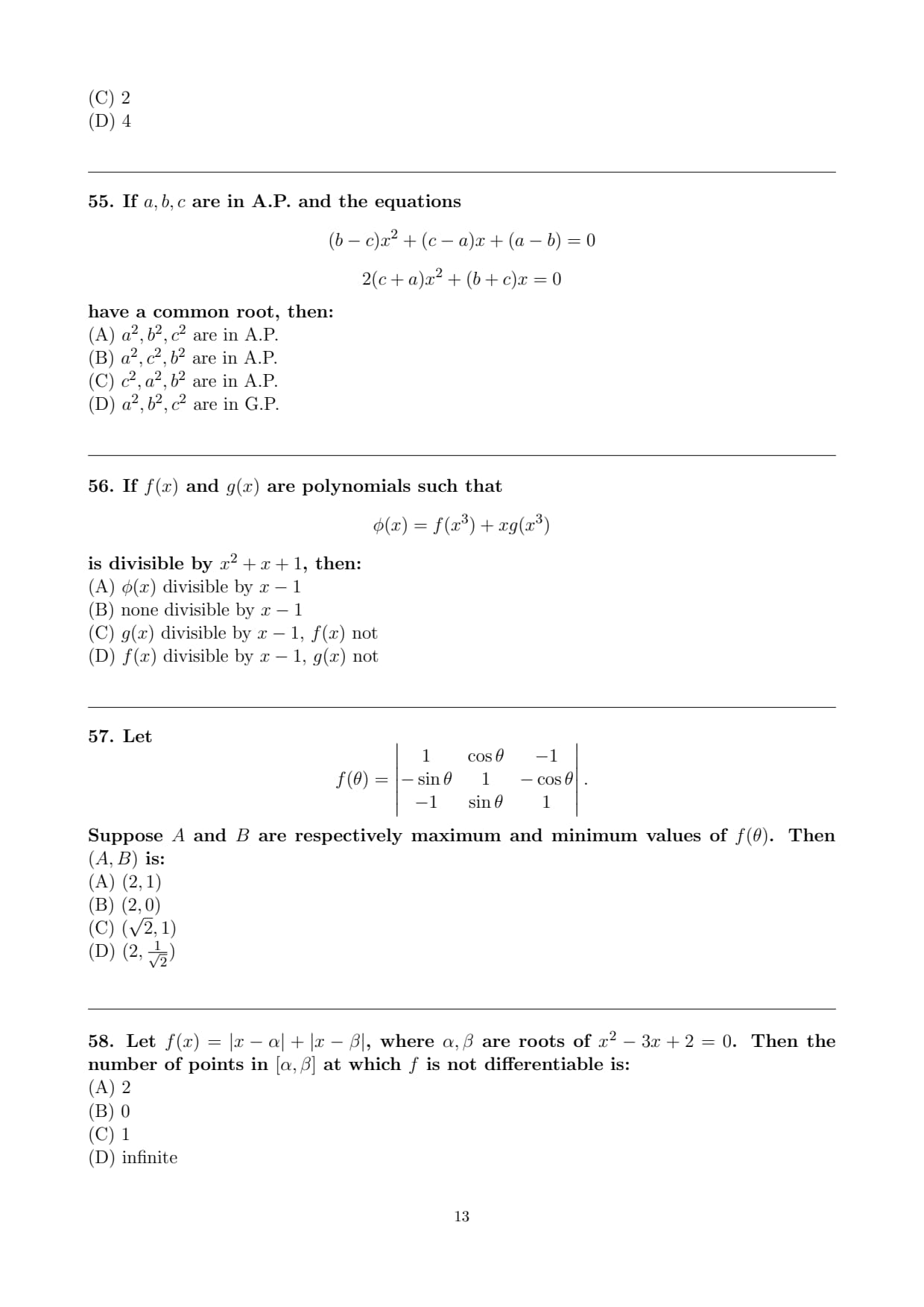
If \( a,b,c \) are in A.P. and the equations \[ (b-c)x^2 + (c-a)x + (a-b) = 0 \] \[ 2(c+a)x^2 + (b+c)x = 0 \]
have a common root, then:
If \( f(x) \) and \( g(x) \) are polynomials such that \[ \phi(x) = f(x^3) + xg(x^3) \]
is divisible by \( x^2 + x + 1 \), then:
Let \[ f(\theta) = \begin{vmatrix} 1 & \cos\theta & -1
-\sin\theta & 1 & -\cos\theta
-1 & \sin\theta & 1 \end{vmatrix}. \]
Suppose \( A \) and \( B \) are respectively maximum and minimum values of \( f(\theta) \). Then \( (A,B) \) is:
Let \( f(x)=|x-\alpha|+|x-\beta| \), where \( \alpha,\beta \) are roots of \( x^2-3x+2=0 \). Then the number of points in \( [\alpha,\beta] \) at which \( f \) is not differentiable is:
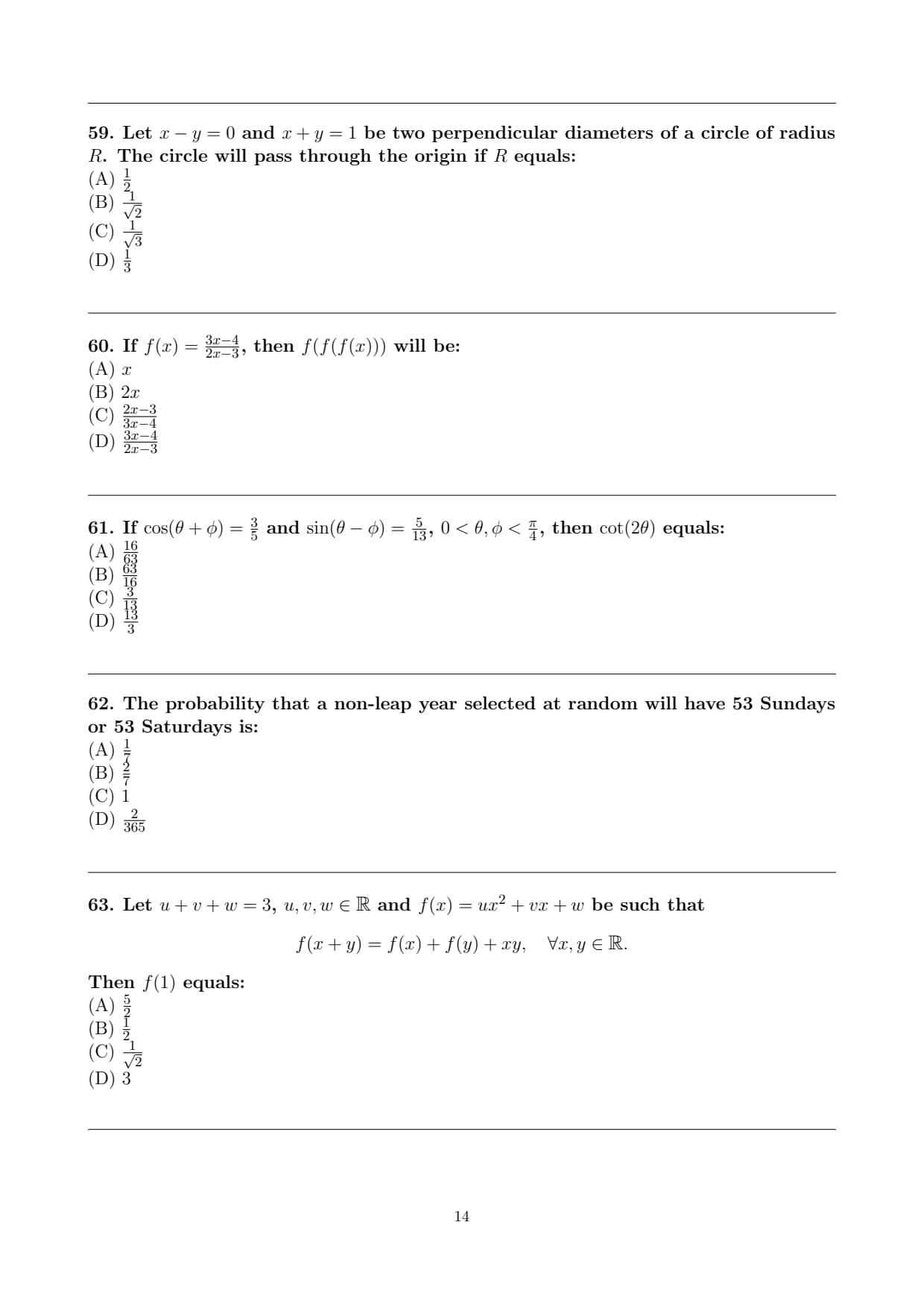
Let \( x-y=0 \) and \( x+y=1 \) be two perpendicular diameters of a circle of radius \( R \). The circle will pass through the origin if \( R \) equals:
If \( f(x)=\frac{3x-4}{2x-3} \), then \( f(f(f(x))) \) will be:
If \( \cos(\theta+\phi)=\frac{3}{5} \) and \( \sin(\theta-\phi)=\frac{5}{13} \), \( 0<\theta,\phi<\frac{\pi}{4} \), then \( \cot(2\theta) \) equals:
The probability that a non-leap year selected at random will have 53 Sundays or 53 Saturdays is:
Let \( u+v+w=3 \), \( u,v,w \in \mathbb{R} \) and \( f(x)=ux^2+vx+w \) be such that \[ f(x+y)=f(x)+f(y)+xy,\quad \forall x,y \in \mathbb{R}. \]
Then \( f(1) \) equals:
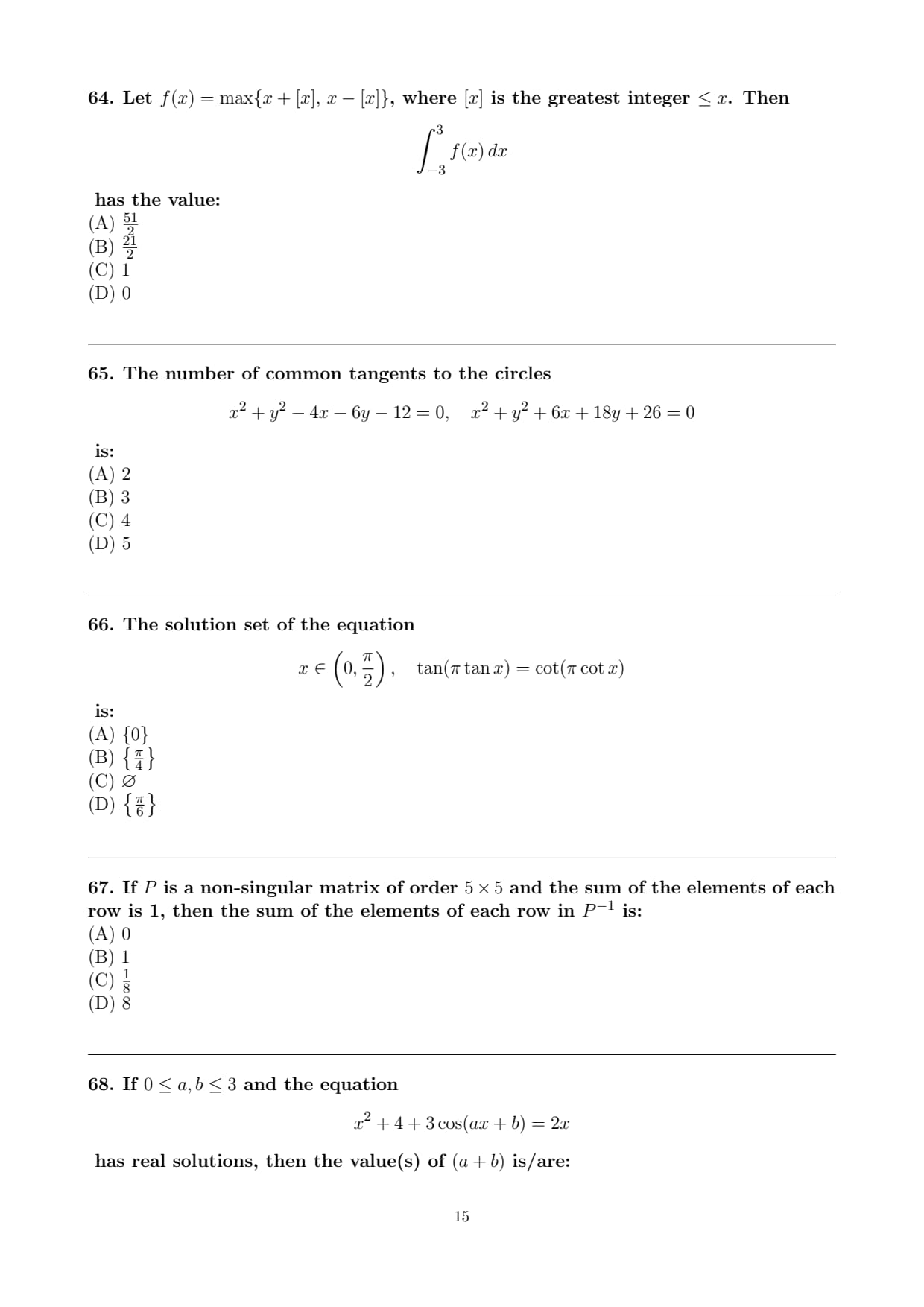
Let \( f(x)=\max\{x+[x],\, x-[x]\} \), where \( [x] \) is the greatest integer \( \le x \). Then \[ \int_{-3}^{3} f(x)\,dx \]
has the value:
The number of common tangents to the circles \[ x^2+y^2-4x-6y-12=0,\quad x^2+y^2+6x+18y+26=0 \]
is:
The solution set of the equation \[ x \in \left(0,\frac{\pi}{2}\right), \quad \tan(\pi \tan x) = \cot(\pi \cot x) \]
is:
If \( P \) is a non-singular matrix of order \( 5\times5 \) and the sum of the elements of each row is 1, then the sum of the elements of each row in \( P^{-1} \) is:
If \( 0\le a,b \le 3 \) and the equation \[ x^2 + 4 + 3\cos(ax+b) = 2x \]
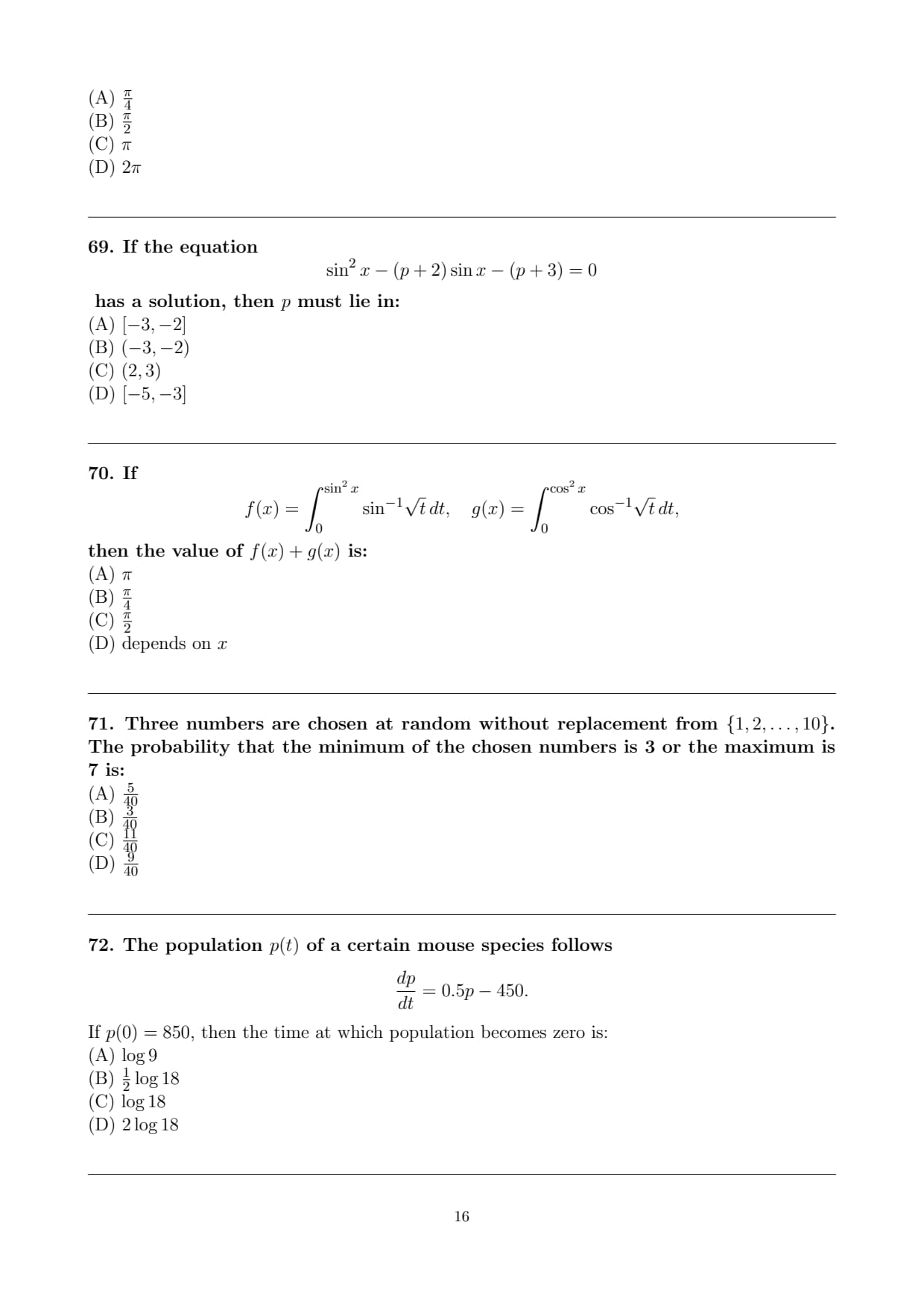
has real solutions, then the value(s) of \( (a+b) \) is/are:
If the equation \[ \sin^2x - (p+2)\sin x - (p+3) = 0 \]
has a solution, then \( p \) must lie in:
If \[ f(x)=\int_0^{\sin^2 x}\sin^{-1}\!\sqrt{t}\,dt, \quad g(x)=\int_0^{\cos^2 x}\cos^{-1}\!\sqrt{t}\,dt, \]
then the value of \( f(x)+g(x) \) is:
Three numbers are chosen at random without replacement from \( \{1,2,\dots,10\} \). The probability that the minimum of the chosen numbers is 3 or the maximum is 7 is:
The population \( p(t) \) of a certain mouse species follows \[ \frac{dp}{dt} = 0.5p - 450. \]
If \( p(0)=850 \), then the time at which population becomes zero is:
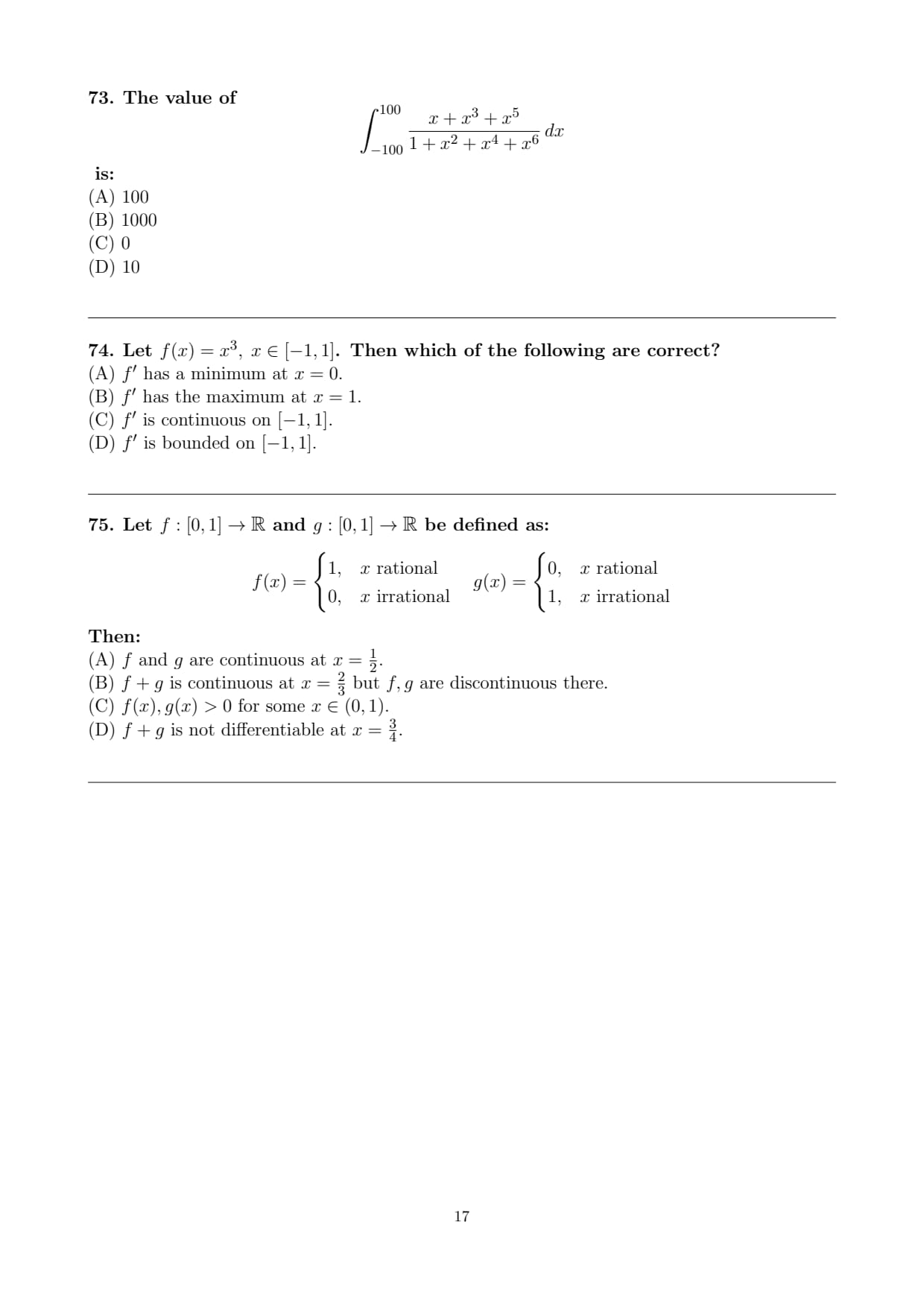
The value of \[ \int_{-100}^{100} \frac{x+x^3+x^5}{1+x^2+x^4+x^6}\,dx \]
is:
Let \( f(x)=x^3,\; x\in[-1,1] \). Then which of the following are correct?
Let \( f:[0,1]\to\mathbb{R} \) and \( g:[0,1]\to\mathbb{R} \) be defined as: \[ f(x)= \begin{cases} 1, & x rational
0, & x irrational \end{cases} \quad g(x)= \begin{cases} 0, & x rational
1, & x irrational \end{cases} \]
Then:



Comments