




BITSAT 2026 Question Paper for May 26 Shift 2 is available here. BITS Pilani conducted BITSAT Session 2 exam on May 26, 2026 in Shift 2 from 2 PM to 5 PM. BITSAT exam is held in a CBT Mode at various exam centres in India and abroad for students to apply for Integrated programs at BITS Campuses in Pilani, Goa and Hyderabad.
- BITSAT question paper contains 130 questions divided into 5 sections- Physics and Chemistry with 30 questions each, English Proficiency with 10 questions, Logical Reasoning with 20 questions and Mathematics or Biology with 40 questions.
- Each correct answer gets you 3 marks while incorrect answer has an negative marking of 1.
Candidates can download BITSAT 2026 May 26 Shift 2 Question Paper with answer key and solution PDF from the links provided below.
Also Check: BITSAT 2026 May 26 Slot 2 Expected Marks vs Rank
BITSAT 2026 May 26 Shift 2 Question Paper with Solution PDF (Memory-Based)
| BITSAT 2026 Question Paper May 26 Shift 2 | Download PDF | Check Solutions |
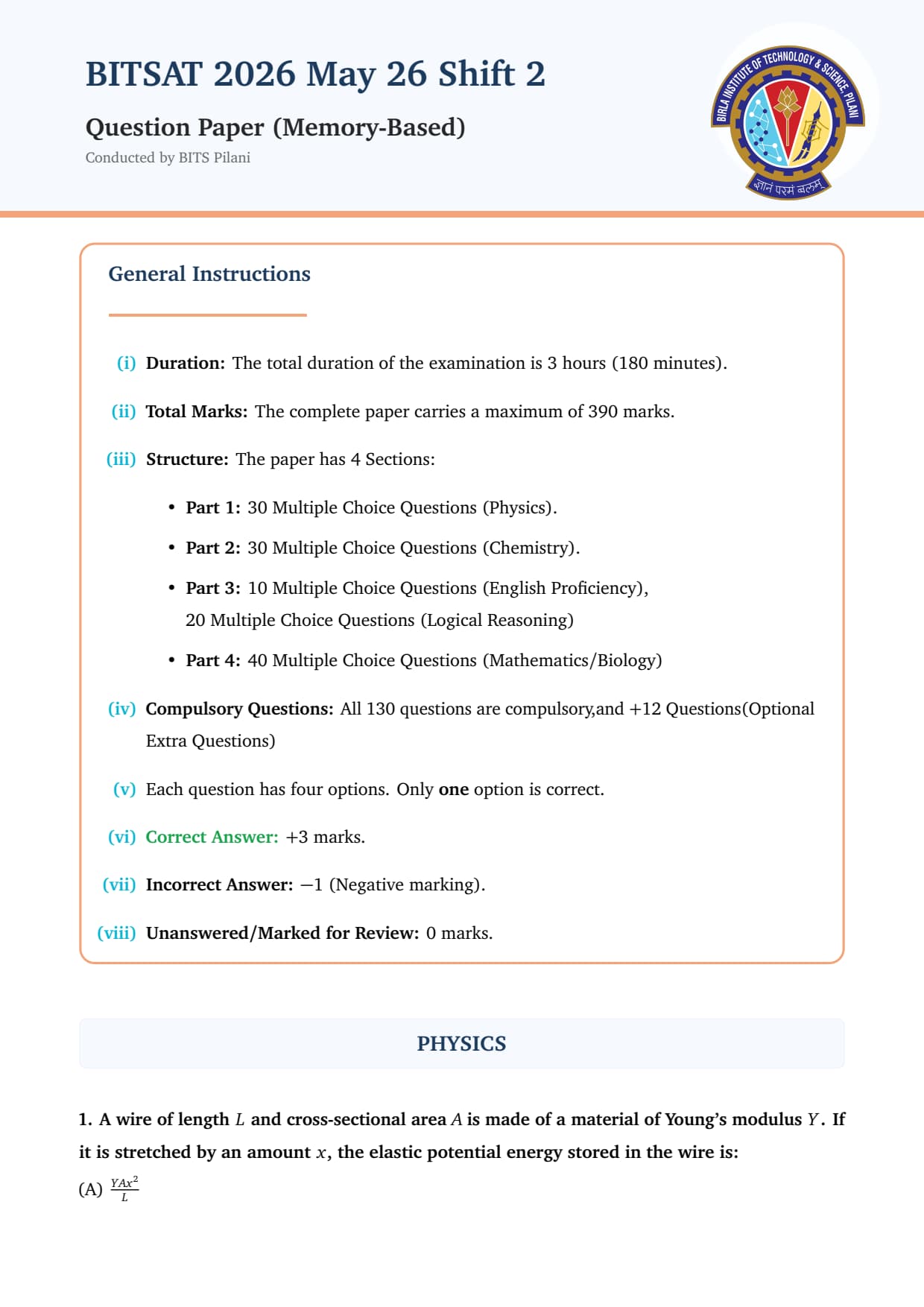


A wire of length \(L\) and cross-sectional area \(A\) is made of a material of Young's modulus \(Y\). If it is stretched by an amount \(x\), the elastic potential energy stored in the wire is:
A particle moves in a circle of radius \(R\) such that its linear speed varies with time \(t\) as \(v = kt\), where \(k\) is a positive constant. The angle \(\theta\) between the net acceleration vector and the velocity vector at time \(t\) is given by:
Two wires \(X\) and \(Y\) of the same material have lengths in the ratio \(1:2\) and diameters in the ratio \(2:1\). If they are subjected to the same stretching force, the ratio of the elongation produced in wire \(X\) to that in wire \(Y\) (\(\Delta L_X : \Delta L_Y\)) is:
The elastic potential energy stored per unit volume (energy density) in a stretched string under a longitudinal tension stress \(\sigma\) and material Young's modulus \(Y\) is expressed as:
An octahedral coordination complex with the electronic configuration \(t_{2g}^4 e_g^0\) is expected to exhibit which of the following magnetic properties and d-d transition characteristics?
During the structural analysis of an unknown aldohexose, a chemist treats a sample with periodic acid (\(HIO_4\)). If the carbohydrate is completely cleaved to yield five molecules of formic acid (\(HCOOH\)) and one molecule of formaldehyde (\(HCHO\)), this diagnostic breakdown directly proves the presence of:
In an analytical laboratory, a \(20.0 mL\) sample of an aqueous solution containing oxalic acid (\(H_2C_2O_4\)) requires exactly \(16.0 mL\) of a \(0.05 M\) potassium permanganate (\(KMnO_4\)) solution for complete oxidation in a hot, acidic medium (\(H_2SO_4\)). Calculate the molarity of the oxalic acid solution.
A current of \(2.0 A\) is passed for 5 hours through an electrolytic cell containing an aqueous solution of a metal salt, depositing \(12.0 g\) of the metal at the cathode. If the atomic mass of the metal is \(193 g mol^{-1}\), find the oxidation state of the metal ion in the solution. (Take Faraday's constant \(F = 96500 C mol^{-1}\)).
In how many ways can the letters of the word COCHIN be arranged such that the two 'C's are never separated by any other letter?
Evaluate the definite integral: \(\int_{0}^{2026} \frac{x^5}{x^5 + (2026 - x)^5} \, dx\)
If the vectors \(\vec{a} = 2\hat{i} - \hat{j} + \hat{k}\), \(\vec{b} = \hat{i} + 2\hat{j} - 3\hat{k}\), and \(\vec{c} = 3\hat{i} + \lambda\hat{j} + 5\hat{k}\) represent the concurrent coterminous edges of a parallelopiped whose volume is \(0\) (i.e., the vectors are coplanar), find the value of the scalar parameter \(\lambda\).
A pair of fair dice is thrown simultaneously. What is the probability that the sum of the numbers appearing on the top faces is at least 10?
BITSAT 2026 Chapter-Wise Weightage
Physics
| Chapter | Expected Weightage (%) |
|---|---|
| Laws of Motion | 8–10% |
| Current Electricity | 7–9% |
| Ray Optics & Wave Optics | 6–8% |
| Thermodynamics | 6–7% |
| Electrostatics | 5–7% |
Chemistry
| Chapter | Expected Weightage (%) |
|---|---|
| Chemical Bonding | 8–10% |
| Organic Chemistry (Basics + Reactions) | 10–12% |
| Coordination Compounds | 6–8% |
| Electrochemistry | 5–7% |
| p-Block Elements | 6–8% |
Mathematics
| Chapter | Expected Weightage (%) |
|---|---|
| Calculus (Limits, Integration, Differentiation) | 12–15% |
| Vectors & 3D Geometry | 8–10% |
| Complex Numbers & Quadratic Equations | 6–8% |
| Probability | 6–8% |
| Coordinate Geometry | 7–9% |



Comments